|
||||
| London, 25 September: A new paper published in the prestigious journal Climate Dynamics find that the effect of carbon dioxide emissions on global temperatures is likely to be even smaller than previously thought.
Earlier this year, in a widely discussed report for the Global Warming Policy Foundation, climate researcher Nic Lewis and science writer Marcel Crok put forward a new estimate of the Earth’s climate sensitivity based on observational data, finding that it was much less alarming than suggested by computer simulations of the Earth’s climate. Now, Lewis and well known American climate science professor Judith Curry have updated the Lewis and Crok report estimates using the latest empirical data, a more sophisticated methodology and an approach to accounting for uncertainties that has been described by one independent reviewer as “state of the art”. Their findings fully support the modest estimates of climate sensitivity and future warming given in the Lewis and Crok report, and compared with that report make it look even less likely that the substantially higher estimates based on computer simulations are correct. “Our results, which use data from this year’s IPCC fifth assessment report, are in line with those of several recent studies based on observed centennial warming and strongly suggest complex global climate models used for warming projections are oversensitive to carbon dioxide concentrations,” said Nic Lewis. 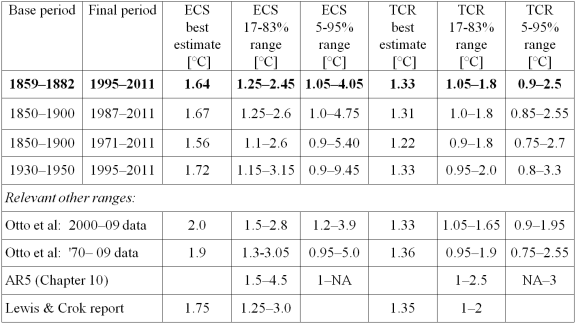 Best sensitivity estimates are medians (50% probability points). Ranges are to the nearest 0.05°C
Nicholas Lewis & Judith A. Curry (2014) The implications for climate sensitivity of AR5 forcing and heat uptake estimates, Climate Dynamics 25 September 2014 Abstract 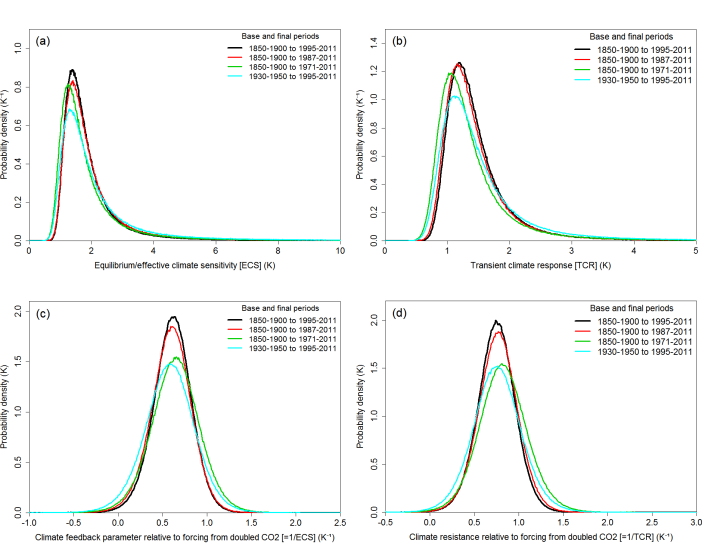 Full paper of the accepted manuscript is available, along with data and code here |
- Comment
-
Subscribe
Subscribed
Already have a WordPress.com account? Log in now.
 "Mothers Against Wind Turbines™" Phoenix Rising...