BUSHFIRE RED ALERT: Wind Power Really Is Setting the World on FIRE

As the Australian countryside turns to the golden hues of summer, the attentions of its farming and rural communities also turn: hundreds of eager eyes become fixed on the horizon for tell-tale signs of the smoke that heralds the bushfires that cast fear amongst those that live and work in the bush.
Rules are set to avoid bushfires on high fire danger days – when a Total Fire Ban is called:
You cannot light, maintain or use a fire in the open, or to carry out any activity in the open that causes, or is likely to cause, a fire. No general purpose hot works such as using tractors, slashers and/or welding, grinding or gas cutting can be done in the open either, and this includes incinerators and barbecues which burn solid fuel, eg. wood or charcoal.
Farmers engaged in crop harvesting operations think twice about operating harvesters when the northerly winds pick up and send temperatures into the 40s – the safety conscious leave their headers parked in the shed or the corner of the paddock and spend the day in front of the A/C enjoying the cricket on TV – ready to respond in a heartbeat to the call if a fire does break out. Better to miss a day’s reaping than set the country ablaze.

All sensible stuff.
But such is the seriousness with which country people take the ever-present threat of a bushfire, that can turn a swathe of country black; destroy homes, sheds, equipment, livestock, fences, generations of hard work; and, most savage of all – lives.

The approach taken to the threat of the savagery of an Australian bushfire is about the common sense management of RISK – and, wherever possible, taking steps to minimise or prevent that risk altogether.
But one massive – and utterly unjustified – RISK is the one created by the roll-out of hundreds of giant fans across WA, SA, NSW, Tasmania and Victoria – all in areas highly prone to bushfires.
Turbines represent the perfect bushfire incendiary: around the world, hundreds have blown up in balls of flame – in the process – each one raining molten metal and hundreds of litres of flaming hydraulic oil and burning plastic earthwards. Here’s a few pics showing these plucky ‘green’ fire-starters in action:


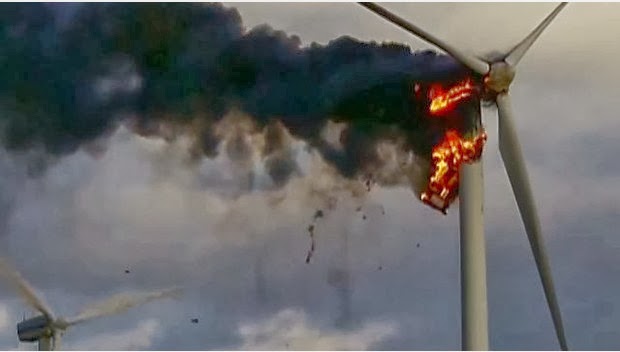


Wind turbine fires are ten times more common than the wind industry and its parasites claim (see our post here and check out this website:http://turbinesonfire.org).
Here’s a report on, yet more, turbines bursting into fireballs.
One Suzlon turbine destroyed and two badly damaged
Wind Power Monthly
Mike McGovern
8 December 2014

NICARAGUA: A Suzlon 2.1MW turbine nacelle caught fire and later crashed to the ground on Sunday in an incident involving three damaged turbines at the 63MW Amayo complex in Nicaragua, the country’s first wind project.
“There were no injuries and the site has been secured,” Suzlon told Windpower Monthly in a written statement, confirming the affected turbines to be S88-2.1MW machines.
Suzlon declined to comment on the possible cause, pending further investigation. Nobody at the US-based owner company, AEI Energy, was available for comment.
Local press reports, citing ground staff and fire fighters, said all three machines at the 23MW Amayo II plant — in service since 2010 — suffered failure in their emergency braking systems, leaving them helpless against high gusts of wind. No other turbines were affected, claimed Suzlon.
The turbines caught ablaze at 5.15am, just under an hour after a blackout hit the Rivas municipality, where the wind farm is located.
All three machines reportedly spun uncontrollably. Turbine 28 finally fell and all three blades of turbine 25 were flung off. A blade on turbine 29 was left broken.
Wind Power Monthly
If the story has an upside, it’s the successful bid for “freedom” made by the blades during yet another “component liberation” event (see our posts here and here and here and here and here).
And glad to see our favourite Indian fan maker, Suzlon making the news! But they weren’t overly keen to let much slip – its spin-masters quickly switching to “radio silence” when quizzed about the cause. And – in typical wind weasel fashion – the wind power outfit concerned went into complete media lock-down. No surprises there.
Suzlon – aka Suzlon REPower, aka Senvion – have planted hundreds of its S88s all over the Australian countryside: near-bankrupt wind power outfit, Infigen operate a stack of them in NSW; Trustpower planted 47 at Snowtown, in South Australia’s Mid-North; and AGL speared a hundred or so into SA’s Mid-North, around Jamestown and Hallett.
Senvion are the crowd behind the ridiculous CERES project – which aims to spear 197 of its whirling, pryro-technic devices into SA’s agricultural Heartland, the Yorke Peninsula. Thankfully for farmers and fire-fighters, the chances of that debacle eventuating are slimmer than a German supermodel.
There have been at least 4 bushfires started by wind turbines in Australia, so far:
- Ten Mile Lagoon in Western Australia in the mid-1990s;
- Lake Bonney, Millicent (SA) in January 2006 (see the photo below);
- Cathedral Rocks Wind Farm, Port Lincoln (SA) in February 2009 (see The Advertiser article below); and
- Starfish Hill (SA) in November 2010 (see this link for more detail).

When it comes to talking about the exceedingly “hot” topic of bushfires started by turbines, Australian wind power outfits exhibit the same well-drilled, reticence shown by American outfit, AEI Energy in the article above, about its flaming little Suzlon beauties.
As a result, the media rarely report on the bushfires that are started by turbines. On the rare occasions that the media do – as in this Advertiser article – wind power outfits never comment, keep their heads well below the PR parapet and hope that the flames die down quickly.
Cathedral Rocks Wind Farm turbine fire
The Advertiser
2 February 2009
A $6 MILLION wind turbine has caught fire near Port Lincoln, starting blazes on the ground as embers fall.
The fire, at the Cathedral Rocks Wind Farm about 30km southwest of the town, was first noticed by a boat about 1am.
The turbine is alight halfway up its 60m structure, making it difficult for the 14 Country Fire Service firefighters trying to deal with it to extinguish the blaze.
They are also busy controlling the spotfires, but consider the situation to be safe.
The cause of the blaze is as yet unknown.
The Advertiser

Not only do wind turbines act as the perfect bushfire-starters, their presence precludes the best and safest method of fire-fighting from controlling them: aerial water bombers won’t fly within cooee of these things – experienced pilots have declared that they won’t fly within 3km of a wind turbine, even without the country around them on fire. For a rundown on pilots’ attitudes to flying anywhere near wind farms – see our posts here and here and here.

Aircraft and wind turbines – standing 160m tall, with a whirling wing-span of over 100m – don’t mix at the best of times (see our post here). Add billowing smoke, 50m flames and scorching heat and no-one could blame fire-fighting pilots for giving wind farms a very wide berth when the country around them is ablaze.
Fitting it is then, that the Senate Select Committee has the clearly obvious fire risk created by giant fans, and the ability to fight those fires, squarely in its sights – its terms of reference include scrutiny of: “the effect that wind towers have on fauna and aerial operations around turbines, including firefighting and crop management” (see our post here).
For those in the country keen to avoid the very real threat of incineration that comes hand-in-glove with having wind turbines speared all over it – note that the opportunity to make submissions to the Committee ends on 27 February 2015. See the link here.
It’s high time our political betters brought this insanity under control.

 "Mothers Against Wind Turbines™" Phoenix Rising...