When a Community Sticks Together, They Can Win the Wind-War!

STAY STRONG, WIND WARRIORS!

WE ARE RIGHT WITH YOU ALL THE WAY!!!

WE NEVER GIVE UP OR SURRENDER!!!

‘A group which raised £90,000 to successfully fight two appeals against wind farms in the Vale of Belvoir is gearing up for another battle.

Belvoir Locals Oppose Turbines (BLOT) and Melton Borough Council – which also spent £100,000 at appeal – successfully fought against plans for an eight-turbine wind farm at Normanton, near Bottesford, in 2010.

An appeal by another company for a 10-turbine wind farm less than a mile away two years earlier was also rejected.

The inspector at that appeal said: “This part of the vale is unusually rich in the number of historic assets of the highest grades within it.

“Harm to the historic qualities of the landscape would result of such significant and unacceptable magnitude as to outweigh the electricity generation benefits of this particular scheme in its entirety.”

Speakers against the application at the second public inquiry included Rutland and Melton MP Sir Alan Duncan and Frances, Dowager Duchess of Rutland, the widow of the 10th Duke of Rutland.

Planning inspector Christopher Frost said: “I consider that effects on landscape, heritage and residential amenity are of sufficient moment to justify rejecting this scheme, despite its capacity to contribute towards renewable energy production.”

Now, protesters are fighting plans for six 361ft turbines in the same area, near Normanton.

BLOT campaigner Pandora Mawer said: “We are forced into the ludicrous situation of fighting another application for industrial wind turbines here in the Vale of Belvoir.

“The latest wind farm application is on exactly the same site as the wind farm previously dismissed at appeal in 2008 and less a third of a mile from another wind farm, also dismissed at appeal in 2010.”

She added: “BLOT was professionally represented by a QC and barrister, landscape experts, noise experts and a planning expert, all paid for from the generosity of local donations.

“Not to mention the hundreds of hours of unpaid work undertaken by numerous volunteers and the thousands of pounds spent by two local councils defending their original decisions to refuse.”

She added: ” The previous appeal decisions were dismissed mainly due to the severe impact industrial-sized wind turbines would have on the rich heritage assets and the unacceptable harm imposed on the historic landscape of the beautiful Vale of Belvoir.

“BLOT believe the Sewstern Lane application should be refused on the same grounds. Heritage assets will still be severely impacted.”

Jake Surman, Director at Whirlwind Renewables said:

“Wind energy projects are essential if we are to meet international and national targets to reduce emissions of carbon dioxide, the main greenhouse gas contributing to climate change. Onshore wind is the cheapest low carbon generation available and the Sewstern Lane Wind Farm would produce enough electricity to meet the needs of up to 9,658 homes each year, which is equivalent to 6.4% of all households in South Kesteven.’

“We have carried out public consultation on our proposals with the local community and if the scheme is consented, we are committed to establishing a community benefit fund which would provide a guaranteed income of at least £90,000 per annum over 25 years, for local residents to spend on community projects and initiatives.”

Climate Change Scare, is nothing but a tool, for Wealth Redistribution….

UN Negotiating Text For Climate Agreement Opens Up Gravy Train

How the UN is 'breaking bad' with taxpayer money.How the UN is ‘breaking bad’ with U.S. taxpayer money.In December the United Nations will convene in Paris, for the purpose of hammering out an international agreement on climate change. Reaching an agreement has become a“legacy issue” for President Obama, and his administration is devoting enormous resources towards the successful completion of this task.

In March the UN Framework Convention on Climate Change distributed draft language to serve as options for the agreement that may be decided in December. In a previous IER post I showed how the two climate change goals adopted in the UN text could not be justified, using the UN’s own scientific reports, and how the draft language opened the doors to massive international bureaucracies.

In this post I’ll focus specifically on the enormous wealth transfers from rich to poor countries that are being proposed in the draft—as high as annual transfers in excess of $100 billion from the United States alone, according to some of the language.

To be sure, at this stage these ludicrous suggestions are merely a “wish list,” but average Americans should realize just how much of their money will be on the buffet line when the UN delegates meet in December. In November President Obama already pledged $3 billion for such efforts, and the new UN proposal shows how much more the most zealous advocates have in mind.

The UN’s $100 Billion+ Bonanza

Anyone with the stamina to click on the link and skim through the UN’s draft language will see that the 90-page document is very redundant. However, the following excerpt gives a good sampling of a theme reiterated throughout:

  1. [Scale of resources provided by developed country Parties shall be based on a percentage of their GNP of at least (X per cent) taking into consideration the following:
  2. The provision of finance to be based on a floor of USD 100 billion per year, and shall take into account the different assessment of climate-related finance needs prepared by the secretariat and reports by other international organizations;
  3. Based on an ex ante process to commit quantified support relative to the required effort and in line with developing countries’ needs… [UNFCCC Negotiating Text, p. 43]

Later on, in section 96, the document states, “a. Developed country Parties to provide 1 per cent of gross domestic product per year from 2020 and additional funds during the pre-2020 period to the GCF [Green Climate Fund]…” (bold added).

Thus we see that this negotiating text contains more than a simple pledge for various countries to cap their emissions—it also includes enormous transfers of money from rich to developing countries. If the particular suggestion quoted above from section 96 were to be implemented, it would entail some $175 billion annually in transfers from Americans (because U.S. GDP is currently above $17.5 trillion). Note that this is in addition to conventional foreign aid programs—the UN document makes that clear, elsewhere. The sole (ostensible) purpose of these dedicated funds is to help poorer countries deal with climate change. The recipient countries will no doubt be quite creative in justifying all sorts of infrastructure and other spending projects necessary to combat climate change.

Now, a reasonable reader might think, “Well, supposing the ‘pause’ in global warming continues, they’d probably scale back the funds needed for adaptation, right?” But such common sense would be mistaken. On page 22 of the document we learn that “since adaptation efforts will need to be undertaken far in advance of the temperature rise,” therefore “planning for adaptation and undertaking adaptation should be based on an evaluation of temperature scenarios that are expected to result from particular levels of mitigation action…

In other words, the authors of this proposed treaty language want the transfer spigot turned on with no accountability. So long as they can point to future damages that occur inside a computer simulation, the United States and other wealthy countries will be expected to cough up billions of dollars to fight the computer-projected threat of future climate change damage.

Already, the Green Climate Fund is beefing up staff, with openings ranging from “gender social specialist” to“marketing consultant” whose duties include “helping to shape the brand of the fund.” It is quite clear from the bureaucratic progress of the Green Climate Fund that they mean business (of some kind) and are counting on the money to fund their multiple activities.

Conclusion

The UN has released the Negotiating Text of the possible treaty that may come out of talks in Paris in December. Americans should familiarize themselves with the main items contained in this document. In a previous IER post I showed that the UN document adopts climate change goals that the UN’s own reports can’t justify, and furthermore would create a huge new international bureaucracy.

In the present post, I quoted from the document to show the desire to fund these unaccountable extra-national organizations with an enormous flow of money taken from rich countries. Although the demands are so ludicrous that they should be viewed as a “wish list,” it is nonetheless instructive—and alarming—to see just how expensive they could be. According to one idea contained in the text that the UN has released, the U.S. would be expected to contribute more than $175 billion annually into the giant pot of money. President Obama in November already pledged $3 billion to such an effort. How far do Americans want to go along?

Source

Human-hating Eco-fascists Want to Send Us Back to the Dark Ages!

The Fossil Fuel-Free Fantasy: Robert Bryce Hammers Harvard’s Human-Hating Ecofascist Hit Squad

robert bryce 2

****

Robert Bryce picked the wind power fraud for what it is from the very beginning.

In his 2010 book “Power Hungry: The Myths of “Green” Energy and the Real Fuels of the Future” (Public Affairs), Bryce skewered every one of the myths relied upon by the wind industry to peddle its wares; and went on to predict the massive benefits of the US shale gas revolution – in terms of both cheap energy – operating as a boost to a flagging economy – and as a method of reducing CO2 emissions in the electricity sector.

We’ve covered some of his recent writings on US energy policy and the wind power fraud (see our posts here and here and here).

Bryce recently published another cracking book “Smaller Faster Lighter Denser Cheaper: How Innovation Keeps Proving the Catastrophists Wrong” (Public Affairs) that loads up on the nonsense that is US energy policy today: we covered a review of Bryce’s latest by the New York Timesin this post.

Robert also gave a brilliant lecture here last year, which is worth revisiting, as the lunatics from Getup! & Co work themselves into an astroturfing eco-frenzy selling (at a handsome mark-up – worth over $1 million, so far) the myth that the world can happily run on millions of giant fans and a lot of ‘luck’ (such as the wind Gods agreeing to blow at a constant 11m/s 24 x 365, say):

Robert Bryce: Want to live in Stone-Age Poverty? Then tie your future to Wind Power

In the post above, Robert lays out the key arguments as to why cheap, reliable sparks are critical to the growth, wealth and development of Nations.

While access to power is something we – in the developed world – smugly take for granted, for the billion or so at the bottom of the development heap it is the ONLY path out of poverty. And for those struggling to escape deprivation and darkness, the answer is most certainly not insanely expensive and unreliable wind power. To the contrary, reliable and affordable power is a guarantee of both wealth and freedom.

Energy policy has been over-run by “green” ideologues who are determined to ensure that the poorest remain that way by wedding the world to the fiction that wind power provides a meaningful answer to growing energy demand, while “solving” the climate change “problem”.

Robert picks up the theme in this piece from the National Review in response to the fantasy that the world could operate, as it does, on the strength of a friendly (occasional) breeze – and goes on to hammer the misanthropy of an intellectually dishonest elite, who would – on the strength of little more than an ideological whim – deprive the poorest on the planet that, which they happily take for granted.

The Environmentalists’ Civil War
National Review
Robert Bryce
17 April 2015

It’s a manifesto smackdown, a fight among the members of the green Left for the intellectual and moral high ground. It’s also a fight that reflects the growing schism within American environmentalism. On one side are the pro-energy, pro-density humanists. They call themselves ecomodernists and are led by the Breakthrough Institute, a centrist, Oakland-based environmental group. On Wednesday, it released what it describes as an “ecomodernist manifesto,” a document that, at root, states the obvious: Economic development is essential for environmental protection.

On the opposite side are the anti-energy, pro-sprawl absolutists. Their views are evident in the ongoing protests this week in Harvard Yard. A group called Divest Harvard is pushing the Harvard Corporation, the school’s governing body, to divest the school’s $36 billion endowment of any investments in companies that provide coal, oil, and natural gas to consumers. This group’s manifesto, issued in February, demonizes energy use.

The absolutists like to use the squishy term “climate justice.” They believe that the threat of climate change trumps all other concerns, including the welfare of people living in energy poverty. For the absolutists, the only path to salvation is through the exclusive use of renewable energy. And in that regard, Divest Harvard falls smack in the middle of mainstream liberal-left environmentalism in America.

The anti-energy, pro-sprawl absolutists — a designation that, in my view, fits the Sierra Club, 350.org, Greenpeace, and Natural Resources Defense Council — are anti-nuclear, anti-hydrocarbon, and anti-hydraulic fracturing. They routinely peddle slogans such as “fossil-free” and continually claim that we can rely solely on increased efficiency and renewable energy.

They push these claims despite overwhelming evidence from Germany and Japan that shuttering nuclear power plants and relying too much on renewables results in higher electricity prices and decreased reliability. (For more on that, see this April 13 Reuters piece about the potential shuttering of dozens of conventional power plants in Germany.)

The absolutists are anti-energy. In a Divest Harvard video posted on YouTube, the group stated that its goal is to “stigmatize the fossil fuel industry.” The absolutists try to do that all the time. Just last week, the Sierra Club announced the expansion of its “beyond coal” campaign.

The group’s backers — who include former New York mayor Michael Bloomberg — have pledged some $60 million in funding for the effort, which aims to shutter half of U.S. coal plants by 2017.

Celebrating the fundraising effort, the group’s executive director, Michael Brune, declared, “Dirty, outdated, deadly coal is a thing of the past.” Never mind that coal remains the world’s fastest-growing source of energy and that it has been the fastest-growing source of energy since 1973. Never mind that countries from Germany to Bangladesh are building hundreds of gigawatts of coal-fired power plants. Never mind that the United States has more coal reserves than any other country does. Coal must be stigmatized.

Based on the logic that the Sierra Club and Divest Harvard put forward, companies such as Coal India Limited must be stigmatized. Coal India is deemed untouchable because it provides coal to generation stations in a poverty-stricken country that gets about 70 percent of its power from coal. Coal India provides fuel to 82 of India’s 86 coal-fired generators. Therefore, it must be stigmatized. Never mind that more than 300 million Indians — a group approximately equal to the entire population of the United States — lack access to electricity.

To be clear, the absolutists at Divest Harvard don’t mention Coal India in their manifesto. But the open letter published in mid-February and signed by about three dozen Harvard graduates — including 350.org founder Bill McKibben, Robert F. Kennedy Jr., author Susan Faludi, former U.S. senator Tim Wirth, and actress Natalie Portman — condemns investment in what it calls the “dirtiest energy companies on the planet.”

The manifesto lays bare Divest Harvard’s anti-human outlook. They write: “Global warming is the greatest threat the planet faces . . . . This issue demands we all make changes to business as usual — especially those of us who have prospered from the systems driving climate change.”

Who might be included in “those of us who have prospered” from the use of coal, oil, and natural gas — fuels that, when burned, emit carbon dioxide and therefore contribute to climate change? My back-of-the-envelope calculation shows that it would include nearly every person in America, (approximately 319 million), as well as anyone who has ever made money by taking a car, bus, plane, or ship to work, baked a loaf of bread, or delivered a piano. In all, the number of who’ve prospered thanks to the availability of hydrocarbons probably totals 3 billion to 4 billion people.

Despite energy poverty that afflicts hundreds of millions of people in countries such as India, Pakistan, Bangladesh, and Indonesia (all of which, by the way, are in the process of adding huge amounts of new coal-fired generation capacity), the absolutists equate energy use with evil.

In their February manifesto, the absolutists claim that selling the Harvard’s investments in hydrocarbon producers will make the school “accountable for the future” and that the school should divest because “Harvard eventually divested from apartheid, from tobacco, and from the genocide in Darfur.”

By comparing energy producers (and therefore, energy consumers) with the people involved in racist repression and mass murder, the absolutists are, in effect, saying that consumers who use gasoline, diesel fuel, natural gas, or coal-fired electricity are as morally bankrupt as those who aided racial repression and mass murder.

This is nonsense on stilts. Even if the divestment push at Harvard were to succeed — and dozens of other institutions were to follow suit — it wouldn’t halt the consumption of any hydrocarbons. It won’t give us a “safe climate.” The investments that Harvard sells will simply be purchased by another entity.

To argue that divestment of companies that produce coal, oil, and natural gas will make a difference on climate change is akin to arguing that if investors sell their equity in a McDonalds or Burger King franchise, hungry people will quit buying cheeseburgers.

The divestment movement is predicated on the fantastical assumption that we humans can, as the organizers of 350.org have repeatedly claimed, live “fossil free.” And they continue to claim, wrongly, that the world can be run on nothing more than solar panels and wind turbines.

The absolutists claim that we only need to “do the math” to understand their position. Okay. Let’s do some math. And by doing so, we will show how the absolutists favor sprawl and therefore the destruction of the very environment they say they want to protect.

To make it easy on the Harvard grads, let’s focus solely on Massachusetts, which consumes about 56 terawatt-hours (1 terawatt-hour is equal to 1 trillion watt-hours) of electricity per year. To create that much electricity solely with wind energy would require, in rough terms, about 31 gigawatts of wind-energy capacity. (The annual productivity of wind energy, based on the BP Statistical Review 2014, is 1.8 terawatt-hours per gigawatt of capacity. That’s the average over nine years, from 2005 to 2013.)

The power density of wind energy — as I have repeatedly proven — is 1 watt per square meter. Therefore, the land area needed to produce that much renewable electricity would total about 31 billion square meters or 31,000 square kilometers, which is about 12,000 square miles. Put another way, just to meet electricity demand in Massachusetts with wind energy would require an area larger than the state itself, which, including water area, covers about 27,000 square kilometers, or 10,500 square miles.

And remember, these calculations ignore the essentiality of oil for transportation and home heating. The latter is important because about 30 percent of all Bay State residents rely on heating oil to stay warm in the winter. Staying warm can be a challenge in the Boston area, which got about 100 inches of snow this past winter.

The absolutist, pro-sprawl outlook touted by McKibben and his allies provides a stark contrast to the pro-human outlook the ecomodernists support. Perhaps the key line of their manifesto is in the concluding sentence, which says they want to “achieve universal human dignity on a biodiverse and thriving planet.”

Toward that end, the 18 signers of the manifesto — a group that includes Breakthrough Institute founders Ted Nordhaus and Michael Shellenberger, as well as Whole Earth Catalog founder Stewart Brand, and the University of Tasmania’s Barry Brook — support increased energy use. They note, rightly: “Climate change and other global ecological challenges are not the most important immediate concerns for the majority of the world’s people. Nor should they be. A new coal-fired power station in Bangladesh may bring air pollution and rising carbon dioxide emissions but will also save lives.” That’s it exactly.

While the absolutists want one of America’s most prestigious universities to sell some of its investments — with the only goal being to stigmatize the world’s biggest and single most important business — the ecomodernists are arguing not only that greater global energy consumption is inevitable, but that it’s good, that more energy use will allow more people in the developing world to live fuller, freer lives.

As part of that, they are adding, rightly, that nuclear energy must be a central element of climate policy if we are going to reduce the rate of growth in global carbon dioxide emissions. The ecomodernists oppose sprawl. Their manifesto talks of the need to intensify “many human activities — particularly farming, energy extraction, forestry, and settlement — so that they use less land and interfere less with the natural world.”

Increasing density, they continue, “is the key to decoupling human development from environmental impacts.” The absolutists don’t have any credible plans for producing the vast quantities of energy the world demands. They not only ignore energy poverty in the developing world, they also have worked to block the American government from providing any financing for coal-fired power plants in developing counties. (See my 2013 piece on that issue here.)

At the same time, they promote landscape and wildlife-destroying schemes such as wind energy that will result in unprecedented sprawl. That’s the very same energy sprawl that property owners all over the world are objecting to. (Among the property owners who don’t want wind turbines near their property, of course, is Robert F. Kennedy Jr. The Divest Harvard proponent vociferously objected to the Cape Wind project, the now-dead proposal to install more than a hundred 440-foot-high turbines in Nantucket Sound, near the Kennedy family’s vacation compound at Hyannisport.)

The manifesto smackdown exposes our need to rethink what it means to be an environmentalist. The ecomodernists have laid out a thoughtful position paper that dares the absolutists to go beyond sloganeering and stigmatizing. I will be pleasantly surprised if Divest Harvard, 350.org, Sierra Club, and their allies respond to that dare. But I’m not holding my breath.

Robert Bryce is a senior fellow at the Manhattan Institute. His most recent book is Smaller Faster Lighter Denser Cheaper: How Innovation Keeps Proving the Catastrophists Wrong.
National Review

A solid analysis from go to whoa, as we’ve come to expect from Robert. What he does better than most is to throw the spotlight on the malign aspects of an ideology that has all the hallmarks of an insidious, quasi-religious cult.

hipsterbike1

****

The concept that one can – by ticking a box, or signing up to an outfit like GetUp! etc – become “fossil-fuel-free”, is up there with belief in the tooth fairy or Father Christmas; which requires an intellect so soggy that it hasn’t got the ability to connect the creation and production of things – like the steel and aluminium in their hipster, urban commuting devices –  with the fuel and resources incorporated in them, or needed to make them.

It’s a point well made by Ian Plimer in his book, Not For Greens, available from News Weekly Books (see our post here).

The worship of wind power also runs into the same paradox, for the “faithful”.

Far from being an antidote to the fossil fuels they dread, and are at pains to publicly eschew, fossil fuel producers are delighted with the opportunity to make wild profits, on the back of a meaningless power source, that requires 100% of its capacity to be backed up 100% of the time with conventional generation sources, which, in practical effect, means coal, gas and diesel:

Why Coal Miners, Oil and Gas Producers Simply Love Wind Power

What people like Plimer and Bryce do so well is throw a little reality back at the fantasists, who are happy to live with every modern convenience, product and device made possible by oil, gas and coal. But, in the same breath, are quick to deny the lifestyle, they take for granted, to anyone, anywhere in the world with the simple human ambition to live just a little better than their parents did. “Green” hypocrisy is hardly a crime (more a symptom of intellectual infancy, really); but when its energy impoverished victims run into the millions, it gets mighty close; and becomes even harder to defend, on any level.

poverty india

In a Time of Universal Deceit, Telling the Truth, is a Revolutionary Act…. George Orwell

The numbers racket.

by Pointman

This is a debut article by Athelstan, a moniker long term readers of this blog may read through as they might recognise his fist. He goes by a few names but for me he’ll always be Sulla, one of my comrades in a campaign a number of years back – yeah, the Skeptocats!

You get fair warning now, it’ll probably offend a number of your sensitivities but that’s what a plurality of viewpoint is all about.

Pointman

—-<0>—

In a time of universal deceit, telling the truth is a revolutionary act” – George Orwell

It came to my attention recently, when I learnt of some quite astonishing statistics.

Just a few characters you understand but whence they denoted such a drastic alteration and which were mind-boggling. Discombobulated, I will ever remain, because there is no going back.

Absolute, there can be no rectification and it was all very deliberately done and in saying that, with a maleficent glee. Oh yes, they knew what they were doing, the problem is, like all insane schemes, the consequences will trigger a catastrophe.

You see, it cannot just be me, have you noticed how government’s love to clarion favourable statistics? Glory, when good news, nice events occur, like a heavy cavalry charge do the politicians clamour, battle and stampede to attach their names and political parties to propitious circumstance. Glad tidings, be they sporting victories or, in the UK – royal occasions and of course: good news statistics…. .

Conversely, when the figures do not suit [the politicians – TPTB] they are hidden, stowed or dripped out in piecemeal fashion. Furthermore, and by mixing incongruent or, shoving in unnecessary comparisons, graphs, alignment, using all sorts of creative accountancy and jiggery-pokery, the effects of pure statistics are blunted to dampen their immediate impact. Clever it all is, some would say it’s too bloody clever by half.

Clever or machination?

For the world is full of experts. Colleges, universities pump ’em out and God knows kids with totally useless degrees in psychology and social studies, joint degrees with sports-economics become instant experts pontificating on all manner of stuff which is way above their intellectual capacity to fully comprehend. Ah but no one ever really challenges these ‘experts’ because we live in a ‘virtual’ world which revolves only because of BS blurb. All of which is begging the question, before – what did we ever do without all the consultants and spin doctors? Well I’m pretty sure that the world kept turning.

We all live in a world and whether you like it or not, people, everybody is bombarded by a blizzard of useless information. A plethora of numbers, words and electronic noise, which is interpreted for us in the media, by politicians and by experts who in all truth don’t know Jack about the price, quality or length of a piece of string. Though, it is hard to divine sometimes just who if anybody is actually listening, for sure the UK youth either they are incapable [probably] or, too involved in other pursuits [weren’t we all] to blumin well care.

So, people half listen, are oblivious, careless and anyway, “they never tell us the truth”, well – indeed they won’t and don’t dare to and just don’t and we are led a merry dance to a tune no one recognizes but the music is incessant and the title is, “UNIVERSAL DECEIT”.

On a theme and in continuation.

Political language… is designed to make lies sound truthful and murder respectable, and to give an appearance of solidity to pure wind” – George Orwell.

Now, I cannot resist the urge to run you by some three rather egregious examples which are the very transubstantiation of man-made lies made manifest.

Readers of this ere blog may care to remind me of the great global warming swindleand here I shall not tarry for too long with it. Though, sufficed to say this great fraud is bleeding the western taxpayer and economies dry, it makes €$£billionaires for a few and causes misery for billions and guess what? Yessiree! it’s all based on a few very dodgy statistics and some fearful tampering of the temperature record, though it’s true, as scams go even the scum who ran Ponzi Enron and Bernie Madoff would be impressed.

Next, qualitative easing (QE) or put another way ‘printing money’ is another. Surely, as lies, damned lies and statistics go, QE is right up there and makes lots of money for those who can take advantage and for those who haven’t by diluting, actually debasing would be a better descriptor of the currency, it just makes you poorer, ask the chancellor of the Exchequer one called George Osborne……. silly me! Because, not even George understands it [no surprise there then].

Figures, deceits and liars. For global warming all of it, is based on dodgy stats, with QE except creating asset bubbles nobody really knows what it’s true effects are. With my final example – because the figures are explosive they are very much kept under wraps.

Time was, and here I am particularly referring to the UK and wherever you may live, I would deem that you may see a slight mirror but maybe not as far gone as Britain. Time was when you could more or less rely on your local bank manager, your headmaster, the town hall clerk, the policeman and even politicians, local was best because you used to meet them day in and day out.

These days, with Banking done in Bangalore, the police have retreated from the streets, town halls are glass fronted Lubyankas and with even less chance than the FSB-KGB of answering a FOI. Politicians answer, in descending order from at the top; supranational bodies – the UN, Brussels – the EU, political party, the executive, not even on the list are, “we the people”. Things, edicts, diktats are sent down from on high and our “we the people” job is to simply obey, there is no choice only the choice set before you and by all the Gods – will ye sup and eat it.

So, we come to the final set of numbers, ere the census was sent out in the early part of the decade and by six months later all of the collated data was made freely available to all those who were interested – which in times past was not very many.

Britain, was a nation of 48 million souls just after WWII and until the late Seventies Britain’s population had changed little since the baby boom of the Fifties and early Sixties, set at circa 55 million and which was a stable and pretty homogenous indigenous populace, those of differing skin tones numbered less than 1 million and all were fairly well assimilated into British language and culture, if not traditions, we all happily jostled and got along.

Throughout the next decade things began to change, in the Eighties, immigration was rising by about 50,000/yr. Coming apart it was and then in 1997 Blair, Straw, Brown and his social engineers began their work in earnest.

In 2014, last year the official figures show 583,000 came to our shores and this figure is undoubtedly an underestimate, for even the authorities believe 583,000 to be more like 783,000 ie, two hundred thousand shy of official ‘guestimates’.

Though the authorities keep schtumm, it is a commonly known piece of information, the much championed process, a new system called E-borders was supposed to be rolled out in 2011/12 but it was shelved because TPTB did not want us [the British public] knowing the true extent of the figures.

The Office for National Statistics (ONS), has not released the fully collated 2011 census and patently the figures now are in any direction you wend – bigger, further and faster. Anecdotal evidence, it cannot be belied and any naturalized Aussie or Kiwi who used to live here will attest to, the demographic change this country is undergoing, simply put – stupefies.

For according to the 2011 UK census figures, 8,750,000 Asians [read subcontinent] now call Britain home and add in to that, 3,750,000 who identified themselves as Black or mixed race. In order, 14% and 6% added together gives you one in five, if you throw in the EU contingent 2.5 million and if you stretch the stats – foreigners account for ± 1 in 4 of the UK population.

I think back to the awful days of the Balkans civil wars and think on an oft used, if only a short phrase which conjured up a dystopian blackness and horror evocative of the Nazis. Though in south-eastern Europe, it did seem, not only a world away but an inconceivable, an impossible occurence for it to arrive on these shores, in dear old Blighty.

A final thought, you may remember the term, ‘ethnic cleansing’.

Aussie Government Windpushers, Pushing Renewable Energy Target Tax. A Form of Extortion?

Out to Save their Wind Industry Mates, Macfarlane & Hunt Lock-in $46 billion LRET Retail Power Tax

hunt macfarlane

****

Wind industry front men, Ian “Macca” Macfarlane and, his youthful ward, young Gregory Hunt are out to defy all-comers: the Liberal’s core constituency (of conservative voters); their colleagues, Joe Hockey and Mathias Cormann; boss, Tony Abbott; and political, economic and environmental common sense – as they pump up a deal with Labor to salvage the Large-Scale Renewable Energy Target, and their mates at Infigen, Vestas & Co.

Over the last week or so, Macca’s last-ditch deal to get Labor to sign up to cut the LRET from 41,000 GWh to 33,000 GWh was hailed by economic dullards like The Australian’s Sid Maher as a “Breakthrough”, in a series of articles that included this piece of pure fantasy:

Mr Macfarlane has expressed concerns about the ability of the renewables industry to meet its RET targets after a collapse in ­investment in the sector. Failure to meet the target risks invoking a penalty clause that would double the cost of the scheme.

Anyone that follows these pages should spot the fiction within the fallacy; given that STT has been repeatedly pounding that kind of nonsense for some time now. And, like a dog with his favourite, well-gnawed bone, we won’t be letting go any time soon.

True, it is, that the wind industry will never meet the current target – and, as we’ve said before, it won’t meet the ‘new’ 33,000 GWh target, either. However, the claim that hitting the “penalty” will “double the cost of the scheme” is pure political twaddle; Macca knows it – and any journo who has bothered to do their homework – by reading the legislation, say, would have picked it in a heartbeat.

In short, Australia’s electricity retailers have closed ranks on wind power outfits by steadfastly refusing to enter Power Purchase Agreements, without which wind power outfits will never obtain the finance needed to build any new wind farms. The consequence being that retailers will be hit with the shortfall penalty (the ‘penalty clause’ referred to above), the full cost of which will be recovered from power consumers (a “stealth tax” that will add more than $20 billion to power bills). In addition, the cost of Renewable Energy Certificates will add a further $25 billion, taking the combined total of the REC Tax/Shortfall Charge added to retail power bills to a figure in the order of $46 billion.

At the risk of repeating ourselves (and we concede the point if challenged), in the balance of this post we’ll update our figures; and spell out just why this latest ‘deal’ is simply an effort to postpone the inevitable implosion of the most costly, and utterly pointless, Federal Government industry subsidy scheme ever devised. So, with that aside, on with the show.

The LRET is a policy debacle; it’s completely unsustainable, on every level: economic, social and political. It is not – as the likes of Macca and Hunt cynically pretend – and a gullible press naively reports – a warm and fuzzy, family and business friendly policy that won’t cost anyone a cent.

What journos like Sid Maher have either failed to appreciate – or are simply choosing to ignore – is the fact that the demise of the LRET has nothing to do with numerical targets, the death of the wind industry is a consequence of Australia’s electricity retailers’ commercially driven desire to destroy the LRET, and the wind industry along with it.

In the absence of the mandated subsidies (“the carrot”) directed to wind power outfits, and the mandated penalties (“the stick”) whacked on retailers under the LRET, there would simply be no market whatsoever for wind power (see our post here). Kill or cut the LRET, and the wind industry is completely finished – it’s mortally wounded now.

Commercial power retailers have not entered any Power Purchase Agreements (PPAs) to purchase wind power (or, rather, to obtain RECs) since November 2012. The wind industry’s demise was laid out long before the RET Review panel got to work in April 2014 and the talk about ‘dreaded uncertainty’ is just that: wind farm construction in Australia has come to a grinding halt because it makes no commercial sense to purchase power from an intermittent and wholly weather dependent generation source, that costs 3-4 times the cost of conventional power.

The shortfall charge, set by the legislation at $65 per MWh, is not a deductible business expense (the shortfall charge is treated as a “fine”), the effective pre-tax penalty is, therefore, $92.86 ($65/(1-30%), assuming a 30% marginal tax rate. In the past, we’ve used $94 as the likely trading figure for RECs (as the shortfall charge starts to bite); but, as young Gregory Hunt uses the figure of $93 – when he refers to it as “a massive penalty carbon tax” – we’re happy to knock off the buck and run the numbers again.

Retailers, like Grant King from Origin Energy, have made it known that they have no intention of entering PPAs with wind power outfits – and, instead, will simply pay the shortfall charge, collect the full cost of it from their customers (ie $93 per MWh – compared with the average wholesale price of $35 per MWh) and declare the cost of the fines on their retail power bills as a “Federal Tax on Electricity Consumers”.

The cost of the shortfall charge at $65 per MWh compares with the average wholesale power price of between $35-40 per MWh. Therefore, at a minimum, retailers will be paying $100-105 per MWh for power, once the penalty hits (the average wholesale price plus the shortfall charge).

The Australian’s top economics writer, Judith Sloan has observed that the effect of the $65 per MWh shortfall charge “will be to triple the value of RECs and drive up electricity prices to a dramatic extent”; referring to the REC price in February this year – around $34 at that time – and the effect of the tax treatment of RECs versus the shortfall charge. As Judith notes, retailers will be looking to recover $93 in respect of every shortfall penalty charge they get hit with: ie, the $65 per MWh cost of the shortfall charge and the loss of the tax benefit that would otherwise be received were they to purchase RECs.

STT has likened the scenario to a “political time bomb”, where the government of the day will be belted at the ballot box for the utterly unjustified escalation in power prices, that will inevitably result from the LRET debacle.

And that brings us to Macca and Hunt’s latest efforts to salvage the wreckage of the LRET, their mates at near-bankrupt wind power outfit, Infigen (aka Babcock and Brown) and struggling Danish fan maker, Vestas, as well as their political skins.

Macca and Hunt are driving – with a lot of ‘help’ from the wind industry plants and stooges in their offices – a pitch whereby the ultimate annual LRET target gets pulled from 41,000 GWh to 33,000 GWh per year.

The LRET target is set by s40 of the Renewable Energy (Electricity) Act 2000 (here); and it’s the annual target set under that section that Macca and Hunt are hoping to pull in a deal with Labor, that, as we go to print, also appears to need help from 6 of the 8 Senate cross-benchers.

At the present time, the total annual contribution to the LRET from eligible renewable energy generation sources is 16,000 GWh; and, because retailers have not entered PPAs with wind power outfits for nearly 2½ years – and have no apparent intention of doing so from hereon – that’s where the figure will remain.

With no new wind power capacity being added – and none likely to be added – that leaves the shortfall at 17,000 GWh, or 17,000,000 MWh (1GWh = 1,000MWh); based on Macca and Hunt’s 33,000 GWh ultimate annual target.

So, as we’ve done before, we’ll put some numbers under what Macca and Hunt’s latest, last-ditch Infigen and Vestas salvage mission means – should they succeed – for Australian power punters and their retail power bills – assuming, of course, that they aren’t already among the tens of thousands that have been chopped from the grid, because they can’t pay their power bills now (see our posts here and here); or among those whose businesses are getting slammed against the wall, due to rocketing power prices (see our posts here and here).

In the table below, the “Shortfall in MWh (millions)” is based on the current, total contribution of 16,000,000 MWh, as against the 33,000 GWh target being pitched by Macca and Hunt, set out as the “Target in MWh (millions)”.

The target currently set for 2019 is 36.4 million MWhs, but we’ll assume that gets pulled to 33 million too, under Macca and Hunt’s ‘ingenious’ Infigen and Vestas rescue plan.

A REC is issued for every MWh of eligible renewable electricity dispatched to the grid; and a shortfall penalty applies to a retailer for every MWh that they fall short of the target – the target is meant to be met by retailers purchasing and surrendering RECs. As set out below, the shortfall charge kicks in this calendar year.

As set out above, given the impact of the shortfall charge, and the tax treatment of RECs versus the shortfall charge, the full cost of the shortfall charge to retailers is also $93. Using that figure applied to the 33,000 GWh ‘deal’, we’ll start with the cost of the shortfall penalty.

Year Target in MWh (millions) Shortfall in MWh (millions) Penalty on Shortfall @ $65 per MWh Minimum Retailers recover @ $93
2015 18 2 $130,000,000 $186,000,000
2016 22.6 6.6 $429,000,000 $613,800,000
2017 27.2 11.2 $728,000,000 $1,041,600,000
2018 31.8 15.8 $1,027,000,000 $1,469,400,000
2019 33 17 $1,105,000,000 $1,581,000,000
2020 33 17 $1,105,000,000 $1,581,000,000
2021 33 17 $1,105,000,000 $1,581,000,000
2022 33 17 $1,105,000,000 $1,581,000,000
2023 33 17 $1,105,000,000 $1,581,000,000
2024 33 17 $1,105,000,000 $1,581,000,000
2025 33 17 $1,105,000,000 $1,581,000,000
2026 33 17 $1,105,000,000 $1,581,000,000
2027 33 17 $1,105,000,000 $1,581,000,000
2028 33 17 $1,105,000,000 $1,581,000,000
2029 33 17 $1,105,000,000 $1,581,000,000
2030 33 17 $1,105,000,000 $1,581,000,000
Total 495.6 239.6 $15,574,000,000 $22,282,800,000

Between now and 2031, Macca and Hunt’s 33,000 GWh total target couldbe satisfied by the issue and surrender of 495,600,000 RECs. However, with only 16 million RECs available annually there will be a total shortfall of 239,600,000: only 256 million RECs will be available to satisfy the LRET’s remaining 495,600,000 MWh target, set under the ‘brilliant’ 33,000 GWh Infigen and Vestas rescue ‘plan’.

Under the latest ‘deal’, assuming that RECs hit $93, as the penalty begins to apply later this year, the total cost added to power consumers’ bills will top $46 billion (495,600,000 x $93), as set out in the table below.

Power consumers will end up paying for the shortfall penalty collected by the Federal government, and for the cost of the RECs issued to wind power outfits – in relation to collecting the cost of the REC Subsidy from power consumers, Origin Energy’s Grant King correctly puts it:

[T]he subsidy is the REC, and the REC certificate is acquitted at the retail level and is included in the retail price of electricity”.

It’s power consumers that get lumped with the “retail price of electricity” and, therefore, the cost of the REC Subsidy paid to wind power outfits.

To give some idea of how ludicrously generous the REC Subsidy is, consider a single 3 MW turbine. If it operated 24 hours a day, 365 days a year – its owner would receive 26,280 RECs (24 x 365 x 3). Assuming, generously, a capacity factor of 35% (the cowboys from wind power outfits often wildly claim more than that) that single turbine will receive 9,198 RECs annually. At $93 per REC, that single turbine will, in 12 months, rake in $855,414 in REC Subsidy.

But wait, there’s more: that subsidy doesn’t last for a single year. Oh no. A turbine operating now will continue to receive the REC subsidy for 16 years, until 2031 – such that a single 3 MW turbine spinning today can pocket a total of $13,686,624 over the remaining life of the LRET. Not a bad little rort – considering the machine and its installation costs less than $3 million; and that being able to spear it into some dimwit’s back paddock under a landholder agreement costs a piddling $10-15,000 per year. State-sponsored theft never looked easier or more lucrative!

The REC Tax/Subsidy, including that associated with domestic solar under the original RET scheme, has already added $9 billion to Australian power bills, so far.

At the end of the day, retailers will have to recover the TOTAL cost of BOTH RECs AND the shortfall charge from Australian power consumers, via retail power bills.

And that’s the figure we’ve totted up in the right hand column in the table below – which combines the annual cost to retailers of 16 million RECs at $93 (ie $1,488,000,000) and the shortfall penalty, as it applies each year from now until 2031, at the same ultimate cost to power consumers of $93.

Year Target in MWh (millions) Shortfall in MWh (millions) Shortfall Charge Recovered by Retailers @ $93 Total Recovered by Retailers as RECs & Shortfall Charge @ $93
2015 18 2 $186,000,000 $1,674,000,000
2016 22.6 6.6 $613,800,000 $2,101,800,000
2017 27.2 11.2 $1,041,600,000 $2,529,600,000
2018 31.8 15.8 $1,469,400,000 $2,957,400,000
2019 33 17 $1,581,000,000 $3,069,000,000
2020 33 17 $1,581,000,000 $3,069,000,000
2021 33 17 $1,581,000,000 $3,069,000,000
2022 33 17 $1,581,000,000 $3,069,000,000
2023 33 17 $1,581,000,000 $3,069,000,000
2024 33 17 $1,581,000,000 $3,069,000,000
2025 33 17 $1,581,000,000 $3,069,000,000
2026 33 17 $1,581,000,000 $3,069,000,000
2027 33 17 $1,581,000,000 $3,069,000,000
2028 33 17 $1,581,000,000 $3,069,000,000
2029 33 17 $1,581,000,000 $3,069,000,000
2030 33 17 $1,581,000,000 $3,069,000,000
Total 495.6 239.6 $22,282,800,000 $46,090,800,000

Under the current ultimate LRET target of 41,000 GWh, the figure tops out at $3,854,000,000 a year; and $55,178,000,000 in total, so Macca and Hunt’s BIG compromise drops the REC Tax/Shortfall Penalty impact on retail power prices by a piddling $785 million a year, or $9,087,200,000 over the life of the LRET rort.

Whether it’s RECs being generated by current (or additional) wind power generation, or the shortfall charge being applied, retailers will be recovering the combined costs of BOTH – and power consumers will not “avoid” or, as Macca’s youthful ward, Greg Hunt asserts, be “protected” from any of it under Macca and Hunt’s Infigen and Vestas rescue plan.

As our simple little exercise in arithmetic makes plain, over $46 billion will be added to all Australian power consumers’ bills; irrespective of whether Macca and Hunt are able to satisfy the desires of their mates at Infigen, Vestas & Co to carpet the country in giant fans.

Not that it matters much to Australian power consumers footing the bill, but the ONLY difference is where that $46 billion gets funnelled. In the case of the REC Tax, that gets directed as a subsidy to wind power outfits (like Infigen and Pac Hydro); in the case of the shortfall charge, that gets directed to the Federal government, and goes straight into general revenue – as we call it, a “stealth tax” – as young Greg Hunt calls it, a: “massive $93 per tonne penalty carbon tax.”

Under Macca and Hunt’s piece of energy market ‘magic’, the $46 billion cost to power consumers of the REC Tax/Shortfall Penalty is just the tip of the iceberg.

The wind power capacity that Macca and Hunt’s mates at Infigen & Co are so desperate to build (in order to keep their Ponzi scheme from collapsing, as it has with Pacific Hydro) – and which Macca and Hunt hope will satisfy their ‘new’ target – will cost at least a further $80-100 billion, in terms of extra turbines and the duplicated network costs needed to hook them up to the grid: all requiring fat returns to investors; costs and returns that can only be recouped through escalating power bills:

Ian Macfarlane, Greg Hunt & Australia’s Wind Power Debacle: is it Dumb and Dumber 2, or Liar Liar?

LRET “Stealth Tax” to Cost Australian Power Punters $30 BILLION

In the first of the posts above we looked at the additional costs of building the wind power capacity needed to avoid the shortfall penalty – including the $30 billion or so needed to build a duplicated transmission grid. That is, a network largely, if not exclusively, devoted to sending wind power output from remote, rural locations to urban population centres (where the demand is) that will only ever carry meaningful output 30-35% of the time, at best. The balance of the time, networks devoted to carrying wind power will carry nothing – for lengthy periods there will be no return on the capital cost – the lines will simply lay idle until the wind picks up.

The fact that there is no grid capacity available to take wind power from remote locations was pointed to by GE boss, Peter Cowling in this recent article, as one of the key reasons that there will be no new wind farms built in Australia:

GEreports: Can Australia now learn from any other country in how to encourage renewables?

Peter: Oh yeah, certainly. I mean, I think China’s perhaps an extreme example, but the point is that you put a firm policy in place, and you take it seriously, you unleash infrastructure bottlenecks to allow it to happen, and it will happen.

GEreports: What are Australia’s infrastructure bottlenecks?

Peter: Quite often there are concerns about grid stability if you have large numbers of renewable plants out there. You can fix all that if you really are honest about wanting to increase the level of renewables in the system. There are technical fixes to all of this.

GEreports: Can you give me an example?

Peter: Ultimately, what you might have to do is what they’ve done in Texas, which is get out there and build a new grid – big backbone powerlines – and then the wind turbines come. The problem in Australia is we look at a big windy area and say, “Oh, look, it hasn’t got any grid.” No individual developer can afford to build grid, so it doesn’t happen.

GEreports: The government should do that?

Peter: They could if they wanted to, or they could step up and put in place the mechanism to encourage someone else to do it.

Australia has stepped back from that sort of planning of the grid. The government used to own the grids, and we’re pulling back from that. And that’s fine. It’s not vital that you own it. But you do have to have a plan and send the right signals to investors that you’re serious about the plan for them to be able to risk investing. And that’s a critical question.

Let the private sector do it and I think you’d probably drive your best result, particularly in an economy like Australia. But, you do need the certainty, and the reason things have stalled in Australia is not because it’s too hard or because there’s planning issues or anything else.

It’s simply that people cannot be certain at the moment that the renewable energy target will still be binding on those liable under it, so people pull back from investing. Too risky.

Network owners have no incentive to build the whopping additional transmission capacity required to accommodate new wind power capacity; and nothing like the capacity needed to send a further 17,000 GWh into the grid to meet a 33,000 GWh target.

In many places, there are numerous wind farms planned, but the existing transmission lines are literally full to capacity. One example is the Hornsdale project north of Jamestown in South Australia, which Investec offloaded a year or so back (see our post here). The original plan was for 105, 3MW turbines (or 315MW of nameplate capacity), but the line they were targeting is only capable of taking a further 60-90MW when the wind is blowing (wind farms at Jamestown and Hallett all hook in to the same line). STT hears that the latest ‘plan’ involves 30 turbines, in recognition of the fact that the line has no room to take anything more.

Moreover, even if investors were prepared to – in a Field of Dreams, “build it and they will come” moment, of the kind suggested by GE – throw money at a duplicated grid, the returns demanded by those investors can only be recovered from retail power customers. Which is yet another reason why retailers are out to wreck the LRET and the wind industry with it.

This might sound obvious, if not a little silly: electricity retailers are NOT in the business of NOT selling power.

Adding a $46 billion electricity tax to retail power bills (the ‘modest’ figure under Macca and Hunt’s cunning Infigen and Vestas rescue plan) can only make power even less affordable to tens of thousands of households and struggling businesses, indeed whole industries, meaning fewer and fewer customers for retailers like Origin.

The strategy adopted by retailers of refusing to ‘play ball’ by signing up for PPAs will, ultimately, kill the LRET. It’s a strategy aimed at being able to sell more power, at affordable prices, to more households and businesses. It’s a strategy with a mercenary purpose; and has Hunt, Macca and their wind industry backers in a flat panic.

The continued public squabbling in Canberra over the ‘magic’ LRET number, is simply a signal that the retailers’ have already won. Once upon a time, the wind industry and its parasites used to cling to the idea that the RET “has bi-partisan support“, as a self-comforting mantra: but not anymore. And it’s the retailers that have thrown the spanner in the works.

Power retailers have no incentive to lock themselves into PPAs that run for 10-15 years (the time frame demanded by wind power outfits or, rather, the banks lending to build wind farms), at prices 3-4 times the wholesale price, where the demand for power has fallen, along with the wholesale price; and demand is unlikely to improve much from here.

Nor do they have any incentive to support a policy that will simply price their customers out of the market; leaving them sitting in their – soon to be, if not already, disconnected homes – freezing (or boiling) in the dark; or shutting the doors on power hungry enterprises, like mines and mineral processors, or manufacturing, for starters.

With the collapse in iron ore prices, Australia’s economic dream run is over.

Despite the economic punishment that’s coming, Macca and Hunt are working over-time to ensure the survival of their mates at Infigen and Vestas, via a $3 billion a year wind industry subsidy, that will simply result in further generating capacity (albeit of the kind that can only be delivered, if at all, at crazy, random intervals) – at a time when Australia has REAL power generating capacity coming out of its ears.

There is NO shortage of electricity in Australia: what there is, is a shortage of reliable and affordable power. With Macca and Hunt pulling out all-stops to throw $46 billion at a wholly weather dependent power source – that’s 3-4 times the cost of the reliable stuff – it simply begs the question: just who do these clowns pretend to represent?

It’s against that backdrop, that it’s necessary to be reminded that Hunt and Macfarlane are supposed to be on the conservative side of politics. Their fervent (and seemingly inexplicable) support for the wind industry stands in lamentable contrast with the approach being shown by the Conservatives in the UK, where David Cameron won an election promising to end all subsidies to on-shore wind power:

UK Elections: Brit’s Deliverance from its Wind Power Disaster

The US, where the ‘wind power’ states have cut their state based subsidies to wind power outfits (or are well on the path of doing so); and Republicans are out to prevent the extension of the Federal government’s PTC wind power subsidy:

2015: the Wind Industry’s ‘Annus Horribilis’; or Time to Sink the Boots In

US Republicans Line Up to Can Subsidies for Wind Power

Germany, where consumers and industry are fed up with escalating power prices:

German’s Top Daily – Bild – says Time to Chop Massive Subsidies for Wind Power

And Vesta’s home turf, Denmark, where the government’s brewing and massive legal liability to wind farm neighbours has resulted in a full-blown moratorium on planning permits for new wind farms:

Denmark Calls Halt to More Wind Farm Harm

While Hunt and Macfarlane might consider themselves smarter than the market, for power consumers – and the economy as a whole – salvation comes from the fact that power retailers do NOT have to follow the insane path set by the LRET: by refusing to sign PPAs with wind power outfits, they hopped off that commercially suicidal track nearly 2½ years ago; which has given them round one on points: markets usually win in the end – ask Australian motor manufacturers, General Motors Holden and Ford.

The fact that power consumers (read ‘voters’) will be walloped with a $46 billion electricity tax under the LRET is not so much a problem for retailers, as a brewing political nightmare for the Federal government.

That the bulk of that tax will be collected as fines by retailers, provides them with the perfect piece of political leverage. Once power punters work out that they’re being slugged with a fine that’s around 3 times the cost of the power being supplied to them (ie an additional $93 per MWh, on top of the average wholesale price of $35 per MWh), they won’t just be a little miffed, they’ll be furious.

With wind power outfits in a state of grief stricken panic and their political saviours, like Macca, and Hunt powerless to make retailers enter PPAs, retailers need only keep their nerve, keep their pens in their top pockets, and watch the whole LRET debacle implode.

Far from ‘saving’ the LRET, or avoiding the shortfall penalty, the latest ‘deal’ has simply guaranteed the demise of the former, by the certain imposition of the latter. Political punishment will follow, as night follows day.

dumb 3

The Hidden Agenda, Behind The Global Warming/Climate change scam!

Australia PM adviser says climate change is ‘UN-led ruse to establish new world order’

Tony Abbott’s business adviser says global warming a fallacy supported by United Nations to ‘create a new authoritarian world order under its control’

Maurice Newman, chairman of the Prime Minister's Business Advisory Council

Maurice Newman, chairman of the Prime Minister’s Business Advisory Council Photo: AP

Climate change is a hoax developed as part of a secret plot by the United Nations to undermine democracies and takeover the world, a top adviser toTony Abbott, Australia’s prime minister, has warned.

Maurice Newman, the chief business adviser to the prime minister, said the science showing links between human activity and the warming climate was wrong but was being used as a “hook” by the UN to expand its global control.

“This is not about facts or logic. It’s about a new world order under the control of the UN,” he wrote in The Australian.

“It is opposed to capitalism and freedom and has made environmental catastrophism a household topic to achieve its objective.” Born in Ilford, England, and educated in Australia, Mr Newman, a staunch conservative and former chairman of the Australian Stock Exchange, has long been an outspoken critic of climate change science.

He was appointed chairman of the government’s business advisory council by Mr Abbott, who himself is something of a climate change sceptic and once famously described climate change as “absolute cr**” – a comment he later recanted.

In his comment piece – described by critics as “whacko” – Mr Newman said the world has been “subjected to extravagance from climate catastrophists for close to 50 years”.

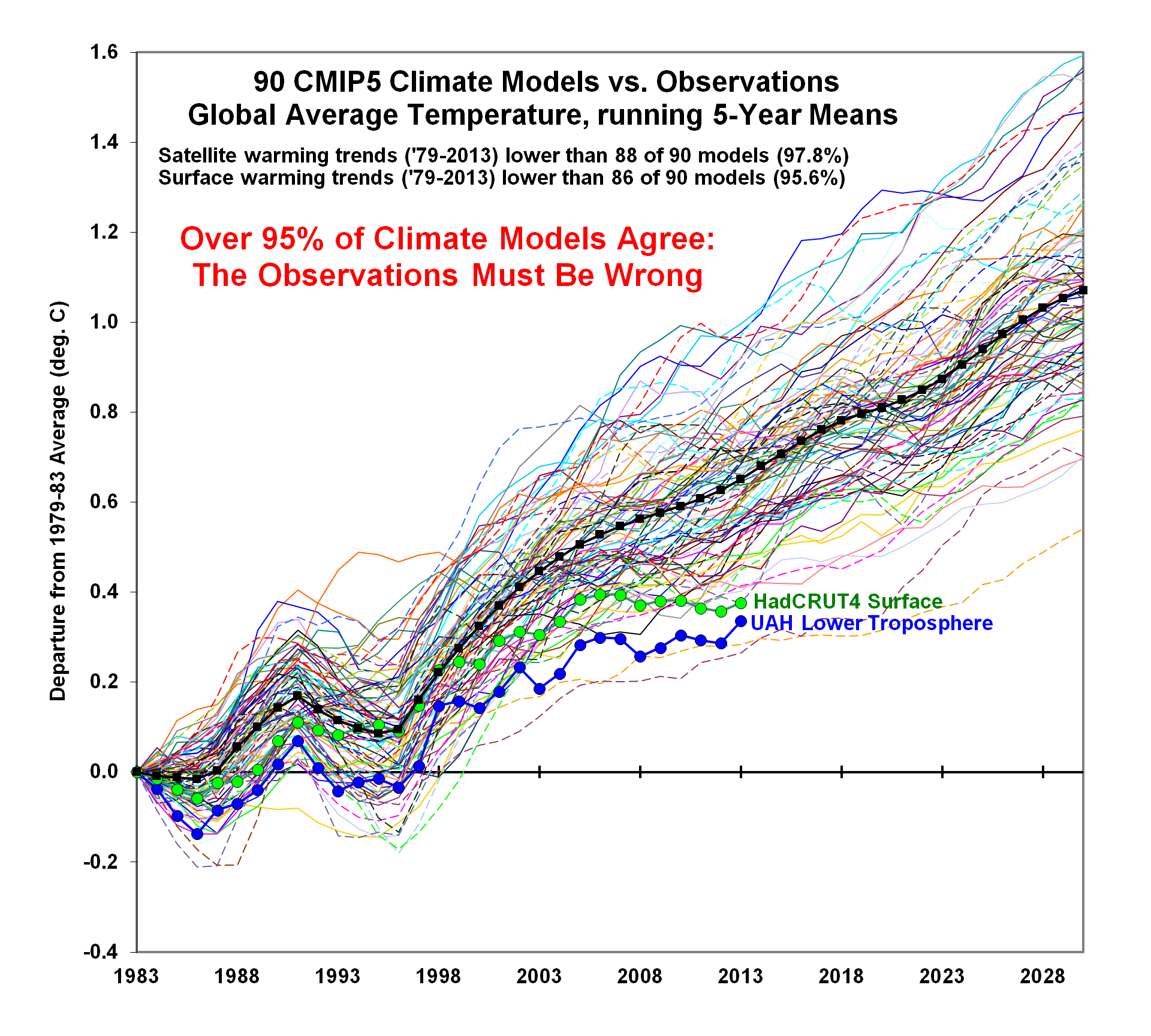
“It’s a well-kept secret, but 95 per cent of the climate models we are told prove the link between human CO2 emissions and catastrophic global warming have been found, after nearly two decades of temperature stasis, to be in error,” he wrote.

“The real agenda is concentrated political authority. Global warming is the hook. Eco-catastrophists [ …] have captured the UN and are extremely well funded. They have a hugely powerful ally in the White House.”

Environmental groups and scientists described Mr Newman as a ‘crazed’ conspiracy theorist and some called on him to resign.

“His anti-science, fringe views are indistinguishable from those made by angry trolls on conspiracy theory forums,” said the Climate Change Council.

Professor Will Steffen, a climate change scientist, told The Australian Financial Review: “These are bizarre comments that would be funny if they did not come from [Mr Abbott’s] chief business adviser.” Mr Abbott’s office did not respond but his environment minister said he did not agree with Mr Newman’s comments.

The article was written by Mr Newman to coincide with a visit by Christiana Figueres, the UN climate change negotiation, who has urged Australia to reduce its reliance on coal. Australia is one of the world’s biggest emitters of carbon emissions per capita.

Since his election in 2013, Mr Abbott has abolished Labor’s carbon tax, scaled back renewable energy targets and appointed sceptics to several significant government positions.

Facts Like These, Put Climate Alarmists to Shame….

A Winter to Remember

In the Northeast, February 2015 was a month like no other in our lifetime; January through March Harshest since 1717?

By Joseph D’Aleo · May, 2015
 No one who has lived in many parts of the Northeast into Canada experienced a six-week and calendar month as extreme for the combination of cold and snow as we have this late winter. From this writer’s viewpoint in southern New Hampshire, February 2015 was the coldest month ever recorded in nearby Nashua with an average temperature of 12.2 degrees Fahrenheit. It beat out January 1888, which had averaged 12.9F. A record 18 days had low temperatures at or below zero (as cold as 14F below). 25 days remained freezing or below, also a record.

Not far away in Boston, where temperature records began in 1872, February 2015 was exceeded only by February 1934, which brought Boston its all-time record of -18F. Temperatures never rose out of the 30s this year in February in Boston, though it topped 40 four times in 1934.

The cold in February 2015 was not confined to the Boston-Nashua area. It was the coldest month ever in Worcester, Hartford and Portland. It was the coldest February in Chicago and Cleveland, third coldest in New York City and fifth coldest ever in Detroit and Baltimore, both with records back into the early 1870s.

Boston set a record for monthly snow with 64.6 inches in February and 100.4 inches in the 39 days following January 24th. The 110.6 inches for the entire season exceeded the 107.6 inch record from 1995/96. The snow that year was spread out over six months with thaws, not concentrated so much in less than six weeks. The snow blitz and the intense cold is why the snow piles were so high this year. College students were shown on local television jumping out second story windows onto huge snowbanks in their bathing suit.

ONLY 1717 BEAT THIS?

Looking back through accounts of big snows in New England by the late weather historian David Ludlum, it appears for the eastern areas this winter’s snow blitz may have delivered the most snow since perhaps 1717.

That year, snows had reached five feet in December with drifts of 25 feet in January before one great last assault in late February into early March of 40 to 60 more inches. The snow was so deep that people could only leave their houses from the second floor, implying actual snow depths of as much as eight feet or more.  The New England Historical Society’s account indicated New Hampshire, Massachusetts and Connecticut were hardest hit, a lot like 2015 in what was known as the year of the great snows.

“Entire houses were covered over, identifiable only by a thin curl of smoke coming out of a hole in the snow. In Hampton, N.H., search parties went out after the storms hunting for elderly people at risk of freezing to death… Sometimes they were found burning their furniture because they couldn’t get to the woodshed. People maintained tunnels and paths through the snow from house to house.”

You may hear or read that increased snow is consistent with global warming because warmer air holds more moisture. In actual fact, 93% of the years with more than 60 inches of snow in Boston were colder than normal.

During the 40 days of snowy weather this winter, we averaged over 11F below normal, and moisture content of the air in the snow region was well below the long-term average. Cooling, not warming, increases snowfall. Indeed, winter temperatures have cooled over the last two decades in the Northeast and the 10-year running mean of Boston area snowfall has skyrocketed to the highest level since snow records were first kept.

The cold continued in March here in New England. The month averaged 5.1F below in Boston and 5.8F below normal in Nashua. There were only four 50F days in March after no 40F days in February in Boston. This compares with seventeen 50F days, eleven 60F days, seven 70F days and one 80F day in March 2012.

JANUARY TO MARCH RECORD COLD

January to March average temperatures were the coldest in the entire record in Worcester, Providence, Hartford and Nashua and third coldest in Boston behind only 1885 and 1895.

In fact, it was the coldest January through March on average in the entire Northeast (the 10 Northeast states and the District of Colombia) in NOAA’s climate record, which started in 1895.

Note how from January to March temperatures in the Northeast have declined for 20 years at a rate of 1.5F/decade.

This season, most areas of central New England had the snowiest mid to late winter and many spots the snowiest winter season on record. In 2013/14, Chicago had its coldest December to March back to 1872 and third snowiest while Detroit had its snowiest back to 1880.

The Great Lakes ice in the two years was the greatest in the record back to 1973, when measurements began edging out the late 1970s, when the world was worrying about a new ice age.

The Adirondacks into southeast Canada in these years usually gets the worst of the Arctic cold. Saranac Lake in February 2015 was 13.6F below normal with 23 sub-zero days, no day reaching freezing and four record lows. March had 15 days zero or below with 10 record lows. Last March (2014), Saranac Lake was 11.4F below normal with 10 sub-zero days and seven record lows.

All of eastern Canada set all-time records for cold, and in Maritime Canada, in many locations, this winter produced more snow than any winter season on record. Charlottetown on Prince Edward Island had a record, incredible 18.1 feet of snow. These were two amazing late winters.

WHAT IS BEHIND THE EXTREMES?

I learned early in my career from the some of the giants in the field like Jerome Namias how ocean temperature pools that develop in conjunction with strong El Niño and La Niña events meander with the ocean currents determine how the jet stream sets up and how strong and persistent it is. This determines how and where extreme winters and summers are for both temperature and precipitation.

A super La Niña in 2010/11 (second strongest in 120 years by some measures) set up warm water in the central Pacific and cold water near the West Coast of North America, which lead to that record warm and droughty 2011/12 central and eastern winter, spring and summer. That warm water came east first to off of Alaska last year leading to the historic winter near the western Lakes and north-central areas (highlighted January’s so-called ‘polar vortex’). Then in 2014 the warm water was carried by the currents southeast to the entire West Coast, forcing the cold to take aim more on the eastern Lakes and Northeast that was at its worst in February.

Similar changes occurred in the Atlantic. Starting in 2007, a warm North Atlantic helped build high pressure in the polar regions and drive Siberian air west to Europe where, in December 2010, the UK had its second coldest December since 1659 in the Little Ice Age.

Though scientists had warned snow was a thing of the past, the UK and much of northern Europe had all–time record snows and cold in five of six years. The North Atlantic turned cold last year and more so this year and Europe turned milder. But a cold North Atlantic means colder and snowier winters in eastern Canada, the Great Lakes and Northeast. The Atlantic thus helped exaggerate the Pacific-driven central U.S. and Northeast cold the last two winters.

At Weatherbell.com, where we use the oceans and sun in our statistical models for long-range prediction, we successfully predicted many months in advance these historic winters. Unless we see major changes in the eastern Pacific, we expect we may make this a threepeat about the time the administration signs a treaty in Paris with other nations at the UN to disassemble our current energy policies to supposedly save the planet from the ravages of warming, which we will show you in the next story is not happening globally and hasn’t for over 18 years.


Joe D’Aleo is a certified Consulting Meteorologist, Fellow of the American Meteorological Society (AMS), former chair AMS Committee on Weather Analysis and Forecasting, co-founder and first Director of Meteorology at The Weather Channel and a former college professor of Meteorology and Climatology.

Climate Alarmists: They Hate Facts that Don’t Back Up Their Story, and the People Who Expose Them!

Climate Change | John Roskam
Australian Financial Review 1st May, 2015

In 1987, the American historian and philosopher Allan Bloom wrote a best-selling book, The Closing of the American Mind. It was about the mediocrity and intellectual conformity of American universities. Bloom died in 1992. If he was alive today and writing about Australian universities his book could be titled The Closed Australian Mind.

The reaction of university academics to the Abbott government’s decision to provide $1 million to fund a branch of Bjorn Lomborg’s Copenhagen Consensus Centre at the University of Western Australia demonstrates all that’s wrong with Australia’s universities. Their culture tends to be distrustful, insular and choked in unthinking intellectual uniformity. That’s why the number of Australian researchers who rival Lomborg’s global renown can be numbered on the fingers of one hand. Probably the closest any Australian comes to having anything like Lomborg’s international standing in the field of philosophy and policy is the ethicist Peter Singer now at Princeton University. (Singer who supports infanticide in some circumstances was voted one of Australia’s most outstanding public intellectuals. He’s also been awarded the Companion of the Order of Australia, the country’s second-highest honour.)

Instead of welcoming a world-class public policy thinker coming to Australia and to their university, academics and students at the University of Western Australia are outraged. The vice-president of the university’s staff association talked of having the funding revoked, while the student guild launched a ‘Say No to Bjorn Lomborg’ campaign.

Lomborg’s problem is he’s a climate “contrarian”. As the The Guardian newspaper has helpfully pointed out a climate “contrarian” is someone who is not a climate “denialist” but who nevertheless says things that “infuriate” people who believe climate change is the world’s most serious and urgent problem. And the reason we know Lomborg is not a “denialist” is because the university’s vice-chancellor says so. At a meeting last week of 150 angry academics the vice-chancellor attempted to placate his staff by reassuring them Lomborg most definitely wasn’t a “denialist” and his institution “had a history of defending its climate change research staff against the most extreme views of climate change deniers”. (There’s no record of the vice-chancellor defining what he meant by the term “denialist”. Presumably his university doesn’t employ any.)

LOMBORG’S BELIEFS

Lomborg believes humans are causing the climate to change and he believes it’s a problem. But he also believes that much of the money spent on fighting climate change would be better spent on overcoming malaria and HIV/Aids and assisting the 700 million people on the planet who don’t have clean water. These views apparently make Lomborg unfit to hold a position at the University of Western Australia. As yet it’s not clear what Lomborg would have to believe to satisfy the staff and students of the university.

In The Closing of the American Mind, Bloom examines how the teaching of humanities has been affected by postmodernism and moral relativism. For Bloom, what’s even worse is that so many academics think the same things and they won’t tolerate anyone disagreeing with them. He tells the story of what happened to him as a student.

“We are used to hearing the Founders charged with being racists, murderers of Indians, representatives of class interests. I asked my first history professor in the university, a very famous scholar, whether the picture he gave us of George Washington did not have the effect of making us despise our regime. ‘Not at all,’ he said, ‘it doesn’t depend on individuals but on our having good democratic values.’ To which I rejoined, ‘But you just showed us that Washington was only using those values to further the class interests of the Virginian squirearchy.’ He got angry, and that was the end of it.”

What Bloom said about the humanities in American universities 30 years ago is true of science in Australian universities today. Those who dare to question whether the science of climate change actually is “settled” provoke anger and name calling from many in Australia’s scientific community.

Australia’s Nobel Laureate Peter Doherty is a leader of that community. He’s another one angry Lomborg is coming to this country. Doherty’s attitude is disappointing but also perplexing. Without contrarian thinkers there wouldn’t be many Nobel Prizes to hand out.

John Middleton, from Scotland, Reports on the Windpushers Latest Tactics!

Thursday night, Ms Sturgeon on the TV looking relaxed in her home, life is good… Now, in the words o the great Max Bygraves.. “Let me tell you a story”… Most people on here know me, some don’t, some girls need a lot o loving an some girls don’t… Naw, only kidding (could not help it)… Having (this is the real story by the way) been up for several nights due to this horrendous noise and it’s effects, I stupidly pleaded with Ms Sturgeon to do something about WLC and NLC, things were pretty bad and the question had to be asked “are these turbines worth more than my sanity and my life”..? My response from Ms Sturgeon was sending two police officers to my door to check on my well being, when they realised I wanted to discuss why I’m being kept awake they did not want to know so said ” thanks very much and tried to close the door which they kicked open, handcuffed me and held me by my throat saying I was mentally ill and frogmarched me into a van and yes they said they had been contacted by Ms Sturgeons office… Well, I was taken to St Johns hospital where I was mentally assessed, they asked me why I had not slept and was contacting various organisations about wind turbines, I told them what I know as I have discussed with many of you here, they brought a guy in from WLC mental health who asked me (an this’ll crack ye up as it did me) “what do the turbines say to you”… Well you can imagine my response, I explained it’s a humming and that it was now widely known that the LFN does indeed effect certain people and does not effect others, I was then deemed “fixed delusional”, I was immediately seized and given certain drugs against my will, this was done first orally then by syringes thrust into my legs through my clothes, put in a wheelchair carted backwards to a secure mental health ward where I have been for over a week now, if you think that these places have changed since “one flew over the cuckoo’s nest” then be rest assured they ain’t…!!! Earlier today I had a top consultant come to see me and having had her assistant look into this “noise”, I was released with immediate effect, she said I should not have been put there as everything I said was indeed true.. The mental health order revoked, the whole time apart from when they forced me into the ward I had no drugs apart from painkillers due to the injuries inflicted by so called nurses… This is the length these people will go to to silence we sufferers of this god forsaken noise, I will continue this fight regardless of this blatant abuse of my civil liberties, let this story be told and never give in….

Climate Models Never Reflect Reality…..Reality Must be Wrong???

95% of Climate Models Agree: The Observations Must be Wrong

Roy W. Spencer, Ph. D.

I’m seeing a lot of wrangling over the recent (15+ year) pause in global average warming…when did it start, is it a full pause, shouldn’t we be taking the longer view, etc.

These are all interesting exercises, but they miss the most important point:the climate models that governments base policy decisions on have failed miserably.

I’ve updated our comparison of 90 climate models versus observations for global average surface temperatures through 2013, and we still see that >95% of the models have over-forecast the warming trend since 1979, whether we use their own surface temperature dataset (HadCRUT4), or our satellite dataset of lower tropospheric temperatures (UAH):

CMIP5-90-models-global-Tsfc-vs-obs-thru-2013

Whether humans are the cause of 100% of the observed warming or not, the conclusion is that global warming isn’t as bad as was predicted. That should have major policy implications…assuming policy is still informed by facts more than emotions and political aspirations.

And if humans are the cause of only, say, 50% of the warming (e.g. our published paper), then there is even less reason to force expensive and prosperity-destroying energy policies down our throats.

I am growing weary of the variety of emotional, misleading, and policy-useless statements like “most warming since the 1950s is human caused” or “97% of climate scientists agree humans are contributing to warming”, neither of which leads to the conclusion we need to substantially increase energy prices and freeze and starve more poor people to death for the greater good.

Yet, that is the direction we are heading.

And even if the extra energy is being stored in the deep ocean (if you have faith in long-term measured warming trends of thousandths or hundredths of a degree), I say “great!”. Because that extra heat is in the form of a tiny temperature change spread throughout an unimaginably large heat sink, which can never have an appreciable effect on future surface climate.

If the deep ocean ends up averaging 4.1 deg. C, rather than 4.0 deg. C, it won’t really matter.