Wind Power…..Good for NOTHING!

Wind Power Costs send Germans back to the Stone Age


axeman_thumb[1]

Power starved Germans take matters into their own hands.

If you’re going down to the German woods today, beware of a big surprise. 

Although it won’t be cuddly Teddys with well-stocked picnic baskets and wonderful games to play – chances are it’ll be a power starved German armed with an axe, looking to filch a pile of timber to cook his bratwurst and warm his home.

In the last couple of posts we’ve looked at the social and economic disaster that is German renewables policy.

The Germans launched into massively subsidised wind and solar power with power prices rising 80 per cent in real terms in little over a decade. Unable to pay skyrocketing power bills, 800,000 German households have been disconnected from the grid – with that number growing by 300,000 each year. In addition, almost 7 million Germans are suffering “fuel poverty” – forced to choose between eating or heating.

Always a resourceful lot, power-starved Germans have grabbed their axes and have headed back to the woods in an effort to obtain that which their insane renewables policy denies: affordable energy. However, it seems their new timber-driven energy economy is premised on a “user-doesn’t-pay” model that has left German foresters unamused.

Here’s SpiegelOnline’s look at Germany’s return to the Stone Age.

Woodland Heists: Rising Energy Costs Drive Up Forest Thievery
Spiegel Online
Renuka Rayasam
17 January 2014

With energy costs escalating, more Germans are turning to wood burning stoves for heat. That, though, has also led to a rise in tree theft in the country’s forests. Woodsmen have become more watchful.

With snow blanketing the ground, it’s the perfect time of year to snuggle up in front of a fireplace. That, though, makes German foresters nervous. When the mercury falls, the theft of wood in the country’s woodlands goes up as people turn to cheaper ways to heat their homes.

“The forest is open for everyone to enter and people just think they can help themselves, but they can’t!” says Enno Rosenthal, head of the forest farmers association in the northeastern German state of Brandenburg. “Naturally, those log piles belong to someone and there is a lot of money and work that goes into them.”

The problem has been compounded this winter by rising energy costs. The Germany’s Renters Association estimates the heating costs will go up 22 percent this winter alone. A side effect is an increasing number of people turning to wood-burning stoves for warmth. Germans bought 400,000 such stoves in 2011, the German magazine FOCUS reported this week. It marks the continuation of a trend: The number of Germans buying heating devices that burn wood and coal has grown steadily since 2005, according to consumer research company GfK Group.

That increase in demand has now also boosted prices for wood, leading many to fuel their fires with theft.

Rosenthal said just last weekend someone stole an entire bundle of oak wood worth about €150 ($199) from a private forest in the town of Neuruppin outside of Berlin. “Many foresters come back to their wood piles and find them a little smaller or even gone,” he says.

Gray Zone

About 10 percent of the firewood that comes out of Brandenburg’s forest every year is stolen, resulting in losses of about €500,000, Rosenthal estimates. In the southern German state of Bavaria some 5 percent is absconded with annually says Hans Bauer, head of the state’s forest owners association.

“A gray zone has developed,” says Rosenthal. “Normally if you sell sausages, you create a business and pay taxes, but with wood some people are laxer.” He says many people steal wood and then resell it via ads in the newspaper. Such sales, needless to say, tend to be of the under-the-table variety.

Other thieves are more spontaneous, says Bauer. Often people will just drive by a pile of wood and see it as invitation to steal, he says. “Drivers just stop, open up their trunks and put the wood in and drive off,” he says. “It’s that easy.”

Bauer says that a couple of years ago, a driver loaded up €2,000 worth of wood into a truck and drove off. He was eventually caught and paid a fine to the forest owner. But Bauer says such retribution is rare.

Extreme Measures

Bauer now advises foresters to keep wood deep in the forests away from busy thoroughfares and to make logs too large to fit in regular cars, keeping temptation for casual thieves at bay.

Often, however, even those measures aren’t enough. Rosenthal said that just a few years ago foresters would leave log piles in the forest for up to a year to dry. Now, though, he says they aren’t kept for more than a month before moving to more secure locales. “Keeping the wood under your own surveillance is the best protection,” says Rosenthal.

In the western German city of Hessisch Lichtenau other foresters are taking a more extreme approach, according to local daily theHessische/Niedersächsische Allegemeine. In recent years, two major tree heists have taken place in town and the state experiences losses of millions of euros as a result. The paper reports that now some foresters are outfitting log piles with GPS devices to track thieves.
Spiegel Online

With hundreds of thousands of (former) German power consumers with no power at all – millions struggling to pay for power – and no relief in sight – German foresters are fighting a losing battle. Deprive people of the basic necessities of life and they will do whatever it takes to replace them with the closest thing available.

Cooking a meal and warming a home were – until pretty recently – matters which Germans, no doubt, largely took for granted. Thanks to the insane cost of their renewable policy – for a substantial and growing number of German households – these basics are now beyond reach.

As we have pointed out before, the costs of wind power fall disproportionately on the poorest and most vulnerable in society (see our posts here and here).

What might make a few inner-city lefties feel good – for the few moments in their day (if ever) that they consider energy policy – carries with it the social cost of deprivation and exclusion that is a form of unjustified punishment. Access to affordable power is a matter of social equity: but social equity is now running a poor second to “green” ideology, as – thanks to the exorbitant cost of wind power – electricity has been turned into an “aspirational” good for those at the bottom of the socioeconomic heap.

With Australia following Germany’s lead on wind power policy, we’re well down the track to a return to the Stone Age. Australia’s “wind power capital”, South Australia (population 1.6 million) has more than 50,000 homes disconnected from the grid because they can no longer afford to pay their power bills – with more being cut-off daily. These people have taken to lighting their homes with candles – and cooking on wood stoves and barbeques. As to why South Australians suffer the highest power prices in the world (see our post here).

So, unless Australia scraps its insanely expensive, totally ineffective and, therefore, unsustainable Renewable Energy Target – like the Germans – we’ll be sharpening our axes and heading off on Stone Age timber gathering adventures of our own.

stone age cave dweller

Wind power costs sends them back to the future.


Global warming fear is used as a tool of coercion!

Global Warming’s Upside-Down Narrative

NEW YORK – When politicians around the world tell the story of global warming, they cast it as humanity’s greatest challenge. But they also promise that it is a challenge that they can meet at low cost, while improving the world in countless other ways. We now know that is nonsense.

Political heavyweights from US Secretary of State John Kerry to UN Secretary General Ban Ki-moon call climate change “the greatest challenge of our generation.” If we fail to address it, Kerry says, the costs will be “catastrophic.” Indeed, this has been the standard assertion of politicians since the so-called Stern Review commissioned by the British government in 2006.

That report famously valued the damage caused by global warming at 5-20% of GDP – a major disruption “on a scale similar to those associated with the great wars and the economic depression of the first half of the twentieth century.”

Tackling climate change, we are told, would carry a much lower cost. The president of the European Commission promised that while the European Union’s climate policies are “not cost-free,” they would amount to just 0.5% of GDP. Indeed, politicians of all stripes have reiterated the Stern Review’s finding that global warming can be curtailed by policies costing just 1% of world GDP.

Climate policies, moreover, are said to help in many other ways. US President Barack Obama promised that policies to combat global warming would create five million new green jobs. The EU claimed that green energy would help “improve the EU’s security of energy supply.”

With the completion of the latest report by the United Nations Intergovernmental Panel on Climate Change (IPCC), we can now see that this narrative is mostly wrong. The first installment of the IPCC report showed that there is indeed a climate problem – emissions of greenhouse gases, especially CO₂, lead to higher temperatures, which will eventually become a net problem for the world. This result was highly publicized.

But the report also showed that global warming has dramatically slowed or entirely stopped in the last decade and a half. Almost all climate models are running far too hot, meaning that the real challenge of global warming has been exaggerated. Germany and other governments called for the reference to the slowdown to be deleted.

The second IPCC installment showed that the temperature rise that we are expected to see sometime around 2055-2080 will create a net cost of 0.2-2% of GDP – the equivalent of less than one year of recession. So, while the IPCC clearly establishes that global warming is a problem, the cost is obviously much less than that of the twentieth century’s two world wars and the Great Depression.

Again, not surprisingly, politicians tried to have this finding deleted. British officials found the peer-reviewed estimate “completely meaningless,” and, along with Belgium, Norway, Japan, and the US, wanted it rewritten or stricken. One academic speculated that governments possibly felt “a little embarrassed” that their previous exaggerated claims would be undercut by the UN.

The third installment of the IPCC report showed that strong climate policies would be more expensive than claimed as well – costing upwards of 4% of GDP in 2030, 6% in 2050, and 11% by 2100. And the real cost will likely be much higher, because these numbers assume smart policies, instantly enacted, with key technologies magically available.

Again, politicians tried to delete or change references to these high costs. British officials explained that they wanted such cost estimates cut because they “would give a boost to those who doubt action is needed.”

Green jobs have been created only with heavy subsidies, costing a similar number of jobs elsewhere. Indeed, each extra job created cost more than $11 million in the US. And facile claims that renewable sources can boost energy security look a lot less convincing after the crisis in Ukraine; Europe now understands that only large and stable energy supplies matter.

CommentsView/Create comment on this paragraphClimate change has been portrayed as a huge catastrophe costing as much as 20% of world GDP, though brave politicians could counter it at a cost of just 1% of GDP. The reality is just the opposite: We now know that the damage cost will be perhaps 2% of world GDP, whereas climate policies can end up costing more than 11% of GDP.

What makes this story all the more amazing is that experts have known almost all of these facts for a long time. The Stern Review was produced by bureaucrats and never subjected to peer review. Economists knew that the damage costs had been extensively massaged, and that the estimates were outliers compared to the academic literature. The unfathomably low projections for policy costs were artifacts of ignoring most liabilities, again contradicting the academic literature.  The media, eager for breathless headlines, share the blame with politicians for this state of affairs. Following the release of the Stern Review, one British newspaper reportedly wrote: “Act now or the world we know will be lost forever.” Being accurate is less sexy, but much more informative.

We live in a world where one in six deaths are caused by easily curable infectious diseases; one in eight deaths stem from air pollution, mostly from cooking indoors with dung and twigs; and billions of people live in abject poverty, with no electricity and little food. We ought never to have entertained the notion that the world’s greatest challenge could be to reduce temperature rises in our generation by a fraction of a degree.

The solution is to stop applauding politicians who warn of catastrophe and promote poor policies. Instead of subsidizing inefficient solar and wind power with little benefit, we need to invest in long-term green innovation. And we need to give more attention to all of the other problems. This is perhaps less entertaining, but it will do much more good.


Read more at http://www.project-syndicate.org/commentary/bj-rn-lomborg-says-that-the-un-climate-panel-s-latest-report-tells-a-story-that-politicians-would-prefer-to-ignore#vvxpTx3ZVsFMGGOl.99

Climate change is a sales gimmick for the Faux-green enterprises.

WHEN AN AGW BELIEVER TELLS YOU THAT NO ONE IS MAKING MONEY OFF OF CLIMATE CHANGE…..

Here’s some more ammunition for you.  (Hint: They’re all Liberals)

Gore Pocketed ~$18 Million from Now-Defunct Chicago Climate Exchange

Although the Chicago Climate Exchange (CCX) collapsed and shut down this week, Al Gore’s Generation Investment Management LLP pocketed approximately $17.8 million on it’s 2.98% share of the exchange when it was sold to the publicly traded Intercontinental Exchange a mere 6 months ago.

According to news reports, the brainchild of the exchange, academic Richard Sandor, founded the exchange with a foundation gift of $1.1 million, and pocketed $98.5 million for his 16.5% share of the CCX. This would place the value of Gore’s firm’s stake at almost $18 million.

Note Gore is the founder, chairman, and largest shareholder in Generation Investment Management LLP. Barack Obama was on the Joyce Foundation Board when it provided the funding to establish the CCX. Maurice Strong, founding head of the United Nations Environmental Program (UNEP), precursor to the IPCC, was a CCX board member.

Ed Barnes — November 2010

Collapse of Chicago Climate Exchange Means a Strategy Shift on Global Warming Curbs

By Ed Barnes Published November 09, 2010 | FoxNews.com

The closing this week of the Chicago Climate Exchange, which was envisioned to be the key player in the trillion-dollar “cap and trade” market, was the final nail in the coffin of the Obama administration’s effort to pass the controversial program meant to combat global warming.

“It is dead for the foreseeable future,” said Myron Ebell, director of the Center for Energy and the Environment with the Competitive Energy Institute, which had fought the measure.

That assessment was echoed by environmentalists as well.

“Economy-wide cap and trade died of what amounts to natural causes in Washington,” said Fred Krupp, president of the Environmental Defense Fund, which had supported the plan.

The CCX was set up in 2000 in anticipation of the United States joining Europe and other countries around the world to create a market that would reduce the emission of greenhouse gases. Under the system, factories, utilities and other businesses would be given an emissions target. Those that emitted less fewer regulated gases than their target could sell the “excess” to someone who was above target. Each year, the target figures would be reset lower.  Continue reading here….

gore rich

Climate Alarmists don’t tell the Whole Story!

Ridley: IPCC & OECD reports are telling us clear as a bell that we cannot ruin the climate with CO2 unless we have a population explosion

Matt Ridley: The Richer We Get, The Greener We’ll Become

The world’s climate change experts are now saying that strong growth doesn’t hurt the environment, it protects it

Matt Ridley, The Times

In the past 50 years, world per capita income roughly trebled in real terms, corrected for inflation. If it continues at this rate (and globally the great recession of recent years was a mere blip) then it will be nine times as high in 2100 as it was in 2000, at which point the average person in the world will be earning three times as much as the average Briton earns today.

I make this point partly to cheer you up on Easter Monday about the prospects for your great-grandchildren, partly to start thinking about what that world will be like if it were to happen, and partly to challenge those who say with confidence that the future will be calamitous because of climate change or environmental degradation.


The curious thing is that they only predict disaster by assuming great enrichment. But perversely, the more enrichment they predict, the greater the chance (they also predict) that we will solve our environmental problems.

Past performance is no guide to future performance, of course, and a well aimed asteroid could derail any projection. But I am not the one doing the extrapolating. In 2012, the Intergovernmental Panel on Climate Change (IPCC) asked the Organisation for Economic Cooperation and Development (OECD) to generate five projections for the economy of the world, and of individual countries, in 2050 and 2100.

[I’ve inserted the graph Matt refers to, PDF here: ENV-EPOC-WPCID(2012)6  – Anthony]

OECD_SSP_projections_to2100

They make fascinating reading. The average per capita income of the world in 2100 is projected to be between three and 20 times what it is today in real terms. The OECD’s “medium” scenario, known as SSP2, also known as “middle of the road” or “muddling through”, sounds pretty dull. It is a world in which, in the OECD’s words, “trends typical of recent decades continue” with “slowly decreasing fossil fuel dependency”, uneven development of poor countries, delayed achievement of Millennium Development Goals, disappointing investment in education and “only intermediate success in addressing air pollution or improving energy access for the poor”.

And yet this is a world in which by 2100 the global average income per head has increased 13-fold to $100,000 (in 2005 dollars) compared with $7,800 today. Britain will be very slightly below that average by then, yet has still trebled its income per head. According to this middling scenario, the average citizen of the Democratic Republic of Congo, who today earns $300 a year, will then earn $42,000, or roughly what an American earns today. The average Indonesian, Brazilian or Chinese will be at least twice as rich as today’s American.

Remember this is in today’s money, corrected for inflation, but people will be spending it on tomorrow’s technologies, most of which will be cleverer, cleaner and kinder to the environment than today’s — and all for the same price. Despite its very modest assumptions, it is an almost unimaginable world: picture Beverly Hills suburbs in Kinshasa where pilotless planes taxi to a halt by gravel drives (or something equally futuristic). Moreover, the OECD reckons that inequality will have declined, because people in poor countries will have been getting rich faster than people in rich countries, as is happening now. All five storylines produce a convergence, though at different rates, between the incomes of poor and rich countries.

Can the planet survive this sort of utopian plutocracy? Actually, here it gets still more interesting. The IPCC has done its own projections to see what sort of greenhouse gas emissions these sorts of world would produce, and vice versa. The one that produces the lowest emissions is the one with the highest income per head in 2100 — a 16-fold increase in income but lower emissions than today: climate change averted. The one that produces the highest emissions is the one with the lowest GDP — a mere trebling of income per head. Economic growth and ecological improvement go together. And it is not mainly because environmental protection produces higher growth, but vice versa. More trade, more innovation and more wealth make possible greater investment in low-carbon energy and smarter adaptation to climate change. Next time you hear some green, doom-mongering Jeremiah insisting that the only way to avoid Armageddon is to go back to eating home-grown organic lentils cooked over wood fires, ask him why it is that the IPCC assumes the very opposite.

In the IPCC’s nightmare high-emissions scenario, with almost no cuts to emissions by 2100, they reckon there might be north of 4 degrees of warming. However, even this depends on models that assume much higher “climate sensitivity” to carbon dioxide than the consensus of science now thinks is reasonable, or indeed than their own expert assessment assumes for the period to 2035.

And in this storyline, by 2100 the world population has reached 12 billion, almost double what it was in 2000. This is unlikely, according to the United Nations: 10.9 billion is reckoned more probable. With sluggish economic growth, the average income per head has (only) trebled. The world economy is using a lot of energy, improvements in energy efficiency having stalled, and about half of it is supplied by coal, whose use has increased tenfold, because progress in other technologies such as shale gas, solar and nuclear has been disappointing.

These IPCC and OECD reports are telling us clear as a bell that we cannot ruin the climate with carbon dioxide unless we get a lot more numerous and richer. And they are also telling us that if we get an awful lot richer, we are likely to have invented the technologies to adapt, and to reduce our emissions, so we are then less likely to ruin the planet. Go figure.

It’s all about the $$$$$. Wind whiners….

Wind industry under siege

Siege being defined as the low cost of gas and the end of federal subsidies. 

This Bloomberg report in the Albuquerque Journal News describes the problems with building wind energy since the end of the Federal subsidies worth $23/MWh to the turbines and the drop in the cost of natural gas caused by the expansion of hydraulic fracturing.  “Power-purchase agreements in the U.S. are under severe pricing pressure because of the shale gas boom,” said Jurgen Zeschky, CEO of Nordex, a German wind-turbine maker. “That’s putting pressure on prices for wind power and makes investments very difficult.”  Congress is considering restoration of subsidies, but may not act during the election season.

I’m not sure how this article came up with construction costs, but  EIA estimatesshow on-shore wind projects about twice the cost per kilowatt as gas projects.  Wind projects seem to dry up when the subsidies dry up.

Wind and Solar…..destructive and unaffordable!

German Wind Power Policy: an Economic Suicide Pact

crystal-ball

Follow the Germans and I see a dark and dismal future.

For anyone looking for a taste of Australia’s economic future, then look no further than Germany. For that reason, over the next few posts, STT is going to have a close look at the debacle that is German wind power policy and its disastrous impacts on German business and households.

Germany’s renewable policy – referred to as the “Energiewende” – has seen €billions in power/taxpayer subsidies thrown at wind and solar power at the expense of German industry, manufacturing and families.

Skyrocketing renewables driven power prices are sending once competitive manufacturers and industries to the USA to benefit from energy made cheap by its recent shale oil and gas bonanza (see our post here).

For the same reason, more than 800,000 German homes are without power simply because they can no longer afford to pay their bills (see our post here). That number can only escalate – from the pieces below something like 300,000 households are being disconnected from the grid annually. And, beyond that, an even larger number suffer from what is euphemistically called “fuel poverty” – which is where a household spends more than 10% of its disposable income on energy – leaving them with the stark choice of “heat or eat” – simply because they can no longer afford both.

The fact that – for all the €billions thrown at wind and solar power – German CO2 emissions have increased not decreased – as coal-fired plants are cranked-up to keep the grid from collapsing – simply adds insult to injury (see our post here).

Here are a couple of reports from NoTricksZone on the German wind power disaster.

Max Planck Institute Economist: Germany’s Energiewende “Bordering On Suicide”… “Unimaginably Expensive Folly”
NoTricksZone
P Gosselin
6 April 2014

Richard Tol tweeted here a link to an article appearing at the Deutsche Wirtschafts Nachrichten (German Business News) about the country’s much ballyhooed Energiewende, in English: transition to renewable energies. The title:

“Max Planck economist: ‘Transition To Renewable Energy Borders On Suicide’

Leading economic experts are firing harsh criticism at the energy policy of federal super minister Sigmar Gabriel. Germany as a friendly location for business is not only being weakened, the transition to renewable energy even borders on suicide and is an unimaginably expensive folly.”

Recently Angela Merkel’s grand coalition government just decided they would water down the scale-back in renewable energy subsidies. The Deutsche Wirtschafts Nachrichten quotes Max Planck Institute researcher Axel Börsch-Supan, who has fired harsh words at Federal Economics Minister Sigmar Gabriel:

“With their policy, the grand coalition is weakening Germany’s location as a place to do business. This is especially true when it comes to the Energiewende, which is bordering on suicide.”

According to the Deutsche Wirtschafts Nachrichten, other experts are also slamming Germany’s “Energiewende”. For example Ifo Institute director Hans-Werner Sinn calls it an “unimaginably expensive folly”. Marc Tüngler director of a German financial association, calls it “a planned economy without a plan” that makes the Energiewende “unbearably expensive”.

The Deutsche Wirtschafts Nachrichten concludes:

According to experts, the big losers are the consumers, who will have to expect continued increasing electricity prices.

NoTricksZone

And what follows Germany’s insane wind and solar power policy?

Over to NoTricksZone again.

More Germans Getting Their Power Cut Off Because They Can’t Afford Paying Sky-High Green Electric Bills
NoTricksZone
P Gosselin
19 April 2014

Just a few days ago, the IPCC WG III report claimed that CO2 emissions could be curbed with little pain involved. Well, go tell it to the more than 300,000 Germans who have had their power shut off in a single year because they no longer can afford skyrocketing electric bills. And these people live in a rich country!

And imagine what expensive power means for poor, developing countries. In such countries it’s nothing short of widespread catastrophe and grinding misery.

The online site of German news television station NTV writes of a threatening energy poverty taking hold in Europe and that”more and more people are unable to pay for the electricity that they consume. More than 300,000 German citizens are going to have their power shut off each year.”

NTV cites a report from German nation daily Die Welt, which writes German power companies turned off the power for 321,539 people because of non-payment in 2012, up from 312,500 people in 2011.

The reason for the high prices? NTV writes:

“A reason for the increased number of power shutoffs is the rash expansion of renewable energies, which lead to higher energy prices.”

Two years ago NoTricksZone reported on an article also from Die Welt who claimed that 600,000 households were getting their power cut off. The figures on power service cutoffs vary broadly. Whichever figure is correct, the scale of the social disaster is immense no matter how you look at it.

It’s time to make energy affordable and attractive for every socioeconomic level, and not a luxury good for the upper classes.
NoTricksZone

Our current (and completely unsustainable) 41,000 GW/h annual mandatory Renewable Energy Target places Australia on the same path to economic suicide.

The cost of building wind power generating capacity – and the duplicated grid infrastructure to support it – will cost in excess of $80 billion (with that cost added to Australian power consumers’ power bills) and to subsidise this colossal rort – a further $54 billion worth of Renewable Energy Certificates would be issued to wind power generators between now and 2031 when the RET expires – which, as a Federal Tax on all Australian electricity consumers, will also be slapped on top of our power bills (see our post here).

By 2020, Australian power prices are forecast to double as a result of the current RET (see our post here).

All of this will simply render Australia’s energy intensive industries – such as mineral processors and manufacturers – economically uncompetitive.

But Australians don’t have to look to Germany to see what a disaster wind power is. South Australia is Australia’s “wind power capital” – with close to half of Australia’s total installed wind power generating capacity.

As a consequence of its “brilliant” wind power policy, SA pays the highest power prices in Australia by a substantial margin and jockeys with wind power mad Denmark and the Germans for the honour of having the highest power prices in the world. Some honour!

Following Germany’s lead, SA (population 1.6 million) has more than 50,000 homes disconnected from the grid because they can no longer afford to pay their power bills – – with more being cut-off daily. These people have taken to lighting their homes with candles – and cooking on wood stoves and barbeques. As to why South Australians suffer the highest power prices in the world (see our post here).

South Australia is going backwards as a result. Mining investment has more or less ground to a halt – the promised mining boom went out with a wimper; manufacturing is a dead duck – well, at least a lame one – with the carmaker Holden promising to limp along at Elizabeth for another year or two. After which, it’ll be a case of last man out turn out the lights.

South Australia not only suffers the highest power prices in Australia, it also recently snared the dubious honour of having the highest rate of unemployment on the mainland – rising from 6.7% to 7.1% – the highest level of unemployment among mainland states by a substantial margin (Western Australia’s rate is 4.9% – down from 5.9%).

So much for all those hollow wind industry promises of thousands of green jobs for South Australians.

The equation is simple: increase the cost of an essential input to businesses and those businesses will react by cutting their other operating costs in order to maintain a profit margin and stay in business.

That leaves a business with some options: employ fewer people, pay them less or relocate the business to countries with lower operating costs. And that is precisely what is happening in Germany and South Australia.

A bright young Scot, Adam Smith was all over the relationship between input costs, profits and employment over 240 years ago when he sat down to pen a little book with a big impact: An Inquiry into the Natureand Causes of the Wealth of Nations

This is not rocket science – it’s Economics 101.

economics101

The fundamentals unchanged since Adam Smith nutted it out in 1776.

Collusion Between Government and “Renewable energy”.

Standing with rancher Cliven Bundy

bundy1Wind Turbine Syndrome, Calvin L. Martin
The other day, something significant happened in American history.  This man stood up to the American government  — and the government backed down.  (The “American government” consisting of a small army of heavily armed cops.)

This is a story about a number of things:  (a) The renewable energy scam.  (b) A foreign energy company taking adverse possession of rangeland used by this rancher’s ancestors going back 150 years, give or take.  (c) An unseemly collusion between a powerful U.S. Senator, the Director of the Bureau of Land Management, and a Chinese energy company.

The bullying and sleaze of wind energy companies inevitably come to mind.

In this case, it’s not wind energy, but another non-starter:  solar energy.  Involving U.S. Senator Harry Reid (Nevada) negotiating with a Chinese energy mogul to build a huge solar energy plant on Bureau of Land Management (BLM) administered rangeland — right smack where this rancher and his forebears have traditionally grazed their livestock.  The Chinese company being legally represented, incidentally, by Senator Reid’s son, a prominent Nevada attorney. Read article


The Collusion between the Wind Industry, and the Provincial Liberal Government!

MUST LISTEN: MIKE CRAWLEY & FIT CONTRACTS — LIBERAL CORRUPTION MAKING MILLIONS

Tip o’ the hat to Robert Stocki for this find. Lowell Green from CFRA 580 in Ottawa, talks about the widespread corruption in the Liberal Party surrounding the FIT contracts. “Mike Crawley Liberal insider and NOW President Of International Power Canada once the Wind Power Guru Of the Dalton Mc Guinty Liberals Party and Past President of the Fderal Liberal Party is now on the RECEIVING END OF the Multi Million dollar FIT CONTRACTS he helped set up under the GREEN ENERGY SHAM….. this is the Crime of the Century and you will be paying for it for 20 years.”
Check out this video….a must see! *****Mike Crawley and FIT CONTRACTS Liberals Making Millions Off of Ontario …: http://youtu.be/e6Nti3z5k_Y via @YouTube
liberal 2012391

Why I’m cheering for fossil fuels this Earth Day

“The heavens reek, the waters below are foul … we are in a crisis of survival.” That’s how Walter Cronkite and CBS hyped the first Earth Day, back in 1970. Somehow we’ve survived since then, and most of life got better, although I never hear that from the worrywarts. Of course, some things got better because of government: We passed environmental rules that got most of the filth out of the air and sewage out of lakes and rivers. Great — but now we’re told that we’re in big trouble because greenhouse gases cause global warming. I mean, climate change.

Time and again, environmentalists oppose the energy production most likely to make the world cleaner and safer. Instead, they persuade politicians to spend billions of your dollars on symbolism like “renewable” energy.

“Crop yields are down, deaths from heat are up,” says the Los Angeles Times. The “Worst Is Yet to Come,” warns The New York Times. This hype is not new. Alarmists always fool the gullible media. They once fooled me. A few years back, we were going to be killed by global cooling, overpopulation, pesticide residues, West Nile virus, bird flu, Y2K, cellphone radiation, mad cow disease, etc. Now it’s global warming. Reporters don’t make these scares up. The recent hype about global warming comes from the Intergovernmental Panel on Climate Change. Most of its members are serious scientists. But reporters don’t realize that those scientists, like bird flu specialists, have every incentive to hype the risk. If their computer models (which so far have been wrong) predict disaster, they get attention and money. If they say, “I’m not sure,” they get nothing. Also, the IPCC is not just a panel of scientists. It’s an intergovernmental panel. It’s a bureaucracy controlled by the sort of people who once ran for student council and are “exhilarated by the prospect of putting the thumb of the federal government on the scale.” Actually, that wasn’t a quote from a global warming alarmist. It’s from anti-marijuana alarmist and former Secretary of Health, Education and Welfare Joe Califano. But it’s the same crisis mindset. Scientists who disagree, who are reluctant to put their thumbs on the government scale, don’t feel welcome in the IPCC. It’s possible climate change may become a problem. But even if industrialization brings warming, we’ve got more important problems. On my TV show this week, statistician Bjorn Lomborg points out that “air pollution kills 4.3 million people each year … We need to get a sense of priority.” That deadly air pollution happens because, to keep warm, poor people burn dung in their huts. Yet, time and again, environmentalists oppose the energy production most likely to make the world cleaner and safer. Instead, they persuade politicians to spend billions of your dollars on symbolism like “renewable” energy. “The amazing number that most people haven’t heard is, if you take all the solar panels and all the wind turbines in the world,” says Lomborg, “they have (eliminated) less CO2 than what U.S. fracking (cracking rocks below ground to extract oil and natural gas) managed to do.” That progress occurred despite opposition from environmentalists — and even bans in places like my stupid state, New York, where activists worry fracking will cause earthquakes or poison the water. Do environmentalists even care about measuring costs instead of just assuming benefits? We spend $7 billion to subsidize electric cars. Even if America reached the president’s absurd 2015 goal of “a million electric cars on the road” (we won’t get close), how much would it delay warming of the Earth? “One hour,” says Lomborg. “This is a symbolic act.” Symbolic. Environmentalism is now more religion than science. It even comes with built-in doomsday stories to warn people about what will happen if they disobey — a bit like the movie “Noah” that’s in theaters now. While environmentalists lament that our time is running out, environmental indicators get better, technological improvements reduce carbon dioxide, water gets cleaner for millions, and human life expectancy goes up. This Earth Day, instead of attacking those who sell fossil fuels, I will applaud them for overcoming constant environmental hysteria — while providing affordable energy that will allow us to fight poverty, which is the real threat to the people of the world.   John Stossel joined Fox Business Network (FBN) in 2009. He is the host of “Stossel” (Thursdays at 9 PM/ET), a weekly program highlighting current consumer issues with a libertarian viewpoint. Stossel also appears regularly on Fox News Channel (FNC) providing signature analysis.

The truth about Agenda 21!

Agenda 21? What is Agenda 21?

  • Agenda 21 kids book

Most people have never heard of Agenda 21. If they have heard of it, they likely believe it to be a vague United Nations program that will never see the light of day, or they believe it is imagined by conspiracy theorists. Yet, the principles contained in Agenda 21 are at the heart of many of our federal programs since the late 1990s. They reach every corner of the United States and impact millions of Americans who don’t even realize the document exists.

Although Agenda 21 was decades in the making, it was showcased to the world at the 1992 UN “Earth Summit” in Rio de Janeiro. It was there that President George H. Bush, along with leaders from 177 other nations, signed onto this “non-binding” UN action plan that was purportedly designed to assist governments at the local, national and international level implement the principles of so-called “sustainable development.” The “21” in the name refers to the 21st Century.

Agenda 21 made its way into the U.S. the following year when President Clinton quietly established the President’s Council on Sustainable Development (PCSD). The PCSD codified Agenda 21 into U.S. policy through a program called Sustainable America. Today, nearly all federal programs dealing with land management, education, environment and much more are linked to Agenda 21 through Sustainable America.

Because of grassroots pushback, the federal government today rarely uses the term Agenda 21 or Sustainable America anymore – especially with any program it is promoting. Instead, programs which administer Agenda 21’s sustainable development principles are given warm and fuzzy titles like the America’s Great Outdoors InitiativePartnership for Sustainable CommunitiesObama’s Climate Action Plan and many more. Even the newest education fad,Common Core, is linked to Agenda 21, as are the new Next Generation Science Standards.

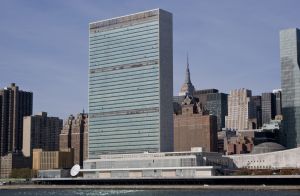
Google has over 300 million referenUN buildingces to Agenda 21, yet it’s hard for most people to get the truth about Agenda 21 because of the truckloads of smoke and misinformation generated by government bureaucrats and the progressive media. This UN program is indeed real and it is an affront to our personal liberties.\Agenda 21 is supposedly designed to make the world “sustainable” by limiting human activities that environmental extremists believe are harming the planet. That may sound fine to many people – until they understand what it means in practice. In order to protect the environment, Agenda 21 instructs governments to micromanage virtually all human activity – which the governments either severely restrict, or regulate to the point that such activity can be minimalized.

A good case in point took place in California recently, which as has been widely reported, experienced a major three-year drought. In mid-March 2014, the Ninth U.S. Circuit Court of Appeals upheld federal guidelines that guaranteed minimal flow of the Sacramento River to benefit “endangered” Delta Smelt – totally neglecting the needs of local farmers. Most farmers are getting no water even though most of them have long-term contracts guaranteeing it to them.

Delta smeltIronically, the Delta Smelt have survived many severe droughts in the past when farmers got virtually all the available water from the Sacramento River. Yet today the smelt get the water and the farmers don’t – even though many of the farmers will not survive the cutbacks. Seeing the needs of nature as being in conflict with the needs of people is a principle that is at the very heart of Agenda 21.

This is no small matter. Thousands of workers are being put out of work in California, and up to 700,000 acres of prime farmland will be removed from production. Since one-third of America’s fruit and vegetables originate in California’s Central Valley, this means that food prices could jump as much as 3.5%. While that may not seem like much to the more affluent in our society, it could be devastating to seniors and the poor who may no longer be able buy essential fruits and vegetables.

Simply stated, the only way Agenda 21 can work is to deny private citizens their private property rights. This should surprise no one since the UN has maintained that “public control of land use is…indispensable” since the 1976 Habitat I Conference in Vancouver, British Columbia. Yet, recent research sponsored by the World Bank has shown that legally protected private property rights drastically reduce corruption, while establishing the foundation for wealth creation. This in turn also helps the environment as weathier nations spend more on environmental protection than poorer ones. The research stressed that “since these people do not have access to a comprehensive legal property system, they cannot leverage their assets to produce additional wealth.” The bottom line? “Nearly five billion people are legally and economically disenfranchised by their own governments,” reports the Bank.

The vast bulk of this is occurring, of course, in the developing world – but not all. The same thing is happening in the U.S. as Agenda 21 principles are adopted into policy. It has already had devastating effects. According to the Fraser Economic freedom wordsInstitute and CATO’s Economic Freedom of the World, the legal-system and-private-property-rights ranking for the U.S. plummeted from number one in 1980 to38th in 2011; which not unsurprisingly has occurred since Agenda 21 principles began to be implemented in the 1990s. The U.S. combined economic ranking in the world from 1980 to 2000 was second or third place behind Hong Kong and Singapore. It plummeted to 19th between 2000 and 2011—mostly due to federal spending, debt, skyrocketing regulations (especially from EPA) and, most importantly, loss of a stable legal system and property rights.

Is it any wonder the current “economic recovery” is so anemic. Certainly not all of the economic woes we have experienced since President Obama’s election can be blamed on Agenda 21 policy. But Agenda 21 is no doubt a big factor in ravaging the U.S. economy. Citizens can begin to restore America’s health by supporting rational candidates at every level of government that are committed to ridding this nation of Agenda 21’s “sustainable development” policy plague.

Mike Coffman

About the Author: Michael Coffman

Michael Coffman, PhD, is CEO of Sovereignty International and has worked to raise awareness about the UN Convention on Biological Diversity, one of the key goals of Agenda 21