Unreliable, Unaffordable Wind Turbines Sending Power Prices Skyward!

Wind Power Sending Power Prices Through the Roof

electricity-price-rise

The wind industry in Australia is still reeling at the RET Review Panel’s recommendation to prevent any more wind farms being built by closing off the ability of “new entrants” to participate in the Large-Scale Renewable Energy Target (LRET) (see our post here).

In response, the wind industry and its parasites have been frantically trying to salvage the RET – bombarding the Senate cross-benchers with propaganda and irritating members of the Coalition – especially Tony Abbott.

One falsehood being pedalled is their pitch that wind power is lowering retail power prices (see our post here).

The falling power price furphy must come straight from the same “play-book” used by the wind industry the World over – because it seems to pop up everywhere lately. Trouble is – it’s a complete fiction.

The places where giant fans have sprouted like mushrooms have all seen retail power prices skyrocket faster than those without.

Denmark, with more turbines per capita than anywhere in the world has seen power bills triple in the past 20 years. Germans – who have slung up thousands of giant fans in the last decade or so – have been belted with power bills that have increased by more than 80% since 2000. And Australia’s “wind power capital”, South Australia jockeys with Denmark and Germany for the “honour” of having the highest power prices in the World (see page 11 of this paper: FINAL-INTERNATIONAL-PRICE-COMPARISON-FOR-PUBLIC-RELEASE-19-MARCH-2012 – the figures are from 2011 and SA has seen prices jump substantially since then).

And it’s not just South Australians, the Danes and the Germans facing escalating power bills thanks to wind power. In the USA a number of States have been madly slinging up giant fans – with the inevitable consequence of spiralling electricity prices. Funny about that.

A little while back we covered a report by James Taylor on how those states in the US that have seen increases in wind power capacity are being belted by phenomenal power price increases – way above the National average (see our post here).

James is back with a piece that revisits the topic and brings the figures up to date – slamming wind industry claims about wind power reducing power prices; and creating millions of “green” jobs.

Electricity Prices Soaring In Top Wind Power States
James Taylor
Forbes
17 October 2014

Electricity prices are soaring in states generating the most wind power, U.S. Energy Information Administration data show. Although U.S. electricity prices rose less than 3 percent from 2008-2013, the 10 states with the highest percentage of wind power generation experienced average electricity price increases of more than 20 percent.

According to the U.S. Energy Information Administration (EIA), the 10 states in which wind power accounts for the highest percentage of the state’s electricity generation are:

Iowa – 27%
South Dakota – 26%
Kansas – 19%
Idaho – 16%
Minnesota – 16%
North Dakota – 16%
Oklahoma – 15%
Colorado – 14%
Oregon – 12%
Wyoming – 8%

The wind power industry claims switching from conventional power to wind power will save consumers money and spur the economy. However, data from the top 10 wind power states show just the opposite. From 2008-2013 electricity prices rose an average of 20.7 percent in the top 10 wind power states, which is seven-fold higher than the national electricity price increase of merely 2.8 percent.

The 2008-2013 price increases in the top 10 wind power states were:

Iowa – 16%
South Dakota – 25%
Kansas – 26%
Idaho – 34%
Minnesota – 22%
North Dakota – 23%
Oklahoma – -2%
Colorado – 14%
Oregon – 16%
Wyoming – 33%

With the sole exception of Oklahoma, every one of the top 10 wind power states saw its electricity prices rise at least 14 percent. For each of these states, electricity prices rose at least five times faster than the national average.

The electricity price increases in states producing the most wind power don’t tell the whole story. Federal and state taxpayer subsidies to wind power producers hide additional costs of wind power. The federal wind power Production Tax Credit (PTC), for example, gave wind power producers 2.3 cents for every kilowatt hour of wind power production last year. With U.S. retail electricity prices at 10.08 cents per kilowatt hour, the PTC allowed wind power producers to hide over 20 percent of wind power costs. This allowed the wind power industry to charge the American people still more money in backdoor tax bills, in addition to the higher retail electricity prices documented above.

Higher electricity prices in states producing the most wind power are taking a devastating toll on disposable incomes and the overall economy.

In Colorado, for example, electricity consumers spent $5.3 billion on electricity in 2013. Had Colorado electricity prices risen at merely the national average from 2008-2013, however, Colorado electricity consumers would have spent only $4.8 billion on electricity. That’s $500 million in excess electricity costs in 2013. If we divide that up among Colorado’s 2 million households, the extra electricity costs drained $250 from the average Colorado household in 2013.

In Minnesota, electricity consumers spent $6.4 billion on electricity in 2013. Had Minnesota electricity prices risen at merely the national average from 2008-2013, however, Minnesota electricity consumers would have spent only $5.4 billion on electricity. That’s $1 billion in excess electricity costs in 2013. If we divide that up among Minnesota’s 2.1 million households, the extra electricity costs drained $476 from the average Minnesota household in 2013.

In Kansas, electricity consumers spent $3.8 billion on electricity in 2013. Had Kansas electricity prices risen at merely the national average from 2008-2013, however, Kansas electricity consumers would have spent only $3.1 billion on electricity. That’s $700 million in excess electricity costs in 2013. If we divide that up among Kansas’ 1.1 million households, the extra electricity costs drained $636 from the average Kansas household in 2013.

The wind power industry’s fallback position is wind power benefits state economies, despite rapidly rising electricity costs, because the switch from conventional power to wind power generates jobs within the wind power industry. This argument, however, amounts to nothing more than a misleading head-fake. Shifting electricity production from conventional power to wind power does not create any net new jobs – it merely shifts jobs from one sector (conventional power) to another sector (wind power). Jobs created in the wind power industry come at the price of eliminating jobs in the conventional power industry.

Worse yet, the jobs shifted to the wind power industry fail to equal the number of jobs eliminated in other sectors of the economy for two important reasons.

First, wind power employs very few workers. After the tremendous start-up costs necessary to build wind turbines and place them in industrial wind farms, operational wind power facilities employ few workers. Nor does wind turbine manufacturing adds many jobs in top wind power states. Of the world’s top 10 wind turbine manufacturers, only one is located in the United States. Wind turbine manufacturing jobs are created in places like Germany, Denmark, and China more than in the United States.

Even among the top seven manufacturers of the wind turbines that are deployed in the United States, only one is located in the United States.

By contrast, conventional power plant operation requires far more workers than wind farms. More jobs are created in the conventional power industry even while electricity production costs go down. And unlike wind power jobs, nearly all U.S. conventional power plant manufacturing and operational jobs go to American workers – and especially to workers within the resident state of the conventional power plant.

Second, higher electricity prices caused by wind power kill jobs throughout the entire state and national economy. For example, when the average household in Kansas spends an extra $636 on electricity each year due to unnecessarily high electricity prices, that means the average Kansas household spends $636 less on other goods and services. The aggregate effect of such reduced spending in the Kansas economy (equaling $700 million in Kansas economy-wide reduced spending in 2013) eliminates thousands of jobs that would otherwise be created or sustained throughout all segments of the Kansas economy with higher consumer spending.

Any way you cut it, wind power is needlessly raising living costs, reducing living standards, and destroying American jobs. Fortunately, states can easily rectify the problem by repealing renewable power mandates and taxpayer subsidies that perpetuate higher electricity costs and widespread job destruction.
Forbes

Jame’s brilliant analysis applies with equal force in Australia. The LRET has cost Australian power consumers around $9 billion so far; and will cost a further $50 billion between now and 2031, when the scheme (or, rather scam) expires (see our post here).

STT hears that the Coalition – alive to this brewing political disaster – is muscling up in an effort to do a deal with Labor that would see the price of Renewable Energy Certificates – the life-blood of the wind industry – plummet.

The main ingredients of the deal being proposed are that the current LRET target of 41,000 GWh (set to run annually from 2020 to 2031) would become a “true” 20% target, relating to actual demand in 2020 – which will end up somewhere between 23,000 and 26,000 GWh.

Where, in 2010, the RET was split into the Small-Scale Renewable Scheme (SRES) and Large-Scale RET (LRET) the plan is to bring both under the same roof, so that the certificates issued under the SRES (STCs) would be used by retailers to satisfy the LRET.

The new (reduced) LRET target would bring into account behind the meter solar: meaning power generated by rooftop solar, heat pumps and solar hot water systems – power used up by households, not being fed into the grid and not currently included in the SRES target (behind the meter solar is currently producing around 1,000-2,000 GWh annually). More generally, rooftop solar fed to the grid (currently producing around 7,000 GWh annually) would be also included in the LRET. All of this would be included – taking domestic solar’s total contribution to the target to around 9,000 GWh annually – and go towards satisfying the reduced LRET target.

Then there’s “old” hydro: hydro generation capacity built before 1998, which is excluded from the LRET; meaning the operators do not receive RECs at all.

Clive and his  PUPettes, take note - there are cheaper ways of abating carbon and saving job.

This stands as a travesty for Tasmanians – like PUP Senator Jacqui Lambie, who rails at the fact that – despite almost 100% of its power coming from hydro – because 95% of it is “old” hydro – only 5% is eligible to receive RECs. As a result, Tasmanian retailers will have to purchase millions of RECs from wind power outfits on the mainland or, otherwise, be whacked with the $65 per MWh shortfall charge – both of which will be added to Tasmanian retail power bills. Seems unfair, but that’s the LRET.

STT hears Jacqui is pulling out all stops to see that Tasmania’s “old” hydro gets included in the LRET, with RECs going to Tasmanian hydro generators (for a taste of Jacqui’s fury, see her press release here). In that event, Tasmania would satisfy the target in an eye-blink.

Which leads to a bigger question as to why – so far – “old” hydro hasn’t been included in the LRET?

STT hears that hydro is back on the Coalition’s LRET radar – with the announcement that some 27 dams have been slated for construction, expansion or upgrading all over the Country. A number of these have hydro generation potential, including the Apsley dam in NSW – the Nullinga dam; and the Burdekin Falls dam expansion in QLD – and the Wellington dam in WA.

Any new hydro capacity would be entitled to participate in the LRET and receive RECs.

If the Coalition can’t get any changes to the LRET target through the Senate, the current target will stand and it will not be satisfied; which leads back to the treatment of “old” hydro under the LRET.

With Tony Abbott making no secret of his desire to scrap the RET outright, NO retailer is going to sign a Power Purchase Agreement with a wind power outfit; and, without a PPA, hopeful developers will never get the finance needed to construct any new wind farms.

This means that – in a few short years – as the annual target for the LRET starts to rocket towards its ultimate 41,000 GWh target – power prices will skyrocket under the weight of the shortfall charge – simply because there will be a shortfall in renewable energy production of around 18,000 GWh (see our post here).

Whichever side is in charge of the Federal government at the time the target starts to bite (around 2017), it will be pilloried for setting up the addition of some $15 billion to power consumers’ bills by way of the shortfall charge levied on retailers – but doing so with: NO additional renewable energy; NO “break-through” on-demand renewable energy technologies; and NO reduction in CO2 emissions.

With that political time-bomb already ticking, the need to avoid the LRET simply turning into a great big toxic tax on all power consumers is starting to sharpen the focus of Coalition MPs.

With political suicide looming on the not-too-distant horizon, the temptation to satisfy the escalating (current) annual target set by the LRET by including “old” hydro will become irresistible.

By bringing in “old” hydro now, the Coalition would avoid the imposition of the shortfall charge altogether; would “flood” the REC market, causing REC prices to crash; and with a REC price anything less than $40, would choke off any further investment in wind power.

And the Coalition would make a life-long friend in Jacqui Lambie, whose Senate vote is one that they need to pick up whenever the Greens-Labor Senators unite to block legislation passing the upper house.

STT thinks that if Tony Abbott doesn’t get his wish of scrapping the LRET outright, the Coalition will be left with no choice but to bring “old” hydro under the LRET. In that event, the current target will be satisfied in a heartbeat; the REC price would plummet; and the wind industry would grind to a halt.

In the longer term, the RECs issued under the SRES and LRET are lined up to be amalgamated with Carbon Credits Units issued under the Coalition’s Direct Action policy – with the price of credits likely to trade around $8-10 (see our post here) – or, if Clive Palmer has his way, the CCUs will be priced at exactly ZERO (see our post here).

STT thinks that, whichever way you slice it, the wind industry is in for an old fashioned Snowy Scheme soaking.

snowy hydro

Wind Energy…Not Only Unnaffordable, but does NOTHING to improve our Environment!

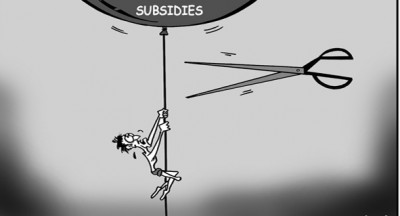
Pac Hydro Write-Down Proves Wind Farms Don’t Run on Wind, they Run on Subsidies

subsidies

Remember all that huff and puff put out over the last few months by the Clean Energy Council and near-bankrupt wind power outfit, Infigen about wind power becoming so cheap as to be competitive with coal and gas fired generators?

You know, the fantastic tales about wind power causing a reduction in Australian retail power prices?

Never mind, that nowhere in Australia have retail power prices decreased; and that – thanks to its ludicrous efforts to “rely” on wind power – South Australians pay the highest retail power prices in the world (see our post here).

In a “hey, quick look over there” approach to media manipulation, the CEC and its clients bang on about the effect of wind power on the wholesale market (on those rare occasions when the wind happens to be blowing, of course – see our post here) – while steering well clear of the actual cost of wind power to retailers.

These hucksters never talk about the prices fixed under Power Purchase Agreements with retailers – set at $90-120 per MWh versus $30-40 for conventional power – and recovered from retail customers, irrespective of the wholesale price (see our post here); and they run a mile from any mention of the Renewable Energy Certificates that get directed to wind power outfits; that have added $9 billion to power bills already; and that will add $50 billion to Australian power bills over the next 17 years, if the Large-Scale RET remains in place (see our post here).

No, the wind industry’s main pitch over the last few months has been that it’s delivering a “stand-alone” product at a price which is lower than its conventional generation “competitors” (see our post here).

Now, if there was a just a whiff of substance to the wind industry’s spin, then you’d think the industry would welcome the chance to stand on its own two feet – and jump at the opportunity to finally take on coal and gas generators in a head-to-head battle that the wind industry (with its abundant source of “free” fuel) is just bound to win, right?

But, hold the phone. It seems all that wind industry talk was … well …, just “talk”.

Despite all that chest-thumping and “big-boy” posturing, the wind industry turns out to be a sooky little mummy’s boy, after all. Here’s The Age stripping away a little of the wind industry’s false bravado.

Pacific Hydro write-down
The Age
Tim Binsted
6 October 2014

Heavyweight fund manager IFM Investors has taken a $685 million write-down on its Pacific Hydro renewable energy business due to the adverse impact of the Abbott government’s Warburton review, weaker electricity demand in Australia, and tax changes in Chile.

IFM Investors has $50 billion in assets under management and is owned by 30 pension funds with more than 5 million Australian members, including funds such as AustralianSuper, Cbus and HostPlus.

The hefty valuation changes to Pacific Hydro – which has hydro, wind, solar and geothermal projects in Australia, Brazil and Chile – were driven partly by businessman Dick Warburton’s review into the renewable energy target. His report is with the government for its consideration.

IFM Investors chief executive Brett Himbury said the review had undermined confidence for renewable energy investors.

“There’s two primary factors [impacting the Australian assets]: a lowering of energy demand and uncertainty around the current laws,” he said.

“It’s a great shame that at a time when the likes of President Obama are saying there’s no bigger challenge for the globe than climate change, we’ve got this policy uncertainty.”

On August 28, the Warburton RET review made two recommendations to the government: either allow the large-scale RET to continue to operate until 2030 for existing and committed renewable generators, but close it to new investment, or modify the fixed target for 20 per cent renewable energy by 2020 to a “real 20 per cent” of actual electricity demand.

Both of these outcomes would be negative for the renewable energy sector. Pacific Hydro has assumed a “20 per cent real” RET in its valuation.

The “real target” would reduce the annual production of renewable energy in 2020 from 41,000 gigawatt hours to about 27,000GWh.

Compounding the sector’s woes, the Australian Energy Market Operator in June made big cuts in its annual forecasts for electricity demand over the next decade.

The combined impact of lower anticipated energy demand and assuming a “20 per cent real” RET have hit the valuation of Pacific Hydro by $220 million.

“We’d like to see continued commitment to the current bipartisan agreed target and more broadly as investors we’d prefer to see a relatively certain [regulatory] environment,” Mr Himbury said. “As long-term investors you’d like to think that there is economic value in renewable energy, but what we need is clarity and certainty.”

Infigen Energy boss Miles George has previously warned that an overhaul of the target would be “disastrous” for the industry and push investment overseas.

Infigen, one of Australia’s biggest wind farm operators, has warned it could breach its debt covenants within three months if the RET is wound back without compensation for investors.

The renewable energy industry has warned any moves to scrap the target would jeopardise $15 billion in renewable energy investment.

The RET review also contributed to a further $60 million write-down on the value of the company’s development portfolio in Australia and South America.

“Under the current environment it wouldn’t be economic to bring the development book to market. There’s a knock-on effect that could impact thousands of construction jobs,” Mr Himbury said.

Grattan Institute energy director Tony Wood said the proposed Warburton RET changes were not just a headache but entering “serious migraine territory” for anyone exposed to renewable energy investments.

“It’s not like a slight change in the offside rule in AFL or NRL. This is changing the game,” he said.

“Existing projects are almost certainly not making money at the moment. The REC [renewable energy credit price] is suppressed because there is an oversupply of credits, and renewable energy itself has suppressed the wholesale [energy] price. It’s good for consumers but it hurts the return on capital.”

Underscoring the dangers of regulatory change, Pacific Hydro’s Chilean assets have taken a $210 million hit after tax reforms proposed by Chilean President Michelle Bachelet were approved by the country’s congress.

The reforms include a rise in the base corporate tax rate from 20 per cent to 25 per cent by 2017 and an increase in the stamp tax payable on financing proceeds from 0.4 per cent to 0.8 per cent.

Chilean hydro generation has also been hurt by prolonged drought in that country.

Primarily as a result of the Pacific Hydro write-downs, IFM’s mammoth Australian Infrastructure Fund is expected to decline in value by about 5 per cent for the September quarter. This is a major hit given infrastructure investments are supposed to be stable, defensive assets for the long term.

IFM will host an investor briefing, with a special focus on Pacific Hydro, on October 7.

The fund manager is undertaking a strategic review of Pacific Hydro called Project Primavera that is expected to be completed by the end of the year.

The RET was introduced with bipartisan support by the Howard government in 2001 and was expanded by the Labor government in 2009.

According to its 2013 report, Pacific Hydro has 18 operating assets, employs 294 people and generates annual revenues of $224 million.
The Age

There. Pac Hydro’s write-down proves it: wind farms don’t run on wind, they run on subsidies (see our post here).

The wind industry was created by the mandated target set by the LRET – and the $billions worth of RECs directed to wind power outfits at power consumer expense, issued under it.

Without the guaranteed transfer of $billions worth of RECs, wind power outfits would be out of business in a heartbeat – which explains the wind industry’s desperation to maintain the mandatory LRET at all costs.

It also explains why wind industry rhetoric never seems to match reality. Or, as the Americans put it, why “money talks, and bullshit walks.”

cow_dung

Waubra Foundation Speaks About Health Risks From Wind Turbines!

Wind farms: NEW HEALTH WARNING issued

eol-torture

The Waubra Foundation warns again wind turbine manufacturers, developers, acousticians and governments worldwide

waubra-logo
http://waubrafoundation.org.au/

Important letter date august 10th 2014 from Waubra Fondation to Ms Katarina Dea Zetko,
Civil Initiative for the Protection of Senožeška Brda (Slovenia):
http://www.senozeska-brda.si/

“In my opinion, based on my first hand knowledge of what has happened to wind turbine neighbours in Australia and elsewhere internationally, this is a recklessly irresponsible and dangerous plan and will inevitably result in serious adverse health effects for citizens of Slovenia who are neighbours of such turbines, out to significant distances. This is happening around the world, and I know of no reason why Slovenian citizens will not have the same adverse health impacts being reported internationally.
Breaches of UN Convention Against Torture
Decisions made by public officials to approve such an unsafe development, or to allow a development to continue to operate in spite of directly causing adverse health consequences such as sleep deprivation and “sensory bombardment from noise”, could be held to be breaches of the UN Convention Against Torture. Both “sleep deprivation” and “sensory bombardment from noise” have been acknowledged as methods of torture by the Physicians for Human Rights. The UN Committee Against Torture has also specifically acknowledged that sleep deprivation is used as a method of torture”.
Download letter here

Windweasels Lie about Noise they are Creating With Their Useless Wind Turbines!

Moyne Shire Council Rubberstamps AGL’s Macarthur Wind Farm Noisewash

Rubber_stamp_stand

The nightmare that is AGL’s Macarthur wind farm began operating in October 2012 – the first 30 fired up then.  All 140 giant 3MW Vestas V112s kicked into gear in about February 2013.

Ever since, the locals have been driven absolutely insane with incessant low-frequency noise and infra-sound.

AGL (aka “Australia’s Greatest Liars”) have been running interference in relation to noise problems from the very start.

The incompetent bunch of goons that they hired to do the acoustic work lost and fudged data and, when challenged about data that went missing, blamed flat batteries more than once.

Macarthur residents hired their own careful, independent acoustic engineers to do proper methodical studies into noise impacts, which included full spectrum testing – something that AGL and its pet acoustic consultants have not done and will never do.  The low-frequency testing done by AGL used the same method discredited by Steve Cooper a while back.

STT has seen the work done by the locals’ acoustic experts and – without a shadow of a doubt – it demonstrates that the noise levels generated do not and will never satisfy the noise conditions of AGL’s planning consent.

Now AGL have managed to get the Moyne Shire Council to rubber-stamp its acoustic white-wash in order to allow it to claim compliance with the noise conditions of its planning consent. But the lawyers for the Council – as well as the outfit charged with reviewing AGL’s noise report – had trouble working out what the “vague” and “unduly complicated … wording of the planning permit” actually meant, so advised that the best way to determine compliance was with a vote on it, according to the Council’s Agenda:

As Maddocks have advised, (Confidential Attachment 6) the noise compliance issue for the Macarthur Wind Farm has been unduly complicated by the wording of the planning permit. For example, the permit wording is so vague it is unclear whether Council is required to make a resolution regarding noise compliance. However in order to be transparent and to act in the most appropriate manner as the responsible authority, Maddocks recommends to Council that a resolution is the best means of addressing the noise compliance issue.

There. Isn’t it so much simpler when sticky situations that might see a wind farm operator called to account are settled on a show of hands. Settled that is, by people who aren’t acoustic experts and don’t, apparently, even know what the terms of the noise conditions they’re meant to be applying mean (their lawyers didn’t). And, instead of being “transparent”, the Council kept the correspondence from its lawyers pointing out that the conditions were “unduly complicated” and “vague” confidential (Attachment 6). So much for open and transparent government.

When it came to the Council meeting AGL didn’t have it all its own way. Former Mayor, Councillor Jim Doukas ripped into AGL and gave his fellow members a right-royal-rocket for their complicity in allowing AGL to operate with impunity.

Moyne councillor slams Macarthur wind farm noise review
The Standard
Anthony Brady
25 September 2014

A MOYNE Shire Councillor has hit out at the operators of the huge Macarthur wind farm, saying they should be “tied to a tree and flogged with a whip”.

In a fiery address to the council’s meeting on Tuesday night, Cr Jim Doukas refused to accept a peer review commissioned by the shire which found company AGL was operating the 140-turbine wind farm within noise guidelines.

“It is the biggest load of garbage I’ve ever read in my life and AGL should be tied to a tree and flogged with a whip,” Cr Doukas said.

He said the noise readings taken by AGL’s consultants were “insignificant” and “outside the guidelines” and questioned how a peer reviewer could find them compliant.

“For anyone who reads this and says this is a fair and honest report is just not right and should be ashamed.  “We as a council should not make the determination on the report here tonight. We haven’t gone out to the public.

“No one in Australia who is involved in the wind energy industry, whether they support it or not, has had the chance to look at this and make comment and I think there are wiser heads out there than ours.

“As for those who are objectors, they are entitled to make comment and address council on the issue.

“If we support this tonight we deny them their right and I don’t think that’s right. We are shoving it down their throats and forgetting about the community and, for me, that’s just not on.”

But Cr Mick Wolfe disagreed with the outburst, saying people had already had a chance to comment.

“It’s time for this to go through. We’ve got our report and it’s been reviewed, the facts are in there,” Cr Wolfe said.

“We’ve heard from others alleging corruption, fraud, failure — you name it.

“Everything that AGL or the testers try to do that’s not in favour of the opponents they slam them with some pretty serious allegations.

“They (the opponents) have had a chance to come to any council meeting and show us their data.

“They are hiding it, they are holding it and not releasing it and I don’t know why. Come forward with it.”

The council agreed with the report’s findings that the wind farm is complying with noise levels, but has called for further monitoring within 12 months.

This follows advice from the peer reviewer that noise emissions can change over time as faults develop within the turbines and parts need replacing.

A spokeswoman for AGL yesterday welcomed the council’s confirmation of the report.

She said AGL had already carried out more than 40,000 hours of noise monitoring at Macarthur which was “well beyond” the level required under the shire’s planning permit.
The Standard

jim doukas

Compliant or not, the suffering caused by AGL’s turbines is real; and was documented by STT Champion, Anne Schafer in a community survey.  Here’s a link to the survey. And see our post here.

One of AGL’s numerous victims, STT Champion Annie Gardner wrote this cracking letter to the Editor of The Standard – praising Jim Doukas for doing his job; and slamming the goats that pass for local government representatives for failing to do theirs.

To the Editor,
The affected residents of this district are extremely grateful for the unconditional support given by Councillor Jim Doukas (“Moyne Councillor slams Macarthur wind farm noise review 25.9).

Unfortunately the same cannot be said of the remainder of Moyne Shire Council who have been elected with a duty of care to protect the health of ALL residents.

Moyne Shire Council are in receipt of hundreds of health complaints as a result of the acoustic emissions from the turbines at the Macarthur wind farm, but have done NOTHING to protect us from this serious harm to our bodies.

As Councillor Doukas rightly claims, we have been denied our right to comment on the noise peer review. I have requested on several occasions to have a copy of this peer review forwarded to me, but these requests have been constantly denied by a council withholding information.

Councillor Wolfe shows his ignorance when he claims residents have had plenty of time to address council and hand over our noise data. It is not that simple, as any lay person isn’t able to comprehend acoustic data, and I doubt any councillors would be trained in acoustics.

Just prior to the council meeting on Tuesday, when Moyne Shire finally released the peer review report, I requested Council forward to our independent acoustic expert, all documentation relating to the peer review, in order that he may compile a report to immediately present to Council. This report, with additional damning evidence, will prove that the Macarthur Wind Farm is NOT COMPLIANT with government noise guidelines.

I also requested Council defer confirming compliance of the wind farm, until our acoustic expert is able to present his report to the Council. This request was obviously ignored.

In the name of openness and transparency, surely Moyne Council could have waited to read the resident’s acoustic expert report which will surely blow any claim of compliance of the Macarthur wind farm, out of the water.

We ask Moyne Shire, WHERE HAS DEMOCRACY GONE?

ANN and ANDREW GARDNER
PENSHURST,   Victoria

annie-gardner

Wind Turbines Monitored by Unbiased Sound Experts Prove Noise Levels are Intolerable!

Hansen, Zajamsek, Hansen, Noise Monitoring, Waterloo Wind Farm

Noise Monitoring in the Vicinity of the Waterloo Wind Farm

Kristy Hansen, Branko Zajamsek and Colin Hansen, School of Mechanical Engineering
University of Adelaide May 26, 2014

This report by the above authors describes the results of their concurrent full spectrum acoustic monitoring conducted at a number of homes located between 2 km out to nearly 10km from the Waterloo Wind Development. This monitoring was independent of the South Australian Environment Protection Authority (SA EPA) and was requested by Mrs Mary Morris and other concerned residents in the Waterloo district. The monitoring occurred during the period of the South Australian EPA Acoustic Survey, conducted in mid 2013.

The results in this independent survey as well as the conclusions are in marked contrast to the results and conclusions of the SA EPA Acoustic Survey report, and reinforce the Waubra Foundation’s opinion expressed at the time the initial SA EPA report was released that there were serious problems with the methodology used by the SA EPA in its acoustic survey at Waterloo. This report provides further evidence that the current SA EPA Wind Farm Noise Guidelines do not protect the health and sleep of the neighbours to these wind developments, out to nearly 10km from the closest wind turbine, because they do not regulate the acoustic emissions to protect health, and most importantly, the sleep of the neighbours.

Emeritus Professor Colin Hansen has advised that he sent the report to the EPA, requesting their comment. To date, three months later (19th August, 2014) no comment or feedback has been received by the Adelaide University researchers from the SA EPA responsible public officials.

Extract from the Conclusions:

“Therefore, the results show that there is a low frequency noise problem associated with the Waterloo wind farm. Therefore, it is extremely important that further investigation is carried out at this wind farm in order to determine the source of the low frequency noise and to develop mitigation technologies. In addition, further research is necessary to establish the long‐term effects of low frequency noise and infrasound on the residents at Waterloo. This research should include health monitoring and sleep studies with simultaneous noise and vibration measurements.”

Key Extracts from the report are reproduced below, and the report is downloadable from the link beneath.

1 Introduction

This report details independent noise measurements and their analysis taken in the vicinity of the Waterloo Wind Farm during the period 9/4 – 22/6, which is the same period as the study undertaken by the EPA and reported in EPA (2013). Measurements were taken outside of as well as inside a number of residences. Due to the potential for data contamination by background noise during the day, only data measured between midnight and 5am are reported here, as during those hours, the dominant noise source was generally the wind farm. The following sections of this report detail the measurement equipment, measurement procedures, data analysis and data interpretation, followed by a conclusion summarising the results detailed in the rest of the report.

The data analysis and interpretation comprises four sections:

  • overall levels averaged over 10‐minutes for all night‐time data collected at each residence;
  • unweighted third‐octave spectra and overall levels for the shutdown periods;
  • unweighted third‐octave spectra and narrowband spectra for measurement times corresponding to noise diary entries; and
  • unweighted and A‐weighted third‐octave spectra for measurements which exceeded 40 dB(A).

2 Measurement Details

Three B&K 4955 microphones were used for the indoor measurements. These microphones have a low noise floor of 6.5 dB(A) and a flat frequency response down to 6 Hz. While these microphones do not have a flat frequency response below 6 Hz, they are still capable of measuring the blade‐pass frequency and harmonics (Hansen, 2013). The microphones were connected toLANXI hardware and continuous 10‐minute recordings were made using Pulse software. The average sound pressure level of the three microphones was calculated in accordance with the Danish guidelines for indoor low‐ frequency noise measurements (Jakobsen, 2001). This average includes one microphone positioned in the room corner. In this position, the maximum sound pressure level would be measured since this is an anti‐node for all room response modes. A singleGRAS 40AZ / SV 17 microphone was connected to a SVAN 979 sound level meter. This microphone was used as a back‐up and check for the indoor measurements made with the Pulse system.

The outdoor measurements were made using GRAS 40AZ / SV 12L microphones connected to aSVAN 958 sound level meter, which measured continuously over 10‐minute intervals. The microphones have a noise floor of 17 dB(A) and a flat frequency response down to 0.8 Hz. Hemispherical secondary windshields were used to minimise wind‐induced noise experienced by the outdoor microphones, and they were designed to be consistent with the IEC 61400‐11 standard, which specifies the use of these secondary windshields for measurements close to a wind turbine. A spherical secondary windshield and box windshield with specifications described in Hansen (2013) were also used for comparison but these results are only presented in the narrowband analysis in Section 6.2. Wind speed and direction were measured at heights of 1.5 m and 10 m using Davis Vantage Vue and Vantage Pro weather stations, respectively. The weather measurements were collected in 5‐minute intervals and then the 10‐minute average was calculated during post‐ processing.

3 Guidelines

It is well known that wind farm noise is dominated by low‐frequency energy (Moller & Pedersen, 2011), particularly at large distances from the wind farm, where the high‐frequency noise has been more attenuated than the low‐frequency noise. As such, a number of different weighting functions have been applied to the data in Section 4 to highlight different characteristics of the noise. A detailed description of these weightings and their applications is given in the report by the EPA(2013). This section provides a brief analysis of the limitations of some of these weighting functions in the context of wind turbine noise. Additionally, some drawbacks of the current SA EPA guidelines (EPA, 2009) are discussed and recommendations for improvements are suggested.

In South Australia, compliance of a wind farm is determined based on the applicable outdoor limit specified in the SA EPA guidelines (2009). Most of the measurement locations detailed in this report correspond to “rural industrial” zones where the allowable limit is 40 dB(A). One of the township locations is situated in an area which has been zoned “township” according to the Clare and Gilbert Valleys Council regulations. For lack of additional information, it is assumed that this translates to “rural living” in the context of the SA EPA guidelines (2009), which has a corresponding outdoor limit of 35 dB(A). According to the EPA guidelines (2009), a compliance analysis requires collection of over 2,000 data points, with 500 data points recorded for the worst‐case wind direction. For the measurements outlined in this report, such a large amount of data were not collected at any one location, however it was still considered valuable to plot a regression curve to illustrate the degree of compliance over short periods as well. In any case, the use of night‐time data is expected to reduce the degree to which data are contaminated by extraneous sources, thus giving a reasonable estimate of the degree to which the wind farm is compliant.

The SA EPA guidelines also specify use of the LA90 metric, which is the A‐weighted noise level that is exceeded 90% of the time. It should be noted that wind farm noise can be significantly underestimated using LA90 levels due to the unsteady nature of the noise. Hence, the LAeq, which is the energy average of the noise, is considered to be a more realistic representation of the actual noise level attributed to the wind farm, particularly between midnight and 5am when there are very few other noise sources of a similar level to the wind farm noise.

Despite the fact that low‐frequency noise has been identified as a potential issue associated with wind turbine operation, the SA EPA guidelines (2009) do not provide guidance for acceptable levels of low‐frequency noise and infrasound, even though there are several recommendations available in the literature. For example, the C‐weighting can be used to provide an indicator of the presence of low‐frequency noise. According to Broner (2010), a night‐time limit of 60 dB© is recommended, and this limit was included in the NSW draft guidelines (2011). Low‐frequency noise can also be identified by finding the difference between the overall C‐weighted and A‐weighted levels. When LCeq – LAeq > 20, a potential low‐frequency noise problem is indicated, and Broner and Leventhall (1983) and DIN 45680 (1997) would recommend further investigation into the time‐dependent low‐ frequency noise characteristics including noise fluctuations, spectral balance and amplitude modulation.

The G‐weighting is used to indicate the level of infrasound. According to ISO 7196 (1995) and DIN45680 (1997), the audible threshold for the overall G‐weighted noise level is 85 dB(G). On the other hand, this does not preclude the possibility that lower levels of infrasound will have an effect on people (Salt & Lichtenhan, 2014).

The SA EPA guidelines (2009) suggest that the indoor A‐weighted noise level should not exceed 30 dB(A). According to the World Health Organisation night‐time guidelines (WHO, 2009), the no observed effect limit for outdoor noise is 30 dB(A). To quantify the low‐frequency contribution to the indoor noise, it is useful to refer to the Danish guidelines for indoor low‐frequency noise (DanishEPA, 1997) and the UK Department of Food and Rural Affairs criteria (DEFRA, 2005). The Danish limit considers A‐weighted levels in the frequencies from 10 Hz to 160 Hz and the limit is the calculated average of the sound pressure level measured at three different locations in a room. According to the Danish guidelines, the indoor noise level, LpA,lf in the frequency range from 10 Hz to 160 Hz should not exceed 20 dB(A). The DEFRA criteria are frequency dependent and also span the frequency range from 10 Hz – 160 Hz. The allowable limits for each third‐octave frequency bin in this range are specified in the relevant report (DEFRA, 2005). The specified limits can be relaxed for steady noise and for daytime measurements but the measurements in this report did not fall into either of these categories. It is well‐known that wind farm noise is an unsteady noise source due to sudden changes in wind speed/direction, inflow turbulence, wind shear (van den Berg, 2005) and directivity (Oerlemans & Shepers, 2009). It has also been found that wind farm noise is modulated at the blade‐pass frequency (Hansen et al., 2013), which causes a periodic variation in the loudness of the sound.

It is worth noting that wind farm compliance according to the SA EPA guidelines is based on a regression line fitted to 2000 or more data points plotted on a graph of noise level (dBA) (y‐axis) vs hub height wind speed (x‐axis). Each data point is a 10‐minute average, which means that the influence on people of a noise source that is highly variable in nature will be underestimated. In addition, many 10‐minute average data points are above the acceptable 35 or 40 dB(A) requirement and as compliance is based on the regression line only, these times of relatively high noise level are ignored. In other words, compliance with the EPA guidelines does not mean that noise levels will never exceed the recommended limits – in fact, they can exceed the recommended limits many times as can be seen by the graphs shown in this report. Furthermore, the 10‐minute average values are lower than the peak values, which means that the wind farm could generate high levels of intermittent noise and still be compliant.

It is also important to recognise that thresholds of audibility are not dependent on the 10‐minute average of the root mean square (rms) value of the noise signal alone. This type of analysis ignores any difference in character between the measured noise and the noise used in the laboratory to determine threshold levels. The main differences in character that are important include the presence of multiple harmonics of the blade passage frequency and the crest factor of the noise. The crest factor is the ratio of the peak noise level to the average (or rms) noise level. The measured average noise levels for wind farm noise have been shown to contain peaks that are up to 20 dB above the reported average level. Even for “compliant” wind farms, such peaks are well above the levels required to disturb sleep (according the 2009 WHO document, “Night Noise Guidelines for Europe”). It is also worth noting that traffic noise, on which the WHO document on night noise levels is based, is not characterised by such high crest factors and thus has less potential for disturbing sleep. Nevertheless, this is an area of future work for our research group and the purpose of this report is to provide an analysis similar to that carried out in the EPA study so that comparison can be made between the two sets of results.

4 Overall Noise Levels

The following section presents data that were measured at the same residences as the EPA study (EPA, 2013), as well as three additional residences. The North East residence is not included in the analysis as we were unable to measure inside at this location. A number of weighting functions have been applied to the data and where applicable, a linear regression curve has been included. The DEFRA criteria and the Danish guidelines for indoor low‐frequency noise have only been applied to the indoor data, as they are not considered relevant for outdoor noise.

The figures presented in this section show data plotted against the wind speed at a height of 10 m in the left hand column and data plotted against the wind speed at hub height in the right hand column. Data points shown in red correspond to times when the residence was downwind from the proposed wind farm, according to the definition that downwind is ±45from the direction of the residence relative to the wind farm. Data points shown in green indicate times where the wind speed at a height of 1.5 m was greater than 5 m/s. For such wind speeds, noise measurements can be contaminated by wind‐induced noise. The sources of wind‐induced noise are pseudo‐noise and acoustic noise. Pseudo‐noise is caused by turbulent pressure fluctuations and vortex shedding incident on the microphone which lead to false indications of the sound pressure level whereas wind‐induced acoustic noise arises when objects such as tree branches and leaves are put in motion by the wind. Pseudo‐noise is only relevant for outdoor measurements but wind‐induced acoustic noise is relevant to both indoor and outdoor measurements. Both indoor and outdoor measurements taken during periods of rain have been discarded from the analysis.

In this section, all plotted data corresponds to night‐time measurements made between 12 am and 5 am. During the night, people are trying to sleep and this time also represents the greatest contrast between ambient noise and wind turbine noise, due to the absence of other sources such as traffic and farming machinery. These times were also selected to minimise contamination from noise sources other than the wind farm.

8 Conclusions

Based on the findings in this report, the following conclusions can be drawn:

  • For the 50 Hz third‐octave band, the sound pressure level difference between shutdown and operational conditions can be higher than 25 dB for both outdoor and indoor measurements.
  • The noise level in the 50 Hz third‐octave band is often above the audibility threshold (ISO389‐7, 2005) when the wind farm is operating.
  • The peak in the 50 Hz third‐octave band would be classified as a tone according to some standards (NZS 6808:2010, 2010; ANSI S12.9 ‐ Part 4, 2005).
  • The allowable limits should be reduced by 5 dB(A) to account for such tonal noise.
  • The outdoor and indoor noise levels measured during the shutdown cases were consistently lower than those measured when the wind farm was operating.
  • The most significant differences between shutdown and operational conditions can be observed when the residence is downwind from the nearest wind turbine and the hub height wind speed is greater than 8 m/s.
  • The shutdown periods should have occurred during 12 am – 5 am when the contribution from extraneous sources would be minimised and the contribution from the wind farm more able to be quantified.
  • For all shutdowns reported here, the closest wind turbine to the residence did not reach its rated speed of 15 m/s. In most cases, the wind speed at hub height was significantly lower than rated speed for the shutdown and adjacent times.
  • The peak in the 50 Hz third‐octave band is a consistent feature of the noise diary results and is often above the audibility threshold (ISO 389‐7, 2005).
  • A narrow‐band analysis with frequency resolution of 0.1 Hz reveals distinct peaks at the blade‐pass frequency and harmonics for many of the results corresponding to noise diary entries.
  • The narrow‐band analysis also shows the existence of tones, which occur at 23 Hz, 28 Hz, 46 Hz, 56 Hz and 69 Hz.
  • These tones have several sidebands which are spaced at the blade‐pass frequency and allude to the occurrence of amplitude modulation.
  • There is a good correlation between low frequency noise events and complaints registered in noise diaries.
  • At many of the residences, there were many occasions during the hours of 12 am and 5 am where the outdoor noise level exceeded the SA EPA (EPA, 2009) criteria of 40 dB(A).
  • The indoor limit for wind turbine hosts of 30 dB(A) recommended by the SA EPA (EPA, 2009) was exceeded on many occasions between 12 am and 5 am. This is also the no observed health effect limit for outdoor noise according to the WHO (2009).
  • The range in the overall A‐weighted levels was noticeably large indoors and could be as low as 5 dB(A) and as high as 38 dB(A). The lower value highlights that the night‐time noise levels in this rural environment are sometimes so low that even low levels of wind turbine noise would be noticeable. It is plausible that the upper value is related to the presence of wind turbine noise.
  • It has been shown that there can be a large variation in the results obtained by considering the LAeq as opposed to the LA90, between the hours of 12 am and 5 am.
  • Since the number of extraneous noise sources is expected to be low during these night‐time hours and wind turbine noise can be highly variable with time, it does not seem justified to only consider noise levels which were exceeded 90 % of the time.
  • The C‐weighted level was often higher for downwind conditions and hub height wind speeds greater than 8 m/s. However, consideration of the overall level with respect to recommended limits did not prove useful in identifying any low frequency noise issues.
  • The LCeq ‐ LAeq criteria was often exceeded and there was a large scatter in the data.
  • The overall G‐weighted level of 85 dB(G) was never exceeded however this does not preclude the possibility that infrasound was not detectable.
  • The Danish low frequency noise guidelines were exceeded on a number of occasions. In general, the exceedences occurred for downwind conditions and hub height wind speeds greater than 8 m/s.
  • The DEFRA criteria were exceeded on multiple occasions, usually corresponding to downwind conditions and hub height wind speeds greater than 8 m/s.

Therefore, the results show that there is a low frequency noise problem associated with the Waterloo wind farm. Therefore, it is extremely important that further investigation is carried out at this wind farm in order to determine the source of the low frequency noise and to develop mitigation technologies. In addition, further research is necessary to establish the long‐term effects of low frequency noise and infrasound on the residents at Waterloo. This research should include health monitoring and sleep studies with simultaneous noise and vibration measurements.

Download the complete report of the acoustic survey by Hansen, Zajamsek and Hansen →

For access to the SA EPA Waterloo Acoustic Survey 2013, and documents expressing concerns which have been raised about that acoustic survey, please seehttp://waubrafoundation.org.au/resources/waterloo-wind-farm-environmental-noise-study-sa-epa/

Careful reading of the UN Convention Against Torture makes it very plain that public officials who know of the damage to human beings and allow it to continue could be facing criminal charges (sleep deprivation is acknowledged as torture by a number of bodies including the Committee Against Torture http://waubrafoundation.org.au/resources/un-convention-against-torture/ and also the Physicians for Human Rights — see pp 22 — 26 of their report called “Leave no Marks” http://physiciansforhumanrights.org/library/reports/leave-no-marks-report-2007.html

The Waubra Foundation advised the Clean Energy Regulator (CER) Board members over a year ago about the damage to human health from proximity to wind turbines — and their response was that they preferred the explanation that it was a Nocebo effect:http://waubrafoundation.org.au/resources/letter-notice-clean-energy-regulator-5-april-2013/

Consequently in 2013 the Waubra Foundation advised both South Australian Premier, Jay Weatherill and the Chair of the CER, Ms Chloe Munro of the Foundation’s concerns about the Waterloo Acoustic Survey — neither of whom responded to the letter:http://waubrafoundation.org.au/resources/open-letter-premier-south-australia-clean-energy-regulator-concerning-sa-epa-acoustic-survey-2/

Angus Taylor…..An Australian Hero! Putting Windweasels on Notice!

The Wind Industry’s Worst Nightmare – Angus Taylor – says: time to kill the LRET

Nightmare (1962) Jerry wakes up

Member for Hume, Angus “the Enforcer” Taylor has taken the lead on behalf of the Coalition in Tony Abbott’s quest to bring the wind industry to its knees. While there’s been a lot of huff and puff emanating from Ian “Macca” Macfarlane and his faithful ward, young Gregory Hunt about saving the mandatory RET with magical “third ways”, STT says keep your eyes focused on Taylor and the PM.

To give you some idea of where Taylor is coming from – and where the wind industry is headed – here’s an interview he gave last week (9 September 2014) on Sky News (transcript follows).

*****

http://blob:https%3A//www.youtube.com/fe2546b4-a7de-461e-8946-528eaf70770e

*****

Graham Richardson: Angus Taylor is the member for Hume, and he’s in our Canberra studio. G’day Angus how are you?

Angus Taylor: G’day Graham.

Graham Richardson: Now I’ve got to say that if I was a minister, I’d be looking behind me and saying there’s a Rhodes scholar on the backbench, we can’t have him there for long. I mean, you’d have to get, you’d have be promoted – I don’t see how they can keep a Rhodes scholar on the backbench.

Alan Jones:  He is a patient man, he’s a farmer’s son. He’s a patient man. Angus, just explain to us would you, in layman’s language, what is the Renewable Energy Target.

Angus Taylor:  Alan, it’s a scheme designed to increase the level of renewable electricity in Australia. And the way it works in practice is it gives big subsidies to renewable projects and it builds those subsidies into our electricity prices ….

Alan Jones:  Sorry to interrupt you – go even simpler – the Renewable, Angus, a renewable project – just explain what a renewable project is.

Angus Taylor:  Well, so there are two schemes, the large scale scheme, which is essentially wind – there is a bit of hydro in there but no new hydro. So that’s the large-scale scheme and that is the majority of it. That’s about 90% of the total. And then there is the small scale scheme which is largely rooftop solar. So they’re the two schemes, and we pay for those big subsidies in our electricity prices, in our bills – they’re not transparent.

Alan Jones:  And that energy is infinitely dearer to produce than coal-fired power so isn’t it fair to say that without massive subsidies, these outfits couldn’t survive. Now if the government is not going to give money to the motor vehicle industry, and it’s not going to give money to SPC Ardmona, why is it giving billions of dollars to Qatari owned wind turbines?

Angus Taylor:  Well that’s a good question. I mean we’ve just had a review of this, led by Dick Warburton, and what the review concluded was that these are expensive schemes, very expensive schemes, but as importantly they’re very expensive ways to reduce carbon emissions. They did come to different conclusions on solar and the large-scale, the wind subsidies, and what we know is rooftop solar in remote areas can be economic, but large-scale wind it’s very clear that it’s not economic on any grounds.

Graham Richardson: If it is not economic, tell me how uneconomic is it? How much dearer? You know, is it 50%, is it 80% dearer than coal-fired power? How much?

Angus Taylor:  Well, put it in perspective. A wind project to get investment will probably need a price somewhere in their long-term contract of somewhere close to $100. And we’re buying electricity now, wholesale electricity at about $30 a megawatt hour. So say three times is a good rule of thumb … What we also know is the cost of reducing carbon emissions this way – it’s something like $60-70 and of course the carbon tax was far less that and we think still way too high.

Alan Jones:   Let’s just go  … just go to where our viewers are involved in all of this. Let me just ask you a simple question, right, I’m a big Qatari investor, because I know that Australians are suckers, we know the Australian government is just shelling out money, now I come from Qatar and I want to build wind turbines and I’ve found this farmer, Angus Taylor in Goulburn and he’s got this a big hill out there – and I think this would be a good place to build wind turbines, so go to Angus Taylor and I say to him I want to put 70 wind turbines on your property. Just basically rule of thumb, how much would you expect to get from me, the big Qatari Guru, how much would you expect to get from me per wind turbine? And I want 70 of them on your farm.

Angus Taylor:  You’d get about 10 to 12 thousand dollars so if you going to have

Alan Jones:  So I kick in $700,000 to you, that’s right. So I build the 70 wind turbines. Enter the taxpayer. So I’m from Qatar, I’m a big wind power man, what’s the taxpayer going to fork out to me in order that I so-called ‘produce’ this wind power?

Angus Taylor:  Look on average you’d expect it to be about $400,000 per year, per turbine.

Alan Jones:  For 30 years.

Angus Taylor: In fact in the next few years – yes for 30 years (GR Wow). 400,000 per turbine.

Alan Jones: Start again

Angus Taylor: So if you had 70 turbines, that’s $28 million a year.

Alan Jones:   28 million on his farm – on his farm – 28 million – so the people watching you – say it again – I’m a Qatari I’m not even an Australian – $28 million a year for one farm. How the hell can this be sustainable?

Angus Taylor: For 70 turbines – and of course we are all paying for that in our electricity bills that’s how it’s coming through.

Graham Richardson:  Can I ask you Angus – at the moment what is the energy target and how close have we got to it?

Angus Taylor:  Right so the energy target is supposed to be 20% of total demand. It’s turning out that it is way above that. The unit is 41 terawatt hours – but what’s important is we’re overshooting the 20% target by a long way. Now the problem with that, the problem with that is from here on in, we would have to build a Snowy Mountains Scheme every year for the next 5 years to reach the target. That’s a Snowy Mountain every year, for the next 5 years to reach the target. And the target will take us well over the 20% mark. The reason it’s going to take us way over the 20% mark, which was the original target, we were originally set ourselves a target of 20%, the reason we’re going way over is that electricity demand has actually been going backwards in Australia and the expectation was it would keep growing. So we’ve got this very high target, huge amount of renewable capacity to be built to reach it, and it’s going to take us way over what we originally expected to do.

Alan Jones:   And Angus isn’t t fair to say that written into the budget there is an expenditure figure of $17 billion – 17 thousand million dollars, to build between 700 and 10,000 of these. Now can I just ask this? If the Abbott Government is not going to give money to SPC Ardmona, and if it’s not going to give money to the car industry – and out there is tax payer land they say, nor should they, why the hell are we subsidising Chinese and Qatari wind farmers jacking up the price of energy, pushing manufacturing out of business? Why are we doing it?

Angus Taylor:  Well, look this is the good question. We are paying these massive subsidies out in our electricity bills we are going way over the target we originally set ourselves and really what this is becoming now is just industry assistance, it’s becoming industry assistance and primarily for the wind industry.

Alan Jones:   It’s industry welfare on steroids.

Graham Richardson: How much investment goes into it? How much private investment goes into it?

Angus Taylor:  Well look, you know, it depends on what’s being built Graham but it is a big number, 17 billion is probably not a bad number to go with, which is the number that Alan mentioned earlier. So there’s a lot of investment- but remember what’s happening here – it’s not creating jobs, we’re actually taking jobs away from other places. In fact, Deloitte tells us that we’re actually going to lose in total 5000 jobs as a result of this – now we gain some in one place and lose them in the other, but the net, we are going to lose 5000 jobs and the reason for that is that it is inefficient investment – we are actually replacing electricity generation we don’t need to replace because demand is going backwards, not forwards. So this is costing us a lot.

Alan Jones:   Yes, it is costing us. Isn’t it valid to say – and it may be an oversimplification, you can either have a manufacturing industry, or a Renewable Energy Target – you can’t have both.

Angus Taylor:  Well, the other part of this, of course, is if it’s pushing electricity prices up, and in the next 5 years it’s likely to push them up quite a lot, if it’s pushing electricity prices up, not only is that hurting households, it’s hurting businesses in exactly the same way that the Carbon tax was hurting businesses. There’s no difference. It’s pushing up electricity prices and that’s hurting all of us.

Alan Jones:  But you said …

Angus Taylor: We’ve gone from being a low cost energy country to a high cost energy country and this is continuing to be one of the contributors. So if all of this was for a good purpose, if it was a cheap way to reduce carbon emissions, depending on your view on whether that’s a good thing to do, then you might be able to justify it. But it’s not and the Review Panel told us that very clearly.

Alan Jones:   Terry McCrann, the very experienced economist said many many years ago, if you want to de-carbonise the Australian economy, your writing yourself a national suicide note. Now here we are forcing manufacturing overseas, forcing jobs, Deloitte said that, up to 6000 jobs. Now at what point do we say to Macfarlane, you said it in the party room, Macfarlane is the Energy Minister, he said this week, there’d be no changes, there’ll be no changes, we’ll make no changes that damage or end the Renewable Energy Target. This is the Energy Minister. You’ve got a Rhode scholar here saying – hang on – this is an inefficient use of resources, this is welfare on steroids and you’ve got the Minister – don’t ask me what I think of that bloke – but you’ve got this Minister saying the exact opposite. What is the party room saying about this?

Angus Taylor: Look, there’s clearly some concerns about solar in the party room, but the overwhelming view of the party room has always been that we have got to contain electricity prices. There’s no question about that. I think, to be fair to the Minister, in the last 48 hours he’s made it very clear that he’s concerned about the rise in electricity prices we’re likely to see in the next few years. He’s made that very clear. You know, look if there’s one cause that we took to the last election, aside from stopping the boats, it was that we needed to contain electricity price increases. That was a view that the party room held…

Graham Richardson:  But the argument was … Angus , the trouble is you ran the argument about the Carbon tax being the cause and it was only a small part of the cause, so you actually didn’t really tell the truth about the Carbon tax, because I think it was about 9% and everybody tried to make it sound like it was a great deal more.

Angus Taylor:  Well, 10% on someone’s electricity bill Graham is a big number for the average Australian and remember the people who are hit hardest here are those are least well off, and energy-intensive businesses which have been the core of Australia’s strength over the years. So 10% impact on electricity bills, and we are seeing that come off now, now that the Carbon tax is gone, that’s a big deal, it’s a big deal for your average Australian and it’s a big deal for Australian businesses.

Graham Richardson:  If we dropped these massive subsidies, which by the way are far greater than I’d ever believed, what would be the effect on electricity prices then?

Angus Taylor:  Well look, it depends but it will be 3-5% over the next few years, but the real problem is this, over the next 5 years, we are not likely to reach the target that was set. We’re not likely to reach it. Now when that happens, the price of these subsidies, they’re caught up in these certificates, the price of those certificates, which goes into your electricity bills, will go sky rocketing.

Alan Jones:  Correct.

Angus Taylor:  And this is the worry – and to be fair to the Minister – he has voiced this concern in the last 48 hours – the real worry is that the sky rocketing price of these subsidies because we can’t get enough of this large scale renewable capacity coming on, the wind turbines, we can’t get them on fast enough, the cost of this scheme is going to go right up in the next few years. And that’s the real concern and it’s a concern that I think the Labor party should share too, I mean they know. You only have to go door knocking in the less well off parts of my electorate or in any other electorate, to know that electricity prices and cost of living are right at the top of the list – so anything that’s pushing that up they’re concerned about.

Alan Jones:   But manufacturing is moving offshore. Jobs are being lost all over the place. Deloitte said that. But you talked at the beginning of this program Graham ‘what’s this bloke doing on the back bench?’ What kind of an Energy Minister would he make? You’re being very charitable to Macfarlane – I will tell you what Macfarlane said about the Renewable Energy Target. These are his exact words. ‘Anything the government does, will not effect any existing investment in renewable energy’. ‘Any existing investment’. I mean, is this bloke off his head? Manufacturing is closing down, jobs are being lost people out there can’t turn on their electric blanket because of the escalating cost of electricity and there should be a comprehensive movement by the Abbott government to reverse all of that.

Angus Taylor:  Look the concern the Minister voiced there is that people have invested to this point in good faith and we should respect investments they’ve made in good faith. I think what he has also said in the last 48 hours is the real issue is here is do we want more of this investment, accelerating over the next 5 years and costing us all a great deal and I think that is the real concern – I mean, do we want to just keep going – and do we want to miss this target.

Alan Jones:  But the real concern, just finally, Angus, isn’t the real concern if there is no money for Holden in the car industry, and no money for SPC Ardmona, why are there billions and billions of dollars for this industry?

Angus Taylor:  I think that’s a good question. I think unfortunately a lot of these schemes set out with the best of intentions and end up being industry assistance, industry pork-barrelling on steroids, as you say, and that’s the concern here. And it’s why there is a legitimate debate – a very legitimate debate in my view, about scaling it back. The Review Panel has said to us that that’s its preferred option. It gave us 2 options on the large scale, on the wind subsidies, and you know, I have made no secret of the fact that I think that we should scale it back. I think, as I say, to be fair to the Minister, he knows that if we don’t scale it back, we have a very serious risk of big increases in electricity prices and escalating subsidies.

Graham Richardson:  I’ve really got to say we have to leave it here. Now I am not concerned about being fair to the Minister. If the Minister is fair dinkum, then he’ll do something about it, and he will do it quickly. Because this is a debacle. And it is just something that you can’t wait. You can’t sit and look at it. It’s got to be addressed immediately. And I don’t understand why he doesn’t. I can’t get it. But we have got to leave it there. Well go on have one last word, very quickly…

Angus Taylor: I was just going say we need the Labor party to help us, we’ve got to get this through the Senate. Either the Labor party or the cross-benchers have got to help us as it needs legislative change so it is incredibly important.

Graham Richardson: Well we will see what we can do.

Alan Jones: good on you Angus

Graham Richardson: I don’t actually hold out a great deal of hope on that front – but I will see what I can do because I think you are right.

Alan Jones:  Hope of the side – this bloke.

Graham Richardson: Certainly is – as I said if I was a Minister looking behind, I’d be on my toes. Angus Taylor, a pleasure to have you on the show. I hope to talk to you again soon.

Alan Jones:  Thanks Angus.

Angus Taylor: Thanks Graham.

Angus Taylor

Scrap Renewable Energy Targets! It’s all a big scam!

Terry McCrann: The Mandatory RET – It’s Only a RORT When You’re Not In On It

terry_mcrann

Follow the money trail, and RET spells rort not power
Herald Sun
Terry McCrann
8 September 2014

TWO eternal pieces of advice emerged from the Watergate saga that kneecapped Richard Nixon’s presidency and then the president himself.

The first was the observation that it’s not the crime that gets you but the cover-up; the second was the instruction to follow the money.

While we’ve seen dozens if not indeed hundreds of examples of the former in the subsequent four decades, arguably it’s the latter that has proved more absolutely durable.

That’s been the case, if for no other reason than that, all too often, neither the crime nor the cover-up gets the — usually, political — “criminal”, with or without the quotation marks.

But “the money” always, always, leads somewhere. Throw in the great and piercingly accurate quote from Australia’s larrikin entrepreneur John Singleton that it’s only a rort when you are not in on it, and we arrive at the RET.

More specifically, we arrive at the long overdue and fundamentally necessary review of the RET — Renewable Energy Target — by businessman and both economic and climate realist Dick Warburton.

Somewhere along the line, as I’ve previously noted, it lost the “M” from its original acronym of M (for mandatory) RET, even though it remained just as punitively obligatory.

Well, the release of Warburton’s punishingly rational and even-handed review has unleashed a primeval scream across the renewable energy sector as if torn from Munch’s famous painting.

Follow the money, your money — and the screams. They lead directly to all those who have been sucking on the taxpayer and consumer teat: so far, as Warburton detailed, to the tune of over $9 billion (of your money) with another $22 billion (still, of your money) to come, if the scheme is left untouched.

Those figures are in NPV (net present value) terms — which mean the total of actual dollars wasted every year through until at least 2030 will be much, much bigger.

We have seen the usual campaign of misrepresentation and outright lies to scare the Federal Government out of turning off the money flows to all the renewable energy main-chancers.

This has been done in the context of a vicious campaign to demonise Warburton as a climate sceptic, by deliberately mischaracterising and indeed simply ignoring what he recommended. If anything Warburton went too lightly on the extraordinary fraud that is so-called renewable energy.

Extraordinary, but so obvious. What part of: when the wind don’t blow the power don’t flow; and when the moon comes out the glass doesn’t glow, do assorted otherwise intelligent people and useful idiots find impossible to comprehend?

That, on a more substantive level, every single MW of installed (sic) wind and solar capacity (sic) has to be backed up by real sources of power generation, otherwise known as carbon-based coal or gas?

Even in the country which is the poster boy for wind power — Denmark — which gets close to a third of its total power from wind, there are times when it gets zero, nothing, nada, from that source.

It then has to use its own coal-fired generators or tap into the power generation of its neighbours — mostly Norway, Sweden and Germany.

That means it gets access to a mix of hydro — when the water’s flowing; nuclear; and coal, with “green” Germany building more Hazlewood-style brown coal stations because, ahem, even in Germany some times the winds don’t blow.

The bottom line with wind so-called power — for all the lazy allure of solar panels on rooftops and even massive solar “farms”, almost all future RET-imposed renewable spending will be on wind — is that its actual cost of production is two-to-three times that of coal.

We have seen an innovative form of deception with the claim that massive increases in wind will work to reduce future power prices.

The claim is true, in terms of potential prices to the power buyer, because the RET would swamp energy supply with compulsory wind. Generators of real and reliable (coal-fired) power would cut prices to buy a slice of the lower non-RET available demand.

To understand why it’s a fraud, imagine if we’d done that to “save” the car industry. The government could have mandated 20 per cent of cars bought had to be locally made. It might well have sparked a cut in prices by importers fighting over the remaining 80 per cent, but it would not be sustainable.

Whether cars or power, the market would correct. In the case of power, generators of (actual) cheap power would be forced to close, leaving us with mandatory (actual) expensive wind power.

Somebody, somewhere, would have to pay the bill for producing wildly expensive wind power.

Warburton didn’t actually go near any of these core absurdities; there wasn’t an ounce of climate scepticism in his analysis, far less the recommendations.

All he did was to arrive at the inescapable conclusion that using the RET to try to reduce emissions of carbon dioxide was grossly wasteful and inefficient. He was also very mindful of the legitimate point that, whether sane or not (my comment, not), people had invested money on the basis of the RET, and to simply scrap it would be unfair.

So he offered two alternatives. The first was to continue the scheme until 2030, but freeze it at its current level of investment, including projects that had just only been committed.

As he noted: this would “provide investors in existing renewable generation with continued access to certificates so as to avoid substantial asset value loss and retain the CO2 emissions reductions that have been achieved so far.

“Importantly, this approach avoids the costs to the community associated with subsidising additional generation capacity that is not required to meet electricity demand.”

Alternatively, to grow the RET in line with growth in electricity demand; and indeed, allocate it 50 per cent of that growth.

That is hardly the recommendation of a so-called sceptic, but of a businessman — who doesn’t think you can simply ignore both arithmetic and reality — doing the job he was asked to do.

But no, no, that was not enough for the reality-deniers sucking on the renewable target teat. They don’t want us to follow the money, just to keep it coming.
Herald Sun

dirtyrottenscoundrelsoriginal

Gotta Love Those Aussies…..Bringing the Wind Scam, to it’s Knees!

Politicians & Business Finally Waking Up to the Massive Costs of the LRET

Sleep-deprived

In this post we highlighted the political distinction between the small scale renewable energy scheme (SRES) – which doles out subsidies for rooftop solar – and the Large-Scale RET (LRET) – upon which the debacle that is the wind industry depends.

While Greg Hunt and Ian “Macca” Macfarlane have been running around talking up ways of saving the RET – and their mates in the wind industry – STT hears that Tony Abbott is as determined as ever to kill the RET outright: no “grandfathering”, no “ifs”, no “buts”.

STT hears that – while Tony Abbott wants to kill both the SRES and LRET – the PM is ready to leave the SRES in place, in order to avoid a political bun-fight with the solar industry that has little upside and plenty of downside.

But the LRET is in a different class. Tony Abbott has made no secret of his desire to can the fans (see our posts here and here and here.) And his Treasurer, Joe Hockey and Finance Minister, Mathias Cormann are singing from the same hymn sheet when it comes to axing the RET and bringing the wind industry to a well-earned demise (see our posts hereand here and here). And – to the horror of the wind industry – this hard-hitting trio have emerged as Natural Born RET Killers (see our post here).

Now, after over 13 years of operation, Coalition MPs – including lightweights like young Greg Hunt and Ian “Macca” Macfarlane – have finally dusted off their copies of the Renewable Energy (Electricity) Act 2000 to learn, apparently for the first time, that the LRET contains a mighty sting in the tail.

The “sting” is the mandated shortfall charge of $65 per MWh which – under the current 41,000 GWh target – starts to impact from 2017. There is no way that the annual target set from 2017 (that escalates to 41,000 GWh in 2020, where it stays until 2031) will be met. Wind farm construction is almost at a standstill: “investment” in the construction of wind farms went from $2.69 billion in 2013 to a piddling $40 million this year (see this article).

And, from here on, no retailer is going to sign a Power Purchase Agreement with a wind power outfit; which means hopeful wind farm developers will never get the finance needed to build any new wind farms (see our post here).

In our earlier posts (here and here) we outlined the fact that – under the LRET – retailers are fined $65 per MWh for every MW they fall below the mandated annual targets – follow the links here and here.

With less than 23,000 GWh coming from renewable sources annually at present – and no likelihood of any significant wind power capacity being added between now and 2020 – Australia will fall short of the fixed target by a figure in the order of 18,000 GWh. When the target hits 41,000 GWh in 2020 – the fine will apply to that figure until 2031.

The fines paid by retailers will be collected by the Commonwealth and be directed into general revenue.

The cost of the fine compares with the average wholesale price of between $35-40 per MWh. Therefore, at a minimum, retailers will be paying $100-105 per MWh (the average wholesale price plus the fine). Retailers have already announced that they will simply recover the cost of the fine from their retail customers (see our posts here and here).

Retailers will add a margin to that in the order of 10% (or more) which means Australian power consumers will be paying upwards of $115 per MWh: 3 times the average wholesale price.

The Australian Energy Market Commission, EnergyAustralia and AGL have all united to declare that meeting the 41,000 GWh annual target will be impossible; and that, as a consequence, power punters will simply be lumbered with an enormous new electricity tax.

Given current renewable capacity of 23,000 GWh – under the legislation – the shortfall charge (fine) starts to bite from 2017.

Year Target GWh Shortfall GWh Penalty Cost
2017 27,200 4,200 $273 million
2018 31,800 8,800 $572 million
2019 36,400 13,400 $871 million
2020 41,000 18,000 $1.17 billion
    Total $2.886 billion

The mandatory RET continues until 2031; and the $65 per MWh fine with it. That means power consumers will be paying around $1.17 billion every year from 2020 until the RET expires in 2031. In addition to the $2.886 billion in fines added to power bills (up to and including 2020) – between 2021 and 2031 – fines of almost $12 billion will be issued to retailers, recovered from power consumers and the proceeds pocketed by the Commonwealth.

Remember that the policy justification for the insane cost of the mandatory RET is that it would: “encourage the additional generation of electricity from renewable sources”; and “reduce emissions of greenhouse gases in the electricity sector”; and “ensure that renewable energy sources are ecologically sustainable”.

On the scenario outlined above, the Federal government will collect close to $15 billion from power consumers by way of the shortfall charge levied on retailers. However, there will be: NO additional renewable energy; NO “break-through” on-demand renewable energy technologies; and NO reduction in CO2 emissions. An outrageous outcome, confirmed by Australian Energy Market Commission, EnergyAustralia and AGL (seeour post here).

Here’s the Australian Financial Review reporting on how the obscene cost and pointlessness of the LRET has just dawned on some of our political betters and business leaders.

Election power price surge fear forcing new clean energy plan
Australian Financial Review
Joanna Heath
8 September 2014

The fear of spiralling electricity prices around the time of the next federal election is driving the government to consider a deal with Labor on the Renewable Energy Target to avoid deadlock in the Senate.

A potential “third way” for the RET that would lower the 41,000-gigawatt-hour target but fix prices of renewable energy certificates is being actively considered as a way to match falling electricity demand but provide certainty to the industry, and provide a palatable option for Labor.

In an opinion piece published in The Australian Financial Review today Business Council of Australia chief executive Jennifer Westacott warns of “an effective $93 tax” that would be triggered under legislation if there were a political impasse on the RET.

“Under this circumstance community sympathy for the RET is likely to quickly dissipate and the pressure will come on the government to do more than just amend the existing scheme,” Ms Westacott writes.

“If people are really concerned about renewable energy then they should be encouraging an agreement across political parties so as to guarantee a moderate amount of future investment, while reducing the cost burden on consumers.”

Without the support of Labor, the government must rely on the Palmer United Party to pass any changes to the RET through the Senate, something leader Clive Palmer has vowed it will not do.

According to Bloomberg New Energy Finance modelling, if this political impasse were not resolved by 2015, so-called “penalty” prices within the RET would be triggered which the government fears would drive up retail power prices in about eighteen months’ time.

Industry minister Ian Macfarlane is understood to be using this pre-election nightmare scenario to build support for finding a compromise position that could be taken to Labor.

One coalition party source said the penalty scenario was “a nasty train wreck waiting to happen” which will focus minds on finding a solution.

“There is potentially some room to come to an arrangement,” the source said.

Senior Labor sources said the party’s default position was not to allow any changes to the RET, but a sensible approach from the government could open doors.

“We need to see quite what their bona fides are before we were to sit down with them,” a source said.

“We’ve always taken the view that a bipartisan policy around renewables is the only way to guarantee strong levels of investment. So if there was a way to restore that . . . it’s a question of how far off the reservation they have wandered.”

New analysis published by Bloomberg on Monday estimates a continued political impasse on the RET would freeze investment until 2016, which would mean renewable energy production would start to fall short of its target around 2018.

In this scenario, renewable energy certificates would surge to a legislated “penalty” price of about $93/MWh, compared to the current price of around $20.

Market anticipation of that scenario could drive up prices far earlier, however, creating political tensions around the next election.

Bloomberg analyst Kobad Bhavnagri described this as the “worst case outcome for consumers”.

“To prevent this outcome, the political uncertainty will need to be resolved by 2015, or early 2016 at the latest,” Mr Bhavnagri writes.

No approaches have yet been made by the government to Labor over a potential compromise, with the coalition party room expected to meet first to decide on a position.

Lowering the target but fixing certificate prices is an option that it is hoped would address industry concerns by providing some investor certainty.

But accepting it would mean ignoring the two key recommendations of the Warburton review to either close the large-scale RET to new entrants or scale the target back to 50 per cent of new demand every year. It would also require several influential members of cabinet – including the Prime Minister and Treasurer – to soften their position on keeping the RET.

The search for a bipartisan deal is not likely to be helped by the renewable energy lobby, who are refusing to budge from their opposition to any change in the target.

“We don’t think there is any rationale whatsoever for changing the policy. While we’re always open to talking at the end of the day we certainly don’t have a proposal on the table worthy of any meaningful discussion,” Clean Energy Council chief executive Kane Thornton said.

Mr Thornton also cast doubt on the viability of the floated “third way” option, arguing fixing certificate prices was a highly interventionist, anti-market approach.

“There are a whole lot more questions than answers.”

The Solar Council is continuing to rev up its campaign against the Warburton review recommendation to scrap the small-scale renewable energy target.

Its “Save Solar” campaign in marginal coalition electorates is gaining some traction, according to government insiders, and political impetus to attack solar is waning.

In coming weeks the Solar Council will launch advertisements on commercial television in Victoria and Queensland with the tagline “don’t vote for anyone who will cut the renewable energy target”.

Solar Council chief executive John Grimes said his organisation was not interested in compromise.

“The government is rattled, backbenchers are nervous, they understand solar is enormously popular in the electorates. I think our pointed marginal seat campaigns have been working,” Mr Grimes said.

“[The advertisements are] a big escalation in the campaign. We are furious about the way the government has handled the entire thing.”

According to the Bloomberg modelling, however, solar would be less badly affected in the long term by an abolition of the small-scale RET than larger projects would be under changes proposed to the large-scale RET.

“Our residential and commercial market modelling suggests that the total amount of behind-the-metre solar capacity installed by 2030 will vary only slightly in response to policy decisions stemming from the current review,” the report reads.
Australian Financial Review

You’ve just got to love the Clean Energy Council and the irony dripping from Kane Thornton’s statement that: “fixing certificate prices was a highly interventionist, anti-market approach”.

It seems irony is a subtlety lost on the wind industry and its highly paid spruikers; neither of which would exist in the absence of the mandatory RET: which the more economically literate might point out is easily the most “highly interventionist, anti-market approach” developed since Jo Stalin decided to help himself to the Kulaks’ grain and “collectivize” their farms.

Apparently, setting up legislation that threatens to whack retailers with $billions in penalties for not purchasing wind power in order to make them enter PPAs with wind power outfits, so as to purchase $billions worth of RECs and avoid the penalty, is not “interventionist” or “anti-market”?

And we pause to notice the CEC’s uncompromising, all-or-nothing approach to changing the 41,000 GWh target set by the LRET. With Tony Abbott sharpening his axe, we think it a little like keeping the band playing as the Titantic started to founder: a noble gesture, despite the inevitable outcome.

The gripes from John Grimes will soon die down as Tony Abbott makes plain the Coalition’s plan to leave the SRES alone; thereby avoiding a fight over the solar panels that mums and dads are dying to own; and Grime’s clients are itching to install.

But expect the wind industry’s whining to continue unabated, as its merry band of rent seekers watch their lives flash before their eyes.

Here’s the opinion piece by Jennifer Westacott referred to above.

Take the third path on renewable energy target
Australian Financial Review
Jennifer Westacott
8 September 2014

Reaching the original RE target now presents considerable political risks. So why not cut it to a true 20 per cent?

When circumstances and the evidence changes, policies too need to change. This is the case with the Renewable Energy Target (RET) scheme.

The RET was meant to ensure 20 per cent of our energy supply comes from renewable sources, but because it was not designed to be adjusted if demand for energy falls – as it has – it now accounts for almost 30 per cent of energy supplies.

The best outcome for the community, business and the renewable energy industry would be bipartisan support for a form of a true 20 per cent RET that doesn’t risk falling short of its megawatt target at a huge cost to consumers.

The risk is that while reaching the existing megawatt target might be technically possible, it is unlikely to be commercially possible.

The commercial risks in the electricity and renewable energy certificate market are just too great to pull through large-scale renewable energy (predominately wind) investments in the coming years.

First, the price of renewable energy certificates is suppressed to a point which is too low to finance new wind projects due to an oversupply of certificates that are expected to hang in the market until 2017.

Second, because of the decline in energy demand, the wholesale price of electricity is suppressed which isn’t conducive to attracting further investment in any form of energy generation.

Third, because of the lack of bipartisan support on the design of the RET, it makes it very difficult for any investor to allay the commercial risks of regulatory change.

Even after 2017, once the oversupply of certificates is eventually soaked up by the market, it leaves only three years to build a massive amount of wind energy, some 8000 megawatts (MW) in three years.

This compares to 3800 MW of wind energy that the RET, in its various guises, has pulled through over the past 13 years.

To deliver wind on this scale and this quickly would require shorter community consultation on proposed wind farms than has historically occurred and would likely lead to added cost pressures as projects compete for limited resources.

Add all these risks together and it presents a grim investment environment – a market frozen until there is political consensus on the policy of the RET.

Certificate oversupply problem

What is becoming clear is that unless all parties to this debate are willing to compromise, investment in wind will be stymied, creating the risk of higher electricity prices for consumers. This is because, without new wind investment, the price of certificates will spike.

What is not well understood is that if the certificate price hits the level of what is called the penalty price, electricity consumers will be paying an effective $93 tax with no additional investment in renewable energy.

Under this circumstance, community sympathy for the RET is likely to quickly dissipate and the pressure will come on the government to do more than just amend the existing scheme.

What needs to be recognised is that unwavering support for the existing target will not lead to greater wind investment unless the current issue of certificate oversupply is dealt with and there is a stable and bipartisan policy and investment environment.

If people are really concerned about renewable energy then they should be encouraging an agreement across political parties so as to guarantee a moderate amount of future investment, while reducing the cost burden on consumers.

The fact remains that the RET is an expensive way of reducing Australia’s greenhouse gas emissions.

According to the government’s own modelling by ACIL Allen Consulting, the cost of reducing emissions under the RET is estimated to be between $35 and $68 per tonne – which is significantly more expensive than the uncompetitively high $23 carbon tax.

Saving the furniture on a second-best policy tool to reduce emissions, such as the existing flawed design of the RET, will not create an environment for bipartisanship on climate change policy – it will just push up prices. Instead we are better to have a well-designed market mechanism that reduces emissions on a least-cost basis that does not add to the oversupply in our electricity markets.

All sides of politics need to recognise the consequences of sticking with the existing RET, and seek out the middle ground on a form of a true 20 per cent RET that minimises the risk of higher costs being lumped on consumers.

Jennifer Westacott is chief executive of the Business Council of Australia.
Australian Financial Review

STT is very keen to see the evidence on which Jennifer bases her “wonderful” claim that wind power reduces CO2 emissions in the electricity sector. No doubt, WA Senator Chris Back would be keen to see it too (see our post here).

Jennifer gets 10/10 for identifying “that if the certificate price hits the level of what is called the penalty price, electricity consumers will be paying an effective $93 tax with no additional investment in renewable energy”. It’s a point STT has made once or twice, but has been lost on our political betters, business leaders and commentators, until now (see above and our posts here and here and here).

Jennifer’s figure of $93 for RECs is based on the shortfall charge of $65 per MWh. As the shortfall charge is not a deductible business expense (it is treated as a fine), the effective pre-tax penalty is therefore $92.86/REC ($65/(1-30%), assuming a 30% marginal tax rate.

However, Jennifer gets an “F” for her “third way” argument, which is a little like Goldilocks breaking into houses to look for porridge at just the right temperature.

Setting up a “true 20%” target begs the question: “20% of what?” With spiralling power prices driving minerals processors to the wall and manufacturers offshore, demand for power will continue to fall (see our posts here and here). The AEMO demand forecasts (on which the current target was set) have been woefully inaccurate, so far. So just when does Jennifer suggest we should lock-in this “true 20%” target? Now, say? Or in 2020, when our vision will be 20/20?

And just what does Jennifer propose as a solution to the “problem” of an oversupply of RECs? Government “intervention” in the REC market, perhaps?

To STT, Jennifer’s magical “third way” simply sounds like more of the “highly interventionist, anti-market approach” (which gave us the RET in the first place) of the kind that Jo Stalin loved and that the CEC now purports to loathe.

The LRET is simply unsustainable – even with magical “third way” approaches. Any policy that is unsustainable will fail under its own steam; or its creators will be forced to scrap it. It’s a matter of when; not if.

abbott, hockey, cormann

It’s time for the Wind Industry to PROVE that they are reducing CO2, or Go Away!

Senator Chris Back: Wind Industry must prove its CO2 abatement claims

Chris Back

In our last post we tipped a bucket on the central, endlessly repeated lie trotted out by the wind industry and its parasites, that Australia’s great wind rush has resulted in substantial reductions of CO2 emissions in the electricity sector.

In Australia, the central object of the Renewable Energy (Electricity) Act 2000 is for “renewable” energy to “reduce emissions of greenhouse gases in the electricity sector” (see s3). The legislation provides that wind power outfits receive 1 Renewable Energy Certificate (REC) for each MWh dispatched to the grid. That relationship proceeded on the mammoth assumption that – for each MWh of wind power dispatched to the grid – there will be a 1 tonne reduction of CO2 emissions in the electricity sector.

Were the mandatory RET retained in its current form, Australian power consumers will see some $50 billion added to their powers bills and transferred to wind power outfits over the next 17 years (see our post here). With that amount at stake, it would be fair to assume that there was some measurable benefit attached – of the kind envisaged by the legislation (ie substantial reductions of CO2 emissions in the electricity sector) – to what will be the biggest wealth transfer in the history of the Commonwealth.

And, with that amount in play, it would also be reasonable to assume that our political betters had already satisfied themselves that the benefit in question is, in fact, being delivered – and that they are sitting on hard evidence quantifying that benefit – especially since the mandatory RET has been in operation for over 13 years.

A few starry-eyed, policy-pygmies seek comfort in a report by ACIL Allenthat’s been used to pump up wind industry CO2 abatement claims. But that document is nothing more than a desktop study, based on Alice in Wonderland assumptions that: uses irrelevant annual averages for wind power output; bases its conclusions about CO2 emissions intensity from conventional generators on assumed (not actual) thermal efficiencies; and, critically, ignores the actual figures from coal/gas fired generators – in particular, the actual coal/gas use data from conventional generators (which ACIL Allen never bothered to ask for) against which power output comparisons can be made to determine actual (not assumed) CO2 emissions intensity; and, therefore, whether wind power has, in fact, reduced CO2 emissions in the electricity sector.

At no point since that legislation took effect over 13 years ago has the wind industry provided any actual proof that it has in fact reduced CO2 emissions in the electricity sector. In what might come as a rude shock, none of our political representatives on the Federal stage has ever had the temerity to ask for any hard evidence to substantiate the wind industry’s mantra; and have seemed content to oversee the wholesale punishment of power consumers on nothing more than blind faith.

Until now.

Chris Back is a Liberal Senator from Western Australia – and he gets it (see our posts here and here and here).

Chris has thrown down the gauntlet, challenging the wind industry to stump up concrete proof to back its wild claims about reducing CO2 emissions in the electricity sector. Here’s a speech Chris delivered in the Senate last Wednesday.

THE SENATE
PROOF
MATTERS OF PUBLIC INTEREST
Renewable Energy Target
SPEECH
Wednesday, 3 September 2014

Senator BACK (Western Australia) (13:36):

I wish to discuss the renewable energy target review and its report, now that it has actually been handed to the government by the independent panel, chaired by Mr Dick Warburton. I want to make some comments about the review itself.

The first point I want to put to bed is around some allegations that have been bandied about in this place during the week to do with the apparent incompetence of the panellists to review the RET.

I just want to point out that, in addition to Mr Warburton, the other panellists include the eminent Mr Brian Fisher AO PSM, a previous executive director of the Australian Bureau of Agricultural and Resource Economics and Sciences. He is a renowned economist.

Another panellist is Ms Shirley Int’t Veld. As a Western Australian, she was the managing director of Verve Energy in WA from 2007 to 2012. Verve was the energy instrumentality that used more renewable energy sources than any other in Western Australia, so I do not know how she could not be regarded as credible.

The other panellist is Mr Matt Zema, managing director of the Australian Energy Market Operator. So I want to dispel the myth that this group was not competent to undertake the work.

For those who might be interested, I will review what the RET is all about. The RET is a government intervention designed to mandate the proportion of electricity generated from selected sources. It is designed to support a policy of at least 20 per cent of Australia’s energy coming from renewable sources by 2020; as such, the policy taxes electricity users and, in some cases, non-renewable generators.

How does it work?

The renewable energy certificate market emerges from the energy targets. Renewable energy certificates, or RECs, are issued to power station generators classified as renewable under the act. They are a form of energy currency as electricity retailers must purchase the RECs to cover their liability. Costs are passed on to consumers through purchase of mandatory certificates by electricity retailers. That, of course, is where it becomes a tax on energy consumers.

The first point I make about the target is that the objectives of the act have not been met, principally because there has not been to any extent a reduction of greenhouse gases in the time the target has been in place.

The second point is that whatever achievements the renewable energy sector has made have largely come from hydroelectricity. Hydroelectricity, as we all know, was around for a long time before the renewable energy target was formed. Having lived and worked in Tasmania and having even had to declare an interest because a company of which I was the managing director actually supplied lubricants and fuels to the hydroelectricity scheme in Tasmania, I place on record that it is a wonderful scheme.

Senator Singh interjecting –

Senator BACK: I want to place on record that I, for one, want to make sure that – whatever outcome is eventually decided by government – the hydroelectricity scheme is enhanced, protected and encouraged independent of the RET system, because it preceded RETs by so many years, as Senator Singh herself indeed knows.

At the time it was suggested that to achieve a 20 per cent contribution of renewable energy by 2020 would require some 41 gigawatt hours to be generated by renewable sources. We know that two things have happened. First of all, there has been a drop in demand –

Senator Singh: Mr Acting Deputy President, I rise on a point of order. I offer a correction to Senator Back; it is 41,000 gigawatt hours, not 41 gigawatt hours.

The ACTING DEPUTY PRESIDENT (Senator Seselja): Order! Senator Singh, there is no point of order.

Senator BACK: Senator Singh’s contribution is quite right, for which I thank her. It is 41,000 gigawatt hours. I will check the Hansard to see what I did say.

Indeed, as a result of a reduction in demand, we now realise that to achieve that 20 per cent target the figure is probably closer to 23,000 gigawatt hours. I do appreciate Senator Singh’s keen attention in listening to my contribution. That is the background of the RET.

The RET comes under two broad categories: the small-scale renewable energy target and large-scale renewable energy targets.

The small renewable targets, which are probably 10 per cent or less, are mainly to do with photovoltaics and solar hot water systems. In relation to the small-scale RETs, the recommendation of the panel is that there is probably little if any need for further support at this time. This is because power charges have gone up – somewhat because of the carbon tax, which has now been repealed through the excellent work of Senator Cormann and others – and costs in the solar sector have come down considerably.

Nevertheless, power charges have gone up while the costs of putting photovoltaics on roofs have come down. It is arguable that photovoltaics are now cost neutral. I was the chief executive of an organisation that introduced seven or eight different forms of solar energy many years ago on an island that I had the pleasure of being responsible for and I am a great supporter of solar energy. If indeed there needs to be some continued support for a limited period of time then I would not violently object to that. However, market forces have applied and the costs of photovoltaic installations have come down while electricity charges have come up, and I hope that we are now at the point of cost-neutrality. The panel has said that we are probably already at that point and that, if we are not there currently, we will probably be there reasonably soon.

I want to move to the issue of the large-scale renewable energy targets.

I have spoken in this place before of how concerned I am with regard to the wind energy sector. This report and others support the fact that there is an enormous amount of misinformation out there in the wider community about the large-scale RETs, particularly those relating to the wind industry.

The industry have employed very effective tricks to – I believe – mislead the public into believing that paying them billions of dollars in subsidies will lower power prices. Of course, it will not; there is no evidence to say that it will. The reason that the public is not outraged about this, as I said earlier, is that the public do not pay this money in taxes; rather, they pay it as part of their energy consumption. The modelling has shown that it is possible that some $37 billion over the next 15 years – or $2.5 billion per year – may be wasted on wind farms. Again, because the costs are concealed, they will not be picked up.

Comment was made that currently the RET is responsible for only around four per cent of household electricity bills. I have to say to you that other evidence refutes that. I will quote this document from AGL Energy and then seek the authorisation of the chamber to table it. I have passed the document to others in the chamber seeking authorisation.

The interesting point in the document is that AGL estimate that, in their commitment to buy 1.3 terawatt hours per year through the various wind associated organisations, it will cost them some $32 per megawatt hour above the 2015 wholesale market. They say that as a headline figure that will cost them some $40 million a year more for electricity than would have been the case without the wind strategy in place. I seek leave to table the document.

Leave granted.

Senator BACK: We are seeing the possibility that the estimated cost of the REC scheme could add some $50 billion to power bills over the next 17 years, with some 600 million renewable energy certificates being issued at a unit cost of about $90. So, in other words, we are looking at having $50 billion added to consumers’ power bills, transferred to wind-power companies. I think this is unacceptable.

I know that Senator Polley wishes to follow me and I am anxious to make sure that she is given adequate time to do so, but first I would like to comment on emissions reductions, because I think this is important.

The arguments regarding the long-term effect of the RET on price are fundamentally flawed, simply because the energy generated by wind farms does not reduce greenhouse gas emissions in the electricity sector.

I challenge the wind energy sector to produce the evidence relied upon to assert that wind power has reduced GHG emissions in the electricity sector.

Wind power is delivered intermittently, on repeated occasions not at all, meaning of course that the entire installed capacity from wind power has to be matched with equal capacity of fossil fuel generation. I challenge that industry to produce evidence to this chamber to say that what I am indicating is not correct.

Once awareness of the existence of the RET, let alone the magnitude of its cost impact, becomes more widespread in the public arena, support for it will evaporate. Renewable energy is not free. It is high cost compared to alternative forms of generation. It is not commercially viable without large subsidies, which ultimately come out of the consumer’s pocket.
Senator BACK (WA)  

Clearly on a roll, Chris followed up his speech in the Senate with this media release.

Dr Christopher Back
Liberal Senator for Western Australia
MEDIA RELEASE
3 September 2014 

Can the wind industry meet my Emissions Reductions Challenge?

In the Senate today, Senator Back said that the RET acts as a tax on energy consumers and conventional energy suppliers to fund a subsidy to selected renewable energy generators.

“But – and this is the big issue that the Coalition Government is now addressing – after 13 years of operation it has become clear that the objectives of the Act have not been reflected in the outcomes. While the investment in renewable energy sources has increased, from a carbon abatement perspective, the Act has been all but totally ineffective in its objective to reduce greenhouse gas emissions in the electricity sector.”

Arguments regarding the long-term effects of the RET on price are fundamentally flawed. This is because energy generated by wind farms does not reduce greenhouse gas emissions in the electricity sector. In fact, there is some evidence that the addition of wind energy onto the grid actually increases carbon emissions. This is the great tragedy of the scheme.

“My challenge to the wind industry is to produce the evidence relied upon to assert that wind power has reduced greenhouse gas emissions in the electricity sector at all. Wind power is delivered intermittently and, on repeated occasions, not at all, which means that an entire installed capacity from wind power has to be matched with an equal capacity of fossil fuel generation at all times.”

Grid managers are required to keep fossil fuel generating plants constantly running in the background to maintain balance within the grid in order to account for dramatic fluctuations in wind power output which occur on a minute by minute basis and base-load generators are required to maintain spinning reserve for occasions when wind power output collapses as it does on a routine but unpredictable basis. The requirement to maintain spinning reserve means that base-load generators are burning coal and gas at a constant rate even though no power is being dispatched to the grid.

“The case to abolish the RET is driven by its cost to electricity consumers compared to the corresponding reduction (or lack of reduction) in greenhouse gas emissions achieved through its 13 year lifespan. This cost comparison, extending the RET tax to 2031 for no measurable reduction in greenhouse gas emissions in the electricity sector is completely futile. It becomes a drag on the Australian economy and an insidious impost on every electricity consumer in the nation – large and small businesses, families and individuals.”

The wind industry is trumpeting two issues in the media: one is that wind is dropping the wholesale price of electricity; and the second is that the RET will cause the retail price of electricity to fall. Put simply, if wind is causing the wholesale price of electricity to fall, then the renewables industry no longer requires the billions of dollars in subsidy it receives through the large-scale RET scheme, as renewable energy is therefore cost competitive in the market.

In reality, the RET is causing electricity prices to rise significantly as it is the Power Purchase Agreement (PPA) that is and always has been the fundamental relationship between the power generator and the retailer.

These PPAs lock in prices of up to $120/MWh compared to the average wholesale price of between $30-$40/MWh. The price set by the PPA is paid by the retailer irrespective of the wholesale price. This PPA price is passed on to retail customers along with the retail margin over the life of the PPA which is usually 15 and up to 25 years. I have tabled a confidential document showing proof of this in the Senate chamber today to ensure transparency for the Australian public.

It is a legislated requirement that 600 million RECs will be issued between now and 2031, adding a cost of at least $50 billion to power bills over the next 17 years. This represents a significant wealth transfer to wind power companies from Australian power consumers and achieves no measurable benefit to the environment.

The RET scheme was never intended to act as an unchecked subsidy. “Once awareness of the existence of the RET, let alone the magnitude of its cost impact, becomes more widespread, public support for the scheme will evaporate. Renewable energy is not free; it is high cost compared to alternative forms of generation and commercially unviable without large subsidies. What people need to understand is that they pay these costs in their electricity bills and not through their taxes. It hurts everyone.”
Senator Chris Back (WA).

Proof

Keep Roof Top Solar, (Domestic), and get rid of Wind Turbines….BRILLIANT IDEA!

Angus Taylor: Coalition set to kill the wind industry, while supporting rooftop solar

divide-and-conquer2

With the wind industry reeling after the RET review panel delivered its recommendation to slam the door shut on any more wind farms (see our post here), it’s sought to whip up support for the mandatory RET by enlisting the usual band of useful Marxist idiots (like GetUp! and 350.org) to rally a band of imaginary troops (apparently ready to die on the barricades); and to rattle cans to fund super-shrill ad campaigns. What’s that they say about “astro-turfing”?

What the wind industry has counted on (so far) in its attempt to retain the RET, is support from the solar industry; and its many satisfied customers.

The wind industry and its parasites like to shelter under the same umbrella as the solar boys: blancmanging the two very distinct animals under the “renewables” tagline.

There are, however, a number of key distinctions between the wind industry and domestic (rooftop) solar. The differences are significant, have political consequences, and the Coalition government is alive to them.

Installing rooftop solar has created a big number of specialist installers (mostly electricians and panel fitters) who way outnumber the handful of permanent jobs created in the wind industry. This band (numbering some 18,000) work for, or operate, hundreds of small businesses across Australia; and, therefore, have the potential of becoming very vocal regarding any threat to the small scale renewable energy scheme (SRES) – which doles out subsidies for rooftop solar.

The RET review panel delivered a recommendation that the SRES should be scrapped immediately. However, STT hears that (for reasons that follow) the Coalition are not going to follow that recommendation.

Unlike the wind industry, rooftop solar has lots of friends and no real enemies.

Were the Coalition to cut the SRES, thousands of solar installers would immediately face an uncertain future: no doubt, many would lose their jobs. There are thousands of panel installers who are currently employed or who own business built on the SRES – all feel threatened – and have been lobbying Coalition members for a retention of the SRES.

In suburban Australia, rooftop solar has become an aspirational good – with families planning their next home (or new home) with panels; or otherwise hoping to take up rooftop solar in order to reduce their spiralling power bills. To an extent, given the massive take-up of rooftop solar to date, getting solar panels has become a game of “keeping up with the Jones”.

So, between thousands of rooftop solar installers and tens of thousands of families who see solar panels as a right of household passage (all of them potential Coalition voters), the Coalition faces a serious loss of political capital were it to chop the SRES (as recommended by the panel).

The wind industry, on the other hand, has very few friends and lots of enemies (see our posts here and here). Its “friends” are panicky investors and died-in-the-wool Labor and Green voters (predominantly inner city trendies from the hard-green-left) who would never vote for the Coalition in a fit. Pandering to this lot has no political upside for Tony Abbott and his team.

The wind industry was brought to life by the Large-Scale RET (LRET). The RET review panel has recommended that the current target set by the LRET of 41,000 GWh be slashed and that the scheme be closed to new entrants from here on.

STT hears that the Coalition, starting with Tony Abbott, is all set to follow that recommendation. While Environment Minister, Greg Hunt has been working flat-out in the media, touting claims that the Coalition supports a real 20% target, he couldn’t be more isolated from his own party than if he were Robinson Crusoe. STT hears that, for his recent efforts, young Greg is about to have his wings clipped by the Head Boy (as soon as he returns from his trip to India).

Unlike rooftop solar and the SRES, were the LRET scaled back and closed to new entrants hardly any current wind industry jobs would face immediate threat.

In the wind industry, most of the jobs involve the fleeting work created during wind farm construction (see our post here). Australia doesn’t manufacture wind turbines: every single one of them has been imported from Denmark, India, Germany and China.

In Australia, wind farm construction is almost at a standstill: “investment” in the construction of wind farms went from $2.69 billion in 2013 to a piddling $40 million this year (see this article). So it’s not as if thousands of currently employed construction workers will lose their jobs as a result of changes to the LRET.

As to the few permanent jobs created by the wind industry, most of these involve the repair and maintenance of turbines (changing oil, changing over gearboxes, bearings etc); and these jobs are not under immediate threat – turbines put up in the last decade will continue to need repairs (and more so, as time passes).

Employment in the wind industry is all about what might be; rather than what is. With hardly any jobs under immediate threat, the Coalition has little political capital to lose and much to gain in following the panel’s recommendations regarding the LRET.

The SRES is estimated to cost a further $1.5-2 billion, which is chickenfeed compared to the future cost of the LRET. The wind industry has been, and would be, the only practical beneficiary of the LRET; and stands to reap a further $50 billion in subsidies via the REC Tax levied on all Australian power consumers (see our post here).

From a political perspective then, the options are a “no-brainer”: keep the SRES and kill off the LRET.

By closing off any threat to rooftop solar, the Coalition avoids a battle that it’s likely to lose – and also allows it to target the wind industry standing all on its lonesome.

In the battle to “win hearts and minds” over the fate of the RET, the wind industry has used the solar industry as a kind of “human shield”: avoiding political flack by hiding behind a sea of suburban solar panels; the hundreds of small businesses that install them; and the mums and dads that own (or want to own) them.

With the Coalition coming out in support of the SRES, the political “stink” being kicked up by the solar lobby will simply fade away – and the wind industry will lose its “solar shield”. Oops!

Leading the Coalition’s charge to maintain the SRES (and government support for rooftop solar); and to kill the wind industry (by following the panel’s recommendation on the LRET) is STT Champion, Angus “the Enforcer” Taylor. Here’s a piece Angus penned for the Australian Financial Review, outlining the Coalition’s shift on renewable policy.

Time to get rational about the RET (Renewable Energy Target)
Australian Financial Review
Angus Taylor
4 September 2014

Now that the renewable energy target (RET) review panel has published its findings, it is time to focus on home truths and explode some myths relating to renewables.

As politicians’ inboxes fill with carefully crafted messages from vested interests with huge dollars at stake, it is important to keep a grip on the facts.

First, we need to remember that, strictly speaking, there is no RET. In fact, there are two schemes. The large scale renewable target (LRET) focused mostly on wind, and the small scale renewable energy scheme (SRES), focused mostly on roof-top solar. Many renewables interests, particularly the wind industry, want to confuse the two, because roof-top solar has far more mainstream political support than other renewables. However, the review made quite different recommendations for the two, and the government will need to announce different policies for each scheme.

Second, the review and other recent work showed that there are many cheaper carbon abatement options than renewables. We should not forget that the purpose of the exercise is to reduce carbon emissions, not to build an industry. If an industry emerges out of our efforts to reduce emissions, then well and good, but industry pork-barrelling has not been an aspiration of this government.

Deloitte tells us that we all wear these costs, but the least well-off are hardest hit by higher retail electricity prices, as with the carbon tax. Investment is not a free lunch, and bad investment reduces productivity, wages and jobs, despite all the talk about green jobs. Deloitte’s estimate is that the cost is 5000 jobs and over $1250 in lost earnings for the average Australian.

A FLAWED TARGET

Third, it is now very clear that the 20 per cent renewable target was flawed. In an atrocious decision, the former government decided to translate the 20 per cent target into 45,000 GWh of new capacity, allocating 41,000 of the target to large-scale schemes. This was based on ridiculously optimistic views of electricity demand growth and effectively eliminated demand risk for the renewables industry – a risk that other businesses face every day. In reality, electricity demand has been going backwards, not forwards. The forecaster responsible for the current target, AEMO, has done some serious soul searching and will need to do more.

Fourth, according to the spin from the renewables sector, the schemes are costless, because of a magical impact on wholesale electricity prices. No serious economist agrees that these schemes are costless. The review estimates the cross-subsidy to be $22 billion, and the only serious work done on economy wide impacts (Deloitte again) put that at $29 billion.

The critical question is who wears these costs. In reality, they are shared between electricity consumers (via higher electricity bills), electricity generators and the broader economy. The renewables industry likes to imagine that household bills will not go up, but the review rejects that argument, particularly in the next five years. Of course, if the cost of renewables drops in the longer term – which would be a great thing – then subsidies are no longer necessary.

INVESTMENTS IN GOOD FAITH

Finally, the review panel recognised the legitimate claim from the renewables industry that past investments were made in good faith, and those investments should be protected from changes to the LRET or the SRES. At the same time, non-renewable generators invested in good faith, and have had to wear a massive increase in capacity while demand has shrunk. We shouldn’t forget that many of the shareholders in these companies are mum and dad investors.

As a result of these competing considerations, the panel rightly recognised the need to scale back the LRET to reduce the massive subsidies to the wind industry, while simultaneously protecting past investment. The review offers two options that will strengthen the economy and reduce electricity prices in time, while maintaining a commitment to large scale renewables.

The prospects for solar are quite different and are positive. The SRES is planned to be phased out in coming years and is responsible for a fraction of the renewable subsidies, but much political noise. In the absence of new hugely expensive state-based feed in tariffs, solar’s future is hitched to its ability to cash in on the excessive network charges in electricity bills. We should support that goal.

Vigilance with the facts and measured policy debate will ensure noisy vested interests don’t subvert the national interest.

Angus Taylor is the federal member for Hume.
Australian Financial Review

Angus Taylor