Renewable Energy Targets Force Consumers to Use Inefficient, Unreliable, Overpriced Products!

The crazy world of Renewable Energy Targets

Nothing makes sense about Renewable Energy Targets, except at a “Bumper-Sticker” level. Today the AFR front page suggests* the federal government is shifting to remove the scheme (by closing it to new entrants) rather than just scaling it back. It can’t come a day too soon. Right now, the Greens who care about CO2 emissions should be cheering too. The scheme was designed to promote an  industry, not to cut CO2.

UPDATE: Mathias Cormann later says “that the government’s position was to “keep the renewable energy target in place” SMH.  Mixed messages indeed.

We’ve been sold the idea that if we subsidize “renewable” energy (which produces less CO2) we’d get a world with lower CO2 emissions. But it ain’t so. The fake “free” market in renewables does not remotely achieve what it was advertised to do — the perverse incentives make the RET good for increasing “renewables” but bad for reducing CO2, and, worse, the more wind power you have, the less CO2 you save. Coal fired electricity is so cheap that doing anything other than making it more efficient is a wildly expensive and inefficient way to reduce CO2. But the Greens hate coal more than they want to reduce carbon dioxide. The dilemma!

The RET scheme in Australian pays a subsidy to wind farms and solar installations. Below, Tom Quirk shows that this is effectively a carbon tax (but a lousy one), and it shifts supply — perversely taxing brown coal at $27/ton, black coal at $40/ton and gas at up to $100/ton. Because it’s applied to renewables rather than CO2 directly, it’s effectively a higher tax rate for the non-renewable but lower CO2 emitters.

Calculating the true cost of electricity is fiendishly difficult. “Levelized costs” is the simple idea that we can add up the entire lifecycle cost of each energy type, but it’s almost impossible to calculate meaningful numbers. Because wind power is fickle, yet electricity demand is most definitely not, the real cost of wind power is not just the construction, maintenance and final disposal, but also the cost of having a gas back-up or expensive battery (give-us-your-gold) storage. It’s just inefficient every which way. Coal and nuclear stations are cheaper when run constantly rather than in a stop-start fashion (just like your car is). So the cost of renewables also includes the cost of shifting these “base load” suppliers from efficient to inefficient use — and in the case of coal it means producing more CO2 for the same megawatts. South Australia is the most renewable-dependent state in mainland Australia, and it’s a basketcase (look at the cost stack below). Real costs only come with modeling, and we all know how difficult that is.

If the aim is really the research and development of renewables (and not “low CO2″) then I’ve long said that we should pay for the research and development directly, not pay companies to put up inefficient and fairly useless versions in the hope that companies might earn enough to pay for the research out of the profits. Tom Quirk points out that it’s all frightfully perverse again, because most innovations come from industry, not government funded research, but in Australia we hardly have any industry making parts used in power generation — we don’t have the teams of electrical engineers working on the problem anymore. I suppose the theory is that Chinese companies will profit from solar panels and do the R&D for us (keeping “our” patents too)? It would be cheaper just to gift them the money direct wouldn’t it — rather than pay an industry to produce and install a product that no one would buy, which doesn’t work, and hope that the “profits” translate into discoveries that will produce royalties and jobs for people overseas. I’m sure Chinese workers and entrepreneurs will be grateful. Yay.

Meanwhile, Green fans have suddenly discovered the idea of sovereign risk (where were they while the Rudd-Gillard team blitzed Australia’s reputation for stable, predictable policy?). According to the AFR, the government is scornful (and rightly so):

The government source said the market was oversupplied with energy and there was no longer any cause for a mandated use of any specific type of power. The source said while there would be investment losses if the RET was abolished, or even scaled back, investors “would have to have been blind to know this wasn’t coming’’.

On Catalaxy files, Judith Sloan mocks the Fin for pushing a press release from a rent-seeking firm, and guesses the Abbott government will be too “gutless” to ditch this economic and environmental dog of a policy.

—   Jo


Renewable Energy Targets Force Consumers to Use Inefficient, Unreliable, Overpriced Products!

The crazy world of Renewable Energy Targets

Nothing makes sense about Renewable Energy Targets, except at a “Bumper-Sticker” level. Today the AFR front page suggests* the federal government is shifting to remove the scheme (by closing it to new entrants) rather than just scaling it back. It can’t come a day too soon. Right now, the Greens who care about CO2 emissions should be cheering too. The scheme was designed to promote an  industry, not to cut CO2.

UPDATE: Mathias Cormann later says “that the government’s position was to “keep the renewable energy target in place” SMH.  Mixed messages indeed.

We’ve been sold the idea that if we subsidize “renewable” energy (which produces less CO2) we’d get a world with lower CO2 emissions. But it ain’t so. The fake “free” market in renewables does not remotely achieve what it was advertised to do — the perverse incentives make the RET good for increasing “renewables” but bad for reducing CO2, and, worse, the more wind power you have, the less CO2 you save. Coal fired electricity is so cheap that doing anything other than making it more efficient is a wildly expensive and inefficient way to reduce CO2. But the Greens hate coal more than they want to reduce carbon dioxide. The dilemma!

The RET scheme in Australian pays a subsidy to wind farms and solar installations. Below, Tom Quirk shows that this is effectively a carbon tax (but a lousy one), and it shifts supply — perversely taxing brown coal at $27/ton, black coal at $40/ton and gas at up to $100/ton. Because it’s applied to renewables rather than CO2 directly, it’s effectively a higher tax rate for the non-renewable but lower CO2 emitters.

Calculating the true cost of electricity is fiendishly difficult. “Levelized costs” is the simple idea that we can add up the entire lifecycle cost of each energy type, but it’s almost impossible to calculate meaningful numbers. Because wind power is fickle, yet electricity demand is most definitely not, the real cost of wind power is not just the construction, maintenance and final disposal, but also the cost of having a gas back-up or expensive battery (give-us-your-gold) storage. It’s just inefficient every which way. Coal and nuclear stations are cheaper when run constantly rather than in a stop-start fashion (just like your car is). So the cost of renewables also includes the cost of shifting these “base load” suppliers from efficient to inefficient use — and in the case of coal it means producing more CO2 for the same megawatts. South Australia is the most renewable-dependent state in mainland Australia, and it’s a basketcase (look at the cost stack below). Real costs only come with modeling, and we all know how difficult that is.

If the aim is really the research and development of renewables (and not “low CO2″) then I’ve long said that we should pay for the research and development directly, not pay companies to put up inefficient and fairly useless versions in the hope that companies might earn enough to pay for the research out of the profits. Tom Quirk points out that it’s all frightfully perverse again, because most innovations come from industry, not government funded research, but in Australia we hardly have any industry making parts used in power generation — we don’t have the teams of electrical engineers working on the problem anymore. I suppose the theory is that Chinese companies will profit from solar panels and do the R&D for us (keeping “our” patents too)? It would be cheaper just to gift them the money direct wouldn’t it — rather than pay an industry to produce and install a product that no one would buy, which doesn’t work, and hope that the “profits” translate into discoveries that will produce royalties and jobs for people overseas. I’m sure Chinese workers and entrepreneurs will be grateful. Yay.

Meanwhile, Green fans have suddenly discovered the idea of sovereign risk (where were they while the Rudd-Gillard team blitzed Australia’s reputation for stable, predictable policy?). According to the AFR, the government is scornful (and rightly so):

The government source said the market was oversupplied with energy and there was no longer any cause for a mandated use of any specific type of power. The source said while there would be investment losses if the RET was abolished, or even scaled back, investors “would have to have been blind to know this wasn’t coming’’.

On Catalaxy files, Judith Sloan mocks the Fin for pushing a press release from a rent-seeking firm, and guesses the Abbott government will be too “gutless” to ditch this economic and environmental dog of a policy.

—   Jo


Investing in the Wind Turbine Scam, is a Risky Business!

Australia’s wind turbines may stop spinning as banks foreclose


Australian analysts have warned that some of the country’s wind farms could be forced to close down under proposals made by the Abbott government’s RET Review panel.

Insiders are aghast at the assumptions made by the panel about the possibility of closing the scheme to new entrants and providing “grandfathering” arrangements for existing assets.

They say the proposals – and the assumption that LGCs, the certificates that are the currency of the scheme – will hold value are flawed, and the panel has not considered the basic refinancing risks of all projects under any scenario.

“I’m amazed at how flawed this document is,” said one close observer. “It is internally inconsistent, it is intellectually flawed … and it doesn’t even try to cover up its bias. It is 160 pages of self-serving logic.”

Another noted that almost every wind farm in the country will be up for refinancing for next 3 years. “They will be in major financial distress, and they are all at risk of falling over.”

While wind farms in Australia can have long term power purchase agreements out to 2030, the financing arrangements are much shorter, usually around 5 years.

This means that most, if not all, wind farms, will be up for refinancing in the next few years. When that happens, the major banks will review the state of the market, and are either likely to raise the price of debt, or do an “equity sweep” – calling on project owners to invest more cash.

None are likely to do so.

And in some cases – because the value of the LGCs will be effectively zero – as Bloomberg New Energy Finance has pointed out – and the price of wholesale electricity has fallen due to the removal of the carbon price and over-capacity brought about by the construction of thousands of megawatts of gas-fired generation – many wind farms will struggle to make debt obligations under current terms.

In its report, BNEF warned that a “whole host of Australian and foreign companies and lenders could be exposed to asset impairments, and almost all will suffer significant write-downs in the mark-to-market value of their investments.”

This dire situation was confirmed last week by Infigen Energy, which warned of potential bankruptcieslast week (an extraordinary enough statement for a listed company). Infigen Energy head Miles George – who doubles as the chair of the Clean Energy Council – warned that many other companies are in a similar situation.

Those wind farms on merchant contracts are most at risk, but even those with PPAs have clauses which allow bankers to review the financing arrangements.

Analysts suggest that Australian banks will be mortified when they understand the full implications of the review panel’s recommendations.

“Every time there is a refinancing, banks redo the base case model for the project. As the situation gets worse – with a lower LGC price – they will have to squeeze all of their parameters to make sure they get repaid,” one said.

“When they pull all those levers – a shorter amortisation period, a higher debt-equity ratio, then the equity holders are going to have to tip in additional capital to keep the projects going. The project owners are not in position to do that.

“And if the equity holders start falling over, banks might be left with wind farms to run and operate. But there will be no real market left, and no real market value in those projects. It may be that they have to turn them (the wind turbines) off.”

Even the other scenario recommended by the RET Review panel – that of downgrading the target from its current level of 41,000GWh to a “real” 20 per cent target of around 25,000GWh with targets set annually, would not be practical.

Analysts warn that there would unlikely be any new entrants because of the price uncertainty with rolling targets and – as a result – the higher cost of capital.  It is highly unlikely that any Australian bank would provide debt finance in these circumstances.

All of Australia’s big four banks are at risk, but particularly NAB and ANZ, who have project financed most wind farms in Australia.

bnef debt

Aussies Determined to Scrap the Renewable Energy Targets to Save the Poor!

Senator David Leyonhjelm: “Wake Up Clive!” – It’s Time to Kill the RET & Save the Poor

clive palmer sleeping

STT hears that Tony Abbott is hard at work on his mission to kill off the mandatory RET – with the aim of bringing an end to the most expensive and pointless policy of all time. One of the cross-bench Senators the PM needs to help demolish it during this parliament is David Leyonhjelm – the Liberal Democrats Senator for NSW – and he gets it.

David has come out with a cracking piece published by The Australian – which is pitched squarely at Clive Palmer and his PUPs. The Palmer United Party’s 3 Senators – Glenn Lazarus (QLD), Dio Wang (WA) and Jacqui Lambie (Tasmania) – are the only obstacle that stands in the way of scrapping the mandatory RET during the life of this parliament. Big Clive and his Senators should consider David’s article a timely “wake up” call.

Ditch RET to set economy free
The Australian
David Leyonhjelm
27 August 2014

If Labor and Clive Palmer care about the poor they will stop subsidies for windmills.

ELECTRICITY bills are a huge worry for many Australians. In coming months a lot of people will receive the biggest household utility bills they have seen.

The latest figures from the Australian Bureau of Statistics show that in the five years to June 2012, Australia’s retail electricity prices rose by 72 per cent with even higher increases in Melbourne and Sydney.

The Queensland Competition Authority’s annual report revealed recently that 344 households were disconnected every week in the Sunshine State because of non-payment of electricity bills.

Senators and MPs, however, don’t need to worry about whether staying warm in chilly Canberra may send them broke. Perhaps if they had to pay for their own heating and airconditioning in Parliament House, it would concentrate their minds on the important discussion we need to have on the future of the renewable energy target.

The repeal of the carbon tax will help, but studies show that the RET has an even greater impact on the bottom line, reducing our living standards and the competitiveness of our entire economy.

The dramatic surge in power bills has been a major factor in the decline of our manufacturing sector and the loss of thousands of jobs. In a little more than 10 years the RET has rocketed Australia from almost the cheapest to almost the most expensive electricity in the world: Australian states occupy four of the top six spots beaten only by Denmark and Germany. These countries also are sapped pointlessly with punishing renewable energy policies producing small amounts of extremely expensive, intermittent power that has to be backed up by fossil fuel power anyway.

Contrary to claims by industry lobby groups and consultants representing Big Wind producers and merchant bankers, it is no coincidence that power prices went up so steeply when mandatory renewable energy targets were introduced. A report from the accounting firm Deloitte shows the RET will stifle the economy, cost jobs and drive up prices, and is a very inefficient means of reducing greenhouse gas emissions. It concludes that abolishing the RET would increase real GDP by $29 billion in net present terms relative to the RET continuation.

The chief beneficiary of the RET is the wind industry, which receives Renewable Energy Certificates worth about $30 for every megawatt of electricity it produces, on top of the price paid to it for electricity generated by wind turbines. The certificates are funded by electricity customers as a hidden charge on their bills. The net effect of this subsidy is to hand an additional $17bn of our money to these companies over 15 years for no measurable environmental benefit.

It is undisputed that despite being a mature technology the wind generation industry is not viable anywhere in the world without government or customer subsidies. It is just government mandated corporate welfare.

Grant King, chief executive of Origin Energy, one of Australia’s largest electricity retailers with extensive interests in gas and wind energy generation, has said that the RET would be the main driver of electricity price rises by 2020 and that renewable energy costs now accounted for 14 per cent of electricity bills, up from 2 per cent five years ago; for larger users it is 30 per cent of their bills.

If Labor, the Greens and Clive Palmer really care for social justice they will not allow working families, pensioners and the disadvantaged to be ripped off by wealthy wind generators and will back the abolition of the RET.

David Leyonhjelm is the Liberal Democrats senator for NSW.
The Australian

david leyonhjelm

When David talks about handing wind power outfits “$17bn of our money … over 15 years for no measurable environmental benefit”, he bases that figure on a REC price of $30.

While RECs are currently trading at $30, from 2017 – when the annual figure for the RET starts to increase dramatically – RECs will be worth at least as much as the mandated shortfall charge of $65 per MWh.

The total renewable energy target between 2014 and 2031 is 603,100 GWh, which converts to 603.1 million MWh (1 GW = 1,000 MW). In order for the target to be met, 603.1 million RECs have be purchased and surrendered over the next 17 years: 1 REC is issued for every MWh of renewable energy dispatched to the grid. The REC is a Federal Tax on all Australian electricity consumers.

The cost of subsiding the wind industry through the REC Tax is born entirely by Australian power consumers. As Origin Energy chief executive Grant King correctly put it earlier this week:

“[T]he subsidy is the REC, and the REC certificate is acquitted at the retail level and is included in the retail price of electricity”.

It’s power consumers that get lumped with the “retail price of electricity” and, therefore, the cost of the REC subsidy to wind power outfits.

Even at the current REC price of $30, the amount to be added to power consumers’ bills will hit $18 billion (David gets pretty close with his figure of $17 billion). However, beyond 2017 (when the target ratchets up from 27.2 million MWh to 41 million MWh and the $65 per MWh shortfall charge starts to bite) the REC price will almost certainly reach $65 and, due to the tax benefit attached to RECs, is likely to exceed $90.

Between 2014 and 2031, with a REC price of $65, the cost of the REC Tax to power consumers (and the value of the subsidy to wind power outfits) will approach $40 billion – with RECs at $90, the cost of the REC Tax/Subsidy balloons to over $54 billion (see our post here).

This massive stream of subsidies for wind power stands as the greatest wealth transfer in the history of the Commonwealth.

That transfer comes at the expense of the poorest and most vulnerable; struggling businesses; and cash-strapped families.

If Clive Palmer is serious when he says he is out to represent the poorest in society, he has a golden opportunity to put his money where his mouth is.

With thousands of Australian households living without power – having been chopped from the grid simply because they can no longer afford what used to be a basic necessity of life – and thousands more suffering “energy poverty” as they find themselves forced to choose between heating (or cooling) and eating – Australia risks the creation of an entrenched energy underclass, dividing Australian society into energy “haves” and “have-nots”.

For a taste of the scale (so far) of a – perfectly avoidable – social welfare disaster, here are articles from Queensland (click here); Victoria (click here); South Australia (click here); and New South Wales (click here).

Slapping a further $50 billion on top of already spiralling Australian power bills over the next 17 years can only add to household misery. So Clive, if you really do care about the poor? – then it’s time to muscle up and help kill the mandatory RET now.

Beyond the RET’s perverse impact on the poorest and most vulnerable is its wealth and job destroying impact on the economy as a whole.

The Australian Chamber of Commerce and Industry (ACCI) – the top body representing Australian business – came out with this press release in full support of the position taken by David Leyonhjelm – calling for the mandatory RET to be scrapped outright.

Australian Chamber of Commerce and Industry
MEDIA RELEASE
WEDNESDAY, August 27, 2014

BUSINESS WELCOMES LEADERSHIP ON RENEWABLE ENERGY TARGET

The Australian Chamber of Commerce and Industry (ACCI), Australia’s largest and most representative business organisation, welcomes the leadership of Independent Senator David Leyonhjelm in calling for the abolition of the Renewable Energy Target (RET).

The RET is a major policy failure that drives up electricity prices and is a highly inefficient means of emissions abatement. Economic modelling by Deloitte Access Economics commissioned by ACCI makes a powerful policy case for the abolition of the RET. The modelling shows that persisting with the policy in its current form will cost the economy $29bn in lost economic output and more than 5,000 jobs.

“It is a matter of deep regret that a policy with such appalling economic foundations has remained uncontested for so long”, remarked Chief Economist Burchell Wilson.

“This insidious tax needs to be taken off energy users and is important step toward restoring the competitiveness of Australian industry.”

“The business community remains hopeful that the Palmer United Party after examining the findings of the Deloitte Access Economics modelling will reconsider their support for a policy that is driving up electricity prices, sending businesses to the wall and destroying jobs”.

While options for appropriate compensation for sunk investment under the scheme will need to be considered, it is clear that abolition of the RET is the best outcome for energy users and the economy.

At the very least the target should be wound back to a level consistent with 20 per cent of demand in the wake of the collapse in actual and projected electricity consumption over the past five years.

A robust Parliamentary debate in which all the facts are on the table is the first step in achieving that objective.
Australian Chamber of Commerce and Industry
27 August 2014

kate carnell

When Will All Governments Follow the Aussies lead? Not soon enough!

Australian Wind Industry Doomed: Tony Abbott Signals the End of the Mandatory RET

wind_turbine_fire

STT followers have been delighted with news that Tony Abbott, Joe Hockey and Mathias Cormann have teamed up to axe the mandatory RET (see our post here).

In response to the PM’s mooted plan, the wind industry and its parasites have been reduced to making idle threats of “revenge” and bleating about “sovereign risk”. Despite a rear-guard effort by Environment Minister, Greg Hunt to salvage something of the mandatory RET, his boss has confirmed that his mission is to kill it outright. And that pretty much means the end of the wind industry as we’ve known and grown to despise it. Here’s the Australian Financial Review on the beginning of the end.

Coalition fails to budge on RET pruning
Australian Financial Review
Phillip Coorey
26 August 2014

Pleas by solar and wind companies to leave the Renewable Energy Target untouched have fallen on deaf ears with the government deciding to proceed with a phasing down of the scheme.

While a final position will not be announced until next month, The Australian Financial Review understands the intent is to cut the scheme harder than a compromise scenario that was being pursued by the Environment Minister, Greg Hunt.

The end result will be closer to the abolition scenario advocated by Prime Minister Tony Abbott which would end the scheme by closing it to new entrants and grandfathering existing large scale projects.

Seeking to overcome the cabinet split, Mr Hunt, Mr Abbott and Industry Minister Ian Macfarlane met on Sunday to discuss a policy position to be put to the bureaucracy for analysis and then to the cabinet for a final decision.

The government is being guided by the findings of the review into the RET conducted by businessman Dick Warburton, a person the industry has argued is ill-suited to the task because he is a climate-change sceptic.

The guiding principles of the final decision will be to balance investor risk with the impact of the RET on household and business power bills. Mr Abbott claims the RET has had a significant impact on power prices. The government’s own modelling shows while the RET has added $40 a year to average household power bill, prices will fall over the medium term as more renewable energy is produced.

The industry is ramping up its warnings that any dilution of the current scheme will not only jeopardise more than $11 billion in the renewable energy investment pipeline, but create a broader sovereign risk perception for Australia.

Close watch on outcome

Philip Green, the London-based partner of the Children’s Investment Master Fund (TCI), which has a 33 per cent stake in renewable energy company Infigen, said the issue was being watched closely. “Sovereign risk has already increased in Australia given the media coverage of the carbon debate and now the RET. Sovereign risk will increase more if the stories about cuts to the RET are confirmed,” he said in a statement.

“This comes at a cost to the nation through higher capital costs as it seeks future investment in infrastructure. The Australian RET had strong bi-partisan political support [including from the current prime minister]. It can take a long time to restore trust and in some cases this is only achieved with a change in leadership/policy/party.”

Under the RET, a policy which hitherto had bipartisan support, 20 per cent of Australian’s energy production by 2020 would come from renewable sources. Based on earlier predictions of power production in 2020, this 20 per cent target was calculated at an annual production of 41,000 gigawatt hours.

But the 2020 production total has been downgraded following the decline of the manufacturing sector, including automotive and aluminium.

Consequently, 20 per cent of the revised production target is 27,000 GWh. This is the “real 20 per cent” scenario for which Mr Hunt is advocating.

Under the push by Mr Abbott, renewable energy output would be frozen at current levels of about 16,000 GWh.

Any proposed change faces a near impossible passage through the Parliament with Labor and the Greens opposed to any alteration, while Clive Palmer says he will not allow any change unless Mr Abbott goes to the next election in 2016 and wins a mandate.
Australian Financial Review

dick-warburton

STT thinks the constant reference to Dick Warburton as a “climate-change sceptic” is just churlish bitterness from the vanquished. From STT’s viewpoint, Dick did precisely what he was supposed to do: standing up for Australian power consumers and helping to bring an end to the most costly and pointless piece of policy ever devised.

And, yet again, the wind industry – and those with shirts to lose when it collapses – trot out the furhpy about “sovereign risk”. Not only is it utter bunkum (see our posts here and here and here and here), harping on about it won’t save the wind industry from the inevitable demolition of the mandatory RET.

The AFR talks about Australia risking “$11 billion in the renewable energy investment pipeline” as if that were some kind of loss to Australian power consumers, in an already over-supplied market. As we’ve previously pointed out, the threatened “investment” is hardly a “no-strings attached-gift”. The would be investors are after annual gross returns in the order of 20% on that figure – ie, a cool $2.2 billion, every year – which can only be recouped from power consumers through higher power bills – with a fat pile of RECs underwriting the “investment” (see our post here).

As a piece of friendly advice, we wouldn’t be betting the house on Clive Palmer blocking any changes to the RET in the Senate. Horse trading is the life-blood of politics; and a week can be a very long time for anyone engaged in the political caper. As you’d expect, STT hears that Tony Abbott is already doing business with the Senate’s cross-benchers, including the PUP in order to come up with a workable solution to the debacle that is the mandatory RET, which has utterly failed as a cost-effective CO2 abatement policy.

Clive Palmer wants an Emissions Trading Scheme (albeit with the price of credits set at zero). So the Coalition’s Direct Action policy is being reworked by top energy market economist, Danny Price in a manner that will not only resemble something like what Clive is after, but in a way that will slash the value of the subsidies to wind power outfits (as promised by the RET) by around 90%. One of the cross-benchers, Nick Xenophon – who works closely with Danny Price – is in on the mission to kill off the wind industry, by introducing some tweaks of his own to Coalition policy, aimed at achieving least-cost CO2 abatement (see our posts here andhere). Another cross-bencher, David Leyonhjelm penned a piece for The Australian today (we’ll cover it shortly) setting out his eagerness to kill the mandatory RET, which he sees as “just government mandated corporate welfare” that will cost power consumers $billions “for no measurable environmental benefit”. No, STT didn’t write David’s article.

But, in the result, whether or not changes to the mandatory RET occur during the life of this parliament is a matter of passing academic interest. The wind industry is doomed simply because – from here on – NO retailer in touch with their earthly senses will enter a long-term Power Purchase Agreement with a wind power outfit – which means that those desperados still hoping to build wind farms will never obtain the finance needed to do so. Moreover, the REC price is bound to head south over the coming weeks and months, placing outfits with current wind farm operations in mortal financial jeopardy.

One of those facing an early exit from the stage is our old favourite, Infigen. These boys have just announced an $8.9 million loss for 2013/14, which follows a $55 million loss in 2011/12 and an $80 million loss for 2012/13 (see our posts here and here). Those hefty losses were all racked up at a time when the mandatory RET was set in stone, such that the regulatory cards were all firmly stacked in Infigen’s favour.

With the mandatory RET set for the chop, Infigen is preparing to emulate its predecessor (Babcock & Brown) with another spectacular financial collapse. Here’s the Australian Financial Review setting the scene for Babcock & Brown Mk II.

Infigen at risk if RET wound up
Australian Financial Review
Angela Macdonald-Smith
26 August 2014

Wind power producer Infigen Energy has warned it could fall into breach of its debt covenants within three months should the 2020 Renewable Energy Target be wound back with no compensation for affected investors.

Managing director Miles George said either of the two outcomes apparently being favoured by the government for the overhaul of the RET would be “disastrous” for both the industry and Infigen.

He said significant write-downs would follow, with the loss of value for Infigen more than its current market cap of about $185 million.

The government is thought to be considering two potential outcomes for its RET review, one involving reining the 2020 target back to represent a “real” 20 per cent of electricity use, rather than the 26 per cent to 28 per cent it is currently expected to represent.

The other involves closing off the scheme to new entrants, while honouring existing contracts only.

“Either of these scenarios is disastrous for our industry,” Mr George said, after Infigen posted an $8.9 million full-year net loss, affected by the regulatory uncertainty. “They are both death for the renewable energy industry and, to be frank, they are death for Infigen.”

He said if no compensation was provided for investors, the resulting weakness in the price of large-scale renewable energy certificates would cut cash flow for debt servicing. As a result, Infigen would be at risk of breaching its covenants within three months.
Australian Financial Review

This couldn’t be happening to a nicer bunch of lads.

dirtyrottenscoundrelsoriginal

You Cannot Trust the Climate Alarmists. They Have an Agenda & They’re Willing to Lie!

But….but….the truth won’t scare the masses!


Who’s going to be sacked for making-up global

warming at Rutherglen?

HEADS need to start rolling at the Australian Bureau of Meteorology. The senior management have tried to cover-up serious tampering that has occurred with the temperatures at an experimental farm near Rutherglen in Victoria. Retired scientist Dr Bill Johnston used to run experiments there. He, and many others, can vouch for the fact that the weather station at Rutherglen, providing data to the Bureau of Meteorology since November 1912, has never been moved.

Senior management at the Bureau are claiming the weather station could have been moved in 1966 and/or 1974 and that this could be a justification for artificially dropping the temperatures by 1.8 degree Celsius back in 1913.

Surely its time for heads to roll!

The temperature record at Rutherglen has been corrupted by managers at the Australian Bureau of Meteorology.


Some background: Near Rutherglen, a small town in a wine-growing region of NE Victoria, temperatures have been measured at a research station since November 1912. There are no documented site moves. An automatic weather station was installed on 29th January 1998.

Temperatures measured at the weather station form part of the ACORN-SAT network, so the information from this station is checked for discontinuities before inclusion into the official record that is used to calculate temperature trends for Victoria, Australia, and also the United Nation’s Intergovernmental Panel on Climate Change (IPCC).

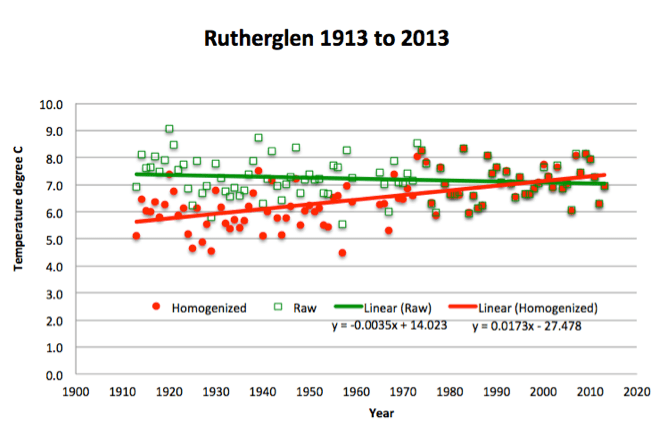
The unhomogenized/raw mean annual minimum temperature trend for Rutherglen for the 100-year period from January 1913 through to December 2013 shows a slight cooling trend of 0.35 degree C per 100 years. After homogenization there is a warming trend of 1.73 degree C per 100 years. This warming trend is essentially achieved by progressively dropping down the temperatures from 1973 back through to 1913. For the year of 1913 the difference between the raw temperature and the ACORN-SAT temperature is a massive 1.8 degree C.

There is absolutely no justification for doing this.

This cooling of past temperatures is a new trick* that the mainstream climate science community has endorsed over recent years to ensure next year is always hotter than last year – at least for Australia.

There is an extensive literature that provides reasons why homogenization is sometimes necessary, for example, to create continuous records when weather stations move locations within the same general area i.e. from a post office to an airport. But the way the method has been implemented at Rutherglen is not consistent with the original principle which is that changes should only be made to correct for non-climatic factors.

In the case of Rutherglen the Bureau has just let the algorithms keep jumping down the temperatures from 1973. To repeat the biggest change between the raw and the new values is in 1913 when the temperature has been jumped down a massive 1.8 degree C.

In doing this homogenization a warming trend is created when none previously existed.

The Bureau has tried to justify all of this to Graham Lloyd at The Australian newspaper by stating that there must have been a site move, its flagging the years 1966 and 1974. But the biggest adjustment was made in 1913! In fact as Bill Johnston explains in today’s newspaper, the site never has moved.

Surely someone should be sacked for this blatant corruption of what was a perfectly good temperature record.

———-

Climate records contradict Bureau of Meteorology by Graham Lloyd, 27th August
http://www.theaustralian.com.au/national-affairs/climate/climate-records-contradict-bureau-of-meteorology/story-e6frg6xf-1227037936046

The story is behind a paywall. But if you don’t already have a subscription perhaps its time… this could just be the biggest story of the year.

** There are a lot of tricks that climate science managers have implemented over the years to fix the temperature record; that is fix it so it shows global warming. “Trick” was the word Phil Jones, a leading United Nation’s Intergovernmental Panel on Climate Change (IPCC) scientist, used to explain to his peers that, when constructing very long global temperature series using proxy data based on tree ring measurements that can extend back thousands of years, it was best to substitute thermometer data for this proxy data from about 1960 because the proxy data started to show cooling from about then. Indeed from about 1960 until 2002 the thermometer data mostly did show warming. But now even this instrumental record is starting to show cooling. Enter the relatively new trick of homogenization.

Even the “Slower” Aussies, are catching on, to the fact that Wind Turbines are Useless!

How the Public Are Deceived About the True Cost of the Mandatory RET

sprinter_2248190b

The Australian Financial Review – as one of the lefty Fairfax stable – “drank the Kool Aid” early and happily ran with the wind industry’s narrative that having Australia bristle with giant fans is a sure-fire way of cooling mother Earth; that wind power is free; and that the mandatory RET is public policy at its best.

In short, the AFR has been a faithful outlet for wind industry spin and propaganda. Regurgitating an endless stream of Clean Energy Council (CEC) press releases; and giving the likes of Infigen (aka Babcock & Brown) free rein to spruik about the “wonders” of wind – never questioning, let alone challenging, the wild and fantastic claims made about lowering retail power prices (all while “saving” the planet, of course) – it’s been a serious media outlet of choice for the wind industry and its parasites.

Until now.

In the last few weeks there’s been a seismic shift in the AFR’s approach to the imminent demise of the mandatory RET. Faced with an increasing barrage of hysterical claims about the world ending if the RET gets the axe (by the likes of the CEC and Infigen’s Miles George) the AFR’s journos and editor have finally opened their eyes to the greatest rort of all time. And, to the horror of the CEC and its taskmasters, they’ve stopped buying the myths and mis-information pitched up by Infigen & Co.

Phil Coorey’s piece on how Tony Abbott, Joe Hockey and Mathias Cormann have joined forces to bring an end to most ludicrous policy ever devised sent the wind industry into a state of panic (see our post here).

Since then, the AFR has followed up with a terrific piece from Alan Moran and an editorial calling the mandatory RET flawed and unsustainable (seeour post here) – and a detailed analysis of the inherent flaws and failings of the RET by crack energy market economist Danny Price (see our post here).

With the AFR turning on it, the wind industry must know its days are numbered.

The AFR continues its recent trend with this fine piece of work by Ben Potter and another terrific editorial that strip away the myth that the mandatory RET is a benign piece of “climate change” policy which won’t cost power consumers a thing.

Renewable energy lobby’s shell game
Australian Financial Review
Ben Potter
25 August 2014

shell-game2009Mar06

The renewable energy lobby employs a neat trick to show that billions in subsidies for the costliest forms of electricity can lower power prices.

Wind and solar power costs between 1½ and 10 times as much to produce as power from coal and gas. But the vagaries of the National Electricity Market allow the renewables sector to claim that it lowers prices – even if it imposes costs on consumers elsewhere.

In a shell game, a conman quickly moves around three shells on a table or mat and his buddies pressure passers-by to bet which one contains a pea.

The pea under the shell is $37 billion of renewable energy certificates (RECs) that electricity retailers will buy from renewable energy generators or generate themselves between now and 2030 if the renewable energy target scheme isn’t changed.

“It’s misleading, because the subsidy is the REC, and the REC certificate is acquitted at the retail level and is included in the retail price of electricity,” Origin Energy chief executive Grant King says.

The renewable energy target has helped drive installations of 52 wind farms and 1.3 million solar roof-top systems – about one-eighth of total capacity – since 2001, Bloomberg New Energy Finance says.

The NSW Independent Pricing and Regulatory Tribunal estimated the cost of the renewable energy target to the average household in 2013-14 at $107 – about 5.3 per cent of a typical $2012 bill.

It is now under review by a panel headed by businessman Richard Warburton, who is sceptical that human activity is causing global warming.

Because the price of RECs is about the same as the electricity price per megawatt/hour, renewables generators are deriving as much revenue from selling RECs as they are from selling power to the National Electricity Market.

“All it is is a tax on existing producers which is passed onto existing consumers,” says Tony Wood, head of the energy program at the Grattan Institute.

“No one denies, when they are asked the right question, that renewable energy costs more than fossil energy.

“The only question is who pays for it? And right now it’s a combination of consumers and fossil generators who are paying for it, and you’ve got to question is that the right policy?”

The RET’s costs are buried in ACIL Allens’ modelling for the RET review and a report issued by the Climate Institute last week.

Most of the costs are REC costs. Deloitte Access Economics in a report for business groups estimates the net present value of REC transfers to the renewables industry over 2015-30 at $17 billion, compared with $8 billion to $9 billion if the RET is closed or the target is wound back to a true 20 per cent of energy supplied.

When REC costs are included, retail bills are higher until at least 2020, after which opinions diverge.

ACIL Allen and the Climate Institute find that continuing the RET on its current path lowers household power bills by as much as $80 a year from now to 2030, despite swelling bills between now and 2020. Deloitte, using different assumptions about capital costs, falling demand and market responses, finds retail bills higher after 2020 as well.

The Climate Institute report shows the high long-run marginal production costs of solar and wind power – which include capital costs – relative to coal and gas. Coal and gas power come in at about $60 to $80 a megawatt hour in the eastern states, wind at $88 to $544 a megawatt hour and solar at $128 to $1533 megawatt hour.

But when it comes to bidding in the National Electricity Market, wind and solar clean up because they have zero short-term marginal costs (in the short term, capital costs are less important). Wood argues they even have negative short-term marginal costs because they need to produce energy to sell RECs.

The rising RET target forces renewables into the NEM, even though electricity demand is shrinking and no more capacity is required. Those factors combine to suppress wholesale prices, which have dipped below $40 a megawatt hour.

That in turn squeezes profits and market share for coal and gas generators, which have to cover their fuel costs, at peak times when they used to make their profits. Retailers then have to buy or generate renewable energy certificates to cover the renewable energy target – currently about 10 per cent, rising to about 28 per cent by 2020. The REC cost goes into the retail price.

If that cost is less than the wholesale price suppression, the consumer wins. But it’s a fine call, says Wood.

The RECs subsidy costs about $29 billion in net present value economic activity, 5000 jobs and $1260 in average annual earnings. This comes from more costly investments in renewables, which Deloitte says raise power prices and suppress resources, jobs and demand in other sectors.

Erwin Jackson, deputy chief executive of the Climate Institute, says such losses are more than offset by the benefits of emissions reductions under the RET.

A Climate Institute report released last week puts a much lower $2.7 billion economic cost on the RET. It finds it lowers household power bills after 2020. It values the social benefits of emissions cuts at $19 billion, based on a $24 to $50 a tonne social cost of carbon. Mr Jackson said this was almost certainly an under-estimate but “you have to factor it in, otherwise it’s a one-sided model and you are assuming climate change doesn’t exist.”

He admitted it was only an estimate of the RET’s contribution to global climate change efforts – offset by emissions increases in large emerging economies such as China and India – rather than any quantifiable benefit to Australia.

But it was the “best tool we have” to “open up the conversation” to considering the benefits of reducing emissions.

“What they’ll talk about very carefully is the cost to consumers, and they’ll show the cost to consumers is either slightly favourable or not much different – therefore ‘isn’t this a reasonable price to pay for renewable energy?’” Wood says.

“What they are very careful not to say [is] ‘what’s the cost to the Australian economy?’ because the cost to the economy includes the negative cost to the existing generators.

“To say that the renewable energy target is a small impost to consumers is the right answer but it’s the wrong question. The right question is ‘what’s the economic impact of the RET?’ and the economic impact of the RET is negative.”

The RET is a costly way to cut greenhouse gas emissions. Its price of abatement is $54 to $186 a tonne, up to eight times the recently abolished carbon price, ACIL Allen modelling for the RET review finds.

A cheaper – but politically tricky – way to reduce emissions to would be to return to a technology neutral carbon price signal.

The difference between Deloitte’s estimate of the REC cost savings from winding back the RET to a true 20 per cent and closing it – $9 billion – is similar to the $10 billion “additional profit” for coal and gas generators – such as Origin and EnergyAustralia – claimed by the Climate Institute report.

“It’s not that they’re better off because the RET was removed. It’s that they’re worse off because the RET was introduced,” Wood says.

Tim Sonnreich, strategic policy manager at the Clean Energy Council, an industry body, accepts that there’s a substantial wealth transfer from incumbent generators to renewables generators.

“We are not denying that,” Sonnreich says. “But it’s a wealth transfer that’s in favour of consumers so we would have thought in a political sense that’s a pretty popular one.”
Australian Financial Review

A valiant effort there from the CEC, as its spin master plays the shell game and otherwise attempts to turn night into day.

The mandatory RET sets up the greatest wealth transfer in the history of the Commonwealth. However, it’s not – as the CEC asserts – one that power consumers are going to thank their political betters for. That transfer – which comes at the expense of the poorest and most vulnerable; struggling businesses; and cash-strapped families – is effected by the issue, sale and surrender of RECs. As Origin Energy chief executive Grant King correctly puts it:

“[T]he subsidy is the REC, and the REC certificate is acquitted at the retail level and is included in the retail price of electricity”.

It’s power consumers that get lumped with the “retail price of electricity” and, therefore, the cost of the REC subsidy to wind power outfits. Between 2014 and 2031, the mandatory RET requires power consumers to pay the cost of issuing 603.1 million RECs to wind power generators. With the REC price likely be at least $65 (by 2017) – and tipped to exceed $90 – the wealth transfer from power consumers to the wind industry will be somewhere between $40 billion and $60 billion, over the next 17 years (see our posts here and here).

Here’s the AFR’s editor in response to the wind industry’s latest efforts to spin its way out of trouble.

Models can’t hide true RET cost
Australian Financial Review
Editorial
25 August 2014

Studies relied on by the renewable energy lobby to justify the continuation of the Renewable Energy Target make a lot about noise about the RET’s effect on the wholesale price of energy. But as shown in this newspaper today, force feeding up to 30 per cent renewables such as wind and sun-generated electricity into the power grid may put downward pressure on wholesale prices amid weak demand by artificially boosting supply. But the effect of forcing more power into the system will then show up in other ways: by increasing retail prices through the cost of renewable energy certificates. Those increased prices will reduce gross domestic product, by depressing productivity and by pushing up prices and costs elsewhere in the economy. That is, it is a highly expensive way to reduce emissions.

As previously discussed in this newspaper, an ongoing review of the RET led by Dick Warburton to make recommendations about winding back or even ending the scheme has resulted in considerable argument over the scheme’s effect on the electricity markets. These arguments include contradictory findings by computer modelling groups, with the RET lobby relying on studies pointing to the effect of dumping a lot of additional capacity into the wholesale market at a time of stagnating demand. However, as the coverage in today’s Financial Review notes, retailers still have to buy the Renewable Energy Certificates required to meet their obligations under the RET from the renewable generators, and that is expected to cost $37 billion between now and 2030, or as much as the electricity itself. That is $37 billion that must be reflected in higher prices elsewhere.

The arguments over the Renewable Energy Target show just how deftly skilled lobbyists can distort the debate, but we should not lose sight of the fact that the RET in any form will cost many billions of dollars in return for an hypothetical social benefit of the carbon emissions being offset.
Australian Financial Review

dirtyrottenscoundrelsoriginal

Renewable Energy Targets…the Smart Thing to do, is Get Rid of Them! It’s a scam!

Mandatory RET: An Expensive (and Unsustainable) Economic Burden

Donkey HeavyLoad

The RET is an expensive burden on the economy
Australian Financial Review
Alan Moran
19 August 2014

People and firms should be free to choose how they trade off their sources of energy and price preferences.

With the carbon tax repealed, the focus has shifted to the renewable requirements. A key component of these, the renewable energy target (RET), is under review by a panel headed by former Caltex chief Dick Warburton. The RET forces electricity retailers to buy certificates to ensure they incorporate at least 20 per cent of renewable energy within their total supply. Few other countries have renewable schemes as ambitious as Australia’s.

Compared with $40 per megawatt hour, the price of unsubsidised electricity, the cheapest source of additional renewable energy is from wind and is about $110 per megawatt hour. The renewable energy certificates are intended to fill the gap but they have been trading at low prices of around $35 due to the subsidy from the carbon tax, very attractive subsidies to roof-top installations and the fact that the build-up of renewable requirements is gradual. The subsidy price, in after-tax terms, is capped at $93 per certificate (or per megawatt hour).

Two external analyses have been undertaken as part of the RET review process. While both of them adopted conservative assumptions about the required renewable subsidy, they each arrived at very high aggregate costs to the economy as a result of the existing scheme.

The review itself commissioned ACIL Allen to estimate the future costs of the present scheme in 2014 prices. ACIL Allen put this cost at $37 billion or $6 billion if the scheme were to be closed to new entrants but existing installations continued to receive the subsidy.

The ACIL Allen estimate is based on the renewable subsidy at $70 per megawatt hour. This is equivalent to providing renewables a carbon tax subsidy of about $60 per tonne of carbon dioxide compared with the now defunct broader carbon tax at about $25 per tonne.

The other study undertaken by Deloitte was funded in part by the government’s Consumer Advocacy Panel and estimated the overall cost to the economy from maintaining the scheme is $29 billion. If it were to be immediately closed to new entrants that cost would remain in excess of $16 billion. These two cost estimates of the RET ($29 billion to $37 billion) approach the combined value of the Australian electricity transmission network.

Gains to coal-fired generators

An analysis for the Climate Institute estimates the abolition of the RET would bring gains to coal-fired generators of $25 billion by 2030. Although coal would regain market share from not facing subsidised renewables, electricity supply is highly competitive and increased revenues to coal-fired generators would not involve any form of super-profit.

In terms of the direct impact on electricity consumers, the burden of renewable requirements this year is estimated by the energy regulator to add 12 per cent to the average household’s electricity costs. That’s about $260 per year.

On current policies, these costs will rise considerably over the next six years. The annual renewable energy certificates requirements will increase from 17,000 this year to 41,000 by 2020. In addition, the price of these certificates will need to rise sharply to allow incentives for the construction of new windfarms.

As a result, the cost of renewable programs for typical households could rise as much as fourfold.

In research IPA commissioned last week from Galaxy, people were asked whether they favoured retaining the present level of support, increasing support in line with current policy or scrapping all assistance to renewable energy. Only 14 per cent favoured increasing support along the lines of current policy. Twenty-three per cent favoured scrapping the scheme entirely.

While 62 per cent said they would be content to see the subsidy costs kept at present levels, people are rarely as profligate as they say they would be when it comes to their actual spending decisions. This is readily seen in the small take-up of consumers’ voluntary top-up sales of green energy at premium prices, which amount to only 0.7 per cent of the annual sales of electricity.

Moreover, the direct costs of renewable energy through electricity prices is only half of the costs that consumers bear – the rest come about through consequent higher costs of goods and services. And for businesses, the renewable requirements are much greater, as a share of total energy costs, than they are for consumers.

The renewable energy subsidies fail all tests. Consumers resent paying for them and they represent a dead weight on industry competitiveness and economic growth.

Restoring consumer sovereignty and allowing people and firms to make their own choices about trading off their sources of energy and price preferences is the appropriate course.

Alan Moran is director of the Institute of Public Affairs’ deregulation unit.
Australian Financial Review

Alan Moran is alive to the scale and scope of the wind power fraud (see our posts here and here and here). But we think his calculator must have flat batteries in order to explain his observation in the piece above that:

“The annual renewable energy certificates requirements will increase from 17,000 this year to 41,000 by 2020.”

In fact, the “renewable energy certificate requirement” referred to by Alan will increase from 16.1 million RECs this year to 41 million RECs each and every year from 2020 to 2031.

The target figures in the legislation are set in GWh (1 GW = 1,000 MW): 16,100 GWh for 2014 (which converts to 16,100,000 MWh); rising to 41,000 GWh in 2020 through to 2031 (which converts to 41,000,000 MWh) (here’s the relevant section).

The “renewable energy certificate requirement” is that retailers purchase renewable energy (with which they receive RECs) and surrender RECs sufficient to satisfy the mandated target: 1 REC has to be surrendered for each MWh set by the target. If they fail to surrender enough RECs, they will be hit with the mandated shortfall charge of $65 per MWh for every MWh below the mandated target (see our post here).

Wind power generators are issued 1 REC for every MWh of power dispatched to the grid – and this deal continues until 2031: the operator of a turbine erected in 2005 will receive RECs (1 per MWh dispatched) each and every year for 26 years.  Retailers aiming to satisfy the target purchase RECs through a Power Purchase Agreement with a wind power generator. The rates set by PPAs see wind power generators receive guaranteed prices of $90-120 per MWh (versus $30-40 for conventional power). PPAs run from 15 and up to 25 years.

As part of the PPA deal, whenever a MWh of wind power is dispatched to the grid, the generator claims a supply under the PPA; and recovers the guaranteed price from the retailer. For the same supply, the wind power generator is issued RECs (1 REC per MWh) by the Clean Energy Regulator. In accordance with the PPA, the wind power generator transfers the REC to the retailer which can cash it in, thereby reducing the net cost of the power supplied under the PPA (RECs are currently trading around $30).

For example, if the price set under the PPA is $110 per MWh, the retailer sells the REC that comes with it – pocketing $30 – and reducing the net cost to $80 per MWh (which is still double the rate for conventional power). In this example, the retailer pays, and the wind power generator gets, $110 per MWh (or, in reality, whatever the PPA price is) irrespective of the REC price. In that respect, the value of the REC operates as a direct subsidy, designed to support the inflated (fixed) price received by wind power generators under their PPAs.

In practice, the full cost of wind power supplied to retailers (as set by PPAs) is recovered from retail customers (with a retail margin of 7-10% on top of that). As such, the REC is a Federal Tax on all Australian power consumers (see our post here). On the other side of the equation, the RECs issued to wind power generators operate as a direct subsidy for wind power; the value of which allows wind power generators to charge retailers prices under PPAs 3-4 times the cost of conventional power.

While the RECs transferred to retailers act as a “sweeteners”, the failure to purchase RECs leaves retailers liable for the $65 per MWh shortfall charge – and it was the threat of being whacked with a whopping fine (bear in mind the conventional power retailers purchase costs less than $40 per MWh) that provided “encouragement” to retailers to sign up to PPAs. Although, a number of the big retailers – like Origin and EnergyAustralia – have said they would rather pay the shortfall charge than purchase unreliable wind power and pass the full cost of the fine on to their customers.

Between now and 2031, the cost of the REC Tax/Subsidy will range between $40 billion to $60 billion; depending on the price for RECs.

The total renewable energy target between 2014 and 2031 is 603,100 GWh, which converts to 603.1 million MWh. In order for the target to be met, 603.1 million RECs have be purchased and surrendered over the next 17 years.

Even at the current REC price of $30, the amount to be added to power consumers’ bills will hit $18 billion. However, beyond 2017 (when the target ratchets up from 27.2 million MWh to 41 million MWh and the $65 per MWh shortfall charge starts to bite) the REC price will almost certainly reach $65 and, due to the tax benefit attached to RECs, is likely to exceed $90.

Between 2014 and 2031, with a REC price of $65, the cost of the REC Tax to power consumers (and the value of the subsidy to wind power outfits) will approach $40 billion – with RECs at $90, the cost of the REC Tax/Subsidy balloons to over $54 billion (see our post here).

As Liberal member for Hume, Angus Taylor – in his attacks on the cost of the subsidies directed to wind power outfits under the mandatory RET – puts it: “this is corporate welfare on steroids” (see our posts here andhere). STT thinks Angus is the master of understatement. In Australia’s history, there has never been an industry subsidy scheme that gets anywhere near the cost of the mandatory RET.

In the same edition, the AFR’s Editor chimed in with this eminently sensible piece of analysis.

Renewable target is not sustainable
Australian Financial Review
19 August 2014

The Abbott government’s moves to wind back or even scrap the Renewable Energy Target, as reported exclusively in this newspaper, would reduce a major distortion of the electricity market that has produced only a limited and expensive reduction in carbon emissions. How the RET affects the electricity market and prices is subject to much argument, including contradictory findings by computer modelling groups. But it clearly has forced considerable additional electricity supply – intermittently generated by windmills – into the market at a time of static electricity demand.

That extra capacity is pushing down wholesale prices at the expense of the margins of conventional electricity producers, as some modelling efforts have suggested. But force-feeding high-cost supply into a market of stagnating demand is likely to have some unintended consequences. One has been to short-circuit the hoped-for shift to less emissions-intensive gas plants. They have been squeezed out by the mandated high-cost windpower at one end and the sunk cost of the dirtier coal-fired power stations at the other. So the RET has restricted the expansion of an important transition fuel.

The RET scheme was conceived by the Howard government with a small initial target of 5 per cent of electricity consumption. But it took on a new life in 2010 when the Rudd government lifted the target to 20 per cent of estimated electricity consumption by 2020. That renewables target of 45 terawatt hours by 2020 assumed that the demand for electricity would continue to grow. Instead, demand has stalled due to soaring power prices and the decline of power-hungry manufacturing plants. So the absolute mandated target may amount to as much as 30 per cent of electricity consumption by 2020. That leaves the nation’s power grid heavily reliant on whether the wind blows.

Informed by a review by business leader Dick Warburton, the Abbott government is set to decide whether to wind the renewables mandate back to a “real 20 per cent” or even to end the scheme. In a world of a general carbon price, of course, a renewables target would become redundant. But, without a carbon price, Australia has been left in the worst of worlds. We have abandoned the lowest-cost mechanism for reducing emissions, adopted a budget-sapping “Direct Action” scheme that is surely no long-term answer and, so far, retained a high-cost renewables target. The government does need to be careful about the sovereign risk of changing its investment incentives. But mandating 30 per cent of our energy to come from high-cost renewables is not a sustainable energy policy.
Australian Financial Review

The mandatory RET is the most expensive and utterly ineffective policy ever devised.

As the AFR points out, the RET is simply not sustainable. Any policy that is unsustainable will either fail under its own steam; or its creators will eventually be forced to scrap it. European governments are responding to their unsustainable renewables policies by winding back subsidies and tearing up wind power contracts (see our posts here and here). And Australia won’t be far behind them.

STT hears that Tony Abbott is acutely aware that the mandatory RET is an entirely flawed piece of public policy; and is nothing more than an out of control industry subsidy scheme.

As such, it represents a ticking political time-bomb for a government that doesn’t need anymore grief from an angry proletariat. And boy, the proletariat are going to be angry when they find out that under the mandatory RET they’re being lined up to pay $50 billion in REC Tax – to be transferred as a direct subsidy to wind power outfits and added to their power bills – over the next 17 years.

For Tony Abbott to have any hope of a second term in government, the mandatory RET must go now.

abbottcover

Time to Put an End, to the Renewables Scam!!! Aussies to Axe the RET!

Lost In Translation: How a CO2 Abatement Scheme Became “Corporate Welfare on Steroids”

subsidies

Time to remember the original aim of the RET
Australian Financial Review
Danny Price
21 August 2014

The RET was intended to cut carbon. Opening it up to more forms of efficient generation would help get that result.

The debate over the renewable energy target has ended up exactly where you would expect a debate on subsidies to end up. The beneficiaries of the subsidy are taking the high moral ground while those adversely affected by the subsidy are crying foul.

We see similar debates in the agricultural sector. Australian farmers complain they face unfair market conditions because the international farmers they compete with have the protection of subsidies, while our government provides none.

In this case, the coal-fired generators claim they are finding it hard to recover their costs on existing investments while the renewable generators who earn a subsidised return, claim their future investments are threatened.

Both arguments are founded on the same concept – investment certainty.

What has been lost in all this debate is the original objective of the RET. The renewable industry has focused on the benefits it brings to customers by suppressing the price coal and gas generators can charge customers. But as PJ O’Rourke once observed about the US health system, “If you think healthcare is expensive now, wait until you see what it costs when it’s free.” The economic costs of lowering the wholesale price charged by thermal generators by subsidising renewable generators will be enormous.

The renewable energy sector has cleverly confused the concepts of economic costs, which are the costs of the resources used to produce renewable energy, with prices. They do this to disguise the real cost impact of the RET on the economy and to make themselves a smaller political target.

RET never about pricing

The goal of the RET was never about suppressing prices, but this is now the cause célèbre of the renewable industry because they know this will appeal to politicians looking to reduce electricity price pressure. The RET was aimed at encouraging a reduction in greenhouse gas emissions by actively promoting the, then-fledgling renewable industry.

The debate about the RET really should be re-focused on how we can achieve our environmental targets most economically. If we can minimise the costs of reducing emissions, then it follows that we are more likely to reduce emissions further, which Australia will inevitably be pressured to do at the Paris round of climate negotiations in late 2015.

More recently the renewable generators claim they are now cost-competitive with thermal generators. While these claims are probably overstating the relative economics of the thermal versus renewable generation, there is certainly less need to continue to subsidise investors in renewable generators as the RET has done its job in developing a local renewable industry. It is now time for the renewable industry to face competition and this competition should lead to lower economic costs and lower consumer prices.

This could be achieved by progressively levelling the playing field between all potential sources of electricity supply and demand so that all technologies can compete to supply emissions reductions.

Recent analysis of the opportunity to reduce the economic costs and price impacts of the RET by making it more technologically neutral, for example by allowing gas generators to compete with renewable generators and create partial credits under the scheme to reflect emissions abated, has shown that this approach can simultaneously reduce the economic cost of the RET by more than $1 billion and reduce prices for customers by more than $50 a year. This cost could fall further if other forms of cleaner generation could also compete vigorously with gas and renewable generators.

Part of the reason that this cost and price reduction occurs is that it makes use of existing gas capacity that mostly sits idle that could compete with coal under a more technologically neutral RET. This approach of broadening the RET to allow a wider range of technologies to compete to supply emissions reductions, is one of those rare no-regrets policies.

Competitive pressure

If no technology is able to compete with the renewable technologies (for example due to the risk of rising gas prices) then the worst thing that would happen is that wind generators would continue to be built. The only complaint that the renewable industry could have against such a proposal is that they would be subject to more competitive pressure.

With lower costs and prices from such a transformation of the RET, the government could afford to leave the target where it is and rely on the transformed RET to do more work to contribute towards the achievement of Australia’s emissions reduction.

Unfortunately, the only beneficiaries from such a transformation of the RET are customers and the economy and, sadly, there is nobody to advocate for these stakeholders in the current RET debate.

Danny Price is managing director of Frontier Economics.
Australian Financial Review

When Danny Price says: “The economic costs of lowering the wholesale price charged by thermal generators by subsidising renewable generators will be enormous” he’s playing as the master of understatement.

As Liberal Member for Hume, Angus “the Enforcer” Taylor has repeatedly pointed out, the mandatory RET is nothing short of “corporate welfare on steroids” (see our posts here and here and here).

Putting aside the hidden costs of providing fossil fuel back up to cover the occasions when wind power output plummets every day – and for days on end (see our post here); putting aside the need for a duplicated network to carry wind power from the back blocks to urban markets (seeour post here); putting aside the cost of running highly inefficient Open Cycle Gas Turbines to cover wind power “outages” (see our post here), the cost of Renewable Energy Certificates and their bedmate – the mandated shortfall charge will add a minimum of $39 billion, and – if the price of RECs reaches $100 (as is forecast under the current RET of 41,000 GWh) – up to $60 billion, to power consumer’s bills over the next 17 years (see our post here).

As Danny Price points out, the original purpose of (and justification for) the mandatory RET was the cost-effective abatement of CO2 emissions in the electricity sector. So Australian power punters – lumped with the task of propping up near-bankrupt outfits like Infigen (aka Babcock & Brown) via the redirection of $40-60 billion of their hard-earned cash over the next 17 years – might reasonably ask just how much CO2 abatement “bang” they’re getting for those very considerable bucks?

It’s the very question that Danny Price has been grappling with over the last few months.

STT followers will be pleased to know that Danny Price hates intermittent, unreliable and insanely expensive wind power with a passion – and that he’s been tasked by the Coalition with coming up with a workable method of achieving least-cost CO2 abatement.

Danny’s mission is to amalgamate the entirely unsustainable REC Tax – filched from unwitting power consumers and directed to wind power outfits – into the Direct Action policy, under which an Australian Carbon Credit Unit (CCU) will be issued to anyone stumping up audited proof that they’ve reduced or abated 1 tonne of CO2. The CCU will be tradeable on international markets and the equivalent of European carbon credits, which trade around A$8. Under Danny’s plan, RECs will be replaced with CCUs – and the subsidy per MWh of wind power will plummet from a projected $100 to less than $10. For a run-down on the mechanics of Danny’s plan – see our post here.

While seeing their subsidy gravy train slashed by 90% might sound a little like “bad news” for wind power outfits, earning CCUs comes with a BIG catch: CCUs will ONLY be issued where there is credible proof that the applicant has reduced or abated CO2. For wind power outfits this means coming up with actual proof (not smoke and mirrors “modelling”) that they have in fact reduced CO2 emissions in the electricity sector.

As youngsters sceptical of their peers’ more ambitious pronouncements say: “well, good luck with that”.

The need for 100% of wind power capacity to be backed up 100% of the time by fossil fuel generation sources means that wind power cannot and will never reduce CO2 emissions in the electricity sector (see our postshere and here and here and here and here and here and here).

E.ON operates numerous transmission grids in Germany and, therefore, has the unenviable task of being forced to integrate the wildly fluctuating and unpredictable output from wind power generators, while trying to keep the German grid from collapsing (E.ON sets out a number of the headaches caused by intermittent wind power in the Summary of this paper at page 4). Dealing with the fantasy that wind power is an alternative to conventional generation sources, E.ON says:

“Wind energy is only able to replace traditional power stations to a limited extent. Their dependence on the prevailing wind conditions means that wind power has a limited load factor even when technically available. It is not possible to guarantee its use for the continual cover of electricity consumption. Consequently, traditional power stations with capacities equal to 90% of the installed wind power capacity must be permanently online [and burning fuel] in order to guarantee power supply at all times.”

STT is happy to go all out and say that in Australia wind power requires 100% of its capacity to be backed up 100% of the time by conventional generation sources. As just one recent example, on 3 consecutive days (20, 21 and 22 July 2014) the total output from all of the wind farms connected to the Eastern Grid (total capacity of 2,952 MW – and spread over 4 states, SA, Victoria, Tasmania and NSW) was a derisory 20 MW (or 0.67% of installed capacity) for hours on end (see our post here). The 99.33% of wind power output that went AWOL for hours (at various times, 3 days straight) was, instead, all supplied by conventional generators; the vast bulk of which came from coal and gas generators, with the balance coming from hydro generators.

For wind power to reduce CO2 emissions in the electricity sector it has be a true “substitute” for conventional generation sources. Because it can’t be delivered “on-demand” (can’t be stored) and is only “available” at crazy, random intervals (if at all) wind power will never be a substitute for conventional generation sources (see our post here). Accordingly, wind power is simply incapable of reducing CO2 emissions in the electricity sector

The wind industry has never produced a shred of evidence to show that wind power has reduced CO2 emissions in Australia’s electricity sector. To the contrary of wind industry claims, the result of trying to incorporate wind power into a coal/gas fired grid is increased CO2 emissions (see thisEuropean paper here; this Irish paper here; this English paper here; thisAmerican article and this Dutch study here).

STT hears that Danny Price is well and truly alive to all that.

With Tony Abbott about to go on the offensive in his quest to wind up the mandatory RET (expect to hear more from the PM this week) the wind industry’s wild and unsubstantiated claims about CO2 abatement in the electricity sector provide the PM with just another reason to bring the greatest environmental and economic fraud of all time to a shuddering halt.

DannyPrice_banner1

Aussies Know Renewable Energy Targets are a SCAM! Get rid of them!

Senator Matt Canavan: mandatory RET is an Enormous Wind Industry Protection Racket

abbott, hockey, cormann

With news that Tony Abbott, Joe Hockey and Mathias Cormann have teamed up to axe the mandatory RET (see our post here), the wind industry and its parasites have been reduced to a pitiful spectacle: drifting between pleading and begging for mercy, on the one hand, and foaming rage, on the other.

These desperados are like a band of teenage brats facing a little “parenting” for the first time in their lives: how dare anyone pull the plug on $50 billion worth of REC Tax/Subsidy that would have given me a delightful Point Piper view of Sydney Harbour, and kept me and my mates in Mercs and Beamers for life?!?!

And like spoilt infants facing a little discipline, these boys are looking for any hint that they might avoid punishment. Overblown reports put out by the ABC and Fairfax press that the Coalition isn’t really intent on scrapping the mandatory RET outright have been seized on by the wind industry and its parasites like shipwreck survivors clinging to floating wreckage.

But this is one occasion where the stricken will be denied any salvation.

STT hears that what was reported in the Australian Financial Review (and covered in this post) is just the beginning of the wind industry’s woes.

STT hears that Tony Abbott harbours a deep antipathy to the wind industry, which is only matched by his distaste for corporate welfare; we’ve covered a little of it in our posts here and here and here.  The PM is determined to bring the wind industry to an end; the only question is precisely how that objective is to be achieved. While the shortest route home is to simply scrap the Renewable Energy (Electricity) Act 2000, there are plenty of other ways of skinning the subsidy cat.

STT hears that the (current) preferred option is to leave the legislation in tact, but to gut it in such a way that the wind industry will be starved of subsidies by choking off the current and, more importantly, expected value of RECs.

The plan goes a little like this.

The Coalition has a policy aimed at achieving least-cost CO2 abatement, called “Direct Action” (a run down on the policy is available here). The policy has its critics on other scores, but it may well end up being the wind industry’s Armageddon.

Under the Direct Action policy, CO2 abatement is to be achieved at the lowest possible cost using “Australian Carbon Credit Units” (CCUs).

CCUs would be issued on audited proof of the abatement of 1 tonne of CO2. That could be by way of “carbon farming”: planting trees or restoring vegetation cover to over-grazed pastoral range-lands, say.

RECs, on the other hand, are issued on proof of renewable power dispatched to the grid: 1 REC for each and every MWh delivered. The deal has proceeded on the (wild) assumption that 1 MWh of wind power dispatched to the grid results in 1 tonne of CO2 emissions reduction in the electricity sector.

Under the PM’s brewing plan to kill the wind industry, RECs would be made redundant and, instead, wind power generators would be entitled to apply for CCUs. RECs and CCUs would be consolidated, with the former being phased out, and eventually replaced by the latter.

Now, here’s the clever part.

A CCU will only be issued on audited proof that the applicant has, in fact, reduced or abated 1 tonne of CO2 emissions. That will see wind power outfits struggle to jump the first hurdle: despite some “smoke and mirrors” modelling, the wind industry has never produced a shred of evidence to back its CO2 abatement claims.

The auditing of CCU applications will be done by way of certification and verification by a registered valuer. In the event that wind power outfits can satisfy the auditor and pocket a CCU, they then face the prospect of a far less generous subsidy stream.

(As an aside, one earlier variation of the plan was that the recipient of the CCU would not be able to cash it in, but would, rather, surrender the CCU to the Australian Tax Office and enjoy a reduction in their taxable income to the (pre-determined) value of the CCU: after auditing, the applicant would present their CCUs to a Certified Practicing Accountant to be submitted to the ATO with the applicant’s tax returns.)

The point of Direct Action and the CCU is to bring about the cheapest possible CO2 abatement, by whatever means. This means that the market for CCUs will be open to all comers and competitive in a way which the market for RECs isn’t.

The REC price is underpinned by the mandated shortfall charge of $65 per MWh: the effect of which comes into play from 2017, as the annual RET figure begins to climb from 27,200 GWh to the 41,000 GWh target, effective from 2020 to 2031. It’s that relationship that has wind power outfits salivating at the prospect of RECs being worth at least $65 and, by 2017, exceeding $100.

The CCU, however, is meant to be tradeable and interchangeable with carbon credits on international markets; such as those traded in Europe. Under Direct Action, certain CO2 emitters will be able to meet their obligations to surrender CCUs by purchasing European carbon credits at the going rate: the trading price of which has ranged between A$7-10.

The price for CCUs is, therefore, expected to top out at around $10.

And it’s on the issue of being able to trade CCU’s on the international market that the Coalition have been talking seriously to big Clive Palmer and, in this respect, may end up adopting parts of the PUP’s much reported plan for an ETS – starting with internationally tradeable CCUs. Of course, Palmer’s stated position is that the price for ETS credits must be set at ZERO, until such time as all of Australia’s major trading partners (like Europe, China, Japan, Canada and the US etc) sign up to an international ETS (see our post here).

For wind power outfits to survive, let alone build any new capacity, they need RECs to be trading at around $40, at a minimum. Anything less than $30, and wind power generators will never cover their operating costs, which run between $25-30 per MWh (see our post here).

Under Direct Action (assuming audited proof that 1 tonne of CO2 emissions has been abated) wind power generators would be issued with 1 CCU (instead of 1 REC).

By replacing RECs (currently trading around $30) with CCUs likely to trade around $8, the wind industry would disappear in a heartbeat. Although, we note that wind industry barrackers, the Climate Institute predicts that wind power outfits will soon be able to survive on subsidies of around $10 per MWh (see further below) – in which case, the wind industry will lap up CCUs at $8-10 and rub along just fine: but we doubt it … What’s that they say about being careful about what you wish for?

STT hears that over the last few months crack energy market economist, Danny Price has been working on the plan to rework the RET to bring it into line with the Direct Action policy; starting with the plan to replace the REC system with CCUs (see our post here).

So, if you hear the members of the Coalition talking about retaining the mandatory RET, don’t be too concerned. STT hears that Tony Abbott is absolutely committed to killing the wind industry; and how it’s done is a matter of substance, not form.

In the meantime, a growing number of Coalition members are going on the offensive; calling for the mandatory RET to be scrapped outright.

matt canavan

Another to join the queue is Queensland Nationals Senator, Matt Canavan (a former Director of the Productivity Commission) who penned this brilliant piece for The Australian.

Dodgy sums on renewables don’t add up
The Australian
Matt Canavan
19 August 2014

THE advocates of renewable energy would have you believe that they have discovered the economic equivalent of the fountain of youth. According to them, we can adopt more expensive ways of doing things, yet that will lead to cheaper prices.

That renewable energy is more expensive than fossil fuels should not be in dispute. If renewables were cheaper, they would not need the billions of dollars in subsidies they receive every year courtesy of taxpayers.

The most recent example of magic pudding economic modelling was released by the Climate Institute yesterday and purports to show that subsidising renewable energy will in fact reduce energy prices. The report concedes, at least in its graphs, that abolishing the renewable energy target will reduce power prices.

The Climate Institute claims that after a few years of falling prices, they will increase. This primarily occurs because the modelling assumes that renewable energy will get cheaper through learning by doing. Thanks to this miraculously rapid learning, it is assumed that subsidies to renewables will drop from more than $70 per megawatt hour in 2020 to just over $10 by 2030. The modelling refers to “international studies” to support this assumption without referencing any. So much for peer review.

Windmills have been around for centuries and despite massive investment from countries such as Denmark, they are still not economically viable without subsidies. But if the RET is about to solve the problem of affordable energy, why stop there?

For instance, Australia has long had a problem producing cheap and competitive cars but we have the solution. All we need is a domestic automobile target. The DAT will mandate that, say, 20 per cent of our cars should be produced domestically. Domestic manufacturers will receive domestic automobile certificates for every car they produce. Importers of cars will have to buy these DACs. We know this will work because it is a market-based solution. Just like the RET, it should magically reduce the price of cars for Australian consumers.

In reality, such a scheme would be nothing but a fancy form of tariff. Those who argued for tariffs argued that Australian industry needed protection when it was young, but one day it would grow up and would become cheaper and more competitive. Advocates of renewables use a version of this discredited infant industry argument today.

The models used to support this just confirm the old joke: ask an economist what two plus two equals and he will respond: “How much would you like it to equal?”

Some who can’t bear to defend wealthy companies asking for taxpayer handouts say the RET is cheap. It is true that credible economic modelling shows the RET probably costs consumers about $50 a year. Is that cheap?

Last week, the nation was gripped by the spectacle of a “regressive” fuel tax that would cost the average consumer $20 a year. The same people who pillory the Treasurer for indexing fuel excise argue for a RET more than twice as costly. At least fuel excise will help build roads, whereas the RET doesn’t make electricity more reliable or powerful, it just makes pensioners and the poor go without heating or airconditioning to subsidise the lucky few with the resources to invest in the latest fad: renewables.

The RET is an extremely expensive form of emission reductions, between double and six times the cost of the carbon tax.

And it doesn’t stop there. The big losers from the RET are those industries that use lots of energy, such as aluminium and fertiliser producers. Some economic modelling finds that the RET will lead to 5000 fewer jobs.

There are few supporters left of high car or other tariffs. The biggest protection racket left is renewable energy.

The final argument used to stop protection from being removed is that it introduces sovereign risk and would be unfair to those who have invested in an industry based on government policy. Even some who want to remove renewable subsidies argue that we should grandfather existing investments.

There is merit in this but it cuts both ways. When the 20 per cent RET was introduced five years ago it effectively devalued billions of dollars worth of coal and gas assets. Some estimates say the RET will transfer more than $5 billion from fossil fuel to renewable assets in the next 15 years. Such an expropriation also represents sovereign risk. It is fine to talk about grand­fathering renewables but we should also great-grandfather those who invested in coal, gas or aluminium before there was a prospect of a RET.

As an economically damaging protectionist policy, the RET should be removed. The adjustment should be done over time and the costs should be shared between fossil fuel, energy-intensive and renewable sectors alike.

Matt Canavan is a Nationals senator for Queensland. He was formerly a director of the Productivity Commission.
The Australian

The only quibble we have with Matt’s fine piece of analysis is the implicit concession that reducing or scrapping the mandatory RET amounts to “sovereign risk”.

In this post, WA Senator, Chris Back slammed that one straight over the long-boundary, based on Parliamentary advice which, funnily enough, reflects what STT has already said on the issue (see our posts here andhere). What the wind industry faces is “regulatory risk” – just like the risk realised by aluminium processors and conventional power generators when Labor increased the mandatory RET to 41,000 GWh in 2010: examples relied on by Matt when dealing with the claimed need for “grandfathering” wind industry investments.

Matt has a pretty fair crack at the “Magic Pudding” economics put up by wind industry cheer squad, the Climate Institute and its nonsensical claims that subsidies to wind power outfits will drop from $70 per MWh in 2020 to around $10 per MWh by 2030. That fiction dissolves with a cursory peek at the legislation that makes up the mandatory RET; and the application of plain old arithmetic to its terms.

By 2020, the RECs issued to wind power outfits (1 REC per MWh dispatched) will be worth at least $65 (equal to the cost of the mandated shortfall charge) – and are expected to trade at around $100 by then – which means the subsidy extracted from power consumers and directed to wind power outfits will be worth at least $65 per MWh and, more likely, $100 per MWh, right up until 2031. Between 2014 and 2031, the REC Tax/Subsidy will add between $36 billion and $50 billion to Australian power consumers’ bills (see our post here).

Not only is the Climate Institute’s claim about the cost of subsidies to wind power outfits utter bunkum, its “modelling”, of course, deliberately ignores the impact of the Power Purchase Agreements struck between wind power generators and retailers, which guarantee returns of between $90-120 per MWh (versus the wholesale price for conventional power of $30-40 per MWh). Sticking with its “Magic Pudding” approach to the cost of the mandatory RET, the Climate Institute tosses up the wind industry’s argument that wind power lowers wholesale prices: precisely how it does so on days when the entire wind power output of all wind farms connected to the Eastern Grid struggles to top 20 MW is anybody’s guess (see our post here). But, in any event, power consumers don’t pay the wholesale price (and couldn’t care less about it): it’s the price fixed by PPAs (which run from 15 to 25 years) that determines the price retailers charge their customers and the final cost of wind power; and, therefore, retail prices (see our posts here and here).

The Magic Pudding’s ability to return to his original form – no matter how many times he was eaten – is the stuff of delicious fantasy. However, slice $50 billion from Australian power consumers and our economy is unlikely to mimic the Magic Pudding’s most desirable quality and bounce back without a scratch. The mandatory RET is not only “the biggest protection racket left”, it is the single biggest (and perfectly avoidable) threat to sustainable Australian employment and prosperity there is. The mandatory RET must go now.

MagicPudding