Discussion About the Parasitic Wind industry!

Exposing wind industry “vampires”: Alan Jones and James Dellingpole


263977-alan-jones

James Dellingpole was interviewed by Alan Jones on 2GB  last week about the economic, environmental and social fraud of the wind industry.

Alan has a little radio show that more than just a few Australians tune into each morning. Syndicated through over 77 Stations and with close to 2 million listeners Countrywide – AJ as he’s known – is one of those people that leads the political charge on many issues that really affect ordinary Australians and which the rest of the press ignore.

To hear the interview click on the player below. The transcript follows.

00:00
00:00


Transcript

Alan Jones: Well I told you yesterday, there’s been more damning evidence if any was needed, that this renewable energy rubbish, the Renewable Energy Target scheme, propping up the so-called “clean energy” sector (whatever that means) is sheer economic madness. Economic vandalism. Economic waste.

There’s now an economic analysis of the scheme, commissioned by the Mineral Council of Australia, but it is an independent analysis, suggests that there will be job losses as economic activity slows in the face of ever increasing power costs, caused by these ridiculous Renewable Energy Targets. Now you’ve heard me on about this for years and years. The economic analysis argues that the scheme’s opportunity cost, that is, money that could have been invested elsewhere will be more than $36 billion in six years time. That subsidies to the scheme could reach between $19 and $21 billion – your money in six years time. It finds that solar panels and wind farm subsidies will cost you, the electricity consumer, nearly $22,000,000,000 by 2020, six years time.

The Renewable Energy Target scheme of Rudd and Gillard is another ‘Building the education revolution’, another ‘Pink batts’, another ‘Broadband’, another harebrained idea of the utterly discredited Rudd and Gillard regimes, and it is now, as we warned, reeking its havoc.

Tony Abbott has an expert panel reviewing the scheme. That is compromised because the Federal Energy Minister, this bloke Macfarlane, is in bed with the wind industry. He dines with them, and that day is not far away when I will start naming some of those people and the occasions on which Mr McFarlane has been both their guest and their host. Talk about ICACs! Quite frankly, this whole renewable energy nonsense should be abandoned now.

The former Queensland Labour Treasurer Keith De Lacy, who is now a significant business figure, has said it is plain crazy to have schemes such as this-solar feed in tariffs and carbon tax that are driving up power bills. He said the Australian public keep complaining about the increases in the cost of living and this is become even more so. One of the biggest increases he said, is the price of electricity. He said it is the most fundamental of services to the Australian public. Now the most brain-dead aspect to all of this, and you’ve heard me say this a million times before, it that this wind power and solar power can only survive with massive taxpayer subsidies. And of course it is seeking to demonise coal fired power which has been the source of our international competitive advantage.

It was Terry McCrann who said to me years ago on this program, that if we de-carbonised the Australian economy, we are writing for ourselves, his words “a national suicide note, albeit by slow strangulation”. And of course it’s not just the decarbonisation that is the so-called carbon tax, well it’s not a carbon tax, that’s a lie too, its carbon dioxide tax, it’s this abject persistence with the so-called Renewable energy targets. The mistaken and dishonest view is that Australia’s energy needs can be met by sources other than coal-fired power.

And that was always the source of our international strength.

Now the fact that we have to feed solar power and wind power into the national energy grid, together with the carbon dioxide tax – are the reasons people can’t afford to have the heater on at night. It is the reason why manufacturing is locating overseas. It is the reason why thousands and thousands of jobs have been lost in the manufacturing industry. 60% of the increased cost faced by business in recent times were a direct consequence of the combination of the carbon dioxide tax and the Renewable Energy target. That wouldn’t be a bad thing, and we would most probably be prepared to cop it, if the science weren’t so obviously flawed.

It’s not just Tony Abbott who has a review and privately believes, as does Joe Hockey, that these Renewable Energy Targets are rubbish. Joel Fitzgibbon, when Labour were in government, has said that the Renewable Energy Target should be dismantled. So we have got wind farms around the country, which can’t survive unless they are subsidised to the tune of about half $1 million per turbine. Billions and billions of dollars are wasted in Renewable energy certificates for wind turbine farms that are non-compliant.

Forget the destruction that they do to the environment, to public health, and all those other things we’ve discussed, now here we got proof of the pudding that subsidies for renewable energy schemes, such as rooftop solar panels and wind farms will cost you the consumer almost $22 billion by 2020.

Well James Dellingpole-well I should just say before we go to James, how can we say, rightly as a government and as a community that we are not going to follow Holden and Toyota and SPC Ardmona down the road with an open cheque-book – yet here we are tipping billions into entities – wind power, wind turbines which are only jacking up the price of energy to you and to business, putting business and people out of work and they couldn’t survive without massive taxpayer subsidies.

Well James Dellingpole, I’ve spoken to him before, an English writer – tough bloke, and fearless broadcaster and he has expressed and written his opposition to this. It wasn’t long ago that in an extraordinary article he wrote and he said, and you’ve got to say this slowly- in Britain, every wind industry job costs the taxpayer 100, 000 pounds a year in subsidies. James Dellingpole is on the line from Northamptonshire. James -good morning.

James Dellingpole: G’day Alan, good to be back on your show.

Alan Jones: Thank you, lovely to have you. How much longer can we tolerate this nonsense?

James Dellingpole: It’s going to take a very long time to turn this oil tanker around. Because there are so many people with their snouts in the trough. And in Australia as I know from the last time I visited your beautiful country, and God knows I want to come back soon, I was astonished to discover how heavily the ALP is involved in this scam. A lot of the pension funds are heavily invested in these wind turbines. I don’t know if you caught that fantastic speech a few months ago by Senator John Madigan?

Alan Jones: I did, We talked to him at the time.

James Dellingpole: Talking presumably under Parliamentary privilege, because I know from my experience – when ever you speak out against the wind industry in Australia you get very nasty threatening lawyer’s letters. Because these guys don’t like the truth and they’ve got various tame academics supporting them, they’ve got …. It is as you’ve rightly said, it’s an industry which can only survive with heavy taxpayer subsidies. And what this kind of industry does is it attracts the very worst kind of people. People who don’t want to make an honest buck. People that just want to live like vampires off the taxpayer. So this is what is going on and John Madigan in this speech pointed out one example about the Waubra wind farm in Victoria. I mean it was an absolute disgrace

And the one thing I think you can console yourself with in Australia is that you really are ahead of the game in fighting back. I don’t know whether it’s that you Aussies don’t take it like other people do, but you are really fighting back hard. And I was looking today actually at the website of the Waubra foundation – this wonderful thing by Sarah Laurie.

Alan Jones: Just for my listeners’ sake, James, James is speaking in his Northamptonshire accent there – that is W-a-u-b-r-a and we have talked about that often here. Waubra, but might’nt have come through, but that is where it is, in Victoria. But of course, Napthine is the Premier of Victoria, and these things are all is in, many of these things are in his electorate.

James Dellingpole: Yes. I was reading the extraordinary story of a guy – he wrote – various people have written letters describing their experiences with the wind industry, and one of these guys actually was conned into having wind turbines on his land and he was told there was going to be no health consequences, no noise, etc. etc. Anyway, once he had signed the deal in blood and there was no escape from it, he discovered that on the contrary, these things ruined his life. To the point where even when he was sleeping 5 km away, 5 km away from wind turbines they were  destroying his health. I’ve spoken to loads of people who have wind turbine syndrome and I can tell you it is a miserable experience. It has all sorts of terrible effects.

And we haven’t even gone to the environmental damage these things do. The number of birds and bats they chop to pieces. I call them bat-chomping eco-crucifixes – because that’s what they are. They are just kind of a symbol of the green movement but they don’t actually do anything useful for anyone other than the rent seekers who’ve got their snouts in the trough.

Alan Jones: It’s frightening isn’t it? I mean even if it were economically viable, which it isn’t, its unpredictable, it’s inefficient, it’s intermittent, you can’t rely on it …I mean it has government protection like no other in a day and age where we are saying we are winding all of this protection stuff back so you’ve now got a large scale wind turbine developer can make nearly half $1 million in taxpayer subsidies, and they call them renewable energy certificates.

James Dellingpole: Yes. The point I think that some people don’t understand. You get some idiot, some naive idiot saying “we are just harvesting nature’s free bounty”, “wind is free”, wind energy is free”. No it is not free and there is a very simple reason for that which you can tell by the fact that wind does not blow all the time. Wind blows when it feels like it. Wind doesn’t blow when you want to take a hot shower. It doesn’t blow when you want to use your air conditioning. It blows when it wants to. So in other words the energy that the wind industry produces is essentially worthless because you can’t have a situation where the supplier decides when to supply you. I mean what kind? … How does that work in a free market?

Alan Jones: When do you think people are going to wake up to the fact that this has destroyed our once comparative manufacturing advantage because we had cheap energy and cheap electricity it has been destroyed now. We can’t compete internationally because of energy costs.

James Dellingpole: Well part of the problem of course is that apart from all these rent seeking politicos and corporations which are involved in these dodgy deals, is that also you’ve got organisations like Greenpeace, the World Wildlife Fund, you’ve got all these organisations are pumping out eco-propaganda saying that renewable energy is the only answer. These organisations are multi-nationals ….

Alan Jones: But James,that shouldn’t matter – if you’ve got a government that listens and understands what the issues our-we’ve got a federal energy Minister in bed with these people.

James Dellingpole: Yes. Well I mean at least Tony Abbott is beginning to turn the tide.

Alan Jones: Yes he knows – And so does Hockey, Hockey knows too. But you’ve got to do something about it.

James Dellingpole: Yes, when I was last there, somebody called Julia Gillard was in charge and would you prefer her back?

Alan Jones: Don’t start me there, thank you very much. But the people listening to you our funding all of this dramatically.

James Dellingpole: Yes.

Alan Jones: Maurice Newman, Maurice Newman is a man I’m sure you know him.

James Dellingpole: I love Maurice Newman – he is a hero.

Alan Jones: He is a very respected Australian businessman, and he called wind farms, quote, “an obscene wealth transfer from the poor to the rich”. He called it “a crime against the people”. Now the people listening to you James this morning are all battlers out there in Struggle Street. They’re having money ripped out of their pockets so some Thai company, or Chinese wind turbine company is going to make a big, big quid.

James Dellingpole: Yes, I know. It is an absolute obscenity. And the depressing thing is that across the world these dishonest political leaders – you know like President Obama. President Obama has built the second term of his administration on creating “green jobs”. Well you’ve seen what’s happened to America. You have the example, for example of Solyndra, this company run by his friends into which he poured $500 million dollars-half a $1 billion of taxpayer’s money down the drain. And there has been research from all over the world. The Spanish economy has pretty much been destroyed by renewable energy. In fact it was a Spanish economist who came up with the shocking statistic that for every green job created by government so called “investment”, 2.2 jobs were killed in the real economy. And in Britain they did a survey and it was even higher – 3.7 jobs killed for every “green job” created.

Alan Jones: And Germany has had a gut full of it.

James Dellingpole: Oh yes.

Alan Jones: I must say last time that you were here, you said this, and it might be a good spot to end, James, James Dellingpole said, “God I wish I could be there at the barricades with the protesters in Canberra today – if ever a cause was worth fighting for, this is the one.

James Dellingpole: Yes.

Alan Jones: It is isn’t it?

James: It is, absolutely. I mean I only wish that – no I can’t say this, I can’t say this – I wish that some Tornado would come along and blow them all down. I’m not going to advocate terrorism but sometimes it is quite tempting.

Alan Jones: Lovely to talk to you. We’ll keep in touch. Okay, there we are, so there we are. Now there is a review of this. Tony Abbott does understand that he has and Achilles’ heel here in that the Federal Energy Minister in Macfarlane is in bed with these people. How this review is objective – I don’t know. But why do you need review? There is any amount of evidence out there – the whole thing needs to be scrapped. If people can make it pay without taxpayer’s money-away you go. But not one cent of our money should be spent. Another Rudd and Gillard failure that has to be dismantled.

Wind Turbines Destroy the Fabric of Rural Communities!

Wind Farms & “Community Division”: Tales

from Rye Park (NSW) & Northumberland (UK)

Money Wasted

Naked greed, institutional corruption and State-sanctioned corporate bullying and thuggery are part and parcel of the wind industry, wherever you go. We recount below a tale from Northumberland that could have been written anywhere giant fans have been slung up anywhere in the world.

In tales like these the phrase “community division” often appears. However, the term appears to suggest the rural communities concerned are equally divided – in the same way that 18 players line up against each other in the AFL. Nothing could be further from the truth. Communities set upon by wind industry goons divide roughly (and unequally) into three groups.

The first is the tiny minority who hope to profit directly: farmers in contracts with the developer paid to host the turbines; gullible local business people who (foolishly) believe that they’ll snaffle work surrounding the project (construction and engineering work is almost exclusively the preserve of large, well-oiled outfits like Transfield or Leighton – the fans are built in China, India or Denmark); the local volunteer firefighters (CFA/CFS) promised a brand-new fire-truck by the developer (never mind that the fire unit will be reserved to look after the developer’s fans ahead of local properties); and the local footy club, promised a little cash and brand-new footy jumpers (featuring the developer’s “stylish” logo, of course).

The second group is by far and away the majority and includes those whose lives will be the all worse for the short-sighted greed of the few mentioned above. This group obviously includes the many who will end up as neighbours, whose homes will become sonic torture traps: hard-working people who will be driven mad by shadow flicker and the incessant turbine generated low-frequency noise, night after merciless night. As part of the so-called “green” energy “bargain”, the value of their properties will be smashed, if it were even possible to find a buyer for their (soon to be uninhabitable) homes (see our post here).

A pretty fair example of the division outlined above was given a week or so ago at a “community consultation” held by Epuron – an outfit hoping to develop what it calls the “Rye Park” wind farm (north of Yass and east of Boorowa, NSW).

Epuron sent a “pretty young thing” equipped with not much more than a Marketing Degree and the developer’s “spin sheet”. This young lass found herself way out of her depth, as locals grilled her on the wild and unsubstantiated claims she made about her bosses planned giant fans. You know, the usual stuff about “powering” 100,000 homes; reducing CO2 emissions; creating thousands of wonderful “green” jobs; and, best of all, lowering retail power prices. Locals hammered her on all of these classic furphies: in trying to defend the indefensible, she didn’t get off to a great start – it quickly became evident that she had no idea what a Renewable Energy Certificate was, let alone the cost impact of RECs on retail power prices or the (critical) benefit of that subsidy to her employer. Oops!

On a show of hands, the 32 present “divided” as follows: 23 locals, firmly against; and 9 in favour – 4 of whom were employed by Epuron, 2 were contracted as turbine hosts and 3 were “unknowns” (check out this video of the count).

And that brings us to the third group. Quite often a few “unknowns” turn up at “community consultations” to voice their loving support for giant fans. These aren’t “locals” and, even if they live in the vicinity, will never actually live anywhere near that (or any other) wind farm. They’re pretty easy to spot: beards are essential, as are socks and sandals. They turn up to the meeting, rant about the mortal perils of “climate change” and disappear into the ether, never to be seen again. Think Dave Clarke of delusional “ramblings” fame. You know, the type that says having a couple of hundred giant fans speared into YOUR backyard is a sacrifice that THEY’RE willing to make.

Take out rent seekers (like the developer and hopeful turbine hosts) – and rent-a-crowd ideologues – and the “division” in communities set upon by plans for giant fans soon disappears.

Remember, that it’s only ever been about the money.

Chop the fat pile of taxpayer and power consumer subsidies directed to wind power outfits and “community division” will soon resolve. The developers will disappear in a heartbeat; the prospective hosts will go back to doing what they were doing before they entered contracts they neither read nor understood; and the locals will return to the peaceful and untroubled lives they deserve.

Here’s The Daily Mail on how mountains of pointless subsidies fuel the utterly rotten and corrupt wind industry; and sustains its parasites.

Dirty tricks, greed and a ruined idyll that proves the wind turbine plague ISN’T over after all: ROBERT HARDMAN on the stormy issue of green subsidies
The Daily Mail
Robert Hardman
24 May 2014

The last time tempers were this high around here was almost exactly 500 years ago at the Battle of Flodden — the biggest Anglo-Scottish punch-up in history. And not much has changed in this stunning corner of Northumberland since then.

The big house is still Ford Castle, where James IV of Scotland spent his last night alive, carousing on the eve of battle. A couple of miles down the road is Etal Castle, where the English army celebrated victory.

Going back further still, there are 60 sites of prehistoric interest in a three-mile radius — including the Geordie answer to Stonehenge.

The views are much the same, across to the Cheviots, the Scottish borders and what is now Northumberland National Park.

But, this week, all that has changed. The diggers and pile drivers have just arrived, along with a lot of heavies in hi-viz jackets.

By Christmas, a great swathe of this ancient and enchanting border country, including the Holy Island of Lindisfarne, will be overshadowed by the Barmoor Wind Farm — six wind turbines, each 360ft tall and with a blade span the size of a Boeing 747.

Thought we’d heard the last of the onshore wind farm? Remember last year’s ministerial pledges to ‘roll back’ those barmy green subsidies for landowners and companies which desecrate the countryside?

As this week’s scenes in wildest Northumberland testify, it’s business as usual.

This racket, which already adds £3billion a year to all our fuel bills, is as lucrative as ever. The planning applications are pouring in, even though Britain has comfortably met its wind energy targets for 2020.

Oh for the days when the worst to fear was a wall of leylandii. It’s a story familiar to rural communities all over Britain. And, with just six turbines, Barmoor is actually at the smaller end of the wind farm spectrum.

But it’s important for several reasons. First, it shows that nowhere, however beautiful, is safe from the predations of developers masquerading as environmentalists.

Second, even the energy company now building these things acknowledges that ‘amazing’ tactics were used to ram through this development in the face of overwhelming local opposition.

Third, the bulldozers have started tearing up the soil here in the very week that Britain’s only overtly anti-wind farm party — UKIP — has made giant strides across the political landscape.

Down on the edge of Brackenside Farm, I find a building site, a digger and several men in hi-viz jackets scratching their chins. It’s the new site for EDF Energy’s Barmoor sub-station. A security guard becomes rather aggressive the moment we start taking photographs, even when I point to the public footpath sign next to me.

‘It’s a hard-hat area and it’s dangerous,’ he shouts.

Three EDF officials appear and say the same, though two must be in mortal danger for they are without hard hats, too.

Eventually, they concede that they have no powers to shut down a public right of way and choose not to engage in further conversation. We go about our business.

A mile further on, I meet another digger ripping up a field to create a new access road from the B6525 to the wind turbines. The sight of our cameras prompts two men to jump in to a van and race over the field to confront us as we stand on the public road.

‘Can I help?’ asks one, in tones presaging the answer ‘no’. He marches off when I explain I am from a newspaper.

As soon as I start exploring the background to this project, I begin to understand why these EDF contractors are so jumpy.

It has taken 11 years of legal battles, bad blood and festering anger to create a hideous eyesore which will, ultimately, generate just 12 megawatts — on a windy day.

That’s enough electricity to power a few villages in the right weather. Yet, as I shall explain, it will pay out a £50 million jackpot over 20 years.

The Barmoor saga began when wind farm developers Force 9 Energy and Catamount persuaded three local farmers to sign up to a deal, which was all sorted before the public had any inkling of what was going on.

The locals, as locals do, formed an action group called Save Our Unspoiled Landscape (SOUL) and produced a few leaflets.

To their astonishment, Force 9 hired a swanky London PR firm and then made a formal complaint to the Advertising Standards Authority arguing that the locals had exaggerated the threat from the turbines.

Quite why it was the ASA’s business to adjudicate on a planning dispute is anyone’s guess, but the judges ruled in favour of the developer.

Meanwhile, the action group bought a bright orange helium-filled blimp which they tethered at the proposed site to show people across the region just how visible the turbines would be.

Soon after it was raised aloft, its moorings were mysteriously cut and the local authorities spent several days warning North Sea air traffic to be aware of a large orange UFO with ‘NO!’ written on it.

The local council threw out the project after receiving more objections to this plan than any it could recall.

But, shortly before the 2010 election, the Labour government ruled in favour of the development on the grounds that ‘it involved proposals of major significance for the delivery of the government’s climate change programme’.

Job done, Force 9/Catamount started looking for a buyer and sold the project for an undisclosed sum (thought to be around £10million), via Duke Energy, to EDF Energy Renewables in March. And now work begins.

Politicians love to bang on about ‘vibrant communities’, but this one has just been torn in half. How can the footling energy output from a minor get-rich-quick scheme justify the long-term pain felt by so many?

People who wouldn’t get planning permission for a garage extension must now see their views desecrated and the value of their homes slashed in order to enrich a handful of their neighbours.

Based on the projected output of the plant, the highly respected think tank, the Renewable Energy Foundation, expects the wind plant (how can anyone call this thing a ‘farm’?) to receive a £1.15million annual subsidy on top of £1.4million a year for electricity generated over a 20-year contract.

How is it shared out? The terms are always confidential, but the going rate for a landowner in this situation is £10,000-£20,000 per turbine per year, plus a slice of the pie every time the site is resold.

The locals now realise that there is nothing more they can do.

Nick Maycock smiles grimly outside his comfortable guest house, the Friendly Hound, which overlooks the site. He doesn’t even want to contemplate the effect on his trade.

‘Those farmers have been offered a goldmine. How can they turn it down?’ he asks.

I find only one of the farmers today. Sandy Rievely will have two turbines on his land, but will only say he is not allowed to discuss it under the terms of the contract. So what do his neighbours think?

‘I’d prefer not to say,’ replies Dr John Ferguson, 73, a former GP whose retirement has been consumed by the 11-year battle to stop his cottage being dwarfed by these monstrosities.

‘Well, I will then,’ says his wife, Ann. ‘It’s just completely wrong that a handful of landowners can do this to all their neighbours. I avoid even talking to them now because I’ll lose my temper . . .’

Her voice cracks, the conversation halts and we all look awkwardly out of the kitchen window across the sheep and the fields to the distant treeline. In a matter of months, six giant fans on six masts many times the height of the trees, will look back at her.

Now is probably not the moment to remind Ann of the immortal words of the former Energy Secretary who inflicted much of this unhappiness on the countryside in the name of fluffy Polar bears and saving the planet. ‘It is socially unacceptable to be against wind turbines in your area,’ declared Ed Miliband the last time Labour was in power, ‘like not wearing your seat belt.’

The very man who now attacks grasping energy bosses for fleecing the poor is none other than the Minister who thought it would be a wise and noble idea to make the rest of us pay dukes and developers an overall £200,000 annual bonus for every single skyscraper-sized windmill they planted in the middle of the countryside.

For these things really are the size of skyscrapers. Each one of the wind turbines going up by the Fergusons’ home near Flodden Field is going to be the height of a 30-storey office block — taller indeed than anything in, say, Edinburgh.

If they were buildings, they would automatically enter the list of Britain’s top 50 highest.

After more than a decade of sleepless nights and legal battles costing hundreds of thousands of pounds, the residents are well-used to the arguments: that they are simply Nimbys, that it is our duty as human beings to place the greater needs of the environment ahead of selfish local considerations.

They’ve heard all this stuff. And they know it’s tosh. These landowners and EDF wouldn’t be doing any of this if it wasn’t for the staggering inducements.

I go for a drive with local farmer Andrew Joicey, 58, whose elder brother runs the family estate covering 15,000 acres in this area, including mighty Ford Castle (now leased to the local council).

He points out that the estate was offered the usual big bucks to sign up for the scheme, but rejected it. And Andrew has devoted a large part of the past 11 years to fighting local wind farm proposals, seeing off three others — but not this one.

‘What is particularly galling is the way these things are just bought and sold without any regard for local feelings,’ he tells me.

Just this week, he had a long meeting with a senior EDF ‘director of construction’ as part of the company policy of ‘engaging’ with the community.

To his astonishment, the executive admitted that he had heard how the developers had persuaded local farm workers to sign meaningless contracts for a few hundred pounds (wind farm noise restrictions do not apply to people deemed to be ‘financially involved’). Force 9/Catamount was unavailable for comment yesterday.

The EDF executive also agreed that it was ‘incredible’ that the local action group had been reported to the ASA.

As for the Government’s claim that this 12 megawatt site was of ‘major significance’ to Britain’s climate change programme, he shook his head and admitted: ‘It doesn’t even feature.’

So there we have it. Lives and livelihoods are being blighted by a project which even the owners concede is of little consequence.

An EDF spokesman points out that it will give £60,000-a-year to community schemes as a gesture of goodwill.

But it’s a gesture which impresses no one, any more than the latest Tory promise, four weeks ago, to cut wind subsidies after the next election.

For these locals are already having to fund yet another legal battle to stop yet another wind project. In January, a government inspector approved a scheme to put a turbine in front of Northumberland’s ancient Duddo Stone Circle.

Next month, they are taking the Government and the farmer concerned to the High Court in a bid to overturn the decision.

As UKIP — with its clear anti-wind farm agenda — toasts its council successes and looks forward to tomorrow’s Euro election results, there is a clear message here for the eco-zealots in all the main parties.

But is anyone listening?
The Daily Mail

dirtyrottenscoundrelsoriginal


Wind Turbines Have a Very Short Shelf Life!! Useless!!

Wind Turbines: lucky to last 10 Years

wind_turbine_fire

Dr Gordon Hughes is a Professor of Economics at the University of Edinburgh and a while back produced this cracking study which destroyed yet another wind industry myth about the longevity of their giant fans: windfarm peformance UK hughes.19.12.12.

Instead of the much touted 25 years, the output from modern turbines starts to drop significantly after about 8 – and they’re well and truly ready for the scrapheap by the time they hit their teens. Here’s a story on Dr Hughe’s findings by The Courier.

Wind turbines’ lifespan far shorter than believed, study suggests
The Courier
29 December 2012

SCOTLAND’S LANDSCAPE could be blighted by the rotting remains of a failed regeneration of windfarms, according to a scathing new report.

A study commissioned by the Renewable Energy Foundation has found that the economic life of onshore wind turbines could be far less than that predicted by the industry.

The “groundbreaking” research was carried out by academics at Edinburgh University and saw them look at years of windfarm performance data from the UK and Denmark.

The results appear to show that the output from windfarms — allowing for variations in wind speed and site characteristics — declines substantially as they get older.

By 10 years of age, the report found that the contribution of an average UK windfarm towards meeting electricity demand had declined by a third.

That reduction in performance leads the study team to believe that it will be uneconomic to operate windfarms for more than 12 to 15 years — at odds with industry predictions of a 20- to 25-year lifespan.

They may then have to be replaced with new machinery — a finding that the foundation believes has profound consequences for investors and government alike.

Members of the renewables industry have attacked the findings, questioning the Edinburgh University research and describing them as “misleading”.

Scottish Renewables for one said that its oldest commercial windfarms in Scotland were around 16 years old and that none of them have been decommissioned or repowered.

Nonetheless, anti-windfarm campaigners believe that the evidence should be enough to halt the pace of development and force the Scottish Government to rethink its backing of the energy source.

Conservative MSP Murdo Fraser said that parts of the USA, where the industry is further advanced, were already home to what amounted to windfarm graveyards.

And he said the difficulties associated with the decommissioning of such machinery could blight the Scottish landscape for years.

“We already know that the average wind turbine must be in operation for a minimum of two years to pay back the carbon cost of construction,” he said.

“If the average lifespan of a wind turbine is only 10 years then the Scottish Government must seriously question wind energy’s role in displacing carbon emissions.

“However, the rapid wear and tear of wind turbines comes as no surprise. We need only cast our eye across the Atlantic to see 12,000 turbines rotting in the Californian desert.

“I have particular concerns surrounding the environmental costs of decommissioning and exactly who bears these burdens.

“With question marks raised over intermittency, noise, cost, efficiency, placement and now lifespan, when will the Scottish Government see sense and pull at the reins of wind energy?”

The Renewable Energy Foundation is a registered charity promoting sustainable development for the benefit of the public by means of energy conservation and the use of renewable energy. It claims to have “no political affiliation or corporate membership” and believes its findings have worrying implications for the investment being made in the UK in wind power.

The study also reports that the decline in the performance of Danish offshore windfarms had been greater than that of UK onshore windfarms.

Director Dr John Constable said: “This study confirms suspicions that decades of generous subsidies to the wind industry have failed to encourage the innovation needed to make the sector competitive.

“Put bluntly, wind turbines onshore and offshore still cost too much and wear out far too quickly to offer the developing world a realistic alternative to coal.”
The Courier

California has something like 14,000 giant fans that have been abandoned – erected in the late 1980s they lasted less than 20 years – most were clapped-out by 1998 – before the enormous cost of maintaining them saw them left to rust:

tehachapi-wind-turbines-p1

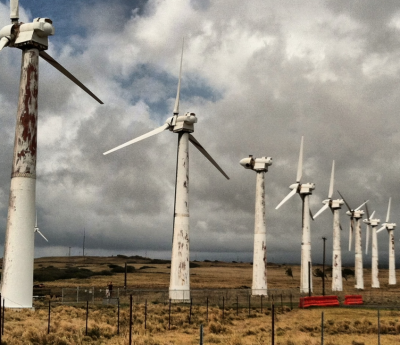
In Hawaii a stack went up at Kamaoa in 1985 – by 2004 they too were left to the elements:

Hawaii rusting turbines

So, you’re thinking, only in America could wind power outfits get away with leaving thousands of giant fans to rust in the paddock. Well, think again.

The company that wind power outfits use to hold the land holder agreements with farmers is usually a $2 company with no real assets and, therefore, the “promise” contained in those agreements to decommission turbines isn’t worth the paper it’s written on: the parent company will simply let the company with the land holder agreement be wound up in insolvency; and host farmers were too gullible to obtain decommissioning bonds to ensure the clean-up costs are covered. And planning authorities were just as stupid – they could have easily forced developers to provide decommissioning bonds as a condition of granting planning consent, but generally failed to do so.

So, once these things are past their economic use by dates, their owners will cut and run in a heartbeat. Expect to see fleets of dilapidated fans rusting on Australian ridge-lines in the not too distant future.


Wind Power Takes….Far More Than it Gives! NO Net Benefit!

Wind Farms: Nothing More than Power-Grid-Parasites

mosquito-7192_lores

Apart from the insane cost of propping up near bankrupt wind power outfits – like Infigen – with $ billions in subsidies in the form of the REC Tax/Subsidy – the wind industry gets to “free-ride” on the Australian electricity consumer in at least 2 ways.

The first is getting preferential distribution of the power wind farms manage to dispatch to the grid at crazy, random intervals – at no cost to wind power outfits.

Because the mandatory RET carries with it the threat of a $65 per MWh fine for retailers failing to satisfy the RET, wind power outfits have been able to “encourage” retailers into signing Power Purchase Agreements at rates ($90-120 per MWh) 3-4 times the cost of conventional power generation; under which the retailer receives a Renewable Energy Certificate. The retailer, therefore, avoids the $65 per MWh fine by purchasing a MW of wind power (as part of the PPA) and surrendering a REC as proof of purchase.

With ludicrously high and guaranteed rates under their PPAs, wind power generators are able to underbid all-comers in the dispatch market and – on those occasions when the wind is blowing (usually at night-time) – are happy to drive the dispatch price towards zero and even into negative territory – simply because they will continue to make money at the phenomenal rates guaranteed by their PPAs (see our post here).

The consequence of this Federally mandated market distortion, is that wind power takes precedence over all other forms of generation and – on every occasion when the wind is blowing – results in wind power jumping to the head of the queue.

This results in thermal gas and coal generators having to throttle back their generators; and ramping down output by disengaging turbines. However, boilers continue to run – gas and coal continue to burn – with the plant ready to re-engage the generator at a minute’s notice – ramping up output in order to take up the slack when the wind inevitably – but unpredictably – stops blowing (see our post here).

Forcing thermal plants to ramp output up and down means those plants run much less efficiently than they should – and leads to mountains of wasted coal and gas and, therefore, increased CO2 emissions (see thisEuropean paper here; this Irish paper here; this English paper here; and this Dutch study here).

Wind power outfits don’t bear any of the additional and unnecessary costs suffered by conventional generators in this regard.

And worse, network operators don’t charge wind power operators a cent for the privilege of getting their power into the system on a preferred basis; nor are they charged for the disruption and chaos their utterly unpredictable efforts cause grid managers and conventional generators. So far, so pointlessly costly.

The second way in which wind power gets a “free-ride” at power consumers’ expense is the cost of having other conventional generators supply power to “balance the grid”: which means ensuring that the “voltage”, “phase” and “frequency” of power within the entire grid is kept relatively stable and constant; within defined tolerances. For a brief outline of the fundamentals of grid balancing – see this link.

In a widely dispersed, distributed power generation network – like Australia’s Eastern Grid – this means having sufficient reserve capacity to increase generation output (and, therefore, input to the grid) on a second by second (or minute by minute) basis to maintain “frequency”. This is done largely with “spinning reserve” held by base-load gas and coal thermal plants – which can be added to the grid in seconds – and hydro generation, which can be called upon to start generating within minutes (see our post here).

Maintaining “voltage stability” and “phase” is done on a much faster time scale – a few cycles (ie Hz) or less. The extra power needed in this respect is already in the grid: it then becomes a matter of matching positive and negative voltage balances that simultaneously exist within the grid to maintain equilibrium throughout the grid as a whole. This is done – in simple terms – by grid managers “pushing” power around the grid using transformers, switching gear and circuit breakers.

In Australia, supplying the power used to maintain “voltage” and “phase” stability largely comes from hydro power. That power is not “sold” to retail customers, but is simply absorbed by the grid to keep it stable (ie to prevent blackouts, which would otherwise occur). In other words, a substantial volume of the power generated and dispatched to the grid is used up within it and never sees a kettle or a light globe. However, because it is critical to grid stability, generators supplying power for that purpose charge grid operators a premium price for it. The introduction of substantial – but wildly fluctuating – volumes of intermittent wind power has made the task of maintaining grid stability more difficult; and requires an even greater volume of conventional power to do so.

With 2,660 MW of installed (nameplate) wind power capacity connected to the Eastern Grid, the task of grid managers in trying to balance the grid has become a nightmare – the fluctuations in wind power output vary enormously, second by second, minute by minute and hour by hour – and bring with it a serious risk of widespread blackouts (see our post here).

On the opposite side of each and every one of those utterly unpredictable fluctuations in wind power output, there has to be an equal amount of power already within the grid to compensate. If not, the grid collapses. Despite necessitating the provision of a substantial volume of additional power from conventional sources (dispatched to the grid for no other purpose than balancing it) wind power outfits pay nothing towards that cost.

In respect of all of the above – where wind power outfits escape Scott free – power consumers are ultimately lumbered with the entire cost of providing preferential network distribution for wind power – as well as paying for the additional power generated (and essential) to maintain a balanced grid – through high and rising power bills.

In the US, conventional generators and grid operators have just cottoned on to the manifest unfairness in having their customers pay for wind power’s “free lunch”.

Here’s the Denver Business Journal on one effort to make the freeloaders pay.

Xcel asks federal regulators to ensure wind power pays its own way
Denver Business Journal
Cathy Proctor
23 May 2014

As wind energy grows as a power source in Colorado, Xcel Energy Inc. is asking federal regulators for permission to change the way it charges other utilities that use Xcel’s transmission lines to move their wind-based power to their customers.

Xcel wants the utilities to pay for its costs associated with having supplies of reserve power ready to go in case the wind suddenly dies, said Terri Eaton, Xcel’s director of federal regulatory and compliance efforts.

Currently, those costs are paid by Xcel’s business and residential customers, Eaton said.

If the transmission lines customers can supply their own back-up power supplies, they wouldn’t be charged under the proposed rates, she said.

Readily available, back-up power supplies are critical to keep the transmission grid in balance and avoid blackouts that can occur when a big source of power suddenly disappears, Eaton said.

Under the proposal Xcel filed with the Federal Energy Regulatory Commission (FERC) on May 15, the new rates would bring in about $727,000 a year, according to the filing.

The new rates, if approved, would become effective Jan. 1, 2015.

“What we’re trying to do is to have the costs we’re now paying to integrate wind on our system allocated to all the parties who have wind on our system — as well as those who will add wind on our system in the future,” Eaton said.

While FERC has discussed the challenges with adding wind to the nation’s grid, Xcel’s filing is the first to ask for a special charge, or tariff, to pay for backup power supplies in case the wind suddenly dies, Eaton said.

“We’ve seen some dramatic wind fall-offs in really short periods of time,” Eaton said.

Xcel has already experienced such falls offs, when “several hundreds of megawatts of wind” drops dramatically — and swiftly — due to changes in the wind, she said.

“Sometimes the wind is just howling, and an hour later the wind has calmed — and it’s in those circumstances that we need to have reserves available to pick up the load,” Eaton said.

In such cases, backup power supplies typically come from natural gas-fueled power plants, she said.

If FERC approves the new charges, the rates only would be applicable to Xcel’s power lines in Colorado, she said.

Xcel worked hard with representatives of the wind industry to draft its proposed rates, said Michael Goggin, director of research for the American Wind Energy Association, an industry trade group.

“We plan on taking a close look at the filing to ensure that Xcel’s proposal is consistent with FERC precedent and cost allocation rules,” Goggin said.

“It’s important that all energy sources be treated fairly, particularly because ratepayers pick up the tab for the integration cost of accommodating the abrupt failures of conventional power plants,” he said.

Xcel’s Colorado transmission lines currently carry about 25 megawatts of wind power owned by other utilities, specifically the Platte River Power Authority and the Arkansas River Power Authority, Eaton said.

It’s not a big amount, but the total is expected to grow as other rural cooperatives and city-owned utilities add wind farms to their power portfolios and need to use Xcel’s transmission lines to move the power to their customers, Eaton said.

Xcel currently has about 2,200 megawatts of its own wind power moving across its transmission lines in Colorado, and expects to add about 450 megawatts of wind power by 2018.

Rural cooperatives must get 20 percent of their power supplies from renewable energy by 2020 under a controversial 2013 bill, Senate Bill 252, that Gov. John Hickenlooper signed into law in June 2013.

Under the proposal, the new rates would raise transmission costs for the Arkansas River Power Authority by $105,144 a year, while the Platte River Power Authority’s rates would rise an estimated $326,447 per year, according to Xcel.

Eaton stressed that the proposal doesn’t mean Xcel is hostile toward wind energy, or renewable power.

“This isn’t a money maker for the company,” Eaton said.

Lee Boughey, a spokesman for Tri-State Generation and Transmission Association, said the association doesn’t currently send the its wind power over Xcel’s transmission lines, but understands Xcel’s concerns.

Tri-State supplies power to 18 member electric cooperatives in Colorado, which are affected by the new renewable energy goal, in addition to serving customers in Nebraska, Wyoming and New Mexico.

“As more intermittent resources are added in the region, we understand the need to address the higher costs of integrating and balancing power,” Boughey said.

“It’s important that costs be addressed in a transparent fashion,” he added.
Denver Business Journal

The wind industry and its parasites are quick to trumpet anything that looks remotely like a “benefit” purportedly attached to wind power; but have, so far, avoided being called to account for the true and hidden costs of wind power generation – just like those detailed above.

STT is aware of several submissions to the RET Review Panel from Australia’s leading energy market economists that specifically address these issues.

The Panel has made it plain that they are principally concerned “with the cost impacts of renewable energy in the electricity sector” – so there’ll no place for the wind industry to hide this time around (see our post here).

Forcing power consumers to pay for the wind industry’s giant “free lunch” is just another reason why the mandatory RET simply has to be scrapped now.

John Candy Ol 96er


Renewable Energy Targets are Ridiculous! It’s a Scam!!

Abolish Renewable Energy Targets, Now

Viv Forbes

The Australian government is holding an unnecessary enquiry into whether to abolish the Renewable Energy Target (RET), which mandates that 20% of Australian electricity must come from renewable sources by 2020.

There is only one “renewable” energy source that makes sense for grid power in Australia — hydro-power. But all the good hydro dam sites are either already equipped, or have been sterilized by the same people who demand that we use renewable energy.

Geothermal energy works, but Australia’s geology does not have many attractive geothermal sites. Nuclear is also “emissions free” but it is politically prohibited. And we have zero chance of getting approvals to clear-fell forests of timber for burning as biomass.

Which leaves wind and solar. Neither can ever produce continuous power at their “rated” capacity. They are intermittent energy producers. The sun sets every day and there are cloudy days, stormy days and windless days. No amount of “research” will change these laws of nature.

Wind and solar power can be useful in some situations such as remote locations, but when connected to the grid they are energy cripples that can only exist on crutches supplied by reliable power plants using hydro, coal, or gas, and subsidized by consumers or tax payers.

The costly RET can have no measurable effect on global warming. It imposes needless costs on poorly utilized backup facilities, and increases transmission costs, network instability, capital destruction and operating losses for existing generators. Germany has already showed how to create renewable energy chaos — let’s not follow their sad example.

This enquiry is an excuse for inaction and delay. The minister could have dictated the answer to his secretary before smoko one morning: “If we are serious about providing Australian industry and consumers with economical reliable electricity, we must abolish the RET now.”

And if the green Senate refuses to abolish the act, the minister can use his regulatory powers to change the renewables target from 20% to 2%, and the time limit from 2020 to 2120.


Page Printed from: http://www.americanthinker.com/blog/2014/05/abolish_renewable_energy_targets_now.html at May 26, 2014 – 09:10:50 PM CDT

Lawyers Ask for Action, on Macarthur Wind Farm Noise!

Law firm asks Moyne council to act on Macarthur wind farm noise

A LAW firm representing residents living near the Macarthur wind farm has called on Moyne Shire to step in and order the facility to stop operating at nights.

The Piper Alderman firm says the council has an obligation to take action after it received 20 official complaints from residents about noise coming from AGL’s 140-turbine wind farm last year.

The council has begun investigating the nuisance complaints under the Public Health and Wellbeing Act, which the lawyers have labelled “a serious risk to public health”.

They say their clients are farmers and graziers and include families with young children who do not have the individual means to prosecute a private claim of nuisance against a company with the resources of AGL.

“Our clients consider that the council has a duty, not only to remedy the nuisance detailed in the notifications in accordance with the act, but also a duty of common law to protect our clients from reasonably-foreseeable harm,” the firm said in a letter to the council.

It suggested a prohibition notice could be issued to prevent AGL from operating the wind farm at night, avoiding the “serious and adverse consequences” of sleep disturbance and deprivation suffered by the 20 clients and their 16 children.

Lawyers also urged the council to write to Health Minister David Davis, requesting a health-impact assessment and a public inquiry into the wind farm.

The shire’s energy and major projects co-ordinator Russell Guest said council had to ensure the wind farm complied with noise standards set out in the original planning permit.

Councils were being left to resolve complex and little understood matters relating to wind farms, he said.

In a report to council, Mr Guest recommends it consider the request to support a health-impact assessment once it finishes investigating the noise complaints.

Medical Professionals Everywhere are calling for Studies, Rather than Denying the Facts!!

Austrian Medical Association Issues Warning,

Calls for Comprehensive Studies on Wind Turbine Noise

by ashbee2

Austrian Medical Association Issues Warning, Calls for Comprehensive Studies on Wind Turbine Noise

The Medical Chamber (equivalent to the Austrian Medical Association) is issuing a warning on behalf of large-scale wind turbine installations. The Chamber is calling for comprehensive studies on potential negative health effects as well as minimum safety distances to populated areas.
Vienna — Noise problems, caused by the operation of wind turbines, are drawing increasingly more attention from scientists. This was pointed out todday, Wednesday, by the Medical Chamber on the occasion of the International Noise Awareness Day. The Medical Chambe is now calling for comprehensive studies on potential negative health effects as well as a minimum safety distance to populated areas.

Wind power plants are — as opposed to individual wind turbines — very large scale operations and clustered into “wind parks”. The rotor diameter of current turbines can measure up to 114 metres — almost the length of a soccer pitch. Rotational speeds of the rotor blades lie in between 270 and 300km/h, which is causing distinct acoustic patterns and noise.

This is the point the Medical Chamber is making: “It has to be our objective to prevent sleep disorders, psychological effects and irreversible hearing damages, as they are also caused by wind farms” says Piero Lercher, the Chamber’s spokesperson for environmental medicine.

As complaints from residents about excessive and especially low-frequency noise and infrasound near wind farms are mounting, full scale investigations of potentially health-damaging effects are indispensable.

The phenomena currently observed in connection with the operations of large-scale wind power plants justify the demand for adequate safety distances — which is consistent with most expert’s view on following a precautionary principle on that issue. Says Lercher: impairments of well-being have to be taken seriously from a medical perspective, even if they are frequently attributed to a so-called “nocebo” phenomenon.

Lercher requires from manufacturers the use of environmentally friendly technologies and substances. “For example, so-called “permanently exited generators” contain large amounts of rare earths, whose mining processes lead to toxic and radioactive contaminations of vast areas in the mining regions” warns the environmental physician.

Government needs to Stop the Abuse of Citizens, by Unscrupulous Wind Pushers!

Federal Government’s Mandatory RET

pays Pac Hydro to Steal Sonia Trist’s Home

Sonia Trist

As STT followers are well aware, the mandatory Renewable Energy Target and the Renewable Energy Certificates issued to wind power generators under it amount to a Federal Tax on all Australian power consumers. The value of the REC Tax is then transferred to wind power outfits – like Union Super Fund backed, Pacific Hydro – to the tune of $billions each year.

As a direct consequence of the Federal government’s RET policy, Pac Hydro speared 29 giant fans into the heart of the peaceful Victorian coastal community of Cape Bridgewater back in 2008: no RET, no RECs, no wind farm – pure and simple.

Pac Hydro’s Cape Bridgewater wind farm does not – and will never – comply with the noise conditions of its planning permit. The Victorian government are well aware of that fact but – in a form of malign acquiescence – aid and abet the offender, by doing nothing.

One of Pac Hydro’s numerous Cape Bridgewater victims, Sonia Trist has finally had enough and has decided to abandon her beautiful seaside home. Sonia’s decision was made for no other reason than to escape the incessant low-frequency noise and infrasound generated by Pac Hydro’s turbines – and the impact that noise has on her ability to sleep, to use and enjoy her (otherwise) perfectly comfortable home.

Here is Sonia talking a while back about the merciless nature of the noise generated by Pac Hydro’s non-compliant wind farm.

****

****

Here’s local rag, the Portland Observer talking about Sonia’s anguished decision to leave the place she dearly loves – but then the paper otherwise acts as an apologist for Pac Hydro – as Bill Meldrum lets its execs entirely off the hook. So much for hard-hitting journalism.

Turbines forces owner to quit home
Portland Observer
Bill Meldrum
17 April 2014

A CAPE Bridgewater resident is on the verge of abandoning her dream property because of the impacts nearby wind turbines are having on her health.

Sonia Trist said on Friday she was resigned to inevitability that she will have to leave her 2.2 hectare property on the cape.

The closest turbine to Miss Trist’s house is about 600 metres away, and is one of a cluster of five on the north side of Pacific Hydro’s Cape Bridgewater wind farm.

She said she bought the property in 2006-07, saying she was fully aware a wind farm would be built in the area, but it was only when the construction started in 2007 and finished in 2008 that she became aware of the size of the turbines.

“It has become unbearable, there is the proximity of the turbines, the shadow flicker caused by them and the noise – in an easterly wind they are really noisy and in a south-westerly there is a rumble,” she said.

She said that she had lived at the property full-time since 2011 since she sold her previous property in Brisbane, but that whenever she has lived at the house since the turbines started her health had deteriorated.

“I have palpitations, anxiety connected to sleep deprivation … I would love to sleep with the windows open, enjoy the fresh air, but had to close the windows because of the noise,” she said.

“It is really difficult to explain the different impacts these turbines have on different people … The best example I can draw on is that some people get seasick when they are on a boat, others don’t.”

She said it was a very emotional decision to abandon a property.

“You don’t make a decision like that without a great deal of thought … The natural environs are really beautiful here,” she said.

It is not the first time Miss Trist has mentioned abandoning her property, having done so previously in 2012.

“It is an emotional attachment here … The property is not on the market and I have received legal advice saying there is a definite liability I would have if I rented it out and the tenants found they were unable to sleep ,” she said. “I have been looking at rental properties in Hamilton to live in short term so I am close enough to see the acoustic testing being done by Steven Cooper (Sydney-based noise engineer) and being arranged by Pacific Hydro at the property … he will need access to the property and house,” she said.

“I will be leaving for six months from July to be with my daughter in Great Britain, after that I just don’t know … all I know is that in all reality I won’t be living at Cape Bridgewater.”

Pacific Hydro government and corporate affairs executive manager Andrew Richards confirmed last Friday that the testing at three properties including the Trist property would start soon.

“From our point of view, it is likely to be the most extensive testing undertaken relating to noise from a wind farm,” he said.

Mr Richards said the tests would involve audible sound, vibration and infrasound.

“The reason it has taken so long to get a start on the actual testing is the scope of the testing, it will be interested on people and the fact that there will be equipment, wires and access to their properties needed,” he said.

Both Mr Richards and company commercial head Rachel Watson said they were disappointed with Miss Trist’s decision to abandon her property.

“We have found her feedback valuable at the meetings, we are disappointed that she has made a decision to leave,” they said.
Portland Observer

A few posers Bill Meldrum (or anyone professing to be a journalist) might have put to Pac Hydro are:

  • a large number of your neighbours have been complaining about turbine noise since 2008, so why has it taken you 6 years to bother doing any serious testing?
  • have you ever simply considered shutting your turbines off at night to let your neighbours sleep? And if not, why not?
  • what does Pac Hydro propose doing if Steven Cooper’s noise testing proves non-compliance? Will Pac Hydro shut its turbines down then? Will it inform the Clean Energy Regulator that it does not comply with the conditions of its planning consent and is, therefore, ineligible to receive RECs?
  • does Pac Hydro plan to compensate Sonia Trist for the loss of the use and enjoyment of her home? And if not, why not? (At this point, a real journalist would hit Pac Hydro’s spin doctors with the hypocritical fact that Pac Hydro – and a bunch of other rent-seeking wind power outfits – are currently bullying the Federal government with nonsense claims for “compensation” if the mandatory RET is scaled back or scrapped.)

Although, in fairness to Bill, he’s probably never spent a single night trying to sleep with turbine noise – let alone 6 years of being pounded night after night by the incessant grinding, metallic, low-rumbling of the gearbox and generator – combined with the roaring, thumping, air-tearing-blade noise.

For Bill’s benefit (and the benefit of those fortunate enough to have never suffered through it) here is a video recording taken at Sonia Trist’s home, providing a minute fraction of what Sonia has had to put up with for 6 years – and maybe, just maybe a logical reason as to why Sonia is set to abandon her home.

****


****

The “screech” heard in the video is a “special” feature that was added in 2011 to the “Psychopath’s Symphony” that Pac Hydro has faithfully rendered, whenever the wind is blowing, since 2008 (see our post here).

So, in the end result, a law-abiding Australian citizen is driven from her own home, to which the offender’s glib response is that it’s “disappointed” with her decision.

The offender was only placed in the position to ruin that person’s life (andmany other citizens’ lives) by virtue of a perverse Federal government industry subsidy scheme, that has added $billions to power consumers’ bills – lining the pockets of outfits like Pac Hydro – and which has done nothing at all to reduce CO2 emissions in the electricity sector (its stated aim).

In substance, the mandatory RET/REC scheme is financing outfits like Pac Hydro to take peoples’ homes (some 40, so far) without paying any valuable consideration – or, in simpler terms again, Pac Hydro and other wind power outfits are literally stealing Australian citizens’ homes with Commonwealth government assistance (see our post here).

Call us old fashioned, but in STT’s view there’s something very wrong with that picture.

thief


More Bad News for Renewable Energy’s “Solar Power!”

Via.GREENIE WATCH.

May 22, 2014

Solar panels ‘are time bombs’

THE Coalition has likened the spate of house fires caused by allegedly faulty rooftop circuit-breakers to the pink batts fiasco, claiming Labor ignored warnings that subsidies for solar power would create a similar honey pot for dodgy operators.

As revealed by The Australian, Advancetech, the Queensland company that imported and sold 27,000 solar power DC isolators, went into receivership last Friday, leaving tens of thousands of homeowners to replace them in their rooftop arrays or risk a ­conflagration.

The Queensland and NSW governments have issued recall notices for the Avanco isolators after 70 of them burnt out, in some cases causing minor house fires.

Also recalled is a PVPower branded isolator imported and sold by Swiss electrotechnical products supplier DKSH, though that began in March at the instigation of the company.

Describing solar panels as “ticking time bombs”, Nationals senator Ron Boswell said there would be “possibly thousands” of other dangerous breakdowns.

The Queensland senator said the Labor government’s subsidy to encourage home owners to install solar panels, the Small-scale Renewable Energy Certificates scheme, led to an overheated market in which shoddy operators and cheap imports thrived.

“The flaws and waste associated with this scheme have been largely under the radar because of the scale of the personal tragedies associated with the pink batts fiasco, but as an exercise in silliness, waste, and maladministration, the solar scheme has been its absolute equal,” Senator Boswell said.

“It has a long way to go before it plays out, as systems installed age.

“Fire-prone isolators in rooftop solar arrays in Queensland and NSW are just the sort of problem Labor was warned about, and ignored, as it ramped up demand for its solar program in 2010.”

He quoted several experts who had given evidence to a Senate committee on the topic that year, including the chief executive of environmental credits trader Greenbank Environmental, Fiona O’Hehir, who said the subsidy gave rise to possible dodgy and dangerous installations.

“You would actually have DC generation on your roof, which can be as high as 120V DC. A flood of cheap imports into Australia could mean that we have significant risk,” she said at the time.

“If it continues at this rate, we will soon end up with a situation along the lines of the insulation program, which would be a disaster for the renewable energy industry.’’

The SREC scheme is still in place, though at a much reduced rate of subsidy, and is under review pending the outcome of the inquiry into renewable energy by businessman Dick Warburton.

SOURCE: http://www.theaustralian.com.au/national-affairs/solar-panels-are-time-bombs/story-fn59niix-1226926234717#