Wind Turbines…..NOT a Good Investment. (Pyramid schemes never are!)

Wind Power Investors: Get Out While You Can

exitsigns

For anyone still foolish enough to have their hard earned cash invested in wind power companies the warnings to grab your money and run couldn’t be louder or clearer.

The members of the RET review panel has signalled their intention to take an axe to the RET: spelling out the fact that the review has absolutely nothing to do with “climate change” or CO2 emissions – their task is simply to analyse, model and forecast “the cost impacts of renewable energy in the electricity sector” (see our post here).

The Treasurer, Joe Hockey entered the fray last week – during an interview with Alan Jones – when he branded wind turbines “a blight on the landscape” and “utterly offensive”. However, it’s what he went on to say about the “age of entitlement” that should have wind power investors quaking in their boots (see our posts here and here).

Joe outlined the Coalition’s plans to scrap a raft of public sector departments and agencies ostensibly charged with controlling the climate (there are currently 7 climate change agencies, 33 climate schemes and 7 departments).

Joe went on to say that the Coalition’s attack on the “age of entitlement” will be directed at “business as much as it applies to each of us.” If ever there was a beneficiary of the “age of entitlement” it was the wind industry and the rort created in its favour by the mandatory RET/REC scheme – quite rightly described by Liberal MP, Angus “the Enforcer” Taylor as: “corporate welfare on steroids” (see our post here).

The chances of the mandatory RET surviving the RET Review panel – and a Coalition itching to scrap it – are slimmer than a German supermodel.

With the wind industry on the brink of collapse there are three main groups facing colossal financial losses: retailers, financiers and shareholders.

Wind power companies – like any company – raise capital by borrowing (debt) or issuing shares (equity). Bankers price the risk of lending according to the likelihood that the borrower will default and, if so, the ability to recover its loan by recovering secured assets. Share prices reflect the underlying value of the assets held by the company and projected returns on those assets (future dividends). Share prices fall if the value of the assets and/or the projected returns on those assets falls.

Retail power companies saw the writing on the wall as the Green-Labor Alliance disintegrated at the end of 2012, presaging the Coalition’s election victory in September 2013. The risk point for retailers sits in their Power Purchase Agreements with wind power generators – the value of which depends on the amount of “renewable” energy fixed by the mandatory Renewable Energy Target and the value of Renewable Energy Certificates. Scale back the mandatory RET and the price of RECs will plummet; scrap it and RECs won’t be worth the paper they’re written on. Faced with that increasingly likely scenario, (sensible) retailers stopped entering PPAs around December 2012.

RECs are transferred from wind power generators to retailers under their PPAs, and the retailer gets to cash them in at market value. Retailers that haven’t signed PPAs can thank their lucky stars – chances are they will have avoided the very real prospect of being left with millions of worthless RECs.

Bankers have also baulked at lending to new wind power projects, keeping their cheque books firmly in the top drawer over the last 18 months or so. However, having lent $billions to wind power developers over the last 13 years, Australian banks have more than their fair share of exposure – exposure, that is, to the insolvency of the wind power company borrowing from it.

Ordinarily, bankers protect themselves by holding valuable security over the assets held by the borrower (eg the mortgage you granted over your patch of paradise when you borrowed to buy it). However, the value of the security granted by a wind power company is principally tied up in the future stream of income guaranteed under its PPA with its retail customer (the true value of which is tied to the value of RECs).

In the event that the RET were scaled back or scrapped it is highly likely that retailers (left with a bunch of worthless RECs) will seek to get out of their PPAs, making the bank’s security largely worthless. A wind farm with a fleet of worn-out Suzlon s88 turbines – on land owned by someone else – is unlikely to yield all that much for a receiver or liquidator charged with recovering the assets of an insolvent wind power company for its creditors.

Were banks forced to write off $billions in loans to wind power companies as bad and doubtful debts, then shareholders in that bank can expect to see the value of their shareholdings fall. Now would be a prudent time for those with shareholdings in banks to find out just how much that the bank has lent to wind power companies and, therefore, the bank’s exposure and risk they face as shareholders of that bank.

Shareholders in wind power companies, of course, have direct exposure to the declining fortunes of the wind industry. A decline in the share price obviously reduces the value of the shareholder’s investment. However, in the event of insolvency shareholders rank last behind all creditors, which means their shares are, ordinarily, worthless. In the case of wind power companies this will be invariably the case, as the companies in question are merely $2 companies with no real assets to speak of.

However, it is superannuation funds that have, by far, the greatest total exposure to the imminent collapse of Australian wind power companies. Australian superannuation funds (particularly industry and union super funds) have invested very heavily in wind power. These investments are either directly through shareholdings (equity) or through investment banks lending to wind power companies (debt). Examples include Members Equity Bank and IFM Investors (outfits run by former union heavy weight, Gary Weaven and Greg Combet) which have channelled $100s of millions into wind power operator, Pacific Hydro.

If you think that superannuation funds are somehow magically immune from the risk of the financial collapse of the companies they invest in, then cast your mind back to the wholesale corporate collapse of companies involved in Managed Investment Schemes that saw banks and super funds lose $100s of millions (see this story).

Anyone with their money in superannuation should be asking their fund just how much exposure their fund has to wind power companies?

Since the RET review panel outlined their mission a couple of weeks ago it seems that the word “RISK” – associated with investing in, or lending to, wind power companies – is the word that’s on everyone’s lips. Here’s the Australian Financial Review.

Green energy on tenterhooks
Australian Financial Review
Tony Boyd
30 April 2014

Contrary to popular opinion, leading businessman Dick Warburton does not have any pre-determined views about the future of Australia’s $20 billion Renewable Energy Target scheme.

While it is reassuring he is determined to be completely impartial in his rapid fire review of the RET scheme, Warburton makes it clear in an interview with Chanticleer that there will not necessarily be a grandfathering of existing arrangements.

“We have not made a decision on that – how could we when we have just started consulting with the industry,” he says.

In other words, it is possible that Warburton’s committee will abandon the RET targets and the accompanying certificates that are used by renewable energy developers to subsidise operations.

That helps explain why the renewables industry is starting to be priced for a disastrous outcome that could wipe out billions of dollars in existing investments and see a wave of bankruptcies and restructuring.

Shares in wind farm operator Infigen Energy have fallen 25 per cent since the RET scheme review was announced. Its shares are being priced for a negative outcome from Warburton’s review.

Chief executive Miles George says Infigen’s Australian business would lose roughly 40 per cent of its revenue in the event of existing targets and certificate arrangements not being honoured.

“Our business would fail, along with most other wind farms in Australia,” he says. Infigen has 20,000 shareholders split about one third between mums and dads and two thirds institutions. They could lose their entire investments.”

Infigen is not the only company worried about the potential damage to its business from changing the RET target, which is 41,000 GWh. One of Australia’s largest infrastructure investors, IFM Investors, is concerned its renewable energy business, Pacific Hydro, will have to shut down and move its investment offshore. Garry Weaven, chairman of IFM Investors and Pacific Hydro, tells Chanticleer that while he respects Warburton’s independence and ability as a businessman, he is particularly worried by the “climate change vibes” emanating from the Abbott government.

Weaven told CEDA in a speech last month that renewable energy development in Australia has been severely handicapped by inconsistent and untimely interventions by successive governments.

He makes the perfectly valid point that investors in renewables have to measure their investments over at least 25 to 30 years.

“It is simply not possible to generate an acceptable project IRR for a wind farm without that assumption, and other forms of renewable energy generation are still less economic and also require a very long investment life-cycle,” he told CEDA.

Weaven’s broader point is that with the plan to scrap the carbon tax and the uncertainty surrounding the government’s Direct Action policy, there is no new investment in any form of energy generation in Australia at the moment. Banks are unwilling to go anywhere near power generation investment unless it is the purchase of existing assets, such as Macquarie Generation, which is being sold by the NSW Government. Warburton says George and Weaven should not be barking at shadows, especially since the expert panel has only just begun speaking to industry participants.

But he is also crystal clear that every aspect of the RET scheme is up for grabs.

As Warburton says, there is good reason why sovereign risk is one of the five key areas being examined by an expert panel which also includes Brian Fisher, Shirley In’t Veld and Matt Zema. The key words used in the terms of reference in relation to sovereign risk are as follows: “The review should provide advice on the extent of the RET’s impact on electricity prices, and the range of options available to reduce any impact while managing sovereign risk.”

Sovereign risk is not something normally associated with investment in Australia. It last raised its ugly head when the former Labor government introduced the Mineral Resources Rent Tax. But investors around the world are getting used to escalating sovereign risk in democratic countries with normally predictable long term policies.

Recently in Norway, the Canadian Pension Plan Investment Board (CPPIB) was severely burned when the government changed the tariff that can be charged by a private company that bought the rights to manage a gas pipeline.

CPPIB’s return from its company, Solveig, was slashed from 7 per cent to 4 per cent.

Warbuton says potential management of sovereign risk would not have been a part of the terms of reference for the RET scheme review if all options were not on the table. Warburton, chairman of Westfield Retail Trust and Magellan Flagship Fund, will use a cost-benefit analysis from ACIL Allen as the foundation of the RET review. ACIL Allen has been accused of being in the pocket of the fossil fuel lobby but its data was used on Tuesday by the Clean Energy Council in a document in support of keeping the RET scheme in its current form.

The Clean Energy Council report, which was prepared by ROAM Consulting, modelled three scenarios: a business as usual case, a no RET scenario, where the RET is repealed, with only existing and financially committed projects being covered by the scheme and an increased and extended RET scenario where the RET is increased by 30 per cent by 2030 target and extended to 2040. The report concluded that the legislated large scale RET can be met under the business as usual scenario.

It also says that both RET scenarios result in lower net electricity costs to consumers in the medium to long term.

Australian Financial Review

When AFR refers to “the $20 billion Renewable Energy Target scheme” – it underplays the cost of the RET by at least $30 billion (probably just small change to the AFR?).

The energy market consultants engaged by the RET review panel, ACIL Allen produced a report in 2012, that showed that the mandatory RET – with its current fixed target of 41,000 GW/h – would involve a subsidy of $53 billion, transferred from power consumers to wind power generators via Renewable Energy Certificates and added to all Australian power bills. From modelling done by Liberal MP, Angus “the Enforcer” Taylor – and privately confirmed by Origin Energy – ACIL Allen’s figure for the REC Tax/Subsidy is pretty close to the mark.

Adding $53 billion to power consumers’ bills can only increase retail power costs, making the Clean Energy Council’s claims about wind power lowering power prices complete bunkum. And that figure is a fraction of the $100 billion or so needed to roll out the further 26,000 MW in wind power capacity needed to meet the current RET – and the duplicated transmission network needed to support it (see our post here).

Yet again, the wind industry and its parasites seek to hide behind the furphy of “sovereign risk”. “Sovereign risk” and “regulatory risk” are two entirely different animals: the wind industry is the product of Federal Government regulation which, of course, is prone to amendment or abolition at any time.

Sovereign risk” is the risk that the country in question will default on its debt obligations with foreign nationals or other countries; and, by some definitions, includes the risk that a foreign central bank will alter its foreign-exchange regulations thereby significantly reducing or completely nulling the value of foreign-exchange contracts.

It has nothing at all to do with changes in legislation that impact on industry subsidy schemes – which is precisely what the mandatory RET/REC scheme is: the prospect that a subsidy might be reduced or scrapped is simply “regulatory risk”.

To claim that the alteration of a government subsidy scheme is “sovereign risk” is complete nonsense.

At one point during the RET review panel’s meeting in Sydney, as Dick Warburton spelt out the panel’s mission, the boys from Infigen howled from the back of the room: “but, what about sovereign risk?!?” To which a nonplussed Warburton retorted: “what about it? Sovereign risk is your problem, it’s not our problem.”

And, indeed, it appears that Infigen has serious problems (whether or not “sovereign risk” is one of them).

Infigen is bleeding cash (it backed up a $55 million loss in 2011/12 with an $80 million loss, last financial year). It’s been scrambling to get development approvals for all of its projects so they can be flogged off ASAP. If it finds buyers it can use the cash to retire debt and fend off the receiver – who must be circling like a vulture all set to swoop.

Reflecting its fading fortunes, Infigen’s share price has taken a pounding in the last 8 months (if the graphs below look fuzzy, click on them, they’ll open in a new window and look crystal clear):
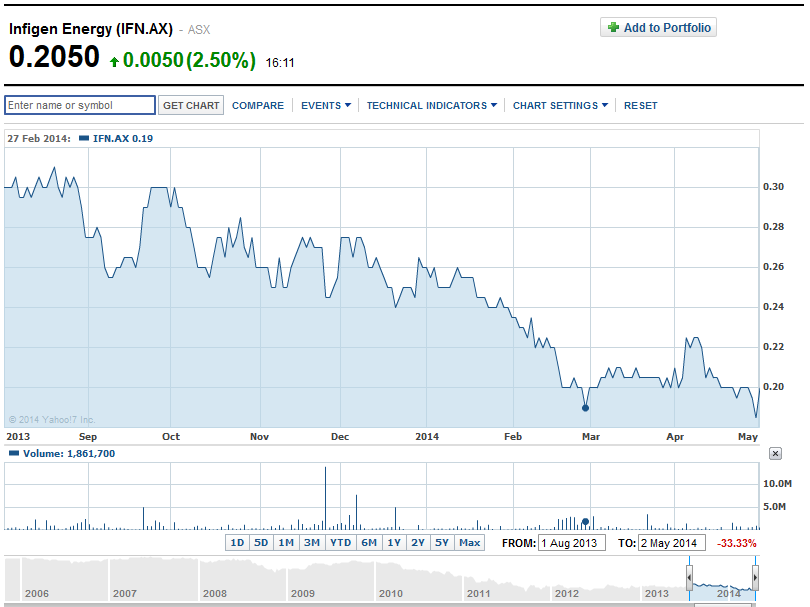
Infigen 1.8.13-5.5.14

Note the drop after the Coalition took office in September; the dive after the RET Review was announced in January; and the plummet in April, when the Panel defined what its mission was about, as it called for submissions (see our post here).

The drop seen above – from the year high of $0.32 (in August 2013) to $0.20 (now) – represents a 36% loss for investors who bought in at the top of the market this financial year. But spare a thought for those that bought in back in 2009 – when Infigen emerged from the ashes of Babcock and Brown:
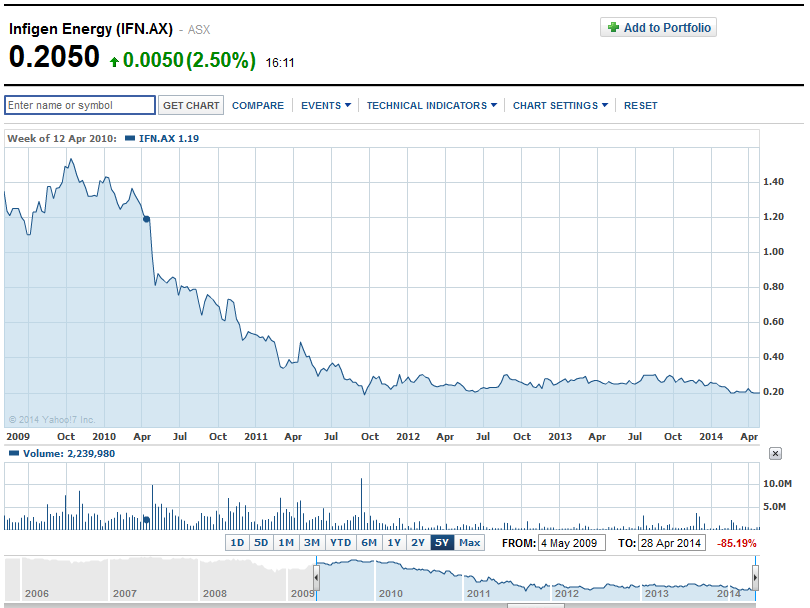
Infigen 2009-5.5.14

The early movers have seen their shares freefall from over $1.40 to $0.20 – representing an 80% loss. Ouch!

The collapse in Infigen’s share price simply highlights our warning to bankers and investors. Remember this is an outfit that used to be called Babcock and Brown – which collapsed spectacularly in 2009 – taking $10 billion of investors’ and creditors’ money with it on the way out (see this story). Get set for a replay.

Consider this STT’s fair warning to anyone with exposure to wind power companies – be it shareholders, bankers or those who face exposure through their super fund’s investments – grab your money and get out while you can.

please-take-a-moment-and-look-around-and-find-the-nearest-exit

Joe Hockey points out the Futility of Wind Turbines!

Joe Hockey keen to scrap Infigen’s “utterly offensive” Lake George Wind Farm

joe hockey 2

In our last post we covered the Alan Jone’s interview with Federal Treasurer Joe Hockey that’s sent the wind industry and its parasites into a tailspin.

Apart from the fact that Joe detests the very sight of these things, the Treasurer made it abundantly clear that when the Coalition talks about ending the “age of entitlement” it includes the fat pile of subsidies in the form of Renewable Energy Certificates being gouged from unwilling (or, rather, unknowing) Australian power consumers – and set to be delivered to wind power generators for another 17 years.

The mandatory RET/REC scheme started operation in 2001. RECs are issued to wind power generators from the moment a turbine starts delivering power to the grid – and will (under the current legislation) continue to be issued until 2031. So, there are giant fans that went up in 2001 that have the potential to collect RECs every year for 30 years – 1 for every MW delivered to the grid: 30 years is clearly “ages” of “entitlement”.

STT is hard pressed to think of any “infant” industry subsidy (and that’s what it was pitched as) that’s paid at precisely the same rate for more than a generation. That’s probably why we call the mandatory RET the most ludicrous energy policy ever devised. It is inherently unsustainable – and any policy that’s unsustainable is doomed to fail.

Anyway, back to the reaction to Joe’s comments. The Fairfax press have gone ballistic – resorting to the standard tactic of calling Joe a “climate change denier”. Once upon a time, it used to be called “global warming” but the inconvenient fact that the World’s thermometers haven’t budged for 17 years has seen that label drop off the radar.

Although, the grand prize for abusing the English language has to go to shadow Climate Change Minister, Labor’s Mark Butler – who, in theWeekend Australian was quoted as saying that Joe Hockey: “had joined the ranks of the Coalition’s caucus of climate deniers”.

Now, clearly, that’s a far more serious charge than simply questioning the true cause(s) of “climate change” – whatever that is. However, we’re pretty sure that Joe Hockey – and all other members of the Coalition will grudgingly concede that there is such a thing as the “climate”.

The continued efforts of Labor and the hard-green-left to paint giant fans as the only “solution” to “global warming” or “climate change” (call it what you will) are, of course, infantile nonsense.

We’ll return to this theme in a moment. But, first, here is an uncharacteristically objective piece from the ABC covering Joe Hockey’s full frontal assault on the wind industry.

Joe Hockey says wind turbines ‘utterly offensive’, flags budget cuts to clean energy schemes
ABC Online
Latika Bourke
2 May 2014

Government sources have moved to reassure the energy sector that they have no plans to close down the Clean Energy Regulator, despite Treasurer Joe Hockey saying it is in the Government’s sights.

Mr Hockey made the comment while launching an attack on wind farms, saying he finds the giant turbines “utterly offensive” but is powerless to close down those operating outside Canberra.

Speaking to Macquarie Radio, Mr Hockey was being asked about whether the Government would target clean energy programs in its quest for massive spending cuts.

“Well, they say get rid of the clean energy regulator, and we are,” he said.

He then mounted an attack on wind farms, specifically the wind turbines operating outside the national capital.

“If I can be a little indulgent please, I drive to Canberra to go to Parliament, I drive myself and I must say I find those wind turbines around Lake George to be utterly offensive,” he said.

“I think they’re just a blight on the landscape.”

Infigen Energy, which owns the turbines, says the farm is capable of producing 189 megawatts of wind power, which is used to supply Sydney’s desalination plant.

It falls in the electorate of Hume, which is represented by the Liberal MP Angus Taylor.

He has told the ABC he does not support wind farms either but for different reasons.

“The economics don’t work. Right now wind requires massive subsidies over and above other means of reducing carbon emissions,” he told the ABC.

“This is not about their appearance; this about their cost and we all pay.”

Asked if he would cut Government subsidies to wind farms, in line with the Government’s stance on corporate welfare, Mr Hockey said he could not stop the Bungendore wind turbines from spinning.

“We can’t knock those ones off because they’re into locked-in schemes and there is a certain contractual obligation I’m told associated with those things,” he said.

But Mr Hockey hinted new climate and green energy schemes could be on the chopping block come budget night.

“You will see in the budget that we have addressed the massive duplication that you have just talked about and the vast number of agencies that are involved doing the same thing,” he said.

“We are addressing that in the budget, [and] we are considering that very carefully.”

But a Government source has told the ABC that the Clean Energy Regulator [CER] will not be one of them.

The CER will oversee and enforce the Coalition’s Direct Action policy.

The Government is abolishing other climate change programs and schemes, including the Clean Energy Finance Corporation and Climate Commission.
ABC Online

Nice work there from Angus “the Enforcer” Taylor – precisely what you’d expect from a Rhodes Scholar with a love of hard numbers and a hatred of “corporate welfare” that matches his hatred of giant fans.

But we can’t let this comment from our favourite whipping boys, Infigen go unnoticed:

Infigen Energy, which owns the turbines, says the farm is capableof producing 189 megawatts of wind power, which is used to supply Sydney’s desalination plant.

The wind farms which Joe Hockey finds so “utterly offensive” and “a blight on the landscape” – and being referred to by Infigen in the extract above – are “Capital” and “Woodlawn” on the shores of Lake George, north of Canberra. So let’s have a quick look at their last Report Card to see that they’re really “capable of”.

REPORT CARD: CAPITAL & WOODLAWN

Dear Mr and Mrs Infigen,

Please find below our assessment of your children’s performance for Term 1. As Capital and Woodlawn have worked jointly, we have assessed their performance jointly.

ASSESSMENT – GRADE:

We have included several pieces of their recently submitted assessable work. This work was drawn from work set over the last month to date: April/May 2014.

Capital’s performance is shown by the red line; Woodlawn’s performance is shown by the purple line; and their combined performance is shown by the grey line. If you have any trouble reading their work, click on the graph – it will pop up in a new window, use your magnifier to enlarge it and all will become clear.

Capital 8.4.14

GRADE: Fail.

COMMENT: When power was needed most in the middle of the day, Capital and Woodlawn showed no interest in their set task, instead annoying grid managers with a couple of spurts of less than 20 MW of their combined capacity of 188 MW.

Captital 9.4.14

GRADE: Fail.

COMMENT: Again, Capital and Woodlawn appear to have no interest in applying themselves. A momentary spurt of 30 MW – which is no more than 16% of what they claim to be capable of – is totally unsatisfactory. And by choosing to work late at night or in the early hours of the morning, yet again, they are simply disrupting others trying to enjoy their homes and sleep.

Capital 16.4.14

GRADE: Fail.

COMMENT: A marginally better effort, but at 1am, as they know, there is no demand for their output and all they are doing is sending the dispatch price towards zero and engaging in “predatory pricing” – punishing the diligent students (coal, gas and hydro) who are always prepared to work around the clock.

Capital 17.4.14

GRADE: Fail.

COMMENT: As per above. Two brief and tiny spurts of 8 MW is simply nuisance value for grid managers, forced by the RET to take those insignificant efforts ahead of base-load power; they have been repeatedly warned about destabilizing the grid by this kind of behaviour.

Captial 19.4.14

GRADE: Fail.

COMMENTS: Sporadic efforts like this make a mockery of the claims made by Capital and Woodlawn to be serious substitutes for coal, gas and hydro power. They have been asked to provide a report explaining where the power came from on this occasion – and the hundreds of other occasions – when they failed to apply themselves: they are yet to provide any sensible explanation.

Captital 1.5.14

GRADE: Fail.

COMMENT: Capital and Woodlawn continue to frustrate with their poor attitude to carrying out set tasks. Two fleeting spurts of less than 8 MW is totally unsatisfactory. They have been spoken to many times about their failure to perform even the simplest tasks required of them. This pitiful effort takes to 6 the number of times in less than 24 days when Capital and Woodlawn have completely failed in their set tasks.

ATTITUDE & BEHAVIOUR:

Capital and Woodlawn are on their final warning concerning their poor attitude and unsettling behaviours. They have been repeatedly warned about telling lies, half-truths and spreading misinformation about their performance; and their relationships with other students leaves much to be desired.

Despite repeated warnings, Woodlawn keeps claiming that it “powers” 32,000 homes and saves over 138,000 tonnes of CO2 emissions every year (here is a note seized in class). It is evident from Woodlawn’s continued and repeated failure to perform (as summarised above) that these wild claims are nothing but complete fiction.

As Woodlawn well knows, its persistent failure to deliver any meaningful power to those homes – hundreds of times each year – has threatened to leave their owners freezing (or boiling) in the dark.

Woodlawn is also well aware that while it was slacking off, the power it failed to deliver was all made up by “spinning reserve” from base-load gas and coal thermal generators and highly inefficient Open Cycle Gas Turbines – which spew out 3-4 times the CO2 per unit of power generated, compared to a modern coal-fired plant. These simple and unassailable facts mean that its claims about reducing CO2 emissions are patent nonsense. We sent these notes home last month about spinning reserve and OCGTs.

Capital has performed no better.

Capital continues to claim that it “powers” the Sydney Desalination Plant (this was found scrawled on the blackboard).

As Capital well knows it fails to “power” so much as a kettle for hours and days on end, hundreds of times each year – the abysmal examples above make that plain.

And, despite repeated warnings about lying, Capital is acutely aware that its claims about “powering” the Sydney Desalination Plant are doubly wrong.

First, because any power Capital has bothered to produce is dispatched into the same Eastern Grid – along with power from every other generation plant connected to that grid: an electron produced by a coal-fired plant and Capital is indistinguishable. Any power generated by Capital is simply lost in the system and, therefore, its claim to be the exclusive provider of “power” to the Sydney Desalination Plant is simply nonsense.

And second, because the Sydney Desalination Plant has not produced a single drop of desalinated water since July 2012 it, therefore, has had no need for Capital’s power for almost 2 years (another helpful student sentus this report on the mothballed Desal plant – see the section headed “Operation”).

All of which raises the question of what Capital is “powering” when it finds itself bothered to apply itself to its assigned task?

Capital and Woodlawn have also demonstrated a range of unsettling and anti-social behaviours. They continue to falsely claim that the noise they generate is no louder than listening to a refrigerator 500m away (for an example of what they really sound like – when they’re working – click here).

Because of their erratic work habits – generating most of their power at night-time when there is simply no demand for it – they continue to disturb and annoy other students trying to sleep and enjoy their homes. This behaviour, in particular, demonstrates a lack of empathy and emotional intelligence (for just one example of the impact Capital and Woodlawn’s thoughtless behaviour is having on others – click here).

In an effort to correct their behaviour in this regard, we recommend that both Capital and Woodlawn attend the counselling sessions that the school has previously offered to them.

Capital and Woodlawn have also been repeatedly warned about stealing people’s lunch money. Their excuse that it is not really “money” because they’re only taking Renewable Energy Certificates is unsatisfactory.

Whenever challenged, they continue to lie about the cost of the power they do (on rare occasions) manage to produce by pointing to the dispatch price – which is totally irrelevant to power consumers, who – thanks to under-performers like Capital and Woodlawn – now pay among the highest retail power prices in the world (see page 11).

And they refuse to mention at all the rates paid under their Power Purchase Agreements with retailers – which are 3-4 times higher than the diligent and consistent students, coal, gas and hydro. Capital and Woodlawn also ignore the cost of coal/gas thermal generators maintaining spinning reserve (wasting mountains of coal and gas every year) and the cost of running insanely expensive OCGTs – both needed to keep the power flowing to customers when Capital and Woodlawn continually fail to deliver – costs which are all ultimately added to power consumers’ bills, crippling energy intensive businesses and harming poor and vulnerable families.

Capital and Woodlawn continue to disappoint with their erratic performance; their continued lies, half-truths and misinformation about their performance; and the callous way that they treat their neighbours trying to sleep at night time. We find their repeated promises to perform better next time hollow and tiresome.

OVERALL ASSESSMENT:

FAIL.

LAKE GEORGE HIGH SCHOOL

Principal: A. Power-Consumer

May 2014.

report-card

Aussie Federal Treasurer finds Wind Turbines….”Utterly offensive”!

Joe Hockey says wind turbines ‘utterly offensive’, flags budget cuts to clean

energy schemes

Wind turbines at Capital wind farm stand next to Lake George near Canberra.

Federal Treasurer Joe Hockey says he finds wind turbines “utterly offensive”, but is powerless to close down the ones operating outside Canberra.

Speaking to Macquarie Radio, Mr Hockey was being asked about whether the Government would target clean energy programs in its quest for massive spending cuts.

“Well, they say get rid of the clean energy regulator, and we are,” he said.

He then mounted an attack on wind farms, specifically the wind turbines operating outside the national capital.

“If I can be a little indulgent please, I drive to Canberra to go to Parliament, I drive myself and I must say I find those wind turbines around Lake George to be utterly offensive,” he said.

“I think they’re just a blight on the landscape.”

Asked if he would cut Government subsidies to wind farms, in line with the Government’s stance on corporate welfare, Mr Hockey said he could not stop the Bungendore wind turbines from spinning.

“We can’t knock those ones off because they’re into locked-in schemes and there is a certain contractual obligation I’m told associated with those things,” he said.

But Mr Hockey hinted new climate and green energy schemes could be on the chopping block come budget night.

“You will see in the budget that we have addressed the massive duplication that you have just talked about and the vast number of agencies that are involved doing the same thing,” he said.

“We are addressing that in the budget, [and] we are considering that very carefully.”

STOP SUBSIDIZING USELESS, INEFFICIENT WIND!

Perverse Renewables Policy turns Wind Power into Super-Predator

great white shark

The RET turned me into an occasional Super-Predator.

On the rare occasions when wind power is able to deliver meaningful output to the grid – usually at night-time – generators are more than happy for the dispatch price (the price paid by the grid operator to generators) to hit zero – and have even paid the grid operator to take their output, on occasions.

In Australia, that perverse market outcome is a product of the mandatory Renewal Energy Target – which forces retailers to take wind power output ahead of every other generation source (failure to take wind power and Renewable Energy Certificates (RECs) that go with it, leaves the retailer liable to pay a fine (the “shortfall charge”) of $65 for each MW/h the retailer falls short of the mandated target; the REC that is issued to wind power generators for each MW of wind power dispatched (currently worth around $28); and the Power Purchase Agreements wind power generators hold with retailers, containing fixed and guaranteed guarantee minimum prices of between $90-120 per MW/h (3-4 times the cost of conventional power).

As a result of the above, when they’re delivering to the grid, wind power generators are happy to watch the dispatch price plummet, punishing base-load generators, while having no impact on their own returns.

Some might call it “predatory pricing” – Travis Fisher an American economist with the Institute for Energy Research certainly does.

Here’s a very detailed analysis of the US energy market by Travis in which he demonstrates just how perverse renewable energy policy is.

What Travis says about predatory pricing by wind power generators in the US has direct relevance to what’s happening in the Australian energy market. In the piece below just substitute the “Clean Energy Council” for the “American Wind Energy Association (AWEA)”; and substitute “Renewable Energy Target (RET) and Renewable Energy Certificate (REC)” for “Renewable Portfolio Standards (RPS) and Production Tax Credit (PTC)”.

AWEA’s Bold Push for More Wind Welfare Wind
Institute for Energy Research
Travis Fisher
23 April 23

The American Wind Energy Association (AWEA) is making an all-out effort to convince Congress to renew the wind production tax credit (PTC), the wind industry’s lucrative subsidy that expired at the end of 2013. AWEA is desperate to revive the PTC and, unfortunately, its most recent lobbying push relies heavily on misinformation and half-truths in order to divert attention away from the PTC’s many critics.

To set the record straight, this article addresses some of AWEA’s flawed arguments and glaring omissions. The PTC, while incredibly valuable to owners of wind power facilities, hurts U.S. taxpayers and undermines the economic efficiency and physical reliability of the U.S. power grid.

Background

AWEA is a well-funded and well-organized industry association with 40 years of experience influencing public policy and an annual budget of more than $30 million. Perhaps due to AWEA’s skilled lobbying efforts, four different administrations and countless lawmakers have sided with AWEA and provided the wind industry a direct hand-out from American taxpayers.

Initially signed into law by George H. W. Bush as part of the Energy Policy Act of 1992, the PTC has expired and been renewed multiple times. Each renewal lasted only a short period, designed to extend the industry’s coveted subsidy for just one or two more years. Most recently, the PTC was extended through the 2013 calendar year as part of the “fiscal cliff” legislation passed in early 2013. A PTC extension for 2014 recently passed the Senate Finance Committee after being added to a tax extenders package by one of the wind industry’s most enthusiastic supporters, Senator Chuck Grassley. The Joint Committee on Taxation projects that a one-year extension of the PTC will cost American taxpayers over $6 billion.

The Institute for Energy Research (IER) has consistently argued against the PTC and highlighted its negative effects, which range from threatening grid reliability to redistributing federal tax dollars to a minority of U.S. states.

AWEA and Exelon Spar Over the PTC

As part of AWEA’s push to renew the PTC, it recently published a 28-page report that attempted to show that the PTC does not distort electricity markets and does not harm nuclear plant owner-operators. The policy report comes as a direct response to Exelon Corporation, the owner of the largest fleet of nuclear plants in the U.S. The issue at the center of the policy debate is “negative pricing.”

What is Negative Pricing?

Unlike the stable and predictable price of electricity at the retail level, market prices for wholesale electricity can fluctuate widely throughout the day – usually referred to as on-peak and off-peak prices – and across seasons. For example, wholesale prices tend to range between $30 and $50 per megawatt-hour but can drop into the negative or spike well above $500 per megawatt-hour. When the price becomes negative, electric generators are actually paying the grid to take their electricity. Several factors influence wholesale prices, namely supply, demand, and transmission constraints. Fundamentally, negative wholesale prices send a distress signal to markets that the supply and demand balance on the grid is economically unsustainable and suppliers need to reduce their output.

Why do sellers not drop out of the market when negative pricing occurs? As the Energy Information Administration (EIA) notes, “negative prices generally occur more often in markets with large amounts of nuclear, hydro, and/or wind generation.” That is because each of these technologies has an incentive to continue operating even when its facilities are temporarily paying the grid to take their power.

Nuclear plants are designed to run at full output and not “ramp” up and down, making them very reliable but inflexible. In times of very low demand, nuclear plants will sometimes take negative prices rather than go through the long and expensive process of lowering their output. Similarly, hydroelectric plants sometimes take negative prices in power markets because they are forced to run in order to comply with environmental requirements that force them to release water, regardless of whether the electricity is needed.

Unlike nuclear or hydro producers, the wind industry actually profits from negative prices because the PTC is such a large subsidy. Wind producers receive PTC payments per unit of power produced (even when the power has no value whatsoever to the grid), so they flood the grid with uneconomic power and ignore the distress signal sent by negative prices. Specifically, wind producers are paid the equivalent of $35 per megawatt-hour in PTC subsidies, so a wind producer taking the PTC can still profit while paying the grid to take its electricity.

Wind’s inflexibility in the face of negative prices is therefore a policy problem with a policy solution (let the PTC expire), not a matter of physics or environmental restrictions.

The threat to baseload generation from negative prices is very real. Already, Dominion closed its Kewaunee Nuclear Plant in Wisconsin 20 years ahead of schedule and Entergy plans to retire its Vermont Yankee Nuclear Plant at the end of this year. Both companies cited economic considerations as the reason for closing the plants. While it is true that low-cost natural gas is partially responsible, it is also clear that artificially low prices caused by the PTC during off-peak hours played a role. In fact, the Department of Energy’s assistant secretary for nuclear energy referred to this emerging pattern of nuclear plants shutting down early as “a trend we are clearly very, very concerned about.”

Exelon’s Argument

Exelon argues that the PTC wreaks havoc on baseload or “around-the-clock” generation such as nuclear power by encouraging negative prices in wholesale electricity markets. In contrast to baseload units, electricity production from wind peaks at night and in the early morning when electricity demand is low, which contributes to a situation of over-supply. A 2012 study commissioned by Exelon maintains that PTC-related negative prices harm baseload power and grid reliability because they “directly conflict with the performance and operational needs of the electric system.” Essentially, if the PTC is extended, it will induce more negative pricing events during off-peak hours, and make more baseload units uneconomic. In other words, the PTC perpetuates a system of predatory negative prices that attack reliable (and far less subsidized) baseload producers.

The power grid reliability implications are straightforward. The PTC is making reliable generation uneconomic, while subsidizing unreliable wind power. Without reliable generation up and running, many regions will struggle to meet seasonal peak demand in winter or summer. For most of the country, the highest peaks occur in the summer months. The following chart from a study on the intermittency of wind power illustrates just how little wind contributes to those summer peaks (click on the graph for a clearer view).

ERCOT-Wind-Power

On these arguments against the PTC, IER is not alone – energy experts across the board agree with Exelon. The Congressional Research Service (CRS) acknowledged the problem of negative pricing, noting in 2012 that “[n]egative power prices associated with wind power might generally occur at night when wind is producing at high levels. Large amounts of wind power generation can potentially contribute to transmission congestion and result in negatively priced wholesale power in certain locations.” The EIA also specifically lists the PTC as a cause of negative prices.

The same CRS report from 2012 outlined the reliability issues associated with wind, predicting that “should wind power continue to experience growth, it is uncertain whether current [regional transmission organization] market designs would function to ensure availability of the types of generation that would be necessary to both maintain resource adequacy and manage the variable and intermittent nature of wind power.”

Last December, the New York Times published an article about how wind and nuclear power “are trying to kill each other off” and noted the “cannibal behavior” of wind in power markets.

Focusing on Texas, which is the U.S. market hit hardest by wind power, Public Utility Commission Chairman Donna Nelson testified in 2012 that “[t]he market distortions caused by renewable energy incentives are one of the primary causes I believe of our current resource adequacy issue … [T]his distortion makes it difficult for other generation types to recover their cost and discourages investment in new generation.” And as the non-partisan Center for Strategic and International Studies wrote in May of 2013, “[a] growing number of analytical reports … point to the negative impact of renewable energy mandates and subsidies (direct and indirect) on the competitiveness of nuclear power.”

In fact, some environmentalists are troubled by wind power’s parasitic effect on nuclear power. James Hansen’s observation relating to a similar policy – renewable portfolio standards – actually underscores Exelon’s argument regarding the PTC:

The asymmetry finally hit me over the head when a renewable energy advocate told me that the main purpose of renewable portfolio standards (RPS) was to “kill nuclear”. I had naively thought that the purpose was simply to kick-start renewables. Instead, I was told, because utilities were required to accept intermittent renewable energies, nuclear power would become less economic, because it works best if it runs flat out.

In short, the predatory pricing enabled by the PTC is real, it is harmful to reliable generation, and it hits nuclear generation the hardest. AWEA cannot shrug off the harmful effects of the PTC or pretend they do not exist. As an Exelon executive said recently, “[w]e can work with AWEA on a clean energy future but we can’t deny the truth.”

AWEA’s Fuzzy Math

AWEA’s policy report, titled “The facts about wind energy’s impacts on electricity markets: Cutting through Exelon’s claims about ‘negative prices’ and ‘market distortion,’” attempts to turn the negative pricing arguments on their head by narrowly focusing on the wind industry’s side of the story. Specifically, AWEA flatly misrepresents the effect of the PTC on wholesale markets by omitting important information and making bogus comparisons.

AWEA claims the impact of wind on wholesale markets is “entirely market-driven” and “widely seen as beneficial.” The first claim is patently false and the second is very misleading.

No one at AWEA can claim with a straight face that the growth in the wind industry is “entirely market-driven.” AWEA spends millions of dollars a year lobbying for renewable energy mandates in the states and for the PTC and other support at the federal level. If wind were truly “market-driven,” there would be no need for AWEA’s massive lobbying effort for mandates and subsidies. The mandates and subsidies AWEA supports are the exact opposite of “market-driven.”

AWEA knows better than any other organization just how much government support the wind industry receives – support that simply does not exist for baseload generation and should not exist for any power generation source whatsoever. Because of AWEA’s lobbying efforts to mandate the use of their product, 29 states and the District of Columbia mandate certain levels of renewable energy generation (these laws are commonly called Renewable Portfolio Standards or RPSs). Because the vast majority of the power being used to satisfy these requirements comes from wind plants, the wind industry currently enjoys a government-mandated market share. This alone is enough to discredit AWEA’s comment about Exelon obscuring the “real story of wind energy successfully competing against more expensive forms of energy in the market.” AWEA knows the wind industry is winning on government support, not the free market.

State-level mandates aside, AWEA attempts to downplay the role of the PTC specifically in undermining baseload generation. It is vitally important to realize that negative prices are not the only indicator of market distortion. AWEA draws a false dichotomy in its report between the “real economic savings” from wind and the “exceedingly rare” negative prices that cause market distortions. Here, AWEA downplays the possibility that market distortion can exist without negative prices. But just as the PTC subsidy causes negative prices at the extreme, it regularly causes artificially low power prices in off-peak hours that can be just as damaging to baseload generation.

AWEA then makes the stretch that, because the negative pricing problem was less rampant in 2013 than it was in 2012, market distortions from the PTC no longer exist or are “extremely rare.” This argument is fatally flawed as demonstrated by the following analogy. Consider if a thief said, “I didn’t do anything wrong in 2013. I only stole half as often as I did in 2012.” Such a statement would be silly because theft is theft. The same is true of harmful market distortions.

Just because there were fewer hours in 2013 with negative prices, it does not follow that the PTC is any less of a problem. Even in a world where prices were never to fall below zero, market distortion caused by the PTC could still render baseload units uneconomic. For example, reliable power plants would still close if prices were consistently at or very near zero. As discussed above, this is what we are seeing in practice, AWEA’s distractions notwithstanding.

Also, the 2012 data are so bad that 2013 was bound to be a less damaging year – in fact, one of Exelon’s plants took negative prices for 8.3 percent of all hours in 2012. The fact that this statistic fell to 4.3 percent in 2013 is little consolation. Essentially, we can debate the extent to which the PTC continues to cause negative prices, but to recast the PTC as incapable of distorting power markets is disingenuous on AWEA’s part.

Finally and perhaps most disturbingly, AWEA’s report fails to capture any long-term effects of the PTC. For example, in several places the AWEA report talks about wind power “replacing the most expensive and polluting sources of energy.” In practice, wind cannot do this because wind is unreliable. Wind cannot replace the most expensive source of electricity generation because those generation sources only run at peak times. The wind does not blow when AWEA wants it to and millions of dollars spent on lobbying cannot change that simple fact of the physical world.

Furthermore, as James Hansen and others have observed, heavily subsidized wind power is actually displacing zero-emission nuclear power rather than the “most polluting” sources AWEA references. If the goal of the PTC was to wipe out America’s nuclear fleet, then it is succeeding. But if the goal was to support zero-emission generation, then it has backfired miserably. The PTC has wasted billions of taxpayer dollars to replace nuclear, a clean technology that works, with one that only sounds good and is fundamentally unreliable.

Conclusion

The wind production tax credit distorts power markets by allowing wind producers to profit from artificially low prices. Such market distortion undermines the reliability of America’s power grid in the long run by forcing reliable baseload power plants to close -including nuclear plants, which in turn defeats any environmental purpose for keeping the PTC.

AWEA’s recent study is a desperate attempt to obscure the very real and worrisome long-term effects of the PTC by relying on misleading data. The PTC has rightly received scrutiny from energy experts across the political spectrum, and it deserves a more comprehensive analysis than AWEA provides in its report.
IER Economist Travis Fisher authored this post.
Institute for Energy Research

The only significant difference between the Australian energy market and that detailed above, is that Australia doesn’t have any nuclear power generation at all.

Instead, it’s base-load gas generators who are being pounded by wind power generators’ ability to periodically crash the dispatch price.

By base-load gas generators, we’re referring to either gas/thermal plants (where gas is used to fire boilers, create steam and run turbines) or highly efficient Combined Cycle Gas Turbines.

One early casualty was Stanwell (Queensland’s largest power generator) – which back in February took the extraordinary step of announcing it would mothball its biggest gas-fired power station – the Swanbank E power station, near Ipswich – a highly efficient Combined Cycle Gas Turbine (CCGT) plant – and resurrect a coal facility built in the 1980s. Stanwell put its inability to operate its gas-fired plant squarely down to the market distortions created by the mandatory RET (see our post here).

What’s doubly perverse is that generating power using CCGTs produces about 50% less CO2 emissions than coal/thermal. Instead of CCGTs, generators have invested $millions in Open Cycle Gas Turbines (OCGTs) that emit 3-4 times the CO2 per unit of electricity – when compared to a modern coal-fired thermal plant and cost a small fortune to run (between $200-300 per MW/h, compared to $25 for coal/thermal). So much for a policy designed to “save the planet”.

Because wind power can only be ever delivered at crazy, random intervals – 100% of its capacity has to backed up 100% of the time with spinning reserve and inefficient OCGTs – which can be deployed in a heartbeat to keep the grid balanced — and the lights on – whenever wind power output varies or disappears altogether (see our post here).

Wind power generators’ ability to game and distort the dispatch price by operation of the mandatory RET (and the matters outlined above) is about to come under the microscope of the RET review panel.

The top-flight energy market consultancy, ACIL Allen has been directed by the panel to focus on the cost impacts of renewable energy in the electricity sector. And that means the whole electricity market – and the long-run impact the RET will have on power prices, including the impact of periodic predatory pricing by wind power generators knocking out highly efficient base-load gas generators – like Stanwell’s Ipswich plant.

Given the make-up of the panel – and the terms of its brief – we doubt that ACIL Allen will pull any punches.

million_dollar_baby_clint_eastwood_clint_eastwood_060_jpg_pvrk

Now – have I got your attention?

Those Aussies are all set, to kick Wind to the Curb! Wonderful!

Alan Moran: Scrap the RET and let Australian business compete again

alan pic

Alan Moran: scrap the RET and save our industry.

Stop renewable subsidies to allow lower electricity prices and competitive industry
Catallaxy Files
Alan Moran
24 April 2014

The RET Review brought the usual howls of anguish from the rent seekers concerned that regulatory measures will cease and that they will need to sell their wind and solar products on the open market. That means they would need to persuade people to pay three times the price they are already paying.

Support for the rent seekers is coming strong from the usual green left anti-capitalists, including THEIR ABC.

This piece on the Drum explains the issues then goes full pelt in support of the continuation of the rort. It includes a clip by Sarah Ferguson who, along with her husband Tony Jones and the dozens of other far leftists, is a major shareholder in the tax financed propaganda agency. In the clip the ACCI’s Burchell Wilson stoutly defends the consumer’s right to avoid exploitation by the politically correct.

The RET scheme with the feed-in tariffs for roof-top solar already adds 7 per cent to the cost of electricity to households, a cost that will more than double on present policies. By 2020 the scheme, if unchanged, will add over 40 per cent to the wholesale cost of electricity and largely negate the benefits from the demise of the carbon tax (should that occur). It is little wonder that major energy intensive industries are departing Australia – our prices have risen to be among the highest in the world from among the lowest less than a decade ago.

The RET review does not have the usual clutch of green left or docile functionaries that have previously characterised such reviews. Led by a highly successful businessman, Dick Warburton, there is no likelihood of a repeat of the previous pattern of reviews that ramped up the scheme. In the past we had:

  • Howard announcing a scheme in 2001 which would subsidise an innocuous “two per cent of additional energy”; that was trebled to 9,500 GWh by a hand-picked team established to interpret this.
  • A proposal in 2003 by the hapless Grant Tambling for an increase to 20,000 GWh, which John Howard, having come to his senses, rejected.
  • And as a “compromise”, Rudd and Turnbull agreeing to the present 20 per cent of electricity to be provided by subsidised exotics, mainly wind, defined as 45,000 GWh by 2020.

The rent seekers know the game is up and there is no prospect of an economy-busting increase in their feed. They know they cannot even expect Gillard’s Climate Change Authority placepeople’s solution of retaining the scheme as is and are falling back on one that which would reduce it to comprise the currently expected 20 per cent of electricity.

The presently expected 20 per cent by 2020 shaves off at least a quarter of the existing RET’s 45,000 GWh because regulatory and tax boosts have caused energy demand to drop.

Alternative approaches would range from cancelling the scheme’s subsidies for any new proposals to doing something akin to the Spanish Government’s approach and ceasing to pay any subsidies, even on windmills in the ground.

The review is to report later this year and is taking submissions until May 15.
Alan Moran

Alan mentions “the usual howls of anguish from rent seekers” that followed the announcement of the RET review. Well, after the meeting held by the panel last week in Sydney – where the panel spelled out the review’s real mission (determining the cost impacts of renewable energy in the electricity sector) – those “howls” have become a blood-curdling banshee scream (see our post here).

But we can’t fathom why? You see, the greentard bloggers have been telling us for years now that wind power is “free” and already competitive with conventional power generation sources – it’s a “line” they still run, but now it’s about to be tested.

If they’re right – then the wind industry won’t miss the mandatory Renewable Energy Target at all.

The wind industry simply won’t need the RET to force retailers to take wind power ahead of conventional power under the threat of being hit with a $65 fine (the “shortfall charge“) for every MW they fall short of the mandated target.

And they should have no trouble at all finding retail customers willing to pay 3-4 times the cost of conventional power, delivered at crazy, random intervals – and also willing to find some alternative for the 70% of the time they’ll be freezing (or boiling) and sitting in the dark – wood stoves and candles, say?

And they’ll have no need for a further $50 plus billion worth of Renewable Energy Certificates that – under the current target – will be issued to wind power generators and added to power consumers’ bills between now and 2031.

But, from the hysterical hectoring now coming from the Clean Energy Council, the wind industry and its other parasites about saving the RET, we think actions belie words. Or, as the Americans put it: “money talks and bullshit walks”.

cow_dung

Wind industry spin: you can fill your boots with it.


Everybody….fight hard, like the Aussies Do!!! We don’t need Wynne Power or Wind Power!!!

Australia’s Wind Industry Finally Faces its “Waterloo”

napoleon

He always seemed a little taller in the saddle.

During the latter part of the French Revolution a diminutive Corsican took charge of French affairs, installing himself as First Consul in 1799; and, in 1804, anointing himself French Emperor – adopting the tag Napoleon I.

The little Emperor bestrode Europe and – with his Grande Armée – from 1803 to 1815 generally gave his neighbours hell. His trip to Moscow in 1812 languished in the Russian winter snows – it wasn’t anywhere near the roaring success he’d planned for (although it did result in one or twothumping orchestra tunes – and a few very long and somewhat grimpieces of literature).

After his trip to Russia, his Grande Armée was defeated at Leipzig, Germany and in the Peninsular War at Vitoria, Spain – but still, the little Emperor fought on.

Napoleon’s self-confidence and belief in his own brilliance bordered on the maniacal – he lived and breathed hubris and hyperbole – and if he was worried that he had made an enemy of every European state, including the Super Power of the day, Great Britain, he didn’t show it.

But, eventually, the little Corsican’s luck ran out in June 1815 – near a little Belgian town called Waterloo. Napoleon ran smack bang into a grand coalition of forces under the command of the Duke of Wellington – backed up by a host of other Countries, including the massive Prussian army, commanded Gebhard von Blücher.

At Waterloo, Napoleon’s defeat was final and definitive – with the Corsican banished thereafter to rot on the island of St Helena in the South Atlantic.

The rest, as they say, is history.

Since then to meet one’s “Waterloo” – in common parlance – is to meet one’s final, insurmountable challenge and be defeated by it.

Well, the Australian wind industry has just got a glimpse of its Waterloo.

Last Wednesday, the Coalition’s Expert Panel – charged with the task of reviewing the Renewable Energy Target – held a meeting in Sydney, attended by representatives from peak business bodies, such as the Business Council of Australia; miners, like Rio Tinto; and serious (ie conventional) power generators. Along for the ride too were a bunch of rent-seekers from the wind and solar industries – including, of course, the Clean Energy Council – all desperate to keep the RET gravy train rolling.

The wind industry and its parasites reacted in fits of horror when the make up of the panel was announced back in February. The panel is headed up by Dick Warburton – former Reserve Bank board member and all-round friend of (real) business and industry – with Matt Zema, the chief executive of the Australian Energy Market Operator; Brian Fisher, the former executive director of the Australian Bureau of Agricultural and Resource Economics; and Shirley In’t Veld, the former chief executive of Verve Energy in Western Australia making up the rest of a hard-hitting team (see our post here).

dick-warburton

Dick “RET Slayer” Warburton spells it out.

At the time the make-up of the panel was announced, the wind industry had no real insight into just how bad things were about to get. All of that changed at last Wednesday’s meeting.

During the meeting, Dick Warburton – and other members of the panel – laid out precisely what the panel’s task is all about (and what it isn’t about) and gave some pretty strong hints about what its recommendations will ultimately be: none of it favourable to the wind industry.

The wind and solar industry representatives present descended into a state of panic stricken shock – one of STT’s operatives noted that Infigen’s boys left the meeting looking like “zombies”.

The eco-fascist bloggers that spin propaganda on behalf of the wind industry are crying foul – calling the review a “farce”; “rigged”; “biased”; with a “pre-determined outcome”.

STT puts their hysterical language down to the fact that they’re just working their way through the 5 stages of grief: denial, anger, bargaining, depression and acceptance.

What really got their goat was the announcement that top-flight energy market consultants, ACIL Allen has been appointed by the panel to carry out the modelling for the review.

No fools, ACIL Allen – these boys are well and truly alive to the insane costs of the RET.

Back in 2012, they produced a report for Energy Australia which pointed out that the mandatory RET – with its current fixed target of 41,000 GW/h – would involve a subsidy of $53 billion, transferred from power consumers to wind power generators via Renewable Energy Certificates – a Federal Tax on all Australian power consumers. On the modelling done by Liberal MP, Angus “the Enforcer” Taylor – and privately confirmed by Origin Energy – ACIL Allen’s figure for the REC Tax is pretty close to the mark.

The wind industry’s cries of “farce”, “rigged” and “biased” fall just a little hollow, however, against the fact that Infigen & Co had pushed very, very hard for wind industry “friendly”, SKM to do the modelling for the review.

SKM has already performed $millions worth of engineering consultancy work for the wind industry and hopes to do tens of $millions more. It’s already tossed up a few pieces of wind industry backed drivel – pitched as hard-hitting “research” – but which are no more than the kind of fluff and guff you get from the Clean Energy Council. No surprises there. What’s that you say about “bias” and “pre-determined outcomes”? Apparently, it’s only an issue when the bias and outcome isn’t set to run in your favour.

During the meeting, the expert panel made it very clear what their mission is NOT about: the review has nothing to do with “climate change” (formerly known as “global warming” – until it stopped getting warmer 17 years ago); it has nothing to do with the spurious claims made by the wind industry about the creation of tens of thousands of “green” jobs; and it has nothing to do with modelling or measuring CO2 abatement.

On that last point, the panel flagged its position by implicitly rejecting the wind industry’s unsubstantiated claims about CO2 abatement. At one point, Dick Warburton made it plain that the review had nothing to do with CO2 emissions – and that the review was only concerned with the cost impacts of renewable energy in the electricity sector.

The panel told the meeting that its modelling will assume that there will be no carbon price between now and 2030 and no CO2 abatement target during that time – and that the modelling will assume that meeting the current 41,000 GW/h by 2020 is a physical impossibility – which it is.

Head spruiker for the Clean Energy Council, Russell “Rusty” Marsh addressed the meeting from the podium – while Infigen’s boys carped and whinged from the back of the room – banging on about “dangerous climate change” – mumbling about saving Polar Bears and Penguins – and bleating about the “wonders of wind” – much to the panel’s amusement.

Dick Warburton grinned through most of Rusty’s plea for RET mercy. It seems Rusty was squarely engaged in venting the first and third stages of his and his clients’ grief: “denial” and “bargaining”.

In a moment of pure desperation, the clowns from Infigen resorted to an effort to link the La Nina and El Nino weather patterns to giant fans – apparently the latter are the perfect solution to the former.

Although, we think it a little bit of a stretch to suggest that the continued maintenance of a massive stream of taxpayer/power consumer subsidies to an intermittent and unreliable power generation source – which cannot and will never reduce CO2 emissions – might have a bearing on the movement of ocean currents in the Pacific – a phenomenon which predates human history.

Rusty – and the boys from Infigen – made a raft of other wild claims about the “benefits” of wind power – all of which were soundly dismissed by the panel as “too hard to model” (polite code for “patent nonsense”) – and that any such “benefits” amounted to nothing more than a “wealth transfer” from power consumers to wind farm operators. Ouch! No wonder Infigen’s boys shuffled out of the meeting looking like extras from the Night of the Living Dead.

Having woken up to the RET review panel’s true mission, the wind industry and its parasites have now been reduced to name-calling – tagging Dick Warburton “a climate change denier and pro-nuclear advocate”; former ABARE chief, Brian Fisher a “fossil fuel lobbyist”; and Shirley In’t Veld, a “front for big coal”.

Hardly the kind of approach that might help their “cause” you’d think, but hysterical responses are to be expected, as they work through the second stage of their grief: “anger”.

The noises made by the panel at the meeting last Wednesday clearly don’t bode well for the RET. Scrap the RET and the wind industry – on life support now – will, of course, die a quick and natural death.

The panel’s likely recommendations will find a Federal Parliament raring to lay waste to the most ludicrous energy policy ever devised. The great majority within the Coalition are keen to bring the rort to an end, seeing the RET for what it is: nothing more than “corporate welfare” on a massive scale.

Come July, the new Senate takes its place and the balance of power will be held by a bunch of arch-conservative newcomers – along with STT Champions, John Madigan and Nick Xenophon.

The newcomers include 3 Senators from the Jolly “Un-Green” Giant, Clive Palmer’s Palmer United Party (PUP) – plus 1 – Ricky Muir of the Motoring Enthusiasts’ Party, who has already done a deal to side with the PUP; Bob Day (Family First) from South Australia; and David Leyonhjelm (Liberal Democratic Party) from NSW. All of them have signalled that they are itching to help the Coalition ditch Labor’s Carbon Tax – and all of them have made noises that they’re just as keen to scrap the Renewable Energy Target, too.

From July, to get its legislation through the Senate, the Coalition will have to do business with the help of these 6 newcomers – and John Madigan and Nick Xenophon. With that line up, getting legislation scrapping the RET through the Senate will be a doddle.

With the RET review panel sharpening its axe – and the Parliamentary Planets about to align – things couldn’t look much worse for the wind industry. This, of course, couldn’t be happening to a nicer bunch of lads.

Expect to hear a whole lot more hysterical language from that quarter as the industry, its parasites and the Clean Energy Council work their way through the 5 stages of grief; the first of which is “denial”.

At Waterloo, even with his artillery captured, his troops in disarray and Wellington’s superior forces holding all the points of strategic importance, Napoleon tried to rally the last rump of his forces, flattering himself with the hope of the victory he knew was his.

It wasn’t, of course, to be – Napoleon had, finally, met his Waterloo.

From the noises made by the RET review panel last Wednesday, it appears the Australian wind industry is about to meet its very own Waterloo.

napoleon defeated

Even Emperors run out of luck, eventually.

Energy Australia pulls the plug on Robertstown wind farm project

Great news for the tight little South Australian farming communities of Robertstown and Point Pass as Energy Australia pulls the plug on its plans to slam 40 giant fans into the heart of highly productive farming and grazing territory in SA’s Mid-North.

Here’s the story – as told by STT Champion, Mary Morris:

Colin & Mary

Colin Schaefer and Mary Morris celebrate a victory for common sense.

Colin Schaefer (Brady Creek) and Mary Morris (Buchanan) give the thumbs up to Australian Radio Towers workers as they dismantle an Energy Australia wind monitoring mast near Point Pass in the Mid North of South Australia.

Roberstown tower

Going, going …

This wind monitoring mast for the proposed Robertstown wind farm was taken down today by contractors under direction from Energy Australia. It was erected in 2009, a mere 500 m from a neighbouring farm house and close to the township of Point Pass and dozens of hobby farms and lifestyle blocks.

A second tower will be removed tomorrow near Inspiration Point, west of the township of Robertstown.

Initially local landowners were supportive when invited to take part in the project in 2005. However, local opposition to the proposed wind farm took off in late 2010, when the nearby Waterloo wind farm started operating and landowners who had signed up for Robertstown wind farm realised they could hear and feel noise and vibration from 8 km away.

Nine of the fourteen contracted Robertstown landowners believe they were misled about the impacts of the wind farm – especially noise – and no longer want to be part of the project. Colin Schaefer (pictured) was one of the contracted landowners who changed his mind when Waterloo wind farm started operating. He had worked on the construction at Waterloo and thought it was great idea – until the turbines started turning and his sleep was frequently disturbed.

A petition with 345 local signatures against any more turbines being built in the area south of Burra was presented to Energy Australia at a public information session at Marrabel in May 2012.

At the site today, Mary Morris thanked Clint Purkiss (Energy Australia) for removing the mast and asked him for his reasons for doing so. He replied “it’s fair to say, we listened”.

Mary Morris
14 April 2014

Robertstown tower 2

…. gone!

And here’s a Channel 7 News report on the victory:

****


****

Truth be told, a whole host of factors lined up to kill off the project.

In the end, Energy Australia didn’t have the land-holder agreements it needed to make the project viable.

One local farmer and grazier, Jim Dunstan (seen in the Channel 7 report) bought out a substantial property where the former owner had signed a land-holder agreement and was set to host a large number of turbines for Energy Australia. Jim managed to get rid of the contract, which meant the developer immediately lost the ability to erect a substantial part of its planned project. Nice work Jim!

Jim Dunstan is an avid environmentalist with a burning passion for Australia’s native birds and animals. He’s campaigned for years to keep a raft of planned giant fans from being built on the hills behind Robertstown – that would run North to Stony Gap and Burra – in order to prevent the destruction of the last-remaining habitat of the critically endangered Pygmy Blue-Tongue lizard (see below) – as well as to avoid having his many feathered friends sliced and diced by giant fans. So this retreat must be a doubly sweet victory for him.

pygmy blue tongue

No longer threatened by bulldozers, another local breathes a sigh of relief.

And, of course, the economics have caught up with wind power. Built and maintained on the mandatory Renewable Energy Target and the steady stream of Renewable Energy Certificates – that have been driving up retail power prices and upon which the whole fiasco critically depends – the wind industry is facing the very real prospect of the subsidy trough drying up quite a bit sooner than it budgeted on.

The RET Review will almost certainly spell the end of the current 41,000 GW/h annual target. On current forecasts showing declining demand, that figure will end up with renewables notionally supplying more than 27% of total demand. Demand for sparks has fallen in the last few years – and will continue to fall – as industry, minerals processors and manufacturers – belted by escalating power costs – shut their doors and bolt for cheaper places to operate overseas. The target was meant to be 20% by 2020 – so there can no justification for the current figure.

The Panel in charge of the review are all keen advocates of real (ie stand its own 2 feet) business and the Coalition have made plain their avid dislike of corporate welfare – which is precisely what the RET/REC scheme reduces to – as Angus “the Enforcer” Taylor put it: “corporate welfare on steroids”.

Energy Australia would not have secured a Power Purchase Agreement for its Robertstown project – in the absence of which it will never secure the finance to build.

In the end, the decision to drop the project was probably more about avoiding throwing good money after bad – than about “listening” to locals. But, whatever killed it, the locals are over the Moon.

Mary-Morris

A Thank You letter, from a strong, courageous Aussie, fighting for justice!

Melissa Ware: a heartfelt “thank you” to Chris Back, Alan Jones & Graham Richardson

Chris Back

Senator Chris Back – gets a note of thanks for standing up.

A few posts back we covered the fantastic Chris Back interview on Sky News with Alan Jones and Graham Richardson – where the Senator from Western Australia gave the wind industry and it’s parasites a terrific serve (see our post here).

One of Pac Hydro’s long-suffering neighbours at Cape Bridgewater – Melissa Ware – has written this heartfelt letter – setting out her appreciation of the work being done by Chris Back and Alan Jones to help bring an end to the greatest economic and environmental fraud of all time – as well as the entirely unnecessary harm caused to decent, hard-working rural people.

To Senator Back and Messrs Jones and Richardson,

Thank you Senator Back, Mr Alan Jones and Mr Richardson on Skynews for this interview informing people about the uselessness of wind facilities. You managed to convey a wide range of issues all Australians face living with wind farms and RET’s, Renewable Energy Targets.

The health effects on neighbours, including hosts, the higher electricity bills we’re all paying, the enormous subsidies paid annually by taxpayers for each turbine; and the fact that turbines are an inefficient and expensive source of power because wind is a limited and unreliable resource that doesn’t always blow. Simply put, when turbines and renewables don’t generate enough electricity to meet needs and demand, prices for energy soar that none of us can afford.

Creating an Australia which is no longer one of the cheapest energy countries, forcing manufacturers and businesses to close due to roll on carbon costs. Every day Australians are impacted yet we haven’t reversed carbon emissions and still rely on back-up coal to meet energy need.

Wind farm noise experienced here at Cape Bridgewater is covered up and Pacific Hydro present as having no idea what we residents are truly suffering from exposure to the many different wind farm sound emissions, the heard noises and unheard infrasound. Community Consultations held with Futureye for residents of Cape Bridgewater, by Pacific Hydro staff, is an attempt by this company to garner trust and be seen to be accountable following its apology to Cape Bridgewater residents in August 2013. An apology for screeching noises Pacific Hydro claimed to have fixed and are still occurring.

Pacific Hydro and the Glenelg Shire Council openly supports the VicWind Alliance, favouring wind energy, also claiming that despite complaints of health impacts near wind turbines, “there is no scientific evidence to show a connection”. See Portland Observer 4.April.2104, p5 ‘Wind Energy Petition launched at Cape Nelson’. There are more than 80 Professionals, such as Professor Salt, whom disagree with that statement. Many are requesting the AMA to apologise and retract their recent position statement claiming a similar view.

I am grateful to Senator Back for doing his research, for standing up to inform the facts, to declare he has been to a wind farm and actually heard them and that when the blades pass the towers there’s a peak noise (amplitude modulation) that wind farms cover up. I blinked away furious tears at the continual injustice we neighbours of wind farms endure from such continued omissions of fact.

Those condoning our suffering ‘wind turbine syndrome’ and wind energy nuisances can’t ignore an Australian Senator. They can’t say it’s in his head, can’t accuse him of ‘nocebo effect’ and can no longer dishonestly claim “turbines are no louder than the fridge”. With this Government committed to independent noise and health studies it’s time to stop fudging the data and making baseless statements when it’s not proven there are no health impacts and it is proven there is nuisance noise in our homes.

Mr. Jones is equally appalled that AGL interfered in health management two years ago, by sending a letter to 12 clinics in the Western District, including 2 in Portland referring wind farm effected patients back to AGL where they are insultingly informed there are no health impacts. It’s an outrage recently revealed in Parliament by Senator Madigan.

My main concern is for residents and workers in homes, aged care, kindergartens and schools in South Portland. Particularly for the students and staff at the Portland Bay Specialist School, about to be impacted by Stage 4 of the Portland Wind Energy Project, which will have bigger towers and turbines than already inflicted on Cape Bridgewater and Cape Nelson.

How is Pacific Hydro going to prevent harm to children with special needs known to be noise sensitive and overstimulated by noise?

William C. Mulvaney, Superintendent of Armstrong Schools in Illinois, has reported wind farm health issues, seehttp://www.windaction.org/posts/38759-illinois-school-superintendent-letter-turbine-noise-creating-health-problems-for-students#.U0To4o1–M8

Dr. Chrystella Calvert a Paediatrician in Canada has reported concerns about wind turbines and impacts on his patient Joey, whom has complex developmental issues. See http://waubrafoundation.org.au/wp-content/uploads/2014/03/Calvert-Dr-Chrystella.-Joey-Correia-and-Exposure-to-Wind-Turbines.pdf

Like so many mothers wanting to protect their children, Joeys mother Shellie Correia has to fight the Government on his behalf see;http://waubrafoundation.org.au/wp-content/uploads/2014/03/Correia-Shellie.-Real-People-are-Suffering.pdf

How can Staff and parents protect children in their care when Pacific Hydro allows suffering at Cape Bridgewater to continue for nearly six years without fixing low frequency noise, infrasound and vibration etc. problems which we Cape Bridgewater residents have been reporting since the wind farm started operating.

None of the Capes residents can continue to live and function in our homes as we did prior to the wind development. All effected families have either left semi-permanently or seek regular respite because of wind farm emissions. GP’s and Specialists have advised me to leave my home on the Cape due to impacts on my health. The banks valuer unofficially told me our house and land is unsellable due to the wind farms proximity. How many more people will continue to be ignored or told to move away or take a sleeping tablet? These issues may not be ignored without consequence.

These questions do not have to be answered as part of permit conditions but can Pacific Hydro guarantee no-one in Portland will be sleep deprived nor cause or exacerbate health conditions from their turbines? Have they actively warned people of heart health risks and possible impacts of the magnetic field on pacemakers near wind farms? Have they done proper noise studies pre-construction of Stage 4 where people live and work? Will they conduct proper noise studies showing the peaks and troughs of noise that people hear and the health impacting infrasound after commissioning? Have they already ‘gagged’ those living in close proximity to Stage 4?

Community funding, sustainability and promise of temporary work won’t address growing concerns about a wind industry that brutally divides and sickens previously strongly connected and quiet rural communities all around the world.

Melissa Ware
Cape Bridgewater
10.4.14

Melissa-Ware

Not clean, green, or efficient. Just a waste of time and MONEY!!!

WIND ENERGY — FREE AND CLEAN? ACTUAL WORLD DATA PROVES OTHERWISE

High numbers of wind turbines equals the highest electricity rates.

Tip of the hat to the Galileo Movement for this chart.

This chart uses data from 2011.  Ontario, which has seen several rate hikes since then is not on this chart, but is lumped in with the rest of Canada.  However, we  know that Ontario (the province with the most wind turbines in Canada) also has the highest rates, so if it were listed separately, it would be much higher up on the graph.

Notice also that California and Texas, 2 states that have heavily invested in wind turbines, are much higher on the list than states that haven’t.

Interesting to note that the countries with the most wind turbines also have the highest electricity prices. Among the top 10 countries with the highest rates are Denmark, Germany, Australia and Norway, all of which are world leaders in wind turbines blanketing their lands.

As noted a couple of weeks ago, those same places have seen a dramatic rise in their CO2 emissions.  Thus proving that 2 of the main reasons for switching to wind, according to the wind energy associations around the world — CHEAP or FREE energy that also helps to reduce CO2 emissions — are complete lies.

When is this corrupt industry going to be exposed for the liars and con artists that they are?  But more importantly, why are our politicians and governments going along with this corruption? Money?  Political influence?  Eco lobbyists?

10173542_612379845519382_9013984296746024166_n

Noise from Wind Turbines ignored as usual!

Pac Hydro promises but fails to fix its screeching fans at Cape Bridgewater

Cape Bridgewater screech

Pacific Hydro – run by Union Heavy, Gary Weaven and funded by Union Super money handled by Members Equity Bank, controlled by his best mate Greg Combet – operates a non-compliant wind farm at Cape Bridgewater in Victoria – and has done since 2008.

The Victorian government is well aware that Pac Hydro does not and can not comply with the noise conditions of its planning consent, but does nothing to challenge it. This malign acquiescence means that Pac Hydro has been able to (unlawfully) pocket millions of RECs (at times worth up to $60 each) over the last 5 years when it should have never been accredited by the Clean Energy Regulator to receive RECs at all. But that’s just the financial aspect of a far greater crime.

By aiding and abetting Pac Hydro to breach the noise conditions of its planning consent (the ones meant to protect neighbours from excessive noise) the Victorian government is also guilty of causing untold and unnecessary human suffering.

If you were to breach the conditions of a planning permit – by say, adding an extra metre or two to a boundary wall – the Vic Planning Department would have you tear it down in a jiffy. But, when it comes to enforcing the rules that are supposed to govern the operation of wind farms, these boys run strangely silent.

STT thinks the answer lays in the cracking speech delivered by Victorian Senator, John “Marshall” Madigan before Christmas, which lambasted the Planning Minister, Matthew Guy and the wind industry’s “Mr Fix-it”, Andrew Tongue for their role in helping outfits like Pac Hydro ride roughshod over the rules – and a lot of ordinary, hard-working rural people.

As if tolerating an endless barrage of turbine generated low-frequency noise and infra-sound wasn’t bad enough, long-suffering neighbours have had to put up with an excruciating “screech” emitted by Pac Hydro’s giant fans. The “screech” has been a periodic feature of daily life at Cape Bridgewater since 2011.

Pac Hydro has made a series of hollow promises to their victims about fixing the “screech” – which have, quite evidently, come to nothing.

Cop an ear-full of this 3 minute video – recorded over the last 3 years at a home 600 metres from the nearest turbine – capturing the “gently soothing tones” (the industry’s pet acoustic consultants liken it to waves lapping on a moonlit beach) produced by Pac Hydro’s giant fans – and featuring the pure “melody” of the “screech”:

What a tremendous consolation it must be for Pac Hydro’ numerous Cape Bridgewater victims to know that it’s “sorry” about the “screech”.

With hollow promises and disingenuous apologies it’s little wonder the locals are experiencing what is euphemistically called “community outrage”.

A while back, Pac Hydro sent in the shadowy outfit “Futureye” in an effort to quell local disquiet – using its own special brand of “outrage management” (see our post here). But it seems its efforts have simply backfired – the victims are, quite rightly, angrier than ever.

No one should have to put up with treatment like this. Those that created it – and those who seek to excuse it – should hang their heads in shame.

Ashamed head-in-hands

You got me – it’s all my fault and there are no excuses.