Global Warming….Global Cooling….Climate Change….Science is DEFINITELY NOT Settled

 NASA Scientists Puzzled by Global Cooling on Land and Sea

Image: NASA Scientists Puzzled by Global Cooling on Land and Sea(iStock)

Monday, 06 Oct 2014

The deep ocean may not be hiding heat after all, raising new questions about why global warming appears to have slowed in recent years, said the US space agency Monday.

Scientists have noticed that while greenhouse gases have continued to mount in the first part of the 21st century, global average surface air temperatures have stopped rising along with them, said NASA.

Some studies have suggested that heat is being absorbed temporarily by the deep seas, and that this so-called global warming hiatus is a temporary trend.

But latest data from satellite and direct ocean temperature measurements from 2005 to 2013 “found the ocean abyss below 1.24 miles (1,995 meters) has not warmed measurably,” NASA said in a statement.

The findings present a new puzzle to scientists, but co-author Josh Willis of NASA’s Jet Propulsion Laboratory (JPL) said the reality of climate change is not being thrown into doubt.

“The sea level is still rising,” said Willis.

“We’re just trying to understand the nitty-gritty details.”

A separate study in August in the journal Science said the apparent slowdown in the Earth’s surface warming in the last 15 years could be due to that heat being trapped in the deep Atlantic and Southern Ocean.

But the NASA researchers said their approach, described in the journal Nature Climate Change, is the first to test the idea using satellite observations, as well as direct temperature measurements of the upper ocean.

“The deep parts of the ocean are harder to measure,” said researcher William Llovel of NASA JPL.

“The combination of satellite and direct temperature data gives us a glimpse of how much sea level rise is due to deep warming. The answer is — not much.”

Read Latest Breaking News from Newsmax.comhttp://www.Newsmax.com/Newsfront/Science-US-climate-oceans/2014/10/06/id/598864/#ixzz3FTZYhwTG
Urgent: Should Obamacare Be Repealed? Vote Here Now!

Carbon Taxes are a Economy-Crippling Scam! Get rid of them!

GWPF Calls On Government To Suspend Fourth Carbon Budget

The_GWPF_logoPress Release 06/10/14
UK Business Minister Finally Admits Carbon Taxes Are Damaging British Businesses
London, 6 October: The Global Warming Policy Forum has welcomed Vince Cable’s belated admission that the government’s climate policy is damaging British businesses.

Business secretary Vince Cable yesterday warned that Britain’s unilateral carbon tax is hampering UK businesses who are losing competitiveness to their counterparts abroad.

Of course it is not just the Carbon Floor Price that is driving up the cost of energy, but so are the ever rising subsidies for green energy which will amount to £8 billion p.a. by 2020.

Mr Cable is right to highlight the growing risk to British businesses that “are struggling against international competition because of the cost of energy.”
“At a time when most major economies are turning to cheap and abundant fossil fuels, Britain alone seems prepared to risk its economic competitiveness by adopting policies that are making energy ever more expensive,” said Dr Benny Peiser, the GWPF’s director.
“Given the manifest reluctance of major economies to follow Britain’s unilateral policy, the government should now suspend the fourth carbon budget and all post-2020 climate targets,” he added.

Global Warming Alarmists Have an Agenda. Science Has NO Consensus!

The Corruption of Science

The late Dr. Michael Crichton in a speech at the California Institute of Technology made the following observation:

“I want to …talk about … the rise of what has been called consensus science. I regard consensus science as an extremely pernicious development that ought to be stopped cold in its tracks. Historically, the claim of consensus has been the first refuge of scoundrels; it is a way to avoid debate by claiming that the matter is already settled. …

“Let’s be clear: the work of science has nothing whatever to do with consensus. Consensus is the business of politics. Science, on the contrary, requires only one investigator who happens to be right, which means that he or she has results that are verifiable by reference to the real world. In science consensus is irrelevant. What is relevant is reproducible results … .

“There is no such thing as consensus science. If it’s consensus, it isn’t science. If it’s science, it isn’t consensus. … .”  … Consensus is invoked only in situations where the science is not solid enough. Nobody says the consensus of scientists agrees that E = mc². Nobody says the consensus is that the sun is 93 million miles away. It would never occur to anyone to speak that way.”

 In recent decades, the term consensus science has come to be associated with climate change/global warming.  The appeal to a consensus has been used to avoid honest and open debate about the extent of human influence on the climate system.  Climate change has become the poster child for the widely documented corruption in many fields of science resulting from competition for funding, tying funding to specific policy outcomes, and the increasing pressure to publish or perish.

Norman Rogers in the May 14 issue of the American Thinker began his article citing President Eisenhower’s farewell address warning that a “scientific-technological elite” dependent on government money would exert undue influence on government policy”. Scientific advice to policy makers has become heavily influenced by political agendas and rewards to organizations and scientists that provide the necessary scientific support for political objectives.  In the case of climate change, the influence can be traced back to the White House and Al Gore.

Climate change is the primary example of how science can be perverted by money and politics.  Today there is an international climate establishment that is supported annually by billions of dollars to advance a war on fossil energy, promote an agenda of fear, and undermine capitalism’s market driven system.  Anyone who does not subscribe to the climate orthodoxy is subjected intimidation and not to subtle threats to their careers.  Some climate advocates have called so called skeptics war criminals who should be jailed, the equivalent of holocaust deniers, flat earthers, and industry pawns.

The crime of these skeptics is to challenge the asserted consensus that human activities involving fossil energy and economic development are threatening the planet.  Advocates point to computer model results that project dramatic increases in global temperatures that will lead to extreme climate events—more intense hurricanes, extended droughts, and sea level rises that threaten coastal cities for example.

To increase their power and influence, the climate establishment has adopted the mantra that the “science is settled” and 97% of scientists agree that human activities are the primary cause of climate change over the past 50 plus years.

The Intergovernmental Panel on Climate Change (IPCC) does not claim that the science is settled.  Its latest report has a chart that shows level of understanding about major climate forcing processes.  Many are shown as low or medium levels of understanding.  Throughout its report, the IPCC refers to topics reflecting great uncertainty—natural variability, cloud formation, climate sensitivity, for example. The now 18-year pause in warming has so befuddled the establishment that it has come up with 52 different explanations.

In making projections of future global temperatures, the IPCC relies on over 50 models, each of which reflects different assumptions about how the climate system functions.  None of the models has been able to project actual temperatures or the pause. And, the only way these models can “back cast” past temperatures is by a process of adjustments. If climate science was settled, 50 plus models would be unnecessary and they would be highly accurate.

Finally, there is the claim that 97% of climate scientists agree that climate change is real and man-made. It is a bogus claim based on a paper by John Cook of the University of Queensland’s Climate Change Institute.  Reviews of Cook’s work demonstrate that is a case of cooking the books.  One of those critiques was by Richard Tol, a professor at the University of Sussex and an IPCC lead author, while the most detailed and quantitative was by Steve McIntyre—Climate Audit website.  Other critiques have included articles in the American Thinker, Debunking the 97% Consensus on Global Warming, February 4, 2014, The New American, Global Warming “Consensus: Cooking the Books, May 21, 2013, and a blog The Collapsing Consensus by Christopher Monckton of Brenchley.

The Cook paper is a classic example of what Darrell Huff wrote about in his book, How to Lie With Statistics.  The fact that the climate change establishment creates such misleading information to manipulate opinion is clear evidence that its scientific foundation doesn’t exist.  It is also evidence of desperation because the climate is not conforming to its orthodoxy of dread.

Science has provided the foundation for tremendous advances in technology, innovation that have contributed to advances in  human health and wealth.  Its corruption threatens to undermine the potential future advances that will benefit the generations of tomorrow.

CO2 Enriched Air Used to Boost Medicinal Value of Endangered plant

The Climate Sceptics (TCS) Blog


CO2-Enriched Air Boosts Medicinal Value of an Endangered Plant

Posted: 04 Oct 2014 01:35 AM PDT

CO2 Science looks at a new Peer-reviewed paper published in Plant Cell, Tissue and Organ Culture 118: 87-99.

Abstract

The aim of the present study was to evaluate the effects of forced ventilation and CO2 enrichment (360 or 720 μmol mol−1 CO2) on the in vitro growth and development of Pfaffia glomerata, an endangered medicinal species, under photomixotrophic or photoautotrophic conditions. P.glomerata nodal segments showed substantial differences in growth, relative water content and water loss from leaves, photosynthetic pigments, stomatal density, and leaf anatomical characteristics under these different treatments. CO2 enrichment led to increased photosynthetic pigments and reduced stomatal density of in vitro cultivated Pglomerata. A lack of sucrose in the culture medium increased 20-hydroxyecdysone levels, but the increase in CO2 levels did not further elevate the accumulation of 20-hydroxyecdysone. All growth increased in a CO2-enriched atmosphere. In addition, CO2 enrichment, with or without sucrose, gave a lower relative water loss from leaves. This finding indicates that either a photoautotrophic or photomixotrophic system in a CO2-enriched atmosphere may be suitable for large-scale propagation of this species.
Paper Reviewed

Saldanha, C.W., Otoni, C.G., Rocha, D.I., Cavatte, P.C., Detmann, K. da S.C.,, Tanaka, F.A.O., Dias, L.L.C., DaMatta, F.M. and Otoni, W.C. 2014. CO2-enriched atmosphere and supporting material impact the growth, morphophysiology and ultrastructure of in vitro Brazilian-ginseng [Pfaffia glomerata (Spreng.) Pedersen] plantlets. Plant Cell, Tissue and Organ Culture 118: 87-99.
According to Saldanha et al. (2014), “Pfaffia glomerata (fafia, ginseng brasileiro), a medicinal plant that naturally grows in Brazil (Pott and Pott, 1994), has great economic importance due to the production of secondary metabolites such as ß-ecdysone (20E) (Festucci-Buselli et al. 2008),” as a result of its “anabolic, analgesic, anti-inflammatory, anti-mutigenic, aphrodisiac, sedative and muscle tonic properties,” which are described by Neto et al. (2005), Fernandes et al. (2005), Festucci-Buselli et al. (2008) and Mendes (2011). As a result of these facts, Saldanha et al. report that “many patents related to pharmacological and nutritional properties of genus Pfaffia have been published,” citing Shibuya et al. (2001), Bernard and Gautier (20005), Olalde (2008), Rangel (2008), Loizou (2009) and Higuchi (2011). Not surprisingly, therefore, Saldanha et al. further write that “because of its economic relevance, the propagation of P. glomerata plays an essential role in producing raw material for the pharmaceutical industry,” citing Saldanha et al. (2013). Against this backdrop, using two types of explant supports – either agar or Florialite (a mixture of vermiculite and cellulose) – the nine Brazilian scientists grew plantlets of P. glomerata in vitro within small acrylic chambers maintained at either 360 or 1,000 ppm CO2 for a period of 35 days, after which they assessed the plants’ aerial and root dry mass, as well as the accumulation of 20E in their leaves and stems.
Saldanah et al. report that the extra 640 ppm of CO2 increased the aerial dry mass of the plantlets by 246% in the agar treatment and by 219% in the Florialite treatment, while it increased the root dry mass by 100% and 443% in the agar and Florialite treatments, respectively. In addition, they say that “the plants with a higher biomass also produced higher amounts of 20E.” And in light of these findings Saldanah et al. state in the concluding sentence of their paper that their study highlights the fact that “a photoautotrophic system under CO2 enrichment may be attractive for the achievement of autotrophy by CO2, thus potentially being useful for the large-scale commercial production of Pfaffia seedlings or even for producing Pfaffia biomass containing high levels of ß-ecdysone.” And that would help the pharmaceutical industry to produce a lot more of the medicinal products derived from this plant.

Steve Minick from Texas Association of Business on the EPA Clean Power Plan

This is a stunningly good letter that was presented to the Hearing of the Texas House on the latest EPA insanity–the Clean Power Plan. Wanna know what’s wrong with the EPA, read Minick’s letter for a place to start.

Minick takes the EPA big plan apart and shows it to be a empty portfolio of nonsense and bad policy making.

Minick is an important voice for Business in Texas–an eloquent and knowledgeable man.

I highlighted some of the important stuff.

September 29, 2014

The Honorable Patricia Harless, Chairman
Committee on Environmental Regulation
Texas House of Representatives
P.O. Box 2910
Austin, Texas 78768-2910

RE: Environmental Protection Agency’s proposed Clean Power Plan under Clean Air Act Section 111(d)

Chairman Harless:

The Texas Association of Business (TAB) appreciates the opportunity to discuss the Speaker’s charge to the committee to study the Environmental Protection Agency’s (EPA) proposed Clean Power Plan. TAB is a broad-based, bipartisan organization representing more than 4,000 Texas employers and over 200 local chambers of commerce. As Texas’ leading employer organization for more than 90 years, TAB represents some of the largest multi-national corporations as well as small businesses in almost every community in the state. Our business members and local chambers of commerce have a vital interest in the outcome of any decision by EPA to fundamentally alter the management and operation of the state’s electric power system and the effects such a proposal represents for the reliability and cost of critical electric supply in Texas.

EPA’s proposal to impose existing source performance standards for greenhouse gas (GHG) emissions under Clean Air Act §111(d) is yet another in a series of rulemakings from EPA that regrettably departs even further from the cooperative partnership between EPA and the states that Congress envisioned in the passage of the Clean Air Act. The Act states clearly that air pollution prevention at its source is the primary responsibility of States and local governments. In addition to being inconsistent with the fundamental principle of cooperative federalism, the proposed Clean Power Plan is equally inconsistent with other specific provisions of the Clean Air Act. Beyond its questionable legal basis, however, the Committee should also be made aware that this rule, if enacted, will impose significant costs on Texas businesses and consumers, severely test our electric grid and reliability of electric service and effectively relinquish control of our power system to the federal government. Incredibly, even EPA’s own analysis shows plainly that this rule, intended to address climate change by reducing emissions of GHGs, will have no measureable effect on climate change.

Background and Description of the Clean Power Plan
EPA’s proposal to impose existing source performance standards for GHGs follows directly the failure of the current administration to move cap and trade legislation through Congress and is a well-recognized step in EPA’s long range plan to remove coal as a source of fuel for power generation in this country. An earlier step in that plan is the imposition of GHG performance standards for new sources. That rule, which will ensure that no new coal-fired power plants are built, was proposed in September 2013.
This next step, proposed in June of 2014, will ensure the closure of many of the existing coal-fired plants. President Obama, in speaking to the San Francisco Chronicle in 2008 outlined without any confusion his plan for coal power:

“Under my plan of a cap and trade system, electricity rates would necessarily skyrocket. Coal-powered plants…would have to retrofit their operations. That will cost money. They will pass that money on to consumers.”

The Clean Power Plan bears a resemblance to another increasingly familiar aspect of rulemaking under the Clean Air Act – obscuring any technical justification or analysis of a proposed rule in more pages of background than can reasonably be read and understood by the average interested party, certainly any affected party with limited time and resources. In this case, the rule itself only occupies some 38 pages of text, but that is then followed by over 600 pages of preamble with references to some 350 footnotes. Then comes a lengthy regulatory impact analysis and multiple technical support documents and then references to some 620 supporting documents.

While those affected by the rule might hope to find at least clarity in the rule’s purpose and effect in this massive production, even many of those who are supportive of the rule have expressed concern and uncertainty as to what it means, how it will affect their jurisdictions and, perhaps most importantly, how it can possibly be implemented.

Basis of the Clean Power Plan Rule
Under the Clean Power Plan EPA proposes to impose performance standards for existing power plants for GHG emissions under Section 111(d) of the Clean Air Act. In the previous 40 years EPA has used this authority in approximately five cases, and arguably never for any major source of emissions. Section 111(d) allows EPA to establish performance standards for existing sources of emissions and requires that any standards imposed reflect emission limitations achievable through what is defined as a Best System of Emission Reductions (BSER). But in this proposed rule, EPA abandons any rational definition of both source and system in the context of what Section 111(d) actually authorizes. Under the Clean Power Plan, emission reductions would apply not to a source of emissions (a power plant) but conceivably to every element of the state’s entire electric power system.

Further stretching the authority of 111(d), EPA does not propose any system of emission reduction technology, but instead, argues that each state can reach emission reduction targets through a variety of measures, including:

1. Improving efficiency of coal-fired electric generators by 6%;
2. Increasing the operation of natural gas-fired electric generators to 70% of current capacity;
3. Increasing the contribution of renewable energy sources up to 25%; and
4. Increasing the reductions in power consumption through demand response by 9-12%
An obvious observation of these “suggested” paths to compliance with GHG emission limitations is that, while they may indirectly affect emissions, none of them is actually a “system” of emission reductions applied to a “source” of emissions. In other words, EPA proposes to limit GHG emissions by not requiring any direct control of the emission of GHGs at their source. Put another way, the agency is proposing a rule under Section 111(d) that imposes requirements in no way authorized under Section 111(d). Within very specific conditions, EPA has authority to limit emissions by determining an appropriate system of controls for those emissions at their source.EPA does not have the authority to re-design our entire system for the generation, transmission, use or conservation of electric power to indirectly impact the production of GHGs.

Target Emission Rates
The key to the Clean Power Plan is target emission rates that EPA has determined for each affected state. Again, these are not targets applicable to actual sources of emissions (electric power plants) but overall targets applicable on a state-wide basis. In fact, it is accurate to acknowledge that under a statutory provision that authorizes control of sources of pollution, EPA is proposing a target for emission rates that is simply applied to an entire state, and not to any one source of pollution.

Beyond the obvious concern with the underlying statutory authority being cited, a major concern with the states’ emission targets is that the massive submission and supporting documentation still do not reveal any apparent rationale for the emission rates that are proposed. The rates assigned to individual states vary substantially and for reasons that are very difficult to comprehend. Somehow, under a rule presumably intended to reduce the emissions of a pollutant that we are told has serious negative implications for public welfare, some states are allowed to actually increase emissions of GHGs. Some observations of EPA’s proposed emission reduction targets may help to illustrate the difficulty in understanding a valid technical basis:

1. GHG emission reduction targets for the states range from an 83% reduction (for Washington) to a 37% increase (for Rhode Island).
2. Washington must reduce GHG emissions by 83%, Oregon by 42% and California by 7%.
3. Texas must reduce emissions by 42% and Oklahoma 41%, while Kansas and Nebraska can increase emissions by 10%.
4. South Dakota must decrease emissions by 4% but North Dakota can increase emissions by 1%.
5. Idaho has a reduction target of 49%, Wyoming 31%; Montana can increase emissions 8%.
6. Mississippi faces a target reduction of 62%, but Alabama 32%.
7. 3%.Virginia must reduce GHG emissions by 35%, West Virginia 0%.
8. Tennessee must reduce GHG emissions by 20%; Kentucky can increase emissions by 3%.
These examples are only some of the observations that clearly raise far more questions than EPA’s proposal provides answers.
The rationale of EPA appears to be an acknowledgment that each state is different and faces different challenges and opportunities for reducing GHG emissions. But in no provision of the Clean Air Act is EPA authorized to invent a plan for reducing emissions from existing sources without actually imposing requirements on existing sources and then allocate obligations to each of the states based on what in some opinion of EPA each state is capable of accomplishing. Beyond EPA’s questionable authority to impose such emission targets, it must also be recognized that the states on which fall the obligations to comply may lack much of the statutory authority to do what EPA outlines in its suggested “system” of emission reductions.

It must also be recognized that Texas is singled out for special treatment under this proposed rule. While Texas’ required percentage reduction in GHG emissions is not as large as some states (42%), when applied to the actual magnitude of Texas’ electric generation capacity the figures become very revealing of the real impact of the rule. Texas is clearly the largest producer and consumer of power in the U.S, but that status is merely a reflection of Texas’ position as a producer of fuel, manufactured goods and other products that meet the needs of the other states and our global trading partners. Under the Clean Power Plan, Texas is far and away the most significantly affected state:

• By 2030, Texas must reduce coal-fired electric generation by over 72 million megawatt hours (MWH), Florida is a distant second at just over 40 million MWH.
• Texas’ required GHG reductions by 2030 are almost three times greater than those required of second place Florida and dwarf the requirements for any other state.
To comply, Texas must reduce its coal-fired electric generation by over 53%; Indiana and Kentucky, the two closest states to Texas in terms of coal-fired generation, must reduce their generation from coal by 4.8% and 1%, respectively.
Texas leads the nation in the production of renewable energy. But by 2030, Texas must increase its use of renewable energy almost five times as much as the state closest to Texas in renewable energy capacity, California.
The significant variation and seemingly random allocation of emission targets to the different states, and certainly the significantly greater impact of the rule on Texas, are clearly impacts that demand a far more detailed and reasoned explanation before this rule receives any further consideration by EPA.

Costs and Benefits of the Clean Air Plan
There is no question that implementation of the Clean Air Plan will significantly affect the electric generation industry and consumers of power, from the largest industrial user to individual residential customers. The U. S. Chamber of Commerce has estimated compliance costs at approximately $50 billion. Other estimates of industry compliance costs are as “low” as $28 billion. These compliance costs to the electric industry are distinct from the actual costs to consumers which has been estimated to be a loss in disposable income of over $585 billion through 2030. Cost to manufacturers and others who use natural gas for purposes other than electric generation will also increase significantly as natural gas prices are projected to increase up to $50 billion. In addition to dollar impacts, the rule will result in some 178,000 lost jobs per year. Less easily quantified, but equally important, is the potential impact of a rule that will significantly put at risk the reliability of Texas’ electric grid, the failure of which can have extremely dramatic financial impacts, as well as public health and safety impacts.

One would assume that such a rule, with the potential for significant, negative economic consequences, would have to clearly provide benefits to public health and welfare at least as great, or even greater than the costs to justify serious consideration and certainly formal proposal. Quite surprisingly, the dramatic economic costs and potential risks to our electric power system will provide virtually no benefit whatsoever. EPA’s own analysis shows that the proposed rule will affect no more than .18 percent of global GHG emissions and offset the huge costs of its implementation by reducing global temperatures by between .01-.02 degrees C. and preventing a projected sea level rise of .016 inches.

EPA attempts to make up for the almost absurd lack of simple economic justification for the rule by suggesting that reducing operations and emissions from coal-fired power plants will have ancillary public health benefits. Even if such an unsupported position were rational, it is beyond reason to suggest that sufficient public health benefits could accrue to offset the significant costs of this rule. But the reality is that for several years and throughout EPA’s pursuit of its current air quality and energy policy agenda, the agency has continued time and again to cite ancillary benefits from reductions in emissions (e.g., PM2.5) where no public health benefit from the direct effect of the rule in question can be cited. The Clean Air Plan is simply the latest in a long line of air quality rulemaking where no public health benefit can be directly attributed to the pollutant the rule is intended to address.

Perhaps even more significant as a critique of EPA’s cost analysis is the fact that the cost/benefit equation ignores (as it does for essentially all such rules) the negative public health impacts of reducing the disposable income of those who are affected by the rule.
This rule if implemented will significantly impact the costs of electricity. That cost, particularly when borne by lower income ratepayers, will reduce the ability of those ratepayers to afford other essential goods and services that directly affect their health and welfare, including medical care, medicine, adequate food and housing and the expenses required to be sufficiently educated and prepared to acquire and maintain employment. The strongly positive correlation between income and public welfare and longevity has been well established and any cost/benefit analysis that ignores it cannot be considered to be valid or credible.

Other Impacts on Texas
It has been suggested by many in support of this rule that Texas should share that support due to the positive impact the rule will have on demand for natural gas, particularly as the prices for natural gas have declined and the incentives for more production have weakened. There is also at least the implication that Texas can benefit from this rule by simply building more gas-fired electric generation and easily mitigate the loss of any coal-fired facilities, while simultaneously benefiting from the economic effects of increased gas production. Missing from this presumptive analysis is the proper recognition of the role Texas’ competitive deregulated retail electric market plays in any theoretical scenario of how this state would attempt to implement EPA’s suggested methods of compliance. In Texas the Public Utility Commission, perhaps unlike in most other states, cannot simply set a price for electricity that will provide an incentive to build new gas-fired power plants to replace coal-fired plants. It is entirely uncertain that Texas’ electric market structure will be able to react as EPA assumes it can under any requirement to replace coal-fired with gas-fired generation.

The assumption that Texas can increase natural gas electric generation while benefiting from increased natural gas production also ignores the potential impact of other air quality rules being promulgated by EPA. The proposed reduction in the ozone national ambient air quality standard (NAAQS) can potentially bring large areas of Texas, including the major oil and gas production areas, into nonattainment status for ozone. Without a clearer picture of what a revised ozone NAAQS will be, what areas will be determined to be nonattainment and how such designation and subsequent ozone control measures will affect natural gas exploration and production, availability and price, it is impossible at this time to make assumptions that can dispel the many legitimate concerns about the loss of coal-fired electric capacity in Texas.

Conclusions
EPA’s proposed Clean Power Plan is poorly supported by current law and suffers from a thorough lack of technical and financial justification. It truly is a rule that on its face will have enormous costs and virtually zero benefit. It fulfills the administration’s goals for a cap and trade program by making cap and trade the only viable option for some states who simply cannot reengineer their electric power systems. In fact, the proposal will conceivably reward those states that have some type of cap and trade program by enabling those states with marketable credits to sell to other states, essentially establishing a wealth transfer from coal states to non-coal states. The proposal further supports the anti-coal agenda by imposing de facto federal renewable energy standards and federal energy efficiency standards – all in one rule.

It is appropriate to question EPA’s motives in proposing a rule that has such significant questions as to its legal foundation and for which the cost/benefit analysis so clearly shows that there are no benefits. Even the EPA leadership appears somewhat uncertain as to exactly what this rule is intended to do. In testimony before the Senate Public Works Committee, EPA Administrator Gina McCarthy stated:

“The great thing about this [111(d)] proposal is that it really is an investment opportunity. This is not about pollution control. It’s about increased efficiency at our plants, no matter where you want to invest. It’s about investments in renewables and clean energy.”

However, Acting Assistant Administrator for Air and Radiation, Janet McCabe, before the House Energy and Power Subcommittee described the same rule quite differently:

“Chairman Upton, this is not an energy plan. This is a rule done within the four corners of 111(d) that looks to the best system of emission reduction to reduce emission… The rule is a pollution control rule, as EPA has traditionally done under section 111(d).”

If EPA admits that a rule to benefit climate change has no effect on climate and is yet still unclear as to what the rule is for, it would appear prudent to postpone any further consideration at this time.

Thank you for the opportunity to appear before the committee and share our thoughts on this subject. Please contact me at 512.637.7707 or sminick@txbiz.org if you have questions or need additional information.

Respectfully,

Stephen Minick
Vice President for Governmental Affairs
Texas Association of Business

Fighting an Imaginary Green Catastrophe, is costing us a Fortune!

Fight against climate change ‘may cause more harm than global warming’

Owen Paterson, who was sacked as environment secretary in David Cameron’s reshuffle, claimed that the fight against climate change did more harm than global warming
  • Owen Paterson
    Owen Paterson, who was sacked as environment secretary in David Cameron’s reshuffle, claimed that the fight against climate change did more harm than global warming Will Oliver/Getty Images

Measures to combat climate change may be causing more damage than current global warming, a former environment secretary has said.

Owen Paterson, who was sacked in David Cameron’s reshuffle in July, attacked what he described as a “wicked green blob” of environmentalists for failing to explain the pause in global warming.

“There has not been a temperature increase now for probably 18 years, some people say 26 years,” he told a fringe event at the Conservative party conference. “So the pause is old enough to vote, the pause is old enough to join the army, the pause is old enough

New York Climate Alarmist Convention……Epic Fail!

NY Climate Spin: Putting on a brave face

We met to talk about CO2, and got a forest agreement –

Eric Worrall writes:

Now that its all over, the climate spinners are already hard at work, desperately trying to reframe the New York climate shambles as a win for the environment.

According to “The Australian”, a major Aussie daily newspaper;

“Yet this year’s summit seemed different. UN Secretary-General Ban Ki-moon brought together heads of state, NGOs and business leaders from major global companies such as Unilever, Coca-Cola and Asia Pulp & Paper to sign a declaration to safeguard the world’s forests. … The declaration is a commitment to act, not just to speak. Action on this scale will, though, require collaboration on an unprecedented level. A crucial phrase in the New York Declaration is: “We commit to doing our part to achieve the following outcomes in partnership.”

http://www.theaustralian.com.au/business/opinion/climate-change-talk-is-over-its-time-to-act/story-e6frg9if-1227073204287

However, a declaration to save forests is truly an empty, painless piece of spin. Forests are already recovering worldwide, thanks to globalisation, cheap energy and economic development. In a mirror of our own economic history, large scale urbanisation of countries such as Brazil and Panama, driven by the creation of new jobs in the cities, is luring the younger generation to abandon subsistence farms hacked out of the jungle.

The abandoned farms, contrary to green propaganda, very quickly revert back to a state almost indistinguishable from the original virgin forest.

http://www.spiegel.de/international/world/tropical-comeback-can-new-growth-save-the-amazon-rainforest-a-642199.html

In fact, the only places where forests are not recovering, are places where perverse incentives are encouraging an increase in agriculture.

One of the biggest of these perverse incentives is biofuel subsidies, which are motivating global corporations to clear fell large plots of tropical forest, to make way for palm oil plantations.

http://www.worldwildlife.org/stories/illegal-palm-oil-plantations-threaten-protected-forests

Stepping back from the forest non issue, there is another aspect of the NY climate conference spin which I find disturbing – the continuous emphasis on the need for “widespread collaboration” and “unprecedented cooperation”. Every time I see a reference to how everyone has to allegedly strive to sacrifice their own interests, and work together for a common eco-goal, to save the world, I remember something the famous author Terry Pratchett once said;

“Pulling together is the aim of despotism and tyranny. Free men pull in all kinds of directions.”

Thankfully, for now at least, people appear to be following Pratchett’s sage advice.

Jihadis and Warmunists….Both want to Destroy Our Way of Life!

September 28, 2014
Jihadis and Warmunists: Brothers Under the Skin
By Clarice Feldman
Watching the parade of the naïve, the far left, and their energy-hogging celebrity manipulators marching in New York City this week, I was struck by how much these true believers had in common with jihadis, a notion reinforced by Purdue Professor Louis Rene Beres’ description of jihadis in Gatestone Institute and my friend “Ignatz’s’” comment at Just One Minute.

Both movements seem to these authors to be a means of denying death and change and making the mortal, immortal and the insignificant individual life, a significant force when massed with others.

If this is true — and I think it is — we cannot defeat these irrational movements in the ordinary ways. New strategies are called for.

Jihadis

Beres’ argument (and you should read it all to fully understand it) is, in sum, that the bloody depredations of jihadism provide its adherents with a “delusion of immortality” and a “religious justification” for erotic satisfaction.

If this is the case, he says, we cannot stifle its advance by treating terrorism simply as a normal striving for land or politics or strategy. It’s a different kind of enemy.

Among more “normal” conflict scenarios, America, Europe and Israel now need to consider mega-threats of both unconventional war and unconventional terrorism. Faced with determined adversaries — who are not only willing to die, but who actively seek their own “deaths” in order to live forever — Washington and Jerusalem should finally address the what needs to be done in addition to military remediation.

Sustained and selective armed force against IS and related Jihadist targets is certainly necessary and appropriate. However, it is also important to remind our leaders that force always needs to be combined with reinforcing efforts to convince these terrorists that their expected martyrdom is ultimately just an elaborate fiction.

Jihadists, in killing Americans, Israelis, and all other “unbelievers,” may not even intend to commit evil, so much as to do themselves and Allah good — and to do so with an absolute purity of heart. In their view, waging Holy War can never be shameful; it can only be heroic.

Going forward, our main task should be to systematically undermine these fantasies and doctrinal “underpinnings.” In conjunction with the recommended nuanced persuasions of military firepower, it can be done.

Warmunists

The New York demonstration, full as it was of communist organizers and sympathizers, inspired one wag to argue the marchers really were warmunists — that is, far left-wingers posing as environmentalists. (Any question respecting their commitment to environmentalism and keeping the planet clean were resolved by shots of the mounds of trash they left behind while purporting to save the planet.)

Ignatz made observations about the marchers which strike me as related to Beres’ comments about jihadis:

Lefties love to talk about revolution, “cause change” fundamental transformations, progress, etc., but they are the most retrograde reactionaries imaginable. They want a one-time revolution to cement and codify utter stasis.

People who talk about change are scared to death of the creative destruction of free markets. People who worship Darwinian progress, which after all implies millions of extinctions, want to save every single evolutionary cul-de-sac of a species they can find living in some pothole or cave somewhere. Their desire to somehow fix our climate to an optimum they have arbitrarily decided is in all our interests is obvious. Less obvious is their desire for the tranquility and stultifying sameness of socialism, not because it’s fair but because it’s predictable and controllable and therefore not as disruptive and scary. They seek the perennial childlike state of someone else supplying their security while they indulge their pleasures, presumably because they regret ever having to grow up.

These fools of all ages are on a children’s crusade to compel the adults of the world to create an actual real-world Neverland for them where nothing ever changes, they’ll never age and they can pretend they’re somehow going to be the magical ones picked by fate to cheat death.

The jihadis’ “heresy” charges against those who oppose their tyranny is simply another version of the warmunists’ “treason”. If you had any doubt about that, here’s Robert F Kennedy, Jr, who disproves his existential claims about climate warming by flying in private planes to warn us we will perish if we don’t stop using conventional energy.

Kennedy lamented in an interview with Climate Depot, [he]is not permitted by law to “punish” or to imprison those who disagree with him — and this, he proposed, is a problem of existential proportions. Were he to have his way, Kennedy admitted, he would cheer the prosecution of a host of “treasonous” figures — among them a number of unspecified “politicians”; those bêtes noires of the global Left, Kansas’s own Koch Brothers; “the oil industry and the Republican echo chamber”; and, for good measure, anybody else whose estimation of the threat posed by fossil fuels has provoked them into “selling out the public trust.” Those who contend that global warming “does not exist,” Kennedy claimed, are guilty of “a criminal offense — and they ought to be serving time for it.”
Just as Eric Hoffer warned us a half century ago about all mass movements in his book The True Believer: Thoughts On The Nature Of Mass Movements such movements thrive in climates where individual opportunities are limited. He said then that they had not had much purchase in the United States because capitalism and our Constitution permitted so much advancement and freedom. Don’t the warmunists and the jihadis imperviousness to reality and fact share a common root? Doesn’t the drive of both to convert us all to their way of thinking echo Hoffer’s belief that the death denier “strengthen[s] his own faith by converting others”? Can you think of a better explanation, for example, of Kennedy’s tyrannical wish?

As anti-capitalist laws and regulations cooked up by this administration impoverish the middle class and shrink it while expanding the numbers now on the dole and pc restrictions of free speech in the workplace and colleges strangle us, do you suppose the climate for pernicious mass movements will grow or will it shrink?

I think we need to redouble our efforts to separate fact from fiction here and abroad even as we undertake warfare in the Middle East and to strengthen free markets and free speech rights here even though to do so means challenging in every available forum the ridiculous notions of the adherents of both of these mass movements.

Read more: http://www.americanthinker.com/2014/09/9_27_2014_18_33.html##ixzz3Ef1vqfKg
Follow us: @AmericanThinker on Twitter | AmericanThinker on Facebook

Climate Scientist Calls For Common Sense, Not Alarmism, in the Handling of the Environment.

Richard Lindzen–MIT hot shot on climate–declaims on the issues and warns us

Who am I to even comment on the eloquence of Richard Lindzen, who has tried–lord how he’s tried, to educate people on climate science done by real scientists.

Here he provides some wisdom on the mess that is the debate on Anthropogenic Warming.

I would add, as a humble physician–warm is better, what’s the damn panic about a few degrees of warming?

Dr. Lindzen:

Reflections on Rapid Response to Unjustified Climate Alarm
The Cato Institute’s Center for the Study of Science today kicks off its rapid response center that
will identify and correct inappropriate and generally bizarre claims on behalf of climate alarm. I
wish them luck in this worthy enterprise, but more will surely be needed to deal with this issue.
To be sure, there is an important role for such a center. It is not to convince the ‘believers.’ Nor
do I think that there is any longer a significant body of sincere and intelligent individuals who
are simply trying to assess the evidence. As far as I can tell, the issue has largely polarized that
relatively small portion of the population that has chosen to care about the issue. The remainder
quite reasonably have chosen to remain outside the polarization. Thus the purpose of a rapid
response Center will be to reassure those who realize that this is a fishy issue, that there remain
scientists who are still concerned with the integrity of science. There is also a crucial role in
informing those who wish to avoid the conflict as to what is at stake. While these are important
functions, there are other issues that I feel a think tank ought to consider. Moreover, there is a
danger that rapid response to trivial claims lends unwarranted seriousness to these claims.
Climate alarm belongs to a class of issues characterized by a claim for which there is no
evidence, that nonetheless appeals strongly to one or more interests or prejudices. Once the
issue is adopted, evidence becomes irrelevant. Instead, the believer sees what he believes.
Anything can serve as a supporting omen. Three very different previous examples come to mind
(though there are many more examples that could be cited): Malthus’ theory of overpopulation,
social Darwinism and the Dreyfus Affair. Although each of these issues engendered opposition,
only the Dreyfus Affair led to widespread societal polarization. More commonly, only the
‘believers’ are sufficiently driven to form a movement. We will briefly review these examples
(though each has been subject to book length analyses), but the issue of climate alarm is
somewhat special in that it appeals to a sizeable number of interests, and has strong claims on the
scientific community. It also has the potential to cause exceptional harm to an unprecedented
number of people. This has led to persistent opposition amidst widespread lack of interest.
However, all these issues are characterized by profound immorality pretending to virtue.
Malthus’ peculiar theory wherein the claimed linear growth of food loses out to the exponential
growth of population has maintained continuous popularity in the faculty lounge for about two
centuries. It is, therefore, worth noting that Malthus had no evidence that food supply would
increase only linearly. Nor did he have evidence for exponential population growth. Malthus
initially went so far as to estimate an e-folding time for population of 25 years, based on the
population of North America, and ignoring the role of immigration. Although Malthus, himself,
eventually acknowledged these problems, the enthusiasm for his anti-human conclusions remains
strong. Neither the green revolution nor the diminution of famine amidst increasing population
dissuades them. The fact that Chad is poor and the Netherlands is rich never strikes the believer
as odd. Apparently, the growth of cities, the movement of workers from the farm to the city,
and, for much of the developed world, immigration, all served to convince people of means that
there were too many other people around, and Malthusian theory formed a framework for
something they were (and are) eager to believe.
Social Darwinism and its corollary, eugenics, represents another case of a theory without support
that was widely accepted with, at times, horrid consequences. Darwin’s “The Origin of the
Species” had immense influence. It presented a theory whereby natural selection and what were
essentially mutations could account for biological evolution. While it offered valuable insights
into the development of finch beaks, it was hardly meant to describe societal evolution.
Nevertheless, the notion of ‘survival of the fittest’ applied to society had obvious appeal to those
who perceived themselves to be the fittest and who naturally regarded the application as
scientifically justified. It was a small step to eugenics which was the counterpart of modern day
environmentalism during the first third of the twentieth century, and was supported by all the
‘best’ people (including George Bernard Shaw, Margaret Sanger, Alexander Graham Bell, and
Theodore Roosevelt) despite the fact that there actually was a mathematical theorem (the Hardy-
Weinberg Theorem) that showed that the impact of eugenics on the gene pool would be
negligible. Needless to add, mathematics is of no importance to the ‘best’ people. Malthusian
population fears continue to the present, but eugenics was rendered unfashionable by the obvious
implications presented by the Nazis.
While science is a common vehicle for such misuse, the Dreyfus Affair shows that other vehicles
exist. In 1894, Captain Alfred Dreyfus was accused of passing secret French military
information to the Germans. There was, in fact, no evidence to support this accusation.
Nevertheless, there was again a strong desire on the part of many people in France to believe the
accusation. To be sure, there was the endemic anti-Semitism in France. However, there was
also the humiliation of France’s loss in the Franco-Prussian War, and the desire to blame such
loss not on the army, but on the perfidy of a group that some considered to be ‘outside’. (The
Nazis’ ‘stab in the back’ theory for the German loss in WW1 represents a similar instinct).
Dreyfus was tried (several times) and sentenced to Devil’s Island. Prominent Frenchmen (Emile
Zola in particular) , incensed by the obvious injustice campaigned for Dreyfus, and the issue
literally split France in half (partly because the conflict between Catholics and Secularists also
entered the Affair). Dreyfus was eventually exonerated after the identification of the actual spy
became undeniable.
The current issue of global warming/climate change is extreme in terms of the number of special
interests that opportunistically have strong interests in believing in the claims of catastrophe
despite the lack of evidence. In no particular order, there are the leftist economists for whom
global warming represents a market failure, there are the UN apparatchiks for whom global
warming is the route to global governance, there are third world dictators who see guilt over
global warming as providing a convenient claim on aid (ie, the transfer of wealth from the poor
in rich countries to the wealthy in poor countries), there are the environmental activists who love
any issue that has the capacity to frighten the gullible into making hefty contributions to their
numerous NGOs, there are the crony capitalists who see the opportunity to cash in on the
immense sums being made available for ‘sustainable’ energy, there are the government
regulators for whom the control of a natural product of breathing is a dream come true, there are
newly minted billionaires who find the issue of ‘saving the planet’ appropriately suitable to their
grandiose pretensions, etc., etc. Strange as it may seem, even the fossil fuel industry is generally
willing to go along. After all, they realize better than most, that there is no current replacement
for fossil fuels. The closest possibilities, nuclear and hydro, are despised by the
environmentalists. As long as fossil fuel companies have a level playing field, and can pass
expenses to the consumers, they are satisfied. Given the nature of corporate overhead, the latter
can even form a profit center. The situation within science itself is equally grim. Huge sums of
government and private funding have become available to what was initially a small backwater
field. Science becomes easy when emphasis is on malleable models supported by hugely
uncertain data that can be readily found ‘consistent’ with the models supplemented by fervidly
imagined catastrophic ‘implications.’ Indeed, uncertainty is often exaggerated for just this
purpose. Opposition within the scientific community is immediately met with ad hominem
attacks, loss of funding, and difficulty in publishing.
Of course, science is not the only victim of this situation. Affordable energy has been the
primary vehicle for the greatest advance in human welfare in human history. This issue
promises to deny this to the over 1 billion humans who still lack electricity. For billions more
energy will be much less affordable leading to increased poverty. Poverty, itself, is a major
factor in reduced life expectancy. It requires a peculiarly ugly obtuseness to ignore the
fundamental immorality of this issue.
Although all these issues have strong political consequences, it is by no means clear that their
origin is, itself, political. I would suggest that a more likely situation is that politics is always
opportunistically seeking some cause that fits its needs. However, once an illusional issue
becomes a passionate belief, it becomes impervious to argument. Given how dangerous some
illusional positions are, it is an important problem to know how to avoid them. This is a problem
that is truly worthy of Cato’s attention. Rapid response can only do so much; belief seems to
inevitably trump objective reality when one is free to choose ones narrative.
Richard S. Lindzen
Sloan Professor of Atmospheric Sciences, Emeritus, MIT
Distinguished Senior Fellow, Cato Institute
September 14, 2014

The Facts That Climate Alarmists Ignore! CO2 is NOT Evil!

Press Release 25/09/14

New Research Finds Earth Even Less

Sensitive To CO2 Than Previously

Thought

Research Used Data From This Year’s

IPCC 5th Assessment Report

London, 25 September: A new paper published in the prestigious journal Climate Dynamics find that the effect of carbon dioxide emissions on global temperatures is likely to be even smaller than previously thought.

Earlier this year, in a widely discussed report for the Global Warming Policy Foundation, climate researcher Nic Lewis and science writer Marcel Crok put forward a new estimate of the Earth’s climate sensitivity based on observational data, finding that it was much less alarming than suggested by computer simulations of the Earth’s climate.

Now, Lewis and well known American climate science professor Judith Curry have updated the Lewis and Crok report estimates using the latest empirical data, a more sophisticated methodology and an approach to accounting for uncertainties that has been described by one independent reviewer as “state of the art”. Their findings fully support the modest estimates of climate sensitivity and future warming given in the Lewis and Crok report, and compared with that report make it look even less likely that the substantially higher estimates based on computer simulations are correct.

“Our results, which use data from this year’s IPCC fifth assessment report, are in line with those of several recent studies based on observed centennial warming and strongly suggest complex global climate models used for warming projections are oversensitive to carbon dioxide concentrations,” said Nic Lewis.

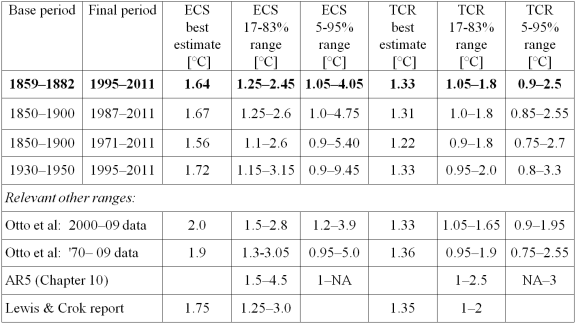
 Article_Table1
Best sensitivity estimates are medians (50% probability points). Ranges are to the nearest 0.05°C

Nicholas Lewis & Judith A. Curry (2014) The implications for climate sensitivity of AR5 forcing and heat uptake estimates, Climate Dynamics 25 September 2014

Abstract
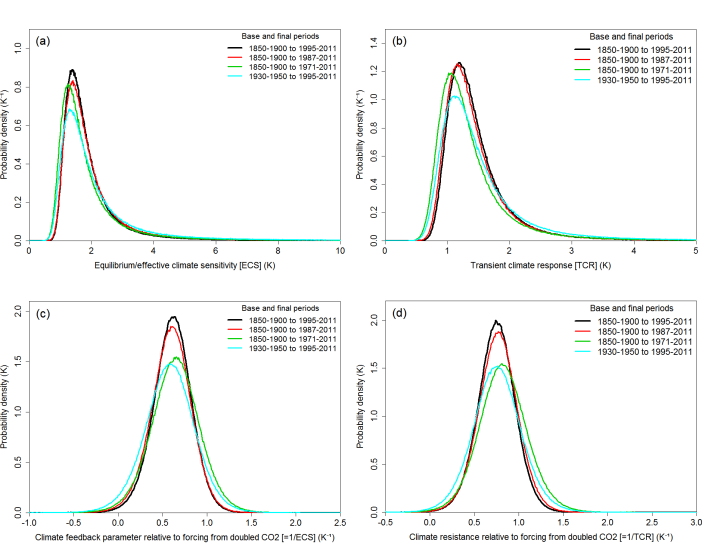
Energy budget estimates of equilibrium climate sensitivity (ECS) and transient climate response (TCR) are derived using the comprehensive 1750–2011 time series and the uncertainty ranges for forcing components provided in the Intergovernmental Panel on Climate Change Fifth Assessment Working Group I Report, along with its estimates of heat accumulation in the climate system. The resulting estimates are less dependent on global climate models and allow more realistically for forcing uncertainties than similar estimates based on forcings diagnosed from simulations by such models. Base and final periods are selected that have well matched volcanic activity and influence from internal variability. Using 1859–1882 for the base period and 1995–2011 for the final period, thus avoiding major volcanic activity, median estimates are derived for ECS of 1.64 K and for TCR of 1.33 K. ECS 17–83 and 5–95 % uncertainty ranges are 1.25–2.45 and 1.05–4.05 K; the corresponding TCR ranges are 1.05–1.80 and 0.90–2.50 K. Results using alternative well-matched base and final periods provide similar best estimates but give wider uncertainty ranges, principally reflecting smaller changes in average forcing. Uncertainty in aerosol forcing is the dominant contribution to the ECS and TCR uncertainty ranges.

Fig2_ECS_TCR.bcs3.vol1a

Full paper of the accepted manuscript is available, along with data and code here