Why Have So Many People Gone Enviro-Mental? It’s a Scam!

FULL-FRONTAL ENVIRONMENTALISM: WE KNEW IT ALL ALONG

There’s an old line that environmentalists are “watermelons”—green on the outside, red on the inside. A lot of environmentalists will take great offense if you say this: No no! We like economic growth and capitalism just fine! We just want it to be “sustainable,” whatever that means. And don’t ask for specificity about what “sustainability” means in detail, unless you have a lot of time and a full bottle of hootch handy. Before long you’ll figure out that “sustainable” is just a code word for green things we like, and that it has no rigor whatsoever aside from old-fashioned factor-efficiency, which economists figured out over a century ago at least.

No it doesn't.

But anyway, environmentalists resist being called socialists. But next week Naomi Klein is coming out with a book called This Changes Everything. In case you’ve forgotten your show notes, Klein is the author of The Shock Doctrine, a book ragingly popular with the far left that is so far gone into absurd conspiracizing and looney renderings of “neoliberalism” that it makes Lyndon LaRouche look positively staid by comparison.

What is the “this” that “changes everything” in her title? Why climate change, don’t you know? And what does it “change”? Why capitalism, of course. The argument of the book in one sentence is that only overthrowing capitalism can solve climate change. Don’t take my word for it. Here’s how the progressive lefty site CommonDreams described it today: “Forget everything you think you know about global warming. The really inconvenient truth is that it’s not about carbon—it’s about capitalism.” For this bit of candor about what we’ve long suspected of the climate campaign, we owe Klein and her followers a debt of thanks. I’m going to send her a bouquet of (sustainably-raised) flowers.

Climate change is just the ultimate in “late capitalism” I guess but what’s really getting late is the odor of this badly decayed Marxism. (Klein still uses the uproariously hilarious term “late capitalism” without a trace of irony in her pre-publications articles.) Talk about trying to sell something past its “use by” date! Wasn’t World War I the crisis that “changed everything”? Then the Great Depression? Then the Cold War? The panic and crash of 2008? “This changes everything,” as G.K. Chesterton probably said somewhere, is the refrain of the lunatic in the asylum who thinks he’s Napoleon. It’s always something.

The book unwittingly reveals that none of this crusading and posturing is about the environment at all. Bill McKibben’s dust jacket blurb gives the game away: “This is the best book about climate change in a very long time—in large part because it’s about much more.” Silly me: I thought it was about greenhouse gas emissions.Thought experiment: if we wave a magic wand, will Klein, McKibben, et al suddenly say, “Oh, I guess capitalism is okay after all”? Anyone want to buy some sustainable swampland in Florida?

It will be interesting to see whether “mainstream” environmental groups will distance themselves from Klein’s book. I intend to ask them about her argument at every opportunity. I expect every kind of weasel excuse imaginable. So I guess I better put in for a large order of free-range, gluten-free, sustainably-raised Green Weenies.

This New Book Will Have the Greenie’s Head’s Spinning!

ABOUT FACE!’ NEW BOOK PROMOTES INCREASING ATMOSPHERIC CO2

Written by PSI Staff

As ever-more scientists denounce misguided attempts to reduce carbon dioxide emissions, the evidence grows that more CO2 in the atmosphere, not less, is best. About Face

A new book ‘About Face!’ by two respected scientists and an economist makes the case for adding more CO2 to earth’s atmosphere.

The scientists are Madhav Khandekar in Canada and Cliff Ollier in Australia, plus economist Arthur Middleton Hughes in the USA. They show us why CO2 is essential to all life on earth. It is plant food.

The authors say, “We believe that the more CO2 there is in the atmosphere the bigger and better plants will grow all over the world. Three million people die each year because the prices of food are too high for them. We want to increase CO2 in the atmosphere and reduce world malnutrition.”

The Authors’ Synopsis

This book is highly controversial as billions of dollars are involved in ethanol and climate control. The Obama Administration is planning to shut down all coal fired electric plants because they emit CO2 in amounts more than the EPA permits. This will cost more than $300 billion dollars and result in more than 100,000 unemployed. We say that such actions are unnecessary and wrong.

The UN Intergovernmental Panel on Climate Change (IPCC) issues periodic reports that predict the warming of the earth and that the warming will raise the level of the oceans, and bring on wild weather such as hurricanes, droughts, floods, tornadoes, etc. None of this is true. It has no scientific basis.

Today, more than one million people die from malaria in Africa and other less developed areas. None die from malaria in the US, Europe, Australia or other developed countries where the mosquitos that spread malaria have been wiped out using DDT.

The US and UN have forbidden these less developed areas to use DDT. This must be changed. More than three million people die from malnutrition because of the high price of food partly due to 14% of the world corn crop being converted to ethanol.  We cite studies that show that increasing CO2 in the atmosphere by 300 ppm will increase food production by 36% in every country in the world on all continents.

This increase can result from abandoning the thousands of laws and regulations that inhibit emission of CO2. Carbon dioxide is a harmless, odorless, tasteless gas that is essential to photosynthesis – the basis of plant growth – without which life on earth would end.

Copies of ‘About Face!’ are available to buy securely online now at secure.mybookorders.com

Wind Turbines Increase the Amount of CO2 Being Produced to Make Electricity!

Why Intermittent Wind Power Increases CO2 Emissions in the Electricity Sector

lies

The central, endlessly repeated lie (upon which the great wind power fraud rests) is that increasing wind power generation results in decreases in CO2 emissions.

In Australia, the central object of the Renewable Energy (Electricity) Act 2000 is for “renewable” energy to “reduce emissions of greenhouse gases in the electricity sector” (see s3). But, somewhere along the way, what was a CO2 abatement scheme became an industry subsidy scheme which is nothing short of “corporate welfare on steroids” (see our post here).

At no point since that legislation took effect over 13 years ago has the wind industry provided any actual proof that it has in fact reduced CO2 emissions in the electricity sector. When we talk about “proof” we’re not talking about smoke and mirrors “modelling” based on long-term average wind farm output – which ignores the extra gas and coal being burnt (and wasted) in order to balance the grid to account for wild fluctuations in wind power output (see our post here); and to maintain additional “spinning reserve” (see our post here) to account for complete collapses in wind power output – as seen in this post.

As we have pointed out just once or twice – the need for 100% of wind power capacity to be backed up 100% of the time by fossil fuel generation sources means that wind power cannot and will never reduce CO2 emissions in the electricity sector (see our posts here and hereand here and here and here and here and here).

E.ON operates numerous transmission grids in Germany and, therefore, has the unenviable task of being forced to integrate the wildly fluctuating and unpredictable output from wind power generators, while trying to keep the German grid from collapsing (E.ON sets out a number of the headaches caused by intermittent wind power in the Summary of this paper at page 4). Dealing with the fantasy that wind power is an alternative to conventional generation sources, E.ON says:

“Wind energy is only able to replace traditional power stations to a limited extent. Their dependence on the prevailing wind conditions means that wind power has a limited load factor even when technically available. It is not possible to guarantee its use for the continual cover of electricity consumption. Consequently, traditional power stations with capacities equal to 90% of the installed wind power capacity must be permanently online [and burning fuel] in order to guarantee power supply at all times.”

STT is happy to go all out and say that in Australia wind power requires 100% of its capacity to be backed up 100% of the time by conventional generation sources. As just one recent example, on 3 consecutive days (20, 21 and 22 July 2014) the total output from all of the wind farms connected to the Eastern Grid (total capacity of 2,952 MW – and spread over 4 states, SA, Victoria, Tasmania and NSW) was a derisory 20 MW (or 0.67% of installed capacity) for hours on end (see our post here). The 99.33% of wind power output that went AWOL for hours (at various times, 3 days straight) was, instead, all supplied by conventional generators; the vast bulk of which came from coal and gas plants, with the balance coming from hydro.

For wind power to reduce CO2 emissions in the electricity sector it has be a true “substitute” for conventional generation sources. Because it can’t be delivered “on-demand” (can’t be stored) and is only “available” at crazy, random intervals (if at all) wind power will never be a substitute for conventional generation sources (see our post here).

Perhaps the reason that the wind industry has never produced a shred of evidence to show that wind power has reduced CO2 emissions in Australia’s electricity sector is simply because it can’t. Running counter to wind industry claims about wind power abating CO2 emissions, the result of trying to incorporate wind power into a coal/gas fired grid is increased CO2 emissions (see this European paper here; this Irish paper here; this English paper here; this American article and this Dutch study here).

This American study details just why increasing wind power capacity – and trying to incorporate its wildly fluctuating output into a coal and gas fired grid – results in increased CO2 emissions across the electricity sector.

Wind Integration vs. Air Emission Reductions: A Primer for Policymakers
Master Resource
Mary Hutzler
24 June 2010

Many claim that wind generation is beneficial because it reduces pollution emissions and does not emit carbon dioxide. This isn’t necessarily the case. The following article explains a phenomena called cycling where the introduction of wind power into a generation system that uses carbon technologies to back-up the wind actually reduces the energy efficiency of the carbon technologies. Recent studies with actual data have estimated the impact of cycling on air pollution and carbon dioxide emissions.

Energy modelers evaluating the impact of legislation such as Senator Bingaman’s American Clean Energy Leadership Act and the American Power Act proposed by Senators Kerry and Lieberman should take note for their models most likely are underestimating the cost of compliance by incorrectly modeling the integration of wind power into the electricity grid.

Wind is not a new technology. It was one of our principal sources of energy, along with wood and water, prior to the carbon era. But the use of renewables in the pre-carbon age was very different from the current use of renewables. Today, people rely on energy being available 24 hours a day, 7 days a week, 365 days a year, regardless of whether the sun shines, the wind blows, or there are high or low water levels.  We now have over 1,000 gigawatts of generating plants[1], and a large and elaborate electrical grid that requires great coordination among system operators to avoid disruptions.

Also, in the pre-carbon energy era, when renewables were the sole source of energy, there were no coal-fired or natural-gas fired power plants to provide back-up power. Studies have found that the efficiency of those carbon-based plants is affected by incorporating wind energy into the system. When a plant’s efficiency is reduced, its fuel consumption and emissions increase, causing unintended consequences that wind proponents do not disclose. Requiring even larger amounts of renewable energy through renewable portfolio standards will only exacerbate this problem.

Picture1

Background

Our various electricity generating technologies were designed and constructed to meet electricity demand based on their best operating characteristics for meeting portions of the electricity load duration curve. The load duration curve illustrates periods of constant demand that are served by base-load power versus periods of intermediate and peak demand. Owing to their high capital cost, low fuel cost, and high capacity factors, technologies such as coal and nuclear were designed to operate continuously to meet the base-load demand component. Owing to their lower capital costs but higher fuel costs, natural gas technologies, including combined-cycle and turbine plants, were designed to meet intermediate and peak electrical load.

Wind is an intermittent technology since it can generate power only when the wind blows. Its low operating cost (with no fuel component) and the mandates of state Renewable Portfolio Standards (RPS) make it practically a “must take” technology for system operators. RPSs require that a certain amount of electricity generation be produced by renewable fuels. The renewable target mandates tend to start out low but increase over time, with those of most RPS states reaching 15 to 30 percent by 2020 or 2025.[2] Wind tends to be the primary technology for meeting RPS targets, since it is lower in capital cost than solar, thermal, and photovoltaic technologies, the other politically acceptable “green” technologies.

Part of the rationale for introducing RPSs is that the substitution of “green” technologies for carbon technologies is supposed to reduce pollution emissions as well as carbon dioxide emissions. However, studies have shown that this may not be the case. As conventional generation (coal or natural gas) is reduced to make room for wind generation and is then increased as wind generation subsides, its heat rate rises. The heat rate is a measure of a generating station’s thermal efficiency commonly stated in units of Btu per kilowatt-hour. This reduction in efficiency  increases its fuel consumption and emissions. When sudden increases or decreases occur in generation output, it is referred to as “cycling”.

The Bentek Study

Bentek did a study of the results of integrating wind into the generation mix of the Public Service Company of Colorado (PSCO), using data from the company’s financial reports, the Energy Information Administration, the Federal Energy Regulatory Commission, the Environmental Protection Agency, and the National Renewable Energy Laboratory.[3] PSCO is a largely coal-fired utility with 3,764 megawatts of coal-fired generators, 3,236 megawatts of gas-fired combined-cycle and gas turbine capacity, 405 megawatts of hydro and pumped storage capacity, and 1,064 megawatts of wind generators. Colorado has an RPS that required 3 percent of the electricity generated by investor-owned utilities come from qualifying renewable technologies by 2007, and 30 percent by 2020.[4]

Colorado’s energy demand is highest during the day, peaking in late afternoon or early evening. Wind generation, however, is greatest between the hours of 9 pm and 5 am; it cannot be counted on to provide power when most needed, and so is used when available to meet the RPS. Most of the time that wind generation is available, it backs out (or replaces) natural gas. However, there are times when coal generation, which provides over 50 percent of PSCO’s base-load generation, is backed out to make room for the wind generation. When this happens, coal generation is cycled, causing its heat rate to increase and resulting in more fuel consumption and emissions. In PSCO, coal cycling predominates because of the low amount of gas generation in the system since most of its gas-fired generation is from turbines and because wind is strongest at night when coal use is even more pronounced.

Picture2

In the Denver non-attainment area, PSCO has 4 coal-fired plants: Arapahoe, Valmont, Pawnee, and Cherokee. Between 2006 and 2009, these coal-fired plants have experienced higher emissions rates ranging from 17 to 172 percent higher for sulfur dioxide, 0 to 9 percent higher for nitrous oxide, and 0 to 9 percent higher for carbon dioxide. In 2008, Cherokee even switched to a lower sulfur coal, but still ended up with sulfur dioxide emissions higher by 18 percent. And, between 2006 and 2009, these plants reduced their generation by over 37 percent, exacerbating further the increase in emissions.

Because the PSCO data are limited, Bentek checked their results against data from the Energy Reliability Council of Texas, whose utilities are required to report generation levels by fuel every 15 minutes. Texas has the most wind capacity in the country—over 9,500 megawatts.[5] Texas also has an RPS that was instituted during George W. Bush’s governorship and that pushed Texas ahead of California in wind capacity during 2006. The Texas renewable portfolio standard requires that utilities have 5,880 megawatts of renewable capacity by 2015, including a target of 500 megawatts of renewable-energy capacity from resources other than wind. The legislation also set a target of reaching 10,000 megawatts of renewable energy capacity by 2025, although it will be exceeded much earlier.[6] However, even in Texas, which has a large natural gas–fired capacity base, with over 40 percent of its generation being natural gas-fired,[7] coal-fired generation is cycled as is shown in the graph below.

Picture3

Another benefit that wind power generators get is that their forecast power generation entails no penalty if it is not available. Other generators must provide their own back-up power if their generation is suddenly unavailable. But the owners of wind generators believe that they can’t be held accountable for whether the wind blows and thus for inaccuracies in their forecasting capability. For example, on February 26, 2008, a cold front moved through West Texas and rendered wind’s output 1,000 megawatts less than promised, and that unexpectedly had to be made up by other generating technologies.[8] Only careful and extensive coordination, such as was carried out in West Texas on that cold February day, can prevent brown outs and black outs from occurring.

The Netherlands Experience[9]

Two researchers, C. le Pair and K. de Groot, found that the Netherlands government was overestimating the amount of carbon dioxide reductions associated with wind production. The government was using incorrect data because it did not correct for the reduction in efficiency of the conventional power plants once wind was introduced into the system. Using data provided by CBS, the Dutch Institute for Statistics, the researchers made an estimate of the “turning point” where the efficiency reduction of conventional power plants balances out the fuel savings from wind energy. Using data for 2007, when wind power was at 3 percent, they found the turning point to be at an efficiency reduction of 2 percent based on all the power stations serving the Netherlands. That is, when the efficiency of the back-up plants was reduced by over 2 percent due to cycling caused by the integration of wind energy into the system, fuel use and emissions of the back-up plants increased.

Heat Rate Simulations

An engineer, Kent Hawkins, evaluated several heat rate simulations to represent cycling of the plants when wind is introduced into the system.[10] One set of simulations evaluates wind energy replacing coal power with different technologies serving as the back-up power to wind, in order to evaluate their effect on fuel use and carbon dioxide emissions. He found that because of cycling, carbon dioxide emissions increase with the incorporation of wind energy if coal is the sole back-up power for wind. If coal and gas turbines or gas combined-cycle and gas turbines are used to back up the wind power, carbon dioxide emissions are reduced mainly due to the lower carbon dioxide emissions produced from natural gas generators as compared to coal generators. This is best seen by examining the last bar in the chart below where the lowest carbon dioxide emissions result when natural gas combined-cycle plants are solely used to replace coal.

Picture4

An interesting consequence of this analysis is that certain areas of the world where wind is integrated into a system that is primarily coal-based may result in an increase in total carbon dioxide emissions from using wind in their generating sector. That is, in these circumstances, wind would not be providing an offset in carbon dioxide emissions, but would actually be providing an increase in those emissions. China, for example, relies on coal for 80 percent of its generation and natural gas for only 2 percent.[11] China also added the most wind power of any country in 2009, 13 gigawatts,[12] ranking third in the world in total wind capacity, with the United States first and Germany second.[13] Since China’s wind would primarily be backed up by power from coal-fired generating units, it is no wonder that China’s carbon dioxide emissions increased by 9 percent in 2009.[14]

Conclusion

As more wind units are built and data become available regarding their integration into conventional energy systems, we will learn more about the effects of wind units on the operation of conventional plants. A few studies have been done showing that the effect of wind integration on both fuel consumption and emission reductions can in fact be negative. Further evaluation of our current wind units and their effects on fuel consumption and emissions should be done before increasing the penetration of renewable energy to the 20 and 30 percent levels currently mandated by some state renewable portfolio standards, and before a national renewable portfolio standard is considered for enactment.

[1] Energy Information Administration, Electric Power Annual,http://www.eia.doe.gov/cneaf/electricity/epa/epat1p2.html

[2] Institute for Energy Research, Energy Regulation of the States: A Wake-up Call, www.instituteforenergyresearch.org/states/

[3] Bentek Energy LLC, How Less Became More: Wind, Power and Unintended Consequences in the Colorado Energy Market,http://www.bentekenergy.com/WindCoalandGasStudy.aspx

[4] Institute for Energy Research, Energy Regulation of the States: A Wake-up Call, http://www.instituteforenergyresearch.org/states/colorado/

[5] American Wind Energy Association,http://www.awea.org/projects/projects.aspx?s=Texas

[6] Institute for Energy Research, Energy Regulation of the States: A Wake-up Call, http://www.instituteforenergyresearch.org/states/texas/

[7] Energy Information Administration, Electric Power Monthly, March 2010, http://tonto.eia.doe.gov/ftproot/electricity/epm/02261003.pdf

[8] The Wall Street Journal, Natural Gas Tilts at Windmills in Power Feud, March 2, 2010,http://online.wsj.com/article/SB10001424052748704188104575083982637451248.html

[9] The impact of wind generated electricity on fossil fuel consumption, C. le Pair and K. de Groot, http://www.clepair.net/windefficiency.html

[10] Wind Integration: Incremental Emissions from Back-Up Generation Cycling (Part V: Calculator Update), Kent Hawkins, February 12, 2010,http://www.masterresource.org/2010/02/wind-integration-incremental-emissions-from-back-up-generation-cycling-part-v-calculator-update/#more-7271

[11] Energy Information Administration, International Energy Outlook 2010, Tables H10, H12, and H13,http://www.eia.doe.gov/oiaf/ieo/pdf/ieoecg.pdf

[12] Global Wind Energy Council, Global wind power boom continues amid economic woes, March 2, 2010, http://www.gwec.net/index.php?id=30&no_cache=1&tx_ttnews[tt_news]=247&tx_ttnews[backPid]=4&cHash=1196e940a0

[13] Global Wind Energy Council, http://www.gwec.net/index.php?id=13, and Global Wind Energy Council, Global wind power boom continues amid economic woes, March 2, 2010, http://www.gwec.net/index.php?id=30&no_cache=1&tx_ttnews[tt_news]=247&tx_ttnews[backPid]=4&cHash=1196e940a0

[14] Reuters, China top carbon emitter for second year running, June 9, 2010, http://alertnet.org/thenews/newsdesk/LDE6580Y1.htm

Facts

Faux-green Energy…..No more than an Over-priced Novelty!

Obama’s Green Unicorn


The true cost of renewable energy is being masked by government subsidies and bailouts.

Wind turbines are silhouetted by the setting sun Friday, Aug. 23, 2013, near Beaumont, Kan. The turbines are part of the 100-unit Elk River Wind Farm in south central Kansas.

Propped up by the government.

By    Aug. 25, 2014 
America is about as likely to become reliant on green energy to meet its baseload power requirements as a unicorn is to stroll down the middle of Washington’s Pennsylvania Avenue during rush hour followed by a pink elephant.

It’s just not happening – but that’s hasn’t deterred the modern day snake oil salesmen and their allies inside the Obama administration from continuing to make a push for wind and solar power as an eventual replacement for energy generated from traditional sources like coal, oil and natural gas. Renewable technology has improved, no doubt, but it’s a long way away from being ready to make a substantial contribution to the heating of our homes and the powering of our businesses unless the generous tax subsidies that create the illusion of cost competitiveness continue.

There’s nothing wrong per se with the pursuit of renewable energy; it’s just that what it actually costs is being masked by taxpayer subsidies, federal loan guarantees and renewable fuels mandates at the state level that force power companies to put wind and solar into the energy mix, sometimes at two to three times what traditional power costs. Ultimately, one way or another, the taxpayers and energy consumers are footing the bill even if they don’t know it

Congress has taken a few positive steps in the right direction. The federal Wind Production Tax Credit was allowed to expire at the end of the year, meaning new wind projects are going to have to be competitive at market rates to attract funding. Remember it was none other than billionaire Warren Buffett, the “Oracle of Omaha,” who explained recently to a group of investors that the tax credit was the only reason that any sensible person invested in wind projects in the first place.

Unfortunately, some federal agencies are trying to keep the program alive through the backdoor.

The worst offender in this regard may be the IRS, which recently issued new “guidelines” that make it even easier for wind projects currently in development to qualify for the tax credit on the basis of work already contemplated or completed. According to Politico, “The IRS says completed or in-progress facilities can be sold and the costs incurred by the seller will still count toward qualifying for the [credit], except in cases where tangible property (think equipment like wind turbines) bought for one project is sold and used at another site.”

To translate this into English, it’s a move to help keep the whole shell game alive until such time as wind power supporters can get the tax credit reauthorized. “There is a large pipeline of projects that were under development at some stage that by virtue of this guidance will be able to go forward. In that regard it is going to permit a lot of projects to be developed,” said one wind energy expert cited by Politico.

Outside groups are also weighing in, including the Sierra Club, which has targeted nine members of Congress in a pressure campaign over the August recess to push for reauthorization of the Wind Production Tax Credit. That is in addition to the online ad buys in 16 other districts that started in June.

[MORE: Cartoons on Gas Prices]

The Democrats who run the Senate want to keep the now-expired credit alive and have, in the Senate Finance Committee, already approved a package of so-called “extenders” that would breathe new life into it. The House has thus far refused to go along – and kudos to Texas Republican Rep. Randy Weber, who deserves credit for successfully introducing an amendment to shut the whole business down permanently. But he’s not just fighting the lobbyists and green groups in favor of the credit, but the entire federal bureaucracy which, once a program has been established, is loath to let it die.

Major government investment in speculative green projects may have at one time made sense. But even if that were once the case, it is so no longer. The Obama green energy push has enriched more than a few politically well-connected liberals who used tax credits and government bailouts to enlarge their portfolios, but it has done little to make energy more abundant or lower costs to consumers, which is the justification in the first place to get the taxpayers involved. If people want to build wind farms – on land or offshore – and they want to reap the benefits of their investments, then they should be willing to take the same risks as everyone else. The way the bureaucrats have it structured now, the taxpayers are making payments on both ends through subsidies for construction and higher rates on consumption. It’s a system only a bureaucrat could love.

Even the Climate Alarmists are Admitting it was a Hoax!

BBC Alarmists admit the Global Warming Slowdown.
The BBC had its start as an eco-propaganda unit for the Global Warming Alarmist’s campaign after 30 key BBC staff’ and ‘30 invited guests’ attended a seminar. The Daily Mail reported that the BBC tried to hide this for 6 years:

The BBC has spent tens of thousands of pounds over six years trying to keep secret an extraordinary ‘eco’ conference which has shaped its coverage of global warming, The Mail on Sunday can reveal.
The controversial seminar was run by a body set up by the BBC’s own environment analyst Roger Harrabin and funded via a £67,000 grant from the then Labour government, which hoped to see its ‘line’ on climate change and other Third World issues promoted in BBC reporting.
At the event, in 2006, green activists and scientists – one of whom believes climate change is a bigger danger than global nuclear war – lectured 28 of the Corporation’s most senior executives. (link)
Seems like someone has taken the Kool-Aid (or is it FOOL-Aid?) from the BBC’s watercoolers because this week they not only acknowledged the warming hiatus, but have raised the possibility that the
Global warming slowdown ‘could last another decade’
The hiatus in the rise in global temperatures could last for another 10 years, according to new research.
Scientists have struggled to explain the so-called pause that began in 1999, despite ever increasing levels of CO2 in the atmosphere.
The BBC reported a peer reviewed paper published in Science in August (link) which tried to explain the warming hiatus (or as they expressed it, “global-warming slowdown”)

Varying planetary heat sink led to global-warming slowdown and acceleration
A vacillating global heat sink at intermediate ocean depths is associated with different climate regimes of surface warming under anthropogenic forcing: The latter part of the 20th century saw rapid global warming as more heat stayed near the surface. In the 21st century, surface warming slowed as more heat moved into deeper oceans.
How the heat missed the surface and went into the deep ocean has not been explained.

The ‘deep ocean’ theory has been ridiculed by IPCC expert reviewer Lord Christopher Monckton:

The warming is hiding in the bottom of the ocean. Someday it will pop out and say BOO!
They are saying that it somehow managed to go from the atmosphere into the ocean. Not into the bit of the ocean that touches the atmosphere, no, it missed that out and it’s gone down and hidden in the bottom of the ocean where we can’t measure it. And one day it’s going to come out and say boo!

Finally…the Scam is Being Exposed! They Know They Are NOT Helping Our Environment!

It’s about something

Ms. McCarthy is now saying that the Clean Power Plan is not about climate. Ms. McCarthy’s July 23 testimony on the Clean Power Plan was that it is not about climate or pollution control.  This contradicts the June testimony, the web site and the federal register notice.  So it’s about something.  

From the Bonner Cohen, Heartland.org:

EPA’s recently announced restrictions on carbon dioxide emissions have nothing to do with reducing pollution, EPA Administrator Gina McCarthy admitted in Senate hearings. Instead, said McCarthy, EPA imposed the restrictions based on a belief imposing expensive renewable energy on the electricity marketplace will stimulate the economy.

‘Not About Pollution Control’
“The great thing about this proposal is that it really is an investment opportunity. This is not about pollution control,” McCarthy told the Senate Environment & Public Works Committee July 23. “It’s about increased efficiency at our plants. It’s about investment in renewables and clean energy. It’s about investments in people’s ability to lower their electricity bills by getting good, clean, efficient appliances, homes, rental units.”

McCarthy’s comments came as a shock to utilities facing steep costs attempting to comply with the proposed restrictions. The comments also came at a time when the Obama administration’s prior EPA restrictions have pushed U.S. electricity prices to an all-time record high.

Contradicts Prior Testimony
McCarthy’s Senate testimony represents a significant departure from the way EPA defended its proposal before lawmakers just a month earlier. At a June hearing before the House Energy and Commerce Committee, Acting Assistant Administrator for Air and Radiation Janet McCabe offered a different explanation. Citing Section 111 (b) of the Clean Air Act, which authorizes EPA to regulate certain pollutants, McCabe made that argument in her testimony:

“Chairman Upton, this is not an energy plan. This is a rule done within the four corners of 111 (b) that looks to the best system of emission reduction to reduce emission.… This is a pollution control rule as EPA has traditionally done under section 111 (d).”

McCarthy’s comment didn’t escape the attention of climatologist Roy Spencer.

“This gaffe could come back to bite the EPA,” Spencer wrote on his website. “The Endangerment Finding was all about the negative effect of ‘carbon pollution’ on the environment. Now we find out ‘this is not about pollution control’?”

In her testimony, McCarthy repeatedly emphasized EPA views its rule as an investment opportunity for the business community, while downplaying the cost it would impose on consumers.

“This is an investment strategy that will not just reduce carbon pollution but will position the United States to continue to grow economically in every state, based on their own design,” she said.

So CO2 restrictions are not about climate and all the supposed health benefits are not about pollution control, they are energy efficiency, jobs and economic programs.  Sounds like EPA is getting caught with a reg that obviously doesn’t do what they said it was designed to do and are scrambling.

Aussie Politicians, We Can ALL Be Proud Of!!!

Tony Abbott, Joe Hockey & Mathias Cormann: Natural Born RET Killers

abbott, hockey, cormann

Tony Abbott has made no secret of his eagerness to do away with the most colossal corporate welfare scheme in the history of the Commonwealth (see our posts here and here and here).

And his Treasurer, Joe Hockey has pinned his colours to the mast as someone who can’t stand wind farms – and whose political mission is to bring the “age of entitlement” to an end, which includes the stream of subsidies directed at wind power outfits (see our posts here and here).

The Finance Minister, Mathias Cormann made his disdain for the great wind power fraud known by joining Hockey to prevent the Clean Energy Finance Corporation signing up anymore unsecured loans to wind power outfits (see our post here).

So it comes as no surprise that Abbott, Hockey and Cormann would team up as Natural Born RET Killers. Here’s the Australian Financial Review heralding the beginning of the end for the mandatory RET and, with it, the end of the great Australian wind power fraud.

Abbott’s plan to axe RET
Australian Financial Review
Phillip Coorey
18 August 2014

The federal government is moving towards abolishing the Renewable Energy Target rather than scaling it back in a move that will cost almost $11 billion in proposed investment and which is at odds with the views of its own Environment Minister.

The Australian Financial Review understands Prime Minister Tony Abbott has asked businessman Dick Warburton, whom he handpicked after the election to review the RET, to do more work on the option of terminating the target altogether. This was after Mr Warburton’s review leant towards scaling back the RET.

Sources said Environment Minister Greg Hunt, who advocated scaling back the RET as a compromise, has been sidelined from the process and is understood to be unhappy. They said Mr Abbott, Treasurer Joe Hockey and Finance Minister Mathias Cormann are pushing the issue now.

A government source said when the government announced its decision, possibly before the end of this month, it was now “more likely” the RET will be abolished under a so-called “closed to new entrants scenario” in which existing contracts only would be honoured.

Given Clive Palmer has vowed to block any change to the RET until after the 2016 election, it remains unclear when the government could declare the RET terminated.

Independent modelling commissioned by the Climate Institute and other environmental groups, and which will be released Monday, found that under the termination scenario, coal-fired power generators would reap an extra $25 billion in profits between 2015 and 2030.

There would be no reduction to household power prices and carbon emissions would climb by 15 million tonnes a year on the back of a 9 percent increase in coal-fired power.

Diminished investments

Abolishing the RET would diminish investment in renewable energy by $10.6 billion, said the modelling, conducted by consulting firm Jacobs.

Conceived under the Howard government, the RET mandated that 20 per cent of Australia’s electricity be generated from renewable sources by 2020. The Abbott government has been lobbied heavily by the business and energy sectors to abolish or water it down as renewable energy gained a larger than expected share of the electricity market.

When the RET was first conceived, it was envisaged 20 per cent of total power production by 2020 would equate to 41,000 gigawatt/hours of renewable energy produced each year.

Under the scaleback favoured by Mr Hunt, annual production of renewable energy in 2020 would be reduced to 27,000GWh. But this would still amount to 20 per cent of total energy production because forecast total energy production for 2020 had been downgraded due to the decline in manufacturing, especially the collapse of the car industry and the closure of two aluminium smelters. This is known as the “real 20 per cent” option.

The abolition proposal would reduce renewable energy production in 2020 to 16,000GWh.

It is understood Mr Abbott’s office was briefed on the recommendations of the Warburton review in late July. The review found the RET did not add significantly to household and commercial power bills, as its critics, including Mr Abbott, had argued, and that it should be scaled back to the real 20 per cent model as advocated by Mr Hunt.

With the government favouring ­termination, Mr Warburton was asked to give the option more consideration and his report is expected this week.

Energy oversupply

The government source said the market was oversupplied with energy and there was no longer any cause for a mandated use of any specific type of power. The source said while there would be investment losses if the RET was abolished, or even scaled back, investors “would have to have been blind to know this wasn’t coming”.

Miles George, managing director of renewable company Infigen Energy, said either scaling back or terminating the RET “would be devastating”.

He said the creation of sovereign risk would be significant and the very issue had been raised by prospective foreign investors, including Canadian pension funds which Mr Abbott sought to woo when abroad in June.

“Infigen’s shareholder base of over 20,000 investors has invested in renewable energy in Australia on the basis of a fixed target of 41,000 GWh by 2020,” Mr George said. “This is no different to investors in private public partnerships acquiring a toll road concession, or a port lease.

“If the Government pulls the rug from under institutional investors in renewable energy we shouldn’t expect those investors to come back to buy other infrastructure assets here, including the electricity networks and generation assets that the governments of NSW and Queensland are proposing to sell or lease.”
Australian Financial Review

The AFR touts the wind industry line about “diminished investments”, as if wind power outfits are lining up to make an outright, “no-strings-attached” gift of $10.6 billion to Australian power consumers.

On that spin, Australia’s power punters are meant to fear the “loss” and shed a tear for cowboys like Infigen (aka Babcock & Brown) who are, apparently, just itching to give their investors’ money away.

Of course, like every investment, those stumping up the capital will only do so where a juicy return is on offer; and, under the current 41,000 GWh target set by the mandatory RET, the returns promised to be very “juicy”, indeed. Until now.

So let’s have a look at just who ends up paying for the promised (or, rather, threatened) $billions in wind power investment: we’ll call it $10 billion for ease of reference.

Before we kick off, there are a few things to note.

First, is that around 50% of the value of the threatened “investment” will go to foreign turbine manufacturers in China, India and Denmark. So that sends at least $5 billion offshore; adding to Australia’s current account deficit.

Next, is the fact that the great bulk of any wind power “investment” is underwritten by all Australian power consumers via the mandatory RET – as detailed below.

And it needs to borne in mind that any “investment” in wind power generation capacity has to be matched with an equal investment in fossil fuel generation capacity (principally fast-start-up Open Cycle Gas Turbines) to provide power to balance the grid (the need for which increases – along with the need for additional spinning reserve held by base-load thermal generators – due to the wild fluctuations in wind power output – see our post here) and to accommodate routine, but unpredictable, collapses in wind power output (our posts here and hereand here and here and here and here and here and here).

The greater the amount of installed wind power capacity, the greater the need for highly inefficient OCGTs – the installation of which needs to be financed, allowing for returns to those providing the capital: a cost that is never included in calculations accounting for the costs attached to wind power generation (see our post here).

As noted by the AFR, the Australian energy market is oversupplied, which means any further investment in an unpredictable and unreliable source like wind power will simply cause further and substantial increases in retail power prices, additional grid instability and energy market chaos – precisely the circumstances the Germans now find themselves in, after years of runaway renewable energy policy (see our post here).

An “investment” NOT a “gift”

Any investor naturally looks for a return on a capital investment. Ideally, that return exceeds bank interest and – if there is any risk involved – accounts for that risk by way of higher returns. Investors in wind farm projects aim for a gross return on the capital invested in the order of 20% per annum.

That means that the investors stumping up $10 billion to build new wind power capacity will be looking to recover $2 billion from power consumers each and every year to achieve that level of return: returns on wind power investments can only be recouped via income received from power sales – there is NO other source of revenue.

So, rather than being the objects of $10 billion in wind industry largesse, power consumers are being lined up for an enormous, additional and – because there is already ample generating capacity to meet (declining) demand well into the future – completely unnecessary $2 billion hit in the hip pocket each and every year.

A fair slice of the $2 billion annual return on investment required by investors would be recouped via power bills in the form of Renewable Energy Certificates (RECs): a Federal Tax on all Australian electricity consumers. RECs are issued to wind power generators and transferred to retailers under the Power Purchase Agreements signed between them (see our post here).

Which brings us to another furphy trotted out in the AFR piece – based on “modelling” by wind industry cheer squad, the Climate Institute – that the mandatory RET hasn’t had any significant effect on retail power prices; and that scrapping it would not result in any decrease in power bills.

As we’ve just pointed out, the $10 billion in threatened wind power investment would, alone, add $2 billion to Australian power bills each and every year: no return, no “investment” – simple as that.

The true cost of the mandatory RET

As is the style of the wind industry and its parasites, whenever they’re pitching about the “wonders” of wind it’s all done with “modelling” and never with real numbers. Smoke and mirrors stuff, using assumptions that never hold water – and always ignoring the terms of the legislation upon which the whole rort depends.

So – let’s forget about “models” – based on nonsensical and unjustified assumptions – and simply apply a little old fashioned arithmetic to the provisions that make up the mandatory RET.

Putting aside the hidden costs of providing fossil fuel back up to cover the occasions when wind power output plummets every day – and for days on end (see our post here); putting aside the need for a duplicated network to carry wind power from the back blocks to urban markets (seeour post here); putting aside the cost of running highly inefficient Open Cycle Gas Turbines to cover wind power “outages” (see our post here), for the purpose of this argument let’s just focus on the cost of Renewable Energy Certificates and their bedmate – the mandated shortfall charge.

Under the mandatory RET – retailers are fined $65 per MWh for every MW they fall below the mandated annual target: what’s called the “shortfall charge” – follow the links here and here. The shortfall charge is directed straight to the Commonwealth, ending up as general revenue.

The alternative is to buy RECs (which is done via the retailer’s PPA with the wind power generator) and surrender them as proof that the retailer has purchased a MWh of renewable energy.

Wind power generators are issued 1 REC for every MWh of power dispatched to the grid – and this deal continues until 2031: the operator of a turbine erected in 2005 will receive RECs (1 per MWh dispatched) each and every year for 26 years.

Since the RET began in April 2001, over 195 million RECs have been created – worth more than $8 billion – the cost of which has all been added to our power bills.

The cost of the REC is ultimately borne by retail customers and, therefore, constitutes a Federal Tax on all Australian electricity consumers (see our post here).

Time for a little arithmetic.

If no RECs were purchased, retailers would simply be hit with the $65 per MWh shortfall charge on the entire figure set by the mandatory RET legislation (see the link here).

That cost alone would add $2.665 billion to power bills annually from 2020 to 2031.

Alternatively, if sufficient RECs to satisfy the target were purchased at $100, say, the cost rises to $4.1 billion a year from 2020 through to 2031.

Year RET in MWh (millions) Shortfall Charge
(or RECs) @ $65
RECs @ $100
2014 16.1 $1,046,500,000 $1,610,000,000
2015 18 $1,117,000,000 $1,800,000,000
2016 22.6 $1,469,000,000 $2,260,000,000
2017 27.2 $1,768,000,000 $2,720,000,000
2018 31.8 $2,067,000,000 $3,180,000,000
2019 36.4 $2,366,000,000 $3,640,000,000
2020 41 $2,665,000,000 $4,100,000,000
2021 41 $2,665,000,000 $4,100,000,000
2022 41 $2,665,000,000 $4,100,000,000
2023 41 $2,665,000,000 $4,100,000,000
2024 41 $2,665,000,000 $4,100,000,000
2025 41 $2,665,000,000 $4,100,000,000
2026 41 $2,665,000,000 $4,100,000,000
2027 41 $2,665,000,000 $4,100,000,000
2028 41 $2,665,000,000 $4,100,000,000
2029 41 $2,665,000,000 $4,100,000,000
2030 41 $2,665,000,000 $4,100,000,000
  Total $36,483,500,000 $56,210,000,000


RECs are currently trading around $30, but, as the target starts to bite from 2017, the price is expected to reach $90 and is tipped to reach $100 beyond that.

The shortfall charge (as a fine) is a cost that the retailer can’t claim as a legitimate tax deduction, whereas the REC is – this places an added value on the REC to the extent that its face value can reduce the retailer’s taxable income. At a minimum then, RECs can be expected to trade at a figure at least equal to the shortfall charge. But with the tax benefit attached, RECs would be worth at least $94 – based on a shortfall charge of $65.

At the bottom end, this means the value of RECs surrendered (and/or the shortfall charge applied) will add over $36 billion to power bills over the next 17 years. At the top end, the figure (assuming RECs hit $100 by 2017) will exceed $50 billion.

These figures represent the greatest transfer of wealth in the history of the Commonwealth: a transfer that comes at the expense of the poorest and most vulnerable in society; struggling manufacturing businesses, real jobs and families. To call the mandatory RET obscene is pure understatement. No single policy has ever threatened to cost so much for nothing in return.

It’s these hard and fast facts that have united the PM, his Treasurer and Finance Minister with the intention of killing the mandatory RET outright; and the vast majority of the Coalition are right behind them. The sooner the Coalition axe it, the better. The mandatory RET must go now.

chop-wood-axe-downgrade

Wind and Solar….No More Than an Overpriced, Inefficient, Novelty

FRIDAY, AUGUST 15, 2014

Parasitic Power Producers


Another Issue of “Carbon Sense” prepared by The Carbon Sense Coalition
Please pass on. We rely on our supporters to spread the word.


www.carbon-sense.com

15 August 2014


Promoting Parasitic Power Producers

Wind and solar are parasitic power producers, unable to survive in a modern electricity grid without the back-up of stand-alone electricity generators such as hydro, coal, gas or nuclear. And like all parasites, they weaken their hosts, causing increased operating and transmission costs and reduced profits for all participants in the grid.

Without subsidies, few large wind/solar plants would be built; and without mandated targets, few would get connected to the grid.

Green zealots posing as energy engineers should be free to play with their green energy toys at their own expense, on their own properties, but the rest of us should not be saddled with their costs and unreliability.

We should stop promoting parasitic power producers. As a first step, all green energy subsidies and targets should be abolished.

 
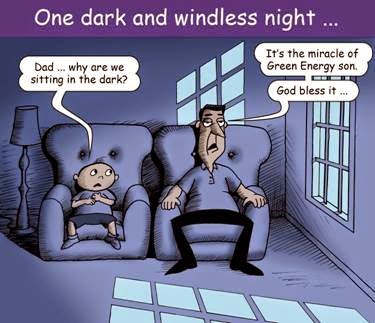
The Miracle of Green Energy – by Steve Hunter  www.stevehunterillustrations.com.au
Viv Forbes,17th July 2014

Faux-green Environmentalists (EPA), Push Their Political Agenda!

EPA goes from Environmental Protection Agency to Extremist Political Agenda

A report from the EPA’s public hearings on the proposed Clean Power Plan

During the week of July 28, the Environmental Protection Agency (EPA) held hearings in four cities: Atlanta, Denver, Pittsburgh, and Washington, DC. The two-day sessions were to allow the public to have their voice heard about the proposed rules it released on June 2 that will supposedly cut CO2 emissions by 30%.

MaritaMany, including myself, believe that these rules are really an attempt to shut down coal-fueled electricity generation and implement a cap-and-trade program that the Administration couldn’t get through Congress in 2009, when cap-and-trade’s obvious allies held both houses of Congress.

If the EPA’s plans were clear, direct, and honest, the public would likely revolt outright. Instead, the intent is hidden in pages of cumbersome language and the messaging becomes all about clean air and water—and about the health of children.

Because I was in the area—speaking a few hours from Atlanta on Sunday—I took advantage of the proximity and signed up to speak at the hearing. When I first attempted to sign up, day one was already full. The EPA had so many people who wanted time to share their opinions, a second day was added, and I was put on the schedule.

The first day, Tuesday, July 29, included competing rallies held in near-record-low temperatures for Atlanta in July. Supporters of the EPA’s plan—many of whom were bussed in from surrounding states—gathered in Centennial Olympic Park. I spoke at the rally, made up of plan opponents, that was organized by Americans for Prosperity’s Georgia chapter held at the Sam Nunn Federal Center—where the hearing was originally scheduled (before a power outage forced a move to the Omni Hotel).

I spent the rest of the day at the hearing. It had a circus-like atmosphere. With tables of literature, people carrying signs, and many of the plan’s supporters identified by their matching pale-green tee shirts emblazoned with:

                             Protect our communities

                             CLIMATE ACTION NOW.

Once I had a taste of what to expect the next day, when I was to present my comments in the five minutes allotted, I prepared what I wanted to say. The following is my original text—though I had to edit it down to get it within the allowed time frame. For presentation here, I’ve also enhanced my comments with some additional insights from others. The verbiage that is not a part of my original testimony is included in italics.

* * * *

I was here yesterday and earlier today. I’ve listened to the well-intentioned pleas from many who have begged you, the EPA, to take even stronger action than this plan proposes. One even dramatically claimed: “You are the Environmental Protection Agency. You are our only hope. If you don’t protect us no one will?”

I heard a teary-eyed, young woman tell a tale about a man she knows who is dying of cancer, supposedly because he grew up near a coal-fired power plant—he couldn’t be here, so she told his story. She also said: “I am fortunate enough to have not been around in the 1960s when there was real smog.” Her father has told her about it.

One woman claimed her neighbor had gotten asthma from global warming.

Another addressed how she gets headaches from emissions. She told how lung tissue could be burned. And, how particulates are why people can no longer see the mountain in her region.

An attorney’s testimony told about seeing “carbon pollution” every day from his 36th floor office “a few blocks from here” from where he looks “out over a smog-covered city.”

The passion of these commenters supersedes their knowledge, as none of the issues I’ve mentioned here, and there are many more, are something caused by carbon dioxide—a clear, colorless gas that each of us breathe out and plants breathe in.

Marita and the UMWADave Bufalo is a retired civil engineer who attended and testified at the EPA’s Denver location. He told me he had a similar experience: “I was only able to stay for about an hour but I did hear about 10 testimonials. They were all in support of the EPA’s proposed regulation.  I don’t believe that anyone had really read the proposal prior to testifying. Their testimonies seemed to lack an understanding of the chemical nature of CO2. One elderly woman could only state that she thanked the EPA for insuring that she had clean air and water. One gentleman was clearly pushing for the sale of his company’s solar panels.” 

James Rust, Ph.D., is a retired professor of nuclear engineering from Georgia Tech. In his testimony in Atlanta, he referenced thousands of peer-reviewed papers showing carbon dioxide emissions had a negligible effect on climate change. He pointed to the stack of documents from the Heartland Institute called Climate Change Reconsidered I and II that contained these peer-reviewed articles. It was at that point, that a man in the front row shouted out “Liar!” Rust told me: “This is the typical type of response from the mob that promotes this climate change scare.  They use ad hominem attacks and don’t debate the real issues because they have no experimental data that backs up what they are proposing.”  

Carbon dioxide is a natural, and essential, part of the environment— massive, unknown, quantities of carbon dioxide are emitted each year from natural sources, such as volcanoes. Were we able to eliminate carbon dioxide from every industrial source in the United States, it would have virtually no impact on global carbon dioxide emissions.

I understand the concerns over true smog and pollution. I grew up in Southern California—graduating from high school in 1976. At that time, we had made a mess of our environment. We had polluted the air and water. Cleaning up our collective act was an important public policy issue. San Bernardino, where my family lived, is in a valley, surrounded by mountains. It was not uncommon for a family to move into the area in the summer, when the smog was the worst, and not even know the beautiful mountains existed. In the fall, when the winds came in and blew the smog out to sea, newcomers where amazed to discover the mountains.

But that pollution, that smog, has largely been cleaned up. Utilities have spent hundreds of billions of dollars on scrubbers, and on other highly technical equipment such as SCR’s, electrostatic precipitators, and bag houses, to successfully remove the vast majority of the particulates.

People often see a billowing white cloud coming from the stacks at a coal-fueled power plant and confuse it with pollution when it is really H2O—water in the form of steam. Depending on the time of year, or the time of day, it may be more, or less, visible. The weather conditions may make it settle like fog until the sun burns it off. And this, I believe, is mistaken for pollution.

If you haven’t seen Randy Scott Slavin’s Bird’s-Eye-View of New York City, I encourage you to check it out.  The book shows an birdseyeamazingly clean city—despite the more than 8 million people living in those compact 469 square miles. New York City is one of the most populated places on the planet, yet its air is sparkling.

This rule is not about pollution. It is about shutting down coal-fueled power plants, and thus killing jobs and raising electricity rates—both of which punish people who can least afford it. But plenty of others have addressed the economic impact, so I won’t take more of my time on that topic.

Dozens of members from a variety of different unions were present in Atlanta to speak out against the plan. Skip Howard, Business Manager for Plumbers and Pipefitters Local 421 in North and South Carolina, explained: “Although Nuclear Power is a clean, renewable source of energy and not affected by fluctuating oil-and-gas prices, energy from Coal-fired Plants is cheaper and helps keep the cost of electricity affordable to consumers. Coal-fired Plants are reliable and cheaper to build than a Nuclear Plant. Coal-fired plants are now designed to be a safe and efficient source of energy that supports grid systems, helping to avoid blackouts. New clean coal technologies create many thousands of new high-wage jobs across our country, helping our economy grow.” 

Several of the union members who testified in Atlanta assailed the EPA representatives because the hearing locations were far from where those most impacted—the coal miners—live. 

coal trainI spent some time on Tuesday talking with many of the union representatives. David Cagle, Marketing Representative for the Plumbers, Pipefitters, and HVAC/R Service Technicians Local Union 72 based in Atlanta, told me: “I appreciate your interest in helping our country to be able to continue to provide economical electric energy and well-paying jobs to America’s families and businesses.” He then offered me this brief history of what the coal-fired electric energy industry means to his family:

After World War II my father worked in one of the first large coal-fired powerhouses built in the state of Georgia. That well-paying job allowed him to help his parents pay off the mortgage on their house and also to start saving for a down payment for a home of his own one day.  My father worked on several coal-fired powerhouses throughout his career in the piping industry. These well-paying jobs provided a decent standard of living for his family.

The powerhouses that my father helped build are still providing well-paying jobs for the people who run them and the workers who do the maintenance on them. Hundreds of thousands of construction workers have benefited from the well-paying jobs in the construction and maintenance of these facilities. They are also still providing low-cost electrical power to hundreds of thousands, if not millions of customers.

”””””””””””””””””””””””””””””””””””””””””””” 

Beside my family benefiting from the coal-powered electric generation industry, I can tell you firsthand what coal does for our country across the continent. 

powderrivercoalI lived in Campbell County, Wyoming, for two years in the mid-90s.  Campbell County is the Energy Capital of the United States. Thousands of families would lose a very good way of living, if the coal mines in Wyoming were shut down.  The coal mined there is very low in sulfur and produces some of the cleanest electricity on earth. I also know many people from West Virginia who depend on coal to be able to make a decent living. 

I fully understand the devastating effects the Obama Administration’s new EPA rules on coal-fired powerhouses would have on people on a fixed income. My parents are in their late 80s and early 90s. They are on a fixed income and in poor health. The last thing they need are large power bills that would destroy their budget and force them to rely on their children to help pay their power bills. 

My whole family are outdoorsmen. We have all been raised to hunt and fish and respect and protect our environment. My family would be the first to embrace a low-cost, environmentally sound alternative to coal-fired powerhouses. The problem is, there is no alternative economically viable source available at this time. 

The Wall Street Journal (WSJ) covered a union protest that took place at the Pittsburgh hearing. It states: “Unions opposing the proposed rule argue that U.S. workers will pay the price for lowering emissions domestically while other countries—most notably China, where coal usage has grown rapidly—will continue to burn coal and emit carbon dioxide.” The WSJreported: “Unions focused their efforts on Pittsburgh, sending busloads of unionized miners, utility workers, railroad workers, and others from Pennsylvania, West Virginia, Virginia, Ohio, Kentucky, Alabama, and other states.”

scaliaI also want to address the constitutionality of the proposed plan, as it does exactly what the Supreme Court admonished the EPA about on June 23. Justice Antonin Scalia, for the majority, wrote this about the Tailoring Rule decision: “Were we to recognize the authority claimed by EPA in the Tailoring Rule, we would deal a severe blow to the Constitution’s separation of powers… The power of executing laws…does not include a power to revise clear statutory terms that turn out not to work in practice.” Yet, this is exactly what this proposed plan will do.

Later in the decision, Scalia says: “When an agency claims to discover in a long-extant statute an unheralded power to regulate ‘a significant portion of the American economy’ . . . we typically greet its announcement with a measure of skepticism. We expect Congress to speak clearly if it wishes to assign an agency decisions of vast ‘economic and political significance.’”

I believe on these grounds, this plan must not go forward. It is one more example of executive overreach.

I fear that if it does, America will pay a dear price. This hearing was scheduled to take place down the street at the Sam Nunn Federal Center. However, it was moved due to a power outage. Note: business cannot be done without power. You were able to move this hearing. In a reduced-power environment businesses will move to places where they have access to energy that is effective, efficient, and economical. They will move, as many have already done, to places with far-looser environmental policies and the perceived gain will be lost.

Thinking that what we do in the United States will have a serious impact on global carbon dioxide emissions is like thinking that declaring a “no pee” section in the swimming pool will keep the water urine free.

I’ll end with a quote from the smog-viewing attorney who closed with: “I am hopeful that my new grandchildren, who will live into the 22nd century, will enjoy a world that my grandparents, born in the 19th century, would recognize.” If this plan is passed, he may get his wish. His grandparents’ world contained none of the energy-based modern conveniences or medical miracles we consider standard and essential today—let alone those yet to be developed or discovered by the 22nd century. In his grandparents’ day, life expectancy in the U.S. was estimated at 45 years. By 2000, this had increased to 78 years—mostly due to our expansion of cost-effective electricity throughout the nation.

Remember, the countries with the best human health and the most material wealth are those with the highest energy consumption. America needs energy that is abundant, available, and affordable.

* * * *


Climate Alarmists Stubbornly Refuse to Face Reality…

‘Hoodwinking the Nation’ on climate issues

Guest essay by Charles Battig, M.D. VA-Scientists and Engineers for Energy and Environment

American popular culture has scattered nuggets of perceived wisdom. In order to understand and perhaps explain our continuing frustration with getting more of the American public and politicians to accept the reality of climate issues, I invoke “Cool Hand Luke.” In that 1967 film the prison warden tells Luke: “What we’ve got here is failure to communicate. Some men you just can’t reach…”

Both short statements encapsulate the problem of getting out and accepted the scientifically validated climate information labored over by so many at this site and at other similar sites. Both the mainstream press and government officials are particular challenges. The public-at-large seems to be getting the message that our weather events are not deserving of prime-time concern.

The media loves an attention grabbing headline too much to concede the climate panic button re-set for any event, real or imagined. Our political ruling class and its corporate sycophants are entwined in a mad love and financial embrace that validates “love is blind.” They are blind to any facts of climate research that might threaten their profitable symbiotic relationship.

This conundrum of effective communication of validated scientific fact became of great concern and dismay to Julian Simon. “Hoodwinking the Nation” (1999) was Julian’s last published book, and is just 140 pages.

He was the eternal optimist which made him a rare bird amongst those of the “dismal profession.” Perhaps he is best remembered to the general public for his 1980 wager with Paul Ehrlich. Ehrlich had insisted that a basket of commodities would become more expensive over the next ten years because they would become scarcer as increased global population depleted natural reserves. Simon bet the opposite. His inherent optimism reasoned that more people meant more opportunities for new discoveries which would result in cheaper costs of exploration and extraction. For him, people and their potential discoveries were the “Ultimate Resource.” Fortuitously, Simon won the bet.

In “Hoodwinking the Nation,” Julian describes his successful 1980’s effort to debunk the prevalent claim of the day that urbanization of U.S. farmland was creating a potential shortage of food for the U.S. and its food exports. By 1984, Julian’s analysis of the government’s own data showed that there was no such thing as a vanishing farmland crisis…it was all a scam. The Soil Conservation Service, the National Agricultural Lands Study, and the U.S. Department of Agriculture all reversed their earlier scarcity claims. Julian was proved correct, yet the press “did nothing to uncover the scam.” In the section, “A postmortem,” Julian describes his attempt to understand this lack of interest by the press to publicize the factual good news. His finding: “When shown the facts, these journalists usually say that even if cries of an environmental danger are somewhat overblown, they contain the germ of truth.” I think that this reality is still valid today. The media are pre-disposed to look for “false bad news” or to fabricate it to catch a headline.

The remainder of the book attempts to define and explain this whole phenomenon of good news being crowded out by false bad news. Why is the public pre-disposed to believe things are getting worse, even if facts prove otherwise? Some chapter headings identify the dilemma: “Chapter 1: What Do Americans Wrongly Believe about Environment, Resources, and Population,” “Chapter 4: Why Does the Public Not Hear Sound Environmental Thinkers?” “Chapter 9: How Psychology Affects the Evaluation of Trends,” and “Chapter 10: Why Do We Hear Prophecies of Doom from Every Side?”

These same questions and his answers are just as timely today as writers here and elsewhere lament the fact that they have won the scientific climate debates fairly at numerous climate conferences and conventions, yet the press and politicians, as well as competing academics, refuse to acknowledge their findings. In the contests of political propaganda, emotional appeals have an unfair, but proven advantage over scientific facts. Parents and politicians succumb to images of cute children waving “clean air’ banners. Do not think that arguments centered on climate sensitivity, relative risk, and negative feedback loops will prevail in that arena.

It is encouraging that the public-at-large has continued to rank “climate change issues” at the bottom of possible concerns, and so there is hope that persistent repetition of verifiable facts is finding receptive ears. The Internet was not yet prime-time in Julian’s day, but now it provides an end-run about a mainstream media intent on scares and not science.

So “Cool Hand Luke,” we have come a long way with the ability to communicate. However, we have yet to conquer the: “some men you just can’t reach…” Significant progress there rests upon voting out of office those we cannot reach by reason alone.