Educated Consumers are the Wind Industry’s Worst Enemy! Knowledge is power!

America’s Worst Wind-Energy Project
Wind-energy proponents admit they need lots of spin to overwhelm the truly informed.

The more people know about the wind-energy business, the less they like it. And when it comes to lousy wind deals, General Electric’s Shepherds Flat project in northernOregon is a real stinker.

I’ll come back to the GE project momentarily. Before getting to that, please ponder that first sentence. It sounds like a claim made by an anti-renewable-energy campaigner. It’s not. Instead, that rather astounding admission was made by a communications strategist during a March 23 webinar sponsored by the American Council on Renewable Energy called “Speaking Out on Renewable Energy: Communications Strategies for the Renewable Energy Industry.”

During the webinar, Justin Rolfe-Redding, a doctoral student from the Center for Climate Change Communication at George Mason University, discussed ways for wind-energy proponents to get their message out to the public.Rolfe-Redding said that polling data showed that “after reading arguments for and against wind, wind lost support.” He went on to say that concerns about wind energy’s cost and its effect on property values “crowded out climate change” among those surveyed.

The most astounding thing to come out of Rolfe-Redding’s mouth — and yes, I heard him say it myself — was this: “The things people are educated about are a real deficit for us.” After the briefings on the pros and cons of wind, said Rolfe-Redding, “enthusiasm decreased for wind. That’s a troubling finding.” The solution to these problems, said Rolfe-Redding, was to “weaken counterarguments” against wind as much as possible. He suggested using “inoculation theory” by telling people that “wind is a clean source, it provides jobs” and adding that “it’s an investment in the future.” He also said that proponents should weaken objections by “saying prices are coming down every day.”

It’s remarkable to see how similar the arguments being put forward by wind-energy proponents are to those that the Obama administration is using to justify its support of Solyndra, the now-bankrupt solar company that got a $529 million loan guarantee from the federal government. But in some ways, the government support for the Shepherds Flat deal is worse than what happened with Solyndra.

The majority of the funding for the $1.9 billion, 845-megawatt Shepherds Flat wind project in Oregon is coming courtesy of federal taxpayers. And that largesse will provide a windfall for General Electric and its partners on the deal who include GoogleSumitomo, and Caithness Energy. Not only is the Energy Department giving GE and its partners a $1.06 billion loan guarantee, but as soon as GE’s 338 turbines start turning at Shepherds Flat, the Treasury Department will send the project developers a cash grant of $490 million.

The deal was so lucrative for the project developers that last October, some of Obama’s top advisers, including energy-policy czar Carol Browner and economic adviser Larry Summers, wrote a memo saying that the project’s backers had “little skin in the game” while the government would be providing “a significant subsidy (65+ percent).” The memo goes on to say that, while the project backers would only provide equity equal to about 11 percent of the total cost of the wind project, they would receive an “estimated return on equity of 30 percent.”

The memo continues, explaining that the carbon dioxide reductions associated with the project “would have to be valued at nearly $130 per ton for CO2 for the climate benefits to equal the subsidies.” The memo continues, saying that that per-ton cost is “more than 6 times the primary estimate used by the government in evaluating rules.”

The Obama administration’s loan guarantee for the now-bankrupt Solyndra has garnered lots of attention, but the Shepherds Flat deal is an even better example of corporate welfare. Several questions are immediately obvious:


First: Why, as Browner and Summers asked, is the federal government providing loan guarantees and subsidies for an energy project that could easily be financed by GE, which has a market capitalization of about $170 billion?

Second: Why is the Obama administration providing subsidies to GE, which paid little or no federal income taxes last year even though it generatedsome $5.1 billion in profits from its U.S. operations?

Third: How is it that GE’s CEO, Jeffrey Immelt, can be the head of the President’s Council on Jobs and Competitiveness while his company is paying little or no federal income taxes? That question is particularly germane as the president never seems to tire of bashing the oil and gas industry for what he claims are the industry’s excessive tax breaks.

Over the past year, according to Yahoo! Finance, the average electric utility’s return on equity has been 7.1 percent. Thus, taxpayer money is helping GE and its partners earn more than four times the average return on equity in the electricity business.

A few months ago, I ran into Jim Rogers, the CEO of Duke Energy. I asked him why Duke — which has about 14,000 megawatts of coal-fired generation capacity — was investing in wind energy projects. The answer, said Rogers forthrightly, was simple: The subsidies available for wind projects allow Duke to earn returns on equity of 17 to 22 percent.

In other words, for all of the bragging by the wind-industry proponents about the rapid growth in wind-generation capacity, the main reason that capacity is growing is that companies such as GE and Duke are able to goose their profits by putting up turbines so they can collect subsidies from taxpayers.

There are other reasons to dislike the Shepherds Flat project: It’s being built in Oregon to supply electricity to customers in Southern California. That’s nothing new. According to the Energy Information Administration, “California imports more electricity from other states than any other state.” Heaven forbid that consumers in the Golden State would have to actually live near a power plant, refinery, or any other industrial facility. And by building the wind project in Oregon, electricity consumers inCalifornia are only adding to the electricity congestion problems that have been plaguing the region served by the Bonneville Power Authority. Earlier this year, the BPA was forced to curtail electricity generated by wind projects in the area because a near-record spring runoff had dramatically increased the amount of power generated by the BPA’s dams. In other words, Shepherds Flat is adding yet more wind turbines to a region that has been overwhelmed this year by excess electrical generation capacity from renewables. And that region will now have to spending huge sums of money building new transmission capacity to export its excess electricity.

Finally, there’s the question of the jobs being created by the new wind project. In 2009, when GE and Caithness announced the Shepherds Flat deal, CNN Money reported that the project would create 35 permanent jobs. And in an April 2011 press release issued by GE on the Shepherds Flat project, one of GE’s partners in the deal said they were pleased to be bringing “green energy jobs to our economy.”

How much will those “green energy” jobs cost? Well, if we ignore the value of the federal loan guarantee and only focus on the $490 million cash grant that will be given to GE and its partners when Shepherds Flat gets finished, the cost of those “green energy” jobs will be about $16.3 million each.

As Rolfe-Redding said, the more people know about the wind business, the less they like it.

— Robert Bryce is a senior fellow at the Manhattan Institute. His latest book, Power Hungry: The Myths of “Green” Energy and the Real Fuels of the Future, was recently issued in paperback.

The Truth About Nuclear vs Wind/Solar….No contest….Nuclear wins, hands down!

Let’s Run the Numbers
Nuclear Energy  vs. Wind and Solar

by
Mike Conley & Tim Maloney
April 17, 2015

(NOTE: This is a work in progress.
It will be a chapter in the forthcoming book
“Power to the Planet” by Mike Conley.)

Four bottom lines up front:

  • It would cost over $29 Trillion to generate America’s baseload electric power with a 50 / 50 mix of wind and solar farms, on parcels of land totaling the area of Indiana. Or:
  • It would cost over $18 Trillion with Concentrated Solar Power (CSP) farms in the southwest deserts, on parcels of land totaling the area of West Virginia. Or:
  • We could do it for less than $3 Trillion with AP-1000 Light Water Reactors, on parcels totaling a few square miles. Or:
  • We could do it for $1 Trillion with liquid-fueled Molten Salt Reactors, on the same amount of land, but with no water cooling, no risk of meltdowns, and the ability to use our stockpiles of nuclear “waste” as a secondary fuel.

Whatever we decide, we need to make up our minds, and fast. Carbon fuels are killing us, and killing the planet as well. And good planets are hard to come by.

If you think you can run the country on wind and solar, more power to you.

It’s an attractive idea, but before you become married to it, you should cuddle up with a calculator and figure out exactly what the long-term relationship entails.

This exercise has real-world application. The 620 MW (megawatt) Vermont Yankee nuclear reactor was recently shut down. So were the two SONGS reactors in San Onofre, which generated a combined total of 2.15 GWs (gigawatts). But the public didn’t suddenly go on an energy diet; in the wake of Fukushima, they were just more freaked out than usual about nuclear power.

Regardless, the energy generated by these reactors will have to be replaced, either by building more power plants or by importing the electricity from existing facilities.

To make the numbers easier to think with, we’ll postulate a 555 MW reactor that has an industry-standard 90% online performance (shutting down for refueling and maintenance) and delivers a net of 500 MW, sufficient to provide electricity for 500,000 people living at western standards. The key question is this:

What will it take to replace a reactor that delivers 500 MW of baseload (constant) power with wind or solar?

Once we’ve penciled out our equivalent wind and solar farms, we’ll be able to scale them to see what it would take to power any town, city, state or region—or the entire country—on renewables.

The ground rules.

TheSolutionProject.Org has a detailed proposal to power the entire country with renewables by 2050. It’s an impressive piece of work, presenting a custom blend of renewables tailored for each state, everything from onshore and offshore wind, to wave power, rooftop solar, geothermal, hydroelectric, the list goes on.

Costs are offset by the increased economic activity from building and operating the plants. Other major offsets derive from health care savings, increased productivity, lower mortality rates, reduced air pollution and global warming. But since these offsets also apply to an all-nuclear grid, they cancel themselves out.

Instead of exploring each technology the Solutions Project offers, we’ll simplify things and give them their best advantage by concentrating on their two major technologies—onshore wind and CSP solar (we’ll explain CSP shortly.) Both systems are at the low end of the long-term cost projections for renewables.

In our comparative analysis, we’ll be focusing on seven parameters:

  • Steel
  • Concrete
  • CO2 (from material production and transport)
  • Land area
  • Deathprint (casualties from power production)
  • Carbon karma (achieving CO2 break-even)
  • Construction cost

Most of these are obvious, but “deathprint” and “carbon karma” deserve a bit of explaining. We’ll get into the first one now, and save the other one for later.

Deathprint.

No form of energy production is, or ever has been, completely safe. Down through the centuries, countless people have been injured and killed by beasts of burden. More were lost harvesting the wood, peat and whale oil used for cooking, heating, and lamplight. Millions have died from mining coal, and millions more from burning it. America loses 13,000 people a year from health complications attributed to fossil fuel pollution; China loses about 500,000.

Although hydroelectric power is super-green and carbon-free, we too easily forget that in the last century alone, many thousands have died from dam construction and dam failures. Even solar energy has its casualties. In fact, more Americans have died from installing rooftop solar than have ever died from the construction or use of American nuclear power plants. Some people did die in the early days of uranium mining, but the actual cause was inhaling the dust. Proper masks lowered the casualty rates to nearly zero.

Although reactors produce nearly 20% of America’s power, and have been in use for over fifty years, there have been just five deaths from construction and inspection accidents. Only three people have ever died from the actual production of American atomic energy, when an experimental reactor suffered a partial meltdown in 1961. And for all the panic, paranoia, and protests about Three Mile Island, not one person was lost. The worst dose of radiation received by the people closest to the TMI plant was equal to one half of one chest X-ray.

As we contrast and compare the facts and figures for a wind farm, a solar farm, and a reactor, we’ll cite each technology’s “deathprint” as well—the casualties per terawatt-hour (TWh) attributed to that energy source.

[NERD NOTE: A terawatt is a trillion watts. The entire planet’s electrical consumption is right around 5 terawatt-hours. One TWh (terawatt-hour) is a constant flow of a trillion watts of electricity for a period of one hour.]

“Any way the wind blows, doesn’t really matter to me.” — Freddy Mercury

Well, it should. Wind power is all about direction and location. The problem is, climate change may also be changing long-term wind patterns. The polar vortex in the winter of 2013 might be a taste of things to come. Large-scale wind farms could prove to be a very expensive mistake, but we’ll look at them anyway.

At first frostbitten blush, a freight train of Arctic air roaring through the Lower 48 seems to fly in the face of global warming, doesn’t it? But here’s how it works:

Since the Arctic is warming faster than the rest of the world, its air mass is becoming less distinct than Canada’s air mass. This erodes the “thermal wall” of the Jet’s Stream’s arctic corridor, and it’s starting to wander like a drunk, who can usually navigate if he keeps his hand on the wall. But now the wall is starting to disappear, and when it finally goes it’s anyone’s guess where he’ll end up next.

In North America, the median “capacity factor” for wind is 35%.

Some places in America are a lot more windacious than others. But on average, the wind industry claims that a new turbine on U.S. soil will produce around 35% of the power rating on the label, meaning it has a “35% capacity factor.”

One difficulty in exploring renewables is that capacity factor numbers are all over the map. The Energy Information Agency disagrees with the Department of Energy, and the renewables industry disagrees with them both. Manufacturers stay out of the fray, only stating what their device’s “peak capacity” is, meaning the most power it can produce under ideal conditions. Your mileage may vary.

Because wind, like solar, is an “intermittent” source (ebbs and flows, comes and goes) the efficiency of a turbine has to be averaged over the course of a year, depending on where it’s used. But we’ll accept the wind industry’s claim of 35% median capacity factor for new onshore turbines sited in the contiguous states.

And we won’t stop there. Because if we actually do build a national renewables infrastructure, it stands to reason that we’ll concentrate our wind farms where they’ll do the most good, and build branch transmission lines to connect them to the grid. Since the industry claims a maximum U.S. capacity factor of 50% for new turbines and a median of 35%, we’ll split the difference at a generous 43%.

To gather 500 MWavg (megawatts average) of wind energy in a region with a 43% capacity factor (often called “average capacity”), we’ll need enough turbines for a peak capacity of 1,163 MWp (megawatts peak): 500 ÷ 0.43 = 1,163.

Let’s go with General Electric’s enormous model 2.5xl turbines, used at the Shepherd’s Flat wind farm in Oregon, a top-of-the-line machine with a peak capacity of 2.5 MW. That pencils out to 465 “spinners” (1,163 ÷ 2.5 = 465.)

Each assembly is made with 378 tonnes of steel, and the generator has a half-tonne of neodymium magnets, a rare earth element currently available only in China, where it’s mined with an appalling disregard for the environment and worker safety. And, the 300-ft. tower requires a concrete base of 1,080 tonnes.

[NERD NOTE: A “tonne” is a metric ton, which is 1,000 kilograms—2,204.62 lbs to be exact. And no, it’s not pronounced “tonnie” or “tonay.” A tonne is a ton.]

The installed cost of a GE 2.5xl is about $4.7 Million, which includes connecting it to the local grid. That breaks down to $1.9 Million per MWp.

In this exercise, we’re not factoring in the cost of the land, or the cost of a branch transmission line if our renewables farm isn’t next to the grid. But figure about $1 Million a mile for parts and labor to install a branch line, plus the land.

Renewables, like most things, have their own CO2 footprint.

Steel production emits 1.8 tonnes of CO2 per tonne, and concrete production emits 1.2 tonnes of CO2 per tonne. So just the raw material for GE’s 2.5xl turbine alone “costs” 1,976 tonnes of CO2 emissions. [(378 X 1.8) + (1,080 X 1.2) = 1,976.4]

We’ll give them a pass on the CO2 emitted during parts fabrication and assembly, but we really should include the shipping, because these things weigh in at 378 tonnes. And, the motors are made in China and Germany, the blades are made in Brazil, they do some assembly in Florida, and the tower sections are made in Utah. That’s a lot of freight to be slinging around the planet.

But to keep things simple, and to be more than fair, we’ll just figure on shipping everything from China to the west coast, and write off all the CO2 emissions from fabrication and assembly, and the land transportation at both ends. So 378 tonnes at 11 grams of CO2(equivalent) per ton-mile, shipped 5,586 miles from Shanghai to San Francisco, comes out to 23.2 tonnes per turbine.

Even though we’re not calculating the price of the land, we will be adding up the amount of acreage. Turbines need a lot of elbowroom, because they have to be far enough away from each other to catch an undisturbed breeze. It can be difficult to realize how huge these things are—imagine a 747 with a hub in its belly, hanging off the roof of a 30-story building and spinning like a pinwheel.

Each turbine will need a patch of land 0.23 / km2 (square kilometers), or 550 yards on a side. A rough rule of thumb is to figure on four large turbines per square kilometer, or ten per square mile. But before we put the numbers together, there are two more things to consider.

Wind and solar farms are gas plants.

Don’t take our word for it; listen to this guy instead, one of the most famous voices in the renewable energy movement:

“We need about 3,000 feet of altitude, we need flat land, we need 300 days of sunlight, and we need to be near a gas pipe. Because for all these big solar plants—whether it’s wind or solar—everybody is looking at gas as the supplementary fuel. The plants we’re building, the wind plants and the solar plants, are gas plants.” – Robert F. Kennedy, Jr., board member of BrightSource, builders of the Ivanpah solar farm on the CA / NV border.

Large wind and solar farms are in the embarrassing position of having to use gas-fired generators to smooth out the erratic flow of their intermittent energy. It’s like showing up at an AA meeting with booze on your breath.

Still, it’s considered a halfway decent solution, but only because wind and solar contribute such a small proportion of the energy on the grid. But if renewables ever hope to be more than 15% of our energy picture, they’ll have to lose the training wheels, and there’s only one way to do it. Which brings us to the other thing we need to consider. And this one is a deal-breaker all by itself.

Energy storage.

For the wires to sing, you need a choir of generators humming away in perfect harmony. And for intermittent energy farms to join the chorus as full-fledged members, they’ll first have to store all the spurts and torrents of energy they produce, and then release it in a smooth, precisely regulated stream.

Right now, the stuttering contributions that residential solar or the occasional renewables farm feed the grid are no problem. It’s in such small amounts that the “noise” it generates isn’t noticeable. The amount of current on the national grid is massive in comparison, generated by thousands of finely tuned turbines at our carbon-fuel, nuclear, and hydro plants. These gargantuan machines operate 24 / 7 / 365, delivering a rock-solid stream of AC power at a smooth 60Hz.

That’s baseload power, and every piece of gear we have—from Hoover Dam to your doorbell—is designed to produce it, convey it, or run on it. Our entire energy infrastructure has been built around that one idea. Choppy juice simply won’t do.

(For a more detailed explanation of why this so, please see our article “We’re Not Betting the Farm, We’re Betting the Planet.“)

Dynamo hum.

For renewables to be a major player and replace carbon and nuclear fuels, they’ll have to deliver the same high-quality energy, day in and day out. Up to now, computerized controls haven’t been able to smooth out the wrinkles, because the end result of all of their highfalutin calculations comes down to engaging or disengaging mechanical switches. And mechanical switches aren’t nearly as precise as the computers that run them, because they’re made out of metal, which expands and contracts and wears down. Unless this technology is perfected (and it’s a lot harder than it sounds), glitches will resonate through the grid, and with enough glitches we won’t have baseload power, we’ll have chaos.

So while a national renewables infrastructure will have to be built on free federal acreage—the amount of land required is nearly impossible to wrap your mind around, and paying for it is completely out of the question—the cost of energy storage needs to be factored into any grid-worthy plant.

Remember, we’re replacing a reactor. They crank it out day and night, rain or shine, for months at a stretch, with an average online capacity of 90% after shutdowns for refueling and maintenance are factored in. If a renewables farm can’t provide baseload power, it’ll be just another expensive green elephant on the greenwash circuit.

Pumped-Hydro Energy Storage (PHES).

By far, the most cost-effective method of producing baseload power from intermittent energy is with pumped hydro. It’s an idea as simple as gravity: Water is pumped uphill to an enormous basin, and drains back down through precisely regulated turbines to produce a smooth, reliable flow of hydroelectricity.

Thus far, most pumped-hydro systems have used the natural terrain, connecting a high basin with a lower one. Dams that have been shut down by drought or other upstream conditions can also be used. Watertight abandoned mines and quarries, or any large underground chambers at different elevations have potential as well. But if nothing’s readily available, one or both basins can be built. And if we go big on wind and solar, we’ll likely be building a lot of them.

A “closed-loop” PHES has a basin at ground level connected by a series of vertical pipes to another basin deep underground. When energy is needed, water drops through the pipes to a bank of generators below, then collects in the lower basin. Later, when energy production is high and demand is low, the surplus energy is used to pump the water back upstairs.

It sounds great, but the amount of water needed is mind-boggling. To understand why, here’s a rundown of the basic concepts underlying hydroelectric power.

Good old H2O.

The metric system is an amazing, ingenious, brilliant, and stupid-simple method of measurement based on two everyday properties of a common substance that are exactly the same all over the world: the weight and volume of water.

One cubic meter (m3) of pure H2O = one metric ton (~ 2,200 lbs) = 1,000 kilograms = 1,000 liters. And one liter  = 1 kilogram (~ 2.2 lbs) = 1,000 grams = 1,000 cm3 (cubic centimeters.) And one cm3 of water = one gram, hence the word “kilogram,” which means 1,000 grams. And a tonne is a million grams.

You may have already deduced that metric linear measurements are related to the same volume of water: A meter is the length of one side of a one-tonne cube of water, and a centimeter is the length of one side of a one-gram cube of water.

Metric energy measurements are based on another thing that’s exactly the same all over the world: the force of falling water. One cubic centimeter (one gram) of water, falling for a distance of 100 meters (about 378 feet) has the energy equivalent of right around one “joule” (James Prescott Joule was a British physicist and brewer in the 1800s who figured a lot of this stuff out.)

One joule per second = one watt. (Energy used or stored over time = power. A joule is energy, a watt is power.) A million grams (one tonne) falling 100 meters per second = a million joules per second = a million watts, or one megawatt (MW). One MW for 3,600 seconds (one hour) = one MWh (megawatt-hour.)

They don’t call this a water planet for nothing.

Which brings us back to Pumped-Hydro Energy Storage.

To store one hour’s worth of energy produced by a 500 MW wind farm, we’ll need to drop 500 metric tonnes (cubic meters) of water each second for an entire hour, down a series of 100-meter-long pipes, to spin a series of turbines at the bottom of the drop. (For right now, we’ll leave out the loss of energy due to friction in the pipes, and the less-than-perfect efficiency of the turbines.)

That’s 1,800,000 tonnes per hour, which is a lot of water. How much, exactly? About twice the volume of the above-ground portion of the Empire State Building, which occupies 1.04 million cubic meters of space (if you throw in the basement.)

Remember, that’s for just one hour of pumped-hydro. To pull it off, our wind farm will need two basins, each one the volume of two Empire State Buildings (!), with a 100-meter drop in elevation between them. And, the basins will have to be enclosed to minimize evaporation.

Two ESBs (Empire State Buildings) is a huge volume of water to devote to one hour of energy storage, particularly when we might be entering a centuries-long drought induced by climate change. Replenishing our water supply because of evaporation won’t be an easy option, and will likely annoy the locals, who will probably be fighting water wars with the folks upstream.

Sorry, no free lunch. Wrong universe.

Converting one form of energy to another always results in a loss, and pumped hydro systems can consume nearly 25% of the energy stored in them. But we’ll be generous and figure on 20%. That still means we have to grow our 465-turbine wind farm to 581 turbines to get the output we need.

And remember, we’re just storing one hour of power. If our wind farm gets two hours of dead calm, we’re out of luck. And two hours of dead calm is nowhere near uncommon. But with a national renewables energy grid, maybe we can import some solar energy from Arizona. Maybe. Unless it’s cloudy in Arizona, or it’s after sundown.

Sigh... When you start thinking it through, it’s becomes pretty clear that you have to figure on at least one full day of storage. Some people will tell you to figure on a week, but as you’ll see, even one day is enough to fry your calculator.

The DoE estimates that closed-loop pumped storage should cost about $2 Billion for one gigawatt-hour, or $2 Million per megawatt-hour. First we’ll add the extra turbines, and then we’ll throw in the PHES. (Are you sitting down?)

A 500 MWavg baseload wind farm with Pumped-Hydro Energy Storage.

To get 500 MWavg in a region with 43% average capacity, we’ll need 465 turbines with a 2.5 MW peak capacity: [(500 ÷ 2.5) = 200. (200 ÷ 0.43) = 465].

On top of that, we’ll need to compensate for the 20% energy loss to pumped-hydro storage, so we’ll need a grand total of 581 turbines (465 ÷ 0.80 = 581.)

  • Steel …………………………………………  219,618 tonnes
  • CO2 from steel ……………………………  395,312 t
  • Concrete ……………………………………  627,480 t
  • CO2 from concrete ………………………  752,976 t
  • CO2 from shipping ………………………  29,951 t
  • CO2 estimate for PSH ………………….  1 Million t
  • Total CO2 …………………………………..  2.17 Million t (see below)
  • Land (0.23 km2 / MWp) ………………..  119 km2 (10.9 km / side)                                                                           46 sq. miles (6.78 mi / side)
  • Deathprint ………………………………….  0.15 deaths per TWh
  • Carbon karma …………………………….  181 days (see below)
  • Turbines (581 X $4.7 M) ………………  $2.7 Billion
  • PHES (500MW X 24hrs X $2M) ……  $24 Billion
  • Total cost …………………………………..  $26.7 Billion

Carbon Karma — achieving the serenity of CO2 break-even.

The entire point of a renewables plant is to make carbon-free energy. But it will “cost” us at least 1.17 Million tonnes of CO2 just to get our turbines built and shipped. And remember, that doesn’t include the CO2 of fabrication, assembly, and the land transport at both ends.

Depending on local conditions, we could get lucky and use an old mine or quarry, or dam up a mountain hollow. But we should figure at least another 1 million tonnes of CO2 in the material and construction of the PHES: Two steel-reinforced concrete basins stacked on top of each other, 350 meters deep and 350 meters on a side, with the floor of the lower one 800 meters underground, plus the 100-meter drop pipes to connect them, with turbines at the bottom of the drop. Plus the diesel fuel needed to excavate and build it.

Burning coal for energy emits about 1 metric ton of CO2 per MWh (megawatt-hour) of energy produced. Since our wind farm will be cranking out 500 clean MWs, it won’t be releasing the 500 tonnes of CO2 / hr normally emitted if we were burning coal. Then again, it took about 2.17 Million tonnes of CO2 emissions to get the place up and running, which is nothing to sneeze at.

To pay off this carbon-karma debt, our wind farm will have to make merit by producing carbon-free energy for at least 4,320 hours, or 181 days. (2.17 Million tonnes of CO2 ÷ 12,000 tonnes per day saved by 500MW of clean energy production = 180.83) Sounds pretty good, until you see how fast a 500 MW reactor redeems itself.

“Direct your feet to the sunny side of the street.” — Louis Armstrong

A good song to live by. Except there’s a good chance that, just like our wind farm, our solar farm will be miles from any street or highway. Like wind, solar needs lots of land, and the cheaper the better. Free is better than cheap, but that means it’ll probably be a bleak patch of federal wilderness 50 miles from nowhere.

In North America, the capacity factor for PV (photo-voltaic) solar panels averages 17% of the peak capacity on the label, due to things like latitude, the seasonal angle of the sun, clouds, and nighttime. Dust on the panels can lower the average to 15%. But we’ll be using a much better technology than PV solar.

Sunshine in a straw.

We’ll model our solar farm after the 150 MWp (megawatts peak) Andasol station in Andalusia, Spain. Its Concentrated Solar Power (CSP) technology is far more efficient and cost-effective than PV panels, and uses just a fraction of the land. Instead of flat panels with photo-electric elements, Andasol has racks of simple parabolic trough mirrors (“sun gutters”) that heat a pipe suspended in the trough, carrying a 60/40 molten salt blend of sodium nitrate and potassium nitrate.

Andasol claims a whopping 41% capacity factor due to their high altitude and semi-arid climate, but it’s actually 37.7%. They say they have a 150 MWp farm that produces a yearly total of 495 GWh, so who do they think they’re fooling?

[NERD NOTE: 150 MWp X 8,760 hrs a year = 1,314 GWh. 495 ÷ 1,314 = 0.3767, or 37.67%. So there.]

But aside from that bit of puffery, they do have a good system, and a big factor is the efficiency of their molten salt heat storage system. Costing just 13% of the entire plant, the storage system can generate peak power for 7.5 hrs at night or on cloudy days. And remember, Andasol’s peak power is 150MW.

This means that in a pinch, they can deliver up to 83% of their daily average capacity from storage alone. (37.7% of 150 MWp = 56.5 MWavg / hr. 56.5 MW X 24 hrs = 1,357 MWavg / day. 150 MWp X 7.5 hrs = 1,125 MW. 1,125 ÷ 1,357 = 0.829, or 83%.) What this also means is that the molten salt storage concept can be exploited to produce baseload power.

The Andasol plant is compact, as far as solar installations go: Using 162.4 t of steel and 520 t of concrete per MWp, the $380 Million (USD) facility produces 56.5 MWavg  from 150 MWp on just 2 square kilometers of sunbaked high desert. That’s $2.53 Million per MWp, or about $6.85 Million per MWav.

But since we want to produce true baseload power, we’ll need to re-think the system. Heat storage is all well and good for “load balancing,” which is meant to to smooth out the dips and bumps of production and demand over the course of several hours. But heat dissipates—you either use it or lose it—and baseload is a 24-hour proposition. So there’s a point of diminishing returns for molten salt heat storage, and Andasol figured that 7.5 hrs was about as far as they could push it. We’ll take their advice, and proceed from there.

Producing 500 MW baseload with Concentrated Solar Power.

We’ll have to put all the energy we generate into storage, staggering the feed-in from sunup to sundown. To do this, we’ll have to grow the plant by 3.2 times (24 hrs ÷ 7.5 = 3.2). Like our pumped-storage wind farm, our CSP energy will be distributed from storage at a steady 500 MW of baseload power, with a 24-hr “margin” of continuous operation—meaning if we know we’ll be offline because a big storm is coming in, the masters of the grid will have 24 hours to line up another producer who can fill in. With enough baseload renewables plants in enough regions of the country, 24 hours will (hopefully) be sufficient.

Although solar capacity in the U.S. averages 17%, it’s a dead certainty that if we actually do go with a national renewables infrastructure, we’ll put CSP plants in the southwest deserts where they’ll do the most good. And if some of them end up 50 miles from nowhere, it’ll just be another $50 million a pop (not counting the transmission corridor) to hook them into the grid. Which is chump change, given the overall price tag.

The California deserts have a CSP capacity factor of 33%, so let’s roll with that. Remember, Andasol is high desert, and most of our deserts are at low elevation, with thicker air for the sun to punch through. But the USA is still CSP country.

A 500 MWavg baseload CSP system.

At 33% average capacity, we’ll need 1,515 MWp of CSP (500 ÷ 0.33 = 1,515). Then we grow the plant by 3.2 X to get 24-hour storage, for a total of 4,848 MWp.

  • Steel …………………………………………..  787,315 tonnes
  • CO2 (from steel) …………………………… 1.42 Million t
  • Concrete ……………………………………..  2.52 Million t
  • CO2 (from concrete) ………………………  3.02 Million t
  • Total CO2 …………………………………….  4.44 Million t
  • Land: (0.013 km2 / MWp X 4,848)…….  63 km2 (7.9 km / side)

24.3 sq. miles (4.9 mi / side)

  • Deathprint ……………………………………  0.44 deaths per TWh (for solar)
  • Carbon karma ………………………………  370 days
  • Cost (4,848 X $2.53 M / MWp) ……….  $12.3 Billion

It’s less than one-third the cost of wind, but it’s still enough to make you…

Go nuclear!

Instead of a budget-busting renewables farm that takes up half the county, we could go with a Gen 3+ reactor instead, such as the advanced, passively safe Westinghouse AP-1000 Light Water Reactor (LWR). Two are under construction in Vogtle, GA for $7 Billion apiece.

Four more are under construction in China. We won’t really know what the Chinese APs will cost until they cut the ribbons, but it’ll certainly be a fraction of our cost, because they’re not paying any interest on the loan, or any insurance premiums, or forking over exorbitant licensing and inspection fees.

They also don’t have to deal with long and pricey delays from lawsuits, protests, and the like. Which don’t just cost a fortune in legal fees; you also get eaten alive paying interest on the loan. So the Chinese are going to find out what it actually costs to just build one. And that will be a very interesting and meaningful number.

With 90% online performance, the 1,117 MWp AP-1000 produces 1,005 MWavg of baseload power. And since the AP has scalable technology, the parts and labor for a mid-size AP should be roughly proportional.

Installing a new 555 MWp / 500 MWavg Gen 3+ Light Water Reactor.

The AP-1000 requires 58,000 tonnes of steel and 93,000 tonnes of concrete. Cutting that roughly in half, our  “AP-500″ will need:

  • Steel ……………………………………..  28,818 tonnes
  • CO2 from steel ……………………….   51,872 t
  • Concrete ……………………………….   46,208 t
  • CO2 from concrete ………………….   55,450 t
  • Total CO2 ………………………………   107,322 t
  • Land (same as AP-1000) …………   0.04 km2 (200 meters / side)

0.015 sq. miles (about 8 football fields)

  • Deathprint ……………………………..   0.04 deaths per TWh
  • Carbon karma ………………………..   9 days
  • Cost ($7.27 Million X 555)  ………   $4.03 Billion

Let’s review.

We’ve been cuddled up with a calculator, thinking about whether to go with a 500 MW Light Water Reactor, or a 500 MW wind or solar farm.

So far, wind is weighing in at $26.7 Billion, CSP solar at $12.3 Billion, and a Gen-3+ Light Water Reactor at $4.03 Billion. The land, steel and concrete for the reactor is minuscule, the material for wind or solar is substantially more, and the land for the wind farm is enough to make you faint.

But wait, it gets worse…

A reactor has a 60-year service life. Renewables, not so much.

The industry thinks that wind turbines will last 20-25 years, and that CSP trough mirrors will last 30-40 years. But no one really knows for sure: the earliest large-scale PV arrays, for example, are only 15 years old, and CSP is younger than that. And there’s mounting evidence that wind turbines will only last 15 years.

Of course, when the time comes they’ll probably just replace the generator, not the entire contraption. And to refresh a CSP farm, they’ll probably just swap out the mirrors, and maybe the molten salt pipes, and use the same racks. And we should assume that all the replacement gear will be better, or cheaper, or both.

So out of an abundance of optimism, and an abiding faith in Yankee ingenuity, let’s just tack on another 50% to extend the life of our renewables to 60 years.

Putting it all in perspective.

For a baseload 500 MWavg power plant with a 60-year lifespan, sufficient to provide electricity for 500,000 people living at western standards:

Land:

  • Wind: 119 km2  ………..  two-thirds of Washington, DC
  • CSP: 63 km2 ……………  one-third of Washington, DC
  • Nuclear: 0.04 km2 …….  one-half of the White House grounds

(0.03% of wind / 0.06% of CSP)

Deathprint:

  • Wind ………………………  0.15 deaths / TWh
  • CSP ……………………….  0.44 deaths / TWh
  • Nuclear …………………..  0.04 deaths / TWh

(26% of wind / 9% of solar)

Carbon Karma:

  • Wind ………………………. 181 days
  • CSP ……………………….  370 days
  • Nuclear …………………..  9 days

(7.6% of wind / 3.3% of CSP)

60-year Cost:

  • Wind ……………………..  $40 Billion (nearly 10 X nuclear)
  • CSP ………………………  $18.5 Billion (over 4.5 X nuclear)
  • Nuclear ………………….  $ 4.03 Billion

(10% of wind / 22% of CSP)

One step at a time.

Granted, $4.03 Billion is still a hefty buy-in. But power companies will soon be able to buy small factory-built reactors one at a time, and gang them together to match the output of a large reactor. These new reactors will be walk-away safe, with a 30-year fuel load for continuous operation—think “nuclear battery.” Welcome to the world of Small Modular Reactors (SMRs.)

Over the next decade, several Gen-3+ and Gen-4 SMRs are coming to market. The criteria for Gen-4 reactors are a self-contained system with high proliferation resistance, passively cooled, and a very low waste profile. Most Gen-4s won’t need an external cooling system, which requires access to a body of water. They’ll be placed wherever the power is needed, even in the harshest desert.

For a lower buy-in and a much faster start-up time, you’ll be able to install an initial SMR and roll the profits into the next one, building your plant in modular steps and reaching your target capacity as fast, if not faster, than building one big reactor. And you’re producing power for your customers every step of the way.

So instead of securing a loan for $4+ Billion and constructing a single, massive reactor like a hand-built, one-of-a-kind luxury car, you could be up and running with a small mass-produced $1 Billion reactor instead, with perhaps 20% of the output, delivered and installed by the factory. And as soon as you’re in the black, just get another one.

The daunting thing about building a large power plant is more than just the eye-popping buy-in. It’s also the long, slow march through the “Valley of Death”—that stretch of time (it could be years, even decades) when you’re hemorrhaging money and not making a profit, which makes you far more vulnerable to lawsuits, harassments, protests and other delays.

Going big — a carbon-free national energy infrastructure.

A robust power grid would be modeled after the Internet—a network of thousands of right-sized, fully independent nodes. If one node is down, business is simply routed around it. And within these nodes are smaller units that can also stand on their own, interacting with the local area as well as the national system.

Small Modular Reactors can be sited virtually anywhere, changing our grid in fundamental ways—if one reactor needs to be shut down, the entire power plant doesn’t have to go offline. Behemoth power plants, their transmission corridors marching over vast landscapes, will no longer serve as kingpins or fall like dominos. Once a top-down proposition for big players, baseload power will become distributed, networked, local, independent, reliable, safe and cheap.

Aside from the mounting threat of global warming, the productivity and lives lost from rolling blackouts is immense, and will surely get worse with business-as-usual. Ad as our population continues to expand, whatever energy we save will quickly be consumed by even more energy-saving gadgets.

Poverty and energy scarcity strongly correlate, along with poor health and poor nutrition. Unless we start desalinating the water we need, shooting wars will soon be fought over potable water. Energy truly is the lifeblood of civilization.

A word or two about natural gas.

Gas-fired plants are far less expensive than nuclear plants, or even coal plants, which typically go for about $2 an installed watt. Nuclear plants, even in America, could be as cheap as coal plants if the regulatory and construction process were streamlined—assembly-line fabrication alone will be an enormous advance. Still, a gas plant is about a third the price of a coal plant, which sounds great. But the problem with a gas-fired plant is the gas.

CO2 emissions from burning “natural gas” (the polite term for “methane”) are 50% less than coal, which is a substantial improvement, but it’s still contributing to global warming. It’s been said that natural gas is just a slower, cheaper way to kill the planet, and it is. But it’s even worse than most folks realize, because when methane escapes before you can burn it (and any gas infrastructure will leak) it’s a greenhouse gas that’s 105 times more potent than CO2. (If it’s any consolation, that number drops to “only” about 20 times after a few decades.)

Another problem with natural gas is that it’s more expensive overseas. Which at first glance doesn’t seem like much of a problem, since we’ve always wanted a cheap, abundant source of domestic energy. But once we start exporting methane in volume (the specialized ports and tankers are on the drawing board), why would gas farmers sell it here for $3 when they can sell it over there for $12?

A final note on natural gas: Even if all of our shale gas was recoverable (which it’s not), it would only last 80-100 years. But we have enough thorium, an easily mined and cheaply refined nuclear fuel, to last for literally thousands of years.

Natural gas is a cotton candy high. The industry might have 10 years of good times on the horizon, but I wouldn’t convert my car if I were you. Go electric, but when you do, realize that your tailpipe is down at the power plant. So insist on plugging into a carbon-free grid. Otherwise you’ll just be driving a coal burner.

Which brings us back to nuclear vs. renewables, the only two large-scale carbon-free energy sources available to us in the short term. And since all we have is the short term to get this right, we’d better knuckle down and make some decisions.

America has 100 nuclear power plants. We need hundreds more.

Reactors produce nearly 20% of America’s electrical power, virtually all of it carbon-free. And if you’re concerned about the proliferation of nuclear weapons, it may interest you to know that for the last 25 years, half of that power has been generated by the material we recovered from dismantling Soviet nuclear bombs. (And just so you know, power reactors are totally unsuited for producing weapons-grade material, and the traces of plutonium in their spent fuel rods is virtually impossible to use in a weapon. But that’s the subject for another paper.)

Many of our reactors are approaching retirement age, and lately there’s been some clamor about how to replace them. The top candidates—other than a new reactor—are natural gas and renewables. (Nobody’s a big fan of coal, except the coal company fat cats and the folks in the field doing the hard work for them. And of course their lobbyists.)

If the foregoing thicket of numbers hasn’t convinced you thus far, or if you’re still just fundamentally opposed to nuclear energy, let’s apply the numbers to the national grid. Let’s see what it would take to shut down every American reactor, like they shut down Vermont Yankee and San Onofre, and replace them all with wind and solar. And just for fun, we’ll also swap out our fossil fuel power plants, until the entire country is running on clean and green renewables.

A refresher on the ground rules.

TheSolutionsProject.Org has a buffet of renewables that they’ve mixed and matched, depending on the availability of renewable energy in each state. But keep in mind that onshore wind and CSP solar are two of the lowest-cost technologies in their tool kit, and that the actual renewables mix for any one state will probably be more complex—and more expensive—than what we’ll be laying out in the next section.

Thus far, we’ve bent over backwards to give renewables every advantage, from average capacity numbers to CO2 estimates to pumped-hydro efficiency to equipment replacement costs. Projecting how the entire country can run on wind and solar alone is simply an exercise for ballpark comparisons. Your mileage will definitely vary, and probably not in a way you would like.

“Let me live that fantasy.” — Lourde

So after all we’ve been through together, you would still prefer to run the country on wind and solar? Well, okay, then let’s run the numbers and see what it takes.

America’s coal, gas, petroleum and nuclear plants generate a combined baseload power of 405 GWavg, or “gigawatts average.” (Remember, a gigawatt is a thousand megawatts.) Let’s replace all of them with a 50 / 50 mix of onshore wind and CSP, and since our energy needs are constantly growing, let’s round up the total to 500 GWs, which is likely what we’ll need by the time we finish a national project like this. Some folks say that we should level off or reduce our consumption by conserving and using more efficient devices, which is true in principle. But in practice, human nature is such that whatever energy we save, we just gobble up with more gadgets. So we’d better figure on 500 GWs.

To generate this much energy with 1,000 of our 500 MW renewables farms, we’ll put 500 wind farms in the Midwest (and hope the wind patterns don’t change…) and we’ll put 500 CSP farms in the southwest deserts—all of it on free federal land and hooked into the grid. Aside from whatever branch transmission lines we’ll need (which will be chump change), here’s the lowdown:

Powering the U.S. with 500 wind and 500 CSP farms, at 500 MWavg apiece.

  • Steel ………………..  503 Million tonnes (5.6 times annual U.S. production)
  • Concrete …………..  1.57 Billion t (3.2 times annual U.S. production)
  • CO2 ………………….  3.3 Billion t (all U.S. passenger cars  for 2.5 years)
  • Land …………………  91,000 km2 (302 km / side)

35,135 sq. miles (169 mi / side)

(the size of Indiana)

  • 60-year cost ………  $29.25 Trillion

That’s 29 times the 2014 discretionary federal budget.

If we can convince the wind lobby that they’re outclassed by CSP, we could do the entire project for a lot less, and put the whole enchilada in the desert:

Powering the U.S. with 1,000 CSP farms, producing 500 MWavg apiece.

  • Steel ……………….   787 Million t (1.6 times annual U.S. production)
  • Concrete ………….  2.52 Billion t (5.14 times annual U.S. production)
  • CO2 …………………  3.02 Billion t (all U.S. passenger cars for 2.3 years)
  • Land ………………..  63,000 km2 (251 km / side)

24,234 sq. miles (105.8 mi / side)

(the size of West Virginia)

  • 60-year cost …….  $18.45 Trillion


That’s to 18 times the 2014 federal budget.

Or, we could power the U.S. with 500 AP-1000 reactors.

Rated at 1,117 MWp, and with a reactor’s typical uptime of 90%, an AP-1000 will deliver 1,005 MWav. Five hundred APs will produce 502.5 GWav, replacing all existing U.S. electrical power plants, including our aging fleet of reactors.

The AP-1000 uses 5,800 tonnes of steel, 90,000 tonnes of concrete, with a combined carbon karma of 115,000 t of CO2 that can be paid down in less than 5 days. The entire plant requires 0.04km2, a patch of land just 200 meters on a side, next to an ample body of water for cooling. (Remember, it’s a Gen-3+ reactor. Most Gen-4 reactors won’t need external cooling.) Here’s the digits:

  • Steel ……….  2.9 Million t (0.5% of W  &  CSP / 0.36% of CSP)
  • Concrete …  46.5 Million t (3.3% of W  & CSP / 1.8% of CSP)
  • CO2 ………..  59.8 Million tonnes (2% of W & CSP / 1.5% of CSP)
  • Land ……….  20.8 km2 (4.56 km / side) (0.028% W & CSP / 0.07% of CSP)

1.95 sq. miles (1.39 miles / side)

(1.5 times the size of Central Park)

  • 60-year cost ………  $2.94 Trillion

That’s 2.9 times the 2014 federal budget.

Small Modular Reactors may cost a quarter or half again as much, but the buy-in is significantly less, the build-out is much faster (picture jetliners rolling off the assembly line), the resources and CO2  are just as minuscule, and they can be more widely distributed, ensuring the resiliency of the grid with multiple nodes.

Or for just $1 Trillion, we could power the entire country with MSRs.

The Molten Salt Reactor was invented by Alvin Weinberg and Eugene Wigner, the same Americans who came up with the Light Water Reactor (LWR). The liquid-fueled MSR showed tremendous promise during more than 20,000 hours of research and development at Oak Ridge National Labs in the late 60s and early 70s, but it was shelved by Richard Nixon to help his cronies in California, who wanted to develop another type of reactor (which didn’t work out so well.)

Today’s MSR proponents are confident that when research and development is resumed and brought up to speed, assembly-line production of MSRs could be initiated within five years. The cost of all this activity would be about $5 Billion—substantially less than the cost of one AP-1000 reactor in Vogtle, Georgia.

Several cost analyses on MSR designs have been done over the years, averaging  about $2 an installed watt—cheaper than a coal plant, and far cleaner and safer as well. A true Gen-4 reactor, the MSR has several advantages:

  • It can’t melt down
  • It doesn’t need an external cooling system
  • It’s naturally and automatically self-regulating
  • It always operates at atmospheric pressure
  • It won’t spread contaminants if damaged or destroyed
  • It can be installed literally anywhere
  • It can be modified to breed fuel for itself and other reactors
  • It is completely impractical for making weapons
  • It can be configured to consume nuclear “waste” as fuel
  • It can pay for itself through the production of isotopes for medicine, science and industry
  • It can be fueled by thorium, four times as abundant as uranium and found all over the world, particularly in America (it’s even in our beach sand.)

Since it never operates under pressure, an MSR doesn’t need a containment dome, one of the most expensive parts of a traditional nuclear plant. And MSRs don’t need exotic high-pressure parts, either. The reactor is simplicity itself.

Overall, an MSR’s steel and concrete requirements will be significantly less than an AP-1000, or any other solid-fuel, high-pressure, water-cooled reactor, including the Small Modular Reactors.

While SMRs are a major advance over the traditional Light Water Reactor, and are far safer machines, the liquid-fueled MSR is in a class all its own. It’s a completely different approach to reactor design, which has always used coolants that are fundamentally—and often violently—incompatible with the fuel.

Like the old saying goes, “Everything’s fine until something goes wrong.” And the few times that LWRs have gone wrong, the entire planet freaked out. In the wake of those three major incidents—only one of which (Chernobyl) has ever killed anyone—the safest form of large-scale carbon-free power production in the history of the world was very nearly shelved for good.

The key differences in MSR design is that the fuel is perfectly compatible with the coolant, because the coolant IS the fuel and the fuel IS the coolant, naturally expanding and contracting to maintain a safe and stable operating temperature.

They used to joke at Oak Ridge that the hardest thing about testing the MSR was finding something to do. The reactor can virtually run itself, and will automatically shut down if there’s a problem—an inherently “walk-away safe” design. And not because of clever engineering, but because of the laws of physics.

Wigner and Weinberg should have gotten the Nobel Prize. The MSR is that different. Liquid fuel changes everything. Liquid fuel is a very big deal.

The bottom line

The only way we’re going to power the nation—let alone the planet—on carbon-free energy is with nuclear power. And the sooner we all realize that, the better.

There’s so much work to do!

SEE another preview chapter We’re not betting the farm. We’re betting the planet.

The Hidden Agenda, Behind The Global Warming/Climate change scam!

Australia PM adviser says climate change is ‘UN-led ruse to establish new world order’

Tony Abbott’s business adviser says global warming a fallacy supported by United Nations to ‘create a new authoritarian world order under its control’

Maurice Newman, chairman of the Prime Minister's Business Advisory Council

Maurice Newman, chairman of the Prime Minister’s Business Advisory Council Photo: AP

Climate change is a hoax developed as part of a secret plot by the United Nations to undermine democracies and takeover the world, a top adviser toTony Abbott, Australia’s prime minister, has warned.

Maurice Newman, the chief business adviser to the prime minister, said the science showing links between human activity and the warming climate was wrong but was being used as a “hook” by the UN to expand its global control.

“This is not about facts or logic. It’s about a new world order under the control of the UN,” he wrote in The Australian.

“It is opposed to capitalism and freedom and has made environmental catastrophism a household topic to achieve its objective.” Born in Ilford, England, and educated in Australia, Mr Newman, a staunch conservative and former chairman of the Australian Stock Exchange, has long been an outspoken critic of climate change science.

He was appointed chairman of the government’s business advisory council by Mr Abbott, who himself is something of a climate change sceptic and once famously described climate change as “absolute cr**” – a comment he later recanted.

In his comment piece – described by critics as “whacko” – Mr Newman said the world has been “subjected to extravagance from climate catastrophists for close to 50 years”.

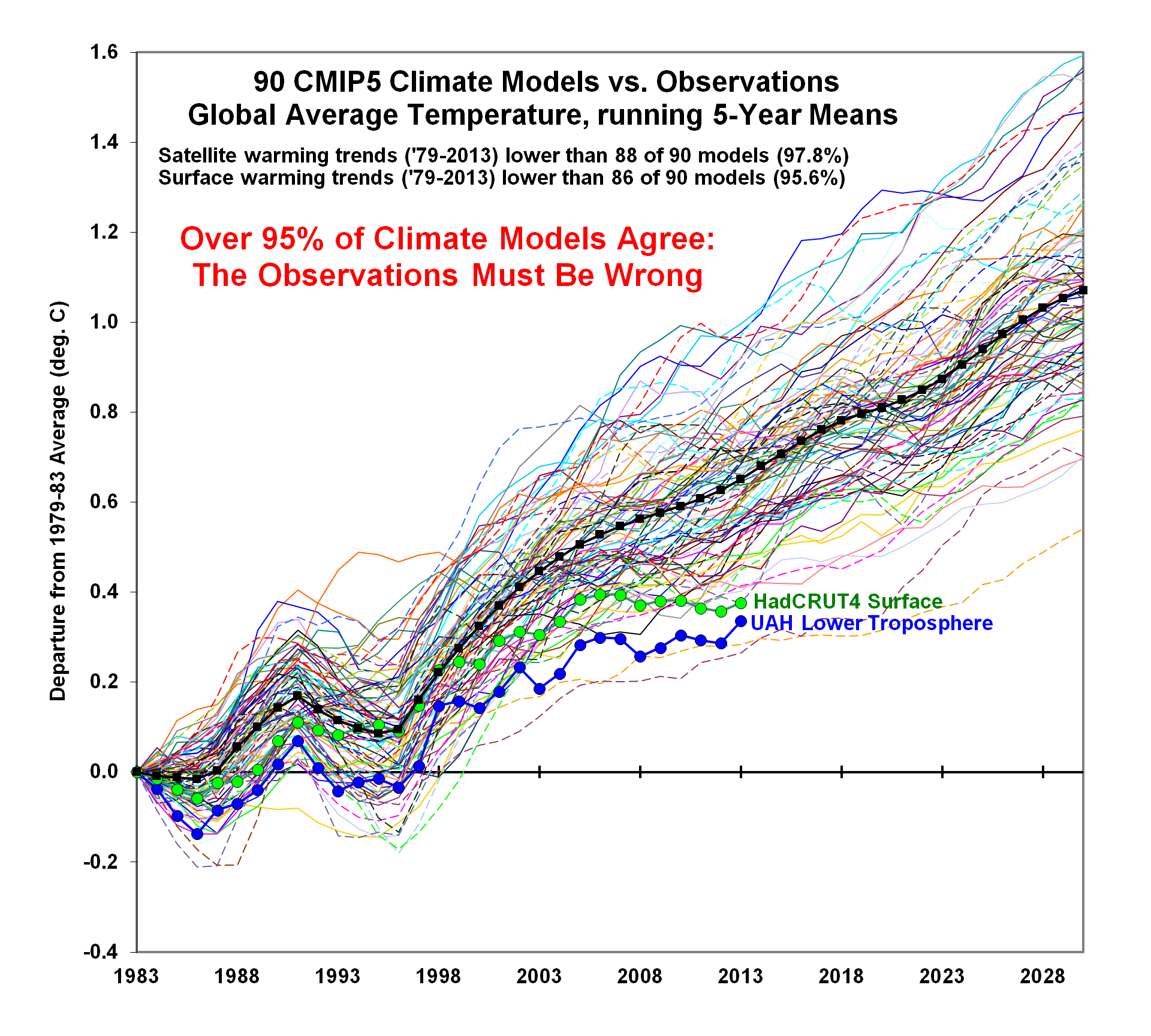
“It’s a well-kept secret, but 95 per cent of the climate models we are told prove the link between human CO2 emissions and catastrophic global warming have been found, after nearly two decades of temperature stasis, to be in error,” he wrote.

“The real agenda is concentrated political authority. Global warming is the hook. Eco-catastrophists [ …] have captured the UN and are extremely well funded. They have a hugely powerful ally in the White House.”

Environmental groups and scientists described Mr Newman as a ‘crazed’ conspiracy theorist and some called on him to resign.

“His anti-science, fringe views are indistinguishable from those made by angry trolls on conspiracy theory forums,” said the Climate Change Council.

Professor Will Steffen, a climate change scientist, told The Australian Financial Review: “These are bizarre comments that would be funny if they did not come from [Mr Abbott’s] chief business adviser.” Mr Abbott’s office did not respond but his environment minister said he did not agree with Mr Newman’s comments.

The article was written by Mr Newman to coincide with a visit by Christiana Figueres, the UN climate change negotiation, who has urged Australia to reduce its reliance on coal. Australia is one of the world’s biggest emitters of carbon emissions per capita.

Since his election in 2013, Mr Abbott has abolished Labor’s carbon tax, scaled back renewable energy targets and appointed sceptics to several significant government positions.

Facts Like These, Put Climate Alarmists to Shame….

A Winter to Remember

In the Northeast, February 2015 was a month like no other in our lifetime; January through March Harshest since 1717?

By Joseph D’Aleo · May, 2015
 No one who has lived in many parts of the Northeast into Canada experienced a six-week and calendar month as extreme for the combination of cold and snow as we have this late winter. From this writer’s viewpoint in southern New Hampshire, February 2015 was the coldest month ever recorded in nearby Nashua with an average temperature of 12.2 degrees Fahrenheit. It beat out January 1888, which had averaged 12.9F. A record 18 days had low temperatures at or below zero (as cold as 14F below). 25 days remained freezing or below, also a record.

Not far away in Boston, where temperature records began in 1872, February 2015 was exceeded only by February 1934, which brought Boston its all-time record of -18F. Temperatures never rose out of the 30s this year in February in Boston, though it topped 40 four times in 1934.

The cold in February 2015 was not confined to the Boston-Nashua area. It was the coldest month ever in Worcester, Hartford and Portland. It was the coldest February in Chicago and Cleveland, third coldest in New York City and fifth coldest ever in Detroit and Baltimore, both with records back into the early 1870s.

Boston set a record for monthly snow with 64.6 inches in February and 100.4 inches in the 39 days following January 24th. The 110.6 inches for the entire season exceeded the 107.6 inch record from 1995/96. The snow that year was spread out over six months with thaws, not concentrated so much in less than six weeks. The snow blitz and the intense cold is why the snow piles were so high this year. College students were shown on local television jumping out second story windows onto huge snowbanks in their bathing suit.

ONLY 1717 BEAT THIS?

Looking back through accounts of big snows in New England by the late weather historian David Ludlum, it appears for the eastern areas this winter’s snow blitz may have delivered the most snow since perhaps 1717.

That year, snows had reached five feet in December with drifts of 25 feet in January before one great last assault in late February into early March of 40 to 60 more inches. The snow was so deep that people could only leave their houses from the second floor, implying actual snow depths of as much as eight feet or more.  The New England Historical Society’s account indicated New Hampshire, Massachusetts and Connecticut were hardest hit, a lot like 2015 in what was known as the year of the great snows.

“Entire houses were covered over, identifiable only by a thin curl of smoke coming out of a hole in the snow. In Hampton, N.H., search parties went out after the storms hunting for elderly people at risk of freezing to death… Sometimes they were found burning their furniture because they couldn’t get to the woodshed. People maintained tunnels and paths through the snow from house to house.”

You may hear or read that increased snow is consistent with global warming because warmer air holds more moisture. In actual fact, 93% of the years with more than 60 inches of snow in Boston were colder than normal.

During the 40 days of snowy weather this winter, we averaged over 11F below normal, and moisture content of the air in the snow region was well below the long-term average. Cooling, not warming, increases snowfall. Indeed, winter temperatures have cooled over the last two decades in the Northeast and the 10-year running mean of Boston area snowfall has skyrocketed to the highest level since snow records were first kept.

The cold continued in March here in New England. The month averaged 5.1F below in Boston and 5.8F below normal in Nashua. There were only four 50F days in March after no 40F days in February in Boston. This compares with seventeen 50F days, eleven 60F days, seven 70F days and one 80F day in March 2012.

JANUARY TO MARCH RECORD COLD

January to March average temperatures were the coldest in the entire record in Worcester, Providence, Hartford and Nashua and third coldest in Boston behind only 1885 and 1895.

In fact, it was the coldest January through March on average in the entire Northeast (the 10 Northeast states and the District of Colombia) in NOAA’s climate record, which started in 1895.

Note how from January to March temperatures in the Northeast have declined for 20 years at a rate of 1.5F/decade.

This season, most areas of central New England had the snowiest mid to late winter and many spots the snowiest winter season on record. In 2013/14, Chicago had its coldest December to March back to 1872 and third snowiest while Detroit had its snowiest back to 1880.

The Great Lakes ice in the two years was the greatest in the record back to 1973, when measurements began edging out the late 1970s, when the world was worrying about a new ice age.

The Adirondacks into southeast Canada in these years usually gets the worst of the Arctic cold. Saranac Lake in February 2015 was 13.6F below normal with 23 sub-zero days, no day reaching freezing and four record lows. March had 15 days zero or below with 10 record lows. Last March (2014), Saranac Lake was 11.4F below normal with 10 sub-zero days and seven record lows.

All of eastern Canada set all-time records for cold, and in Maritime Canada, in many locations, this winter produced more snow than any winter season on record. Charlottetown on Prince Edward Island had a record, incredible 18.1 feet of snow. These were two amazing late winters.

WHAT IS BEHIND THE EXTREMES?

I learned early in my career from the some of the giants in the field like Jerome Namias how ocean temperature pools that develop in conjunction with strong El Niño and La Niña events meander with the ocean currents determine how the jet stream sets up and how strong and persistent it is. This determines how and where extreme winters and summers are for both temperature and precipitation.

A super La Niña in 2010/11 (second strongest in 120 years by some measures) set up warm water in the central Pacific and cold water near the West Coast of North America, which lead to that record warm and droughty 2011/12 central and eastern winter, spring and summer. That warm water came east first to off of Alaska last year leading to the historic winter near the western Lakes and north-central areas (highlighted January’s so-called ‘polar vortex’). Then in 2014 the warm water was carried by the currents southeast to the entire West Coast, forcing the cold to take aim more on the eastern Lakes and Northeast that was at its worst in February.

Similar changes occurred in the Atlantic. Starting in 2007, a warm North Atlantic helped build high pressure in the polar regions and drive Siberian air west to Europe where, in December 2010, the UK had its second coldest December since 1659 in the Little Ice Age.

Though scientists had warned snow was a thing of the past, the UK and much of northern Europe had all–time record snows and cold in five of six years. The North Atlantic turned cold last year and more so this year and Europe turned milder. But a cold North Atlantic means colder and snowier winters in eastern Canada, the Great Lakes and Northeast. The Atlantic thus helped exaggerate the Pacific-driven central U.S. and Northeast cold the last two winters.

At Weatherbell.com, where we use the oceans and sun in our statistical models for long-range prediction, we successfully predicted many months in advance these historic winters. Unless we see major changes in the eastern Pacific, we expect we may make this a threepeat about the time the administration signs a treaty in Paris with other nations at the UN to disassemble our current energy policies to supposedly save the planet from the ravages of warming, which we will show you in the next story is not happening globally and hasn’t for over 18 years.


Joe D’Aleo is a certified Consulting Meteorologist, Fellow of the American Meteorological Society (AMS), former chair AMS Committee on Weather Analysis and Forecasting, co-founder and first Director of Meteorology at The Weather Channel and a former college professor of Meteorology and Climatology.

Germany Buckling Under the Weight of the Wind Scam!

German Climate Physicist says: Time for Germans to Sober Up, kill their Wind Power Debacle & Save Millions of REAL Jobs

Horst_Ludecke-567x410

****

The Germans went into wind power harder and faster than anyone else – and the cost of doing so is catching up with a vengeance. The subsidies have been colossal, the impacts on the electricity market chaotic and – contrary to the environmental purpose of the policy – CO2 emissions are rising fast: if “saving” the planet is – as we are repeatedly told – all about reducing man-made emissions of an odourless, colourless, naturally occurring trace gas, essential for all life on earth – then German energy/environmental policy has manifestly failed (see our post here).

Some 800,000 German homes have been disconnected from the grid – victims of what is euphemistically called “fuel poverty”. In response, Germans have picked up their axes and have headed to their forests in order to improve their sense of energy security – although foresters apparently take the view that this self-help measure is nothing more than blatant timber theft (see our post here).

German manufacturers – and other energy intensive industries – faced with escalating power bills are packing up and heading to the USA – where power prices are 1/3 of Germany’s (see our posts here and hereand here). And the “green” dream of creating thousands of jobs in the wind industry has to turned out to be just that: a dream (see our post here).

Now, with Germany’s wind powered energy debacle clearly running completely out of control, a few sober individuals – like German physicist, climate scientist and spokesman for the European Institute for Climate and Energy (EIKE), Prof. Dr. Horst-Joachim Lüdecke – have weighed in. Prof Lüdecke has ripped into his country’s insane renewables policy; in an effort to get his compatriots to sober up, before they’re all left without a job, living on welfare and sitting freezing, in the dark.

German Climate Physicist: Alternative Energy, Climate Are A “Religious Creed”… “Miles Away” From Openness
NoTricksZone
P Gosselin
26 April 2015

german miners protest

****

Yesterday approximately 15,000 coal miners turned out to protest the German government’s energy policy.

German Economics Minister Sigmar Gabriel announced earlier he intended to levy a CO2 surcharge on older coal power plants with the aim of shutting them down.

Before yesterday’s demonstration, German physicist and climate scientist and spokesman for the European Institute for Climate and Energy (EIKE), Prof. Dr. Horst-Joachim Lüdecke, published a sharply-worded commentary here on the government’s anti-fossil fuel/nuclear power policy. As the introduction Lüdecke wrote:

“Climate protection and the switch over to renewable energies were instilled in German citizens by state propaganda, green brainwashing and with the help of all of Germany’s mainstream media. The unconditional necessity to advance into alternative energies has become a religious creed. By historical and global comparison, such a thing happens the most easily here, time after time. The logic used by the politically interested parties every time appears to be infallible. [..]

The argument goes as follows: The rescue of the planet from a death by heat and the immediate shutdown of the irresponsible German nuclear power plants are essential. The question of whether this is really true is not to be asked, let alone discussed.”

Lüdecke says, however, that public awareness over the madness of Germany’s energy policy is beginning to dawn and that he believes “now is the phase of sobering up, but unfortunately not yet one of reason.” Leading print media are beginning to soften their support for the so-called Energiewende as it now stands, he writes. As angry coal miners take to the street, and thousands of industrial jobs become threatened, it is becoming increasingly apparent something has gone awry.

Lüdecke thinks that the sobering-up process will take time because every political party has made green issues part of its platform. “Green is a very difficult color to wash away,” the German physicist writes.

Lüdecke then explains the primary disadvantage of renewable energy: their low energy density, i.e. meaning they require vast areas and that the major ones are weather-dependent. The German EIKE professor does not know how long the sobering-up process will take, citing the immense power of an array of lobbies behind the green movement.

Lüdecke also aims harsh words at Germany’s pompous and one-sided media:

“Finally a word for the German media, here especially for the public TV and radio networks. They are rightly being compared by the current contemporaries to the conditions of former East Germany or even earlier times.”

At the political level, Lüdecke blasts the atmosphere of intimidation against people who have alternative views, who often are threatened with physical violence from radical leftists groups.

When it comes to openness, such as that proclaimed by French philosopher Voltaire, the German climatologist writes “in the dark media of Germany, we are miles away.” He adds:

“Factual discourse, connected with polite listening and taking the arguments from opponents seriously, is definitely not in fashion.”

Lüdecke describes Germany as a desert when it comes to independent reporting and expression of opinions.
NoTricksZone

There, as here, a gullible and pliant media has aided and abetted the greatest environmental and economic fraud of all time. Whether it’s bone laziness, or intellectual dishonesty, modern journos have a lot to answer for.

sherlock-holmes

****

Once upon a time, the ambitious young hack was inquisitive, suspicious and had the kind of forensic zeal that would have teamed up well with Sherlock Holmes and his side-kick, Watson. Not any more.

Sadly, save for a few remarkable examples – like Graham Lloyd, Alan Jones, James Delingpole, Emily Godsen, Christopher Booker and Rodney Lohse – the press-pack simply parrot the drivel tossed out as “media releases” by the Clean Energy Council, and its wind industry funded equivalents around the globe.

But, thanks to the likes of NoTricksZone, and a few other dedicated bloggers, the unassailable facts are seeing the light of day; much to the horror and annoyance of the wind industry, its parasites and spruikers.

As the scale and scope of the fraud is steadily being revealed – despite the wind industry’s best efforts to keep a lid on it – those who are in a position to have called it a long time ago – and failed or refused to do so – are going to end up looking like either gullible dupes; or willing worshippers, in an insidious, quasi-religious cult.

remember-jonestown-small-jpg

The Full Impact of the Damage, from the Wynned Fiasco, is being felt in increments. Greed Energy!

GWYN MORGAN

Special to The Globe and Mail

Published Sunday, May. 03 2015, 7:20 PM EDT

Last updated Monday, May. 04 2015, 7:31 AM EDT

Last month’s announcement by Ontario Premier Kathleen Wynne that her province would link up with the existing Quebec and California carbon dioxide cap-and-trade systems prompted an editorial in this newspaper headlined, “Is this Green Energy Act Round Two?”

Ontario’s Green Energy Act offered so-called “feed-in rates” almost four times existing electricity rates for wind and more than 10 times for solar power. Like bees to honey, wind and solar companies rushed in. By the time the government realized that these subsidies were driving Ontario from one of the lowest to one of the highest power cost jurisdictions in North America, the province had signed myriad 20-year-locked-in-rate-guaranteed contracts that will drive power rates up a further 40 per cent to 50 per cent in coming years. Adding salt to this self-inflicted wound is the reality that much of the green power comes on stream when it isn’t needed. This unneeded electricity is dumped into the United States at bargain-basement prices that Ontario’s Auditor-General found has already cost Ontario power consumers billions of dollars, with much bigger losses yet to come before those 20-year contracts expire.

Given these disastrous results, one would think that Ms. Wynne and her cabinet colleagues would have carefully studied experience in other jurisdictions before implementing green policy two. The first and largest carbon cap-and-trade scheme is Europe’s 10-year-old system. As in Ontario, the story begins with huge subsidies for wind and solar power that drove up electricity prices precipitously. Cap-and-trade handed wind and solar power companies a second windfall by creating a “carbon trading market” that allowed them to sell “carbon offsets” from their low-emission projects.

On the other hand, many factories and industrial plants, already struggling with high power costs, found it more profitable to shut down and sell their carbon credit allocation in the carbon trading market. As a result, the bulk of Europe’s emissions reductions have been achieved by the departure of energy-intensive industries to overseas locations. Many of the products consumed by Europeans are now produced in countries without emissions limits, demonstrating the futility of imposing local carbon cap measures without global commitments. And since European industry was already among the world’s most energy efficient, the emissions embedded in most of those imported goods are higher than when the same goods were produced domestically.

Adding irony to this job-exporting fiasco, some European countries, including Germany, have implemented subsidies in an effort to keep the remnants of their industrial sector from shutting down. German electricity consumers paid some €20-billion ($27.2-billion) in green power subsidies last year, while at the same time their government spent billions of euros to help industrial plants survive the combination of high electricity and cap-and-trade costs that made them uncompetitive in the first place.

The Ontario announcement has promulgated a debate as to whether cap-and-trade is a tax. Clearly, for those having to buy carbon credits, it amounts to a tax. But for those who have credits to sell, it amounts to a subsidy.

But what most commenters have missed is that former premier Dalton McGuinty’s Green Energy Act created what is, for practical purposes, an indirect tax on energy consumers. Now comes Ms. Wynne’s equally ill-considered cap-and-trade tax. In mirror image to Europe’s green-power-driven levy on electricity consumers followed by cap-and-trade, Ontario’s ill-considered green scheme No. 2 could strike the final blow that drives industry elsewhere.

This leaves the question as to why Quebec so warmly welcomed Ontario’s decision to join its cap-and-trade system. Quebec’s electricity comes almost entirely from cheap, emissions-free hydropower, mitigating much of the competitive impact of cap-and-trade. Quebec has just announced a massive expansion of its hydropower capacity and is looking for markets. The net effect of signing Ontario onto its cap-and-trade system may well be the export of jobs from Ontario to Quebec businesses and the export of electricity from Quebec to Ontario consumers, along with the added bonus of selling carbon credits to Ontario businesses unable to meet cap-and-trade targets.

Ontario generates just 0.5 per cent of global carbon emissions. Even a giant 20-per-cent reduction would knock just a tenth of 1 per cent off global emissions. A minuscule gain for the globe, at a potentially enormous cost to the people of Ontario, and all Canadians.

Gwyn Morgan is a retired Canadian business leader who has been a director of five global corporations

Climate “Fiction -“They are no longer Climate Scientists…they are Fiction writers….

151 Degrees Of Fudging…Energy Physicist Unveils NOAA’s “Massive Rewrite” Of Maine Climate History

Fellow New Englander, engineering physicist and energy expert, Mike Brakey has sent a summary analysis of NOAA past temperature “adjustments” for Lewiston-Auburn, Maine.
=====================================

Black Swan Climate Theory
By Mike Brakey

Here in the U.S. I have documented manipulations similar to those in Switzerland and other locations worldwide that NTZ wrote about yesterday.

Over the last months I have discovered that between 2013 and 2015 some government bureaucrats have rewritten Maine climate history between 2013 and 2015 (and New England’s and of the U.S.). This statement is not based on my opinion, but on facts drawn from NOAA 2013 climate data vs NOAA 2015 climate data after when they re-wrote it.

We need only compare the data. They cooked their own books (see numbers below).

Brakey_1

NOAA cooled the years of Lewiston-Auburn Maine’s past by an accumulated 151°F! (55,188 heating degree day units).

The last four months have been some of the coldest you might ever recall in our lifetime. So far 2015 is the fourth coldest in Maine’s history over the last 120 years. Data from 2013 confirm that so far – from January 1 to April 29 – 2015 has required 4249 heating degree days.

That rivals 1904, 1918 and 1923 over the last 120 years.

But when I recently looked at NOAA’s revised 2015 data, these last four months now would not even put us in the top twenty of coldest months. The federal government went into the historical data and lowered those earlier years – and other years in the earlier decades – so that they can keep spending $27 billion a year on pushing global warming.

They assumed no one would archive temperature data. But I did. My research indicated they used the same algorithm across the United States at the same time. Fortunately I had archived their data from 2013 for Maine and recently compared it to their 2015 data (see above table).

As an engineering physicist and heat transfer specialist, I have worked with heating and cooling degree days for forty years. It is alarming when one discovers multi-million dollar websites have been corrupted with bogus data because the facts do not match up with agendas.

It tremendously harms the industry you and I both work in. Worse, it harms the public. If the public knew the climate data facts indicated it was not getting warmer locally, and that it might actually be getting cooler, it would have all the more reason to insulate and become more energy-efficient in their homes.

I have put together a Maine history of climate temperatures in a narrated PowerPoint Presentation placed on YouTube titled, Black Swan Climate Theory.

Below is a brief sampling of my findings:

Brakey_3

So far 2015 Maine temperatures, as of April, are running neck-and-neck with the coldest years in Maine’s history: 1904 (40.6°F), 1918 (42.1°F) and 1925 (42.3°F). These temperatures cited come right from the federal government’s own NOAA climate data (from 2013). I archived them on my computer for future reference.

2015 so far among coldest on record

A BLACK SWAN event is forming in 2015 (see chart to right). Based on the first four months of 2015, there is an excellent chance 2015 Maine temperature might average, on an annual basis, well under 43.0°F. Not only have Maine temperatures been on a decline since 1998, we are now seeing temperatures reminiscent of the bitter turn of the early 1900s.

Massive rewrite

It appears NOAA panicked and did a massive rewrite of Maine temperature history (they used the same algorithm for U.S. in general). The new official temperatures from Maine between 1895 and present were LOWERED by an accumulated 151.2°F between 1895 and 2012.

“Out-and-out fraud”

In my opinion, this is out-and-out fraud. Why did they corrupt national climate data? Global warming is a $27 billion business on an annual basis in the U.S alone.

Brakey_4

Now NOAA data revised in 2015 indicate that 1904, 1919 and 1925 in Maine were much colder than anything we experience today. (See the scorecard above comparing the NOAA data that are 18 months apart). Note how for 1913 the NOAA lowered the annual temperature a whole 4°F!

For the balance of the years, as they get closer to the present, the NOAA tweaks less and less. They have corrupted Maine climate data between 1895 and present by a whopping accumulated 151.2°F.

Unfortunately NOAA is remaining true to that old saying, “Figures don’t lie but liars figure.”

A multi-million dollar website has been corrupted. I can no longer rely on the tax-payer funded NOAA for clean, unfiltered, climate data for my ongoing research.

Conclusion

I can no longer trust the climate data and energy information ultimately drawn from the U.S. government. Locally, I now have to determine if they got their data from NOAA.

This makes research a lot tougher.

Mike Brakey

– See more at: http://notrickszone.com/2015/05/02/151-degrees-of-fudging-energy-physicist-unveils-noaas-massive-rewrite-of-maine-climate-history/#sthash.BBzJYpeL.gdGB9urs.dpuf

Father of Green Communities Act, Convicted Under the RICO Act! Who’s Next?

Falmouth Wind Turbines – RICO Act

Prior to Wind Turbine Installations Falmouth had the Octave Band Data / Sound performance for the V82 turbine

Falmouth Wind Turbines & RICO Act

Did the Town of Falmouth violate the RICO Act ? They all knew the turbines would break state noise laws !

The Commonwealth of Massachusetts
Department of Environmental Protection (DEP)
Noise Control Regulation  310 CMR 7.10

310 CMR 7.10 Noise
(1) No person owning, leasing, or controlling a source of sound shall willfully, negligently, or through failure to provide necessary equipment, service, or maintenance or to take necessary precautions cause, suffer, allow, or permit unnecessary emissions from said source of sound that may cause noise.

Prior to the installations of the Falmouth wind turbines it appears Vestas Wind Company forewarned the Town of Falmouth, Town of Falmouth contract engineers and construction contractors. The manufacturer ( Vestas )also needs confirmation that the Town of

Falmouth understands they are fully responsible for the site selection of the turbine and bear all responsibilities to address any mitigation needs of the neighbors.

The turbines operated full time until May of 2012. State officials shut down the wind turbine in Falmouth after measurements showed the machine generating more than 10 decibels above ordinary background noise.

The turbines operate 12 hours a day during daylight now and are shut off on Sunday

Passed in 1970, the Racketeer Influenced and Corrupt Organizations Act (RICO) is a federal law designed to combat organized crime in the United States. It allows prosecution and civil penalties for racketeering activity performed as part of an ongoing criminal enterprise.

To convict a defendant under RICO, the government must prove that the defendant engaged in two or more instances of racketeering activity and that the defendant directly invested in, maintained an interest in, or participated in a criminal enterprise affecting interstate or foreign commerce.

Political Corruption

Politicians :
. UNITED STATES V. CIANCI
Providence Rhode Island
For twenty-one years, from 1975-1984 and from 1991-2002, Vincent A. “Buddy” Cianci was the mayor of Providence, Rhode Island.

Ultimately, Cianci was only convicted of one RICO conspiracy count.
The First Circuit notes—for a RICO conspiracy conviction, a defendant simply “must intend to further an endeavor which, if completed, would satisfy all of the elements of a substantive criminal offense, but it suffices that he adopted the goal of furthering or facilitating the criminal endeavor.”

Buddy Cianci was therefore found guilty of a §1962(d) RICO conspiracy violation and sentenced to five years and four months in prison.

Falmouth noise letter recently released through a Freedom of Information Request

August 3, 2010
Mr. Gerald Potamis
WasteWater Superintendent
Town of Falmouth Public Works
59 Town Hall Square
Falmouth, MA 02540

RE: Falmouth WWTF Wind Energy Facility II “Wind II”, Falmouth, MA
Contract No. #3297

Dear Mr. Potamis,

Due to the sound concerns regarding the first wind turbine installed at the wastewater treatment facility, the manufacturer of the turbines, Vestas, is keen for the Town of Falmouth to understand the possible noise and other risks associated with the installation of the second wind turbine.

The Town has previously been provided with the Octave Band Data / Sound performance for the V82 turbine. This shows that the turbine normally operates at 103.2dB but the manufacturer has also stated that it may produce up to 110dB under certain circumstances. These measurements are based on IEC standards for sound measurement which is calculated at a height of 10m above of the base of the turbine.

We understand that a sound study is being performed to determine what, if any, Impacts the second turbine will have to the nearest residences. Please be advised that should noise concerns arise with this turbine, the only option to mitigate normal operating sound from the V82 is to shut down the machine at certain wind speeds and directions. Naturally this would detrimentally affect power production.

The manufacturer also needs confirmation that the Town of Falmouth understands they are fully responsible for the site selection of the turbine and bear all responsibilities to address any mitigation needs of the neighbors.

Finally, the manufacturer has raised the possibility of ice throw concerns. Since Route 28 is relatively close to the turbine, precautions should be taken in weather that may cause icing.

To date on this project we have been unable to move forward with signing the contract with Vestas. The inability to release the turbine for shipment to the project site has caused significant [SIC] delays in our project schedule. In order to move forward the manufacturer requires your understanding and acknowledgement of these risks. We kindly request for this acknowledgement to be sent to us by August 4, 2010, as we have scheduled a coordination meeting with Vestas to discuss the project schedule and steps forward for completion of the project.

Please sign in the space provided below to indicate your understanding and acknowledgement of this letter. If you have any questions, please do not hesitate to call me.

Sincerely,

(Bruce Mabbott’s signature)
_____________________
Bruce Mabbott Gerald Potamis
Project Manager Town of Falmouth

CC: Sumul Shah, Lumus Construction, Inc.
(Town of Falmouth’s Wind-1 and Wind-2 Construction contractor)

Stephen Wiehe, Weston & Sampson
(Town of Falmouth’s contract engineers)

Brian Hopkins, Vestas
(Wind-1, Wind-2’s turbine manufacturer, and also Webb/NOTUS turbine)

Climate Models Never Reflect Reality…..Reality Must be Wrong???

95% of Climate Models Agree: The Observations Must be Wrong

Roy W. Spencer, Ph. D.

I’m seeing a lot of wrangling over the recent (15+ year) pause in global average warming…when did it start, is it a full pause, shouldn’t we be taking the longer view, etc.

These are all interesting exercises, but they miss the most important point:the climate models that governments base policy decisions on have failed miserably.

I’ve updated our comparison of 90 climate models versus observations for global average surface temperatures through 2013, and we still see that >95% of the models have over-forecast the warming trend since 1979, whether we use their own surface temperature dataset (HadCRUT4), or our satellite dataset of lower tropospheric temperatures (UAH):

CMIP5-90-models-global-Tsfc-vs-obs-thru-2013

Whether humans are the cause of 100% of the observed warming or not, the conclusion is that global warming isn’t as bad as was predicted. That should have major policy implications…assuming policy is still informed by facts more than emotions and political aspirations.

And if humans are the cause of only, say, 50% of the warming (e.g. our published paper), then there is even less reason to force expensive and prosperity-destroying energy policies down our throats.

I am growing weary of the variety of emotional, misleading, and policy-useless statements like “most warming since the 1950s is human caused” or “97% of climate scientists agree humans are contributing to warming”, neither of which leads to the conclusion we need to substantially increase energy prices and freeze and starve more poor people to death for the greater good.

Yet, that is the direction we are heading.

And even if the extra energy is being stored in the deep ocean (if you have faith in long-term measured warming trends of thousandths or hundredths of a degree), I say “great!”. Because that extra heat is in the form of a tiny temperature change spread throughout an unimaginably large heat sink, which can never have an appreciable effect on future surface climate.

If the deep ocean ends up averaging 4.1 deg. C, rather than 4.0 deg. C, it won’t really matter.

Sign a Wind Lease in Haste, Repent at Your Leisure!

Wind Leaseholders May Be On The Hook For Billions

global-landgrabA recent visit by members of the Ontario Landowners Association to the Land Registry Office in Goderich (Service Ontario) has revealed the registration of a one billion dollar encumbrance by K2 Wind Ontario Inc. on 100 wind leaseholder properties in Ashfield-Colborne-Wawanosh (ACW), home of the 140 turbine K2 Wind Project. They were looking for the original deed for a property and stumbled on K2 Wind’s charge. Certified publicrecords indicate that some properties may be encumbered at twenty times their farm land value, or more.

“We don’t know the full ramifications of what we have discovered this week”, stated Dave Hemingway, President of the Huron Perth Landowners Association. “We know that K2 Wind is not the only wind company following this practice but we don’t know at this point just how many others are involved.” Mr. Hemingway went on to say, “This raises some serious questions. Have the wind developers been smooth talkers and have rural leaseholders been too naïve and trusting? This might very well impact leaseholders’ ability to borrow money for their farming operations.”
Mr. Hemingway states that this discovery could have a profound effect on a leaseholders’ ability to borrow money, sell the farm or otherwise do what he/she sees fit with their own land.

The Ontario Landowners Association has been promoting the concept of property rights for landowners and has been encouraging them to make application for their Crown Land Patent. As part of this program the association encourages property owners to get a copy of the original deed for when the property was transferred from the Crown to private ownership. In the Huron Perth area, this happened from around 1830. The Crown sold the land to the Canada Company which then sold parcels to the local landowners of the time. The Huron Perth Landowners Association has published a Crown Letters Patent booklet to explain what a Crown Letters Patent is and how to get one for your own property. The association also recommends getting the original deed for one’s property which sets out the terms under which the first individual landowner received the property rights which have subsequently becomes the current owner’s property rights.
For further information, contact Dave Hemingway at 519-482-7005 or davehemingway@gmail.com.