EU’s Green Policies. An Example That No One Should Follow!

EU’s green energy debacle shows the futility of climate change policies

A wind turbine spins at a wind farm on February 19, 2015 near Zaragoza, Spain.

David Ramos/Getty ImagesA wind turbine spins at a wind farm on February 19, 2015 near Zaragoza, Spain.

Ontario will follow the EU at its peril — power rates will soar while industries depart

As the Ontario government announces new unilateral climate policies, Canadian policymakers would be well advised to heed the lessons of Europe’s self-defeating green energy debacle.

The European Union has long been committed to unilateral efforts to tackle climate change. For the last 20 years, Europe has felt a duty to set an example through radical climate policy-making at home. Political leaders were convinced that the development of a low-carbon economy based on renewables would give Europe a competitive advantage.

European governments have advanced the most expensive forms of energy generation at the expense of the least expensive kinds. No other major emitter has followed the EU’s aggressive climate policy and targets. As a result, electricity prices in Europe are now more than double those in North America and Europe’s remaining and struggling manufacturers are rapidly losing ground to international competition. European companies and investors are pouring money into the U.S., where energy prices have fallen to less than half those in the EU, thanks to the shale gas revolution.

Although EU policy has managed to reduce CO2 emissions domestically, this was only achieved by shifting energy-intensive industries to overseas locations without stringent emission limits, where energy and labour is cheap and which are now growing much faster than the EU.

Most products consumed in the EU today are imported from countries without binding CO2 targets. While the EU’s domestic CO2 emissions have fallen, if you factor in CO2 emissions embedded in goods imported into EU, the figure remains substantially higher.

Of all the unintended consequences of EU climate policy perhaps the most bizarre is the detrimental effect of wind and solar schemes on the price of electricity generated by natural gas. Many gas power plants can no longer operate enough hours. They incur big costs as they have to be switched on and off to back-up renewables.

Most products consumed in the EU today are imported from countries without binding CO2 targets

This week, Germany’s energy industry association warned that more than half of all power plants in planning are about to fold: Even the most efficient gas-fired power plants can no longer be operated profitably.

Every 10 new units worth of wind power installation has to be backed up with some eight units worth of fossil fuel generation. This is because fossil fuel plants have to power up suddenly to meet the deficiencies of intermittent renewables. In short, renewables do not provide an escape route from fossil fuel use without which they are unsustainable.

Gas-fired power generation has become uneconomic in the EU, even for some of the most efficient and least carbon-intensive plants. At the end of 2013, 14 per cent of the EU’s installed gas-fired plants stood still, had closed or were at risk of closure. If all gas plants currently under review were to close, this would amount to 28 per cent of current capacity by 2016. Almost 20 per cent of gas power plants in Germany have already become unprofitable and face shutdown as renewables flood the electricity grid with preferential energy.

To avoid blackouts, the government has to subsidize uneconomic gas and coal power plants. Already half of the 28 EU countries have in place or are planning to subsidize fossil fuel power plants to keep the lights on.

Germany’s renewable energy levy, which subsidizes green energy production, rose from 14 billion euros to 20 billion euros in just one year as a result of the fierce expansion of wind and solar power projects. Since the introduction of the levy in 2000, the electricity bill of the typical German consumer has doubled.

As wealthy homeowners and business owners install wind turbines on their land and solar panels on their homes and commercial buildings, low-income families all over Europe have had to foot the skyrocketing electric bills. Many can no longer afford to pay, so the utilities are cutting off their power. The German Association of Energy Consumers estimates that up to 800,000 Germans have had their power cut off because they were unable to pay the country’s rising electricity bills.

The EU’s unilateral climate policy is absurd. First consumers are forced to pay ever increasing subsidies for wind and solar energy; secondly they are asked to subsidize nuclear energy too; thirdly, they are forced to pay for increasingly uneconomic coal and gas plants to back up power needed by intermittent wind and solar energy; fourthly, consumers are additionally hit by multi-billion subsidies that become necessary to upgrade the national grids; fifthly, the cost of power is made even more expensive by adding a unilateral Emissions Trading Scheme. Finally, because Europe has created such a foolish scheme that is crippling its heavy industries, consumers are forced to pay even more billions in subsidizing almost the entire manufacturing sector.

In the last few years, major economies such as Canada, Australia and Japan have begun to realize the futility of going it alone and have retreated from unilateral policies and targets. Now even the EU has decided to walk away and has adopted a conditional climate pledge. It has burdened European taxpayers and businesses with astronomical costs while shifting its heavy industry and CO2 emissions to other parts of the world. Europe’s climate policy failure demonstrates beyond doubt that its unilateralism has been a complete fiasco. The lessons of this self-defeating debacle are clear: Don’t make the same mistakes or you will face the same fiasco.

Benny Peiser is the director of the London-based Global Warming Policy Forum. The text is based on written evidence he gave to the Committee on Environment and Public Works of the U.S. Senate.

Funny that Wind Proponents refuse to Study REAL PEOPLE! Obvious they know the truth!

FOR IMMEDIATE RELEASE  

                                                                                                                          April 8, 2015

Toronto ON/ On April 9 the Council of Canadian Academies (CCA) will release a report in Canada evaluating the literature on the impacts of wind turbine noise on human health called Understanding the Evidence: Wind Turbine Noise.

The group Canadians for Radiation Emissions Enforcement (CFREE) wants the endless reviewing of the literature on wind turbines and health to cease.

“The people of rural Canada don’t want any more expert reviewers reviewing other expert reviewers year after year”, says Shawn Drennan spokesperson for CFREE. “We are at a crossroads with the wind industry. We want action. The government of Ontario is plowing ahead with the planned 6000 industrial scale wind turbines while communities are desperate to be heard and protected.  Why is the Radiation Emitting Devices Act – a Law created to protect Canadians from acoustical waves such as those emitted by wind turbines – being ignored?”

“How many people in rural Canada need to complain and suffer from the operation of wind turbines before justice takes hold?” Drennan added.

“Added to this is the fact that the CCA panel of experts, supported by the federal government and including a member of the wind industry lobby, has no mandate to  investigate any individuals reporting health effects for this report. Where do we the public fit in?” adds Drennan.

It is prescribed in the REDA that if an importer or operator of a device such as a wind turbine is made aware of risk of personal injury or  impairment of health they must “forthwith notify the Minister” [of Health for Canada]. CFREE asks why wind developers did not follow this law seven years ago when people first reported problems to them about the impacts of the noise emitted from turbines operating in their vicinity.

“If developers had complied with the law and reported the complaints to Health Canada, investigations would have been carried out back then before the Green Energy Act. This could have advanced the understanding a long time ago and avoided risk of harm to those living close to these facilities” said Joan Morris, an epidemiologist and Chair of CFREE.

Drennan adds, “So here we are seven years later- more reviews of the reviews while the problems have not gone away but have become more grievous for the people suffering in rural Canada.”

For more information:

Joan Morris

Oxford County ON

519 851-2092   morrisj99@gmail.com

Shawn Drennan

Ashfield-Colborne-Wawanosh Township in Huron County

www.CFREE.info

“Agenda 21” The Reason for the “War on Carbon Fuels”!

Strange Allies in the War on Carbon Fuels

big-oilGuest opinion by Viv Forbes

What great cause could unite Prince Charles, President Obama, the Pope, the Arab Oil sheiks, the United Nations, the European Union, the Russians, the Chinese, Pacific Island Nations, most undeveloped countries, the glitterati of Hollywood, left-wing politicians, unrepentant reds, government media, the climate research industry, Big Oil, Big Gas and the Green Blob. It must be something posing a clear and urgent danger to all humanity?

No, the crusade that unites them all is the War on Carbon Fuels, focussed mainly on that most vilified target, coal.

The biggest group, and the generals in this war on carbon, have no real interest in the facts or science of global climate change – they see climate alarmism as a great opportunity to achieve their goal of creating an unelected global government. They have even laid out their plans in a document called Agenda 21.

This group naturally includes the United Nations and all of its subsidiaries, the EU, and left wing politicians and media everywhere. At a news conference in Brussels recently, Christiana Figueres, executive secretary of U.N.’s Framework Convention on Climate Change, admitted that the goal of environmental activists is not to save the world from ecological calamity, but “to change the economic development model” ie destroy what is left of free enterprise and private property. See:
http://news.investors.com/ibd-editorials/021015-738779-climate-change-scare-tool-to-destroy-capitalism.htm
http://www.breitbart.com/london/2014/10/10/shell-oil-lego-greenpeace-and-the-environmental-movement-s-war-on-capitalism/
The next big group of carbon warriors is the anti-western failed states who see this as their big chance to enrich and entrench their ruling classes with “climate reparations”.
Then there are the enviro-entrepreneurs forever seeking new crusades to energise their supporters and get the donations rolling in – Greenpeace, WWF, Get Up etc…
In the dark corner are the anti-human Malthusians and the Deep Greens who want to get rid of most of us other people – personified by the rich and powerful such as Prince Charles and Maurice Strong. They know that carbon fuels support millions of people by cultivating, harvesting, transporting, processing and storing most of the food that supports the cities of the world. Killing the use of carbon fuels will certainly achieve their goal of reduced world population.

See:
http://explosivereports.com/2013/01/12/prince-charles-openly-endorses-draconian-conclusions-of-new-population-study/

Naturally, government media usually support a bigger role for government, and all media like a scare story. Truth or logic does not matter greatly for most of them – just so long as they can coax a looming disaster story from someone. The daily diet of natural calamities soon heightens climate anxiety, which then motivates politicians to be seen to be “doing something”.
And then there are those who see that fighting carbon fuels also suits their pockets. As someone said “When placing a bet, the best horse to back is the one called ‘Self-interest’ – at least you know he is trying”.

For example, Shell, with its massive gas interests, was caught campaigning against coal fired power, the main competitor of gas in electricity generation. See:
http://www.theaustralian.com.au/innovationchallenge/shell-admits-campaigning-against-coal-fired-power-plants/story-fn9dkrp5-1226770855004

Arab Oil interests were caught funding a film attacking their competitors – shale oil fracking in America. See:
http://dailysignal.com/2012/09/28/matt-damons-anti-fracking-movie-financed-by-oil-rich-arab-nation/

And a Russian oil company was exposed funding US anti-carbon green groups. See:
http://freebeacon.com/issues/foreign-firm-funding-u-s-green-groups-tied-to-state-owned-russian-oil-company/

The Chinese of course are great supporters of green energy as long as it is installed elsewhere – eg they supply the machines and solar panels and then welcome the factories forced from the host country by soaring electricity prices.
Gas, nuclear and hydro power will be the greatest long term beneficiaries of the war on coal. Initially they will be needed to provide base load and back up for intermittent green power like wind and solar. Then as green subsidies are withdrawn to appease angry taxpayers, the green play-toys will fail and grown-up generators will step easily into full time electricity production.

Finally, the government bureaucracy and the research grants industry justify their existence by “solving community crises”. They love “The Climate Crisis” because it can be blamed for any weather event anytime, anywhere. It is unlikely to be solved, no matter how many dollars are thrown at it – a problem that does not exist can never be “solved”. And the sinister “Greenhouse Effect”, like any good ghost, is invisible, mysterious in operation, debatable, and allows anyone to produce their own scare story.

Opposing this coalition of climate alarmists and opportunists is a rag-tag army of stressed tax payers and electricity consumers and a scattering of sceptical scientists and media researchers.
But the imposing alarmist empire has a hollow heart – the globe has refused to warm, the alarmist “science” is crumbling, their climate models are discredited, some researchers have been caught manipulating records and results, and the costs of green electricity are becoming obvious and onerous. The public is growing restive, governments can no longer afford the climate industry cuckoo in the public nest and the ranks of sceptics grow. Groups like UKIP in UK and the Tea Party in US have abandoned the war on carbon.

The climate revolt is spreading.


Disclosure: Viv Forbes is a shareholder and non-executive director of a small Australian coal exploration company. His views are not shared or supported by most Big Coal CEO’s.

Brilliant Discussion on the Issue of “Global Warming”….

The Sensible Believer

I consider myself a “sensible believer” in Global Warming.
In my definition, what does “sensible believer” mean?
I believe that CO2 is a greenhouse gas and thus that increased concentrations of it in the atmosphere would tend to increase the amount of heat trapped by that same atmosphere.
Also, I believe there is enough relatively unbiased evidence to state that over the past 50 years, the average temperature of the planet has increased by ~0.64°C.
So far, so good, but then come some “inconvenient” questions, like, for example:
  • Of the ~0.64°C, how much is man made?
  • Is all this temperature increase due to increased CO2 concentrations in the atmosphere?
  • Are there other mechanisms that would provide positive / negative feedback to the effect of the CO2?
  • Would all the effects of an eventual warming of the planet be negative? Or, could there be positive consequences also?
  • If there could also be positive consequences, would they compensate, at least in part, the negative consequences?
Now, as a “sensible believer,” let me state what I don´t believe in:
  • That we know for sure how much the average temperature of the Earth will increase vs the CO2 concentration in the atmosphere.
  • That there is a “carbon budget” we shouldn’t exceed.
  • That Global Warming is the most serious problem for humanity.
  • That any cost / suffering is justified to fight Global Warming.
  • That renewables (in particular Solar and Wind) are the best solution to reduce our CO2 emissions.
  • That the IPCC is perfect and that it’s intentions are purely the presentation of science.
  • That the believer side is “pure” and thus that no paid lobbyists are pursuing interests that have nothing to do with Global Warming.
  • Carbon taxes. When you boil them down to their essentials, carbon taxes are just another tax. So thanks, but no thanks.
  • “Freak” energy such as wave, tide, etc. They are “interesting” but will continue to be almost irrelevant in our total primary energy supply.
  • That we have all the questions and all the answers: in other words, we are too arrogant. If the persons in 1915 would have tried to prevent our problems today, they would have failed miserably.
So, as a “sensible believer” these are my inputs to the energy / climate discourse:
  • Intensely pursue improvements in efficiency. We have barely scratched the surface here and it is, for the most part, a win-win situation because efficiency does not reduce our standards of living.
  • Aggressively replace coal with natural gas. Aside from efficiency, probably nothing can reduce CO2 emissions faster.
  • In general, increase as much as possible the production of natural gas to not only replace coal with it, but minimize the usage of coal in the first place in developing economies.
  • Do not go all out for renewables (Solar & Wind), this might end up being counter-productive. Thus, remove all overt / covert subsidies for renewables. They are valuable under some circumstances but let them stand on their own feet. While at it, let’s remove subsidies for FF also, however, let’s consider that per unit of energy produced renewables are today more subsidized than FF.
  • Let current nuclear continue to flourish, but more important, invest in R&D for future generations of nuclear (fission and fusion). Eventually (say in 100 to 150 years, nuclear may be our #1 energy source).
  • Support innovation in general.
  • Help reduce population growth in countries that cannot afford it.
  • Carefully evaluate other “controversial” partial solutions: CCS, geo-engineering, etc.
  • Our global energy use is of such gigantic proportions that whatever we do, will take decades to show results. “It takes time to bring an elephant to term.” Hysteria and doing something (anything) for the sake of doing it might prove counter-productive.
  • Essentially, the Global Warming issue is not primarily scientific. It is a political, economic, engineering, psychological, (plus many other things) issue.
Both Robert Bryce and Richard Muller consider natural gas the best energy source we have, and the former states that our plan, long term, should be N2N, in other words: natural gas to nuclear.
From the energy point of view of our civilization, this plan seems to me perfectly reasonable.
Thank you.
Feel free to add to the conversation in Twitter: @luisbaram

Wind Turbines are a Scourge on any Community, and People are Becoming Aware!

Greenwich concerned about wind turbines

Greenwich Neighbors United is hosting an event to educate residents about proposed wind park and let them voice their concerns.
AARON KRAUSE
JAN 17, 2015

As members of the Greenwich community learn more about the proposed wind turbine park, they are voicing their concerns about its potential impact on this peaceful and tranquil community. The case is pending before the Ohio Power Siting Board (OPSB), docket #13-990-EL-BGN.

Kay VanScoy, a long-time resident of Greenwich who recently turned 100, said, “I think they will be too close to Greenwich. I’ve heard from big dairy farms that have turbines close to them that they have lost 20 percent of milk production because of them.”

Dean and Carol Sheldon, community members on Greenwich-Milan Townline Road, said, “We were impressed that the OPSB granted OMEGA the application for rehearing after reviewing the hundreds of comments filed by citizens and state and local officials. It would seem appropriate that an entire review of the Ohio Wind Farm siting criteria should be undertaken before a decision is made affecting submitted plans for the proposed Greenwich Wind Farm development.”

Other residents of the community, Heidi Johnson, and Tim Williams, voiced concerns about the impact on Greenwich.

Heidi said, “We have a geothermal heating/cooling system in our home, so we are not against alternative energy. Eight years ago we became interested in erecting a wind mill on our property. We had a company come and give us an estimate. The cost was going to be $25,000 and they told us that it would generate about $35 per month in electric. At that point, we realized that windpower was not a good investment in this area because the system would never pay for itself.

“We believe that putting 900 families within one-mile of a wind turbine is not a wise move. In Europe and Australia, they are moving wind turbines further and further away from private dwellings. Since wind turbines have been in these countries much longer than in the U.S., it seems that they have learned that placing them close to homes can cause problems for families.” Tim added, “If this project is pushed through, we as a community will be negatively impacted in many ways. Personally, there will be a negative visual impact which will ultimately lead to a larger and more destructive issue, the reduction of our property values.”

In addition, Ginnie Robson, life-long resident of Greenwich said, “In my mind I have been comparing the turbines coming to our area to the time before the indoor smoking ban was made law in Ohio in November of 2006. People’s choice to smoke directly infringed on non-smoker’s rights and health. Both sides of the issue were deeply affected but only one side had a choice. Again, the citizens neighboring the huge industrial complexes being created have no choice on a matter that will impact their health as well as their property values.”

The young, the old, life-long residents and those new to the area have great concerns about the proposed wind turbine development.

Greenwich Neighbors United is hosting an event on Feb. 22 to educate more citizens about the proposed wind park and provide an opportunity to voice their concerns. The event will be take place at South-Central (K-8) School, from 5 p.m. to 7 p.m.

Hey! Right here! We are all so worried about where our electricity is going to come from? A nuclear power plant, coal fired or oil fired power plants. A wind farm, a solar farm, a hydro electric dam, geothermal… If you are receiving your electrical power from the grid, a lot of power has been already wasted before it gets to your house. Wasted in heat loss. Come on! I can create a device that can power your house without being connected to the grid. Almost zero power lost in the form of heat. This device can be modified and put in an automobile. With an electric motor, drive non stop. You could drive an Abrams Tank and not have to worry about MPG. Or you could drive a riding lawnmower and not have to worry about MPG. It is not a battery where you are limited to hours or miles driven. But something you could pass on to your children. Oil is dropping in price pulling global currencies down with it. Rely on this, rely on that. Everything is going to work itself out. People it will not work itself out. We have rode power generation into the ground. We need a new way to power our future. I have found a few alternative ways to generate electricity. Combustion free, no external forces needed, green energy. A closet size device, that would fit INSIDE your home or automobile, no POWER GRID. I am not afraid to say I can build this. I have lost multiple jobs, because of greener pastures. I want to create jobs and forge a new future for life past my own. Where is this affirmative action committee?

Battle with an outside company that wants to degrade your standard of living. Or create a device that changes the game of how you receive electricity and power your OWN future. No need to rely on a wind farm, a nuclear power plant, coal, or oil.

Most People Are Becoming Aware of Wind Turbine’s Futility, and Inaffordability!

Wind Industry Keeps Losing ‘Hearts and Minds’: Community Opposition Rolls & Builds

1397574371-dublin-thousands-gather-to-protest-against-pylons-and-wind-turbines_4479876

Remember all the guff about everyone just “loving” wind farms: you know, the spin trotted out by wind industry spruikers – like the Clean Energy Council – in Mickey Mouse “surveys” that claim 150% of your compatriots just can’t wait to spear thousands of giant fans into YOUR slice of heaven (not theirs, of course).

As we’ve pointed out before, though, the answer you get depends very much on the question you ask (see our post here).

survey

And – funnily enough – it also depends on WHO you ask.

Sure enough, a gullible-green-voting-skinny-soy-latte-sipper from inner city Melbourne or Sydney is going to Tweet his support for wonderful ‘free’ wind power to Getup! – with exactly the same level of conscious ‘thought’ directed to the energy-end-game as when he’s madly re-Tweeting yet another 100 cat videos to his bearded-band of BFFs.

life organic

But ask anyone with a basic grip on reality – and the facts – and you tend to get a very different response.

Around the world, rural communities are fighting back hard against the great wind power fraud.

Wherever wind farms have appeared – or have been threatened – big numbers of locals take a set against the monsters being speared into their previously peaceful – and often idyllic – rural communities.

Their anger extends to the goons that lied their way to development approval – and the bent officials that rubber-stamped their applications and who, thereafter, help the operators ride roughshod over locals’ rights to live in and enjoy the peace and comfort of their own homes and properties (see our post here).

Australians are in there fighting hard – with the numbers solidly against wind power outfits that cause nothing more than community division and open hostility wherever they go (see our posts here and here and hereand here). In Australia, the wind industry, it’s parasites and spruikers have completely lost their grip on the ‘game’ (see our post here).

The Irish have already hit the streets to bring an end to the fraud: some 10,000 stormed Dublin back in April last year. The sense of anger inIreland – as elsewhere – is palpable (see our post here).

Rural Ontario is seething, with locals taking the law into their own hands – sabotaging turbines and construction equipment in order to defend their (once) peaceful and prosperous communities (see our post here).

And the Scots have joined in – tearing down MET masts in order to prevent wind power outfits from gaining a foothold and, thereafter, violating their right to live free from turbine terror (see our post here).

The back-lash against wind power outfits has been mirrored in the US – with communities rallying to shut down projects before they begin; and a raft of litigation launched by neighbours (see our post here) – as well as 23 Texan turbine hosts suing the wind farm outfit they contracted with for turbine noise impacts and loss of property value, etc (see our post here).

As community and political opposition to the great wind power fraud rolls and builds across the world, the charge that opponents are red-necked climate change deniers, infected with a dose of Not In My Backyard syndrome, starts to ring hollow.

Surely that charge can’t stick to each and every one of the 1,000 who signed the petition against the Mt Emerald wind farm proposal in Far North QLD – and the 92% of locals there who are bitterly opposed to it (see our post here)?

Mt Emerald Summary

The same level of opposition arises at the local level – wherever wind power outfits are seeking to spear turbines into closely settled agricultural communities (see our post here) – and extends to efforts that result in the destruction of pristine and fragile desert environments (seeour post here).

That includes dozens of communities across the Southern Tablelands of NSW, where locals are up in arms at efforts by wind farm outfits and the NSW Planning Department to sack and stack “community consultation committees” to ensure their development applications don’t face any real scrutiny (see our post here).

At Rye Park, 91% of locals are opposed to the wind farm Epuron plans to spear into their peaceful and prosperous farming community (see our post here).  And here’s the results of a survey carried out at a community meeting held there last year – taken by organisers to determine the level of support for wind power development in Boorowa, Yass, Rugby and Rye Park. After the speakers finished, the crowd delivered their responses to the survey to organisers: of the 104 in attendance, 88 people participated. The results were:

  • “I do not support wind power development in Boorowa, Yass, Rugby and Rye Park”: 80 votes (91%)
  • “I do support wind power development in Boorowa, Yass, Rugby and Rye Park”: 6 votes (7%)
  • “I am undecided about wind power development in Boorowa, Yass, Rugby and Rye Park”: 2 votes (2%).

No surprises there.

And communities like Tarago have erupted in anger at plans to destroy their lives and livelihoods (see our post here).

Australian farmers – who had signed up to host turbines based on the promise of a few thousand dollars a year per turbine – and, initially, sucked in by the lies pedalled by the hopeful wind power outfit concerned – have told the companies concerned to stick their fans where the sun don’t shine (see our post here).

A little while back, the usual response from those opposed to wind farms was along the lines of: “we’re all in favour of renewable energy, so long as wind farms are built in the right place”.

But that was before people understood the phenomenal cost of the subsidies directed at wind power through the mandatory LRET (see our post here) – and the impact on retail power prices (see our post here).

Fair minded country people are usually ready to give others the benefit of the doubt; and, not used to being lied to, accepted arguments pitched by wind power outfits about the “merits” of wind power: guff like “this wind farm will power 100,000 homes and save 10 million tonnes of CO2 emissions” (see our post here).

Not anymore.

Apart from the very few farmers that stand to profit by hosting turbines, rural communities have woken up to the fact that wind power – which can only ever be delivered at crazy, random intervals – is meaningless as a power source because it cannot and will never replace on-demand sources, such as hydro, gas and coal.

And, as a consequence, that wind power cannot and will never reduce CO2 emissions in the electricity sector. The wind industry has never produced a shred of actual evidence to show it has; and the evidence that has been gathered shows intermittent wind power causing CO2 emissions to increase, not decrease (see our post here; this European paper here; this Irish paper here; this English paper here; and this Dutch study here).

The realisation that the wind industry is built on series of unsustainable fictions has local communities angrier than ever and helps explain the remarkable numbers opposed: 90% is what’s fairly called a solid “majority” in anybody’s book.

The hostility that’s erupted among pro-community groups to the great wind power fraud is a world-wide phenomenon – with more than 2,000 groups doing their level best to bring an end to the greatestenvironmental and economic fraud of all time (see our post here).

And, for the wind industry and its parasites, the situation will only get worse from here. In our travels we’ve met plenty of people that started out in favour of wind power and turned against it.  But we’ve yet to meet anyone who started out opposed to wind power, who later became a supporter.  Funny about that.

turbine-2_3153749b

So, with that in mind, let’s have a look a little survey conducted where the right questions were asked of the right people, which gives a fair taste of the scale of the community backlash brewing in New Hampshire: of 353 residents (to whom surveys were sent) 41% are opposed to wind power plants; of the 226 that responded to the survey, 64% are dead-against.

Poll shows Groton voters oppose new wind plants
New Hampshire Union Leader
Dan Suefert
18 December 2014

GROTON — A master plan poll of town residents by the planning board shows most people in town are against adding more wind-energy plants.

According to planning board Chairman Steve Spafford, the board sent 353 mailings to all of the residents on the voting list, and received 226 of them back.

Of those, 89 people said they would approve more wind-energy plants, and 145 were opposed to the idea, Spafford said.

The town, which accepted the plans of Spanish wind-energy developer Iberdrola Renewables and allowed the Groton Wind Power Project, a 25-turbine, $120 million, 48-megawatt plant which went online in 2012, to be built.

In return, the town is given payments from the plant each year which were set at an amount that is roughly the town’s budget amount.

After some debate and legal questioning, the town accepted a proposal from EDP Renewables of Portugal this fall for a test tower on a local hill. Since then, EDP officials have announced that they will be filing an application for a $140 million, 15- to 25-turbine wind project called Spruce Ridge, which, if permitted by the state’s Site Evaluation Committee, would be built on land in five towns, including Groton.

The town is hoping to update its master plan in 2015, Spafford said, and needed to “get a sense of how people are feeling about new power projects, in this case wind projects.”

Earlier this month, the board mailed a survey to residents, asking, “Do you support more wind projects or oppose them?”

“We got a pretty strong response,” Spafford said. “We will likely add some wording on this for the master plan, and now we have something to tell the SEC when (EDP) files for this new project. according to our vote, the town is against more wind projects.”

EDP officials did not return requests for comment.

A local group opposing more wind power plants in the area, New Hampshire Wind Watch, said EDP should not ignore the vote.

“Industrial wind developers take notice, you are not wanted here,” said Wind Watch President Lori Lerner. “We have one huge turbine complex here already. One is one too many.”

“People live in this area because we don’t want to be urbanized. Now that the region has been ‘turbanized’ by (Groton Wind), residents in all towns in the region are coming together to fight this latest industrial scourge from EDP as the residents of Groton did so overwhelmingly (in the poll).”
New Hampshire Union Leader

turbine fire 3

If Supplying Clean, Dependable, Electricity, is the Problem, Wind is NOT the solution!

Greens clueless on energy
The Australian
Brendan Pearson
16 January 2015

DURING his formative years, the legendary 20th-century American journalist Walter Lippman spent a lot of time with revolutionaries, radical intellectuals and others with a weak grip on reality.

But Lippman soon grew tired of “dilettante rebels, he who would rather dream 10 dreams than realise one; he who so often mistakes a discussion in a cafe for an artistic movement, or a committee meeting for a social revolution”. It was, he complained, “a form of lazy thoughtlessness to suppose that something can be made of nothing; that the act of creation consists of breathing upon the void”.

It is a description that is apt for activists, the Greens and related vested interests who argue blithely that fossil fuels can and should be phased out in the next few decades. No thought of the practicality of the goal or consideration of the consequences. No evidence is presented on whether such a transition is possible, or at what cost, including to the world’s poorest people. Nothing is allowed to interrupt the addiction to the pleasures of intellectual condescension.

Certainly no reference is made to the lessons of recent history. Between 1990 and 2010, 1.7 billion people secured access to electricity for the first time. More than 1.27 billion people secured access to electricity powered by fossil fuels. By comparison, 65 million people secured access to electricity for the first time from renewable energy sources. Put another way, 19 gained access to energy from fossil fuels for every one person who secured access via renewable energy sources.

Now let’s consider the plausibility of the challenge. Within a generation, can non-fossil fuel sources provide reliable, affordable electricity to 1.3 billion people who have no access to energy and another two billion people who have only limited access, while also replacing the 82 per cent of global primary energy that is currently supplied by fossil fuels?

According to the International Energy Agency, non-fossil-fuel energy sources (nuclear, hydro and other renewables) accounted for 18 per cent of energy in 2013. Let’s test this proposition using the IEA’s most aggressive emissions reduction scenario, consistent with the goal of limiting the global increase in temperature to 2C. Even under this scenario, fossil fuels will still provide 59 per cent of primary energy in 2040.

In short, if campaigners get their wish and fossil fuels are phased out by 2040, the world will face an energy gap of at least 9.2 billion tonnes of oil equivalent. That is the equivalent of 147 countries with no energy.

To illustrate, an energy gap like that would mean that the 56 nations of Africa, the 44 nations of Latin America, the 12 nations of the Middle East and 35 nations in Asia, including China, would have to exist without energy.

It would be a neo-medieval existence for most of the world’s population — much lower life expectancy and much higher levels of infant mortality, poverty and abject misery.

If nuclear and hydropower are off limits — the Greens are hostile to both — the situation is even worse. You can add the US and Japan to the list of 147 countries with no access to energy.

It is a point that demonstrates the farcical nature of the anti-fossil-fuel movement’s central proposition.

But why can’t renewables fill the gap? Independent analysis has shown that replacing existing fossil fuel-powered electricity with solar power by 2030 would take 470 years at the current rate of deployment. To do so with wind energy would take 270 years and require 3,460,000 wind turbines. (Incidentally that would be good news for the coal sector — every offshore wind turbine uses 250 tonnes of coking coal in its manufacture.)

What’s more, back-up power storage would be necessary for when the sun didn’t shine and the wind didn’t blow. That would mean 4600 new hydro projects — 13 times the number of large dams operating globally today.

The simple reality is that fossil fuels will continue to be indispensable if the world is to meet rapidly growing energy demand.

The good news is that continued fossil fuel use and lower emissions are not mutually exclusive. In addition to good progress on carbon capture and storage, conventional technologies are slashing carbon dioxide emissions from coal-fired generation by as much as 50 per cent.

The bottom line is that all energy sources will be needed. To pretend otherwise is to substitute an ideological prejudice for empirical evidence. In Lippman’s words, it is simply “breathing upon the void”.

Brendan Pearson is chief executive of the Minerals Council of Australia.
The Australian

Not a bad little wrap-up there by Brendan, but his line “that all energy sources will be needed” – if taken to include wind power – represents the kind of wooly-headed thinking that got the great wind power fraud going in the first place.

The wind industry parades as an “alternative” energy source. Which begs the question: “alternative” to what?

When it comes to their demand for electricity, the power consumer has a couple of basic needs: when they hit the light switch they assume illumination will shortly follow and that when the kettle is kicked into gear it’ll be boiling soon thereafter. And the power consumer assumes that these – and similar actions in a household or business – will be open to them at any time of the night or day, every day of the year.

For conventional generators, delivering power on the basic terms outlined above is a doddle: delivering base-load power around the clock, rain, hail or shine is just good business. It’s what the customer wants and is prepared to pay for, so it makes good sense to deliver on-demand.

But for wind power generators it’s never about how much the customer wants or when they want it, it’s always and everywhere about the vagaries of the wind. When the wind speed increases to 25 m/s, turbines are automatically shut-off to protect the blades and bearings; and below 6-7 m/s turbines are incapable of producing any power at all.

The basic terms of the wind power “deal” break-down like this:

  • we (“the wind power generator”) will supply and you (“the hopeful punter at the end of the line”) will take every single watt we produce, whenever that might be;
  • except that this will occur less than 30% of the time; and, no, we can’t tell you when that might be – although it will probably be in the middle of the night when you don’t need it;
  • around 70% of the time – when the wind stops blowing altogether – we won’t be supplying anything at all;
  • in which event, it’s a case of “tough luck” sucker, you’re on your own, but you can try your luck with dreaded coal or gas-fired generators, they’re burning mountains of coal and gas anyway to cover our little daily output “hiccups” – so they’ll probably help you keep your homeand business running; and
  • the price for the pleasure of our chaotic, unpredictable power “supply” will be fixed for 25 years at 4 times the price charged by those “evil” fossil fuel generators.

It’s little wonder that – in the absence of fines and penalties that force retailers to sign up to take wind power (see our post here) and/or massive subsidies (see our post here) – no retailer would ever bother to purchase wind power on the standard “irresistible” terms above.

If you think we’re joking – or you’re suffering the kind of mental incapacity for which greentards are renowned – we’ll spell it out in pictures.

Here’s a little hard data from July and August last year for the entire Eastern Grid  – which covers every wind farm in Victoria, Tasmania and New South Wales, as well as including the 1,329 MW of installed capacity that comes from Australia’s “wind power capital” – South Australia. All of these wind farms are connected to the Eastern Grid and, back then, had a total installed capacity of 2,952 MW. Oh, and if our data looks a little fuzzy, click on the image, it will pop up in a new window, use your magnifier and it will look crystal clear.

JULY20

Entire Eastern Grid – 20 July 2014 – from 12 noon to 6.30pm (6.5hrs):

Total wind farm output: never more than 140 MW; generally less than 70 MW; collapsing to less than 20 MW for 2hrs.  (Note the collapse of over 600 MW between 4.30am and 3pm).

Output as a percentage of total installed wind farm capacity: 12 noon to 6.30pm – 4.7%, generally less than 2.3%, falling to 0.67%.

Total demand (average): 22,000 MW.

Contribution to total demand as a percentage: 12 noon to 6.30pm – never more than 0.64%, generally less than 0.32%, falling to 0.09%.

JULY21

Entire Eastern Grid – 21 July 2014 – from 11am to 8.30pm (9.5hrs):

Total wind farm output: never more than 120 MW; generally less than 60 MW; collapsing to less than 20 MW for 2hrs.  (Note the collapse of 580 MW between 3am and 3pm).

Output as a percentage of total installed wind farm capacity: 11am to 8.30pm – 4.1%, generally less than 2%, falling to 0.67%.

Total demand (average): 24,000 MW.

Contribution to total demand as a percentage: 11am to 8.30pm – never more than 0.5%, generally less than 0.25%, falling to 0.08%.

JULY22

Entire Eastern Grid – 22 July 2014 – from 3.30am to 6.30pm (15hrs):

Total wind farm output: never more than 140 MW; generally less than 70 MW; collapsing to less than 20 MW for 5hrs.

Output as a percentage of total installed wind farm capacity: 3.30am to 6.30pm – 4.7%, generally less than 2.3%, falling to 0.67%.

Total demand (average): 24,000 MW.

Contribution to total demand as a percentage: 3.30am to 6.30pm – never more than 0.58%, generally less than 0.29%, falling to 0.08%.

AUGUST2

Entire Eastern Grid – 2 August 2014 – from 4.30am to 9pm (16.5hrs):

Total wind farm output: never more than 165 MW; generally less than 140 MW; dropping to 80 MW.

Output as a percentage of total installed wind farm capacity: 4.30am to 9pm – 5.6%, generally less than 4.7%, falling to 2.7%.

Total demand (average): 22,000 MW.

Contribution to total demand as a percentage: 4.30am to 9pm – never more than 0.75%, generally less than 0.63%, falling to 0.36%.

Bear in mind that the 30 wind farms covered by the data above are spread over 4 States.

Eastern grid3

On the Eastern Grid Australia’s wind farms are spread from: Jamestown in the Mid-North, west to Cathedral Rocks on lower Eyre Peninsula and south to Millicent in South Australia; down to Cape Portland (Musselroe) and Woolnorth (Cape Grim) in Tasmania; all over Victoria; and right up to Cullerin on the New South Wales Tablelands.

Those wind farms have hundreds of fans spread out over a geographical expanse of 632,755 km². That’s an area which is 2.75 times the combined area of England (130,395 km²) Scotland (78,387 km²) and Wales (20,761 km²) of 229,543 km².

One of the wilder claims made by the wind industry is that if you erect thousands of giant fans over a large enough area wind power will produce base-load power and replace on-demand sources such as hydro, gas and coal: the “distributed network” myth.

Nowhere else in the world are so many interconnected wind farms spread over such a large geographical expanse. If there was a shred of substance to the distributed network myth, then it would be just jumping out of the pictures above, but – surprise, surprise – it just ain’t there.

When you have 2,952 MW of installed capacity – connected and spread over an area more than twice the size of Great Britain – producing less than 140 MW for hours on end – and, on plenty of occasions, less than half that figure – the idea that wind power is providing (or could ever provide) “base-load” power – or even power “on demand” – by having wind farms spread far and wide is pure, infantile nonsense.

For a solid debunking of that and other wind industry myths see our post here.

Oh, and if you think the data we’ve picked represents a few “unlucky” days for wind power generators see our posts here and here and hereand here and here and here.

On the FACTS laid out in the pictures above, STT is happy to go all out and say that in Australia wind power requires 100% of its capacity to be backed up 100% of the time by conventional generation sources.

Where the TOTAL output from all of the wind farms connected to the Eastern Grid was a derisory 20 MW (or 0.67% of installed capacity) for hours on end (see our post here), the 99.33% of wind power output that went AWOL for hours (at various times, 3 days straight) HAD to come from somewhere.

And that somewhere was from conventional generators; the vast bulk of which came from coal and gas plants, with the balance coming from hydro.

Now and again we get comments which query the comparative costs of wind power and conventional power. But there is simply NO comparison: the question is patent nonsense.

Conventional generation – is available 24 x 7 – ON DEMAND – and doesn’t depend on the weather – therefore, comfortably earning the tag “generation system”.

Wind power will NEVER be available on demand (can’t be stored) – is entirely dependent upon the weather – and is, therefore, not a generation “system” at all: “chaos” and “system” are words that come from completely different paddocks; and which mean completely different things.

If an economy started out with a power generation “system” that was entirely based upon the inherent chaos of wind power generation – in order for its people to enjoy a meaningful power supply (ie, one available around the clock and every day of the year) so as to live, thrive and survive – that economy would inevitably need to build an entire conventional power generation system based on coal, gas, hydro, geo-thermal or nuclear power – with enough capacity to supply 100% of the predictable needs of all power consumers in that economy.

In other words, if an economy with no power generation system at all built a “system” based on wind power alone, it would inevitably need to build a conventional generation system – capable of supplying every last MW of power used by homes, business and industry – of the kind enjoyed by first world economies, like Australia, in any event.

The pictures tell the story.

Rod-Stewart-Every-Picture

We are being Misled by Many of the World’s Climate Scientists….Here’s Why!

Global Temperatures

January 18th, 2015 by Roy W. Spencer, Ph. D.

OR: Why I Should Have Been an Engineer Rather than a Climate Scientist

I’ve been inundated with requests this past week to comment on the NOAA and NASA reports that 2014 was the “hottest” year on record. Since I was busy with a Japan space agency meeting in Tokyo, it has been difficult for me to formulate a quick response.

Of course, I’ve addressed the “hottest year” claim before it ever came out, both here on October 21, and here on Dec. 4.

In the three decades I’ve been in the climate research business, it’s been clear that politics have been driving the global warming movement. I knew this from the politically-savvy scientists who helped organize the U.N.’s process for determining what to do about human-caused climate change. (The IPCC wasn’t formed to determine whether it exists or whether is was even a threat, that was a given.)

I will admit the science has always supported the view that slowly increasing carbon dioxide levels in the atmosphere from burning of fossil fuels should cause some warming, but the view that this would is any way be a bad thing for humans or for Nature has been a politically (and even religiously) driven urban legend.

I am embarrassed by the scientific community’s behavior on the subject. I went into science with the misguided belief that science provides answers. Too often, it doesn’t. Some physical problems are simply too difficult. Two scientists can examine the same data and come to exactly opposite conclusions about causation.

We still don’t understand what causes natural climate change to occur, so we simply assume it doesn’t exist. This despite abundant evidence that it was just as warm 1,000 and 2,000 years ago as it is today. Forty years ago, “climate change” necessarily implied natural causation; now it only implies human causation.

What changed? Not the science…our estimates of climate sensitivity are about the same as they were 40 years ago.

What changed is the politics. And not just among the politicians. At AMS or AGU scientific conferences, political correctness and advocacy are now just as pervasive as as they have become in journalism school. Many (mostly older) scientists no longer participate and many have even resigned in protest.

Science as a methodology for getting closer to the truth has been all but abandoned. It is now just one more tool to achieve political ends.

Reports that 2014 was the “hottest” year on record feed the insatiable appetite the public has for definitive, alarming headlines. It doesn’t matter that even in the thermometer record, 2014 wasn’t the warmest within the margin of error. Who wants to bother with “margin of error”? Journalists went into journalism so they wouldn’t have to deal with such technical mumbo-jumbo. I said this six weeks ago, as did others, but no one cares unless a mainstream news source stumbles upon it and is objective enough to report it.

In what universe does a temperature change that is too small for anyone to feel over a 50 year period become globally significant? Where we don’t know if the global average temperature is 58 or 59 or 60 deg. F, but we are sure that if it increases by 1 or 2 deg. F, that would be a catastrophe?

Where our only truly global temperature measurements, the satellites, are ignored because they don’t show a record warm year in 2014?

In what universe do the climate models built to guide energy policy are not even adjusted to reflect reality, when they over-forecast past warming by a factor of 2 or 3?

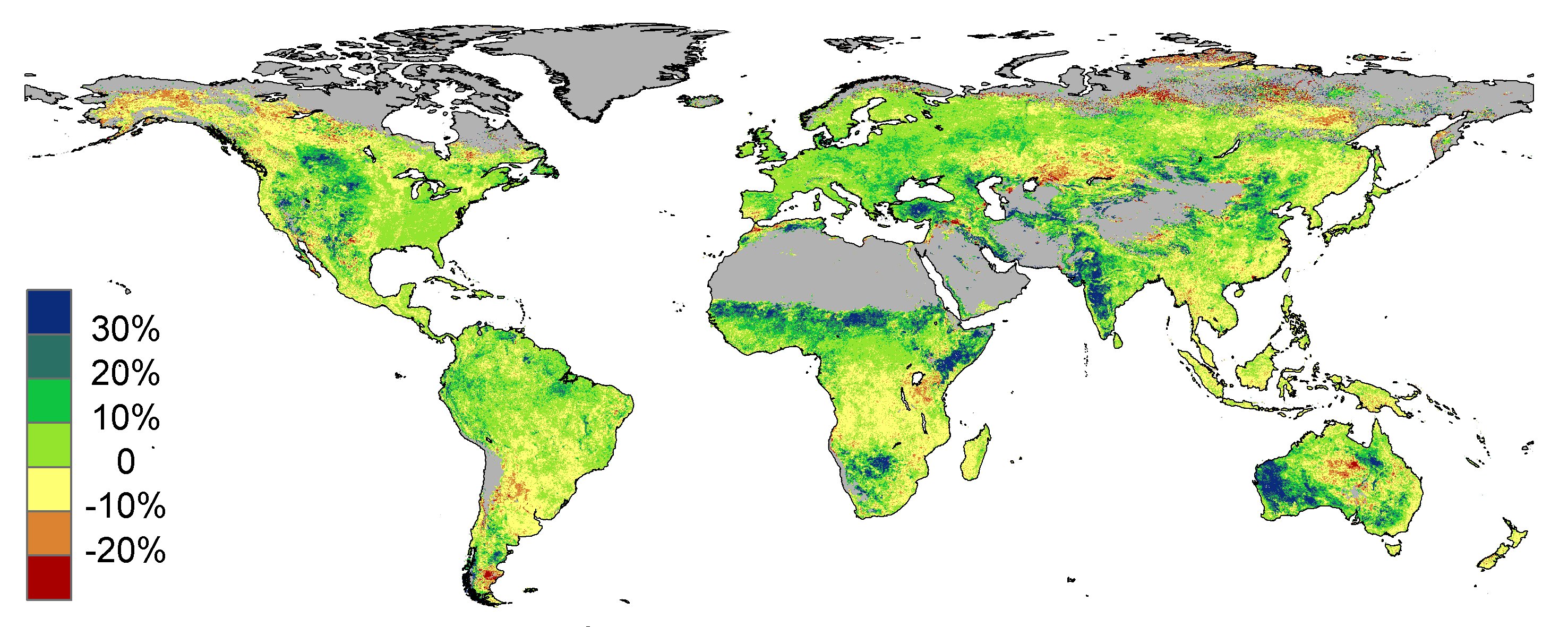
And where people have to lie about severe weather getting worse (it hasn’t)? Or where we have totally forgotten that more CO2 is actually good for life on Earth, leading to increased agricultural productivity, and global greening?:

Estimated changes in vegetative cover due to CO2 fertilization between 1982 and 2010 (Donohue et al., 2013 GRL).

It’s the universe where political power and the desire to redistribute wealth have taken control of the public discourse. It’s a global society where people believe we can replace fossil fuels with unicorn farts and antigravity-based energy.

Feelings now trump facts.

At least engineers have to prove their ideas work. The widgets and cell phonesand cars and jets and bridges they build either work or they don’t.

In climate science, whichever side is favored by politicians and journalism graduates is the side that wins.

And what about those 97% of scientists who agree? Well, what they all agree on is that if their government climate funding goes away, their careers will end.

German Citizens are “Fed Up” With the Useless Wind Turbines!

German Citizens Have Had Enough…”Conflict Over Wind Turbines Escalating” …Against “Horror Landscapes”!

In Germany protests over a broad range of issues have been heightening.

In Dresden citizens have been turning out by the thousands in “Monday demonstrations” to protest the perceived threat of the Islamification of Europe and the so-called “liar media”, which they no longer trust. Since the Paris attacks by radical Islamic terrorists, the protesters have only become more emboldened.

Citizens are also clearly beginning to feel they are being misled by the “liar media” and politicians regarding wind energy. The glaring difference between what was promised and what is actually being delivered can no longer be ignored. Enough is enough!

Germany’s online SVZ.de writes that the “conflict over wind turbines is escalating” and that “criticism and fears are becoming louder” and that “citizen protest groups are forming at many locations“.

What does it mean? It means that wind and solar power are nothing like they were once cracked up to be. They are poor performers, costly, and are creating a nationwide blight that risks permanently scarring Germany’s once idyllic landscape and natural heritage.

Everything and anything can now be sacrificed at the alter of climate protection. Recently Die Welt published a scathing commentary on the “immensely dangerous power of the eco-cartel“, writing that “totalitarian undercurrents are plainly visible” and that the movement is all about power and money, and less so about environmental protection. Germany’s green movement has been corrupted to the bone.

In the state of Mecklenburg-Pomerania the SVZ.de site writes how an organization called Freier Horizont was established last November and serves as the umbrella for 40 citizens initiatives. “They are protesting against what they see as the uncontrolled expansion of wind energy and speak of horror landscapes.”

Freier Horizont Chairman Norbert Schumacher worries that wind energy will have negative impacts on the region’s coastal tourism. Citizens are concerned that Germany’s cherished Baltic Sea coast will be “blighted” and believe political leaders and wind energy developers are not taking their concerns seriously.

They aren’t, of course. It’s all about money. Even the most self-professed Greens are selling out to the big money of wind energy. For example Die Welt writes of German Green Party honcho Boris Palmer, someone “who grew up protesting the installation of power transmission towers is – no joke – demanding that natural parks and reserves be opened for the 200-meter tall rotating monsters, even if they are located right next World Heritage Sites.”

Greens like Palmer no longer have qualms about that, and so it should not surprise us that they are ready to trample and permanently damage heritage locations – e.g. like the Nazca Lines in Peru. It’s all in the name of the Green Allah: Climate Protection. Green madness has taken over in Germany, but citizens are waking up.

=======================

– See more at: http://notrickszone.com/2015/01/09/german-citizens-have-had-enough-conflict-over-wind-turbines-escalating-against-horror-landscapes/#sthash.AcVU3BzX.dpuf

Climate Change Scam is NOT Fooling Smart Citizens! STOP Fear Mongering!

UN POLL REVEALS: GLOBAL POPULATION NOT CONVINCED BY CLIMATE CHANGE SCAREMONGERING

A global poll of more than 6.5million people has placed climate change at the very bottom of a long list of priorities, with the finding being consistent across both genders, almost all age ranges, all education levels and in most regions of the world. (h/tWatts Up With That). Conversely, every single demographic placed “a good education” at the top.

The poll is being conducted by the United Nations as part of a program to find out what people across the world want to see action on. Participants are offered a choice of sixteen policy issues, which also include “a good education”, “Political freedoms”, “Protecting forests, rivers and oceans”, and “Equality between men and women”.

6,654,216 people have taken part in the My World survey so far (launched last March, it is remaining open until next year). Across almost every demographic, “Action taken on climate change” was rated 16 / 16.

The only exceptions are amongst those aged 46 and above, who placed “Phone andinternet access” at the bottom of their lists of priorities, and those living within moreaffluent regions of the world. Across the whole of Africa and Asia climate change rated last, but Europe, Oceania and the Americas promoted the issue to around half way up the table.

In the US it ranked 10th, whilst in the UK it was placed 9th. Both countries put “a good education” in the top spot. Votes can be submitted online, via mobile phone, or in some countries via offline ballots. Researchers are also heading to places where internet access is not available to survey populations in person.

At the time the project was launched, Claire Melamed, Head of Growth at the Poverty and Inequality Programme at the Overseas Development Institute said “We are collecting an incredibly rich source of information about what people want. We’re able to look at what men want, what women want, what people of different ages want, how the choices people are making vary in all kinds of different ways. We can look at particularly what some of the poorest people think and compare that with richer people in their own countries.”

Willis Eschenbach, commenting on the Watts Up With That blog said “People are not as stupid as their leaders think. Folks know what’s important and what’s trivial in their lives, and trying to control the climate is definitely in the latter group.”