The Truth About the Climate Scam, Fear Mongering, and Faux-Green Energy!

Bjørn Lomborg: Climate Change “Fixes”? – the “Cure” is Worse than the “Disease”

Bjorn-Lomborg-wsj

When it comes to assessing the costs, risks and benefits of environmental policy, Bjørn Lomborg is one of the very few that provide balanced, detailed analysis supported by facts and evidence. The economic choices we make – about allocating scarce resources to unlimited wants – should – as Lomborg consistently points out – be made taking into account all of the costs weighed against properly measured benefits (see our post here).

Bjørn Lomborg has become one of the most high profile critics of insanely expensive and utterly pointless renewable energy policies across the globe (see our posts here and here and here).

Bjørn’s back –  in this piece published by The Telegraph – in which he hammers the insane cost and utter pointlessness of tying our energy futures to unreliable and intermittent renewables, like wind power.

Climate change is a problem. But our attempts to fix it could be worse than useless
The Telegraph
Bjørn Lomborg
3 November 2014

Panicked, ill-thought-through responses to the threat of climate change could hurt more people than they save

The UN Climate Panel came out with its final report yesterday. It is a summary of its 3 main reports, published over the last year. It tells us that global warming is real and a significant problem. And as usual, the media hears something else – in the words of Mother Jones magazine, how future warming will be “ghastly, horrid, awful, shocking, grisly, gruesome.”

In between the alarmist hype and the reality of climate change we once again risk losing an opportunity to think smartly about energy and find a realistic way to fix global warming.

We need to realise that the world will not come off fossil fuels for many decades. Globally, we get a minuscule 0.3pc of our energy from solar and wind. According to the International Energy Agency, even with a wildly optimistic scenario, we will get just 3.5pc of our energy from solar and wind in 2035, while paying almost $100 billion in annual subsidies. Today, the world gets 82pc of its energy from fossil fuels, in 21 years it will still be more than 79pc.

The simple reason is that cheap and abundant energy is what powers economic growth. And for now, that means four fifths from fossil fuel, and much of the rest from water and nuclear. While wind is lower cost in a few, rural areas, coal is for the most part much cheaper, and provides power, also when the wind is not blowing.

As the poor half of our world is reaching for a similar development to that of China, they will also want much, much more power, most of it powered by coal. Even the climate-worried World Bank president accepts that “there’s never been a country that has developed with intermittent power.”

poverty_2226036b (1)

Realising that fossil fuels will be here for a long time means stronger focus on moving from coal to gas, since gas emits about half the greenhouse gasses. The US shale gas revolution has reduced gas prices and lead to a significant switch from coal to gas. This has reduced US CO₂ emissions to their lowest in 20 years.

In 2012, US shale gas reduced emissions three times more than all the solar and wind in Europe. At the same time, Europe paid about $40 billion in annual subsidies for solar, while the Americans made more than $200 billion every year from the shale gas revolution. Gas is obviously still a fossil fuel and not the final solution, but it can reduce emissions over the next 10-20 years, especially if the shale revolution is expanded to China and the rest of the developing world.

While global warming will be a problem, much of the rhetoric is wildly exaggerated – like when UN secretary-general Ban Ki-moon calls it “an existential challenge for the whole human race.” The IPCC finds that the total cost of climate change by 2070 is between 0.2pc and 2pc of GDP. While this is definitely a problem, it is equivalent to less than one year of recession over the next 60 years.

ban-ki-moon-hd-picture

Global warming pales when compared to many other global problems. While the WHO estimates 250,000 annual deaths from global warming in 30 years, 4.3 million die right now each year from indoor air pollution, 800 million are starving, and 2.5 billion live in poverty and lack clean water and sanitation.

When the UN asked 5 million people for their top priorities the answers were better education and health care, less corruption, more jobs and affordable food. They placed global warming at the very last spot, as priority number 17.

Climate policies can easily cost much more than the global warming damage will – while helping very little. The German solar adventure, which has cost taxpayers more than $130 billion, will at the end of the century just postpone global warming by a trivial 37 hours.

While a low carbon tax in theory could help a little, the political reality is that climate policies almost everywhere have been ineffective, done little good while sustaining the most wasteful technologies. The IPCC warns than less-than-perfect climate policies can be 2-4 times more expensive. Biofuels, for instance, have driven up food costs, likely causing an extra 30 million starving, with prospects of starving another 100 million by 2020. And it is likely that biofuels cause net increase in CO₂ emissions, because they force agriculture to cut down forests elsewhere to grow food.

This is why we have to be careful in pushing for the right policies. For twenty years, the refrain has been promises to cut CO₂, like the Kyoto Protocol. For twenty years these policies have failed. We should instead look to climate economics to find smarter solutions.

The fundamental problem is that green energy is too expensive, which is why it will need billions in subsidies the next two decades. Instead of making more failed promises to pay ever more subsidies, we should spend the money on research and development of the next generations of green energy sources. If we can innovate the price of green energy down below the cost of fossil fuels, everyone will switch, including China and India. Economics confirm that for every dollar spent on green R&D, we will avoid $11 of climate damage.

But this requires us to separate the hype from the real message from IPCC: global warming is a problem, but unless we fix it smartly, we won’t fix it at all.
The Telegraph

panic-disorder-971

Green Energy Nightmare Worsens in Ontario…

Wynne’s billion-dollar hydro boondoggle

Ontario hydro customers are trapped by the Wynne Liberals’ mad obsession with expensive and unneeded green energy

lorrie-goldstein

BY , TORONTO SUN

FIRST POSTED: SATURDAY, NOVEMBER 08, 2014 

windtubines
Ontario is heavily subsidizing companies to construct electricity generating wind turbines in a push for more renewable energy. 

TORONTO – For anyone who wants to understand what a complete mess Ontario’s Liberal government has made of our hydro bills, Parker Gallant is must reading.

A retired banking executive, he easily dissects and explains in English the never-ending nonsense the Liberals pump out to justify their green energy financial disaster.

An occasional Sun News Network contributor and newspaper columnist, Parker and Scott Luft, an energy analyst and blogger, published a report last week on energy pricing for Wind Concerns Ontario — an anti-wind turbine group — that was truly alarming.

Titled: “October, 2014, Ontario’s breath-taking, record-breaking month for electricity bills”, Parker and Luft reveal that last month, Premier Kathleen Wynne’s Liberal government paid $1 billion more for electricity than the market value of that power.

Put another way, the so-called “Global Adjustment” in Ontario — the difference between the market value of electricity and what it actually cost to produce — topped $1 billion, for the first time, ever.

For the average Ontario household, Parker and Luft note, that will mean an extra charge of about $30 on November’s hydro bill alone, although it won’t appear as a separate item on many residential hydro bills because the Global Adjustment is incorporated into “time of use” rates.

The Liberals say the main reason for the Global Adjustment is to “cover the cost of building new electricity infrastructure … as well as providing conservation and demand response programs.”

But as Parker and Luft explain it:

“The situation has developed as a result of Ontario’s rush to incorporate renewable energy in the form of wind, solar and biomass into the grid, without proper planning on how this new capacity would align with demand.

“The result is that during the spring and fall seasons, when demand is lower, IESO (Independent Electricity System Operator) has a surplus supply capacity of over 100% during many hours of the day. Through the Global Adjustment fund, Ontario’s electricity consumers pay contracted generators to idle or curtail generation of thousands of megawatts.

“In October, wind power generators produced almost 600,000 MWh of electricity at a cost of $81 million and additionally were paid another $11 million for 100,000 MWh that they could have produced, but were asked not to add to the grid.

“Due to the glut of power in October, Ontario sold this power to neighbouring jurisdictions at an average of 4.31 per MWh, or $2.6 million, meaning a loss of almost $90 million for Ontario electricity users.”

Parker and Luft note these costs do not include the amount the government had to pay to the province’s privately-run nuclear operator not to produce electricity, because under the 20-year deals it signed with wind (and solar) operators, it has to buy their power first, meaning other sources have to be reduced when there’s a surplus of wind and solar .

Their advice to the Liberals is the same as energy analyst Tom Adams and University of Guelph economist Ross McKitrick gave in their recent report for the Fraser Institute, What Goes Up.

That is, at least stop making the situation worse by bringing more wind and solar power on line.

As Adams put it: “Wind and solar power systems provide less than 4% of Ontario’s power but account for 20% of the cost paid by Ontarians, yet the government wants to triple the number of wind and solar generators. That’s a good deal for wind and solar producers but a raw deal for consumers.”

(The Liberals insist wind and solar power only account for 8% of the cost of our energy bills — and that they were needed to close down polluting, coal-fired electricity. But that’s absurd because the Liberals didn’t replace coal power with wind and solar, but with nuclear power and natural gas).

Sadly, the longer the Liberals double down on their green disaster, the faster hydro rates are going to rise.

Even the Liberals acknowledged last year that hydro bills would jump 42% over the next five years.

Now-retired auditor general Jim McCarter produced similar numbers in his 2011 report that was sharply critical of the Liberals’ renewable energy programs, noting green energy initiatives would account for more than half (56%) of a 7.9% annual increase in hydro bills over the next five years.

Hydro rates were bumped up again on Nov. 1 and there’s no relief in sight.

Then again, Al Gore does think the world of the Liberals.

Massive Wind Project Planned for Key Migratory Bird Corridor-Lake Huron

MEDIA RELEASE

Short-eared Owl by Ashok Khosla

The Short-eared Owl, a species listed as endangered in Michigan, is one of many birds using the area in Huron County slated for major wind energy expansion.
(Washington, DC, November 6, 2014) American Bird Conservancy (ABC) has raised serious concerns about a plan by Heritage Sustainable Energy, DTE Energy, Exelon Corporation, and NextEra Energy to construct additional commercial wind turbines in Huron County, Michigan, which could eventually result in up to 900 turbines in the area. This plan is advancing despite the fact that U.S. Fish and Wildlife Service (FWS) radar studies show vast numbers of birds migrating through or wintering in this area.
In an October 30 letter to the FWS Regional Director, ABC charged that the proposed expanded wind development—which already includes 328 turbines—threatens a major confluence of neotropical migratory birds and raptors, including federally protected Bald and Golden Eagles.
“Many species that are threatened or endangered in the U.S. and within the state of Michigan, such as the Piping Plover, Kirtland’s Warbler, Henslow’s Sparrow, and Short-eared Owl, migrate through or inhabit this area. This triggers serious Endangered Species Act (ESA) concerns,” said ABC’s Dr. Michael Hutchins, National Coordinator, Bird Smart Wind Energy Campaign.
“We have reviewed the recent radar studies conducted by FWS in this area and must conclude that Huron County is not an appropriate area for wind energy development, given the potential and substantial risks it poses to federally protected birds. If this is an example of ‘proper’ siting of wind energy development, then we wonder what criteria are being used to make such decisions,” Hutchins said further.
“An annual spring migration of thousands of eagles, hawks, and falcons travel through this area and congregate along the Huron County shoreline,” said Monica Essenmacher, President of Port Crescent Hawk Watch, a raptor conservation group in Michigan. “We have documented this occurrence since 1992, so there is a high likelihood of major raptor mortality from continued construction of these turbines.”

The ABC letter says that in addition to ESA-protected birds, vast numbers of other migrants also move through or breed in these areas. Although there is no current provision for a federal permit to harm or kill these birds (called a “take permit”) under the Migratory Bird Treaty Act (MBTA), ABC suggests that the FWS should consider this option as soon as possible, so that it can be used as an additional tool for proper siting and operation of future wind energy facilities.

Under FWS’ current voluntary permitting guidelines, wind energy companies are not required to apply for incidental take permits under the Bald and Golden Eagle Protection Act or the ESA when the project sits on private property. ABC asserts that this is a loophole allowing wind developers to kill federally protected birds with impunity. To remedy this, the organization is calling for independent post-construction monitoring and for the institution of a permit process that imposes fines to developers who kill more protected birds than their permit would allow.
ABC supports the development of clean, renewable sources of energy such as wind and solar power, but also believes that it must be done responsibly and with minimal impact on our public trust resources, including native birds and bats and particularly threatened, endangered, and other protected species. ABC supports Bird Smart Wind Energy, which emphasizes the importance of careful siting and mitigation to prevent unintended impacts to wildlife. As this study suggests, the risk to birds and bats can be substantial, depending on the circumstances. Another studysuggests even higher mortality.
Developers typically argue that they can effectively mitigate the impacts of wind development, but ABC—and the U.S. Department of Energy (DOE)—caution that most forms of mitigation touted by the wind industry have not yet been scientifically tested for their efficacy. ABC strongly agrees with the DOE’s recent statement that “…technologies to minimize impacts at operational facilities for most species are either in early stages of development or simply do not exist.”
Regarding the Huron County wind energy expansion, ABC has requested that an Environmental Impact Statement be prepared for the project and says that “… the voluntary (FWS) guidelines (must) be followed to the letter, which means consultation under Section 7 of the ESA, applications for incidental take permits under the ESA and Bald and Golden Eagle Protection Act, a three-mile setback from any shoreline, and an Avian Protection Plan … before the companies are allowed to go ahead with any construction.”
ABC also asks that the wind energy companies share bird mortality data with the public. “At present, these data are being treated as proprietary information, but these are public trust resources being taken,” said Hutchins. “The public has a right to know.”
#
American Bird Conservancy is the Western Hemisphere’s bird conservation specialist—the only organization with a single and steadfast commitment to achieving conservation results for native birds and their habitats throughout the Americas. With a focus on efficiency and working in partnership, we take on the toughest problems facing birds today, innovating and building on sound science to halt extinctions, protect habitats, eliminate threats, and build capacity for bird conservation.

Wonderful News! Powerful (Faux) Green Lobby defeated in US Mid-term Elections!

The day ‘climate change’ became irrelevant in politics – Powerful Green Lobby Defeated In US Midterm Elections

Republicans Win Control Of US Senate

For Tom Steyer and other environmentalists, $85 million wasn’t enough to help Democrats keep the Senate blue or win more than a single governor’s mansion in Tuesday’s toughest races. The billionaire’s super PAC and other green groups saw the vast majority of their favored candidates in the battleground states go down to defeat, despite spending an unprecedented amount of money to help climate-friendly Democrats in the midterm elections. The outcome brought gloating from Republicans and fossil-fuel supporters even before the results rolled in — and raised questions about whether greens can fulfill their pledge to make climate change a decisive campaign issue in 2016. –Andrew Restuccia, Politico, 5 November 2015

Climate Change: This was one of the dogs that didn’t bark in the 2014 election, even after liberal billionaire Tom Steyer spent an estimated $70 million to promote the issue and a new U.N. report Sunday warned of “severe, pervasive, and irreversible” global warming that will worsen without environmental policy changes. Robert Brulle, professor of sociology and environmental science at Drexel University, said a GOP-led Congress is more likely to try to stop Obama’s Environmental Protection Agency from imposing new regulations on power plants than endorsing any additional steps to reduce U.S. carbon pollution. Said Brulle: “I am not an optimist about us doing anything – I think it looks bad for political action on climate change in any way.” –Will Bunsch, Philadelphia Daily News, 5 November 2014

The $12 million that the United States Senate has allocated to UN climate agencies is expected to be among the first casualties [after] Republican take control of the chamber following Tuesday’s midterm elections. The current Senate bill on funding for state and foreign operations includes $11,700,000 for the Intergovernmental Panel on Climate Control (IPCC) and the UN Framework Convention on Climate Change (UNFCC). However, the House version of the bill passed by a Republican-controlled sub-committee, states that “none of the funds in this Act may be made available for the Intergovernmental Panel on Climate Change/United Nations Framework Convention on Climate Change.” –Denis Fitzgerald, UN Tribune, 4 November 2014

The Keystone XL pipeline won big Tuesday night. Following an election night that saw anti-Keystone Democrats replaced by pro-Keystone Republicans, the oil-sands pipeline project now appears to have at least 60 supporting votes. That means legislation forcing approval of the long-delayed project may be headed to President Obama. Before the election, at least 57 senators could be counted on to support pro-Keystone legislation, but that was never enough to beat a filibuster from the project’s opponents. Tuesday night’s results appear to change that. –Clare Foran, National Journal, 5 November 2014

The expected Republican majority in the U.S. Senate after Tuesday’s mid-term elections is likely to seek to roll back federal regulations on power-plant emissions, approve the Keystone XL pipeline, expand oil and gas development on federal lands and work toward ending the 40-year ban on U.S. crude oil exports, energy experts said. “The Republicans will go to Obama and say, look, ‘We’ve got to get this done; your own government is saying this is fine. The election is over so you don’t have to worry,’” Lynch said. –Jon Hurdle, The Street, 4 November 2014

President Obama will continue to take action on policies to fight climate change whether or not Republicans take control of the Senate, the White House said. White House press secretary Josh Earnest told reporters Tuesday that Obama plans to keep using his executive powers to mitigate greenhouse gas emissions that cause climate change. “The president will use his executive action to take some additional steps.” –Timothy Cama,The Hill, 4 November 2014

soon-politicians-wont-be-able-to-avoid-the-issue

Thanks to Dr. Benny Peiser and The GWPF for this summary

World Council for Nature Shares Info. On Wind Turbines!

Note: Infrasound & Low Frequency Noise is often referred to as “ILFN”

infrasound - www.bgr.bund.de
Simulation of infrasound waves propagating in the atmosphere
Source: BGR http://www.bgr.bund.de


IMPORTANT NEWS Nº 1:

Health Board: wind turbines are a hazard to human health

October 17th, 2014
GLENMORE, WISCONSIN, USA: “This week the Brown County Health Board went on record declaring that wind turbines “are a human health hazard“.


Folks living in the Glenmore area near the Shirley Wind Project have been saying this for years though, and now they have the health department on their side. By state statute wind turbines can be within 1250 feet of a home. The Brown County Board of Health says that’s too close for comfort.”

Read more: windfarm a health hazard  — don’t miss the video


The wording of the motion was as follows:


To Declare The Industrial Wind Turbines In The Town Of Glenmore, Brown County. WI. A Human Health Hazard For All People (Residents, Workers, Visitors, And Sensitive Passersby) Who Are Exposed To Infrasound/Low Frequency Noise And Other Emissions Potentially Harmful To Human Health.”

Read more: ILFN potentially harmful

wind turbine effects on the inner ear


IMPORTANT NEWS Nº 2


Windfarm victims worldwide will feel vincicated by this:


In Plympton Wyoming, Ontario, Canada, complaints from windfarm victims “will lead to investigations and hefty fines. This is the first bylaw directly referencing ILFN and demanding fines of between $500 to $10,000 per day, and which may be, the bylaw states, in excess of $100,000.


The bylaw references charging fees to developers if ILFN causes residents problems. Common effects are, from chronic unrelenting noise: sleep disorders, hormone level disruption, increased risk of disease, diabetes, hypertension, depression, heart arrhythmias, and possibly even cancer.”


Read more: a groundbreaking Wind Turbine Noise bylaw


BACK IN 2013, STEPHEN AMBROSE, Board Certified Member of the Institute of Noise Control Engineering and a Full Member of the Acoustical Society of America, testified in front of the Vermont Senate Natural Resources Committee:


Regulatory boards are now unable to protect public health and wellbeing because the wind turbine industry has substituted their own measurement and assessment procedures through international committees.


The wind turbine acoustic standards differ dramatically from other noise sources. Wind turbines are evaluated using A- weighted sound levels by removing all low frequency and infrasound from consideration. A-weighting lowers infrasound levels by 50 dB at 20 Hz and 70 dB at 10 Hz. This promotes false statements that wind turbines do not produce infrasound.


“I have measured infrasound using a sound level meter and a microbarograph. I have experienced the adverse health effects caused by infrasound. Again, I felt miserable with a headache, nausea, loss of cognitive ability, sleep interference and interruption.


“I felt better when only a few miles away from the wind turbines’ influence.”


“I recommend that anyone who thinks wind turbines are good acoustic neighbors to do what I did. Go to a wind turbine site, live as a neighbor, and sleep in their bed when the wind blows strong.


Read more: Testimony from an acoustician with 35 years’ experience


THE BIBLE of WINDFARM EFFECTS on NEIGHBOURS:


This is just the concluding paragraph, but there is plenty more:


A compliant project may still cause damage to neighbours for numerous reasons:


– first, the standard only refers to dBA and thereby omits reference to ILFN;


– secondly, even with regard to audible noise, the standard refers to a maximum of 40 dBA outdoors, whereas every other form of industrial or other noise in country and city is limited to 35 dBA maximum. There is no technical basis for such an aberration, and it is clearly, (intended or not), discriminatory;


– thirdly, in quiet rural environments, even 35 dBA will be intrusive and loud, if the background level is below 25dBA, which is not uncommon.


The ear responds to the peaks of sound levels, not the averages. The wind turbine noise standards all refer only to averages, and exclude ILFN, and do not account for the human response, so cannot protect people from predictable serious harm to their health.”


The definitive document on wind turbine noise

Tom Harris, executive director of ICSC, talks about Suffering People Deserving Priority over Alleged Climate Problems.

ICSC: IPCC focus on stopping global warming and extreme weather is unscientific and immoral

Ottawa, Canada, November 2, 2014: “IPCC Chairman Dr. Rajendra Pachauri was right toadvocate “a global agreement to finally reverse course on climate change” when he spoke to delegates tasked with approving the IPCC Synthesis Report, released on Sunday,” saidTom Harris, executive director of the Ottawa, Canada-based International Climate Science Coalition (ICSC). “The new direction governments should follow must be one in which the known needs of people suffering today are given priority over problems that might someday be faced by those yet to be born.”

“Yet, exactly the opposite is happening,” continued Harris. “Of the roughly one billion U.S. dollars spent every day across the world on climate finance, only 6% of it is devoted to helping people adapt to climate change in the present. The rest is wasted trying to stop improbable future climatic events. That is immoral.”

ICSC chief science advisor, Professor Bob Carter, former Head of the Department of Earth Sciences at James Cook University in Australia and author of Taxing Air explained, “Science has yet to provide unambiguous evidence that problematic, or even measurable, human-caused global warming is occurring. The hypothesis of dangerous man-made climate change is based solely on computerized models that have repeatedly failed in practice in the real world.”

New Zealand-based Terry Dunleavy, ICSC founding chairman and strategic advisor remarked, “U.N. Secretary General Ban Ki-moon often makes unjustified statements about climate change and extreme weather. However, in their still unansweredNovember 29, 2012 open letter to the Secretary General, 134 scientists from across the world asserted, ‘The U.K. Met Office recently released data showing that there has been no statistically significant global warming for almost 16 [now 18] years. During this period…carbon dioxide concentrations rose by nearly 9%…The NOAA “State of the Climate in 2008” report asserted that 15 years or more without any statistically-significant warming would indicate a discrepancy between observation and prediction. Sixteen years without warming have therefore now proven that the models are wrong by their creators’ own criterion.”

“Although today’s climate and extreme weather are well within the bounds of natural variability and the intensity and magnitude of extreme events is not increasing, there is, most definitely, a climate problem,” said Carter. “Natural climate change brings with it very real human and environmental costs. Therefore, we must carefully prepare for and adapt to climate hazards as and when they happen. Spending billions of dollars on expensive and ineffectual carbon dioxide controls in a futile attempt to stop natural climate change impoverishes societies and reduces our capacity to address these and other real world problems.”

“The heavily referenced reports of the Nongovernmental International Panel on Climate Change demonstrate that, scientifically speaking, the global warming scare is over,” concluded Harris. “It is time to defund the IPCC and dedicate our resources to helping solve today’s genuine humanitarian problems.”


The ICSC is a non-partisan group of scientists, economists and energy and policy experts who are working to promote better understanding of climate science and related policy worldwide. We aim to help create an environment in which a more rational, open discussion about climate issues emerges, thereby moving the debate away from implementation of costly and ineffectual “climate control” measures. Instead, ICSC encourages effective planning for, and adaptation to, inevitable natural climate variability, and continuing scientific research into the causes and impacts of climate change. 

ICSC also focuses on publicizing the repercussions of misguided plans to “solve the climate crisis”. This includes, but is not limited to, “carbon” sequestration as well as the dangerous impacts of attempts to replace conventional energy supplies with wind turbines, solar power, most biofuels and other ineffective and expensive energy sources.


For more information about this announcement or ICSC in general, visithttp://www.climatescienceinternational.org,

Ridiculous Faux-green Energy Policies Wrecking Economies and Hurting the Poor!

The Hard-“Green”-Left Promote Energy Policies that Wreck Economies & Smash the Poor

USSR

A little while back, the good Senator from Victoria, John “Marshall” Madigan launched an Exocet missile at the seedy world of hard-green-left politics and the wind power outfits that fund the Australian Greens (seeour post here).

The Greens have been particularly coy about where the hundreds of thousands of dollars used to fund their last Federal election campaign (including the rerun of the West Australian Senate election) came from. The Greens set out to crush SA’s favourite Greek, Nick Xenophon due to his efforts to bring the wind power fraud to an end: the Green vote went backwards, but Nick (a true STT Champion) – who ran as an independent candidate – polled a snicker under 25% in the South Australian Senate race (beating the Labor Party’s vote of 22.7%) – an all-time record for an independent Senator.

But, we digress. Since the launch of Vestas’ “Act on Facts” campaign in June last year it was evident that the Vestas were throwing mountains of cash at the Greens (see this article and see our post here).

With Vestas as their new paymaster, the Greens have completely abandoned any claim to be friends of the environment and have instead become rabid spruikers for the wind industry: ignoring the millions of birds and bats being slaughtered (see our posts here and here) and lambasting and ridiculing wind farm neighbours suffering from turbine noise generated sleep deprivation – bending over backwards to prevent any research into the problem, in a naked effort to protect their financial backers (see our post here).

Recently, it’s come to light that the billionaire founder of wotif.com, Graeme Wood has poured hundreds of thousands of dollars into the Green’s coffers. And, just like Vestas, is using the Greens to advance his wind farm interests, proving that the Greens truly are the best party money can buy.

Paying $millions to so-called “green” politicians and astro-turfing propaganda outfits like the WWF (see our post here), Getup! and 350.org (see our post here) has become a central wind industry strategy: if you’re a foreign owned company worth $billions, with no political credibility and rolling in mountains of (other peoples’) cash, why not pay a bunch of slick little political manipulators to plead and beg to governments on your behalf?

But the purpose of all this propaganda and political manipulation goes way beyond promoting wind power; and ensuring it has unobstructed access to an overflowing subsidy trough.

Piglets-Snout-2270058

Still bitter about the fact that their team lost the ideological battle when the Berlin Wall succumbed to sledgehammers back in 1989, the hard-green-left have redoubled their efforts to command and control the economic fortunes of countries around the Globe; both rich and poor alike.

The shortest route to wrecking an economy is to deprive it of cheap, reliable power. By portraying fossil fuel generators as evil; and nuclear generators, more so, the new Trotsky-ites aim to hammer energy intensive industry (which they hate) and the poor (who they couldn’t care less about).

Heat or Eat?

If you’ve ever wondered about the motivation of so-called “green” groups – and how their hysterical propaganda manages to garner so much attention – then take your time and enjoy this detailed analysis from the Daily Mail.

EXPOSED: How a shadowy network funded by foreign millions is making our household energy bills soar – for a low-carbon Britain
Daily Mail
David Rose
26 October 2014

  • Shadowy pro-green lobbyists working at every level of the Establishment
  • Organisations are channelling tens of millions of pounds into green policies
  • Elite lobby group linked to Friends of the Earth, Greenpeace and the WWF
  • Current energy policies shaped by the Green Blob will cost up to £400 billion
  • If continued, there will be further eye-watering energy bill rises for Britons

The Mail on Sunday today exposes how a ‘Green Blob’ financed by a shadowy group of hugely wealthy foreign donors is driving Britain towards economically ruinous eco targets.

The phrase the ‘Green Blob’ was coined by former Environment Secretary Owen Paterson after he was sacked from the Cabinet in July.

He was referring to a network of pro-green lobbyists working at every level of the British Establishment, who have helped shape the eco policies sending household energy bills soaring.

But investigations by this newspaper reveal the Blob is not just an abstract concept.

We have found that innocuous-sounding bodies such as the Dutch National Postcode Lottery, the American William and Flora Hewlett Foundation and the Swiss Oak Foundation are channelling tens of millions of pounds each year to climate change lobbyists in Britain, including Greenpeace and Friends of the Earth.

They have publicly congratulated themselves on their ability to create green Government policy in the UK – most notably after Ed Miliband steered through aggressive CO2 reduction targets in his 2008 Climate Change Act, and announced there would be no more coal power stations.

Yet the consequences of their continuing success are certain: further eye-watering rises in energy costs for millions of Britons and an increasing risk of blackouts.

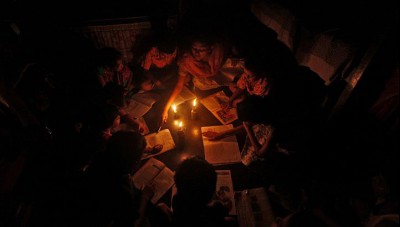
studying candle

According to leading energy analyst Peter Atherton of Liberum Capital, current UK energy policies shaped by the Blob will cost between £360 billion and £400 billion to implement by 2030. He said this will see bills rise by at least a third in real terms – on top of the increases already seen over the past ten years.

This bill dwarfs the EU’s £1.7 billion demand from Britain last week.

Lobbying by the Blob helped lead to a new European Union emissions deal announced on Friday, when EU leaders including the Prime Minister agreed to triple the current pace of emissions cuts.

Following earlier deals, EU-wide emissions of CO2 are supposed to fall 20 per cent over the 30-year period 1990 to 2020.

Under the new agreement, this reduction must be doubled in just a decade, reaching ‘at least’ 40 per cent by 2030 – a goal that could only be accomplished through further massive investment in wind and nuclear energy.

At the heart of the Blob is a single institution – the European Climate Foundation (ECF) – which has offices in London, Brussels, The Hague, Berlin and Warsaw.

Every year it receives about £20 million from ‘philanthropic’ foundations in America, Holland and Switzerland, and channels most of it to green campaign and lobby groups.

It refuses to disclose how much it gives to each recipient, and does not publish its accounts. But it admits that the purpose of these grants is to influence British and EU climate and energy policy across a broad front.

Many more millions are fed directly to British and European lobby groups from the same overseas foundations which also fund ECF.

In its last annual report, ECF said working towards a 2030 deal was ‘a big focus area for ECF as a whole’.

ECF managing director Tom Brookes told The Mail on Sunday he provides ‘a fact-base’ to help policy-makers make the ‘many complex decisions that are necessary to move towards a high-innovation, prosperous and low-carbon future’. He added: ‘The UK is a leader in many of these fields.’

The Blob and Red Ed

Friday’s EU deal contains a get-out clause: if the rest of the world fails to agree a binding global emissions treaty at a UN conference in Paris next year, then Europe’s targets can be ‘reviewed’ – or in other words, abandoned.

Giants such as China, India and Australia have insisted they will not sign such a treaty. It is also unlikely to be approved by the US Congress, which is Republican-controlled.

However, thanks to Ed Miliband and his 2008 Climate Change Act, the get-out will make no difference for Britain. The UK is the only country which already has a binding target for 2050. By then, the law says, UK emissions must be 80 per cent down on 1990.

ed milliband

Mr Miliband’s Act also created a mechanism for ensuring the country sticks to a path that achieves this target – the so-called ‘carbon budget’. The scale of the challenge that its latest version poses is not widely realised.

Over the next 15 years, the electricity industry has to cut the CO2 it emits for every kilowatt it generates by 90 per cent – an unprecedented transformation.

But the carbon budget also means the total amount of power generating capacity has to more than double. In order to meet the 2050 target, there has to be a massive shift towards electric vehicles and heating. While fossil fuel power plants will close, both their replacements and this vast additional capacity will have to be wind or nuclear – by far the most expensive types of power.

Remarkably, green lobby group Friends of the Earth not only conceived the Climate Change Act, but Bryony Worthington, the FoE official who came up with the idea and lobbied MPs to support it, later actually drafted it.

‘When you’re on the outside lobbying, you kind of hope that you are going to have an impact, [but] you’re never really very sure,’ she told a green seminar three years ago.

But she hit the jackpot. Her proposal was taken up first by the new Tory leader, David Cameron, and followed by the then-Labour Government. Worthington, who was seconded into the civil service, was asked to rewrite her lobbyist’s memo, this time as a law.

Once it was safely on the statute book, she left the civil service to form a new green campaign group, Sandbag, which presses the Government to adopt more stringent forms of carbon taxes. Like her previous employer FoE, it is now funded by ECF. Ed Miliband made her a Labour peer in 2011.

While the Act was going through Parliament, the ECF, which was launched in 2007-8, was giving money to Greenpeace UK, FoE, Christian Aid and the WWF to mount a campaign against coal-fired power plants. Also funded was Client Earth, a group of lawyers who secured court acquittals for ‘direct action’ protesters who broke into the Kingsnorth plant in Kent, climbed its chimneys and occupied it.

The campaign persuaded Mr Miliband to announce the cancellation of a planned new generating unit at Kingsnorth – and that there would be no new coal plants built in Britain.

Afterwards, the ECF president, Jules Kortenhorst, boasted that Miliband had acted in response to ‘a complex, multifaceted effort over a year and a half, with grass-roots mobilisation campaigns [and] behind the scenes lobbying’.

He added: ‘All of this work, backed by substantial philanthropic investment, resulted in UK Climate Change Secretary Ed Miliband announcing that no new coal-fired power plants would be built… This is an example of a policy that can be replicated, increasing its impact.’

Follow the money

The most significant source for the ECF’s millions is a body called Climate Works – a private foundation which channels colossal sums to climate campaigners worldwide.

The Climate Works manifesto was set out in 2007 in a document entitled ‘Design to Win: Philanthropy’s Role in the Fight Against Global Warming’. It said that to be effective, a campaign to change government policies on energy and emissions would need at least $600 million from donors.

It was driven by the belief that without radical action, ‘we could lose the fight against global warming over the next ten years’.

It advocated the giving of generous grants to local campaigners in countries such as Britain who had detailed knowledge of the way their political systems operated.

As well as better energy efficiency, carbon taxes and emissions caps, they must ‘promote renewables and low emission alternatives’. Utility companies must be given ‘financial incentives’ – in other words, enormous subsidies from tax and bill payers – to make this happen.

Climate Works soon achieved its ambitious fundraising target, with a grant in 2008 of $500 million from the William and Flora Hewlett Foundation, which spends the fortune amassed by the co-founder of the Hewlett-Packard computer firm. This was followed by further grants of up to $100 million, and donations of $60 million from the sister Packard foundation. In July, a report by a US Senate committee named the Hewlett foundation as a key element in a ‘billionaires’ club’ which effectively controlled the environmental movement, pumping more than half a billion dollars a year into green groups around the world.

It claimed these ‘wealthy liberals fully exploit the benefits of a generous tax code meant to promote genuine philanthropy and charitable acts’, but instead were transferring money to ‘activists’ to ‘promote shared political goals’.

One of the US-based Climate Works’s first acts was to set up and fund ECF as its European regional office. All ECF’s main funders are represented on ECF’s board, including Charlotte Pera, who is also Climate Works’s CEO. Susan Bell, ECF’s vice-chairman, was formerly the Hewlett foundation’s vice-president.

Another director is Kate Hampton, an executive director at the Children’s Investment Fund, a UK charity with assets worth £324 million.Others come from finance and business. ECF’s chairman is Caio Koch-Weser, vice-chairman of Deutsche Bank, whose contacts in Brussels could not be better: from 2003–5, he chaired the EU’s Economic and Financial committee. Yet another director is Mary Robinson, the former president of Ireland.

No transparency

It is hard to assess the ECF’s full impact for a simple reason – although it publishes the names of some of the organisations it funds, it does not state how much it gives, nor exactly how this money is used.

The ECF’s Tom Brookes said: ‘The projects we fund all fall within the overall mission of the Foundation to support the development of a prosperous low-carbon economy in Europe.’

He would not explain why no amounts were stated, saying only that ECF’s annual report ‘describes the objectives of each ECF programme area and its significant grantees.

‘We are confident that this is a sufficient level of detail to provide insight into the work of the Foundation… Our policy on the information we publish reflects our responsibilities to our grantees and donors.’

Nevertheless, it is clear from the information that is available that the list of ECF funding recipients is a Who’s Who of the green movement, including Friends of the Earth, Greenpeace, the WWF, Client Earth, Carbon Brief, the Green Alliance, and E3G, the elite lobby group that persuaded the Government to set up the £3 billion Green Investment Bank.

The 2013 ECF report sets out its priorities for Britain, praising its ‘leadership on the climate front’ – thanks to the Climate Change Act.

It also boasts that its grants had an impact on this year’s Energy Act: ‘ECF grantees such as Green Alliance, E3G, and Greenpeace helped secure important milestones such as an emissions performance standard for new power stations.’

To ECF’s dismay, however, the supposed UK ‘consensus’ on climate and energy is now in jeopardy: ‘Household energy bills have shot to the top of the political agenda, and progress on decarbonisation is tangled in competing visions of the country’s energy future… A growing number of media and political voices are casting doubt on the climate science and the economic case for action.’

Against this opposition, ECF’s 2013 report says it intends to work with British greens to ‘rebuild confidence in the low-carbon transition’, by ‘fact-checking the UK media’s coverage of climate and energy issues’.

It says it will ‘establish a new unit that will promote evidence-based discussions in the media and mobilise authoritative voices on the low-carbon economy’.

Since the report was published, this unit has come into being, run by former BBC environment correspondent Richard Black. How effective it will be remains to be seen.

Meanwhile, it is clear that the sheer scale of this lavishly funded lobbying effort dwarfs that of its opponents.

The Global Warming Policy Forum in London, Europe’s only think-tank which is sceptical about climate science and energy policy, has an annual budget of £300,000 and employs just three people.

Its director, Dr Benny Peiser, said yesterday: ‘At the end of the day, someone will have to be held accountable for us committing economic suicide. We are the only organisation that does what we do – against hundreds on the other side, all saying the same thing.’
Daily Mail

Josef Stalin

Oxford Professor Tells the Truth About Green Energy!

OXFORD PROF SHREDS GOVERNMENT’S GREEN ENERGY POLICY

An Oxford University Professor has torn the UK government’s energy policy to shreds in his appearance before the House of Lords Science and Technology Committee.

Speaking to the Lords yesterday, Professor Dieter Helm said that the “Miliband-Huhne-Davey” policy (referring to the last three energy secretaries), which is based on an assumption that fossil fuel prices would rise, was “dramatically wrong”. (h/t to Bishop Hill, where the full exchange of views can be seen).

The Lords Committee gathered to hear evidence from a range of energy experts including power companies and the National Grid to determine whether there was indeed a risk of the lights going out this winter, as has been widely reported (including on Breitbart London).

Opening the second session, Professor Helm gave his name and title, before delivering a short two minute speech lambasting the governance of energy policy in recent times.

“It is a quite extraordinary state of affairs for a major industrialised economy to find itself even debating whether there is a possibility that the margins may not be sufficient of electricity to guarantee supply,” he said.

“If it was achieving carbon objectives and if it was producing low prices there might be some consolation. The wholesale price in Great Britain is twice that of northern Europe and on a CO2 front we’ve been switching from gas to burn as much coal as possible, and our emissions are actually rising on a production basis and of course on a carbon consumption basis which is the basis that matters for decarbonisation.

“For a major industrial economy to fail on one of the three objectives is a serious problem. But to fail on security and on competitiveness of price, and on decarbonisation is a sad state of affairs. And it’s even sadder in the context of which the problem isn’t fundamentally particularly difficult.

“It’s ultimately about having enough power stations and enough wires to supply the needs of the population. It’s a problem that’s been with us for a century. Many other countries solve these problems and it’s, as I say, rather sad that we’ve got to this particular point.”

The Committee probed the professor on a range of aspects including “resilience”, which the Professor explained was a matter not just of physical capability, but also the price which people are asked to pay for the energy supplied. If prices rise above people’s desire or ability to pay, people simply “turn themselves off, as happened in California”, he pointed out.

“The kit is there. If the will is there to do it, and the expertise and capacity of the grid I think is up to it, they will manage to make supply equal demand. The question is: how much higher will the price go as a result, and how long will Britain carry on having such high wholesale prices with all the consequences there are for British industry and also consumers?” he asked.

When questioned about medium term threats to resilience, Prof Helm was particularly scathing. Pointing to the fact that “the commodity super-cycle is over” and that gas, coal and oil prices are all falling, he blasted energy secretary Ed Davey, saying “We have a policy with the secretary of state repeatedly reminds us is based on the idea that gas prices are rising and volatile. Well, they’re falling and the volatility is something that we don’t want to protect customers from. [That is, downwards volatility is good for customers who want the benefit of cheaper prices immediately].

“Should we worry about resilience of fuel supplies? No, I don’t think so. The world is awash with gas. Unconventional gas is popping up all over the place America is no longer importing, plenty of supplies around, plenty more being discovered.

“The one medium term ‘risk’ that I would pay much less attention to but clearly the government thinks they should pay much more attention to is whether or not we’ll get enough supplies of fossil fuels. We have enough fossil fuels in the world to fry the planet many times over.”

He then set his target wider, laying into the “Miliband-Huhne-Davey policy”, so called “because it’s very consistent through that period”, as a whole. Successive energy secretaries had based their policy on the assumption that fossil fuel prices would continue to rise, making renewables comparatively cheaper by the 2020s and allowing subsidies to fall away; an assumption that the professor said  “[doesn’t have] any part in energy policy.

“That fossil fuel prices are going to go up. … That’s an outcome of the market, not a policy assumption to make. … If your bet turns out to be dramatically wrong, you’re going to have lots of technologies which are ‘out of the market’ for some considerable period to come. We will have to subsidise those technologies right through the 2020s and beyond.

“This knowledge that politicians have, that politicians know what the winners are, we’ve been there so many times before.  It usually turns out badly and it has done this time.”

If We Had More Politicians Like This One, We Could Have True Democracy

New post on lsarc

No Challenge, No Democracy

by lsarc

Herewith a statement by Terry Mokriy, formerly a council candidate and now a Grey Highlands Council member who got top votes out of all 14 candidates running.

We feel it is well worth sharing as his comments are particularly appropriate given what many have all felt and experienced over the past 10 to 12 years.

Please share.

Below is Terry’s statement in full:

“Years of experience in government and public service arenas have left an indelible mark on my world view and psyche.

Federally, I was the Youth, Education, and Ontario Chair for a cross Canada national council dealing with Multiculturalism. We reported directly, and made recommendations, to the Federal Minister of Multiculturalism. I had the opportunity to travel across Canada and meet, conference with, and listen to many groups and individuals. Our mandate was to make recommendations to the Minister and Cabinet. I also wrote and delivered speeches for, and on behalf of, the Minister. That was my first foray into political and bureaucratic frustration.

I have also served as a Federal Riding Association President, Canvass Chair, Campaign Chair, and Treasurer of a GTA wide political association comprised of some 63 ridings. I had the chance to work with, support and meet a wide range of politicians and politicos, some who were movers and shakers and some not.

At the provincial level, I was actively involved as a Campaign Chair, advisor to elected politicians, campaign strategist, and speech and pamphlet writer.

That being said these experiences have led me to my present state. I consider myself to be philosophically and politically a realist with, what could be considered, strong populist tendencies. That is why I volunteered to help establish and Chair the South East Grey Community Health Centre in Markdale. I believe in, what the Americans refer to as, “government for the people”. That is not what the current trends appear to be.

Today’s governments, especially at the political party levels, often times seem to serve, not the electorate, but their own interests. This trend has been years in its development. I witnessed it in Ottawa when bureaucratic and party priorities took precedence over the obvious needs, concerns and wishes of the people.

The past provincial government of Ontario took this self interest to its zenith. We need not discuss the examples for they are obvious.

It is now even harder not to become more cynical vis a vis political institutions which are increasingly less interested in the “common good” and more in political and party expedience. Government is supposed to be for the people and is supposed to aid, provide for and assist. It is to expedite a common quality of life and ease the experience of the community. Instead, it has become more and more intrusive, invasive and dictatorial, taking into account vested interests and hidden political and personal agendas.

The Municipal level of government has, willingly or not, become the last bastion of true democracy. It is the place where people can directly interact with government. It is the arena in which the democratic principals of “what is right for the people” can still hold sway.

We can and must continue to involve ourselves and participate. We must not fall into apathy or complacency for that will be the death knell of democracy. That apathy can take the form of simply agreeing to, ignoring, or accepting without question. We need to stop simply shrugging our shoulders saying, “What can I do about it? The decision has already been made”.

I have witnessed government, both political and bureaucratic, in action. I have seen how decisions are made and what influence personal, party and political agendas have in the process and the outcomes. People, individuals and groups, make decisions and people, individuals and groups, must continue to question and challenge those decisions.

We must continue to ask the question, “Why?” If there is no reasonable answer forthcoming then we should not simply acquiesce because, “They said so!”.

If there is no one to question and to challenge then there truly is no democracy.”

Climate Change is a Natural Phenomenon. Humans are NOT to Blame!

Climate Is Changing, And Some Parks Are Endangered, But Humans Aren’t The Cause

Editor’s note: The climate is changing, but is it humankind’s fault? Daniel B. Botkin, professor Emeritus in the Department of Ecology, Evolution, and Marine Biology at University of California Santa Barbara, doesn’t believe so. In the following column, he dissects the conclusions reached by the Union of Concerned Scientists in its report,National Landmarks at Risk, How Rising Seas, Floods, and Wildfires Are Threatening the United States’ Most Cherished Historic Sites.

Alternate Text
Jamaica Bay National Wildlife Refuge The only wildlife refuge in the National Park System lies within New York City, and is not on the Union of Concerned Scientists List. The refuge is the largest bird migration stop in the Northeast, and serves as a buffer protecting urban development from major storms. Its well-developed paths among birds and flowering plants and along inland wetlands and waterways are available by public transportation to the 8.6 million residents of New York City. (Photo by the author)

For those of us who love our national parks and are confronted daily with media, politicians, and pundits warning us of a coming global-warming disaster, it’s only natural to ask what that warming will mean for our national parks. This is exactly what the well-known Union of Concerned Scientists discuss in their recent report, National Landmarks at Risk: How Rising Seas, Floods, and Wildfires Are Threatening the United States’ Most Cherished Historic Sites.

I’ve done research since 1968 on the possibility of human-caused global warming and its possible ecological effects, and have published widely on this topic, discussing possible effects on biodiversity and on specific endangered species as well as on forests, cities, and historical evidence of Arctic sea ice change. I’ve also been involved in the development of some aspects of some climate models, and having developed a computer model of forests that is one of the principal methods used to forecast global warming effects on vegetation, I sought out the UCS report with great interest.

The approach the Union has taken is to have the report written by four staff members: Debra Holtz, a journalist; Kate Cell, a fund-raiser for the organization; Adam Markham, with a B.S. in zoology, who was the founder of Clean Air-Cool Planet, a nonprofit organization “to promote innovative community-based solutions to climate change in the Northeast”; and Brenda Ekwurzel, the Union’s Senior Climate Scientist. She is the only author with research experience on the subject, has a Ph.D. in isotope geochemistry from the Department of Earth Sciences at Columbia University’s Lamont-Doherty Earth Observatory and has been on the faculty of the University of Arizona Department of Hydrology and Water Resources.

These four authors took the standard reports from such organizations as the United National Intergovernmental Panel on Climate Change, treating them as accurate and true, and then discussed the implications for 16 American historic sites. As shown in the accompanying table, they write that 11 of the sites are threatened by rising sea levels and their consequences (coastal erosion and flooding); two by inland flooding; two by wildfires; and one by “extreme heat and drought” (table 1).

The report opens with a bold assertion: “Many of the United States’ iconic landmarks and heritage sites are at risk as never before. Sea level rise, coastal erosion, increased flooding, heavy rains, and more frequent large wildfires are damaging archaeological resources, historic buildings, and cultural landscapes across the nation.” The report later goes on to add, “All of the case studies in this report draw on observations of impacts that are either consistent with, or attributable to, human-induced climate change based on multiple lines of scientific evidence.” To which the authors add, “This report sounds a wake-up call: as the impacts of climate change continue, we must protect these sites and reduce the risks.”

The point of the report, its opening theme and its major conclusion, is that these historic places are in trouble and it’s our fault, we have been the bad guys interfering with nature and therefore damaging places we value. This is consistent with the IPCC 2014 report and the 2014 White House Climate Change Assessment, for both of which I acted as an expert reviewer and testified before the House and Senate about.

TABLE 1. HISTORIC SITES AND CLAIMED THREATS TO THEM

Threatened by Sea Level Rise and Accompanying Flooding

  1. Boston’s Faneuil Hall and surroundings
  2. Statue of Liberty and Ellis Island
  3. Harriet Tubman National Monument Monument
  4. Historic Jamestown, VA
  5. NASA’s coastal facilities
  6. Annapolis, MD
  7. Fort Monroe National Monument
  8. Cape Hatteras Lighthouse
  9. Bering Land Bridge National Monument & Shishmaref; Cape Krusenstern National Monument, including Kivalina Native Villages and Ancestral Lands
  10. Pu’uhonua O Honaunau & Kaloko-Honokhau National Historical Parks
  11. Prehistoric Florida shell structures

Threatened by Future Floods

  1. Charleston, SC; Historic St. Augustine, Fl and Castillo De San Marcos

Threatened by Wildfires (and perhaps also flooding)

  1. Mesa Verde National Park and Bandelier National Monument & Santa Clara Pueblo
  2. Groveland, CA and other California Gold Rush era towns

Threatened by Extreme Heat and Drought

  1. Cesar Chavez National Monument, California

Back Bay Fens Park and Jamaica Bay National Wildlife Refuge

Reading the dire forecasts of the UCS report, I thought immediately about two seaside places familiar to me: Back Bay Fens Park in Boston and Jamaica Bay National Wildlife Refuge in New York City. Back Bay Fens park was designed by Frederick Law Olmsted, the famous landscape architect known especially for designing New York City’s Central Park. Back Bay was a problem because it was a landfill on Boston’s shore that flooded frequently, which caused various problems.

To understand what Olmsted did in designing Back Bay, one has to step back and consider Boston’s original site, which had certain advantages for a major city: a narrow peninsula with several hills that could be easily defended, a good harbor, and a good water supply. But as the city grew, demand increased for more land for buildings, a larger area for docking ships, and a better water supply. The need to control ocean floods and to dispose of solid and liquid wastes grew as well. Much of the original tidal flats area, which had been too wet to build on and too shallow to navigate, had been converted, before Olmsted got involved, to flat land — hills cut away and the marshes filled with their soil. The filling of Back Bay began in 1858 and continued for decades.

Olmsted’s solution to the flooding and sewage pollution was a water-control project he called the “fens.” His goal was to “abate existing nuisances” by keeping sewage out of the streams and ponds and building artificial banks for the streams to prevent flooding—and to do this in a natural-looking way. His solution included creating artificial watercourses by digging shallow depressions in the tidal flats, following meandering patterns like natural streams; setting aside other artificial depressions as holding ponds for tidal flooding; restoring a natural salt marsh planted with vegetation tolerant of brackish water; and planting the entire area to serve as a recreational park when not in flood. He put a tidal gate on the Charles River—Boston’s major river—and had two major streams diverted directly through culverts into the Charles so that they flooded the fens only during flood periods. He reconstructed the Muddy River primarily to create new, accessible landscape.

The result of Olmsted’s vision was that control of water became an aesthetic addition to the city. The blending of several goals made the development of the fens a landmark in city planning. Although to the casual stroller it appears to be simply a park for recreation, the area serves an important environmental function in flood and sewage control. Confronted with the combined problems of ocean surges and flooding from river runoff inland, Olmsted did not waste his time complaining about whether or not people have caused the problem. He just set out and solved it.

Jamaica Bay National Wildlife Refuge, although not directly planned to solve flooding problems, does so in much the same way that the Boston Back Bay Fens does. The Refuge has become one of my favorite places in New York City. It is the largest migratory bird sanctuary in the northeastern United States. It is the only wildlife sanctuary that is part of the National Park System, and it lies within the city of New York, in view of the Empire State Building, as my accompanying photograph shows. New York City residents wanting contact with nature can get there by public transportation.

The Refuge faces onto Long Island Sound and includes inlets and wetlands directly connected to the Sound. The refuge was damaged during tropical storm Sandy, but it served the same multiple functions that Back Bay does in Boston — it acted as a buffer between that major ocean storm and city structures inland.

As I read the UCS report, Back Bay Fens and Jamaica Bay Refuge were in mind as what to do about coastal flooding along cities. Then I went to the scientific evidence that should be forming the basis for the UCS report, and which I will turn to now.

The Scientific Evidence

What is the evidence that sea level is rising, that wildfires, drought, and episodes of very high temperatures are increasing, and what is the evidence that such changes are our fault? Let’s take them one by one.

As is well-known, we are blamed for causing a global warming mainly because our burning of fossil fuels is increasing the carbon dioxide (CO2) concentration in the atmosphere. Since this is a greenhouse gas, we must be warming the climate.

Yes, carbon dioxide, the greenhouse gas that gets so much attention, has increased greatly and rapidly, from 280 parts per million to 400, and as this graph shows, it is continuing that rapid rise.

Alternate Text

Has Earth been warming?

Climate has always changed and is always changing. The last Ice Age, which covered places like what is now New York City with ice two miles deep, ended between 17,000 and 12,500 years ago, with overall but highly variable warming since then. Among the variations during the last thousand or so years, there was a warming period lasting approximately 300 years, from A.D. 950 to 1250, known as the Medieval Warm Period (warming compared to what climatologists today call “normal,” taken in general by today’s climatologists to mean the average surface temperature during the past century between 1960-1980 or between 1960–1990). This is the time when Vikings settled Greenland and reached North America, and when in the southern Pacific the Polynesians did a lot of their expansion among far-flung Pacific islands.

The Medieval Warming was followed by the “Little Ice Age,” which lasted from approximately mid-1400 to 1700 A.D and somewhat later. Crop failures occurred in western Europe, and some mountain glaciers in the Swiss Alps advanced to the extent that they filled valleys and destroyed villages. Areas to the north that had enjoyed abundant crop production were under ice. This was the time when the human population was devastated by the Black Plague, whose effects may have been exacerbated by poor nutrition as a result of crop failures, and by the damp and cold that reached out across Europe and even to Iceland by about 1400. It was also the time of the early European settlement of the United States. As I have written elsewhere, when the Pilgrims said it was a cold winter, it was a very cold winter.

A warming trend started in the mid-nineteenth century. This was interrupted from about 1940 to 1960 by a cooling, and then the temperature rose until about 20 years ago. An important scientific paper published September 1 this year states that Earth’s surface temperature has not changed for the past 19 years, and 16-26 years for the lower atmosphere. That’s the conclusion of University of Guelph statistician and Professor of Economics Ross R. McKitrick, who used a novel kind of statistical analysis. He points out that this lack of warming is of “particular note because climate models project continuing warming over the period. Since 1990, atmospheric carbon dioxide levels rose from 354 ppm to just under 400 ppm, a 13% increase.”

Carbon dioxide is definitely continuing to increase in the atmosphere, but Earth’s surface and atmospheric temperatures aren’t tracking it. Even though our activities are adding carbon dioxide rapidly to the atmosphere, it seems to be having no effect right now on Earth’s average surface and lower atmosphere temperature.

However, the UCS report blithely comments, “Climate models show that if our emissions of carbon dioxide and other heat-trapping gases remain high, Bakersfield could have almost 50 days of extreme heat, with temperatures reaching 104°F or more, by 2050—up from four days a year on average between 1961 and 1990.”

But if the temperature has not changed in 19 to 26 years, then how much credence can we give to this assertion? We must ask whether the climate models have been accurate predictors of recent climate change.

John Christy, the climatologist who is said to be the primary person responsible for the development of satellites that measure Earth’s temperature, compared the combined forecasts of major global climate models with observed temperature change since 1980. As you can see in his graph, there is no correspondence. The climate models do not even come close to forecasting actual temperature change; they forecast a huge, steady increase. In contrast, as you can see in the graph, the temperature has varied a little, as it always does, but as the new paper that I mentioned earlier asserts, it has not changed.

John Christy’s Comparison of Global Warming Model Forecasts

Actual Temperature Change since 1980 (Courtesy of John Christy, Alabama State Climatologist)

Alternate Text

Thus the climate models cannot be considered reliable bases for forecasting the future. Indeed, other experts on model validation say that the climate models have never been sufficiently validated in any other ways as well, and therefore are not an accurate representation of the real world we live in. Conclusion: our addition of carbon dioxide to the atmosphere does not appear to be increasing Earth’s temperature.

Whatever is happening to Earth’s climate does not seem to be our fault.

Sea Level Rise

What about the claim that sea level rise is another factor “damaging archaeological resources, historic buildings, and cultural landscapes across the nation? Well, the sea level has been rising since the end of the last Ice Age, starting about 14,000 years ago as the continental and mountain glaciers have melted and sea water has expanded with the overall warming. The average rate has been about a foot or two a century (about 23-46 cm per century). Data suggest that the rate was much greater until about 8,000 years ago.

Alternate Text

Yes, sea-level rise is definitely a problem, but it is not a problem simply because it is our fault. It is a problem that we just haven’t bothered to face up to in any serious way until the global warming issue captured our attention. Whether or not we are adding to the rate of sea level rise, this is causing problems and will continue to cause problems. It would be a mistake to focus on it only if we were convinced it was our fault. For many years past, we should have been planning for sea level rise, and we need to make this an important environmental priority.

Frequency of Severe Storms

The main concern often expressed about sea levels is that severe ocean storms do greater damage than indicated by the simple rise in the water level. Therefore, it is necessary for us to look at how the frequency of severe storms has changed over time. Underlying the claim by the UCS report that 12 of the 16 sites are in danger of flooding is the assumption that the frequency of severe storms has increased, as have their landfalls. But the graphs below of severe storm frequency, show variation over time but no overall increase. Therefore, during the recent past the claim by the UCS report is contradicted. And since the climate models don’t even come close to forecasting temperature change, we cannot trust them to forecast changes in storm frequency.

Number of Severe Storms affecting the United States since 1970

(Courtesy of Roger Pielke Jr., Professor in the Environmental Studies Program, University of Colorado, from his House of Representatives Testimony 11 December 2013)

Alternate Text

Frequency of Extremely Hot Days

This is controversial, because it is difficult to get information that summarizes these trends for the entire United States, and there are a variety of opinions and discussions about these data, so I put this into the article with some caution to the reader. But several graphs indicate that there has not been an increase in the average number of very hot days. For example, this graph shows days with temperatures above 95° F. This graph is based on the summary from all United States Historical Climatology Network weather stations that have been in operation since 1930.

Alternate Text

Wildfire Frequency in the U.S. Has Not Increased

The UCS report claims that two historic sites within the National Park System are being, and will be, damaged by increases in wildfire frequency. But once again, a graph from the U.S. government agencies involved, of number of wildfires, shows no increase.

Furthermore, it is well-established that most major wildfires that occur these days are from the failure to allow much more frequent, and therefore light fires, to burn. The 20th century policy dominated by Smokey Bear — “only you can prevent forest fires” — and the belief, ill-founded, that all forest and grassland fires are bad and must be prevented — have had a damaging effect.

Alternate Text

Wildfire Frequency

(Source EPA http://www.epa.gov/climatechange/)

As I wrote in my latest book, The Moon in the Nautilus Shell, this Smokey Bear policy also caused the extinction of Kirtland’s warbler, which nests in young jack pine, a tree species that regenerates only after fire. It was only when ornithologists realized the population had dropped in half in a decade and that fire suppression was the cause that the Audubon Society, the U. S. Fish and Wildlife Service, and the state of Michigan began prescribed burning programs.

As I also discuss in that book, excellent work by Professor Wallace Covington of Northern Arizona University, involving careful historical analysis of the pre-European ponderosa pine forests of that state, followed by careful removal of excess fuel and trees, followed by prescribed burns every 3 to 5 years, as was the natural rate—restored some of these forests to their beautiful and natural condition: large pines widely spaced with grasses filling the land between. In contrast, next door to his experimental forests is one of The Nature Conservancy ponderosa pine protected, no-touch areas, which does not resemble the pre-European ponderosa pine forests at all, but instead forms a very dense stand of young, small trees and a lot of fuel on the ground, just waiting for a wildfire.

Carefully managed Ponderosa Pine Forest, with excess fuel built up over more than a century removed and light fires every 3 to 5 years (Photo by the author)

Alternate Text

Next to the strongly managed forest is a Nature Conservancy no-touch Ponderosa Pine Preserve. (Photo by the author)

Alternate Text

What Should be Done About Sea Level Rise and Wildfires and Our National Parks?

As I have shown, observations do not support the claim that our activities are currently warming the globe. Does this mean that we should stop worrying about climate change? Of course not. Because sea level has been rising for thousands of years, the encroachment of ocean waters and damage from ocean storms have been problems for coastal structures, which we have just ignored. We have to face up to these. But arguing about whether this is our fault or not is beside the point and detracts us away from doing anything useful, as we focus instead of what can best be called a fairy-tale debate. The same must be said about wildfires. For decades, experts on wildfires have been calling for improved management of America’s forests, and the need remains important. We must remember Frederick Law Olmsted’s approach to designing the Back Bay Fens— solve the problem, do not waste your time arguing if we are to blame.

However, global warming has become the sole focus of so much environmental discussion that it risks eclipsing much more pressing and demonstrable environmental problems. The major damage that we as a species are doing here and now to the environment is not getting the attention it deserves.

We need to keep in mind the reality of Nature, which I have portrayed in a replacement for Smokey Bear: Morph the Moose (Copyright and trademarked by the author).

Alternate Text

Comments

Interesting article. These points caught my eye:

On topics such as climate change and sea level rise, he notes, “….arguing about whether this is our fault or not is beside the point and detracts us away from doing anything useful.”

“…global warming has become the sole focus of so much environmental discussion that it risks eclipsing much more pressing and demonstrable environmental problems. The major damage that we as a species are doing here and now to the environment is not getting the attention it deserves.”

He makes some valid comments about wildfire policy, but his summary of recent wildfire statistics needs a little closer look. While he notes that “Wildfire Frequency in the U.S. Has Not Increased” since 1980, statistics from the National Interagency Fire Center (NIFC) offers some other key data.

For example, the number of acres burned has been considerably larger since the year 2000. Between 1969 through 2013 (23 years) a total of 6 million acres or more were burned in only 3 years; between 2000 and 2013, that threshold was reached 8 times.

Federal costs for wildfire suppression? Prior to 2000, that total never reached $1 billion; since 2000, those costs have exceeded $1 billion for 12 of the 14 years.

NIFC has compiled a table summarizing Historically Significant Wildland Fires(between 1803 and Aug 2013). That table lists 78 wildfires over a 210 year span; 25 of those listed (nearly 1/3 have occurred since the year 2000).

Whether or not wildfire policy or climate change are the cause, the fact is we’ve had a significant increase in the impacts of wildfires, based on several measures, in the past decade or so.