Famous Climate Alarmists Frequently Resort to Blatant Lies to Create Fear!

Margaret Atwood, Elizabeth May, Naomi Klein: Climate handmaids fail—to tell the truth

IMG_4048

Perpetuating the massive deception of a planetary climate emergency

It goes without saying that most rational people with a reasonable amount of common sense worry about pollution and want to keep our environment healthy and habitable. So why do the radical environmentalists and the man-made climate change/anthropogenic global warming (AGW) alarmist crowd choose to outright lie about the problems facing us?

The UN’s IPCC, the extreme-green groups, the mainstream media, the UN-dependent scientists, academia, and politicians are all perpetuating the massive deception of the unproven hypothesis of man-made climate change/anthropogenic global warming, and use it as supposed evidence of a cataclysmic global emergency demanding extreme measures and the surrender of our rights, freedoms, and money.

The AGW movement, a quasi-religious, political, ideological one, is supported by many celebrity acolytes who, by virtue of being famous people, garner huge publicity for the cause whenever they parrot the climate change dogma. This high-minded entertainment fodder has ripple effects that are far from trivial. Mindless celebrity regurgitation of the man-made climate change/AGW catechism, in the seeming absence on their part of any serious effort to study the issues, has grave consequences that affect people, the environment, the economy, wildlife, human rights, and democracy. The celebrity flag-waving on behalf of the AGW movement also serves to exacerbate the corruption of science and the scientific method for political purposes. That’s when things get dangerous and evil. Michael Crichtonexplained:

“When we allow science to become political then we are lost. We will enter the internet version of the Dark Ages, an era of stifling fears and wild prejudices, transmitted to people who don’t know any better.”

Celebrated author and poet Margaret Atwood has over half a million Twitter followers; Elizabeth May is an MP and the leader of the Green Party of Canada; Naomi Klein is an award-winning journalist, syndicated columnist, and bestselling author. The three of them enjoy extensive national and international media exposure and public speaking opportunities. They are high-profile Canadians who have earned fame, honours, public respect and trust. They choose to voice their opinions on the subject of man-made climate change/AGW, a matter of public interest, on a variety of public platforms.

That being the case, shouldn’t the moral onus be on them to get at all the facts before they presume to preach to the people? Don’t they have an ethical duty to do their best to tell the truth if they want to try to influence public opinion and policy with their lecturing, moralizing, castigating, laying blame, and telling us how to live?

Atwood, May, and Klein appear to believe that the unproven hypothesis of made-made climate change/AGW is a fact beyond doubt. They tend to ascribe any and all weather events to AGW, even though the five standard global datasets (GISS, HadCRUT4, UAH, RSS, NCDC, comprising two satellite and three terrestrial datasets) that measure global warming have not recorded any increase for the last 18 years. Apparently, Atwood, May, and Klein are not aware of this 18-year-long development, or if they are, they choose not to mention it—because if they did, their doom-and-gloom exhortations would fall flat. They don’t explain that climate changes all the time, always has, always will—it’s natural.

The three celebrities demonize “carbon” and carry on about our “carbon footprint” and “carbon credits” and “carbon pollution” but never explain what they mean by “carbon.” They don’t seem to know, or choose not to acknowledge, that the “carbon” involved in the climate change debate is carbon dioxide (CO2), a harmless, invisible trace gas (constituting 0.04% of the atmosphere), vital to life on earth. Carbon dioxide is plant food—not a pollutant. And since they don’t mention that there hasn’t been any warming for 18 years, they also don’t tell you that during that time, the levels of carbon dioxide (allegedly the cause of global warming) have gone up. That’s a rather inconvenient fact if you want to demonize CO2 as the driver of man-made global warming/climate change!

Margaret Atwood: Hell on earth, a scary scenario

Last November, Margaret Atwood published an odd article on climate change in Huffington Post, in which she asserted:

“Conditions around the world are being altered much faster than was formerly predicted…It’s a scary scenario, and we’re largely unprepared.”

If, by “formerly predicted,” Atwood is referring to the dire prognostications of the UN’s IPCC faulty climate models, the truth is that every single one of them has actually turned out to be spectacularly wrong. Undeterred, Atwood doubles down and fast forwards the occurrence of the predicted conditions (she does not specify what they are) that have failed to materialize, providing no sources for her claims. The truth is that whatever weather and climate events have occurred within the last decade and a half cannot be blamed on AGW, because there hasn’t been any warming for 18 years and counting.

In the same article, Atwood makes a bizarre, not to mention irresponsible and naive suggestion. In reference to absorption of excess rainfall, she opines that “In cities, depaving could help.” (What? Would she advocate “depaving” and turning her hometown Toronto into Muddy Yorkagain?) Atwood obviously does not seem to know (or care?) that a major source of particulate pollution is unpaved roads!

Margaret Atwood regularly tweets about things related to “climate change,” by which she means man-made climate change. For example, in one tweet she asserts that climate change is partly “at root of Toledo water pollution.” In another, she urges her 529,000 Twitter followers to sign and re-tweet a petition to phase out “carbon pollution to zero,” lest “climate change accelerate beyond our control, threatening our survival.” She is also joiningDavid Suzuki’s Blue Dot tour (she’s an honourary member of the board of the David Suzuki Foundation), designed to “see every Canadian’s right to live in a healthy environment legally recognized” (emphasis added—sounds reasonable, but you can be sure that whatever “legally” really means, it will probably entail “depaving,” along with edicts, diktats, and intrusive, Big Brother smart-controls on how you may live your life). 

Margaret Atwood is a President of the Rare Bird Club of BirdLife International and she has tweeted about saving vultures from poisoning, and spoken out about protecting Amherst Island (and Ostrander Point) in Ontario from industrial wind turbines:

I was horrified to hear of the proposal to blanket Amherst Island with wind turbines…The need to reduce our carbon footprint is widely known, but the destruction of rare natural habitat and species is not the way to do it. Amherst Island is the wrong place for a windfarm. It is a very wrong place.”

Of course, as anyone who has taken a good look at the wind energy industry knows, there is no right place for the useless satanic white windmills, whichkill birds and bats in catastrophic numbers wherever they are located. Why doesn’t Atwood tell the whole truth about how all industrial wind turbines brutally slice and dice any avian creatures that get in their way (ironically while actually adding to CO2 emissions)? What kind of activist bird lover is she? And doesn’t she see all the other devastating environmental, social, and economic evils the monster machines represent? (Talk about “depaving”! Each industrial wind turbine requires an 800-ton concrete platform, and that is just the beginning of howun-green those useless, eco-dirty things really are.)

The terrible irony is that Margaret Atwood has written novels about dystopian worlds, and that with her AGW activism she seems to be helping to create a real one. She says her novels are “speculative fiction” about worlds that “could really happen. Atwood has written that speculative fiction can:

“…explore proposed changes in social organisation, by showing what they might actually be like for those living within them. Thus, the utopia and the dystopia, which have proved over and over again that we have a better idea about how to make hell on earth than we do about how to make heaven.”

But Atwood seems unable to recognize that the man-made climate change movement, in which she is a celebrity activist, and the AGW ideology for which she is a high-profile advocate, have been deliberately conceived and engineered as the phoney rationale for a dystopian UN objective (“hell on earth”), as outlined in its master plan for world governance, Agenda 21. This plan would curtail, if not eliminate, not only our democratic rights but also our country’s very sovereignty; it’s a plan to inventory and control everything and everyone on the planet. And this plan not only “could really happen”—it really is happening right now; in fact, it began to be slowly, stealthily implemented more than 20 years ago.

That is the real “scary scenario.”

Margaret Atwood and all the other AGW celebrity acolytes seem to be completely oblivious to the big picture as they go about aiding and abetting the greatest scientific deception of our time. Atwood has written: “There’s a new term, cli-fi (for climate fiction, a play on sci-fi), that’s being used to describe books in which an altered climate is part of the plot.” With her high-profile AGW activism she is helping to perpetuate the real-life AGW climate fiction—a fiction that in Ontario has already cost billions of dollars in the name of green energy, diverted attention and resources from genuine, urgent problems facing us, inflicted untold suffering on people, stalled the economy, blighted the environment, killed wildlife.

Those are real “hell on earth” consequences.

Elizabeth May: Giving voice to nonsense 

Elizabeth May, leader of the Green Party of Canada, claims:

The Green party is the only party that bases its policies on evidence. That is why we may take positions ahead of the “group-think” curve…We have been consistent about climate policies, while other parties treat the greatest threat to our children’s future as a passing fad.”

If May’s claim about her party’s evidence-based policies is true, and she sees it as her job “to communicate the science,” why hasn’t she admitted that the evidence and science show that there has not been any global warming for 18 years? It appears that May is “consistent about climate policies” to the extent that she consistently and mindlessly (as in “group-think”) repeats false, long-ago debunked predictions (“greatest threat to our children’s future”), while apparently failing to understand, or deliberately ignoring, the latest scientific findings.

In an April interview on CBC TVCanada’s national broadcaster, Elizabeth May lauds the IPCC, which is actually a political body masquerading as a scientific one, for part three of its Fifth Assessment Report:

“It’s science, it’s evidence, it’s not someone’s opinion…based on evidence, based on science, these aren’t a group of people who get together and look in a crystal ball…this is scientific warnings that are based on what is happening now.”

As we have mentioned, all of the climate model predictions the IPCC uses to formulate its reports for policy makers—predictions which are actually nothing more than opinions, the equivalent of looking into a crystal ball—have failed. None of the climate models have agreed with the observed data, i.e. the hard scientific evidence.

Does May not know this, or is she deliberately obfuscating the truth? Either way, it doesn’t make her look good. And by “what is happening now,” does she mean that the “serious threat,” with which she tries to scare Canadians, and “the risk for security, the risks of failed states, the risk of a collapse of civilization” are actually unfolding now, at a time when global warming, supposedly the cause of all the doom-and-gloom, has not happened for 18 years? If there hasn’t been any global warming for almost two decades, how can whatever is “happening now” have been caused by it? May’s rhetoric, misinformation, and apocalypse-mongering are deeply irresponsible, reckless, and harmful.

In the interview (see it to believe it), and in what seems like a breezily sanctimonious, arrogant, holier-than-thou tone, Elizabeth May goes on to make the astonishing statement that “99.5% of the scientists who know the issue” agree that climate change is man-made. This claim has been debunked many times over (and just like Pinocchio’s nose, the original phoney statistic of 97% seems to get bigger every time someone cites it). And yet, here is Elizabeth May on national television telling viewers something that is simply not true. Perhaps she thinks she’s in good company because everyone from President Obama down with a vested interest in maintaining the fiction continues to make the same bogus claim. Needless to say, and as usual, the CBC interviewer, in this case Peter Mansbridge—probably because he isn’t informed but given his position certainly ought to be—doesn’t challenge her on the untruth.

And it gets worse. May says that the “denier industry was invented by the fossil fuel industry lobby.” She seems to be proud of her knowledge of “the science,” as she calls it:

“I learned the climate science when I was a senior policy advisor for the Minister of the Environment in the 1980s. We were looking at all the science that was coming in from all around the world, and it was before anyone had “invented”* the idea that there was doubt. The “invention”* of doubt was a product of the fossil fuel lobby that decided after the Earth Summit and after the Framework Convention on Climate Change was signed…then they decided, oh oh, this could cut into profits, we’d better invent doubt…”

*[May employs air quotes.]

What’s astonishing here is May’s smug, self-satisfied conviction that the doubt could only have been manufactured by an avaricious, manipulative fossil fuel industry bogeyman, and not perhaps have come out of the rigorous research of honest climate scientists, (as, for example, Canadian Dr. Tim Ball), who adhere to the scientific method in which healthy, questioning, intelligent scepticism plays an indispensable role. And, if she really does know “the science” as she claims, why is she not telling the truth that there are sound scientific findings out there that invalidate the AGW hypothesis?

May also displays an unbelievably patronizing attitude about people who question the fiction that she promotes:

“So when I talk to people who aren’t convinced, I’m very respectful because I understand that a lot of good people have gotten one little bit of information that seems plausible and have allowed that to morph into their head into some level of large-scale doubt about the science. If we had a lobby that wanted to deny the laws of gravity and the media decided to give them equal voice…that’s the level of the science debate. We shouldn’t be giving voice to nonsense.”

Wow! Look at the poor saps who have that one little “plausible” thing morph into a huge, doubtful balloon in their heads! Let’s censor the ones who let it fester and want to talk to the media about it! Who is actually being granted a national platform and given voice to nonsense here? The irony is that the mainstream media, including our taxpayer-funded national broadcaster the CBC, have given scant, if any voice to the fine scientists and other experts who have not been corrupted into toeing the party line of man-made climate change.

Elizabeth May is a national political figure who holds herself out to be an expert who knows “the science,” but seems to be getting away with disseminating serious misinformation, with the CBC’s vaunted Peter Mansbridge uttering nary a peep of a challenge. This is a national disgrace. Pity the young people, because as she indicates in the interview, she speaks to (indoctrinates?) them in places where they are a captive audience, as she puts it, and they are forced to listen to her nonsensical, apocalyptic view of their future.

Naomi Klein: A death sentence for the planet

In the media and in her latest book, This Changes Everything: Capitalism vs. the Climate, Naomi Klein does a good job as an AGW alarmist, with what some might even say is histrionic fear mongering. A sampling: 

“…keep warming below catastrophic levels,” …this crisis continues to be existentially terrifying,” “…in the midst of a climate emergency,” “…we’re on a four-to-six-degree temperature trajectory. To be in decade zero, and out of time,” “…a clear and present danger to civilization, “…a death sentence for the planet,” “…a weapon of mass destruction,” “…the road we’re on…will lead us to a greater brutality..to a world of a kind of disaster apartheid I think we caught a glimpse of with Hurricane Katrina.”

When it comes to the climate, Klein also seems to have a problem understanding or telling the truth. She claims to have “immersed myself in the science and politics of climate change.” But she doesn’t appear to be interested in facts: “It’s that I don’t want quibbling about the science. This is how a lot of the debate gets derailed. I don’t want to be derailed with quibbles about how many hurricanes there were in 2012.” (Could that be because, inconveniently, statistics show that there have been a lot less hurricanes and other extreme weather events than the AGW believers claim to be the consequences of man-made climate change?) In a recentCBC radio interview, she quotes Michael Mann, “the famed climate scientist” of the Hockey Stick debacle who employed statistical tricks to produce a misleading graph of global warming history—the graph was used extensively as a propaganda tool to fuel the man-made global warming hype. Perhaps Klein doesn’t know that two Canadian researchers exposed the manipulations:

What they found was that 99% of the time you could process random data using Mann’s techniques and it would generate a Hockey Stick shape. This meant that Mann’s claim that the Hockey Stick graph represented an accurate reconstruction of the past climate was in tatters.

Given Klein’s Jewish heritage, it’s hard to understand how she can use the odious term “deniers,” with its terrible allusion to the Holocaust, when referring to the learned climate scientists and others who have demonstrated that the scientific data do not support the hypothesis of man-made global warming/climate change: “We focus too much on climate deniers,” she says. The use of this nasty ad hominem label has led to outrageous excesses, such as a sickening ad for the upcoming climate march in New York City, wherein it’s implied that respected scientists, other experts, and ordinary people who think for themselves and who happen not to agree that the scientific data support the unproven hypothesis of man-made climate change are tolerant of genocide.

Klein advocates “deep changes to our political and economic system.” She says, “Core inequalities need to be tackled through redistribution of wealth and technology” and bemoans that we seem to be “incapable of responding collectively to an existential crisis and incapable of acting collectively for a greater good.” The socialist/communist plan of action she’s apparently advocating appears to be in line with the UN’s Agenda 21 objectives, which Canadian Maurice Strong, founder of the UN Environment Programme (now resident of communist China when he’s not being fêted in Toronto by celebrity and former Canadian governor-general Adrienne Clarkson as “a true Canadian gem” who “invented the environment”) took a lead in formulating when he said:

“Isn’t the only hope for the planet that the industrialized civilizations collapse? Isn’t it our responsibility to bring that about?”

That would be a real death sentence for the planet.

The grave consequences of celebrities thinking that star power doesn’t need the truth

Of course, Margaret Atwood, Elizabeth May, and Naomi Klein aren’t the only Canadian celebrities chastising us for not “believing in” the religion of man-made climate change or doing enough about it. There are many others, including the publicly-lionized David Suzuki, another pseudo-expert on climate science whose shocking and appalling lack of knowledge on the subject was exposed to world-wide ridicule on Australian national television last September. (Watch the video or read the transcript here.)

Do any of the celebrities ever stop to think about the damage they cause by failing to do their homework and study the issues before recklessly and irresponsibly taking their uninformed opinions on the road?

Do they have any inkling that what they say, write, tweet, or sing in public forums may help to bring about and sustain, for example, the miserable realities of trying to live amidst industrial wind turbines which have been forced on rural residents as a direct result of the deception of man-made climate change posing a planetary emergency, thus supposedly necessitating special, draconian, democratic-rights-robbing legislation which gives the wind industry unprecedented rights to despoil prime farmland, expropriate land, kill wildlife, adversely affect people’s health, destabilize the electrical grid, fracture communities, devalue property, and allows it to enjoy 20-year guaranteed, significantly above-market returns on investment, courtesy of the taxpayers?

People are suffering badly for a big, celebrity-enabled lie, and losing their rights, their jobs, their homes, their communities, their environment, their way of life, their money.

Celebrity acolytes and advocates of man-made climate change, with their hysterical exaggerations, outrageous fear mongering, blatant misinformation, and bald-faced untruths have to take a good look at themselves and their role in the terrible consequences of helping to propagate the greatest scientific deception of all time.

Even Scientists Do Not All Agree on Climate Change – It is NOT Settled!

Climate Science Is Not Settled

Sept. 19, 2014 12:19 p.m. ET

The crucial scientific question for policy isn’t whether the climate is changing. That is a settled matter: The climate has always changed and always will. Mitch Dobrowner

The idea that “Climate science is settled” runs through today’s popular and policy discussions. Unfortunately, that claim is misguided. It has not only distorted our public and policy debates on issues related to energy, greenhouse-gas emissions and the environment. But it also has inhibited the scientific and policy discussions that we need to have about our climate future.

My training as a computational physicist—together with a 40-year career of scientific research, advising and management in academia, government and the private sector—has afforded me an extended, up-close perspective on climate science. Detailed technical discussions during the past year with leading climate scientists have given me an even better sense of what we know, and don’t know, about climate. I have come to appreciate the daunting scientific challenge of answering the questions that policy makers and the public are asking.

The crucial scientific question for policy isn’t whether the climate is changing. That is a settled matter: The climate has always changed and always will. Geological and historical records show the occurrence of major climate shifts, sometimes over only a few decades. We know, for instance, that during the 20th century the Earth’s global average surface temperature rose 1.4 degrees Fahrenheit.

Nor is the crucial question whether humans are influencing the climate. That is no hoax: There is little doubt in the scientific community that continually growing amounts of greenhouse gases in the atmosphere, due largely to carbon-dioxide emissions from the conventional use of fossil fuels, are influencing the climate. There is also little doubt that the carbon dioxide will persist in the atmosphere for several centuries. The impact today of human activity appears to be comparable to the intrinsic, natural variability of the climate system itself.

Rather, the crucial, unsettled scientific question for policy is, “How will the climate change over the next century under both natural and human influences?” Answers to that question at the global and regional levels, as well as to equally complex questions of how ecosystems and human activities will be affected, should inform our choices about energy and infrastructure.

But—here’s the catch—those questions are the hardest ones to answer. They challenge, in a fundamental way, what science can tell us about future climates.

Even though human influences could have serious consequences for the climate, they are physically small in relation to the climate system as a whole. For example, human additions to carbon dioxide in the atmosphere by the middle of the 21st century are expected to directly shift the atmosphere’s natural greenhouse effect by only 1% to 2%. Since the climate system is highly variable on its own, that smallness sets a very high bar for confidently projecting the consequences of human influences.

A second challenge to “knowing” future climate is today’s poor understanding of the oceans. The oceans, which change over decades and centuries, hold most of the climate’s heat and strongly influence the atmosphere. Unfortunately, precise, comprehensive observations of the oceans are available only for the past few decades; the reliable record is still far too short to adequately understand how the oceans will change and how that will affect climate.

A third fundamental challenge arises from feedbacks that can dramatically amplify or mute the climate’s response to human and natural influences. One important feedback, which is thought to approximately double the direct heating effect of carbon dioxide, involves water vapor, clouds and temperature.

Scientists measure the sea level of the Ross Sea in Antarctica. National Geographic/Getty Images

But feedbacks are uncertain. They depend on the details of processes such as evaporation and the flow of radiation through clouds. They cannot be determined confidently from the basic laws of physics and chemistry, so they must be verified by precise, detailed observations that are, in many cases, not yet available.

Beyond these observational challenges are those posed by the complex computer models used to project future climate. These massive programs attempt to describe the dynamics and interactions of the various components of the Earth system—the atmosphere, the oceans, the land, the ice and the biosphere of living things. While some parts of the models rely on well-tested physical laws, other parts involve technically informed estimation. Computer modeling of complex systems is as much an art as a science.

For instance, global climate models describe the Earth on a grid that is currently limited by computer capabilities to a resolution of no finer than 60 miles. (The distance from New York City to Washington, D.C., is thus covered by only four grid cells.) But processes such as cloud formation, turbulence and rain all happen on much smaller scales. These critical processes then appear in the model only through adjustable assumptions that specify, for example, how the average cloud cover depends on a grid box’s average temperature and humidity. In a given model, dozens of such assumptions must be adjusted (“tuned,” in the jargon of modelers) to reproduce both current observations and imperfectly known historical records.

We often hear that there is a “scientific consensus” about climate change. But as far as the computer models go, there isn’t a useful consensus at the level of detail relevant to assessing human influences. Since 1990, the United Nations Intergovernmental Panel on Climate Change, or IPCC, has periodically surveyed the state of climate science. Each successive report from that endeavor, with contributions from thousands of scientists around the world, has come to be seen as the definitive assessment of climate science at the time of its issue.

There is little doubt in the scientific community that continually growing amounts of greenhouse gases in the atmosphere, due largely to carbon-dioxide emissions from the conventional use of fossil fuels, are influencing the climate. Pictured, an estuary in Patgonia. Gallery Stock

For the latest IPCC report (September 2013), its Working Group I, which focuses on physical science, uses an ensemble of some 55 different models. Although most of these models are tuned to reproduce the gross features of the Earth’s climate, the marked differences in their details and projections reflect all of the limitations that I have described. For example:

• The models differ in their descriptions of the past century’s global average surface temperature by more than three times the entire warming recorded during that time. Such mismatches are also present in many other basic climate factors, including rainfall, which is fundamental to the atmosphere’s energy balance. As a result, the models give widely varying descriptions of the climate’s inner workings. Since they disagree so markedly, no more than one of them can be right.

• Although the Earth’s average surface temperature rose sharply by 0.9 degree Fahrenheit during the last quarter of the 20th century, it has increased much more slowly for the past 16 years, even as the human contribution to atmospheric carbon dioxide has risen by some 25%. This surprising fact demonstrates directly that natural influences and variability are powerful enough to counteract the present warming influence exerted by human activity.

Yet the models famously fail to capture this slowing in the temperature rise. Several dozen different explanations for this failure have been offered, with ocean variability most likely playing a major role. But the whole episode continues to highlight the limits of our modeling.

• The models roughly describe the shrinking extent of Arctic sea ice observed over the past two decades, but they fail to describe the comparable growth of Antarctic sea ice, which is now at a record high.

• The models predict that the lower atmosphere in the tropics will absorb much of the heat of the warming atmosphere. But that “hot spot” has not been confidently observed, casting doubt on our understanding of the crucial feedback of water vapor on temperature.

• Even though the human influence on climate was much smaller in the past, the models do not account for the fact that the rate of global sea-level rise 70 years ago was as large as what we observe today—about one foot per century.

• A crucial measure of our knowledge of feedbacks is climate sensitivity—that is, the warming induced by a hypothetical doubling of carbon-dioxide concentration. Today’s best estimate of the sensitivity (between 2.7 degrees Fahrenheit and 8.1 degrees Fahrenheit) is no different, and no more certain, than it was 30 years ago. And this is despite an heroic research effort costing billions of dollars.

These and many other open questions are in fact described in the IPCC research reports, although a detailed and knowledgeable reading is sometimes required to discern them. They are not “minor” issues to be “cleaned up” by further research. Rather, they are deficiencies that erode confidence in the computer projections. Work to resolve these shortcomings in climate models should be among the top priorities for climate research.

Yet a public official reading only the IPCC’s “Summary for Policy Makers” would gain little sense of the extent or implications of these deficiencies. These are fundamental challenges to our understanding of human impacts on the climate, and they should not be dismissed with the mantra that “climate science is settled.”

While the past two decades have seen progress in climate science, the field is not yet mature enough to usefully answer the difficult and important questions being asked of it. This decidedly unsettled state highlights what should be obvious: Understanding climate, at the level of detail relevant to human influences, is a very, very difficult problem.

We can and should take steps to make climate projections more useful over time. An international commitment to a sustained global climate observation system would generate an ever-lengthening record of more precise observations. And increasingly powerful computers can allow a better understanding of the uncertainties in our models, finer model grids and more sophisticated descriptions of the processes that occur within them. The science is urgent, since we could be caught flat-footed if our understanding does not improve more rapidly than the climate itself changes.

A transparent rigor would also be a welcome development, especially given the momentous political and policy decisions at stake. That could be supported by regular, independent, “red team” reviews to stress-test and challenge the projections by focusing on their deficiencies and uncertainties; that would certainly be the best practice of the scientific method. But because the natural climate changes over decades, it will take many years to get the data needed to confidently isolate and quantify the effects of human influences.

Policy makers and the public may wish for the comfort of certainty in their climate science. But I fear that rigidly promulgating the idea that climate science is “settled” (or is a “hoax”) demeans and chills the scientific enterprise, retarding its progress in these important matters. Uncertainty is a prime mover and motivator of science and must be faced head-on. It should not be confined to hushed sidebar conversations at academic conferences.

Society’s choices in the years ahead will necessarily be based on uncertain knowledge of future climates. That uncertainty need not be an excuse for inaction. There is well-justified prudence in accelerating the development of low-emissions technologies and in cost-effective energy-efficiency measures.

But climate strategies beyond such “no regrets” efforts carry costs, risks and questions of effectiveness, so nonscientific factors inevitably enter the decision. These include our tolerance for risk and the priorities that we assign to economic development, poverty reduction, environmental quality, and intergenerational and geographical equity.

Individuals and countries can legitimately disagree about these matters, so the discussion should not be about “believing” or “denying” the science. Despite the statements of numerous scientific societies, the scientific community cannot claim any special expertise in addressing issues related to humanity’s deepest goals and values. The political and diplomatic spheres are best suited to debating and resolving such questions, and misrepresenting the current state of climate science does nothing to advance that effort.

Any serious discussion of the changing climate must begin by acknowledging not only the scientific certainties but also the uncertainties, especially in projecting the future. Recognizing those limits, rather than ignoring them, will lead to a more sober and ultimately more productive discussion of climate change and climate policies. To do otherwise is a great disservice to climate science itself.

Dr. Koonin was undersecretary for science in the Energy Department during President Barack Obama’s first term and is currently director of the Center for Urban Science and Progress at New York University. His previous positions include professor of theoretical physics and provost at Caltech, as well as chief scientist of BP,BP.LN +0.42% where his work focused on renewable and low-carbon energy technologies.

This New Book Will Have the Greenie’s Head’s Spinning!

ABOUT FACE!’ NEW BOOK PROMOTES INCREASING ATMOSPHERIC CO2

Written by PSI Staff

As ever-more scientists denounce misguided attempts to reduce carbon dioxide emissions, the evidence grows that more CO2 in the atmosphere, not less, is best. About Face

A new book ‘About Face!’ by two respected scientists and an economist makes the case for adding more CO2 to earth’s atmosphere.

The scientists are Madhav Khandekar in Canada and Cliff Ollier in Australia, plus economist Arthur Middleton Hughes in the USA. They show us why CO2 is essential to all life on earth. It is plant food.

The authors say, “We believe that the more CO2 there is in the atmosphere the bigger and better plants will grow all over the world. Three million people die each year because the prices of food are too high for them. We want to increase CO2 in the atmosphere and reduce world malnutrition.”

The Authors’ Synopsis

This book is highly controversial as billions of dollars are involved in ethanol and climate control. The Obama Administration is planning to shut down all coal fired electric plants because they emit CO2 in amounts more than the EPA permits. This will cost more than $300 billion dollars and result in more than 100,000 unemployed. We say that such actions are unnecessary and wrong.

The UN Intergovernmental Panel on Climate Change (IPCC) issues periodic reports that predict the warming of the earth and that the warming will raise the level of the oceans, and bring on wild weather such as hurricanes, droughts, floods, tornadoes, etc. None of this is true. It has no scientific basis.

Today, more than one million people die from malaria in Africa and other less developed areas. None die from malaria in the US, Europe, Australia or other developed countries where the mosquitos that spread malaria have been wiped out using DDT.

The US and UN have forbidden these less developed areas to use DDT. This must be changed. More than three million people die from malnutrition because of the high price of food partly due to 14% of the world corn crop being converted to ethanol.  We cite studies that show that increasing CO2 in the atmosphere by 300 ppm will increase food production by 36% in every country in the world on all continents.

This increase can result from abandoning the thousands of laws and regulations that inhibit emission of CO2. Carbon dioxide is a harmless, odorless, tasteless gas that is essential to photosynthesis – the basis of plant growth – without which life on earth would end.

Copies of ‘About Face!’ are available to buy securely online now at secure.mybookorders.com

Corrupt and Inaccurate Research, Hides Negative Effects from Wind Turbines!

Biology professor blows the whistle on wind farms

The biggest danger: corrupt research


corruption

Infrasound and other problems recognized


In an interview published in Truthout, Dr Patricia Mora casts doubts about the way in which environmental studies are conducted.


What happens is absolute corruption. I have to admit that generally there are “agreements” behind closed doors between the consultants or research centers and the government offices before the studies are conducted. They fill out forms with copied information (and sometimes badly copied), lies or half truths in order to divert attention from the real project while at the same time complying with requirements on paper. Unfortunately, consultants sometimes take advantage of high unemployment and hire inexperienced people or unemployed career professionals without proper titles. Sometimes the consultants even coerce them into modifying the data.


“Research centers, pressured by a lack of funding, accept these studies. It is well known that scientists recognized by CONACYT (National Counsel on Science and Technology)accept gifts from these companies, given that they need money to buy equipment for their laboratories and to fill their pocketbooks to maintain their lifestyles. This is the extent of the corruption. Upon reviewing these studies, it is clear that the findings are trash, sometimes even directly copied from other sources online. These studies tend to focus on the “benefits of the project” and do not include rigorous analysis.


“The Secretary of Environment and Natural Resources (SEMARNAT) does follow-up to the studies, but everything can be negotiated. The bureaucrats have the last word.”


Patricia Mora is a research professor in coastal ecology and fisheries science at the Interdisciplinary Research Center for Comprehensive Regional Development, Oaxaca Unit (CIIDIR Oaxaca), at the National Institute of Technology.


She also raises other issues: the thorough destruction of biotopes by wind farms…


“… we find ourselves at the meeting point of various intimately related aquatic and terrestrial ecosystems, known as “ecotones.” What occurs in each distinct ecosystem affects the dynamic on a larger scale, placing the existence of the adjoining ecosystems in danger.”


… the issues of low frequency sound, infrasound, and electromagnetic fields…


“There is abundant information about the harm caused by the sound waves produced by wind turbines. These sound waves are not perceptible to the human ear, which makes them all the more dangerous. They are also low frequency sound waves and act upon the pineal and nervous systems, causing anxiety, depression (there is a study from the United States that found an elevated suicide rate in regions with wind farms), migraines, dizziness and vomiting, among other symptoms. Western science has given very little weight to electromagnetic and sound waves. In contrast, Eastern science, which gives greater importance to the flow of energy through the body, links the origin of many illnesses to the pollution we generate through the emission of human-made energy flows. The harm caused by this pollution has only recently begun to be accepted.”


… the adverse effects on the population…


“The inhabitants would have to leave behind their traditional activities. Migration and misery would be their future. You can see how this has happened in other areas of the country. They would lose their culture and a lifestyle that has a deep respect for nature. For example, in the northwest coastal region of the country, the arrival of these projects has displaced the fishing communities and farmers. Today, many of these people and their children have migrated. In the worst cases, they have joined the drug trafficking business.”


“The only benefit has been for the companies. The carbon credits they have received have allowed them to avoid taxes and have permitted them to continue polluting.”


Read more: http://truth-out.org/news/item/26244-mexico-researcher-raises-alert-about-environmental-risks-in-region-with-highest-concentration-of-wind-farms-in-latin-america

Germany’s Largest Newspaper, Gets Clued in About the Climate Scam!

“Self-Inflicted Apocalypse Fascination”! Germany’s Leading Daily Fed Up With End-Of-World Scenarios, Climate Catastrophe!

Germany’s major media takes a landmark step, one could argue.

At their Die kalte Sonne site, geologist Dr. Sebastian Lüning and chemist Prof. Fritz Vahrenholt point out a recent article appearing in Germany’s no. 1 daily by circulation (2.5 million), Bild. Apparently the Axel Springer publication is getting fed up with all the global warming catastrophe nonsense.

Note that Bild is the world’s 6th largest newspaper.
=================================

Bild daily has had enough of the climatic end of the world  “Apocalypse? No!”
By Sebastian Lüning and Fritz Vahrenholt

Bild daily has had enough of the constant screaming of alarm, and expressed it in very clear terms on September 11, 2014:

World refuses to end: Apocalypse? No!

Ozone hole, bird flu, Mayan curse or El Niño: How occupational pessimists, esoteric eggheads, astro-kooks and eco-freaks constantly want to talk us into the end of the world.

For 30 years we feared the ozone hole that had exposed us without protection to insidious UV rays: Until Wednesday. Then all of a sudden the UN announced: The ozone layer is well on its way to regeneration. This was not the first time that creepy end-of-world scenarios turned out to be a mix of fear-mongering and self-inflicted apocalypse fascination, […]

4. Climate change is melting the poles

Hardly anything in science is more at loggerheads than the question of to what extent man causes climate change. It’s an undisputed fact that the amount of carbon dioxide and other ‘greenhouse gases’ in the air has risen strongly since industrialization, recently at a record level, and also the rise in global mean temperature (currently globally at 0.13°C per decade). But on the other hand the warnings of the dramatic melting of the poles and horror flooding of the poor Pacific islands have proven to be exaggerated. Currently the sea level is rising 3.2 mm per year. And the melting at the poles? Last summer the sea ice area in the Arctic compared to a year earlier rose 60%. 20 ships had to be rescued by ice breakers.”

Read the entire article at bild.de.

=======================================

Adding to Vahrenholt’s and Lünings piece, in its article Bild brings up 8 once claimed end-of-world scenarios that never came true: 1) acid rain/forest die-off, 2) Mayan Calendar, 3)  2014/2015 El Niño, 4) poles melting/climate change, 5) bird flu, 6) Nostradamus, 7) 1910 Haley’s Comet, and 8) nuclear inferno.

Bild sarcastically ends the part about the climate catastrophe with a photo of a semi-submerged Brandenburg Gate with the caption:

The Brandenburg Gate has remained completely spared by the ‘worst environmental catastrophe since Chernobyl’.”

Glad to see Bild is taking this step when it comes to the kooky climate catastrophe. It served them well, but now they are moving on.


– See more at: http://notrickszone.com/2014/09/17/self-inflicted-apocalypse-fascination-germanys-leading-daily-fed-up-with-end-of-world-scenarios-climate-catastrophe/#sthash.mMSRDIdP.dpuf

Michael Mann has been Left at the Altar, by his “Science” Friends!

Quote of the week: The link between ‘defending Michael Mann is defending climate science’ seems to have been broken

Mark Steyn writes:

[Tuesday] marked a not unimportant court deadline in the upcoming Mann vs Steyn trial of the century, and I wouldn’t want to let it pass without comment. Ever since this tedious suit was launched by Doctor Fraudpants in defense of his global-warming hockey stick, Michael Mann’s supporters have insisted that it’s not, as I and my fellow defendants have insisted, about free speech. Instead, as they see it, it’s about science finally fighting back against a sustained assault by Koch-funded “denialists”. This sub-headline encapsulates the general line:

Michael Mann is taking a stand for science.

Gotcha. Michael Mann is not doing this for Michael Mann, or even for Michael Mann’s science, or even for climate science. He’s doing it for science. Mann is science and science is Mann.

A few weeks ago, you’ll recall, the ACLU, The Washington Post, NBC News, The Los Angeles Times and various other notorious right-wing deniers all filed amici briefs opposed to Michael Mann and his assault on free speech. They did this not because they have any great love for me, but because their antipathy to wackjob foreign blowhards is outweighed by their appreciation of the First Amendment – and an understanding of the damage a Mann victory would inflict on it. After noting the upsurge of opposition to Mann, Reuters enquired of Catherine Reilly (one of his vast legal team) whether there would be any amici filing pro-Mann briefs:

I asked Reilly if the professor would have any supporting briefs next month when he responds to the defendants in the D.C. appeals court.

“At this point, we don’t know,” she said.

Ms Reilly was a pleasant sort when I met her in court over a year ago, but she struck me as a formidable opponent. So I naturally assumed that the above was what what the political types call “lowering expectations”. As I wrote:

I would be surprised if Mann didn’t have any supporting briefs. I was in court when Ms Reilly’s genial co-counsel made his argument for Mann, which was a straightforward appeal to authority: Why, all these eminent acronymic bodies, from the EPA and NSF and NOAA even unto HMG in London, have proved that all criticisms of Mann are false and without merit. So I would certainly expect them to file briefs – and, given that Mann sees this as part of a broader “war on science” by well-funded “deniers”, I would also expect briefs from the various professional bodies: the National Academy of Sciences, the American Physical Society, etc. As pleasant as it is to find my side of the court suddenly so crowded, I’m confident Mann will be able to even up the numbers.

Well, yesterday was the deadline, and not a single amicus brief was filed on behalf of Mann. Not one. So Michael Mann is taking a stand for science. But evidently science is disinclined to take a stand for Michael Mann. The self-appointed captain of the hockey team is playing solo. As Judith Curry wrote last month:

The link between ‘defending Michael Mann is defending climate science’ seems to have been broken.

As yesterday’s deafening silence confirms. If you’re defending Michael Mann, you’re not defending science, or defending climate science, or theories on global warming or anything else. Defending Michael Mann means defending Michael Mann – and it turns out not many people are willing to go there.

===========================================

More here: http://www.steynonline.com/6565/the-lonesomest-mann-in-town

This development is very telling, and is the moment that the tide of consensus receded and left Mann out standing in his field.

the-tide-has-turned

Climate Change Alarmists are “Confused”….Reality doesn’t match their “Predictions”! No kidding!

When the Intergovernmental Panel on Climate Change recently requested a figure for its annual report, to show global temperature trends over the last 10,000 years, the University of Wisconsin-Madison’s Zhengyu Liu knew that was going to be a problem.

“We have been building models and there are now robust contradictions,” says Liu, a professor in the UW-Madison Center for Climatic Research. “Data from observation says global cooling. The physical model says it has to be warming.”

Writing in the journal Proceedings of the National Academy of Sciences today, Liu and colleagues from Rutgers University, the National Center for Atmospheric Research, the Alfred Wegener Institute for Polar and Marine Research, the University of Hawaii, the University of Reading, the Chinese Academy of Sciences, and the University of Albany describe a consistent trend over the course of the Holocene, our current geological epoch, counter to a study published last year that described a period of global cooling before human influence.

The scientists call this problem the Holocene temperature conundrum. It has important implications for understanding and evaluating climate models, as well as for the benchmarks used to create for the future. It does not, the authors emphasize, change the evidence of human impact on global climate beginning in the 20th century.

“The question is, ‘Who is right?'” says Liu. “Or, maybe none of us is completely right. It could be partly a data problem, since some of the data in last year’s study contradicts itself. It could partly be a model problem because of some missing physical mechanisms.”

Over the last 10,000 years, Liu says, we know atmospheric carbon dioxide rose by 20 parts per million before the 20th century, and the massive ice sheet of the Last Glacial Maximum has been retreating. These physical changes suggest that, globally, the annual mean should have continued to warm, even as regions of the world experienced cooling, such as during the Little Ice Age in Europe between the 16th and 19th centuries.

The three models Liu and colleagues generated took two years to complete. They ran simulations of climate influences that spanned from the intensity of sunlight on Earth to global greenhouse gases, ice sheet cover and meltwater changes. Each shows global warming over the last 10,000 years.

Yet, the bio- and geo-thermometers used last year in a study in the journal Science suggest a period of beginning about 7,000 years ago and continuing until humans began to leave a mark, the so-called “hockey stick” on the current climate model graph, which reflects a profound global warming trend.

In that study, the authors looked at data collected by other scientists from ice core samples, phytoplankton sediments and more at 73 sites around the world. The data they gathered sometimes conflicted, particularly in the Northern Hemisphere.

Because interpretation of these proxies is complicated, Liu and colleagues believe they may not adequately address the bigger picture. For instance, biological samples taken from a core deposited in the summer may be different from samples at the exact same site had they been taken from a winter sediment. It’s a limitation the authors of last year’s study recognize.

“In the Northern Atlantic, there is cooling and warming data the (climate change) community hasn’t been able to figure out,” says Liu.

With their current knowledge, Liu and colleagues don’t believe any physical forces over the last 10,000 years could have been strong enough to overwhelm the warming indicated by the increase in global greenhouse gases and the melting, nor do the physical models in the study show that it’s possible.

“The fundamental laws of physics say that as the temperature goes up, it has to get warmer,” Liu says.

Caveats in the latest study include a lack of influence from volcanic activity in the models, which could lead to cooling—though the authors point out there is no evidence to suggest significant volcanic activity during the Holocene—and no dust or vegetation contributions, which could also cause cooling.

Liu says scientists plan to meet this fall to discuss the conundrum.

“Both communities have to look back critically and see what is missing,” he says. “I think it is a puzzle.”

More information: The Holocene temperature conundrum, PNAS, http://www.pnas.org/cgi/doi/10.1073/pnas.1407229111

Provided by University of Wisconsin-Madison

Angus Taylor…..An Australian Hero! Putting Windweasels on Notice!

The Wind Industry’s Worst Nightmare – Angus Taylor – says: time to kill the LRET

Nightmare (1962) Jerry wakes up

Member for Hume, Angus “the Enforcer” Taylor has taken the lead on behalf of the Coalition in Tony Abbott’s quest to bring the wind industry to its knees. While there’s been a lot of huff and puff emanating from Ian “Macca” Macfarlane and his faithful ward, young Gregory Hunt about saving the mandatory RET with magical “third ways”, STT says keep your eyes focused on Taylor and the PM.

To give you some idea of where Taylor is coming from – and where the wind industry is headed – here’s an interview he gave last week (9 September 2014) on Sky News (transcript follows).

*****

http://blob:https%3A//www.youtube.com/fe2546b4-a7de-461e-8946-528eaf70770e

*****

Graham Richardson: Angus Taylor is the member for Hume, and he’s in our Canberra studio. G’day Angus how are you?

Angus Taylor: G’day Graham.

Graham Richardson: Now I’ve got to say that if I was a minister, I’d be looking behind me and saying there’s a Rhodes scholar on the backbench, we can’t have him there for long. I mean, you’d have to get, you’d have be promoted – I don’t see how they can keep a Rhodes scholar on the backbench.

Alan Jones:  He is a patient man, he’s a farmer’s son. He’s a patient man. Angus, just explain to us would you, in layman’s language, what is the Renewable Energy Target.

Angus Taylor:  Alan, it’s a scheme designed to increase the level of renewable electricity in Australia. And the way it works in practice is it gives big subsidies to renewable projects and it builds those subsidies into our electricity prices ….

Alan Jones:  Sorry to interrupt you – go even simpler – the Renewable, Angus, a renewable project – just explain what a renewable project is.

Angus Taylor:  Well, so there are two schemes, the large scale scheme, which is essentially wind – there is a bit of hydro in there but no new hydro. So that’s the large-scale scheme and that is the majority of it. That’s about 90% of the total. And then there is the small scale scheme which is largely rooftop solar. So they’re the two schemes, and we pay for those big subsidies in our electricity prices, in our bills – they’re not transparent.

Alan Jones:  And that energy is infinitely dearer to produce than coal-fired power so isn’t it fair to say that without massive subsidies, these outfits couldn’t survive. Now if the government is not going to give money to the motor vehicle industry, and it’s not going to give money to SPC Ardmona, why is it giving billions of dollars to Qatari owned wind turbines?

Angus Taylor:  Well that’s a good question. I mean we’ve just had a review of this, led by Dick Warburton, and what the review concluded was that these are expensive schemes, very expensive schemes, but as importantly they’re very expensive ways to reduce carbon emissions. They did come to different conclusions on solar and the large-scale, the wind subsidies, and what we know is rooftop solar in remote areas can be economic, but large-scale wind it’s very clear that it’s not economic on any grounds.

Graham Richardson: If it is not economic, tell me how uneconomic is it? How much dearer? You know, is it 50%, is it 80% dearer than coal-fired power? How much?

Angus Taylor:  Well, put it in perspective. A wind project to get investment will probably need a price somewhere in their long-term contract of somewhere close to $100. And we’re buying electricity now, wholesale electricity at about $30 a megawatt hour. So say three times is a good rule of thumb … What we also know is the cost of reducing carbon emissions this way – it’s something like $60-70 and of course the carbon tax was far less that and we think still way too high.

Alan Jones:   Let’s just go  … just go to where our viewers are involved in all of this. Let me just ask you a simple question, right, I’m a big Qatari investor, because I know that Australians are suckers, we know the Australian government is just shelling out money, now I come from Qatar and I want to build wind turbines and I’ve found this farmer, Angus Taylor in Goulburn and he’s got this a big hill out there – and I think this would be a good place to build wind turbines, so go to Angus Taylor and I say to him I want to put 70 wind turbines on your property. Just basically rule of thumb, how much would you expect to get from me, the big Qatari Guru, how much would you expect to get from me per wind turbine? And I want 70 of them on your farm.

Angus Taylor:  You’d get about 10 to 12 thousand dollars so if you going to have

Alan Jones:  So I kick in $700,000 to you, that’s right. So I build the 70 wind turbines. Enter the taxpayer. So I’m from Qatar, I’m a big wind power man, what’s the taxpayer going to fork out to me in order that I so-called ‘produce’ this wind power?

Angus Taylor:  Look on average you’d expect it to be about $400,000 per year, per turbine.

Alan Jones:  For 30 years.

Angus Taylor: In fact in the next few years – yes for 30 years (GR Wow). 400,000 per turbine.

Alan Jones: Start again

Angus Taylor: So if you had 70 turbines, that’s $28 million a year.

Alan Jones:   28 million on his farm – on his farm – 28 million – so the people watching you – say it again – I’m a Qatari I’m not even an Australian – $28 million a year for one farm. How the hell can this be sustainable?

Angus Taylor: For 70 turbines – and of course we are all paying for that in our electricity bills that’s how it’s coming through.

Graham Richardson:  Can I ask you Angus – at the moment what is the energy target and how close have we got to it?

Angus Taylor:  Right so the energy target is supposed to be 20% of total demand. It’s turning out that it is way above that. The unit is 41 terawatt hours – but what’s important is we’re overshooting the 20% target by a long way. Now the problem with that, the problem with that is from here on in, we would have to build a Snowy Mountains Scheme every year for the next 5 years to reach the target. That’s a Snowy Mountain every year, for the next 5 years to reach the target. And the target will take us well over the 20% mark. The reason it’s going to take us way over the 20% mark, which was the original target, we were originally set ourselves a target of 20%, the reason we’re going way over is that electricity demand has actually been going backwards in Australia and the expectation was it would keep growing. So we’ve got this very high target, huge amount of renewable capacity to be built to reach it, and it’s going to take us way over what we originally expected to do.

Alan Jones:   And Angus isn’t t fair to say that written into the budget there is an expenditure figure of $17 billion – 17 thousand million dollars, to build between 700 and 10,000 of these. Now can I just ask this? If the Abbott Government is not going to give money to SPC Ardmona, and if it’s not going to give money to the car industry – and out there is tax payer land they say, nor should they, why the hell are we subsidising Chinese and Qatari wind farmers jacking up the price of energy, pushing manufacturing out of business? Why are we doing it?

Angus Taylor:  Well, look this is the good question. We are paying these massive subsidies out in our electricity bills we are going way over the target we originally set ourselves and really what this is becoming now is just industry assistance, it’s becoming industry assistance and primarily for the wind industry.

Alan Jones:   It’s industry welfare on steroids.

Graham Richardson: How much investment goes into it? How much private investment goes into it?

Angus Taylor:  Well look, you know, it depends on what’s being built Graham but it is a big number, 17 billion is probably not a bad number to go with, which is the number that Alan mentioned earlier. So there’s a lot of investment- but remember what’s happening here – it’s not creating jobs, we’re actually taking jobs away from other places. In fact, Deloitte tells us that we’re actually going to lose in total 5000 jobs as a result of this – now we gain some in one place and lose them in the other, but the net, we are going to lose 5000 jobs and the reason for that is that it is inefficient investment – we are actually replacing electricity generation we don’t need to replace because demand is going backwards, not forwards. So this is costing us a lot.

Alan Jones:   Yes, it is costing us. Isn’t it valid to say – and it may be an oversimplification, you can either have a manufacturing industry, or a Renewable Energy Target – you can’t have both.

Angus Taylor:  Well, the other part of this, of course, is if it’s pushing electricity prices up, and in the next 5 years it’s likely to push them up quite a lot, if it’s pushing electricity prices up, not only is that hurting households, it’s hurting businesses in exactly the same way that the Carbon tax was hurting businesses. There’s no difference. It’s pushing up electricity prices and that’s hurting all of us.

Alan Jones:  But you said …

Angus Taylor: We’ve gone from being a low cost energy country to a high cost energy country and this is continuing to be one of the contributors. So if all of this was for a good purpose, if it was a cheap way to reduce carbon emissions, depending on your view on whether that’s a good thing to do, then you might be able to justify it. But it’s not and the Review Panel told us that very clearly.

Alan Jones:   Terry McCrann, the very experienced economist said many many years ago, if you want to de-carbonise the Australian economy, your writing yourself a national suicide note. Now here we are forcing manufacturing overseas, forcing jobs, Deloitte said that, up to 6000 jobs. Now at what point do we say to Macfarlane, you said it in the party room, Macfarlane is the Energy Minister, he said this week, there’d be no changes, there’ll be no changes, we’ll make no changes that damage or end the Renewable Energy Target. This is the Energy Minister. You’ve got a Rhode scholar here saying – hang on – this is an inefficient use of resources, this is welfare on steroids and you’ve got the Minister – don’t ask me what I think of that bloke – but you’ve got this Minister saying the exact opposite. What is the party room saying about this?

Angus Taylor: Look, there’s clearly some concerns about solar in the party room, but the overwhelming view of the party room has always been that we have got to contain electricity prices. There’s no question about that. I think, to be fair to the Minister, in the last 48 hours he’s made it very clear that he’s concerned about the rise in electricity prices we’re likely to see in the next few years. He’s made that very clear. You know, look if there’s one cause that we took to the last election, aside from stopping the boats, it was that we needed to contain electricity price increases. That was a view that the party room held…

Graham Richardson:  But the argument was … Angus , the trouble is you ran the argument about the Carbon tax being the cause and it was only a small part of the cause, so you actually didn’t really tell the truth about the Carbon tax, because I think it was about 9% and everybody tried to make it sound like it was a great deal more.

Angus Taylor:  Well, 10% on someone’s electricity bill Graham is a big number for the average Australian and remember the people who are hit hardest here are those are least well off, and energy-intensive businesses which have been the core of Australia’s strength over the years. So 10% impact on electricity bills, and we are seeing that come off now, now that the Carbon tax is gone, that’s a big deal, it’s a big deal for your average Australian and it’s a big deal for Australian businesses.

Graham Richardson:  If we dropped these massive subsidies, which by the way are far greater than I’d ever believed, what would be the effect on electricity prices then?

Angus Taylor:  Well look, it depends but it will be 3-5% over the next few years, but the real problem is this, over the next 5 years, we are not likely to reach the target that was set. We’re not likely to reach it. Now when that happens, the price of these subsidies, they’re caught up in these certificates, the price of those certificates, which goes into your electricity bills, will go sky rocketing.

Alan Jones:  Correct.

Angus Taylor:  And this is the worry – and to be fair to the Minister – he has voiced this concern in the last 48 hours – the real worry is that the sky rocketing price of these subsidies because we can’t get enough of this large scale renewable capacity coming on, the wind turbines, we can’t get them on fast enough, the cost of this scheme is going to go right up in the next few years. And that’s the real concern and it’s a concern that I think the Labor party should share too, I mean they know. You only have to go door knocking in the less well off parts of my electorate or in any other electorate, to know that electricity prices and cost of living are right at the top of the list – so anything that’s pushing that up they’re concerned about.

Alan Jones:   But manufacturing is moving offshore. Jobs are being lost all over the place. Deloitte said that. But you talked at the beginning of this program Graham ‘what’s this bloke doing on the back bench?’ What kind of an Energy Minister would he make? You’re being very charitable to Macfarlane – I will tell you what Macfarlane said about the Renewable Energy Target. These are his exact words. ‘Anything the government does, will not effect any existing investment in renewable energy’. ‘Any existing investment’. I mean, is this bloke off his head? Manufacturing is closing down, jobs are being lost people out there can’t turn on their electric blanket because of the escalating cost of electricity and there should be a comprehensive movement by the Abbott government to reverse all of that.

Angus Taylor:  Look the concern the Minister voiced there is that people have invested to this point in good faith and we should respect investments they’ve made in good faith. I think what he has also said in the last 48 hours is the real issue is here is do we want more of this investment, accelerating over the next 5 years and costing us all a great deal and I think that is the real concern – I mean, do we want to just keep going – and do we want to miss this target.

Alan Jones:  But the real concern, just finally, Angus, isn’t the real concern if there is no money for Holden in the car industry, and no money for SPC Ardmona, why are there billions and billions of dollars for this industry?

Angus Taylor:  I think that’s a good question. I think unfortunately a lot of these schemes set out with the best of intentions and end up being industry assistance, industry pork-barrelling on steroids, as you say, and that’s the concern here. And it’s why there is a legitimate debate – a very legitimate debate in my view, about scaling it back. The Review Panel has said to us that that’s its preferred option. It gave us 2 options on the large scale, on the wind subsidies, and you know, I have made no secret of the fact that I think that we should scale it back. I think, as I say, to be fair to the Minister, he knows that if we don’t scale it back, we have a very serious risk of big increases in electricity prices and escalating subsidies.

Graham Richardson:  I’ve really got to say we have to leave it here. Now I am not concerned about being fair to the Minister. If the Minister is fair dinkum, then he’ll do something about it, and he will do it quickly. Because this is a debacle. And it is just something that you can’t wait. You can’t sit and look at it. It’s got to be addressed immediately. And I don’t understand why he doesn’t. I can’t get it. But we have got to leave it there. Well go on have one last word, very quickly…

Angus Taylor: I was just going say we need the Labor party to help us, we’ve got to get this through the Senate. Either the Labor party or the cross-benchers have got to help us as it needs legislative change so it is incredibly important.

Graham Richardson: Well we will see what we can do.

Alan Jones: good on you Angus

Graham Richardson: I don’t actually hold out a great deal of hope on that front – but I will see what I can do because I think you are right.

Alan Jones:  Hope of the side – this bloke.

Graham Richardson: Certainly is – as I said if I was a Minister looking behind, I’d be on my toes. Angus Taylor, a pleasure to have you on the show. I hope to talk to you again soon.

Alan Jones:  Thanks Angus.

Angus Taylor: Thanks Graham.

Angus Taylor

Wind Power is the Key to Poverty for Citizens and Insecurity in our Energy Sector.p

Robert Bryce: Want to live in Stone-Age Poverty? Then tie your future to Wind Power

robert bryce 2

Robert Bryce picked the wind power fraud for what it is from the very beginning.

In his 2010 book “Power Hungry: The Myths of “Green” Energy and the Real Fuels of the Future” (Public Affairs), Bryce skewered every one of the myths relied upon by the wind industry to peddle its wares; and went on to predict the massive benefits of the US shale gas revolution – in terms of both cheap energy – operating as a boost to a flagging economy – and as a method of reducing CO2 emissions in the electricity sector.

We’ve covered some of his recent writings on US energy policy and the wind power fraud (see our posts here and here and here). Bryce recently published another cracking book “Smaller Faster Lighter Denser Cheaper: How Innovation Keeps Proving the Catastrophists Wrong” (Public Affairs) that loads up on the nonsense that is US energy policy today: we covered a review of Bryce’s latest by the New York Times in this post.

In this video, Robert lays out the key arguments as to why cheap, reliable sparks are critical to the growth, wealth and development of Nations. While access to power is something we – in the developed world – smugly take for granted, for the billion or so at the bottom of the development heap it is the ONLY path out of poverty. And for those struggling to escape deprivation and darkness, the answer is most certainly not insanely expensive and unreliable wind power. To the contrary, reliable and affordable power is a guarantee of both wealth and freedom.

Energy policy has been over-run by “green” ideologues who are determined to ensure that the poorest remain that way by wedding the world to the fiction that wind power provides a meaningful answer to growing energy demand, while “solving” the climate change “problem”. Tune in to Robert as he skewers that – and other – wind industry myths.

crystal-ball

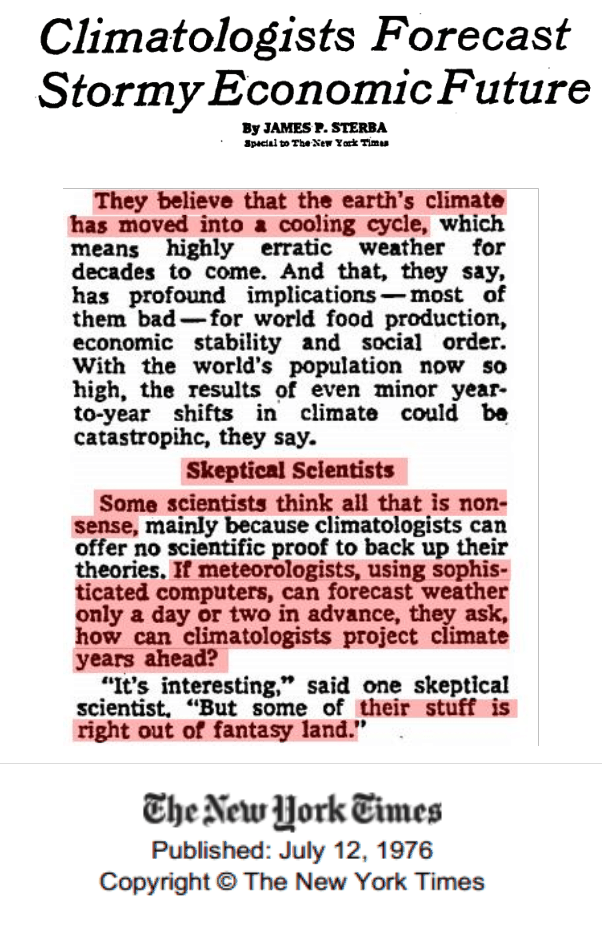
Climate Alarmism has been going on for a Very Long Time! (It’s never true!)

Time To Silence The Skeptics

In 1976, foolish skeptics didn’t trust official forecasts of catastrophic global cooling – doubting the ability of climate models to predict the weather years ahead. Forty years later, these same evil skeptics are blocking global warming acceptance for the same reason. Don’t the skeptics ever learn?

ScreenHunter_242 Feb. 06 08.11

Climatologists Forecast Stormy Economic Future – Climatologists Forecasting Dire Effects of Weather on World Economy and Social Order – View Article – NYTimes.com

Frauds, Crooks and Criminals

Demonstrating daily that diversity is not strength!

Family Hype

All Things Related To The Family

DeFrock

defrock.org's principal concern is the environmental and human damage of industrial wind turbines on rural communities

Gerold's Blog

The truth shall set you free but first it will make you miserable

Politisite

Breaking Political News, Election Results, Commentary and Analysis

Canadian Common Sense

Canadian Common Sense - A Unique Perspective from Grassroots Canadians

Falmouth's Firetower Wind

a wind energy debacle

The Law is my Oyster

The Law and its Place in Society

Illinois Leaks

Edgar County Watchdogs

stubbornlyme.

My thoughts...my life...my own way.

Oppose! Swanton Wind

Proposed Wind Project on Rocky Ridge

Climate Audit

by Steve McIntyre

4TimesAYear's Blog

Trying to stop climate change is like trying to stop the seasons from changing. We don't control the climate; IT controls US.

Wolsten

Wandering Words

Patti Kellar

WIND WARRIOR

John Coleman's Blog

Global Warming/Climate Change is not a problem