Climate Alarmists are Not to be Taken Seriously! They are Scammers!

An economist’s bad climate advice


You are here: HomeAll PostsAn economist’s bad climate advice

  • CO2_fraud

If I need my car repaired, I do not take it to a dentist. If I am seeking advice about the climate I check out what climatologists and meteorologists are saying, at least those who have not sold their souls to the global warming/climate change hoax.

On September 3rd,  The Wall Street Journal published a commentary by Edward P. Lazeartitled “The Climate Change Agenda Needs to Adapt to Reality: Limiting carbon emissions won’t work. Better to begin adjusting to a warming world.”

Wrong! Wrong! Wrong! It’s cooling, not warming.

Apparently Mr. Lazear is unaware that the Earth has been in a cooling cycle for seventeen years. A visit to

Edward P. Lazear

www.climatedepot.com or a subscription to the Heartland Institute’s monthly Climate & Environmental News or a copy of its policy studies, “Climate Change Reconsidered”, would help him understand why he’s wrong. Check out www.climatechangedispatch.com as well for the latest commentaries.

Perhaps his error should be forgiven because Mr. Lazear is an economist. He was the chairman of the President’s Council of Economic Advisors (2006-09) and head of the White House Committee on the Economics of Climate Change (2007-08). Presently he is a professor at Stanford University’s Graduate School of Business and a Hoover Institution fellow.

He’s not a fool, but like a lot of academics who lack a background in science, he has been fooled by the legion of global warming/climate change charlatans from Al Gore through the ranks of organizations such as the United Nations Intergovernmental Panel on Climate Change that depend on maintaining the hoax.

Mr. Lazear has fallen for the greatest lie ever; the assertion that greenhouse gases, especially carbon dioxide, are warming the Earth. The hoaxers are calling the past seventeen years “a pause” in warming, but it is actually an indicator that the Earth is on the cusp of the next ice age. The period in between ice ages is calculated at 11,500 years and we are at the end of the current interglacial period.

“The Obama administration is instituting a variety of far-reaching policies to reduce carbon emissions and mitigate climate change. Are any of these capable of making a difference?” asked Mr. Lazear. “Simple arithmetic suggests not.” Up to this point I was very pleased with his conclusion, but then he wrote “Given this reality, we would be wise to consider strategies that complement and may be more effective than mitigation—namely, adaptation.”

Humans have been adapting to the climate—the weather—since they emerged as homo sapiens about 195,000 years ago.

What Mr. Lazear wants the U.S, to do is limit “carbon emissions” but admits that “The economics also work against a major transformation in the technology of producing power, either mobile or stationary. Coal is cheap. Natural gas is becoming even cheaper.”

The primary flaw in his commentary is simply that more carbon dioxide is a good thing. As the primary gas utilized by all vegetation, more means greater crop yields and healthier forests. What carbon dioxide doesn’t do is “trap” heat long enough to lower the Earth’s temperature. It represents a mere 0.04% of the atmosphere.

The Earth is not a greenhouse with a glass roof. The amount of heat in the atmosphere is totally dependent on the amount of heat the Sun produces. In its current cycle, it is producing less.

“Carbon math,” wrote Mr. Lazear, “makes clear that without major effort and a good bit of luck, we are unlikely to control the growth of emissions enough to meet the standards that many climate scientists suggest are necessary.” Those scientists are usually on college or university faculties where securing federal and other grants to study a warming that is not occurring leads to urging limits on carbon dioxide. Others are just huge liars who, like Al Gore, have been making predictions of warming that have not and are not coming true.

There’s another reason why there will be more carbon dioxide in the atmosphere. It involves two of the most swiftly developing nations in the world, China and India, both of whom are building coal-fired plants to generate electricity as fast as they can. This is happening while the Environmental Protection Agency has been engaged in an all-out war on coal that has closed several hundred U.S. plants. If an especially cold winter occurs, the demand for electricity to warm homes and other facilities may overload a system that has been diminished in scope.

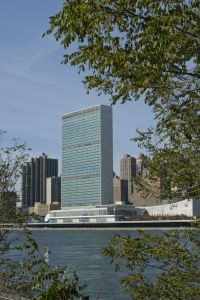
The United Nations Intergovernmental Panel on Climate Change is the driving force behind the global united-nations-building-1-1106992-mwarming hoax. It is holding a climate change summit on September 23. Guess who won’t be attending? Chinese president Xi Jinping, India’s prime minister, Narenda Modi, and for good measure, Germany’s chancellor, Angela Merkel. Others whose leaders will not be attending include Canada, Japan, and Russia.

In typical fashion, always predicting climate conditions decades from now, the United Nations, according to a report in The Guardian, “is warning of floods, storms and searing heat from Arizona to Zambia within four decades, as part of a series of imagined weather forecasts” to publicize the climate summit.

All of the forecasts made by a legion of climate charlatans in the 1980s and 1990s turned out to be WRONG.

You cannot trust the UN’s World Meteorological Organization which like the IPCC is just part of a vast matrix of groups that have been so severely corrupted by the global warming/climate change hoax that one must exercise caution when hearing its forecasts. If they are for anything beyond two weeks hence, you would be wise to be dubious.

Mr. Lazear is just one of many, often with distinguished careers in other fields than meteorology or climatology, who have bought into the hoax and who declaim the need to reduce carbon dioxide. He’s wrong. The others are wrong.

And you need to educate yourself to avoid being afflicted by various government policies intended to advance the hoax. To start with, do not vote for any politician who talks of global warming/climate change or uses the term “sustainability.”

– See more at: http://www.cfact.org/2014/09/07/an-economists-bad-climate-advice/#sthash.Pkjvx1cg.dpuf

It’s time for the Wind Industry to PROVE that they are reducing CO2, or Go Away!

Senator Chris Back: Wind Industry must prove its CO2 abatement claims

Chris Back

In our last post we tipped a bucket on the central, endlessly repeated lie trotted out by the wind industry and its parasites, that Australia’s great wind rush has resulted in substantial reductions of CO2 emissions in the electricity sector.

In Australia, the central object of the Renewable Energy (Electricity) Act 2000 is for “renewable” energy to “reduce emissions of greenhouse gases in the electricity sector” (see s3). The legislation provides that wind power outfits receive 1 Renewable Energy Certificate (REC) for each MWh dispatched to the grid. That relationship proceeded on the mammoth assumption that – for each MWh of wind power dispatched to the grid – there will be a 1 tonne reduction of CO2 emissions in the electricity sector.

Were the mandatory RET retained in its current form, Australian power consumers will see some $50 billion added to their powers bills and transferred to wind power outfits over the next 17 years (see our post here). With that amount at stake, it would be fair to assume that there was some measurable benefit attached – of the kind envisaged by the legislation (ie substantial reductions of CO2 emissions in the electricity sector) – to what will be the biggest wealth transfer in the history of the Commonwealth.

And, with that amount in play, it would also be reasonable to assume that our political betters had already satisfied themselves that the benefit in question is, in fact, being delivered – and that they are sitting on hard evidence quantifying that benefit – especially since the mandatory RET has been in operation for over 13 years.

A few starry-eyed, policy-pygmies seek comfort in a report by ACIL Allenthat’s been used to pump up wind industry CO2 abatement claims. But that document is nothing more than a desktop study, based on Alice in Wonderland assumptions that: uses irrelevant annual averages for wind power output; bases its conclusions about CO2 emissions intensity from conventional generators on assumed (not actual) thermal efficiencies; and, critically, ignores the actual figures from coal/gas fired generators – in particular, the actual coal/gas use data from conventional generators (which ACIL Allen never bothered to ask for) against which power output comparisons can be made to determine actual (not assumed) CO2 emissions intensity; and, therefore, whether wind power has, in fact, reduced CO2 emissions in the electricity sector.

At no point since that legislation took effect over 13 years ago has the wind industry provided any actual proof that it has in fact reduced CO2 emissions in the electricity sector. In what might come as a rude shock, none of our political representatives on the Federal stage has ever had the temerity to ask for any hard evidence to substantiate the wind industry’s mantra; and have seemed content to oversee the wholesale punishment of power consumers on nothing more than blind faith.

Until now.

Chris Back is a Liberal Senator from Western Australia – and he gets it (see our posts here and here and here).

Chris has thrown down the gauntlet, challenging the wind industry to stump up concrete proof to back its wild claims about reducing CO2 emissions in the electricity sector. Here’s a speech Chris delivered in the Senate last Wednesday.

THE SENATE
PROOF
MATTERS OF PUBLIC INTEREST
Renewable Energy Target
SPEECH
Wednesday, 3 September 2014

Senator BACK (Western Australia) (13:36):

I wish to discuss the renewable energy target review and its report, now that it has actually been handed to the government by the independent panel, chaired by Mr Dick Warburton. I want to make some comments about the review itself.

The first point I want to put to bed is around some allegations that have been bandied about in this place during the week to do with the apparent incompetence of the panellists to review the RET.

I just want to point out that, in addition to Mr Warburton, the other panellists include the eminent Mr Brian Fisher AO PSM, a previous executive director of the Australian Bureau of Agricultural and Resource Economics and Sciences. He is a renowned economist.

Another panellist is Ms Shirley Int’t Veld. As a Western Australian, she was the managing director of Verve Energy in WA from 2007 to 2012. Verve was the energy instrumentality that used more renewable energy sources than any other in Western Australia, so I do not know how she could not be regarded as credible.

The other panellist is Mr Matt Zema, managing director of the Australian Energy Market Operator. So I want to dispel the myth that this group was not competent to undertake the work.

For those who might be interested, I will review what the RET is all about. The RET is a government intervention designed to mandate the proportion of electricity generated from selected sources. It is designed to support a policy of at least 20 per cent of Australia’s energy coming from renewable sources by 2020; as such, the policy taxes electricity users and, in some cases, non-renewable generators.

How does it work?

The renewable energy certificate market emerges from the energy targets. Renewable energy certificates, or RECs, are issued to power station generators classified as renewable under the act. They are a form of energy currency as electricity retailers must purchase the RECs to cover their liability. Costs are passed on to consumers through purchase of mandatory certificates by electricity retailers. That, of course, is where it becomes a tax on energy consumers.

The first point I make about the target is that the objectives of the act have not been met, principally because there has not been to any extent a reduction of greenhouse gases in the time the target has been in place.

The second point is that whatever achievements the renewable energy sector has made have largely come from hydroelectricity. Hydroelectricity, as we all know, was around for a long time before the renewable energy target was formed. Having lived and worked in Tasmania and having even had to declare an interest because a company of which I was the managing director actually supplied lubricants and fuels to the hydroelectricity scheme in Tasmania, I place on record that it is a wonderful scheme.

Senator Singh interjecting –

Senator BACK: I want to place on record that I, for one, want to make sure that – whatever outcome is eventually decided by government – the hydroelectricity scheme is enhanced, protected and encouraged independent of the RET system, because it preceded RETs by so many years, as Senator Singh herself indeed knows.

At the time it was suggested that to achieve a 20 per cent contribution of renewable energy by 2020 would require some 41 gigawatt hours to be generated by renewable sources. We know that two things have happened. First of all, there has been a drop in demand –

Senator Singh: Mr Acting Deputy President, I rise on a point of order. I offer a correction to Senator Back; it is 41,000 gigawatt hours, not 41 gigawatt hours.

The ACTING DEPUTY PRESIDENT (Senator Seselja): Order! Senator Singh, there is no point of order.

Senator BACK: Senator Singh’s contribution is quite right, for which I thank her. It is 41,000 gigawatt hours. I will check the Hansard to see what I did say.

Indeed, as a result of a reduction in demand, we now realise that to achieve that 20 per cent target the figure is probably closer to 23,000 gigawatt hours. I do appreciate Senator Singh’s keen attention in listening to my contribution. That is the background of the RET.

The RET comes under two broad categories: the small-scale renewable energy target and large-scale renewable energy targets.

The small renewable targets, which are probably 10 per cent or less, are mainly to do with photovoltaics and solar hot water systems. In relation to the small-scale RETs, the recommendation of the panel is that there is probably little if any need for further support at this time. This is because power charges have gone up – somewhat because of the carbon tax, which has now been repealed through the excellent work of Senator Cormann and others – and costs in the solar sector have come down considerably.

Nevertheless, power charges have gone up while the costs of putting photovoltaics on roofs have come down. It is arguable that photovoltaics are now cost neutral. I was the chief executive of an organisation that introduced seven or eight different forms of solar energy many years ago on an island that I had the pleasure of being responsible for and I am a great supporter of solar energy. If indeed there needs to be some continued support for a limited period of time then I would not violently object to that. However, market forces have applied and the costs of photovoltaic installations have come down while electricity charges have come up, and I hope that we are now at the point of cost-neutrality. The panel has said that we are probably already at that point and that, if we are not there currently, we will probably be there reasonably soon.

I want to move to the issue of the large-scale renewable energy targets.

I have spoken in this place before of how concerned I am with regard to the wind energy sector. This report and others support the fact that there is an enormous amount of misinformation out there in the wider community about the large-scale RETs, particularly those relating to the wind industry.

The industry have employed very effective tricks to – I believe – mislead the public into believing that paying them billions of dollars in subsidies will lower power prices. Of course, it will not; there is no evidence to say that it will. The reason that the public is not outraged about this, as I said earlier, is that the public do not pay this money in taxes; rather, they pay it as part of their energy consumption. The modelling has shown that it is possible that some $37 billion over the next 15 years – or $2.5 billion per year – may be wasted on wind farms. Again, because the costs are concealed, they will not be picked up.

Comment was made that currently the RET is responsible for only around four per cent of household electricity bills. I have to say to you that other evidence refutes that. I will quote this document from AGL Energy and then seek the authorisation of the chamber to table it. I have passed the document to others in the chamber seeking authorisation.

The interesting point in the document is that AGL estimate that, in their commitment to buy 1.3 terawatt hours per year through the various wind associated organisations, it will cost them some $32 per megawatt hour above the 2015 wholesale market. They say that as a headline figure that will cost them some $40 million a year more for electricity than would have been the case without the wind strategy in place. I seek leave to table the document.

Leave granted.

Senator BACK: We are seeing the possibility that the estimated cost of the REC scheme could add some $50 billion to power bills over the next 17 years, with some 600 million renewable energy certificates being issued at a unit cost of about $90. So, in other words, we are looking at having $50 billion added to consumers’ power bills, transferred to wind-power companies. I think this is unacceptable.

I know that Senator Polley wishes to follow me and I am anxious to make sure that she is given adequate time to do so, but first I would like to comment on emissions reductions, because I think this is important.

The arguments regarding the long-term effect of the RET on price are fundamentally flawed, simply because the energy generated by wind farms does not reduce greenhouse gas emissions in the electricity sector.

I challenge the wind energy sector to produce the evidence relied upon to assert that wind power has reduced GHG emissions in the electricity sector.

Wind power is delivered intermittently, on repeated occasions not at all, meaning of course that the entire installed capacity from wind power has to be matched with equal capacity of fossil fuel generation. I challenge that industry to produce evidence to this chamber to say that what I am indicating is not correct.

Once awareness of the existence of the RET, let alone the magnitude of its cost impact, becomes more widespread in the public arena, support for it will evaporate. Renewable energy is not free. It is high cost compared to alternative forms of generation. It is not commercially viable without large subsidies, which ultimately come out of the consumer’s pocket.
Senator BACK (WA)  

Clearly on a roll, Chris followed up his speech in the Senate with this media release.

Dr Christopher Back
Liberal Senator for Western Australia
MEDIA RELEASE
3 September 2014 

Can the wind industry meet my Emissions Reductions Challenge?

In the Senate today, Senator Back said that the RET acts as a tax on energy consumers and conventional energy suppliers to fund a subsidy to selected renewable energy generators.

“But – and this is the big issue that the Coalition Government is now addressing – after 13 years of operation it has become clear that the objectives of the Act have not been reflected in the outcomes. While the investment in renewable energy sources has increased, from a carbon abatement perspective, the Act has been all but totally ineffective in its objective to reduce greenhouse gas emissions in the electricity sector.”

Arguments regarding the long-term effects of the RET on price are fundamentally flawed. This is because energy generated by wind farms does not reduce greenhouse gas emissions in the electricity sector. In fact, there is some evidence that the addition of wind energy onto the grid actually increases carbon emissions. This is the great tragedy of the scheme.

“My challenge to the wind industry is to produce the evidence relied upon to assert that wind power has reduced greenhouse gas emissions in the electricity sector at all. Wind power is delivered intermittently and, on repeated occasions, not at all, which means that an entire installed capacity from wind power has to be matched with an equal capacity of fossil fuel generation at all times.”

Grid managers are required to keep fossil fuel generating plants constantly running in the background to maintain balance within the grid in order to account for dramatic fluctuations in wind power output which occur on a minute by minute basis and base-load generators are required to maintain spinning reserve for occasions when wind power output collapses as it does on a routine but unpredictable basis. The requirement to maintain spinning reserve means that base-load generators are burning coal and gas at a constant rate even though no power is being dispatched to the grid.

“The case to abolish the RET is driven by its cost to electricity consumers compared to the corresponding reduction (or lack of reduction) in greenhouse gas emissions achieved through its 13 year lifespan. This cost comparison, extending the RET tax to 2031 for no measurable reduction in greenhouse gas emissions in the electricity sector is completely futile. It becomes a drag on the Australian economy and an insidious impost on every electricity consumer in the nation – large and small businesses, families and individuals.”

The wind industry is trumpeting two issues in the media: one is that wind is dropping the wholesale price of electricity; and the second is that the RET will cause the retail price of electricity to fall. Put simply, if wind is causing the wholesale price of electricity to fall, then the renewables industry no longer requires the billions of dollars in subsidy it receives through the large-scale RET scheme, as renewable energy is therefore cost competitive in the market.

In reality, the RET is causing electricity prices to rise significantly as it is the Power Purchase Agreement (PPA) that is and always has been the fundamental relationship between the power generator and the retailer.

These PPAs lock in prices of up to $120/MWh compared to the average wholesale price of between $30-$40/MWh. The price set by the PPA is paid by the retailer irrespective of the wholesale price. This PPA price is passed on to retail customers along with the retail margin over the life of the PPA which is usually 15 and up to 25 years. I have tabled a confidential document showing proof of this in the Senate chamber today to ensure transparency for the Australian public.

It is a legislated requirement that 600 million RECs will be issued between now and 2031, adding a cost of at least $50 billion to power bills over the next 17 years. This represents a significant wealth transfer to wind power companies from Australian power consumers and achieves no measurable benefit to the environment.

The RET scheme was never intended to act as an unchecked subsidy. “Once awareness of the existence of the RET, let alone the magnitude of its cost impact, becomes more widespread, public support for the scheme will evaporate. Renewable energy is not free; it is high cost compared to alternative forms of generation and commercially unviable without large subsidies. What people need to understand is that they pay these costs in their electricity bills and not through their taxes. It hurts everyone.”
Senator Chris Back (WA).


Proof

STOP lying about the 97% Consensus! It’s FRAUD!

Press Release 08/09/14

New Paper: Fraud, Bias &

Public Relations

Claims of 97% Consensus are based

on research described as fraudulent

and biased 


London, 8 September: A new briefing note published today by the Global Warming Policy Foundation examines claims made by a great many commentators across the world, including President Obama and Ed Davey, of an overwhelming consensus on climate change. These depend on research that has been subject to public and entirely unrebutted allegations that it is fraudulent.

Although the authors of the research claim to have shown that most climate change papers accept that mankind is responsible for the majority of recent warming, in fact the underlying study shows no such thing.

One senior climatologist described the paper as ‘poorly conceived, poorly designed and poorly executed’. Another researcher called it ‘completely invalid and untrustworthy’, adding that there was evidence of scientific fraud.

Andrew Montford, the author of the paper, said: “It has now been shown beyond doubt that the claims of a 97% consensus on climate change are at best misleading, perhaps grossly so, and possibly deliberately so. It’s high time policymakers stopped citing this appalling study.”

Full paper (pdf) – Fraud, Bias And Public Relations: The 97% ‘Consensus’ And Its Critics

Contacts

Andrew Montford
e: awmontford@gmail.com 

Dr Benny Peiser
The Global Warming Policy Foundation
e: benny.peiser@thegwpf.org 

If I Wanted America to Fail…. A Bone-Chilling Classic, becoming reality!

If I Wanted America to Fail

A new group has recently released a video advocating free-market policies from a whole new perspective, and the result is very compelling.

The group is called Free Market America, and its stated mission is to defend economic freedom, particularly from environmental extremism.

The video puts the viewer in the perspective of someone who wants to dismantle the country, and walks them though what they would do to accomplish it. Throughout the video, the viewer becomes aware of how many of today’s ideas match the destructive actions learned through this perspective.

What makes this argument compelling is that this sort of connection cannot be built from anything other than concrete evidence. Leaving the viewer to digest the sobering truth once the video ends.

After watching the video, feel free to read the transcript below if you would like a closer look at the video’s points.

If I wanted America to fail …

To follow, not lead; to suffer, not prosper; to despair, not dream — I’d start with energy.

I’d cut off America’s supply of cheap, abundant energy.  Of course, I couldn’t take it by force.  So, I’d make Americans feel guilty for using the energy that heats their homes, fuels their cars, runs their businesses, and powers their economy.

I’d make cheap energy expensive, so that expensive energy would seem cheap.

I would empower unelected bureaucrats to all-but-outlaw America’s most abundant sources of energy.  And after banning its use in America, I’d make it illegal for American companies to ship it overseas.

If I wanted America to fail …

I’d use our schools to teach one generation of Americans that our factories and our cars will cause a new Ice Age, and I’d muster a straight face so I could teach the next generation that they’re causing Global Warming.

And when it’s cold out, I’d call it Climate Change instead.

I’d imply that America’s cities and factories could run on wind power and wishes.  I’d teach children how to ignore the hypocrisy of condemning logging, mining and farming — while having roofs over their heads, heat in their homes and food on their tables.

I would never teach children that the free market is the only force in human history to uplift the poor, establish the middle class and create lasting prosperity. Instead, I’d demonize prosperity itself, so that they will not miss what they will never have.

If I wanted America to fail …

I would create countless new regulations and seldom cancel old ones. They would be so complicated that only bureaucrats, lawyers and lobbyists could understand them.  That way small businesses with big ideas wouldn’t stand a chance — and I would never have to worry about another Thomas Edison, Henry Ford or Steve Jobs.

I would ridicule as “Flat Earthers” those who urge us to lower energy costs by increasing supply.  And when the evangelists of commonsense try to remind people about the law of supply and demand, I’d enlist a sympathetic media to drown them out.

If I wanted America to fail …

I would empower unaccountable bureaucracies seated in a distant capitol to bully Americans out of their dreams and their property rights.  I’d send federal agents to raid guitar factories for using the wrong kind of wood; I’d force homeowners to tear down the homes they built on their own land.

I’d make it almost impossible for farmers to farm, miners to mine, loggers to log, and builders to build.  And because I don’t believe in free markets, I’d invent false ones.  I’d devise fictitious products — like carbon credits — and trade them in imaginary markets.  I’d convince people that this would create jobs and be good for the economy.

If I wanted America to fail …

For every concern, I’d invent a crisis; and for every crisis, I’d invent the cause.

Like shutting down entire industries and killing tens of thousands of jobs in the name of saving spotted owls.  When everyone learned the stunning irony that the owls were victims of their larger cousins — and not people — it would already be decades too late.

If I wanted America to fail …

I’d make it easier to stop commerce than start it — easier to kill jobs than create them — more fashionable to resent success than to seek it.  When industries seek to create jobs, I’d file lawsuits to stop them.  And then I’d make taxpayers pay for my lawyers.

If I wanted America to fail …

I would transform the environmental agenda from a document of conservation to an economic suicide pact.  I would concede entire industries to our economic rivals by imposing regulations that cost trillions.

I would celebrate those who preach environmental austerity in public while indulging a lavish lifestyle in private.  I’d convince Americans that Europe has it right, and America has it wrong.

If I wanted America to fail …

I would prey on the goodness and decency of ordinary Americans.  I would only need to convince them … that all of this is for the greater good.

If I wanted America to fail, I suppose I wouldn’t change a thing.


Wind Turbines Increase the Amount of CO2 Being Produced to Make Electricity!

Why Intermittent Wind Power Increases CO2 Emissions in the Electricity Sector

lies

The central, endlessly repeated lie (upon which the great wind power fraud rests) is that increasing wind power generation results in decreases in CO2 emissions.

In Australia, the central object of the Renewable Energy (Electricity) Act 2000 is for “renewable” energy to “reduce emissions of greenhouse gases in the electricity sector” (see s3). But, somewhere along the way, what was a CO2 abatement scheme became an industry subsidy scheme which is nothing short of “corporate welfare on steroids” (see our post here).

At no point since that legislation took effect over 13 years ago has the wind industry provided any actual proof that it has in fact reduced CO2 emissions in the electricity sector. When we talk about “proof” we’re not talking about smoke and mirrors “modelling” based on long-term average wind farm output – which ignores the extra gas and coal being burnt (and wasted) in order to balance the grid to account for wild fluctuations in wind power output (see our post here); and to maintain additional “spinning reserve” (see our post here) to account for complete collapses in wind power output – as seen in this post.

As we have pointed out just once or twice – the need for 100% of wind power capacity to be backed up 100% of the time by fossil fuel generation sources means that wind power cannot and will never reduce CO2 emissions in the electricity sector (see our posts here and hereand here and here and here and here and here).

E.ON operates numerous transmission grids in Germany and, therefore, has the unenviable task of being forced to integrate the wildly fluctuating and unpredictable output from wind power generators, while trying to keep the German grid from collapsing (E.ON sets out a number of the headaches caused by intermittent wind power in the Summary of this paper at page 4). Dealing with the fantasy that wind power is an alternative to conventional generation sources, E.ON says:

“Wind energy is only able to replace traditional power stations to a limited extent. Their dependence on the prevailing wind conditions means that wind power has a limited load factor even when technically available. It is not possible to guarantee its use for the continual cover of electricity consumption. Consequently, traditional power stations with capacities equal to 90% of the installed wind power capacity must be permanently online [and burning fuel] in order to guarantee power supply at all times.”

STT is happy to go all out and say that in Australia wind power requires 100% of its capacity to be backed up 100% of the time by conventional generation sources. As just one recent example, on 3 consecutive days (20, 21 and 22 July 2014) the total output from all of the wind farms connected to the Eastern Grid (total capacity of 2,952 MW – and spread over 4 states, SA, Victoria, Tasmania and NSW) was a derisory 20 MW (or 0.67% of installed capacity) for hours on end (see our post here). The 99.33% of wind power output that went AWOL for hours (at various times, 3 days straight) was, instead, all supplied by conventional generators; the vast bulk of which came from coal and gas plants, with the balance coming from hydro.

For wind power to reduce CO2 emissions in the electricity sector it has be a true “substitute” for conventional generation sources. Because it can’t be delivered “on-demand” (can’t be stored) and is only “available” at crazy, random intervals (if at all) wind power will never be a substitute for conventional generation sources (see our post here).

Perhaps the reason that the wind industry has never produced a shred of evidence to show that wind power has reduced CO2 emissions in Australia’s electricity sector is simply because it can’t. Running counter to wind industry claims about wind power abating CO2 emissions, the result of trying to incorporate wind power into a coal/gas fired grid is increased CO2 emissions (see this European paper here; this Irish paper here; this English paper here; this American article and this Dutch study here).

This American study details just why increasing wind power capacity – and trying to incorporate its wildly fluctuating output into a coal and gas fired grid – results in increased CO2 emissions across the electricity sector.

Wind Integration vs. Air Emission Reductions: A Primer for Policymakers
Master Resource
Mary Hutzler
24 June 2010

Many claim that wind generation is beneficial because it reduces pollution emissions and does not emit carbon dioxide. This isn’t necessarily the case. The following article explains a phenomena called cycling where the introduction of wind power into a generation system that uses carbon technologies to back-up the wind actually reduces the energy efficiency of the carbon technologies. Recent studies with actual data have estimated the impact of cycling on air pollution and carbon dioxide emissions.

Energy modelers evaluating the impact of legislation such as Senator Bingaman’s American Clean Energy Leadership Act and the American Power Act proposed by Senators Kerry and Lieberman should take note for their models most likely are underestimating the cost of compliance by incorrectly modeling the integration of wind power into the electricity grid.

Wind is not a new technology. It was one of our principal sources of energy, along with wood and water, prior to the carbon era. But the use of renewables in the pre-carbon age was very different from the current use of renewables. Today, people rely on energy being available 24 hours a day, 7 days a week, 365 days a year, regardless of whether the sun shines, the wind blows, or there are high or low water levels.  We now have over 1,000 gigawatts of generating plants[1], and a large and elaborate electrical grid that requires great coordination among system operators to avoid disruptions.

Also, in the pre-carbon energy era, when renewables were the sole source of energy, there were no coal-fired or natural-gas fired power plants to provide back-up power. Studies have found that the efficiency of those carbon-based plants is affected by incorporating wind energy into the system. When a plant’s efficiency is reduced, its fuel consumption and emissions increase, causing unintended consequences that wind proponents do not disclose. Requiring even larger amounts of renewable energy through renewable portfolio standards will only exacerbate this problem.

Picture1

Background

Our various electricity generating technologies were designed and constructed to meet electricity demand based on their best operating characteristics for meeting portions of the electricity load duration curve. The load duration curve illustrates periods of constant demand that are served by base-load power versus periods of intermediate and peak demand. Owing to their high capital cost, low fuel cost, and high capacity factors, technologies such as coal and nuclear were designed to operate continuously to meet the base-load demand component. Owing to their lower capital costs but higher fuel costs, natural gas technologies, including combined-cycle and turbine plants, were designed to meet intermediate and peak electrical load.

Wind is an intermittent technology since it can generate power only when the wind blows. Its low operating cost (with no fuel component) and the mandates of state Renewable Portfolio Standards (RPS) make it practically a “must take” technology for system operators. RPSs require that a certain amount of electricity generation be produced by renewable fuels. The renewable target mandates tend to start out low but increase over time, with those of most RPS states reaching 15 to 30 percent by 2020 or 2025.[2] Wind tends to be the primary technology for meeting RPS targets, since it is lower in capital cost than solar, thermal, and photovoltaic technologies, the other politically acceptable “green” technologies.

Part of the rationale for introducing RPSs is that the substitution of “green” technologies for carbon technologies is supposed to reduce pollution emissions as well as carbon dioxide emissions. However, studies have shown that this may not be the case. As conventional generation (coal or natural gas) is reduced to make room for wind generation and is then increased as wind generation subsides, its heat rate rises. The heat rate is a measure of a generating station’s thermal efficiency commonly stated in units of Btu per kilowatt-hour. This reduction in efficiency  increases its fuel consumption and emissions. When sudden increases or decreases occur in generation output, it is referred to as “cycling”.

The Bentek Study

Bentek did a study of the results of integrating wind into the generation mix of the Public Service Company of Colorado (PSCO), using data from the company’s financial reports, the Energy Information Administration, the Federal Energy Regulatory Commission, the Environmental Protection Agency, and the National Renewable Energy Laboratory.[3] PSCO is a largely coal-fired utility with 3,764 megawatts of coal-fired generators, 3,236 megawatts of gas-fired combined-cycle and gas turbine capacity, 405 megawatts of hydro and pumped storage capacity, and 1,064 megawatts of wind generators. Colorado has an RPS that required 3 percent of the electricity generated by investor-owned utilities come from qualifying renewable technologies by 2007, and 30 percent by 2020.[4]

Colorado’s energy demand is highest during the day, peaking in late afternoon or early evening. Wind generation, however, is greatest between the hours of 9 pm and 5 am; it cannot be counted on to provide power when most needed, and so is used when available to meet the RPS. Most of the time that wind generation is available, it backs out (or replaces) natural gas. However, there are times when coal generation, which provides over 50 percent of PSCO’s base-load generation, is backed out to make room for the wind generation. When this happens, coal generation is cycled, causing its heat rate to increase and resulting in more fuel consumption and emissions. In PSCO, coal cycling predominates because of the low amount of gas generation in the system since most of its gas-fired generation is from turbines and because wind is strongest at night when coal use is even more pronounced.

Picture2

In the Denver non-attainment area, PSCO has 4 coal-fired plants: Arapahoe, Valmont, Pawnee, and Cherokee. Between 2006 and 2009, these coal-fired plants have experienced higher emissions rates ranging from 17 to 172 percent higher for sulfur dioxide, 0 to 9 percent higher for nitrous oxide, and 0 to 9 percent higher for carbon dioxide. In 2008, Cherokee even switched to a lower sulfur coal, but still ended up with sulfur dioxide emissions higher by 18 percent. And, between 2006 and 2009, these plants reduced their generation by over 37 percent, exacerbating further the increase in emissions.

Because the PSCO data are limited, Bentek checked their results against data from the Energy Reliability Council of Texas, whose utilities are required to report generation levels by fuel every 15 minutes. Texas has the most wind capacity in the country—over 9,500 megawatts.[5] Texas also has an RPS that was instituted during George W. Bush’s governorship and that pushed Texas ahead of California in wind capacity during 2006. The Texas renewable portfolio standard requires that utilities have 5,880 megawatts of renewable capacity by 2015, including a target of 500 megawatts of renewable-energy capacity from resources other than wind. The legislation also set a target of reaching 10,000 megawatts of renewable energy capacity by 2025, although it will be exceeded much earlier.[6] However, even in Texas, which has a large natural gas–fired capacity base, with over 40 percent of its generation being natural gas-fired,[7] coal-fired generation is cycled as is shown in the graph below.

Picture3

Another benefit that wind power generators get is that their forecast power generation entails no penalty if it is not available. Other generators must provide their own back-up power if their generation is suddenly unavailable. But the owners of wind generators believe that they can’t be held accountable for whether the wind blows and thus for inaccuracies in their forecasting capability. For example, on February 26, 2008, a cold front moved through West Texas and rendered wind’s output 1,000 megawatts less than promised, and that unexpectedly had to be made up by other generating technologies.[8] Only careful and extensive coordination, such as was carried out in West Texas on that cold February day, can prevent brown outs and black outs from occurring.

The Netherlands Experience[9]

Two researchers, C. le Pair and K. de Groot, found that the Netherlands government was overestimating the amount of carbon dioxide reductions associated with wind production. The government was using incorrect data because it did not correct for the reduction in efficiency of the conventional power plants once wind was introduced into the system. Using data provided by CBS, the Dutch Institute for Statistics, the researchers made an estimate of the “turning point” where the efficiency reduction of conventional power plants balances out the fuel savings from wind energy. Using data for 2007, when wind power was at 3 percent, they found the turning point to be at an efficiency reduction of 2 percent based on all the power stations serving the Netherlands. That is, when the efficiency of the back-up plants was reduced by over 2 percent due to cycling caused by the integration of wind energy into the system, fuel use and emissions of the back-up plants increased.

Heat Rate Simulations

An engineer, Kent Hawkins, evaluated several heat rate simulations to represent cycling of the plants when wind is introduced into the system.[10] One set of simulations evaluates wind energy replacing coal power with different technologies serving as the back-up power to wind, in order to evaluate their effect on fuel use and carbon dioxide emissions. He found that because of cycling, carbon dioxide emissions increase with the incorporation of wind energy if coal is the sole back-up power for wind. If coal and gas turbines or gas combined-cycle and gas turbines are used to back up the wind power, carbon dioxide emissions are reduced mainly due to the lower carbon dioxide emissions produced from natural gas generators as compared to coal generators. This is best seen by examining the last bar in the chart below where the lowest carbon dioxide emissions result when natural gas combined-cycle plants are solely used to replace coal.

Picture4

An interesting consequence of this analysis is that certain areas of the world where wind is integrated into a system that is primarily coal-based may result in an increase in total carbon dioxide emissions from using wind in their generating sector. That is, in these circumstances, wind would not be providing an offset in carbon dioxide emissions, but would actually be providing an increase in those emissions. China, for example, relies on coal for 80 percent of its generation and natural gas for only 2 percent.[11] China also added the most wind power of any country in 2009, 13 gigawatts,[12] ranking third in the world in total wind capacity, with the United States first and Germany second.[13] Since China’s wind would primarily be backed up by power from coal-fired generating units, it is no wonder that China’s carbon dioxide emissions increased by 9 percent in 2009.[14]

Conclusion

As more wind units are built and data become available regarding their integration into conventional energy systems, we will learn more about the effects of wind units on the operation of conventional plants. A few studies have been done showing that the effect of wind integration on both fuel consumption and emission reductions can in fact be negative. Further evaluation of our current wind units and their effects on fuel consumption and emissions should be done before increasing the penetration of renewable energy to the 20 and 30 percent levels currently mandated by some state renewable portfolio standards, and before a national renewable portfolio standard is considered for enactment.

[1] Energy Information Administration, Electric Power Annual,http://www.eia.doe.gov/cneaf/electricity/epa/epat1p2.html

[2] Institute for Energy Research, Energy Regulation of the States: A Wake-up Call, www.instituteforenergyresearch.org/states/

[3] Bentek Energy LLC, How Less Became More: Wind, Power and Unintended Consequences in the Colorado Energy Market,http://www.bentekenergy.com/WindCoalandGasStudy.aspx

[4] Institute for Energy Research, Energy Regulation of the States: A Wake-up Call, http://www.instituteforenergyresearch.org/states/colorado/

[5] American Wind Energy Association,http://www.awea.org/projects/projects.aspx?s=Texas

[6] Institute for Energy Research, Energy Regulation of the States: A Wake-up Call, http://www.instituteforenergyresearch.org/states/texas/

[7] Energy Information Administration, Electric Power Monthly, March 2010, http://tonto.eia.doe.gov/ftproot/electricity/epm/02261003.pdf

[8] The Wall Street Journal, Natural Gas Tilts at Windmills in Power Feud, March 2, 2010,http://online.wsj.com/article/SB10001424052748704188104575083982637451248.html

[9] The impact of wind generated electricity on fossil fuel consumption, C. le Pair and K. de Groot, http://www.clepair.net/windefficiency.html

[10] Wind Integration: Incremental Emissions from Back-Up Generation Cycling (Part V: Calculator Update), Kent Hawkins, February 12, 2010,http://www.masterresource.org/2010/02/wind-integration-incremental-emissions-from-back-up-generation-cycling-part-v-calculator-update/#more-7271

[11] Energy Information Administration, International Energy Outlook 2010, Tables H10, H12, and H13,http://www.eia.doe.gov/oiaf/ieo/pdf/ieoecg.pdf

[12] Global Wind Energy Council, Global wind power boom continues amid economic woes, March 2, 2010, http://www.gwec.net/index.php?id=30&no_cache=1&tx_ttnews[tt_news]=247&tx_ttnews[backPid]=4&cHash=1196e940a0

[13] Global Wind Energy Council, http://www.gwec.net/index.php?id=13, and Global Wind Energy Council, Global wind power boom continues amid economic woes, March 2, 2010, http://www.gwec.net/index.php?id=30&no_cache=1&tx_ttnews[tt_news]=247&tx_ttnews[backPid]=4&cHash=1196e940a0

[14] Reuters, China top carbon emitter for second year running, June 9, 2010, http://alertnet.org/thenews/newsdesk/LDE6580Y1.htm

Facts

Global Warming Alarmists ….Causing Global Chaos!

Lawrence Solomon: How global warming policies have led to global insecurity

 Lawrence Solomon | September 4, 2014 7:30 PM ET
Lawrence Solomon: Over the last two decades, global warming activists succeeded in slowing the development of the oil sands, blocking major pipelines like Keystone XL, phasing out coal plants and banning shale gas and oil projects.

Nathan VanderKlippe /National Post, fileLawrence Solomon: Over the last two decades, global warming activists succeeded in slowing the development of the oil sands, blocking major pipelines like Keystone XL, phasing out coal plants and banning shale gas and oil projects.
  •  

Limits on energy production in the West enabled conflicts in the Ukraine and the Middle East

Global warming policies abet terrorism and global insecurity. If Western governments weren’t spooked by global warming, ISIS would be less of a threat to the West, the Middle East would be less of a cauldron of hate, Europe wouldn’t be held hostage by Russia and China wouldn’t be threatening its neighbours over islands in the South and East China Seas.

Over the last two decades, global warming activists succeeded in slowing the development of the oil sands, blocking major pipelines like Keystone XL, phasing out coal plants and banning shale gas and oil projects. Without their activism, the Western world would have years ago not only become self-sufficient in fossil fuels, it would have become an exporter. Even with the roadblocks, the U.S. managed a miraculous transformation — once the world’s largest energy importer, it is now becoming a major exporter. Only Europe among the Western continents remains subject to dictates from energy exporters, most of them from unsavoury and hostile areas such as the Middle East, Russia and Venezuela.

Had the West earlier become a major energy exporter, these hostile economies would have lost their chief markets and the bulk of their revenues, particularly since prices would also have collapsed in a world awash in energy. Russia, for example, relies on energy for 30% of its GDP, Venezuela for 33%, some Middle East countries for more than 50%. Their economies would have retrenched, unable to finance social services at home let alone military adventures abroad. Their regimes would have focused on self-preservation rather than spreading ideologies abroad.

Funders of Islamic terrorism would have been strapped for cash

In a world of low-cost, plentiful energy, ISIS could never have emerged as a major threat. This ultimate-Islamic-terror group largely relies on generous grants from energy-exporters like Qatar, a Muslim Brotherhood-friendly emirate, and on sales from its own oil fields, captured in battle. Without global warming dogma, neither of these revenue sources would have taken ISIS far.

Likewise Iran, Qatar’s rival for the title of No. 1 funder of Islamic terrorism, would have been strapped for cash. It would have been unable to bankroll such notables in the region’s terrorist gallery as Hamas and Islamic Jihad in Gaza, Hezbollah in Lebanon and Assad in Syria, not to mention their terror cells in the West.

Russia would also have been sapped of strength and unable to threaten its neighbours, much as occurred in the 1980s, when the USSR’s failed economy led to its breakup and the release from its grasp of Ukraine and the rest of eastern Europe. The potent Putin we created would instead have been Putin the Impotent.

China, too, would have been less belligerent with its neighbours. Its territorial disputes with Japan, Taiwan, the Philippines, Malaysia, and Vietnam often focus on barren islands — sometimes mere outcroppings — in the East and South China Seas. Their value lies mostly in the prospect that oil and gas will be found in their offshore waters. That value would greatly diminish, along with the logic of going to war for them, if energy became cheap and plentiful.

Ironically, the environmentalists who pushed global warming policies on the West thought they would be enhancing global security. Wars — particularly those in the Middle East — stemmed from the West’s desire for oil, they argued. By getting the West off oil and onto CO2-free renewables, the West would lose its lust for the Middle East’s energy resources, ushering in a new era of peace.

They were half right — it did make sense to rid the West of dependence on Middle East energy. And half wrong — the alternative to oil and gas from the Middle East was not renewable energy but oil and gas from Western countries. And they were entirely misguided — contrary to their claims, the planet has not warmed in almost 20 years now.

Today, most Western governments are reining in their global warming policies, slashing their ruinously expensive subsidies to renewables and aggressively developing fossil fuels. All that the global warming scare accomplished was to make people pay with their pocketbooks — tens of millions of Europeans now suffer “fuel poverty,” the household term in Europe for those who now can’t afford to pay their power bills — and to increase wars, terrorism and global insecurity.

The Consequences of Faux-green Renewable Energy, on Nature, in Germany!

germany Deutschland
How The Green Energy Transition Is Destroying Germany’s Nature

 Date: 28/08/14

  • Fritz Vahrenholt, Die Welt

Germany’s climate and energy policy is the main threat to bio-diversity. Politicians, however, have closed their eyes from the destructive effects of the rampant expansion of renewable energy.

Dankwart Guratzsch has convincingly described the destruction of the environment by the energy transition in these pages. The mayor of Tübingen, Boris Palmer (Green Party), responded in an article, saying: “Everything is not so bad. The impact of wind farms on nature is almost zero … The only relevant negative aspect of wind power is the optical … Many wind farms attract visitors, who do not find repulsive.”

What a devastating form of denial by the Green mayor. But he shares the fatal disregard for the destruction of nature with many greens who – helped by the WWF and Greenpeace – open up forests and premium areas of natural beauty for businesses and belittle the intrusion by wind turbines into nature.

More and more citizens are beginning to realise how the green energy transition is at odds with nature conservation and environmental protection in Germany. A grassroot protest movement has started with thousands of local citizens’ initiatives, barely connected with each other, who are against the planting of biofuels far and wide and which is destroying biodiversity, against the threats to indigenous birds by wind turbines built in forests, and against the devastation of unique cultural and landscape areas by photovoltaic excesses.

A biodiversity disaster

Of Germany’s 115 most common bird species, 51 have declined significantly in the last 20 years. The head of the biosphere reserve in Schorfheide, Martin Flade, speaks of a “biodiversity disaster” which is due to “the hectic climate, energy and agricultural policy: In the corn farmland birds have no chance – the field processing falls in the breeding season, and later they hardly find any insects to eat in these mono-cultures. Of the 30 most common species, there are just four that could hold their numbers, all the rest are declining since at least since 2007.”

The Lesser Spotted Eagle, also called Pomerania Eagle, became extinct in Saxony-Anhalt last year. Only 108 breeding pairs remain in Germany. It finds less and less food in the declining grassland and open meadow. The distances between breeding sites and food areas are getting longer and are also increasingly endangered by wind turbines.

Notably countries with Green Party ministers (North Rhine-Westphalia, Rhineland-Palatinate, Baden-Wurttemberg, Brandenburg and Hessen) have approved regulations which open the use of forests for wind turbines. To place a wind farm every 500 meters in the forest, six meter wide open lanes have to be cut through the forest in order to transport the 100-ton turbines and to maintain them later. Around each turbine, a five-acre open area must be created to lift the blades by giant cranes.

Wind farms in pristine forests

What a wind farm forest looks like can now be seen in many parts of Germany – for instance around Soonwaldsteig, a part of the Hunsrück, one of the last great, largely untouched forest areas in Rhineland-Palatinate with high biodiversity and the presence of numerous highly endangered species. There, the project developer Juwi has erected eight wind turbines in the middle of a forest – despite public protests – and then sold the park to an Austrian energy supplier. Faced with the images of demonstrating citizens, the Green minister Evelin Lemke could only come up with: “Without climate protection, there will be no more biodiversity here.”

But a policy that overestimates the dangers of climate change and that subordinates all other policy objectives, including nature conservation, whatever the cost, generates resistance. The Soonwaldsteig has become a nationwide focal point of citizens’ initiatives against the use of wind power in sensitive areas.

Today, 200,000 dead bats are found under wind turbines annually. The clever animals locate the rotors, fly through them and in the lee behind the turbines, where the air pressure decreases sharply, the bats’ lungs burst. Particularly affected are the noctule, the Serotine, the Small Noctule or the parti-colored bat. The female bat only gives birth to one or two young per year, thus these useful insectivores are endangered by a further uncontrolled construction of new wind turbines.

The red kite is acutely threatened

Following the review of the German Council for Bird Preservation (DRV) and the umbrella organization of German Avifaunists (DDA, 2012), the Red Kite is also in particular danger. After an investigation by the State Ornithological Institute of Brandenburg, the Red Kite is no longer safe in this state with its 3,200 wind turbines. About 300 Red Kites are killed annually in Brandenburg alone by wind turbines.

The decline of the red kites since 2005 in West Germany is striking, as Klaus Richarz, former head of the State Ornithological Institutes for Hesse, Rhineland-Palatinate and Saarland, has warned. For him too, windmills built in the habitats of kites are fatal for the birds. The protection of the Red Kite is of special obligation for Germany, because a large percentage of the global population of the birds live in Germany. If you like, it is the real national bird of Germany.

In his hard-hitting article “From the energy transition to biodiversity disaster” Martin Flade, the recognized bird expert, describes climate protection and energy policy as a “major threat to biological diversity”. He concludes: “Overall, you have to draw the bitter conclusion that effects of climate change on biodiversity are hardly detectable; the effects of climate and energy policies, however, are dramatic.”

The problem with intermittent wind turbines

Tübingen’s mayor Boris Palmer demands: “We need to double the number of currently 25,000 wind turbines in order to supply Germany.” What a mistake!

Even 50,000 wind turbines only lead to massive surpluses if the wind blows. Wind turbines have on average around 2,500 full load hours per year, but the year has 8,760 hours. In times of no wind, no electricity is generated, even if one multiplies the number of facilities. Zero times x is zero. The intermittency of renewable energy such as wind and solar require either backup fossil power plants or energy storage capacities.

Storage technologies can only do this tasks with excessive costs. Without fossil power plants to balance the intermittency of renewable energy there will be no guaranteed power supply in Germany, with fatal consequences for the competitiveness of German industry and the manufacturing industry.

It should also be known to the Greens that the expansion of renewable energy due to Germany’s Renewable Energy Law is completely ineffective in terms of CO2 emissions in Europe. The CO2 emissions in Europe are determined solely by the capping of the emissions trading scheme. New wind and solar power, in fact, set more emission allowances free.

These certificates float through the stock exchanges to coal power plants in other EU countries where they allow further increase in CO2 emissions which amount to the same level as the reductions in Germany. Besides additional costs for citizens and the devastation of nature, any expansion of renewable energy will not achieve a single ton of CO2 reduction.

Assumptions of climate policy are flawed

Fossil fuel power plants are not an alternative for Boris Palmer and the Greens because they cause climate change, claiming that “some nature reserves, but also some urban areas cannot be saved from rising sea levels, drought and floods and devastating storms”.

But there are growing signs that the assumptions used for German and European climate policy are flawed. Surprisingly, no global temperature increase has occurred for about 15 years. However, computer models used by climate scientists had predicted a temperature rise of 0.2 degrees Celsius per decade.

In early 2013, 17 renowned climate scientists came to the conclusion that the climate sensitivity of greenhouse gases should be significantly reduced. Hans von Storch, researcher from the Helmholtz Centre in Geesthacht, admits: “First option: global warming is weaker because the greenhouse gases, especially CO2, have a lower impact than assumed. That does not mean that there is no man-made greenhouse effect, only that our influence on the climate system would not be as strong as expected. The other possibility: In our simulations we have underestimated how much the climate varies due to natural causes “.

In fact, there are good reasons for the global warming pause. Solar activity has reached a maximum in the second half of the last century. But since the last eleven-year solar cycle, solar activity has decreased dramatically, the solar maximum exited very quickly. The current solar cycle 24 is the weakest in 200 years.

Ocean currents shift into cold phase

Another crucial error by the Intergovernmental Panel on Climate Change was its failure to take into account the 60-year-old oceanic-atmospheric cycle of the Pacific Decadal Oscillation (PDO) and the Atlantic Multidecadal Oscillation (AMO). The ocean currents change in 30-year intervals between warm and cold phases. They are now moving into a cold phase in which they will remain until 2035. The natural temperature rise in the past was also blamed on CO2, and so scientists got the wrong predictions.

Yes, CO2 is a greenhouse gas; it causes a warming of about 1.1 degrees Celsius per doubling of its concentration. But catastrophic global warming of three to six degrees Celsius this century, which justifies energy policies that threaten the existence of local wildlife, is not to be feared.

The sacrifice of German forests may do for wind energy what the battle against the Whyl nuclear power plant was for Germany’s nuclear energy. None of the political parties represented in the German parliament intends to end this attack on the environment. However, the Green Party would feel the impact most if the growing protest movement against the destruction of nature were to raise this threat onto the political agenda.

Fritz Vahrenholt is the chairman of the German Wildlife Foundation and author of the 2012 bestseller “The Neglected Sun”. He is a member of the GWPF’s Academic Advisory Council.

Translation Philipp Mueller


Renewable Energy Targets Force Consumers to Use Inefficient, Unreliable, Overpriced Products!

The crazy world of Renewable Energy Targets

Nothing makes sense about Renewable Energy Targets, except at a “Bumper-Sticker” level. Today the AFR front page suggests* the federal government is shifting to remove the scheme (by closing it to new entrants) rather than just scaling it back. It can’t come a day too soon. Right now, the Greens who care about CO2 emissions should be cheering too. The scheme was designed to promote an  industry, not to cut CO2.

UPDATE: Mathias Cormann later says “that the government’s position was to “keep the renewable energy target in place” SMH.  Mixed messages indeed.

We’ve been sold the idea that if we subsidize “renewable” energy (which produces less CO2) we’d get a world with lower CO2 emissions. But it ain’t so. The fake “free” market in renewables does not remotely achieve what it was advertised to do — the perverse incentives make the RET good for increasing “renewables” but bad for reducing CO2, and, worse, the more wind power you have, the less CO2 you save. Coal fired electricity is so cheap that doing anything other than making it more efficient is a wildly expensive and inefficient way to reduce CO2. But the Greens hate coal more than they want to reduce carbon dioxide. The dilemma!

The RET scheme in Australian pays a subsidy to wind farms and solar installations. Below, Tom Quirk shows that this is effectively a carbon tax (but a lousy one), and it shifts supply — perversely taxing brown coal at $27/ton, black coal at $40/ton and gas at up to $100/ton. Because it’s applied to renewables rather than CO2 directly, it’s effectively a higher tax rate for the non-renewable but lower CO2 emitters.

Calculating the true cost of electricity is fiendishly difficult. “Levelized costs” is the simple idea that we can add up the entire lifecycle cost of each energy type, but it’s almost impossible to calculate meaningful numbers. Because wind power is fickle, yet electricity demand is most definitely not, the real cost of wind power is not just the construction, maintenance and final disposal, but also the cost of having a gas back-up or expensive battery (give-us-your-gold) storage. It’s just inefficient every which way. Coal and nuclear stations are cheaper when run constantly rather than in a stop-start fashion (just like your car is). So the cost of renewables also includes the cost of shifting these “base load” suppliers from efficient to inefficient use — and in the case of coal it means producing more CO2 for the same megawatts. South Australia is the most renewable-dependent state in mainland Australia, and it’s a basketcase (look at the cost stack below). Real costs only come with modeling, and we all know how difficult that is.

If the aim is really the research and development of renewables (and not “low CO2″) then I’ve long said that we should pay for the research and development directly, not pay companies to put up inefficient and fairly useless versions in the hope that companies might earn enough to pay for the research out of the profits. Tom Quirk points out that it’s all frightfully perverse again, because most innovations come from industry, not government funded research, but in Australia we hardly have any industry making parts used in power generation — we don’t have the teams of electrical engineers working on the problem anymore. I suppose the theory is that Chinese companies will profit from solar panels and do the R&D for us (keeping “our” patents too)? It would be cheaper just to gift them the money direct wouldn’t it — rather than pay an industry to produce and install a product that no one would buy, which doesn’t work, and hope that the “profits” translate into discoveries that will produce royalties and jobs for people overseas. I’m sure Chinese workers and entrepreneurs will be grateful. Yay.

Meanwhile, Green fans have suddenly discovered the idea of sovereign risk (where were they while the Rudd-Gillard team blitzed Australia’s reputation for stable, predictable policy?). According to the AFR, the government is scornful (and rightly so):

The government source said the market was oversupplied with energy and there was no longer any cause for a mandated use of any specific type of power. The source said while there would be investment losses if the RET was abolished, or even scaled back, investors “would have to have been blind to know this wasn’t coming’’.

On Catalaxy files, Judith Sloan mocks the Fin for pushing a press release from a rent-seeking firm, and guesses the Abbott government will be too “gutless” to ditch this economic and environmental dog of a policy.

—   Jo


Renewable Energy Targets Force Consumers to Use Inefficient, Unreliable, Overpriced Products!

The crazy world of Renewable Energy Targets

Nothing makes sense about Renewable Energy Targets, except at a “Bumper-Sticker” level. Today the AFR front page suggests* the federal government is shifting to remove the scheme (by closing it to new entrants) rather than just scaling it back. It can’t come a day too soon. Right now, the Greens who care about CO2 emissions should be cheering too. The scheme was designed to promote an  industry, not to cut CO2.

UPDATE: Mathias Cormann later says “that the government’s position was to “keep the renewable energy target in place” SMH.  Mixed messages indeed.

We’ve been sold the idea that if we subsidize “renewable” energy (which produces less CO2) we’d get a world with lower CO2 emissions. But it ain’t so. The fake “free” market in renewables does not remotely achieve what it was advertised to do — the perverse incentives make the RET good for increasing “renewables” but bad for reducing CO2, and, worse, the more wind power you have, the less CO2 you save. Coal fired electricity is so cheap that doing anything other than making it more efficient is a wildly expensive and inefficient way to reduce CO2. But the Greens hate coal more than they want to reduce carbon dioxide. The dilemma!

The RET scheme in Australian pays a subsidy to wind farms and solar installations. Below, Tom Quirk shows that this is effectively a carbon tax (but a lousy one), and it shifts supply — perversely taxing brown coal at $27/ton, black coal at $40/ton and gas at up to $100/ton. Because it’s applied to renewables rather than CO2 directly, it’s effectively a higher tax rate for the non-renewable but lower CO2 emitters.

Calculating the true cost of electricity is fiendishly difficult. “Levelized costs” is the simple idea that we can add up the entire lifecycle cost of each energy type, but it’s almost impossible to calculate meaningful numbers. Because wind power is fickle, yet electricity demand is most definitely not, the real cost of wind power is not just the construction, maintenance and final disposal, but also the cost of having a gas back-up or expensive battery (give-us-your-gold) storage. It’s just inefficient every which way. Coal and nuclear stations are cheaper when run constantly rather than in a stop-start fashion (just like your car is). So the cost of renewables also includes the cost of shifting these “base load” suppliers from efficient to inefficient use — and in the case of coal it means producing more CO2 for the same megawatts. South Australia is the most renewable-dependent state in mainland Australia, and it’s a basketcase (look at the cost stack below). Real costs only come with modeling, and we all know how difficult that is.

If the aim is really the research and development of renewables (and not “low CO2″) then I’ve long said that we should pay for the research and development directly, not pay companies to put up inefficient and fairly useless versions in the hope that companies might earn enough to pay for the research out of the profits. Tom Quirk points out that it’s all frightfully perverse again, because most innovations come from industry, not government funded research, but in Australia we hardly have any industry making parts used in power generation — we don’t have the teams of electrical engineers working on the problem anymore. I suppose the theory is that Chinese companies will profit from solar panels and do the R&D for us (keeping “our” patents too)? It would be cheaper just to gift them the money direct wouldn’t it — rather than pay an industry to produce and install a product that no one would buy, which doesn’t work, and hope that the “profits” translate into discoveries that will produce royalties and jobs for people overseas. I’m sure Chinese workers and entrepreneurs will be grateful. Yay.

Meanwhile, Green fans have suddenly discovered the idea of sovereign risk (where were they while the Rudd-Gillard team blitzed Australia’s reputation for stable, predictable policy?). According to the AFR, the government is scornful (and rightly so):

The government source said the market was oversupplied with energy and there was no longer any cause for a mandated use of any specific type of power. The source said while there would be investment losses if the RET was abolished, or even scaled back, investors “would have to have been blind to know this wasn’t coming’’.

On Catalaxy files, Judith Sloan mocks the Fin for pushing a press release from a rent-seeking firm, and guesses the Abbott government will be too “gutless” to ditch this economic and environmental dog of a policy.

—   Jo


Look at the Kind of Nonsense, the On-Line Health and Safety Course was promoting!

Is There Anything At All, Nowadays, that Cannot be Attributed to “Global Warming”?  The Alarmists will soon resort to walking the streets, with sandwich boards, warning us, that the end is near!

VIOLENCE IN THE WORKPLACE

INTRODUCTION

Violence in the Workplace has been increasing over the last five years due to changes in both lifestyle and climate.

Lifestyles have changed in the last 20 years. People are expected to work longer hours, and there is more pressure to get more work completed with fewer workers mainly due to downsizing.

We have seen more than a 50% increase in 2006 – 2007 and 2008 due to climate change.  These companies have not taken steps to be proactive in such areas as:

  • Makeup Air Systems
  • Air Movement
  • Changes to Remove
  • Heat from Equipment
  • Companies have not Developed Policies to Deal with Climate Change
  • New Procedures and Programs to Deal with Increase in Heat and Relative Humidity (R.H%).