Hey Ho, the Carbon Tax Witch is Dead…. Yaaayyy!!!!

Finally! Carbon Tax Gone – Australia gets rid of a price on carbon

As of today, Australia no longer has the most expensive “carbon” price in the world. The voters didn’t ask for a tax in 2010,  but it was forced on them in 2011. They rejected it wholeheartedly in 2013 but it still has taken months to start unwinding this completely pointless piece of symbolism which aimed to change the weather. The machinery of democracy may be slow, but this is a win for voters.

11:15am EST today: The Australian Senate passes the carbon tax repeal bill.

“Australia has become the first country in the world to abolish a price on carbon, with the Senate passing the Abbott government’s repeal bills 39 votes to 32. SMH

Now we need to turn off the tap to all the other green gravy rent-seekers who ignore the evidence.

h/t Matthew

Other news services are starting to cover this.  All the cross-benchers except Nick Xenophon (who was absent) voted for the repeal. Labor and the Greens opposed it. News.com

Soon big companies will stop paying a penalty on carbon emissions, currently just over $25 a tonne, ending Australia’s most controversial policy implementation since the 2003 decision to join the Iraq invasion.

Labor dragged out the final debate stages with questions about the Palmer United Party’s amendment to ensure price cuts from the carbon tax repeal are passed fully onto consumers and businesses. The Greens took a similar line of questioning and quizzed the finance minister about the government’s promised $550 saving for households from the repeal of the carbon tax.

On the question of $550 per household per year — just as it was impossible to know exactly how much more everything cost with a carbon tax, it will be impossible to know exactly how much less we will have to pay, and it will take months for savings to be passed through the supply lines. And billions of dollars wasted will never be recovered.


Aussies Axe the Carbon Tax! Finally! It’s Gone!

Carbontax_tombstoneAn ill-fated foray that never made much sense

Guest opinion by Phillip Hutchings

With perhaps a few more grandstanding shenanigans in our Federal Senate this week, Australia’s two-year experiment with a Carbon Tax will soon end. Legislation to kill the tax, which was brought in by the left-leaning Labor-Greens coalition in mid-2012, is now being finalised by our one year-old conservative Government.


That carbon tax has cost three prime ministerships, confused the voting population, and achieved pretty much nothing. Other market dynamics have been far more important in changing Australia’s greenhouse emissions, yet it’s politically insensitive to mention them.

The sanctimoniousness of such a tax in Australia is breathtaking. We are an energy heavy-weight, the world’s largest exporter of coal. Soon we will also be the world’s largest exporter of liquefied natural gas. At the same time as our Labor prime ministers were being successively culled by infighting over the carbon tax, the world’s biggest oil & gas companies were directing more than two-thirds of global investment in LNG production into Australia, the biggest investment boom ever in this country.

We are an economy built on the world’s hunger for fossil fuels. Yet with our gas and coal sources being either offshore or in remote locations, these vital export industries are mostly hidden from Australian voters.

The carbon tax itself was a lightweight. The theory underlying a carbon tax is to provide a long term price signal to drive a change in the industrial and consumer behaviour. On this score, the Australian tax was doomed to failure. After all, politically it had to appeal to the latte-sipping lefties, but without affecting their wallets.

The outcome – a watered-down policy that was all noise and no effect.

To minimise the economic fall-out, the Labor-Green Government limited the carbon tax to large industrial emitters (more than 25,000 CO2e/yr). Road transport and agriculture was exempt. Put together, that meant only about 185 companies in Australia’s US$ 1.5 trillion economy had to comply. And even those few were only lightly touched.

Industries which are “trade exposed” such as cement or aluminium smelting were mostly excused. They got either 66% or 94.5% of their carbon cost covered by the award of free units.

Just over one-third of Australia’s carbon emissions come from coal-fired electricity generators. And the dirtiest electricity comes from the aging brown-coal plants in Victoria – with almost double the emissions of modern gas-fired plants. Yet being located in a Labor-voting union heartland, they too got off lightly with the first half of their emissions effectively carbon- tax free. Nice.

None of which gave much incentive at all for carbon reduction. It’s hard to see any evidence at all of industries making long term investments in lower carbon-emitting factories or generating plants.

The domestic airlines got slugged with an extra 6 c/litre fuel excise, surely as crude a carbon tax as you can get. How was that supposed to reduce emissions? Yep, sure, aircraft fleets get renewed over time, and you bet, fuel efficiency is a factor when selecting alternative aircraft. But a surcharge on fuel itself was not going to change Qantas’ emissions.

So as a policy instrument, Australia’s carbon tax was never going to change emissions itself. It was a neutered program, raising Government revenue but not effective in changing behaviour.

https://wattsupwiththat.files.wordpress.com/2014/07/clip_image0024.png?w=640

Source – Quarterly Update of Australia’s National Greenhouse Gas Inventory: December 2013 Australia’s National Greenhouse Account

Yet, Australia’s greenhouse emissions have been declining for almost eight years. After decades of steady increase, that pause in carbon emissions since 2007 is striking. And it started six years before the carbon tax was implemented. It’s pretty easy to find the main reason for that – a steady fall in national electricity consumption. Latest figures show that Australia’s electricity use is at the lowest level since 2006. And with three-quarters of Australia’s electricity coming from carbon-intensive coal-fired sources, the fall in electricity use has led directly to a pause in carbon emissions.

But what caused Australian consumers to wind back their power use over the past eight years? Simple price elasticity, that’s what. There’s been huge investment in the network, the poles and wires to deliver (as opposed to generate) electricity. In most states, that led to a doubling of retail electricity prices. And yes, consumers did respond to that price signal, changing from electrical profligacy to parsimony. Nothing to do with the carbon tax, it was the regulated electricity supply industry recouping their capital investment.

What did we learn from this? The theory behind a carbon tax works fine – provide a price signal, and the consumer responds. It’s just that in this case, it was nothing to do with the carbon tax and all to do with regulated utilities doubling power prices as they caught up on network investment.

Here’s another little perverse change. Some years ago, I helped a fledgling gas producer negotiate a long term gas sales contract for electricity generation. The customer was a state Government-owned electricity generator, then setting up a new flagship and clean gas-fired generation plant. That helped shift the state’s generation sources ten years ago away from dirty coal, and into cleaner gas.

Yet earlier this year, that generator announced the closure of its gas generation in favour of dirtier coal generation. The reason? With three large export LNG plants now being commissioned for export, that gas is worth more for sale to China than for powering my fridge. In effect, a state Government snubbed its nose at the intent, let alone the price signal, from the Federal carbon tax.

So as a policy instrument, Australia’s carbon tax has been a failure. It never could have worked. And politically, it’s been a graveyard. Let’s hope politicians and bureaucrats from more enlightened jurisdictions study it and learn.

Australia’s carbon tax – no wonder it’s about to be buried.

This is What We Need. More People to Stand Up, and Speak the Truth!

Though Scorned by Colleagues, a Climate-ChangeSkeptic Is Unbowed


John Christy, a professor of atmospheric science at the University of Alabama, Huntsville, with the weather data he recorded daily while growing up in Fresno, Calif., in the 1960s.
ROB CULPEPPER FOR THE NEW YORK TIMES
 
By MICHAEL WINES

HUNTSVILLE, Ala. — John Christy, a professor of atmospheric science at the University of Alabama in Huntsville, says he remembers the morning he spotted a well-known colleague at a gathering of climate experts.

“I walked over and held out my hand to greet him,” Dr. Christy recalled. “He looked me in the eye, and he said, ‘No.’ I said, ‘Come on, shake hands with me.’ And he said, ‘No.’ ”

Dr. Christy is an outlier on what the vast majority of his colleagues consider to be a matter of consensus: that global warming is both settled science and a dire threat. He regards it as neither. Not that the earth is not heating up. It is, he says, and carbon dioxide spewed from power plants, automobiles and other sources is at least partly responsible.

But in speeches, congressional testimony and peer-reviewed articles in scientific journals, he argues that predictions of future warming have been greatly overstated and that humans have weathered warmer stretches without perishing. Dr. Christy’s willingness to publicize his views, often strongly, has also hurt his standing among scientists who tend to be suspicious of those with high profiles. His frequent appearances on Capitol Hill have almost always been at the request of Republican legislators opposed to addressing climate change.

“I detest words like ‘contrarian’ and ‘denier,’ ” he said. “I’m a data-driven climate scientist. Every time I hear that phrase, ‘The science is settled,’ I say I can easily demonstrate that that is false, because this is the climate — right here. The science is not settled.”

Dr. Christy was pointing to a chart comparing seven computer projections of global atmospheric temperatures based on measurements taken by satellites and weather balloons. The projections traced a sharp upward slope; the actual measurements, however, ticked up only slightly.

Such charts — there are others, sometimes less dramatic but more or less accepted by the large majority of climate scientists — are the essence of the divide between that group on one side and Dr. Christy and a handful of other respected scientists on the other.

“Almost anyone would say the temperature rise seen over the last 35 years is less than the latest round of models suggests should have happened,” said Carl Mears, the senior research scientist at Remote Sensing Systems, a California firm that analyzes satellite climate readings.

“Where the disagreement comes is that Dr. Christy says the climate models are worthless and that there must be something wrong with the basic model, whereas there are actually a lot of other possibilities,” Dr. Mears said. Among them, he said, are natural variations in the climate and rising trade winds that have helped funnel atmospheric heat into the ocean.

Dr. Christy has drawn the scorn of his colleagues partly because they believe that so much is at stake and that he is providing legitimacy to those who refuse to acknowledge that. If the models are imprecise, they argue, the science behind them is compelling, and it is very likely that the world has only a few decades to stave off potentially catastrophic warming.

And if he is wrong, there is no redo.

“It’s kind of like telling a little girl who’s trying to run across a busy street to catch a school bus to go for it, knowing there’s a substantial chance that she’ll be killed,” said Kerry Emanuel, a professor of atmospheric science at the Massachusetts Institute of Technology. “She might make it. But it’s a big gamble to take.”

By contrast, Dr. Christy argues that reining in carbon emissions is both futile and unnecessary, and that money is better spent adapting to what he says will be moderately higher temperatures. Among other initiatives, he said, the authorities could limit development in coastal and hurricane-prone areas, expand flood plains, make manufactured housing more resistant to tornadoes and high winds, and make farms in arid regions less dependent on imported water — or move production to rainier places.

Dr. Christy’s scenario is not completely out of the realm of possibility, his critics say, but it is highly unlikely.

In interviews, prominent scientists, while disagreeing with Dr. Christy, took pains to acknowledge his credentials. They are substantial: Dr. Christy, 63, has researched climate issues for 27 years and was a lead author — in essence, an editor — of a section of the 2001 report of the United Nations Intergovernmental Panel on Climate Change, the definitive assessment of the state of global warming. With a colleague at the University of Alabama in Huntsville, Dr. Roy Spencer, he received NASA’s medal for exceptional scientific achievement in 1991 for building a global temperature database.

That model, which concluded that a layer of the atmosphere was unexpectedly cooling, was revised to show slight warming after other scientists documented flaws in its methodology. It has become something of a scientific tit for tat. Dr. Christy and Dr. Spencer’s own recalculations scaled back the amount of warming, leading to further assaults on their methodology.

Dr. Christy’s response sits on his bookshelf: a thick stack of yellowed paper with the daily weather data he began recording in Fresno, Calif., in the 1960s. It was his first data set, he said, the foundation of a conviction that “you have to know what’s happening before you know why it’s happening, and that comes back to data.”

Dr. Christy says he became fascinated with weather as a fifth grader when a snowstorm hit Fresno in 1961. By his high school junior year, he had taught himself Fortran, the first widely used programming language, and had programmed a school computer to make weather predictions. After earning a degree in mathematics at California State University, Fresno, he became an evangelical Christian missionary in Kenya, married and returned as pastor of a mission church in South Dakota.

There, as a part-time college math teacher, he found his true calling. He left the pastoral position, earned a doctorate in atmospheric sciences at the University of Illinois and moved to Alabama.

And while his work has been widely published, he has often been vilified by his peers. Dr. Christy is mentioned, usually critically, in dozens of the so-called Climategate emails that were hacked from the computers of the University of East Anglia’s Climatic Research Center, the British keeper of global temperature records, in 2009.

“John Christy has made a scientific career out of being wrong,” one prominent climate scientist, Benjamin D. Santer of the Lawrence Livermore National Laboratory, wrote in one 2008 email. “He’s not even a third-rate scientist.”

Another email included a photographic collage showing Dr. Christy and other scientists who question the extent of global warming, some stranded on a tiny ice floe labeled “North Pole” and others buoyed in the sea by a life jacket and a yellow rubber ducky. A cartoon balloon depicts three of them saying, “Global warming is a hoax.”

Some, including those who disagree with Dr. Christy, are dismayed by the treatment.

“Show me two scientists who agree on everything,” said Peter Thorne, a senior researcher at Norway’s Nansen Environmental and Remote Sensing Center who wrote a 2005 research article on climate change with Dr. Christy. “We may disagree over what we are finding, but we should be playing the ball and not the man.”

Dr. Christy has been dismissed in environmental circles as a pawn of the fossil-fuel industry who distorts science to fit his own ideology. (“I don’t take money from industries,” he said.)

He says he worries that his climate stances are affecting his chances of publishing future research and winning grants. The largest of them, a four-year Department of Energy stipend to investigate discrepancies between climate models and real-world data, expires in September.

“There’s a climate establishment,” Dr. Christy said. “And I’m not in it.”

Climate Alarmism is a Fraudulent scam! Read this!

Two Simple Questions for Al Gore

By Joe Bastardi · Jul. 16, 2014
 

Al Gore is at it again. He was just in Australia (he should hire Weatherbell.com to help him avoid the “Gore effect” – Brisbane recorded its coldest temperature in 103 years during his stay) and told BBC, “This [climate change] is the biggest crisis our civilization faces.”

A statement like that, which echoes much of what State Secretary John Kerry says, is very serious indeed, so perhaps Al Gore should answer a couple of basic questions.

Some points first. CO2 in the atmosphere is portrayed in proportions that distort it in the same way a picture of an ant under a microscope would distort its size in relation to the environment around it.

A pretty intimidating creature.

Next, CO2 has no linkage with the globe temperature in the geological time scale, nor in recent times (as the Pacific started to cool, so did temperatures), as plainly seen in the charts below.

Left is CO2 vs. temps, middle: model busts, and right: closeups of latest temps

The CO2 graphics are on a scale similar to showing an ant under a microscope and then claiming these monster creatures are taking over earth. The correct scale of CO2, since it is measured in parts per million, is to show it on a scale from zero to a million instead of the way it is portrayed most commonly, which makes it look like increases can take over the world. It is 400 parts permillion total and increases 1.8 parts per million a year. Since it is impossible to create a chart like that in millions, and CO2 would not show up anyway because its contribution is so small, I will try to be more realistic. It looks more like the following chart in relation to the total atmosphere. In this case, I will use the graphic of CO2 as a percentage of the atmosphere (.04%).

Another way of putting it: Here is Beaver Stadium at Penn. State filled to capacity with 107,000 people.

The current percentage of atmospheric CO2 is equivalent to picking 43 people out of 107,000. The yearly increase from the U.S.: ¼ to 1/3 person to that crowd.

Consider this: The yearly increase in the level of CO2 from all sources is 1.8 ppm. (ppm = parts per million). There are arguments as to how much of this is due to man. To make sure that I give my opponents the benefit of a doubt, I will assume all of that increase is because of man.

Now remember, the heat capacity of the atmosphere is only 1/1000th of the ocean’s. That means when we are talking man’s input of CO2 into the entire planetary climate system, the fact is the part we put into the air only has 1/100th of the greenhouse gas effect, the primary one being water vapor. Water vapor makes up just 4% of the atmosphere, and the atmosphere only has 1/1000th the heat capacity of the ocean. Common sense reasoning shows that the effect of CO2 has to be boxed in by all this. But let’s continue, shall we?

The EPA estimates that the U.S. contributes about 1/5th of the CO2 man emits, which would be .20 x 1.8 ppm, or .36 (that’s point 36) ppm. I am not going to use smaller estimates of the U.S. contribution, which are as low as 10%. As I said, I am assuming all the increase is from man, which is also arguable. But I want to consider the worst case scenario.

So let’s keep this short and sweet. Two question for Mr. Gore:

1.) What is the perfect temperature for the planet?

2.) Do you really believe that the U.S.‘ contribution of .36 parts per million of CO2 has any provably measurable effect on weather/climate?

Joe Bastardi 

Renewable Energy Targets Must Go….It’s a SCAM!!!

Burchell Wilson: Sectors Should Join to Beat the RET


Together we can protect  small business and mums and dads from the burden of bad energy policy

Burchell Wilson is an extraordinary economist and holds the chief economist role at the Australian Chamber of Commerce and Industry. He writes today in the Australian;

Sectors should join to beat RET
Burchell Wilson
The Australian
17 July 2014

A QUIET but effective lobbying campaign is under way by the Australian Aluminium Council to deflect the unnecessary economic damage being inflicted on the industry by a dramatically expanded renewable energy target.

Rather than tackle Labor’s hidden carbon tax head-on, representatives of the aluminium industry understandably are seeking to exempt themselves from the fatal toll the RET is inflicting on Australian producers of aluminium.

From a political economy perspective the strategy adopted by the sector makes sense and would appear to be an attractive option, at least as far as the aluminium industry is concerned.

However, exempting aluminium refiners and smelters alone from the RET has the effect of shifting the cost of the scheme on to other energy users. It may allow aluminium producers to save hundreds of millions of dollars in energy costs, yet it unfortunately heaps the cost burden of the scheme further sideways on to mums and dads and small-business operators at the expense of the broader community.

The likelihood that those who would be asked to bear the cost of these exemptions will provide sufficient political resistance to these proposals is limited. Small businesses are too busy keeping their heads above water to be overly engaged in policy machinations and most households are focused on putting food on the table and ensuring their kids get the best chance in life.

Similar behaviour by sectoral interests was seen around the imposition of the carbon tax. Rather than opposing bad policy outright, many focused instead through necessity on carving themselves out of the policy to minimise exposure. As a political dynamic this is one reason so many policy failures get up in the first instance. There can be only limited effective opposition to bad policy when industry sectors focus instead on narrowly targeted campaigns to moderate their own impacts.

All of which serves to highlight the importance of broad-based industry associations in the political environment as advocates for good economic policy. The Australian Chamber of Commerce and Industry represents the interests of a large base of energy users in the business community covering 300,000 businesses and acts on their behalf to ensure their views are considered in the national policy debate. The broad interests of industry in relation to the RET also happens to largely coincide with those of household energy users; both groups would benefit considerably from the scheme being phased out or scaled back.

The RET operates to drive up electricity prices for the sake of high-cost carbon abatement opportunities. Soon to be released modelling for ACCI by Deloitte Access Economics shows this will not only impose costs on energy consumers directly, it will also lead to broader economic damage to the Australian economy to the tune of $30 billion across the remaining life of the scheme. Jobs and investment will also be a casualty of the RET due to the loss of competitiveness it inflicts on Australian industry. The chief bene­ficiaries of the RET are in the wind industry, which will pocket $37bn in subsidies until 2030, or about $2.5bn a year on average.

Rather than seeking an exemption for individual sectors, ACCI is seeking wholesale reform of the RET on behalf of all energy users. Just as Palmer United Party senator Jacqui Lambie wants to see the entire state of Tasmania exempted from the scheme, ACCI believes the most appropriate exemption is one for the entire country.
The Australian

A reminder of Burchell’s cracking interview on the ABC’s 7.30 with Sarah Ferguson broadcast on 17 February 2014 (see our post here) – transcript follows.

**

****
Transcript:
SARAH FERGUSON, PRESENTER: A day after US Secretary of State John Kerry described climate change as perhaps the world’s most fearsome weapon of mass destruction, the Abbott Government has today taken another step towards overhauling the climate policies left over from Labor’s years in power. The Government has announced a major review of the impact of clean energy on retail power prices. It’ll be headed by a self-confessed global warming sceptic, businessman Dick Warburton. And it’s widely expected to result in a decision to wind back the current Renewable Energy Target, which aims to ensure that 20 per cent of Australia’s power comes from renewable sources like wind and solar by the year 2020. Industry groups are lobbying for the target to be abolished or cut. Among them is the Australian Chamber of Commerce and Industry. Its chief economist, Burchell Wilson, joined me earlier from Canberra. Burchell Wilson, thank you very much for joining the program.

BURCHELL WILSON, AUST. CHAMBER OF COMMERCE & INDUSTRY: You’re welcome.

SARAH FERGUSON: There was a substantial review of the Renewable Energy Target in 2012. Why do we need another review so soon after?

BURCHELL WILSON: Well the review is scheduled by legislation to take place in 2014, so obviously it has a parliamentary mandate to take place. But the other thing about the scheme is there needs to be more clarity around the cost it’s imposing on consumers, the cost it’s imposing on industry and the sort of inefficiencies it’s giving rise to in the energy sector.

SARAH FERGUSON: What about those people who are investing in the renewable sector, are they not part of the Chamber of Commerce as well?

BURCHELL WILSON: Look, the problem with the Renewable Energy Target is it’s imposing a cost of $1.6 billion across the economy. It amounts to about five per cent of household energy costs now and that’s just going to mushroom over time as the scheme continues to be rolled out.

SARAH FERGUSON: Let’s just talk about the domestic cost for a minute because the Climate Change Authority did look at the consequences of scrapping the target, if that were to happen as a result of the review, and they found that the effect on domestic energy prices would be negligible. Why do you say it’s such an important factor in this decision to review the target then?

BURCHELL WILSON: Look, you’ve had a range of regulatory authorities around the country come out in recent – in recent months and say – and tell us that the cost of the RET to average households is around $102 per annum, which is about five per cent of their electricity bill …

SARAH FERGUSON: And how much of that is covered by government compensation?

BURCHELL WILSON: None of it. It’s all – it’s a consumer subsidy. Taxpayers don’t foot the bill, energy users do. That just makes it more insidious. It’s not on the budget anywhere. It’s a cost to consumers that they don’t really know that they’re wearing.

SARAH FERGUSON: Is $100 a year a good enough reason to consider scrapping the Renewable Energy Target, if that is indeed one of the factors at play here?

BURCHELL WILSON: Look, the problem with the Renewable Energy Target is it’s a very inefficient way of abating carbon. The Productivity Commission’s told us – told us this. It’s costing up to $525 per tonne to abate carbon under the renewable energy target. There are low-cost alternatives available and, effectively, we’re undermining our emissions reduction effort by persisting with the Renewable Energy Target.

SARAH FERGUSON: Would you like to see it scrapped?

BURCHELL WILSON: Ah, we need to see it wound back in terms of its ambition and gradually phased out would be desirable from the perspective of industry and energy users.

SARAH FERGUSON: Phased out over what period? What are you actually calling for here?

BURCHELL WILSON: Look, this has to be examined as part of the review. There needs to be some provision made for the sunk investment under the scheme, but over time we should be winding this back, allowing the sunk investment to naturally decay and fall away and allow the renewable sector to compete on an even – on a level footing with baseload generators and efficient sources of energy.

SARAH FERGUSON: And is that something that you can realistically expect, were you to wind back the Renewable Energy Target in the short term, as you propose?

BURCHELL WILSON: Look, if people want to consume renewable energy, there are schemes available for them to opt in on a voluntary basis, but mandating this cost on consumers without providing any sort of level of clarity around the costs they’re imposing is bad policy and it’s bad for energy users.

SARAH FERGUSON: Let’s just have a look at the make-up of the panel who are going to consider this review. Dick Warburton is a self-avowed sceptic. His views on the subjects are well known. Is he an appropriate person to be leading this review?

BURCHELL WILSON: Absolutely. Dick led the charge against Australia having the highest carbon tax in the world. You’ll realise that Australians per capita pay $380 per head under the carbon tax, whereas Europeans under the ETS, they’re paying about $1.50. So there is no comparison between what we’re doing domestically and the efforts that are taking place abroad. We are an outlier.

SARAH FERGUSON: Just stay with the make-up of the panel for the moment. We’ve also got Brian Fisher, who has a long history of being opposed to pricing mechanisms in this area. It does sound as though the outcome of the review is to some extent preordained?

BURCHELL WILSON: Brian Fisher is a first-rate economist, one of the best in the country. If he – I don’t think he has any predetermined views on the matter, but he will approach this like an economist and he will …

SARAH FERGUSON: But a long history of opposition to pricing mechanisms for tackling climate change.

BURCHELL WILSON: Well, I don’t know if that’s true, but what he will tell you is the Renewable Energy Target is high-cost, it’s inefficient as a means of abating carbon, and if that’s your primary objective with respect to the RET, then we should scrap it altogether.

SARAH FERGUSON: What do you expect the outcome of the review to be?

BURCHELL WILSON: Look, we’re hopeful that at least the scale of the ambition for the Renewable Energy Target will be scaled back, but also hopeful that there’ll be some provision made for phasing the thing out over time and putting the renewable sector on a competitive footing with other forms of generation.

SARAH FERGUSON: It’s not going to be an an even footing though because if you remove the mandated target, that’s going to harm investor confidence in the renewable sector, isn’t it?

BURCHELL WILSON: Look, the Renewable Energy Target is – it’s corporate welfare on a massive scale directed towards the renewable sector. I don’t know why anyone would have any level of sympathy for businesses that – they don’t employ many people, that they don’t export anything and they’ve surreptitiously imposed these massive costs on energy consumers for the sake of lining their own profits.

SARAH FERGUSON: Do you have any sympathy for investors in the renewable energy sector in Australia tonight?

BURCHELL WILSON: Ah, well, they’ve run quite a disingenuous campaign in recent years, they’ve hidden the cost of the RET and they’re finally experiencing a level of accountability. I think that’s entirely appropriate and it’s strong leadership from the Prime Minister, the Industry Minister and the Environment Minister in putting the RET on the table and having an honest examination of the issue.

SARAH FERGUSON: Thank you very much indeed, Burchell Wilson, for joining us. We’ll see how the review pans out.

BURCHELL WILSON: Thanks very much.
ABC 7.30

STT says: “Hats off Burchell.”

Greenpeace. No Longer A Name to be Trusted…Faux-Green!

Paul Driessen helps you to understand why I detest greenpeace

I got this note and essay to be published by Paul Driessen of CFACT soon. Paul was at Las Vegas.


His note is less than a week after the outstanding outing of Greenpeace that Patrick Moore provided at the climate conference in Las Vegas. Moore had a compelling story to tell about the misanthrope club of arrogant nasties that is the greenpeace mob.

I met a few of them, they were there, I think because they knew Patrick was not going to be kind and I could identify them by their lack of substance, poor posture, pasty faces, and weak chins. I think I could lick the lot of them with a 3 minute break between, and I am an old and average sized man. They are not people of substance, they are true believers. And I would disagree with Paul that the greenpeacer he dealt with is a “bright” person. How is he bright Paul? What part of his portfolio shows his “brightness.”

But that aside, here’s Paul’s story from the beginning–he is a much more civilized person than I. I have no patience with these creeps.

I had a surreal experience last week, being interrogated by a Greenpeace activist, on topics ranging from climate change to funding, an anti-Greenpeace protest … and something he really did not want to discuss: the lethal impacts of his organization’s policies on billions of impoverished, malnourished and diseased people around the world.

As I have noted many times previously, 2.5 billion people still do not have electricity or get it only sporadically, and so must burn wood and dung for heating and cooking. That results in widespread lung diseases that kill two to four million people every year. No electricity also means no refrigeration, safe water or decent hospitals, which means virulent intestinal diseases kill another two million annually.

Greenpeace and its fellow eco-imperialists are directly responsible for much of this misery and death. Their anti-technology, anti-people campaigns insist that the far-fetched and illusory risks of using modern marvels of electricity, insecticides and biotechnology are worse than the life-threatening dangers those technologies would reduce or prevent.

Thank you for posting my article, quoting from it, and forwarding it to your friends and colleagues.

Have a great week!

Best regards,

Paul

Greenpeace showcases its anti-human side

Greenpeace activist confirms every negative story you’ve ever read about this activist group

Paul Driessen

It was a surreal experience. As the Heartland Institute’s hugely successful Ninth International Conference on Climate Change ended, I agreed to let Greenpeace activist Connor Gibson interview me.

I’d just given a presentation on Big Green’s lethal agenda, describing how “dangerous manmade climate change” is just one of many mantras invoked by the Deep Ecology movement to advance an agenda that is anti-energy, anti-people, and opposed to modern economies, technologies and civilizations. As readers of my book and articles know, this unaccountable movement inflicts lethal consequences on millions of people every year – the result of malaria, malnutrition, lung and intestinal diseases, and other afflictions of rampant poverty imposed or perpetuated by unelected and unaccountable eco-imperialists.

“I read your book,” he told me, and attended some of the talks by globally renowned experts on climate, weather, species extinction, human health and other topics. If so, he obviously hadn’t listened, or had simply chosen to ignore every fact and explanation presented, as not in accord with his ideologies. That would certainly include the keynote address by Greenpeace cofounder Patrick Moore, explaining how he left the organization over its increasingly bizarre, irrational and inhumane attitudes and actions.

Gibson’s “interview” quickly became a prosecutorial interrogation, marked by ignorance or denial of basic facts and repeated interruptions to contest my observations. He insisted that hurricanes are more frequent and devastating than ever before (though not one Category 3 or higher ‘cane has made US landfall in eight-plus years, breaking a century-long record, as a panel discussion I had chaired that day made clear); wildfires are worsening (though their number and acres burned are down significantly, and could be driven lower via more intelligent forest management and fire suppression policies); and rising seas will soon drown coastal communities (hardly likely at the current rate of seven inches per century).

He likewise denied the 18-year pause in global warming, even though the IPCC and other alarmists have finally admitted it is real. My references to conference participants and the exhaustive NIPCC report were met with claims that it had not been peer-reviewed. Perhaps not by the closed circle of well-funded IPCC scientists, bureaucrats and activists who rubberstamp one another’s work – while refusing to share data and methodologies, allow outside experts to review their work products, attend Heartland conferences, or debate NIPCC scientists in any forum. (Alarmists know their data, claims, conclusions and economy-killing demands cannot withstand scrutiny.) However, the NIPCC reports and the studies they laboriously analyze and summarize were fully peer-reviewed by numerous scientists.

(Alarmists say twenty years of warming proves Earth is at a “tipping point” for runaway climate chaos, requiring the end of fossil fuels. They say the subsequent 18 years of no warming, and even a slight cooling, is irrelevant and meaningless. Whom do you believe, they ask? Us alarmists and our computer models, or a bunch of “fringe” scientists who cite actual temperature and other evidence?)

After twenty minutes, Gibson got to his real issue: money. Where does CFACT get its funding? The Koch brothers and ExxonMobil? That would be nice, to compliment the cash that Exxon gives to radical green groups. But no, they don’t support us. My mention of Chesapeake Energy’s $26 million to the Sierra Club, to fund anti-coal campaigns, did force him to admit this is a problem for Big Green’s social responsibility mantra. But when I noted Tom Steyer’s billions from hedge fund investments in coal mines and power plants, Gibson insisted that this money was second-hand and thus pure – whereas Koch money was earned directly (via producing energy and creating jobs) and thus was tainted by “self-interest.”

That “ethical” distinction without a difference would also apply, I suppose, to the tens of millions of dollars that Greenpeace and the Greenpeace Fund have received from fat-cat liberal foundations that are heavily invested in fossil fuel and other corporate securities.

Gibson also brought up his organization’s attempted 2003 anti-chemicals rally in New Jersey’s Liberty Park. The event turned into a resounding protest against Greenpeace, when scores of black and Hispanic demonstrators from the Congress of Racial Equality completely flummoxed the Rainbow Warriors with stilt walkers, bongo drums and chants of “Hey hey Greenpeace, what do you say? How many children did you kill today?” He dropped his inquisition when I pointed out that I’m a life-member of CORE.

Indeed, what Gibson really did not want to discuss were the destructive, even lethal effects of Greenpeace policies and campaigns. Some 2.5 billion people still do not have electricity or get it only sporadically, and so must burn wood and dung for heating and cooking, which results in widespread lung diseases that kill two to four million people every year. No electricity also means no refrigeration, safe water or decent hospitals, which means virulent intestinal diseases kill another two million annually.

Worldwide, some two billion people still live in malaria-infested areas, 500 million get the disease every year, and nearly a million die. A primary reason is their inability to acquire insecticides to kill mosquitoes and DDT to keep the flying killers out of homes. Another billion people face malnutrition and Vitamin A deficiency that causes blindness and death in children. In fact, eight million children have died from Vitamin A deficiency since Golden Rice was invented and made available at no charge to poor farmers.

But the Rainbow Warriors and other callous eco-imperialists wage well-funded campaigns against Golden Rice, insecticides and DDT, and coal-fired, gas-fueled, hydroelectric and nuclear power generation – perpetuating poverty, malnutrition, disease, misery and death. To them, a planet free from the wildly conjectural and exaggerated dangers of these technologies is far more important than the billions of lives improved and millions of lives saved by them. It is a vicious war on dark-skinned women and children, who die in the greatest numbers from malaria, lung infections, malnutrition and severe diarrhea.

Greenpeace actions are akin to denying chemotherapy to cancer patients or antibiotics to pneumonia sufferers. Their anti-technology campaigns are eco-manslaughter and should no longer be tolerated.

Personally, I cannot imagine life without modern technologies. I can’t imagine living in electricity-free, disease-ridden, malnourished, polluted poor nation squalor. As my grandmother used to tell me, “The only good thing about the good old days is that they’re gone.”

But of course, Gibson has an air-conditioned malaria-free home, fine food, access to affordable, reliable electricity and transportation, a refrigerator, video camera and cell phone. He would never give them up, nor would I ask him to. However, some of my African friends would gladly let him “enjoy” a few months in a state-of-the-art, mosquito-infested hut, rely solely on a bed net, drink parasite-infested water, breathe polluted smoke from cooking fires, and walk miles to a clinic when he gets malaria, TB or dysentery – hoping the nurse has some non-fake medicines to treat him. I’d gladly help make the arrangements.

Financially motivated innovators, entrepreneurs and companies have worked wonders to improve and save the lives of billions. Yes, there have been accidents, some of which have killed hundreds of people or thousands of animals. However, the real killers are governments and anti-technology nonprofit activist corporations. Their death tolls are in the millions – via wars and through misguided or intentional policies that institute or perpetuate starvation and disease from denial of food and life-saving technologies.

Gibson is a bright guy. Perhaps one day he will understand all of this, hopefully before the death toll rises much higher. To that end, he and his alarmist colleagues would profit mightily from reading my Eco-Imperialism book and new report Three Faces of Sustainability; the new book About Face: Why the world needs more carbon dioxide; and several recent studies: Climate Change Reconsidered: Physical Science; CCR: Biological Impacts, and Climate Catastrophe: A superstorm for global warming research.

Countless jobs, living standards and lives hang in the balance. The eco-imperialist crimes against humanity must end.

Paul Driessen is senior policy analyst for the Committee For A Constructive Tomorrow (www.CFACT.org) and author of Eco-Imperialism: Green power – Black death.

A Light at the End the Tunnel, for Americans!

Checkmate, ObamaCare

imageThe collision is unavoidable. Barack’s pathological narcissism will ultimately face the fierce, direct opposition of the political best interests of Hillary (and Bill) Clinton, most House Democrats and virtually all Senate Democrats in 2014 and 2016. These two massive, ideological forces will rip apart the Democrat Party and badly weaken the mainstream media’s corrosive influence in America. The widespread toxicity of ObamaCare will impact all federal elections, driving the majority of office seeking Democrats to choose self-preservation and party-preservation over saving Obama’s personal legacy.

Checkmate. America wins.

The expanding nightmare of ObamaCare, with policy cancellation victims exceeding five million in 2013, will explode to an estimated one hundred and twenty million policy cancellation victims in 2014. The mounting political pressure on all politicians to reverse and repeal the wealth evaporating impact of Obama’s healthcare tyranny is absolutely unavoidable. Within one month of the disastrous, public debut of the “Affordable” Care Act, thirty-nine Democrats (approximately 20 percent of all House Democrats) swiftly turned their back on Barack’s legacy legislation.

Thanks to Harry Reid and Barack Obama recently exercising the “nuclear option” in the Senate, Republicans and Democrats need only cast 51 Senate votes to repeal ObamaCare in January, 2015. This repeal vote will happen. And Obama will veto this effort, attempting to spin the vote as an egregious assault on his legacy. He will also enlist his fellow travelers to decry this bi-partisan Senate repeal effort as further evidence that America is an inherently racist nation. Desperation is all that remains. He will fail as even his media cheerleaders capitulate to reality.

Not Iran, immigration reform nor gun control diversions will wag this dog from biting Obama and the Democrat party in their rear ends.

Scientist’s Findings Do NOT Support AGW. (Warming not hiding in the ocean, either.)

More Heat about Ocean Heat – another nail in the AGW coffin

Posted: 14 Jul 2014 08:31 PM PDT

Anthony Cox


I have previously written about the fact that the heat in the ocean isn’t there. A Facebook commentator produced some excellent graphs based on the ARGO data which showed NO heat accumulation at any level in the world’s oceans. This lack of warming contradicts completely  (Anthropogenic Global Warming) AGW theory as put forward by such AGW stalwarts as Trenberth and England. It also has Hansen scrambling for weird and whacky explanations.


So it is plain in the ARGO era that the oceans are not warming and this contradicts AGW.

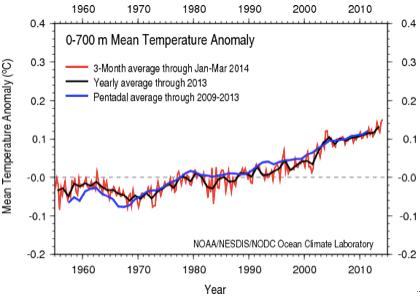
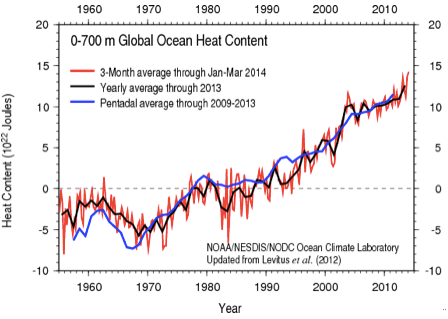
In my articles I noted that NODC graphs were shown in joules which allowed a steeper slope compared to a temperature trend. Mischievously I suggested an ulterior motive for this. Alarmism.


Another blogger has taken me to task. Rob Ryan has defended the NODC graphs and pointed out that they do indeed have temperature graphs. Indeed they do:


Thanks Rob. By way of comparison here is the same graph in joules:


Well to me the trend slope in the joules graph looks steeper and more alarming than the temperature graph. But Rob doesn’t like OHC as a measure of the energy; it is poor terminology according to Rob. Hey Rob, don’t blame me, argue with NODC and indeed AGW in general; they’re the ones using and relying on it.

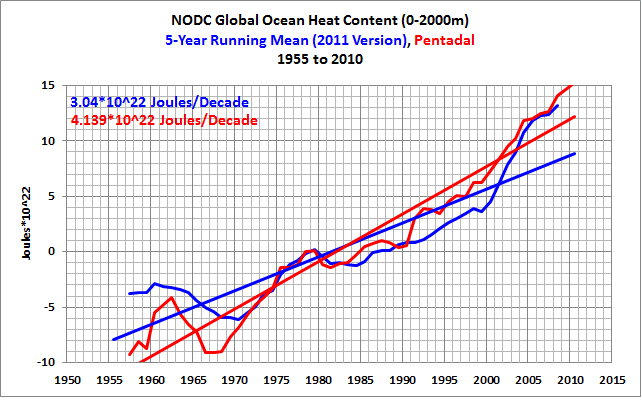
What really is poor is the notion that by any measure the oceans are heating. The estimable Bob Tisdale does a comparison of all OHC measures and produces this graph:


Plainly Hansen’s model on behalf of AGW is off with the pixies while the MET and the NODC show the opposite trend!

A couple of things about this. 

Firstly the ARGO data is adjusted before it is presented. Obviously NODC and the MET adjust it differently. In fact in another post Bob Tisdale examines the NODC adjustment procedure:

At the 700 meters range NODC have increased the trend by 19%. The NODC adjustments increase the trend at 2000 meters by 36%!

Secondly the ARGO data, even though it is the best we have ever had, is vastly insufficient. Willis Eschenbach notes:

  • The sampling of the oceans is by no means as uniform as I had expected. Part of the ocean is under sampled, sometimes badly so, compared to other areas. Half of the global ocean has been sampled less than 20 times per 10,000 sq. km, and 14% has never been sampled by Argo floats at all.
  • Even when we look at just the area from 60°N/S, half the ocean has been sampled less than 24 times per 10,000 sq. km, and 8% is unsampled.
  •  The area of the El Nino phenomenon is a critical area for the regulation of planetary heat loss. Oceanic heat content in this area can change quite rapidly. However, parts of it are woefully undersampled.
  • Finally, the older Argo floats sample either down to 1,000 metres, and intermittently go to 1,500 metres depth. The newer ones go down to 1800 metres. Which is quite deep, about a mile down. But the estimates of oceanic heat storage include the whole ocean. Figure 3 shows a pair of transects from Antarctica (on the left) to Hawaii, and then Hawaii to Alaska on the right, to give some sense of scale.

Figure 3 (Figure 10 from cited source.) North/South Pacific transect at 150°W.  ORIGINAL CAPTION: Vertical section of potential temperature (°C) along 150°W from data collected in 1991-1993 as part of the World Ocean Circulation Experiment. Data north of Hawaii were collected in 1984 (Talley et al., 1991). Potential temperature is the temperature a parcel of water would have if moved to the sea surface with no change in heat content, and is lower than measured temperature since temperature increases when water is compressed due to the high pressure in the ocean.

The Argo floats operate mostly in the warmer area up top of Figure 3, above the lower thermocline (light blue). Average depth in this entire transect is much deeper than that, about 5,000 metres. So the Argo floats are measuring less than a quarter of the water in this part of the Pacific basin. Makes the whole question of oceanic heat content kinda iffy.

Kinda iffy is a vast understatement! The ARGO floats don’t even go to 2000 meters and yet we have temperature profiles at that depth.

The only reasonable conclusion is that based on the best data from ARGO the oceans are not warming, whether you are considering joules or temperature.

Thanks again Rob; by my reckoning that is another nail in the AGW coffin.

Wind is free? Not on your life! The Price we Pay is OUTRAGOUS!

“The Wind is Free” and other

          pork pies (lies)

In May of this year the Department of Communications, Energy and Natural

Resources launched the “Green Paper on Energy Policy in Ireland”. Many

of my readers probably have not read the Paper, and who could blame you? Some

of you might have battled though parts of it, some of you might have read the

executive summary. I dragged myself through the whole thing and the recurring

thought that flashed through my mind was “hot air, lots of it”. This thought was quite

appropriate as the document, although pretending to be a comprehensive renewable

energy policy, was little more than an homage to the wind farm.

Rather than go through the entire sordid document, I thought that over two days I

would look at two recurring themes in this Green paper about wind energy and show

them for what they are: calculated, but nevertheless blatant, lies.

.
Lie #:1 Wind energy is a “free and plentiful” form of energy

Let’s just get one thing straight from the outset: Any form of renewable energy

is not cheap, andmost certainly not free.

Renewable energy is far more expensive than energy from coal, for example,

which is very cheap but also very dirty. Coal is so cheap at the moment that the

ESB are actually buying more and more (American) coal for MoneyPoint, which

seems a bit daft when the poor consumer is payingmore and more for the electricity

coming from the wind farms. Somebody’s getting rich but it ain’t you or me.  This is not

something we are doing to save money. It is something we are doing to save the planet;

and because the EU (ruled by the wind industry) has a gun to our head. So when the

Minister talks about how the wind is free and doesn’t Ireland have a lot of it, that is a

blatant lie. If we accept that we need renewable energy, and that we are going to pay

though our noses for that renewable energy, does it not make sense to try and produce

more of the cheaper forms of renewable energy?

Wind is the most expensive form of renewable energy. It is also unreliable,

because the wind does not blow all the time, and sometimes it blows too hard and so

the turbine is shut down (before it catches fire), but you pay for it 24/7. Two other far

more reliable forms of energy also happen to be a lot cheaper: biomass and solar.

The cost of energy has become a life or death issue as more and more Irish families

experience fuel poverty –

many citizens simply cannot afford to light or heat their homes. That’s a huge problem,

especially in winter.  Here’s the price comparison:

Wind costs €135 per ton of carbon saved. There are very few jobs in the Irish wind

industry as the turbines and accessories are all built in other countries, and so the

technicians and maintenance crews come from other countries.  The only Irish jobs

would be short-term installation jobs – low skills, poorly paid.

Domestic Solar PV costs €100 per ton of carbon saved, and it would create loads

of  jobs as people would need solar panels fitted on their houses. I know you are going to say

that the sun and Ireland don’t really belong in the same sentence, but these things run on

daylight as opposed to sun, and they really do make a difference.The conversion of

MoneyPoint power station to biomass would cost €60 per ton of carbon saved. That

means it costs less than half the cost of wind! It also means that the huge carbon footprint

of MoneyPoint would rapidly diminish as it stops burning that dirty American coal. Finally,

there would be loads of good long-term jobs as the biomass industry in this country becomes

profitable and so can flourish.

To recap: Any renewable energy is expensive and we must pay for it. There is no such

thing as free green energy. There are three proven sources of renewable energy: wind, sun,

and biomass. Both sun and biomass are cheaper than wind and will create far more Irish

jobs. Finally, the sun and biomass do not need huge pylons

and wind farms, so no loss of tourism, local industries, agriculture and food production, and no

adverse effects on our health.

Now, is that a no-brainer or what?


Could This Be the Dawning of Better Days for the UK? End the Greenscam~!

UK’s new energy and environment ministers opposed green energy

Matthew Hancock called for cuts to wind power subsidies while Liz Truss claimed renewable power was damaging the economy…

Britain's new minister for energy, nusiness and enterprise, Matthew Hancock at 10 Downing Street  on July 15, 2014.
Britain’s new minister for energy, business and enterprise, Matthew Hancock, at 10 Downing Street. Photograph: Suzanne Plunkett/Reuters

The new set of Conservative environment and energy ministers announced on Tuesday bring a track record of opposing renewable energy, having fought against wind and solar farms, enthusiastically backed fracking and argued that green subsidies damage the economy.

New energy minister, Matthew Hancock, signed a letter to David Cameron in 2012 demanding that subsidies for onshore windfarms were slashed. “I support renewable energy but we need to do it in a way that gives the most value for money and that does not destroy our natural environment,” he said at the time.

Hancock, who takes over from Michael Fallon, also opposed new turbines in his Suffolk constituency, arguing: “The visual and other impact of the proposed turbines is completely unacceptable in this attractive rural corner of Suffolk.”

New environment secretary and former Shell employee, Liz Truss, dismissed clean renewable energy as “extremely expensive” and said it was damaging the economy during an appearance on BBC Question Time last October.

“We do need to look at the green taxes because at the moment they are incentivising particular forms of energy that are extremely expensive,” she said. “I would like to see the rolling back of green taxes because it is wrong that we are implementing green taxes faster than other countries. We may be potentially exporting jobs out of the country as our energy is so expensive.”

In 2009, as deputy director of the free-market thinktank Reform, Truss said energy infrastructure in Britain was being damaged by politicians’ obsession with green technology: “Vast amounts of taxpayers’ money are being spent subsidising uneconomic activity,” she said. Research from the London School of Economics recently concluded that green policies were not harming economic growth.

Truss will have a key role in regulating the environmental safety of shale gas exploration and has said fracking would benefit people living nearby. “We need to make sure shale gas is being exploited in this country, which will benefit local communities,” she said on BBC Question Time. As well as fracking, Truss backed “renewable” nuclear power as a way to “hit green targets”.

In her first statement since being appointed as environment secretary, Truss said: “I look forward to tackling the important issues facing our rural communities including championing British food, protecting people from flooding and improving the environment.” She did not mention fracking or the controversial badger cull, which she has supported in parliamentary votes.

Truss, Hancock and another new appointee to the Department of Energy and Climate Change, Amber Rudd, all face conflicts between their new ministerial responsibilities and their previous constituency work.

Truss has spoken out about insufficient flood protection for farmland in her Norfolk South West constituency. But she is now responsible for flood defences and faces a £500m hole in the budget needed to keep pace with the rising flood risk being driven by climate change.

Truss has also been a vocal opponent of an energy-from-waste project – an incinerator – at Kings Lynn. She has opposed solar farms being built and also complained the energy secretary Ed Davey that subsidies helping crops to used to generate energy was making straw difficult to get for pig farmers.

One of the most contentious issues Truss faces will be over the badger
cull. Her East Anglian constituency is far from the bovine TB hotspots in
the west of the UK, but she has been keenly involved in rural issues – for
instance, she is pro-hunting.

Lord Krebs, chair of the sub-group of the Committee on Climate Change that
looks at adaptation to the effects of global warming, said at a meeting of
the all-party environment group in Westminster on Tuesday that he would
wait for a private conversation with Truss before advising her on that.

But he did say that he would offer his advice on badgers and bovine TB – a
subject which the prominent zoologist examined in detail for the previous
Labour government, finding that a cull was not likely to solve the
problem.

He told the Guardian: “I would say don’t be so focused on killing badgers
(as a way of controlling the disease) but go back and look at all the
policy options.”

Hancock has opposed both windfarms and new housing developments, while Rudd has raised her constituents safety fears about the Dungeness nuclear power plant in her constituency. Rudd, whose represents the coastal constituency of Hastings and Rye, has been praised by campaigners for supporting sustainable fishing and has raised questions about how government energy efficiency programmes would help social housing.

The Renewable Energy Association said it looked forward to working with Truss, Hancock and Rudd. The trade body’s chief executive, Dr Nina Skorupska, said of the outgoing Greg Barker, who Rudd replaces: “Not only did he bring stability to the department, he also brought passion and enthusiasm.”

Truss, Hancock and Rudd appear not to have made any public statements about climate change.

Frauds, Crooks and Criminals

Demonstrating daily that diversity is not strength!

Family Hype

All Things Related To The Family

DeFrock

defrock.org's principal concern is the environmental and human damage of industrial wind turbines on rural communities

Gerold's Blog

The truth shall set you free but first it will make you miserable

Politisite

Breaking Political News, Election Results, Commentary and Analysis

Canadian Common Sense

Canadian Common Sense - A Unique Perspective from Grassroots Canadians

Falmouth's Firetower Wind

a wind energy debacle

The Law is my Oyster

The Law and its Place in Society

Illinois Leaks

Edgar County Watchdogs

stubbornlyme.

My thoughts...my life...my own way.

Oppose! Swanton Wind

Proposed Wind Project on Rocky Ridge

Climate Audit

by Steve McIntyre

4TimesAYear's Blog

Trying to stop climate change is like trying to stop the seasons from changing. We don't control the climate; IT controls US.

Wolsten

Wandering Words

Patti Kellar

WIND WARRIOR

John Coleman's Blog

Global Warming/Climate Change is not a problem