Global Warming Alarmists Hate This!

Claim: ‘One Guy With A Marker Just Made The Global Warming Debate Completely Obsolete.’

I watched the video with interest. He starts off saying he has: “… An argument that leads to a  conclusion even the most ardent skeptic and most panicked activist can agree on. … No one I’ve show it to so far has been able to poke a hole in it. …”


(Source: http://www.upworthy.com/one-guy-with-a-marker-just-made-the-global-warming-debate-completely-obsolete-7?g=2&c=upw1)

GW Dichotomy

As the image from the video indicates, he divides the Global Warming debate into two dichotomies:

  • Global Climate Change (GCC) is “False” (Top Row) or “True” (Bottom Row), and
  • We take Action “Yes” (Column A) or “No” (Column B)

Here are the results he gives for his four boxes:

  1. GCC is False but we unnecessarily take Action. The result is a high “Cost” that results in a “Global Depression”.
  2. GCC is False and we take No Action. The result is a happy face.
  3. GCC is True and we take Action that stops GCC dead in its tracks. The result is a happy face.
  4. GCC is True and we take No Action. The result is “CATASTROPHES [in the] ECONOMIC, POLITICAL, SOCIETAL, ENVIRONMENTAL, [and] and HEALTH” areas.

He ends with the inevitable: “The only choice is Column A” – we must take Action!

“All or nothing”, “Camelot or Catastrophe” arguments have great emotional power in political discourse, where the (usually hidden) assumption is that some things are perfectly TRUE and others are perfectly FALSE. But the real world is mostly in shades of grey. He studiously avoids that complication, because, when shades of grey are considered, his argument, IMHO, falls apart.

Let us take a closer, more realistic look at his four boxes:

  1. GLOBAL DEPRESSION: This box is included to make it appear he is being “fair” to Skeptics. He assumes that taking Action to stop GCC will be so costly that, if it turns out to have been unnecessary, the result will be a “Global Depression”. Certainly, maximum environmental spending will damage the world-wide economy, but I doubt that type of spending, alone, will trigger a “Global Depression”. When we get to box #3 we will see that he doesn’t really think so either!
  2. HAPPY FACE: GCC is “False”, we take No Action, so all is well! But, is it? Does his “GCC” include NATURAL PROCESSES and CYCLES that have caused Global Warming (and Cooling), Floods (and Droughts), and Violent Storms (and Blessed Rain) prior to the advent of Humans on Earth, and before we Humans had the capability to affect the climate? Apparently not, else “GCC” could not be totally “False”.  Therefore, by “GCC” he is referring ONLY to the HUMAN-CAUSED variety, totally ignoring the evidence from the geological, ice-core, and historical records of NATURAL Global Climate Change and some Catastrophes.
  3. HAPPY FACE: This box is totally inconsistent with box #1! If Action to stop Human-Caused Global Warming is so costly as to cause a Global Depression in the first box, would it not also cause such a Global Depression in this box? So, why the Happy Face? Realistically, even if we in the US and other nations in the Developed World take maximum Action to reduce our CO2 emissions, it is totally unrealistic to expect those in the Developing World to do the same. Indeed, China, India, and other countries will continue to build power plants, nearly all of them coal-fired. CO2 levels are bound to continue their rapid increase for at least the coming several decades, no matter what we do.
  4. TOTAL CATASTROPHE: This box is filled with terrible consequences and is intended to scare us into taking maximum Action. He assumes the worst-case Global Warming of several degrees predicted by Climate Models despite the failure of those Climate Models to predict the past 17 years of absolutely no net Global Warming. (The most realistic prediction is continued moderate change in Global Temperatures, mostly NATURAL but some small part HUMAN-CAUSED. As standards of living continue to improve world-wide, populations will stabilize which will allow reasonable action to be taken to moderate CO2 emissions, and Human Civilization will ADAPT to inevitable Natural and Human-Caused Climate Change as we have throughout history.)

Bottom Line: This “One Guy With A Marker” DID NOT MAKE “The Global Warming Debate Completely Obsolete.” His failures of logic:

  • He assumes HUMAN-CAUSED Climate Change is the only kind we need to worry about, which flies in the face of the fact that most Global Climate Change has been and continues to be NATURAL, and not under Human control or influence.
  • He assumes costly Action to prevent GCC will cause a GLOBAL DEPRESSION (box #1) if GCC is “False”, but the same costly Action will cause a HAPPY FACE (box #3) if GCC is “True”. Box #3 contradicts box #1.
  • He ignores the fact that GCC models have way over-predicted Global Warming. For example, taking 1979 (when worldwide Satellite temperature data came available) as a starting point, the average of 102 Global Climate Models predicted warming of 0.9°C (1.5°F) by 2013. Actual warming from 1979 to 2013 has been less than a quarter of that, and there has been no net Global Warming since 1997.  During this time period, CO2 levels have continued their rapid rise. (See http://wattsupwiththat.com/2014/01/12/global-warming-is-real-but-not-a-big-deal-2/)
  • He assumes “All or Nothing at all” and “Camelot or Catastrophe” which is the characteristic of irresponsible EMOTIONAL argument. He ignores the shades of grey in-between. He brings POLITICAL rhetoric to what should be a rational SCIENTIFIC discussion.

Ira Glickstein

The Faux-Green Thieves, use the Environment Fears to Extort Money!

Environmental shakedown through bastardized application of science, policy, and education

Disgruntled ex-federal employees found a way to bilk taxpayers out of millions of dollars using the flawed Endangered Species Act

  • FourCorners

Over a 3-year period, 2009-2012, Department of Justice data show American taxpayers footed the bill for more than $53 million in so-called environmental groups’ legal fees—and the actual number could be much higher. The real motivation behind the Endangered Species Act (ESA) litigation, perhaps, could have more to do with vengeance and penance than with a real desire to protect flora and fauna.

On May 7, I spoke at the Four Corners Oil and Gas Conference in Farmington, New Mexico. During the two-day event, I sat in on many of the other sessions and had conversations with dozens of attendees. I left the event with the distinct impression that the current implementation of the ESA is a major impediment to the economic growth, tax revenue, and job creation that comes with oil-and-gas development. I have written on ESA issues many times, most recently I wrote about the lesser prairie chicken’s proposed “threatened” listing (which the Fish and Wildlife Service [FWS] listed on March 27) and the Oklahoma Attorney General’s lawsuit against the federal government over the “sue and settle” tactics of FWS and the Department of the Interior.

GunnisonsagegrouseWhile at the conference, I received an email announcing that FWS has asked a federal court for a 6-month delay in making a final determination on whether to list the Gunnison sage grouse as an endangered species—moving the decision past the November elections. Up for re-election, Senator Mark Udall(D-CO) “cheered” the extension request. The E & E report states: Colorado elected leaders “fear the listing could have significant economic impacts.”

Kent Holsinger, a Colorado attorney specializing in lands, wildlife, and water, posited: “Senator Udall is among those lauding the move—perhaps because a listing decision would affect his fate in the U.S. Senate. Gunnison sage grouse populations are stable, if not on the increase. In addition, myriad state, local and private conservation efforts have been put into place over the last decade. Those efforts, and the Gunnison sage grouse, are at risk if the FWS pursues listing.”

The report continues: “WildEarth Guardians is not opposing the latest extension after Fish and Wildlife agreed to some extensive new mitigation measures that will be made in the interim, including increasing buffer zones around sage grouse breeding grounds, called leks, and deferring coal, oil and gas leasing, said Erik Molvar, a wildlife biologist with WildEarth Guardians.” It goes on to say: “But the Center for Biological Diversity, which is a party to the settlement agreements with WildEarth Guardians, said the latest extension is a bad move for the grouse, which it says has needed ESA protections for years.”

Two important items to notice in the Gunnison sage grouse story. One, the power the environmental groups wield. Two, part of appeasing the environmental groups involves “deferring coal, oil and gas leasing.”

It is widely known that these groups despise fossil fuels. The Center for Biological Diversity (CBD) brags about its use of lawsuits to block development—but it is not just oil and gas they block, it is virtually all human activity.

In researching for this week’s column, I have talked to people from a variety of industry and conservation efforts. The conversations started because I read something they’d written about CBD. Whether I was talking to someone interested in protecting big horn sheep, a fishing enthusiast, or an attorney representing ranching or extractive industries, CBD seems to be a thorn in their side. All made comments similar to what Amos Eno, who has been involved in conservation for more than 40 years, told me: “CBD doesn’t care about the critters. They are creating a listing pipeline and then making money off of it.” Environmental writer Ted Williams, in a piece on wolves,called CBD: “perennial plaintiffs.”

New Mexico rancher Stephen Wilmeth directed me to a CBD profile he had written. In it he addressed how the CBD’s efforts targeted livestock grazing and sought “the removal of cattle from hundreds of miles of streams.” Wilmeth states: “CBD has elevated sue and settle tactics, injunctions, new species listings, and bad press surrounding legal action to a modern art form. Consent decrees more often than not result in closed door sessions with concessions or demands made on agency policy formulation.”

In a posting on the Society for Bighorn Sheep website titled: Legal tactics directly from the Center for Biological Diversity, board member Gary Thomas states: “The Center ranks people second. By their accounting, all human endeavors, agriculture, clean water, energy, development, recreation, materials extraction, and all human access to any space, are subordinate to the habitat requirements of all the world’s obscure animals and plants. But these selfish people don’t care about any person, plant, or animal. The Center collects obscure and unstudied species for a single purpose, specifically for use in their own genre of lawsuits. They measure their successes not by quality of life for man nor beast, but by counting wins in court like notches in the handle of a gun.”

You’d expect someone like me, an energy advocate, to dis the CBD—and I have (CBD is not too fond of me)—but how did it get such a broad-based collection of negativity from within the environmental community?

Ted Williams told me: “Environmentalists who are paying attention are not happy with CBD.” He has written the most comprehensive exposé on CBD that can be found—for which he was threatened with a lawsuit. Without Williams’ work, one has to resort to bits and pieces off the internet to put together CBD’s modus operandi—but there is plenty to choose from!

One of the most interesting ones to catch my eye was a part of the post on SheepSociety.com. There, Thomas points out the fact that the three founders of CBD are ex-Forest Service workers. He states: “To donors, their motives appear altruistic. To the informed, they look more like a 20-year quest for revenge for their firing.”

I am fairly well acquainted with CBD, but Thomas’ accusation was new to me—though it fit what I knew. (One of the very first pieces I ever wrote, when I originally got into this work seven plus years ago, was on the one and only legal victory ever won against CBD. Arizona rancher Jim Chiltonwon a defamation suit against CBD with a $600,000 settlement. Nearly everyone I talked to as a part of my research for this story mentioned Chilton’s name with reverence.

I dug around and found an interesting story from Backpacker magazine that gave credence to Thomas’ claim. The February 2003 issue features a multi-page profile on Kieran Suckling, co-founder and executive director. Addressing the three founders, who were working for the Forest Service, Backpacker reports: “All three of them were frustrated by their agencies’ inaction.” The story KieranSuckling-2012.jpgtcurry2goes on to explain how the threesome “hatched a plan” to petition the Forest Service and force it to list the spotted owl.

Then, I found a 2009 profile on Suckling in High Country News (HCN). It quotes Suckling describing how the roots of his full-time activism started while working for the Forest Service doing spotted owl surveys: “We had signed contracts saying we wouldn’t divulge owl locations, but we went the next day to the Silver City Daily Press, with a map that told our story. We were fired within seconds. That was the start of us becoming full-time activists.”

These snippets help explain Suckling’s animosity toward the Forest Service and other government agencies. CBD is gleeful over its results. It has sued government agencies hundreds of times and has won the majority of the cases—though many never go to court and are settled in a backroom deal (hence the term: “sue and settle”). Thomas writes: “They are extremely proud to report that single-handedly they deplete the U.S. Fish and Wildlife’s entire annual budget, approximately $5 million, for endangered species listings year after year by forcing them to use their limited funds defending lawsuits instead of their intended purpose.”

The HCN piece describes Suckling’s approach to getting what he wants—which he explains in theNew Yorker, as “a new order in which plants and animals are part of the polity”: “The Forest Service needs our agreement to get back to work, and we are in the position of being able to powerfully negotiate the terms of releasing the injunction. … They [federal employees] feel like their careers are being mocked and destroyed—and they are. So they become much more willing to play by our rules and at least get something done. Psychological warfare is a very underappreciated aspect of environmental campaigning.”

“In CBD speak,” adds Wilmeth, “the suggestion of playing by the rules equates to its rules of manipulating positive outcomes for its mission.”

Putting the pieces together, it does appear, as Thomas asserts, that Suckling is on a 20+ year “quest for revenge” for being fired—vengeance that American taxpayers are funding.

Suckling is an interesting character. The Backpacker story cites his ex-wife, who said the following: “He’s not tethered on a daily basis to the same things you and I are tethered to.”

Tierra Curry is another name that comes up frequently in CBD coverage. CBD’s staff section of the website lists her as “senior scientist” and says she “focuses on the listing and recovery of endangered species.” As Warner Todd Huston reports: “Curry has an odd profile for an activist. She once claimed to have enjoyed dynamiting creek beds in rural Kentucky and taking perverse pleasure at sending fish and aquatic animals flying onto dry land and certain death. Now Curry spends her time filing petitions to ‘save’ some of the same animals she once enjoyed killing.”

Perhaps Curry’s frenetic listing efforts are her way of doing penance for her childhood penchant of killing critters.

The role vengeance and penance may play in CBD’s shakedown of the American public is just a hypothesis based on facts. But the dollars paid out are very real.

In an April 8, 2014, hearing before the House Committee on Natural Resources, fifth-generation rancher and attorney specializing in environmental litigation, Karen Budd-Falen talked about the need for ESA reform, as four different House bills propose: “Public information regarding payment of attorney’s fees for ESA litigation is equally difficult to access.” Addressing HR 4316—which requires a report on attorney’s fees and costs for ESA related litigation—she says: “It should not be a radical notion for the public to know how much is being paid by the federal government and to whom the check is written.”

As she reports in her testimony, Budd-Falen’s staff did an analysis of the 276-page spreadsheet run released by the Department of Justice (DOJ) listing litigation summaries in cases defended by the Environment and Natural Resources Division, Wildlife Section. She explains: “The spreadsheets are titled ‘Endangered Species Defensive Cases Active at some point during FY09-FY12 (through April 2012).’ Although the DOJ release itself contained no analysis, my legal staff calculated the following statistics.”

Budd-Falen then shows how she came up with the nearly $53 million figure of taxpayer money paid out over an approximate 3-year period. However, she then shows how her own Freedom of Information Act requests have proven “that the DOJ does not keep an accurate account of the cases it defends”—making the actual dollar figure much higher.

Budd-Falen has stated: “We believe when the curtain is raised we’ll be talking about radical environmental groups bilking the taxpayer for hundreds of millions of dollars, allegedly for ‘reimbursement for attorney fees.’”

Budd-Falen’s research shows that for groups like CBD—who sue on process not on substance—it really is about the money.

Eno believes that for the CBD, it isn’t about the critters: “CBD endangers the endangered species program on multiple fronts.

* First, their petitions and listing suits use up significant financial and personnel resources of both Office of Endangered Species and solicitors office in DOI. This means less funding and personnel devoted to species recovery.

* Second, CBD suits antagonize and jeopardize recovery programs of cooperating federal land management agencies, particularly USFS and BLM.

* Third, their suits have hampered forest and grassland management thereby inviting forest fires which endanger both human and wildlife (sage grouse) communities throughout the west.

* Fourth, CBD suits antagonize, alienate and create financial hardship for affected private land owners, thereby reducing both public support and initiatives and active assistance for listed species recovery.”

Despite numerous attempts, the ESA has not had any major revisions in more than 25 years. TheWall Street Journal states: “The ESA’s mixed record on wildlife restoration and its impact on business have made the law vulnerable to critics.” Groups like CBD have twisted the intent of the law. Reform is now essential—not just to save taxpayer dollars, but to put the focus back on actually saving the species rather than, as Wilmeth calls it: “the bastardized application of science, policy, and education.”

– See more at: http://www.cfact.org/2014/05/14/environmental-shakedown-through-bastardized-application-of-science-policy-and-education/#sthash.JPqu7obU.dpuf

The Faux-Green Renewables Scam is Dripping with Outrageous subsidies!!

Big Green’s untold billions

Mainstream media don’t know Big Green has deeper pockets than Big Oil

  • Big Green follow the money CFACT Org

The “Kill Keystone XL” crowd isn’t little David up against a Big Oil Goliath. As usual, conventional wisdom isn’t wisdom when the mainstream media ask all the wrong questions with commensurate answers.

Behemoth Big Green outstrips Big Oil in expendable revenue by orders of magnitude — if you know how to follow the money.

The mainstream media don’t know how. Like most liberals, their staffs are afflicted with what 20th century futurist Herman Kahn called “Educated Incapacity” — the learned inability to understand or even perceive a problem, much less a solution.

They’ve been taught to be blind, unable to see Big Green as having more disposable money than Big Oil, so they don’t look into it.

They would never discover that the American Petroleum Institute’s IRS Form 990 for the most recent year showed $237.9 million in assets while the Natural Resources Defense Council reported $241.8 million.

Nor would they discover who started the anti-Keystone campaign in the first place. It was the $789 million Rockefeller Brothers Fund (established in 1940). The fund’s program is elaborated in a 2008 PowerPoint presentation called “The Tar Sands Campaign” by program officer Michael Northrop, who set up coordination and funding for a dozen environmental and anti-corporate attack groups to use the strategy, “raise the negatives, raise the costs, slow down and stop infrastructure, and stop pipelines.” Tom Steyer’s $100 million solo act is naive underclass nouveau cheap by comparison.

Mainstream reporters appear not to be aware of the component parts that comprise Big Green: environmentalist membership groups, nonprofit law firms, nonprofit real estate trusts (The Nature Conservancy alone holds $6 billion in assets), wealthy foundations giving prescriptive grants, and agenda-making cartels such as the 200-plus member Environmental Grantmakers Association. They each play a major socio-political role.

Invisible fact: the environmental movement is a mature, highly developed network with top leadership stewarding a vast institutional memory, a fiercely loyal cadre of competent social and political operatives, and millions of high-demographic members ready to be mobilized as needed.

That membership base is a built-in free public relations machine responsive to the push of a social media button sending politically powerful “educational” alerts that don’t show up on election reports.

Big Oil doesn’t have that, but has to pay for lobbyists, public relations firms and support groups that do show up on reports.

You don’t need expert skills to connect the dots linking Keystone XL to Alberta’s oil sands to climate change to Big Green.

On the other hand, you do need detailed knowledge to parse Big Green into its constituent parts. I spoke with CFACT senior policy analyst Paul Driessen, who said, “U.S. environmental activist groups are a $13-billion-a-year industry — and they’re all about PR and mobilizing the troops.

“Their climate change campaign alone has well over a billion dollars annually, and high-profile battles against drilling, fracking, oil sands and Keystone get a big chunk of that, as demonstrated by the Rockefeller assault.”

Driessen then identified the most-neglected of all money sources in Big Green: “The liberal foundations that give targeted grants to Big Green operations have well over $100 billion at their disposal.”

That figure is confirmed in the Foundation Center database of the Top 100 Foundations. But how much actually gets to environmental groups? The Giving USA Institute’s annual reports show $80,427,810,000 (more than $80 billion) in giving to environmental recipients from 2000 to 2012.

I checked the U.S. Chamber of Commerce and found $147.3 million in assets while environmental donor Gordon E. and Betty I. Moore Foundation posted $5.2 billion.

Driessen pointed out another unperceived sector of Big Green: government donors. “Under President Obama, government agencies have poured tens of millions into nonprofit groups for anti-hydrocarbon campaigns.”

Weather Channel co-founder John Coleman adds, “The federal government is currently spending $2.6 billion [per year] on climate change research (and only those who support the “carbon dioxide is a pollutant/major greenhouse gas’ receive funding).”

This web of ideological soul-mates, like all movements, has its share of turf wars and dissension in the ranks, but, as disclosed on conference tapes I obtained, it shares a visceral hatred of capitalism, a worshipful trust that nature knows best, and a callous belief that humans are not natural but the nemesis of all that is natural.

Lawyer Christopher Manes wrote “Green Rage: Radical Environmentalism and the Unmaking of Civilization.” Manes now practices tax litigation from his law office in Palm Springs, Calif., which he has not yet unmade.

The legal branch of Big Green is varied. Earthjustice, (formerly Sierra Club Legal Defense Fund) raked in $133.8 million in the past five years – comparable to many similar law organizations. Highly litigative attack groups receiving federal settlements are numerous and thriving, such as the Center for Biological Diversity ($29.2 million in the past five years).

It’s not unusual for heirs of big money to dream of unmaking the source of their wealth: Laura Rockefeller Chasin of the Rockefeller Family Fund once said, “It’s very hard to get rid of the money is a way that does more good than harm. One of the ways is to subsidize people who are trying to change the system and get rid of people like us.”

The money reported to the Federal Election Commission is barely the beginning of what’s really happening. It doesn’t show you Big Green’s mobilized boots on the ground, the zooming Twitter tweets, the fevered protesters, the Facebook fanatics or the celebrities preaching carbon modesty from the lounges of their private jets.

When self-righteous victims of Educated Incapacity insist that Big Oil outspends the poor little greenies, keep in mind the mountains of IRS Form 990s filed by thousands of groups, land trusts, lawyer outfits, foundations, and agenda-makers, just waiting for America to wake up and smell Big Green’s untold hundreds of billions.

____________

This article originally appeared in The Washington Examiner

– See more at: http://www.cfact.org/2014/05/14/big-greens-untold-billions/#sthash.u6BIT3H8.dpuf

Science has turned into a Propaganda Machine!!!

Shameless Climate McCarthyism on full display – scientist forced to resign

Climate McCarthyism: “Have you now or have you ever been a climate skeptic?”.

joseph-mccarthy

Hans von Storch reports on an email that I also received today, but held waiting on a statement from The GWPF. Since von Storch has already published the email, breaking my self-imposed embargo, I’ll add the GWPF statement when it becomes available.

von Storch writes:


In an e-mail to GWPF, Lennart Bengtsson has declared his resignation of the advisory board of GWPF. His letter reads :

“I have been put under such an enormous group pressure in recent days from all over the world that has become virtually unbearable to me. If this is going to continue I will be unable to conduct my normal work and will even start to worry about my health and safety. I see therefore no other way out therefore than resigning from GWPF. I had not expecting such an enormous world-wide pressure put at me from a community that I have been close to all my active life. Colleagues are withdrawing their support, other colleagues are withdrawing from joint authorship etc. I see no limit and end to what will happen. It is a situation that reminds me about the time of McCarthy. I would never have expecting anything similar in such an original peaceful community as meteorology. Apparently it has been transformed in recent years.

Under these situation I will be unable to contribute positively to the work of GWPF and consequently therefore I believe it is the best for me to reverse my decision to join its Board at the earliest possible time.”

I am reproducing this letter with permission of Lennart Bengtsson.


Source: http://klimazwiebel.blogspot.nl/2014/05/lennart-bengtsson-leaves-advisory-board.html

Wikipedia says:

McCarthyism is the practice of making accusations of disloyalty, subversion, or treason without proper regard for evidence. It also means “the practice of making unfair allegations or using unfair investigative techniques, especially in order to restrict dissent or political criticism.

This sort of witch hunt for the imagined sin of being affiliated with a climate skeptics group is about as anti-science (to use the language of our detractors) as you can get.

I keep waiting for somebody in science to have this Joseph N. Welch moment, standign  up to climate bullies:

Have you no sense of decency, sir? At long last, have you left no sense of decency?

Nothing will change in the rarefied air of climate debate unless people are allowed to speak their minds in science without such pressure. The next time somebody tells you that “science is pure”, show them this.

Wind Power? Wind = Powerless!

Wind Power Myths BUSTED

mythbusters2

As the Australian wind industry’s house of cards collapses, its parasites and paid spruikers – like the Clean Energy Council – have been working up a real sweat in their efforts to make a case for the retention of the mandatory Renewable Energy Target – upon which that house of cards entirely depends.

All manner of fictions are being relied upon, most of which we’ve all heard before – crackers like: wind power has REDUCED household power bills; wind power has created thousands of “green” jobs; wind power is cost competitive with conventional power generation sources; and that giant fans are literally sucking CO2 out of the atmosphere.

In this episode of STT Mythbusters, we thought we’d tackle 3 of the biggest myths peddled about wind power by its dwindling group of hard-pressed supporters.

Myth #1: “the distributed network myth”.

This is the often told tale about wind power providing “base-load” power (ie available on-demand and around-the-clock) when wind farms are spread over a large geographical area and connected to the same grid. This myth is based on the story that the “wind is always blowing somewhere” – spread fans far and wide and there will always be oodles of wonderful “free” wind power available on-demand.

Myth #2: “wind farms in Australia produce enough energy to power 1.7m homes”.

Variants of this myth pop up as: “the Woodlawn [insert name] wind farm will “power” 32,000 homes [or simply insert any made-up figure you like]” (see our post here).

Myth #3: “wind power is a substitute for fossil fuel generation sources”.

This myth is trotted out to support wild claims about wind power completely displacing coal and gas-fired power plants, thereby eliminating CO2 emissions in the electricity sector, altogether. This myth is tied up with Myth #1 – relying upon the myth that wind power provides “base-load” power. One lesser version of the myth is that wind power is capable of being a perfect substitute for coal and gas (some day) – provided that 10s of thousands of new giant fans are added to the grid.

At STT Mythbusters we don’t just tell the myths, we put them to the test. So let’s take a look at some data from the last month, courtesy ofhttp://windfarmperformance.info/.

In this episode, we’ll look at data for the entire Eastern Grid – which covers every wind farm in Victoria, Tasmania and New South Wales, as well as including the 1,203 MW of installed capacity that comes from Australia’s “wind power capital” – South Australia. All of these wind farms are connected to the Eastern Grid and together have a total installed capacity of 2,660 MW. Oh, and if our data looks a little fuzzy, click on the image, it will pop up in a new window, use your magnifier and it will look crystal clear.

Nat 16.4.14

Entire Eastern Grid – 16 April 2014 – from 8am to 12 noon (4hrs) and from 6pm to midnight (6hrs):

Total wind farm output: 8am to 12 noon – less than 165 MW, falling to 90 MW; 6pm to midnight – less than 80 MW, falling to less than 50 MW.

Output as a percentage of total installed wind farm capacity: 8am to 12 noon – 6.2%, falling to 3.3%; 6pm to midnight – 3%, falling to 1.9%.

Total demand (average): 22,000 MW.

Contribution to total demand as a percentage: 0.75%, falling to 0.22%.

Nat 17.4.14

Entire Eastern Grid – 17 April 2014 – from midnight to 11am (11hrs) and from 6pm to 9pm (3hrs):

Total wind farm output: midnight to 11am – less than 80 MW and generally less than 60 MW; 6pm to 9pm – less than 140 MW, falling to 80 MW.

Output as a percentage of total installed wind farm capacity: midnight to 11am – 3%, falling to 2.2%; 6pm to 9pm – 5.2%, falling to 3%.

Total demand (average): 22,000 MW.

Contribution to total demand as a percentage: midnight to 11am and 6pm to 9pm – between 0.27% and 0.63%.

Nat 19.4.14

Entire Eastern Grid – 19 April 2014 – from 8am to 1pm (5hrs) and from 7pm to 11pm (4hrs):

Total wind farm output: 8am to 1pm – less than 180 MW, falling to 90 MW; 7pm to 11pm – around 45 MW.

Output as a percentage of total installed wind farm capacity: 8am to 1pm – between 3.4%, and 6.7%; 7pm to 11pm – 1.7%.

Total demand (average): 19,000 MW.

Contribution to total demand as a percentage: 8am to 1pm and 7pm to 11pm – between 0.23% and 0.94%.

Nat 30.4.14

Entire Eastern Grid – 30 April 2014 – from 8am to midnight (16hrs):

Total wind farm output: 8am to midnight – never more than 380 MW, generally less than 300 MW, and falling to less than 40 MW (10pm to midnight).

Output as a percentage of total installed wind farm capacity: 8am to 10pm – between 5% and 14%; 10pm to midnight – 1.5%.

Total demand (average): 23,500 MW.

Contribution to total demand as a percentage: 8am to midnight – between 0.17% and 1.62%.
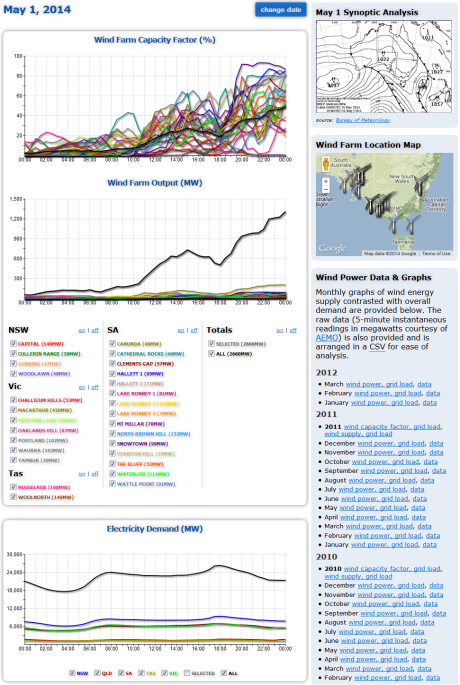
Nat 1.5.14

Entire Eastern Grid – 1 May 2014 – from midnight to 10am (10hrs):

Total wind farm output: midnight to 10am – never more than 150 MW and generally less than 100 MW.

Output as a percentage of total installed wind farm capacity: midnight to 10am – between 3.75% and 5.6%.

Total demand (average): 23,500 MW.

Contribution to total demand as a percentage: midnight to 11am – between 0.42% and 0.64%.

Nat 6.5.14

Entire Eastern Grid – 6 May 2014 – from 10am to midnight (14hrs):

Total wind farm output: from 10am to midnight – never more than 280 MW, dipping to 210 MW around 3pm.

Output as a percentage of total installed wind farm capacity: from 10am to midnight – around 10.5%, dipping to 7.8% around 3pm.

Total demand (average): 23,500 MW.

Contribution to total demand as a percentage: 10am to midnight – between 0.89% and 1.2%.

Nat 11.5.14

Entire Eastern Grid – 11 May 2014 – from 4am to 4pm (12hrs); and 5pm to midnight (7hrs):

Total wind farm output: from 4am to 4pm – never more than 370 MW; from 5pm to midnight – never more than 240 MW, dipping to 130 MW around 11pm.

Output as a percentage of total installed wind farm capacity: from 4am to 4pm – around 14%; from 5pm to midnight – around 9%, dipping to 4.9% around 11pm.

Total demand (average): 21,500 MW.

Contribution to total demand as a percentage: 4am to midnight – between 0.60% and 1.72%.

Nat 12.5.14

Entire Eastern Grid – 12 May 2014 – from midnight to 7pm (19hrs):

Total wind farm output: (from midnight to 7pm) never more than 240 MW, generally less than 170 MW and dipping to around 100 MW between 5pm and 6pm.

Output as a percentage of total installed wind farm capacity: from midnight to 7pm – no more than 9%, generally around 6.4% and dipping to 3.8% around 5pm.

Total demand (average): 23,500 MW.

Contribution to total demand as a percentage: (from midnight to 7pm) between 0.42% and 1.02%.

For more STT Mythbuster’s data see our posts here and here and hereand here and here.

Now back to the workshop with the data to test the myths.

Myth #1: “the distributed network myth”.

Eastern grid3

On the Eastern Grid Australia’s wind farms are spread from: Jamestown in the Mid-North, west to Cathedral Rocks on lower Eyre Peninsula and south to Millicent in South Australia; down to Cape Portland (Musselroe) and Woolnorth (Cape Grim) in Tasmania; all over Victoria; and right up to Cullerin on the New South Wales Tablelands.

Those wind farms have hundreds of fans spread out over a geographical expanse of 632,755 km². That’s an area which is 2.75 times the combined area of England (130,395 km²) Scotland (78,387 km²) and Wales (20,761 km²) of 229,543 km².

Nowhere else in the world are so many interconnected wind farms spread over such a large geographical expanse. If there was a shred of substance to the distributed network myth, then we’d see it in the data above. But it just ain’t there.

When you have 2,660 MW of installed capacity – connected and spread over an area more than twice the size of Great Britain – producing less than 200 MW for hours on end – and, on plenty of occasions, less than half that figure – the idea that wind power is providing (or could ever provide) “base-load” power – or even power “on demand” – by having wind farms spread far and wide is just silly.

Verdict: Myth #1 – BUSTED.

Myth #2: “wind farms in Australia produce enough energy to power 1.7m homes”. 

True it is that, STT Mythbusters has only presented data from the Eastern Grid, overlooking the roughly 420 MW of installed wind farm capacity in Western Australia (which represents around 14% of the 3,080 MW Australian total). So let’s test Myth # 2 as a myth about “Eastern Australian wind farms “powering” 1.4 million homes.”

At STT Mythbusters the term “powering” means exactly what it says: that when someone – at any time – in any and all of those 1.4 million homes flicks the switch the lights go on or the kettle starts boiling.

The claim about wind farms powering 1.4 million homes depends upon all 2,660 MW of total installed capacity operating and pumping all of that power into the grid.

So, how many homes were, in fact, “powered” by wind farms on 12 May 2014 when – from midnight to 7pm (a period of 19 hours) – every single fan hooked up to the Eastern Grid never produced more than 240 MW, generally produced less than 170 MW and was producing about 100 MW around 5-6pm that day?

STT Mythbusters viewers can run the numbers on any of the data we’ve gathered, and get much the same results.

On rare and brief occasions – and then only for very short spurts – the installed wind farm capacity connected to the Eastern Grid has generated around 2,000 MW, but for the most part produces half that and much, much less.

Hundreds of times each year – for hours on end – those same wind farms collectively produce less than 5% of their installed capacity (see our post here). At the abstract level, that means that 70,000 homes (5% of 1.4 million) could be “powered” by output from wind farms. But that’s not what the myth says.

From the data seen above, there are long periods when actual output struggles to exceed more than 4% of total installed capacity, which completely demolishes Myth #2.

Verdict: Myth #2 – BUSTED.

Myth #3: “wind power is a substitute for fossil fuel generation sources”.

The data above kills this myth stone dead. Intermittent and unpredictable wind power output means that wind power is not – and can never be – a substitute for on-demand generation sources, which obviously includes gas and coal generators.

There are hundreds of occasions each year – like those seen in our data above – when, for hours on end – total wind farm output is less than 10% of installed capacity (or half that and less), but the power that householders and businesses need simply has to come from somewhere.

The alternative, of course, is for households to break out the candles and eat cold tins of baked beans while they wait for the wind to pick up. Some might see a wind power “blackout” as a good opportunity to defrost the deep freeze and everything in it. But every other day?

Widespread blackouts are relatively rare occurrences where a grid relies upon base-load gas and coal plants, with sufficient intermediate (on-demand) generating capacity to meet spikes in demand. A grid trying to rely upon wind power would collapse into chaos within 24 hours.

And it wouldn’t matter if there were 100,000 giant fans connected to the Eastern Grid – the result would be identical. As soon as the wind stops blowing, output plummets and – in the absence of coal and gas powered plants – every home and business would be plunged into silent darkness.

The critical point – as our data shows – is that wind power is not available “on-demand”; and never will be. It will never be a substitute for “on-demand” power sources, which – at the present time – in Australia means gas, coal and hydro power.

Verdict: Myth #3 – BUSTED.

bustedplacard-728291


If People don’t have enough food….why burn it?

The Ethanol Disaster

America’s renewables policy is bad for consumers, the environment, and the global poor.

Creative Commons Attribution-ShareAlike 2.0 Generic (CC BY-SA 2.0)Creative Commons Attribution-ShareAlike 2.0 Generic (CC BY-SA 2.0)Last November, when the Environment Protection Agency (EPA) proposed moderating years of escalating mandates by reducing the amount of ethanol that must be mixed into gasoline, a top ethanol lobbyist seemed perplexed. “We’re all just sort of scratching our heads here today and wondering why this administration is telling us to burn less of a clean-burning American fuel,” Bob Dineen, head of the Renewable Fuels Association, told The New York Times

Here are a few possible reasons why: America’s ethanol requirement destroys the environment, damages car engines, increases gas prices, and contributes to the starvation of the global poor. It’s an unmitigated disaster on nearly every level.

Start with the environment. After all, when the renewable fuel standard (RFS), which since 2005 has set forth a minimum annual volume of renewable fuels nationwide, was first set, one of the primary arguments for mandating ethanol use was that it was a greener, more environmentally friendly source of fuel that released fewer greenhouse gasses into the atmosphere.

This turns out to be complete hogwash. Researchers have known for years that, when the entire production process is taken into account, most supposedly green biofuels actuallyemit more greenhouse gasses than traditional fuels.

Some proponents of the ethanol mandate have argued that the requirement was nonetheless necessary in order to spur demand for and development of more advanced, environmentally friendly biofuel like cellulosic ethanol, which is converted into fuel from corn-farm leftovers. But there are two serious problems with cellosic ethanol. The first is that cellulosic ethanol turns out to be rather difficult to produce; despite EPA projections that the market would produce at least 5 million gallons in 2010 and 6.6 million in 2011, the United States produced exactly zero gallons both years—and just 20,069 gallons in 2012.

The second is that cellulosic ethanol is also bad for the environment. At least in the short-term, the corn-residue biofuels release about 7 percent more greenhouse gases than traditional fuels, according to a federally funded, peer-reviewed study that appeared in the journal Nature Climate Change last month.

The environmental evidence against ethanol seems to mount almost daily: Another study published last week in Nature Geoscience found that in São Paulo, Brazil, the more ethanol that drivers used, the more local ozone levels increased. The study is particularly important because it relies on real-world measurements rather than on models, many of which predicted that increased ethanol use would cause ozone levels to decline.

To make things worse, ethanol requirements are bad for cars and drivers. Automakers say that gasoline blended with ethanol can damage vehicles by corroding fuel lines and injectors. An ethanol glut caused by a misalignment of regulatory quotas and demand has helped drive up prices at the pump. And the product is actually worse: ethanol blends are less energy dense than regular gasoline, which means that cars relying on it significantly worse mileage per gallon.

American drivers have it bad, but the global poor have it far worse. Ethanol requirements at home have helped drive up the price of food worldwide by diverting corn production to energy, which dramatically reducing the available calorie supply. A 25-gallon tank full of pure ethanol requires about 450 pounds of corn—roughly the amount of calories required to feed someone for a year. Some 40 percent of U.S. corn crops go to ethanol production, which in effect means we’re burning food for automobile fuel rather than eating it. Studies by economists at the World Bank have found that a one percent increase in world food prices correlates with a half-percent decrease in calorie consumption amongst the world’s poor. When world food prices spiked between 2007 and 2008, between 20 and 40 percentof the effect was attributable to increased global reliance on biofuels. The effect on world hunger is simply devastating.

Ethanol lobbyists are still pretending the renewable fuels mandate is a success, and Senators from corn-friendly states in the Midwest are still urging the agency not to proceed with the proposed reduction to the mandate. But at this point, ethanol requirements have few serious defenders except the people who profit from its production and the politicians who rely on those people for votes and campaign contributions.

Judging by the cut it proposed last November, even the EPA seems to be wavering. A final regulation has yet to be submitted, but the proposal would reduce the amount of renewable fuels the agency requires this year from 18.15 billion gallons to 15.2 billion gallons. That’sif the EPA sticks to its original plan. The agency is under heavy pressure to moderate its proposed cuts, or avoid them entirely.

Those cuts, if approved, would represent a productive step forward. But they wouldn’t be enough. Congress should vote to repeal the renewable fuel standard entirely. The federal government shouldn’t be telling people to burn less ethanol; it shouldn’t be telling anyone to burn any of it at all.

Unless we get a Conservative Majority….this will be our fate!!!

Constraint payments in Scotland soar by 1,300%

Stirling CastleFrom the Times, 11th May 2014

PAYMENTS to green energy firms under a controversial government scheme that compensates them for wasted power have soared by more than 1,300%.

About £35m has been awarded since the start of the financial year to the owners of 21 renewables projects — all of them in Scotland — because Britain’s power network could not cope with the energy they produced.

The figure is a huge increase on the £2.4m paid in 2011-12 under the UK Department of Energy and Climate Change’s “connect and manage” scheme.

Campaigners warn the compensation payments, paid for by the public through their electricity bills, will continue to increase as more wind farms are built. A 2009 report by Frontier Economics for regulator Ofgem estimated the cost of the scheme would reach £2bn by 2020.

A Question not asked, or answered, yet is would constraint payments be made to a foreign country in the wake of a YES vote on the Independence issue. No doubt Salmond will say ‘YES’ and Danny Alexander ‘NO’. The SNP cadre will blame Westminster, again! But then when did you start believing what any politician says, especially “Tipp ‘Eck”! If it adds cost to rUK fuel bills I think the answer is self evident. Not politically acceptable to the the rUK electorate! Even Milibean should see that 😡 .


Our only Chance, to repair Damage done by McWynnty Gov’t….A Conservative Majority!!


John Raymond Crawford 5:03pm May 11
Provincial Popularity Contest: Hudak not interested, winning, regardless.

May 6th: http://globalnews.ca/news/1313199/ontario-pc-leader-tim-hudak-admits-he-may-not-be-popular/

Hudak admits he won’t win a popularity contest.

May 7th: http://ww2.nationalpost.com/m/wp/blog.html?b=news.nationalpost.com%2F2014%2F05%2F07%2Fformer-top-pc-says-tim-hudak-cannot-win-a-popularity-contest-kathleen-wynne-will-be-re-elected

Hudak told that it IS a popularity contest. Critics name Kathleen Wynne as future winner of popularity contest, predicting liberal minority.

May 11th: http://www.ctvnews.ca/mobile/politics/i-m-not-running-a-popularity-contest-ontario-pc-leader-says-1.1816473

Interesting polls: http://www.cp24.com/news/notes-from-the-campaign-trail-poll-gives-tories-lead-1.1815013

Hudak: ‘I’m not running a popularity contest.’

As of recent polls, asking ‘who would make the best premier’, Hudak leads Wynne by 5-points (34% to 29%), with Horwath in third at 28%.

Recent polls suggest that among likely voters, Conservatives are the most committed to getting to the polls, with NDP voters the least committed. The Conservatives have 44% support among voters who ‘will only miss voting due to an unexpected emergency’.

Hudak joked that he didnt want: “…the power of Hudak mania to overwhelm the power of our ideas.”
(Source: May 11th link).

Hudak’s personal popularity is up two points. 72% of voters want a new government. This is up 4 points this month.

The NDP has remained relatively quiet, and are appartently waiting for the political discourse to shift away from who initiated the election in the first place. Expect the NDP to make a late push, and split the left, as Horwath’s strong popularity polling reasserts itself once voters forgive her for tossing out a government that nobody liked.

It’s more likely to be a Conservative minority or majority.

Hudak is set to stick on-point to a simple job-oriented message, and avoid the ‘foreign workers’ style blunders that hurt him last time around.

Support for Hudak continues to rise as he comes out of the gate, controlling the political conversation with a bold plan, balanced by crystal-clear talking points. “This Campaign is about Jobs.” -Hudak

Vote Conservative. -John Crawford


View Post on Facebook · Edit Email Settings · Reply to this email to add a comment.


Climate alarmists use fear as a sales gimmick!

OF THE DATA — A DESTRUCTIVE EPISODE OF

BAD SCIENCE GONE BERSERK

’600 page litany of doom’: Weather Channel Co-Founder John Coleman slams Federal climate report: A ‘total distortion of the data and agenda driven, destructive episode of bad science gone berserk’

Coleman: ‘When the temperature data could no longer be bent to support global warming, they switched to climate change and now blame every weather and climate event on CO2 despite the hard, cold fact that the “radiative forcing” theory they built their claims on has totally failed to verify.’

‘The current bad science is all based on a theory that the increase in the amount of carbon dioxide in the atmosphere from the exhaust of the burning of fossil fuels leads to a dramatic increase in “the greenhouse effect” causing temperatures to skyrocket uncontrollably. This theory has failed to verify and is obviously dead wrong. But the politically funded and agenda driven scientists who have built their careers on this theory and live well on the 2.6 billion dollars of year of Federal grants for global warming/climate change research cling to this theory and bend the data spread to support the glorified claims in their reports and papers.’

The sky is falling.

“Climate Change” is running wild and disaster is certain unless we immediately stop burning coal and oil and move quickly to “green energy” to eliminate use of fossil fuels. Heat waves, huge floods, powerful storms, droughts and rising seas are on the verge of killing millions of us and destroying our civilization. That is my summary of the new Federal Assessment of Climate Change issued by a Obama administration team of more than 300 specialists guided by a 60-member federal advisory committee produced the report. It was reviewed by federal agencies and a panel of the National Academy of Sciences.

This 600 page litany of doom and gloom has received extensive coverage by the panting anchors of the national media who feel important when tell their audience that “the sky is falling.” Horrible pictures of storms, floods, drought and heat waves leaped out of the TV sets as the New York and Washington DC headquartered media was particularly excited to tell us how the huge increases in floods and storms was the worst in that part of the nation.

If you accept the picture painted by this report, the weather was just right, steady and nice in the historic past but because our industrialized society has powered its heating and air conditioning, its transportation by train, plane, cars and trucks, generated it’s electric power to run our lights, computers, television and smart phones with fossil fuels it has triggered this nightmare of awful storms, droughts and heat waves.

I am deeply disturbed to have to suffer through this total distortion of the data and agenda driven, destructive episode of bad science gone berserk. The only good news is that I least where I am and on the channels and websites I saw I was not further insulted by fawning TV Weathercasters visiting the White House and interviewing the President. I best I can tell, on a national level, that turned out to be a non-event (thank goodness).

Please allow me to hold your attention for a few minutes to explain why I don’t buy into this Climate Change alarmism. The climate of Earth has never been “normal” or stable. It has continuously changed through this planet’s 4.5 billion year history. Powerful storms, floods, droughts, heat waves and ice and snow storms have come and gone as long as Earth has existed.

The current bad science is all based on a theory that the increase in the amount of carbon dioxide in the atmosphere from the exhaust of the burning of fossil fuels leads to a dramatic increase in “the greenhouse effect” causing temperatures to skyrocket uncontrollably. This theory has failed to verify and is obviously dead wrong. But the politically funded and agenda driven scientists who have built their careers on this theory and live well on the 2.6 billion dollars of year of Federal grants for global warming/climate change research cling to this theory and bend the data spread to support the glorified claims in their reports and papers.

When the temperature data could no longer be bent to support global warming, they switched to climate change and now blame every weather and climate event on CO2 despite the hard, cold fact that the “radiative forcing” theory they built their claims on has totally failed to verify.  Continue reading here…..

Global-warming

Rational, Intelligent Climate Scientists, are Skeptical of AGW….No wonder!

1) Lennart Bengtsson: He Knows How Little We Know
Basler Zeitung, 7 May 2014

Hans Jörg Müller

One of the most eminent climate scientists, the Swede Lennart Bengtsson, has defected to the camp of climate sceptics. For the climate debate, this could have beneficial effects.

 «Nur teilweise verstanden»: Der schwedische Klimaforscher Lennart Bengtsson mahnt zur Besonnenheit.
“Only partially understood”: The Swedish climate scientist Lennart Bengtsson calls for prudence and moderation.


How the global climate will develop in coming years and decades, and what influence mankind has upon the climate, is a question that has been discussed with almost religious fervor until a few years ago. That is, there were no discussions really; rather, one of the two parties declared the other insane: “climate denier“ was the term used for those who were of the opinion that global warming does not take place or that it may be warming less rapidly as most scientists believed. In any case, the human impact on climate change was far from proven.

The similarity between “climate denier” and Holocaust denier was intentional: the term should insinuate that anyone who deviated from the widely prevailing consensus was a crank, possibly driven by sinister motives. Above all, very few climate sceptics were leading experts, and this was probably the alarmists’ strongest argument. While climatologists and meteorologists warned and warned, those who were becalming and moderate were often economists. As one of the leading climate sceptics, one ex-politician stood out: Nigel Lawson, Britain’s former Chancellor of the Exchequer and the chairman of the Global Warming Policy Foundation (GWPF).

Thaw 

Gradually, however, the ice seems to be melting – if not at the polar caps, then at least in the climate debates: for the first time, a widely recognized expert has changed camps. Lennart Bengtsson , the Swedish climatologist, meteorologist and former director of the Max Planck Institute for Meteorology in Hamburg, has now joined the GWPF’s academic advisory council.

After his decision was announced Bengtsson was attacked, says Lawson, which shows what kind of emotions the issue can still generate. The reason cited by the 77-year-old scientist for his decision comes in a bone-dry scientific language: The relationship between greenhouse gases and global warming was “complex and only partially understood,” Bengtsson wrote in a commentary for the Swiss newspaper Neue Zürcher Zeitung.

Apart from that, all empirical observations showed that global warming has been “no serious problem up to now.” How the climate would develop in the future only model simulations could show, and these were rather “problematic”.

Nothing is settled 

Bengtsson’s conclusion: “It would be wrong to conclude from the IPCC report and similar reports that the science is settled.” Against this background, so the professor, it would be wrong to undertake any energy transition hastily.

Bengtsson’s arguments do not sound like the radicalism of old age. Rather, he exhorts his colleagues to be more prudent and empirical. For the uninitiated, this approach may be comforting, because the climate debate has long been a highly complex issue. Now, for the first time, an expert like Bengtsson admits that he and others like him fare little better: how the world’s climate will develop in coming years and decades remains pure speculation.

Translation Philipp Mueller

2) Dispute Over Global Warming: Respected Meteorologist Joins Climate Sceptics
Spiegel Online, 5 May 2014 

Axel Bojanowski

A delicate academic matter has disrupted the climate science community: One of the most respected climatologists, Emeritus Max Planck Director Lennart
Bengtsson, has switched to the camp of climate sceptics. In this SPIEGEL ONLINE interview he explains his surprising decision.

One of the most renowned climatologists has changed sides. Lennart Bengtsson, former director of the Max Planck Institute for Meteorology in Hamburg, one of the world’s leading climate research centres, has joined the Academic Advisory Council of theGlobal Warming Policy Foundation (GWPF)…

Bengtsson has always been known for his moderate viewpoints during the hot climate debates of the 1990s. In a SPIEGEL ONLINE interview, he explained his move into the camp of skeptics.

About the person
The meteorologist Lennart Bengtsson, born in 1935, was director of the European Centre for Medium-Range Weather Forecasts from 1981 to 1990, then director of the Max Planck Institute for Meteorology in Hamburg, one of the world’s leading climate research centers. Since his retirement in 2000, he has worked as a professor at the University of Reading in England. He has been given many awards, among them the German Environmental Award of the Federal Foundation for the Environment. He has dealt mainly with the modeling of climate and weather.

SPIEGEL ONLINE: Mr. Bengtsson, why have you joined the climate sceptic Global Warming Policy Foundation?

Bengtsson: I think it is important to enable a broad debate on energy and climate. We urgently need to explore realistic ways to address the scientific, technical and economic challenges in solving the energy problems of the world and the associated environmental problems.

SPIEGEL ONLINE: Why do you think the lobby (sic) group GWPF is particularly suitable?

Bengtsson: Most members of the GWPF’s Academic Advisory Council are economists, and this is a chance for me to learn from some of these highly qualified experts in areas outside my own expertise. I want to contribute there through my meteorological knowledge to open the debate.

SPIEGEL ONLINE: But the people at GWPF do not have the reputation of reconsidering their opinions. Have you also become a so-called climate sceptic?

Bengtsson: I have always been a skeptic, and I think that is what most scientists really are.

SPIEGEL ONLINE: But were you not one of the alarmists 20 years ago? Do you think your position at that time was wrong?

Bengtsson: I have not fundamentally changed my opinion in this area. And I have never considered myself an alarmist, but as a scientist with a critical eye. In this sense, I have always been a skeptic. I have used most of my career to develop models for predicting the weather. I have learned the importance of forecasting validation, i.e. the verification of predictions with respect to what has really happened. So I am a friend of climate forecasts. But the review of model results is important in order to ensure their credibility.

SPIEGEL ONLINE: And here you see a demand for climate research?

Bengtsson: It is frustrating that climate science is not able to validate their simulations correctly. The warming of the Earth has been much weaker since the end of the 20th century compared to what climate models show.

SPIEGEL ONLINE: But the IPCC report discusses these problems in detail.

Bengtsson: Yes, but it does not do so sufficiently critical. I have great respect for the scientific work that goes into the IPCC reports. But I see no need for the endeavor of the IPCC to achieve a consensus. I think it is essential that there are areas of society where a consensus cannot be enforced. Especially in an area like the climate system, which is incompletely understood, a consensus is meaningless.

SPIEGEL ONLINE: You complain about the strong tendencies towards politicisation in climate research. Why do you join now a political (sic) organisation?

Bengtsson: I was fascinated my whole life by predictions and frustrated by our inability to make forecasts. I do not think it makes sense to think for our generation that we will solve the problems of the future – for the simply reason that we do not know future problems. Let us do a thought experiment and go back to May 1914: Let us try from the perspective of that point in time to make an action plan for the next hundred years – it would be pointless!

SPIEGEL ONLINE: Do you suggest we should carry on with business as usual just because forecasts are complicated?

Bengtsson: No, but I think the best and perhaps only sensible policy for the future is to prepare society for adaptation and change. In 25 years the world will have nine to ten billion people. This will require twice as much primary energy as today. We need to foster new science and technology. We need a more open approach, especially here in Europe, which includes the issues of nuclear energy and genetic engineering, in order to supply the growing world population with energy and food.

Translation Philipp Mueller 

3) Judith Curry: U.S. National Climate Assessment Report
Climate Etc., 6 May 2014

My main conclusion from reading the U.S. National Climate Assessment Report  report is this:  the phrase ‘climate change’ is now officially meaningless. The report effectively implies that there is no climate change other than what is caused by humans, and that extreme weather events are equivalent to climate change. Any increase in adverse impacts from extreme weather events or sea level rise is caused by humans. Possible scenarios of future climate change depend only on emissions scenarios that are translated into warming by climate models that produce far more warming than has recently been observed.

Some of the basic underlying climate science and impacts reported is contradictory to the recent IPCC AR5 reports.  Pat Michaels and Chip Knappenberger have written a 134 page critique of a draft of the NCADAC report [link].

Even in the efforts to spin extreme weather events as alarming and caused by humans, Roger Pielke Jr. has tweeted the following quotes from the Report:

  • “There has been no universal trend in the overall extent of drought across the continental U.S. since 1900″
  • “Other trends in severe storms, including the intensity & frequency of tornadoes, hail, and damaging thunderstorm winds, are uncertain”
  • “lack of any clear trend in landfall frequency along the U.S. eastern and Gulf coasts”
  • “when averaging over the entire contiguous U.S., there is no overall trend in flood magnitudes”
As a I wrote in a previous post on a draft of the report, the focus should be on the final Chapter 29: Research Agenda, which outlines what we DON’T know.  Chapter 28 Adaptation is also pretty good.  Chapter 27 Mitigation is also not bad, and can hardly be said to make a strong case for mitigation.  Chapter 26 on Decision Support is also ok, with one exception: they assume the only scenarios of future climate are tied to CO2 emissions scenarios.

An interesting feature of the report is Traceable Accounts – for each major conclusion a Traceable Account is given that describes the Key Message Process, Description of evidence base, New information and remaining uncertainties, Assessment of confidence based on evidence.  The entertainment value comes in reading the description of very substantial uncertainties, and then seeing ‘very high confidence’.  This exercise, while in principle is a good one, in practice only serves to highlight the absurdity of the ‘very high confidence’ levels in this report.

White House

Apparently President Obama is embracing this Report, and the issue of climate change, in a big way, see this WaPo article For President Obama A Renewed Focus On Climate.  Motherboard has an interesting article How extreme weather convinced Obama to fight climate change.

In an interesting move, Obama Taps TV Meteorologists to Roll Out New Climate Report, which describes how Obama is giving interviews to some TV weathermen.  It will be interesting to see how this strategy plays out, since TV weathermen tend to be pretty skeptical of AGW.

The politics on this are interesting also, see especially these two articles
White house set to lay out climate risks as it touts U.S. energy boom
Podesta:  Congress can’t stop Obama on global warming

JC reflections

While there is some useful analysis in the report, it is hidden behind a false premise that any change in the 20th century has been caused by AGW.  Worse yet is the spin being put on this by the Obama administration.  The Washington Post asks the following question: Does National Climate Assessment lack necessary nuance? In a word, YES.

The failure to imagine future extreme events and climate scenarios, other than those that are driven by CO2 emissions and simulated by deficient climate models, has the potential to increase our vulnerability to future climate surprises (see my recent presentation on this Generating possibility distributions of scenarios for regional climate change).  As an example, the Report highlights the shrinking of winter ice in the Great Lakes:  presently, in May, Lake Superior is 30% cover by ice, which is apparently unprecedented in the historical record.

The big question is whether the big push by the White House on climate change will be able to compete with this new interview with Monica Lewinsky 🙂

4) We Can Easily Adapt To Sea Level Changes, New Report Says
Breitbart London, 7 May 2014

James Delingpole

Attempts to stem sea level rises by reducing CO2 levels in order to “combat” global warming are a complete waste of time says a new report by two of the world’s leading oceanographic scientists.

Over the last 150 years, average global sea levels have risen by around 1.8 mm – a continuation of the melting of the ice sheets which began 17,000 years ago.

Satellite measurements (which began in 1992) put the rate higher – at 3mm per year. But there is no evidence whatsoever to support the doomsday claims made by Al Gore in 2006 that sea levels will rise by 20 feet by the end of the century, nor even the more modest prediction by James Hansen that they will rise by 5 metres.

Such modest rises, argue oceanographer Willem P de Lange and marine geologist Bob Carter in their report for the Global Warming Policy Foundation, are far better dealt with by adaptation than by costly, ineffectual schemes to decarbonise the global economy.

They say:

No justification exists for continuing to base sea-level policy and coastal management regulation upon the outcomes of deterministic or semi-empirical sea-level modelling. Such modelling remains speculative rather than predictive. The practice of using a global rate of sea-level change to manage specific coastal locations worldwide is irrational and should be abandoned.

It is irrational not least because it is based on a complete misunderstanding of the causes and nature of sea-level rises. There are parts of the world where the sea level is rising, others where it is falling – and this is dependent as much on what the land is doing (tectonic change) as on what the sea is doing.

In other words – a point once made very effectively by Canute – it is absurdly egotistical of man to imagine that he has the power to control something as vast as the sea. The best he can hope to do is to adapt, as previous generations have done, either by deciding to shore up eroding coastal areas or abandon them and move further inland.

And for those still in doubt, here is what Vincent Courtillot, Emeritus professor of geophysics at Paris Diderot University has to say in his introduction to the report:

Sea level change is a naturally occurring process. Since the last glacial maximum, some 18,000 years ago, de-glaciation has taken place and this natural global warming has led to sea-level rise of on average 120 m or so. At some times, pulses of melt water coming from large peri-glacial lakes led to rates of sea level rise as high as 3 m per century. The rate slowed down some 7000 years ago and since then has been naturally fluctuating by only a few metres. The remaining global sea-level rise has been about 20 cm in the 20th century. Has this led to global disasters? The answer is no. If the projected rise over the 21st century is double what was seen in the 20th, is it likely that it will result in global disasters? Again, the answer is most likely no; human ingenuity, innovation and engineering, and the proper material and financial resources should solve local problems if and when they arrive, as they have in the 20th century.

Frauds, Crooks and Criminals

Demonstrating daily that diversity is not strength!

Family Hype

All Things Related To The Family

DeFrock

defrock.org's principal concern is the environmental and human damage of industrial wind turbines on rural communities

Gerold's Blog

The truth shall set you free but first it will make you miserable

Politisite

Breaking Political News, Election Results, Commentary and Analysis

Canadian Common Sense

Canadian Common Sense - A Unique Perspective from Grassroots Canadians

Falmouth's Firetower Wind

a wind energy debacle

The Law is my Oyster

The Law and its Place in Society

Illinois Leaks

Edgar County Watchdogs

stubbornlyme.

My thoughts...my life...my own way.

Oppose! Swanton Wind

Proposed Wind Project on Rocky Ridge

Climate Audit

by Steve McIntyre

4TimesAYear's Blog

Trying to stop climate change is like trying to stop the seasons from changing. We don't control the climate; IT controls US.

Wolsten

Wandering Words

Patti Kellar

WIND WARRIOR

John Coleman's Blog

Global Warming/Climate Change is not a problem