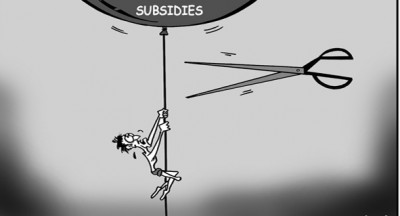
Shut Off the Subsidy Tap….and the Windweasels Scurry!

Brits’ Wind Power Nightmare to End Soon: Tories Set to Take the Axe to Subsidies

chop-wood-axe-downgrade

****

Contrasting with the delusions that continue to grip Australian’s political betters in Canberra (see our post here), sensible governments are rapidly retreating from the brink of energy market madness.

The Americans are pulling the plug on Federal and State based subsidies for wind power outfits. Its ‘wind power’ states have cut their state based subsidies to wind power outfits (or are well on the path of doing so); and Republicans are out to prevent the extension of the Federal government’s PTC wind power subsidy:

Texans Move to Slam Wind Power Subsidies

2015: the Wind Industry’s ‘Annus Horribilis’; or Time to Sink the Boots In

US Republicans Line Up to Can Subsidies for Wind Power

And David Cameron’s Tories strode to power on the back of a manifesto pledge to slam the door on wind power outfits eager to carpet Britain in 10s of thousands of giant fans, in terms that couldn’t be clearer:

“I want to make it clear that if there is a Conservative Government in place we will remove all subsidy for on-shore wind and local people should have a greater say.  Frankly I think we have got enough on-shore wind and we have enough to be going on with, almost 10 per cent of our electricity needs, and I think we should give local people a say if they want to block these sorts of projects.  The only way to stop more on-shore wind is to vote Conservative there is no other party with this policy. We are saying very clearly we would remove the subsidy and give local people the power to say yes or no. This would end the growth of on-shore wind and if that’s what you care about you must vote Conservative.”

Now, Cameron’s Tories are sharpening their axes ready to bring the lunacy to an end even faster than Brits could have dreamed of, even a month ago.

Wind farm subsidies facing the axe
The Telegraph
Emily Godsen
31 May 2015

Generous taxpayer subsidies will be cut off earlier than expected, effectively preventing thousands of turbines from being built, under plans being considered by Amber Rudd, the energy secretary

amberrudd

****

Subsidies that have fuelled the spread of onshore wind farms are to be dramatically curtailed, under Government plans to be unveiled within days.

The Telegraph has learnt that a generous subsidy scheme will be shut down earlier than expected, effectively preventing thousands of turbines from getting built, under plans being considered by Amber Rudd, the new energy secretary.

The proposals, which could be announced as soon as this week, will set out for the first time how the Conservatives will implement their manifesto pledge to end any new public subsidy for onshore wind farms – amid concerns that turbines are unpopular with local communities.

Under current policy, any big onshore wind turbines built before the end of March 2017 would automatically be able to qualify for generous payments through a scheme called the Renewables Obligation (RO), which is funded through green levies on consumer energy bills.

The Department of Energy and Climate Change has now confirmed it plans to “reform” the RO scheme. It is understood to be looking at ending the free-for-all by shutting the scheme down early – effectively preventing thousands of turbines getting built. The action follows similar moves taken to curb subsidies for solar farms last year.

After the RO shuts, the only possible subsidies for wind farms will be through a new scheme that is less generous and also much more strictly rationed, with ministers deciding how many projects – if any – are awarded subsidy contracts, enabling them to block further onshore wind if desired.

As well as big wind farms, subsidies for small individual wind turbines such as those popular with farmers – funded through a separate scheme called the Feed in Tariff – are expected to be limited under the plans.

A spokesman for the DECC said: “We are driving forward plans to end new public subsidy for onshore wind farms.

“We will shortly be publishing our plans to reform the Renewables Obligation and Feed in Tariff scheme to implement this commitment. With the cost of supplying onshore wind falling, government subsidy is no longer appropriate.

“We have supported new technologies when they’ve been a good deal for the consumer – providing start-up funding and certainty about future payments to help them become competitive. However, those subsidies won’t continue when costs come down – that’s not value for money for billpayers in the long run.”

Ms Rudd said: “We promised people clean, affordable and secure energy supplies and that’s what I’m going to deliver. We’ll focus support on renewables when they’re starting up – getting a good deal for billpayers is the top priority.”

Government plans to tackle climate change and hit EU renewable energy targets envisage that between 11 and 13 gigawatts (GW) of onshore wind power is needed by 2020.

More than 9.5 GW of projects – about 5,500 turbines – have either already been built or are under construction in the UK. At least 5.2 GW more wind farms – almost 3,000 more turbines – have already been granted planning permission.

Even if not all of these are built there would still be enough to hit the top end of Government plans.

On top of that, there are close to 3,000 more big new turbines with a combined capacity of more than 7GW seeking planning permission.

The DECC spokesman said: “Looking at what has already had planning permission, there is enough onshore wind to contribute what’s needed to reach the ambition set out in the Coalition Government’s renewables roadmap that 30 per cent of our electricity should come from renewables by 2020.”

Many of the projects that already have planning permission would have been expecting to secure subsidies under the RO scheme and it is not clear whether they will still be able to if the scheme shuts early. Ministers may consider offering a ‘grace period’, enabling some of those that already have permission to still get built while blocking off subsidies for those that do not.

One of the biggest factors determining the impact of the proposed changes will be whether or not they apply in Scotland, where the majority of proposed turbines are due to be built.

The Government said last week that it would “consult with the devolved administrations on changes to subsidy regimes for onshore wind farms”.

Nicola Sturgeon, the SNP Scottish First Minister, wants more onshore wind farms and has already demanded a veto on the Tory plans – raising the prospect that subsidies could continue to be paid to new projects in Scotland.

However the Conservatives will be under pressure from their own backbenches to ensure the subsidies are scrapped across the UK.

The Government also announced in the Queen’s Speech last week that it would bring forward legislation to give local communities “the final say” by ensuring large wind farm projects are decided at local rather than national level.

Ms Rudd said: “We need to make decisions on energy more democratic and give our communities a direct say into new onshore wind farms where they live. In future, I want planning decisions on onshore wind farms to be made by local people – not by politicians in Westminster.”

However those in the green energy industry had been most concerned about the pledge to end subsidies, amid uncertainty over the detail of the plans.

Critics of the Conservative pledge, including Tim Yeo, the former Tory head of the energy committee, and Ed Davey, the former Lib Dem energy secretary, have argued that it will actually push up bills as ministers instead offer subsidies to more offshore wind farms that are even more expensive.
The Telegraph

What’s spelt out above is just the accelerated passage of the inevitable.

Britain’s insane wind power policy has been accompanied with all the usual stuff: an unstable grid, with increased risk of widespread blackouts; subsidy-soaked, institutional corruption; spiralling power costs;splattered birds and bats; and divided and angry rural communities.

In those circumstances, David Cameron had little choice but to promise to end the madness. By answering the brewing rage among rural constituents about the adverse impacts of thousands of giant fans on home, hearth and health, he headed off an attack from the UKIP – which had run a solid pro-community stance against the wind power fraud.

And, by decoupling from the Lib-Dem’s deluded love of giant fans (an outfit peopled with wind industry shills like Ed Davey), Cameron dragged in votes from those hundreds of thousands of households and businesses being belted by escalating power bills (see our post here).

And the Conservatives have also seized on a report into the health complaints of those subjected to incessant turbine generated low-frequency noise and infrasound; promising to add adverse health effects as a basis to refuse planning approval, with local communities to have the final say, in any event (see this article from the Daily Mail).

Any policy that is unsustainable will either fail under its own steam; or its creators will eventually be forced to scrap it. Endless streams of massive subsidies for a meaningless power source fits the “unsustainable” tag to a T.

The wind industry has been telling the world it’s almost ready to stand on its own two feet for over 30 years (see our post here). Now, in Britain, David Cameron, Amber Rudd & Co will give it the chance to do so. We wish it the best of luck.

subsidies

Corrupt Ontario Liberals are Accused of Lying, Covering Up Evidence, and Erasing e-mails…..Again!

Trillium accuses Liberals of destroying wind farm lawsuit documents

An offshore wind farm developer that is in the midst of a lawsuit against the province of Ontario is now accusing the Liberal government of destroying documents related to its case.

In a notice of motion filed with the Ontario Superior Court, Trillium Power Wind Corp. says: “It has become apparent … that documents have been destroyed and records of communications have been wiped clean or deleted from computers, or assigned a code name to render their retrieval impossible.

Trillium spent years and millions of dollars developing plans for an offshore wind farm in Lake Ontario near Kingston, but it had the rug pulled out from under it in February, 2011, when the province said it would not consider any offshore development until more scientific studies were done. The decision came the same day Trillium was to sign a large financing deal.

Trillium sued the government – initially for $2.25-billion in damages – but most of the grounds for the suit were thrown out of court.

However, in 2013 the Ontario Court of Appeal said the company could go ahead with one specific allegation, that the government’s decision amounted to “malfeasance in public office.”

As the revised suit – which reduced the claim for damages to $500-million – wound through the discovery process, Trillium found that some government documents it expected to see were not handed over.

Now the company has filed a notice of motion asking that its claim be amended to include the allegation of “spoliation,” or the “deliberate destruction or elimination of incriminating evidence.” None of these allegations, or the claims in the broader suit, have been proven in court.

Ontario’s Liberal government has been hit with accusations that staff members under former premier Dalton McGuinty deleted documents related to the cancellation of two gas-fired power plants. Police are investigating the destruction of e-mails and other records.

The Trillium court filing alleges that the destruction and concealment of documents related to its case were done “concurrently with, and by the same persons” in the office of Mr. McGuinty and the cabinet office who deleted files in the gas plant case.

Jennifer Beaudry, a spokeswoman for Ontario Energy Minister Bob Chiarelli, said it is inappropriate for the minister to comment on the Trillium allegations because the case is before the courts.

However, she said, “we take our record-keeping obligations very seriously. We’re committed to being open, accountable and transparent.” The government has implemented “significant record-keeping reforms” including mandatory staff training and new legislation that implements recommendations of the Privacy Commissioner, she said.

Trillium’s lawyer Morris Cooper said his client’s claim is that “the energy brief was destroyed” pretty much in its entirety when the gas plant files were erased. “All of the communications from the cabinet office and the office of the premier are gone. And there are e-mails confirming an intention to purge, and e-mails confirming an instruction to alter the offshore file to a codeword,” he said.

Among Trillium’s evidence for the destruction of documents, its court filing says, is that some of the communications the company had with the government are “nowhere to be found in the [government’s] documentary productions.”

Trillium also said that the government has not produced any documents regarding internal discussions in the premier’s office or the cabinet about cancelling offshore wind projects, even though it has said that decision was a “core policy decision” of the government.

The provincial government has denied any wrongdoing. A trial in the case is not likely before late in the summer, at the earliest.

Windscam….Just a matter of Time, Before it Implodes….Which Country Gets Smart First?

Greg Hunt Delivers Coalition’s Political Suicide Manifesto: Liberals Lock-In $46 Billion Power Tax as Wind Industry Rescue Package

hunt macfarlane

****

The wind industry in Australia is doomed.

Australia’s commercial lending institutions know it (calling in their loans and refusing to lend for any new wind farms). And the wind industry knows it – hence the big players’ frantic efforts to ditch their wind farms, cut and run – although these fire sales are as much a product of their bankers’ refusal to extend credit (see our post here).

The big power retailers know it (see our post here).

And, from the panic exhibited in Canberra, every Federal MP knows it too (see our post here).

However, in an effort to Keep Up Appearances, wind industry front man, young Gregory Hunt delivered a speech last week that not only defies reality, it almost defies measured description (we’ll do our best in a moment).

WARNING: The speech comes with a public health warning: readers gifted with a modicum of knowledge of Australia’s energy market and/or commonsense are likely to experience sensations such as skin crawling; skin rashes; high blood pressure; and nausea.

These sensations will not arise by reason of some “nocebo” effect: the greater the reader’s understanding of the debacle that is the Large-Scale Renewable Energy Target and the great wind power fraud, the more severe these effects will be. Accordingly, we suggest securing a suitably sized bucket, clean towels and some iced water before passing this point. You have been WARNED.

COMMONWEALTH OF AUSTRALIA
House of Representatives
Hansard
WEDNESDAY, 27 MAY 2015

Renewable Energy (Electricity) Amendment Bill 2015

First Reading

Bill—by leave—and explanatory memorandum presented by Mr Hunt.

Bill read a first time.

Second Reading

Mr HUNT (Flinders—Minister for the Environment) (09:12): I move:

That this bill be now read a second time.

The Renewable Energy (Electricity) Amendment Bill 2015 will implement changes to the Renewable Energy Target to better reflect market conditions and allow sustainable growth in both small- and large-scale renewable energy.

The bill will lead to more than 23½ per cent of Australia’s electricity being sourced from renewable energy by 2020—not 20 per cent but 23½ per cent.

It also addresses problems which emerged more than three years ago with the Renewable Energy Target. Despite the presence of the 41,000 gigawatt-hour target, it was unlikely that it would be met.

First, there was a significant drop in electricity demand which occurred following the global financial crisis and it coincided with the closure of energy-intensive manufacturing plants. Together, they played havoc with wholesale electricity prices.

This was compounded by rising retail electricity costs associated with the carbon tax, network charges and feed-in tariffs resulting in households and industry changing their consumption patterns.

Second, the changes to the Renewable Energy Target introduced by the Rudd government and the subsequent creation of the phantom credit bank of what is currently 23 million certificates is still being felt today. This overhang continues to suppress demand for renewable energy certificates and stymie the signing of power purchase agreements.

These combined to make it increasingly difficult for renewable energy projects to attract finance.

Added to this, the increasing realisation that new subsidised capacity was being forced into an oversupplied electricity market made it likely that financial institutions would be approaching the new investments in the renewable energy space with significant caution and reluctance.

It is in this context that we have sought to place the Renewable Energy Target on a sustainable footing and to overcome the legacy of the problems created by the phantom credit scandal.

So this then brings me to the fact that the Renewable Energy (Electricity) Amendment Bill 2015 amends the Renewable Energy (Electricity) Act 2000 to:

adjust the large-scale renewable energy target (LRET) to 33,000 gigawatt hours in 2020. This will reflect a commitment to achieve approximately 23½ per cent of electricity from all renewable sources by 2020;

increase the partial exemptions for all emissions-intensive trade-exposed activities to full exemptions. This will be of particular importance to trade-exposed industries throughout the country, as recognised by the opposition and as in particular has been championed by many members such as the members for Bass, Braddon, Lyons, Wannon and Corangamite;

reinstate biomass from native forest wood waste as an eligible source of renewable energy; and

remove the requirement for Labor’s legislated biennial reviews of the RET.

These changes will ensure that there is continued support for sustainable growth in the large scale renewable sector. And, the 33,000 target, I repeat, is higher in its ultimate effect than the originally conceived objective of 20 per cent, which was the purpose, the intended outcome and the stated objective of the original legislation.

There will be no changes to the Small-scale Renewable Energy Scheme. The scheme will continue in line with household and small business demand.

The removal of Labor’s phantom credit scheme federally and the rationalization of feed-in-tariffs at the state level have reduced many of the distortions outlined in this week’s Grattan Institute report. I am delighted that this bill is proceeding in a bipartisan fashion.

Key features of the revised Renewable Energy Target

The Large Scale Renewable Energy Target

This then leads me to the fact that the bill will adjust the large-scale renewable energy target, or LRET, to reflect the 23½ per cent target. We will therefore adjust the LRET from 41,000 gigawatt hours in 2020 to 33,000 gigawatt hours in 2020. It will adjust the profile of annual renewable generation targets from 2016 to 2030 so that the target reaches 33,000 gigawatts in 2020 and is maintained at 33,000 gigawatt hours per annum from 2021 to 2030. This target is separate to the 850 gigawatt hours that is to come from waste coalmine gas generation each year until 2020 under pre-existing transitional arrangements previously agreed between the parties.

As highlighted in our energy white paper released by the Minister for Industry, Australia has an over-supply of generation capacity and some of that is aged. From 2009-10 to 2013-14, electricity demand has fallen by approximately 1.7 per cent per year on average.

This is due to many factors: sadly, declining activity in the industrial sector; increasing energy efficiency, which is a positive for Australia; and strong growth in rooftop solar PV systems, which is also a benefit for Australia, which does, however, reduce demand for electricity sourced from the grid.

While the Government welcomes a diverse energy mix in Australia, it also recognises that circumstances have changed since the original target of 41,000 gigawatt hours was set in order to achieve what had been hoped would be a 20 per cent outcome.

This new target of 33,000 gigawatt hours directly addresses these issues and gives the industry an opportunity to grow. It represents a sound balance between the need to continue to diversify Australia’s portfolio of electricity generation assets, the need to encourage investment in renewables while also responding to market conditions, the need to reduce emissions in the electricity sector in a cost-effective way, and the need to keep electricity prices down for consumers.

Most importantly, this new target of 33,000 gigawatt hours by 2020 is achievable. It will require in the order of six gigawatts of new renewable electricity generation capacity to be installed between now and 2020.

Even at the adjusted level of 33,000 gigawatt hours, the renewable sector will have to build as much new capacity, on the advice that I have, in the next five years as it has built in the previous fifteen. This will not be an easy task, but, on all the advice we have, it is achievable and therefore real construction will occur.

This new target will therefore be good for jobs in the renewable energy sector and, as I have said, lift the proportion of Australia’s electricity generation to approximately 23½ per cent by 2020.

Assistance to emissions-intensive trade-exposed industries

When the RET scheme was expanded in 2010, partial exemptions were introduced for electricity used in emissions-intensive trade-exposed activities. These were hard-fought and negotiated by the coalition. The exemptions only apply to the additional RET costs that were incurred as a result of the expansion of the scheme.

The RET scheme regulations currently prescribe that electricity used in activities defined as highly emissions intensive and trade exposed is exempted at a 90 per cent rate, and electricity used in activities defined as moderately emissions intensive and trade exposed is exempted at a 60 per cent rate.

This bill will increase support for all emissions-intensive trade-exposed activities to full exemptions from all RET costs—that is, from the costs of the original target as well as the costs of the expanded target. A full exemption will protect jobs in these industries and ensure they remain competitive. This has been of particular concern, as I mentioned earlier, to the members for Bass, Braddon, Lyons, Wannon and Corangamite—each of whom has played an extremely important role in securing this agreement between the parties.

The reduction in the direct costs of the RET resulting from the lower large-scale renewable energy target will more than offset the impact on other electricity users of the increase in assistance for emissions-intensive trade-exposed activities.

Reinstating biomass from native forest wood waste as an eligible source of renewable energy Native forest wood waste was in place as an eligible source of renewable energy under Labor’s own legislation until November 2011.

The use of such native forest wood waste for the sole or primary purpose of generating renewable electricity has never been eligible to create certificates under the scheme. Eligibility was subject to several conditions, including that it must be harvested primarily for a purpose other than energy production. This is about the use of wood waste; it is not about cutting down biomass to burn.

Consistent with our election commitment, as was set out in our forestry policy on the first page and further within the policy, this bill reinstates native forest wood waste as an eligible source of renewable energy under the RET, basing eligibility on exactly the same conditions—precisely the same conditions—as were previously in place under the ALP when they were in government.

One of the objectives of the RET is to support additional renewable generation that is ecologically sustainable. We are reinstating, therefore, the provision allowing native forest wood waste as an eligible renewable energy source, because there is no evidence that its eligibility leads to unsustainable practices or has a negative impact on Australia’s biodiversity. This was the experience of the 10 years during which this provision was in place.

We believe that the safeguards that were in place previously were, and are still, sufficient assurance that native forest wood waste is harvested and used in a sustainable way. The regulations were underpinned by ecologically sustainable forest management principles which provide a means for balancing the economic, social and environmental outcomes from publicly owned forests.

In all cases, the supply of such wood waste is subject to the Commonwealth and state or territory planning and environmental approval processes, either within, or separate to, the regional forest agreement frameworks.

Using wood waste for generation is more beneficial to the environment than burning the waste alone on the forest floor or simply allowing it to decompose and to produce methane—a greenhouse gas with very high global warming potential. Its inclusion as an eligible energy source is another contribution to the target.

We understand that regular reviews of policy settings create uncertainty for investors, business and consumers. That is why this bill removes the requirement for two-yearly reviews of the RET. Providing policy certainty is crucial to attracting investment, protecting jobs, and encouraging economic growth.

Protecting electricity consumers, particularly households, from any extra costs related to the RET, has been a priority from the start and the government understands that the 33,000 gigawatt-hour target remains a challenge for industry.

For these reasons, instead of the reviews, the Clean Energy Regulator will prepare an annual statement on the progress of the RET scheme towards meeting the new targets and the impact it is having on household electricity bills.

Again, this bill is about appropriately balancing different priorities; replacing the biennial reviews with regular status updates better meets the needs of industry and the needs of consumers, and any concerns within the parliament. It is about increased transparency at the same time as increased certainty.

Importantly, both the government and the opposition have agreed to work cooperatively on a bipartisan basis to resolve any issues which may arise with the operation of the Renewable Energy Target through to 2020. Against that background I do wish to thank many people, beginning with the opposition. We have negotiated in good faith with Mark Butler, Gary Gray and Chris Bowen. I particularly thank my opposite, the shadow minister for the environment, Mark Butler, and his staff for their work. These negotiations can be difficult but I believe both sides conducted an honourable process, and this was an example of the parliament operating as a parliament for an outcome which will be, ultimately, beneficial to Australia. So I acknowledge and appreciate the work of my colleagues on the opposite side of the chamber.

I want to thank my colleagues, in particular: Ian Macfarlane, whose knowledge of the electricity is peerless, not just within the parliament but arguably almost anywhere within Australia; the Prime Minister who, himself, proposed the compromise and suggested the notion of the Clear Energy Regulator providing the annual outdates—it was an important breakthrough and step forward and he engaged deeply in this process and was always seeking a balanced outcome; as I have mentioned, my colleagues Dan Tehan, Sarah Henderson, Eric Hutchinson, Andrew Nikolic and Brett Whiteley; and Angus Taylor, whose knowledge of the electricity sector and whose concerns for his electors were absolutely vital in helping us to achieve this outcome. He is a very informed individual and the parliament benefits from having another Rhodes Scholar enter this chamber.

From within the Department of the Environment, David Parker and Brad Archer played a critical role throughout the review process. I thank Lyndall Hoitink and John Jende—whose knowledge of the Renewable Energy Act and the implications are extraordinary. Mark Scott, Candice El-Asmar, Kieran McCormack and Peter Nicholas all played critical roles.

From the Clean Energy Regulator I thank Chloe Monroe, who performed an extraordinary role in executing the first Emissions Reduction Fund auction and also provided invaluable advice. She and her team are outstanding policy professionals. Although appointed by a previous government, we have proudly and happily continued her role. As far as I am concerned, she is invited to stay in the job for as long as she wishes to do it. She is really one of the great public servants in Australia. Similarly, she is supported by people such as Mark Williamson and Amar Rathore, both of whom have done a great job.

At the Office of Parliamentary Counsel I thank Iain McMillan and his staff. From others who have contributed significantly there is Jessi Foran from Ian Macfarlane’s office. From within industry Miles George, as chair of the Clean Energy Council, and Kane Thornton, CEO of the Clean Energy Council, were indefatigable and fundamental in pressing the concerns and needs of their sector. This deal would not have been achieved without their work, and I honour and acknowledge it.

Similarly, Miles Prosser, from the Aluminium Council; Innes Willox, from the Australian Industry Group; and Kate Carnell and John Osborn, from the Australian Chamber of Commerce and Industry, all played critical roles in helping to bring us to this point.

Finally, I want to acknowledge two people from my office: my chief of staff, Wendy Black, whose counsel and guidance on every topic is really outstanding; and Patrick Gibbons, who is my senior adviser and whose knowledge of the electricity sector is surpassed only by that of Ian Macfarlane, who has spent hundreds and hundreds of hours helping to bridge the gaps between different parties. Again, this would not have been possible without him.

To all of those parties I say thank you. Let me conclude by saying this: this bill is consistent with the government’s conviction that policy decisions must be based on sound economic principles and real-world experience. It also represents the government’s commitment to maintain stable and predictable settings that encourage growth, encourage competitiveness, encourage efficiency and that produce better outcomes for electricity consumers.

The RET had to be reformed in response to changing circumstances. This bill achieves balanced reform. It will provide certainty to industry, encourage further investment in renewable energy and better reflect market conditions. It will also help Australia reach its emissions targets, and it will protect jobs and consumer interests.

As the energy white paper points out, Australia has world-class solar, wind and geothermal resources, and very good potential across a range of other renewable energy sources. In addition to the support for small- and large-scale renewables, which this bill provides, the government is providing over $1 billion towards the research, development and demonstration of renewable energy projects.

This bill recognises that renewable energy is an important part of Australia’s future, while also recognising that its deployment must be supported in a responsible way with minimal disruption to our energy markets. I thank all of those involved in reaching this point. I am delighted that we have achieved a sensible balance which will allow the industry to grow to 23½ per cent of Australia’s total energy production by 2020.

I commend the bill to the House.

Debate adjourned.

Hansard, 27 May 2015

Where to begin?

Before we do, please note, we cannot rule out the possibility that the speech was in fact written in its entirety by the lunatics from the Greens. It is so far to the hard-green-left that it is unrecognisable as a statement purportedly emanating from a so-called Conservative government.

Stomach churning content aside, perhaps we’ll start with a take on young Gregory’s “style” and “themes”.

miss world

****

The gushing delivery reminds STT of the gorgeous Venezuelan gal who bags the Miss World title and who, on cue, reacts with welled-upped eyes, and hands-to-face (faux) surprise.

Brushing away an alloy of tears and top-quality mascara, the winner hits us with her suitably ambitious manifesto. Starting with her wish list of an end to hunger; world peace; an end to disease and so on, the soon-to-be Hollywood starlet thanks all those that got her to the winner’s podium, from her personal trainer, her publicist, right down to her hairdresser.

Of course, young Greg’s speech didn’t go so far. However, as to plausible realisation, Greg’s manifesto is on precisely the same footing.

No-one in their right mind expects Miss World to follow through on her promise to save the world from hunger and disease etc.

Likewise, there is absolutely no way that Greg’s ultimate annual 33,000 GWh LRET will be satisfied by the “due date” of 2020, or at all.

Greg knows it; and so does everybody on his seemingly endless thank you list.

For those new to this site, STT is all about smacking people with the reality that wind power is meaningless as a power source, because it can only ever be delivered at crazy, random intervals. In the absence of mandated fines on retailers and/or whopping subsidies to wind power outfits, the wind industry simply would not exist. The claim that wind power is “clean” and “green” is nothing more than a cynical marketing ploy; and a cruel hoax played on the gullible and naïve.

The politicians who support wind power have simply devoured the lies and myths spouted by the wind industry and fall into 2 camps:

  1. those who are simply “pig” ignorant; or
  1. little piggies with their trotters in the wind scam trough

Most of the line up on Greg’s “thank you list” have been in the game long enough to know precisely what’s going on, which tends to rule out their inclusion in the first category above.

The inclusion of energy market lightweights, and economic illiterates, from the ranks of the Coalition – such as Disappointing Dan Tehan, Sarah Henderson, Eric Hutchison, Andrew Nikolic and Brett Whiteley is no surprise (none of them have the foggiest clue about the cost or operation of the LRET, the impact of Power Purchase Agreements on retail power prices, dispatch prices, grid stability etc, etc).

Dimwits in politics are a dime-a-dozen; and this won’t be the first time that elected representatives chimed in with support for a policy that they haven’t got the faintest understanding of.

And glad to see young Greg outing all those who STT readers have always placed in the second category above:

The wind industry’s plants and stooges within Hunt and Macfarlane’s offices, like Patrick Gibbons (who’s best mates with Vesta’s former front man, Ken McAlpine). As well as wind industry shills like Chloe Monroe (and her gang from the CER).

And the boys from the so-called Clean Energy Council, Miles George (who conveniently heads up Infigen – cutting down on lobbying time and costs) and head wind industry spin-master, Kane Thornton. Reports that Kane slept on a camp stretcher in Greg Hunt’s office during the weeks of negotiations cannot be confirmed.

What can be confirmed is that the Clean Energy Regulator (a statutory authority paid for entirely by taxpayers) has been shovelling tens of thousands of dollars into the coffers of the Clean Energy Council (a lobbying outfit set up – and meant to be fully paid for – by wind power outfits). During Senate estimates last week, Chloe Monroe conceded that the CER and the CEC are singing from precisely the same hymn sheet; and that the CER is stumping up taxpayers’ cash to help them do so:

Ms Munro: There was one question that we just took on notice which I think I can now answer. It was about the cost of our subscription to the Clean Energy Council and our membership there. For the current financial year it is $14,520. I might just mention that we regard that as an important membership to have because of the very significant role the Clean Energy Council plays in disseminating information to its membership which assists with the overall regulatory performance of the industry. Also, as a member, we do not exercise our right to vote, for example, so we do not play any part in the decision making of the Clean Energy Council, for example, in the recent elections for the chair of the council. We would not take any part in that. We are very much at arm’s length from that.

Hmmm … unfortunately for Chloe, her efforts to distance herself from the tens of $thousands thrown by the CER at the wind industry’s spin-masters, fell flat with her special mention in Greg Hunt’s thank you list, right next to Miles George and Kane Thornton.

While the shills from the CER, CEC, Infigen & Co were obvious among those Hunt was bound to thank (although, as their very existence depends on Hunt’s efforts to save the LRET, they should all be thanking him) the inclusion of the PM, Tony Abbott and Angus “the Enforcer” Taylor on Hunt’s little list is a bridge way too far.

Angus Taylor

****

STT hears that Angus Taylor is close to furious about the manner in which Hunt and Macfarlane double-crossed their party on the terms of the LRET deal with Labor – and he’s not alone – STT hears that the PM is less than amused, too.

Leading up to the deal, both Hunt and Macfarlane were under strict instructions to maintain the provision in the Renewable Energy (Electricity) Act 2000 (section 162) that provides that reviews of the mandatory RET must take place every two years; taking into account the cost and benefits of any recommendation made, as part of the review.

Their colleagues, from the PM down, understood that the retention of two yearly reviews was a ‘deal breaker’. However, as evidenced in Hunt’s political suicide manifesto above, Hunt and Macfarlane ‘caved in’ (under the slightest ‘pressure’ from their wind industry mates); much to the disgust and horror of the majority of their party colleagues.

The two yearly reviews were understood by all those in the Coalition giving licence to Hunt and Macfarlane to cut a deal with Labor, to be a critical mechanism available to pull a halt to the runaway costs of the LRET, in general; and the ludicrous costs of wind power, in particular.

The review process was set up to allow the government of the day to act on recommendations; such as scrapping the LRET in its entirety; or to deny RECs to wind power outfits, simply because the demonstrated and extraordinary costs of wind power (the key beneficiary of the LRET) completely outweighs any of its purported benefits.

STT fully expects Angus Taylor (among others) to set the cat amongst the pigeons this week, by challenging Hunt and Macfarlane on their backdoor deal to drop the two yearly reviews, at the wind industry’s behest, among other things.

Double-dealing aside, there’s also the small matter of substance. The Coalition (the combination of the Liberals and the Nationals) is purportedly made up of conservative, pro-business, small government types. Their core constituency will be less than impressed to learn that Hunt and those on his “thank you list” have set them up with a $46 billion electricity tax: half of which will be directed to wind power outfits – like near-bankrupt Infigen (aka Babcock and Brown); with the balance being recovered as a $65 per MWh fine (aka “the shortfall charge”) – and directed to general revenue (ie a ‘stealth tax’):

Out to Save their Wind Industry Mates, Macfarlane & Hunt Lock-in $46 billion LRET Retail Power Tax

Hunt, Macfarlane and the CER have given a “guarantee” to the PM that wind power outfits will easily build the capacity needed to generate the extra 17,000 GWh required to satisfy the ultimate annual 33,000 GWh target (thus avoiding the politically toxic penalty set under the LRET). However, that little “promise” is, again, more like Miss World’s promise to achieve world peace: something that everyone with a hint of common sense considers as pure nonsense.

The other furphy being pitched by Hunt, Macca and the CER is that – provided the shortfall charge is avoided – the LRET carries absolutely no cost to power consumers at all (see the post above). However, if that were the case, why was Greg so pleased to announce that Energy Intensive Industries will be exempt from “all RET costs”?

So which is it Greg? Is the LRET a family and small business ‘friendly’, that’s as cheap as chips and a guaranteed vote winner? Or is the effort to protect the Aluminium sector etc a dead-set giveaway, that – at $3 billion a year – the LRET is the largest, single electricity tax ever cooked up?

It’s going to Penalty

STT hears that the finance sector has absolutely no intention of providing any money to build new wind power capacity. The expectation is that RECs will, in the longer term, trade in the order of $30, at which price wind power outfits will not break even, placing lenders at enormous and perfectly avoidable RISK (see our post here).

STT hears that the major retailers are of the same view.

Greg Hunt talks about “the phantom credit bank of what is currently 23 million [REC] certificates” – what’s called the “overhang”.

Retailers, such as Origin, hold the bulk of those certificates and will be able to use them to avoid the shortfall charge, until they run out. That means that there is no need for them to enter long-term Power Purchase Agreements with wind power outfits to obtain RECs, for some time. One scenario involves those holding RECs simply hanging on to them until the penalty set by the LRET kicks in, such that they can cash them in at prices over $90 (many were purchased at $20 or less).

STT also hears that the major retailers have no interest in wind power at all: remember, that commercial retailers have not entered PPAs with wind power outfits since November 2012.

output vs demand

****

As we’ve pointed out (just once or twice) wind power can only ever be delivered at crazy, random intervals (if at all); and is usually generated late at night, or very early in the morning, when there is little demand for power. The only reason retailers sign up to purchase wind power, is to obtain the RECs that come with the deal – power that can never be delivered on demand, is of no commercial value, otherwise.

Solar power, on the other hand, is available almost every day during daylight hours and is, therefore, capable of satisfying demand, as it rises during the daytime.

STT hears that the big retailers are planning to wait until they look like exhausting the pile of RECs that they’re sitting on at present, at which point they’ll build some large-scale solar power facilities, in order to obtain the RECs needed to avoid the shortfall charge.

The retailers still believe that the politics of the LRET are inherently toxic; which will lead to its inevitable implosion (hence the belief that REC’s will end up at less than $30). By investing in a few solar panels, these boys will avoid the impact of the LRET penalty, in the short term. And, once the LRET implodes, they will be able to sell those panels for re-use by householders in domestic situations.

And the implosion of the LRET is as inevitable as death and taxes.

So, if you run into young Gregory, be the first to congratulate him on his speech.

It’ll be the one that comes back to bite him and his team as the LRET disaster unfolds; power prices go through the roof; and householders and businesses realise that a government that they elected on a promise to scrap the Labor/Green Alliance’s business and economy destroying – and family punishing – “carbon” tax, set them up to pay for the most ridiculously generous corporate welfare scheme in the history of the Commonwealth. And all because Hunt and Macfarlane’s wind industry mates wanted it that way.

dumb 3

Sanity returning to the UK! Are our politicians smart enough to follow their lead?

New curbs can block ‘health risk’ wind farms

Government grants new powers for critics to stop the building of turbines.

  • Critics of huge wind farms have been handed power to block developments
  • Energy Secretary Amber Rudd has promised to strip her department of its power to force through large wind-farm projects against local opposition
  • Move comes amid new health warnings for those living close to turbines

 Energy Secretary Amber Rudd promised to strip her department of its power to force through wind-farms against local opposition. The move comes amid new health warnings for those living near turbines.

By Glen Owen and Brendan Carlin for The Mail on Sunday

Critics of huge wind farms received a boost last night after the Government gave them new powers to block the developments.

The move, by Energy Secretary Amber Rudd, comes amid new health warnings for those living close to turbines.

Ms Rudd has promised to strip her department of its power to force through large wind-farm projects against local opposition.

She is also expected to crack down on Government subsidies for the onshore farms.

Under current rules, the Energy Secretary can have the final say on giant wind farms of 50 megawatts and over.

But Ms Rudd will today pledge to lay down that power. It means farms will in future be treated in the same way as a planning application for a home extension – a matter to be decided purely by the local council.

The action was backed by anti-wind-farm campaigner Tory MP Chris Heaton-Harris, who has presented Ministers with a report warning that sleep deprivation, migraines and hearing problems could be just some of the effects of living within a mile of a wind farm.

This Is A Good Start, But World-Wide Reforms Needed!

Robson: Good winds blowing

Credit:  By Frank Robson, Guest Columnist | The Journal Record | May 29, 2015 | journalrecord.com ~~

I applaud the Oklahoma Legislature and Gov. Mary Fallin for implementing much-needed reform of the wind industry, addressing both excessive subsidies and lack of regulation for protection of property owners. The progress made this year is important in establishing a regulatory framework. Yet there is still work to do.

Senate Bill 808 by state Sen. Brian Bingman, R-Sapulpa, and Rep. Earl Sears, R-Bartlesville, signed by Fallin on April 17, established a 1.5-nautical-mile setback of wind turbines from schools, airports and hospitals and provides a stronger decommissioning statute that protects landowners and taxpayers from being financially responsible for taking down turbines at the end of their life. The legislation also requires notification to landowners at least six months before construction begins.

The new law doesn’t take into consideration protection of wind turbines from homes, neighborhoods, public parks and other land where natural habitat may be disturbed. We hope the Legislature will consider the need for further requirements that address reasonable restrictions on the placement of wind turbines near other areas of public safety concern.

Senate Bill 498 by state Sen. Mike Mazzei, R-Tulsa, and Sears, signed May 20, repeals the ability of the wind industry to qualify for a five-year property tax exemption. This provides a good start in addressing the magnitude of industrial wind’s subsidies and negative impact on Oklahoma’s budget.

Senate Bill 502 by state Sen. Marty Quinn, R-Claremore, and Sears, signed May 20, repeals the ability of the wind industry to qualify for the new jobs investment tax credit effective Jan. 1, 2017. This eliminates an unnecessary and potentially costly subsidy for an industry that creates few jobs here.

Wind developers may still qualify for zero-emission tax credits, which amount to $5 per megawatt-hour for all electricity produced from industrial wind facilities for 10 years. The current law saddles Oklahoma taxpayers with this burden for all wind facilities built prior to Jan. 1, 2021. Payment of subsidies under this program may extend until Dec. 31, 2030.

We look forward to continued forthright discussions with state leadership regarding the need for further safety regulations, and the need to evaluate the legitimacy of the remaining subsidies available to industrial wind. Let’s continue to make progress for the betterment of Oklahoma.

Frank Robson is a member of the Oklahoma Property Rights Association.

Open Submission by Carmen Krogh, regarding the ERT for Niagara Region Wind Corp.

By Carmen Krogh, BScPharm
May 25, 2015
To Whom It May Concern
Re: ERT Case No. 14-096 ENVIRONMENTAL REVIEW TRIBUNAL IN THE
MATTER OF an appeal by Mothers Against Wind Turbines Inc and Renewable
Energy Approval No. 4353- 9HMP2R issued by the Director, Ministry of the
Environment, on November 6, 2014 to Niagara Region Wind Corporation.
This Commentary is public and may be shared.
I declare no potential conflicts of interest and have received no financial support with respect
to the research and authorship of this Commentary.
1. ERT Case No. 14-096 states the onus on the Appellant:
[8] Pursuant to s. 145.2.1 of the EPA, the onus is on the Appellant to establish that
engaging in the Project in accordance with the REA will cause serious harm to human
health and/or serious and irreversible harm to plant life, animal life or the natural
environment. (Page 4)
2. The ERT dismissed the Appeal:
[9] For the reasons that follow, the Tribunal finds that the Appellant has failed to meet
either the Health Test or the Environmental Test and has not established the necessary
elements of a s. 7 Charter violation and, therefore, the appeal is dismissed. (Page 4)
3. Ms. Shellie Correia, mother of Joey, testified during this ERT and provided a letter from
her son’s specialist, a Behavioral Pediatrician.
Joey has been under the specialist care for 8 years and is diagnosed with a “Sensory
Processing Disorder”.
Excessive, uncontrollable noise can lead to sensory overload and Joey’s specialist noted
that Joey “is exceptionally more vulnerable”.
With respect to his condition, the specialist states “Wind turbines concern me, given my
strong knowledge of neurobiology.”

4. Other members of the community testified regarding their concerns associated with
children being exposed to IWTs while at home, at school (or both), or while visiting.
5. Ms Correia provided additional citations such as Joey’s Individual Education Plan in
support of his risk factors and that of children in general. See the Appendix below.
6. Ms Correia has advised Premier Wynne, Energy Minister Chiarelli, the Approval Holder
and the project manager, and many others in an effort to protect her son and other
children from harm.
7. Several 3 MWatt IWTs will be in close proximity, with one of the turbines 550 metres
from the family home.
8. Joey and other children will have to travel past transmission lines while attending school
and for other purposes.
9. In its Decision, the ERT states:
[119] In response to Ms. Correia’s concerns about the impact of noise on her son who
has “developmental issues, including ADHD, anxiety and serious processing issues
(mainly, but not exclusively aural)”, Dr. McCunney said that he is unaware of any
scientific literature that suggests that wind turbine noise would adversely affect the
health of a child with these developmental disorders. (Page 28)
10. Dr. Robert McCunney testified on behalf of the Approval Holder. His qualification states:
[95] On agreement of the parties, Dr. McCunney was qualified by the Tribunal as a
medical doctor specializing in occupational and environmental medicine with
particular expertise in the health implications of noise exposure. He provided expert
opinion evidence on behalf of the Approval Holder. (Page 21)
11. Based on this qualification, indications are that Dr. McCunney was not appearing as a
Behavioral Pediatrician, specializing in assessment and care of children with
developmental and mental health problems.
12. Regarding noise in general, the World Health Organization has identified the fetus,
babies, children and youth including those with pre-existing medical conditions and
special needs as a vulnerable population group.
World Health Organization, Children and Noise, Children’s Health and the
Environment, WHO Training Package for the Health Sector, http://www.who.int/ceh

Commentary ERT Case No. 14-096
By Carmen Krogh, BScPharm, May 25, 2015
Any errors or omissions are unintended.
13.
Another WHO reference relating to children states:
Noise is an underestimated threat that can cause a number of short- and long-term
health problems, such as for example sleep disturbance, cardiovascular effects, poorer
work and school performance, hearing impairment, etc.
World Health Organization Noise Facts and Figures
health/noise/facts-and-figures
14.
Stansfeld and Matheson (2003) state:
It is likely that children represent a group which is particularly vulnerable to the non-
auditory health effects of noise. They have less cognitive capacity to understand and
anticipate stressors and lack well-developed coping strategies. Moreover, in view of
the fact that children are still developing both physically and cognitively, there is a
possible risk that exposure to an environmental stressor such as noise may have
irreversible negative consequences for this group…
Stephen A Stansfeld and Mark P Matheson (2003), Noise pollution: non-auditory
effects on health, British Medical Bulletin 2003; 68: 243–257 DOI:
10.1093/bmb/ldg033
Additional citations on children’s risk factors from exposure to noise in general are available.
Conclusion
Research indicates the fetus, babies, children and youth including those with pre-existing
medical conditions and special needs are a vulnerable population group to the effects of noise
exposure in general.
The specialist who has diagnosed and treats Joey states:
I, as a “normal brain” (or typical brain) individual would not want this risk to my
mental health (or my children’s) in my neighbourhood. The placement of these
devices must be thoughtful and, of course, “first, do no harm.”
And that:
In a developed society like Canada, we must advocate and protect the most vulnerable
members. Joey, and all our children deserve our thoughtful and ethical best.
Commentary ERT Case No. 14-096
By Carmen Krogh, BScPharm, May 25, 2015
Any errors or omissions are unintended
4
The World Health Organization comments it is not necessary to wait for full scientific proof
before taking action:
…where there is a reasonable possibility that public health will be damaged, action
should be taken to protect public health without awaiting full scientific proof.
World Health Organization, Guidelines for Community Noise, WHO (1999).
The Policy Interpretation Network on Children’s Health and Environment comments on the
precautionary principle:
Policies that may protect children’s health or may minimise irreversible health effects
should be implemented, and policies or measures should be applied based on the
precautionary principle, in accordance with the Declaration of the WHO Fourth
Ministerial Conference on Environment and Health in Budapest in 2004.
Report WP7 Summary PINCHE policy recommendations Policy Interpretation
Network on Children’s Health and Environment (PINCHE) Policy Interpretation
Network on Children’s Health and Environment QLK4-2002-02395
The Council of Canadian Academies Panel states in its assessment of IWT noise:
…that there is a paucity of research on sensitive populations, such as children and
infants and people affected by clinical conditions that may lead to an increased
sensitivity to sound.
Council of Canadian Academies (2015) Understanding the Evidence: Wind Turbine
Noise, The Expert Panel on Wind Turbine Noise and Human Health, Executive
Summary, Page xvii.
This raises the question whether Appellants and concerned families will be expected to wait
until children-based research demonstrates that “engaging in the Renewable Energy Project
in accordance with the Renewable Energy Approval “will cause serious harm to human
health” (“Health Test”).
If so, are there any potential legal-ethical concerns?
Respectfully,
Carmen Krogh, BScPharm
Ontario, Canada
Commentary ERT Case No. 14-096
By Carmen Krogh, BScPharm, May 25, 2015
Any errors or omissions are unintended
5
Appendix: documents provided to the ERT
1.Open Submission on Risk of Harm to Children May 15/2013
2 Open submission on Risk of Harm to Children Dec 27/2012
3 Letter from Carmen Krogh, requesting help from PM Harper and Peter Mckay Re: UN
Rights of the Child.
4 Arline L. Bronzaft, Noise from Wind Turbines: Potential health Effects on Children.
5 Welfare of Children at Risk, Due to Wind Turbines, Parents Reporting.
6 Joey Correia’s Individual Education Plan
7 Letter from Dr. Calvert, Joey’s Specialist, Regarding Sensory Processing Issues.
8 Information about Auditory Processing Disorder – From Website, KidsHealth from
Nemours
8a Letter from Retired Special Education teacher, Susan Smith, Re: Children & Wind turbines
8b Letter from School Superintendent, William C. Mulvaney
9 Brett Horner’s Open letter to health Canada, (Discontinue Ongoing Experiments)
10 Dr. Sarah Laurie’s Concerns Re: Health Canada Study
11 Ways to Improve Future Health Studies – Multi-Municipal Wind Turbine Working Group.
12 “Critique on Infrasound Study”, by Jerry Punch
13 Dr. Maria Alves-Pereira on Vibro-Acoustic Disease
14 Canadian Journal of Rural Medicine – Industrial Wind Turbines, and Health Effects.
15 Summary of 21 Peer-Reviewed Articles on Adverse Health Effects, on IWT’s.
16 Mothers Against Wind Turbines…Call for a Moratorium.
17 Open Letter/Press Release from N.A.P.A.W.
18 Victim’s Statement’s, from Wind Victims Ontario
19 Letter to PM Harper and Peter McKay, Minister of Justice
20 Letter to Dr. Murray, and Dr. Weiss.
21 Letter to Premier Kathleen Wynne, May 6
22 Letter to Premier Kathleen Wynne, Apr. 18
23 Letter to Steve Klose, M.O.E.
24 Letter to Ombudsman, Andre Marin
25 Attempts to Speak with NRWC.
26 Speeches Read at Local and Regional Councils, to Appeal for Help

Government-induced Climaphobia Strikes Again!

Tom Harris explains why the climate promises are a joke

Harris is an engineer with a special interest in Climate studies and GHG agreements. Here he explains the hypocrisy of the Lima “promises” on reductions in emissions.

It’s like any agreement with a leftist agenda, the words hide the intentions. In any international “promise” on GHG no verification, no enforcement–window dressing.

http://www.torontosun.com/2015/05/23/harpers-climate-pledge-is-hot-air

Harper’s climate pledge is hot air

Canada has no way to ensure developing nations keep their commitments

Tom Harris, Guest Columnist

First posted: Saturday, May 23, 2015 07:00 PM EDT | Updated: Saturday, May 23, 2015 11:51 AM EDT

In announcing the Stephen Harper government’s new greenhouse gas (GHG) reduction targets earlier this month, Environment Minister Leona Aglukkaq said Canada will “work with our international partners to establish an international agreement in Paris that includes meaningful and transparent commitments from all major emitters.”

But Canadians are being tricked.

Any GHG emission reduction pledges made by developing countries in Paris later this year will almost certainly not be enforced.

Written in bureaucratese, the convoluted first sentence in last December’s “Lima Call for Climate Action”, the United Nations’ last major climate change agreement, indicated exactly that.

It reads: “The Conference of the Parties, Reiterating that the work of the Ad Hoc Working Group on the Durban Platform for Enhanced Action (ADP) shall be under the Convention and guided by its principles…”

The ADP are the back room negotiators who are drafting the text for the big climate deal to be signed in Paris in December.

The “Convention” refers to the UN Framework Convention on Climate Change (UNFCCC), signed by former Canadian prime minister Brian Mulroney and hundreds of other world leaders at the Earth Summit in Rio in 1992.

And the ADP’s work will adhere to the UNFCCC, including its critical Article 4: “The extent to which developing country Parties will effectively implement their commitments under the Convention will depend on the effective implementation by developed country Parties of their commitments under the Convention related to financial resources and transfer of technology and will take fully into account that economic and social development and poverty eradication are the first and overriding priorities of the developing country Parties.”

So, under any treaty based on the UNFCCC (which all UN climate agreements are), developing countries will keep their emission reduction commitments only if we in the developed world pay them enough and give them enough of our technology.

Also implied in the article is that, even if we give them everything we promise, developing countries may simply forget about their GHG targets if they interfere with their “first and overriding priorities” of “economic and social development and poverty eradication.”

Developed nations like Canada, on the other hand, do not have this option. We must keep our emission reduction commitments no matter how it impacts our economies.

It is not as if the UN has been hiding this “firewall” between developing and developed nations.

It has told us repeatedly in UN climate change agreements in Copenhagen, Cancun, Durban and Lima that, “development and poverty eradication”, not emission reduction, takes top billing for developing countries.

Actions to significantly reduce GHG emissions would entail dramatically cutting back on the use of coal, the source of 81% of China’s electricity and 71% of India’s.

As coal is by far the least expensive source of electric power in most of the world, reducing GHG emissions by restricting coal use would unquestionably interfere with development priorities.

So, developing countries simply won’t do it, citing the UNFCCC in support of their actions.

Some commentators have speculated that tougher requirements will be imposed by the UN on poor nations over time as they develop.

The only way this can happen is if there are substantial revisions to the UNFCCC treaty.

China, India, and other developing countries have clearly indicated they will not allow this to happen any time soon.

Chinese negotiator Su Wei summed up the stance of developing nations when he explained that the purpose of the Paris agreement is to “reinforce and enhance” the 1992 convention, not rewrite it.

Canada withdrew from the Kyoto Protocol in part because it lacked legally binding GHG targets for developing countries.

So why is the Harper government supporting a process that will result in our country being stuck in another Kyoto?

— Harris is Executive Director of the Ottawa-based International Climate Science Coalition, which opposes the hypothesis carbon dioxide emissions from human activities are known to cause climate problems

Tom Harris, B. Eng., M. Eng. (Mech.)
Executive Director,
International Climate Science Coalition (ICSC)
P.O. Box 23013
Ottawa, Ontario
K2A 4E2
Canada

Good to See Sanity Returning to Britain….

UK’s Wind Industry in Meltdown: Cameron to Flush-Out DECC’s Detritus

SWITZERLAND-WEF-DAVOS-CAMERON

****

The wind industry’s current form reminds STT of Simon Pegg’s character in ‘How to Lose Friends and Alienate People‘, Sidney Young – blunt, gormless, and ready to pull out all stops to ensure every one who counts hates him.

Now that they’ve lost the grip on the game in countries where they thought they had things sewn up, they’ve been reduced to abusing those who have the ability to make or break them. STT thinks they’re just working through the 5 stages of grief: denial, anger, bargaining, depression and acceptance (see our post here).

David Cameron has just won an election promising to end all subsidies to on-shore wind power:

UK Elections: Brit’s Deliverance from its Wind Power Disaster

In the US, ‘wind power’ states have cut their state based subsidies to wind power outfits (or are well on the path of doing so); and Republicans are out to prevent the extension of the Federal government’s PTC wind power subsidy:

2015: the Wind Industry’s ‘Annus Horribilis’; or Time to Sink the Boots In

US Republicans Line Up to Can Subsidies for Wind Power

In Germany, consumers and industry are fed up with escalating power prices:

German’s Top Daily – Bild – says Time to Chop Massive Subsidies for Wind Power

And, on Vesta’s home turf, Denmark, the government’s brewing and massive legal liability to wind farm neighbours has resulted in a full-blown moratorium on planning permits for new wind farms:

Denmark Calls Halt to More Wind Farm Harm

brat

****

The response from the wind industry has been just what you’d expect from a bunch of immature brats, that couldn’t survive for a second without a massive and endless stream of subsidies filched from taxpayers and power consumers. Here’s yet another childish wind industry outburst – this time from Britain.

Cameron Puts Wind-Farm Opponent at Junior U.K. Energy Post
Bloomberg Business
Alex Morales
12 May 2015

Prime Minister David Cameron named a vocal opponent of onshore wind farms to a junior post in the U.K. energy department, reinforcing his Conservative government’s effort to halt the spread of turbines in rural areas.

Andrea Leadsom, who has campaigned against “intrusive wind farms” in South Northamptonshire constituency in central England, will report to Amber Rudd, who was named as the Cabinet minister in charge of energy on Monday.

The two will work to balance Britain’s growing energy needs and stricter pollution rules against the demands of rural voters who voted overwhelmingly for the Conservatives. Some of those voters have raised concerns about the spread of wind farms that they say blight the landscape under the previous two governments, which encouraged the technology as the cheapest way to generate low-carbon electricity at scale.

“Whilst renewable energy has an important part to play in providing energy for our 21st century needs, we have got to stop building incredible insensitive and intrusive wind farms on top of local communities,” Leadsom says on her website. “In the future, I want to see a proper consultation process and the opportunity for communities to say no.”

Rudd, who was promoted from a junior ministerial role to lead the Department of Energy & Climate Change, worked with the Liberal Democrats in the previous coalition government and stuck closely to the government script encouraging all forms of energy, especially renewables and nuclear power.

If Rudd’s appointment reassured the renewable energy industry about the continuity of government policy to cut carbon emissions, Leadsom’s elevation is a reminder of the manifesto promise Cameron’s party made to halt subsidies to wind developments on land.

Before the election, those promises prompted Ecotricity Group Ltd. Chief Executive Officer Dale Vince, a donor to the opposition Labour Party, to call the Conservatives “an existential threat to the renewable energy industry.”

Leadsom’s appointment was announced on the Twitter feed of Cameron’s office. Her role hasn’t yet been defined, and so far she’s the only junior minister to be named at DECC. Previously, two ministers Rudd and Matthew Hancock, served as junior ministers at the department.

Hancock was moved to a role at the Cabinet Office in charge of civil service reform.
Bloomberg Business

Just a tiny whiff of panic from the wind industry’s parasites there. And just what you’d expect from Ecotricity’s Dale Vince, when he wails about the Conservatives being “an existential threat to the renewable energy industry.” We’ve covered Dale Vince’s faux claims to be the environment’s best friend:

The Guardian Caught Out Pumping Dale Vince’s Bogus Wind Power Propaganda

Although, this time around, we can’t fault Vince’s analysis: Vince and his cronies are doomed.

Cameron’s Tory-Only line up gives him the chance to follow through on the clear-as-crystal promise to “halt subsidies to wind developments on land”.

It’s that humungous policy shift that spells the beginning of the end for the wind industry in Britain.

The promise to allow communities to reject wind farms adds nothing, in practical effect – a bit like stabbing a corpse, really. Without an endless stream of guaranteed subsidies, rent-seekers like Dale Vince will disappear in a heartbeat; the wind industry will die a natural death.

With Britain turning on the wind industry, pretty soon it’ll have no “friends” left to alienate anywhere at all.

Andrea Leadsom

The Horrific Slaughter of Birds, Even Endangered Species, is Hidden by the Wind Industry.

Covering up the massacre

GRULLA MONTES CIERZO
European crane.
Unlike cats, cars and buildings, wind turbines kill cranes, eagles, storks etc.


Wind farms: a slaughter kept hidden from the public
15 May 2015


Submission to the Australian Senate – updated version
WIND TURBINES SELECT COMMITTEE
Parliament House
Canberra ACT 2600


Subject:
Impact of wind turbines on bird and bat populations


Distinguished Senators of the Commonwealth of Australia,


Australian members of our organisation have complained to us that mortality predictions being used in Australia to assess the impacts of wind turbines on birds and bats are minimised to a level that thoroughly misleads decision makers. To wit, in a widely used report prepared for the Australian Government by consultant Biosis Research Pty Ltd, we read: “the additional mortality predicted for the cumulative effects of turbine collisions for wind farms within the range of the Tasmanian Wedge-tailed Eagle (TWTE) is likely to result in the additional death of approximately one bird per annum” (1). Yet, actual eagle mortality at just one of the 7 wind farms considered by the study turned out to be 3.2 eagles per year, according to the operator of the Woolnorth wind farm (2). Dr. Stephen Debus puts the number at 5 TWTE per year (3). As the 6 other wind farms have not been monitored, “there might be tens of eagle deaths per year in Tasmania” (from blade strikes), adds Dr. Debus. Of these, the vast majority concerns the TWTE: at the Woolnorth wind farm, from 20 eagles killed in 4 years, 17 were TWTEs and 3 were white-bellied sea eagles (2).


The Tasmanian Wedge-tailed Eagle, a (bigger) sub-species of the Wedge-tailed Eagle, numbered only 130 successful breeding pairs in 2010 according to the state’s National Parks and Wildlife Service (2) – and obviously less now, as the killings are allowed to continue. It is classified as “endangered”. The result of the misleading assessment of Biosis will be to condemn to extinction the largest of Australia’s eagles.


I analysed the Biosis TWTE study in 2010, and found disturbing “errors” in it, huge ones at that, totalling two orders of magnitude. So I wrote an open letter to the authors (4). They failed to reply. Australian ornithologists, which had been copied on it, also kept silent. The letter generated record levels of traffic on the Iberica 2000 website that had published it, but nobody responded, no one. Apparently, nobody wanted to hear the bad news, let alone acknowledge them, especially ornithologists, bird societies, and even the media, enthralled as they all are by the “goodness” of wind turbines. In fact, I realised that everyone had an interest in continuing business as usual. And business as usual it has been, in the five years that followed to this date. As we speak, mendacious mortality predictions from eager-to-please consultants continue to be used to promote wind farms across your great country.


The Tasmanian situation was resolved by making sure that no more news of eagles killed by wind farms on the island would be published by the media. This cover-up is now 5 years old, and has been quite effective: no news of eagle mortality has transpired from Woolnorth or any other Tasmanian wind farm.


I shall come back to the matter of unethical consultants and bird societies later, but I would like to cite another example briefly, to make my point. It’s about the Macarthur wind farm, in Victoria. Before the project was built, consultants had estimated that the level of bird activity was low in the area, and that the impact on birds would be insignificant. But after construction, a monitoring surveycounted the carcasses and estimated the death toll at about 1500 birds in one year, including nearly 500 raptors – among which 6 wedge-tailed eagles) (5). So much for the negligible bird mortality…


This scenario is repeating itself at wind farms all over the world, wherever post-construction monitoring surveys are performed. My experience has been that predicted rates of mortality are often two orders of magnitude (100 times) lower than reality. The monitoring surveys themselves play their part, by never reflecting the full extent of the death toll (for technical reasons – e.g. the insufficient size of the area searched under each turbine * – as well as conflicts of interest).
* search area: a 50-meter-radius circle around each mast, whereas a 150-meter-tall wind turbine can project the body of a small bird 200 meters away and beyond).


MANIPULATED MORTALITY STATISTICS


It is my duty, as President of the World Council for Nature, to bring to your attention the true extent of the carnage which is taking place at wind farms around the world, including Australia. The deception being staged by consultants in order to fool people and their governments will have unfathomed consequences for wildlife, biodiversity, natural habitats, and the health of forests and agriculture. We are facing widespread corrupt behavior, which is putting private interests ahead of the common good.


In Australia, but also elsewhere, consultants mislead decision-makers by predicting insignificant mortality. We have seen the case of the Macarthur wind farm. In Europe it is much the same, e.g. in France the official mortality estimate is about one bird/turbine/year (6). Here again,consultants willing to please the wind industry, their main employer, are the source of the deception.


In the US, the latest nationwide windfarm mortality estimates are Dr. Smallwood’s 573,000 birds and 888,000 bats per year, i.e. almost 15 birds and 23 bats per turbine (7). But there are also European estimates of interest: for instance, extrapolating to Germany the findings of reknowned Dutch biologist J.E. Winkelman, ornithologistBernd Koop had calculated that annual mortality would be 60,000 – 100,000 birds per Gigawatt of installed wind capacity (8). For today’s Germany, which has 39 Gigawatts, this would add up to 2,340,000 – 3,900,000 dead birds a year.


The Koop estimate is much closer to reality, which was revealed in 2012 by a comprehensive evaluation of wind farm mortality by the Spanish ornithological society SEO-BirdLife (Sociedad Española de Ornitología). In response to a request based on the right to information in environmental matters (Aarhus Convention), SEO has obtained copies of 136 monitoring studies of wind farms, studies that the Spanish government had filed without publishing. Having analysed them, SEO researchers estimated the mortality as follows: Spain’s 18,000 wind turbines kill on average 6 – 18 million birds and bats a year. Considering that wind turbines kill roughly twice as many bats as birds, this comes to a death toll of 100 – 300 birds and 200 – 600 bats per turbine per year (9). Averaging these numbers, we can say that, on average, each wind turbine kills 200 birds and 400 bats a year. For the Macarthur wind farm: 200 birds x 140 turbines = 28,000 birds a year, as opposed to 1,500 estimated by monitoring consultants.


These figures are actually shy of the first estimates of two decades ago. In a study published by an agency of the California government, the California Energy Commission, we can read as follows: “In a summary of avian impacts at wind turbines by Benner et al. (1993) bird deaths per turbine per year were as high as 309 in Germany and 895 in Sweden(10). We are very far indeed from the 1 bird per turbine/year being routinely predicted by some remarkably mendacious consultants or government agencies.


THE COVER-UP


Something obviously happened between the high mortality found in the early days of wind farms by biologists such as Winkelman, Benner, Lekuona, Everaert etc. and present estimates as low as 1 bird per turbine/year being “predicted” in Australia, France, the UK etc. Could it be that actual mortality has come down to such a low level?
– Not in the least: if you need convincing, see the mortality at Altamont Pass, Macarthur, Wolfe Island etc.


What actually happened was that powerful political and financial interests have worked together towards deceiving our perception of mortality from wind turbines – i.e. putting in place a cover-up. To succeed in this mystification, it was essential to obtain the cooperation of ornithological NGOs. This was generally done by way of donations, and a plethora of attractive contracts: impact studies for wind projects, monitoring avian mortality once the projects are built, modelling ornithological mortality etc… In countries with high penetration of “green” energy, the wind industry quickly became the main employer of ornithologists.


In Spain, Iberdrola and Banco Triodos (the renewable energies’ bank) used to make donations to SEO-Birdlife amounting to nearly 25% of its budget. After a number of years, this finally caused some dissension among members, eventually resulting in the departure of the General Manager, Alejandro Sánchez, in 2010 (11). Less than two years later, the ornithological society published its estimate of windfarm mortality in Spain, revealing the enormity of the massacre (9). But their report was neither published nor mentioned by ornithological societies in other countries –what better proof of the collusion between wind interests and ornithology?


An average of 200 dead birds per turbine per year is not at all surprising: it is less than one bird per 24 hours. It could easily be more, considering that song birds migrate at night, to avoid overheating. On moonless nights, all they can see from the turbines are the position lights on the nacelles, while the blades are slashing through the air at up to 300 km/h, invisible, up to 30, 40 or 50 meters away…


Accidents also happen during the day, particularly in the case of those species that are attracted to wind turbines(12). This attraction puts their lives in danger, because the blades can reach speeds of 300 km/h at the tip (see further below). It is the case for swallows, swifts and other birds that catch insects on the wing; Professor Ahlén found that they look for insects that are themselves attracted to wind turbines (12).

THE CASE OF RAPTORS


It is also the case of raptors, which are attracted by dead or wounded birds or bats that lie under the turbines, or by the mice and rabbits that live there. Indeed, rodents find plenty of food in these open spaces covered in gramineae; also, it is easy to dig burrows where the soil has been softened up by foundation work – see picture below.

cottontail Altamont
Rabbit in front of its burrow, Altamont Pass wind farm, California – (first generation turbines).


Perched on the still blades (picture further below), or on the nacelles, birds of prey have a commanding view of this exceptional hunting territory. Many will hunt successfully without getting struck by a blade. But their very success will cause their brains to establish a connection between wind turbines and great hunting opportunities. Thus, when they spot some wind turbines, which may be seen from many miles away, they will be attracted to them. Young, unattached raptors will therefore visit many windfarms, and so will adults on migration. Breeding adults, on the other hand, will only visit the wind turbines within their territories, but will do it over and over again. In either case, the more time they spend near the turbines, the greater the chances they will be struck by a blade, the speed of which it is very easy to misjudge .


For birds as for humans, the blades appear to be moving at a leisurly pace. Yet, they travel at up to 300km/h at their tip. Here is the calculation for a 2.3 MW ENERCON Model E-70: 71m (diameter) x 3.14 = circumference of 223m x 21.5 revolutions per minute (in winds above 45 km/h) = 4.794m travelled by the tip of each blade in a minute x 60 minutes = 287,640m travelled in an hour, i.e. at a speed of 287km/h. In low winds, the speed is of 100 – 200 km/h. The difference between apparent slowness and actual high speed, plus the attraction they exert, are what turn wind turbines into deadly traps for birds and bats.


Raptors, experience has shown, are prone to be decimated by wind turbines (13). Yet these birds are very useful to us, as they control certain animal populations (rats, mice, rabbits, and nest plunderers such as magpies, crows etc.). They also eliminate sick or dead animals, thus preventing epidemics and contributing to the health of many species. Their role is important for the maintenance of natural balances, biodiversity and ecosystems. Yet, a new peer-reviewed study is alerting us that wind turbines are partly responsible for the coming extinction of some species of raptors (in southern Europe). One of them, the Egyptian Vulture, is seeing its population of breeding adults decline by 3-4% per year (14). This spectacular glider is already very rare in Europe, and millions of euros have been spent for its protection (and its reintroduction in France).

2_blade_perching_tubular
Photo: Red-tailed hawk perched on a blade, Altamont Pass, California.


Perching opportunities make wind turbines attractive to raptors, so does the prey or carcasses to be found under them (as we commented above). Here are more pictures (15), and videos (25 and 26) proving the point. But consultants promote the fiction that raptors “avoid” wind turbines, and the ornithology profession turns a blind eye to that baseless assertion, all of which is helping their common employers: wind farm promoters. But if raptors avoided wind turbines, why would so many be killed by their blades? (13).


Consultants use a wide array of deceptive tricks, which they developped over the years. I listed some of them years ago in an article, “the Shame of Scotland” (16). One of these tricks has been pushed to unprecedented levels in Australia: the “core-range manipulation” (16). There, consultants have decided, based upon unscientific, biased and unpublishedobservations, that wind turbines can be safely erected as close as 300 meters from the nests of eagles or other raptors. For instance, in the Bulgana Windfarm Flora and Fauna Assessment Report No. 13051 (7.6), page 97, we read: “Previous studies on wind farms have shown that resident Wedge-tailed Eagles are able to successfully nest and raise young on wind farms, if turbines are located at least 300 metres away (BL&A unpublished data )”.

Years ago, I debunked an identical assertion which was based on 24 searches spread over two years at theChallicum Hills wind farm – hardly constituting solid scientific evidence, to say the least. Biosis even admitted:“the work does not discount the possibility of WT eagle collisions” (17). Yet the fiction perdures, and wind turbines continue to be erected in Australia as close as 300 meters from eagle and other raptors’ nests. Nowhere else in the world are protected birds being treated so carelessly. We have seen the tragic results of this attitude at Woolnorth, Macarthur, Starfish Hill, etc. Australia’s eagles are being slaughtered, but the cover-up keeps Australians uninformed.


By contrast, Scottish raptor expert Michael J. McGrady recommends a 5 km buffer zone for the Golden Eagle, in the peer-reviewed study “A model of golden eagle (Aquila chrysaetos) ranging behavior”, J. Raptor Res. 36 (1 Supplement): 62-69 – by McGrady, M.J., Grant, J. R., Baingridge, I. P. & David R.A. McLeod D.R.A. (2002) (18). This study and its recommendation are mentioned in SEO-Birdlife’s guide for the assessment of windfarms as regards bird life, in which one can find the buffer zones recommended by scientists for various protected bird species (18). The shortest is 1 km, for the smallest of the kestrel species. For eagles, they vary from 5 to 10 km (18). Ospreys (“Águila pescadora” in Spanish): 2 km. Peregrine falcons: 2 – 4 km. Cranes: 10 km.


PLUNDERING NATURE WITH PUBLIC FUNDS


Out of control windfarm development is hurting many protected species, riding as it does on the optimistic estimates put out by hired consultants, government agencies, bird societies, the wind industry and its agents, pro-wind activists etc. It is also facilitated by considerable flows of public money, in the form of subsidies, tax credits, special loans, carbon certificates, etc. These millions of dollars (billions in those countries that have thousands of wind turbines) enable private interests to remove all obstacles to their greed, and this includes overriding nature protection legislation. Migration routes and stopover areas, shrinking habitat of threatened species (e.g. brolgas), high bird-traffic areas bordering natural reserves (e.g. Bald Hills, Victoria), nothing is sacred: the plunder has no limits.


Planning authorities which give the green light to wind projects rarely have other bird data at hand than what’s reported in impact studies prepared by unethical consultants. I read about a hundred of these reports over the past 12 years, and none concluded that the impact on the environment would be unacceptable, even when the project was to be located inside a protected nature reserve, or was threatening an endangered species with extinction. None of them was honest, without errors or omissions, and free of manipulations.


MITIGATION


To obtain approval for wind projects that will highly impact protected species, consultants usually suggest applying some techniques for avoiding, minimising, or attenuating the risks of collision. They call these “mitigation”. But we must be aware that none of these schemes, none of these formulas have proved effective. Wherever they have been implemented, they have failed (Altamont Pass, Woolnorth, Smola, Tarifa). The President of the French bird society LPO-Birdlife acknowledged the fact that mitigation does not work (19).


In situations where opponents to a wind project have raised the issue of bat mortality, consultants often propose a mitigation which consists in increasing the cut-in wind speed to, say, 6 meters per second. This means not letting the blades rotate unless the speed of the wind exceeds 22 km/h. The idea is that, as few bats fly when the wind exceeds that speed, mortality will be reduced by about 90%. We would comment on this particular mitigation as follows:

First observation: the promised reduction in mortality to 90% has not been verified. To our knowledge, no wind farm has put this measure into practice and published the results.

Second observation: a 10% residual mortality is considered by consultants to be negligible, as if it were acceptable to kill 1.2 million bats per year instead of 12 million (supposing a country that has, or will have, 18,000 wind turbines as in Spain). Most bat species are endangered, all are extremely useful. Killing them in such numbers is irresponsible. Also consider that the figure of 1,2 million will be much higher, as a) the reduction to 10% is unproven, b) only few wind projects contemplate “bat mitigation”.

Third observation: the practical application of such a measure is not verifiable . Indeed, who would make sure that, during 25 years, the computer program controlling the feathering of the blades a) reflects that mitigation, b) is in good order and c) is being applied? The interest of the windfarm owner is to not apply it, as it reduces his income. Thus, inspectors would be needed, but who would pay them during 25 years? It would have to be the State. And who would ensure that the operators of the wind farms will not “convince” these civil servants to turn a blind eye? Indeed, wind farms are often associated with corruption (20).


BATS


Thus, mitigation of bat mortality is doubtful at best. Yet bats are killed in bigger numbers than birds – about twice as many, i.e. circa 400 per turbine/year, or one bat per turbine/night. According to a study published in France, bats“are the most valuable fauna group” (in French:«constituent le groupe faunistique ayant la plus forte valeur patrimoniale» )(21). Indeed, bat species are very useful to humans, but they all are in decline. To make things worse, their populations cannot recover easily, most females only raising one pup a year.

Many of the chiropter species are classified as threatened with extinction. This is especially worrying because, without bats, farmers, the forest industry, and national forestry administrations would have to use more pesticides to control insects that attack trees and crops. This would lead to undesirable effects on prices and on the health of citizens. Services rendered by bats to US agriculture have been valued at $3.7 billion – $53 billion annually (22). That we know of, no evaluation has been made for services rendered by chiropters to forestry, but their usefulness in controlling some forest pests is recognised (23). Yet they are being killed in their millions by wind turbines. This is causing considerable harm to the environment.


In this video (24), we see bats getting hit by turbine blades, and others falling to the ground due to “barotrauma” (fatal injuries in the lungs caused by large pressure differences created around the blades).


COMPENSATION


The ineffectiveness of mitigation resulted in wily consultants proposing yet another deceptive scheme: “compensation”. This stratagem is useful to businesses that are causing serious harm to nature as a result of their activities. So much so that “offset programs” (27) are being set up, fooling people into believing that destroying more nature can be compensated. “No net biodiverity loss” is the publicised goal, but it is yet another scam to facilitate more plundering of nature. It boggles the mind to see most ecologists and bird societies support this. Here again, ethics vanish where there is money to be made…


Natural wetlands cannot be replaced by man-made reservoirs, any more than destroying primary tropical forests can be compensated by planting eucalyptus, nor killing birds of a protected species can be offset by giving money to a bird society. This scheme of redeeming one’s ecological sins with money is not without parallel with the indulgences that were sold by the Church in the Middle Ages.


Compensation is increasingly being used in the windfarm business. For instance, it is being alleged that, if new hunting areas for raptors are created nearby, it is acceptable to install wind turbines in their breeding territories. But this only works on paper. It hasn’t been successful anywhere in the world. The example of Beinn an Tuirc, Scotland, is sometimes quoted by some consultant as a reference. But this example is anything but conclusive. I exposed its false claim to success years ago (28).


The since-discovered fact that raptors are attracted to wind turbines further proves the ineffectiveness of this compensation. A wind farm is a giant bird trap which acts as a population sink, attracting its victims from many miles around. Nothing can compensate this ongoing massacre. Creating new hunting grounds next to it is as absurd as “killing the children but building orphanages”. .


No government in the world has considered objectively the cumulative effects of so many wind turbines, each of them an ecological trap attracting and killing many protected species. Some residents report that, since wind turbines were built, there are no more bats where they live; others noted that they see fewer and fewer raptors. Swallows and swifts are becoming rarer too, according to others.


The situation is serious, if only because these species are of great benefit to humanity. Natural equilibriums are also at risk, and so is quality of life. Are we willing to replace our countryside with industrial landscapes, our birds and bats with crop dusters? Where are we headed, with this “green” ideology which destroys nature by calling for a new, unnecessary industrial revolution, and misleads people into thinking it’s for the greater good of the planet?


What an awful mess are these ideologues making of our world, under the pretext of saving it… The wind industry has never been able to prove it can achieve its goal of significantly reducing harmful emissions. The wind’s intermittency stands in its way. The German experience is far from being conclusive in this regard, to say the least (29). A few years from now, when all the expensive tinkering will have failed (more power lines, international connections, smart meters, giant batteries, reservoirs and pumping stations, etc.), the Germans will have to face the harsh reality: wind intermittency has no economically viable solution.


Independent engineers keep repeating it (30), but stubborn governments are not listening. Through the famous “revolving door” of politics, wind power subsidies help finance political parties. Thus, cutting subsidies would be suicide for the party that would decide to do so (30). The wind industry clearly calls the shots, be it in Canberra, Copenhagen, London, Berlin, Paris or Washington.


The renewable energy bubble has burst in Spain and other southern European countries. It occurred when the cost of subsidies became unaffordable, i.e. when these countries became technically bankrupt and HAD to cut down on government expenses. When this happened, the so-called “green jobs” vanished. The countries were left with households impoverished by the high cost of “renewable” electricity. Some companies relocated abroad due to this cost, or are contemplating doing so. Tourists looking for nature, landscapes and relaxation choose other destinations. In the countryside, residents are poorer as their homes are worth a fraction of their normal value. Many live unhappy lives because of the Wind Turbine Syndrome, shorter too as they suffer chronically from high levels of cortisol. As for the birds, they keep being chopped up year after year…


Mark Duchamp
Chairman, World Council for Nature
Tél: +34 693 643 736 wcfn@live.com


References:


1) –http://www.environment.gov.au/system/files/resources/2d42fcbd-31ea-4739-b109-b420571338a3/files/wind-farm-bird-risk.pdf page 32 of TWTE modelling study


2) – http://www.smh.com.au/environment/animals/deaths-of-rare-eagles-rise-20101116-17vy7.html


3) –http://www.iberica2000.org/documents/eolica/BIRD_MORTALITY/Yaloak_South_Debus_comments.pdf


4) – http://www.iberica2000.org/Es/Articulo.asp?Id=4382


5) –http://www.weeklytimesnow.com.au/news/national/wind-farm-turbines-take-toll-on-birds-of-prey/story-fnkfnspy-1227066199577


(6) – http://www.lefigaro.fr/sciences/2007/03/19/01008-20070319ARTFIG90140-l_effet_des_eoliennes_sur_les_oiseaux.php


(7) –http://onlinelibrary.wiley.com/doi/10.1002/wsb.260/abstract


(8) – (Koop B., 1997. Vogelzug und Windenergieplanung. Beispiele für Auswirkungen aus dem Kreis Plön (Schleswig-Holstein). Naturschutz und Landschaftsplanung 29 (7): 202-207).


(9) –http://savetheeaglesinternational.org/releases/spanish-wind-farms-kill-6-to-18-million-birds-bats-a-year.html


(10) –http://www.iberica2000.org/documents/EOLICA/REPORTS/Dave_Sterner_2002.pdfPage 12, 1er paragraphe.


(11) –http://es.wikipedia.org/wiki/Alejandro_S%C3%A1nchez_P%C3%A9rez


(12) – http://wcfn.org/2013/07/24/biodiversity-alert/


(13) – Some of the eagles killed by wind turbines (tip of the iceberg)
http://www.iberica2000.org/es/Articulo.asp?Id=3071 – Last updated in 2006

– Some of the ospreys killed by wind turbines (tip of the iceberg)
http://savetheeaglesinternational.org/new/843-2.html

– Effects on red kites
http://rapaces.lpo.fr/sites/default/files/milan-royal/63/actesmilan150.pdf (pages 96, 97).


(14) – Study “Action on multiple fronts, illegal poisoning and wind farm planning, is required to reverse the decline of the Egyptian vulture in southern Spain”
Ana Sanz-Aguilar, José Antonio Sánchez-Zapata, Martina Carrete, José Ramón Benítez, Enrique Ávila, Rafael Arenas f, José Antonio Donázar (a).
Study published on April 21 2015 by ELSEVIER, Biological Conservation, Volume 187, July 2015, pages 10–18
http://www.sciencedirect.com/science/article/pii/S0006320715001408


(15) – –https://savetheeagles.wordpress.com/2013/05/28/raptors-attracted-to-windfarms-2/


(16) – The Shame of Scotland:http://www.iberica2000.org/es/Articulo.asp?Id=3426
See –> ” 3 . THE CORE RANGE MANIPULATION ”


(17) – http://www.iberica2000.org/es/Articulo.asp?Id=4313
See –> ” 4 – The precedent of Challicum Hills ”


(18) – https://www.seo.org/wp-content/uploads/2012/05/MANUAL-MOLINOS-VERSION-31_WEB.pdf
See –> Annex II, pages 106 and 107
Literature review of recommended buffer zones and sizes of home range for eagles and other raptors.


(19) –https://conseilmondialpourlanature.wordpress.com/2014/12/01/lpo-et-systemes-de-dissuasion-avienne/


(20) – http://wcfn.org/2015/04/22/huge-wind-farm-corruption-scandal-in-spain/


(21) –http://www.aude.gouv.fr/IMG/pdf/Etude_d_impacts_CVO_21-06-2013_Partie2_cle55bcf8.pdf
See –> page 89


(22) –
http://www.usgs.gov/newsroom/article.asp?ID=2743#.VU4hv_ntmkp


(23) –http://www.ncbi.nlm.nih.gov/pmc/articles/PMC4186828/


(24) – VIDEO http://savetheeaglesinternational.org/bats-struck-by-wind-turbines.html


(25) – VIDEO http://savetheeaglesinternational.org/vulture-struck-by-wind-turbine.html


(26) – VIDEO http://savetheeaglesinternational.org/vultures-killed-videos.html


(27) – http://bbop.forest-trends.org/


(28) –http://www.iberica2000.org/Documents/eolica/BIRD_MORTALITY/Critique_Beinn_an_Tuirc_report.rtf


(29) –
http://online.wsj.com/articles/germanys-expensive-gamble-on-renewable-energy-1409106602 Available upon request to wcfn@live.com


(30) – http://www.epaw.org/documents.php?lang=en&matter=backup


(31) – http://en.friends-against-wind.org/realities/windfarms-are-only-good-for-financing-political-parties


X X X

Windpushers Lie about CO2 Abatement from Wind Turbines. Top Physics Professor Disputes Their Claims.

Wind Industry’s CO2 Abatement Claims Smashed by Top Physics Professor – Dr Joseph Wheatley

lies

****

The mandatory RET has seen the cost of around $9 billion worth of Renewable Energy Certificates added to retail power prices and recovered from all Australian power consumers.

Under the Large-Scale Renewable Energy Target, a further $45 to $55 billion will be transferred from power consumers to wind power outfits via the REC Tax/Subsidy over the next 17 years; depending on whether Ian “Macca” Macfarlane and his youthful ward, Gregory Hunt strike a deal with Labor to cut the ultimate annual target from 41,000 GWh to 33,000 GWh (see our post here). The ‘deal’ is aimed at saving their mates at Infigen, Vestas & Co – and is doomed to fail, in any event (see our postshere and here).

With that phenomenal cost being added to already spiralling power bills – there will be many more households who will be unable to afford power; adding to the tens of thousands of homes already deprived of what was once a basic necessity of (a decent) life. And thousands more destined to suffer “energy poverty” as they find themselves forced to choose between heating (or cooling) and eating:

Victoria’s Wind Rush sees 34,000 Households Chopped from the Power Grid

Casualties of South Australia’s Wind Power Debacle Mount: Thousands Can’t Afford Power

If our political betters in Canberra don’t get a grip and line up to kill the LRET very soon – in less than a decade – Australia will have created an entrenched energy underclass, dividing Australian society into energy “haves” and “have-nots”.

For a taste of an escalating social welfare disaster, here are articles from Queensland (click here); Victoria (click here); South Australia (click here); and New South Wales (click here).

There’s something deeply troubling about thousands of Australian households descending into gloom after dark – unable to afford the power needed for electric lighting; or troubling, at least, for those with a social conscience.

The ONLY justification for the massive stream of subsidies filched from power consumers and directed to wind power outfits is the claim that wind power reduces CO2 emissions in the electricity sector and, therefore, provides a solution to climate change (or what used to be called “global warming”). The former proposition is a proven fallacy (seeour post here). And, because the planet hasn’t reached boiling point (in bitter defiance of the IPCC’s models), the once concrete relationship between CO2 emissions and increasing global temperature now seems murky, at best.

Claiming the “global warming” moral high ground, wind power proponents continue to blindly chant the mantra that wind power reduces CO2 emissions – although they rarely, if ever, talk about the actual cost of the claimed reductions.  Probably because there are, in fact, no reductions.

STT has focused on the fact that industrial scale wind power does not – and will never – reduce CO2 emissions simply because it is intermittent; being delivered at crazy, random intervals, such that 100% of its capacity must be backed up 100% of the time by fossil fuel generation sources (see our post here).  Accordingly, we call it an environmental fraud.

Because wind power fails to deliver on its primary claim (and the wind industry’s only reason for existence) the $billions in subsidies purloined from taxpayers and power consumers have been received on an utterly false premise. Accordingly, we call it an economic fraud. Wind power, whichever way you slice it, is not, and will never be, a meaningful power generation source.

With that in mind, power consumers and taxpayers are clearly entitled to ask whether the subsidies received by wind power generators represent a cost-effective means of reducing CO2 emissions; if, indeed, there is any such reduction at all.

One such group is the Association for Research of Renewable Energy in Australia (ARREA): a band of hard-hitting, pro-farming and pro-community advocates, with a mission to ensure Australia gets the sensible energy policy it needs. Rather than the present policy fiasco, foisted on power consumers and rural communities by eco-fascist nutjobs – that wouldn’t know the first thing about markets and/or power generation – and the rent-seekers from the wind industry and its parasites that profit from the useful idiots they pay handsomely to run cover on their behalf: like yes2-ruining-us, GetUp!, the Climate Speculator and ruin-economy.

On that score, ARREA’s latest effort is to put some facts before the Senate Inquiry into the great wind power fraud – that kicked off in Portland on 30 March, and which continues at a clip this week in Cairns and Canberra.  ARREA’s submission is available here: sub372_ARREA

ARREA has a very solid crack at the most colossal industry subsidy scheme in the history of the Commonwealth; and the fact that, despite the ridiculous cost of the LRET (set up as a $3.8 billion a year subsidy for wind power), there has never been any cost/benefit analysis of the policy in its 15 years of operation.

ARREA also takes a well-aimed swipe at the ludicrous claims by the wind industry that each and every MWh of wind power dispatched to the grid results in the abatement (or reduction) of 1 tonne of CO2 gas in the electricity generation sector.

It’s that relationship that is said to justify – what Greg Hunt calls – the “massive $93 per tonne carbon tax” imposed on all Australian power consumers under the LRET (see our post here).

Under the LRET, a REC is issued for each MWh of wind power dispatched to the grid, on the assumption that it in fact reduces or abates 1 tonne of CO2, that would otherwise be emitted by a conventional generator. The figure of $93 talked about by Hunt as a 1 “tonne carbon tax” is the full cost of a REC, that will be reached when the shortfall penalty starts to apply: the full cost of the REC is added to retail power bills.

STT hears that young Greg has taken to arguing that there is no such assumption: his argument appears to be that a REC is issued for a MWh of wind power, irrespective of whether any CO2 is abated elsewhere in the electricity sector; which simply begs the question as to what Australians are getting for their $93 per MWh electricity tax? Hmmm …

ARREA’s submission also picks up on the work done by Dr Joseph Wheatley, a graduate of Trinity College Dublin with a PhD in condensed matter physics from Princeton University. Here’s a little primer on Dr Wheatley’s submission from Graham Lloyd.

Emission cuts due to wind power ‘not so big as claimed’
The Australian
Graham Lloyd
16 May 2015

Carbon dioxide emissions savings from wind turbines were 20 per cent less than claimed, leading to the overpayment of renewable energy certificates worth about $70 million last year, according to an inter­national analysis of Australia’s national electricity market.

The study found wind farm inefficiencies were likely to grow as more turbines were added to the grid under the renewable energy target.

Joseph Wheatley analysed the output of 256 generators connected to the national electricity market last year. His research, funded by private individuals through the Association for Research of Renewable Energy in Australia, found that while wind provided 4.5 per cent of national electricity generation, it reduced emissions by only 3.5 per cent.

“This represents a significant loss of effectiveness,” Dr Wheatley said. His research found the possibility that wind power was 100 per cent effective in reducing carbon dioxide emissions, as is the current basis for issuing renewable energy certificates, was not supported by evidence.

“The evidence in this study suggests that effectiveness in the national electricity market would fall to less than 70 per cent if the proportion of energy provided by wind is doubled from 2014 levels,” the report says.

Dr Wheatley said more data was needed on actual fuel consumption at coal-fired power stations but there were several reasons for the inefficiencies of wind in abating emissions.

“Lower emissions gas and black-coal plant were displaced more than brown-coal plant,” he said. “Displaced thermal generators operating under part load were less efficient on average and wind power also tended to be subject to larger system losses.”

Dr Wheatley is a graduate of Trinity College Dublin with a PhD in condensed matter physics from Princeton University. He has worked as a researcher at Cambridge University. A report of his findings has been submitted to the Senate inquiry into wind turbines and health issues.

The Clean Energy Council said it would not respond to the detailed findings in Dr Wheatley’s paper. But Clean Energy Council policy director Russell Marsh said “the vast majority of Australians support renewable energy and would be better served by objective scientific analysis rather than a group of grumblers brainstorming imaginary problems”.

ARREA is a not-for-profit organisation founded in 2013 by a group of senior businessmen including former liquidator, Tony Hodgson. ARREA spokesman Rodd Pahl said the group believed “the behaviour of wind farm companies and the level of subsidies they are given is the result of bad policy settings and sloppy administration”.
The Australian

Nice ‘work’ there from wind industry spruiker, “Rusty” Marsh!

STT followers will remember Rusty as the creator of the “Atari defence“, which he conjured up in answer to the highly relevant work done by NASA in the 1980s, that proved the direct causal relationship between turbine generated low-frequency noise and infrasound and adverse health effects, and which Rusty and his ilk have spent 30 years covering up, ever since (see our post here).

Now, Rusty appears to be more than just a little flummoxed by the hard-hitting qualifications of Jo Wheatley and what he has to say. So, as is the wind industry fashion, he sets out to attack the boys at ARREA, instead. Clever!

Jo Wheatley’s submission to the Senate Inquiry is available here:sub348_Wheatley

STT thinks that Dr Wheatley is on the right track – he’s travelled the path before (see his paper on the Irish situation here).

However, his findings are estimates, based on assumptions, rather than a complete set of actual fuel use data. As is noted in the piece above, where Dr Wheatley says: “more data was needed on actual fuel consumption at coal-fired power stations”. For that reason, his finding that the chaotic delivery of wind power connected to a coal/gas fired grid might reduce CO2 emissions in the electricity sector as a whole is a form of polite flattery.

The coal and gas generators have never been that keen to hand over their fuel use data; the ‘carbon’ tax set up under the Green/Labor alliance would have seen them liable for a much greater whack if they did. And, with the threat of such a tax always on the horizon, they have no incentive in opening their fuel use books to public scrutiny, any time soon.

hamish-cumming

****

And it was for that reason that, STT Champion, Hamish Cumming ran into a brick wall, as he set about thumping the wind industry’s wild claims about CO2 abatement. Hamish – a farmer and grazier and engineer with 20 years of international experience – has already given evidence to the Inquiry about the wind industry’s bogus CO2 abatement claims:

Senator LEYONHJELM: Thank you. I have a couple more questions, and then I will give someone else a go. Mr Cumming, in your submission you say that the Loy Yang A power station annual report shows a rising carbon intensity, which is increasing proportionally to the increase in wind turbine output. Why is this so?

Mr Cumming: If you look through the annual reports from 2005 report through to about 2013 you will see that carbon intensity has continued to rise. Off the top of my head, it was something like 1.14 tonnes of carbon per megawatt and it is currently running at about 1.35. If you look at all the power stations, you will see where you can get the information – it is very hard to get some of it – and you will see that it is happening across the board, even in Queensland.

The Queensland power stations are the same. It is all to do with backing up wind farms and making the grid safe so that it will not blackout. The more wind farms that come on, the higher the backup has to be. In 2005, it was something like 600 megawatts and now it is over 1,000. Nothing has changed in the grid. In fact, demand is less. The reasons for having it should be less. Industry is less. And it is all in line with wind farms coming on line.

Senator LEYONHJELM: So you think Loy Yang, Yallourn and Hazelwood burn more coal now than prior to the penetration of wind energy capacity into the grid?

Mr Cumming: Very much so. The data for Loy Yang is very clear and very public – much to their horror when I point it out to them. Now they have even changed the way they do their carbon intensity calculation. They have removed a third of the input data to try and make it look smaller, but it is very public for Loy Yang.

If you look at the savings that they have made in thermal efficiency and other in-house savings of performance of the plant and then you look at the coal-led burning, there is a gap for Loy Yang of six million tonnes of coal a year today versus 2005.

Senator LEYONHJELM: Did you hear the evidence of Pacific Hydro this morning?

Mr Cumming: No. I was not here for that, sorry.

Senator LEYONHJELM: They basically put a completely alternative point of view to us on that.

Mr Cumming: Did he use Loy Yang’s annual reports and public data?

Senator LEYONHJELM: He did not provide any data. The view was simply that there was no increase in spinning capacity.

Mr Cumming: That is incorrect. You have to look at the documents that the industry runs on. There is a guy called Hugh Saddler, who works for Pitt & Sherry. He does what are called CEDEX reports, ACIL Tasman reports. That is what the industry is always based on. All the emissions, all the RECs – everything – is based on that.

It is all reverse calculated. It is all calculated from what power is sold through theoretical thermal efficiency and data. It has a number of errors in it, including a seven per cent error for the Yallourn power station. When I highlighted this to them, they said, yes, they know. It is the closest thing they have got, whereas carbon intensity is actual fuel burnt. You cannot get away from it.

Senator LEYONHJELM: Do you think the Clean Energy Regulator’s reports of emissions reductions are accurate?

Mr Cumming: No, not at all.

Senator LEYONHJELM: Why is that?

Mr Cumming: Because they are relying on the CEDEX reports and the ACIL Tasman reports and those are all based on reverse calculation. None of it is based on fact. The fact has to come from the actual carbon, the actual fuel burnt –

Senator LEYONHJELM: The actual fuel burnt?

Mr Cumming: The actual fuel burnt. If you have actual fuel burnt for a half-hour period and then you use the AEMO data for the same half-hour period, you can see exactly what is happening.

And this was highlighted in my submission on 4 July 2013, when Macarthur, Lake Bonney and another one went off line at the same time. The power was instantly picked up, without a flicker of a light bulb, without down time of any industry. It was picked up by New South Wales and Queensland coal-fired power stations – 450 megawatts. That is a massive amount of power. It is bigger than the largest Victorian single generating plant, and it was picked up instantly. The only way they can do that is if they are burning the coal already and venting for steam as backup. None of that is covered in the reports that are used officially by government.

Senator LEYONHJELM: Do you have a view on how effectively the Clean Energy Regulator is performing its legislated responsibilities?

Mr Cumming: My personal belief is that they cannot perform their responsibilities if they are not using facts. If they are using reverse calculated data estimates, they cannot perform their responsibilities. They have got to get the facts.

Senator LEYONHJELM: What would you do? Would you broaden their responsibilities or change the way they calculate what they are supposed to calculate already?

Mr Cumming: I would change the rules so that they have to use base data from the entire power industry. That will force the generators to provide the hourly coal feed, gas feed, fuel feed data.

At the moment there is no regulation to enforce those companies to provide the data – and it is not in their interests to because it affects how they get paid. If they tell the truth about what they are doing then the investors are not going to allow AGL to buy more wind farms or build more wind farms when AGL owns Loy Yang A. It is the same with the other power stations. They all own wind farms, power stations and coal seam gas. It is in none of their interests to tell the truth.

Hansard, 30 March 2015

Hamish hits the bulls-eye! The actual fuel use data needed to make any definitive statement on the purported ability of wind power to reduce CO2 emissions just simply isn’t made available, in order to protect the commercial interests of all parties involved. However, getting at that data is very much on the Senate Inquiry’s radar.

No wonder the wind industry and its spruikers, like the CEC’s Rusty Marsh are working in a pool of cold sweat, as they try to deflect, diminish, deny and otherwise attempt to throw cold water on the work of ARREA; and the likes of Jo Wheatley and Hamish Cumming.

STT predicts that this week will see the wind industry, its parasites, spruikers and their institutional aiders and abetters enter a new world of pain, as the Senators on the Inquiry start smacking into the lies, treachery and deceit, that defines the greatest fraud of all time, with an unparalleled zeal for the task.

STT will bring you blow-by-blow descriptions of the carnage; it won’t be pretty, but, in a “let’s get it over with”, kind of way, it will be fun.

“Bring it on”, as the REAL contenders say.

Ali Vs Patterson