Wind Scam Turning Germany into an Energy Poverty Country!

Germany’s Wind Power Chaos to Leave them Freezing in the Dark

transformer

****

The Germans are rueing the day the bought into the great wind power fraud.

The Germans went into wind power harder and faster than anyone else – and the cost of doing so is catching up with a vengeance. The subsidies have been colossal, the impacts on the electricity market chaotic and – contrary to the environmental purpose of the policy – CO2 emissions are rising fast: if “saving” the planet is – as we are repeatedly told – all about reducing man-made emissions of an odourless, colourless, naturally occurring trace gas, essential for all life on earth – then German energy/environmental policy has manifestly failed (see our post here).

Some 800,000 German homes have been disconnected from the grid – victims of what is euphemistically called “fuel poverty”. In response, Germans have picked up their axes and have headed to their forests in order to improve their sense of energy security – although foresters apparently take the view that this self-help measure is nothing more than blatant timber theft (see our post here).

German manufacturers – and other energy intensive industries – faced with escalating power bills are packing up and heading to the USA – where power prices are 1/3 of Germany’s (see our posts here and hereand here). And the “green” dream of creating thousands of jobs in the wind industry has turned out to be just that: a dream (see our post here).

The ‘gloss’ has well and truly worn off Germany’s wind power ‘Supermodel’ status – as communities fight back against having thousands of these things speared into their backyards – and for all the same reasons communities are fighting back all over the world; those with a head for numbers have called the fraud for what it is; and medicos have called for a complete moratorium on the construction of new wind farms in an effort to protect their patients and quarantine their professional liability:

Germany’s Wind Power ‘Dream’ Becomes a Living Nightmare

German Medicos Demand Moratorium on New Wind Farms

And, on a practical level, those in charge of Germany’s power grid have stepped up calls for an end to the lunacy of trying to absorb a wholly weather dependent generation source into what was never designed to deal with the chaos presented on a daily basis:

Germany’s Wind Power Debacle Escalates: Nation’s Grid on the Brink of Collapse

Electricity grids were designed as – funnily enough – ‘SYSTEMS’ – that can only operate around tolerances of a few volts and hertz, either way. Their designers never had the chaos of wind power generation in mind – with 60% of its installed capacity being thrown at the grid for a few hours when the wind blows and – without meaningful warning – having the whole lot disappear in a heartbeat.

13 June SA

[Now, that’s what STT means by ‘disappearing in a heartbeat’. Entire South Australian Grid – 13 June 2015 – from 9am to 3pm – a collapse of 750MW – 800MW to 50MW – or an output drop of 94% – at a rate of 125MW/hour]

That kind of chaos is set to have calamitous consequences for the entire grid – and every living thing connected to it. Here’s NoTricksZone with a no-punches-pulled take on Germany’s unscheduled return to the very Dark Ages.

“Alarming Results” From Fraunhofer Institute Study On Grid Overloading From Wind, Solar Power … Crippled Cities
Pierre Gosselin
NoTricksZone
15 July 2015

As Germany piles on more sporadic energy from wind and solar into its power grid, stability concerns are growing.

Increasingly volatile energies like wind and sun are turning out to be more of an expensive nuisance rather than a benefit.

Researchers at the Germany-based Fraunhofer-Instituts für Optronik, Systemtechnik und Bildauswertung, Institutsteil Angewandte Systemtechnik (IOSB-AST) have studied the risk of grid overloads caused by renewable energies at the community level, the online Ostthüringer Zeitung (OTZ) writes here.

The result, reports the OTZ:

Already in just a few years power will have to be stored locally as well. […] And the answers in their study are, depending on the perspective, thoroughly alarming or spurring for policymaking and the economy.

According to the OTZ, a team of researchers led by Peter Bretschneider at the Fraunhofer’s IOSB-AST conducted a 3-year study, where they literally built a statistical mock-up city of 30,000 that included a downtown, residential areas, commercial district, solar installations and wind parks. “A total of 1847 residential and business buildings that included everything from grandma’s little house to office complex for public officials.”

And so that the mock-up city simulates what is typical today in Germany, it also had everything a town would expect to have with the current German feed-in act:

4456 ‘grid elements’, i.e. power lines, transformers, large points of consumption and feed-in systems, foremost photovoltaics on the roofs.”

Even the homes were provided with the thermal insulation that they are expected to have later on.

The OTZ continues:

Next the Fraunhofer scientists electrified their simulated city. Then using meteorological data they allowed the sun to rise and set, the wind to blow, the temperatures to change – just like in real life.”

Next they extrapolated outwards to the expected conditions of the year 2018 and 2023, leaving the local power grid unchanged and allowing more wind and solar energy to come online as expected from the provisions of the feed-in act. How did the city’s power grid fare? The OTZ tells us the shocking results, and they aren’t pretty:

Already today in the simulated city one of the 14 network nodes gets sporadically overloaded. In 2018 the impacted transformer comes under serious stress 22 days a year, and so does another transformer. Five years later three nodes are impacted by long-term frequent back-feeding of surplus solar energy in the medium-voltage grid. At least one cable in the area exceeds ‘the limits of thermal loading’. […]  ‘Yes, a transformer would be glowing – and the cable would go up in smoke,’ system engineer Sebastian Flemming explains the results in layman’s terms.

The OTZ asks what this all means for the citizens? Flemming responds: “Blackout, for the entire city.”

In the wintertime this would be most inconvenient, and for some possibly even fatal.

Flemming adds that even if a blackout were averted, the wild frequency fluctuations in the grid would have “grave consequences” for many electrical appliances and systems. The OTZ writes:

None of today’s productions systems in the economy could function under such fluctuations, especially everything that is computer-controlled.

In other words, it would not even take a blackout to cripple a city.

The OTZ then asks what can be done with the surplus electrical energy that will surely result from the wind and sun. Here once again the financially and technically unfeasible storage systems get brought up. Another solution mentioned is the conversion of the electricity into heat for supplying warmth to homes.

But the online OTZ daily writes that solutions appear to be a ways off, and so it warns:

Time is running out: According to the study, beginning in 2018, the first transformers are threatened with prolonged overloading.”

Do these findings of the Fraunhofer Institute surprise us? Not at all. It’s been known for a long time that the feed-in of solar and wind power leads to crazy, uncontrolled power surges in the grid. Supply stability remains the glaring problem that too many among us continue to deny.

Prepare for blackouts!
NoTricksZone

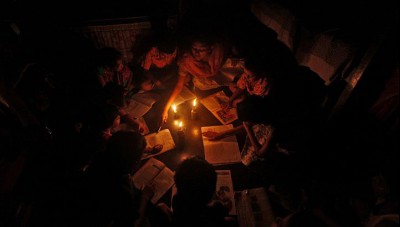
studying candle

Wynne Protects her Granddaughters “Future”, at the Expense of My Child’s Well-Being, NOW!

An Ill-Wind in Ontario

78808847Despite rising public complaints about adverse health effects from industrial wind turbines, thousands continue to be erected across the province.

Environmentalists often talk about people whose lives are ruined by man-made global warming.

But they never mention the lives that are devastated by misguided climate change policy.

There is no better example than the debilitating human health impacts of the hundreds of thousands of industrial wind turbines (IWTs) that are being erected around the world to supposedly mitigate climate change.

In “Adverse health effects of industrial wind turbines,” a 2013 paper in the magazine of the College of Family Physicians of Canada, Dr. Roy D. Jeffery, Carmen Krogh, and Brett Horner explained, “People who live or work in close proximity to IWTs have experienced symptoms that include decreased quality of life, annoyance, stress, sleep disturbance, headache, anxiety, depression, and cognitive dysfunction.”

“The problem is not just cyclical audible noise keeping people awake but also low frequency infrasound which can travel many kilometres,” notes Dufferin County-based Barb Ashbee, who says she was forced out of her Amaranth, Ontario home by the siting of IWTs too close to it.

“Infrasound goes right through walls,” said Ashbee, operator of the Wind Victims Ontario website. “It pummels your body.”

Tens of thousands of complaints have been received by governments around the world.

Sherri Lange, CEO of North American Platform Against Wind, said, “I have personally received hundreds of phone calls from distressed people who need to vacate their homes [because of IWTs].”

Lange contended governments try to not address the issue.

“It is my experience from talking to doctors, researchers and other high-level professionals, that governments seem to be (under the influenced of) the industry.”

Ontario Premier Kathleen Wynne promised her government would not force any of the 6,736 IWTs being erected by the province into “unwilling communities”.

To date, 90 communities have declared themselves as “Unwilling Hosts”, yet construction is underway, or planned, in many of these areas.

For example, in West Lincoln and surrounding regions, wind developers have received approval to install at least 77 three-Megawatt IWTs, each as tall as a 61-storey building, despite strong public objections.

Local resident Shellie Correia is particularly concerned.

Her 12-year-old son, Joey, has been diagnosed with Sensory Processing Disorder and it is crucial that he live in a quiet environment.

But now, as part of the Ontario government’s climate change plans, an IWT will be sited only 550 metres from his home, the closest “setback” allowed in Ontario for residents who do not sign lease agreements with wind companies.

The province, which cites a 2010 report from its Chief Medical Officer of Health that found no direct causal links between IWTs and adverse health effects, has claimed the province’s setbacks are “the most stringent in North America”.

In reality, most jurisdictions in Canada, the U.S., Australia, and Europe require greater setbacks. Two kilometres is commonplace.

As Correia explained in her January, 2015 presentation before the government’s Environmental Review Tribunal, “On top of the incessant, cyclical noise, there is light flicker, and infrasound. This is not something that my son will be able to tolerate.”

Correia is supported by her son’s pediatrician, Dr. Chrystella Calvert, a specialist in the care of children with developmental and mental health problems.

Calvert says, “I, as a ‘normal brain’ individual would not want this risk [of an IWT] to my mental health (or my children’s) in my neighbourhood.”

Like most governments, Ontario officials insist the adverse health effects of IWTs are minimal, citing various studies.

But there is much scientific evidence to the contrary and studies are lacking with regards to children.

Krogh, one of the authors of the report on health problems linked to IWTs that appeared in the magazine of The College of Family Physicians of Canada, wrote in a May 13, 2013 open communication to Canada’s health minister, “Vigilance and long-term surveillance systems regarding risks and adverse effects related to children are lacking. … This evaluation should take place before proceeding with additional approvals.”

But the approvals go ahead regardless.

As Correia notes, “Wynne speaks about ‘protecting’ her granddaughter’s future (in defending her government’s plan to introduce carbon pricing through cap-and-trade.) Why then, is it not important for her to protect my son, now?”

As the Green Scam Implodes, the Wind Weasels Scream Louder!

‘Greens’ Gamble on Your Future; while PM Stops CEFC from Laying Wind Power Bets

kenny-rogers-420x0

****

A little while back, that great philosopher, Kenny Rogers spelt out the rules for Gamblers in clear and simple terms:

You got to know when to hold ‘em, know when to fold ‘em,

Know when to walk away and know when to run.

You never count your money when you’re sittin’ at the table.

There’ll be time enough for countin’ when the dealin’s done.

That sound and sage advice is ignored in the breach by the wind industry, its parasites and spruikers.

Every time there’s a ‘little blow’ – and wind power output registers more than the usual piddling fraction of its ‘installed capacity’, there’s a flurry of Tweets and blog posts about the ‘monumental’ (but always ‘momentary’) energy effort. All laced with the kind of tear-filled joy that accompanies cheers for a disabled athlete, who’s just won Olympic Gold.

But, when it comes to cheering on the ‘disabled’ energy runner, wind power fans are always in breach of the Gambler’s 3rd rule, about counting their money while sittin’ at the table – they always count too loud and too soon.

And, just like the Gambler, the greentard is always quick and ready to tell you about their “wins”, but never about their “losses”.  When he’s down on his luck, the Gambler will happily lie to himself, friends and family about his failing fortunes – the greentard Gambler is no different.

In the last two posts (here and here) we popped up the some of the “track results” for wind power and, as laid out in dozens of pictures, its shameful ‘form’ would have had it “scratched” from the book, long ago – but for the gullible and naive (not to mention corrupt) among our political betters that control the field.

We’ll start with another example of how the “Gambling Bug” has displaced common sense, with greentards cock-a-hoop about “a single windy NIGHT in Denmark” – said to herald a ‘new dawn’ in our wind powered ‘future’.

GetUp! striving for an Australia where wind power meets 3am demand
Freedom Watch
Brett Hogan
14 July 2015

The hearts of climate change lobbyists were aflutter recently with news that wind farms had generated 140 per cent of Denmark’s electricity demand, and local advocates contrasting this with the Abbott Government’s supposed ‘war on wind’.

What this story is really saying is that in a country with a population the size of Victoria (around 5.6 million) and less than half the geographical area of Tasmania (at 43,000 square kilometres), wind power is able at 3am in the morning, when very few people are using electricity, to generate electricity in excess of demand.

Great work!

To get a sense of what 3am demand for electricity looks like, here it is this morning in Victoria:

400Energy_demand

****

Denmark is of course famous for having the most expensive electricity prices in the world and enjoys the luxury of being close enough to Germany, Sweden and Norway to buy their excess electricity (in part supplied by significant nuclear and hydroelectric facilities) when the wind isn’t blowing.

Wind farms turn the economics of energy markets upside down. Traditional power plants, like any other commodity, generate a product (power) that is sold in a market competing with other providers, and charging a price that is set balancing demand and supply.

However, wind farms, which are typically only economical in the first place due to significant government subsidies, which often include fixed tariffs (so much for the free market) actually rob the market of price signals when the wind blows. It can destroy the economics of electricity providers that need to stay in the market as backup for the 70 per cent of the time that the wind doesn’t blow.

Every country needs cheap and affordable electricity to build and sustain a modern economy and for its people to enjoy quality of life.

Australia has a population of almost 24 million people spread over 7 million square kilometres with an electricity demand more than 6 times that of Denmark, and no neighbouring country’s electricity to fall back on. Denmark offers no lessons for Australia other than “Don’t do this.”

Chris Berg in The Drum today wrote about the history of the Clean Energy Finance Corporation and its political genesis. The Abbott government was right to follow the lead of the United Kingdom and instruction to the Clean Energy Finance Corporation to no longer invest in wind or small-scale solar facilities.
Freedom Watch

roulette-table-2

****

Now, while the wind industry and its greentard-gamblers are ready to keep rolling the dice with our energy future, thankfully, the PM, Tony Abbott and his Vice-Squad, Treasurer “Smokin’” Joe Hockey and Mathias “The Terminator” Cormann have tipped the gaming tables and prevented the Clean Energy Finance Corporation from laying anymore high-risk bets, with taxpayers’ money. Here’s a little piece on the Vice-Squad’s raid.

There’s no ‘war on wind’, just MPs doing their job
Chris Berg
14 July 2015
The Drum

There are a lot of objectionable things in Australian politics, but Government ministers directing the Clean Energy Finance Corporation to stop funding new wind farm projects doesn’t rate, writes Chris Berg.

There was a lot of heat in the debate about the Clean Energy Finance Corporation over the weekend, but not much light.

On Sunday, Fairfax papers reported the Abbott Government had directed the CEFC to stop funding new wind farm projects.

Social media was livid. Tony Abbott was waging a “war on wind power”. How dare the Abbott Government presume to interfere with such a virtuous independent market program to tackle climate change?

That reaction was, to put it mildly, a load of nonsense. The Government’s direction to the CEFC is not unprecedented interference in an independent body. Nor is the CEFC a “market” mechanism. The CEFC is a government program whose funding policies are set by the executive.

Yes, the Coalition wants to abolish the CEFC outright. But it can’t. So the Government says it would rather the CEFC focus on funding innovation rather than established technology. There are a lot of objectionable things in Australian politics. This doesn’t rate.

The CEFC’s enabling legislation – which was written and introduced by the Gillard government and passed without Coalition support – allows the sitting government to do exactly what the Coalition is doing now. Asnoted in an explanatory memorandum authored by the Gillard government:

It is appropriate that the Government, as manager of the economy and owner of the Corporation, have a mechanism for articulating its broad expectations for how the Corporation’s funds will be invested and managed by the Board.

So each year the government is required to provide the CEFC with an investment mandate direction.

The memorandum specifically nominated “allocation of investments between different types of clean energy technologies” as one of the areas in which ministers might issue a direction.

What independence is provided by the CEFC Act is a requirement that ministerial directions not be contrary to the CEFC’s statutory obligations, and that ministers must not direct or prevent CEFC investments in specific companies. All fair enough.

With these provisions, the Gillard government gave itself the statutory leeway to direct the CEFC’s investment direction. If it didn’t want an Abbott Government to have the same leeway, it should have written the legislation differently. It knew the Coalition was opposed to the CEFC.

Anyway, that discretion is entirely proper. The CEFC is not an ethereal, non-political part of the Australian social fabric. It is the result of a four-year-old political compromise, designed to funnel money into one particular sector of the economy as part of the quid pro quo for theGreens’ carbon tax support.

So it’s a little bit silly to hear (as we did over the weekend) that by changing the CEFC’s mandate the Abbott Government is “picking winners”. That’s exactly what the CEFC was designed to do. The CEFC was designed to pick winners. It was designed to choose investments that it felt were not being adequately funded by open capital markets.

And the CEFC legislation already favours specific technologies. The body is not allowed to invest in carbon capture and storage or nuclear power. Nor can it invest in non-Australian projects. This last constraint seems a little peculiar if you think the CEFC’s ultimate goal is to reduce carbon emissions – a global, not a national, problem. But foreigners can’t vote.

Because it is not driven by the profit motive in a competitive market, the CEFC has to rely on non-market criteria on which to evaluate alternative investments. Right now that is done by these folk – the board of the CEFC. All the Abbott Government’s no-wind mandate does is constrain their criteria some more.

The idea that the CEFC is a “commercial” operation is nonsense. If it makes a profit consistently then it is a good candidate for privatisation. Why should the government own a profit-making financier? Why would it need to?

The CEFC got upset earlier this year when the Abbott Government asked it to lift its investment returns, asking it to “consistently outperform the market by a large margin”. But if the CEFC can’t beat the market with its government support, then the case for its continued existence is pretty weak.

Australia has a long history of government-owned banks like the CEFC – banks designed to push money into politically favoured sectors.

Who now remembers the Commonwealth Development Bank or the Australian Industry Development Corporation? Or the Commonwealth Bank’s Mortgage Bank Department and Industrial Finance Department? Or the joint public-private ventures of the Australian Resources Development Bank, the Primary Industry Bank of Australia, or the Australian Banks’ Export Refinance Corporation?

These banks were abolished or privatised because Australia came to recognise that markets allocate capital better than bureaucrats.

Right now there is a majority in the Senate preventing the abolition of the CEFC.

But it is almost inevitable that one day parliament will end the CEFC. Just as it ended all its other special development banks.
The Drum

abbott, hockey, cormann

More Evidence, that Wind Power is a FRAUD!

The Wind Power Fraud (in pictures): Part 1 – the South Australian Wind Farm Fiasco

Definition of fraud

****

In today’s post we lay out the wind power fraud in pictures, as it’s perpetrated in, what’s referred to as, ‘Australia’s wind power capital’, South Australia (tomorrow we expand the net to capture the debacle on the entire Eastern Grid).

To call the ‘performance’ of SA’s 17 wind farms (spread over a vast area of the State – with an installed capacity of 1,477MW) over the last few months “diabolical” is to flatter them.

SA’s Labor government has been talking up a wind powered future for months now – it’s presiding over the worst unemployment in the Nation, at 8.2% and rising fast – and seems to thinks the answer is out there somewhere – ‘blowin’ in the wind’. The fact that its wind power debacle has led to South Australians paying the highest power costs in the Nation – if not (on a purchasing power parity basis) the highest in the world – and, yet, the dimwits that run it wonder why it’s an economic train wreck (see our posts here and here).

Well, today, STT – always ready to rain on the wind industry’s parade – as well as the gullible and corrupt that cheer it on – spells it out in pictures – that even the most intellectually interrupted should be able to grasp.

The derisory data that follows comes courtesy of Aneroid Energy. We’ll start with a quick look at SA’s monthly performance (oh, and if the graphs appear fuzzy, click on them and they’ll pop up crystal clear in a new window).

May 2015 SA

Looking a bit like the meanderings of a drunken spider that had dipped one leg in the ink-well and staggered over the page, that’s the nonsense that wind farms can deliver power as an “alternative” to on-demand power generation sources such as hydro, gas and coal belted, yet again.

With 31 ‘chances’ to make a meaningful contribution to lighting up the230,000 homes said by wind power outfits to be ‘powered’ by their wind farms in SA – output collapses 13 times to less than 100MW – or less than 6.8% of the total installed capacity of 1,477MW.

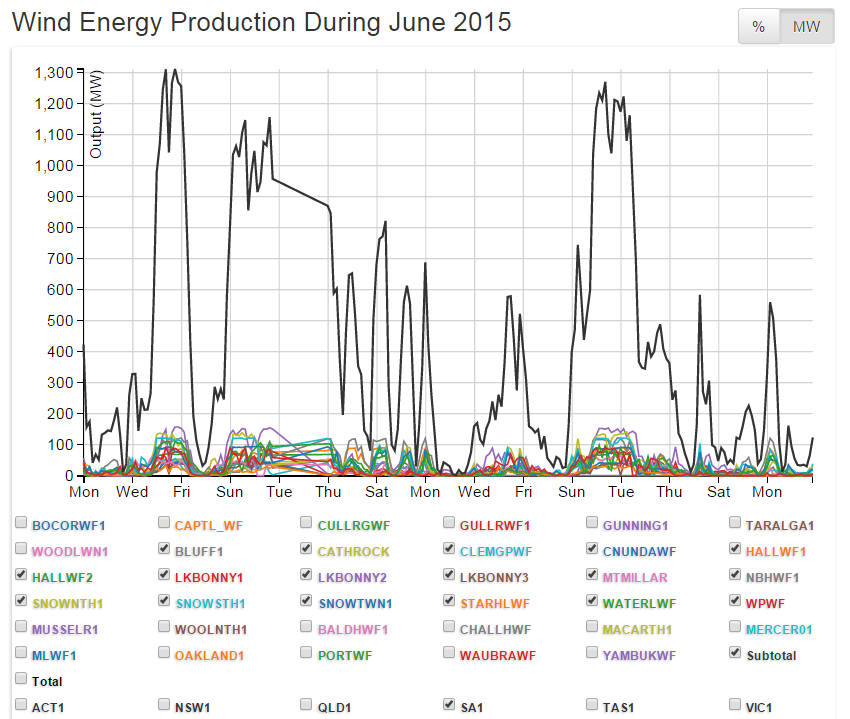
Here’s the total output from all wind farms in SA for June 2015.

June 2015 SA

Having hardly lit up the screen for much of May, you’d think that June would see a better effort – but, oh no. Total output spends more time below 200MW (or 13% of installed capacity) than above. And hits the bottom of the pool more than 7 times – with ‘output’ failing to power a single kettle – let alone the hundreds of thousands of SA homes we’re constantly told are ‘powered’ by the wind.

Here’s the total output from all wind farms in SA for the start of July 2015.

July 2015 SA

Looking more like the fat bloke bouncing around in the deep-end of the local pool, after a long lunch, July’s effort (so far) isn’t much better than the months before.

A couple of short-lived ‘spurts aside, and the rest is largely a ‘joke’: crashing by around 1,000 MW over 24 hours; and almost repeating the ‘performance’ a few days later with a precipitous plummet of over 500 MW in a couple of hours – makes it pretty clear that the words ‘reliable’ and ‘wind power’ don’t belong on the same page, let alone in a sensible sentence.

Spending days struggling to produce 200MW; hours and hours producing less than half that (or less than 6.7% of capacity); and 50MW (3.38%) or less for hours at a stretch, tends to take the gloss off the glory heaped on SA’s wind power dream; and suggests its future will be more of an energy nightmare.

Having taken a ‘helicopter view’, we’ll zoom in now – for a closer look at some of the more outlandish results on: May 3, 16, 25 and 26; June 12, 13, 14, 16, 17, 20, 29 and 30; July 2, 3 and 7.

3 May 2015 SA

Entire SA Grid – 3 May 2015 – from midnight to 9pm (21hrs):

Total wind farm output: midnight to 9pm – never more than 100MW; from 3am to 8pm (17hrs) – never much more than 50MW; and during the same period collapsing to ZERO around 6am, and 5pm to 6pm.

Output as a percentage of total installed wind farm capacity: midnight to 2 am – 3.4%; 7am to 2pm – 1.7%; 2am to 9pm – 3.38%; 6am and 5pm to 6pm – ZERO%.

16 May SA

Entire SA Grid – 16 May 2015 – from 1am to 12.30pm – a total collapse of 720MW to ZERO:

Total wind farm output: 11.30am to 5pm (5.5hrs) – never more than 100MW; collapsing to ZERO from 12.30pm to 2pm (1.5hrs).

Output as a percentage of total installed wind farm capacity: 11.30am to 5pm (5.5hrs) – never more than 6.8%; collapsing to ZERO% – from 12.30pm to 2pm (1.5hrs).

25 May SA

Entire SA Grid – 25 May 2015 – from 8am to noon – a collapse of 325MW to ZERO – a 100% drop in output, in around 4hrs.

Total output: from 11am to 9pm (10hrs) – never more than 50MW; from noon to 4pm (4hrs) – ZERO.

Output as a percentage of total installed wind farm capacity: 11am to 9pm – less than 3.85%; from noon to 4pm – ZERO%.

26 May SA

Entire SA Grid – 26 May 2015 – from midnight to 6pm (18hrs):

Total wind farm output: from midnight to 6pm – never much more than 350MW; from midnight to 2am 150MW; from 8am to 4pm – never more than 200MW; and falling to 90MW at 11am.

Output as a percentage of total installed wind farm capacity: from midnight to 2am – 10%; 8am to 4pm – never more than 13.5%; and dropping to 6.1% – at 11am.

Now for a closer look at June 2015.

12 June SA

Entire SA Grid – 12 June 2015 – from midnight to 4pm a collapse of over 600MW:

Total wind farm output: 10am to 6pm – less than 150MW; 3pm to 5pm – dropping to 50MW.

Output as a percentage of total installed wind farm capacity: 10am to 6pm – 10%; and 3pm to 5pm  – dropping to 3.85%.

13 June SA

Entire SA Grid – 13 June 2015 – from 9am to 3pm – a collapse of 750MW – 800MW to 50MW – or an output drop of 94% – at a rate of 125MW/hour:

Total wind farm output: from 2pm to 8pm – never much more than 100 MW; from 3pm to 5pm – around 50MW.

Output as a percentage of total installed wind farm capacity: 2pm to 8pm – between 6.8% and 10%; 3pm to 5pm – around 3.85%.

14 June SA

Entire SA Grid – 14 June 2015 – from 8am to 3pm – a collapse of over 650MW – from 700MW to 30MW – or a 96% drop in output:

Total wind farm output: from 1pm to 4pm (3hrs) – less than 100MW – dropping to 30MW.

Output as a percentage of total installed wind farm capacity: 1pm to 4pm – less than 6.8% – dropping to 2.03%.

16 June SA

Entire SA Grid – 16 June 2015 – 24 hours – never more than 140MW:

Total wind farm output: from midnight to 5pm (17hrs) – less than 30 MW; from 3am to 7am (4hrs) – ZERO; falling to ZERO between 9am and 11am.

Output as a percentage of total installed wind farm capacity: never more than 10% for the entire 24 hour period; midnight to 5pm – less than 2%; with ZERO% produced for around 5hrs.

17 June SA

Entire SA Grid – 17 June 2015 – 24 hours – never more than 260MW – or 17.6% of capacity:

Total wind farm output: from 5am to 8am – less than 140MW; dropping to 100MW at 8.30am.

Output as a percentage of total installed wind farm capacity: never more than 17.6%; 5am to 8am less than 9.4%; falling to 6.8%.

20 June SA

Entire SA Grid – 20 June 2015 – from midnight to 6pm (18hrs) – never more than 70MW:

Total wind farm output: from midnight to 6pm – less than 70MW; 3am to 6am (3hrs) – around 25MW; from 1pm to 6pm (5hrs) – 25MW; falling to 10MW – around 4pm.

Output as a percentage of total installed wind farm capacity: midnight to 5pm – less than 4.7%; 3am to 6am – 1.7%; 1pm – 6pm – 1.7%, falling to 0.7% – at 4pm.

29 June SA

Entire SA Grid – 29 June 2015 – from 3am to 1pm – an almost total collapse of 550MW to 10MW – or a 98% drop in output:

Total wind farm output: from 1pm to 5pm (4hrs) – never more than 10MW; from 6pm to midnight (6hrs) – 50MW – briefly rising to 170MW and dropping to 90MW.

Output as a percentage of total installed wind farm capacity: from 1pm to 5pm – 0.7%; 6pm to midnight – 3.3% – briefly rising to 11% – dropping back 6.1%.

30 June SA

Entire SA Grid – 30 June 2015 – for the 24 hour period – never more than 200MW:

Total wind farm output: from 1am to 7pm (18hrs) – never more than 80MW; from around 3am to around noon – less than than 40MW and closer to 20MW for that period; falling to less than 20MW around 4pm.

Output as a percentage of total installed wind farm capacity: 1am to 7pm (6hrs) – never more than 5.4%; from around 3am to around noon (9hrs) – less than than 2.7% and closer to 1.3% for that period; falling to less than 1.3% around 4pm.

Now a look at the scoreboard for July, so far.

2 July SA

Entire SA Grid – 2 July 2015 – a total collapse of output over the period – 700MW to around 10MW:

Total wind farm output: from noon to midnight (12hrs) – never more than 150MW; generally around 100MW – falling to 10MW around 10pm to midnight.

Output as a percentage of total installed wind farm capacity: from noon to midnight (12hrs) – never more than 10%MW; generally around 6.8% – falling to 0.7% around 10pm to midnight.

3 July SA

Entire SA Grid – 3 July 2015 – for the 24 hour period – never more than 150MW:

Total wind farm output: from midnight to 3am (3hrs) – never more than 20MW; twice falling to around 10MW; short burst to reach 80MW by 6am; dropping back to 40MW by 8am; with peaks and troughs later in the day – before dropping back to less than 100MW – 7pm to midnight.

Output as a percentage of total installed wind farm capacity: never more than 11% for the 24 hour period; much of it producing less than 6% – and often less than 2%.

7 July SA

Entire SA Grid – 7 July 2015 – from 2am to 1pm – a collapse (almost total) of 450MW – from 470MW to 20MW – or a 97% drop in output:

Total wind farm output: from 10am to midnight (14hrs) – never more than 60MW; twice falling to less than 20MW; and to ZERO around 10pm to midnight.

Output as a percentage of total installed wind farm capacity: from 10am to midnight (14hrs) – never more than 4.1%; twice falling to less than 1.3%; and to ZERO% – around 10pm to midnight.

We’re bored now – we’ve made our point: the idea that SA (or anywhere else for that matter) can ditch fossil fuel power generation sources and – by relying on wind power – go ‘100% renewable’ is pure fantasy.

Anyone who – after perusing the pitiful pictorial above – tries to tell you otherwise is probably not playing with the full deck. Either that, or they’ve got their trotters firmly planted in the wind power fraud trough.

At STT we love scorching wind power myths – and all the more so when it can be done with pictures.

In the last few months the lunatics from the fringes of the Labor party – and other hard-green-left nutjobs – have ramped up their rhetoric – pressing all and sundry join in their ultimate mission to go “fossil free” – they mean abstaining from the use of “fossil fuel”, rather than ceasing to rely on T-Rex and his – now stony/boney – kin. Although they have no apparent hesitation when it comes to burning up millions of litres of kerosene, flying to groovy backpacker must-sees, and “climate change” jamborees, all over the globe (see our post here).

Contrary to the anti-fossil fuel squad’s ranting, there isn’t a ‘choice’ between wind power and fossil fuel power generation: there’s a ‘choice’ between wind power (with fossil fuel powered back-up equal to 100% of its capacity) and relying on wind power alone. If you’re ready to ‘pick’ the latter, expect to be sitting freezing (or boiling) in the dark more than 60% of the time.

Wind power isn’t a ‘system’, it’s ‘chaos’ – the pictures tell the story.

One thing that amuses the STT gang, is seeing links to our posts appearing on the comments pages of online news sites, blog forums and the like: often they’re dropped into a ‘debate’ about the ‘wonders of wind’, with an apparently gleeful ‘splat’ – in a ‘get around that, and play fair’ kind of moment – that usually pulls the ‘debate’ to a shuddering halt.

STT predicts that this is going to be one such post.

So, next time you find yourself dealing with the intellectual pygmies, that are still clinging to their wind power myths and fantasies, why not flick them a link to this post – or have a little fun with an STT ‘splat moment’, on their favourite blogs and news sites?

Why not pitch a few sitters along with it, such as: on 3 May; after lunch on 25 May; after lunch on 13 June; on 16 June; on 20 June; and after lunch on 7 July:

How many South Australian homes (not kettles) were actually being powered by ‘wonderful wind’?

Where did all the power come from that kept the lights on and got the kettles boiling?

Was it coal? Was it gas? Or a bit of both?

In the light of your last answer, how much ‘dreaded’ CO2 gas was saved by SA’s 17 wind farms?

And what effect did wind power have on power prices in SA’s wholesale market for electricity?

We don’t expect them to enjoy it; but wind power worshippers have never been that keen on the facts.

Facts

Tom Harris Talks About the Negative Effects From Wynne’s Turbines….

An ill-wind in Ontario

 TOM HARRIS, GUEST COLUMNIST  

Despite rising public complaints about adverse health effects from industrial wind turbines, thousands continue to be erected across the province

FIRST POSTED: SATURDAY, JULY 18, 2015 07:00 PM EDT

But they never mention the lives that are devastated by misguided climate change policy.

There is no better example than the debilitating human health impacts of the hundreds of thousands of industrial wind turbines (IWTs) that are being erected around the world to supposedly mitigate climate change.

In “Adverse health effects of industrial wind turbines,” a 2013 paper in the magazine of the College of Family Physicians of Canada, Dr. Roy D. Jeffery, Carmen Krogh, and Brett Horner explained, “People who live or work in close proximity to IWTs have experienced symptoms that include decreased quality of life, annoyance, stress, sleep disturbance, headache, anxiety, depression, and cognitive dysfunction.”

“The problem is not just cyclical audible noise keeping people awake but also low frequency infrasound which can travel many kilometres,” notes Dufferin County-based Barb Ashbee, who says she was forced out of her Amaranth, Ontario home by the siting of IWTs too close to it.

“Infrasound goes right through walls,” said Ashbee, operator of the Wind Victims Ontario website. “It pummels your body.”

Tens of thousands of complaints have been received by governments around the world.

Sherri Lange, CEO of North American Platform Against Wind, said, “I have personally received hundreds of phone calls from distressed people who need to vacate their homes [because of IWTs].”

Lange contended governments try to not address the issue.

“It is my experience from talking to doctors, researchers and other high-level professionals, that governments seem to be (under the influenced of) the industry.”

Ontario Premier Kathleen Wynne promised her government would not force any of the 6,736 IWTs being erected by the province into “unwilling communities”.

To date, 90 communities have declared themselves as “Unwilling Hosts”, yet construction is underway, or planned, in many of these areas.

For example, in West Lincoln and surrounding regions, wind developers have received approval to install at least 77 three-Megawatt IWTs, each as tall as a 61-storey building, despite strong public objections.

Local resident Shellie Correia is particularly concerned.

Her 12-year-old son, Joey, has been diagnosed with Sensory Processing Disorder and it is crucial that he live in a quiet environment.

But now, as part of the Ontario government’s climate change plans, an IWT will be sited only 550 metres from his home, the closest “setback” allowed in Ontario for residents who do not sign lease agreements with wind companies.

The province, which cites a 2010 report from its Chief Medical Officer of Health that found no direct causal links between IWTs and adverse health effects, has claimed the province’s setbacks are “the most stringent in North America”.

In reality, most jurisdictions in Canada, the U.S., Australia, and Europe require greater setbacks. Two kilometres is commonplace.

As Correia explained in her January, 2015 presentation before the government’s Environmental Review Tribunal, “On top of the incessant, cyclical noise, there is light flicker, and infrasound. This is not something that my son will be able to tolerate.”

Correia is supported by her son’s pediatrician, Dr. Chrystella Calvert, a specialist in the care of children with developmental and mental health problems.

Calvert says, “I, as a ‘normal brain’ individual would not want this risk [of an IWT] to my mental health (or my children’s) in my neighbourhood.”

Like most governments, Ontario officials insist the adverse health effects of IWTs are minimal, citing various studies.

But there is much scientific evidence to the contrary and studies are lacking with regards to children.

Krogh, one of the authors of the report on health problems linked to IWTs that appeared in the magazine of The College of Family Physicians of Canada, wrote in a May 13, 2013 open communication to Canada’s health minister, “Vigilance and long-term surveillance systems regarding risks and adverse effects related to children are lacking. … This evaluation should take place before proceeding with additional approvals.”

But the approvals go ahead regardless.

As Correia notes, “Wynne speaks about ‘protecting’ her granddaughter’s future (in defending her government’s plan to introduce carbon pricing through cap-and-trade.) Why then, is it not important for her to protect my son, now?”

— Harris is executive director of the Ottawa-based International Climate Science Coalition, which opposes the hypothesis carbon dioxide emissions from human activities are known to cause climate problems 

Dr. Sarah Laurie sticks up for Victims of Bad Gov’t Policies, re: Wind Turbines!

Senate Wind Farm Inquiry – Dr Sarah Laurie says: “Kill the Noise & give Neighbours a Fair Go”

senate review

****

The Senate Inquiry has had to wade through a fairly pungent cesspit of ‘material’ dropped on it by the wind industry, its parasites and spruikers. No doubt to their great relief (or, in the case of wind industry stooge, Anne Urquhart, infuriation) the Senators have heard from a raft of genuine and highly qualified people, who are clearly dedicated to protecting their fellow human beings – rather than ridiculing, denigrating or deriding them as “anti-wind farm wing-nuts” or “Dick Brains“.

One of those rare breaths of empathetic fresh air arrived before the Committee in the form of Dr Sarah Laurie (one of STT’s ‘Australians of the Year); and a Champion for human health and human rights.

Sarah has been out to protect people from all manner of excessive industrial noise since she pitched up with the Waubra Foundation in 2010.

In the finest tradition of what made (and STT would like to think still makes) Australia a decent place for all comers, Sarah has thrown everything she’s got at getting a solid set of truly relevant noise regulations – that will actually be enforced – with one thing in mind: a “fair go” for all.

STT’s covered the concept of a National Noise Regulator, with the sort of teeth needed to prevent industries of all descriptions – not just wind power outfits –  from destroying peoples’ rights to sleep, live in and otherwise enjoy their homes, a couple of times:

Top Acoustics Professor Calls for Full Compensation for Wind Farm Victims, as Council Calls for “National Noise Cops”

Alan Moran: on the Insane & Pointless Cost of Wind Power

Here’s Dr Laurie detailing to the Inquiry the common-sense-concept of having one noise rule for all.

Senate Select Committee on Wind Turbines – 29 May 2015

LAURIE, Ms Sarah, Chief Executive Officer, Waubra Foundation

CHAIR: Welcome. Could you please confirm that information on parliamentary privilege and the protection of witnesses in evidence has been provided to you?

Ms Laurie: Yes, it has.

CHAIR: Thank you. I now invite you to make a brief opening statement. At the conclusion of your remarks I will invite members of the committee to put questions to you.

Ms Laurie: Thank you, Senators, for the invitation to attend this Senate inquiry into regulatory issues relating to industrial wind turbines.

The systemic regulatory failure with respect to the way industrial and environmental noise pollution is regulated in Australia is not confined to wind turbine noise. As you would have seen from the submissions of the Wollar Progress Association; and residents living near the coalmines in the Upper Hunter region and residents of Lithgow impacted by coal fired power stations and extractor fan noise and vibration. Their stories, both with respect to the range and severity of symptoms and the way they are treated by the noise polluters and the government regulatory authorities, are all too familiar to the growing numbers of rural residents living near industrial wind power generators.

Once sensitised, residents affected by infrasound and low-frequency noise from coal fired power stations find they also react to wind turbines in the same way. The body and the brain do not care about the source of the sound and vibration. The reactions are involuntary and hardwired, and part of our physiological fight/flight response.

At the heart of this systemic regulatory failure of environmental noise pollution is the failure of the planning and noise pollution regulations, because they all fail to varying degrees to predict, measure and regulate the excessive noise and vibration in the lower frequencies—in the infrasound and low-frequency noise regions, specifically between 0.1 and 200 hertz. These regulations also permit levels of audible noise which are guaranteed to cause adverse impacts because they are so much higher than the very quiet background noise environments in rural areas. These rules are not fit for purpose, and guarantee that some residents will be seriously harmed.

There has been pretence that there is no evidence of harm at the levels of infrasound and low-frequency noise being emitted. This is untrue. There is an extensive body of research conducted by NASA and the US Department of Energy 30 years ago, which: established direct causation of sleep disturbance and a range of physiological effects euphemistically called ‘annoyance’; acknowledged that people became sensitised or conditioned to the noise with ongoing exposure; and recommended exposure thresholds in order to ensure residents were protected from harm directly caused by this pulsing infrasound and low-frequency noise.

This research was conducted in residents living with sound and vibration from military aircraft, from gas and from wind turbines. Small rooms facing onto the noise source were described as being the worst. Residents described feeling unpleasant sensations at levels where the sound could not be heard but could still be perceived. These recommended exposure limits and the evidence of direct causation were widely known at the time but appeared to be ignored by noise pollution regulatory authorities and acousticians ever since and have never been adopted. This is a serious failure of the professional and ethical responsibilities of the acoustics profession.

Many medical practitioners remain completely ignorant of the effects of excessive noise in the lower frequencies, other than acknowledging that excessive night time noise could cause sleep disturbance which, if prolonged, could cause serious harm to physical and mental health. They do not realise that the neurophysiological stress, the cardiovascular pathology, the mental health pathology, and the cancers and chronic infections resulting from immunosuppression are all related to chronic sleep deprivation and chronic stress. Both these are designated as indirect effects from noise pollution by some, including the NHMRC in their 2010 rapid review.

However, the effects of chronic sleep deprivation are anything but indirect, as the UN committee against torture and cruel, inhuman and degrading treatment has specifically acknowledged. In addition, there is a substantial body of research which has established a disease complex called vibroacoustic disease, also caused by excessive infrasound and low-frequency noise. Most of that research has been done in an occupational setting. This disease causes permanent damage to a variety of organs and tissues including, for example, damage to cardiac valves from thickened collagen, which is now being reported in residents living near industrial wind turbines in Germany and in Australia. It is concerning that in Portugal this pathology has been identified in a child exposed to excessive infrasound and low-frequency noise in utero and in his early years. People living near coalmines in the Upper Hunter have also started to report pathology consistent with vibroacoustic disease.

Also of concern are the unexplained and life-threatening adrenaline surge pathologies being reported by residents living near coalmines and industrial-scale wind turbines in Canada and Australia: takotsubo heart attacks and acute adrenal crises with reported blood pressures well over 200 millimetres of mercury systolic. There is a concern among some cardiologists with an interest in takotsubo cardiomyopathies that excessive lower frequency sound energy could be causing some of these cases. At the moment we have minimal information about the exposure doses when these events occur but it is hoped that portable dosimeters which can accurately measure these exposures to infrasound will expand our knowledge.

In summary, there has been a fundamental failure of the health, planning and noise pollution regulatory authorities to listen, investigate and act decisively to stop the predictable and serious damage to the health of vulnerable rural community members. The systemic regulatory failure is not confined to rural areas, however. The culture of silence—the use of gag agreements to silence both sick people and independent acoustic consultants—has meant that important scientific knowledge is kept out of the public domain. This problem is increasing in scale because of the increasing industrialisation of our quiet rural areas and because machines are getting bigger, so there is a shift in frequencies generated down to the lower part of the spectrum. This problem is not going to go away. Planning and noise pollution regulatory authorities are invariably physically located hundreds of kilometres away from where the adverse impacts are experienced and are not held accountable to anyone for the public health disasters in rural communities which their decisions are creating.

The National Health and Medical Research Council has gravely failed the Australian public and the governments it advises by failing to ensure that serious conflicts of interest were not prevented with their choice of experts for their literature reviews. These have had a material impact on the quality of the advice from the NHMRC and have led to dangerously optimistic predictions about the safe distance of impact from wind turbine noise, for example. This has been achieved by cherry-picking data, ensuring the goalposts for the inclusion of studies were extremely narrow, and even resorting to misclassification of studies. The only possible reason for it was to ensure these studies were never included because they would damage the commercial interests of the wind industry. Incompetence is another, perhaps less likely, explanation.

The human cost of the failure to protect people from excessive noise pollution, especially at night, is terrible. I have personally helped to prevent a number of suicides of people who were utterly desperate because of the consequences of excessive noise pollution and who reached out for help. It was just lucky that I was available by phone or email and could help them find the help that they needed at the time. However, I am aware of others who did not receive such help and who did take their own lives. Sadly I have good reason to suspect that they are the tip of the iceberg and there will be more.

We need systemic regulatory reform and we need it now across all noise and vibration sources. The current system, where the noise polluters pay the acousticians handsomely to investigate, is not working to protect public health. He who pays the piper calls the tune. We also need tightly targeted research to accurately measure the exposure doses of people reporting adverse impacts inside their homes and to measure objectively their reactions to that noise as well as their reports of their symptoms. We need a commitment from the federal and state ministers of health and the chief medical officers in each state that this health-damaging excessive industrial noise pollution will be dealt with to protect people from further harm. A national noise pollution regulatory authority with strong powers to investigate, regulate, conduct targeted research and set standards free from commercial conflicts of interest, which are then actively and transparently enforced, is required right now.

Finally, there is the matter of which ministers are the most appropriate to have responsibility for this issue. It is the World Health Organization, not the world environment organisation, that has issued major reports over the last 10 or 15 years, such as the 2009 Night noise guidelines for Europe. It is our strong view that this is a public health issue and therefore should be under the direct and regulatory control of ministers for health, not ministers for the environment. Ministers for health have a stronger direct incentive to help prevent disease.

Senator DAY: Thank you, Ms Laurie. You have been here all day today and have heard evidence from a number of witnesses. For me, being on this inquiry has been a bit like living in a parallel universe. We have had people citing evidence from all over the world about the adverse health effects of wind turbines and then we have had evidence from people completely dismissing any connection whatsoever. He who pays the piper calls the tune. I accept that that could explain some, but it would not explain all of it. Can you shed any light on the rest? Why are so many people—public servants and others—so dismissive of there being any health impacts at all?

Ms Laurie: I think there are a variety of motivations. I am quite shocked that even now not one health authority has gone and directly investigated for themselves—not one. I think that says it all, really, in terms of the responsibility of health departments. I think there is enormous ignorance, as I have said, amongst the medical profession. There is a bias against believing that there is a problem with wind turbine noise.

I think people come at it from a variety of different standpoints. I know I myself was very reluctant to accept that there could be anything wrong. I used to take my children to go and watch wind turbines being built locally near our home. I had no idea about any adverse health impacts from wind turbines. I have a lot of friends who are Green-voting environmentalists, very concerned about the planet, very concerned about their children’s futures. I wonder if that has something to do with it.

But, when you listen to the stories of people affected by noise when they are trying to sleep in their beds at night, it does not matter what the source of the noise is if they cannot sleep and they are having these other very distressing symptoms and deteriorating health. The people I speak to do not mind what the source of the noise is; they just want it to stop.

Senator LEYONHJELM: Ms Laurie, I have read your submission and I have heard your comments at various times. I am interested in your thoughts on this because you have spent a lot of time working on this. You are a medical doctor, aren’t you?

Ms Laurie: That is correct.

Senator LEYONHJELM: It seems to me that it is a well-established scientific fact that infrasound can cause human harm.

Ms Laurie: That is correct.

Senator LEYONHJELM: I do not think anybody disputes that, do they?

Ms Laurie: Some do. It depends on the dose and it depends on the exposure time.

Senator LEYONHJELM: Yes. That is where I am going. So infrasound can cause harm. It is also not disputed by anybody that wind turbines emit infrasound. Have you heard anybody deny that, apart from the South Australian government?

Ms Laurie: No. Increasingly now I think the comments are that there is evidence proving that it is in fact emitted.

Senator LEYONHJELM: It seems to me the issue is whether enough infrasound is emitted from wind farms, under some circumstances if not all circumstances, to cause human harm. Would that be the proposition?

Ms Laurie: I think that is right. It is certainly a dose response relationship. However, people living near sources of industrial noise talk at various times about audible noise that is clearly disturbing to them if it is above the level of their television. I think Clive and Petrina Gare talked about that in their evidence. For some it is the pulsating, radiating quality of the sound that penetrates into their home and for some it is the sensations that they feel, which might be correlated to vibrations. Steven Cooper’s work down at Cape Bridgewater went into that in the most considerable detail of anyone in the world.

There is still a lot we do not know, but it is the combination of the frequency that people are exposed to and the features of the house, the acoustic resonance that might happen in certain rooms. Even the position in the a room can have an impact, together with the individual’s susceptibility. But until we measure what people are actually exposed to inside their homes—the sound and the pressure pulsations together with the vibration coming up through the ground—we will not know what their exposures are.

Senator LEYONHJELM: You mentioned chronic sleep deprivation and chronic stress as being key elements in this.

Ms Laurie: Yes.

Senator LEYONHJELM: Is there any particular reason for that? The reason for my question is that we have had other witnesses mention the Canadian health study, which focused on annoyance, which may not include those things. We have also had people suggest it involves the middle ear. I think somebody suggested it relates to the inner ear. We are hearing from a witness this afternoon who thinks it has a relationship to the vestibular mechanism. So why do you think chronic sleep deprivation is the key to it?

Ms Laurie: I think there are four key areas. Chronic sleep deprivation is the most widely reported symptom, and that seems to be the thing that really undoes people. Chronic stress can be associated with that. If you are chronically sleep deprived, that in itself can cause a chronic stress response. However, the chronic physiological stress is also part of what we are hearing from people.

The Japanese study, the Inagaki study, which measured the brain responses of Japanese wind turbine workers when exposed to reproduced wind turbine sound, showed clearly and objectively that the brain could not attain a relaxed state. Those EEG studies are precisely the sorts of studies I believe we need to do inside people’s homes to measure what their brains are responding to, because the clinical stories that they are giving are very consistent—that they are getting a physiological response.

Sometimes it can be that they are waking up in a very anxious, frightened, panicked state, and that can happen repeatedly. One of my colleagues from America, Dr Sandy Reider, has talked about a patient of his who woke up repeatedly in that state 30 to 40 times a night. It did not take long for that combination of sleep deprivation and repeated stress to wear this person down. He left and came back repeatedly. He was fine when he was away. He came back and got the same symptoms. He eventually moved away and his health is now improving. So the two are linked but separate.

However, I believe the vestibular system is actually the mechanism by which the brain is being affected by the sound energy. So it is via the vestibular system. Professor Salt’s work has shown that, if you stimulate the outer hair cells in the inner ear, some of the afferent fibres will take that sound energy and translate it into pulses into the brain that stimulate the alerting response in the brain. I think that is really the crux of the physiological response in what we are seeing.

Senator LEYONHJELM: But we have heard evidence that obviously not everybody—in fact, not even a majority—of people exposed to wind turbine noise or sound are adversely affected. Dr McMurtry suggested it was somewhere between five and 30 per cent of people. If that were the case, it would tend to suggest that there is a source of individual variation and that something like the motion sickness mechanism, a middle ear or vestibular mechanism, might explain it. If chronic sleep deprivation was the explanation, I think you would expect—and I am interested in your thoughts on this—people to be broadly affected the same way, wouldn’t you?

Ms Laurie: No, because everybody is impacted to different levels by the sound. Perhaps some examples will help. There are some couples where one partner was affected immediately when the turbines started operating and for the other partner it was months or years before they noticed an impact. I believe David Mortimer has given evidence to the inquiry. David and Alida are a good example. David was impacted very early on, within days to weeks of being exposed. Alida was fine for four years, and now she is quite badly impacted. Everybody is different, and everybody has different susceptibilities. Malcolm Swinbanks has shared with me some research from the 1970s related to the size of the helicotrema, which is a little hole in the inner ear. The smaller the hole, the greater the sensitivity to low-frequency sound. Alec Salt’s work with guinea pig models has provided some confirmatory evidence of that. Apparently when that hole is blocked the sensitivity to infrasound and low-frequency noise increases markedly. I also have heard from pharmacologists, pharmacists, that if people are on narcotic medication for pain relief then that can increase their sensitivity to sound.

So, a wide variety of individual factors can influence that. From my experience there is a subset of people who are terribly impacted very early on. Those people are the ones who tend to present with acute vestibular disorder type of symptoms—dizziness and motion sickness, which can be accompanied by extreme anxiety. Those people often just cannot last very long, and they move if they can. Trish Godfrey is one who has given evidence; Mrs Stepnell is another. They would fit in that category. However, for people in the same house, exposed to the same levels, like Carl Stepnell, it took a lot longer. Eventually he was impacted but in a different way.

In understanding the public health consequences, when you look at the population surveys that have been done, just looking at the sleep issue, a number have been done in Australia, one by an Adelaide University master’s student called Frank Wang. It was a population survey out to five kilometres, and 50 per cent of the people reported moderate to severe impacts from the turbine noise at Waterloo. From that, Mary Morris repeated his survey out to 10 kilometres—a smaller percentage, because it is a bigger area, so you get the dilution effect, but nevertheless she found that people were adversely impacted in terms of their sleep. Some of those people have subsequently had acoustic measurements done inside their house, which has confirmed that they are being subjected to excessive levels of low-frequency noise and that infrasound from the turbines is present. These people cannot see the turbines. Sometimes they can hear them. But they are being reliably and predictably disturbed—for example, when the wind is blowing towards them or when there is a cold, frosty night, because that cold air acts as a blanket to keep the sound energy down and stop the refraction up. That was something that Kelley and the NASA research showed 30 years ago. So, we have a lot of knowledge about what the impacts are and the distance of impacts.

Senator LEYONHJELM: But I have one final question: you mentioned this distance out to 10 kilometres; I have asked Steven Cooper what he thinks is an appropriate distance for wind turbines currently being constructed, and he says that 10 kilometres is probably about right. What is your view on that?

Ms Laurie: It depends on the size of the turbines and the power-generating capacity.

Senator LEYONHJELM: I mean the ones currently being constructed—three megawatts—

Ms Laurie: Yes, for three megawatts, 10, just based on the reports from the residents.

Senator LEYONHJELM: So, 10 kilometres for three megawatts?

Ms Laurie: Yes.

Senator URQUHART: There has been some controversy over your qualifications and professional standing so, for the record, could you let us know what your standing and professional qualifications are now?

Ms Laurie: Certainly. I am a medical graduate. I graduated from Flinders University with a bachelor of medicine, a bachelor of surgery, in 1995. I subsequently did postgraduate training in rural general practice. I attained my fellowship of the Royal Australian College of General Practitioners in 1998, I think it was, and subsequently was invited to become a clinical examiner for that college, which I did for a couple of years, until I became unwell. I attained my fellowship for the Australian College of Rural and Remote Medicine just after that, and I was one of the councillors on the South Australian Medical Association branch for a period of time, but that was prematurely cut short when I was diagnosed with an illness. I took time off and then subsequently had children, and I had intended to go back to work professionally as a country GP. A few other things got in the way, including finding out about what low-frequency noise is doing to people.

Senator URQUHART: So, currently you are not registered as a—

Ms Laurie: I am not currently registered to practise; that is correct. However, I am very keen to return. I really want to see some progress on this issue, because I do not want to abandon people who have invested a fair amount of trust and hope that things will change.

CHAIR: Just for the record: you have never been deregistered, have you?

Ms Laurie: I have never been deregistered, and apart from the defamatory complaint that was publicised and circulated from the Public Health Association of Australia, in which I believe the wind industry had a fair hand, I have never had any disciplinary complaints against me whatsoever.

Senator URQUHART: Thank you.

Senator BACK: Dr David Iser appeared before the committee in Melbourne. When did Dr Iser first report on what he believed to be the impacts and their causing of adverse health effects to people in the vicinity of industrial wind turbines?

Ms Laurie: May 2004 was when he wrote to Premier Bracks, Minister Brumby, Minister Delahunty and Minister Thwaites about the results of his population survey at Toora in Victoria. That was a world first. To my knowledge nobody else had ever done a population survey which demonstrated that not everybody was impacted but, of the people who were impacted, three were severely impacted, and I think five were moderately impacted.

Senator BACK: Did he report the actual clinical signs he was observing and did he validate medically the symptoms people were reporting to him?

Ms Laurie: He did in the sense that for some of them he was their treating doctor. In fact, that was why he became concerned about what was going on, because these people were presenting. People he had treated and known for a long time were presenting with these new problems, and some of them were very unwell, and that was why he did his research.

Senator BACK: That was the original work done. Can you tell me when the Waubra Foundation formed?

Ms Laurie: The foundation was established by Peter Mitchell in March or April 2010. I was invited to join in July or August 2010. I can give you the exact date, but I cannot remember it off the top of my head.

Senator BACK: We are actually talking about a six-year time gap between when Dr Iser first presented the population survey to the ministers of the Victorian government and when the Waubra Foundation was formed.

Ms Laurie: That is correct.

Senator BACK: Can you explain to me then why it is the Waubra Foundation that has been the butt of so many allegations and accusations of the spreading of fear if indeed Iser’s work was out in the public arena for six years?

Ms Laurie: I think there are a whole lot of reasons for that. I think it is a case of shooting the messenger—clinical whistleblowers—particularly if there are significant sums of money involved, as well as some ideology and concern about the environment. I think there are a whole lot of reasons that the message of the foundation has not been well received. And I should say that from the inception Peter Mitchell, as an engineer, was well aware that large rotating fans could generate noise, some of which was subaudible, so could therefore potentially have an impact on human health. So, from the beginning the foundation has been concerned about a variety of noise sources. We are concerned about the interface of the sound energy on people and promoting research that will help protect people. The source of the noise is a secondary consideration. We have been targeted particularly by the wind industry. If the coal industry and the gas industry were more aware of what we do, helping people directly impacted in communities like Tara in Queensland, up in the Hunter, in Lithgow, in Wellington and at some other sites, perhaps we would generate the same heat from them.

There is clearly a problem. The industry itself has admitted there is a problem. It is time that the facts were faced and we got some hard, objective evidence of what people are exposed to inside their homes, worked out exactly what thresholds are triggering this response and made sure that the noise pollution levels and vibration levels inside homes, no matter the noise source, do not exceed those thresholds.

Senator BACK: As a person with medical degrees and having been a fellow, as you have explained, of the college of rural practice and related areas, can you explain to me the circumstance of why you believe the Australian Medical Association has come out with its statement to the effect that there are no adverse health effects from industrial wind turbines in the face of evidence presented by peers within the medical profession refuting that.

Ms Laurie: I really cannot explain—I really do not understand—why they have come out and said that in the face of the clinical evidence that we know already about what sleep deprivation and chronic stress do to people. That position is not based on scientific evidence. The AMA have been repeatedly asked by people impacted by wind turbine noise to come and visit them, listen to their stories and listen to their own doctors. There are a number of doctors who have been prepared to stick their heads up above the parapet and say, ‘I believe my patient is impacted by wind turbine noise.’ Many of the people I speak to say that their doctors are not prepared to put that opinion in writing because they have seen what has happened to me and they are very concerned that they will be attacked, denigrated and publicly vilified and have their reputations smashed in the media. I can understand why the treating doctors are reluctant to put some of this in writing. For the Australian Medical Association to have come out with that position statement, in the face of the evidence that it was subsequently presented with, and refuse to either change it or investigate it, I think it reflects very poorly on the organisation.

Senator BACK: I have been nonplussed about it, but I just thought you might have had a more recent explanation, particularly given the history of some in the medical profession over time. Thank you very much and thank you for the work you do.

Ms Laurie: It is a pleasure. I should add that I have written on a number of occasions to the AMA and I am yet to receive any response whatsoever from them.

CHAIR: Ms Laurie, could you tell us when it was first known that people exposed to chronic excessive infrasound and low-frequency noise did not get used to that sound?

Ms Laurie: The first reference I can find is in Dr Kelley’s work, the extensive acoustic survey that was conducted in Boone County in America with NASA and, I think, 15 or so American research institutions—General Electric were part of it; there were quite a number of aero-acoustics and mechanical engineering university faculties involved. I was very interested to read that because on, I think, page 199 of that 1985 acoustic survey they specifically say that there are residents who have become conditioned to the sound—the later terminology is ‘sensitised’ to it. What that means is that they do not become used to it and they get progressively more sensitive as time goes on. The reason this is important is that, if you do not have sufficiently low thresholds set to protect people, over time they are going to get worse and we are going to have more and more people in our communities who are chronically sensitised to the sound. That really is a terrible thing for the people concerned because then they can pick up very low-frequency sound energy from other sources. They end up in a situation where they find it often very hard to sleep—they are perpetually sleep deprived—and they have a physiological stress response. They do not do well. They can become profoundly depressed and acutely suicidal.

One of the interesting pieces of research which a marine biologist and acoustician sent to me the other day—and I believe Geoff McPherson gave evidence to the inquiring in Cairns on this—was done into wild seal populations in Scotland. The researchers subjected the seals to different sorts of sound energy but at the same levels. There was sound energy that had a rapid acceleration, so it was very impulsive. And there was sound energy which was at the same level but had a much slower rise of the impulse. They found that the seals that were exposed to the rapidly impulsive sound did really badly. They showed signs of being conditioned and sensitised to the sound. But the seals that were exposed to the slower rising sound energy at the same peak level became used to the noise. They were habituated to it; it just did not worry them. I think there is something very profoundly important about the rate of acceleration.

There is actually one paper—although, I have not managed to track it down—that was cited by Dr Norm Broner, who you will be hearing from this afternoon, and also Dr Leventhall. It was in Dr Broner’s fairly major review from 1978 of infrasound and low-frequency noise. This was a paper by a man called Bryan. It specifically talked about the rate of rise in acceleration of the sound impulse being important with annoyance for this particular case that he was reporting on. I do think there are scientific clues from a long time ago that help us to understand that, perhaps, it is not just the level but the rate of acceleration as well.

CHAIR: Going back to the AMA’s position statement, why does the AMA’s position statement not address audible noise concerns? Do you know?

Ms Laurie: Again, I do not know. You would have to ask the AMA. I think audible noise is reported by the residents to be a major problem. As I said in my opening address, if you have loud levels of audible noise pollution way above the background level, acoustic experts say that anything that is background plus five you are going to start to notice it. Background plus 10 is excessive and is going to cause an impact. Background noise levels in Australia might be 18, 20 dB—maybe 25. You have allowable levels in South Australia of 40 or 35. That is going to cause an impact, a significant adverse impact, particularly because this sound energy is being transmitted especially at night when people are trying to sleep. Quite apart from low-frequency noise or infrasound, if you have excessive audible noise then you have regulations that are not protecting people.

Senator LEYONHJELM: I would be interested in your thoughts again. You have spent so much time on this. In light of the fact there is a paucity of research, I think your investigations are as good as we are likely to get on some of these areas, so I appreciate your thoughts. You can get used to loud noises without becoming sensitised when they are not infrasound. I am a living example. I live under the flight path of Sydney airport. I have done so for 30 odd years. Unless it blocks out the TV, I sort of tune it out. Yet we are not hearing that people, or some people at least, are capable of doing that with very low-frequency sound. Do you have any thoughts on whether anyone can do it? And if they cannot, why not?

Ms Laurie: Professor Salt has done some interesting work looking at this. He uses an analogy which, I think, is a useful one. If you think of the cochlea as being a little bit like the pupil in the eye that regulates the amount of light that gets into your eye, then, in an environment with a lot of light, your pupil constricts, and so less light gets in. And the converse happens. In quiet country environments at night, when people are asleep, because there is not a lot of loud background noise in their environment, the cochlea opens wide open. What happens, according to Professor Salt, is that a higher proportion of the low-frequency sound gets through to the afferent fibres, which are stimulated and send a message to the brain, and that, we believe, is the basis for this waking at night in a panic state, or the disturbed sleep. As to the evidence that supports this, you might remember Mrs Gare talking about how she sleeps with a radio on and ear plugs in her ears. Having some additional noise helps to close the cochlea down, if you like, in terms of the amount of the very-low-frequency sound and infrasound energy that gets transmitted through the brain.

That is where I think EEG studies inside people’s homes would help. We cannot do to the people what Professor Salt did to the guinea pigs, but I think if you have the EEGs you have objective evidence of what is going on. If you have concurrent full-spectrum acoustic monitoring at the same time, then you can see what people are exposed to and see what the brain response is.

Senator LEYONHJELM: Full spectrum, and do you have any thoughts on this argument amongst the acousticians that every 10 minutes is all right—and averages and so forth?

Ms Laurie: It is rubbish. We are talking millisecond responses. We are talking of a stimulus response. So, no, 10-minute averages will not cover it. It hides the peaks. The ear and the brain respond to the peaks.

Senator LEYONHJELM: I have no better idea than you, but I wonder whether it is the peaks we are talking about, rather than anything else, that are responsible for these adverse reactions?

Ms Laurie: My hypothesis is that it is these sudden peaks. That is why I am so interested in this idea that where you have more than one wind turbine generator and you have the synergy of the different frequencies from a number of towers, and the pressure bolt effects that people are describing, I actually think that that is a very, very important point. People are reporting being dropped to their knees suddenly with pressure waves—big, burly farmers being dropped to their knees. That is not happening at developments where there is only one wind turbine, in my experience. This is happening where there are multiple wind turbines. I suspect there is a cumulative impact from the forces.

CHAIR: Thank you for attending and for your evidence.

Hansard, 29 May June 2015

Dr Laurie’s evidence is available from the Parliament’s website here.

sarah laurie

More About the Lies the Windpushers Tell….

WIND FAIL: 20 QUOTES FOR 30 YEARS OF FALSE HOPES

Last week, news reports indicated the Senate Finance Committee will soon mark up legislation to retroactively extend a number of tax provisions that expired at the end of last year. Of note in this package is the wind Production Tax Credit (PTC). This would be the 10thextension of the PTC since it became law in 1992.

Senator Charles Grassley of Iowa, one of the original authors of the wind PTC, made clear last week in a letter to Chairman Hatch that despite his past statements, he wants yet another extension of this damaging provision. He stated:

“But, I also know this credit won’t go on forever. It was never meant to, and it shouldn’t. In 2012, the wind industry was the only industry to put forward a phase out plan. I have expressed support in the past for a responsible, multi-year phase out of the wind tax credit. But, I believe any phase out should be done in the context of comprehensive tax reform, where all energy tax provisions are on the table.” Senator Grassley letter to Chairman Hatch, 7/7/15

Sen. Grassley admits the wind PTC should not last forever and indicated he supports a phase out. It is clear that today Sen. Grassley does not want to see the wind PTC expire on his watch. Of course, this is significantly different than what he said 12 years ago:

“I’d say we’re going to have to do it [keep the PTC] for at least another five years, maybe for 10 years. Sometime we’re going to reach that point where it’s competitive (with other forms of energy). I think the argument for any tax credit is to make the new source of energy economically competitive.” (“Wind Energy Rides Roller Coaster Year.” Electrical Wholesaling, 4/1/03)

Sen. Grassley now appears not to believe what he said in 2003. Not only has more than 10 years passed, but the American Wind Energy Association claims that wind is not only competitive, but cheaper than other sources. In fact, AWEA claims that “the current cost of wind energy of under $50/MWh.” To put that in perspective, the Energy Information Administration explains that new combined cycle natural gas plants will produce electricity for $72/MWh. It appears that Sen. Grassley either does not believe the wind lobbyists or he was not being truthful in 2003 when he spoke about the PTC.

It turns out that wind promoters like Sen. Grassley and AWEA have long made claims that wind would soon be cost competitive and that the PTC would not be needed forever. Here are of some of their claims over the years:

1983 – Booz, Allen & Hamilton did a study for the Solar Energy Industries Association, American Wind Energy Association, and Renewable Energy Institute. It stated: “The private sector can be expected to develop improved solar and wind technologies which will begin to become competitive and self-supporting on a national level by the end of the decade [i.e. by 1990] if assisted by tax credits and augmented by federally sponsored R&D.”(Renewable Energy Industry, Joint Hearing before the Subcommittees of the Committee on Energy and Commerce et al., House of Representatives, 98th Cong., 1st sess. 1983)

1984 – Christopher Flavin of the Worldwatch Institute: “Tax credits have been essential to the economic viability of wind farms so far, but will not be needed within a few years.” (Christopher Flavin, “Electricity’s Future: The Shift to Efficiency and Small-Scale Power,” Worldwatch Paper 61, Worldwatch Institute, 11/84)

1985 – Christopher Flavin of the Worldwatch Institute: “Although wind farms still depend on tax credits, they are likely to be economical without this support within a few years.” (Christopher Flavin and Cynthia Pollock, “Harnessing Renewable Energy,” in Worldwatch Institute, State of the World 1985)

1985 – “Wind Energy Cannot Only Become Competitive, But Will In The 1990’s Be One Of The Cheapest Sources Of New Power.” “While wind power cannot yet deliver electricity at costs competitive with other energy sources – some experts estimate that it may cost anywhere from 9 to 12 cents a kilowatt-hour, as opposed to the 7-cents-a-kilowatt-hour cost of oil and gas -proponents point to a recent study by the Electric Power Research Institute of Palo Alto, Calif., a research group financed by electric utilities. That study indicated that wind energy cannot only become competitive, but will in the 1990’s be one of the cheapest sources of new power.” (Barry Fisher, “The Threat To Wind Energy,” The New York Times, 10/26/85)

1986 – Christopher Flavin of the Worldwatch Institute: “Early evidence indicates that wind power will soon take its place as a decentralized power source that is economical in many areas…. Utility-sponsored studies show that the better wind farms can produce power at a cost of about 7¢ per kilowatt-hour, which is competitive with conventional power sources in the United States.” (Christopher Flavin, “Electricity for a Developing World: New Directions,”Worldwatch Paper 70, Worldwatch Institute, 6/86)

1986 – Amory Lovins of the Rocky Mountain Institute lamented the untimely scale-back of tax breaks for renewable energy, since the competitive viability of wind and solar technologies was “one to three years away.” (Lovins, K. Wells, “As a National Goal, Renewable Energy Has An Uncertain Future.” Wall Street Journal, 2/13/86)

1986 – A representative of the American Wind Energy Association testified: “The U.S. wind industry has … demonstrated reliability and performance levels that make them very competitive. It has come to the point that the California Energy Commission has predicted windpower will be that State’s lowest cost source of energy in the 1990s, beating out even large-scale hydro.”(Statement of Michael L.S. Bergey, American Wind Energy Association inRenewable Energy Industries, Hearing before the Subcommittee on Energy Conservation and Power of the Committee on Energy and Commerce, House of Representatives, 99th Cong., 2nd sess. 1986)

1990 – In 1990, two energy analysts at the Worldwatch Institute predicted an almost complete displacement of fossil fuels in the electric generation market within a couple decades [i.e. 2010]: “Within a few decades, a geographically diverse country such as the United States might get 30 percent of its electricity from sunshine, 20 percent from hydropower, 20 percent from wind power, 10 percent from biomass, 10 percent from geothermal energy, and 10 percent from natural-gas-fired cogeneration.” (Christopher Flavin and Nicholas Lenssen, Beyond the Petroleum Age: Designing a Solar Economy, Worldwatch Institute, 1990)

1991 – Dale Osborn, Former AWEA President: “The Wind Industry Could Produce, At Competitive Prices, Up To One-Third Of The Nation’s Electricity Needs Within The Next 30 Years.” “‘Here we go again. Nuclear, coal and oil appear to be receiving all the benefits, while clean, proven energy technologies like wind are receiving little serious attention,’ said Dale Osborn, president of the California-based company, U.S. Windpower, and president of the American Wind Energy Association. ‘Given an equal opportunity to compete fairly, the wind industry could produce, at competitive prices, up to one-third of the nation’s electricity needs within the next 30 years.’” (“Bush Administration’s Energy Plan Represents Another Missed Opportunity For America, Says U.S. Windpower,” PR Newswire, 2/20/91)

1991 – “Wind Power Will Be Cheaper Than Conventional Power By 2000.” “’Wind power will be cheaper than conventional power by 2000 when strides in engineering will have made windmills even more economically competitive,’ said Paulus Soullie, a windmills engineer at Holland’s Energy Research Centre in Petten. A windmill with a record 1.3Mw output will be built later this year in Holland.” (Peter Spinks, “Charm Of The Farm Goes With The Wind,” The Observer, 1/13/91)

1996 – Christopher Flavin, President of WorldWatch Institute. “Following the laws of technological progress and large-scale manufacturing, the cost of wind-generated electricity has fallen by more than two-thirds over the past decade, to the point where it is lower than that of new coal plants in many regions. Within the next decade, it is projected to fall to 3 to 4 cents per kilowatt-hour, making wind the least expensive power source that can be developed on a large scale worldwide.” (“Power Shock: The Next Energy Revolution.”WorldWatch, January/February 1996)

1998 – Ken Lay, former CEO of Enron, to Gov. Bush in 1998. “The bill, H.R. 1401 (Thomas R-CA), extends for five years the existing wind production tax credit (PTC), which was passed by the Bush Administration in the Energy Policy Act of 1992. Wind is the fastest growing new electrical generation technology in the world today and has rapidly decreased its production costs until it is close to being competitive with conventional generation technologies.” (“Enron’s Ken Lay asks for Texas Gov. Bush’s help in securing tax credits for wind.” National Wind Watch, 9/10/2008)

1999 – A DOE Assistant Secretary Said Wind Power Is Getting Close To Being Competitive With Wholesale Power. ‘”Although wind power is not yet competitive with wholesale power, it’s getting close… ‘Of all the renewable technologies, wind power is the closest to market competitiveness today. When you consider the improved technology the opportunity for consumers to choose green power, and the concerns over climate change, it all adds up to a strong potential for wind to really take off over the next 20 years.’” (Taylor Moore, “Wind Power: Gaining Momentum,” EPRI Journal, 12/22/99)

2001 – Robert Boyd, Enron Wind Corp. VP: “With Additional R & D Funding And The Continuation Of The Production Tax Credit For The Next Five Years Wind Should Become Price Competitive With Conventional Generation Technologies.” “Wind energy is close to becoming competitive with conventional fuels. With additional R & D funding and the continuation of the Production Tax Credit for the next five years wind should become price competitive with conventional generation technologies.” (Robert T. Boyd, Committee On Finance, U.S. Senate, Testimony, 7/19/01)

2003 – Senator Chuck Grassley (R-IA) on the PTC. “I’d say we’re going to have to do it for at least another five years, maybe for 10 years. Sometime we’re going to reach that point where it’s competitive (with other forms of energy). I think the argument for any tax credit is to make the new source of energy economically competitive.” (“Wind Energy Rides Roller Coaster Year.” Electrical Wholesaling, 4/1/03)

2004 – Experts Said in 2004 Wind Was “Getting Close” To Viability And “Very Nearly Competitive.” “Not long ago wind power was the domain of fringe scientists and environmentalists…. But the industry is maturing and growing quickly–and is beginning to find its place as one viable element in the energy puzzle. … Still, says Bob Thresher of the Department of Energy’s National Renewable Energy Lab, ‘wind is the first renewable technology that is very nearly competitive in the market for bulk power generation.’ … [Wind pioneer Jim] Dehlsen says the cost of wind needs to fall below three cents per kilowatt hour–without tax credits–to truly break society’s addiction to fossil fuels. “It’s still not there, but we’re getting close,” he says.” (Brad Stone, “The Master of Wind,” Newsweek, 9/20/2004)

2004 – Edward Berkel, Senior VP Shell WindEnergy: “Cost Reductions Will Eventually Make Wind Fully Competitive With CCTG Power.” “Cost reductions will eventually make wind fully competitive with CCTG power. If PTCs are not replaced other mechanism might be used, i.e. green certificates. Driven by customer needs, overall world pressure to reduce GGEs.” (“Where’s The Bill?” Project Finance, 3/2004)

2006 – A Former FERC Chairman Said The Wind Industry Will Be Eventually Be Able To Survive Without Subsidies. “[Pat Wood, former chairman of the Federal Energy Regulatory Commission (FERC)] said that the high price of fossil fuels make it a ‘pretty safe bet’ that the wind energy industry will eventually be able to survive without government subsidies in the form of the wind production tax credit.” (Suzanna Strangmeier, “Former FERC Chairman Pat Wood Sees Bright Future for Wind Power,” Oil Daily, 5/2/06)

2012 – Denise Bode, Former AWEA CEO on PTC Phase-out. “In coordination with any phase down of the credit, we would urge Congress to consider additional policy mechanisms to encourage a diverse portfolio that includes renewable energy. With the policy certainty that accompanies a stable extension, the industry believes it can achieve the greater economies of scale and technology improvements that it needs to become cost competitive without the PTC.” (AWEA letter to Congress. 12/12/12)

2012 – Secretary of Energy Steven Chu: “I think it’s something the wind industry sees: “As the technology gets better, there’s no need to be subsidizing a competitive industry once it’s competitive.” “So over a period of time, especially as — and no dates were discussed — but over a period of time, a road map of phasing out, you see where the prices are going and you can see” how to eliminate the credit…. Just as eventually VEETC and other things were eventually phased out, I think it’s something the wind industry sees: As the technology gets better, there’s no need to be subsidizing a competitive industry once it’s competitive,” (“Chu opens the door to phaseout of wind incentive.” Governors’ Wind Energy Coalition, 3/15/12)

2014 – Warren Buffett on how wind isn’t profitable without subsidies. “I will do anything that is basically covered by the law to reduce Berkshire’s tax rate,” Buffet told an audience in Omaha, Nebraska recently. “For example, on wind energy, we get a tax credit if we build a lot of wind farms. That’s the only reason to build them. They don’t make sense without the tax credit.” (U.S. News & World Report, 5/12/14)

2015 – Senator Chuck Grassley on (yet another) PTC extension. “But, I also know this credit won’t go on forever. It was never meant to, and it shouldn’t. In 2012, the wind industry was the only industry to put forward a phase out plan. I have expressed support in the past for a responsible, multi-year phase out of the wind tax credit. But, I believe any phase out should be done in the context of comprehensive tax reform, where all energy tax provisions are on the table.” (Senator Grassley letter to Chairman Hatch, 7/7/15)

The definition of insanity is doing the same thing over and over again and expecting a different result. For more than 30 years, wind promoters have claimed that wind would soon not need subsidies because it would be cost-competitive. But here we are in 2015, and despite claims from AWEA that wind is cost competitive, their actions suggest they don’t believe their own talking points. After all, if wind were competitive, the wind lobby would be greedy to insist on $6 billion from the taxpayer for the PTC.

AWEA certainly knows that their claims about wind truly being cost competitive are not true. New research by the Institute for Energy Research found that electricity from new wind is three times as expensive as electricity for the existing fleet of coal units. This is the real reason wind supporters need the wind PTC to be continually extended. Without the PTC, no one would build wind turbines. As Warren Buffet said, “On wind energy, we get a tax credit if we build a lot of wind farms. That’s the only reason to build them. They don’t make sense without the tax credit.”

Instead of looking towards Senator Grassley, Congress should heed the advice of another author of the wind PTC, former Rep. Phil Sharp from Indiana. He said in 2013 that the tax credit should have “a sunset provision to ensure that the temporary incentive does not become a permanent subsidy.”  (“Extending the wind tax credit.” Washington Times, 12/5/13)

Members like Senator Grassley want the wind PTC to be a permanent subsidy. It is time to break this cycle and allow this subsidy to phase out. Congress should embrace HR 1901, the PTC Elimination Act by Reps. Marchant and Pompeo, to accomplish this goal.

The Effects of Infrasound are Shown in this Study… Critiqued by Dr. Sarah Laurie!

Brains ‘excited’ by wind turbines: study

Groundbreaking research from Germany on low-frequency “infrasound” adds to the recent body of work that is challenging wind energy proponents’ insistence that turbines are not linked to health complaints reported by those living close by.

Sensing inaudible sounds
Sensing inaudible sounds. (Source: The Australian)

By Graham Lloyd, Environment Editor, Sydney

The international project led by the National Metrology Instit­ute of Germany (PTB) concludes that exposure to infrasound below the range of hearing could stimul­ate parts of the brain that warn of danger. It finds that humans can hear sounds lower than had been assumed and the mechanisms of sound perception are much more complex than previously thought.

The researchers do not claim the results are definitive regard­ing wind turbines and health impacts, and say more work is needed.

But the research builds on recen­t work in Japan and Iran — and investigations by NASA dating back to the 1980s — that suggests the health science of wind energy is far from decided and would benefit from further inquiry, though it is unlikely to persuade prominent wind farm advocate, Simon Chapman.

Dr Chapman, who did not respond to questions from The Australian about the German work, told a Senate inquiry into wind farms and health last month that he was not persuaded by other recent­ research.

“I believe there is much evidence that belief in the harms of wind farms is the cause of harm from wind farms and that those who are intent on spreading this fear are largely responsible for that harm,” he told the inquiry.

The Clean Energy Council was unavailable to comment. But others in the renewables industry say they are open to further inquiry.

Oliver Yates, the chief executive officer of the Clean Energy Finan­ce Corporation, which has less than 20 per cent of its portfolio invested in wind farms, said that “environmental considerations” were critical in any project.

Asked at a conference in Sydney yesterday if the corporation was concerned about increased health risks, he replied: “I encourage any necessary additional support or research people feel that they need to have in relation to this matter to get clarity and satisfaction within their own mind.”

The National Health and Medical Research Council is currently reviewing the evidence on wind turbines and health. The Australian Medical Association will review its position on the issue once the NHMRC reports. Until then, its position is that available Australian and international evidence does not link adverse health effects to wind farms.

The AMA’s vice-president, Geoffrey Dobb, said there was “no accepted physiological mechanism where sub-audible infrasound could cause health effects”.

The German study suggests the impact of very low frequency noise on some people is poorly understood. Scientists in Japan measured brain function and reported last year that it showed the brains of Japanese wind turbine workers could not achieve a relaxed state.

In a similar vein, a study of 45 people in three groups by Tehran University, published earlier this year, said “despite all the good benefits of wind turbines, it can be stated that this technology has health risks for all those exposed to its sound.”

Work by Neil Kelley and NASA in the 1980s on early model wind turbines found impacts from infrasound and led to design changes.

It identified a direct causal link between wind turbine infrasound and low-frequency noise and neighbours’ health problems including sleep disturbance, collect­ively described as “annoyance”.

As the number and size of wind turbines has increased, the number and spread of complaints has also grown. The German research says infrasound is pervasive and generates from an increasing number of sources, including renew­able energy sources such as wind parks and heat pumps.

“Although commonly declared as ‘non-audible’, the number of complaints about infrasound expos­ure has been increasing expon­entially in Germany and also in other countries serious problems exist,” the research paper says.

“It has been agreed that infrasound is perceived by humans and it represents an almost unknown hazard to human health.” Project leader Christian Koch told The Australian the intention of the PTB researc­h was to investigate how infrasound can be perceived by humans.

“We think this is a contribution to the many questions we have within this field but it is too early to conclude seriously about wind turbines­ and their impact,” Dr Koch said.

As part of the German research, laboratory tests were conducted using very pure low-frequency signals.

Test subjects were asked to describe their experience and their brain responses were measured using magnetoencephalography and functional magnetic resonance imaging technologies.

The results showed that human­s could hear sounds of eight hertz, a whole octave lower than had been previously assumed, and that excita­tion of the primary auditory cortex could be detected down to this frequency.

A PTB report on the research findings said all participants had explicitly stated that they had heard something.

Clinical observations showed a reaction in certain parts of the brain which play a role in emotions. “This means that a human being has a rather diffuse perception, saying that something is there and that this might involve danger,” Dr Koch said.

PTB said the wind energy sector and authorities had often tried to appease concerns of health impacts from wind farms by declaring that the sounds generated were inaudible and too weak to be the source of health problems.

But Dr Koch said the issue must be taken seriously. “Neither scaremongering nor refuting everything is of any help in this situation,” he said. Investigations were only beginning and further research was urgently needed.

The Australia-based Waubra Foundation has long been recommending independent research into the effects of industrial sound and vibration from wind turbines and other sources. The foundation said the German research had helped “demonstrate objectively and visually via functional MRI scans that an infrasound stimulus triggered physiological responses that were hardwired into the mammalian brain”.

Additional reporting: Annabel Hepworth

Dr. Christian Koch conference paper

For those who are not familiar with this area of research

By Sarah Laurie

For those who are not familiar with this area of research from a clinical / physiological perspective I have listed some more of the supporting research and information immediately below – some of which was mentioned in the newspaper article. There is now a confluence of research leading in the same direction, pointing to the existence of a stimulus response relationship between infrasound and low frequency noise impulses from a variety of sound sources, including industrial wind turbines, resulting in a variety of impacts on humans and animals, including physiological stress and tissue pathology such as described in the vibroacoustic disease (VAD) research (more information here: waubrafoundation.org.au/resources/alves-pereria-m-castelo-branco…).

The rest of the information below relates to the physiological effects, not to VAD, (which is not to discount its importance). Rather this accentuates the broad range of pathology possible – all caused directly by exposure to excessive levels of infrasound and low frequency noise.

Graham Lloyd has mentioned some of the previous research which underpins this important German work, including particularly the Kelley / NASA research from the 1980’s – for more detail and access to those research reports:
waubrafoundation.org.au/2013/explicit-warning-notice and in much more detail here: cdn.knightlab.com/libs/timeline/latest/embed/index.html…

This neuroimaging research by Dr Christian Koch is consistent with in the early observations of medical practitioners, listed in the Darmstadt Manifesto in Germany in 1998 (waubrafoundation.org.au/resources/darmstadt…). This was followed by two rural general practitioners – Drs Amanda Harry in 2003 in the UK waubrafoundation.org.au/resources/dr-amanda-harry… and Dr David Iser in 2004 in Australia waubrafoundation.org.au/resources/dr-david-iser…relating to physiological stress symptoms being reported by the residents, with some very serious consequent health problems for some.

The recent German research extends the important work done by US Paediatrician and scientist Dr Nina Pierpont subsquently in the mid – late 2000’s, and her recognition that it was disturbances of the vestibular system which linked the observed and reported clinical adverse health effects, and the stimulation of the fight flight response being reported by residents as similar to “panic attacks” and waking at night in an anxious frightened panicked state. waubrafoundation.org.au/resources/dr-nina-pierpont…

There is more detail about the other research relating to the stimulation of the sympathetic nervous system, physiological stress and vestibular dysfunction which may be useful background in my expert opinion for the Stony Gap case:
www.wind-watch.org/documents/expert-opinion-concerning-the-adverse…

The neuroimaging in the German collaborative study is consistent with the animal experimental work by neuroscientist Professor Alec Salt and his team, who established that the afferent nerve fibres from the outer hair cells of the inner ear were sending “alerting” messages to the cochlear nucleus in the brain after being stimulated by infrasound, which could be responsible for the sleep disturbance reported by the residents. More information about Professor Salt’s work is here (see particularly section 3 (pp 24-25):
waubrafoundation.org.au/resources/salt-n-lichtenhan-j-t-how-does-wind…

The German work is also consisent with the recently reported Japanese research by Inagaki et al, which demonstrated objectively using EEG monitoring that the brains of Japanese wind turbine workers could not attain a relaxed state when exposed to recorded wind turbine sound in a laboratory study, indicating physiological stress in non English speaking people, who financially benefited from wind energy via their employment (yet again countering the nocebo effect hypothesis):
waubrafoundation.org.au/resources/ingaki-et-al-analysis-aerodynamic…

One of the best clinical descriptions of this disturbed sleep and repeated activation of the fight flight response and how health damaging it can be was by Dr Sandy Reider, a US family physician from Vermont. His description was given as part of testimony given to the Vermont state legislature and can be accessed here: waubrafoundation.org.au/resources/dr-sandy-reider…

It has long been my view that the combination of these physiological stress episodes, particularly at night, (disturbing sleep) is what is driving the relentless and very individual deterioration in the physical and mental health of people exposed chronically to excessive levels of this pulsing infrasound and low frequency sound energy. The vast range of reported adverse effects merely demonstrates the variable individual human response to prolonged stress and chronic sleep deprivation, which most people, especially those trained in clinical medicine should understand and recognise.

At the extreme end of the spectrum of reported physiological stress events strongly suspected to be directly caused by excessive impulsive infrasound, low frequency noise and vibration from a variety of sources (including both open cut coal mining and wind turbines), the rare but important adrenaline surge pathology such as Tako Tsubo events and acute Hypertensive Crises, were reported in my presentation (given by Professor Bob McMurtry in my absence) to the American Acoustical Society conference in May this year:
waubrafoundation.org.au/resources/acoustical-society-america-conference….

Sarah Laurie

Wind Turbine Host, “Tells All” at Australian Government Inquiry! Brilliant!

Farmer Knocks Back ‘Offers’ of $100,000 a Year to Host Turbines & Tells Senate: “These Things Shouldn’t Be In Anyone’s Backyard”

senate review

****

Remember all those glowing stories about wind power outfits being welcomed into rural communities with open arms? You know, tales about how farmers are dying to have turbines lined up all over their properties? How locals can’t wait to pick up some of the thousands of permanent,high paying jobs on offer? How developers are viewed with the kind of reverence reserved for Royalty?

No?

We’ve forgotten them too.

The wind industry routinely trots out 4 or 5 year old community surveys (where the respondents don’t and will never live within driving distance from these things) that purport to show the ‘love’. But, when the question is put fair and square to people that know they’ll end up as wind industry “road-kill”, the results tend to come out a little differently:

1,000 Sign Petition Against Mt Emerald Wind Farm: Survey says 92% Opposed

After years of being lied to, bullied, berated and treated like fools (at best) and “road-kill” (at worst), for most, the ‘gloss’ comprising wind industry PR efforts to ‘win hearts and minds’ has well and truly worn off.

These days, the communities aren’t so gullible; they aren’t so welcoming; and they aren’t willing to take it lying down. Despite having the skills of the best spin doctors in the business at its disposal, it’s “outrage” that’s become the word synonymous with the wind industry, wherever it goes. In short, rural communities have had enough – and they’re fighting back, by fair means and foul:

Angry Wind Farm Victims Pull the Trigger: Turbines Shot-Up in Montana and Victoria

These days, the PR outfits that are paid a packet to ‘shape the debate’ – like the Clean Energy Council and the Australian Wind Alliance – are probably just stealing from their wind industry clients.

Most of their recent efforts are just plain silly, and plenty seem to backfire. The case of Hamish and Anna Officer from Macarthur is only just the latest example. The industry’s case on wind turbine noise sleep and health; corporate social responsibility and relations with its contracted hosts has taken a hammering in the last few months:

SA Farmers Paid $1 Million to Host 19 Turbines Tell Senate they “Would Never Do it Again” due to “Unbearable” Sleep-Destroying Noise

Unwilling Turbine Hosts Tell Senate: Australia’s Most Notorious Wind Power Outfit – Infigen – a Team of Bullies, Liars & Thugs

In an effort to hose down the utterly damning evidence given to the Senate Inquiry by Clive and Trina Gare, and the group of unwilling turbine hosts from Flyers Creek in NSW, who have been repeatedly bullied and threatened by near-bankrupt Infigen, the wind industry’s spruikers trotted out the Officers to parrot from a well-oiled script about how much they love living cheek-by-jowl with the 48 Vestas V112s they host on their property at Macarthur in western Victoria. The Officers telling the SMH that they “live a good deal closer to wind turbines than most people” and simply love the look of the things; and that the noise is as soothing as a well-written symphony (the wind industry’s cooked-up propaganda piece about the Officers is available here).

There’s only one minor problem with the Officer’s story. And that’s the fact that the Officers are spending something in the order of $2million on a dream home 30km away from the public health disaster they helped create. The apparent aim of the Officer’s pricey building program is to leave their current home, and the sweet “music” created by their fleet of “beautiful, majestic, landscape improvers” – it must pain them so, to have to leave them so far behind:

Macarthur Turbine Hosts Destroy Community & Bolt as Hammering the Wind Industry becomes the “New Black”

When people with real honour and integrity – like the Gares – tell the story of their self-inflected misery, there’s a ring of honesty that gels with country people. Not so, with hypocrites that run in lockstep with the wind industry; and who seem happy to pocket the loot and leave their neighbours for dead. Which brings to mind the ol’ chestnut that you can fool some of the people, some of the time, but you can’t fool all the people, all the time.

Now, back to the evidence before the Senate Inquiry. David Brooks, Dr Michael Crawford and Mark Tomlinson gave a very solid wrap up on the institutional corruption that pervades State Planning departments and the Clean Energy Regulator. But we think the stand-out testimony was that given by Michael Lyons – a farmer from Bodangora in NSW – who was repeatedly offered a deal to host 10 turbines on his property in exchange for over $100,000 a year.  STT thinks Michael’s response as to why he knocked back that kind of money says it all really:

Mr Lyons: The first time I knocked it back, I did not know anything about them, to be quite honest. The proponent was quite insistent that I host turbines, but I said no. I said, ‘I am going to find out a little bit more about them first before I say yes or no.’ At that stage I was pretty open minded. Another contact of mine had done a lot more research into them and through that person I then formed the opinion that these things were not something that should be inflicted on anybody. Call me a nimby if you like but I do not think that these things should be in anyone’s backyard, let alone mine.

Here’s the rest of their evidence.

Senate Select Committee on Wind Turbines – 29 May 2015

BROOKS, Mr David, Chairman, Parkesbourne/Mummel Landscape Guardians Inc.

CRAWFORD, Dr Michael Arthur, Private capacity

LYONS, Mr Michael David, Coordinator, Bodangora Wind Turbine Awareness Group

TOMLINSON, Mr Mark, Member, Residents against Jupiter Wind Turbines Noise Committee

CHAIR: Welcome. Could you please confirm that information on parliamentary privilege and the protection of witnesses and evidence has been provided to you?

Dr Crawford: Yes, it has.

Mr Brooks: Yes.

Mr Tomlinson: Yes.

Mr Lyons: Yes.

CHAIR: Thank you. The committee has your submissions and I now invite you to make a brief opening statement and at the conclusion of your remarks, I will invite members of the committee to put questions to you.

Dr Crawford: Thank you for the invitation to appear here today. I am speaking as a private individual, though I am also a board member of the Waubra Foundation and a member of the local group, Residents against Jupiter Wind Turbines. Members of that group have had extensive dealings with the New South Wales planning department as well as other New South Wales agencies in relation to Jupiter and other wind farms. While I am critical of the way the system currently operates, I acknowledge that the current New South Wales Minister for Planning, Rob Stokes, and his predecessor Pru Goward, as well as the secretary of the department, appear to be trying to improve the process. But institutional inertia is powerful and the changes are slow, meanwhile innocent people are being badly harmed and that will continue under current arrangements.

I have worked for more than 30 years as a management consultant to private and public sector organisations, normally advising the CEO and other senior executives on matters of corporate strategy and organisation design. While my first degree was in physics and maths, my PhD relates specifically to organisation design and my subsequent research was in corporate change. I also taught on executive programs at the Australian Graduate School of Management. That is by way of background.

It is clear to me that the current processes for approving and regulating wind farms in New South Wales are excessively complex and neither economically efficient nor socially just. They are essentially a tick-the-box planning exercise with little integrity, conducted at large public and private expense, to produce an outcome favourable to developers. As you have already discovered, conditions imposed by wind farm approvals are quite deficient and, unlike some industries such as coalmining in New South Wales, compliance testing and enforcement is virtually non-existent. Without effective compliance and enforcement in any field, conditions will be regularly breached.

It is possible to add some integrity to the current approvals system in various ways such as relying only on data provided by parties with no association with the proponent, not accepting judgements made by consultants hired by the developer to support their case and imposing decommissioning funding conditions guaranteed to not leave the taxpayer or the local community on the hook.

Alternatively, it is possible to remove most of the inefficiency, subjectivity and injustice by replacing the current regulatory process by a standards-based one that forces developers to absorb externalities through fair commercial transactions and imposes genuinely rigorous ongoing noise monitoring with material costs for breaches. Such an approach would be far more transparent and much less exposed to the risks of corruption than the current process. Our local group provided the previous New South Wales planning minister with advice on how that could be done but have heard nothing further. Hopefully this committee will have more success. Thank you.

Mr Tomlinson: Thank you for giving me the opportunity to speak here today. Residents against Jupiter Wind Turbines is a community group established in the Tarago area of New South Wales opposing the proposed Jupiter wind farm. A subcommittee was formed, now known as the noise committee, and members of this committee are tasked with investigating various aspects of wind turbine noise. Some of these areas are noise propagation and the effects of topography and geographical spread, the relationship between multiple turbines and wind shear relating to international standards—just to mention a few.

My role as a member of the noise committee is to investigate the background noise monitoring process as outlined in the various wind farm guidelines used in New South Wales. This role involves monitoring equipment set-up, data collection, data analysis and preliminary findings reports. This has also led into the investigation into wind turbine infrasound. The committee purchased industry standard class 1 noise monitoring equipment and use the current New South Wales draft wind farm guidelines and the 2003 South Australia wind farm guidelines as guiding documents, as used by the Department of Planning and Infrastructure.

In January 2015, we commenced a monitoring program to ascertain the ambient environmental background noise at six properties around the proposed wind farm. We have currently completed five and, as a result, have discovered numerous deficiencies within the guidelines used for wind farm approvals. The major deficiencies include removal of extraneous noise; wind over microphone; position of monitoring equipment; checks and balances as to the accuracy of noise monitoring reports submitted by developer-paid acousticians; ongoing compliance monitoring; and others listed in our submission.

In our monitoring program, we employed a Svantek 977 class 1 noise data logger, a wind data logger positioned at microphone height, a wind data logger on a portable 10-metre tower and a TASCAM DR-40 digital sound recorder to achieve full 24/7 sound recordings for the purpose of extraneous noise removal. We have also purchased three microbarometers, which are capable of recording infrasound levels from 0.05 hertz to 20 hertz, with which we have recorded wind turbine infrasound out to 14 kilometres.

I must stress at this point that we are not acousticians and we do not purport to be such; we are simply a community group putting forward our views and observations after conducting background noise monitoring, according to the relevant wind farm guidelines used in New South Wales. We believe the current wind farm guidelines are in no way adequate and must be amended as a matter of urgency. Thank you.

Mr Lyons: In the interests of time, I think you will find you already have a copy of my opening address. I am quite happy to pass on making opening remarks, so that we can get on with more questions.

Mr Brooks: Before I begin my presentation, I would like to thank you for all the work that you have done on the issues of this inquiry, especially for your interim report. If all its recommendations are implemented then there will be some hope that wind farm neighbours will find some relief at last. Today, I will limit myself to three topics that concern planning and regulation. I will deal with each topic briefly and then draw some conclusions from them, taken together. For evidence in detail for what I shall say, I must refer you to my submissions.

Topic No. 1: first, I wish to summarise the situation relating to the unauthorised turbine relocations of the Gullen Range wind farm because this matter illustrates the unreliability, incompetence, negligence and impropriety of the planning and assessment of wind farms in New South Wales. I realise that you cannot directly affect state planning issues, but it is important that you should be aware of them if you are to make recommendations for the federal government’s negotiations with the states through COAG, and for new measures regarding federal agencies. It is not an exaggeration to say that the suffering of wind farm neighbours is almost entirely due to inadequate planning and assessment at state level.

The project approval for the Gullen Range wind farm prohibits the proponent from moving turbines up to 250 metres from their approved positions without seeking permission from the Minister for Planning—that is condition 1.5. Moreover, section 75W(2) of the Environmental Planning and Assessment Act 1979 of New South Wales insists that modifications that are not ‘consistent with the existing approval require the permission of the Minister for Planning’. The proponent ignored these conditions and built the infrastructure of the wind farm with 69 of the 73 turbine footings in the wrong place without seeking the permission of the minister. This was a clear violation of both the project approval and the EPA Act. Nonetheless the department of planning has allowed the proponent to submit a modification application in order to get retrospective approval for all these violations, and the department has consistently recommended that such retrospective approval be granted by the Planning Assessment Commission.

I cannot go into all the twists and turns by which the department has justified its response to this violation. You may wish to ask questions about that presently. Here, I only wish to point out that a project approval and a clause in a law, which have perfectly clear and intelligible meanings, are being deliberately disregarded by the department and that the department’s only justification for this is sophistry. This makes a mockery of the idea of regulation. That is topic one.

Topic 2, much more briefly: the Gullen Range has been approved under the completely inadequate South Australian noise guidelines 2003. When neighbours have asked for the approval to be reviewed because of the deficiencies of the noise guidelines, they have been told that this cannot happen because the EPA Act allows a developer to sue the minister for compensation if the minister revokes or modifies an approval. The planning law in this way gives certainty to the developer but excludes any possibility of relief to neighbours.

Topic 3: under the Renewable Energy (Electricity) Act, the federal act, the Clean Energy Regulator can consider suspending the accreditation of a wind farm if the regulator ‘believes on reasonable grounds that the power station is being operated in contravention of a law of the Commonwealth, a state or a territory’—that is subsection 30E(3). However, the regulator seems to have unlimited discretion to avoid forming a reasonable belief. There is abundant evidence in the public domain that the Gullen Range wind farm is in breach of New South Wales law, but the New South Wales department of planning refuses to say so and the Clean Energy Regulator refuses to consider all the evidence. Moreover, the Clean Energy Regulator has adopted the preposterous position that it can only test whether a wind farm is in breach of law in the present. It cannot, so it thinks, test whether a wind farm has been in breach in the past.

If the New South Wales Planning Assessment Commission gives retrospective approval to all the violations of the project approval of the Gullen Range wind farm, the Clean Energy Regulator will refuse to consider whether the wind farm has been in breach of New South Wales law and the wind farm will keep over a year’s worth of renewable energy certificates, worth somewhere in the region of several million dollars to which, arguably, it is not entitled. Those are the three topics; two quick conclusions.

Firstly, a law or a project approval can be quite clear and unambiguous, yet a government agency will arrogate to itself the discretionary power to disregard the clear meaning of that law or that approval, and to render it meaningless. There is no check or balance to prevent such an abuse of power by that government agency. Both the New South Wales department of planning and the Clean Energy Regulator are guilty of this abuse of power. Secondly, when the law protects the rights and capital of a developer then the law is hard and firm and solid, and will be respected by government agencies. But when a law is likely to make difficulties for a developer, a regulatory agency will use sophistry to disregard the law and to avoid enforcing the law against the developer. This gives the developers a privileged position in the face of the law, offends against the principle of equality before the law and subverts any possibility of serious regulation.

Finally, in view of these facts, there needs to be a royal commission into wind farm development in Australia. Such a commission is necessary if the corrupt nature of planning, assessment and regulation is to be addressed and overcome. Thank you.

Senator DAY: Dr Crawford, I am drawing on your experience with organisation and corporate culture. Can you explain why, in the face of such overwhelming evidence regarding the adverse health effects of wind turbines, there is such a denial, which seems to defy all logic, by so many operators, regulators, commentators and others? It is a phenomenon which really intrigues me. You have got a PhD in this, so please enlighten me.

Dr Crawford: Without actually going to the PhD, I believe that it was Upton Sinclair who said something like, ‘It’s extremely difficult to get someone to understand something when their salary depends on not understanding that.’ Basically, if you look at not just the wind industry but regulatory agencies in this area, and given the commitment of government to introduce renewable energy in this country, everyone’s incentives are actually aligned with pretending there is no problem. To recognise a problem would put people in the situation where they then have to overtly recognise to themselves that they are behaving in a way which certainly some people would describe as evil—they are inflicting harm on others simply for their personal benefit in terms of ongoing salary and other acceptances.

Senator DAY: Thank you.

Senator LEYONHJELM: I have a question for Mr Lyons. You are part of the group opposed to the Bodangora wind energy facility in central New South Wales. I understand it will have 33 turbines. Can you tell us what is the level of opposition locally to that facility?

Mr Lyons: The community opposition was overwhelming—and still is. I think it has probably grown because people have got themselves a lot more educated as to the negative impacts of wind farms. When we did the submissions to the department of planning and infrastructure, it worked out, I think, that it was 94, 96 per cent opposed within the community. Of those that were not opposed, there were 163 total submissions. I think it was 152 opposed and, of the remainder, I think there were a mixture of government agencies, of which most of them had issues—still unresolved to this day. Of the individual ones, they were from host farms, host families. There were two anonymous and, of those two anonymous, one came from a distance of 50 kilometres outside the project area.

Senator LEYONHJELM: The facility has not been built yet—is that right?

Mr Lyons: That is correct.

Senator LEYONHJELM: When will it be built?

Mr Lyons: As soon as they get finance, and they cannot get finance until they get a power purchase agreement.

Senator LEYONHJELM: They have been waiting for the RET agreement, presumably.

Mr Lyons: That is correct.

Senator LEYONHJELM: How many host properties are there?

Mr Lyons: I am going on memory. This submission went into the department of planning a couple of years ago. I may be a couple out, but I think there were eight host families.

Senator LEYONHJELM: What is their view of it? Have you had any contact with them?

Mr Lyons: I have had very limited contact because a lot of them are my neighbours. I am the largest single non-host neighbour on the southern side of the project area.

Senator LEYONHJELM: Were you offered the opportunity to become a host?

Mr Lyons: Several times.

Senator LEYONHJELM: And you knocked it back?

Mr Lyons: Correct, yes.

Senator LEYONHJELM: Why was that?

Mr Lyons: The first time I knocked it back, I did not know anything about them, to be quite honest. The proponent was quite insistent that I host turbines, but I said no. I said, ‘I am going to find out a little bit more about them first before I say yes or no.’ At that stage I was pretty open minded. Another contact of mine had done a lot more research into them and through that person I then formed the opinion that these things were not something that should be inflicted on anybody. Call me a nimby if you like but I do not think that these things should be in anyone’s backyard, let alone mine.

Senator LEYONHJELM: How much money do you think you turned down?

Mr Lyons: We are talking tens of thousands here. The situation is that Mount Bodangora, which is the name of the property, is the highest point across Australia on the latitude that it sits so it is reasonably high up, it is fairly well exposed to wind and there are quite a few ridges around. I think I could probably put up 10 turbines at least without any worries.

Senator LEYONHJELM: On the basis of $10,000 a year?

Mr Lyons: The contract, which you would have a copy of, is an original contract that I have. It is not something that we made up; it was actually handed to me by a potential host farmer, who eventually knocked the whole project back as well. I understand, from memory, that it was $11,000 for the first turbine and $10,000 per turbine per year after that.

Senator LEYONHJELM: So you are not the only local who knocked back hosting turbines?

Mr Lyons: That is a good question. I would have to get back you on to that.

Senator LEYONHJELM: I thought you said you got a copy of the contract from somebody who knocked it back?

Mr Lyons: Yes, you are quite right. There were several others. I was just trying to think how many, not whether I was the only one.

Senator LEYONHJELM: So was there more than one?

Mr Lyons: There was certainly more than one.

Senator LEYONHJELM: The department of planning and infrastructure, I gather, has told you that they do not have the resources to adequately check on this facility. Is that correct? Can you explain what they said?

Mr Lyons: Yes, they verbally told me that over the phone. They certainly were not prepared to put it in writing.

Senator LEYONHJELM: What exactly did they say?

Mr Lyons: Essentially they said that the department did not have either the financial resources or the manpower resources to check on whether or not the proponent had actually completed what they were supposed to do. As long as the proponent had made what looked like a an attempt to fulfil the director-general’s requirements, that was good enough for the department.

Senator LEYONHJELM: We have been unable so far to get the relevant New South Wales authorities to come along and tell us how the process for approving wind farms in New South Wales operates. We do not know whether that is deliberate or not but we hope that we can resolve that before too much longer. In the absence of that information, can you tell us who approves them and then who checks compliance with the planning approvals subsequently?

Mr Brooks: One fact that may be of interest to you in relation to this is my association went to the Land and Environment Court back in 2009. For that purpose, we subpoenaed all the correspondence between the department and the developer—the original developer. We got two volumes of correspondence. It was quite obvious from that correspondence that the department was indeed helping the developer to put the proposal in a form where it could get approval.

For my world—I used to be an academic—it was rather like a supervisor helping a postgraduate to write a thesis; so the supervisor will say you need more of an argument here, you need more evidence for this bit, this bit of you argument needs clarification and so on. The officials in the department of planning were doing that for the developer for months and months. Whether or not the people who then go on to recommend the proposal for approval are the same officials, I cannot tell you—you would have to ask the department of planning. But certainly the department of planning itself would seem to have a conflict of interest because if a supervisor helps a postgraduate to write a thesis, they do not then examine the thesis.

Senator LEYONHJELM: What contribution does the local council have to that process?

Mr Brooks: They can make a submission just like anybody else but they do not have any authoritative power of decision.

Senator LEYONHJELM: Once it is built and operating, what is your understanding of checking compliance with planning conditions?

Mr Brooks: This goes back to the developer, who will use the same noise consultant who did the original noise projections. That noise consultant will put in a report and then that, presumably, will be accepted by the department of planning. I do not think there is any compulsory obligation on the department of planning to do any independent checking.

Senator LEYONHJELM: Does the council have any role at all in verifying compliance?

Mr Brooks: No, because all of this is done at the level of the state government.

Senator URQUHART: Mr Tomlinson, can you tell me about your organisation, the Residents Against Jupiter Wind Turbines Noise Committee. How many members do you have?

Mr Tomlinson: On the noise committee, we have three members. The Residents Against Jupiter community group has in the vicinity of about 140-odd members.

Senator URQUHART: Is this like a subcommittee of that committee?

Mr Tomlinson: This is a subcommittee, yes.

Senator URQUHART: Are you funded at all?

Mr Tomlinson: No, we are not funded. We have had members donate some money to purchase equipment.

Senator URQUHART: Is this the equipment that you talked about earlier?

Mr Tomlinson: That is correct.

Senator URQUHART: What was the cost of all that equipment?

Mr Tomlinson: The cost was around $8,000 for the equipment we have.

Senator URQUHART: You said in your opening statement that you are not acousticians. Is there anybody in there that is qualified to actually run that equipment?

Mr Tomlinson: No, there is not although we have been in contact with some acousticians who have given us some guidance, one of those being Steven Cooper.

Senator URQUHART: Mr Lyons, can I ask you how many members you have in your awareness group?

Mr Lyons: We are a fairly loose-knit organisation, comprising every neighbour surrounding the turbines area. It is probably around about 30.

Senator URQUHART: What would be the area that you are looking at? What would be the radius of it?

Mr Lyons: Of the project area, I think it would be about 28,000 hectares.

Senator URQUHART: Are the 30 people within that area?

Mr Lyons: No, outside of that area. I may stand corrected on the 28,000 but I think that is what hectare area is of the project itself. We are outside that area.

Senator URQUHART: You said you called for submissions and I did not quite understand your numbers there so if I could just go back through them. I think you said you received 163 submissions. What was the process that you went through?

Mr Lyons: The project was put on public display for 60 days.

Senator URQUHART: Whereabouts?

Mr Lyons: It was at the local council. I think it was also online on the department of planning website, I believe, although I got my copy from the council, a digital copy.

Senator URQUHART: Was this the planning project?

Mr Lyons: This was for the Bodangora wind farm. It was on display for 60 days. I think the general public had about six weeks to put submissions in. We put in a submission of over 900 pages detailing what was wrong with the project. Basically, I think, we were totally ignored.

Senator URQUHART: So those 163 submissions went in to the local council?

Mr Lyons: No, this was a state significant development so it went into the department of planning.

Senator URQUHART: That was what I wanted to clear up. As the wind turbine awareness group for the area that you talk about, have you undertaken any research to determine the community attitudes to wind farms?

Mr Lyons: Very much so.

Senator URQUHART: Has it been formal or informal? How have you done that?

Mr Lyons: We held a community meeting which we funded ourselves within Wellington. I think we had about 200 or 250 people show up. We invited different speakers including Ms Sarah Laurie, who spoke here earlier today. We also invited the proponent and several other wind farm companies who were proposing to put wind farms in the Wellington area. Infigen were the only ones that actually showed up, which was the proponent for the Bodangora wind farm.

Senator URQUHART: Was that a question-and-answer type community meeting?

Mr Lyons: Yes, pretty much. Guest speakers would speak for a while and then it was open to questions and answers, a bit like this is today. It was very much overwhelmingly against the proposal. The research that we did as part of our response to the department of planning for our response to the EA was very much against the project. The community just does not want this project.

Senator URQUHART: The 200 to 250 people that came along, how big a radius do those people live in? Are they part of this group of 30 that are part of your awareness group or how was that made up? Do you know?

Mr Lyons: I do not quite get where your group of 30 fits in. Are you talking about that the Bodangora Wind Turbine Awareness Group? Probably about half of us were able to come that particular day.

Senator URQUHART: So the rest of the 200 to 250 people were from within that community?

Mr Lyons: They were from as far away as South Australia really. Dr Laurie came from South Australia. We had a couple of speakers from South Australia because that was where most of the wind farms that we knew of at the time were located, so we wanted to get some information from there. By far the vast majority of people were locals. By local I mean I would say within 30 kilometres probably.

Senator URQUHART: Mr Brooks, your organisation, the landscape guardians, how many members do you have?

Mr Brooks: Back in 2009 when we went to court, we had a maximum membership I think of 173. Since then, and especially since the wind farm has been built, people have got demoralised and so on so our official paid-up membership now is actually somewhere around 20. We are not the only organisation. There is also Crookwell District Landscape Guardians. I believe they have a membership of about 100, which is quite strong. The other thing which is relevant is that even though people do not pay their subscriptions and continue their membership, they still object to the wind farm. The whole community still knows each other. We still see each other.

Senator URQUHART: As part of your group, do you undertake research to determine community attitudes? How do you get your information?

Mr Brooks: We have not done that. We have had meetings. I might cite the Planning Assessment Commission meeting that took place in September last year, which was held in Crookwell in the RSL. About 200 people turned up to that. It was obvious just being in the room that the overwhelming majority were against the wind farm. I have never had any doubt from all our meetings over the years that certainly the overwhelming majority of people who are going to be affected by the wind farm are solidly opposed to it.

Senator URQUHART: Dr Crawford, you indicated at the start that you were also a director—I think that was the right terminology—of the Waubra Foundation and you are also part of the Residents Against Jupiter Wind Turbines Noise. Are you just on the committee or are you part of the larger group?

Dr Crawford: I am certainly part of the larger group. When we had a community meeting, I was elected as chairman. We had a community meeting in February last year with 200 people and that group elected me as chairman to chair that and pass the motions which went to the New South Wales government. I also happen to be a member of the noise committee.

Senator URQUHART: So you wear a few hats?

Dr Crawford: Yes.

Senator URQUHART: Mr Tomlinson, are you a member of other organisations or just the Residents Against Jupiter?

Mr Tomlinson: No, just Residents Against Jupiter.

Senator URQUHART: Mr Lyons, is your only membership of Bodangora Wind Turbine Awareness Group? Are you a member of other groups?

Mr Lyons: No.

Senator URQUHART: And Mr Brooks?

Mr Brooks: I am vice-president of New South Wales Landscape Guardians, which is a sort of umbrella organisation for—I will have to check the number. I cannot remember whether the number of our affiliated associations is eight or whether it has gone down to five, because again you have the problem of people not always renewing their subscriptions. But it is somewhere in that region.

Mr Lyons: I would just like to correct the record with you, Senator. Dr Laurie did not attend the Wellington public meeting; she attended the Planning Assessment Commission meeting in Wellington. She only did a teleconference presentation at the public meeting.

Senator URQUHART: Okay. Thank you.

CHAIR: Mr Brooks, in your previous evidence you mentioned that, in the planning process, the acousticians who were engaged by the proponents were the same acousticians who then later corrected, shall we say, their own work. Have you seen this in any other field in your professional career?

Mr Brooks: I used to teach English literature, so this sort of issue would not have come up except, as I said, in the case of examiners. Usually, you have to have quite a separation of powers between people who are helping the student and people who are doing the examination. In the case of a PhD, for example, the examiners cannot even belong to the same university; they have to be from a different university.

To come back to the noise compliance monitoring business, it is the same company that does the compliance monitoring. For example, in the case of Gullen Range, it was Marshall Day Acoustics. Whether they literally used the same individuals, I have no idea; but it was certainly the same company.

The other thing that is a bit dubious about the compliance monitoring is that it is to be done only at the same residences where the original background noise monitoring was done. In the case of Gullen Range, at the time there were 63 noninvolved residences within two kilometres, and Marshall Day Acoustics chose, I think, 17 at which to do the original background noise monitoring. So the compliance noise monitoring, now that the wind farm is built, is going to be done at those same 17 residences. It will not be done at all 63. It certainly will not be done anywhere outside two kilometres.

The other thing—and I think this is really the crucial point—is that both the original background noise monitoring and the compliance noise monitoring, and any additional noise audits that the Minister for Planning might order, are all going to be done in terms of the noise limits and the conditions of consent which are based on the South Australian noise guidelines. I had the asset manager from the wind farm come to my house. He sat down in my lounge room. He was going through this spiel about how concerned they were, how they wanted to help people and so on, and I said to him quite plainly, ‘Look, you’re not going to do anything you’re not legally obliged to do, are you,’ and he said no. I said, ‘You’re not going to test for infrasound, are you,’ and he said no. I said, ‘You’re not going to test for low-frequency noise, are you,’ and he said no. So we know, even before the compliance noise monitoring happens, that it is going to be inadequate.

CHAIR: Thank you, Mr Brooks.

Senator LEYONHJELM: Dr Crawford, I have a question similar to what Senator Day asked you before. You have done a lot of consulting to business. It occurs to me that if this were any other industry about which accusations were being made, assuming that it felt that those accusations were unfounded, it would want to do everything it could to put them to bed, disprove them—say, ‘We don’t think there’s any credibility to these accusations but let’s do something to stamp them out.’ I cannot think of any other industry that would not take that approach. The wind industry does not take that approach. Have you seen anything similar in any other sector?

Dr Crawford: Sure. All industries want ultimately to be seen to be good citizens. Sometimes they do it by actually being good citizens and sometimes they do it by suppressing any contrary evidence. I think we have seen at least two other examples: the tobacco industry, whose history is essentially the same as this; and the asbestos industry in Australia, where the companies involved tried first to hide the involvement of asbestos in the harm it was causing and then to arrange their assets in such a way that they protected shareholders against those who might have claims on them. We are in a society where directors of companies typically believe that their responsibility is primarily to maximise value for their shareholders. They do that within the bounds of the law. If the law allows them to behave in ways, as it does in this case, that harm other people, then they typically believe that it is their obligation to do so. We have seen that certainly in the tobacco industry and in the asbestos industry in Australia.

Senator LEYONHJELM: I have speculated that one day there may be a class action similar to those that have occurred in the tobacco industry and the asbestos industry in which the wind industry is found liable in tort. Do you anticipate that possibility as well?

Dr Crawford: I certainly think it is likely that a number of parties will eventually go that route. Obviously as the industry grows it brings more people into harm and grows the number of people who will do so. One of the issues, of course, is which of those companies will still be alive when that occurs. Whilst there are some major companies that have probably a long life ahead of them, there are also a number of other companies in the industry that will have passed off their responsibilities to someone else. If there is a claim down the track, they will not be the ones who have to field it.

CHAIR: Thank you all for appearing here to today and for your evidence.

Hansard, 29 May June 2015

Mr Brooks, Dr Crawford, Mr Lyons and Mr Tominson’s evidence is available from the Parliament’s website here.
Lyons

Wind Turbines….Useless, Inefficient, Unreliable. Just Giant “Bird Blenders”.

Wind Power: ‘Shredding Birds and Mincing Logic’

eagle 1

****

Shredding Birds and Mincing Logic
Quadrant Online
Peter O’Brien
1 July 2015

That wind farms are ugly is the least of the problems their heavily subsidised, rent-seeking promoters are inflicting on the rest of us. Quite apart from their damage to avian populations, the very process of manufacturing them generates a vast tonnage of toxic waste.

Recently, Tony Abbott caused a stir with his entirely rational and reasonable observation that wind turbines are ugly — an opinion that further disturbed Fairfax opinion-page fixture Elizabeth Farelly, who countered that she likes ‘their whiteness and grandeur, and how they catch the morning light like so many celestial beings beamed across the landscape’.  The obvious response, once one has recovered from exposure to such fly-blown prose, is that, while beauty will always be in the eye of the beholder, the bottom-line cost of extracting volts from zephyrs presents an irredeemably ugly mess of red ink.

Simply put, when the outrageously expensive hilltop turbines are judged against the cost of electricity from coal- and gas-fired power plants they make no economic sense whatsoever. As to their alleged environmental benefits, no amount of ‘whiteness and grandeur’ can blind the rational observer — a category which would not, on almost any topic, include Farrelly –  to turbines’ disastrous environmental and ecological impacts.

Let’s have a look at one of the largest wind farms in the world, Roscoe in Texas.  It is rated at 782MW, but its actual output is closer to 230MW.  It cost $1 billion to construct.  It requires a back-up capacity that is not included in this cost.

But these wind turbines, which so many environmentalists find charming, are very resource-intensive creations.  Each turbine requires about 250 to 350 tonnes of raw materials to construct, not including the thousand-or-so tonnes of reinforced concrete that form the base of each tower. At Roscoe, there are 782 turbines spread over 400 square miles and, generally, they’re spaced about 300 metres apart.

So we’re talking about 200,000 tonnes of raw materials, mainly metal, and 782,000 tonnes of concrete.  The CO2 emissions from the manufacture of the concrete bases alone is in the order of 800,000 tonnes.  To that must be added the CO2 emissions from the back-up generator.  Suddenly, the CO2 abatement provided by Roscoe doesn’t look like a very significant number.

Australia currently has an installed power generation capacity of just over 40,000MW.  A Roscoe equivalent could provide, say, 200MW.  Therefore, to replace all our existing power with wind would require 200 Roscoes.  That is 80,000 square miles of Australian landscape, roughly the area of Victoria, covered with 150,000 towers at a cost of $200 billion.  Add to that the cost of back-up generation, thousands of kilometres of new roads, transmission lines, substations and so on.  A simplistic comparison, I grant you, because we would, of course, add solar to the mix as well.  Less raw materials and land coverage,  but at a much higher price per megawatt.

But it doesn’t end there.   We haven’t talked about the human factor.  The effect that wind power on this scale has on land values, scenic beauty or people’s health.  Or on wildlife.

dead_white-tailed_eagle-500

The Spanish Ornithological Society estimates that Spain’s 18,000 wind turbines kill between six million and 18 million birds and bats per year.  That estimate may be on the high side, but even the lower estimatereported by the Smithsonian Institution for avian casualties in the US alone — between 140,000 and 328,000 birds every year — is deeply shocking.

****

****

As an example closer to home, the endangered Tasmanian wedgetail eagle is one species identified as being impacted by the Woolnorth wind farm, operating a grand total of just 62 turbines. Worth noting is that, in 2005, a report based on models and conjecture noted that eagles are intelligent birds and, therefore, would be unlikely to be brought down in significant numbers by whirling rotors. Ten years later, according to the World Council for Nature,  casualties have been such that Tasmania wedgetails’ survival as a sub-species is in grave doubt.

****

****

But wait.  There’s more!

The heart of any wind turbines, the permanent magnet, is made from rare earth minerals, most of which are mined in China.  (As an aside, is it any wonder that China is promoting wind power?)

To put it bluntly, mining and refining of rare earth minerals is far from an environmentally friendly process.  Here are some figures that might will more likely horrify.  Each ton of refined rare earth products produces about 10,000 cubic metres of gas contaminated with flue dust, hydrochloric and sulphuric acid and sulphur dioxide.  There are also 75 cubic metres of acidic waste water,  one ton of radioactive waste residue and, finally, 2,000 tons of tailings, which also contain radioactive elements.

Each modern wind turbine requires two tons of refined rare earth elements, so for each turbine we double the amount of these contaminants.  To put that in perspective, there are currently 200,000 wind turbines worldwide.  That is 400,000 tons of rare earths.  A simple mathematical calculation shows us that, worldwide, the production of these machines has resulted in 400,000 tons of radioactive waste residue, 4,000,000 cubic metres of contaminated gas and 40,000,000 tons of radioactive tailings.  All this environmental damage to produce a mere 1% of the world’s electricity, and that piddling amount not even a reliable supply.

Ninety-five per cent of these rare earth minerals are produced in China and a large percentage of these waste products find their way into the environment.  The Chinese government has estimated that production of rare earths in Baotou region alone results in 10,000,000 tons of contaminated waste water every year, most of which is discharged, untreated, into waterways.

china rare earth toxic lake

All of this leads me to put a question to Ms Farelly: Suppose, just for a minute, that CO2 were not the villain you’ve been told it is.  If that were the case, would wind power seem like a proposition that a passionate environmentalist like yourself would rush to embrace?
Quadrant Online

eagle 2