This is a debut article by Athelstan, a moniker long term readers of this blog may read through as they might recognise his fist. He goes by a few names but for me he’ll always be Sulla, one of my comrades in a campaign a number of years back – yeah, the Skeptocats! You get fair warning now, it’ll probably offend a number of your sensitivities but that’s what a plurality of viewpoint is all about. Pointman —-<0>— “In a time of universal deceit, telling the truth is a revolutionary act” – George Orwell It came to my attention recently, when I learnt of some quite astonishing statistics. Just a few characters you understand but whence they denoted such a drastic alteration and which were mind-boggling. Discombobulated, I will ever remain, because there is no going back. Absolute, there can be no rectification and it was all very deliberately done and in saying that, with a maleficent glee. Oh yes, they knew what they were doing, the problem is, like all insane schemes, the consequences will trigger a catastrophe. You see, it cannot just be me, have you noticed how government’s love to clarion favourable statistics? Glory, when good news, nice events occur, like a heavy cavalry charge do the politicians clamour, battle and stampede to attach their names and political parties to propitious circumstance. Glad tidings, be they sporting victories or, in the UK – royal occasions and of course: good news statistics…. . Conversely, when the figures do not suit [the politicians – TPTB] they are hidden, stowed or dripped out in piecemeal fashion. Furthermore, and by mixing incongruent or, shoving in unnecessary comparisons, graphs, alignment, using all sorts of creative accountancy and jiggery-pokery, the effects of pure statistics are blunted to dampen their immediate impact. Clever it all is, some would say it’s too bloody clever by half. Clever or machination? For the world is full of experts. Colleges, universities pump ’em out and God knows kids with totally useless degrees in psychology and social studies, joint degrees with sports-economics become instant experts pontificating on all manner of stuff which is way above their intellectual capacity to fully comprehend. Ah but no one ever really challenges these ‘experts’ because we live in a ‘virtual’ world which revolves only because of BS blurb. All of which is begging the question, before – what did we ever do without all the consultants and spin doctors? Well I’m pretty sure that the world kept turning. We all live in a world and whether you like it or not, people, everybody is bombarded by a blizzard of useless information. A plethora of numbers, words and electronic noise, which is interpreted for us in the media, by politicians and by experts who in all truth don’t know Jack about the price, quality or length of a piece of string. Though, it is hard to divine sometimes just who if anybody is actually listening, for sure the UK youth either they are incapable [probably] or, too involved in other pursuits [weren’t we all] to blumin well care. So, people half listen, are oblivious, careless and anyway, “they never tell us the truth”, well – indeed they won’t and don’t dare to and just don’t and we are led a merry dance to a tune no one recognizes but the music is incessant and the title is, “UNIVERSAL DECEIT”. On a theme and in continuation. “Political language… is designed to make lies sound truthful and murder respectable, and to give an appearance of solidity to pure wind” – George Orwell. Now, I cannot resist the urge to run you by some three rather egregious examples which are the very transubstantiation of man-made lies made manifest. Readers of this ere blog may care to remind me of the great global warming swindleand here I shall not tarry for too long with it. Though, sufficed to say this great fraud is bleeding the western taxpayer and economies dry, it makes €$£billionaires for a few and causes misery for billions and guess what? Yessiree! it’s all based on a few very dodgy statistics and some fearful tampering of the temperature record, though it’s true, as scams go even the scum who ran Ponzi Enron and Bernie Madoff would be impressed. Next, qualitative easing (QE) or put another way ‘printing money’ is another. Surely, as lies, damned lies and statistics go, QE is right up there and makes lots of money for those who can take advantage and for those who haven’t by diluting, actually debasing would be a better descriptor of the currency, it just makes you poorer, ask the chancellor of the Exchequer one called George Osborne……. silly me! Because, not even George understands it [no surprise there then]. Figures, deceits and liars. For global warming all of it, is based on dodgy stats, with QE except creating asset bubbles nobody really knows what it’s true effects are. With my final example – because the figures are explosive they are very much kept under wraps. Time was, and here I am particularly referring to the UK and wherever you may live, I would deem that you may see a slight mirror but maybe not as far gone as Britain. Time was when you could more or less rely on your local bank manager, your headmaster, the town hall clerk, the policeman and even politicians, local was best because you used to meet them day in and day out. These days, with Banking done in Bangalore, the police have retreated from the streets, town halls are glass fronted Lubyankas and with even less chance than the FSB-KGB of answering a FOI. Politicians answer, in descending order from at the top; supranational bodies – the UN, Brussels – the EU, political party, the executive, not even on the list are, “we the people”. Things, edicts, diktats are sent down from on high and our “we the people” job is to simply obey, there is no choice only the choice set before you and by all the Gods – will ye sup and eat it. So, we come to the final set of numbers, ere the census was sent out in the early part of the decade and by six months later all of the collated data was made freely available to all those who were interested – which in times past was not very many. Britain, was a nation of 48 million souls just after WWII and until the late Seventies Britain’s population had changed little since the baby boom of the Fifties and early Sixties, set at circa 55 million and which was a stable and pretty homogenous indigenous populace, those of differing skin tones numbered less than 1 million and all were fairly well assimilated into British language and culture, if not traditions, we all happily jostled and got along. Throughout the next decade things began to change, in the Eighties, immigration was rising by about 50,000/yr. Coming apart it was and then in 1997 Blair, Straw, Brown and his social engineers began their work in earnest. In 2014, last year the official figures show 583,000 came to our shores and this figure is undoubtedly an underestimate, for even the authorities believe 583,000 to be more like 783,000 ie, two hundred thousand shy of official ‘guestimates’. Though the authorities keep schtumm, it is a commonly known piece of information, the much championed process, a new system called E-borders was supposed to be rolled out in 2011/12 but it was shelved because TPTB did not want us [the British public] knowing the true extent of the figures. The Office for National Statistics (ONS), has not released the fully collated 2011 census and patently the figures now are in any direction you wend – bigger, further and faster. Anecdotal evidence, it cannot be belied and any naturalized Aussie or Kiwi who used to live here will attest to, the demographic change this country is undergoing, simply put – stupefies. For according to the 2011 UK census figures, 8,750,000 Asians [read subcontinent] now call Britain home and add in to that, 3,750,000 who identified themselves as Black or mixed race. In order, 14% and 6% added together gives you one in five, if you throw in the EU contingent 2.5 million and if you stretch the stats – foreigners account for ± 1 in 4 of the UK population. I think back to the awful days of the Balkans civil wars and think on an oft used, if only a short phrase which conjured up a dystopian blackness and horror evocative of the Nazis. Though in south-eastern Europe, it did seem, not only a world away but an inconceivable, an impossible occurence for it to arrive on these shores, in dear old Blighty. A final thought, you may remember the term, ‘ethnic cleansing’. |
Faux-green

Australia’s “Melissa Ware”, Attacks the Ignorance, Surrounding the Effects of Infrasound!
Pac Hydro Cape Bridgewater Wind Farm Victim – Melissa Ware – Attacks Infrasound Ignorance
May 14, 2015 by

****
Melissa Ware is one of the long-suffering victims of Pac Hydro’s Cape Bridgewater disaster.
No sooner had Melissa given Labor-in-Liberal clothing Federal MP, Disappointing Dan Tehan a solid whack – for his wind industry backed plea to salvage the completely unsustainable Large-Scale Renewable Energy Target – (see our post here), than she was back lining up another, ignoramus with this cracking letter to the Ballarat Courier.
Ill-informed opinions build on wind farm ignorance
The Courier
By Melissa Ware
5 May 2015
SENATORS and public servants, please listen to the doctors and [not] Ms Hawkins’ ill informed knowledge on wind farm health issues, and publicly remedy the ignorance without delay.
For those failing to understand simple physics and dynamics of wind turbines and resulting impacts of noise, vibration and sensation to human and animal health then you can surely understand IWEF ‘noise’ is not always ‘heard’ by the ear but by the brain. Vibrations from turbines that ripple through the ground and air, through our homes and bodies, [are] not always consciously ‘felt’, [but] are detected.
These turbine emitted noise and vibrations and sensations are torturous to many, not only in south west Victoria but around the world.
Educate yourself with some facts and figures about impacts, read Mr Cooper’s recent findings and summary of the Cape Bridgewater Wind Farm, read the submissions into the senate inquiry into wind farms: or if you can’t manage to recognise what you allow to occur in your backyard, try some empathy. Adapt.
Recognise wind farm health issues being cruelly scorned or dismissed has only one purpose, and it is not to promote good public health or well-being.
Science is purely based on a theory which is founded on fact. When new information or facts are provided then the theory is supposed to adapt accordingly.
Harmed rural people like myself tell scientists, acousticians and the medicos we are getting sick and sicker near turbines and many adversely impacted residents are prepared to assist in learning why and how we are getting sick. We are willing to open our homes and share our experiences, what we don’t need from Ms Hawkins is an accusation there is a dubious sounding, completely unbelievable ‘health scare’ campaign being undertaken by Senator Madigan.
Wind energy [is] an illusion, is illustrated and promoted as clean and safe as expected from a huge business raking in huge sums of taxpayer funding through the RECs. It is gullible believing the surface story investigate, read up on some facts or live 900m from a wind farm for six years and experience first hand the oil leaks, the chemicals, the cement, the cost, the never ending maintenance, the bombardment and the cruelty, and the utter uselessness of wind energy.
Rural people [are] forced through the inaction of the AMA and the NHMRC, and inadequate planning laws, to endure impacting emissions of wind turbines and are being prescribed the only recommendation available by GPs, and that is to ‘move away’.
Imagine, if you are able, what your response would be to the imposition of a wind farm built next door, which damages your health, which the company and the government refuse to acknowledge and you are told for your health to move away.
You can’t sell because no-one will live by choice in close proximity to these monstrosities. Senator Madigan is not the only one doing a great job in having our voices heard in parliament and seeing that this marginalisation of rural people, including my family, being adversely impacted is recognised.
Melissa Ware
Cape Bridgewater
Melissa is on very solid scientific ground, when she talks about the known, and well-established, relationship between incessant, turbine generated low-frequency and infrasound and adverse health consequences, for those constantly exposed to it.
The wind industry have known about it for over 30 years; and, in all of that time, have done precisely what you’d expect from people without a shred of empathy or human decency – they lied through their back teeth and covered it up:

Among Non-Biased, Informed Scientists, there is No 97% Consensus. That was a “Con”.
The con in consensus: Climate change consensus among the misinformed is not worth much
Ross McKitrick, Special to Financial Post | May 11, 2015

AP Photo/Jim Cole, FileRoss McKitrick: Lots of people get called “climate experts” and contribute to the appearance of consensus, without necessarily being knowledgeable about core issues. A consensus among the misinformed is not worth much.
Not only is there no 97 per cent consensus among climate scientists; many misunderstand core issues
In the lead-up to the Paris climate summit, massive activist pressure is on all governments, especially Canada’s, to fall in line with the global warming agenda and accept emission targets that could seriously harm our economy. One of the most powerful rhetorical weapons being deployed is the claim that 97 per cent of the world’s scientists agree what the problem is and what we have to do about it. In the face of such near-unanimity, it would be understandable if Prime Minister Harper and the Canadian government were simply to capitulate and throw Canada’s economy under the climate change bandwagon. But it would be a tragedy because the 97 per cent claim is a fabrication.
Like so much else in the climate change debate, one needs to check the numbers. First of all, on what exactly are 97 per cent of experts supposed to agree? In 2013 President Obama sent out a tweet claiming 97 per cent of climate experts believe global warming is “real, man-made and dangerous.” As it turns out the survey he was referring to didn’t ask that question, so he was basically making it up. At a recent debate in New Orleans I heard climate activist Bill McKibben claim there was a consensus that greenhouse gases are “a grave danger.” But when challenged for the source of his claim, he promptly withdrew it.
The Intergovernmental Panel on Climate Change asserts the conclusion that most (more than 50 per cent) of the post-1950 global warming is due to human activity, chiefly greenhouse gas emissions and land use change. But it does not survey its own contributors, let alone anyone else, so we do not know how many experts agree with it. And the statement, even if true, does not imply that we face a crisis requiring massive restructuring of the worldwide economy. In fact it is consistent with the view that the benefits of fossil fuel use greatly outweigh the climate-related costs.
One commonly-cited survey asked if carbon dioxide is a greenhouse gas and human activities contribute to climate change. But these are trivial statements that even many IPCC skeptics agree with. And again, both statements are consistent with the view that climate change is harmless. So there are no policy implications of such surveys, regardless of the level of agreement.
More than half acknowledge that their profession is split on the issue
The most highly-cited paper supposedly found 97 per cent of published scientific studies support man-made global warming. But in addition to poor survey methodology, that tabulation is often misrepresented. Most papers (66 per cent) actually took no position. Of the remaining 34 per cent, 33 per cent supported at least a weak human contribution to global warming. So divide 33 by 34 and you get 97 per cent, but this is unremarkable since the 33 per cent includes many papers that critique key elements of the IPCC position.
Two recent surveys shed more light on what atmospheric scientists actually think. Bear in mind that on a topic as complex as climate change, a survey is hardly a reliable guide to scientific truth, but if you want to know how many people agree with your view, a survey is the only way to find out.
In 2012 the American Meteorological Society (AMS) surveyed its 7,000 members, receiving 1,862 responses. Of those, only 52 per cent said they think global warming over the 20th century has happened and is mostly manmade (the IPCC position). The remaining 48 per cent either think it happened but natural causes explain at least half of it, or it didn’t happen, or they don’t know. Furthermore, 53 per cent agree that there is conflict among AMS members on the question.
So no sign of a 97 per cent consensus. Not only do about half reject the IPCC conclusion, more than half acknowledge that their profession is split on the issue.
The Netherlands Environmental Agency recently published a survey of international climate experts. 6550 questionnaires were sent out, and 1868 responses were received, a similar sample and response rate to the AMS survey. In this case the questions referred only to the post-1950 period. 66 per cent agreed with the IPCC that global warming has happened and humans are mostly responsible. The rest either don’t know or think human influence was not dominant. So again, no 97 per cent consensus behind the IPCC.
But the Dutch survey is even more interesting because of the questions it raises about the level of knowledge of the respondents. Although all were described as “climate experts,” a large fraction only work in connected fields such as policy analysis, health and engineering, and may not follow the primary physical science literature.
But in addition to poor survey methodology, that tabulation is often misrepresented
Regarding the recent slowdown in warming, here is what the IPCC said: “The observed global mean surface temperature (GMST) has shown a much smaller increasing linear trend over the past 15 years than over the past 30 to 60 years.” Yet 46 per cent of the Dutch survey respondents – nearly half – believe the warming trend has stayed the same or increased. And only 25 per cent agreed that global warming has been less than projected over the past 15 to 20 years, even though the IPCC reported that 111 out of 114 model projections overestimated warming since 1998.
Three quarters of respondents disagreed or strongly disagreed with the statement “Climate is chaotic and cannot be predicted.” Here is what the IPCC said in its 2003 report: “In climate research and modelling, we should recognize that we are dealing with a coupled non-linear chaotic system, and therefore that the long-term prediction of future climate states is not possible.”
Looking into further detail there are other interesting ways in which the so-called experts are unaware of unresolved discrepancies between models and observations regarding issues like warming in the tropical troposphere and overall climate sensitivity.
Second, it is obvious that the “97 per cent” mantra is untrue. The underlying issues are so complex it is ludicrous to expect unanimity. The near 50/50 split among AMS members on the role of greenhouse gases is a much more accurate picture of the situation. The phony claim of 97 per cent consensus is mere political rhetoric aimed at stifling debate and intimidating people into silence.
The Canadian government has the unenviable task of defending the interest of the energy producers and consumers of a cold, thinly-populated country, in the face of furious, deafening global warming alarmism. Some of the worst of it is now emanating from the highest places. Barack Obama’s website (barackobama.com) says “97 per cent of climate scientists agree that climate change is real and man-made…Find the deniers near you — and call them out today.” How nice. But what we really need to call out is the use of false propaganda and demagoguery to derail factual debate and careful consideration of all facets of the most complex scientific and policy issue of our time.
Ross McKitrick is a professor of economics at the University of Guelph, a senior fellow at the Fraser Institute and an adjunct scholar of the Cato Institute.
Whenever they Do a “Study” on Wind Turbine Emissions, It is Never Done Properly! Science Ignored!
Massachusetts Wind Turbine Health Impact Study- Fraud, Hoax Sham,
http://patch.com/massachusetts/falmouth/bogus-mass-wind-turbine-noise-study-2012-update-0
Jeffrey M. Ellenbogen, MD; MMSc
Assistant Professor of Neurology, Harvard Medical School Division Chief, Sleep Medicine, Massachusetts General Hospital
Sheryl Grace, PhD; MS Aerospace & Mechanical Engineering Associate Professor of Mechanical Engineering, Boston University
Wendy J Heiger-Bernays, PhD
Associate Professor of Environmental Health, Department of Environmental Health, Boston University School of Public Health
Chair, Lexington Board of Health
James F. Manwell, PhD Mechanical Engineering;
MS Electrical & Computer Engineering; BA Biophysics
Professor and Director of the Wind Energy Center, Department of Mechanical & Industrial Engineering University of Massachusetts, Amherst
Dora Anne Mills, MD, MPH, FAAP
State Health Officer, Maine 1996–2011
Vice President for Clinical Affairs, University of New England
Kimberly A. Sullivan, PhD
Research Assistant Professor of Environmental Health, Department of Environmental Health, Boston University School of Public Health
Marc G. Weisskopf, ScD Epidemiology; PhD Neuroscience
Associate Professor of Environmental Health and Epidemiology Department of Environmental Health & Epidemiology, Harvard School of Public Health
Facilitative Support provided by Susan L. Santos, PhD, FOCUS GROUP Risk Communication and Environmental Management Consultants
Bogus Mass Wind Turbine Noise Study 2012 Update
Counter Points To The 2012 Massachusetts Wind Turbine Noise Study -110 Decibels Equal To A Loud Out Door Rock Band
Share CommentsBogus Mass Wind Turbine Noise Study 2012 Update
Bogus Mass Wind Turbine Noise Study 2012 Updated –May 2015
Counter Points To The Massachusetts Wind Turbine Noise Study. This study was done in 2012
Not One Victim Was Ever Interviewed or Examined
– Massachusetts has not installed a megawatt wind turbine since 2013.
First it has been found the Town of Falmouth had known three years prior to the Massachusetts DEP 2012 noise report in 2009 that the turbines being installed would produce noise levels over 110 Decibels of noise equivalent to a loud outdoor rock band .
The August 3, 2010 noise letter from Vestas wind company is at the link :
http://www.windaction.org/posts/41357-vestas-raises-concerns-about-turbine-noise-letter#.VVJlVflVikp
Since the installation of the Falmouth wind turbines the Massachusetts Clean Energy Center has admitted the turbines were placed “Ad Hoc” and now looks at setbacks over 2000 feet and has changed their noise testing procedures.
Counter Points To The Massachusetts Wind Turbine Noise Study In Which Not One Victim Was Ever Interviewed or Examined
What the Study Says: On page 1: “…It should be noted that the scope of the Panel’s effort was focused on wind turbines and is not meant to be a comparative analysis of the relative merits of wind energy vs. non-renewable fossil fuel sources such as coal, oil, and natural gas.”
However: The second paragraph of Chapter 1 of the study discusses a significant decrease in the consumption of conventional fuels and a corresponding decrease in the production of carbon dioxide and nitrogen and sulfur oxides.
The second paragraph states that reductions in the production of these pollutants will have demonstrable and positive benefits on human and environmental health
Appendix A has a 28 page summary on the origin of wind energy, the mechanics and operation of wind turbines, and the reduction of emissions if more turbines were providing energy (Section 12 is titled“Wind Turbines and Avoided Pollutants”)
On page 1: “The overall context for this study is that the use of wind turbines results in positive effects on public health and environmental health…local impacts of wind turbines, whether anticipated or demonstrated, have resulted in fewer turbines being installed than might otherwise have been expected. To the extent that these impacts can be ameliorated, it should be possible to take advantage of the indigenous wind energy resource more effectively.”
This passage indicates the true purpose of the Massachusetts study—to create an expansion of the wind industry through a slanted interpretation of wind health study documents.
The Panel merely reviewed literature and public media sources and met only three times.
Stated that sleep disruption is the most commonly reported complaint by people and discusses this primarily as a result of “unwanted sound” and audible, amplitudemodulated noise (“whooshing”)
Writes off most self-reported “annoyance” as a combination of sound, sight of the turbine, and attitude towards the wind project (ES-5)
Therefore, according to the Panel, because they “found” no negative health effects to humans as a result of their literature research, it must necessarily follow that there are positive health effects.
Yet, these positive health effects are not the result of wind turbines being safe, but that the turbines’ “green” impact on the environment will result in a decrease of conventional sources of fuel.
This endorsement of safety is an admission that the Panel failed to strictly adhere to the scope of their charge.
Expert “Independent” Panel Members:Dr. James F. Manwell and Dora Anne Mills are extreme pro-wind advocates:
Manwell oversaw the first utility scale wind turbine and the largest wind turbine constructed in Massachusetts
Manwell has won several awards from American Wind Association and U.S. Department of Energy Mills has provided public testimony and “op-ed” newspaper pieces supporting wind turbines while a member of the Commission and before the findings were released Posted information on Maine’s CDC website as Maine’s public health director that wind turbines do not have negative health effects in 2009
Page 2 of the study states that 5 of the panel members “did not have any direct experience with wind turbines.”
While the other members had backgrounds in epidemiology, toxicology , neurology, and sleep medicine, they had no past direct experience with wind turbines
Massachusetts Study Cites Sources that Contain Information that Wind Turbines Cause Negative Health Effects:
The Panel used several articles by the same authors of other studies that Senator Lasee provided to the PSC
The Panel used several articles that Senator Lasee provided to the PSC that found that infrasound from wind turbines can have negative health effects, yet the Massachusetts panel comes to different conclusions than the study authors: Ambrose, S.E. & Rand R. W., (2011, December).
The Bruce McPherson Infrasound and Low Frequency Noise Study: Adverse Health Effects Produced By Large Industrial Wind Turbines Confirmed.
http://randacoustics.com/wp-content/uploads/2011/12/The-Bruce-McPherson-ILFN- Study.pdf
http://docs.wind-watch.org/Infrasound-Measurements-Falmouth-Wind-Turbines-NCE.pdf
Infrasound Measurements of Falmouth Wind Turbines Wind #1 and Wind #2NoiseControl Engineering, LLC (NCE) – February 27, 2015 Impact on People Noise Massachusetts
This important study conducted at a home situated within 1300 feet of the Falmouth MA wind turbines identified infrasonic sound pressure levels inside the residence. These results are similar to results from other international researchers with references given in the report.
http://www.windaction.org/posts/42443-infrasound-measurements-of-falmouth-wind-turbines-wind-1-and-wind-2#.VVJmU_lViko

Counter Points To The 2012 Massachusetts Wind Turbine Noise Study -110 Decibels Equal To A Loud Out Door Rock Band
Aussie Government Windpushers, Pushing Renewable Energy Target Tax. A Form of Extortion?
Out to Save their Wind Industry Mates, Macfarlane & Hunt Lock-in $46 billion LRET Retail Power Tax
May 12, 2015 by

****
Wind industry front men, Ian “Macca” Macfarlane and, his youthful ward, young Gregory Hunt are out to defy all-comers: the Liberal’s core constituency (of conservative voters); their colleagues, Joe Hockey and Mathias Cormann; boss, Tony Abbott; and political, economic and environmental common sense – as they pump up a deal with Labor to salvage the Large-Scale Renewable Energy Target, and their mates at Infigen, Vestas & Co.
Over the last week or so, Macca’s last-ditch deal to get Labor to sign up to cut the LRET from 41,000 GWh to 33,000 GWh was hailed by economic dullards like The Australian’s Sid Maher as a “Breakthrough”, in a series of articles that included this piece of pure fantasy:
Mr Macfarlane has expressed concerns about the ability of the renewables industry to meet its RET targets after a collapse in investment in the sector. Failure to meet the target risks invoking a penalty clause that would double the cost of the scheme.
Anyone that follows these pages should spot the fiction within the fallacy; given that STT has been repeatedly pounding that kind of nonsense for some time now. And, like a dog with his favourite, well-gnawed bone, we won’t be letting go any time soon.
True, it is, that the wind industry will never meet the current target – and, as we’ve said before, it won’t meet the ‘new’ 33,000 GWh target, either. However, the claim that hitting the “penalty” will “double the cost of the scheme” is pure political twaddle; Macca knows it – and any journo who has bothered to do their homework – by reading the legislation, say, would have picked it in a heartbeat.
In short, Australia’s electricity retailers have closed ranks on wind power outfits by steadfastly refusing to enter Power Purchase Agreements, without which wind power outfits will never obtain the finance needed to build any new wind farms. The consequence being that retailers will be hit with the shortfall penalty (the ‘penalty clause’ referred to above), the full cost of which will be recovered from power consumers (a “stealth tax” that will add more than $20 billion to power bills). In addition, the cost of Renewable Energy Certificates will add a further $25 billion, taking the combined total of the REC Tax/Shortfall Charge added to retail power bills to a figure in the order of $46 billion.
At the risk of repeating ourselves (and we concede the point if challenged), in the balance of this post we’ll update our figures; and spell out just why this latest ‘deal’ is simply an effort to postpone the inevitable implosion of the most costly, and utterly pointless, Federal Government industry subsidy scheme ever devised. So, with that aside, on with the show.
The LRET is a policy debacle; it’s completely unsustainable, on every level: economic, social and political. It is not – as the likes of Macca and Hunt cynically pretend – and a gullible press naively reports – a warm and fuzzy, family and business friendly policy that won’t cost anyone a cent.
What journos like Sid Maher have either failed to appreciate – or are simply choosing to ignore – is the fact that the demise of the LRET has nothing to do with numerical targets, the death of the wind industry is a consequence of Australia’s electricity retailers’ commercially driven desire to destroy the LRET, and the wind industry along with it.
In the absence of the mandated subsidies (“the carrot”) directed to wind power outfits, and the mandated penalties (“the stick”) whacked on retailers under the LRET, there would simply be no market whatsoever for wind power (see our post here). Kill or cut the LRET, and the wind industry is completely finished – it’s mortally wounded now.
Commercial power retailers have not entered any Power Purchase Agreements (PPAs) to purchase wind power (or, rather, to obtain RECs) since November 2012. The wind industry’s demise was laid out long before the RET Review panel got to work in April 2014 and the talk about ‘dreaded uncertainty’ is just that: wind farm construction in Australia has come to a grinding halt because it makes no commercial sense to purchase power from an intermittent and wholly weather dependent generation source, that costs 3-4 times the cost of conventional power.
The shortfall charge, set by the legislation at $65 per MWh, is not a deductible business expense (the shortfall charge is treated as a “fine”), the effective pre-tax penalty is, therefore, $92.86 ($65/(1-30%), assuming a 30% marginal tax rate. In the past, we’ve used $94 as the likely trading figure for RECs (as the shortfall charge starts to bite); but, as young Gregory Hunt uses the figure of $93 – when he refers to it as “a massive penalty carbon tax” – we’re happy to knock off the buck and run the numbers again.
Retailers, like Grant King from Origin Energy, have made it known that they have no intention of entering PPAs with wind power outfits – and, instead, will simply pay the shortfall charge, collect the full cost of it from their customers (ie $93 per MWh – compared with the average wholesale price of $35 per MWh) and declare the cost of the fines on their retail power bills as a “Federal Tax on Electricity Consumers”.
The cost of the shortfall charge at $65 per MWh compares with the average wholesale power price of between $35-40 per MWh. Therefore, at a minimum, retailers will be paying $100-105 per MWh for power, once the penalty hits (the average wholesale price plus the shortfall charge).
The Australian’s top economics writer, Judith Sloan has observed that the effect of the $65 per MWh shortfall charge “will be to triple the value of RECs and drive up electricity prices to a dramatic extent”; referring to the REC price in February this year – around $34 at that time – and the effect of the tax treatment of RECs versus the shortfall charge. As Judith notes, retailers will be looking to recover $93 in respect of every shortfall penalty charge they get hit with: ie, the $65 per MWh cost of the shortfall charge and the loss of the tax benefit that would otherwise be received were they to purchase RECs.
STT has likened the scenario to a “political time bomb”, where the government of the day will be belted at the ballot box for the utterly unjustified escalation in power prices, that will inevitably result from the LRET debacle.
And that brings us to Macca and Hunt’s latest efforts to salvage the wreckage of the LRET, their mates at near-bankrupt wind power outfit, Infigen (aka Babcock and Brown) and struggling Danish fan maker, Vestas, as well as their political skins.
Macca and Hunt are driving – with a lot of ‘help’ from the wind industry plants and stooges in their offices – a pitch whereby the ultimate annual LRET target gets pulled from 41,000 GWh to 33,000 GWh per year.
The LRET target is set by s40 of the Renewable Energy (Electricity) Act 2000 (here); and it’s the annual target set under that section that Macca and Hunt are hoping to pull in a deal with Labor, that, as we go to print, also appears to need help from 6 of the 8 Senate cross-benchers.
At the present time, the total annual contribution to the LRET from eligible renewable energy generation sources is 16,000 GWh; and, because retailers have not entered PPAs with wind power outfits for nearly 2½ years – and have no apparent intention of doing so from hereon – that’s where the figure will remain.
With no new wind power capacity being added – and none likely to be added – that leaves the shortfall at 17,000 GWh, or 17,000,000 MWh (1GWh = 1,000MWh); based on Macca and Hunt’s 33,000 GWh ultimate annual target.
So, as we’ve done before, we’ll put some numbers under what Macca and Hunt’s latest, last-ditch Infigen and Vestas salvage mission means – should they succeed – for Australian power punters and their retail power bills – assuming, of course, that they aren’t already among the tens of thousands that have been chopped from the grid, because they can’t pay their power bills now (see our posts here and here); or among those whose businesses are getting slammed against the wall, due to rocketing power prices (see our posts here and here).
In the table below, the “Shortfall in MWh (millions)” is based on the current, total contribution of 16,000,000 MWh, as against the 33,000 GWh target being pitched by Macca and Hunt, set out as the “Target in MWh (millions)”.
The target currently set for 2019 is 36.4 million MWhs, but we’ll assume that gets pulled to 33 million too, under Macca and Hunt’s ‘ingenious’ Infigen and Vestas rescue plan.
A REC is issued for every MWh of eligible renewable electricity dispatched to the grid; and a shortfall penalty applies to a retailer for every MWh that they fall short of the target – the target is meant to be met by retailers purchasing and surrendering RECs. As set out below, the shortfall charge kicks in this calendar year.
As set out above, given the impact of the shortfall charge, and the tax treatment of RECs versus the shortfall charge, the full cost of the shortfall charge to retailers is also $93. Using that figure applied to the 33,000 GWh ‘deal’, we’ll start with the cost of the shortfall penalty.
| Year | Target in MWh (millions) | Shortfall in MWh (millions) | Penalty on Shortfall @ $65 per MWh | Minimum Retailers recover @ $93 |
| 2015 | 18 | 2 | $130,000,000 | $186,000,000 |
| 2016 | 22.6 | 6.6 | $429,000,000 | $613,800,000 |
| 2017 | 27.2 | 11.2 | $728,000,000 | $1,041,600,000 |
| 2018 | 31.8 | 15.8 | $1,027,000,000 | $1,469,400,000 |
| 2019 | 33 | 17 | $1,105,000,000 | $1,581,000,000 |
| 2020 | 33 | 17 | $1,105,000,000 | $1,581,000,000 |
| 2021 | 33 | 17 | $1,105,000,000 | $1,581,000,000 |
| 2022 | 33 | 17 | $1,105,000,000 | $1,581,000,000 |
| 2023 | 33 | 17 | $1,105,000,000 | $1,581,000,000 |
| 2024 | 33 | 17 | $1,105,000,000 | $1,581,000,000 |
| 2025 | 33 | 17 | $1,105,000,000 | $1,581,000,000 |
| 2026 | 33 | 17 | $1,105,000,000 | $1,581,000,000 |
| 2027 | 33 | 17 | $1,105,000,000 | $1,581,000,000 |
| 2028 | 33 | 17 | $1,105,000,000 | $1,581,000,000 |
| 2029 | 33 | 17 | $1,105,000,000 | $1,581,000,000 |
| 2030 | 33 | 17 | $1,105,000,000 | $1,581,000,000 |
| Total | 495.6 | 239.6 | $15,574,000,000 | $22,282,800,000 |
Between now and 2031, Macca and Hunt’s 33,000 GWh total target couldbe satisfied by the issue and surrender of 495,600,000 RECs. However, with only 16 million RECs available annually there will be a total shortfall of 239,600,000: only 256 million RECs will be available to satisfy the LRET’s remaining 495,600,000 MWh target, set under the ‘brilliant’ 33,000 GWh Infigen and Vestas rescue ‘plan’.
Under the latest ‘deal’, assuming that RECs hit $93, as the penalty begins to apply later this year, the total cost added to power consumers’ bills will top $46 billion (495,600,000 x $93), as set out in the table below.
Power consumers will end up paying for the shortfall penalty collected by the Federal government, and for the cost of the RECs issued to wind power outfits – in relation to collecting the cost of the REC Subsidy from power consumers, Origin Energy’s Grant King correctly puts it:
“[T]he subsidy is the REC, and the REC certificate is acquitted at the retail level and is included in the retail price of electricity”.
It’s power consumers that get lumped with the “retail price of electricity” and, therefore, the cost of the REC Subsidy paid to wind power outfits.
To give some idea of how ludicrously generous the REC Subsidy is, consider a single 3 MW turbine. If it operated 24 hours a day, 365 days a year – its owner would receive 26,280 RECs (24 x 365 x 3). Assuming, generously, a capacity factor of 35% (the cowboys from wind power outfits often wildly claim more than that) that single turbine will receive 9,198 RECs annually. At $93 per REC, that single turbine will, in 12 months, rake in $855,414 in REC Subsidy.
But wait, there’s more: that subsidy doesn’t last for a single year. Oh no. A turbine operating now will continue to receive the REC subsidy for 16 years, until 2031 – such that a single 3 MW turbine spinning today can pocket a total of $13,686,624 over the remaining life of the LRET. Not a bad little rort – considering the machine and its installation costs less than $3 million; and that being able to spear it into some dimwit’s back paddock under a landholder agreement costs a piddling $10-15,000 per year. State-sponsored theft never looked easier or more lucrative!
The REC Tax/Subsidy, including that associated with domestic solar under the original RET scheme, has already added $9 billion to Australian power bills, so far.
At the end of the day, retailers will have to recover the TOTAL cost of BOTH RECs AND the shortfall charge from Australian power consumers, via retail power bills.
And that’s the figure we’ve totted up in the right hand column in the table below – which combines the annual cost to retailers of 16 million RECs at $93 (ie $1,488,000,000) and the shortfall penalty, as it applies each year from now until 2031, at the same ultimate cost to power consumers of $93.
| Year | Target in MWh (millions) | Shortfall in MWh (millions) | Shortfall Charge Recovered by Retailers @ $93 | Total Recovered by Retailers as RECs & Shortfall Charge @ $93 |
| 2015 | 18 | 2 | $186,000,000 | $1,674,000,000 |
| 2016 | 22.6 | 6.6 | $613,800,000 | $2,101,800,000 |
| 2017 | 27.2 | 11.2 | $1,041,600,000 | $2,529,600,000 |
| 2018 | 31.8 | 15.8 | $1,469,400,000 | $2,957,400,000 |
| 2019 | 33 | 17 | $1,581,000,000 | $3,069,000,000 |
| 2020 | 33 | 17 | $1,581,000,000 | $3,069,000,000 |
| 2021 | 33 | 17 | $1,581,000,000 | $3,069,000,000 |
| 2022 | 33 | 17 | $1,581,000,000 | $3,069,000,000 |
| 2023 | 33 | 17 | $1,581,000,000 | $3,069,000,000 |
| 2024 | 33 | 17 | $1,581,000,000 | $3,069,000,000 |
| 2025 | 33 | 17 | $1,581,000,000 | $3,069,000,000 |
| 2026 | 33 | 17 | $1,581,000,000 | $3,069,000,000 |
| 2027 | 33 | 17 | $1,581,000,000 | $3,069,000,000 |
| 2028 | 33 | 17 | $1,581,000,000 | $3,069,000,000 |
| 2029 | 33 | 17 | $1,581,000,000 | $3,069,000,000 |
| 2030 | 33 | 17 | $1,581,000,000 | $3,069,000,000 |
| Total | 495.6 | 239.6 | $22,282,800,000 | $46,090,800,000 |
Under the current ultimate LRET target of 41,000 GWh, the figure tops out at $3,854,000,000 a year; and $55,178,000,000 in total, so Macca and Hunt’s BIG compromise drops the REC Tax/Shortfall Penalty impact on retail power prices by a piddling $785 million a year, or $9,087,200,000 over the life of the LRET rort.
Whether it’s RECs being generated by current (or additional) wind power generation, or the shortfall charge being applied, retailers will be recovering the combined costs of BOTH – and power consumers will not “avoid” or, as Macca’s youthful ward, Greg Hunt asserts, be “protected” from any of it under Macca and Hunt’s Infigen and Vestas rescue plan.
As our simple little exercise in arithmetic makes plain, over $46 billion will be added to all Australian power consumers’ bills; irrespective of whether Macca and Hunt are able to satisfy the desires of their mates at Infigen, Vestas & Co to carpet the country in giant fans.
Not that it matters much to Australian power consumers footing the bill, but the ONLY difference is where that $46 billion gets funnelled. In the case of the REC Tax, that gets directed as a subsidy to wind power outfits (like Infigen and Pac Hydro); in the case of the shortfall charge, that gets directed to the Federal government, and goes straight into general revenue – as we call it, a “stealth tax” – as young Greg Hunt calls it, a: “massive $93 per tonne penalty carbon tax.”
Under Macca and Hunt’s piece of energy market ‘magic’, the $46 billion cost to power consumers of the REC Tax/Shortfall Penalty is just the tip of the iceberg.
The wind power capacity that Macca and Hunt’s mates at Infigen & Co are so desperate to build (in order to keep their Ponzi scheme from collapsing, as it has with Pacific Hydro) – and which Macca and Hunt hope will satisfy their ‘new’ target – will cost at least a further $80-100 billion, in terms of extra turbines and the duplicated network costs needed to hook them up to the grid: all requiring fat returns to investors; costs and returns that can only be recouped through escalating power bills:
Ian Macfarlane, Greg Hunt & Australia’s Wind Power Debacle: is it Dumb and Dumber 2, or Liar Liar?
LRET “Stealth Tax” to Cost Australian Power Punters $30 BILLION
In the first of the posts above we looked at the additional costs of building the wind power capacity needed to avoid the shortfall penalty – including the $30 billion or so needed to build a duplicated transmission grid. That is, a network largely, if not exclusively, devoted to sending wind power output from remote, rural locations to urban population centres (where the demand is) that will only ever carry meaningful output 30-35% of the time, at best. The balance of the time, networks devoted to carrying wind power will carry nothing – for lengthy periods there will be no return on the capital cost – the lines will simply lay idle until the wind picks up.
The fact that there is no grid capacity available to take wind power from remote locations was pointed to by GE boss, Peter Cowling in this recent article, as one of the key reasons that there will be no new wind farms built in Australia:
GEreports: Can Australia now learn from any other country in how to encourage renewables?
Peter: Oh yeah, certainly. I mean, I think China’s perhaps an extreme example, but the point is that you put a firm policy in place, and you take it seriously, you unleash infrastructure bottlenecks to allow it to happen, and it will happen.
GEreports: What are Australia’s infrastructure bottlenecks?
Peter: Quite often there are concerns about grid stability if you have large numbers of renewable plants out there. You can fix all that if you really are honest about wanting to increase the level of renewables in the system. There are technical fixes to all of this.
GEreports: Can you give me an example?
Peter: Ultimately, what you might have to do is what they’ve done in Texas, which is get out there and build a new grid – big backbone powerlines – and then the wind turbines come. The problem in Australia is we look at a big windy area and say, “Oh, look, it hasn’t got any grid.” No individual developer can afford to build grid, so it doesn’t happen.
GEreports: The government should do that?
Peter: They could if they wanted to, or they could step up and put in place the mechanism to encourage someone else to do it.
Australia has stepped back from that sort of planning of the grid. The government used to own the grids, and we’re pulling back from that. And that’s fine. It’s not vital that you own it. But you do have to have a plan and send the right signals to investors that you’re serious about the plan for them to be able to risk investing. And that’s a critical question.
Let the private sector do it and I think you’d probably drive your best result, particularly in an economy like Australia. But, you do need the certainty, and the reason things have stalled in Australia is not because it’s too hard or because there’s planning issues or anything else.
It’s simply that people cannot be certain at the moment that the renewable energy target will still be binding on those liable under it, so people pull back from investing. Too risky.
Network owners have no incentive to build the whopping additional transmission capacity required to accommodate new wind power capacity; and nothing like the capacity needed to send a further 17,000 GWh into the grid to meet a 33,000 GWh target.
In many places, there are numerous wind farms planned, but the existing transmission lines are literally full to capacity. One example is the Hornsdale project north of Jamestown in South Australia, which Investec offloaded a year or so back (see our post here). The original plan was for 105, 3MW turbines (or 315MW of nameplate capacity), but the line they were targeting is only capable of taking a further 60-90MW when the wind is blowing (wind farms at Jamestown and Hallett all hook in to the same line). STT hears that the latest ‘plan’ involves 30 turbines, in recognition of the fact that the line has no room to take anything more.
Moreover, even if investors were prepared to – in a Field of Dreams, “build it and they will come” moment, of the kind suggested by GE – throw money at a duplicated grid, the returns demanded by those investors can only be recovered from retail power customers. Which is yet another reason why retailers are out to wreck the LRET and the wind industry with it.
This might sound obvious, if not a little silly: electricity retailers are NOT in the business of NOT selling power.
Adding a $46 billion electricity tax to retail power bills (the ‘modest’ figure under Macca and Hunt’s cunning Infigen and Vestas rescue plan) can only make power even less affordable to tens of thousands of households and struggling businesses, indeed whole industries, meaning fewer and fewer customers for retailers like Origin.
The strategy adopted by retailers of refusing to ‘play ball’ by signing up for PPAs will, ultimately, kill the LRET. It’s a strategy aimed at being able to sell more power, at affordable prices, to more households and businesses. It’s a strategy with a mercenary purpose; and has Hunt, Macca and their wind industry backers in a flat panic.
The continued public squabbling in Canberra over the ‘magic’ LRET number, is simply a signal that the retailers’ have already won. Once upon a time, the wind industry and its parasites used to cling to the idea that the RET “has bi-partisan support“, as a self-comforting mantra: but not anymore. And it’s the retailers that have thrown the spanner in the works.
Power retailers have no incentive to lock themselves into PPAs that run for 10-15 years (the time frame demanded by wind power outfits or, rather, the banks lending to build wind farms), at prices 3-4 times the wholesale price, where the demand for power has fallen, along with the wholesale price; and demand is unlikely to improve much from here.
Nor do they have any incentive to support a policy that will simply price their customers out of the market; leaving them sitting in their – soon to be, if not already, disconnected homes – freezing (or boiling) in the dark; or shutting the doors on power hungry enterprises, like mines and mineral processors, or manufacturing, for starters.
With the collapse in iron ore prices, Australia’s economic dream run is over.
Despite the economic punishment that’s coming, Macca and Hunt are working over-time to ensure the survival of their mates at Infigen and Vestas, via a $3 billion a year wind industry subsidy, that will simply result in further generating capacity (albeit of the kind that can only be delivered, if at all, at crazy, random intervals) – at a time when Australia has REAL power generating capacity coming out of its ears.
There is NO shortage of electricity in Australia: what there is, is a shortage of reliable and affordable power. With Macca and Hunt pulling out all-stops to throw $46 billion at a wholly weather dependent power source – that’s 3-4 times the cost of the reliable stuff – it simply begs the question: just who do these clowns pretend to represent?
It’s against that backdrop, that it’s necessary to be reminded that Hunt and Macfarlane are supposed to be on the conservative side of politics. Their fervent (and seemingly inexplicable) support for the wind industry stands in lamentable contrast with the approach being shown by the Conservatives in the UK, where David Cameron won an election promising to end all subsidies to on-shore wind power:
UK Elections: Brit’s Deliverance from its Wind Power Disaster
The US, where the ‘wind power’ states have cut their state based subsidies to wind power outfits (or are well on the path of doing so); and Republicans are out to prevent the extension of the Federal government’s PTC wind power subsidy:
2015: the Wind Industry’s ‘Annus Horribilis’; or Time to Sink the Boots In
US Republicans Line Up to Can Subsidies for Wind Power
Germany, where consumers and industry are fed up with escalating power prices:
German’s Top Daily – Bild – says Time to Chop Massive Subsidies for Wind Power
And Vesta’s home turf, Denmark, where the government’s brewing and massive legal liability to wind farm neighbours has resulted in a full-blown moratorium on planning permits for new wind farms:
Denmark Calls Halt to More Wind Farm Harm
While Hunt and Macfarlane might consider themselves smarter than the market, for power consumers – and the economy as a whole – salvation comes from the fact that power retailers do NOT have to follow the insane path set by the LRET: by refusing to sign PPAs with wind power outfits, they hopped off that commercially suicidal track nearly 2½ years ago; which has given them round one on points: markets usually win in the end – ask Australian motor manufacturers, General Motors Holden and Ford.
The fact that power consumers (read ‘voters’) will be walloped with a $46 billion electricity tax under the LRET is not so much a problem for retailers, as a brewing political nightmare for the Federal government.
That the bulk of that tax will be collected as fines by retailers, provides them with the perfect piece of political leverage. Once power punters work out that they’re being slugged with a fine that’s around 3 times the cost of the power being supplied to them (ie an additional $93 per MWh, on top of the average wholesale price of $35 per MWh), they won’t just be a little miffed, they’ll be furious.
With wind power outfits in a state of grief stricken panic and their political saviours, like Macca, and Hunt powerless to make retailers enter PPAs, retailers need only keep their nerve, keep their pens in their top pockets, and watch the whole LRET debacle implode.
Far from ‘saving’ the LRET, or avoiding the shortfall penalty, the latest ‘deal’ has simply guaranteed the demise of the former, by the certain imposition of the latter. Political punishment will follow, as night follows day.

More Proof of Harm, that Windpushers & Government Choose to Ignore!
Systematic Review 2013: Association Between Wind Turbines and Human Distress
Abstract
Background and Objectives: The proximity of wind turbines to residential areas has been associated with a higher level of complaints compared to the general population. The study objective was to search the literature investigating whether an association between wind turbines and human distress exists.
Methods: A systematic search of the following databases (EMBASE, PubMed, OvidMedline, PsycINFO, The Cochrane Library, SIGLE, and Scirus) and screening for duplication led to the identification of 154 studies. Abstract and full article reviews of these studies led to the identification of 18 studies that were eligible for inclusion as they examined the association of wind turbines and human distress published in peer-review journals in English between 2003-2013. Outcome measures, including First Author, Year of Publication, Journal Name, Country of Study, Study Design, Sample Size, Response Rate, Level of Evidence, Level of Potential Bias, and Outcome Measures of Study, were captured for all studies. After data extraction, each study was analyzed to identify the two primary outcomes: Quality of Study and Conclusion of Study Effect.
Results: All peer-reviewed studies captured in our review found an association between wind turbines and human distress. These studies had levels of evidence of four and five. Two studies showed a dose-response relationship between distance from wind turbines and distress, and none of them concluded no association.
Conclusions: In this review, we have demonstrated the presence of reasonable evidence (Level Four and Five) that an association exists between wind turbines and distress in humans. The existence of a dose-response relationship (between distance from wind turbines and distress) and the consistency of association across studies found in the scientific literature argues for the credibility of this association. Future research in this area is warranted as to whether or not a causal relationship exists.
Introduction
Unlike most industries, the global wind industry grows annually by 21% despite the recent economic challenges. Canada is the ninth largest producer of wind energy in the world with a 45-fold growth in the industry in the year 2012 relative to 2000 [1-2].
The invention of the wind turbine as an electricity generating machine dates back to 1887 by James Blyth, a Scottish academic, and it used to light his holiday home in Marykirk, Scotland[3]. Wind turbines were at first welcomed by the public as being a source of energy that is both renewable and carbon emission-free. The need to generate electrical power on a large scale was the main driver in establishing the industrial wind turbines (IWTs) [4].
Wind turbines can be located as solo wind or in groups called “Wind Farms”. In either form and for various reasons (e.g., minimizing transmission costs), wind turbines are usually positioned in close proximity to residential areas (farms, villages, towns, and cities). This proximity to residential areas has been associated with a higher level of complaints compared to the general population [5]. These complaints are coined in research conducted and articles written on the subject under different terms, such as “Extreme Annoyance”, “Wind Turbine Syndrome (WTS)”, and “Distress”, among others. In this article, the term “distress” will be used unless we are quoting other articles.
Complaints resulting from the proximity to wind turbines vary in their nature, and distress is often attributed to different mechanisms, such as noise, visual impact, sleep disturbance, infrasound, and others [5-7]. Noise is the complaint that has been studied most often, especially given that environmental noise has become one of the major public health concerns of the 21st century [8].
These complaints triggered the debate about possible mechanisms of effect. Several hypothetical mechanisms have been suggested to explain the possible link(s) between wind turbines and the reported distress; some of these hypotheses attribute distress to one or more of the following: chronic noise exposure, infrasound effect, visual impact, perceived lack of control over noise, attitudes, personality, and age [5-6].
To assess the possible effects of wind turbines on human health, different outcome measures have been suggested, including annoyance, sleep disturbance, and cortisol levels. An alternative approach to health assessment involves the subjective appraisal of health-related quality of life, a concept that measures general well-being in all domains, including physical, psychological, and social domains [8].
Although the focus on researching mechanisms of effect may very well be a good first step to identifying the cause, finding an association is a cornerstone of establishing any causality, according to Hill’s Criteria of Causality [9]. A key missing piece of the scientific literature is that of an up-to-date and thorough review that examines the possible existence of an association between wind turbine and human distress. Therefore, the objective of our study was to search the literature investigating whether or not an association between wind turbines and human distress exists.
Materials & Methods
Study design
A systematic review of the existing literature of published peer-reviewed studies investigating the association between wind turbines and human distress between January 2003 – January 2013 was undertaken. This study was conducted as a collaboration between the Northern Ontario School of Medicine (NOSM), Sudbury, and Grey Bruce Health Unit, Owen Sound, Ontario, Canada.
Eligibility criteria
Inclusion Criteria:
– Peer-reviewed studies
– Studies examining association between wind turbines and distress
– Studies published in peer-review journals
– English language
– Studies involving humans
– Studies published between January 2003 – January 2013
Exclusion Criteria:
– Non-English language reports
– Investigations reporting interim analysis that did not result in stopping the study
– Secondary and long-term update reports
– Duplicate reports
– Cost effectiveness and economic studies
– Engineering studies
– Studies involving animals
Information sources
The following bibliographic databases were searched: EMBASE, PubMed, Ovid Medline, PsycINFO and The Cochrane Library, SIGLE, and Scirus, the last two of which deal with grey literature (materials that cannot be found easily through conventional channels, such as publishers; for example, thesis, dissertations, and unpublished peer-reviewed studies). Authors who published multiple studies included in our review were also contacted to identify any additional studies.
Search
Two search approaches were taken: subject heading and keyword searching. Electronic keyword searches were conducted in EMBASE, PubMed, PsycINFO, The Cochrane Library, SIGLE, and Scirus for published peer-reviewed studies according to the study inclusion criteria. All search strategies included the same search terms and combinations ([Wind power OR wind farm OR air turbine OR wind turbine] AND [Distress OR annoyance, sleep disturbance, noise OR sound OR infrasound OR sonic OR low-frequency OR acoustic OR hear OR ear OR wind turbine syndrome]).
Appropriate subject headings and limiters were identified in consultation with the corresponding author and were used to conduct electronic searches in the following bibliographic databases: EMBASE, PsycINFO, Ovid Medline, and PubMed. In order to retrieve all relevant published studies, subject headings were exploded; select subject headings were also chosen as the major focus of the search. Searches were refined by setting a publication restriction of 2003 to current and limiting results to humans.
Study selection
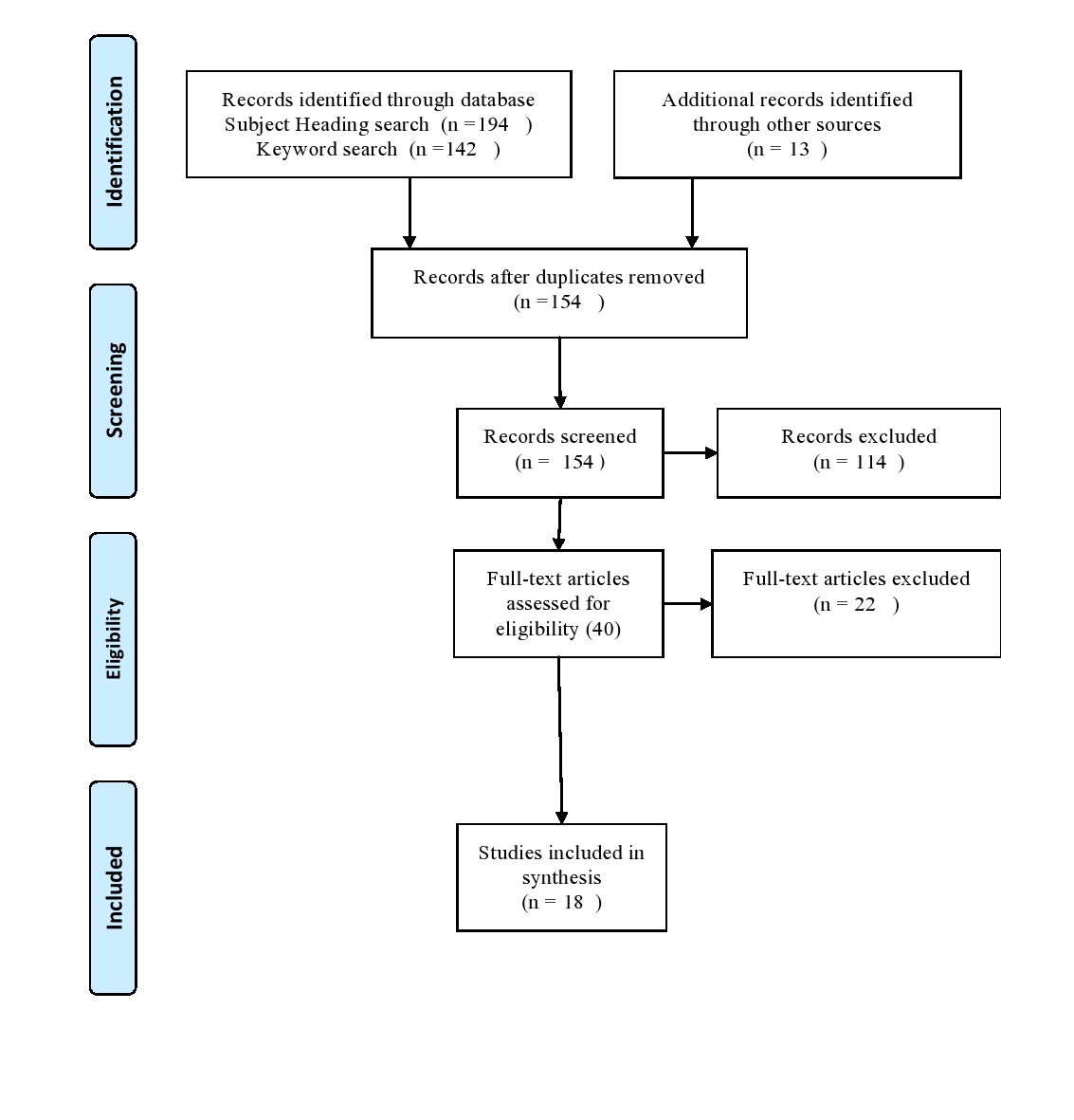
Study selection was performed in three stages (Figure 1):
Stage 1: Database Search
The studies that were identified through the database subject heading search (194 studies), the keyword search (142), and other sources (13 studies) were screened for duplication, yielding 154 studies.
Stage 2: Titles and Abstract Review
Screening of the titles and abstracts of the 154 retrieved studies was conducted by one qualified reviewer (the first author) in order to exclude any obvious non-eligible studies. Of these, 40 studies were deemed eligible for inclusion in a full article review.
Stage 3: Full Article Review
Two qualified reviewers conducted a full article review of the 40 studies. This review had two goals: first, to exclude any studies of non-eligible trials; second, to extract data on specific variables for further analyses. Of the 40 studies, 18 studies were deemed eligible for inclusion in our analysis.

Data collection process
Data extraction was conducted by a qualified reviewer (the first author) during the full article review of the 18 included studies. The source of data in the individual studies was confirmed by contacting investigators who authored multiple studies included in the review, due to the aggregated weight of these studies potentially affecting our conclusion. The confirmation aimed to verify whether the data examined in the individual studies were collected from a single population and used in more than one study, or from different independent populations.
Data items
Primary Outcomes:
– Quality of Study: The quality of the study was categorized into three groups (Low, Moderate, High) (categorical variable)
– Conclusion of Study Effect: (whether the study concluded association of wind turbines with the effect on human health that was under investigation) (binary variable)
Variables (Outcome Measures of Individual Studies):
– First Author: The name of the first author (nominal variable)
– Year of Publication: The year in which the study was published (ordinal variable)
– Journal Name: The name of the publishing journal (nominal variable)
– Country of Study: The name of the country where the trial was originated (nominal variable)
– Study Design: The design of the study (nominal variable)
– Sample Size: The study sample size (continuous variable)
– Response Rate: The response rate of subjects in the study (continuous variable)
– Level of Evidence: The Level of evidence of the study (nominal variable)
– Level of Potential Bias: The level of risk of bias. Categorized into three groups according to Cochrane’s recommendations [10]. (Low risk of bias: Plausible bias unlikely to seriously alter the results; Unclear risk of bias: Plausible bias that raises some doubt about the results; High risk of bias: Plausible bias that seriously weakens confidence in the results) (categorical variable)
– Outcome Measures of Study: The outcome measure under investigation in the study (nominal variable); these outcome measures are:
– Annoyance (Sensitivity to Noise)
– Sleep disturbance
– Visual impact
– Well-being (Quality of Life/Mental Effect)
– Dose-response (description of the change in distress caused by differing distances from a wind turbine)
– Infrasound effect
– Existing background noise (comparison of stress associated with wind turbines to stress associated with road traffic noise/quiet rural environment)
– Attitude to wind turbines (whether people who complain have negative personal opinions toward wind turbines)
– Economical benefit (whether people who benefit economically from wind turbines have a decreased risk of distress)
Risk of bias in individual studies
Assessing the risk of bias of individual studies was performed at both the study level (study design, sample size, response rate, direction and magnitude of any potential bias and how it was handled, limitations, and reporting quality) and the outcome level (a cautious overall interpretation was drawn of the study’s conclusions, whether effect of human distress exists, considering the specific study’s objectives).
Summary measures and synthesis of results
After data extraction, each study was analyzed to identify the two primary outcomes: First, quality of study, taking into account the study’s principle outcome measures; all outcomes, exposures, predictors, potential confounders, and effect modifiers; how the study size was arrived at; how quantitative variables were handled in the analyses; description of all statistical methods; and how loss to follow-up and missing data were addressed. Second, conclusion of study effect as a cautious overall interpretation of the study’s conclusions, taking into account the specific study’s objectives and how well these conclusions were supported by the study results.
Risk of bias across studies
To reduce potential sampling bias (for example, the quality of study could be confounded by journal name and name of first author), the reviewers blinded themselves to the name of the journal and authors until all data on the other variables of interest were collected. To reduce potential measurement bias, the following three measures were undertaken: The data were directly entered into the database instead of using collection forms, quality assurance on all steps of data collection and management was performed, and in any case of uncertainty in deciding the quality of study, the reviewer consulted one of our senior authors to confirm the decision. Furthermore, the source of data was confirmed by contacting investigators who authored multiple studies included in the review, due to the weight their aggregated studies would have in affecting our conclusions.
Ethics approval
This study used previously published data making it exempt from institutional ethics board approval.
Results
Study selection
Figure 1 presents a flowchart depicting the study screening process. The database searches produced 154 publications. From this group, 40 publications were eligible following screening the titles and abstracts. From this group, 18 publications were eligible for inclusion after full article review. These 18 studies, shown in Table 1, consist of six original studies and 12 non-original studies (secondary analyses and literature reviews based on some of these original studies). Only the six original studies were included in the final analysis shown in Table 2. The 12 non-original studies were excluded from the analysis to minimize potential bias associated with repeated results.
This review used previously published data; therefore, there was no missing data for any of the variables of interest.
Study characteristics and risk of bias within studies
Table 1 shows data on the 18 peer-reviewed studies captured in our review, including individual study characteristics, level of potential bias, and quality of study.
Results of individual studies
Table 2 shows summary data on the six original studies’ objectives, p-values, and outcome measures.
Risk of bias across studies
One main source of potential bias across these studies was that 10 of them, listed below, were mainly based on three data sets. The first data set (SWE00) was collected in Sweden in the year 2000 in agricultural areas, the second (SWE05) was collected in different environments in Sweden 2005, and the third (NL07) was collected all over the Netherlands in 2007. This potential bias was eliminated by using only the three original studies that collected the data sets [5, 19, 25]. The rest of the 10 studies (non-original studies) were excluded from the analysis to avoid repeated results.
– Bakker [11] 2012 Science of the Total Environment (NL07)
– Pedersen [16] 2011 Noise Control Eng J (SWE00) + (SWE05) + (NL07)
– Janssen [15] 2011 Acoustical Society of America (SWE00) + (SWE05) + (NL07)
– Pedersen [18] 2010 Energy Policy (NL07)
– Pedersen [19] 2009 Acoustical Society of America (NL07)
– Pedersen [21] 2008 Journal of Environmental Psychology (SWE00) + (SWE05)
– Pedersen [22] 2008 Environ Res Lett (SWE00) + (SWE05)
– Pedersen [23] 2007 Qualitative Research in Psychology (SWE00)
– Pedersen [5] 2007 Occup Environ Med (SWE05)
– Pedersen [25] 2004 Acoustical Society of America (SWE00)
Another source of bias was that three of the studies were reviews of previous literature [6, 12, 17].
Key results
– All 18 peer-reviewed studies captured in our review found an association between wind turbines and one or more types of human distress. These studies had a level of evidence of four and five.
– None of the studies captured in our review found any association (potential publication bias).
– These studies were published in a variety of journals (representative sample).
– Two of these studies showed a dose-response relationship between distance from wind turbines and distress (Table 2).
– There is still no evidence of whether or not a causal relationship between distance from wind turbines and distress exists.
Discussion
Summary of evidence
The peer-reviewed studies we reviewed provide reasonable evidence (Levels Four and Five) that an association exists between wind turbines and distress in humans.
Two of these studies showed a dose-response relationship between distance from wind turbines and distress, and none of the 18 studies concluded no association (consistency of association). The existence of a dose-response relationship and consistency, two of the Hill’s Criteria of Causality, argues for the credibility of the association.
All the evidence comes from expert opinion, case studies, and cross-sectional studies. No higher level of evidence observational studies, namely case-control and cohort studies, were utilized to investigate the subject. For example, although Shepherd, et al’s study [14] had a sound design and was well conducted and reported, it is considered at a lower level of evidence as a cross-sectional study has an increased potential for bias of its results.
Although three of the studies [6-7, 24] suggested that low-frequency sound energy wind turbines (i.e., infrasound below 20 Hz) may directly and negatively affect health, the level of evidence for these studies is also weak (expert opinions [7, 24] and a review [6] citing these two studies).
Economic benefit found in two of the studies [15, 19] could be intuitively and prematurely viewed as a factor lowering the credibility of the complaint. However, in our opinion, compensation would have lowered the credibility of the complaint only if these people had no distress following compensation. People in the studies who benefited economically from wind turbines had a decreased risk of distress but not a complete elimination of distress. Furthermore, the fact that the level of distress could be altered with financial compensation only speaks to the existence of distress.
It is worth pointing out that no causality has been established. The distress could be due to factors other than actual noise exposure. For example, the distress experienced by the participants in the original studies may have been generated or exaggerated by exposure to negative opinions on wind turbine.
Limitations
This study has a number of limitations and sources of bias. One source of bias is the exclusion of non-English studies. For example, China is the world’s leading country in the number of wind turbines [1]. The exclusion of non-English studies might have affected the overall conclusions of our review.
Another source of bias is the fact that the reviewer could not be completely blinded to the journals’ or authors’ names. There might be a theoretical incline to give studies in high impact journals higher quality because of their reputation (potential sampling bias). Nevertheless, if this bias took place, it would have an effect on the magnitude of evidence and not on the existence of the association due to the dichotomous nature of this variable (the number of studies that speaks for an association will not change).
Publication bias could be the reason for the finding that none of the 18 peer-reviewed studies captured in our review found no association. However, potential publication bias was decreased by conducting a search in two major grey literature databases (SIGLE, and Scirus).
Generalizability
The 18 studies were published in a variety of journals, making the captured studies a representative sample, which in turn increases our results’ generalizability (external validity).
The fact that the data in two of the three mentioned data sets were collected in Sweden may decrease the external validity, but simultaneously may increase the internal validity following the above logic. Furthermore, although these data were collected from one country, it still would be a safe assumption that the people and their experience with wind turbines, on which these data were collected, are not fundamentally different from people and experiences in other countries.
Future research
Further research in the area of exposure assessment and measurement is needed. The mechanism and physiology of harm needs to be confirmed. There is a need to identify the actual risk of harm and the health outcomes in people exposed. Until research can separate out specific sets of significant factors for the exposure with higher-level evidence than is available now, our ability to mitigate the harm is limited. Possible future research could be conducting longitudinal studies, performing measurements before wind turbines and after, and observing what happens to people over time.
Conclusions
We have demonstrated in our review the presence of reasonable evidence (Levels Four and Five) supporting the existence of an association between wind turbines and distress in humans. The existence of a dose-response relationship between distance from wind turbines and distress as well as the consistency of association across studies found in the scientific literature argues for the credibility of this association. Future research in this area is warranted.
References
- The Global Wind Energy Council. Accessed: October 30, 2013: http://www.gwec.net/?s=canada.
- The Global Wind Energy Council.. (2012). Accessed: October 30, 2013:http://www.gwec.net/wp-content/uploads/2012/06/Top-10-Cumulative-Capacity-December-2012.jpg.
- University of Strathclyde Archives. Accessed: January 20, 2014:http://stratharchives.tumblr.com/post/85511105886/week-18-windmill-designed-and-built-by-james.
- Krogh C, Gillis L, Kouwen N, Aramini J: WindVOiCe, a self-reporting survey: adverse health effects, industrial wind turbines, and the need for vigilance monitoring. Bull Sci Technol Soc. 2011, 31:334-45.
- Pedersen E, Hallberg L, Waye KP: Living in the vicinity of wind turbines–a grounded theory study. Qualitative Research in Psychology. 2007, 4:49–63.
- Knopper LD, Ollson CA: Health effects and wind turbines: A review of the literature. Environ Health. 2011, 10:78. 10.1186/1476-069X-10-78
- Salt AN, Hullar TE: Responses of the ear to low frequency sounds, infrasound and wind turbines. Hear Res. 2010, 268:12-21. 10.1016/j.heares.2010.06.007
- World Health Organisation: Night noise guidelines for Europe. (2009). Accessed: October 30, 2013:http://www.euro.who.int/__data/assets/pdf_file/0017/43316/E92845.pdf.
- Hill AB: The Environment and Disease: Association or Causation?. Proc R Soc Med. 1965, 58:295-300.
- Higgins JPT, Altman DG, Sterne JAC on behalf of the Cochrane Statistical Methods Group and the Cochrane Bias Methods Group: Chapter 8: Assessing risk of bias in included studies. Cochrane Handbook for Systematic Reviews of Interventions. 2011, Version 5.1.0:Accessed: October 30, 2013:http://handbook.cochrane.org/chapter_8/8_assessing_risk_of_bias_in_included_studies.htm.
- Bakker RH, Pedersen E, van den Berg GP, Stewart RE, Lok W, Bouma J: Impact of wind turbine sound on annoyance, self-reported sleep disturbance and psychological distress. Sci Total Environ. 2012, 425:42-51. 10.1016/j.scitotenv.2012.03.005
- Hanning CD, Evans A: Wind turbine noise. BMJ. 2012, 344:e1527. 10.1136/bmj.e1527
- Nissenbaum MA, Aramini JJ, Hanning CD: Effects of industrial wind turbine noise on sleep and health. Noise Health. 2012, 14:237-43. 10.4103/1463-1741.102961
- Shepherd D, McBride D, Welch D, Dirks KN, Hill EM: Evaluating the impact of wind turbine noise on health-related quality of life. Noise Health. 2011, 13:333-9.10.4103/1463-1741.85502
- Janssen SA, Vos H, Eisses AR, Pedersen E: A comparison between exposure-response relationships for wind turbine annoyance and annoyance due to other noise sources. J Acoust Soc Am. 2011, 130:3746-53. 10.1121/1.3653984
- Pedersen E: Health aspects associated with wind turbine noise—Results from three field studies. Noise Control Eng J. 2011, 59:47-53.
- Bolin K, Bluhm G, Eriksson G, Nilsson ME: Infrasound and low frequency noise from wind turbines: Exposure and health effects. Environ Res Lett. 2011, 6:1-6. 10.1088/1748-9326/6/3/035103
- Pedersen E, van den Berg F, Bakker R, Bouma J: Can road traffic mask the sound from wind turbines? Response to wind turbine sound at different levels of road traffic. Energy Policy. 2010, 38:2520–2527. 10.1016/j.enpol.2010.01.001
- Pedersen E, van den Berg F, Bakker R, Bouma J: Response to noise from modern wind farms in The Netherlands. J Acoust Soc Am. 2009, 126:634-43. 10.1121/1.3160293
- Keith SE, Michaud DS, Bly SHP: A proposal for evaluating the potential health effects of wind turbine noise for projects under the Canadian Environmental Assessment Act. Low Freq Noise Vib Active Control. 2008, 27:253-65.
- Pedersen E, Larsman P: The impact of visual factors on noise annoyance among people living in the vicinity of wind turbines. J Environ Psychol. 2008, 28:379–89.10.1016/j.jenvp.2008.02.009
- Pedersen E, Waye KP: Wind turbines – low level noise sources interfering with restoration?. Environ Res Lett. 2008, 3:1–5.
- Pedersen E, Waye KP: Wind turbine noise, annoyance and self-reported health and well-being in different living environments. Occup Environ Med. 2007, 64:480-6.
- Leventhall HG: Low frequency noise and annoyance. Noise Health. 2004, 6:59-72.
- Pedersen E, Waye KP: Perception and annoyance due to wind turbine noise–a dose-response relationship. J Acoust Soc Am. 2004, 116:3460-70.
Infrasound, from Wind Turbines, makes Life Unbearable, and we Have Proof!
Top Acoustic Engineer – Malcolm Swinbanks – Experiences Wind Farm Infrasound Impacts, First Hand
May 11, 2015 by

****
Top Acoustic Engineer, Dr Malcolm Swinbanks has been at the forefront of investigating the impacts of infrasound and low-frequency noise for over 40 years; and has been on the wind industry’s stinky trail in Michigan since 2009.
Last month, he delivered this technically brilliant paper: “Direct Experience of Low Frequency Noise and Infrasound within a Windfarm Community” at the 6th International Meeting on Wind Turbine Noise – the conference poster is available here: M.A.Swinbanks Poster
The results and observations as to the character and nature of incessant turbine generated low-frequency noise and infrasound backs up the groundbreaking work done by Steven Cooper at Pac Hydro’s Cape Bridgewater disaster (see our post here).
In that respect, the work sits amongst fine company. However, it’s Malcolm’s own experience with turbine noise and vibration that makes his paper all the more remarkable. Here’s a few extracts that tend to knock the wind industry’s ‘nocebo’ story for six.
Summary
The author first became aware of the adverse health problems associated with infrasound many years ago in 1974, when an aero-engine manufacturer approached him to consider the problems that office personnel were experiencing close to engine test facilities. He had been conducting research into the active control of sound, and the question was posed as to whether active sound control could be used to address this problem. At that time, this research was in its infancy, and the scale of the problem clearly lay outside practical implementation. Five years later, however, the author was asked to address a related problem associated with the low-frequency noise of a 15,000SHP ground-based gas-turbine compressor installation, having a 40 foot high, 10 foot diameter exhaust stack.
This problem was of a more tractable scale, and the author and his colleagues successfully reduced the low-frequency noise of the installation by over 12dB. He subsequently was requested to address a similar installation of significantly greater size and power, again with accurately predicted results.
As a consequence of this and subsequent work, the author has gained considerable experience of the disturbing effects of low-frequency noise and infrasound. So when he first became aware of the nature of adverse health reports from windfarm residents, they were immediately recognisable as effects with which he had been familiar for as many as 35 years.
Since late 2009, the author has lived part-time within a Michigan community where windturbines have been increasingly deployed. Consequently he has had significant interaction with residents whose lives and well-being have been damaged, and moreover has experienced the associated very severe effects directly, at first hand. His resultant perspective is thus based on both detailed theoretical analysis, and extensive personal, practical experience.
Introduction
In the latter part of 2009, the intention was announced to install up to 2,800 wind turbines in Huron County, Michigan, together with adjacent regions of the Thumb of Michigan. The agricultural areas of the county are made up of 1 square mile sections, bounded by a grid of roads running north-south and east-west. The proposed wind-turbine density would amount to approximately 2-3 turbines per square mile, but in each square mile there can be typically 4 to 6 residences, usually located around the perimeter. Consequently, the requirement for adequate turbine separation would very substantially restrict the possible setbacks from residences. At that time, there existed two recently commissioned windfarms in Huron county, at Elkton (32 Vestas 80m diameter V80 turbines) and Ubly (46 GE 1.5MW 77m diameter turbines). The Elkton windfarm is in unobstructed open country, but the Ubly windfarm is in an area with significant clusters of trees, which in certain wind directions could obstruct and disrupt the low-level airflow to the turbines.
Following this announcement, the author attended an Open Meeting of the Michigan Public Services Commission, at which a number of residents spoke of the problems that they were already encountering from the windfarms, in particular the windfarm at Ubly.
This author immediately recognized these problems as relating to the characteristics of low-frequency noise and infrasound, with which he had been familiar for many years. But on subsequently visiting the windfarms, it became clear that the higher frequency audible noise levels were also unacceptable, at Ubly in particular, with up to 50dBA L10 being permitted by the ordinances. The author was astonished that any professional acoustician could possibly regard the levels as acceptable.
Following the county’s early experience the ordinances were reconsidered, so that the existing setbacks of 1000 feet, and levels of 50dBA L10, were changed for non-participating landowners to 1320 feet and 45dBA L10. But problems at Ubly were still apparent even at 1500 feet and 45dBA.
The author obtained data from one such residence, which was immediately downwind of 6 turbines located approximately in a line at distances of 1500 feet to 1.25 miles, and found that there could be significant impulsive infrasound present, even though these turbines were of modern, upwind rotor design. Under some circumstances this infrasound took the form of single pulses per blade passing interval, presumably from the nearest turbine, but sometimes up to 6 separate impulses could be detected from the turbine array.
The commissioning of further wind-turbine developments was initially hampered by the lack of high capacity transmission lines, but more recently a 5GW high voltage transmission line has been routed through the county, permitting more than adequate capacity for any intended number of windfarms and turbines. Several further windfarms, with larger 100m and even 114m diameter turbines up to 500 feet in height have now been constructed, resulting in a total of more than 320 wind-turbines installed to date.
Recently, the county has turned to reconsidering the ordinances, but as of the present date has not finalized any changes. Currently permitted wind turbine sound levels and setbacks appear to be dictated primarily by an over-riding incentive to install the requisite number of turbines per square mile.
The author has attended and commented at many public meetings, but has found that the reluctance to acknowledge adverse effects associated with low frequency and infrasound, has resulted in a situation where little traction can be gained.
Several aspects deriving from his first-hand experience will now be described in the following sections.
During the early 1980’s while working on an industrial gas turbine compressor, the author became very aware that the very low-frequency sound can quickly become imperceptible when outside in any moderate breeze. More recently, while attempting to sleep in a house 3 miles from the nearest wind-turbine of a new wind farm consisting of 35 GE 1.6 100m diameter wind turbines, the author and his wife have sometimes been kept awake by the lowfrequency rumble or infrasonic “silent thump” of the turbines.
This situation can occur when the wind has veered from a cold north wind from Canada, to a warm wind from the south blowing over cold ground. Such conditions give rise to a classic temperature inversion, and the resultant wind turbine infrasound can readily propagate for 3 miles or more.
On such occasions, the author has more than once donned outdoor clothes at 1am and gone out onto the road outside the house, clear of trees and obstructions, but in the airflow of an outside wind has been consistently unable to detect any similar subjective disturbance.
It is often argued that infrasound is more readily detectable within a residence simply because the building structure greatly attenuates the higher frequencies, but has little effect on the lower frequencies. There is an additional effect, however, that tends to be overlooked. Outside, individual ears effectively represent unshrouded pointwise microphones, equally sensitive to the full effects of airflow and true infrasound. In contrast, the conditions within a building are very different.
Pressure due to wind turbulence tends to be only locally correlated over the outside surface of the building, whereas true infrasound acts coherently over the entire structure. This gives rise to an additional spatial filtering effect, whereby the wind induced pressure distribution tends to cancel itself out, but the fully coherent very low frequency wind-turbine infrasound acts to fully reinforce itself over the entire structure.
This characteristic has been exploited for many years in the design of conformal sonar arrays – distributed pressure sensing surfaces which preferentially detect acoustic signals that are fully coherent over the surface, yet “average-out” the uncorrelated pressures due to hydrodynamic flow, yielding a significant improvement in signal-to-noise ratio.
A direct consequence of this difference between inside and outside observation is that observers visiting windfarms in the open air may quite correctly comment that they cannot hear any significant low-frequency sound. Put simply, they are not observing under the appropriate conditions. Perception within a residence, particularly in a quiet bedroom, can be entirely different.
This difference is significantly enhanced by the fact that the threshold of hearing is not a constant threshold, but is automatically raised or lowered according to the background ambient sound conditions. It is for this reason that people in urban areas, with typical ambient sound levels around 55dBA, have a naturally raised threshold and are able to tolerate additional noise of comparable level, yet this same level of noise would be completely intolerable in rural areas where ambient levels can be very much lower, not infrequently in the region of 25-30dBA.
This is one of the most important effects with respect to perception of low-frequency noise and infrasound, yet the widely cited AWEA/CANWEA Expert Health Report of 2009 (3), completely failed to indicate the consequences of this process of automatic threshold adjustment.
First Hand Experience of the Severe Adverse Effects of Infrasound.
Approximately 18 months ago, the author was asked by a family living near the Ubly windturbines to help set up instrumentation and assess acoustic conditions within their basement, which is partially underground, where they hoped to encounter more tolerable sleeping conditions.
In the early evening, the author arrived at the site. It was a beautiful evening, with very little wind at ground level, but the turbines were operating. Within the house, however, it was impossible to hear any noise from the turbines and it became necessary to go outside from time-to-time to confirm that they were indeed running.
The author did not expect to obtain any significant measurements under these conditions, but nevertheless proceeded to help set up instrumentation in the form of a B&K 4193-L-004 infrasonic microphone and several Infiltek microbarometers. Calibration of the microbarometers had previously been confirmed by performing background infrasonic measurements directly side-by-side with the precision B&K microphone. The intention was to define measurement locations, to establish instrumentation gains having appropriate headroom, and to agree and go through practice procedures so that the occupants could conduct further measurements themselves.
After a period of about one hour, which time had been spent setting up instrumentation in the basement and using a laptop computer in the kitchen, the author began to feel a significant sense of lethargy. As further time passed this progressed to difficulty in concentration accompanied by nausea, so that around the 3 hour mark, he was feeling distinctly unwell.
He thought back over the day, to remember what food he had eaten and whether he might have undertaken any other action that might bring about this effect. He had light meals of cereal for breakfast and salad for lunch, so it seemed unlikely that either could have been responsible. Meanwhile, the sun was going down leaving a beautiful orange-pink glow in the sky, while ground windspeed levels remained almost zero and the evening conditions could not have been more tranquil and pleasant.
It was only after about 3.5 hours that it suddenly struck home that these symptoms were being brought about by the wind-turbines. Since there was no audible sound, and the infrasound levels appeared to be sufficiently low that the author considered them to be of little consequence, he had not hitherto given any thought to this possibility.
As further time passed, the effects increasingly worsened, so that by 5 hours he felt extremely ill. It was quite uncanny to be trying to concentrate on a computer in a very solid, completely stationary kitchen, surrounded by solid oak cabinets, with granite counter tops and a cast-iron sink, while feeling almost exactly the same symptoms as being seasick in a rough sea.
Finally, after 5 hours it was considered that enough trial runs had been taken and analysed that it was decided to set up for a long overnight run, leaving the instrumentation under the control of the home owners. The author was immensely relieved finally to be leaving the premises and able to make his way home clear of the wind turbines.
But it was by no means over. Upon getting into the car and driving out of the gateway, the author found that his balance and co-ordination were completely compromised, so that he was consistently oversteering, and the front of the car seemed to sway around like a boat at sea. It became very difficult to judge speed and distance, so that it was necessary to drive extremely slowly and with great caution.
Arriving home 40 minutes later, his wife observed immediately that he was unwell – apparently his face was completely ashen. It was a total of 5 hours after leaving the site before the symptoms finally abated.
It is often argued that such effects associated with wind turbines are due to stress or annoyance brought about by the relentless noise, but on this occasion there was no audible noise at all within the house. Moreover, it was a remarkably tranquil evening with a very impressive sunset, so any thought that problems could arise from the turbines was completely absent.
It was only once the symptoms became increasingly severe that the author finally made the connection, having first considered and ruled out any other possibilities. So explanations of “nocebo effect” would hardly appear to be appropriate, when such awareness occurred only well into the event.
In the following two figures, the typical measured infrasound levels in the basement are shown, as measured with one of the Infiltek microbarometers.

Figure 8 shows the power spectrum, measured with a nominal 0.1Hz FFT bandwidth. As can be seen, the peak of the fundamental blade rate component, at 55dB, might not normally be considered to represent a particularly obtrusive level of infrasound. Several higher harmonics of progressively reducing amplitude are visible, but this characteristic is very much as one would expect for an upwind-rotor turbine operating in comparatively smooth airflow.

The corresponding time-trace is shown in Figure 9. It can be seen that there is a single comparatively sharply defined pulse per blade-passage, so it would appear that only the closest wind-turbine is contributing significantly.
Nevertheless, it should be noted that while the fundamental harmonic of blade-passage is at only 55dB, the cumulative effect of the higher harmonics can raise the peak level of the waveform on occasion to 69-72dB. Most of the author’s prior work has concentrated on time-history analysis of the waveform, consistent with the 2004 observation by Moller & Pedersen (4) that at the very lowest frequencies it is the time-history of infrasound which is most relevant to perception. Simply observing separate spectral levels at discrete frequencies and regarding these as independent components can lead to considerable underestimate of the true levels of repetitive infrasound.
The fact that balance and coordination were found to be adversely compromised during the night drive home would suggest interference with the vestibular organs, as proposed by Pierpont (5) and subsequently by Schomer (6).
An important additional observation, however, is that the effects persisted for 5 hours afterwards, when the immediate excitation was no longer present. In contrast, for sea-sickness, effects tend to dissipate rapidly once sea conditions moderate. It is of interest that a 1984 investigation (7), in which test subjects experienced 30 minutes exposure to 8Hz excitation at very much higher levels of 130dB, reported that some adverse effects could persist for several hours later.
Conclusions
It has been shown that upwind-rotor turbines can indeed sometimes give rise to impulsive low-frequency infrasound – a characteristic commonly attributed only to old-fashioned downwind rotor configurations. But perception of wind turbine low frequency noise and infrasound can be quickly suppressed by the effects of wind-induced airflow over the ears, with the result that incorrect conclusions can easily result from observations made when exposed to outside breezy conditions.
The effects within a residence are much more readily perceptible, and cannot be ignored. An account has been given of an occurrence of severe direct health effects experienced by the author, and considered to be due entirely to wind-turbine infrasound, yet manifest under superficially benign conditions where no such adverse effects were anticipated.
MA Swinbanks
23 April 2015

The Truth About Nuclear vs Wind/Solar….No contest….Nuclear wins, hands down!
Let’s Run the Numbers
Nuclear Energy vs. Wind and Solar
by
Mike Conley & Tim Maloney
April 17, 2015
(NOTE: This is a work in progress.
It will be a chapter in the forthcoming book
“Power to the Planet” by Mike Conley.)
Four bottom lines up front:
- It would cost over $29 Trillion to generate America’s baseload electric power with a 50 / 50 mix of wind and solar farms, on parcels of land totaling the area of Indiana. Or:
- It would cost over $18 Trillion with Concentrated Solar Power (CSP) farms in the southwest deserts, on parcels of land totaling the area of West Virginia. Or:
- We could do it for less than $3 Trillion with AP-1000 Light Water Reactors, on parcels totaling a few square miles. Or:
- We could do it for $1 Trillion with liquid-fueled Molten Salt Reactors, on the same amount of land, but with no water cooling, no risk of meltdowns, and the ability to use our stockpiles of nuclear “waste” as a secondary fuel.
Whatever we decide, we need to make up our minds, and fast. Carbon fuels are killing us, and killing the planet as well. And good planets are hard to come by.
If you think you can run the country on wind and solar, more power to you.
It’s an attractive idea, but before you become married to it, you should cuddle up with a calculator and figure out exactly what the long-term relationship entails.
This exercise has real-world application. The 620 MW (megawatt) Vermont Yankee nuclear reactor was recently shut down. So were the two SONGS reactors in San Onofre, which generated a combined total of 2.15 GWs (gigawatts). But the public didn’t suddenly go on an energy diet; in the wake of Fukushima, they were just more freaked out than usual about nuclear power.
Regardless, the energy generated by these reactors will have to be replaced, either by building more power plants or by importing the electricity from existing facilities.
To make the numbers easier to think with, we’ll postulate a 555 MW reactor that has an industry-standard 90% online performance (shutting down for refueling and maintenance) and delivers a net of 500 MW, sufficient to provide electricity for 500,000 people living at western standards. The key question is this:
What will it take to replace a reactor that delivers 500 MW of baseload (constant) power with wind or solar?
Once we’ve penciled out our equivalent wind and solar farms, we’ll be able to scale them to see what it would take to power any town, city, state or region—or the entire country—on renewables.
The ground rules.
TheSolutionProject.Org has a detailed proposal to power the entire country with renewables by 2050. It’s an impressive piece of work, presenting a custom blend of renewables tailored for each state, everything from onshore and offshore wind, to wave power, rooftop solar, geothermal, hydroelectric, the list goes on.
Costs are offset by the increased economic activity from building and operating the plants. Other major offsets derive from health care savings, increased productivity, lower mortality rates, reduced air pollution and global warming. But since these offsets also apply to an all-nuclear grid, they cancel themselves out.
Instead of exploring each technology the Solutions Project offers, we’ll simplify things and give them their best advantage by concentrating on their two major technologies—onshore wind and CSP solar (we’ll explain CSP shortly.) Both systems are at the low end of the long-term cost projections for renewables.
In our comparative analysis, we’ll be focusing on seven parameters:
- Steel
- Concrete
- CO2 (from material production and transport)
- Land area
- Deathprint (casualties from power production)
- Carbon karma (achieving CO2 break-even)
- Construction cost
Most of these are obvious, but “deathprint” and “carbon karma” deserve a bit of explaining. We’ll get into the first one now, and save the other one for later.
Deathprint.
No form of energy production is, or ever has been, completely safe. Down through the centuries, countless people have been injured and killed by beasts of burden. More were lost harvesting the wood, peat and whale oil used for cooking, heating, and lamplight. Millions have died from mining coal, and millions more from burning it. America loses 13,000 people a year from health complications attributed to fossil fuel pollution; China loses about 500,000.
Although hydroelectric power is super-green and carbon-free, we too easily forget that in the last century alone, many thousands have died from dam construction and dam failures. Even solar energy has its casualties. In fact, more Americans have died from installing rooftop solar than have ever died from the construction or use of American nuclear power plants. Some people did die in the early days of uranium mining, but the actual cause was inhaling the dust. Proper masks lowered the casualty rates to nearly zero.
Although reactors produce nearly 20% of America’s power, and have been in use for over fifty years, there have been just five deaths from construction and inspection accidents. Only three people have ever died from the actual production of American atomic energy, when an experimental reactor suffered a partial meltdown in 1961. And for all the panic, paranoia, and protests about Three Mile Island, not one person was lost. The worst dose of radiation received by the people closest to the TMI plant was equal to one half of one chest X-ray.
As we contrast and compare the facts and figures for a wind farm, a solar farm, and a reactor, we’ll cite each technology’s “deathprint” as well—the casualties per terawatt-hour (TWh) attributed to that energy source.
[NERD NOTE: A terawatt is a trillion watts. The entire planet’s electrical consumption is right around 5 terawatt-hours. One TWh (terawatt-hour) is a constant flow of a trillion watts of electricity for a period of one hour.]
“Any way the wind blows, doesn’t really matter to me.” — Freddy Mercury
Well, it should. Wind power is all about direction and location. The problem is, climate change may also be changing long-term wind patterns. The polar vortex in the winter of 2013 might be a taste of things to come. Large-scale wind farms could prove to be a very expensive mistake, but we’ll look at them anyway.
At first frostbitten blush, a freight train of Arctic air roaring through the Lower 48 seems to fly in the face of global warming, doesn’t it? But here’s how it works:
Since the Arctic is warming faster than the rest of the world, its air mass is becoming less distinct than Canada’s air mass. This erodes the “thermal wall” of the Jet’s Stream’s arctic corridor, and it’s starting to wander like a drunk, who can usually navigate if he keeps his hand on the wall. But now the wall is starting to disappear, and when it finally goes it’s anyone’s guess where he’ll end up next.
In North America, the median “capacity factor” for wind is 35%.
Some places in America are a lot more windacious than others. But on average, the wind industry claims that a new turbine on U.S. soil will produce around 35% of the power rating on the label, meaning it has a “35% capacity factor.”
One difficulty in exploring renewables is that capacity factor numbers are all over the map. The Energy Information Agency disagrees with the Department of Energy, and the renewables industry disagrees with them both. Manufacturers stay out of the fray, only stating what their device’s “peak capacity” is, meaning the most power it can produce under ideal conditions. Your mileage may vary.
Because wind, like solar, is an “intermittent” source (ebbs and flows, comes and goes) the efficiency of a turbine has to be averaged over the course of a year, depending on where it’s used. But we’ll accept the wind industry’s claim of 35% median capacity factor for new onshore turbines sited in the contiguous states.
And we won’t stop there. Because if we actually do build a national renewables infrastructure, it stands to reason that we’ll concentrate our wind farms where they’ll do the most good, and build branch transmission lines to connect them to the grid. Since the industry claims a maximum U.S. capacity factor of 50% for new turbines and a median of 35%, we’ll split the difference at a generous 43%.
To gather 500 MWavg (megawatts average) of wind energy in a region with a 43% capacity factor (often called “average capacity”), we’ll need enough turbines for a peak capacity of 1,163 MWp (megawatts peak): 500 ÷ 0.43 = 1,163.
Let’s go with General Electric’s enormous model 2.5xl turbines, used at the Shepherd’s Flat wind farm in Oregon, a top-of-the-line machine with a peak capacity of 2.5 MW. That pencils out to 465 “spinners” (1,163 ÷ 2.5 = 465.)
Each assembly is made with 378 tonnes of steel, and the generator has a half-tonne of neodymium magnets, a rare earth element currently available only in China, where it’s mined with an appalling disregard for the environment and worker safety. And, the 300-ft. tower requires a concrete base of 1,080 tonnes.
[NERD NOTE: A “tonne” is a metric ton, which is 1,000 kilograms—2,204.62 lbs to be exact. And no, it’s not pronounced “tonnie” or “tonay.” A tonne is a ton.]
The installed cost of a GE 2.5xl is about $4.7 Million, which includes connecting it to the local grid. That breaks down to $1.9 Million per MWp.
In this exercise, we’re not factoring in the cost of the land, or the cost of a branch transmission line if our renewables farm isn’t next to the grid. But figure about $1 Million a mile for parts and labor to install a branch line, plus the land.
Renewables, like most things, have their own CO2 footprint.
Steel production emits 1.8 tonnes of CO2 per tonne, and concrete production emits 1.2 tonnes of CO2 per tonne. So just the raw material for GE’s 2.5xl turbine alone “costs” 1,976 tonnes of CO2 emissions. [(378 X 1.8) + (1,080 X 1.2) = 1,976.4]
We’ll give them a pass on the CO2 emitted during parts fabrication and assembly, but we really should include the shipping, because these things weigh in at 378 tonnes. And, the motors are made in China and Germany, the blades are made in Brazil, they do some assembly in Florida, and the tower sections are made in Utah. That’s a lot of freight to be slinging around the planet.
But to keep things simple, and to be more than fair, we’ll just figure on shipping everything from China to the west coast, and write off all the CO2 emissions from fabrication and assembly, and the land transportation at both ends. So 378 tonnes at 11 grams of CO2(equivalent) per ton-mile, shipped 5,586 miles from Shanghai to San Francisco, comes out to 23.2 tonnes per turbine.
Even though we’re not calculating the price of the land, we will be adding up the amount of acreage. Turbines need a lot of elbowroom, because they have to be far enough away from each other to catch an undisturbed breeze. It can be difficult to realize how huge these things are—imagine a 747 with a hub in its belly, hanging off the roof of a 30-story building and spinning like a pinwheel.
Each turbine will need a patch of land 0.23 / km2 (square kilometers), or 550 yards on a side. A rough rule of thumb is to figure on four large turbines per square kilometer, or ten per square mile. But before we put the numbers together, there are two more things to consider.
Wind and solar farms are gas plants.
Don’t take our word for it; listen to this guy instead, one of the most famous voices in the renewable energy movement:
“We need about 3,000 feet of altitude, we need flat land, we need 300 days of sunlight, and we need to be near a gas pipe. Because for all these big solar plants—whether it’s wind or solar—everybody is looking at gas as the supplementary fuel. The plants we’re building, the wind plants and the solar plants, are gas plants.” – Robert F. Kennedy, Jr., board member of BrightSource, builders of the Ivanpah solar farm on the CA / NV border.
Large wind and solar farms are in the embarrassing position of having to use gas-fired generators to smooth out the erratic flow of their intermittent energy. It’s like showing up at an AA meeting with booze on your breath.
Still, it’s considered a halfway decent solution, but only because wind and solar contribute such a small proportion of the energy on the grid. But if renewables ever hope to be more than 15% of our energy picture, they’ll have to lose the training wheels, and there’s only one way to do it. Which brings us to the other thing we need to consider. And this one is a deal-breaker all by itself.
Energy storage.
For the wires to sing, you need a choir of generators humming away in perfect harmony. And for intermittent energy farms to join the chorus as full-fledged members, they’ll first have to store all the spurts and torrents of energy they produce, and then release it in a smooth, precisely regulated stream.
Right now, the stuttering contributions that residential solar or the occasional renewables farm feed the grid are no problem. It’s in such small amounts that the “noise” it generates isn’t noticeable. The amount of current on the national grid is massive in comparison, generated by thousands of finely tuned turbines at our carbon-fuel, nuclear, and hydro plants. These gargantuan machines operate 24 / 7 / 365, delivering a rock-solid stream of AC power at a smooth 60Hz.
That’s baseload power, and every piece of gear we have—from Hoover Dam to your doorbell—is designed to produce it, convey it, or run on it. Our entire energy infrastructure has been built around that one idea. Choppy juice simply won’t do.
(For a more detailed explanation of why this so, please see our article “We’re Not Betting the Farm, We’re Betting the Planet.“)
Dynamo hum.
For renewables to be a major player and replace carbon and nuclear fuels, they’ll have to deliver the same high-quality energy, day in and day out. Up to now, computerized controls haven’t been able to smooth out the wrinkles, because the end result of all of their highfalutin calculations comes down to engaging or disengaging mechanical switches. And mechanical switches aren’t nearly as precise as the computers that run them, because they’re made out of metal, which expands and contracts and wears down. Unless this technology is perfected (and it’s a lot harder than it sounds), glitches will resonate through the grid, and with enough glitches we won’t have baseload power, we’ll have chaos.
So while a national renewables infrastructure will have to be built on free federal acreage—the amount of land required is nearly impossible to wrap your mind around, and paying for it is completely out of the question—the cost of energy storage needs to be factored into any grid-worthy plant.
Remember, we’re replacing a reactor. They crank it out day and night, rain or shine, for months at a stretch, with an average online capacity of 90% after shutdowns for refueling and maintenance are factored in. If a renewables farm can’t provide baseload power, it’ll be just another expensive green elephant on the greenwash circuit.
Pumped-Hydro Energy Storage (PHES).
By far, the most cost-effective method of producing baseload power from intermittent energy is with pumped hydro. It’s an idea as simple as gravity: Water is pumped uphill to an enormous basin, and drains back down through precisely regulated turbines to produce a smooth, reliable flow of hydroelectricity.
Thus far, most pumped-hydro systems have used the natural terrain, connecting a high basin with a lower one. Dams that have been shut down by drought or other upstream conditions can also be used. Watertight abandoned mines and quarries, or any large underground chambers at different elevations have potential as well. But if nothing’s readily available, one or both basins can be built. And if we go big on wind and solar, we’ll likely be building a lot of them.
A “closed-loop” PHES has a basin at ground level connected by a series of vertical pipes to another basin deep underground. When energy is needed, water drops through the pipes to a bank of generators below, then collects in the lower basin. Later, when energy production is high and demand is low, the surplus energy is used to pump the water back upstairs.
It sounds great, but the amount of water needed is mind-boggling. To understand why, here’s a rundown of the basic concepts underlying hydroelectric power.
Good old H2O.
The metric system is an amazing, ingenious, brilliant, and stupid-simple method of measurement based on two everyday properties of a common substance that are exactly the same all over the world: the weight and volume of water.
One cubic meter (m3) of pure H2O = one metric ton (~ 2,200 lbs) = 1,000 kilograms = 1,000 liters. And one liter = 1 kilogram (~ 2.2 lbs) = 1,000 grams = 1,000 cm3 (cubic centimeters.) And one cm3 of water = one gram, hence the word “kilogram,” which means 1,000 grams. And a tonne is a million grams.
You may have already deduced that metric linear measurements are related to the same volume of water: A meter is the length of one side of a one-tonne cube of water, and a centimeter is the length of one side of a one-gram cube of water.
Metric energy measurements are based on another thing that’s exactly the same all over the world: the force of falling water. One cubic centimeter (one gram) of water, falling for a distance of 100 meters (about 378 feet) has the energy equivalent of right around one “joule” (James Prescott Joule was a British physicist and brewer in the 1800s who figured a lot of this stuff out.)
One joule per second = one watt. (Energy used or stored over time = power. A joule is energy, a watt is power.) A million grams (one tonne) falling 100 meters per second = a million joules per second = a million watts, or one megawatt (MW). One MW for 3,600 seconds (one hour) = one MWh (megawatt-hour.)
They don’t call this a water planet for nothing.
Which brings us back to Pumped-Hydro Energy Storage.
To store one hour’s worth of energy produced by a 500 MW wind farm, we’ll need to drop 500 metric tonnes (cubic meters) of water each second for an entire hour, down a series of 100-meter-long pipes, to spin a series of turbines at the bottom of the drop. (For right now, we’ll leave out the loss of energy due to friction in the pipes, and the less-than-perfect efficiency of the turbines.)
That’s 1,800,000 tonnes per hour, which is a lot of water. How much, exactly? About twice the volume of the above-ground portion of the Empire State Building, which occupies 1.04 million cubic meters of space (if you throw in the basement.)
Remember, that’s for just one hour of pumped-hydro. To pull it off, our wind farm will need two basins, each one the volume of two Empire State Buildings (!), with a 100-meter drop in elevation between them. And, the basins will have to be enclosed to minimize evaporation.
Two ESBs (Empire State Buildings) is a huge volume of water to devote to one hour of energy storage, particularly when we might be entering a centuries-long drought induced by climate change. Replenishing our water supply because of evaporation won’t be an easy option, and will likely annoy the locals, who will probably be fighting water wars with the folks upstream.
Sorry, no free lunch. Wrong universe.
Converting one form of energy to another always results in a loss, and pumped hydro systems can consume nearly 25% of the energy stored in them. But we’ll be generous and figure on 20%. That still means we have to grow our 465-turbine wind farm to 581 turbines to get the output we need.
And remember, we’re just storing one hour of power. If our wind farm gets two hours of dead calm, we’re out of luck. And two hours of dead calm is nowhere near uncommon. But with a national renewables energy grid, maybe we can import some solar energy from Arizona. Maybe. Unless it’s cloudy in Arizona, or it’s after sundown.
Sigh... When you start thinking it through, it’s becomes pretty clear that you have to figure on at least one full day of storage. Some people will tell you to figure on a week, but as you’ll see, even one day is enough to fry your calculator.
The DoE estimates that closed-loop pumped storage should cost about $2 Billion for one gigawatt-hour, or $2 Million per megawatt-hour. First we’ll add the extra turbines, and then we’ll throw in the PHES. (Are you sitting down?)
A 500 MWavg baseload wind farm with Pumped-Hydro Energy Storage.
To get 500 MWavg in a region with 43% average capacity, we’ll need 465 turbines with a 2.5 MW peak capacity: [(500 ÷ 2.5) = 200. (200 ÷ 0.43) = 465].
On top of that, we’ll need to compensate for the 20% energy loss to pumped-hydro storage, so we’ll need a grand total of 581 turbines (465 ÷ 0.80 = 581.)
- Steel ………………………………………… 219,618 tonnes
- CO2 from steel …………………………… 395,312 t
- Concrete …………………………………… 627,480 t
- CO2 from concrete ……………………… 752,976 t
- CO2 from shipping ……………………… 29,951 t
- CO2 estimate for PSH …………………. 1 Million t
- Total CO2 ………………………………….. 2.17 Million t (see below)
- Land (0.23 km2 / MWp) ……………….. 119 km2 (10.9 km / side) 46 sq. miles (6.78 mi / side)
- Deathprint …………………………………. 0.15 deaths per TWh
- Carbon karma ……………………………. 181 days (see below)
- Turbines (581 X $4.7 M) ……………… $2.7 Billion
- PHES (500MW X 24hrs X $2M) …… $24 Billion
- Total cost ………………………………….. $26.7 Billion
Carbon Karma — achieving the serenity of CO2 break-even.
The entire point of a renewables plant is to make carbon-free energy. But it will “cost” us at least 1.17 Million tonnes of CO2 just to get our turbines built and shipped. And remember, that doesn’t include the CO2 of fabrication, assembly, and the land transport at both ends.
Depending on local conditions, we could get lucky and use an old mine or quarry, or dam up a mountain hollow. But we should figure at least another 1 million tonnes of CO2 in the material and construction of the PHES: Two steel-reinforced concrete basins stacked on top of each other, 350 meters deep and 350 meters on a side, with the floor of the lower one 800 meters underground, plus the 100-meter drop pipes to connect them, with turbines at the bottom of the drop. Plus the diesel fuel needed to excavate and build it.
Burning coal for energy emits about 1 metric ton of CO2 per MWh (megawatt-hour) of energy produced. Since our wind farm will be cranking out 500 clean MWs, it won’t be releasing the 500 tonnes of CO2 / hr normally emitted if we were burning coal. Then again, it took about 2.17 Million tonnes of CO2 emissions to get the place up and running, which is nothing to sneeze at.
To pay off this carbon-karma debt, our wind farm will have to make merit by producing carbon-free energy for at least 4,320 hours, or 181 days. (2.17 Million tonnes of CO2 ÷ 12,000 tonnes per day saved by 500MW of clean energy production = 180.83) Sounds pretty good, until you see how fast a 500 MW reactor redeems itself.
“Direct your feet to the sunny side of the street.” — Louis Armstrong
A good song to live by. Except there’s a good chance that, just like our wind farm, our solar farm will be miles from any street or highway. Like wind, solar needs lots of land, and the cheaper the better. Free is better than cheap, but that means it’ll probably be a bleak patch of federal wilderness 50 miles from nowhere.
In North America, the capacity factor for PV (photo-voltaic) solar panels averages 17% of the peak capacity on the label, due to things like latitude, the seasonal angle of the sun, clouds, and nighttime. Dust on the panels can lower the average to 15%. But we’ll be using a much better technology than PV solar.
Sunshine in a straw.
We’ll model our solar farm after the 150 MWp (megawatts peak) Andasol station in Andalusia, Spain. Its Concentrated Solar Power (CSP) technology is far more efficient and cost-effective than PV panels, and uses just a fraction of the land. Instead of flat panels with photo-electric elements, Andasol has racks of simple parabolic trough mirrors (“sun gutters”) that heat a pipe suspended in the trough, carrying a 60/40 molten salt blend of sodium nitrate and potassium nitrate.
Andasol claims a whopping 41% capacity factor due to their high altitude and semi-arid climate, but it’s actually 37.7%. They say they have a 150 MWp farm that produces a yearly total of 495 GWh, so who do they think they’re fooling?
[NERD NOTE: 150 MWp X 8,760 hrs a year = 1,314 GWh. 495 ÷ 1,314 = 0.3767, or 37.67%. So there.]
But aside from that bit of puffery, they do have a good system, and a big factor is the efficiency of their molten salt heat storage system. Costing just 13% of the entire plant, the storage system can generate peak power for 7.5 hrs at night or on cloudy days. And remember, Andasol’s peak power is 150MW.
This means that in a pinch, they can deliver up to 83% of their daily average capacity from storage alone. (37.7% of 150 MWp = 56.5 MWavg / hr. 56.5 MW X 24 hrs = 1,357 MWavg / day. 150 MWp X 7.5 hrs = 1,125 MW. 1,125 ÷ 1,357 = 0.829, or 83%.) What this also means is that the molten salt storage concept can be exploited to produce baseload power.
The Andasol plant is compact, as far as solar installations go: Using 162.4 t of steel and 520 t of concrete per MWp, the $380 Million (USD) facility produces 56.5 MWavg from 150 MWp on just 2 square kilometers of sunbaked high desert. That’s $2.53 Million per MWp, or about $6.85 Million per MWav.
But since we want to produce true baseload power, we’ll need to re-think the system. Heat storage is all well and good for “load balancing,” which is meant to to smooth out the dips and bumps of production and demand over the course of several hours. But heat dissipates—you either use it or lose it—and baseload is a 24-hour proposition. So there’s a point of diminishing returns for molten salt heat storage, and Andasol figured that 7.5 hrs was about as far as they could push it. We’ll take their advice, and proceed from there.
Producing 500 MW baseload with Concentrated Solar Power.
We’ll have to put all the energy we generate into storage, staggering the feed-in from sunup to sundown. To do this, we’ll have to grow the plant by 3.2 times (24 hrs ÷ 7.5 = 3.2). Like our pumped-storage wind farm, our CSP energy will be distributed from storage at a steady 500 MW of baseload power, with a 24-hr “margin” of continuous operation—meaning if we know we’ll be offline because a big storm is coming in, the masters of the grid will have 24 hours to line up another producer who can fill in. With enough baseload renewables plants in enough regions of the country, 24 hours will (hopefully) be sufficient.
Although solar capacity in the U.S. averages 17%, it’s a dead certainty that if we actually do go with a national renewables infrastructure, we’ll put CSP plants in the southwest deserts where they’ll do the most good. And if some of them end up 50 miles from nowhere, it’ll just be another $50 million a pop (not counting the transmission corridor) to hook them into the grid. Which is chump change, given the overall price tag.
The California deserts have a CSP capacity factor of 33%, so let’s roll with that. Remember, Andasol is high desert, and most of our deserts are at low elevation, with thicker air for the sun to punch through. But the USA is still CSP country.
A 500 MWavg baseload CSP system.
At 33% average capacity, we’ll need 1,515 MWp of CSP (500 ÷ 0.33 = 1,515). Then we grow the plant by 3.2 X to get 24-hour storage, for a total of 4,848 MWp.
- Steel ………………………………………….. 787,315 tonnes
- CO2 (from steel) …………………………… 1.42 Million t
- Concrete …………………………………….. 2.52 Million t
- CO2 (from concrete) ……………………… 3.02 Million t
- Total CO2 ……………………………………. 4.44 Million t
- Land: (0.013 km2 / MWp X 4,848)……. 63 km2 (7.9 km / side)
24.3 sq. miles (4.9 mi / side)
- Deathprint …………………………………… 0.44 deaths per TWh (for solar)
- Carbon karma ……………………………… 370 days
- Cost (4,848 X $2.53 M / MWp) ………. $12.3 Billion
It’s less than one-third the cost of wind, but it’s still enough to make you…
Go nuclear!
Instead of a budget-busting renewables farm that takes up half the county, we could go with a Gen 3+ reactor instead, such as the advanced, passively safe Westinghouse AP-1000 Light Water Reactor (LWR). Two are under construction in Vogtle, GA for $7 Billion apiece.
Four more are under construction in China. We won’t really know what the Chinese APs will cost until they cut the ribbons, but it’ll certainly be a fraction of our cost, because they’re not paying any interest on the loan, or any insurance premiums, or forking over exorbitant licensing and inspection fees.
They also don’t have to deal with long and pricey delays from lawsuits, protests, and the like. Which don’t just cost a fortune in legal fees; you also get eaten alive paying interest on the loan. So the Chinese are going to find out what it actually costs to just build one. And that will be a very interesting and meaningful number.
With 90% online performance, the 1,117 MWp AP-1000 produces 1,005 MWavg of baseload power. And since the AP has scalable technology, the parts and labor for a mid-size AP should be roughly proportional.
Installing a new 555 MWp / 500 MWavg Gen 3+ Light Water Reactor.
The AP-1000 requires 58,000 tonnes of steel and 93,000 tonnes of concrete. Cutting that roughly in half, our “AP-500″ will need:
- Steel …………………………………….. 28,818 tonnes
- CO2 from steel ………………………. 51,872 t
- Concrete ………………………………. 46,208 t
- CO2 from concrete …………………. 55,450 t
- Total CO2 ……………………………… 107,322 t
- Land (same as AP-1000) ………… 0.04 km2 (200 meters / side)
0.015 sq. miles (about 8 football fields)
- Deathprint …………………………….. 0.04 deaths per TWh
- Carbon karma ……………………….. 9 days
- Cost ($7.27 Million X 555) ……… $4.03 Billion
Let’s review.
We’ve been cuddled up with a calculator, thinking about whether to go with a 500 MW Light Water Reactor, or a 500 MW wind or solar farm.
So far, wind is weighing in at $26.7 Billion, CSP solar at $12.3 Billion, and a Gen-3+ Light Water Reactor at $4.03 Billion. The land, steel and concrete for the reactor is minuscule, the material for wind or solar is substantially more, and the land for the wind farm is enough to make you faint.
But wait, it gets worse…
A reactor has a 60-year service life. Renewables, not so much.
The industry thinks that wind turbines will last 20-25 years, and that CSP trough mirrors will last 30-40 years. But no one really knows for sure: the earliest large-scale PV arrays, for example, are only 15 years old, and CSP is younger than that. And there’s mounting evidence that wind turbines will only last 15 years.
Of course, when the time comes they’ll probably just replace the generator, not the entire contraption. And to refresh a CSP farm, they’ll probably just swap out the mirrors, and maybe the molten salt pipes, and use the same racks. And we should assume that all the replacement gear will be better, or cheaper, or both.
So out of an abundance of optimism, and an abiding faith in Yankee ingenuity, let’s just tack on another 50% to extend the life of our renewables to 60 years.
Putting it all in perspective.
For a baseload 500 MWavg power plant with a 60-year lifespan, sufficient to provide electricity for 500,000 people living at western standards:
Land:
- Wind: 119 km2 ……….. two-thirds of Washington, DC
- CSP: 63 km2 …………… one-third of Washington, DC
- Nuclear: 0.04 km2 ……. one-half of the White House grounds
(0.03% of wind / 0.06% of CSP)
Deathprint:
- Wind ……………………… 0.15 deaths / TWh
- CSP ………………………. 0.44 deaths / TWh
- Nuclear ………………….. 0.04 deaths / TWh
(26% of wind / 9% of solar)
Carbon Karma:
- Wind ………………………. 181 days
- CSP ………………………. 370 days
- Nuclear ………………….. 9 days
(7.6% of wind / 3.3% of CSP)
60-year Cost:
- Wind …………………….. $40 Billion (nearly 10 X nuclear)
- CSP ……………………… $18.5 Billion (over 4.5 X nuclear)
- Nuclear …………………. $ 4.03 Billion
(10% of wind / 22% of CSP)
One step at a time.
Granted, $4.03 Billion is still a hefty buy-in. But power companies will soon be able to buy small factory-built reactors one at a time, and gang them together to match the output of a large reactor. These new reactors will be walk-away safe, with a 30-year fuel load for continuous operation—think “nuclear battery.” Welcome to the world of Small Modular Reactors (SMRs.)
Over the next decade, several Gen-3+ and Gen-4 SMRs are coming to market. The criteria for Gen-4 reactors are a self-contained system with high proliferation resistance, passively cooled, and a very low waste profile. Most Gen-4s won’t need an external cooling system, which requires access to a body of water. They’ll be placed wherever the power is needed, even in the harshest desert.
For a lower buy-in and a much faster start-up time, you’ll be able to install an initial SMR and roll the profits into the next one, building your plant in modular steps and reaching your target capacity as fast, if not faster, than building one big reactor. And you’re producing power for your customers every step of the way.
So instead of securing a loan for $4+ Billion and constructing a single, massive reactor like a hand-built, one-of-a-kind luxury car, you could be up and running with a small mass-produced $1 Billion reactor instead, with perhaps 20% of the output, delivered and installed by the factory. And as soon as you’re in the black, just get another one.
The daunting thing about building a large power plant is more than just the eye-popping buy-in. It’s also the long, slow march through the “Valley of Death”—that stretch of time (it could be years, even decades) when you’re hemorrhaging money and not making a profit, which makes you far more vulnerable to lawsuits, harassments, protests and other delays.
Going big — a carbon-free national energy infrastructure.
A robust power grid would be modeled after the Internet—a network of thousands of right-sized, fully independent nodes. If one node is down, business is simply routed around it. And within these nodes are smaller units that can also stand on their own, interacting with the local area as well as the national system.
Small Modular Reactors can be sited virtually anywhere, changing our grid in fundamental ways—if one reactor needs to be shut down, the entire power plant doesn’t have to go offline. Behemoth power plants, their transmission corridors marching over vast landscapes, will no longer serve as kingpins or fall like dominos. Once a top-down proposition for big players, baseload power will become distributed, networked, local, independent, reliable, safe and cheap.
Aside from the mounting threat of global warming, the productivity and lives lost from rolling blackouts is immense, and will surely get worse with business-as-usual. Ad as our population continues to expand, whatever energy we save will quickly be consumed by even more energy-saving gadgets.
Poverty and energy scarcity strongly correlate, along with poor health and poor nutrition. Unless we start desalinating the water we need, shooting wars will soon be fought over potable water. Energy truly is the lifeblood of civilization.
A word or two about natural gas.
Gas-fired plants are far less expensive than nuclear plants, or even coal plants, which typically go for about $2 an installed watt. Nuclear plants, even in America, could be as cheap as coal plants if the regulatory and construction process were streamlined—assembly-line fabrication alone will be an enormous advance. Still, a gas plant is about a third the price of a coal plant, which sounds great. But the problem with a gas-fired plant is the gas.
CO2 emissions from burning “natural gas” (the polite term for “methane”) are 50% less than coal, which is a substantial improvement, but it’s still contributing to global warming. It’s been said that natural gas is just a slower, cheaper way to kill the planet, and it is. But it’s even worse than most folks realize, because when methane escapes before you can burn it (and any gas infrastructure will leak) it’s a greenhouse gas that’s 105 times more potent than CO2. (If it’s any consolation, that number drops to “only” about 20 times after a few decades.)
Another problem with natural gas is that it’s more expensive overseas. Which at first glance doesn’t seem like much of a problem, since we’ve always wanted a cheap, abundant source of domestic energy. But once we start exporting methane in volume (the specialized ports and tankers are on the drawing board), why would gas farmers sell it here for $3 when they can sell it over there for $12?
A final note on natural gas: Even if all of our shale gas was recoverable (which it’s not), it would only last 80-100 years. But we have enough thorium, an easily mined and cheaply refined nuclear fuel, to last for literally thousands of years.
Natural gas is a cotton candy high. The industry might have 10 years of good times on the horizon, but I wouldn’t convert my car if I were you. Go electric, but when you do, realize that your tailpipe is down at the power plant. So insist on plugging into a carbon-free grid. Otherwise you’ll just be driving a coal burner.
Which brings us back to nuclear vs. renewables, the only two large-scale carbon-free energy sources available to us in the short term. And since all we have is the short term to get this right, we’d better knuckle down and make some decisions.
America has 100 nuclear power plants. We need hundreds more.
Reactors produce nearly 20% of America’s electrical power, virtually all of it carbon-free. And if you’re concerned about the proliferation of nuclear weapons, it may interest you to know that for the last 25 years, half of that power has been generated by the material we recovered from dismantling Soviet nuclear bombs. (And just so you know, power reactors are totally unsuited for producing weapons-grade material, and the traces of plutonium in their spent fuel rods is virtually impossible to use in a weapon. But that’s the subject for another paper.)
Many of our reactors are approaching retirement age, and lately there’s been some clamor about how to replace them. The top candidates—other than a new reactor—are natural gas and renewables. (Nobody’s a big fan of coal, except the coal company fat cats and the folks in the field doing the hard work for them. And of course their lobbyists.)
If the foregoing thicket of numbers hasn’t convinced you thus far, or if you’re still just fundamentally opposed to nuclear energy, let’s apply the numbers to the national grid. Let’s see what it would take to shut down every American reactor, like they shut down Vermont Yankee and San Onofre, and replace them all with wind and solar. And just for fun, we’ll also swap out our fossil fuel power plants, until the entire country is running on clean and green renewables.
A refresher on the ground rules.
TheSolutionsProject.Org has a buffet of renewables that they’ve mixed and matched, depending on the availability of renewable energy in each state. But keep in mind that onshore wind and CSP solar are two of the lowest-cost technologies in their tool kit, and that the actual renewables mix for any one state will probably be more complex—and more expensive—than what we’ll be laying out in the next section.
Thus far, we’ve bent over backwards to give renewables every advantage, from average capacity numbers to CO2 estimates to pumped-hydro efficiency to equipment replacement costs. Projecting how the entire country can run on wind and solar alone is simply an exercise for ballpark comparisons. Your mileage will definitely vary, and probably not in a way you would like.
“Let me live that fantasy.” — Lourde
So after all we’ve been through together, you would still prefer to run the country on wind and solar? Well, okay, then let’s run the numbers and see what it takes.
America’s coal, gas, petroleum and nuclear plants generate a combined baseload power of 405 GWavg, or “gigawatts average.” (Remember, a gigawatt is a thousand megawatts.) Let’s replace all of them with a 50 / 50 mix of onshore wind and CSP, and since our energy needs are constantly growing, let’s round up the total to 500 GWs, which is likely what we’ll need by the time we finish a national project like this. Some folks say that we should level off or reduce our consumption by conserving and using more efficient devices, which is true in principle. But in practice, human nature is such that whatever energy we save, we just gobble up with more gadgets. So we’d better figure on 500 GWs.
To generate this much energy with 1,000 of our 500 MW renewables farms, we’ll put 500 wind farms in the Midwest (and hope the wind patterns don’t change…) and we’ll put 500 CSP farms in the southwest deserts—all of it on free federal land and hooked into the grid. Aside from whatever branch transmission lines we’ll need (which will be chump change), here’s the lowdown:
Powering the U.S. with 500 wind and 500 CSP farms, at 500 MWavg apiece.
- Steel ……………….. 503 Million tonnes (5.6 times annual U.S. production)
- Concrete ………….. 1.57 Billion t (3.2 times annual U.S. production)
- CO2 …………………. 3.3 Billion t (all U.S. passenger cars for 2.5 years)
- Land ………………… 91,000 km2 (302 km / side)
35,135 sq. miles (169 mi / side)
(the size of Indiana)
- 60-year cost ……… $29.25 Trillion
That’s 29 times the 2014 discretionary federal budget.
If we can convince the wind lobby that they’re outclassed by CSP, we could do the entire project for a lot less, and put the whole enchilada in the desert:
Powering the U.S. with 1,000 CSP farms, producing 500 MWavg apiece.
- Steel ………………. 787 Million t (1.6 times annual U.S. production)
- Concrete …………. 2.52 Billion t (5.14 times annual U.S. production)
- CO2 ………………… 3.02 Billion t (all U.S. passenger cars for 2.3 years)
- Land ……………….. 63,000 km2 (251 km / side)
24,234 sq. miles (105.8 mi / side)
(the size of West Virginia)
- 60-year cost ……. $18.45 Trillion
That’s to 18 times the 2014 federal budget.
Or, we could power the U.S. with 500 AP-1000 reactors.
Rated at 1,117 MWp, and with a reactor’s typical uptime of 90%, an AP-1000 will deliver 1,005 MWav. Five hundred APs will produce 502.5 GWav, replacing all existing U.S. electrical power plants, including our aging fleet of reactors.
The AP-1000 uses 5,800 tonnes of steel, 90,000 tonnes of concrete, with a combined carbon karma of 115,000 t of CO2 that can be paid down in less than 5 days. The entire plant requires 0.04km2, a patch of land just 200 meters on a side, next to an ample body of water for cooling. (Remember, it’s a Gen-3+ reactor. Most Gen-4 reactors won’t need external cooling.) Here’s the digits:
- Steel ………. 2.9 Million t (0.5% of W & CSP / 0.36% of CSP)
- Concrete … 46.5 Million t (3.3% of W & CSP / 1.8% of CSP)
- CO2 ……….. 59.8 Million tonnes (2% of W & CSP / 1.5% of CSP)
- Land ………. 20.8 km2 (4.56 km / side) (0.028% W & CSP / 0.07% of CSP)
1.95 sq. miles (1.39 miles / side)
(1.5 times the size of Central Park)
- 60-year cost ……… $2.94 Trillion
That’s 2.9 times the 2014 federal budget.
Small Modular Reactors may cost a quarter or half again as much, but the buy-in is significantly less, the build-out is much faster (picture jetliners rolling off the assembly line), the resources and CO2 are just as minuscule, and they can be more widely distributed, ensuring the resiliency of the grid with multiple nodes.
Or for just $1 Trillion, we could power the entire country with MSRs.
The Molten Salt Reactor was invented by Alvin Weinberg and Eugene Wigner, the same Americans who came up with the Light Water Reactor (LWR). The liquid-fueled MSR showed tremendous promise during more than 20,000 hours of research and development at Oak Ridge National Labs in the late 60s and early 70s, but it was shelved by Richard Nixon to help his cronies in California, who wanted to develop another type of reactor (which didn’t work out so well.)
Today’s MSR proponents are confident that when research and development is resumed and brought up to speed, assembly-line production of MSRs could be initiated within five years. The cost of all this activity would be about $5 Billion—substantially less than the cost of one AP-1000 reactor in Vogtle, Georgia.
Several cost analyses on MSR designs have been done over the years, averaging about $2 an installed watt—cheaper than a coal plant, and far cleaner and safer as well. A true Gen-4 reactor, the MSR has several advantages:
- It can’t melt down
- It doesn’t need an external cooling system
- It’s naturally and automatically self-regulating
- It always operates at atmospheric pressure
- It won’t spread contaminants if damaged or destroyed
- It can be installed literally anywhere
- It can be modified to breed fuel for itself and other reactors
- It is completely impractical for making weapons
- It can be configured to consume nuclear “waste” as fuel
- It can pay for itself through the production of isotopes for medicine, science and industry
- It can be fueled by thorium, four times as abundant as uranium and found all over the world, particularly in America (it’s even in our beach sand.)
Since it never operates under pressure, an MSR doesn’t need a containment dome, one of the most expensive parts of a traditional nuclear plant. And MSRs don’t need exotic high-pressure parts, either. The reactor is simplicity itself.
Overall, an MSR’s steel and concrete requirements will be significantly less than an AP-1000, or any other solid-fuel, high-pressure, water-cooled reactor, including the Small Modular Reactors.
While SMRs are a major advance over the traditional Light Water Reactor, and are far safer machines, the liquid-fueled MSR is in a class all its own. It’s a completely different approach to reactor design, which has always used coolants that are fundamentally—and often violently—incompatible with the fuel.
Like the old saying goes, “Everything’s fine until something goes wrong.” And the few times that LWRs have gone wrong, the entire planet freaked out. In the wake of those three major incidents—only one of which (Chernobyl) has ever killed anyone—the safest form of large-scale carbon-free power production in the history of the world was very nearly shelved for good.
The key differences in MSR design is that the fuel is perfectly compatible with the coolant, because the coolant IS the fuel and the fuel IS the coolant, naturally expanding and contracting to maintain a safe and stable operating temperature.
They used to joke at Oak Ridge that the hardest thing about testing the MSR was finding something to do. The reactor can virtually run itself, and will automatically shut down if there’s a problem—an inherently “walk-away safe” design. And not because of clever engineering, but because of the laws of physics.
Wigner and Weinberg should have gotten the Nobel Prize. The MSR is that different. Liquid fuel changes everything. Liquid fuel is a very big deal.
The bottom line
The only way we’re going to power the nation—let alone the planet—on carbon-free energy is with nuclear power. And the sooner we all realize that, the better.
There’s so much work to do!
SEE another preview chapter We’re not betting the farm. We’re betting the planet.
Angry Locals Willing to Fight the Wind Scam!!!
Community Defenders Down MET Mast in Donegal, Ireland
May 10, 2015 by 3 Comments

****
There aren’t many guarantees in life – death and taxes spring to mind: to which can be added open community hostility to giant fans.
Wherever wind farms have appeared – or have been threatened – big numbers of locals take a set against the monsters being speared into their previously peaceful – and often idyllic – rural communities. Their anger extends to the goons that lied their way to development approval – and the bent officials that rubber-stamped their applications and who, thereafter, actively help the operators ride roughshod over locals’ rights to live in and enjoy the peace and comfort of their own homes and properties.
The Irish have already hit the streets to bring an end to the fraud: some 10,000 stormed Dublin back in April last year. The sense of anger in Ireland – as elsewhere – is palpable (see our post here). And they’re tooling up for a raft of litigation in order to prevent the construction of wind farms, wherever they’ve been threatened on the Emerald Isle (seeour post here).
Having seen their political betters co-opted by the wind industry and acquiesce – if not actively condone – the wanton and needless destruction of neighbours’ common law rights to live in and enjoy their own homes and properties, community defenders in Ireland are fighting back. And, as elsewhere, some of the tactics used have led to sanctimonious huffing and puffing from an industry devoid of any moral compass or human empathy, and always quick to ride roughshod over the living and the dead:
Wind Power Outfits – Thugs and Bullies the World Over
The MET masts used by hopeful wind power outfits to gauge wind speeds are the vanguard for every wind farm disaster: no MET mast data, no wind farm. As soon as they go up, the locals circle their wagons, marshal their forces and declare war on the proponent. No surprises there.
With the wind industry on the ropes in Australia, developers are quietly pulling down their MET masts at places like Robertstown and Hallett in South Australia – much to the delight of locals (see our post here).
In Ireland, and elsewhere, locals have sought to bring matters to a head by bringing MET masts plummeting back to earth, a little earlier than their wind weasel owners had planned.
Do you know who tore down this mast at Lismulladuff in Co Donegal?
Irish Mirror
Stephen Maguire
4 April 2015

****
This giant 250ft mast was found cut down today on the site of Ireland’s biggest wind farm.
The scene of the crime at Lismulladuff outside Killygordon is currently the subject of local protests.
Plans were lodged with with An Bord Pleanala (ABP) a number of weeks ago by Planree Ltd for the Carrickaduff Wind Farm.
The giant wind farm will stretch from the iconic Barnesmore Gap in Donegal, along the Tyrone border, to near Castlefin.
The plans include an application for 49 giant wind turbines, some of which will be 500ft in height.
A recent meeting organised by protest group Finn Valley Wind Action (FVWA) group, was held in the Parochial Hall in the tiny village of Crossroads and attracted more than 300 locals.
The test mast was erected in recent weeks to take wind readings in the area.
Now gardai believe the mast was attacked in recent days but only discovered yesterday.
The group who are protesting over the planned wind farm have condemned the attack.
A spokesperson for the FVWA protest group condemned the attack on the test mast.
“It’s down so other than that we don’t know what happened. We can’t understand why anyone would want to do that.
“It’s bad form because it wasn’t bothering anybody. We think it was better up – as a size guide being half the height of the proposed wind turbines.
“The FVWA condemns this act of vandalism any anyone with any information should contact Ballybofey Gardai,” said the spokesperson.
Gardai from Ballybofey were on site this morning and have launched a full investigation into the attack.
Irish Mirror
The FVWA “Goldilocks” position is ‘just right’; as an effort to distance themselves from the guerrilla tactics employed – and understandable from that political perspective.
However, the saboteurs’ actions are – given what they’re up against – perfectly understandable too; and not without precedent:
More MET Mast Mayhem: Community Defenders Drop Mast in Fight to Save Homes near Bangor, Maine
MET Mast Mayhem: Scots Use Guerrilla Tactics to Stop These Things
Wave of Destruction: Ontario Wind Farm Neighbours in Open Revolt
While the Gardai set off to investigate a crime scene, it’s clearly arguable – on moral, if not legal, grounds – that what is laid out in the story (and the posts linked above) is conduct aimed at preventing a series of greater – and wholly unnecessary – crimes.
Faced with the threat of sonic torture, smashed property values and the risk of death and injury from self-igniting turbines and “uncontrolled flying blades” – from the developer’s potential victims’ viewpoint – it could equally earn the tag of community “self-defence”. And self-defence is a complete defence, to all bar murder.
As the defenders in Donegal (and elsewhere) were ostensibly acting to protect their homes, families and businesses from an acoustic trespasser (see our post here) the “castle doctrine” clearly comes into play.
That doctrine is one of some force and antiquity – it’s been on the books for nearly 400 years, when lawyer and politician Sir Edward Coke (pronounced Cook), scratched it out in The Institutes of the Laws of England, 1628:
“For a man’s house is his castle, et domus sua cuique est tutissimum refugium [and each man’s home is his safest refuge].”
And so, if a few pro-family and pro-community activists have to drop a MET mast here and there to make their point in the active defence of their homes, and the health and safety of their families, it’s action that’s probably excusable and clearly understandable. And, all the more so, when those that are paid handsomely to protect the health and welfare of their citizens, do little more than spin propaganda on behalf of the wind industry – a form of malign indifference, at best.
Many a good revolution kicked off with a handful of hotheads out to make their point, with a few misdemeanors against the property of the powerful; acts quickly deemed ‘threats to civil order’, if not ‘crimes against the state’, by those under threat – with the actors just as quickly rounded up in chains.
In the main, efforts aimed at suppressing the outrage that led the offenders to act, and punishing them for their actions, only added to their fury, and encouraged other, less passionate souls, to eagerly join the fray; and, thereafter, the rest – as they say – “is history”.

The Hidden Agenda, Behind The Global Warming/Climate change scam!
Australia PM adviser says climate change is ‘UN-led ruse to establish new world order’
Tony Abbott’s business adviser says global warming a fallacy supported by United Nations to ‘create a new authoritarian world order under its control’

Maurice Newman, chairman of the Prime Minister’s Business Advisory Council Photo: AP
Climate change is a hoax developed as part of a secret plot by the United Nations to undermine democracies and takeover the world, a top adviser toTony Abbott, Australia’s prime minister, has warned.
Maurice Newman, the chief business adviser to the prime minister, said the science showing links between human activity and the warming climate was wrong but was being used as a “hook” by the UN to expand its global control.
“This is not about facts or logic. It’s about a new world order under the control of the UN,” he wrote in The Australian.
“It is opposed to capitalism and freedom and has made environmental catastrophism a household topic to achieve its objective.” Born in Ilford, England, and educated in Australia, Mr Newman, a staunch conservative and former chairman of the Australian Stock Exchange, has long been an outspoken critic of climate change science.
He was appointed chairman of the government’s business advisory council by Mr Abbott, who himself is something of a climate change sceptic and once famously described climate change as “absolute cr**” – a comment he later recanted.
In his comment piece – described by critics as “whacko” – Mr Newman said the world has been “subjected to extravagance from climate catastrophists for close to 50 years”.
“It’s a well-kept secret, but 95 per cent of the climate models we are told prove the link between human CO2 emissions and catastrophic global warming have been found, after nearly two decades of temperature stasis, to be in error,” he wrote.
“The real agenda is concentrated political authority. Global warming is the hook. Eco-catastrophists [ …] have captured the UN and are extremely well funded. They have a hugely powerful ally in the White House.”
Environmental groups and scientists described Mr Newman as a ‘crazed’ conspiracy theorist and some called on him to resign.
“His anti-science, fringe views are indistinguishable from those made by angry trolls on conspiracy theory forums,” said the Climate Change Council.
Professor Will Steffen, a climate change scientist, told The Australian Financial Review: “These are bizarre comments that would be funny if they did not come from [Mr Abbott’s] chief business adviser.” Mr Abbott’s office did not respond but his environment minister said he did not agree with Mr Newman’s comments.
The article was written by Mr Newman to coincide with a visit by Christiana Figueres, the UN climate change negotiation, who has urged Australia to reduce its reliance on coal. Australia is one of the world’s biggest emitters of carbon emissions per capita.
Since his election in 2013, Mr Abbott has abolished Labor’s carbon tax, scaled back renewable energy targets and appointed sceptics to several significant government positions.
 "Mothers Against Wind Turbines™" Phoenix Rising...