Fracking is a Far Greener Choice, than Wind!

WIND POWER REQUIRES 700 TIMES AS MUCH LAND AS FRACKING

One of the weirder facts of contemporary life is that “environmentalists” generally prefer wind power to fracking. Unless you suffer from an anti-carbon fetish, there is no comparison, as the Telegraph reports:

A wind farm requires 700 times more land to produce the same amount of energy as a fracking site, according to analysis by the energy department’s recently-departed chief scientific advisor. …

Prof MacKay said that a shale gas site uses less land and “creates the least visual intrusion”, compared with a wind farm or solar farm capable of producing the equivalent amount of energy over 25 years.

This is not surprising. Wind power is generally feeble, and intermittent at best.

A spokesman for Cuadrilla said: “This comparison by David MacKay clearly demonstrates that, contrary to what some people may assume, exploration for and production of shale gas would actually have less far less impact on the countryside than wind or solar energy.

“To supply an equivalent amount of energy a shale gas site would occupy just a small fraction of the land required for either wind or solar sites, would have less visual intrusion and significantly less transport impact, given that in the UK we do not anticipate having to truck water to our proposed sites.”

In my experience, many environmentalists don’t actually care much about the environment. “Environmentalism” is most often a cover for something else–either a financial interest, or a general yearning for the government (controlled by them, of course) to have more power over the people they don’t like. There are, no doubt, a few honorable exceptions. But the vast disproportion in environmental impact between fracking and wind power illustrates the point.

Wind is a Really Bad Idea…..Former GE Executive, Tells All!

Former GE executive tells us why BigWind is a BAD idea

GE can’t be happy about this, but retirement can loosen the noose that limits free speech…

In a casual conversation, I was asked why wind energy is a bad idea. Once again, I realized that a one or two-word answer could not convey a readily understandable and accurate picture of wind energy.

This article will try to provide such an answer in a few hundred words, where one or two won’t suffice.

There are essentially four reasons why wind energy is a bad idea.

It is unreliable.  It is very, very expensive. It produces electricity when it isn’t needed. It has environmental issues.

Wind can only produce electricity when the wind is blowing at between 6 mph and 55 mph. Above 6 mph, it gradually increases its output until it reaches a maximum output at around 35 mph. Above 55 mph, the wind turbine is shut down to prevent damage to the turbine.

The wind can stop blowing abruptly, so backup power generation must be immediately available to replace the wind generated electricity, or the grid could collapse causing blackouts.

Typically, gas turbine generators are kept running 24/7 so they are available to be rapidly brought online.

A sufficient number of gas turbine generators must kept running at all times to be ready for when the wind stops blowing. This varies by region and on the reliability of day-ahead weather forecasts.

The electricity generated by wind has an intrinsic cost, based on leveled cost of electricity (LCOE) of around 11 cents per kWh. This compares with around 5 cents per kWh for natural gas combined cycle (NGCC) power plants and around 6 cents for coal-fired power plants.

But there are other costs for wind energy that are seldom taken into consideration, and not included in LCOE calculations….

Wind farms also produce electricity at night, when it isn’t needed.

This has resulted in the bizarre situation where the owners of wind farms have sold electricity at a loss, for example, actually paid the regional transmission organization (RTO) 1 cent per kWh, in order to collect the 2.2 cents per kWh subsidy.

More importantly, the nameplate ratings of wind turbines overstate the amount of electricity they can produce. Wind turbines in the United States have had a capacity factor of around 32%, or lower during the recent past.

Capacity factor is the amount of electricity a wind turbine, or any other power generation method, produces over a year, compared with how much it could produce using its nameplate rating.

Coal-powered and NGCC power plants typically have a capacity factor of around 85%, while nuclear power plants have a capacity factor of 90% or higher.

The American Wind Energy Association (AWEA) is constantly bragging about how many Megawatts (MW) are being installed, when wind turbine’s true ability to produce electricity is only one-third the amount claimed by the nameplate rating.

Essentially, wind turbines produce small amounts of electricity compared with the other methods….

via Why Wind Energy is a Bad Idea | Power For USA.

Wind and Solar….No More Than an Overpriced, Inefficient, Novelty

FRIDAY, AUGUST 15, 2014

Parasitic Power Producers


Another Issue of “Carbon Sense” prepared by The Carbon Sense Coalition
Please pass on. We rely on our supporters to spread the word.


www.carbon-sense.com

15 August 2014


Promoting Parasitic Power Producers

Wind and solar are parasitic power producers, unable to survive in a modern electricity grid without the back-up of stand-alone electricity generators such as hydro, coal, gas or nuclear. And like all parasites, they weaken their hosts, causing increased operating and transmission costs and reduced profits for all participants in the grid.

Without subsidies, few large wind/solar plants would be built; and without mandated targets, few would get connected to the grid.

Green zealots posing as energy engineers should be free to play with their green energy toys at their own expense, on their own properties, but the rest of us should not be saddled with their costs and unreliability.

We should stop promoting parasitic power producers. As a first step, all green energy subsidies and targets should be abolished.

 
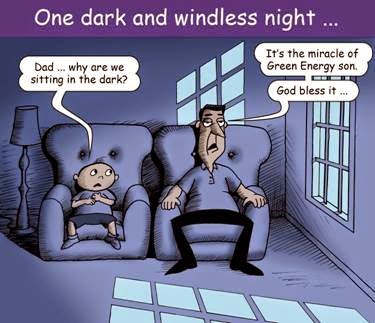
The Miracle of Green Energy – by Steve Hunter  www.stevehunterillustrations.com.au
Viv Forbes,17th July 2014

Another Ridiculous Climate Change Claim, “Blown out of the Water!

National Wildlife Federation Great Lakes Warning!

Global Warming and the Great Lakes

Already, Lake Superior has increased water temperatures and an earlier onset of summer stratification by about two weeks in just the past 30 years. Within another 30 years Lake Superior may be mostly ice-free in a typical winter.

Lake Erie water levels, already below average, could drop 4-5 feet by the end of this century

Global Warming and the Great Lakes – National Wildlife Federation

Lake Superior obliterated all records for ice this year, and the water level in all of the Great Lakes is above normal.

ScreenHunter_1940 Aug. 14 21.54 GLWLD – Great Lakes Water Level Dashboard

Community Opposition to Wind Farms Grows Because Wind Power is a Fraud

lies

As community and political opposition to the great wind power fraud rolls and builds across the world, the charge that opponents are red-necked climate change deniers, infected with a dose of Not In My Backyard syndrome, starts to ring hollow.

Surely that charge can’t stick to each and every one of the 1,000 who signed the petition against the Mt Emerald wind farm proposal in Far North QLD – and the 92% of locals there who are bitterly opposed to it (see our post here)?

The same level of opposition arises at the local level – wherever wind power outfits are seeking to spear turbines into closely settled agricultural communities (see our post here).

Communities across the Southern Tablelands of NSW, locals are up in arms at efforts by wind farm outfits and the NSW Planning Department to sack and stack “community consultation committees” to ensure their development applications don’t face any real scrutiny. At Rye Park, 91% of locals are opposed to the wind farm being pitched by Epuron (see our post here). And communities like Tarago have erupted in anger at plans to destroy their lives and livelihoods (see our post here).

A little while back, the usual response from those opposed to wind farms was along the lines of: “we’re all in favour of renewable energy, so long as wind farms are built in the right place”.

But that was before people understood the phenomenal cost of the subsidies directed at wind power through the mandatory RET (see our post here) – and the impact on retail power prices (see our post here).

Fair minded country people are usually ready to give others the benefit of the doubt; and, not used to being lied to, accepted arguments pitched by wind power outfits about the “merits” of wind power: guff like “this wind farm will power 100,000 homes and save 10 million tonnes of CO2 emissions” (see our post here).

Not anymore.

Apart from the very few farmers that stand to profit by hosting turbines, rural communities have woken up to the fact that wind power – which can only ever be delivered at crazy, random intervals – is meaningless as a power source because it cannot and will never replace on-demand sources, such as hydro, gas and coal. And, as a consequence, that wind power cannot and will never reduce CO2 emissions in the electricity sector. The wind industry has never produced a shred of actual evidence to show it has; and the evidence that has been gathered shows intermittent wind power causing CO2 emissions to increase, not decrease (see this European paper here; this Irish paper here; this English paper here; and this Dutch study here).

The realisation that the wind industry is built on series of unsustainable fictions has local communities angrier than ever and helps explain the remarkable numbers opposed: 90% is what’s fairly called a solid “majority” in anybody’s book.

This extract from the Mt Emerald survey captures some of the changing mood and the reasons for it.

Mt emerald survey2

These days, locals fighting wind power outfits are quick to challenge the wild and unsubstantiated environmental benefits touted by the developers; and will launch into them about the massive subsidies (ie the mandatory RET and the REC Tax) upon which the whole rort depends.

And it’s not because these people are “anti-environment” – it’s simply because they’ve woken up to the fact that wind power is pointless: both as a power source; and as a solution to CO2 emissions reduction. Here’s the Business Report with a take on the same tale from Britain and Europe.

Opposing wind generators is not anti-green
Business Report
Keith Bryer
8 August 2014

The intolerance of dissenting views by the Green Lobby is an unpleasant aspect of some of its members. They are perhaps unaware that tolerance of difference is a pillar of democracy and essential to individual freedom. But, whatever the reasons for vitriolic attacks on those against wind generators, environmentalists should take a closer look at Scottish opposition.

The most prominent in Scotland is the Windfarm Action Group. This group firmly states that everyone should take environmental responsibilities seriously. Whatever the causes of global warming and the varying views on what causes it, we must protect our earth and steward it wisely. It accepts a need to reduce carbon dioxide (CO2) emissions. It wants cleaner, reliable energy. It supports sound scientific solutions with the goal of a cleaner, greener world.

No sane, sensible person can disagree with this. Even the most rabid environmentalist should agree too.

But this green group and 300 others like in Britain, plus another 400 in four EU countries, are against windfarms. They have gone into the subject thoroughly and engineers and scientists back up their conclusions.

To those who accuse them of merely being concerned with their own backyards and not the common good, they say add up our membership and you will find an awful lot of backyards. They are simply against what does not make good sense. They are convinced that wind power:

– Is not a technically legitimate solution.

– Does not meaningfully reduce CO2 emissions.

– Is not a commercially viable source of energy

– Is not environmentally responsible.

They believe there are better solutions to Britain’s energy concerns; solutions that meet scientific, economic, and environmental tests – and they have good reasons.

They point to the massive subsidies that windfarms received initially from the British taxpayer, money that attracts multinational corporations like flies to treacle. These subsidies added to the higher price ordinary British householders pay for their electricity.

This “stealth” tax was considerable. Most consumers were unaware that it was used to make wind-generated economically feasible on the one hand, and to fill the pockets of the manufacturers on the other.

This largess allowed wind-generation companies to make generous payments to landowners for permission to use their land. Such was the temptation that some Welsh farmers trying to raise sheep in arduous and scarcely profitable areas leapt at it.

One told his local newspaper that if it were not for the payments he got, he would have given up farming long ago.

The Wind farm Action Group quotes British government documents that say each wind turbine in Britain still receives an annual subsidy of more than £235,000 (R4.3 million). Britain has about 1,120 turbines in 90 parts of the country.

Among the usual objections to windfarms – they do not work all the time, they are noisy, kill birds and bats, and so on, the group adds a few more. For example, wind generators interfere with radar; dirt and flying insects affect their performance; ice build-up on the propellers affects performance even more; and wind turbulence further reduces their power production.

Finally, there is rust. Britain is a wet place but offshore wind turbines have salt to contend with as well. One Danish offshore wind farm had to be entirely dismantled for repair when it was only 18 months old.

Yes, groups such as these exist almost everywhere there are windfarms. They are often, like this Scottish one, as caring of the environment as anyone, perhaps more so. They are not only concerned with their own backyard; they are concerned about everyone’s backyard.

Yet they say this: “We believe that in time this [windfarms] may well be the greatest environmental disaster that mankind in panic, haste, folly and greed, has ever conceived.”

Britain is an old country and its language is full of folk wisdom like this: “No one ever built a windmill, if he could build a watermill.”

A more modern version of common sense would be: “Using wind power to reduce carbon dioxide emissions is akin to trying to empty the Atlantic Ocean with a teaspoon.”
BusinessReport

The mythical claims of the wind industry and its parasites have all be hinged on a perverse notion of “green” is good. But just what being “green” means these days is a matter of politics, not reason, fact or beneficial environmental outcomes: it’s become little more than a political fashion statement.

Ben Acheson writes for the Huffington Post. He’s also the Energy and Environment Policy Adviser and Parliamentary Assistant to Struan Stevenson MEP at the European Parliament in Brussels. For a taste of Ben’s views on wind power – see our post here.

Here’s Ben taking a swipe at faux “green” politics:


When the Outrageous Subsidies Disappear, so does the Viability of the Wind Turbines.

CEZ Predicts Further Drop in Power Prices as Profit Declines

August 12, 2014

“The prices probably won’t rise in the foreseeable future,” Chief Executive Officer Daniel Benes told reporters today in Prague, after releasing earnings. “They are more likely to fall further.”

CEZ, along with its European peers, has been battling waning demand and falling electricity prices, hovering near a record low. Reduction of subsidies for renewable energy in Romania, where CEZ operates a 600-megawatt wind park, also eroded earnings in the quarter.

Net income fell to 7.3 billion koruna ($351 million) in the three months ended June 30 from 10.7 billion koruna a year earlier, the Prague-based company said today in a statement. That missed the 7.5 billion-koruna average of 12 analyst estimates compiled by Bloomberg. Revenue fell 9 percent to 48.5 billion koruna.

“The decline in earnings reflects the ever-worsening conditions in the European energy sector, falling power prices and an exceptionally warm and dry winter,” Benes said in the statement.

CEZ shares gained as much as 0.9 percent to 596.90 koruna and traded at 593.10 koruna as of 12:17 p.m. in Prague. The stock has gained 15 percent this year.

Higher Target

Earnings before interest, taxes, depreciation and amortization fell 10 percent to 18.7 billion koruna. That beat the average analyst estimate of 17.7 billion koruna. The company maintained its full-year Ebitda target of 70.5 billion koruna and slightly raised its target for net income to 29 billion koruna from 27.5 billion koruna previously.

Power for 2015 delivery to Germany, where CEZ sells part of its output, dropped 3.3 percent this year, extending the 16 percent decline in 2013. The forward contract decreased to a record 33.75 euros ($45) per megawatt-hour on April 4.

Ebitda in Romania, where CEZ runs a 600-megawatt wind farm, dropped by 1.1 billion koruna in the first half of the year after the country cut support for renewable energy and power prices plunged. The wind farm is receiving only one green certificate from the government for every megawatt-hour generated, instead of two previously.

First-half Ebitda in the Czech Republic dropped 20 percent to 23.1 billion koruna.

Pre-Sale

CEZ has pre-sold 82 percent of its 2015 output at 39.5 euros per megawatt hour, 54 percent of 2016 production at 36.5 euros per megawatt hour, and 22 percent of 2017 generated power at 36 euros per megawatt hour, the company said.

The company plans to cut operating costs in the next two years by 16 percent, according to the statement. Through an arbitration suit, CEZ reached an agreement with the Albanian government for a 100 million-euro compensation for having its license revoked and assets confiscated last year.

In April, the utility called off a $15 billion tender for two new reactors at its Temelin nuclear power plant after the Czech government refused to provide guarantees to ensure the project’s profitability. The government is drawing up a new national energy strategy to be introduced at the beginning of next year.

CEZ is interested in Enel SpA’s assets in Slovakia, which the Italian company plans to sell to cut debt. The process is “at the very beginning,” Benes said.

To contact the reporter on this story: Ladka Bauerova in Prague at lbauerova@bloomberg.net

To contact the editors responsible for this story: Will Kennedy at wkennedy3@bloomberg.net Indranil Ghosh, Ana Monteiro

Windweasels “Stack the Deck” for “Community Consultations”

NSW Planning Department Helps Wind Farm Developers Rig Community “Consultations”

dirtyrottenscoundrelsoriginal

As community hostility to wind farm plans erupts across the Southern Tablelands of NSW, wind power outfits have taken to sacking and stacking committees to ensure the “process” of “community consultation” is little more than high farce.

Spanish outfit, Union Fenosa didn’t like the prospect of having Tony Abbott’s key business adviser, Maurice Newman challenge its wild and fictional claims, so it did what any reasonable corporate citizen would do: it booted him off the committee at Crookwell (see our post here). What’s that you say about “shaping the debate”?

Now, EPYC – an outfit planning to spear 100 turbines into the heart of picture post-card Tarago – has adopted the same tactics: stacking the consultation committee with “friendlies” and preventing the appointment of anyone with any insight into the scope of the fraud. Here’s the Goulburn Post with a tale that sounds more like something from the old Soviet Bloc.

Windfarm group demands action
Goulburn Post
Louise Thrower
4 August 2014

OPPONENTS of a proposed wind farm near Tarago are calling on the state government to ‘do its job.’ Community consultative committees (CCCs) are mandatory under guidelines but are nothing more than a ‘fig leaf,’ says a residents’ group.

The Residents Against Jupiter Wind Farm (RAJWF) has not ruled out political action to press their point.

Last month the group met with a senior advisor to Planning Minister and Goulburn MP Pru Goward and a departmental official in Sydney.

Member and Tarago district resident Dr Michael Crawford said the government had the power to appoint CCCs but was abrogating its responsibility and letting wind farm companies decide the make-up.

“It’s not an even handed process but they want it to look as though it is by putting it in the guidelines,” Dr Crawford said.

“The Department is not doing its job to appoint community representatives and the independent chairperson and it doesn’t pull anyone up on it. We tried to get some real change.”

Instead, Dr Crawford said the Department gave him the “soft shoe shuffle.”

His comments follow Union Fenosa’s sacking of Maurice Newman from the Crookwell Three wind farm CCC. The move sparked outrage from NSW Landscape Guardians president Humphrey Price-Jones who called on Ms Goward and the Department to intervene.

Under existing draft guidelines, the director general signs off on CCC membership. But even Union Fenosa conceded that given the draft document, the state was leaving membership up to wind farm companies.

Tarago residents at least argue this is unacceptable.

“Nowhere in the guidelines is there any latitude for the wind farm developer to have a say about choosing community reps,” resident Jane Keaney stated in a letter to the editor.

“In fact, even without the guidelines, anyone with the faintest sense of fair play would recognise that allowing a developer of any sort to select the people who are going to be allowed to talk to the developer on behalf of the community, is anathema. How has the department come to tolerate this corruption of process?” The group has already asked Palerang and Goulburn Mulwaree Councils to help with election of its CCC.

In June, EPYC, which wants to build the 100 turbine wind farm southeast of Tarago, called for community representation.

In response, the group nominated seven people including Mr Crawford, who it wanted on the committee, with a further eight as alternative delegates. The Reverend Tom Frame supervised the election.

Dr Crawford said to date there has been no response from the company or the Department of Planning.

At the most recent Goulburn Mulwaree meeting, planning director Chris Stewart was appointed as Council’s representative.

While companies like Union Fenosa have defended their ability to appoint a wide cross section of views to the committees, others like Mr Price-Jones have branded them “wind farm propaganda” machines.

Dr Crawford said while all the Tarago nominees oppose the wind farm, he would welcome a variety of voices on the committee.

But he’s adamant that the state government needs to regain control.

“The government wants to paper the State with wind farms but the process is nothing more than a fig leaf,” he said.

“… At the meeting in Sydney I said they have to understand our timetable. There’s an election next year and if our members feel political action is required, we won’t sit on our hands.

It’s about government policy and the way to deal with it is through the political process.”

Ms Goward told the Post she had asked her department for a report on CCCs.

“We made it clear that we expect wind farm companies to genuinely consult with communities and the history is that they haven’t,” she said.

“We need to be sure CCCs are genuine, that they genuinely represent the community and can give unfettered advice.”

The company had not responded to requests for comment by the time of going to press.
Goulburn Post

STT is pleased to hear that Pru Goward has taken an interest in what can fairly be described as government gone rotten. The NSW Planning Department – like state planning departments around Australia – is infected with a pernicious brand of groupthink driven by the childish fantasy that wind power is a solution to “climate change” (previously known as “global warming” – until it became evident that it stopped getting warmer 17 years ago – see our post here).

Wedded to a delusion, woe betide anyone – like Maurice Newman or Dr Michael Crawford – who has the temerity to question their mantra. Hence the need to load these so-called “community consultation committees” with gullible “yes-men”.

Wind power – delivered at crazy, random intervals – requires 100% of its capacity to be backed up 100% of the time by fossil fuel generation sources and, therefore, cannot and will never reduce CO2 emissions in the electricity sector (see our posts here and here and here and here andhere and here and here).

Wind power is not a substitute for conventional generation sources and – if CO2 is the problem – presents as a solution to nothing (see our post here).

Remember that the ONLY justification for the $billions in subsidies directed at wind power (see our post here) is CO2 emissions abatement in the electricity sector. It’s the central and endlessly repeated lie that wind power outfits routinely trot out in their planning applications. You know, the guff about “powering 100,000 homes” and abating millions of tonnes of CO2 (see our post here).

Well, STT hears that the industry is about to be put to proof on its CO2 abatement claims.

The wind industry has never produced a shred of evidence to show that wind power has reduced CO2 emissions in Australia’s electricity sector. To the contrary of wind industry claims, the result of trying to incorporate wind power into a coal/gas fired grid is increased CO2 emissions (see thisEuropean paper here; this Irish paper here; this English paper here; and this Dutch study here).

Strip away that myth and the mandatory RET – upon which the entire wind industry depends – can be seen for what it is: the greatest economic and environmental fraud of all time.

pru-goward

Ineffective, Unreliable, Unaffordable, Wind Turbines!

LETTER: Wind turbines are a waste of time and money

The coalition has sanctioned the construction of Rampion, despite the overwhelming evidence that wind turbines are unreliable, grossly inefficient, inflict huge damage on the environment and wildlife, do not reduce greenhouse emissions one iota, and are, by a large margin, the most expensive means of generating electricity.

Thus, one could be forgiven for thinking the two headlines are linked.

Consider, as revealed by the company awarded the contract for the construction of the off-shore wind farm that, although the designed output is 700 megawatts (MW) because of the unreliability of wind turbines, the actual output will be no more than 240MW. Compare this with the output of a gas-fired generator, costing less than half the over £2bn for Rampion, which produces ten times as much electricity 100 per cent of the time.

Some years ago, Centricia, and other electricity-producing companies, made it absolutely clear to the government that, because of the unreliability of the wind, full back-up of conventional power stations is essential.

Therefore, greenhouse gas-emitting generating plants will have to remain permanently in service – thus, there is no point in building wind turbines.

Denmark, which has the greatest number of wind turbines per capita, has the most expensive power in Europe. I have yet to meet

a qualified electrical engineer who thinks the construction of wind turbines to power the national grid is a good idea.

Rampion will cover 60 square miles from Beachy Head to the Isle of Wight. The unreliability, comparatively short life, and huge cost of maintaining the turbines, means that it is only a question of time before Rampion is seen as one of the biggest scrap metal sites in the world.

France, where 80 per cent of electricity is produced by nuclear power, has the cheapest electricity in Europe. To satisfy the Green lobby, nuclear power stations in the UK should employ thorium as the fuel which is much safer than uranium. Nuclear bombs cannot be produced using thorium.

I do hope everyone reading this will write to their MP, county and district councillors, demanding the construction of all wind turbines, both on and off-shore, be halted immediately.

Ideally, those wind turbines already constructed should be dismantled.

Derek Hunnikin

St Leodegar’s Way

Hunston

Faux-green Environmentalists (EPA), Push Their Political Agenda!

EPA goes from Environmental Protection Agency to Extremist Political Agenda

A report from the EPA’s public hearings on the proposed Clean Power Plan

During the week of July 28, the Environmental Protection Agency (EPA) held hearings in four cities: Atlanta, Denver, Pittsburgh, and Washington, DC. The two-day sessions were to allow the public to have their voice heard about the proposed rules it released on June 2 that will supposedly cut CO2 emissions by 30%.

MaritaMany, including myself, believe that these rules are really an attempt to shut down coal-fueled electricity generation and implement a cap-and-trade program that the Administration couldn’t get through Congress in 2009, when cap-and-trade’s obvious allies held both houses of Congress.

If the EPA’s plans were clear, direct, and honest, the public would likely revolt outright. Instead, the intent is hidden in pages of cumbersome language and the messaging becomes all about clean air and water—and about the health of children.

Because I was in the area—speaking a few hours from Atlanta on Sunday—I took advantage of the proximity and signed up to speak at the hearing. When I first attempted to sign up, day one was already full. The EPA had so many people who wanted time to share their opinions, a second day was added, and I was put on the schedule.

The first day, Tuesday, July 29, included competing rallies held in near-record-low temperatures for Atlanta in July. Supporters of the EPA’s plan—many of whom were bussed in from surrounding states—gathered in Centennial Olympic Park. I spoke at the rally, made up of plan opponents, that was organized by Americans for Prosperity’s Georgia chapter held at the Sam Nunn Federal Center—where the hearing was originally scheduled (before a power outage forced a move to the Omni Hotel).

I spent the rest of the day at the hearing. It had a circus-like atmosphere. With tables of literature, people carrying signs, and many of the plan’s supporters identified by their matching pale-green tee shirts emblazoned with:

                             Protect our communities

                             CLIMATE ACTION NOW.

Once I had a taste of what to expect the next day, when I was to present my comments in the five minutes allotted, I prepared what I wanted to say. The following is my original text—though I had to edit it down to get it within the allowed time frame. For presentation here, I’ve also enhanced my comments with some additional insights from others. The verbiage that is not a part of my original testimony is included in italics.

* * * *

I was here yesterday and earlier today. I’ve listened to the well-intentioned pleas from many who have begged you, the EPA, to take even stronger action than this plan proposes. One even dramatically claimed: “You are the Environmental Protection Agency. You are our only hope. If you don’t protect us no one will?”

I heard a teary-eyed, young woman tell a tale about a man she knows who is dying of cancer, supposedly because he grew up near a coal-fired power plant—he couldn’t be here, so she told his story. She also said: “I am fortunate enough to have not been around in the 1960s when there was real smog.” Her father has told her about it.

One woman claimed her neighbor had gotten asthma from global warming.

Another addressed how she gets headaches from emissions. She told how lung tissue could be burned. And, how particulates are why people can no longer see the mountain in her region.

An attorney’s testimony told about seeing “carbon pollution” every day from his 36th floor office “a few blocks from here” from where he looks “out over a smog-covered city.”

The passion of these commenters supersedes their knowledge, as none of the issues I’ve mentioned here, and there are many more, are something caused by carbon dioxide—a clear, colorless gas that each of us breathe out and plants breathe in.

Marita and the UMWADave Bufalo is a retired civil engineer who attended and testified at the EPA’s Denver location. He told me he had a similar experience: “I was only able to stay for about an hour but I did hear about 10 testimonials. They were all in support of the EPA’s proposed regulation.  I don’t believe that anyone had really read the proposal prior to testifying. Their testimonies seemed to lack an understanding of the chemical nature of CO2. One elderly woman could only state that she thanked the EPA for insuring that she had clean air and water. One gentleman was clearly pushing for the sale of his company’s solar panels.” 

James Rust, Ph.D., is a retired professor of nuclear engineering from Georgia Tech. In his testimony in Atlanta, he referenced thousands of peer-reviewed papers showing carbon dioxide emissions had a negligible effect on climate change. He pointed to the stack of documents from the Heartland Institute called Climate Change Reconsidered I and II that contained these peer-reviewed articles. It was at that point, that a man in the front row shouted out “Liar!” Rust told me: “This is the typical type of response from the mob that promotes this climate change scare.  They use ad hominem attacks and don’t debate the real issues because they have no experimental data that backs up what they are proposing.”  

Carbon dioxide is a natural, and essential, part of the environment— massive, unknown, quantities of carbon dioxide are emitted each year from natural sources, such as volcanoes. Were we able to eliminate carbon dioxide from every industrial source in the United States, it would have virtually no impact on global carbon dioxide emissions.

I understand the concerns over true smog and pollution. I grew up in Southern California—graduating from high school in 1976. At that time, we had made a mess of our environment. We had polluted the air and water. Cleaning up our collective act was an important public policy issue. San Bernardino, where my family lived, is in a valley, surrounded by mountains. It was not uncommon for a family to move into the area in the summer, when the smog was the worst, and not even know the beautiful mountains existed. In the fall, when the winds came in and blew the smog out to sea, newcomers where amazed to discover the mountains.

But that pollution, that smog, has largely been cleaned up. Utilities have spent hundreds of billions of dollars on scrubbers, and on other highly technical equipment such as SCR’s, electrostatic precipitators, and bag houses, to successfully remove the vast majority of the particulates.

People often see a billowing white cloud coming from the stacks at a coal-fueled power plant and confuse it with pollution when it is really H2O—water in the form of steam. Depending on the time of year, or the time of day, it may be more, or less, visible. The weather conditions may make it settle like fog until the sun burns it off. And this, I believe, is mistaken for pollution.

If you haven’t seen Randy Scott Slavin’s Bird’s-Eye-View of New York City, I encourage you to check it out.  The book shows an birdseyeamazingly clean city—despite the more than 8 million people living in those compact 469 square miles. New York City is one of the most populated places on the planet, yet its air is sparkling.

This rule is not about pollution. It is about shutting down coal-fueled power plants, and thus killing jobs and raising electricity rates—both of which punish people who can least afford it. But plenty of others have addressed the economic impact, so I won’t take more of my time on that topic.

Dozens of members from a variety of different unions were present in Atlanta to speak out against the plan. Skip Howard, Business Manager for Plumbers and Pipefitters Local 421 in North and South Carolina, explained: “Although Nuclear Power is a clean, renewable source of energy and not affected by fluctuating oil-and-gas prices, energy from Coal-fired Plants is cheaper and helps keep the cost of electricity affordable to consumers. Coal-fired Plants are reliable and cheaper to build than a Nuclear Plant. Coal-fired plants are now designed to be a safe and efficient source of energy that supports grid systems, helping to avoid blackouts. New clean coal technologies create many thousands of new high-wage jobs across our country, helping our economy grow.” 

Several of the union members who testified in Atlanta assailed the EPA representatives because the hearing locations were far from where those most impacted—the coal miners—live. 

coal trainI spent some time on Tuesday talking with many of the union representatives. David Cagle, Marketing Representative for the Plumbers, Pipefitters, and HVAC/R Service Technicians Local Union 72 based in Atlanta, told me: “I appreciate your interest in helping our country to be able to continue to provide economical electric energy and well-paying jobs to America’s families and businesses.” He then offered me this brief history of what the coal-fired electric energy industry means to his family:

After World War II my father worked in one of the first large coal-fired powerhouses built in the state of Georgia. That well-paying job allowed him to help his parents pay off the mortgage on their house and also to start saving for a down payment for a home of his own one day.  My father worked on several coal-fired powerhouses throughout his career in the piping industry. These well-paying jobs provided a decent standard of living for his family.

The powerhouses that my father helped build are still providing well-paying jobs for the people who run them and the workers who do the maintenance on them. Hundreds of thousands of construction workers have benefited from the well-paying jobs in the construction and maintenance of these facilities. They are also still providing low-cost electrical power to hundreds of thousands, if not millions of customers.

”””””””””””””””””””””””””””””””””””””””””””” 

Beside my family benefiting from the coal-powered electric generation industry, I can tell you firsthand what coal does for our country across the continent. 

powderrivercoalI lived in Campbell County, Wyoming, for two years in the mid-90s.  Campbell County is the Energy Capital of the United States. Thousands of families would lose a very good way of living, if the coal mines in Wyoming were shut down.  The coal mined there is very low in sulfur and produces some of the cleanest electricity on earth. I also know many people from West Virginia who depend on coal to be able to make a decent living. 

I fully understand the devastating effects the Obama Administration’s new EPA rules on coal-fired powerhouses would have on people on a fixed income. My parents are in their late 80s and early 90s. They are on a fixed income and in poor health. The last thing they need are large power bills that would destroy their budget and force them to rely on their children to help pay their power bills. 

My whole family are outdoorsmen. We have all been raised to hunt and fish and respect and protect our environment. My family would be the first to embrace a low-cost, environmentally sound alternative to coal-fired powerhouses. The problem is, there is no alternative economically viable source available at this time. 

The Wall Street Journal (WSJ) covered a union protest that took place at the Pittsburgh hearing. It states: “Unions opposing the proposed rule argue that U.S. workers will pay the price for lowering emissions domestically while other countries—most notably China, where coal usage has grown rapidly—will continue to burn coal and emit carbon dioxide.” The WSJreported: “Unions focused their efforts on Pittsburgh, sending busloads of unionized miners, utility workers, railroad workers, and others from Pennsylvania, West Virginia, Virginia, Ohio, Kentucky, Alabama, and other states.”

scaliaI also want to address the constitutionality of the proposed plan, as it does exactly what the Supreme Court admonished the EPA about on June 23. Justice Antonin Scalia, for the majority, wrote this about the Tailoring Rule decision: “Were we to recognize the authority claimed by EPA in the Tailoring Rule, we would deal a severe blow to the Constitution’s separation of powers… The power of executing laws…does not include a power to revise clear statutory terms that turn out not to work in practice.” Yet, this is exactly what this proposed plan will do.

Later in the decision, Scalia says: “When an agency claims to discover in a long-extant statute an unheralded power to regulate ‘a significant portion of the American economy’ . . . we typically greet its announcement with a measure of skepticism. We expect Congress to speak clearly if it wishes to assign an agency decisions of vast ‘economic and political significance.’”

I believe on these grounds, this plan must not go forward. It is one more example of executive overreach.

I fear that if it does, America will pay a dear price. This hearing was scheduled to take place down the street at the Sam Nunn Federal Center. However, it was moved due to a power outage. Note: business cannot be done without power. You were able to move this hearing. In a reduced-power environment businesses will move to places where they have access to energy that is effective, efficient, and economical. They will move, as many have already done, to places with far-looser environmental policies and the perceived gain will be lost.

Thinking that what we do in the United States will have a serious impact on global carbon dioxide emissions is like thinking that declaring a “no pee” section in the swimming pool will keep the water urine free.

I’ll end with a quote from the smog-viewing attorney who closed with: “I am hopeful that my new grandchildren, who will live into the 22nd century, will enjoy a world that my grandparents, born in the 19th century, would recognize.” If this plan is passed, he may get his wish. His grandparents’ world contained none of the energy-based modern conveniences or medical miracles we consider standard and essential today—let alone those yet to be developed or discovered by the 22nd century. In his grandparents’ day, life expectancy in the U.S. was estimated at 45 years. By 2000, this had increased to 78 years—mostly due to our expansion of cost-effective electricity throughout the nation.

Remember, the countries with the best human health and the most material wealth are those with the highest energy consumption. America needs energy that is abundant, available, and affordable.

* * * *