Colorado-based Juwi Wind, packs up & leaves Tipton County….Yahoo!

July 13, 2014

PUBLIC EYE: Wind shifts focus in Tipton County

The wind died considerably in the northwestern portion of Tipton County last week, leaving the perfect break in the weather for remonstrators of wind farm development in the county to celebrate.

Following 11 months of litigation, Colorado-based juwi Wind will no longer pursue plans to develop Prairie Breeze Wind Farm, a project that would have included 94 wind turbines in Prairie and Liberty townships while investing $300 million in the project.

The turbines that countless members of the public have referred to as “offensive” will remain off of farm property and away from those who claim the structures are too loud while reducing property values.

No matter which side of the aisle residents have been on, Tipton County Commissioner Joe VanBibber described juwi’s decision not to build as “a closure to a difficult time in the community.”

Ultimately, the new stipulations put in place by the Tipton County Board of Zoning Appeals proved to be the biggest contributing factor in juwi’s project not coming to fruition.

Juwi’s lawsuit alleged the BZA had exceeded its authority by increasing the distance wind turbines had to be from property lines and requiring a property value guarantee plan to protect non-participating property owners in the project area.

While some have questioned whether local officials have had the best intentions of the public and landowners as wind energy has become the hot button issue in recent years, there can be little argument that the stipulations played a huge role in preventing the wind turbines from going up. juwi said the stipulations “effectively rendered the project impossible to build.”

VanBibber said he believed juwi “no longer wants to do business in that environment.”

So what type of development is appropriate for the county moving forward?

With one wind farm backing out in the county, attention will no doubt shift back to E.ON’s Wildcat Wind Farm, which still has plans to build a second phase of turbines in center of the county.


Any one with a Conscience, Could NOT Support the Wind Travesty!

Windfarm risks acceptable? (Evelyn Morrison)

13/07/2014, by 

To the named supporters of the windfarm, I would ask, since we know that the mining of rare earth minerals in China is poisoning the land, lakes and people, how can they equate this with nice green energy? These rare minerals are components modern turbines depend upon.

Supporters must believe this wretched toxicity is acceptable.

These named supporters are aware that children in the windfarm areas will be exposed to infrasound. So after their bedtime story these little children can cuddle their pillows and receive maximum auditory stimulation. The pillow will block audible sound but not infrasound.

Supporters have found this to be acceptable.

The named supporters obviously have no concerns for the physical and psychological ill health that the windfarm occupants will be subjected to when the turbines become operational. Clearly the supporters have a better understanding of the detrimental health effects than Dr Sarah Taylor whose report supports the evidence that individuals living on windfarms will be affected.

The windfarm supporters find this acceptable.

I will not insult the windfarm supporters intelligence by suggesting that they were perhaps unaware of the above. Thankfully there are still many decent people who do not find these facts at all acceptable.
I have only touched on some of the reasons why I will never support this development.

Surprisingly no one in the above supporters group will have to live in the windfarm.

Evelyn Morrison
Setter,
Weisdale.


Countries need to Follow the Aussies Lead. Stop the Financial Suicide!

Jennifer Westacott: Time to End Poorly-Designed Energy Policy

Jennifer Westacott

Jennifer Westacott is the chief executive of the Business Council of Australia and has extensive policy experience in both the public and private sectors. She has occupied critical leadership positions in the New South Wales and Victorian governments. This weekend she wrote in The Australian about the devastating impact of poorly-designed energy policy on businesses and energy consumers – and the necessity to make changes now.

Repeal carbon tax to reclaim our lost advantage in energy
The Australian
12-13 July 2014

NEXT week we hope to finally get rid of a piece of badly designed public policy that has placed a serious drag on our economy — the carbon tax.

Coming from the power sharing deal between the former government and the Greens, it was a creature of a political compromise and resulted in the highest carbon tax of any country in the world. It’s not that we shouldn’t have taken action on climate change, but the carbon tax was poorly designed, it was unworkable and an example of a very poor policy process.

We might be able to farewell the carbon tax, but it is just one of a long line of green energy policies which federal and state governments have layered on top of one another that are driving up the cost of electricity.

It is the cumulative impact of these policies that is pushing up the cost of electricity and making our businesses less competitive.

Repeal of the carbon tax therefore must be the beginning of removing shortsighted schemes and programs, and the start of a process to design an integrated approach to climate change and energy policy that supports rather than weighs down our economic competitiveness and jobs.

Let’s get some facts on the table about the real costs of green energy policies on the economy.

Analysis for the Business Council by Synergies Economic Consulting and Roam Consulting of actual electricity prices across the mainland states of the National Electricity Market shows that the cost of electricity has more than doubled in the last 10 years.

This will not come as news for anyone opening their electricity bill each quarter, but what is startling about the analysis is the extent to which a plethora of green energy policies have collectively driven up the cost of electricity, particularly for business who are large consumers of electricity.

The research shows that together, the carbon tax, the Renewable Energy Target, and state-based energy efficiency schemes now account for up to 40 per cent of the total electricity bill for a large business that does not qualify for government assistance, such as non trade-exposed manufacturing, dairy farms, retail outlets and office buildings.

Even for businesses that do receive government assistance, the total cost of green energy policies on their electricity bill is 17-25 per cent. There are thousands of businesses that face the brunt of these higher costs. This erodes the competitiveness of Australia relative to the rest of the world and will be a direct hit to the living standards of all Australians.

For households, the research shows that green energy policies account for 11 per cent of an average household electricity bill. The carbon tax alone is estimated to have accounted for 6 per cent of a household electricity bill and 20 per cent for a large business, less for those that qualify for government assistance.

On top of this, the RET is estimated to cost up to almost 10 per cent of a typical electricity bill for a large business that does not receive any exemption, and 3 per cent of a typical household electricity bill.

State-based schemes, including feed-in tariffs and energy ­efficiency schemes, account for 2 per cent of a household bill and up to 12 per cent of a large business bill — for which there is no compensation available.

What the cumulative cost of these schemes highlights is that when climate change policies are developed in isolation of energy policy, it adds to the cost of reducing emissions and ultimately consumers pay more for electricity than they otherwise should.

Good energy policy should deliver reliable and competitively priced energy in the long-term interests of consumers, and include climate policy that enables lowest-cost emissions reduction that keeps us competitive with the rest of the world.

Business and households remain in the dark as to when the high-cost carbon tax will be repealed as politicians debate trade-offs with the Palmer United Party to rescind the tax. Businesses are increasingly concerned that the proposed PUP amendments will bring new levels of complexity and red tape. If the parliament is serious about reducing electricity costs, a speedy repeal with a workable process to ensure reduced electricity prices are reflected in household bills is required.

Repealing the carbon tax is the first step to putting Australia on track for an integrated approach to climate change and energy policy that supports economic competitiveness and jobs. Australia should work to reclaim our comparative advantage in energy while reducing greenhouse gas emissions in line with global ­efforts, by:

1. Providing access to least cost abatement through international permits and getting the design of the emissions reduction fund right.

2. Amending the RET to a true 20 per cent of demand by 2020 and discontinuing the scheme once all liabilities are met in 2030.

3. Integrating climate change and energy policies as part of the government’s energy white paper.

4. Ensuring that future climate change and energy policies look at the cumulative impact of new policies on the cost of energy to households, businesses and the economy as a whole.

5. Completing the outstanding energy market reform agenda initiated by the Hilmer Review, including privatising energy assets, deregulating retail prices, adopting more uniform and economically efficient reliability standards and moving to more cost-reflective electricity tariffs.

With Australia’s competitiveness slipping, and with many businesses, families and individuals struggling, it is vital that the parliament develop consensus on the big issues facing our country such as our demographic changes, the rise of technology and our declining competitiveness.

Reaching a degree of bipartisanship on the critical principles on energy and climate change policy will ensure we play our role in global efforts to reduce greenhouse gas emissions while we reclaim energy as a comparative advantage for Australia in this increasingly competitive world.

The Australian

The mandatory RET/REC scheme is nothing more then a giant TAX on all Australian power consumers: with the proceeds either channelled as corporate welfare to near bankrupt outfits like Infigen (as RECs); or pocketed by the Government, as the shortfall charge. And all of that adding $50 billion or more to power costs, for absolutely no measurable benefit whatsoever.

The mandatory RET must go now.

electricity-price-rise

Wind Turbines….useless, over-priced, novelty energy producers.

“Being crazy isn’t enough”: Wind energy’s fantasy in green (Editorial)

Jul 12, 2014

Dr. Seuss

.
— Curt Devlin, Guest Editor, Massachusetts (7/12/14)

“Never let the facts get in the way of a good story,” cautioned Mark Twain.  Miles Grant heeded Twain’s famous advice in his recent opinion about global climate change and wind opposition. Grant brims with evangelical fervor when he argues that wind power is necessary for averting climate change.

The problem with the argument is it assumes facts that don’t exist. Wind turbines do not reduce CO2 emission, they increase it. In 2013, the U.S. spent some $80B subsidizing wind power, but CO2 only increased. In proportion to their economies, other industrialized nations around the world have invested far more heavily in wind energy than the U.S., but carbon emissions still go up.

Coal supplies roughly 60% of the energy to the world’s power grids, and all industrial turbines must be connected to a grid. Grid operators maintain an instantaneous balance between energy supply and demand. When turbines are spinning, coal generators are ramped down to balance the grid, a process known as “curtailment.”  When turbines stop spinning, coal plants are ramped up, called “cycling — a procedure that can take hours, since coal plants ramp up slowly.

The problem with cycling is that even the most efficient coal plants produce much greater CO2 emissions when they are not running at peak efficiency. This means that wind farms connected to coal grids virtually ensure increased CO2 emissions — not to mention increased particulate air pollution, a dirty little secret the “wind” lobby wants you to know.

Grant mentioned the people who have to breathe the pollutants being belched out of the Brayton Point coal plant, but forgets to mention that connecting wind turbines to the same grid will make matters worse. The misguided demonstrators who marched into Fairhaven last year to support the turbines, clearly didn’t understand this danger. The people being harmed by pollution from this coal plant should be doing everything to prevent further turbines from being connected to the same grid.

BraytonPoint

People like Grant, who look at wind power through green-tinted glasses, are quick to argue that at least coal is not being burned when turbines generate power. Unfortunately, this too falls apart under careful scrutiny. The U.S. has become an exporter of its coal surplus. The principal consumer of our surplus is China. When the Chinese burn our coal, however, their plants don’t have to comply with EPA standards. As a result of these dirty coal plants, some industrialized cities in China now have pollution so bad that the air is unbreathable for days on end.

At least we can all agree on one thing; the climate is global, so we’re all inhaling some of this pollution.

CHINA AIR POLLUTION

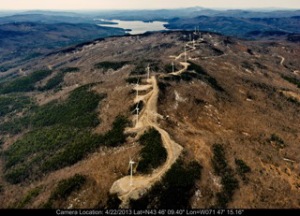
Here are some other facts the green evangelists don’t want you to know. Every living plant growing in huge swaths of land is literally razed to the ground every time a wind turbine goes up. It isn’t just the ten acres needed for the site that get turned into a moonscape. Broad fire lanes and paved roads are often cut across ridges and mountain tops to accommodate the huge vehicles needed to build, service, and maintain these leviathans. The forest habitat is virtually hacked to ribbons, so it can no longer support the complex, balanced ecology of flora and fauna. (Take a look at the wind farms in New Hampshire, Vermont, and Maine with Google Earth to see the true extent of environmental destruction cause by industrial turbines.)

groton-wind-newfound

Another impact that Mr. Green Eggs & Ham won’t mention is the economic one. In the U.K., wind power has driven the cost of retail electricity so high that a new class of poverty has emerged. More and more people are slipping below the poverty line, because they can no longer afford the high cost of electricity produced by turbines. In the global economy, the worst impact is placed on those who are already languishing in poverty.

In proportion to its economy, Germany has invested more in wind than any other industrialized nation. Once the powerhouse of the E.U., its economy has been decimated by its gamble on the roulette wheel of wind. According to government-paid researchers, the wind energy misadventure known as the Energiewende (energy transformation) has damaged the German economy so badly that Germans are bringing ten new coal generators online, with more on the way.

princetonwind

Princeton, MA, one of the earliest adopters of wind power in Massachusetts, has now reported a loss of $6 million, and has the highest electric rates in the Commonwealth.

Though the cost of wind energy is hidden by federal subsidies paid for with your tax dollars, a kilowatt of energy from a land-based turbine costs three times more to produce than conventional generators; and from offshore turbines, three times more than that, again. If Cape Wind is ever built in Nantucket Sound, carbon emissions will continue to rise and Massachusetts will have the highest electric rates in the U.S.

By far the greatest cost of all is the human one. There is no benefit to wind power sufficient to justify the damage to human health and well-being they cause. Wind turbine sites are ecological dead zones. The best science we have offers clear evidence that virtually everyone exposed to the pulsed volleys of infrasound produced by industrial wind turbines will begin to suffer from cognitive impairment or cardiovascular disease. Turbines are a silent killer.

“Lasciate onge speranza, voi ch’ingrate.” “Abandon all hope, ye who enter here.”  Dante’s inscription over the gates of Hell (“The Inferno”).

Contrary to green dogma, wind power doesn’t make sense, whether you believe global climate change is real or not. In the end, the fantasy-in-green doesn’t amount to even a good story. It’s but a fractured fairy tale, full of sound and fury, signifying nothing.

Electricity Bills would be much Higher, if Not for Wind Warriors! Read this!

Wind Turbines are a Waste of Time & Energy!

Wind Power Barely Registers In June

by Paul Homewood


Wind farms: even worse than we thought…


Last year, wind farms contributed about 8% of the UK’s electricity. But as we well know, there are times when the wind does not blow.

A while back, I asked DECC for an analysis of the number of days when output was below a certain figure. Surprisingly, they said they did not have such information. I say surprising, as I would have thought this sort of data would be important for their planning.


Still never mind. Dave Ward has managed to download the 5-minute electricity generation data, from the Gridwatch system. From this he has managed to analyse the data for June, which does not make encouraging reading for supporters of wind power.

For instance, for 56% of the month, wind was supplying less than 3% of the UK’s power, and this during a summer month when demand is low. Worse still, it was generating less than 1% of the country’s needs for 11% of the time.

In terms of capacity, wind was working at less than 5% of its capacity for 28% of the month, and only got above 10% for 27% of the time, the equivalent of 8 days.

The graph below shows just how low capacity utilisation has been for most of the month. ( Based on DECC statistics showing wind capacity of 11461MW in Q1, which will certainly be higher now).

The lowest actual measurement was recorded on the 30th at 82MW, just 0.7% of capacity.


image


It is little wonder the government need to procure 53GW of standby capacity, to call upon when the wind does not blow.

Scotland’s Energy Policies are NOT Feasible, Sensible, or Sustainable!

Brian Wilson: Storm clouds gather over energy

Hunterston B nuclear power station will not be replaced when its lifespan expires Picture: Donald MacLeod

Hunterston B nuclear power station will not be replaced when its lifespan expires Picture: Donald MacLeod

  • by BRIAN WILSON
The latest self-indulgent waste of taxpayers’ money to emerge from St Andrew’s House carries the portentous title Energy Regulation in an Independent Scotland, prepared by an “Expert Commission”.


The clue is in the title. However “expert” these people might be, they were not entrusted with their own agenda. They were not invited to advise on whether independence makes the slightest sense in the energy context. Their remit was restricted to the hypothesis of Scotland having voted to separate.

At that point, their response becomes comical in its evasion of hard questions. Essentially, their conclusion is that everything should carry on as at present because it is in Scotland’s interests that it should. The inconvenient fact that the UK government insists the exact opposite would happen is simply ignored.

As with the currency, there is to be no “plan B”. The rest of the UK will continue to buy Scotland’s electricity output, no matter what it costs. Full stop. There is no consideration of what Scotland would be left with if they declined to do so which, in the view of my own “expert commission” is a racing certainty.

Let’s look at the Scottish Government’s existing energy policy which can be summarised as follows:

1. They hate nuclear power and there will be no replacement for Hunterston B and Torness until hell freezes over.

2. They neither know nor care what will replace the base-load from Scotland’s four thermal power stations, all due to close within a decade, since that’s tomorrow’s problem.

3. The answer is that it will probably come from England via the inter-connector but with a bit of luck the hated Hunterston B and Torness will keep going long enough to avoid that embarrassment for a few years yet.

4. English consumers will continue to fund Scottish renewables, via open-ended subsidy and infrastructure costs, regardless of whether or not we are living in separate states.

5. Er… that’s it…

The central conclusion of the Expert Commission that it would be a jolly good idea to retain a single market in electricity within our small island need not have detained them long. Who could disagree? Certainly not the English generators who will be delighted to pump as much electricity as we want into Scotland as soon as we are daft enough to have put ourselves in the position of requiring it.

Even the Expert Commission summoned all its courage to note this prospect, buried on page 34 of the report: “Under current forecast scenarios of high renewable generation installation in Scotland and closure of current coal and nuclear generation, Scotland is likely, at time of low renewables availability, to import electricity from rUK in order to continue meeting demand.”

For the past half century, Scotland has been an exporter of electricity to the rest of the UK, due mainly to our nuclear stations. Last year, we exported more than a quarter of what was produced. The triumph of Nationalist policy will be to turn us into an importer. That matters less while we are part of the same state and market but would matter – and cost – a great deal if we were not.

While importing base-load from south of the new Border, we would try to sell them our renewables. But why should they buy them? On this point, the Expert Commission is magnificent in its vagueness, dancing round the essential point that there would be no requirement whatsoever for the UK government to subsidise Scottish renewables. This was confirmed recently by the European Court of Justice in a case involving Sweden and Finland.

“An independent Scotland’s ability to maintain course towards the renewable targets and aspirations set by the current Scottish Government,” chunters the report, “will hinge on clarity as early as possible regarding continuity of current and proposed market mechanisms….”. Ah, what we need is clarity! But what if the clarity is summed up as: “No thanks – and even if we wanted to subsidise expensive Scottish renewables, our voters wouldn’t stand for it now that you’ve chosen to walk away.”?

Answer comes there none, but even the Expert Commission acknowledges there might be limits to the costs which “rUK” would pay. So what is their masterly answer to this multi-billion pound dilemma? Rest easy for the Expert Commission has sagely decreed: “These are questions which a robust agreement and strategic energy partnership between Scottish and rUK Governments will need to define”. Loosely translated, that means: “We’re sorry, we haven’t a clue”.

Casting around for precedent, the Expert Commission alights improbably on Ireland where there is a cross-border electricity market. But crucially, as they neglect to point out, there is no shared regime on subsidising renewables. All the Irish example does is confirm that Scotland would be left with a surplus of renewable energy – mostly from onshore wind farms – but without the subsidy base which currently sustains it.

I heard Alex Salmond sound-biting about Scotland as an exporter of electricity – shameless as ever, given that the surplus comes from nuclear – while England is “facing black-outs”. Ipse, they would continue to buy power from Scotland, he asserted. Well, they might buy power – they just wouldn’t subsidise our renewables, which is all we will have to sell.

England and Wales already import more power from mainland Europe than from Scotland. By 2020, the inter-connector between the UK and Europe will have doubled capacity. They will not need electricity from Scotland. Neither, according to National Grid’s evidence to the DECC Select Committee, do they need a low-carbon contribution since the biggest renewable energy projects now happening are offshore wind farms in the shallower waters of the south.

It is a pity that the Expert Commission did not break free of its shackles in order to tell the truth, which is (a) there is not the slightest reason to believe that UK Continuing would force its consumers to subsidise expensive Scottish renewables; (b) the only hope for the Scottish renewables industry is to remain part of the UK market, with subsidy to match; and (c) Scotland desperately needs a balanced energy policy rather than daft over-reliance on renewables.

I doubt if any member of the Expert Commission would disagree with a word of that. They should say so.

Incidentally, in the real world yesterday, Ofgem approved a £1.2 billion subsea link between Caithness and Moray. Anyone fancy funding that kind of investment, multiplied many times over, from within Scotland alone?

The original Mothers Against Wind Turbines TM, appealing for help for children…

Please acknowledge receipt of this message.


To:


The Right Honourable Stephen Harper

Prime Minister of Canada

pm@pm.gc.ca


The Honourable Peter Gordon MacKay

Minister of Justice and Attorney General

mcu@justice.gc.ca


July 12, 2014


Dear Prime Minister Harper and Hon. MacKay, Attorney General and Minister of Justice,


Re: Convention on the Rights of the Child and Industrial Wind Energy 


Ms Correia and I have taken the opportunity to communicate some of the risk factors of exposing fetuses, babies, children, youth and those with special needs to noise and other emissions associated with industrial wind energy facilities. We provided a snapshot of evidence indicating some members of this vulnerable population group with pre-existing medical conditions could also be at risk. In some cases, vulnerable children are expected to be exposed at home, at school or both.


This letter is public and may be shared.


During our correspondence, we cited the Convention on the Rights of the Child.


We now note that a recent Supreme Court of Canada Judgment considered the Convention on the Rights of the Child. [Judgment and Reasons, The Hon. Justice MacTavish, Canadian Doctors for Refugee Care, The Canadian Association of Refugee Lawyers, Daniel Garcia Rodriques, Hanif Ayubi and Justice for Children and Youth v. Attorney General of Canada and Minister of Citizenship and Immigration]   


Ms Correia has urged that the Government of Canada take immediate measures to ensure health protection from wind energy facilities for her son and Canadian children.


We have requested a meeting with Minister Peter McKay and look forward to the opportunity to share our concerns and provide some of the evidence relating to this complex topic.


Respectfully submitted,


Carmen Krogh, BScPharm

Ontario

Cell 613 312 9663


Attachments

  1. Judgment and Reasons, The Hon. Justice MacTavish, Canadian Doctors for Refugee Care, The Canadian Association of Refugee Lawyers, Daniel Garcia Rodriques, Hanif Ayubi and Justice for Children and Youth v. Attorney General of Canada and Minister of Citizenship and Immigration 
  2. Convention on the Rights of the Child July 12 2014.FINAL.pdf


[1]


2 Attachments


Preview attachment SCC-T-356-13 Cdn Doctors v AGC Judgment and Reasons.pdf

SCC-T-356-13 Cdn Doctors v AGC Judgment and Reasons.pdf

Preview attachment Convention on the Rights of the Child July 12 2014 FINAL.pdf

Convention on the Rights of the Child July 12 2014 FINAL.pdf


Faux-Green Scam Used to Push Agenda 21…Fight back! Educate yourself!

Big Green’s lethal agenda

Sustainability and climate claims limit energy access and living standards for the world’s poor

  • snowgore

The outstanding presentations at this Ninth International Conference on Climate Change clearly demonstrate that activist climate science is increasingly devoid of evidence … increasingly removed from the scientific method – and yet is increasingly being used to devise, justify and impose policies, laws, and regulations that govern our lives.

Indeed, rules formulated on the basis of “dangerous manmade climate change” allegationscontrol the hydrocarbons that power America and the world, improve and safeguard our lives, lift billions out of abject poverty, and allow us to achieve technologies and dreams never before thought possible.

Put simply, those who control carbon control our lives … our livelihoods, liberties, living standards, and even life spans. It is therefore essential that climate science reflects the utmost in integrity, transparency, and accountability.

Sadly, the opposite is true. As we have seen, far too much of the supposed science used to justify IPCC, US, EU, and other actions is distorted, exaggerated, even fabricated. If it were used to market private sector investments, products or services, the perpetrators would be prosecuted for fraud.

The latest White House claims are no better. The assertion that shutting down affordable, reliable coal-based electricity will somehow reduce asthma and protect children’s health is as baseless as any other arguments advanced in support of claims that we face an imminent manmade climate change catastrophe.

A primary reason for the fervor and longevity of these claims is that global warming is a social movement – or more accurately one manifestation of a social movement. It is a major part of a near religious Deep Ecology movement that is anti-energy, anti-people, and opposed to modern economies, technologies, and civilizations. In its determination to impose its worldview on the rest of humanity, it is dogmatic, imperialistic, and authoritarian.

It is also a Big Green and Big Government movement – with tens of billions of dollars at its disposal: over $13 billion per year just in the United States for Big Green organizations.

Global warming, climate change, climate disruption, and extreme weather mantras are almost interchangeable with sustainable development. When ClimateGate, fizzled confabs in Copenhagen and Durban, and a then-15-year pause in Earth’s warming made the world weary of climate change disaster demagoguery – Rio+20 Summit organizers simply repackaged climate crisis claims under the sustainability mantra. Fossil fuels, they intoned, must be replaced because we are running out of them, and their use is unsustainable.

Like climate change, sustainability is infinitely elastic and malleable, making it a perfect weapon for anti-development activists. Whatever they support is sustainable. Whatever they oppose is unsustainable.

For other times and audiences, climate and sustainability are replaced – in whole or in part – with over- population, resource depletion, the precautionary principle, mass species extinction … or chemical contamination. That’s why the White House is now talking about carbon pollution and asthma.

Think of the T-1000 android in the movie Terminator 2: Judgment Day. This vastly improved villain had the ability to morph into any shape it desired, giving it previously unimaginable powers and near indestructibility – all with the goal of controlling the future of humanity.

And so we have Alexander King, co-founder of the Club of Rome and its concept of Limits to Growth. “When DDT was introduced for civilian use,” King wrote, within 2 years Guyana had almost eliminated malaria. “But at the same time the birth rate had doubled. So my chief quarrel with DDT in hindsight is that it has greatly added to the population problem.”

ehrlichThe Population Bomb author Paul Ehrlich likewise blamed DDT for the “drastic lowering of death rates” in underdeveloped countries. He suggested that, because those countries were not practicing a “birth rate solution” – they needed to have a “death rate solution” imposed on them. Ban DDT.

Global warming, sustainability, and attacks on fossil fuels and biotechnology must therefore be understood as other components of their “death rate solution” and their intense desire to control all human endeavors.

In his 1973 Human Ecology book with Paul Ehrlich, President Obama’s chief science advisor John Holdren put it this way:

“A massive campaign must be launched to … de-develop the United States [and bring] our economic system … into line with the realities of ecology and the global resource situation…. Once the United States has clearly started on the path of cleaning up its own mess, it can then turn its attention to the problems of the de-development of the other [developed countries] and the ecologically feasible development of the [underdeveloped countries].”

“Limits to growth,” “the global resource situation,” and “ecologically feasible development” of course are synonyms for “resource depletion,” “peak oil,” “sustainable development,” and “dangerous manmade global warming” – with radical Deep Ecologists in and out of government making all the decisions.

Never mind that fracking has obliterated their “peak oil and gas” mantra. Never mind that human ingenuity and innovation – JulianSimonJulian Simon’s ultimate resource – has and will always discover new ways to find and extract the energy and other materials needed to make new technologies that will continue improving lives, living standards and planetary health.

For eco-imperialists, whatever they support is sustainable. Whatever they oppose isunsustainable. Whatever they support complies with the “precautionary principle.” Whatever they disdain violates the principle. Or as Competitive Enterprise Institute founder Fred Smith once put it, “For radical environmentalists, ‘sustainable development’ means don’t use it today, and the precautionary principle means don’t produce it tomorrow.”

The precautionary principle always focuses on the alleged risks of using technologies – butnever on the risks of not using them. It spotlights risks that a technology – such as coal-fired power plants – might cause, but ignores the risks that the technology would reduce or prevent.

That is a major part of the reason why over 700 million people and 300 million Indians (three times the population of the U.S. and Canada combined) still have no access to electricity, or only sporadic access. Worldwide, almost 2.5 billion people – nearly a third of our Earth’s population – still lack electricity or have access only to little solar panels or unreliable networks.

That means they must burn wood and dung for heating and cooking, which results in widespread lung diseases that kill 2 to 4 million people every year. It means they also lack refrigeration, safe water, and decent hospitals, resulting in virulent intestinal diseases that kill another 2 million people a year.

But when anyone points out these cold-as-grave realities, the Terminator 2 ideological android morphs yet again – shifting the topic to “global cataclysms” of manmade global warming and unsustainable development. The Deep Ecologists’ callous indifference to these intolerable and immoral death tolls is stunning.

To the extent that they do want to improve these people’s lives, they advocate wind turbines in villages and solar panels on huts – but never abundant, affordable, reliable electricity from large-scale coal, natural gas, hydroelectric, or nuclear facilities. Their opposition to a gas-fired plant in Ghana, coal-fired plant in South Africa, and hydroelectric projects in China, India, and Uganda underscores their inhumane worldview.

So Big Green activists shift the topic again: to mass global species extinctions. But these claims are based on completely irrelevant examples of predators introduced into islandpopulations. Moreover, the true threats to wild plant and animal species are the very technologies that Deep Ecology/Climate Chaos ideologues love the most: biofuels and wind turbines.

Both of these “eco-friendly alternatives” blanket vast acreage that would otherwise be wildlife habitats – and wind turbines slaughter millions of birds and bats annually, nearly wiping out some species across broad areas near industrial wind turbine facilities.

The key point to remember is this. Climate change, sustainability, and these other mantras give Mr. Holdren and his ideological soul-mates the justification and power to determine the fate of nations … to decide how much development each should be allowed to have … to compel rich countries to de-develop and reduce their living standards … and to force poor countries to accept whatever the Deep Ecologists decide is the proper, sustainable, climate-stabilization level of development, population, poverty, disease, malnutrition, and premature death.

malariachildrenOn and on it goes, with “climate justice” yet another weapon that these wealthy, powerful, arrogant, intolerant, immoral, mostly white elites are using in their crusade to control the rest of humanity – regardless of the human and animal death tolls. As Stalin once said, “A single death is a tragedy. A million deaths is a statistic.”

Their double standards … secret science … morphing mantras … and vicious attacks on anyone who dares to disagree with them – are all designed to seize power over the energy that powers modern civilization … and to control every aspect of our lives, livelihoods, living standards, fundamental liberties, health, welfare, dreams, and aspirations.

These mantras are truly weapons of mass destruction in a movement war on modern civilization. It is a war that pits wealthy elites against poor, minority, elderly, and working classes – and rich nations against poor nations. And in those poor nations, it is a war on women and children, for they are the most vulnerable, and they die in the greatest numbers from malaria, lung infections, malnutrition, and severe diarrhea.

Equally revealing and frightening is the fact that this Big Green/Big Government movement refuses to budge an inch in its opposition to fossil fuels, fracking, and reliable electricity – even when confronted by the turmoil and destruction we are witnessing in Ukraine, the Middle East, Libya, Nigeria, and other parts of the world … many of them energy-rich, and with the prospect of Al Qaeda controlling countless billions of dollars in oil wealth.

The eco-imperialist movement’s focus on distant, conjectural, fabricated risks a century from now remains unchanged. It is truly the great moral and ethical battle of our time.

That is what we’re up against.

We have struck a blow here at this conference for honest, evidence-based science … for transparency and accountability, and open, robust debate … for the freedom and courage to stand up to the forces of tyranny, darkness, and death. But our work is not yet finished.

Like the Thirty Years War and other religious and ideological confrontations of the ages, this battle will go on, and the global death toll will rise.

However, I am heartened by the knowledge that we here gathered today will fight on – for honest science, affordable energy, accountable government, and better lives for billions of people … and against the dark forces of climate fanaticism. I also know we are being joined by more and more countries, as they increasingly understand the true nature of this ideological conflict.

In the immortal words of Sir Winston Churchill: “We shall fight in the fields, in the streets and in the hills. We shall never surrender. We shall fight on until victory, however long and hard the road may be. For without victory, there is no survival.”

————-

Paul Driessen presented this paper at the Heartland Institute’s Ninth International Conference on Climate Change, July 9, 2014, for the panel, “Global Warming as a Social Movement.”

– See more at: http://www.cfact.org/2014/07/11/big-greens-lethal-agenda/#sthash.gkd76cJw.dpuf

Even in Holland, Visible Wind Turbines Decrease the Value of Neighbouring Properties.

Windmills lower valuation landscape especially in North and West Netherlands

July 11, 2014 | By  Reply

AMSTERDAM – Windmills decrease mainly in the west and north of the country, the appreciation of the landscape.

Wind turbines in a field behind Frielans

According to a report by the Environmental Data Compendium.

In Flevoland, the low part of the northern Netherlands, the head of North Holland and Zeeland there are many wind turbines visible.  One of the reasons is that there are many wind turbines, but also because the landscape is flat and open.

In total wind turbines affect one-fifth of the Dutch landscape.

Size of the area

The size of the area in which they are visible, the past few decades has increased, but still could not be measured because the available data is insufficient and unreliable. 

Industrial elements such as wind turbines, pylons, infrastructure and large buildings are useful for the economy, but generally have a negative impact on the valuation of the landscape by civilians.

Appreciation for landscape

In previous research would have shown that 35 percent decrease wind turbines 500 meters from the appreciation of a landscape. 2.5 km away, this percentage dropped to 25 percent.

Also other high structures such as power lines and tall buildings are visible from a great distance, but the effect on landscape appreciation is less well known.

Read the full report here