Please listen to this interview, with Ron Stevens, of Canada Live Radio. We discuss the wind scam, and how it all relates to our problems with the UN and Agenda 21. Not to be missed!
Harm to Children
Tom Harris Speaks Out About Remarks Made by the Pope, and Why it Was Wrong to Make Them!
Tom Harris has used the situation with my son, Joey, to show that the way the climate alarmists are going about pushing senseless solutions, (for problems they can’t prove will ever occur), is harming people here, and now. This is obscene, and has to stop! Please read this article, and share!
A short Video On “Ontario’s Wind Travesty”, and it’s “Key Players”….
TIME TO MAKE A “CHANGE”….
A beautifully made video, giving a brief, but very intense overview of the torture that rural families are being subjected to, in the name of “Greed Energy”. There is certainly nothing “green”, about it. We need to fight back against the Liberal corruption that is being perpetrated, and we need to end the suffering!
Open Submission by Carmen Krogh, regarding the ERT for Niagara Region Wind Corp.
By Carmen Krogh, BScPharm
May 25, 2015
To Whom It May Concern
Re: ERT Case No. 14-096 ENVIRONMENTAL REVIEW TRIBUNAL IN THE
MATTER OF an appeal by Mothers Against Wind Turbines Inc and Renewable
Energy Approval No. 4353- 9HMP2R issued by the Director, Ministry of the
Environment, on November 6, 2014 to Niagara Region Wind Corporation.
This Commentary is public and may be shared.
I declare no potential conflicts of interest and have received no financial support with respect
to the research and authorship of this Commentary.
1. ERT Case No. 14-096 states the onus on the Appellant:
[8] Pursuant to s. 145.2.1 of the EPA, the onus is on the Appellant to establish that
engaging in the Project in accordance with the REA will cause serious harm to human
health and/or serious and irreversible harm to plant life, animal life or the natural
environment. (Page 4)
2. The ERT dismissed the Appeal:
[9] For the reasons that follow, the Tribunal finds that the Appellant has failed to meet
either the Health Test or the Environmental Test and has not established the necessary
elements of a s. 7 Charter violation and, therefore, the appeal is dismissed. (Page 4)
3. Ms. Shellie Correia, mother of Joey, testified during this ERT and provided a letter from
her son’s specialist, a Behavioral Pediatrician.
Joey has been under the specialist care for 8 years and is diagnosed with a “Sensory
Processing Disorder”.
Excessive, uncontrollable noise can lead to sensory overload and Joey’s specialist noted
that Joey “is exceptionally more vulnerable”.
With respect to his condition, the specialist states “Wind turbines concern me, given my
strong knowledge of neurobiology.”
4. Other members of the community testified regarding their concerns associated with
children being exposed to IWTs while at home, at school (or both), or while visiting.
5. Ms Correia provided additional citations such as Joey’s Individual Education Plan in
support of his risk factors and that of children in general. See the Appendix below.
6. Ms Correia has advised Premier Wynne, Energy Minister Chiarelli, the Approval Holder
and the project manager, and many others in an effort to protect her son and other
children from harm.
7. Several 3 MWatt IWTs will be in close proximity, with one of the turbines 550 metres
from the family home.
8. Joey and other children will have to travel past transmission lines while attending school
and for other purposes.
9. In its Decision, the ERT states:
[119] In response to Ms. Correia’s concerns about the impact of noise on her son who
has “developmental issues, including ADHD, anxiety and serious processing issues
(mainly, but not exclusively aural)”, Dr. McCunney said that he is unaware of any
scientific literature that suggests that wind turbine noise would adversely affect the
health of a child with these developmental disorders. (Page 28)
10. Dr. Robert McCunney testified on behalf of the Approval Holder. His qualification states:
[95] On agreement of the parties, Dr. McCunney was qualified by the Tribunal as a
medical doctor specializing in occupational and environmental medicine with
particular expertise in the health implications of noise exposure. He provided expert
opinion evidence on behalf of the Approval Holder. (Page 21)
11. Based on this qualification, indications are that Dr. McCunney was not appearing as a
Behavioral Pediatrician, specializing in assessment and care of children with
developmental and mental health problems.
12. Regarding noise in general, the World Health Organization has identified the fetus,
babies, children and youth including those with pre-existing medical conditions and
special needs as a vulnerable population group.
World Health Organization, Children and Noise, Children’s Health and the
Environment, WHO Training Package for the Health Sector, http://www.who.int/ceh
Commentary ERT Case No. 14-096
By Carmen Krogh, BScPharm, May 25, 2015
Any errors or omissions are unintended.
13.
Another WHO reference relating to children states:
Noise is an underestimated threat that can cause a number of short- and long-term
health problems, such as for example sleep disturbance, cardiovascular effects, poorer
work and school performance, hearing impairment, etc.
World Health Organization Noise Facts and Figures
health/noise/facts-and-figures
14.
Stansfeld and Matheson (2003) state:
It is likely that children represent a group which is particularly vulnerable to the non-
auditory health effects of noise. They have less cognitive capacity to understand and
anticipate stressors and lack well-developed coping strategies. Moreover, in view of
the fact that children are still developing both physically and cognitively, there is a
possible risk that exposure to an environmental stressor such as noise may have
irreversible negative consequences for this group…
Stephen A Stansfeld and Mark P Matheson (2003), Noise pollution: non-auditory
effects on health, British Medical Bulletin 2003; 68: 243–257 DOI:
10.1093/bmb/ldg033
Additional citations on children’s risk factors from exposure to noise in general are available.
Conclusion
Research indicates the fetus, babies, children and youth including those with pre-existing
medical conditions and special needs are a vulnerable population group to the effects of noise
exposure in general.
The specialist who has diagnosed and treats Joey states:
I, as a “normal brain” (or typical brain) individual would not want this risk to my
mental health (or my children’s) in my neighbourhood. The placement of these
devices must be thoughtful and, of course, “first, do no harm.”
And that:
In a developed society like Canada, we must advocate and protect the most vulnerable
members. Joey, and all our children deserve our thoughtful and ethical best.
Commentary ERT Case No. 14-096
By Carmen Krogh, BScPharm, May 25, 2015
Any errors or omissions are unintended
4
The World Health Organization comments it is not necessary to wait for full scientific proof
before taking action:
…where there is a reasonable possibility that public health will be damaged, action
should be taken to protect public health without awaiting full scientific proof.
World Health Organization, Guidelines for Community Noise, WHO (1999).
The Policy Interpretation Network on Children’s Health and Environment comments on the
precautionary principle:
Policies that may protect children’s health or may minimise irreversible health effects
should be implemented, and policies or measures should be applied based on the
precautionary principle, in accordance with the Declaration of the WHO Fourth
Ministerial Conference on Environment and Health in Budapest in 2004.
Report WP7 Summary PINCHE policy recommendations Policy Interpretation
Network on Children’s Health and Environment (PINCHE) Policy Interpretation
Network on Children’s Health and Environment QLK4-2002-02395
The Council of Canadian Academies Panel states in its assessment of IWT noise:
…that there is a paucity of research on sensitive populations, such as children and
infants and people affected by clinical conditions that may lead to an increased
sensitivity to sound.
Council of Canadian Academies (2015) Understanding the Evidence: Wind Turbine
Noise, The Expert Panel on Wind Turbine Noise and Human Health, Executive
Summary, Page xvii.
This raises the question whether Appellants and concerned families will be expected to wait
until children-based research demonstrates that “engaging in the Renewable Energy Project
in accordance with the Renewable Energy Approval “will cause serious harm to human
health” (“Health Test”).
If so, are there any potential legal-ethical concerns?
Respectfully,
Carmen Krogh, BScPharm
Ontario, Canada
Commentary ERT Case No. 14-096
By Carmen Krogh, BScPharm, May 25, 2015
Any errors or omissions are unintended
5
Appendix: documents provided to the ERT
1.Open Submission on Risk of Harm to Children May 15/2013
2 Open submission on Risk of Harm to Children Dec 27/2012
3 Letter from Carmen Krogh, requesting help from PM Harper and Peter Mckay Re: UN
Rights of the Child.
4 Arline L. Bronzaft, Noise from Wind Turbines: Potential health Effects on Children.
5 Welfare of Children at Risk, Due to Wind Turbines, Parents Reporting.
6 Joey Correia’s Individual Education Plan
7 Letter from Dr. Calvert, Joey’s Specialist, Regarding Sensory Processing Issues.
8 Information about Auditory Processing Disorder – From Website, KidsHealth from
Nemours
8a Letter from Retired Special Education teacher, Susan Smith, Re: Children & Wind turbines
8b Letter from School Superintendent, William C. Mulvaney
9 Brett Horner’s Open letter to health Canada, (Discontinue Ongoing Experiments)
10 Dr. Sarah Laurie’s Concerns Re: Health Canada Study
11 Ways to Improve Future Health Studies – Multi-Municipal Wind Turbine Working Group.
12 “Critique on Infrasound Study”, by Jerry Punch
13 Dr. Maria Alves-Pereira on Vibro-Acoustic Disease
14 Canadian Journal of Rural Medicine – Industrial Wind Turbines, and Health Effects.
15 Summary of 21 Peer-Reviewed Articles on Adverse Health Effects, on IWT’s.
16 Mothers Against Wind Turbines…Call for a Moratorium.
17 Open Letter/Press Release from N.A.P.A.W.
18 Victim’s Statement’s, from Wind Victims Ontario
19 Letter to PM Harper and Peter McKay, Minister of Justice
20 Letter to Dr. Murray, and Dr. Weiss.
21 Letter to Premier Kathleen Wynne, May 6
22 Letter to Premier Kathleen Wynne, Apr. 18
23 Letter to Steve Klose, M.O.E.
24 Letter to Ombudsman, Andre Marin
25 Attempts to Speak with NRWC.
26 Speeches Read at Local and Regional Councils, to Appeal for Help
Noise From Wind Turbine Disrupting Children at School.
|
||||
Why Does Wynne’s Granddaughter Deserve Protection, But NOT My Son???
The SELFISH Granny…
Kathleen Wynne is not your friend. She says she wants to let you buy beer in the grocery store and save her granddaughter Olivia from Climate Change but she is not your friend.
Here is how I know.
My son Joey has a diagnosed neurological condition which has made his young life a great trial. He is extremely sensitive to noises and visual stimulations which can trigger seizures and cause serious harm to his health.
His neurological Specialist composed a letter for me to give to Kathleen Wynne describing his condition which I did have delivered to her and to the Minister of Energy Bob Chiarelli.
All say that they are concerned and that their ministry will make green energy to protect human health and that they are sure he will be ok. But they can’t say this. And they never tell the wind company not to come to your area because your son will have debilitating health problems for the rest of his life.
We moved to quiet rural area to protect Joey’s health. He has grown up here and at 14 making him leave our home will be devastating to his sense of safety and comfort. He will lose his school friends who have accepted him the way he is. His familiar surrounding will disappear.
Ms. Wynne though, only cares about her granddaughter Olivia. But I wonder what Olivia would say if she knew this? Would this make her feel good about her granny?
Like most innocent children I am sure Olivia would be very upset if she knew that this young boy Joey was going to have an impossible struggle to survive if he had to live surrounded by giant wind turbines at home and at school all day and all night? Where does he go?
I have had no help from my premier. But I have received some kind advice form an unlikely source. The Environmental Review Tribunal coordinator Eva Petrysik – a rare civil servant who seems to actually care suggested I write a pleading letter to the Mr. Dennis Maloney lawyer for the wind developer at Tory’s LLP.
My son’s personal safety matters. There are thousands of special needs and autistic kids in rural Ontario who will be chronically exposed to wind turbine emissions both noise and visual effects. So which ones does our devoted granny select to protect? Would you like to make this choice? Is unreliable, low performing, costly and harmful wind energy good enough to ruin these kids’ lives? We have international treaties and organizations to protect children from harm but your premier does not care. She is abusing her power and my son.
Huron County – Trouble in Paradise, for Wind Pushers…
Huron County Pushes Stop Button on Wind Development
With more than 300 wind turbines, officials say they’ve had enough!

Local officials at Michigan’s ground zero for wind energy are telling wind developers “enough is enough.” Huron County has 328 wind turbines, more than all of the other Michigan counties combined. But it has just enacted a moratorium on any additional ones until stricter regulations for industrial wind turbines can be put in place.
“What this means is no turbines for people who don’t want them,” Huron County Commissioner John Nugent said. “The people who want them can still have them as long as it doesn’t adversely affect their neighbors.”
At its final March meeting the Huron County Commission voted 4-3 to adopt the moratorium, which will last 90 days, or until the county zoning ordinance is updated with changes recommended by the county’s wind energy zoning committee. If the changes aren’t enacted within 90 days the moratorium could be extended until they are.
Nugent said there is no secret about what the new regulations will be like. They will include increasing the setback distance for the turbines, creating tighter noise restrictions, eliminating turbine flicker for the homes of nonparticipating residents, and a ban on wind development within three miles of the Lake Huron shoreline. This three-mile no-windmill zone was recommended by the U.S. Fish and Wildlife Service.
The county’s wind energy zoning committee has been working on revisions for more than a year, and a possible moratorium has been under discussion by the board of commissioners for months. On Dec. 30, 2014, the board voted to seek legal assistance for drafting a moratorium. In addition to the moratorium, the board has also taken action to assure it covers wind developers that had already submitted site plan review requests to the planning commission.
Complaints that living near industrial wind turbines causes adverse health impacts have been voiced worldwide. They include symptoms such as headaches and dizziness allegedly caused by exposure to low-frequency noise, infrasound emitted by the turbines and visual problems allegedly caused by the flicker effect of the turbine blades.
“This is a big deal,” said Kevon Martis director of the Interstate Informed Citizens Coalition (IICC), a nonprofit organization that is concerned about the construction of wind turbines in the region. “The moratorium in Huron County is a significant blow to Michigan wind development. Wind developers will no doubt continue to whistle past the tombstones and claim that most people do not mind having entire townships and counties turned into 50-story-tall power plants. But as wind development has increased in Michigan, people’s voices of protest have also increased. And most communities hosting wind turbines are now using every legal and regulatory means at their disposal to stop the bleeding.”
Minnesota-based Geronimo Wind Energy, arguably the wind developer most immediately affected by the moratorium, did not respond to a phone call offering the opportunity to comment.
~~~~~
Huron County Looks at Wind Turbine Moratorium
Wisconsin Wind Turbines Declared Health Hazard
Utility Appeals Wind Turbine Noise Ruling
Court Backs Finding of Wind Turbine Noise Problem
Utility Asks Court To Slap Down Excessive Wind Turbine Noise Finding
Michigan’s Renewable Energy Mandate Causing Harm, Probably Unconstitutional
Energy Company At Odds With County Over Safety of Wind Turbines
Lawsuit Alleges Wind Power A Threat To Health and Safety
Most of Michigan Is ‘Poor’ or ‘Marginal’ For Wind Energy
Effort In Lansing To Override Voters’ Rebuke of Higher-Cost Energy Mandate
Wind Industry claims Wind Turbines are Safe….Facts Show Otherwise!
Wind Turbine Blade Throw: Senate Inquiry Gives Chance to Hammer Insanely Dangerous Setback Rules: Submissions Extended to 4 May
March 28, 2015 by
****
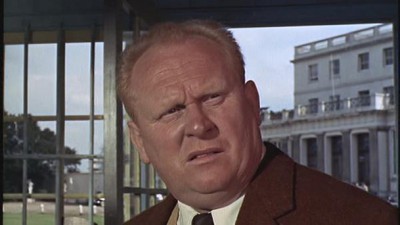
The number of cases involving collapsing turbines and flying blades (aka “component liberation”) has become so common that, if we were a tad cynical, we would go so far to suggest the possibility of some kind of pattern, along the lines proffered by Mr Bond’s nemesis, Goldfinger: “Once is happenstance. Twice is coincidence. Three times it’s enemy action”.
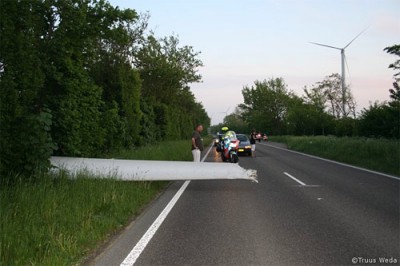
Turbines have been crashing back to earth in frightening numbers – from Brazil – to Kansas – Pennsylvania – Germany and Scotland – Devon and everywhere in between: Ireland has been ‘luckier’ than most (see our posts here and here).
Then there’s the wild habit of these little ‘eco-friendlies’ unshackling their 10 tonne blades, and chucking them for miles in all directions – as seen in the video below – and see our posts here and here and here and here.
****
****
In one serious scientific study into the distances blades are likely to travel during “component liberation” – covering over 37 “component liberation” events – blade throw distances of up to 1,600 m were recorded: that study was completed in 2007 – there have been many more bids for blade “freedom” since then (up to 2014 there have been 309 ‘incidents’, as detailed below).
In Australia, for “planning” purposes, the various states have a variety of “set-back” distances between wind turbines and residential homes – said (laughably) to avoid noise impacts: in South Australia it’s 1km.
For a few years the Victorians set it at 2km – but, before 2007 there was no set-back required and plenty of homes ended up with turbines within 600m. However, there is no such limit placed on the distance between roads and turbines.
****
The eco-fascist nutjobs – that have just taken charge in Victoria – haveslashed the set-back distances to 1km – further demonstrating their naked stupidity and rancid hatred of country people. Under Victoria’s new ‘rules’, residential homes are now well within the throw zone; with no set-back from roads at all, road-users are sitting ducks.
With whole (50m) blades travelling up to 200m, bigger heavier chunks likely to travel well over 300m and the smaller pieces (referred to in the study linked above as “10% blade fragments”) flying out to distances of up to 1,600m (for a 10% blade fragment – think 5m long blade chunks weighing a tonne or so) – the current setback rule in South Australia – and what the eco-fascists just gave Victoria – places wind farm neighbours well and truly within the “throw zone”.
And with those numbers in mind, think about whole blades – or substantial chunks of them – being flung around with gay abandon the next time you drive past the turbines at Cullerin and Macarthur, some of which are less than 300m from the road you’re on.
Fortunately, when it comes to the risks posed by flying turbine blades, it’s the complete disregard paid to health and safety by planning departments and the risible “rules” written for them by their wind industry Overlords – that is squarely in the sights of the Senate Select Committee, its terms of reference including the following:
(1) That a select committee, to be known as the Select Committee on Wind Turbines be established to inquire into and report on the application of regulatory governance and economic impact of wind turbines by 24 June 2015, with particular reference to:
…
(d) the implementation of planning processes in relation to wind farms, including the level of information available to prospective wind farm hosts;
(e) the adequacy of monitoring and compliance governance of wind farms;
(f) the application and integrity of national wind farm guidelines;
…
(i) any related matter.
For those living in, or driving through, the wind turbine blade “throw zone” now is you chance to hammer the so-called ‘standards’ and planning ‘controls’ that have (or will) put you in it.
Why not drop a submission to the Senate Inquiry along those lines? Note that the opportunity to make submissions to the Committee ends on 4 May 2015. See the link here.
To help with your submissions, we’ve popped up a fine piece of work put together by the Caithness Windfarm Information Forum below. Consider, be afraid and let your Senators know just how insanely dangerous this eco-fascist driven nightmare has all become.
Summary of Wind Turbine Accident data to 31 December 2014 (Download as a PDF)
These accident statistics are copyright Caithness Windfarm Information Forum 2014. The data may be used or referred to by groups or individuals, provided that the source (Caithness Windfarm Information Forum) is acknowledged and our URL www.caithnesswindfarms.co.uk quoted at the same time.Caithness Windfarm Information Forum is not responsible for the accuracy of Third Party material or references.
The detailed table includes all documented cases of wind turbine related accidents and incidents which could be found and confirmed through press reports or official information releases up to 31 December 2014. CWIF believe that this compendium of accident information may be the most comprehensive available anywhere.
Data in the detailed table is by no means fully comprehensive – CWIF believe that it may only be the “tip of the iceberg” in terms of numbers of accidents and their frequency. Indeed on 11 December 2011 the Daily Telegraph reported that RenewableUK confirmed that there had been 1500 wind turbine accidents and incidents in the UK alone in the previous 5 years. Data here reports only 142UK accidents from 2006-2010 and so the figures here may only represent 9% of actual accidents.
The data does however give an excellent cross-section of the types of accidents which can and do occur, and their consequences.With few exceptions, before about 1997 only data on fatal accidents has been found.
The trend is as expected – as more turbines are built, more accidents occur. Numbers of recorded accidents reflect this, with an average of16 accidents per year from 1995-99 inclusive; 48 accidents per year from 2000-2004 inclusive; 108 accidents per year from 2005-09 inclusive, and 155 accidents per year from 2010-14 inclusive.
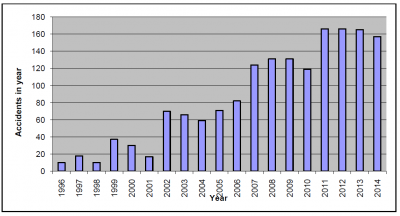
This general trend upward in accident numbers is predicted to continue to escalate unless HSE make some significant changes – in particular to protect the public by declaring a minimum safe distance between new turbine developments and occupied housing and buildings.
In the UK, the HSE do not currently have a database of wind turbine failures on which they can base judgements on the reliabilityand risk assessments for wind turbines. Please refer to http://www.hse.gov.uk/research/rrpdf/rr968.pdf.
This is because the wind industry “guarantees confidentiality” of incidents reported see http://www.renewableuk.com/en/our-work/health-and-safety/incidents–alerts.cfm. No other energy industry works with such secrecy regarding incidents. The wind industry should be no different, and the sooner RenewableUK makes its database available to the HSE and public, the better. The truth is out there, however RenewableUK don’t like to admit it.
Some countries are finally accepting that industrial wind turbines can pose a significant public health and safety risk. The Scottish government has proposed increasing the separation distance between wind farms and local communities from 2km to 2.5km (http://www.bbc.co.uk/news/uk-scotland-scotland-politics-26579733) though in reality the current 2km separation distance is often shamefully ignored during the planning process.
Our data clearly shows that blade failure is the most common accident with wind turbines, closely followed by fire. This is in agreement with a recent survey by GCube, the largest provider of insurance to renewable energy schemes. Their recent survey reported that the most common type of accident is indeed blade failure, and that the two most common causes of accidents are fire and poor maintenance. http://www.gcube-insurance.com/press/gcube-top-5-us-wind-energy-insurance-claims- report/
Data on the detailed list is presented chronologically. It can be broken down as follows:
Number of accidents
Total number of accidents: 1662
By year:

Number of fatal accidents: 110
Fatal accidents
By year:

Of the 151 fatalities:Please note: There are more fatalities than accidents as some accidents have caused multiple fatalities.
- 90 were wind industry and direct support workers (divers, construction, maintenance, engineers, etc), or small turbine owner /operators.
- 62 were public fatalities, including workers not directly dependent on the wind industry (e.g. transport workers). 17 bus passengers were killed in one single incident in Brazil in March 2012; 4 members of the public were killed in an aircraft crash in May 2014.
Human injury
130 accidents regarding human injury are documented.
By year:

107 accidents involved wind industry or construction/maintenance workers, and a further 23 involved members of the public or workers not directly dependent on the wind industry (e.g. firefighters, transport workers). Six of these injuries to members of the public were in the UK.
Human health
Since 2012, 52 incidents of wind turbines impacting upon human health are recorded.
By year:

Since 2012, human health incidents and adverse impact upon human health have been included.
These were previously filed under “miscellaneous” but CWIF believe that they deserve a category of their own. Incidents include reports of ill-heath and effects due to turbine noise, shadow flicker, etc. Such reports are predicted to increase significantly as turbines are increasingly approved and built in unsuitable locations, close to people’s homes.
Blade failure
By far the biggest number of incidents found was due to blade failure. “Blade failure” can arise from a number of possible sources, and results in either whole blades or pieces of blade being thrown from the turbine. A total of 309 separate incidences were found:
By year:

Pieces of blade are documented as travelling up to one mile. In Germany, blade pieces have gone through the roofs and walls of nearby buildings. This is why CWIF believe that there should be a minimum distance of at least 2km between turbines and occupied housing, in order to adequately address public safety and other issues including noise and shadow flicker.
Fire
Fire is the second most common accident cause in incidents found. Fire can arise from a number of sources – and some turbine types seem more prone to fire than others. A total of 242 fire incidents were found.
By year:

The biggest problem with turbine fires is that, because of the turbine height, the fire brigade can do little but watch it burn itself out. While this may be acceptable in reasonably still conditions, in a storm it means burning debris being scattered over a wide area, with obvious consequences. In dry weather there is obviously a wider-area fire risk, especially for those constructed in or close to forest areas and/or close to housing. Three fire accidents have badly burned wind industry workers.
Structural failure
From the data obtained, this is the third most common accident cause, with 157 instances found.
“Structural failure” is assumed to be major component failure under conditions which components should be designed to withstand. This mainly concerns storm damage to turbines and tower collapse. However, poor quality control, lack of maintenance and component failure can also be responsible.
By year:

While structural failure is far more damaging (and more expensive) than blade failure, the accident consequences and risks to human health are most likely lower, as risks are confined to within a relatively short distance from the turbine. However, as smaller turbines are now being placed on and around buildings including schools, the accident frequency is expected to rise.
Ice throw
35 reports of ice throw were found. Some are multiple incidents. These are listed here unless they have caused human injury, in which case they are included under “human injury” above.
By year:

These are indeed only a very small fraction of actual incidences – a report* published in 2003 reported 880 icing events between 1990 and 2003 in Germany alone. 33% of these were in the lowlands and on the coastline.Ice throw has been reported to 140m. Some Canadian turbine sites have warning signs posted asking people to stay at least 305m from turbines during icy conditions.
Additionally one report listed for 2005 includes 94 separate incidences of ice throw and two reports from 2006 include a further 27 such incidences. The 2014 entry refers to multiple YouTube videos and confirmation that ice sensors do not work.
Transport
There have been 137 reported accidents – including a 45m turbine section ramming through a house while being transported, a transporter knocking a utility pole through a restaurant, and various turbine parts falling off and blocking major highways. Transport fatalities and human injuries are included separately. Most accidents involve turbine sections falling from transporters, though turbine sections have also been lost at sea, along with a £50M barge. Transport is the single biggest cause of public fatalities.
By year:

Environmental damage (including bird deaths)
162 cases of environmental damage have been reported – the majority since 2007. This is perhaps due to a change in legislation or new reporting requirement. All involved damage to the site itself, or reported damage to or death of wildlife. 57 instances reported here include confirmed deaths of protected species of bird.Deaths, however, are known to be far higher. At the AltamontPass windfarm alone, 2400 protected golden eagles have been killed in 20 years, and about 10,000 protected raptors (Dr Smallwood, 2004). In Germany, 32 protected white tailed eagles were found dead, killed by wind turbines (BrandenburgState records). In Australia, 22 critically endangered Tasmanian eagles were killed by a single windfarm (Woolnorth). Further detailed information can be found at: www.iberica2000.org/Es/Articulo.asp?Id=3071 and at: www.iberica2000.org/Es/Articulo.asp?Id=1875
- 600,000 bats were estimated to be killed by US wind turbines in 2012 alone.
- 1,500 birds are estimated to be killed per year by the MacArthur wind farm in Australia, 500 of which are raptors.
By year:

Other (miscellaneous)
328 miscellaneous accidents are also present in the data. Component failure has been reported here if there has been no consequential structural damage. Also included are lack of maintenance, electrical failure (not led to fire or electrocution), etc. Construction and construction support accidents are also included, also lightning strikes when a strike has not resulted in blade damage or fire. A separate 1996 report** quotes 393 reports of lightning strikes from 1992 to 1995 in Germany alone, 124 of those direct to the turbine, the rest are to electrical distribution network.
By year:

Caithness Windfarm Information Forum 31 December 2014
* (“A Statistical Evaluation of Icing Failures in Germany‟s „250 MW Wind‟ Programme – Update 2003, M Durstwitz, BOREAS VI 9-11 April 2003 Pyhätunturi, Finland. )
** (Data from WMEP database: taken from report “External Conditions for Wind Turbine Operation – Results from the German „250 MW Wind‟ Programme”, M Durstewitz, et al, European Union Wind Energy Conference, Goeteborg, May 20-24, 1996)

Proponents of Wind Turbines, Beware! Reality Bites…..HARD!
Conscience Bites Commissioner for Approving Wind Farm & Causing Hatred & Division
March 23, 2015 by

****
As the world wakes up to the scale and scope of the great wind power fraud – its inordinate cost to power consumers and taxpayers – the state-sponsored, malfeasance of the wind power outfits that ride the subsidy gravy train, and roughshod over hard-working rural people – and the bitter community division and hatred its roll-out brings – those who have aided and abetted it, have a choice: either pop their consciences into a lead-lined box (so as to avoid any pangs of personal guilt); or front-up to the better Angels of their natures; and seek redemption, and forgiveness, for the unnecessary damage that they’ve caused.
Jane Harper has, to her credit, plumped for the latter. Here’s her story.
Tipton County Indiana Commissioner voted for “wind farms”, now lives with regrets
Jane Harper
Huntington County Concerned Citizens
19 March 2015
Dear Howard County Commissioners and Council Members,
I am writing to you all as a former commissioner colleague who aided in the negotiations and agreements with E.ON Climate Renewables with Tipton County in 2011.
From the onset, I was open to windfarm development in a small section of Tipton County because the commissioners had received no opposition and I felt that the landowners wanted it.
My own family was offered an opportunity to lease land to E.ON and we declined because my husband did not care to farm around the towers, and I just didn’t want to look at them. I set my own personal views aside and made decisions based on what I felt the majority of the public wanted. I was outspoken enough, however, to say that I would never support a plan to cover a large portion of the county with wind turbines.
As it turned out, the problem was that when the decisions were being made to build “Wildcat I”, the commissioners were not hearing from the “majority”. People really did not know this was happening, or if they did, they did not perceive it to be as “invasive” as it was. As you know, public notices are small and often overlooked in the newspaper, so not much resistance was present … until the towers went up, and people saw how enormous and intrusive they were. The red blinking lights even disturb my own summer evenings and my home is 6 miles from the closest tower!!!
You don’t have the time to read all that I could tell you, so in a nutshell, I just want to say that I wish I had the knowledge then that I have now.
However, what I can do, is to try to pass some of what I know, onto the elected officials in the neighboring county, so that perhaps you can gain some wisdom from what I learned in the school of hard knocks.
In Tipton County … my 83 year old mother is mad at me (since I signed the agreements) because she no longer has colorful birds coming to her feeders … my brother’s view from his family dining room table used to be a vast expanse of crops and natural habitat … now that pristine ‘vista’ is forever marred by giant metal structures … neighbors hate each other … back and forth letters to the editor have been selling papers for over a year now … families are torn apart, and because the physical presence of the towers will be there for 30 years, these relationships will never be repaired. In short … this has become an issue that has divided our community like no other.
It has torn our county apart. The May, 2014 primary election is evidence that the majority of the voters supported candidates openly opposed to wind farm development and an incumbent commissioner was voted out of office due to his unwillingness to listen to the majority on any issue, including wind.
If I had this to do over, I would NEVER enter into an agreement with any wind company now that I know what it has done to my home community.
I am not proud that my name is on those documents.
The wind company has breached many parts of the agreement, but insist that their failures are “minor”. Their field representative is arrogant and cavalier in his attitude toward the people who are suffering with the effects of the noise and flicker.
You can’t lose something you never had … so you are not “losing” the supposed ‘windfall’ of money that the project purportedly brings in.
What you WILL lose however, cannot be measured in dollars.
You will lose the rural landscape as you know it and you will lose the closeness of “community spirit” because people will hate each other over this and the presence of the towers will always be a constant reminder of the rift … thus the wounds will never heal.
Please consider this: What do you think of a company that KNOWS it has fierce opposition from a segment of the Howard County citizenry, but would STILL want to build in your county?
It is akin to forcing themselves onto you when they KNOW they are not wanted by those in the project area who would be affected by their presence and are receiving no compensation for the change in their environment. How much of a “community partner” would they be when they really don’t care about the wishes of the people?
I don’t know anything about which “facts” are true and which “facts” are false with regard to property values and personal health issues.
But what I DO know as fact is this: Any issue that has become so contentious that it has caused large groups of people to assemble and vehemently oppose it … and which has caused so much heartache and angst among the citizenry … just cannot be good for the whole. I do not feel that Tipton County will ever wholly heal from the deep personal wounds incurred by many from the placement of wind turbines in our county.
I will leave you with this last piece of wisdom from someone who has “been there, done that”.
As an elected official/public servant … if you must go forward with approvals that allow wind farm development … and thus you become the reason a wind farm was built in Howard County … it will be a decision you will regret the rest of your life.
You will join me.
Jane Harper
Tipton County Commissioner 2009-2012.
Illinois Leaks

Doctors in Ireland Expose Inadequate Noise Regulations!
Here is a story from the Irish Examiner, fitting on St Patrick’s Day. By Conall Ó Fátharta Leading doctors have called on the Government to reduce the noise levels of wind turbines — which they claim are four times that recommended by World Health Organisation (WHO) guidelines. The Irish Doctors’ Environmental Association also said the set-back distance of 500m is not enough, that it should be increased to at least 1,500m. Visiting Research Professor at Queen’s University, Alun Evans and lead clinical consultant at Waterford Regional Hospital Prof Graham Roberts have both expressed concerns over the current noise levels and distance of turbines from homes. Environment Minister Alan Kelly is currently reviewing the wind energy planning guidelines and the group is calling for both issues to be examined closely in the interest of public health. The association has called for the introduction of a maximum noise level of 30 decibels as recommended by the WHO and for the set-back distance from inhabited houses to at least 1,500m from the current 500m. Prof Evans said the construction of wind turbines in Ireland “is being sanctioned too close to human habitation”. “Because of its impulsive, intrusive, and sometimes incessant nature, the noise generated by wind turbines is particularly likely to disturb sleep,” he said. “The young and the elderly are particularly at risk. Children who are sleep-deprived are more likely to become obese, predisposing them to diabetes and heart disease in adulthood. As memory is reinforced during sleep, they also exhibit impaired learning.” Prof Evans said adults who are sleep-deprived are at risk of a ranges of diseases, particularly “heart attacks, heart failure, and stroke, and to cognitive dysfunction and mental problems”. Prof Evans, attached to the Centre for Public Health at Queen’s, said the Government should exercise a duty of care towards its citizens and exercise the ‘precautionary principle’ which is enshrined in the Lisbon Treaty. “It can achieve this by raising turbine set-back to at least 1500m, in accordance with a growing international consensus,” said Prof Evans. In a statement, the Department of the Environment said that in December 2013 it published draft revisions to the noise, set-back distance, and shadow-flicker aspects of the 2006 Wind Energy Development Guidelines. These draft revisions proposed: 1. The setting of a more stringent day and night noise limit of 40 decibels for future wind energy developments; 2. A mandatory minimum setback of 500m* between a wind turbine and the nearest dwelling for amenity considerations; 3. The complete elimination of shadow flicker between wind turbines and neighbouring dwellings. A public consultation process was initiated on these proposed revisions to the guidelines, which ran until February 21, 2014. “The department received submissions from 7,500 organisations and members of the public during this period. In this regard, account has to be taken of the extensive response to the public consultation in framing the final guidelines,” the department said in the statement. “However, it is the department’s intention that the revisions to the 2006 Wind Energy Development Guidelines will be finalised in the near future and will address many of the issues raised in that bill.” *Editor’s note: Ontario’s wind turbine noise regulations, which are based on geography and wind power lobby group instruction, not science, work out to 550 meter setbacks. Health Canada’s Wind Turbine Noise and Health study revealed that problems exist at 55 meters, with 25% of people exposed to the turbine noise and low frequency noise being distressed; 16.5% were distressed at 1 km. The Health Canada research results suggest that a setback should be a minimum of 1300 meters, which means Ontario’s existing noise regulations are completely inadequate to protect health. |

 "Mothers Against Wind Turbines™" Phoenix Rising...