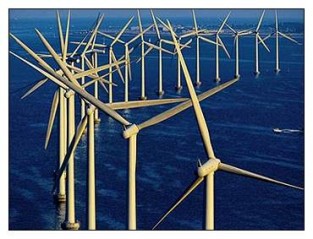
Wind and Solar Are Not Environmentally Friendly, Or Financially Feasible

Big Wind’s Dirty Little Secret: Toxic Lakes and Radioactive Waste

OCTOBER 23, 2013
InfoFacebook

The wind industry promotes itself as better for the environment than traditional energy sources such as coal and natural gas. For example, the industry claimsthat wind energy reduces carbon dioxide emissions that contribute to global warming.

But there are many ways to skin a cat. As IER pointed out last week, even if wind curbs CO2 emissions, wind installations injure, maim, and kill hundreds of thousands of birds each year in clear violation of federal law. Any marginal reduction in emissions comes at the expense of protected bird species, including bald and golden eagles. The truth is, all energy sources impact the natural environment in some way, and life is full of necessary trade-offs. The further truth is that affordable, abundant energy has made life for billions of people much better than it ever was.

Another environmental trade-off concerns the materials necessary to construct wind turbines. Modern wind turbines depend on rare earth minerals mined primarily from China. Unfortunately, given federal regulations in the U.S. that restrict rare earth mineral development and China’s poor record of environmental stewardship, the process of extracting these minerals imposes wretched environmental and public health impacts on local communities. It’s a story Big Wind doesn’t want you to hear.

Rare Earth Horrors

Manufacturing wind turbines is a resource-intensive process. A typical wind turbine contains more than 8,000 different components, many of which are made from steel, cast iron, and concrete. One such component are magnets made from neodymium and dysprosium, rare earth minerals mined almost exclusively in China, which controls 95 percent of the world’s supply of rare earth minerals.

Simon Parry from the Daily Mail traveled to Baotou, China, to see the mines, factories, and dumping grounds associated with China’s rare-earths industry. What he found was truly haunting:

As more factories sprang up, the banks grew higher, the lake grew larger and the stench and fumes grew more overwhelming.

‘It turned into a mountain that towered over us,’ says Mr Su. ‘Anything we planted just withered, then our animals started to sicken and die.’

People too began to suffer. Dalahai villagers say their teeth began to fall out, their hair turned white at unusually young ages, and they suffered from severe skin and respiratory diseases. Children were born with soft bones and cancer rates rocketed.

Official studies carried out five years ago in Dalahai village confirmed there were unusually high rates of cancer along with high rates of osteoporosis and skin and respiratory diseases. The lake’s radiation levels are ten times higher than in the surrounding countryside, the studies found.

As the wind industry grows, these horrors will likely only get worse. Growth in the wind industry could raise demand for neodymium by as much as 700 percent over the next 25 years, while demand for dysprosium could increase by 2,600 percent, according to a recent MIT study. The more wind turbines pop up in America, the more people in China are likely to suffer due to China’s policies. Or as the Daily Mail put it, every turbine we erect contributes to “a vast man-made lake of poison in northern China.”

Big Wind’s Dependence on China’s “Toxic Lakes”

The wind industry requires an astounding amount of rare earth minerals, primarily neodymium and dysprosium, which are key components of the magnets used in modern wind turbines. Developed by GE in 1982, neodymium magnets are manufactured in many shapes and sizes for numerous purposes. One of their most common uses is in the generators of wind turbines.

Estimates of the exact amount of rare earth minerals in wind turbines vary, but in any case the numbers are staggering. According to the Bulletin of Atomic Sciences, a 2 megawatt (MW) wind turbine contains about 800 pounds of neodymium and 130 pounds of dysprosium. The MIT study cited above estimates that a 2 MW wind turbine contains about 752 pounds of rare earth minerals.

To quantify this in terms of environmental damages, consider that mining one ton of rare earth minerals produces about one ton of radioactive waste, according to the Institute for the Analysis of Global Security. In 2012, the U.S. added a record 13,131 MW of wind generating capacity. That means that between 4.9 million pounds (using MIT’s estimate) and 6.1 million pounds (using the Bulletin of Atomic Science’s estimate) of rare earths were used in wind turbines installed in 2012. It also means that between 4.9 million and 6.1 million pounds of radioactive waste were created to make these wind turbines.

For perspective, America’s nuclear industry produces between 4.4 million and 5 million pounds of spent nuclear fuel each year. That means the U.S. wind industry may well have created more radioactive waste last year than our entire nuclear industry produced in spent fuel. In this sense, the nuclear industry seems to be doing more with less: nuclear energy comprised about one-fifth of America’s electrical generation in 2012, while wind accounted for just 3.5 percent of all electricity generated in the United States.

While nuclear storage remains an important issue for many U.S. environmentalists, few are paying attention to the wind industry’s less efficient and less transparent use of radioactive material via rare earth mineral excavation in China. The U.S. nuclear industry employs numerous safeguards to ensure that spent nuclear fuel is stored safely. In 2010, the Obama administration withdrew funding for Yucca Mountain, the only permanent storage site for the country’s nuclear waste authorized by federal law. Lacking a permanent solution, nuclear energy companies have used specially designed pools at individual reactor sites. On the other hand, China has cut mining permits and imposed export quotas, but is only now beginning to draft rules to prevent illegal mining and reduce pollution. America may not have a perfect solution to nuclear storage, but it sure beats disposing of radioactive material in toxic lakes like near Baotou, China.

Not only do rare earths create radioactive waste residue, but according to the Chinese Society for Rare Earths, “one ton of calcined rare earth ore generates 9,600 to 12,000 cubic meters (339,021 to 423,776 cubic feet) of waste gas containing dust concentrate, hydrofluoric acid, sulfur dioxide, and sulfuric acid, [and] approximately 75 cubic meters (2,649 cubic feet) of acidic wastewater.”

Conclusion

Wind energy is not nearly as “clean” and “good for the environment” as the wind lobbyists want you to believe. The wind industry is dependent on rare earth minerals imported from China, the procurement of which results in staggering environmental damages. As one environmentalist told the Daily Mail, “There’s not one step of the rare earth mining process that is not disastrous for the environment.” That the destruction is mostly unseen and far-flung does not make it any less damaging.

All forms of energy production have some environmental impact. However, it is disingenuous for wind lobbyists to hide the impacts of their industry while highlighting the impacts of others. From illegal bird deaths to radioactive waste, wind energy poses serious environmental risks that the wind lobby would prefer you never know about. This makes it easier for them when arguing for more subsidies, tax credits, mandates and government supports.

IER Policy Associates Travis Fisher and Alex Fitzsimmons authored this post. 

Windweasels Trying to Force Themselves on Another Unwilling Community

Battle for Mount Emerald Reaches Boiling Point

The battle to prevent RATCH from getting planning approval for the disaster it proposes for Mount Emerald has reached fever pitch. With 90% of locals bitterly opposed to the project, common sense would suggest a polite withdrawal by the developer. Instead, however, RATCH has dipped into the standard book of wind industry lies and half-truths (we covered a few of them in this post). Here’s the Cairns Post on a few more of them.

Storm brewing over wind farm in Tableland
Daniel Batemen
The Cairns Post
13 July 2014

bruce

THERE’S an ill wind blowing across the Tablelands, with rural landholders considering abandoning their multi-million dollar properties if the Mt Emerald Wind Farm gets the go-ahead.

They have accused the developers behind the renewable energy project of deceiving the community by downplaying the scale and impact of the wind farm, which involves the construction of up to 75 turbines – each about three times taller than Cairns Hospital.

Power producer Ratch Australia and property developer Port Bajool’s $380 million dollar project involves up to 75 wind turbines generating up to 225 megawatts of power from a 2400 hectare property aloft Mt Emerald, which is located about halfway between Atherton and Mareeba.

Jenny

Each tower is to stand about 80-90m tall, with approximately 50m long blades.

The proponents claim the project will potentially generate enough electricity to power 75,000 homes each year. The two-year construction phase of the project will also create an estimated 158 jobs, with up to 45 people to be employed locally once it is complete.

Since the development application for the wind farm was brought to the Tablelands Regional Council in 2010, a storm of protest about the project has been stirred up within the close-knit Walkamin and Tolga farming community.

When the Tablelands Wind Turbine Action Group conducted a recent survey of those living within 5km of the proposed project site, it found about 90 per cent of residents opposed the development.

The group says locals are terrified of health and noise impacts from the turbines; they are concerned about the impact the construction phase could have upon native habitat; they fear their property values will be driven right down; and they have even questioned the spacing and efficiency of the turbines.

Jenny Disley and her partner Jack Krikorian live 1800m away from the project site, where they will have a clear view of the giant bladed towers from their back porch.

The couple have struggled to sell their sprawling 42.9ha property, which has been on the market for three years through multiple real estate agents, with a current price tag of about $5 million.

“We’ve had a bit of interest but no one will buy,’’ Ms Disley told the Cairns Post. “They keep telling us the reason for that is because of the Mt Emerald wind farm uncertainty.”

The pair operate rural workers accommodation business Walkamin Enterprises, providing labour to the thriving local agricultural industry.

Mr Krikorian is most concerned about the impact noise generated by the turbines may have on up to 40 workers staying in various cabins and homes on their property.

“If the noise impacts on those 40 people, that’s the end of our business,’’ he said.

poster

“We are in the middle of an extremely active horticultural area, particularly for bananas, and all of those people need our service continuously.

“How do we get compensated, if everything that we work for is impacted?”

Ms Disley said if they were unable to be compensated for any land devaluation, and unable to sell, they would be left with no other choice but to abandon their land, becoming “wind farm refugees”.

“You can’t sell,’’ she said.

“You’ve sunk your whole life savings back into the property. If you can’t access your superannuation through a sale, you can’t live there because of the noise and infra (low frequency) sound.”

Ratch Australia thoroughly refutes any accusations the farm will generate noise pollution. It says any sound generated by the turbines will be less than that heard on a typical quiet suburban street (a level of 40 decibels).

The company and Port Bajool picked Mt Emerald for its “excellent” wind source, its proximity to the electricity grid, and potential for only “minimal” environmental and social impact.

At 4.5km away from Mt Emerald, one of the oldest families of the area, the Watkins family, believes that while the project may be a good idea, but it is being planned for the wrong spot.

Mt Uncle farmer and distillery owner Bruce Watkins says wind farms should be neither seen nor heard.

“If you see these things, you’re too close to them,’’ he said. “That’s the fact.”

“I’m not against green energy. None of us in (the action) group are – we’re all after sustainable, healthy, green energy. I’m putting solar panels up (on the distillery roof) now.”

“But where these so-called environmentalists go wrong, is they say we must have green energy, but they forget the (real) cost.”

The family has a berry farm within 1.5km of the wind farm site, employing more than 200 people. Mr Watkins said the construction phase of the development could create widespread problems for transport, and therefore businesses, across the region.

“There is a massive migration of the equipment to come up (to the Tablelands),’’ he said.

“You’ve got to appreciate they’ve got the right to commandeer main roads, traffic, everything. The delays in the traffic will be staggering.

“I’m not going to overemphasise it, but the fact is they’re going to get these things on the road, which are 80-tonne things, and they’re going to have to resurface the roads.

“At whose expense? We don’t know.”

When Bruce’s daughter Krista and her husband got married five years ago, they had been planning on building a dream house on the family’s land 2km from Mt Emerald.

The mountain even provided a backdrop in the couple’s wedding photos.

“We would have liked to have started to build a home there this year,’’ Krista said.

“But there is no way I’m going to spend $500,000 building an average home when the fact is I could be looking at a depreciated value of more than 50 per cent because of the wind turbines.”

About four years ago, the couple convinced friends to purchase property at the nearby Rangeview Estate.

Krista said it was a mistake that cost them a good relationship with their friends.

“It was the day they signed their contract, they bumped into some locals who were displaying Ratch’s own documents about the wind farm at the Tolga markets,’’ she said.

“The friends, furious, came back to us and said ‘you didn’t tell us about this’, and we saw (the development application) for the first time. We had no idea. (The developers) told us – many of us – it was just a few wind turbines. Way over the back. That was just a blatant lie, because they’re going to be all over that mountain.”

Last month, the development application was called in by the Deputy Premier and Minister for State Development, Infrastructure and Planning Jeff Seeney.

The minister, at the time, said given the complexity of the proposed development, independent assessments would be carried out to evaluate the true economic, environmental and community impacts and benefits of the project.

The development could be approved later this year, with construction to commence in early 2015.

Ratch Australia executive general manager, business development, Geoff Dutton, said the company had been as open and transparent as possible with the community, maintaining solid communication lines about the project since it was first tabled with the Tablelands Regional Council.

He assured locals would not be disturbed by the turbines, once they were operational.

“We have tried to analyse every aspect of noise and where it will go,’’ he said.

“We look at the individual wind turbine manufacturers and their offerings to us, and go through, with them, very detailed specifications.

“Wind towers aren’t just built, they’re built with a view to being within regulations.”

He conceded there would be “some queues” for traffic during the construction phase, as the turbines and their blades were being transported up to the mountain.

“We won’t be going up from Cairns through Mareeba – the more direct route – that is not practical because there are a few sharp bends that no blade will ever go around,’’ he said.

“The better way is to go the long way round further south and then come back around from the Ravenshoe direction up towards the site.”
The Cairns Post

One of the crackers tossed up by RATCH is that the noise generated by its turbines will be the same as a ‘typical quiet suburban street’. Depending on the suburb, most traffic noise dies down well before midnight and rarely resumes much before 6am. Leaving suburbanites a fair opportunity to catch a few zzzs during the hours of darkness.

Giant fans, on the other hand, operate whenever the wind blows – which usually means late evening/early morning and for some strange reason their noise has a habit of annoying neighbours, preventing them from sleeping and otherwise impacting on their good health. For the uninitiated, the sound tracks to these 2 videos might yield a clue.

****
https://www.youtube.com/watch?v=rOU39ws1gHo

****
https://www.youtube.com/watch?v=iYpgVPAK5To

Leave Mount Emerald to the eagles.

Wind Turbines Get a “License to Kill”! Obscene!

Wind Power Slaughter: ex-USFWS Agent Speaks Out by Kajm
PART 1:

Wind Power Slaughter: ex-USFWS Agent Speaks Out on Shiloh IV (California)


“It has been well known that Shiloh’s wind turbines have slaughtered protected birds species for years. These fatalities have gone largely undocumented due to the wind industry’s practices of rigging their reports and handing them to the unquestioning USFWS.… [Now] comments submitted by two USFWS retired special agents who spent their careers protecting migratory birds and making cases against other energy companies … [have] a lot to say about the Shiloh five-year eagle killing permit.”

The Shiloh IV Wind Project, located in the Montezuma foothills in California, has received an unprecedented permit from the U.S. Fish and Wildlife Service allowing it to kill eagles, hawks, peregrine falcons, owls and songs birds while not being subjected to the normal prohibitions afforded under the federal conservation laws. This company now gets a free pass from federal prosecution under the Bald and Eagle and Protection Act and the Migratory Treaty Act.

No other energy company has the liberty to kill birds so indiscriminately while remaining above the law!

The mitigation for this eagle-kill permit was the fixing of a few power poles by the PG&E. Yet PG&E has already been retrofitting poles in this area consistent with its Avian Protection Plan,and if the retrofitting of more power poles was needed the FWS cold have enforced this just as they have for 35 years with other utility companies. Now the FWS and EPA are accepting fraudulent data to trade the slaughter of eagles as if they were carbon credits. It is truly disgraceful.

This permit will allow for the deaths of five golden or bald eagles over a five-year period without the wind farm’s operators being penalized. Everyone has to understand that Shiloh IV is only part of this large wind resource area. All the other sections in this WIND resource area will also be killing eagles and other highly protected species.  


It has been well known that Shiloh’s wind turbines have slaughtered protected bird species for years. These fatalities have gone largely undocumented due to the wind industry’s practices of rigging their reports and handing them to the USFWS, which never  questioned them. I submitted blistering comments on the company’s Environmental Assessment  reports, which were nothing more than several hundred pages of monotony and misdirection, if not outright deception.

The simple truth is that all Shiloh’s turbines have been killing off golden eagles and, most likely, has already been killing bald eagles (unreported)  living in the region.  This killing of eagles has been happening for decades as supported by eagle surveys. Also not disclosed to the public is that bald eagles, which have been utilizing riparian habitat in the nearby Sacramento River delta, will probably make up the majority eagle kills at this project in the future.

With regards to the comments in favor of a kill permit for Shiloh Wind Power, I wasn’t surprised that many were filed by those that were financially connected to the company. For several years I’d heard that there was dissention within the USFWS against the use of wind power, but had never had any direct contact with anyone from the agency. I understood that USFWS personnel speaking out against the highly politicized issue of wind power would be putting their own careers at risk.

Recently however, I learned that there were comments submitted by two USFWS retired special agents who spent their careers protecting migratory birds and making cases against other energy companies whose activities resulted in eagle and other migratory bird fatalities. Sam Jojola and Lucinda Schroeder have a lot to say about the Shiloh five-year eagle killing permit.

Sam Jojola Letter

Mr. Wiegand,

I have always been impressed with your honest and candid approach on the devastating impacts to avian wildlife and particularly eagles and other raptors in our country. I am a former Special Agent with FWS/LE and appreciate all your valiant efforts to address the political cowardice by Washington bureaucrats when it comes to the wind industry and impacts of our priceless wildlife resources.

He went on to tell me that he and another former agent (Lucinda Schroeder)  had submitted comments against this permit.

I was thankful for the support, and I wanted to know more about his background. And low and behold, Sam Jojola had twenty-three years of field experience, with both short and long term covert operations in federal wildlife law enforcement. Through his years of service, Sam garnered specialized knowledge and experience in targeting international wildlife smugglers with the U.S. Fish and Wildlife Service Branch of Special Operations.

He has extensive experience in surveillance, interviewing and interrogation techniques, recruiting and controlling informants. He developed expertise in collecting and analyzing intelligence, orchestrating raids, execution of arrest and search warrants, grand jury, trial preparation, as well as evidence collecting and preservation. All the skills anyone would need to investigate the wind industry.

Sam Jojola also has a great love for our vanishing wildlife. Like growing numbers of Americans, Sam is not happy with the wind industry, nor does he consider this industry to be any shade of  “green.” In his Comments  (page 177) regarding the Shiloh IV eagle killing permits, Sam shared some of his wisdom on the wind industry and the path our society is taking.

Here are some of Sam Jojola’s Shiloh IV comments:

“The cost of continuing to allow the wind industry to kill Golden Eagles, other raptors and migratory birds for over two (2) decades has been and is too high for the current benefit that wind power provides. The Altamont facility has proven that.”

“I am appalled that anyone is considering a five (5) year programmatic take permit for Shiloh IV given the historical track record of the wind industry’s impact to avian populations elsewhere. How arrogant to consider a long term permit after untold millions of taxpayer dollars have been spent for decades on eagle conservation in the Western U.S.”

“The wind industry needs to be more proactive instead of griping that buildings, cars, and cats are killing more migratory birds. They have had over 2 decades to address these eagle mortalities with meaningful solutions. Buildings, cars and cats usually don’t kill eagles and don’t exploit taxpayer subsidies.”

“These types of permits would allow the industry to continuously justify and allow untold numbers of golden eagles to be legally taken without fear of prosecution. “

“It opens the door to add numbers of eagle deaths to the permit in the future. It would also open up the arguments from electrical utility companies, mining, oil and gas exploration and others who have been prosecuted that the wind industry is getting favorable treatment. Something is wrong with that concept.”

“Why bother with a permit at all? Wind power facilities in California already kill golden eagles and have done so for decades without a permit and no accountability without a single prosecution.”

“Who will monitor this and other forthcoming permits for years to come? Certainly not the U.S. Fish and Wildlife Office of Law Enforcement which has been historically neglected for decades with only 218 Special Agents nationwide as of 2013, the same number they had in 1978. The U.S. Fish and Wildlife Service Office of Law Enforcement was once the “Division of Law Enforcement”. With dwindling numbers they will soon be able to fit into a room or smaller. “

“Leaders need to hire a reasonable amount of agents that is commensurate with the exponentially expanding world of wildlife crime and ecological impacts to our wildlife.”

“Why are higher up officials so quick to “mitigate” wildlife loses? Where were they and where are they now when more FWS/LE Special Agents are needed?”

“Why are bureaucrats in Washington D.C. so quick to issue a permit to a project that represents an industry that has several decades of documented violations of the Migratory Bird Treaty Act and Eagle Act and watch the Office of Law Enforcement languish with such low numbers of Special Agents now and historically?”

“In the really big picture, we are wasting too much money with tax funded subsidies for the current wind turbine technology. The expansion should be slower given the historical impacts to avian wildlife. Our government needs to focus more on what is happening globally with wildlife and the ecosystem. It is all we have.”

“A recent study reports that U.S. taxpayers are paying 12 billion dollars annually for wind power subsidies. What a racket at the expense of wildlife resources and taxpayer money. How beneficial could that be given those figures?”

“Try putting some wind turbines off the coast of Malibu, Miami Beach, or the Grand Canyon, Yellowstone, etc., and see what happens if it is so beneficial. The public would really scrutinize those subsidies and tax credits then.”

“The wind power industry has been treated differently since the 1980’s in California, particularly the Altamont Pass wind facility which has wreaked havoc on Golden Eagle and other raptor populations since then without a single prosecution when they didn’t even have a permit to do so. Oil and gas, including petroleum, electric power corporations, and gold and silver mining operations have all been investigated and prosecuted over decades and these industries have made valiant efforts to curtail migratory bird deaths, much to their credit.”

“Wind power needs to do much more than report bird deaths.  Reporting and monitoring bird deaths for years is almost less than doing nothing at all.”

“We do need to explore the wind industry and its long term benefits. Doing it right with exploring meaningful technology to address the migratory bird deaths will actually create more jobs for our country.”

The official response to Sam Jojola from the FWS was generic, cold, and inappropriate.   When you think about it this is actually quite understandable since, given the chance, FWS agents like Sam Jojola and Lucinda Schroder could bring the wind industry it’s knees overnight for their hidden slaughter to protected species.

– See more at: www.masterresource.org/2014/07…

——-

NO Surprise, When a Windweasel Lies! or…Liar Liar, Turbines on Fire

Wind turbine blaze scandal

  • Thu, 17 Jul 2014
 

10 times more catch fire than reported

Up to 120 wind turbines catch fire annually, according to the journal of Fire Safety Science. This is 10 times the number reported by the industry, The figures, compiled by engineers at Imperial College London and the University of Edinburgh, make fire the second-largest cause of accidents after blade failure.

The researchers claim that out of 200,000 turbines around the world, 117 fires take place annually, many more than the 12 reported by wind farm companies.

Each wind turbine costs more than £2 million and generates an estimated income of more than £500,000 per year.Any loss or downtime of these valuable assets makes the industry less viable and productive.

Dr Guillermo Rein of Imperial’s department of mechanical engineering, said: ‘Fires are a problem for the industry, impacting on energy production, economic output and emitting toxic fumes.

‘This could cast a shadow over the industry’s green credentials.
‘Worryingly our report shows that fire may be a bigger problem than what is currently reported. Our research outlines a number of strategies that can be adopted by the industry to make these turbines safer and more fire resistant in the future.’

Wind turbines catch fire because highly flammable materials such as hydraulic oil and plastics are in close proximity to machinery and electrical wires.

These can ignite a fire if they overheat or are faulty. Lots of oxygen, in the form of high winds, can quickly fan a fire inside a turbine, the research showed.

It contradicts the findings of a report into the wind industry, commissioned by the Health and Safety Executive in 2013, which concluded that the safety risks associated with wind turbines are very low.

The wind industry last night questioned the validity of the new research.
Chris Streatfeild, of Renewable UK which represents wind firms, told the Mail Online: ‘The industry would challenge a number of the assumptions made in the report, including the questionable reliability of the data sources and a failure to understand the safety and integrity standards for fire safety that are standard practice in any large wind turbine.

‘Wind turbines are designed to international standards to meet mandatory health and safety standards including fire safety risks.
‘The industry remains committed to promoting a safe environment for its workers and the public, and no member of the public has ever been injured by a wind turbine in the UK.’


Read more at http://www.yachtingmonthly.com/news/536981/wind-turbine-blaze-scandal#q5ETdeRb7BlzmDT4.99

Wind Turbines…..Killing Machines! Good for, NOTHING!

EXPOSING THE WIND INDUSTRY GENOCIDE


By Jim Wiegand

For those that have the mistaken belief that wind is green, clean, or in some way a noble venture, reality couldn’t be any further from the truth.  There is nothing commendable about hiding the slaughter to millions of protected bird and bats each year.

Most of public is unaware of this because at industrial wind farms there is no transparency.  With gag orders, high security, and studies being conducted by the industry’s own biologists, the public has no way of really knowing anything. Under these conditions information is filtered and the industry can report what they believe the public will accept.

Rigging Search Area Size

For decades I have been doing research and making astute wildlife observations. I have the expertise to see what others can not and when analyzing this industry’s studies, I see one sided environmental documents.

From my research and analysis I now have several thousand carcass distance records from turbine blade strikes. These records are from the years 1990 -2010 and none were taken from industry studies conducted with grossly undersized search areas. Search areas for these studies ranged from 50-105 meters from towers. The wind turbines I looked at ranged in size from 65 kW up to 1.5 MW.

Part of a White Tailed Sea Eagle - Courtesy Save The Eagles
Part of a White Tailed Sea Eagle – Courtesy Save The Eagles


These carcass distance records are from the Altamont Pass Wind Resource Area, Montezuma Hills Wind Resource Area, Buena Vista wind project, Foote Rim Creek Rim Wind Project, Cedar Ridge Wind Farm, Forward Energy Center, and the Blue Sky Green Field wind project. From these carcass records it can be seen that most carcasses upon impact are launched beyond a turbines blade tip length away from towers. In fact this number is about 60% -70% depending on the study being looked at. This still does not take into consideration that search areas for most of these studies were too small for the size of turbine being studied. Several of the studies even mention this.

The average carcass distance from turbine towers recorded in these studies ranges from about 1 1/2 – 3 times the blade length of these turbines. Many of these turbines were only about 100 feet tall when including blades of about 8.5 meters in length. Hundreds of the other turbines I analyzed were about 300-400 feet at the tip of the rotor sweep.

But the industry has evolved and newer studies do not use larger search areas for their much larger turbines.

For the sake of comparison I will comment on some of the recent mortality studies that have been conducted by Stantec. The Stantec studies are important because in my opinion they represent the worst of the worst that this industry has to offer. In the last few years the average carcass distance reported by Stantec in their mortality studies at Wolfe Island, Kibby Mountain, Laurel Mountain, and Georgia Mountain in the Northeast, is about the same distance that was reported from the smallest 65-100 kw turbines at Altamont. But there are huge differences between the turbines studied by Stantec and these smallest turbines. The turbines they write reports for are 40-50 times larger. They reach 250-350 feet higher into the sky, they have blades that reach out 50 meters or more in all directions, and their deadly blade tip speeds are much faster.

All of these factors are important in mortality studies because they contribute to greater blade impact force, more carcass drift from the higher altitudes, and impact points much further out from turbine towers. In one case the blade tip impact points were as much as 47 meters further away (56 total) from turbine towers. Add into the equation that some of these the turbines are located on ridge lines and the carcasses thrown towards the downward slopes will to drift even further.

White Tailed Sea Eagle Corpse stuck in a tree - Courtesy Jim Wiegand
White Tailed Sea Eagle Corpse stuck in a tree – Courtesy Save The Eagles

Yet every one of these Stantec’s mortality studies defies the Laws of Motion and Gravity because the industry’s own data proves that any carcass hit by a turbine blade has a much better than 50/50 odds or 1 out of 2 chance of this carcass landing at a distance beyond a turbines blade length.

For the hundreds of carcasses reported in the Stantec studies, only a handful have been reported past the turbine blade length and the average carcass distance disclosed is about half the distance of the turbine blade length. The odds of this reported carcass distribution to have actually occurred around these huge turbines is so high that it can not be calculated. In other words the numbers are impossible.

In years to come college math and physics classes will have fun analyzing all this. They can apply different wind speeds, acceleration, and points of impact to the wind turbine carcasses distance equation. The combinations are endless but one thing is certain they will understand that most of the carcasses being smacked with 200 mph blade tip speed will fly beyond a turbine’s blade length.

Below is an image of data taken from a 3 year study showing the carcasses distribution for 505 carcasses found in the Montezuma Wind Resource Area. The turbines are 1.5 MW and the search methodology used search areas of 105 meters from towers. The carcasses distance data was reliable for the point I am making but the study still had severe flaws that underreported mortality estimates. When looking at this data readers will see that I have added some notes.

Shiloh 1.5 MW Carcass distance updated

Rigging the Data

The industry is using many tricks and manipulations to make carcasses disappear from around their turbines. None of this is scientific and I see differences in nearly every study I look at. The changes in their studies are predicated on how much mortality needs to be hidden.  The most recent wind industry studies are the most appalling and this is because with the industry’s huge turbines they need far more carcasses to vanish.

From the previous information I have provided it should be quite obvious that the industry studies are unreliable because search areas are far too small.  But there is much more. So much more that I can not put everything in this article or even ten articles. I have chosen to expose some of the manipulation of search plots and touch on the manipulation of carcass data.

In the image below it is fairly self-explanatory and easy to understand. The industry instead of using round search areas and thoroughly searching them has come up with a devious method to hide carcass data, the square search plot. It can be any size they choose but generally an area 120 – 160 meters on all sides.  It may not even be square and the turbine may or may not be centered in the plot. The square search plot is used to give the illusion of a much bigger search area while avoiding the majority of carcasses expected to land within the designated searchable area around the turbine.

square search area round numbers 1 copy-1 Not only are these square plots far too small, the data collected from these plots is easily manipulated. These plots may be fully searched but in most cases they are not and “proportions of area searched” are developed for the wind industry’s contrived mortality formulas.  I have seen proportion of area searched for the furthest point declared at 100 percent as in the Maple Ridge Wind Farm study.  But what the report is not putting in the formulas is that they only searched 100 percent of the area out to the furthest corner of the plot,  the carcasses, the data, and the mortality from the full the declared annulus was avoided.

In the calculation of the proportion area searched, carcasses found at the furthest points can boost the numbers dramatically.  In the image below I show how these carcasses when found and properly calculated can really boost the reported mortality with very small overall search areas.

Making Carcasses

This information was taken from a mortality study conducted in Wisconsin at the Cedar Ridge wind farm. I took the actual area searched and made corrections for the reported carcasses in relation to the proportion of the area actually searched.

From looking at just the search area data, 18 turbines are killing approximately 1100 birds per year and this does not take into consideration that the search areas should have been 150-175 meters from towers.  It also does not taken into consideration searcher efficiency and other factors that boost the mortality numbers. This project has 41 turbines and the actual yearly fatality to birds and bats is many thousands.

For these 18 turbines in 2010 they reported an estimate of 216 bird fatalities.

This study did show that the majority of carcasses land past the turbine blades but how the data  collected was processed,  hid thousands of birds and bats being killed at this site.  They not only used the square search plot ploy but they barely even looked around these turbines.  They also discarded important carcasses by labelling them as “incidental”.

Remains of Two Peregrine Falcons killed by Spanish Wind - Courtesy Save the Eagles
Remains of Two Peregrine Falcons killed by Spanish Wind – Courtesy Save the Eagles

In any wind industry study if  carcasses are labeled “incidental” it is a major red flag that the study is critically flawed. The word “incidental” is trump card exclusion for wind industry studies.  All the carcasses shown in the square plot image are considered incidentals by the industry even though they are finding them dead or crippled on a regular basis.

Honest studies would suggest moving the search areas out to locate and include them in the data.

A high percentage of the raptors found during wind industry studies are dismissed as being incidental.  Even the study that produced the data in the first image dismissed golden eagles found as far away as 200 meters because they were found beyond the 105 meter search areas.

Since 2004 Altamont Pass has been excluding dozens of golden eagles from their mortality estimates killed by turbines because they have been placed in the incidental category.  How do these most of these dead eagles get placed in the incidental category?   Wind personnel go around and pick them up along with other dead raptors ahead of the people doing “standardized surveys”.

An honest survey would never allow any wind personnel to touch a carcass but this takes place at every wind farm.

Immature Bald eagle - Courtesy Save the Eagles
Immature Bald eagle – Courtesy Save the Eagles

What I have pointed out is just a taste of what it is like to read through a wind industry study. It is a dreadful journey, but it must be done to save species from what is coming from this industry. The tricks may change from study to study but the end product is still the same, most of the wind turbine mortality is being hidden.  For the wind industry there is no standardized research methodology and they make it up as they go along. The only thing I see in wind industry studies that is truly standardized is a very clear pattern of these studies being rigged to hide mortality.

All of this is allowed to take place because the industry has been handed voluntary regulations from the upper levels of our government agencies.  It is time for everyone to take note and to start asking the hard questions because these turbines are contributing to species extinction faster than any other source of energy.

Jim Wiegand is an independent wildlife expert with decades of field observations and analytical work. He is vice president of the US region of Save the Eagles International, an organization devoted to researching, protecting and preserving avian species threatened by human encroachment and development. 

(Image at top of Page: Golden eagle =Беркут (Aquila chrysaetos) Source=http://www.flickr.com/photos/chuckthephotographer/2391751046/; Author=Chuck Abbe, cc-by-2.0, Courtesy Wikipedia)

Open Letter to Danish Government….a must-read!


Open letter to the Danish government

by WCFN


LOGO WCFN  8

World Council for Nature

15 July 2014


To the government of Denmark,

Allow me to bring your attention to several press releases by our organisation, the World Council for Nature. Press releases that have been picked up by numerous news media around the world, and which cast an unfavourable light on the Kingdom of Denmark.”

http://wcfn.org/2014/06/07/windfarms-1600-miscarriages/

http://wcfn.org/2014/06/23/another-horror-story-from-denmark/

http://wcfn.org/2014/07/10/denmark-wind-turbines-disrupt-menstruation/

The first release draws attention to the 1,600 stillbirths of mink puppies, many exhibiting deformities, which occurred this year at a long-established mink farm which has wind turbines as new neighbours. The second quotes the mink farmer complaining that, “when the wind blows from the South West (where the wind turbines are), mother minks attack their own puppies.” And the third relates the closing of a plant nursery because its female employees complain of irregularities in their menstrual cycles, including unusual bleeding, since the installation of wind turbines nearby. The Danish media had already reported these tragic news, in the following articles:

https://worldcouncilfornature.files.wordpress.com/2014/07/2014-07-03-danish-article-on-plant-nursery-paper-edition.pdf

http://www.tv2east.dk/artikler/kaempevindmoeller-lukker-planteskole

http://jyllands-posten.dk/opinion/breve/ECE6846968/mink-som-forsoegsdyr/

http://www.maskinbladet.dk/artikel/tidligere-miljominister-vil-aendre-vindmollebekendtgorelse

http://www.tvmidtvest.dk/indhold/mink-amok-over-vindmoellestoej

http://aoh.dk/artikel/vindmller-giver-vanskabte-hvalpe

As far as we were able to find out, the response of your government to these health warnings has been to ignore them. When they were brought to the attention of your Minister of Health, Nick Hækkerup, by Member of Parliament Karina Adsbøl at a hearing on the health effects of wind turbines, Mr. Hækkerup turned a deaf ear to the matter: VIDEO Karina Adsbøl

Is ignoring the issue part of your policy for handling well-documented harm done by wind turbines, especially by those of the new, bigger variety? (See the work of Professor Henrik Møller, recently fired from Aalborg University at what appears to be the instigation of the wind energy lobby. Profs. Møller and Christian Pedersen demonstrated conclusively, in a peer-reviewed article a year or so ago, “the bigger they are, the more infrasound they produce.” Inconvenient truths on wind turbines are unwelcomed in your country, it would appear.)

One can’t ignore the facts that infrasound travels as far as 40 km, and that peer-reviewed studies have shown that chronic exposure at shorter distances can cause Vibro-Acoustic Disease. (VAD encompasses a long list of ailments, ranging from tinnitus to cardiac dysfunctions, cancer, and birth defects.) In their research on low frequency noise (including infrasound), Dr. Mariana Alves-Pereira and her colleague Dr. Castelo-Branco found that young horses can develop limb deformities when raised in the vicinity of wind turbines (1). Their study also found that the members of the family breeding these horses suffered themselves from VAD.

But the above are just small samples. Globally, cases abound of farm animals gravely affected by wind turbines (1). As for people, thousands of windfarm neighbours suffer from sleep deprivation, headaches, nausea, vertigo, tinnitus, etc. (Sleep deprivation, alone, triggers a host of ailments, ranging from stress and difficulty working and concentrating, to car accidents and a weakened immune system.)

With respect to deformities and stillbirths, it stands to reason that humans can be affected just as are minks and cattle, especially when economic and employment constraints prevent them from moving away from the wind turbines. (The story of the women employed by the garden center, mentioned above, is eloquent and tragic in this regard) (3).

The evidence of adverse health effects from wind turbines has been mounting for years. Let’s note the independent research of Nina Pierpont, M.D. (Johns Hopkins), Ph.D. (Princeton University), who described in detail the symptoms she uncovered through interviewing windfarm victims. (Dr. Pierpont published her 300-page report as, “Wind Turbine Syndrome: A Report on a Natural Experiment,” 2009) (4).

We must add to this the widely available, published work of Dr. Alec Salt and colleagues at the Cochlear Fluids Research Lab, Washington University School of Medicine (St. Louis, Missouri). Professor Salt has demonstrated that infrasound produced by wind turbines can indeed dys-regulate inner ear function, triggering the cascade of symptoms documented by Dr. Pierpont. Infrasound can readily do this, despite the fact it cannot be heard audibly. For decades the wind industry has clung to the fallacy that, “If you can’t hear it, it can’t hurt you.” Salt, a professor of Otolaryngology, has demolished that myth.

There is also the widely reported clinical experience of Dr. Steven Rauch, physician, Medical Director of Harvard Medical School’s renowned Clinical Balance and Vestibular Center. Dr. Rauch was recently interviewed by The New Republic:
“Dr. Steven Rauch, an otologist at the Massachusetts Eye and Ear Infirmary and a professor at Harvard Medical School, believes WTS [Wind Turbine Syndrome] is real. Patients who have come to him to discuss WTS suffer from a “very consistent” collection of symptoms, he says. Rauch compares WTS to migraines, adding that people who suffer from migraines are among the most susceptible to turbines. There’s no existing test for either condition but “Nobody questions whether or not migraine is real.”

“The patients deserve the benefit of the doubt,” Rauch says. “It’s clear from the documents that come out of the industry that they’re trying very hard to suppress the notion of WTS and they’ve done it in a way that [involves] a lot of blaming the victim” – see: “Big Wind Is Better Than Big Oil, But Just as Bad at P.R.,” by Alex Halperin in The New Republic, June 16, 2014

The list of studies and other research on the health effects of wind turbines is too long for including in this letter. Instead, we direct you to the list published by Dr Sarah Laurie, Australian physician and CEO of the Waubra Foundation:
LIST of Dr. LAURIE

We applaud the fact that, under prodding from windfarm victims, your government has begun investigating the health effects of wind turbines. Unfortunately (or is this intentional?), the scope and methodology of the investigation appear to overlook the following, commonsensical, measures:

First, there must be a rigorous epidemiological study, if necessary using case-crossover data, as Dr. Pierpont, a population biologist besides being a physician, demonstrated.

Secondly, wind turbine ILFN (infrasound and low-frequency noise), must be measured down to 0.1 Hz within the homes of windfarm victims complaining of illness. That is, noise measurements should be taken within their homes at night, windows closed, when the wind is blowing from the direction they perceive as problematic.

Thirdly, there must be a moratorium on the installation of new wind turbines until these studies are completed, published, and commented upon by the scientific and clinical community.

The World Council for Nature’s primary goal is the conservation of biodiversity. We believe a mentally healthy human population and governments acting responsibly, according to transparent and honest science, are the necessary means for achieving this.

We look forward to your response to our concerns.

Sincerely,

Mark Duchamp, Chairman

References

(1) http://wcfn.org/2014/03/31/windfarms-vertebrates-and-reproduction/

(2) http://wcfn.org/2014/06/07/windfarms-1600-miscarriages/

(3) http://wcfn.org/2014/07/10/denmark-wind-turbines-disrupt-menstruation/

(4) http://www.windturbinesyndrome.com/wind-turbine-syndrome/what-is-wind-turbine-syndrome/

The Truth About Infrasound….Not as Harmless As You Might Think!

Below 20 Hertz: The Rumbling Realm Of Infrasound

Artwork by Andy Gilmore
Sound Inspired Artwork by Andy Gilmore
Infrasound is the realm of sounds in the frequency range of 20 Hz down to 0.001 Hz.

According to Harry F. Olson in his book Maths, Physics and Engineering:

20 Hz is considered the normal low frequency limit of human hearing.

The lower the frequency of sound, the more difficult it us for human to hear it. So, in order for us to hear a sound under 20 Hz, it must be powerful.

We mostly hear infrasound through our ears, but at higher levels it is possible to feel infrasound vibrations in various parts of the body.

Examples of natural events that produce ultrasound include: lightning, earthquakes, volcanoes, bolides (exceptionally bright fireballs), aurorae and surf.

Human can produce ultrasound too, examples include: sonic booms, mechanical sounds from engines, subwoofers and transducers.

Perceiving Sound Under 20 Hz

We all perceive infrasound differently — an infrasound wave might be perceived as loud to one individual, but another might not perceive it at all. Wikipedia says:

When pure sine waves are reproduced under ideal conditions and at very high volume, a human listener will be able to identify tones as low as 12 Hz.

Below 10 Hz it is possible to perceive the single cycles of the sound, along with a sensation of pressure at the eardrums.

Better quality test tones can be found on this page. You can also find tone generators available.

Paranormal Investigations

Infrasound can also cause feelings of awe or fear in humans, because it is not consciously perceived. It can be described as “shivers down your spine” or other weird sensations. An experiment in England was set up to study the effect of infrasound, Participants reported feeling uneasy and fearful when infrasound was introduced. After conducting the experiment, Professor Richard Wiseman said:

These results suggest that low frequency sound can cause people to have unusual experiences even though they cannot consciously detect infrasound. Some scientists have suggested that this level of sound may be present at some allegedly haunted sites and so cause people to have odd sensations that they attribute to a ghost—our findings support these ideas.

Some film soundtracks make use of infrasound to produce unease or disorientation in the audience. Irréversible is one such movie, as is Paranormal Activity.

Here is another infrasound investigation story from Wikipedia:

Research by Vic Tandy, a lecturer at Coventry University, suggested that an infrasonic signal of 19 Hz might be responsible for some ghost sightings.  Tandy was working late one night alone in a supposedly haunted laboratory at Warwick, when he felt very anxious and could detect a grey blob out of the corner of his eye.  When Tandy turned to face the grey blob, there was nothing.

The following day, Tandy was working on his fencing foil, with the handle held in a vise. Although there was nothing touching it, the blade started to vibrate wildly.

Further investigation led Tandy to discover that the extractor fan in the lab was emitting a frequency of 18.98 Hz, very close to the resonant frequency of the eye given as 18 Hz by NASA. This was why Tandy had seen a ghostly figure—it was an optical illusion caused by his eyeballs resonating.  The room was exactly half a wavelength in length, and the desk was in the center, thus causing a standing wave which was detected by the foil.

Tandy investigated this phenomenon further and wrote a paper entitled The Ghost in the Machine.  Tandy carried out a number of investigations at various sites believed to be haunted, including the basement of the Tourist Information Bureau next to Coventry Cathedral and Edinburgh Castle.

So, to sum up:

Most infrasounds are caused by powerful forces.They cause things to shake, without visual cause. They are often associated with the uncanny, because they inspire fear and dread. We often only perceive them subconsciously, and it is usually in the pits of stomachs, or in our bones.

Colorado-based Juwi Wind, packs up & leaves Tipton County….Yahoo!

July 13, 2014

PUBLIC EYE: Wind shifts focus in Tipton County

The wind died considerably in the northwestern portion of Tipton County last week, leaving the perfect break in the weather for remonstrators of wind farm development in the county to celebrate.

Following 11 months of litigation, Colorado-based juwi Wind will no longer pursue plans to develop Prairie Breeze Wind Farm, a project that would have included 94 wind turbines in Prairie and Liberty townships while investing $300 million in the project.

The turbines that countless members of the public have referred to as “offensive” will remain off of farm property and away from those who claim the structures are too loud while reducing property values.

No matter which side of the aisle residents have been on, Tipton County Commissioner Joe VanBibber described juwi’s decision not to build as “a closure to a difficult time in the community.”

Ultimately, the new stipulations put in place by the Tipton County Board of Zoning Appeals proved to be the biggest contributing factor in juwi’s project not coming to fruition.

Juwi’s lawsuit alleged the BZA had exceeded its authority by increasing the distance wind turbines had to be from property lines and requiring a property value guarantee plan to protect non-participating property owners in the project area.

While some have questioned whether local officials have had the best intentions of the public and landowners as wind energy has become the hot button issue in recent years, there can be little argument that the stipulations played a huge role in preventing the wind turbines from going up. juwi said the stipulations “effectively rendered the project impossible to build.”

VanBibber said he believed juwi “no longer wants to do business in that environment.”

So what type of development is appropriate for the county moving forward?

With one wind farm backing out in the county, attention will no doubt shift back to E.ON’s Wildcat Wind Farm, which still has plans to build a second phase of turbines in center of the county.


Any one with a Conscience, Could NOT Support the Wind Travesty!

Windfarm risks acceptable? (Evelyn Morrison)

13/07/2014, by 

To the named supporters of the windfarm, I would ask, since we know that the mining of rare earth minerals in China is poisoning the land, lakes and people, how can they equate this with nice green energy? These rare minerals are components modern turbines depend upon.

Supporters must believe this wretched toxicity is acceptable.

These named supporters are aware that children in the windfarm areas will be exposed to infrasound. So after their bedtime story these little children can cuddle their pillows and receive maximum auditory stimulation. The pillow will block audible sound but not infrasound.

Supporters have found this to be acceptable.

The named supporters obviously have no concerns for the physical and psychological ill health that the windfarm occupants will be subjected to when the turbines become operational. Clearly the supporters have a better understanding of the detrimental health effects than Dr Sarah Taylor whose report supports the evidence that individuals living on windfarms will be affected.

The windfarm supporters find this acceptable.

I will not insult the windfarm supporters intelligence by suggesting that they were perhaps unaware of the above. Thankfully there are still many decent people who do not find these facts at all acceptable.
I have only touched on some of the reasons why I will never support this development.

Surprisingly no one in the above supporters group will have to live in the windfarm.

Evelyn Morrison
Setter,
Weisdale.