Get your money out of Wind & Solar!!

Energy companies–a grim future, Texas company belly up.

This is close to home, a Texas based energy company on the ropes.


Thanks to the enviros and their running dogs in the chattering class, energy companies are in a bit of a bind. After all the Bamster promises to make coal-fired energy a museum piece–right? One thing leftist can do is destroy, that’s actually pretty easy.

Many years ago I worked with an engineer who had moved over to work for Texas Utilities in public relations/legislative affairs. We were battling the air pollution fanatics from the EPA and all their allies in the NGO community, along with people like Laura Miller, an ex consumer greenie advocate who was Mayor of Dallas and put together a coalition of enviros to stop coal energy development. TXU at one point was going to put up 10 coal fired plants and Miller and her hysterical friends were opposed. So along comes KKR, big NY investment outfit and they guy TXU.

I stopped having anyone to work with, cause they caved and scrapped the 10 plants plan. Now they have maneuvered themselves into bankruptcy, a big bust.

You might say that I have spent a lot of time on a losing cause–because the army arrayed on the other side is flush with the 20 billion a year that goes to the lefty green movement.

Here’s a story by Tucker on the death of Energy Futures, a company that came out of the buy out many years ago of Texas Utilities and the decision by the investment firm to try to make Texas Utilities a green friendly company. Nice going boys.

Wind Turbines….A Travesty in Rural Ontario, that Affects Everyone!!!

Ontario Wind Turbines

Ontario has the most expensive electricity in North America
leading to unaffordable hydro bills, manufacturing leaving, high unemployment and a stagnant economy.
This is the result of over-priced wind power; an industry Ontario doesn’t need and can’t afford.
(Comparing to the other provinces and the continental U.S.)

“Ontario is probably the worst electricity market in the world,”
Pierre-Olivier Pineau, Associate Professor and Electricity Market Expert, University of Montreal HEC Business School.


Ontario’s Energy Policy affects every person in Ontario.

Eleven years ago, Ontario had a vibrant energy sector. It has changed since then.
The following is a summary of the energy policy that is being implemented by the Ontario Government.
All supporting information is under Sources.

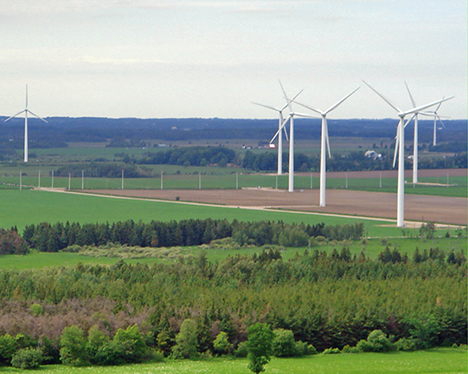
Ripley-KincardineRipley-Kincardine, Lake Huron


Over the next 20 years, your household will pay an additional $40,000 for electricity.

The cost of wind power will add $110,000,000,000.00 to our electrical bills.
To appreciate the cost, $100 billion can buy 5,000,000 Honda Civics.


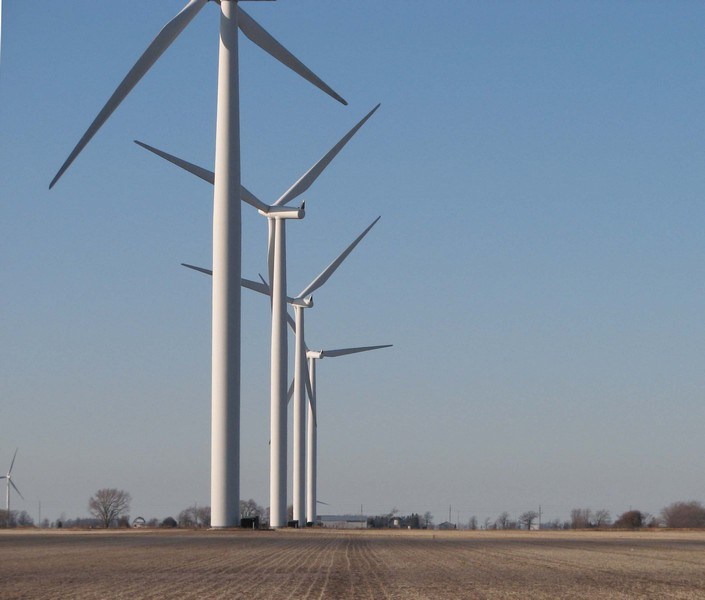
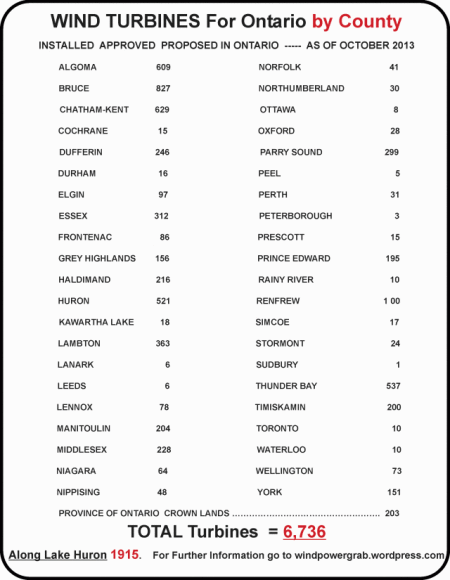
Ontario is building 6736 Wind Turbines.

We already have clean and excess power from water, nuclear and gas.


Bruce Peninsula


We pay more for wind power than any province/state in North America.

We are subsidizing the wind industry.

The Ontario Government pays the wholesale price of 11-13.5 cents per kwh for wind power.
The average retail price for wind power in the U.S. is 7 cents.
The average retail price for Ontario nuclear, water and gas is 7 cents.

Ontario hydro consumers pay for a debt that was actually paid off in 2010.
The 10% clean energy rebate on your hydro bill is charged to Ontario tax payers.
Ontario is the only province/state that charges HST, delivery, and regulatory fees on electricity.
Your hydro rates increase every May and October.

In 2007, you paid 7 cents per kwh.
In 2014, you pay 14-27 cents per kwh, depending on usage and location.
Check your hydro bill; divide the total (including HST, delivery and regulatory fees) by your usage.

1699 kwh costs $210 = 14 cents per kwh.
288 kwh costs $79 = 27 cents per kwh.

Compare our rates to: 6.8 cents in Quebec and 7.9 cents in Manitoba.

Pro-wind groups claim that our expensive electricity is due to expensive nuclear power.
However, the Ontario Power Generation states otherwise as per the link below:
http://www.opg.com/generating-power/nuclear/Pages/nuclear.aspx


Shelburne


Manufacturing is leaving Ontario.

“Ontario has the highest industrial rates in North America.”
Association of Major Power Consumers in Ontario. Refer to Sources for complete report.

Caterpillar (2 plants), United Steel. Heinz, Bicks, International Trucking,
General Motors, Navistar, Kellogg’s, John Deer, Lance Bakeries, Kraft Foods, Unilever.

NOVA Chemicals says the cost of power is critical in its decision to locate a multi-billion-dollar polyethylene expansion in Sarnia Ontario.
Their alternative is the U.S. Gulf Coast where rates are a fraction of ours.

http://www.theglobeandmail.com/report-on-business/economy/ontario-drives-manufacturers-away-with-overpriced-electricity/article14854752/

Since 2006, power usage has decreased by 6%.
Ontario has almost 1 million people out of work.
Ontario’s $227 billion debt is the worst in North America.

“Ontario’s economy has not performed on par with the rest of Canada,
due in part to its slow economic growth and spiralling public debt.”

Fraser Institute, April 2014. Refer to Sources for complete report.


Bruce Peninsula


Gone are the days of beautiful Ontario….

“These wind projects will change this place more totally, more rapidly and more permanently
than anything in the past 10,000 years”
James Corcoran, South Huron, Ontario
30 years experience, environmental assessments on behalf of developers.

The Human & Environmental Impact 

To appreciate the full impact of turbines on our people, please find the time  to read this:
http://www.southwesternontario.ca/news/public-fills-gallery-to-hear-wind-turbine-concerns/

Wind companies pay proportionally less taxes than the rest of us; turbines are assessed at a fraction of the actual value.
Farmers who sign 20 years leases with Wind Companies also sign a gag order whereby they must promote turbines and cannot criticize.

Wind companies are exempt from many Ontario laws.

Examples: municipal bylaws, building permits, road weight restrictions, proximity to highways, drainage.
Example: The restriction on rural bridges with 1/2 ton limits, where the heaviest load is usually a tractor,
are lifted during the construction of a wind project.
Example: Wind Projects can violate the Labour Act.
These cranes from the Adelaide wind project were left in this position overnight.

cranes

The Ministries of Environment and Natural Resources have changed laws that apply only to wind companies.

Example: there is no protection of wetlands; death or harm to endangered species.
Example: If you destroy an eagle’s nest, the fine is $10,000;  whereas wind companies are exempt.

Wind companies routinely sue municipalities/persons who get in their way.

The government supplies lawyers to back a wind company;
but has never backed a municipality, group or person.

Laws were passed where municipalities have no rights regarding wind projects in their jurisdiction.
Over 80 municipalities are “unwilling hosts” to turbines, but are not acknowledged.

Every turbine will permanently destroy 3 acres of land; roughly 21,000 acres of farmland lost forever.
Ontario turbines are closer to humans than any place in the world.
People are suffering from constant turbine noise and wind turbine syndrome which can be life threatening.
People are abandoning their homes at a unprecedented pace; very few want to live in or buy a house surrounded by turbines.
The fortunate ones are bought out by the wind companies, but sign a gag order as to why they left.
Areas in rural Ontario are becoming ghost towns.


The Birds

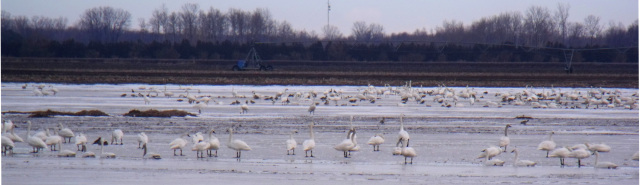
swans-thedford-bogMarch 2014 – Lambton Shores – Rest area for Migrating Tundra Swans
March 2015 – Lambton Shores – Rest area for newly built wind turbines.


People call turbines bird blenders 
because they slice, maim and slaughter birds.
Turbines will be built in the paths of the millions of birds that migrate to or through Ontario.
Turbines kill more bats than birds (their lungs explode from the turbine’s drop in air pressure). Don’t neglect the importance of bats to our eco-system.


A Perspective of Turbine Height

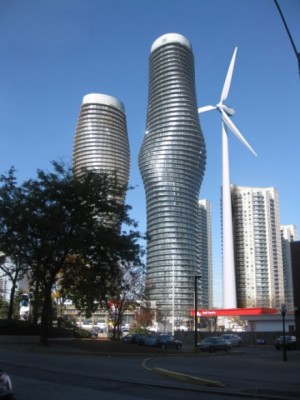
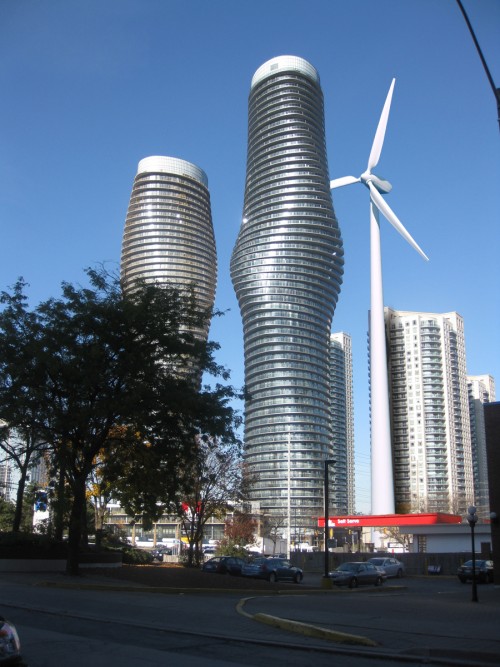
Using the Absolute Towers in Mississauga rendered in as a backdrop:
Absolute Towers is 56 storeys.
The small turbine is the CNE turbine – 299 feet high.
The mid-size is the average Ontario turbine – 380 feet high.
The tall one is the new Ontario turbine – 550 feet and taller.

Three

The rendering below provides a perspective of Ontario’s new turbines.
The building behind is 38 storeys.

TheMega


Ontario’s wind energy policy is convoluted and wastes money.

    • Nuclear, hydro, & gas is clean, cheap and has a 100% reliability, but, wind is given priority to our grid.
    • Wind power is expensive and unreliable; available 20-30% of the time.
    • When there is no wind, there is no wind power available.
    • For every kwh of wind power, we need one kwh of backup, that could otherwise be used as our sole source.
    • Ontario is spending $11 billion building transmission lines to feed power from every wind project.
      That’s an additional $2750 cost to your household
    • Ontario has too much power and we either, pay the USA & Quebec to get rid of the excess or charge 2.5 per kwh.
      In 2013 alone, the loss was $1 billion which will cost your household an additional $250.
    • Quebec turns around and sells our hydro at 5 cents per kwh to bordering States.
    • When there is too much power, Ontario pays $1 million dollars a day to take a nuclear plant off-line ($66 million in 2013)
      and pays wind companies to shut down their turbines.
    • $6 billion was spent to increase the power at Niagara Falls; only to divert the water when there is excess power.
    • Ontario pays gas plants to run as backup for wind power.
    • The first weekend in August, Ontario lost $10 million because of highly windy days resulting in unexpected power to the grid.
      The same occurred on November 9 & 10, where Ontario lost another $20 million.
    • September 11, 2013: Ontario agreed to pay Wind Energy companies $200,000 per mw not to supply power,
      The government says it’s “cheaper than paying the USA & Quebec to use it”.
      Since then, new wind projects continue to be approved.
    • The plan to build two new nuclear reactors at Darlington was abruptly cancelled in October 2013 at a cost of $180 million.
    • During the 2011 election, the Liberals cancelled the construction of 2 gas plants to win Liberal seats.
      These cancellations totaled $1.1 billion which will cost your household an additional $250.
    • The Lambton coal plant had just been upgraded at a cost of $1 billion to produce clean coal before it was closed in October 2013.
      That will cost your household another $250.
      Ironically, the Lambton coal plant is 1 km from a coal plant in Michigan that is still active.

“This situation is expected to get much worse over the next several years as significant amounts of wind,
hydraulic and nuclear generation will be coming into service while expected electrical demand will continue
to be stagnant.”

Ontario Society of Professional Engineers. Refer to Sources for complete report


Truth is stranger than fiction

Ontario pays 11-13.5 cents for wind power.
Ontario pays or charges Quebec 2.5 cents take our excess.
The loss is subsidized by Ontario consumers.
Quebec sells it to border States for 5 cents.
Consequently:
Manufacturers can move to the States and get cheap power; where a portion is sourced from Ontario and subsidized by Ontario consumers.

New York State sees an opportunity.
Promotional information was sent to Ontario’s Manufacturing sector citing Ontario’s high energy costs as a good reason to relocate to New York State.http://www.theglobeandmail.com/news/politics/soaring-energy-prices-making-ontario-look-dim-for-manufacturers/article17560172/


Wolfe Island – photo rendering shows pre-turbine days
Wolfe Rendering

Wolfe Island – actual photo
8


The Vulnerability of our Grid

    • When produced, power has to be used immediately; there’s no technology to store it for a later time.
    • There is excess power almost every hour of every day, and Ontario scrambles to find a state/province that will take it.
    • Depending on their power needs at the time, we either give it away (spill it), pay to take it (spill it) or charge a very low rate.
    • Because wind power is so unpredictable, the IESO staff are continually manipulating the grid; telling the nuclear, gas and hydro suppliers to adjust their output accordingly; and the excess is then sent to Quebec, Manitoba and the States.


According to the Ontario Society of Professional Engineers:

Carbon Dioxide Emissions will increase by 48% in 2030,
because gas plants constantly starting up and shutting down expel more emissions than if they ran continually.

Much of our wind power will go to Quebec and the States.
Wind blows mostly at night and in the winter when we need power the least.
There is no wind on a hot summer day, when our air conditioners need it the most.

Constant changes to the grid are prone to error and Ontario’s grid wasn’t built to handle such.
Be prepared for frequent and long blackouts or worse, as in complete failure of our energy grid.

Chatham-Kent-wind-turbines-from-Lake-Erie-and-Rondeau-Bay15
Rondeau Bay


Ontario has more than enough power with Nuclear, Hydro (water) and Gas.

Ontario’s average demand for power is roughly 18,000 mw.
In the last 8 years, Ontario’s highest demand for power was 27,005 mw on August 1, 2006.

The amount of available reliable power is 30,806 mw which far exceeds the demand.
Nuclear  = 12947 mw:  Hydro = 7939 mw;  Gas = 9920 mw.

The Liberals will have added 3725 mw of installed wind energy by the end of 2014;
with intentions of adding more.

“Ontario will phase in wind, solar and bioenergy 
….with 10,700 MW online  by 2021.”
Ministry of Energy

(Ontario is offering 44-88 cents per kwh for solar and bioenergy.)


Chatham Kent –  photo rendering shows pre-turbine days
chatham kent 1

Chatham Kent – actual photo
chatham-kent-ontario-kruger-energy-port-alma-wind-from-hwy3-talbot-trail-4


Does this make sense to you??

 ”The province’s wind and solar power initiatives were decided and implemented in such haste
that “no comprehensive business-case evaluation was done to objectively evaluate the impacts
of the billion-dollar commitment.”

Auditor General of Ontario

There are about 50 resident wind lobbyists in Toronto.

The Liberals introduced and passed the Green Energy Act 2009.
The NDP have supported the Liberals on wind energy since its inception.
The PC’s do not support subsidized wind power. They want it stopped.

This has been going on for years.  One example:
In 2004, Mike Crawley, the (then) President for the Ontario Liberals,
was awarded a wind power contract that guarantees his company $66,000 a day for a total of $1/2 Billion dollars.
Since then, Mike Crawley continues to build additional Wind Projects.

The Wind Industry held a fundraising event for Kathleen Wynne in April 2013.

Those who promote Wind power, benefit financially by doing so.
David Suzuki, Pembina Institute, Cleantech, MaRs,  Environmental Defence,
Friends of the Wind, Windfacts and CANWEA.

A wind company is getting a pass on violating the law?
In the Niagara region, four turbines that were built too close to residents, are violating the law and need to be dismantled.
The Minister of Energy has done nothing.
http://www.niagarathisweek.com/news-story/4390620-enforce-the-law-hudak-to-energy-minister


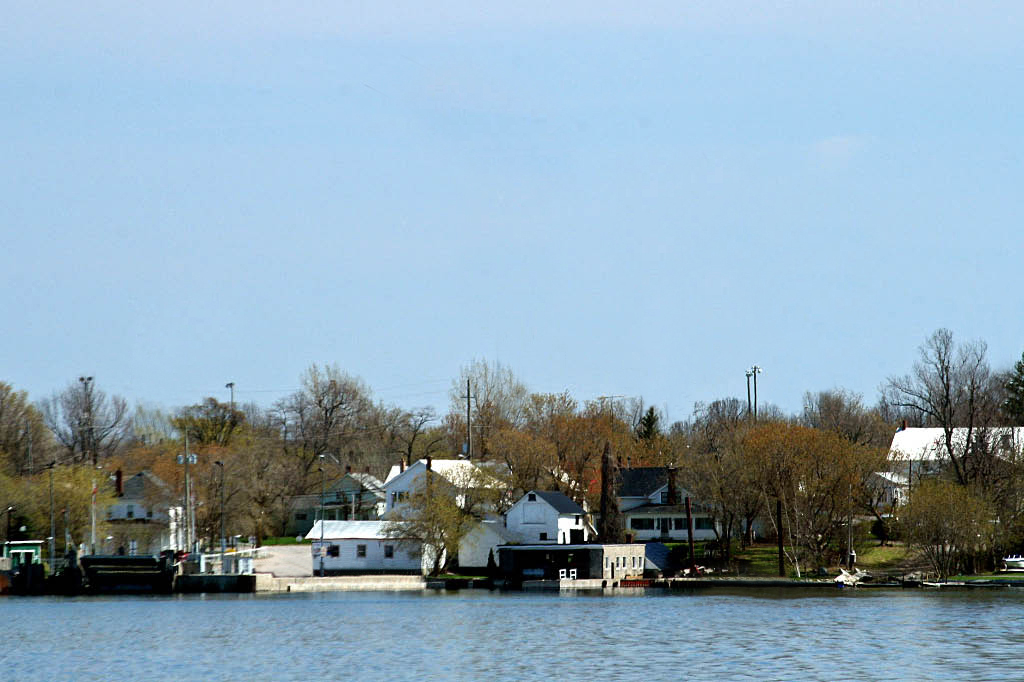
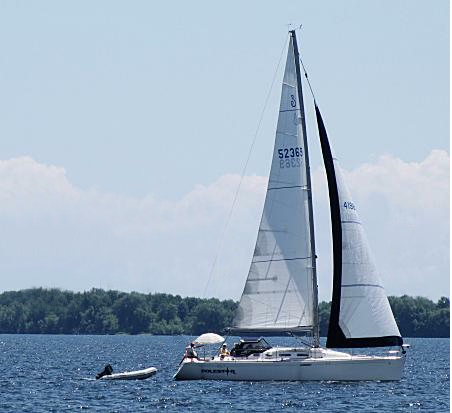
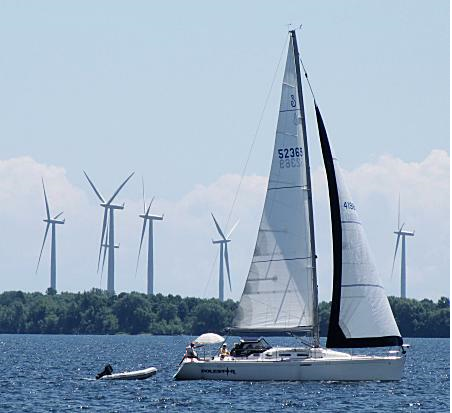
Lake Ontario – photo rendering shows pre-turbine days
sail copy

Lake Ontario – actual photosail


Every project could be stopped today; if the Liberals want to.

The Ontario Government has the discretionary power to cancel or modify these contracts but it’s clear they don’t want to.

An Ontario court ruling in the decision of Trillium vs. Ontario, 2013, clearly states that:
“Governments are free to alter policies in the public interest.” 
“Companies in the renewable power business participate in government subsidy programs ‘at their own risk’.”

As of March, 2014, the Liberals are continuing with the 55 incomplete wind power projects (about 4900 turbines) that could be stopped legally.

“If you are asking me, will you cancel those [wind project] contracts outright? The answer is no we won’t!”
Kathleen Wynne, in Kincardine, April 24, 2014

For ruling, refer to Discussion at the bottom of this page
http://www.osler.com/NewsResources/Appeal-Court-Allows-2-Billion-Wind-Farm-Action-to-Proceed-Against-Government-of-Ontario/


Chatham Kent Airport
Chatham Kent Airport – Location of turbines was denied by Transport Canada,
fought by the municipality, but approved by the Ontario Government.
The same is happening in Collingwood, Peterborough, Goderich, Kincardine, Huron Park, Grand Bend and the Niagara Region.
The sky-diving club in Niagara Region will have to shut down.

Energy Platform by Party

The PC’s introduced Bill 42 in 2012 and Bill 39 in 2013 to eliminate wind subsidies and give control back to municipalities.
The NDP’s and Liberals voted against these bills. Refer to Sources.

Liberal

Will be pursuing additional wind power projects in 2015 and again in 2016.
Remove the Ontario Hydro Debt charge on January 1, 2016. (About $60 a year decrease in costs).
Discontinue the Clean Energy Rebate on December 31, 2015. (About $170 a year increase in costs).
Introduce a surcharge for families making over $40,000, to subsidize lower income families.

NDP

Committed to “aggressively expand renewable energy”.
Honour existing green energy contracts
Place a moratorium on all renewable power projects starting in 2018.

Progressive Conservatives

Scrap Ontario’s wind energy policy.
Give control back to municipalities.
Put a moratorium on wind energy projects.
Eliminate wind subsidies, which would substantially reduce our hydro bills.

“We propose scrapping the Green Energy Act and implementing an immediate moratorium
on industrial wind turbines until the jury is in on health and environmental studies.
We will not sign any more FIT contracts and will take a look at the existing ones.”

PC MPP Toby Barrett, April 2, 2014


Wolfe Island121


Wolfe Island before & after the Liberal’s energy policies


Is Nothing Sacred?

Temple_Rendering___Content

Near Peterborough, a $40 million project to build the largest Buddhist complex outside of China is in jeopardy.
The Liberals knowingly approved wind turbines to surround the complex.
The people in charge of the development say these turbines will have a negative impact on the serenity of the complex.
This complex would have attracted about 45,000 visitors a year and generated more than $20 million for Ontario.


Wind Farms slated for Ontario

Click here to see maps of these projects

Rondeau Bay – photo rendering showing pre-turbine days
Rondeau Bay Rendering

Rondeau Bay – Actual photo
chatham-kent-ontario-internaional-power-gdf-suez-from-across-rondeau-bay-from-erieau-2


Wind verses Nuclear

  • Nuclear power costs 6.8 cents per kwh, period.
    Wind power costs 11-13.5 cents per kwh, plus all other costs mentioned above.
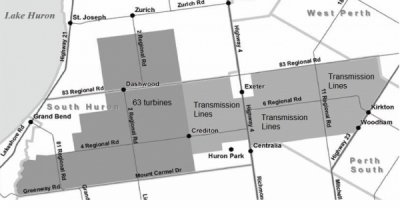
  • One wind project approved for the area east of Grand Bend is approximately 34 km long and 16 km wide.
    The nuclear footprint is 9 sq. kilometers.
  • It will have 63 wind turbines with a maximum output of 102 mwh.
  • Applying efficiency factor of 30%, actual output will be 30 mwh.
  • Ontario average usage is 18,000 mwh.
  • Nuclear can provide approximately 12,947 mwh 24/7.
  • This wind project has the potential of providing .16% (1/6th of one percent) our energy needs.
  • When there is no wind, it will provide 0% of our energy needs.

Map

tmap


 In 10-20 years

  • The Niagara Falls hydro generating stations are 100 years old, but wind turbines are good for only 10-20 years.
  • Each turbine construction consists of 800 tonnes of cement for support, approximately 250 tonnes of unrecyclable materials, 700 litres of hydraulic fuel and, 600 kilograms of rare earth metals. Multiply these numbers by 6736 and Ontario is facing a potential ecological conundrum.
  • The are no bonds posted to ensure these turbines will be dismantled at the end of their life cycle. It is estimated that a turbine, depending on size, will cost $400,000 to $1,000,000 to dismantle.
  • Given that wind companies are predominantly foreign, change ownership or, go bankrupt, it is quite realistic to expect 100′s or 1,000′s of dead turbines in 20 years and left standing.
  • This is happening already. Wind Companies usually don’t fix or dismantle broken turbines and, Ontario already has many non-functioning turbines.
    If companies won’t dismantle a couple of turbines now; what about the future ones?.
  • The Liberals have no plans as to where to dispose these materials, nor have indicated that wind companies will be responsible for the costs of building the landfill sites or depots.
  • One can only assume, that the cost to dispose 6736 turbines will be covered by the people of Ontario.

In 10-20 years, we could be faced with a landscape of old, rusted out, broken down turbines.


The Canadian Taxpayers Federation:
Launched a petition to dismantle the Liberal Green Energy Act.
https://www.taxpayer.com/resource-centre/petitions/petition?tpContentId=84


128,202 total views since Mar

Tim Hudak refuses to Carry On with the Wind Scam! Windweasels will scurry!!!

Hudak vows to pull the plug on wind power

BY  ,QUEEN’S PARK BUREAU CHIEF

FIRST POSTED: MONDAY, MAY 12, 2014 05:24 PM EDT | UPDATED: MONDAY, MAY 12, 2014 05:50 PM EDT

Wind farm
Wind farms. (QMI files)

It’s time to blow off expensive subsidies to wind and solar power, PC Leader Tim Hudak says.

The Progressive Conservatives would, if elected to govern, refuse to sign any more renewable energy deals at high rates of return and focus on creating an electricity system reliant on gas, hydro operations and nuclear power.

A Tory government would also give more control to local municipalities over the siting of wind projects, he said.

“If people can have a say about a hot dog stand going in for a Canada Day celebration, shouldn’t they have a say about massive industrial wind turbines in their backyard?” Hudak said.

The PCs say they will not proceed with any wind or solar applications that have not been already approved.

Those projects that have been approved but not yet connected to the grid would be evaluated on a case-by-case basis.

Such a move would save $20 billion and help businesses create 40,000 jobs through more affordable electricity — numbers confirmed by an independent economist brought in by the PCs, Hudak said.

The election campaign brought Hudak to Stanpac Inc. Monday, a food, dairy and beverage packaging manufacturer located in Smithville which is in the Niagara Region.

Murray Bain, Stanpac’s vice president of marketing, said the company would like to expand its Ontario operations but the rising cost of electricity in the province makes it more likely that those jobs will be added to its Texas plant.

“Every dollar we spend on energy could be a dollar that we would use for new jobs and higher pay cheques in Ontario,” Bain said. “We need to remember that government experiments that drive up energy costs will also end up taking jobs away. High energy prices are a self-inflicted wound on Ontario’s economy. It’s time to heal that.”

Premier Kathleen Wynne said Monday that her government has renegotiated a renewable energy deal with Samsung to find savings, but remains committed to its overall plan for renewable energy, including wind power.

Ontario’s green electricity initiatives had created 42,000 jobs by the end of 2013 in construction, installation, energy auditing, operations and maintenance, engineering, consulting, manufacturing, finance, information technology and software, the Liberals say.

Northern Ontario companies and lower income families benefit from government programs to keep their hydro costs manageable, Wynne added.

Hudak said the cost of hydro has gone up $630 a year for the average family under the Ontario Liberals.


Wildlife Massacred in the Name of Faux-Green Energy!

Photo

CreditMatt Huynh

DISEASE and heedless management ofwind turbines are killing North America’s bats, with potentially devastating consequences for agriculture and human health.

We have yet to find a cure for the disease known as white-nose syndrome, which has decimated populations of hibernating, cave-dwelling bats in the Northeast. But we can reduce the turbine threat significantly without dismantling them or shutting them down.

White-nose syndrome (also known as W.N.S.) was first documented in February 2006 in upstate New York, where it may have been carried from Europe to a bat cave on an explorer’s hiking boot. In Europe, bats appear to be immune, likely the outcome of a long evolutionary process. But in North America, bats are highly susceptible to the cold-loving fungus that appears in winter on the muzzle and other body parts during hibernation, irritating them awake at a time when there is no food. They end up burning precious stores of energy and starve to death.

The consequences have been catastrophic. A 2011 study of 42 sites across five Eastern states found that after 2006 the populations of tri-colored and Indiana bats declined by more than 70 percent, and little brown bats by more than 90 percent. The population of the northern long-eared bat, once common, has declined by an estimated 99 percent and prompted a proposal from the United States Fish and Wildlife Service to list it as an endangered species. Other species of hibernating cave-dwelling bats have declined precipitously as well.

Whether these bats will recover or go extinct is unclear. Meanwhile, W.N.S. continues to spread rapidly. On the back of this year’s extremely cold winter, it moved into Michigan and Wisconsin. It is now confirmed in 23 states and five Canadian provinces.

Tree-dwelling bats don’t seem to be affected by W.N.S., since they don’t hibernate in caves. But wind farms are killing them.

Wind turbines nationwide are estimated to kill between 600,000 and 900,000 bats a year, according to a recent study in the journal BioScience. About half of those lost to turbines are hoary bats, which migrate long distances seasonally throughout North America. Eastern red and silver-haired bats, commonly seen in Central Park in New York City hunting insects at night, are also being killed by turbines by the tens of thousands.

We can’t afford to lose these creatures. In the Northeast, all of our native bat species eat insects. One little brown bat can eat 1,000 mosquitoes in an hour, reducing the potential for mosquito-borne diseases. A colony of 150 big brown bats can protect crops from up to 33 million rootworms over a growing season. The Mexican free-tailed bats of Bracken Cave in south-central Texas consume about 250 tons of insects every summer night. The natural pest control provided by that species across eight Texas counties has been valued at nearly $750,000 as it protects the $6 million summer cotton crop. Nationwide, the value of bats as pest controllers is estimated to be at least $3.7 billion and possibly much more. (This leaves out the value of two other very important services that bats provide: controlling insect-borne diseases and pollinating commercially valuable plants.)

Today, genetic engineering may seem to provide an effective way to protect crops from insects, but pests have already developed resistance to some of these products. Insects also readily evolve resistance to chemical insecticides, and increased use of these chemicals would come at a great cost to human health. But bats have shared the night skies with insects for at least 50 million years, and they know how to hunt and eat them.

Fortunately, we can reduce the mortality caused by wind farms, which are often located on windy routes favored by some migratory bats. Wind turbines usually switch on automatically at wind speeds of about 8 to 9 miles per hour, speeds at which insects and bats are active. But if, during times of peak bat activity, energy companies recalibrated their turbines to start at a wind speed of about 11 miles per hour, which is too windy for insects and bats to fly, turbine-related deaths could be reduced by 44 to 93 percent, according to a 2010 study published in the journal Frontiers in Ecology and the Environment. The effect on power output would be negligible — less than 1 percent annually.

Threats to bats also threaten us. We should step up research on the prevention and cure of white-nose syndrome. And we should require energy companies to take steps to protect bats from collisions with wind turbines. It is foolish to spend enormous sums to create pesticides and transgenic crops to fight insects, while investing little to protect bats, our most efficient insect fighters.

Government has NO Business Funding Useless Wind Turbines!

May 11. 2014 

George Fenwick: Taxpayers should

not be forced to subsidize bird-killing

wind turbines

SINCE EARLY in our nation’s founding, we have placed a high value on conserving native wildlife so that future generations will be able to experience and benefit from wild species as we do today. Yet even as our federal government has ’sequestered’ federal funds and been forced to shutter national parks during contentious government shutdowns, we taxpayers have been regularly tapped, year after year, by large corporate wind companies to provide them with tax credits they demand in order to make a profit of their ventures.

Taxpayers may not be aware that they have funded for several years — through the federal government’s Production Tax Credit (PTC) — a public subsidy that can create a perverse incentive to put wind turbines in areas that produce little electricity but would have a devastating impact on migratory birds.

As presently configured, the PTC provides 2.3 cents per kilowatt generated, largely to wind energy companies. Poorly sited wind energy development kills significant numbers of birds and bats and alters sensitive wildlife habitat. At the current estimated mortality rate, the wind industry is killing hundreds of thousands of birds and bats per year and is expected to kill well over one million per year as projects are built to reach the federal goal of 20 percent renewable energy by 2030.

While these numbers represent a relatively small percentage of the total number of birds and bats estimated to reside in or breed in North America, many of the species being killed are already declining for other reasons, and this mortality can exacerbate these declines. In fact, the North American Breeding Bird Survey shows that between 1966 and 2010, 40 percent of neotropical migratory birds (55 of 137 species assessed) had significant negative population trends. The mortality due to wind turbines is just one more factor contributing to the cumulative impact of humans on wild bird and bat populations.

In addition, many species are protected under the Migratory Bird Treaty Act, Endangered Species Act, and the Bald and Golden Eagle Protection Act. Killing them is a violation of federal law punishable by significant fines.

We all want clean, renewable energy, but wind power cannot be considered “green” if it is unnecessarily killing large numbers of birds and bats. However, we truly can have it both ways. Making wind power a win-win proposition for conservation-minded taxpayers is not overly complicated. Two key actions need to be taken.

The first is that “no-go” zones need to be established for the industry in the most sensitive locations where the toll on birds simply outweighs the benefits of wind development. American Bird Conservancy has already developed maps showing those areas.

The second is that the voluntary U.S. Fish and Wildlife Service (FWS) permitting guidelines, by which the wind industry is currently guided, need to be made mandatory. Since the Energy Policy Act of 1992 established the PTC, the federal government has doled out billions of dollars and hoped that the for-profit wind industry would voluntarily do the right things to minimize impacts to birds and bats.

In addition to their inherent beauty and cultural and scientific importance, birds and bats also have an incalculable value by maintaining the ecosystems on which humans depend. For example, birds and bats eat billions of insects each year that left unchecked could decimate our crops, damage our forests, or lead to more use of troubling pesticides. Bats are equally valuable. In one eight-county region of Texas, Brazilian free-tailed bats saved local farmers an estimated $740,000 annually in crop damage and pesticide costs by feeding on corn earworm and cotton bollworm.

Unfortunately, in the case of wind energy, rapid development has gotten way out ahead of the science and regulatory framework. Setting reasonable regulatory sideboards for the industry and putting key, sensitive areas off limits are two principles that should be non-negotiable as renewal of the PTC is considered. It harkens back to an old standard in business dealings to which most of us have grown accustomed. It is called quid pro quo.

George Fenwick is president of the American Bird Conservancy in Washington, D.C.


The Windweasels KNOW they are Harming people, and wildlife…..They don’t care!!!

WIND FARMS SEVERELY HARMFUL TO WILDLIFE, NEW STUDY FINDS

HAWAII’S WIND TURBINES DEADLY TO BIRDS,…
According to the U.S. Fish and Wildlife Service, 195 birds and other flying animals have been killed by turbines at five of the largest wind farms on Maui and Oahu since Aug. 2007.

A new study from the Swedish University of Agricultural Sciences, combining an impressive six hundred other studies, describes the severe effects wind turbines can have on wildlife. Not only are the disturbances and noise of the building of turbines an issue but also the sound of the windmills rotating and electromagnetic fields (EMF) caused by transferring the electricity produced to the mainland.

At the construction phase, for example, “extreme noise from pile-driving” is observed to cause “significant avoidance behaviour in marine mammals” and “highly likely to cause mortality and tissue damage in fish.”

On the noise of the blades there was “avoidance of the offshore wind farm (OWF) area by harbour porpoise, and possibly a habituation over time.”

EMF affects “cartilaginous fish, which use electromagnetic signals in detecting prey” and EMF could also disturb fish migration patterns.”

The OWF “may also alter local biodiversity patterns and lead to undesired effects.”

Onshore wind farms also have severe effects on animals and birds. A paper published in 2013 from Poland looked at domestic geese (Anser anser f domestica) bred 50m from a wind turbine against 500m for the control group.

After twelve weeks monitoring noise levels and the stress measuring cortisol levels the researchers concluded: “Lower activity and some disturbing changes in behavior of animals from group I (50m) were noted.

“Results of the study suggest a negative effect of the immediate vicinity of a wind turbine on the stress parameters of geese and their productivity.”

In Portugal a study also found that foals born near wind turbines developed Equine Flexural Limb Deformities.

Biologist Dr. Lynne Knuth, in a letter to the Public Service Commission of Wisconsin,testified: “The problems with animal reproduction reported in the wind farms in Wisconsin are lack of egg production, problems calving, spontaneous abortion (embryonic mortality), stillbirth, miscarriage and teratogenic effects:

In chickens: Crossed beaks, missing eyeballs, deformities of the skull (sunken eyes), joints of feet/legs bent at odd angles. In cattle: missing eyes and tails.”

While these effects seem to occur in the immediate vicinity of a wind turbine they are hugely important to humans. It has long been reported that those living near wind farmssuffer from ill health.  Sleep deprivation, headaches, tinnitus, balance problems, motivational difficulties and depression are just some of the alleged effects.

Wind farms continue to be a controversial subject both on and offshore. Not only is the power in need of government subsidies, the comparative cost of producing a Megawatt (MWh) of power ranges from £60 to £65 for coal and gas through to £90 to £150 respectively for onshore and offshore wind farms. Certainly in the UK there is increasing resistance from the population, being the proverbial blot on the landscape.

Many wind farm proponents point to psychogenesis and its subset psychsomaticism, where the person has the real symptoms but they are psychological induced, rather than physically induced. One has to say with animals it is highly unlikely.

When the West Country band The Wurzels release a new record bemoaning wind farms, resistance has to be taken seriously.


Wynne wants to get rid of Essential Services in Rural Ontario….(we don’t vote Liberal).

WYNNE LIBERALS TO CLOSE 5 (FIVE) HOSPITALS IN

THE NIAGARA REGION! WHAATT???

Bet you’re not seeing this headline in the Toronto Star or any of the other Liberal-backing media.  According to the Globe and Mail:

“The restructuring of Niagara Health, a sprawling network of seven hospitals serving 434,000 in a dozen communities, is part of an effort to consolidate medical expertise, create critical mass and provide higher quality care to patients. The initiative has been in the works for more than 1 1/2 years. Kevin Smith, the government-appointed supervisor of Niagara Health, recommended in a May, 2012, report submitted to Ms. Matthews that aging hospitals in five communities – Port Colborne, Fort Erie, Niagara Falls, Welland and Niagara-on-the-Lake – be permanently closed and replaced with a new one.”

Maybe I’ve just been dreaming for the past decade or so, but hasn’t this been the cornerstone of the hatred and vitriol that the Libs and Dippers have been spewing about the ever-evil Lord of Darkness Mike Harris?

For years, I’ve been reading an endless stream of rants from Liberal lemmings who have gone on and on, ad nauseam about how Mike Harris destroyed the health care system in Ontario by closing….wait for it…..5?  No.  10?  No.  20?  Nooooo!  29 (and in some extreme cases 32) hospitals across Ontario.

Finally one day, I started pressing these Liberal parrots for the exact names of all the hospitals that Mike Harris supposedly closed.  “Well…ummm….uh….Well I don’t know the names, but you can mark my word that if the Liberals say that he closed 29 hospitals, by golly, that’s how many he closed!!!”

So I took it upon myself to do a little research and this is what I found.

Here’s the list of hospitals that the Libs and their sheeple have been saying that Harris supposedly closed.

Brockville Psychiatric Hospital
Hotel Dieu-Grace Site (Windsor)
Hotel Dieu Hospital (Kingston)
Providence Continuing Care Centre, St. Vincent de Paul site (Kingston)
Hamilton Psychiatric Hospital
St. Peter’s Hospital (Hamilton)
St. Joseph’s Hospital (Chatham)
Northumberland HealthCare Corp., Port Hope site
St. Joseph’s Health Centre (Peterborough)
St. Joseph’s Hospital (Brantford)
St. Joseph’s Health Centre (London)
London Health Sciences Centre, South St. site
London Psychiatric Hospital
St. Thomas Psychiatric Hospital
St. Bernard’s Hospital
Wellesley-Central Hospital (Toronto)
Queen Elizabeth Hospital, Hillcrest site (Toronto)
Toronto: Doctors Hospital
Humber River Regional Hospital, Northwestern site (Toronto)
Orthopedic & Arthritic Hospital (Toronto)
Riverdale Hospital (Toronto)
Runnymeade Chronic Care Hospital (Toronto)
Salvation Army Grace Hospital (Toronto)
Whitby General Hospital
Salvation Army Grace Hospital (Ottawa)
Pembroke Civic Hospital
Sudbury Memorial Hospital
Subbury General Hospital
Thunder Bay Regional Hospital, McKellar site
Hogarth-Westmount Hospital (Thunder Bay)
Lakehead Psychiatric Hospital (Thunder Bay)
Lakefield Hospital (private)
Sidbrook Hospital (private)
Grace Villa (private)
Dewson Hospital (private)

I decided to do a cursory check to see how many of these hospitals were in fact closed down.   How?  I called the hospitals.  And here’s what I found….

Brockville Psychiatric Hospital is still open — was never closed

Hotel Dieu-Grace Site (Windsor) — still open — was never closed

Hotel Dieu Hospital (Kingston) — still open — was never closed

Providence Continuing Care Centre, St. Vincent de Paul site (Kingston) — still there….never closed

St. Peter’s Hospital (Hamilton) — still there — never closed

St. Joseph’s Hospital (Chatham) still there….now amalgamated under Chatham Kent Health Alliance….never closed

Northumberland Healthcare — Closed

St. Joseph’s Health Centre (Peterborough) — amalgamated with Peterborough Civic Hospital

Joseph’s Hospital (Brantford) — still there….downsized to a clinic

St. Joseph’s Health Centre (London) — still there — never closed

London Health Sciences Centre, South St. site — still there — never closed

St. Thomas Psychiatric Hospital — still there — moved to a new building

St. Bernard’s Hospital Wellesley-Central Hospital (Toronto) — closed

Queen Elizabeth Hospital, Hillcrest site (Toronto) — became the Toronto Rehabilitation Institute — the largest rehabilitation hospital in Canada

I didn’t bother going any further than that.  It told me enough to realize that as usual, the more times a lie is told, the bigger it gets.  In the case of the Liberal Party of Ontario, though, their lies always start off as whoppers.

I’m anxious to see how much coverage this newest Liberal agenda is going to get.  Are we going to hear screaming from the rooftops about it?  Most likely not.  Because after all, Kathleen Wynne is ‘promising’ to build a new supercentre hospital.  “Promising”.   Wait, isn’t there a by-election coming up?  Of course there is.  So for now, we’ll only hear about the new super hospital.  The hospitals that will be closed, will get headline news AFTER the by-elections. — DQ

Hospital-entrance-sign

Donna Quixote Hits the Nail on the Head, with this one!


Michael Strickland — Guelph Mercury — May 10, 2014

There’s an episode of the Big Bang Theory where Dr. Sheldon Cooper, brilliant theoretical physicist at Caltech, explains to the gang why 73 is the best number in the world.

It is, he points out, “the 21st prime number. Its mirror, 37, is the 12th, and its mirror, 21, is the product of multiplying — hang on to your hats — seven and three.”

“Heh? Heh? Did I lie?”

Expressed in binary, he continues, 73 is also the palindrome 1001001.

His friend, astrophysicist Raj Koothrappali, then points out that the number 5,318,008 upside down in a calculator spells “BOOBIES.”

I think the best number in the world — at least in Ontario, as we prepare to go to the polls on June 12 — is one billion. As in $1 billion.

$1 billion and change is, of course, the amount the ruling Liberals thought we’d all appreciate having to pay in order to keep them in power in the last election. So they cancelled contentious gas plant contracts.

It’s been difficult to miss this story during Premier Kathleen Wynne’s tenure. The original estimate ballooned from a paltry $230 million and police launched an investigation into deleted emails in the premier’s office. Expect her critics to crack up the messaging on this billion-dollar talking point.

But did you know, $1 billion and change is also the amount the Liberals wasted on Ornge. That’s right, the government provided the scandal-plagued air ambulance service with $730 million over five years, and allowed Ornge to borrow another $300 million. The OPP are now conducting a criminal investigation, with the help of the RCMP, American authorities and, most recently, officials in Italy.  Continue reading here….

kathleen_wynne lpo

Some facts about Wind turbines in Ontario….from people who KNOW!

Ontario Wind Turbines

Ontario has the most expensive electricity in North America
leading to unaffordable hydro bills, manufacturing leaving, high unemployment and a stagnant economy.
This is the result of over-priced wind power; an industry Ontario doesn’t need and can’t afford.
(Comparing to the other provinces and the continental U.S.)

“Ontario is probably the worst electricity market in the world,”
Pierre-Olivier Pineau, Associate Professor and Electricity Market Expert, University of Montreal HEC Business School.

Ontario’s Energy Policy affects every person in Ontario.

Eleven years ago, Ontario had a vibrant energy sector. It has changed since then.
The following is a summary of the energy policy that is being implemented by the Ontario Government.
All supporting information is under Sources.

Ripley-KincardineRipley-Kincardine, Lake Huron

Over the next 20 years, your household will pay an additional $40,000 for electricity.

The cost of wind power will add $110,000,000,000.00 to our electrical bills.
To appreciate the cost, $100 billion can buy 5,000,000 Honda Civics.

Ontario is building 6736 Wind Turbines.

We already have clean and excess power from water, nuclear and gas.

Bruce Peninsula

We pay more for wind power than any province/state in North America.

We are subsidizing the wind industry.

The Ontario Government pays the wholesale price of 11-13.5 cents per kwh for wind power.
The average retail price for wind power in the U.S. is 7 cents.
The average retail price for Ontario nuclear, water and gas is 7 cents.

Ontario hydro consumers pay for a debt that was actually paid off in 2010.
The 10% clean energy rebate on your hydro bill is charged to Ontario tax payers.
Ontario is the only province/state that charges HST, delivery, and regulatory fees on electricity.
Your hydro rates increase every May and October.

In 2007, you paid 7 cents per kwh.
In 2014, you pay 14-27 cents per kwh, depending on usage and location.
Check your hydro bill; divide the total (including HST, delivery and regulatory fees) by your usage.

1699 kwh costs $210 = 14 cents per kwh.
288 kwh costs $79 = 27 cents per kwh.

Compare our rates to: 6.8 cents in Quebec and 7.9 cents in Manitoba.

Pro-wind groups claim that our expensive electricity is due to expensive nuclear power.
However, the Ontario Power Generation states otherwise as per the link below:
http://www.opg.com/generating-power/nuclear/Pages/nuclear.aspx

Shelburne

Manufacturing is leaving Ontario.

“Ontario has the highest industrial rates in North America.”
Association of Major Power Consumers in Ontario. Refer to Sources for complete report.

Caterpillar (2 plants), United Steel. Heinz, Bicks, International Trucking,
General Motors, Navistar, Kellogg’s, John Deer, Lance Bakeries, Kraft Foods, Unilever.

NOVA Chemicals says the cost of power is critical in its decision to locate a multi-billion-dollar polyethylene expansion in Sarnia Ontario.
Their alternative is the U.S. Gulf Coast where rates are a fraction of ours.

http://www.theglobeandmail.com/report-on-business/economy/ontario-drives-manufacturers-away-with-overpriced-electricity/article14854752/

Since 2006, power usage has decreased by 6%.
Ontario has almost 1 million people out of work.
Ontario’s $227 billion debt is the worst in North America.

“Ontario’s economy has not performed on par with the rest of Canada,
due in part to its slow economic growth and spiralling public debt.”
Fraser Institute, April 2014. Refer to Sources for complete report.

Bruce Peninsula

Gone are the days of beautiful Ontario….

“These wind projects will change this place more totally, more rapidly and more permanently
than anything in the past 10,000 years”
James Corcoran, South Huron, Ontario
30 years experience, environmental assessments on behalf of developers.

The Human & Environmental Impact

To appreciate the full impact of turbines on our people, please find the time to read this:
http://www.southwesternontario.ca/news/public-fills-gallery-to-hear-wind-turbine-concerns/

Wind companies pay proportionally less taxes than the rest of us; turbines are assessed at a fraction of the actual value.
Farmers who sign 20 years leases with Wind Companies also sign a gag order whereby they must promote turbines and cannot criticize.

Wind companies are exempt from many Ontario laws.

Examples: municipal bylaws, building permits, road weight restrictions, proximity to highways, drainage.
Example: The restriction on rural bridges with 1/2 ton limits, where the heaviest load is usually a tractor,
are lifted during the construction of a wind project.
Example: Wind Projects can violate the Labour Act.
These cranes from the Adelaide wind project were left in this position overnight.

cranes

The Ministries of Environment and Natural Resources have changed laws that apply only to wind companies.

Example: there is no protection of wetlands; death or harm to endangered species.
Example: If you destroy an eagle’s nest, the fine is $10,000; whereas wind companies are exempt.

Wind companies routinely sue municipalities/persons who get in their way.

The government supplies lawyers to back a wind company;
but has never backed a municipality, group or person.

Laws were passed where municipalities have no rights regarding wind projects in their jurisdiction.
Over 80 municipalities are “unwilling hosts” to turbines, but are not acknowledged.

Every turbine will permanently destroy 3 acres of land; roughly 21,000 acres of farmland lost forever.
Ontario turbines are closer to humans than any place in the world.
People are suffering from constant turbine noise and wind turbine syndrome which can be life threatening.
People are abandoning their homes at a unprecedented pace; very few want to live in or buy a house surrounded by turbines.
The fortunate ones are bought out by the wind companies, but sign a gag order as to why they left.
Areas in rural Ontario are becoming ghost towns.

The Birds

swans-thedford-bogMarch 2014 – Lambton Shores – Rest area for Migrating Tundra Swans
March 2015 – Lambton Shores – Rest area for newly built wind turbines.

People call turbines bird blenders because they slice, maim and slaughter birds.
Turbines will be built in the paths of the millions of birds that migrate to or through Ontario.
Turbines kill more bats than birds (their lungs explode from the turbine’s drop in air pressure). Don’t neglect the importance of bats to our eco-system.

A Perspective of Turbine Height

Using the Absolute Towers in Mississauga rendered in as a backdrop:
Absolute Towers is 56 storeys.
The small turbine is the CNE turbine – 299 feet high.
The mid-size is the average Ontario turbine – 380 feet high.
The tall one is the new Ontario turbine – 550 feet and taller.

Three

The rendering below provides a perspective of Ontario’s new turbines.
The building behind is 38 storeys.

TheMega

Ontario’s wind energy policy is convoluted and wastes money.

Nuclear, hydro, & gas is clean, cheap and has a 100% reliability, but, wind is given priority to our grid.
Wind power is expensive and unreliable; available 20-30% of the time.
When there is no wind, there is no wind power available.
For every kwh of wind power, we need one kwh of backup, that could otherwise be used as our sole source.
Ontario is spending $11 billion building transmission lines to feed power from every wind project.
That’s an additional $2750 cost to your household
Ontario has too much power and we either, pay the USA & Quebec to get rid of the excess or charge 2.5 per kwh.
In 2013 alone, the loss was $1 billion which will cost your household an additional $250.
Quebec turns around and sells our hydro at 5 cents per kwh to bordering States.
When there is too much power, Ontario pays $1 million dollars a day to take a nuclear plant off-line ($66 million in 2013)
and pays wind companies to shut down their turbines.
$6 billion was spent to increase the power at Niagara Falls; only to divert the water when there is excess power.
Ontario pays gas plants to run as backup for wind power.
The first weekend in August, Ontario lost $10 million because of highly windy days resulting in unexpected power to the grid.
The same occurred on November 9 & 10, where Ontario lost another $20 million.
September 11, 2013: Ontario agreed to pay Wind Energy companies $200,000 per mw not to supply power,
The government says it’s “cheaper than paying the USA & Quebec to use it”.
Since then, new wind projects continue to be approved.
The plan to build two new nuclear reactors at Darlington was abruptly cancelled in October 2013 at a cost of $180 million.
During the 2011 election, the Liberals cancelled the construction of 2 gas plants to win Liberal seats.
These cancellations totaled $1.1 billion which will cost your household an additional $250.
The Lambton coal plant had just been upgraded at a cost of $1 billion to produce clean coal before it was closed in October 2013.
That will cost your household another $250.
Ironically, the Lambton coal plant is 1 km from a coal plant in Michigan that is still active.
“This situation is expected to get much worse over the next several years as significant amounts of wind,
hydraulic and nuclear generation will be coming into service while expected electrical demand will continue
to be stagnant.”
Ontario Society of Professional Engineers. Refer to Sources for complete report

Truth is stranger than fiction

Ontario pays 11-13.5 cents for wind power.
Ontario pays or charges Quebec 2.5 cents take our excess.
The loss is subsidized by Ontario consumers.
Quebec sells it to border States for 5 cents.
Consequently:
Manufacturers can move to the States and get cheap power; where a portion is sourced from Ontario and subsidized by Ontario consumers.

New York State sees an opportunity.
Promotional information was sent to Ontario’s Manufacturing sector citing Ontario’s high energy costs as a good reason to relocate to New York State.http://www.theglobeandmail.com/news/politics/soaring-energy-prices-making-ontario-look-dim-for-manufacturers/article17560172/

Wolfe Island – photo rendering shows pre-turbine days
Wolfe Rendering

Wolfe Island – actual photo
8

The Vulnerability of our Grid

When produced, power has to be used immediately; there’s no technology to store it for a later time.
There is excess power almost every hour of every day, and Ontario scrambles to find a state/province that will take it.
Depending on their power needs at the time, we either give it away (spill it), pay to take it (spill it) or charge a very low rate.
Because wind power is so unpredictable, the IESO staff are continually manipulating the grid; telling the nuclear, gas and hydro suppliers to adjust their output accordingly; and the excess is then sent to Quebec, Manitoba and the States.

According to the Ontario Society of Professional Engineers:

Carbon Dioxide Emissions will increase by 48% in 2030,
because gas plants constantly starting up and shutting down expel more emissions than if they ran continually.

Much of our wind power will go to Quebec and the States.
Wind blows mostly at night and in the winter when we need power the least.
There is no wind on a hot summer day, when our air conditioners need it the most.

Constant changes to the grid are prone to error and Ontario’s grid wasn’t built to handle such.
Be prepared for frequent and long blackouts or worse, as in complete failure of our energy grid.

Chatham-Kent-wind-turbines-from-Lake-Erie-and-Rondeau-Bay15
Rondeau Bay

Ontario has more than enough power with Nuclear, Hydro (water) and Gas.

Ontario’s average demand for power is roughly 18,000 mw.
In the last 8 years, Ontario’s highest demand for power was 27,005 mw on August 1, 2006.

The amount of available power is 30,806 mw which far exceeds the demand.
Nuclear = 12947 mw: Hydro = 7939 mw; Gas = 9920 mw.

The Liberals will have added 3725 mw of installed wind energy by the end of 2014;
with intentions of adding more.

“Ontario will phase in wind, solar and bioenergy
….with 10,700 MW online by 2021.”
Ministry of Energy

(Ontario is offering 44-88 cents per kwh for solar and bioenergy.)

Chatham Kent – photo rendering shows pre-turbine days
chatham kent 1

Chatham Kent – actual photo
chatham-kent-ontario-kruger-energy-port-alma-wind-from-hwy3-talbot-trail-4

Does this make sense to you??

”The province’s wind and solar power initiatives were decided and implemented in such haste
that “no comprehensive business-case evaluation was done to objectively evaluate the impacts
of the billion-dollar commitment.”
Auditor General of Ontario

There are about 50 resident wind lobbyists in Toronto.

The Liberals introduced and passed the Green Energy Act 2009.
The NDP have supported the Liberals on wind energy since its inception.
The PC’s do not support subsidized wind power. They want it stopped.

This has been going on for years. One example:
In 2004, Mike Crawley, the (then) President for the Ontario Liberals,
was awarded a wind power contract that guarantees his company $66,000 a day for a total of $1/2 Billion dollars.
Since then, Mike Crawley continues to build additional Wind Projects.

The Wind Industry held a fundraising event for Kathleen Wynne in April 2013.

Those who promote Wind power, benefit financially by doing so.
David Suzuki, Pembina Institute, Cleantech, MaRs, Environmental Defence,
Friends of the Wind, Windfacts and CANWEA.

A wind company is getting a pass on violating the law?
In the Niagara region, four turbines that were built too close to residents, are violating the law and need to be dismantled.
The Minister of Energy has done nothing.
http://www.niagarathisweek.com/news-story/4390620-enforce-the-law-hudak-to-energy-minister

Lake Ontario – photo rendering shows pre-turbine days
sail copy

Lake Ontario – actual photosail

Every project could be stopped today; if the Liberals want to.

The Ontario Government has the discretionary power to cancel or modify these contracts but it’s clear they don’t want to.

An Ontario court ruling in the decision of Trillium vs. Ontario, 2013, clearly states that:
“Governments are free to alter policies in the public interest.”
“Companies in the renewable power business participate in government subsidy programs ‘at their own risk’.”

As of March, 2014, the Liberals are continuing with the 55 incomplete wind power projects (about 4900 turbines) that could be stopped legally.

“If you are asking me, will you cancel those [wind project] contracts outright? The answer is no we won’t!”
Kathleen Wynne, in Kincardine, April 24, 2014

For ruling, refer to Discussion at the bottom of this page
http://www.osler.com/NewsResources/Appeal-Court-Allows-2-Billion-Wind-Farm-Action-to-Proceed-Against-Government-of-Ontario/

Chatham Kent Airport
Chatham Kent Airport – Location of turbines was denied by Transport Canada,
fought by the municipality, but approved by the Ontario Government.
The same is happening in Collingwood, Peterborough, Goderich, Kincardine, Huron Park, Grand Bend and the Niagara Region.
The sky-diving club in Niagara Region will have to shut down.

Energy Platform by Party

The PC’s introduced Bill 42 in 2012 and Bill 39 in 2013 to eliminate wind subsidies and give control back to municipalities.
The NDP’s and Liberals voted against these bills. Refer to Sources.

Liberal

Will be pursuing additional wind power projects in 2015 and again in 2016.
Remove the Ontario Hydro Debt charge on January 1, 2016. (About $60 a year decrease in costs).
Discontinue the Clean Energy Rebate on December 31, 2015. (About $170 a year increase in costs).
Introduce a surcharge for families making over $40,000, to subsidize lower income families.

NDP

Committed to “aggressively expand renewable energy”.
Honour existing green energy contracts
Place a moratorium on all renewable power projects starting in 2018.

Progressive Conservatives

Scrap Ontario’s wind energy policy.
Give control back to municipalities.
Put a moratorium on wind energy projects.
Eliminate wind subsidies, which would substantially reduce our hydro bills.

“We propose scrapping the Green Energy Act and implementing an immediate moratorium
on industrial wind turbines until the jury is in on health and environmental studies.
We will not sign any more FIT contracts and will take a look at the existing ones.”
PC MPP Toby Barrett, April 2, 2014

Wolfe Island121

Wolfe Island before & after the Liberal’s energy policies

Is Nothing Sacred?

Temple_Rendering___Content

Near Peterborough, a $40 million project to build the largest Buddhist complex outside of China is in jeopardy.
The Liberals knowingly approved wind turbines to surround the complex.
The people in charge of the development say these turbines will have a negative impact on the serenity of the complex.
This complex would have attracted about 45,000 visitors a year and generated more than $20 million for Ontario.

Wind Farms slated for Ontario

Click here to see maps of these projects

Rondeau Bay – photo rendering showing pre-turbine days
Rondeau Bay Rendering

Rondeau Bay – Actual photo
chatham-kent-ontario-internaional-power-gdf-suez-from-across-rondeau-bay-from-erieau-2

Wind verses Nuclear

Nuclear power costs 6.8 cents per kwh, period.
Wind power costs 11-13.5 cents per kwh, plus all other costs mentioned above.
One wind project approved for the area east of Grand Bend is approximately 34 km long and 16 km wide.
The nuclear footprint is 9 sq. kilometers.
It will have 63 wind turbines with a maximum output of 102 mwh.
Applying efficiency factor of 30%, actual output will be 30 mwh.
Ontario average usage is 18,000 mwh.
Nuclear can provide approximately 12,947 mwh 24/7.
This wind project has the potential of providing .16% (1/6th of one percent) our energy needs.
When there is no wind, it will provide 0% of our energy needs.
Map

tmap

In 10-20 years

The Niagara Falls hydro generating stations are 100 years old, but wind turbines are good for only 10-20 years.
Each turbine construction consists of 800 tonnes of cement for support, approximately 250 tonnes of unrecyclable materials, 700 litres of hydraulic fuel and, 600 kilograms of rare earth metals. Multiply these numbers by 6736 and Ontario is facing a potential ecological conundrum.
The are no bonds posted to ensure these turbines will be dismantled at the end of their life cycle. It is estimated that a turbine, depending on size, will cost $400,000 to $1,000,000 to dismantle.
Given that wind companies are predominantly foreign, change ownership or, go bankrupt, it is quite realistic to expect 100′s or 1,000′s of dead turbines in 20 years and left standing.
This is happening already. Wind Companies usually don’t fix or dismantle broken turbines and, Ontario already has many non-functioning turbines.
If companies won’t dismantle a couple of turbines now; what about the future ones?.
The Liberals have no plans as to where to dispose these materials, nor have indicated that wind companies will be responsible for the costs of building the landfill sites or depots.
One can only assume, that the cost to dispose 6736 turbines will be covered by the people of Ontario.
In 10-20 years, we could be faced with a landscape of old, rusted out, broken down turbines.

The Canadian Taxpayers Federation:
Launched a petition to dismantle the Liberal Green Energy Act.
https://www.taxpayer.com/resource-centre/petitions/petition?tpContentId=84
Wind Weasels are NOT known for their Integrity!!!

Danish Fan Maker Vestas Run by Crooks – and that’s a FACT

Forgetful-e1357598522304

Does anyone remember Vestas?

The struggling Danish fan maker used to be a “big player” in Australia’s wind industry – having sold hundreds of its turbines here. But – with Australia’s wind industry on the ropes – Vestas just seems to have lost interest in Australia – because we’ve hardly heard a peep out of them for ages.

It seems like aeons since Vestas launched its risible “Act on Facts” campaign – aimed at foiling the work done by STT (and others) – and in an effort to quell the growing community backlash against giant fans that blew up all over rural Australia (see our post here).

Launching its fan-propaganda campaign last June, Vestas trotted out the usual band of eco-fascist suspects, including a former tobacco advertising guru – who pitches himself as an “expert” on, well, just about everything.

Lately, he’s even taken to pontificating about energy market economics – citing Spain as his prime example of sound energy policy; no, REALLY, Spain. Yep, that’s right, the Country with 26% unemployment – that’s bankrupted itself by throwing mountains of taxpayer’s money at wind power – only to pull the plug on wind power subsidies, as power prices spiralled out of control, the thousands of promised “green” jobs failed to materialise and the money ran out (see our post here). He even cites Germany as a model for energy policy – no, seriously – we’re supposed to follow the lead of a Country where close to a million households have been chopped from the grid, thanks to the insane cost of renewable energy and, notwithstanding all that human misery, CO2 emissions have increased (see our post here). For a good belly laugh – see this fantastic story. What’s that you say about overreach?

Anyway, we digress. Vestas went on the propaganda front foot, spending $millions in Australia to “shape the debate” – paying its team of dilettante advocates and juvenile propagandists a bucket of loot to “win hearts and minds” – and threw a fat pile of cash at the Australian Greens in their futile efforts to unseat STT Champion, SA Senator, Nick Xenophon at the Federal election last September (see our post here).

The Greens continue to pocket mountains of wind industry money – and remain surprisingly coy about the bulging war chest they used for their campaign during the recent re-run of the Western Australian Senate election, refusing to say just who the big donor was. We think the key donor starts with the letter “V”.

Instead of spending $millions hectoring Australians to “Act on Facts” and bankrolling the Greens, Vestas would have been better served keeping its cheque-book in the top drawer and dealing with more serious matters, much closer to home.

You see, Vestas is, apparently, run by a bunch of crooks – who seem very keen to line their own pockets at shareholders’ expense. Here’s The Copenhagen Post on just how low these boys can go.

Vestas scandal continues to widen
The Copenhagen Post
7 May 2014

henrik norremark

Vestas reported Nørremark to the financial crimes office back in December 2012 because of some financial transactions in India

The Danish financial crimes office’s 18-month investigation into a former Vestas head of finance, Henrik Nørremark, has taken a dramatic turn and has been expanded to include a number of other former Vestas bosses.

The police unit is now looking into whether the former bosses had abused their positions to secure private financial gains through business dealings in the wind turbine industry.

“I can confirm that it looks as if some employees, who have had their own companies, have engaged in various forms of business which could be in conflict with the interests of Vestas,” Henrik Helmer Steen, the head of the financial crimes office, told Jyllands-Posten newspaper.

Steen added that it was too early to say whether current employees are also deemed to be involved in the case.

Vestas tight-lipped 

Vestas reported Nørremark to the financial crimes office back in May 2013 because of some financial transactions in India, but in the last few weeks it has emerged that the wind turbine giant has lodged another police report in Germany due to other transactions involving Hans Jørn Rieks, a former head of Vestas Central Europe. That case is connected with the Nørremark case, police say.

“The connection is that we can recognise the investigative theme in the Germany case from our own case,” Steen said. “They involve the employees’ own companies, whose business is apparently linked to Vestas’ business.”

Nørremark has rejected any notion of wrongdoing, while Rieks has refused to comment on the situation. Vestas has been tight-lipped on the subject, but said that it has undertaken several internal investigations since the two former bosses left the company.
The Copenhagen Post

Very unlike Vestas to be “tight-lipped”.

STT can hardly think of any other company that’s ever been more “loose-lipped”?

What’s the matter boys, rampant corporate malfeasance not the kind of “FACT” the public should know about?

Here’s The Copenhagen Post from May last year detailing the origins of the Vesta’s scandal.

Vestas report former financial head to police
The Copenhagen Post
24 May 2013

Questionable dealings with Indian partner cost wind turbine giant 140 million kroner

A dispute between wind turbine maker Vestas and its former financial head, Henrik Nørremark, is now in the hands of the public prosecutor for economic and international crime, Statsadvokaten for Særlig Økonomisk og International Kriminalitet, more commonly known as the financial police.

The case hinges on Nørremark’s relationship with a Vestas partner in India. Nørremark is accused of making decisions that he was not empowered to make that cost the company 140 million kroner.

Police have started their investigation, speaking to senior mangers, employees and Vestas’s CEO, Ditlev Engel.

The company said that it intends to hold Nørremark financially responsible if he is found culpable for costing the company money.

“The Vestas board wants every part of this case scrutinized, and we want the missing money back,” Vestas’s board chairman, Bert Nordberg, said in a statement. “We first had external lawyers and accountants carry out an extensive investigation that showed that the board and the head of the company were not involved in or aware of these transactions.”

The statement said that the independent investigation was unable to discover where the missing money was spent, prompting the company to turn the matter over to the financial police.

Nørremark allegedly entered into agreements with Indian partners who forgave debts of 33 million kroner and invested more than 107 million kroner in a project in India.

The huge investment was far more than Nørremark was allowed to make, according to company spokesperson Morton Albæk, who said that any expenditure that large was subject to approval by Engel and others.

Both the board and Engel deny knowing the details of the India deal.

Nørremark’s lawyer declined comment on the case but said that he was not surprised that it had been turned over to the police.

Nørremark has previously said through his lawyer that he belived that providing the debt relief was within his powers and that the remaining funds were lost in India on purchasing and developing land for a wind farm project that did not materialize.

Nørremark was fired in early 2012. In October of that year, Vestas announced that it had ceased payment of Nørremark’s severance package as a result of the allegations against him.
The Copenhagen Post

This couldn’t be happening to a nicer bunch of lads.

business-man-in-handcuffs