Government Wants Our Land. We Must Fight Back!!!

Why is US Senator Harry Reid so concerned with a local Nevada rancher?

I live in Las Vegas. I live and breath Nevada politics. Something is very wrong. Something smells rotten in the Nevada desert. And Senator Harry Reid’s fingerprints are all over it.

I am of course referring to the Bundy Ranch siege. This was a dispute between a Nevada ranching family with rights to the land in question for 140 years and the BLM (Bureayu of Land Management).

The government claims they haven’t paid grazing fees for 20 years. The result was a government assault on the ranch- including snipers with assault rifles, SUV’s, helicopters, airplanes and over 200 heavily armed troops. No matter whether you come down on the side of the government or the ranch family, I think all of us can agree this was excessive force.

[pullquote]

But forget all that. I believe the more important question is, why is this case so important to United States Senate Majority Leader Harry Reid? And what was his involvement in this controversial assault?

Let’s start with Harry Reid’s obsession with the case. Just on Monday evening heweighed in again, promising, “This isn’t over.”

Doesn’t it strike anyone as strange that the U.S. Senate Majority Leader is so obsessed with a small rancher who hasn’t paid grazing fees? Does New York Senator Chuck Schumer get involved publicly when a New York company is late paying rent to the U.S. government?

Doesn’t the Senate Majority Leader have anything more important to think about?

There are almost 100 million working-age Americans no longer working. More Americans are today on entitlements than working in the private sector. More Americans are on food stamps than the number of women working in America. Iran is building a nuclear bomb. Russian jet fighters are threatening American ships. Yet Harry Reid obsesses about a rancher late on his rent? Something smells fishy folks.

There are other questions raised about Reid’s involvement. Why did this assault become the #1 priority of government only days after a senior political advisor to Nevada Senator Harry Reid took over BLM? Coincidence?

Government appeared completely uninterested in backing down for days on end…and completely unconcerned with instigating a deadly confrontation like Waco or Ruby Ridge. Then suddenly Senator Reid’s involvement was brought up by conservative web sites across the Internet. INSTANTLY, out of the blue, within hours of Reid’s name being attached to the raid, the BLM decided to back down, pack up and walk away. Don’t you think that this timing was a tad too coincidental?

It has been pointed out by journalists intent on covering for Reid that a $5 billion Chinese solar project backed by Reid was recently shelved. But what they forgot to mention is Reid’s involvement in multiple solar and wind projects across the Nevada desert. Only days ago, Senator Reid was featured in a photo at a groundbreaking ceremony for a new solar project. Where is that project located?Just 35 miles from the Bundy ranch in Bunkerville, Nevada.

Senator Reid’s fingers are in virtually every solar and wind project in the Nevada desert. Green energy is his obsession. Green energy is his baby. His vision is turning the Nevada desert into the “Green Energy Capital of America.”

Who benefits from that vision? Democratic donors who run green energy companies. Who stands in the way of that vision- Nevada’s ranchers, farmers and property owners- almost all of whom are diehard Tea Party conservatives and patriots who despise Reid.

Reid and the BLM needed a “cover story” to take the land away from the ranchers. So they claim it’s about protecting the “endangered” desert tortoise.

But if the protection of the desert tortoise was so important to the BLM, why did the same BLM kill hundreds of desert tortoises last fall?

If protecting the tortoises was so important, why has the BLM constantly waived rules protecting the desert tortoise for multiple solar and wind projects? If cattle are a danger to tortoises, why are solar panels and wind turbines not a danger?

There’s much more to this story folks. My educated guess is that someone in the government already has big plans lined up for the Bundy Ranch. Someone is going to make a financial killing with this forceful land grab. Someone powerful in government wants the Bundy family off their land (after 140 years).

What’s good for the goose is good for the gander. It was U.S. Senator Harry Reid who famously made a guess about Mitt Romney’s taxes. He guessed wrong. No one seemed to mind. So now it’s time for all of us to ask questions about Senator Reid’s involvement in this scandal and government land grab. It’s time for the media to investigate.

I’m only guessing…but something smells very rotten in Nevada.

Scotlands Conservative Politicians, Step Up To The Plate, & Stop Wind Subsidies!

Rural Scotland’s delight at wind farm subsidy axe

Campaigners say the SNP should be ashamed that only a Tory Government listened to their warnings about the impact of turbines on Scotland’s countryside.

Whitelee Windfarm on the outskirts of Glasgow

Whitelee Windfarm on the outskirts of Glasgow Photo: PA

Rural communities have reacted with relief and delight after David Cameron called time on the SNP’s wind farm march across Scotland’s countryside.

Anti-turbine campaigners praised the UK Government’s decision to exclude new onshore wind farms from claiming a key subsidy from April next year, 12 months earlier than expected.

They said the move, which is expected to stop the construction of many developments not yet given planning permission, was a welcome respite for communities “besieged by subsidy chasers” taking advantage of the SNP’s “open door” policy.

But they said it was to the “eternal shame” of the Scottish Government that it was only the Conservatives who had heeded the concerns of rural Scots, with one prominent campaigner stating: “Thank God for Westminster.”

SNP ministers were furious with the decision, even claiming they may challenge it in the courts, with Nicola Sturgeon describing it as “wrong-headed”, “perverse” and “downright outrageous”.

In a letter to Mr Cameron, she warned the wind farm companies may sue the taxpayer for compensation for planned schemes “rendered useless by this decision.” The industry claimed the move would cost consumers up to £3 billion.

However, the John Muir Trust, the eminent environmental protection group, said it was the “right time” to work out an energy mix that is affordable “without damaging our wild and natural landscapes.”

The funding for the subsidy comes from the Renewable Obligation (RO), which is funded by levies added to household bills. The Department of Energy and Climate Change (DECC) said there will be grace period for projects already with planning permission.

Although energy policy is reserved to Westminster, the SNP government in Edinburgh has used its control over the planning system in Scotland to encourage the construction of thousands of turbines across the countryside.

Alex Salmond, the former First Minister, set a target of generating the equivalent of all Scotland’s electricity from renewable sources by 2020, with the vast majority coming from onshore wind.

Amid growing opposition from local communities, Scotland’s most senior planning officials even warned that the countryside risked becoming a “wind farm landscape”.

But the Scottish Government told council planners they had set aside too little land for wind farms and Scotland now hosts more than half the UK’s onshore turbines.

Nicola Sturgeon was outraged at the UK Government’s decision

Scotland Against Spin, a national alliance of groups and individuals which campaigns against turbines being built in unsuitable locations, said it was “delighted” the Tories had honoured an election manifesto promise to “end the ludicrously generous subsidies for onshore wind farms.”

Graham Lang, the group’s chairman, said: “ Speculative developers from across the world have flocked to Scotland because of the SNP’s open door policy to the wind industry. Scottish communities besieged by subsidy-chasers can at last look forward to some respite.

“Yet to its eternal shame the Scottish Government has ignored the clamour for reform from its own people. There is a terrible irony that the Conservatives at Westminster, not the nationalists at Holyrood, have finally stood up to the wind speculators and put the interests of communities and consumers first.”

Lyndsey Ward said she hoped the decision would stop the construction of 25 turbines near her home just outside of Beauly, in the Scottish Highlands.

She said she was “fairly disgusted” with the Scottish Government as Fergus Ewing, the SNP Energy Minister, had “parroted wind industry propaganda”. She added: “They should be thoroughly ashamed of themselves. Thank God for Westminster.”

Campaigners against a plan to erect 18 410ft-tall turbines in rural Angus, above the Blackwater Reservoir, also welcomed the announcement.

Sue Smith, a spokesman for the Friends of Backwater and Glenisla Against Turbines group, whose husband Maj Gen Martin Smith is Commandant General of the Royal Marines, said: “The removal of obscene levels of financial gain which these subsidies offer should discourage land owners and turbine developers from exploiting irresistible opportunities to make a fast buck, at the expense of local communities and their environments.”

She also praised the UK Government plans to give communities the final say on large wind farm developments south of the Border and attacked the SNP for failing to introduce this in Scotland.

But, speaking at First Minister’s Questions, Ms Sturgeon said the decision was “utterly wrong-headed” and her government would “do everything in our power” to get it changed.

Mr Ewing said repeated the wind farm companies’ claims the move could cost consumers £3 billion, adding: “We have warned the UK Government that the decision, which appears irrational, may well be the subject of a judicial review.”

But Murdo Fraser, Scottish Tory energy spokesman, said: “This is a Conservative Government standing up for communities that the central belt SNP couldn’t care less about.”

He added: “The latest figures show that, with all the wind projects already constructed, those under construction or given consent, we have already met the SNPs 100 per cent target for renewable electricity.”

A DECC spokesman said: “If we’d allowed the RO to stay open longer, we could have ended up with more projects than we can afford – which would have led to either higher bills, or other renewable technologies losing out on support.”

More Reasons To Stop the Wind Turbines!

Wind Turbine Noise Causes Greater Prairie Chicken Run

chicken run

****

Ardman Animation’s Chicken Run is a rollicking remake of WWII POW breakout favourite, The Great Escape. The tale takes place in the ‘Stalag’ of Tweedy’s Farm – minus the machine gun towers and jackboots – and comes with a feathery twist; and from a feminist perspective.

Ginger, along with her band of intrepid inmates – and a little swashbuckling help from her beau, Rocky the Rhode Island Red, plots an early exit to avoid Mrs Tweedy’s dreaded pie-maker.

In their efforts to avoid a date with a dismal destiny (and gallons of gravy) the hens crack on and build an improbable flying contraption, designed to vault the barbed wire and spirit them to freedom.

All hopes are pinned on Fowler – an ageing rooster with military pretensions, who tuts, struts and sounds every bit the RAF officer he claims to be. But when the time comes to fly the coop, Fowler’s anticipated prowess as pilot is found wanting:

Ginger: But you’re supposed to be up there – you’re the pilot.

Fowler: Don’t be ridiculous. I can’t fly this contraption.

Ginger: Back in your day? The Royal Air Force?

Fowler: 644 Squadron, Poultry Division – we were the mascots.

Ginger: You mean you never actually *flew* the plane?

Fowler: Good heavens, no! I’m a chicken! The Royal Air Force doesn’t let chickens behind the controls of a complex aircraft.

Needless to say, the ladies’ pluck, dash and derring-do prevails on Fowler, who faster that you can say “tally-ho, chocks away”, has the clumsy-craft airborne, on its way to exodus, and all on-board flying like poultry in motion.

chicken run plane

****

Now, to another story of chickens out to escape their tormentors – not malevolent manufacturers with automated pie-machines – this time it’s Greater Prairie Chickens fleeing the sonic torture of giant fans speared into the hills of Kansas.

Vulnerable grassland birds abandon mating sites near wind turbines
environmentalresearchweb
May 7, 2015

Shifting to renewable energy sources has been widely touted as one of the best ways to fight climate change, but even renewable energy can have a downside, as in the case of wind turbines’ effects on bird populations.

In a new paper in The Condor: Ornithological Applications, a group of researchers demonstrate the impact that one wind energy development in Kansas has had on Greater Prairie-Chickens (Tympanuchus cupido) breeding in the area.

Virginia Winder of Benedictine College, Andrew Gregory of Bowling Green State University, Lance McNew of Montana State University, and Brett Sandercock of Kansas State University monitored prairie-chicken leks, or mating sites, before and after turbine construction and found that leks within eight kilometers of turbines were more likely to be abandoned.

Leks are sites at which male prairie-chickens gather each spring to perform mating displays and attract females. The researchers visited 23 leks during the five-year study to observe how many male birds were present and to record the body mass of trapped males.

After wind turbine construction, they found an increased rate of lek abandonment at sites within eight kilometers of the turbines as well as a slight decrease in male body mass. Lek abandonment was also more likely at sites where there were seven or fewer males and at sites located in agricultural fields instead of natural grasslands.

This paper is the latest in a series of studies on the effects of wind energy development on prairie-chickens. “To me, what is most interesting about our results is that we are now able to start putting different pieces of our larger project together to better understand the response of Greater Prairie-Chickens to wind energy development at our field site,” says study co-author Virginia Winder. “We have found that both male and female prairie-chickens have negative behavioral responses to wind energy development.

The data we collected to monitor this response have also allowed us new insights into the ecology of this species. For example, lek persistence at our study site depended not only on distance to turbine, but also male numbers and habitat.”

The findings of this study reinforce the U.S. Fish and Wildlife Service recommendation that no new wind energy development should be done within an eight-kilometer buffer around active lek sites. “It is critical to have rigorous evaluations of direct and indirect effects of wind energy facilities on species such as prairie-chickens,” according to grassland wildlife management expert Larkin Powell, who was not involved with the research. “The potential for trade-offs between renewable energy and wildlife populations on the landscape is one of the key questions of our day.”
environmentalresearchweb

The full paper is available here:http://www.aoucospubs.org/doi/full/10.1650/CONDOR-14-98.1

turbines giant

****

Sure, it’s possible that these plucky little Kansan ground dwellers aren’t happy with the impact on the aesthetics of their neighbourhood, from hundreds of whirling wonders towering over 160m in height.

However, the fact that these birds have voted with their feet – abandoning their nesting sites within 8 km of the turbines – and, after 5 years, still refuse to return to them – suggests that their distaste isn’t driven by disdain for the hideous look of these things.

That birds – unused to communicating in English – should take flight in order to avoid the daily torment thrown up by these things suggests forces at work way beyond the wind industry’s favoured “nocebo” defence.

The Prairie Chicken’s self-imposed 8 km turbine exclusion zone has an eerily familiar ring to it. It’s the same sort of distance from turbines that has humans – living within that range – troubled by incessant infrasound invading their homes, causing sleep disturbance and otherwise annoying the hell out of them (unless they too, like the Prairie Chickens of Kansas, haven’t already left their homes for good).

At Waterloo in South Australia, Professor Colin Hansen and his team from Adelaide University found turbine generated low-frequency noise and infrasound annoying families in homes out to 8.7 km from turbines:

“Unscheduled” Wind Farm Shut-Down Shows Low-Frequency Noise Impact at Waterloo, SA

While it could be that Greater Prairie Chickens have cut and run from wind turbines because they’re “climate denying, anti-wind, wing-nuts”; or that they’re part of a BIG COAL backed conspiracy, the more plausible explanation is that these feathered little fellas just can’t stand incessant turbine generated low-frequency noise and infrasound.

No doubt the wind industry, its parasites and spruikers will invent some tale in an effort to explain the great Prairie Chicken Run. In the meantime, wherever fans get speared, it’s every chicken for themselves.

Greater_Prairie-Chickens

The Horrific Slaughter of Birds, Even Endangered Species, is Hidden by the Wind Industry.

Covering up the massacre

GRULLA MONTES CIERZO
European crane.
Unlike cats, cars and buildings, wind turbines kill cranes, eagles, storks etc.


Wind farms: a slaughter kept hidden from the public
15 May 2015


Submission to the Australian Senate – updated version
WIND TURBINES SELECT COMMITTEE
Parliament House
Canberra ACT 2600


Subject:
Impact of wind turbines on bird and bat populations


Distinguished Senators of the Commonwealth of Australia,


Australian members of our organisation have complained to us that mortality predictions being used in Australia to assess the impacts of wind turbines on birds and bats are minimised to a level that thoroughly misleads decision makers. To wit, in a widely used report prepared for the Australian Government by consultant Biosis Research Pty Ltd, we read: “the additional mortality predicted for the cumulative effects of turbine collisions for wind farms within the range of the Tasmanian Wedge-tailed Eagle (TWTE) is likely to result in the additional death of approximately one bird per annum” (1). Yet, actual eagle mortality at just one of the 7 wind farms considered by the study turned out to be 3.2 eagles per year, according to the operator of the Woolnorth wind farm (2). Dr. Stephen Debus puts the number at 5 TWTE per year (3). As the 6 other wind farms have not been monitored, “there might be tens of eagle deaths per year in Tasmania” (from blade strikes), adds Dr. Debus. Of these, the vast majority concerns the TWTE: at the Woolnorth wind farm, from 20 eagles killed in 4 years, 17 were TWTEs and 3 were white-bellied sea eagles (2).


The Tasmanian Wedge-tailed Eagle, a (bigger) sub-species of the Wedge-tailed Eagle, numbered only 130 successful breeding pairs in 2010 according to the state’s National Parks and Wildlife Service (2) – and obviously less now, as the killings are allowed to continue. It is classified as “endangered”. The result of the misleading assessment of Biosis will be to condemn to extinction the largest of Australia’s eagles.


I analysed the Biosis TWTE study in 2010, and found disturbing “errors” in it, huge ones at that, totalling two orders of magnitude. So I wrote an open letter to the authors (4). They failed to reply. Australian ornithologists, which had been copied on it, also kept silent. The letter generated record levels of traffic on the Iberica 2000 website that had published it, but nobody responded, no one. Apparently, nobody wanted to hear the bad news, let alone acknowledge them, especially ornithologists, bird societies, and even the media, enthralled as they all are by the “goodness” of wind turbines. In fact, I realised that everyone had an interest in continuing business as usual. And business as usual it has been, in the five years that followed to this date. As we speak, mendacious mortality predictions from eager-to-please consultants continue to be used to promote wind farms across your great country.


The Tasmanian situation was resolved by making sure that no more news of eagles killed by wind farms on the island would be published by the media. This cover-up is now 5 years old, and has been quite effective: no news of eagle mortality has transpired from Woolnorth or any other Tasmanian wind farm.


I shall come back to the matter of unethical consultants and bird societies later, but I would like to cite another example briefly, to make my point. It’s about the Macarthur wind farm, in Victoria. Before the project was built, consultants had estimated that the level of bird activity was low in the area, and that the impact on birds would be insignificant. But after construction, a monitoring surveycounted the carcasses and estimated the death toll at about 1500 birds in one year, including nearly 500 raptors – among which 6 wedge-tailed eagles) (5). So much for the negligible bird mortality…


This scenario is repeating itself at wind farms all over the world, wherever post-construction monitoring surveys are performed. My experience has been that predicted rates of mortality are often two orders of magnitude (100 times) lower than reality. The monitoring surveys themselves play their part, by never reflecting the full extent of the death toll (for technical reasons – e.g. the insufficient size of the area searched under each turbine * – as well as conflicts of interest).
* search area: a 50-meter-radius circle around each mast, whereas a 150-meter-tall wind turbine can project the body of a small bird 200 meters away and beyond).


MANIPULATED MORTALITY STATISTICS


It is my duty, as President of the World Council for Nature, to bring to your attention the true extent of the carnage which is taking place at wind farms around the world, including Australia. The deception being staged by consultants in order to fool people and their governments will have unfathomed consequences for wildlife, biodiversity, natural habitats, and the health of forests and agriculture. We are facing widespread corrupt behavior, which is putting private interests ahead of the common good.


In Australia, but also elsewhere, consultants mislead decision-makers by predicting insignificant mortality. We have seen the case of the Macarthur wind farm. In Europe it is much the same, e.g. in France the official mortality estimate is about one bird/turbine/year (6). Here again,consultants willing to please the wind industry, their main employer, are the source of the deception.


In the US, the latest nationwide windfarm mortality estimates are Dr. Smallwood’s 573,000 birds and 888,000 bats per year, i.e. almost 15 birds and 23 bats per turbine (7). But there are also European estimates of interest: for instance, extrapolating to Germany the findings of reknowned Dutch biologist J.E. Winkelman, ornithologistBernd Koop had calculated that annual mortality would be 60,000 – 100,000 birds per Gigawatt of installed wind capacity (8). For today’s Germany, which has 39 Gigawatts, this would add up to 2,340,000 – 3,900,000 dead birds a year.


The Koop estimate is much closer to reality, which was revealed in 2012 by a comprehensive evaluation of wind farm mortality by the Spanish ornithological society SEO-BirdLife (Sociedad Española de Ornitología). In response to a request based on the right to information in environmental matters (Aarhus Convention), SEO has obtained copies of 136 monitoring studies of wind farms, studies that the Spanish government had filed without publishing. Having analysed them, SEO researchers estimated the mortality as follows: Spain’s 18,000 wind turbines kill on average 6 – 18 million birds and bats a year. Considering that wind turbines kill roughly twice as many bats as birds, this comes to a death toll of 100 – 300 birds and 200 – 600 bats per turbine per year (9). Averaging these numbers, we can say that, on average, each wind turbine kills 200 birds and 400 bats a year. For the Macarthur wind farm: 200 birds x 140 turbines = 28,000 birds a year, as opposed to 1,500 estimated by monitoring consultants.


These figures are actually shy of the first estimates of two decades ago. In a study published by an agency of the California government, the California Energy Commission, we can read as follows: “In a summary of avian impacts at wind turbines by Benner et al. (1993) bird deaths per turbine per year were as high as 309 in Germany and 895 in Sweden(10). We are very far indeed from the 1 bird per turbine/year being routinely predicted by some remarkably mendacious consultants or government agencies.


THE COVER-UP


Something obviously happened between the high mortality found in the early days of wind farms by biologists such as Winkelman, Benner, Lekuona, Everaert etc. and present estimates as low as 1 bird per turbine/year being “predicted” in Australia, France, the UK etc. Could it be that actual mortality has come down to such a low level?
– Not in the least: if you need convincing, see the mortality at Altamont Pass, Macarthur, Wolfe Island etc.


What actually happened was that powerful political and financial interests have worked together towards deceiving our perception of mortality from wind turbines – i.e. putting in place a cover-up. To succeed in this mystification, it was essential to obtain the cooperation of ornithological NGOs. This was generally done by way of donations, and a plethora of attractive contracts: impact studies for wind projects, monitoring avian mortality once the projects are built, modelling ornithological mortality etc… In countries with high penetration of “green” energy, the wind industry quickly became the main employer of ornithologists.


In Spain, Iberdrola and Banco Triodos (the renewable energies’ bank) used to make donations to SEO-Birdlife amounting to nearly 25% of its budget. After a number of years, this finally caused some dissension among members, eventually resulting in the departure of the General Manager, Alejandro Sánchez, in 2010 (11). Less than two years later, the ornithological society published its estimate of windfarm mortality in Spain, revealing the enormity of the massacre (9). But their report was neither published nor mentioned by ornithological societies in other countries –what better proof of the collusion between wind interests and ornithology?


An average of 200 dead birds per turbine per year is not at all surprising: it is less than one bird per 24 hours. It could easily be more, considering that song birds migrate at night, to avoid overheating. On moonless nights, all they can see from the turbines are the position lights on the nacelles, while the blades are slashing through the air at up to 300 km/h, invisible, up to 30, 40 or 50 meters away…


Accidents also happen during the day, particularly in the case of those species that are attracted to wind turbines(12). This attraction puts their lives in danger, because the blades can reach speeds of 300 km/h at the tip (see further below). It is the case for swallows, swifts and other birds that catch insects on the wing; Professor Ahlén found that they look for insects that are themselves attracted to wind turbines (12).

THE CASE OF RAPTORS


It is also the case of raptors, which are attracted by dead or wounded birds or bats that lie under the turbines, or by the mice and rabbits that live there. Indeed, rodents find plenty of food in these open spaces covered in gramineae; also, it is easy to dig burrows where the soil has been softened up by foundation work – see picture below.
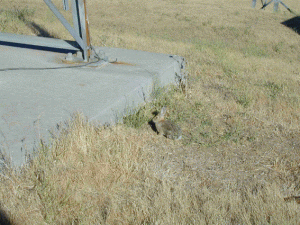
cottontail Altamont
Rabbit in front of its burrow, Altamont Pass wind farm, California – (first generation turbines).


Perched on the still blades (picture further below), or on the nacelles, birds of prey have a commanding view of this exceptional hunting territory. Many will hunt successfully without getting struck by a blade. But their very success will cause their brains to establish a connection between wind turbines and great hunting opportunities. Thus, when they spot some wind turbines, which may be seen from many miles away, they will be attracted to them. Young, unattached raptors will therefore visit many windfarms, and so will adults on migration. Breeding adults, on the other hand, will only visit the wind turbines within their territories, but will do it over and over again. In either case, the more time they spend near the turbines, the greater the chances they will be struck by a blade, the speed of which it is very easy to misjudge .


For birds as for humans, the blades appear to be moving at a leisurly pace. Yet, they travel at up to 300km/h at their tip. Here is the calculation for a 2.3 MW ENERCON Model E-70: 71m (diameter) x 3.14 = circumference of 223m x 21.5 revolutions per minute (in winds above 45 km/h) = 4.794m travelled by the tip of each blade in a minute x 60 minutes = 287,640m travelled in an hour, i.e. at a speed of 287km/h. In low winds, the speed is of 100 – 200 km/h. The difference between apparent slowness and actual high speed, plus the attraction they exert, are what turn wind turbines into deadly traps for birds and bats.


Raptors, experience has shown, are prone to be decimated by wind turbines (13). Yet these birds are very useful to us, as they control certain animal populations (rats, mice, rabbits, and nest plunderers such as magpies, crows etc.). They also eliminate sick or dead animals, thus preventing epidemics and contributing to the health of many species. Their role is important for the maintenance of natural balances, biodiversity and ecosystems. Yet, a new peer-reviewed study is alerting us that wind turbines are partly responsible for the coming extinction of some species of raptors (in southern Europe). One of them, the Egyptian Vulture, is seeing its population of breeding adults decline by 3-4% per year (14). This spectacular glider is already very rare in Europe, and millions of euros have been spent for its protection (and its reintroduction in France).

2_blade_perching_tubular
Photo: Red-tailed hawk perched on a blade, Altamont Pass, California.


Perching opportunities make wind turbines attractive to raptors, so does the prey or carcasses to be found under them (as we commented above). Here are more pictures (15), and videos (25 and 26) proving the point. But consultants promote the fiction that raptors “avoid” wind turbines, and the ornithology profession turns a blind eye to that baseless assertion, all of which is helping their common employers: wind farm promoters. But if raptors avoided wind turbines, why would so many be killed by their blades? (13).


Consultants use a wide array of deceptive tricks, which they developped over the years. I listed some of them years ago in an article, “the Shame of Scotland” (16). One of these tricks has been pushed to unprecedented levels in Australia: the “core-range manipulation” (16). There, consultants have decided, based upon unscientific, biased and unpublishedobservations, that wind turbines can be safely erected as close as 300 meters from the nests of eagles or other raptors. For instance, in the Bulgana Windfarm Flora and Fauna Assessment Report No. 13051 (7.6), page 97, we read: “Previous studies on wind farms have shown that resident Wedge-tailed Eagles are able to successfully nest and raise young on wind farms, if turbines are located at least 300 metres away (BL&A unpublished data )”.

Years ago, I debunked an identical assertion which was based on 24 searches spread over two years at theChallicum Hills wind farm – hardly constituting solid scientific evidence, to say the least. Biosis even admitted:“the work does not discount the possibility of WT eagle collisions” (17). Yet the fiction perdures, and wind turbines continue to be erected in Australia as close as 300 meters from eagle and other raptors’ nests. Nowhere else in the world are protected birds being treated so carelessly. We have seen the tragic results of this attitude at Woolnorth, Macarthur, Starfish Hill, etc. Australia’s eagles are being slaughtered, but the cover-up keeps Australians uninformed.


By contrast, Scottish raptor expert Michael J. McGrady recommends a 5 km buffer zone for the Golden Eagle, in the peer-reviewed study “A model of golden eagle (Aquila chrysaetos) ranging behavior”, J. Raptor Res. 36 (1 Supplement): 62-69 – by McGrady, M.J., Grant, J. R., Baingridge, I. P. & David R.A. McLeod D.R.A. (2002) (18). This study and its recommendation are mentioned in SEO-Birdlife’s guide for the assessment of windfarms as regards bird life, in which one can find the buffer zones recommended by scientists for various protected bird species (18). The shortest is 1 km, for the smallest of the kestrel species. For eagles, they vary from 5 to 10 km (18). Ospreys (“Águila pescadora” in Spanish): 2 km. Peregrine falcons: 2 – 4 km. Cranes: 10 km.


PLUNDERING NATURE WITH PUBLIC FUNDS


Out of control windfarm development is hurting many protected species, riding as it does on the optimistic estimates put out by hired consultants, government agencies, bird societies, the wind industry and its agents, pro-wind activists etc. It is also facilitated by considerable flows of public money, in the form of subsidies, tax credits, special loans, carbon certificates, etc. These millions of dollars (billions in those countries that have thousands of wind turbines) enable private interests to remove all obstacles to their greed, and this includes overriding nature protection legislation. Migration routes and stopover areas, shrinking habitat of threatened species (e.g. brolgas), high bird-traffic areas bordering natural reserves (e.g. Bald Hills, Victoria), nothing is sacred: the plunder has no limits.


Planning authorities which give the green light to wind projects rarely have other bird data at hand than what’s reported in impact studies prepared by unethical consultants. I read about a hundred of these reports over the past 12 years, and none concluded that the impact on the environment would be unacceptable, even when the project was to be located inside a protected nature reserve, or was threatening an endangered species with extinction. None of them was honest, without errors or omissions, and free of manipulations.


MITIGATION


To obtain approval for wind projects that will highly impact protected species, consultants usually suggest applying some techniques for avoiding, minimising, or attenuating the risks of collision. They call these “mitigation”. But we must be aware that none of these schemes, none of these formulas have proved effective. Wherever they have been implemented, they have failed (Altamont Pass, Woolnorth, Smola, Tarifa). The President of the French bird society LPO-Birdlife acknowledged the fact that mitigation does not work (19).


In situations where opponents to a wind project have raised the issue of bat mortality, consultants often propose a mitigation which consists in increasing the cut-in wind speed to, say, 6 meters per second. This means not letting the blades rotate unless the speed of the wind exceeds 22 km/h. The idea is that, as few bats fly when the wind exceeds that speed, mortality will be reduced by about 90%. We would comment on this particular mitigation as follows:

First observation: the promised reduction in mortality to 90% has not been verified. To our knowledge, no wind farm has put this measure into practice and published the results.

Second observation: a 10% residual mortality is considered by consultants to be negligible, as if it were acceptable to kill 1.2 million bats per year instead of 12 million (supposing a country that has, or will have, 18,000 wind turbines as in Spain). Most bat species are endangered, all are extremely useful. Killing them in such numbers is irresponsible. Also consider that the figure of 1,2 million will be much higher, as a) the reduction to 10% is unproven, b) only few wind projects contemplate “bat mitigation”.

Third observation: the practical application of such a measure is not verifiable . Indeed, who would make sure that, during 25 years, the computer program controlling the feathering of the blades a) reflects that mitigation, b) is in good order and c) is being applied? The interest of the windfarm owner is to not apply it, as it reduces his income. Thus, inspectors would be needed, but who would pay them during 25 years? It would have to be the State. And who would ensure that the operators of the wind farms will not “convince” these civil servants to turn a blind eye? Indeed, wind farms are often associated with corruption (20).


BATS


Thus, mitigation of bat mortality is doubtful at best. Yet bats are killed in bigger numbers than birds – about twice as many, i.e. circa 400 per turbine/year, or one bat per turbine/night. According to a study published in France, bats“are the most valuable fauna group” (in French:«constituent le groupe faunistique ayant la plus forte valeur patrimoniale» )(21). Indeed, bat species are very useful to humans, but they all are in decline. To make things worse, their populations cannot recover easily, most females only raising one pup a year.

Many of the chiropter species are classified as threatened with extinction. This is especially worrying because, without bats, farmers, the forest industry, and national forestry administrations would have to use more pesticides to control insects that attack trees and crops. This would lead to undesirable effects on prices and on the health of citizens. Services rendered by bats to US agriculture have been valued at $3.7 billion – $53 billion annually (22). That we know of, no evaluation has been made for services rendered by chiropters to forestry, but their usefulness in controlling some forest pests is recognised (23). Yet they are being killed in their millions by wind turbines. This is causing considerable harm to the environment.


In this video (24), we see bats getting hit by turbine blades, and others falling to the ground due to “barotrauma” (fatal injuries in the lungs caused by large pressure differences created around the blades).


COMPENSATION


The ineffectiveness of mitigation resulted in wily consultants proposing yet another deceptive scheme: “compensation”. This stratagem is useful to businesses that are causing serious harm to nature as a result of their activities. So much so that “offset programs” (27) are being set up, fooling people into believing that destroying more nature can be compensated. “No net biodiverity loss” is the publicised goal, but it is yet another scam to facilitate more plundering of nature. It boggles the mind to see most ecologists and bird societies support this. Here again, ethics vanish where there is money to be made…


Natural wetlands cannot be replaced by man-made reservoirs, any more than destroying primary tropical forests can be compensated by planting eucalyptus, nor killing birds of a protected species can be offset by giving money to a bird society. This scheme of redeeming one’s ecological sins with money is not without parallel with the indulgences that were sold by the Church in the Middle Ages.


Compensation is increasingly being used in the windfarm business. For instance, it is being alleged that, if new hunting areas for raptors are created nearby, it is acceptable to install wind turbines in their breeding territories. But this only works on paper. It hasn’t been successful anywhere in the world. The example of Beinn an Tuirc, Scotland, is sometimes quoted by some consultant as a reference. But this example is anything but conclusive. I exposed its false claim to success years ago (28).


The since-discovered fact that raptors are attracted to wind turbines further proves the ineffectiveness of this compensation. A wind farm is a giant bird trap which acts as a population sink, attracting its victims from many miles around. Nothing can compensate this ongoing massacre. Creating new hunting grounds next to it is as absurd as “killing the children but building orphanages”. .


No government in the world has considered objectively the cumulative effects of so many wind turbines, each of them an ecological trap attracting and killing many protected species. Some residents report that, since wind turbines were built, there are no more bats where they live; others noted that they see fewer and fewer raptors. Swallows and swifts are becoming rarer too, according to others.


The situation is serious, if only because these species are of great benefit to humanity. Natural equilibriums are also at risk, and so is quality of life. Are we willing to replace our countryside with industrial landscapes, our birds and bats with crop dusters? Where are we headed, with this “green” ideology which destroys nature by calling for a new, unnecessary industrial revolution, and misleads people into thinking it’s for the greater good of the planet?


What an awful mess are these ideologues making of our world, under the pretext of saving it… The wind industry has never been able to prove it can achieve its goal of significantly reducing harmful emissions. The wind’s intermittency stands in its way. The German experience is far from being conclusive in this regard, to say the least (29). A few years from now, when all the expensive tinkering will have failed (more power lines, international connections, smart meters, giant batteries, reservoirs and pumping stations, etc.), the Germans will have to face the harsh reality: wind intermittency has no economically viable solution.


Independent engineers keep repeating it (30), but stubborn governments are not listening. Through the famous “revolving door” of politics, wind power subsidies help finance political parties. Thus, cutting subsidies would be suicide for the party that would decide to do so (30). The wind industry clearly calls the shots, be it in Canberra, Copenhagen, London, Berlin, Paris or Washington.


The renewable energy bubble has burst in Spain and other southern European countries. It occurred when the cost of subsidies became unaffordable, i.e. when these countries became technically bankrupt and HAD to cut down on government expenses. When this happened, the so-called “green jobs” vanished. The countries were left with households impoverished by the high cost of “renewable” electricity. Some companies relocated abroad due to this cost, or are contemplating doing so. Tourists looking for nature, landscapes and relaxation choose other destinations. In the countryside, residents are poorer as their homes are worth a fraction of their normal value. Many live unhappy lives because of the Wind Turbine Syndrome, shorter too as they suffer chronically from high levels of cortisol. As for the birds, they keep being chopped up year after year…


Mark Duchamp
Chairman, World Council for Nature
Tél: +34 693 643 736 wcfn@live.com


References:


1) –http://www.environment.gov.au/system/files/resources/2d42fcbd-31ea-4739-b109-b420571338a3/files/wind-farm-bird-risk.pdf page 32 of TWTE modelling study


2) – http://www.smh.com.au/environment/animals/deaths-of-rare-eagles-rise-20101116-17vy7.html


3) –http://www.iberica2000.org/documents/eolica/BIRD_MORTALITY/Yaloak_South_Debus_comments.pdf


4) – http://www.iberica2000.org/Es/Articulo.asp?Id=4382


5) –http://www.weeklytimesnow.com.au/news/national/wind-farm-turbines-take-toll-on-birds-of-prey/story-fnkfnspy-1227066199577


(6) – http://www.lefigaro.fr/sciences/2007/03/19/01008-20070319ARTFIG90140-l_effet_des_eoliennes_sur_les_oiseaux.php


(7) –http://onlinelibrary.wiley.com/doi/10.1002/wsb.260/abstract


(8) – (Koop B., 1997. Vogelzug und Windenergieplanung. Beispiele für Auswirkungen aus dem Kreis Plön (Schleswig-Holstein). Naturschutz und Landschaftsplanung 29 (7): 202-207).


(9) –http://savetheeaglesinternational.org/releases/spanish-wind-farms-kill-6-to-18-million-birds-bats-a-year.html


(10) –http://www.iberica2000.org/documents/EOLICA/REPORTS/Dave_Sterner_2002.pdfPage 12, 1er paragraphe.


(11) –http://es.wikipedia.org/wiki/Alejandro_S%C3%A1nchez_P%C3%A9rez


(12) – http://wcfn.org/2013/07/24/biodiversity-alert/


(13) – Some of the eagles killed by wind turbines (tip of the iceberg)
http://www.iberica2000.org/es/Articulo.asp?Id=3071 – Last updated in 2006

– Some of the ospreys killed by wind turbines (tip of the iceberg)
http://savetheeaglesinternational.org/new/843-2.html

– Effects on red kites
http://rapaces.lpo.fr/sites/default/files/milan-royal/63/actesmilan150.pdf (pages 96, 97).


(14) – Study “Action on multiple fronts, illegal poisoning and wind farm planning, is required to reverse the decline of the Egyptian vulture in southern Spain”
Ana Sanz-Aguilar, José Antonio Sánchez-Zapata, Martina Carrete, José Ramón Benítez, Enrique Ávila, Rafael Arenas f, José Antonio Donázar (a).
Study published on April 21 2015 by ELSEVIER, Biological Conservation, Volume 187, July 2015, pages 10–18
http://www.sciencedirect.com/science/article/pii/S0006320715001408


(15) – –https://savetheeagles.wordpress.com/2013/05/28/raptors-attracted-to-windfarms-2/


(16) – The Shame of Scotland:http://www.iberica2000.org/es/Articulo.asp?Id=3426
See –> ” 3 . THE CORE RANGE MANIPULATION ”


(17) – http://www.iberica2000.org/es/Articulo.asp?Id=4313
See –> ” 4 – The precedent of Challicum Hills ”


(18) – https://www.seo.org/wp-content/uploads/2012/05/MANUAL-MOLINOS-VERSION-31_WEB.pdf
See –> Annex II, pages 106 and 107
Literature review of recommended buffer zones and sizes of home range for eagles and other raptors.


(19) –https://conseilmondialpourlanature.wordpress.com/2014/12/01/lpo-et-systemes-de-dissuasion-avienne/


(20) – http://wcfn.org/2015/04/22/huge-wind-farm-corruption-scandal-in-spain/


(21) –http://www.aude.gouv.fr/IMG/pdf/Etude_d_impacts_CVO_21-06-2013_Partie2_cle55bcf8.pdf
See –> page 89


(22) –
http://www.usgs.gov/newsroom/article.asp?ID=2743#.VU4hv_ntmkp


(23) –http://www.ncbi.nlm.nih.gov/pmc/articles/PMC4186828/


(24) – VIDEO http://savetheeaglesinternational.org/bats-struck-by-wind-turbines.html


(25) – VIDEO http://savetheeaglesinternational.org/vulture-struck-by-wind-turbine.html


(26) – VIDEO http://savetheeaglesinternational.org/vultures-killed-videos.html


(27) – http://bbop.forest-trends.org/


(28) –http://www.iberica2000.org/Documents/eolica/BIRD_MORTALITY/Critique_Beinn_an_Tuirc_report.rtf


(29) –
http://online.wsj.com/articles/germanys-expensive-gamble-on-renewable-energy-1409106602 Available upon request to wcfn@live.com


(30) – http://www.epaw.org/documents.php?lang=en&matter=backup


(31) – http://en.friends-against-wind.org/realities/windfarms-are-only-good-for-financing-political-parties


X X X

Wind Energy….NOT clean, NOT green, NOT affordable!

Wind Power’s Toxic Embrace

china rare earth toxic lake

Our Toxic Relationship with Wind Power
The Valley Patriot
Christine Morabito
February, 2015

If clean, safe and efficient energy is to be our standard, then why use wind power at all?

When we examine the entire process, the construction and operation of wind turbines is a dangerous and toxic affair. It begins with the mining of rare earth minerals, a collection of chemical elements manufactured mostly in China. The ill-protected workers are exposed to hazardous materials like hydrofluoric acid and radioactive particles. These substances are then exported worldwide, for use in wind turbines as well as computers, cell phones, hybrid cars and energy saving light bulbs.

The process of refining of these elements leaves death and destruction in its wake, polluting farmland, killing livestock, seeping into waterways and poisoning drinking water. Besides the devastation to the environment, nearby villagers report significant health problems, like bone, respiratory and heart diseases. Some residents suffer helplessly while their teeth fall out. But, since all this is occurring in the Far East, Western environmentalists don’t seem particularly concerned.

Meanwhile, in the United States, the massive windmills gobble up valuable habitat, as do the roads needed to access them. These eyesores ruin otherwise picturesque landscapes, and are built with little regard for the migratory paths of protected wildlife. The deadly blades can reach speeds up to 170 mph, often chopping birds into pieces. Most recent data estimates that 600,000 birds and hundreds of thousands of bats fall prey to this “green” technology every year.

Just east of San Francisco lies a 58 square mile wind farm called theAltamont Pass. The turbines have reportedly killed some 3,000 golden eagles, putting their population in serious jeopardy.

In the 30-odd years that wind energy has existed, only 2 companies have been prosecuted for illegally killing protected birds. The first was in 2013, when the U.S. Department of Justice and Duke Energy, of Wyoming, announced a $1 million settlement related to the deaths of 14 golden eagles and 149 hawks, blackbirds, larks, wrens and sparrows.

In January, 2015, Pacific Corp, also in Wyoming, was ordered to pay $2.5 million for killing 38 golden eagles and 336 other protected birds.

Under the auspices of fighting climate change, the Obama Administration is awarding wind-power companies a 30-year amnesty in the form of “take permits,” which allow the killing of endangered species. It’s ironic that our tax dollars are being used to study and protect endangered species, while simultaneously subsidizing an industry that is killing the aforementioned animals.

By working with the U.S. Fish and Wildlife Service, wind producers can avoid creating killing fields. The key is to bypass well-known migration routes.

I spoke to Bob Johns, Public Relations Director at the American Bird Conservancy. When holding energy companies accountable, Johns says, “green energy is held to a different standard.” The problem is one of selective enforcement. Fish and Wildlife Service guidelines are voluntaryand not enforced via regulation like those governing oil and electric companies. Johns stressed that “wind producers are not ‘mom and pop’ businesses, but large corporations,” with little incentive to follow mere guidelines. He believes regulations are needed to stop the egregious killing of birds and level the playing field. Deadly turbines are a worldwide problem, with wind farms in Spain, Belgium, Sweden, Germany and the Netherlands, among others.

What exactly is the up-side? Wind energy is expensive, costing about twice as much as conventional power sources. And, since wind is heavily subsidized, taxpayers fund it before and after it is produced, as evidenced by the infamous Cape Wind project in Massachusetts, which is already $10 million over budget. Wind energy is not particularly efficient, producing only between 3 to 4 percent of our country’s electricity. Like other alternative energy sources, turbines must be backed-up by fossil fuels when the wind isn’t blowing.

Like all fledgling energy sources, new technologies, combined with regulations, will make wind energy safer, cleaner and more efficient. Through innovative filtration systems, we have made great strides inremoving pollutants from fossil fuel emissions. The plastics we have come to rely on were once discarded waste products from oil refining, proving that the human race will continue to innovate – because that’s what we do.

While there is risk in producing every type of energy, the risks of using fossil fuels are greatly exaggerated; the benefits rarely mentioned. The well-funded, well-connected environmental lobby has an ideological, knee-jerk reaction to energy. In their world, fossil fuels = bad, alternative energy = good.

Massachusetts State Senator, Kathleen O’Connor Ives plans to introduce legislation to ban the practice of hydraulic fracturing (fracking) in Massachusetts. While carrying some hypothetical risk, fracking has the phenomenal ability to make America energy independent. Lower energy costs make us all richer, and we are sending billions less to our oil producing enemies – who, as we speak, are plotting our demise.

I know Senator Ives to be a reasonable legislator, and I’m hoping she and others will consider the pros and cons of every energy source at our disposal. In our quest for energy alternatives, facts should trump ideology. The earth and all its inhabitants deserve nothing less.
The Valley Patriot

christine morabito1

Wonderful News! The Blanding’s Turtle Will Be Protected After All!

Turtle beats turbine

Mon, Apr 20th, ’15

Blandings-road-800x600

An endangered species has won the power struggle over Ostrander Point as Ontario’s top court has ruled in favour of the Blanding’s turtle over turbines.

In a historic ruling the Ontario Court of Appeal overturned a provincial court decision in relation to the Renewable Energy Approval of Gilead Power’s nine turbine project.

Prince Edward County Field Naturalist President Myrna Wood.

Lawyer Eric Gillespie says this case represents the first time ever that the Environmental Review Tribunal said that their would be serious and irreversible harm to the Blanding’s Turtle and the Ontario Court of Appeal chose appropriately to uphold that decision.

Gillespie says Gilead now has a couple of options going forward one of them being to ask the Supreme Court of Canada in Ottawa to hear the case. He says there’s no automatic right to do that you need leave or permission from the Supreme Court.

Gillespie says the other way that this is definitely going to play out is the Environmental Review Tribunal has been asked by the Ontario Court of Appeal to hear some further submissions on what the solution to this situation should be.

Gillespie chuckled anyone who has ever been to Ostrander Point knows there’s all kinds of ways to get into the point and a a simple gate across a road isn’t going to stop people visiting that site. He says unless there is something completely new that nobody has heard of yet it would be somewhat certainly surprising to our clients if the ERT does anything different than what they originally decided.

PECFN member Cheryl Anderson says the naturalists are more than willing to show the Tribunal how putting gates on the very access roads, which will cause the irreversible harm, is no remedy at all.

The Ministry of Environment says it hasn’t decided how to proceed as of yet.

Gilead Power hasn’t responded to our requests for comment on whether or not they plan to ask for permission to escalate this to the Supreme Court of Canada.

To read the full judgement click here.

Huron County – Trouble in Paradise, for Wind Pushers…

Huron County Pushes Stop Button on Wind Development

With more than 300 wind turbines, officials say they’ve had enough!

Local officials at Michigan’s ground zero for wind energy are telling wind developers “enough is enough.” Huron County has 328 wind turbines, more than all of the other Michigan counties combined. But it has just enacted a moratorium on any additional ones until stricter regulations for industrial wind turbines can be put in place.

“What this means is no turbines for people who don’t want them,” Huron County Commissioner John Nugent said. “The people who want them can still have them as long as it doesn’t adversely affect their neighbors.”

At its final March meeting the Huron County Commission voted 4-3 to adopt the moratorium, which will last 90 days, or until the county zoning ordinance is updated with changes recommended by the county’s wind energy zoning committee. If the changes aren’t enacted within 90 days the moratorium could be extended until they are.

Nugent said there is no secret about what the new regulations will be like. They will include increasing the setback distance for the turbines, creating tighter noise restrictions, eliminating turbine flicker for the homes of nonparticipating residents, and a ban on wind development within three miles of the Lake Huron shoreline. This three-mile no-windmill zone was recommended by the U.S. Fish and Wildlife Service.

The county’s wind energy zoning committee has been working on revisions for more than a year, and a possible moratorium has been under discussion by the board of commissioners for months. On Dec. 30, 2014, the board voted to seek legal assistance for drafting a moratorium. In addition to the moratorium, the board has also taken action to assure it covers wind developers that had already submitted site plan review requests to the planning commission.

Complaints that living near industrial wind turbines causes adverse health impacts have been voiced worldwide. They include symptoms such as headaches and dizziness allegedly caused by exposure to low-frequency noise, infrasound emitted by the turbines and visual problems allegedly caused by the flicker effect of the turbine blades.

“This is a big deal,” said Kevon Martis director of the Interstate Informed Citizens Coalition (IICC), a nonprofit organization that is concerned about the construction of wind turbines in the region. “The moratorium in Huron County is a significant blow to Michigan wind development. Wind developers will no doubt continue to whistle past the tombstones and claim that most people do not mind having entire townships and counties turned into 50-story-tall power plants. But as wind development has increased in Michigan, people’s voices of protest have also increased. And most communities hosting wind turbines are now using every legal and regulatory means at their disposal to stop the bleeding.”

Minnesota-based Geronimo Wind Energy, arguably the wind developer most immediately affected by the moratorium, did not respond to a phone call offering the opportunity to comment.

~~~~~

Huron County Looks at Wind Turbine Moratorium

Wisconsin Wind Turbines Declared Health Hazard

Utility Appeals Wind Turbine Noise Ruling

Court Backs Finding of Wind Turbine Noise Problem

Utility Asks Court To Slap Down Excessive Wind Turbine Noise Finding

Michigan’s Renewable Energy Mandate Causing Harm, Probably Unconstitutional

Energy Company At Odds With County Over Safety of Wind Turbines

Lawsuit Alleges Wind Power A Threat To Health and Safety

Most of Michigan Is ‘Poor’ or ‘Marginal’ For Wind Energy

Effort In Lansing To Override Voters’ Rebuke of Higher-Cost Energy Mandate

Wind Industry claims Wind Turbines are Safe….Facts Show Otherwise!

Wind Turbine Blade Throw: Senate Inquiry Gives Chance to Hammer Insanely Dangerous Setback Rules: Submissions Extended to 4 May

goldfinger

****

The number of cases involving collapsing turbines and flying blades (aka “component liberation”) has become so common that, if we were a tad cynical, we would go so far to suggest the possibility of some kind of pattern, along the lines proffered by Mr Bond’s nemesis, Goldfinger: “Once is happenstance. Twice is coincidence. Three times it’s enemy action”.

Turbines have been crashing back to earth in frightening numbers – from Brazilto KansasPennsylvaniaGermany and ScotlandDevon and everywhere in between: Ireland has been ‘luckier’ than most (see our posts here and here).

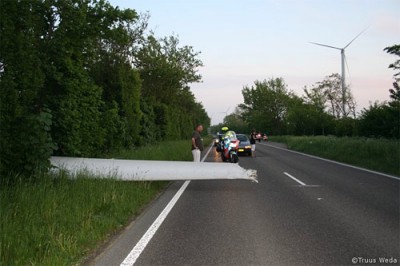
Then there’s the wild habit of these little ‘eco-friendlies’ unshackling their 10 tonne blades, and chucking them for miles in all directions – as seen in the video below – and see our posts here and here and here and here.

****
****

In one serious scientific study into the distances blades are likely to travel during “component liberation” – covering over 37 “component liberation” events – blade throw distances of up to 1,600 m were recorded: that study was completed in 2007 – there have been many more bids for blade “freedom” since then (up to 2014 there have been 309 ‘incidents’, as detailed below).

In Australia, for “planning” purposes, the various states have a variety of “set-back” distances between wind turbines and residential homes – said (laughably) to avoid noise impacts: in South Australia it’s 1km.

For a few years the Victorians set it at 2km – but, before 2007 there was no set-back required and plenty of homes ended up with turbines within 600m. However, there is no such limit placed on the distance between roads and turbines.

turbinedutchbladeaccident

****

The eco-fascist nutjobs – that have just taken charge in Victoria – haveslashed the set-back distances to 1km – further demonstrating their naked stupidity and rancid hatred of country people. Under Victoria’s new ‘rules’, residential homes are now well within the throw zone; with no set-back from roads at all, road-users are sitting ducks.

With whole (50m) blades travelling up to 200m, bigger heavier chunks likely to travel well over 300m and the smaller pieces (referred to in the study linked above as “10% blade fragments”) flying out to distances of up to 1,600m (for a 10% blade fragment – think 5m long blade chunks weighing a tonne or so) – the current setback rule in South Australia – and what the eco-fascists just gave Victoria – places wind farm neighbours well and truly within the “throw zone”.

And with those numbers in mind, think about whole blades – or substantial chunks of them – being flung around with gay abandon the next time you drive past the turbines at Cullerin and Macarthur, some of which are less than 300m from the road you’re on.

Fortunately, when it comes to the risks posed by flying turbine blades, it’s the complete disregard paid to health and safety by planning departments and the risible “rules” written for them by their wind industry Overlords – that is squarely in the sights of the Senate Select Committee, its terms of reference including the following:

(1) That a select committee, to be known as the Select Committee on Wind Turbines be established to inquire into and report on the application of regulatory governance and economic impact of wind turbines by 24 June 2015, with particular reference to:

(d) the implementation of planning processes in relation to wind farms, including the level of information available to prospective wind farm hosts;

(e) the adequacy of monitoring and compliance governance of wind farms;

(f) the application and integrity of national wind farm guidelines;

(i) any related matter.

For those living in, or driving through, the wind turbine blade “throw zone” now is you chance to hammer the so-called ‘standards’ and planning ‘controls’ that have (or will) put you in it.

Why not drop a submission to the Senate Inquiry along those lines?  Note that the opportunity to make submissions to the Committee ends on 4 May 2015. See the link here.

To help with your submissions, we’ve popped up a fine piece of work put together by the Caithness Windfarm Information Forum below. Consider, be afraid and let your Senators know just how insanely dangerous this eco-fascist driven nightmare has all become.

Summary of Wind Turbine Accident data to 31 December 2014 (Download as a PDF)

These accident statistics are copyright Caithness Windfarm Information Forum 2014.  The data may be used or referred to by groups or individuals, provided that the source (Caithness Windfarm Information Forum) is acknowledged and our URL www.caithnesswindfarms.co.uk quoted at the same time.Caithness Windfarm Information Forum is not responsible for the accuracy of Third Party material or references.

The detailed table includes all documented cases of wind turbine related accidents and incidents which could be found and confirmed through press reports or official information releases up to 31 December 2014. CWIF believe that this compendium of accident information may be the most comprehensive available anywhere.

Data in the detailed table is by no means fully comprehensive – CWIF believe that it may only be the “tip of the iceberg” in terms of numbers of accidents and their frequency. Indeed on 11 December 2011 the Daily Telegraph reported that RenewableUK confirmed that there had been 1500 wind turbine accidents and incidents in the UK alone in the previous 5 years. Data here reports only 142UK accidents from 2006-2010 and so the figures here may only represent 9% of actual accidents.

The data does however give an excellent cross-section of the types of accidents which can and do occur, and their consequences.With few exceptions, before about 1997 only data on fatal accidents has been found.

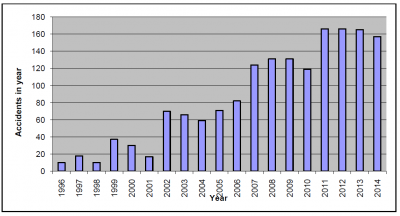
The trend is as expected – as more turbines are built, more accidents occur. Numbers of recorded accidents reflect this, with an average of16 accidents per year from 1995-99 inclusive; 48 accidents per year from 2000-2004 inclusive; 108 accidents per year from 2005-09 inclusive, and 155 accidents per year from 2010-14 inclusive.

accidents per year

This general trend upward in accident numbers is predicted to continue to escalate unless HSE make some significant changes – in particular to protect the public by declaring a minimum safe distance between new turbine developments and occupied housing and buildings.

In the UK, the HSE do not currently have a database of wind turbine failures on which they can base judgements on the reliabilityand risk assessments for wind turbines. Please refer to http://www.hse.gov.uk/research/rrpdf/rr968.pdf.

This is because the wind industry “guarantees confidentiality” of incidents reported see  http://www.renewableuk.com/en/our-work/health-and-safety/incidents–alerts.cfm. No other energy industry works with such secrecy regarding incidents. The wind industry should be no different, and the sooner RenewableUK makes its database available to the HSE and public, the better. The truth is out there, however RenewableUK don’t like to admit it.

Some countries are finally accepting that industrial wind turbines can pose a significant public health and safety risk. The Scottish government has proposed increasing the separation distance between wind farms and local communities from 2km to 2.5km (http://www.bbc.co.uk/news/uk-scotland-scotland-politics-26579733) though in reality the current 2km separation distance is often shamefully ignored during the planning process.

Our data clearly shows that blade failure is the most common accident with wind turbines, closely followed by fire. This is in agreement with a recent survey by GCube, the largest provider of insurance to renewable energy schemes. Their recent survey reported that the most common type of accident is indeed blade failure, and that the two most common causes of accidents are fire and poor maintenance.  http://www.gcube-insurance.com/press/gcube-top-5-us-wind-energy-insurance-claims- report/

Data on the detailed list is presented chronologically.  It can be broken down as follows:

Number of accidents

Total number of accidents: 1662

By year:

accident table

Number of fatal accidents: 110

Fatal accidents

By year:

fatalities

Of the 151 fatalities:Please note: There are more fatalities than accidents as some accidents have caused multiple fatalities.

  • 90 were wind industry and direct support workers (divers, construction, maintenance, engineers, etc), or small turbine owner /operators.
  • 62 were public fatalities, including workers not directly dependent on the wind industry (e.g. transport workers). 17 bus passengers were killed in one single incident in Brazil in March 2012; 4 members of the public were killed in an aircraft crash in May 2014.

Human injury

130 accidents regarding human injury are documented.

By year:

human injury

107 accidents involved wind industry or construction/maintenance workers, and a further 23 involved members of the public or workers not directly dependent on the wind industry (e.g. firefighters, transport workers). Six of these injuries to members of the public were in the UK.

Human health

Since 2012, 52 incidents of wind turbines impacting upon human health are recorded.

By year:

human health

Since 2012, human health incidents and adverse impact upon human health have been included.

These were previously filed under “miscellaneous” but CWIF believe that they deserve a category of their own. Incidents include reports of ill-heath and effects due to turbine noise, shadow flicker, etc. Such reports are predicted to increase significantly as turbines are increasingly approved and built in unsuitable locations, close to people’s homes.

Blade failure

By far the biggest number of incidents found was due to blade failure. “Blade failure” can arise from a number of possible sources, and results in either whole blades or pieces of blade being thrown from the turbine. A total of 309 separate incidences were found:

By year:

blade failure

Pieces of blade are documented as travelling up to one mile. In Germany, blade pieces have gone through the roofs and walls of nearby buildings. This is why CWIF believe that there should be a minimum distance of at least 2km between turbines and occupied housing, in order to adequately address public safety and other issues including noise and shadow flicker.

Fire

Fire is the second most common accident cause in incidents found. Fire can arise from a number of sources – and some turbine types seem more prone to fire than others. A total of 242 fire incidents were found.

By year:

fire

The biggest problem with turbine fires is that, because of the turbine height, the fire brigade can do little but watch it burn itself out. While this may be acceptable in reasonably still conditions, in a storm it means burning debris being scattered over a wide area, with obvious consequences. In dry weather there is obviously a wider-area fire risk, especially for those constructed in or close to forest areas and/or close to housing. Three fire accidents have badly burned wind industry workers.

Structural failure

From the data obtained, this is the third most common accident cause, with 157 instances found.

“Structural failure” is assumed to be major component failure under conditions which components should be designed to withstand. This mainly concerns storm damage to turbines and tower collapse. However, poor quality control, lack of maintenance and component failure can also be responsible.

By year:

structure

While structural failure is far more damaging (and more expensive) than blade failure, the accident consequences and risks to human health are most likely lower, as risks are confined to within a relatively short distance from the turbine. However, as smaller turbines are now being placed on and around buildings including schools, the accident frequency is expected to rise.

Ice throw

35 reports of ice throw were found. Some are multiple incidents. These are listed here unless they have caused human injury, in which case they are included under “human injury” above.

By year:

ice throw

These are indeed only a very small fraction of actual incidences – a report* published in 2003 reported 880 icing events between 1990 and 2003 in Germany alone. 33% of these were in the lowlands and on the coastline.Ice throw has been reported to 140m. Some Canadian turbine sites have warning signs posted asking people to stay at least 305m from turbines during icy conditions.

Additionally one report listed for 2005 includes 94 separate incidences of ice throw and two reports from 2006 include a further 27 such incidences. The 2014 entry refers to multiple YouTube videos and confirmation that ice sensors do not work.

Transport

There have been 137 reported accidents – including a 45m turbine section ramming through a house while being transported, a transporter knocking a utility pole through a restaurant, and various turbine parts falling off and blocking major highways. Transport fatalities and human injuries are included separately. Most accidents involve turbine sections falling from transporters, though turbine sections have also been lost at sea, along with a £50M barge. Transport is the single biggest cause of public fatalities.

By year:

transport

Environmental damage (including bird deaths)

162 cases of environmental damage have been reported – the majority since 2007. This is perhaps due to a change in legislation or new reporting requirement. All involved damage to the site itself, or reported damage to or death of wildlife. 57 instances reported here include confirmed deaths of protected species of bird.Deaths, however, are known to be far higher. At the AltamontPass windfarm alone, 2400 protected golden eagles have been killed in 20 years, and about 10,000 protected raptors (Dr Smallwood, 2004). In Germany, 32 protected white tailed eagles were found dead, killed by wind turbines (BrandenburgState records). In Australia, 22 critically endangered Tasmanian eagles were killed by a single windfarm (Woolnorth). Further detailed information can be found at:  www.iberica2000.org/Es/Articulo.asp?Id=3071 and at:  www.iberica2000.org/Es/Articulo.asp?Id=1875

  • 600,000 bats were estimated to be killed by US wind turbines in 2012 alone.
  • 1,500 birds are estimated to be killed per year by the MacArthur wind farm in Australia, 500 of which are raptors.

By year:

environment

Other (miscellaneous)

328 miscellaneous accidents are also present in the data. Component failure has been reported here if there has been no consequential structural damage. Also included are lack of maintenance, electrical failure (not led to fire or electrocution), etc. Construction and construction support accidents are also included, also lightning strikes when a strike has not resulted in blade damage or fire. A separate 1996 report** quotes 393 reports of lightning strikes from 1992 to 1995 in Germany alone, 124 of those direct to the turbine, the rest are to electrical distribution network.

By year:

other

Caithness Windfarm Information Forum 31 December 2014

* (“A Statistical Evaluation of Icing Failures in Germany‟s „250 MW Wind‟ Programme – Update 2003, M Durstwitz, BOREAS VI 9-11 April 2003 Pyhätunturi, Finland. )

** (Data from WMEP database: taken from report “External Conditions for Wind Turbine Operation – Results from the German „250 MW Wind‟ Programme”, M Durstewitz, et al, European Union Wind Energy Conference, Goeteborg, May 20-24, 1996)

Tip of the iceberg

Frauds, Crooks and Criminals

Demonstrating daily that diversity is not strength!

Family Hype

All Things Related To The Family

DeFrock

defrock.org's principal concern is the environmental and human damage of industrial wind turbines on rural communities

Gerold's Blog

The truth shall set you free but first it will make you miserable

Politisite

Breaking Political News, Election Results, Commentary and Analysis

Canadian Common Sense

Canadian Common Sense - A Unique Perspective from Grassroots Canadians

Falmouth's Firetower Wind

a wind energy debacle

The Law is my Oyster

The Law and its Place in Society

Illinois Leaks

Edgar County Watchdogs

stubbornlyme.

My thoughts...my life...my own way.

Oppose! Swanton Wind

Proposed Wind Project on Rocky Ridge

Climate Audit

by Steve McIntyre

4TimesAYear's Blog

Trying to stop climate change is like trying to stop the seasons from changing. We don't control the climate; IT controls US.

Wolsten

Wandering Words

Patti Kellar

WIND WARRIOR

John Coleman's Blog

Global Warming/Climate Change is not a problem