As the world wakes up to the scale and scope of the great wind power fraud – its inordinate cost to power consumers and taxpayers – the state-sponsored, malfeasance of the wind power outfits that ride the subsidy gravy train, and roughshod over hard-working rural people – and the bitter community division and hatred its roll-out brings – those who have aided and abetted it, have a choice: either pop their consciences into a lead-lined box (so as to avoid any pangs of personal guilt); or front-up to the better Angels of their natures; and seek redemption, and forgiveness, for the unnecessary damage that they’ve caused.
Jane Harper has, to her credit, plumped for the latter. Here’s her story.
Tipton County Indiana Commissioner voted for “wind farms”, now lives with regrets
Jane Harper
Huntington County Concerned Citizens
19 March 2015
Dear Howard County Commissioners and Council Members,
I am writing to you all as a former commissioner colleague who aided in the negotiations and agreements with E.ON Climate Renewables with Tipton County in 2011.
From the onset, I was open to windfarm development in a small section of Tipton County because the commissioners had received no opposition and I felt that the landowners wanted it.
My own family was offered an opportunity to lease land to E.ON and we declined because my husband did not care to farm around the towers, and I just didn’t want to look at them. I set my own personal views aside and made decisions based on what I felt the majority of the public wanted. I was outspoken enough, however, to say that I would never support a plan to cover a large portion of the county with wind turbines.
As it turned out, the problem was that when the decisions were being made to build “Wildcat I”, the commissioners were not hearing from the “majority”. People really did not know this was happening, or if they did, they did not perceive it to be as “invasive” as it was. As you know, public notices are small and often overlooked in the newspaper, so not much resistance was present … until the towers went up, and people saw how enormous and intrusive they were. The red blinking lights even disturb my own summer evenings and my home is 6 miles from the closest tower!!!
You don’t have the time to read all that I could tell you, so in a nutshell, I just want to say that I wish I had the knowledge then that I have now.
However, what I can do, is to try to pass some of what I know, onto the elected officials in the neighboring county, so that perhaps you can gain some wisdom from what I learned in the school of hard knocks.
In Tipton County … my 83 year old mother is mad at me (since I signed the agreements) because she no longer has colorful birds coming to her feeders … my brother’s view from his family dining room table used to be a vast expanse of crops and natural habitat … now that pristine ‘vista’ is forever marred by giant metal structures … neighbors hate each other … back and forth letters to the editor have been selling papers for over a year now … families are torn apart, and because the physical presence of the towers will be there for 30 years, these relationships will never be repaired. In short … this has become an issue that has divided our community like no other.
It has torn our county apart. The May, 2014 primary election is evidence that the majority of the voters supported candidates openly opposed to wind farm development and an incumbent commissioner was voted out of office due to his unwillingness to listen to the majority on any issue, including wind.
If I had this to do over, I would NEVER enter into an agreement with any wind company now that I know what it has done to my home community.
I am not proud that my name is on those documents.
The wind company has breached many parts of the agreement, but insist that their failures are “minor”. Their field representative is arrogant and cavalier in his attitude toward the people who are suffering with the effects of the noise and flicker.
You can’t lose something you never had … so you are not “losing” the supposed ‘windfall’ of money that the project purportedly brings in.
What you WILL lose however, cannot be measured in dollars.
You will lose the rural landscape as you know it and you will lose the closeness of “community spirit” because people will hate each other over this and the presence of the towers will always be a constant reminder of the rift … thus the wounds will never heal.
Please consider this: What do you think of a company that KNOWS it has fierce opposition from a segment of the Howard County citizenry, but would STILL want to build in your county?
It is akin to forcing themselves onto you when they KNOW they are not wanted by those in the project area who would be affected by their presence and are receiving no compensation for the change in their environment. How much of a “community partner” would they be when they really don’t care about the wishes of the people?
I don’t know anything about which “facts” are true and which “facts” are false with regard to property values and personal health issues.
But what I DO know as fact is this: Any issue that has become so contentious that it has caused large groups of people to assemble and vehemently oppose it … and which has caused so much heartache and angst among the citizenry … just cannot be good for the whole. I do not feel that Tipton County will ever wholly heal from the deep personal wounds incurred by many from the placement of wind turbines in our county.
I will leave you with this last piece of wisdom from someone who has “been there, done that”.
As an elected official/public servant … if you must go forward with approvals that allow wind farm development … and thus you become the reason a wind farm was built in Howard County … it will be a decision you will regret the rest of your life.
You will join me.
Jane Harper
Tipton County Commissioner 2009-2012. Illinois Leaks
“People are willing to tolerate, approve, and contribute to the torture of their neighbors with the ill effects of wind turbines simply because they have been told by public officials, the media, or green zealots that it is necessary to ‘save the planet’ from global climate change.”
By Curt Devlin
It is easy to forget just how essential sleep is to health and happiness; until of course, you yourself have been deprived of it for a night or two. Firsthand experience of sleep deprivation, even for a few days, is a powerful reminder of how mentally and physically debilitating it is. Even the ongoing disruption or restriction of sleep for a relatively short period of time can have devastating health consequences. Medicalresearch has clearly shown that sleep is essential to human health and wellbeing. Prolonged sleep deprivation has been linked to memory loss, hallucination, weakened resistance to pain, obesity, hypertension, diabetes, impaired immune response, extreme anxiety, stress, clinical depression, and suicide. In the most extreme cases, animal experimentation suggests that lack of sleep can kill you.
Sleep deprivation has long been recognized as torture by the Geneva Conventions of 1949, the United Nations Convention against Torture (CAT), and the United States War Crimes Act. Depriving someone of proper sleep is torture, regardless of whether it is perpetrated by the CIA against suspected terrorists, OR by reckless planning authorities who permit the wind industry to site industrial-scale wind turbines in residential neighborhoods, or by noise pollution regulatory authorities and health authorities who ignore consistent reports of sleep deprivation from neighboring residents. When authorities deem developments “compliant” with regulations, or wind developers effect specious mitigations; they are inflicting torture. They are violating fundamental human rights.
Recently, the U.S. Senate Intelligence Committee released what has come to be known as the Torture Report. It reveals that sleep deprivation was one of the frequently used CIA “enhanced interrogation” tactics. The use of prolonged sleep deprivation led Committee Chairman, Diane Feinstein to conclude “…that, under any common meaning of the term, CIA detainees were tortured.” She goes on to say “…that the conditions of confinement and the use of authorized and unauthorized interrogation and conditioning techniques were cruel, inhuman, and degrading.” The same can be said of the practice of siting industrial turbines too close to homes. Failure to take action to stop excessive noise pollution, or to enforce existing legal limits on “noise nuisance” whenever noise-induced sleep disturbance or deprivation is reported by wind turbine neighbors, hosts, or their families is full complicity with torture.
It is grimly ironic that the US Senate Committee condemns sleep deprivation as cruel and inhuman when used by the CIA interrogators on terror suspects, but blithely ignores it when imposed by wind developers and local authorities on ordinary, law-abiding citizens who pose no threat to anyone. The only threat they pose is to the income generated by taxpayer subsidies to unscrupulous wind developers.
Is it really fair to compare the torture of detainees to that of turbine neighbors? Consider that the detainees were forced to endure sleeplessness for a few days at a time on many occasions, but never more than a week. Wind turbine victims must endure this same deprivation for arbitrary periods of time whenever the wind is blowing, sometimes intermittently for decades. Often, their only hope of escape or reprieve from this torment is to flee their homes which no one will buy—despite the fact that they are not suspected of any crimes whatsoever. At least detainees were not forced to lie awake and watch their families suffer the same deprivation.
When the turbines were shut down during a winter storm with near hurricane-force winds, one young mother of infant twins living in Fairhaven, Massachusetts USA wrote “Isn’t it crazy that in a weird twist it takes a blizzard to give us peace. According to the power dash the beasts stopped at around 9PM.” Later on, she wrote, “I sleep ok in the basement but the babies still wake up randomly almost every night.” Most who are tortured by turbines will tell you that “the beast” can usually finds them even when they are hiding in the cellar. Not only are people kept awake by the turbines, but they must endure headaches, nausea, dizziness, breathing difficulties, and in some cases uncontrollable anxiety and severe acute depression.
In one incident described in the Torture Report, an Afghani named Arsala Khan “…suffered disturbing hallucinations after 56 hours of standing sleep deprivation….” Afterwards, the CIA determined that he actually was not involved in any plans or activities to harm the U.S! The innocent victims tortured by the wind industry are in a position to know just how it feels to be tortured indiscriminately.
Publicly, the Bush administration and the CIA chose to describe their treatment of detainees as “enhanced interrogation.” The wind industry chooses to call its noise impact mere “annoyance” and refer to residents’ “concerns”. These euphemisms are carefully selected to conceal the ugly reality that sleep deprivation is torture, plain and simple. Such terms attempt to hide what is known to be—by any standard of human decency—utterly wrong and depraved. The Senate Intelligence Committee and others have begun to shine a spotlight on the CIA torture program; but the wind industry program of cruelty continues to operate with impunity, largely beyond the glare of public scrutiny.
When the US Senate Committee report placed the issue of torture front and center in the media, it prompted outrage among some journalists, who have used terms like ‘depravity,’ ‘harrowing,’ and ‘gruesome’ to describe the techniques used by the CIA. Yet the media has no outrage when prolonged sleep deprivation and cruelties are routinely visited on local neighborhoods throughout America and across the world. When the subject turns to wind turbines, all talk of human rights violationsimmediately goes silent.
Remarkably, and despite the condemnation of the Intelligence Committee and the outraged media reaction to it, public opinion polls consistently show that a majority of Americans still consider the CIA’s use of torture justified. Even those who disagree with this view, may be able to understand it. The rationale for torture is that it was necessary to prevent another 911; but what, then, is the rationale for torturing ordinary men, women, and children in their own homes on a nightly basis? What accounts for the almost universal apathy of government officials, mainstream media, and the general public, toward the victims of wind energy? It seems America is one nation, with liberty, and justice for all—except for those unlucky few, who can be tortured without any good cause at all. Our silence gives consent to continue.
Perhaps this silence about turbine victims can be partially explained by a monumental form of social denial. Psychologists have noted that when confronted with tacit complicity with torture, most people tend to diminish in their own minds the actual harm being inflicted. Terms like ‘enhanced interrogation’ and ‘annoyance’ encourage such forms of self-deception. However, this pervasive complicity with torture cannot be fully explained by denial alone. There is a far more ominous and compelling explanation supplied long ago by the experiments of Stanley Milgram.
In 1962, Milgram, a Harvard-trained psychologist, devised a set of experiments designed to explain why people are willing to accept and even participate in torture. Initially, Milgram thought it was a lack of moral fiber. Prior to conducting his experiments, Milgram believed that most Americans were morally superior to those who were responsible for the torture and atrocities of the Holocaust. He predicted that most of his (American) subjects would reject the use of torture out of hand. Milgram also polled many of his fellow psychologists, who made similar predictions. Contrary to all expectations, however, Milgram’s experiment actually proved that about two thirds of Americans were willing to administer torture by electroshock to innocent victims, even to the point of possible lethality, simply because they were told by someone in a position of perceived authority that it was necessary to do so. Contrary to the much beloved American mythology of rugged individualism and personal independence, Milgram has shown that most Americans are just as blindly obedient to authority as everyone else.
Since that time, Milgram’s experiment has been repeated dozens of times by him and other scientists, with subjects from different counties and cultures, but the results are always the same. About 65% of all subjects are willing to administer torture—even to the point of lethality—as long as someone in authority tells them it is necessary. Even when controls are added to identify potentially confounding factors, this result is highly repeatable. This shows that obedience to authority, even to the point of partaking in torture of innocent victims, is so deeply ingrained in human nature that it transcends language, culture, and moral outlook—it is a truly global phenomenon. The evidence for this is sadly pervasive.
People are willing to ignore, condone, and even participate in torturing detainees simply because they are told that it was necessary to protect America from new terrorist attacks. Similarly, people are willing to tolerate, approve, and contribute to the torture of their neighbors with the ill effects of wind turbines simply because they have been told by public officials, the media, or green zealots that it is necessary to “save the planet” from global climate change. There is ample evidence to show that torture is not an effective means of interrogation and that industrial wind turbines cannot stem climate change. No matter. Like subjects in Milgram’s experiment, the public is being told by authority that “the experiment requires that you continue.”
In a position paper entitled Leave No Marks: Enhanced Interrogation Techniques and the Risk of Criminality, Physicians for Human Rights (PHR) and Human Rights First (HRF) have collaborated to publish a detailed condemnation of the CIA torture program, as well as the participation of physicians in these practices. Section 6 specifically details the physical harm and health consequences of forced sleep deprivation and interruption. It also delineates the criminal consequences for anyone who knowingly engages in it. Here it is pointed out that “the U.S. State Department has condemned Indonesia, Iran, Jordan, Libya, Saudi Arabia, and Turkey for using sleep deprivation as a form of torture or cruel, inhuman, or degrading treatment.”
In case anyone is inclined to minimize sleep deprivation as mere annoyance, as the wind industry and its advocates would have you believe; Leave No Marks goes on to note that:
Even sleep restriction of four hours per night for less than a week can result in physical harm, including hypertension, cardiovascular disease, altered glucose tolerance and insulin resistance. Sleep deprivation can impair immune function and result in increased risk of infectious diseases. Further, chronic pain syndromes are associated with alterations in sleep continuity and sleep patterns.
Many of those who are routinely awakened by nearby industrial turbines would consider themselves lucky to get even four consecutive hours of uninterrupted sleep on a regular basis. This paper notes that U.S. federal courts have found that sleep deprivation is also a violation of the Eight Amendment prohibition against cruel and unusual punishment.
Perhaps it is time for groups like Physicians for Human Rights and Human Rights First and indeed the medical profession generally, to turn their intention toward the ongoing torture and cruelty perpetrated by the wind industry. Surely, such acts are criminal whether they are committed by governments or private industry.
Dr. William Hallstein, treating psychiatrist from Falmouth USA, made it abundantly clear that the impacts of the turbines are indeed tantamount to torture in his letter to the Falmouth Town Board of Health. It is telling that Justice Muse from the Falmouth Superior Court issued an injunction in December 2013 to prevent “irreparable harm to physical and psychological health” by turning the turbines off at night. The turbines at Falmouth (USA) remain turned off, over a year later.
Perhaps it’s time to face our own complicity and involvement in these fundamental violations of both civil and human rights, as well.
The wind industry cannot hide behind a claim of ignorance about the devastating impact of wind turbine noise on human health. N.D. Kelley and other NASA scientists from the Solar Energy Research Institute (SERI) have published papers that ascribe the direct causation of human disturbance to wind turbine noise. This group published numerous papers on this subject between 1982 and 1985 based on sound research and clear evidence. Then, in 1987, this research was presented directly to the wind industry at the American Wind Energy Association (AWEA) Conference in San Francisco. In short, the wind industry has continued to site its industrial scale power and noise generators near residential neighborhoods for more than thirty years, knowing full well that it was inflicting cruelty and suffering on those living near them. The silence of public officials, the media, and the public indicates wind turbine torture may be allowed to continue for decades to come.
There can be no doubt that wind turbines cause chronic sleep deprivation, and no doubt that sleep deprivation is torture. The scientific evidence that turbines do cause sleeplessness is already prolific and continues to grow. Moreover, the most comprehensive literature reviews on this question reveal that there is virtually no independent evidence to controvert this conclusion. Perhaps the most damning evidence of all comes from the public record of heath complaints from people around the world. According to the noted epidemiologist Carl V. Phillips, “There is overwhelming evidence that large electricity-generating wind turbines (hereafter: turbines) cause serious health problems in a nontrivial fraction of residents living near them.” Among these public health reports from turbine neighbors, sleep deprivation and disruption are by far the most common.
Taken together, the science and the public record of adverse health reports offer clear and compelling evidence that wind turbines are instruments of torture. Therefore, anyone who advocates for, or participates in, the siting of wind turbines near people is inflicting torture on them. Anyone who contributes to, or endorses, unsafe government noise pollution regulations, or who allows them to continue unabated when turbines are clearly causing sleep deprivation and other forms of human misery, or who ignores community complaints, or obstructs the accurate measurement of infrasound and low frequency noise inside homes is complicit with torture. And, anyone who knowingly conducts spurious turbine noise mitigations, or who permits or helps to perpetuate levels of infrasound and low frequency noise emissions above the thresholds established by Dr. Neil Kelley, and confirmed most recently by Steven Cooper’s research at Cape Bridgewater in Australia, must be held accountable for inflicting, or helping to perpetuate torture by prolonged sleep deprivation. Those who do so are guilty of criminal violation of both civil and human rights on an industrial scale.
This is why the global wind industry has strategically and systematically sought to silence wind turbine hosts and neighbors with property buy-outs and non-disclosure agreements. Undoubtedly, this is also why they and those who support them have publicly targeted acoustic engineers, health practitioners, and public health experts who have attempted to expose this truth in accordance with their canons of professional ethics. This industry subjects legitimate science to ridicule, its authors to character assassination, and its sleepless victims to blame and aspersions of mental defect. All of this is done to cloak conscious criminal cruelty in the name of unbridled greed.
In its determination to hide the ugly reality of industrial wind turbines, this industry uses money and the false promise of cheap energy to exert undue influence over public officials. It substitutes pseudo-science for legitimate science, spends untold millions on PR campaigns to drown out honest journalism, and sponsors fear-mongering in place of reasoned public discourse on renewable energy.
There may be no better evidence for this campaign of pubic deception than the so-called “Wind Turbine Health Impact Study: Report of Independent Expert Panel” produced in January, 2012 by an unholy alliance between the wind industry and Massachusetts governor’s office. This document epitomizes the fraudulence, distortion, and misinformation that flourish when wind industry influence over government goes unchecked by public scrutiny and legal safeguards. The title notwithstanding, none of the authors of this so-called health study had any recognized expertise related to the health effects of wind turbines. None had ever given a physical examination to a turbine sufferer, and no turbine-related health complaints were investigated during the course of this study—despite the vocal and repeated pleas by effected residents to be examined as part of it. Although insufficient peer-review was one of the most salient criticism leveled against the legitimate studies reviewed; the Massachusetts study itself was not submitted to peer-review before its publication. For these and other reasons, it was deemed junk science by Dr. Raymond Hartmann, who is widely recognized for his expertise in analyzing scientific evidence, and exposing the junk science used by the Tobacco industry to defend its products.
The “Expert Panel” study was published by the Massachusetts Departments of Environmental Protection and Public Health. When such junk science such as this is published by the very agencies responsible for protecting the environment and public health, it gives them the ring of authority. It is as though the state has mandated to an unsuspecting public that the torture must continue. In Milgram’s experiment, when a subject refused to continue administering shocks, the authority figure would reassure them by saying something to the effect that no permanent tissue damage will be caused. In that context, the statement was quite true because no real shock was actually being given. But in the case of wind turbines, government sanctioned torture is very real and does real damage to health and safety—and that damage may indeed be permanent. As the epigraph from Leave No Marks reminds us, “The absence of physical evidence should not be construed to suggest that torture did not occur, since such acts of violence against persons frequently leave no marks or permanent scars.”
For those who are willing to face their own conscience, there may be a glimmer of hope in Stanley Milgram’s otherwise bleak findings. In some of his later experiments, Milgram tried to determine how conformity would affect the obedience of the experimental subjects. He found that when at least two others in the room refused to comply with authority, only about 10% of the experimental subjects were willing to continue torturing. For those who have the courage to defy authority, it seems that disobedience can be contagious, and raising your voice loudly, publicly, and repeatedly against indiscriminant torture and injustice can truly make a difference.
About the author: Curt Devlin currently lives in Fairhaven, Massachusetts U.S.A. He was formerly a Teaching Fellow in the Philosophy Department at Tulane University. His opposition to the irresponsible use of wind energy began in 2007, when a wind project was proposed for the undisturbed and ecologically sensitive salt marshes surrounding a quite estuary in the Little Bay area of Fairhaven—an area which is bordered by densely populated neighborhoods. Although this project was defeated, construction began clandestinely on Veteran’s Day in November of 2011. Since then, Devlin been an outspoken critic of the wind industry and its proponents. He has written numerous articles and editorials on this and related topics. He has been a guest speaker at the Fairhaven Wind Forum in 2012, where he criticized the irresponsible siting of turbines in residential neighborhoods across Massachusetts and around the world. In 2013, he spoke on the fundamental human right to be free of unwarranted experimentation at the Falmouth Human Rights Conference in Falmouth, Massachusetts. Professionally, Devlin works as a software architect focused on the development of health science solutions for the detection and treatment of cancer and the improvement of human health.
In even the best of studies, it will be impossible to separate out ‘nocebo’ effects from direct effects. reynermedia/Flickr, CC BY
The out-going head of the National Health and Medical Research Council (NHMRC) Warwick Anderson confirmed in Senate Estimates recently that calls for research proposals for up to a total of A$2.5 million over five years will soon be made to investigate questions about wind farms and health.
Under questioning from Greens Senator Richard Di Natale, Anderson told the committee A$2.5m was a paltry fraction of the agency’s total research budget, which in 2014 stood at A$802.42m. So A$2.5m is the equivalent of less than 0.06% of a projected five-year research budget on today’s allocations.
But researchers’ success obtaining grants has never been lower in Australia, with many strong grants falling below the cut-off score, which is ultimately budget determined. In 2014, researchers submitted 3,700 applications for project grants, with only one in 6.7 of these (14.9%) being funded. In the health services research field, 91.8% if applications were not funded.
Anderson has been emphatic that research standards will not be compromised in all this, and that only high-quality applications from suitably experienced researchers will be funded. It is not clear yet whether only one or more applications will be funded, if indeed any are.
The main debate in this area is between those who are adamant that wind turbines emit sounds and vibrations that upset and harm some of those exposed, and those who argue that the available evidence points strongly to health problems and complaints being psychogenic.
Nocebo phenomena – the idea that fear about wind turbines will cause some people to get symptoms – seem to be at the heart of both complaints and claims of illness.
I have documented an Old Testament-length list of 244 different symptoms and diseases alleged by wind farm opponents to be caused by the pestilence of wind farm exposure. The most bizarre of these include herpes, haemorrhoids, lung skin cancer and disoriented echidnas.
Study limitations
In even the best of studies, it will be impossible to separate out nocebo effects from putative direct effects. Here’s why. Ideally, researchers could select a location where a wind farm was being planned and conduct symptom- and illness-prevalence studies well before the wind farm was constructed and operational.
They would then repeat those measures at different times after the turbines began, analysing the influence of variables such as noise levels, economic benefit, pre-existing levels of antipathy to wind farms and “negatively oriented personality”. They could also request the production of medical records to see whether reported health problems long preceded the commencement of the turbines.
But this sort of research design will always be corrupted by wind farm opponents who, at the first hint of any wind farm development, move into a local area with the express purpose of alarming and frightening as many local residents as possible about what’s down the track.
No wind farm developer could ever commence construction without a long and open period of community consultation. These trigger the alarmists to turn on their best efforts to worry residents sick. This nocebo-priming case study I published recently describes in detail how they operate.
Residents fully sworn against wind farms are highly biased and can game such studies where self-reports of symptoms are central.
Lessons from Canada
Canada has already conducted the sort of study that might be proposed in Australia. In response to agitation from anti-wind groups, starting in 2012, it undertook the largest study of wind turbines and health ever attempted.
The study involved 1,235 houses in Ontario and Prince Edward Island, where randomly selected residents of all houses within 600m of 399 turbines on 18 wind farms were compared with those living 600m to 10km away.
In October 2014, Health Canada published the top-line results from the $CAN2.2 million study of the very sort that the NHMRC might well be asked to replicate.
It found the following were not associated with wind turbine noise:
self-reported sleep (such as general disturbance, use of sleep medication, diagnosed sleep disorders)
self-reported illnesses (such as dizziness, tinnitus, prevalence of frequent migraines and headaches) and chronic health conditions (such as heart disease, high blood pressure and diabetes)
self-reported perceived stress and quality of life.
It did find that “annoyance” was related to wind turbine noise, with 16.5% of houses in Ontario and 6.3% on Prince Edward Island being annoyed.
Ontario is the epicentre of Canadian anti-wind farm activism, while Price Edward Island has seen little of this. So this major difference in the prevalence of annoyance lends support to the idea that wind farm annoyance is a “communicated disease” spread by anti-wind farm agitators.
The Canadian study also found that:
annoyance was significantly lower among the 110 participants who received personal benefit, which could include rent, payments or other indirect benefits of having wind turbines in the area e.g., community improvements. However, there were other factors that were found to be more strongly associated with annoyance, such as the visual appearance, concern for physical safety due to the presence of wind turbines and reporting to be sensitive to noise in general.
These findings are consistent with conclusions reached in what is now 24 reviews of the evidence.
Predictably, anti-wind farm groups in Canada rejected the Canadian study’s conclusions. It seems obvious that the only reports that such groups will ever accept are those which confirm their agenda. This is not a debate which will ever be resolved by research.
Political interests
Disturbingly, the NHMRC has allowed itself to be influenced by what reported internal email described as “the macro policy environment” – bureaucratic code for sensitivity to political interests.
Instead, Warwick Anderson and the Council should have stated clearly and emphatically to the parliament and the public that any researcher wanting to investigate wind farms and health was at perfect liberty to submit such a proposal to compete with all those being submitted by researchers considering any other topic. Such proposals would stand or fall on their competitiveness as determined by peer review.
There is no dedicated research funding being set aside by the NHMRC to further investigate the known massive risks to human health from fossil fuel extraction and burning. And it would be unimaginable for the NHMRC to quarantine money for any other non-disease like wifi sensitivity, smart electricity meter dangers or “fan death”. But this is what it has done here.
The money allocated is not much. But the real damage will be that in having this issue thus elevated to privileged research status, its political apostles will be greatly encouraged.
STT has covered the wind industry’s bat slaughter cover up a couple of times – pointing to the mounting piles of bat carcasses left rotting around wind farms as furry, lifeless and ‘inconvenient’ facts of the kind that send eco-fascists into “spin-mode” and their greentard acolytes into a state of enviro-confusion:
Now, here’s yet another take on the pointless and entirely unjustified slaughter of critters that, once upon a time, the reasonable environmentalist would have died in a ditch to save.
Growing “Swept Area” Of Annihilation … Study Points To Wind Turbines’ Barotraumatic Mayhem Of Bats No Tricks Zone
Pierre Gosselin
2 March 2015
As wind turbines increase in size and scale, so do their deadliness to wildlife and hazards to human health.
Today’s modern wind turbines now soar to heights of up to over 200 meters, can have outputs of well over 5 MW, and blade tip speeds of over 300 kilometers per hour, thus making them especially lethal to avian wildlife, and hazardous for human health through infrasound.
Source: academia.eu, Erin F. Baerwald et al.
21,000 square meters of “swept area” of annihilation
To give an idea of their scale, Danish company Vestas, for example, offers an 8-MW offshore turbine with a total height of 220 meters that is equipped with a monster rotor diameter of 164 meters. The result: horrendous blade speeds and pressure gradients. Flying wildlife stand no chance. Worse is the growing size of the hazardous swept area.
Vestas boasts that its V164-8.0 MW® turbine has a swept area of more than 21,000 square meters, which is “equivalent to almost three footballpitches“. Vestas bellows: “When it comes to profitability, the bigger the swept area the bigger the revenue.”
Unfortunately for birds and other wildlife it is also: The bigger the swept area, also the bigger the wildlife annihilation area. But wildlife be damned.
Birds, bats and other animals can be killed by turbines in any one of three ways:
through loss of their habitat due to the disruption of a vast installation area,
direct impact with high speed moving blades (birds) and
from barotrauma, where bats are the primary victims.
The most sinister of the three is barotrauma, which is a common way bats are killed by wind turbines.
An article published at academia.edu by Erin F. Baerwald et al of the University of Calgary confirms the violent deaths that bats suffer from wind turbines. Bats do not even need to come into contact with the moving blades. It is enough for them to be close to the end of a moving blade to become victims of barotrauma. As the turbine’s blade slices by at 300 km/hr, the negative pressure in the blade’s wake causes the air in the bats’ lungs to expand and incur lethal injury.
Barotrauma typically occurs when an organism is exposed to a significantchange in ambient pressure, such as when a scuba diver, a free-diver or an airplane passenger ascends or descends, or during uncontrolled decompression of a pressure vessel.
The decompression hypothesis proposes bats are killed by barotrauma caused by rapid pressure reduction near movingturbine blades [1,4,5]. Barotrauma involves tissue damage to air-containing structures caused by rapid or excessive pressure change;pulmonary barotrauma is lung damage due to expansion of air in the lungs that is not accommodated by exhalation.”
Moving turbine blades create zones of low pressure as the air flows over them. Animals entering these sudden low pressure zones may suffer barotrauma; academia.edu article writes:
Pressure differences as small as 4.4 kPa are lethal to Norway rats Rattus norvegicus) [6]. The greatest pressure differential at wind turbines occurs in the blade tip vortices which, as with airplanewings, are shed downwind from the tips of the moving blades [7]. The pressure drop in the vortex increases with tip speed, which in modern turbines turning at top speed varies from 55 to 80 m/s. This results in pressure drops in the range of 5–10 kPa (P. Moriarty, personal communication), levels sufficient to cause serious damage to various mammals [6].” […]
Even if echolocation allows bats to detect and avoid turbine blades, they may be incapacitated or killed by internal injuries caused by rapid pressure reductions they cannot detect.”
188 dead bats examined
Baerwald and her team examined 188 dead bats killed by a wind turbine facility in southwestern Alberta:
Of 188 bats killed at turbines the previous night, 87 had no external injury that would have been fatal, for example broken wings or lacerations (Table 1). Of 75 fresh bats we necropsied in the field, 32 had obvious external injuries, but 69 had haemorrhaging in the thoracic and/or abdominal cavities (Table 1). Twenty-six (34%) individuals had internal haemorrhaging and external injuries, whereas 43 (57%) had internal haemorrhaging but no external injuries. Only six (8%) bats had an external injury but no internal haemorrhaging.
Among 18 carcasses examined with a dissecting microscope, ten had traumatic injuries. Eleven bats had a haemothorax, seven of which could not be explained by a traumatic event. Ten bats had small bullae — air-filled bubbles caused by rupture of alveolar walls — visible on the lung surface (Figure 1A). All 17 bats examined histologically had lesions in the lungs consistent with barotrauma (Table 1), with pulmonary haemorrhage, congestion, edema, lung collapse and bullae being present in various proportions (Figure 1). In 15 (88%), the main lesion was pulmonary haemorrhage, which in most cases was most severe around the bronchi and large vessels.”
In summary, the wind turbines are extremely lethal to wildlife on a scale so horrendous and embarrassing that it is being kept out of the public’s eye. What’s worse is that these turbines, and the growing swept areas of annihilation they bring with them, have been installed by the thousands and plans are being made to install many thousands more – many in natural areas. Wildlife will have no chance.
This is all endorsed by Greenpeace and the WWF. No Tricks Zone
As the Australian countryside turns to the golden hues of summer, the attentions of its farming and rural communities also turn: hundreds of eager eyes become fixed on the horizon for tell-tale signs of the smoke that heralds the bushfires that cast fear amongst those that live and work in the bush.
You cannot light, maintain or use a fire in the open, or to carry out any activity in the open that causes, or is likely to cause, a fire. No general purpose hot works such as using tractors, slashers and/or welding, grinding or gas cutting can be done in the open either, and this includes incinerators and barbecues which burn solid fuel, eg. wood or charcoal.
Farmers engaged in crop harvesting operations think twice about operating harvesters when the northerly winds pick up and send temperatures into the 40s – the safety conscious leave their headers parked in the shed or the corner of the paddock and spend the day in front of the A/C enjoying the cricket on TV – ready to respond in a heartbeat to the call if a fire does break out. Better to miss a day’s reaping than set the country ablaze.
All sensible stuff.
But such is the seriousness with which country people take the ever-present threat of a bushfire, that can turn a swathe of country black; destroy homes, sheds, equipment, livestock, fences, generations of hard work; and, most savage of all – lives.
The approach taken to the threat of the savagery of an Australian bushfire is about the common sense management of RISK – and, wherever possible, taking steps to minimise or prevent that risk altogether.
But one massive – and utterly unjustified – RISK is the one created by the roll-out of hundreds of giant fans across WA, SA, NSW, Tasmania and Victoria – all in areas highly prone to bushfires.
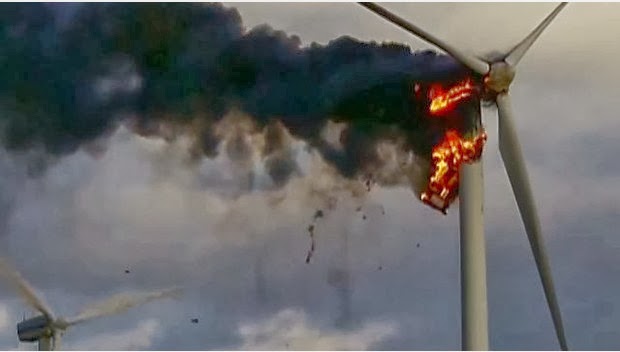
Turbines represent the perfect bushfire incendiary: around the world, hundreds have blown up in balls of flame – in the process – each one raining molten metal and hundreds of litres of flaming hydraulic oil and burning plastic earthwards. Here’s a few pics showing these plucky ‘green’ fire-starters in action:
Wind turbine fires are ten times more common than the wind industry and its parasites claim (see our post here and check out this website:http://turbinesonfire.org).
Here’s a report on, yet more, turbines bursting into fireballs.
One Suzlon turbine destroyed and two badly damaged
Wind Power Monthly
Mike McGovern
8 December 2014
NICARAGUA: A Suzlon 2.1MW turbine nacelle caught fire and later crashed to the ground on Sunday in an incident involving three damaged turbines at the 63MW Amayo complex in Nicaragua, the country’s first wind project.
“There were no injuries and the site has been secured,” Suzlon told Windpower Monthly in a written statement, confirming the affected turbines to be S88-2.1MW machines.
Suzlon declined to comment on the possible cause, pending further investigation. Nobody at the US-based owner company, AEI Energy, was available for comment.
Local press reports, citing ground staff and fire fighters, said all three machines at the 23MW Amayo II plant — in service since 2010 — suffered failure in their emergency braking systems, leaving them helpless against high gusts of wind. No other turbines were affected, claimed Suzlon.
The turbines caught ablaze at 5.15am, just under an hour after a blackout hit the Rivas municipality, where the wind farm is located.
All three machines reportedly spun uncontrollably. Turbine 28 finally fell and all three blades of turbine 25 were flung off. A blade on turbine 29 was left broken. Wind Power Monthly
If the story has an upside, it’s the successful bid for “freedom” made by the blades during yet another “component liberation” event (see our posts here and here and here and here and here).
And glad to see our favourite Indian fan maker, Suzlon making the news! But they weren’t overly keen to let much slip – its spin-masters quickly switching to “radio silence” when quizzed about the cause. And – in typical wind weasel fashion – the wind power outfit concerned went into complete media lock-down. No surprises there.
Suzlon – aka Suzlon REPower, aka Senvion – have planted hundreds of its S88s all over the Australian countryside: near-bankrupt wind power outfit, Infigen operate a stack of them in NSW; Trustpower planted 47 at Snowtown, in South Australia’s Mid-North; and AGL speared a hundred or so into SA’s Mid-North, around Jamestown and Hallett.
Senvion are the crowd behind the ridiculous CERES project – which aims to spear 197 of its whirling, pryro-technic devices into SA’s agricultural Heartland, the Yorke Peninsula. Thankfully for farmers and fire-fighters, the chances of that debacle eventuating are slimmer than a German supermodel.
There have been at least 4 bushfires started by wind turbines in Australia, so far:
Ten Mile Lagoon in Western Australia in the mid-1990s;
Lake Bonney, Millicent (SA) in January 2006 (see the photo below);
Cathedral Rocks Wind Farm, Port Lincoln (SA) in February 2009 (see The Advertiser article below); and
When it comes to talking about the exceedingly “hot” topic of bushfires started by turbines, Australian wind power outfits exhibit the same well-drilled, reticence shown by American outfit, AEI Energy in the article above, about its flaming little Suzlon beauties.
As a result, the media rarely report on the bushfires that are started by turbines. On the rare occasions that the media do – as in this Advertiser article – wind power outfits never comment, keep their heads well below the PR parapet and hope that the flames die down quickly.
Cathedral Rocks Wind Farm turbine fire
The Advertiser
2 February 2009
A $6 MILLION wind turbine has caught fire near Port Lincoln, starting blazes on the ground as embers fall.
The fire, at the Cathedral Rocks Wind Farm about 30km southwest of the town, was first noticed by a boat about 1am.
The turbine is alight halfway up its 60m structure, making it difficult for the 14 Country Fire Service firefighters trying to deal with it to extinguish the blaze.
They are also busy controlling the spotfires, but consider the situation to be safe.
The cause of the blaze is as yet unknown. The Advertiser
Not only do wind turbines act as the perfect bushfire-starters, their presence precludes the best and safest method of fire-fighting from controlling them: aerial water bombers won’t fly within cooee of these things – experienced pilots have declared that they won’t fly within 3km of a wind turbine, even without the country around them on fire. For a rundown on pilots’ attitudes to flying anywhere near wind farms – see our posts here and here and here.
Aircraft and wind turbines – standing 160m tall, with a whirling wing-span of over 100m – don’t mix at the best of times (see our post here). Add billowing smoke, 50m flames and scorching heat and no-one could blame fire-fighting pilots for giving wind farms a very wide berth when the country around them is ablaze.
Fitting it is then, that the Senate Select Committee has the clearly obvious fire risk created by giant fans, and the ability to fight those fires, squarely in its sights – its terms of reference include scrutiny of: “the effect that wind towers have on fauna and aerial operations around turbines, including firefighting and crop management” (see our post here).
For those in the country keen to avoid the very real threat of incineration that comes hand-in-glove with having wind turbines speared all over it – note that the opportunity to make submissions to the Committee ends on 27 February 2015. See the link here.
It’s high time our political betters brought this insanity under control.
Health Canada Wind Turbine Noise “Statistics” Avoid Real Health Problems
Tim Matheson (Nov. 11, 2014) tells us he has had enough of wind turbine health effects. I am sure that the many people living near Ontario’s wind turbines who are still suffering from pounding in the chest and head, dizziness, headaches, ringing in the ears and sleep deprivation have had enough too. However, the serious inaccuracies in Mr. Matheson’s letter must not go without comment. It is entirely untrue, as he claims, that “every peer-reviewed study world-wide has consistently shown the same” as the Health Canada key findings.
Our Grey-Bruce Medical Officer of Health, Dr. Hazel Lynn found 18 peer-reviewed studies that “provide reasonable evidence . . . that an association exists between wind turbines and distress in humans”. Instead of disparaging Dr. Lynn we should admire and respect her for taking the trouble to listen to her constituents and speaking the truth. The Brown County (Wisconsin) Board of Health has taken the growing peer-reviewed evidence seriously enough to declare its industrial wind turbines a “public health nuisance” and a “human health hazard for all people (residents, workers, visitors, and sensitive passers-by) who are exposed to Infrasound/Low Frequency Noise and other emissions potentially harmful to human health”.
There are now dozens of peer-reviewed acoustical and medical research reports that contradict the key findings of the Health Canada study (which has not been peer-reviewed) warning that wind turbines, have a significant potential to cause adverse impacts on the people living nearby. Krough et al (2011), Shepherd (2011), Phillips, (2011), Hanning &. Evans (2012), Nissenbaum (2012), Walker (2012), Ambrose (2012), James (2013), Cooper, (2013), Schomer (2013), Enbom (2013); Kugler 2014, are just a few of the more recent ones.
So how did Health Canada manage to come up with findings so out of line with much of the most recent peer-reviewed research? Could this industry-led, government-supported study have been intended to pacify growing public concern and promote federal government policy– its “Wind Technology Roadmap”?
Already, epidemiologists, physicians and scientists have pointed out grave shortcomings and inconsistencies with the study’s conclusions as well as gaps and errors in methodology.
Contradictions and biases affect its credibility. Unmentioned in the key findings: “The study did find wind turbine noise to be “statistically related to severalself-reported health effects including blood pressure, migraines, tinnitus, dizziness, and disturbed sleep”. — Epidemiologist Joan Morris, Robarts Research Institute, London, Ontario.
The noise “measurements” were in fact only “calculations”, “estimates” and “assumptions”, based on “predictive modeling” obtained from the turbine manufacturers. “It is known that calculated turbine noise is a poor predictor of measured turbine noise. There are other variables that influence the actual turbine noise such as wind-speed gradient, turbulence, upwind or downwind of the wind turbine, [and] temperature gradient. An average has no meaning”. —Dr. John Harrison, Emeritus Professor of Physics, Queen’s University.
The low responder rate of only 1234 out of the 2004 dwellings selected “could easily compromise the validity of any conclusions drawn by the researchers as a result of selection bias”. — Denise Wolfe, professional auditor for drug trial analysis.
Only 20% of the homes studied were “near” turbines; 434 dwellings were excluded as “not valid” (without follow up) because people were not at home, had abandoned their houses, or been bought out—possibly the ones most likely to report serious health effects.
Homes up to 10 kilometres away were included, diluting the results from those nearby. “The choice of the circle size plays a major role in the result obtained and speaks volumes about the motivation of the author”. — Dr. Alex Salt, Professor of Otolaryngology at Washington University School of Medicine.
No, Mr. Matheson, the wind turbines did not shut down coal-fired generation. Nuclear units back on line, decreased consumption, and new natural gas plants (another fossil fuel) made it possible. When fossil-fuelled back-up is factored in, there are no appreciable CO2 savings from wind energy. Meanwhile, consumer subsidies for renewables in Ontario are pushing up hydro costs at an alarming rate, forcing more manufacturers (and jobs) to leave the province.
Canadian taxpayers will not be pleased to learn that Health Canada has spent over $2 million of our money without first making professional clinical observations based on the histories of actual sufferers.
Keith Stelling, Southampton
References:
Ambrose S.E, Rand, R.W (December 2011), Adverse Health Effects Produced By Large Industrial
Wind Turbines Confirmed, The Bruce McPherson Infrasound and Low Frequency Noise Study.
Arra I, Lynn H, Barker K, et al. (2014-05-23 11:51:41 UTC) Systematic Review 2013: Association
Between Wind Turbines and Human Distress. Cureus 6(5): e183. doi:10.7759/cureus.183.
Bray W and James R. (2011). “Dynamic measurements of wind turbine acoustic signals, employing sound quality engineering methods considering the time and frequency sensitivities of human perception”. Proceedings of Noise-Con 2011, Portland, Oregon, 25-27 July 2011. Curran Associates, 2011.
Cooper, S. The Measurement of Infrasound and Low Frequency Noise for Wind Farms (amended version). 5th International Conference On Wind Turbine Noise Denver 28-30 August 2013. Steven Cooper The Acoustic Group Pty Ltd, Sydney, NSW, 2040.
Enbom H & Enbom I (2013) “Infrasound from wind turbines: An overlooked health hazard,”
Läkartidningen, vol. 110 pp. 1388-89.
Hanning C & Evans A (2012) “Wind turbine noise”, British Medical Journal 344, e1527.
James R. Opening Statement Nov 18, 2013 hearing. BluEarth Project, Bull Creek, Alberta.
Krogh C, Gillis L, N. Kouwen N, and Aramini J. (2011) “WindVOiCe, a self-reporting survey: adverse health effects, industrial wind turbines and the need for vigilance monitoring.” Bull. Sci. Tech. Soc. 31 334-339.
Kugler K, Wiegrebe L, Grothe B, Kössl M, Gürkov R, Krause E, Drexl M. 2014 Low-frequency sound
affects active micromechanics in the human inner ear. R. Soc. open sci. 1: 140166.
Nissenbaum M, Armani J & Hanning D. (2012) “Effects of industrial wind turbine noise on sleep and health”, Noise and Health 14, 237-243.
Phillips C. (2011) “Properly interpreting the epidemiologic evidence about the health effects of industrial wind turbines on nearby residents”, Bull. Sci. Tech. Soc. 31 303-315.
Salt, Alec N. and Lichtenhan, Jeffery T. “How Does Wind Turbine Noise Affect People? The many ways by which unheard infrasound and low-frequency sound from wind turbines could distress people living nearby are described”. Acoustics Today, A publication of the Acoustical Society of America, Vol. 10, Issue 1, Winter, 2014.
Written by Mark Duchamp, President, Save the Eagles International on 10 Nov 2014
In an article published in The Guardian on November 7th, the RSPB (Royal Society for the Protection of Birds) is quoted saying that since 1980, across 25 European countries, house sparrow numbers have declined by 147 million, a 62% drop to 90 million. According to the same report, starlings have fallen by 45 million, down to 40 million. As for Skylarks, their population went down by 37 million, to 43 million today. Says the author of the article, “It’s principally agricultural intensification that is behind the crisis.” (1)
Populations ranging from 40 to 90 million birds, for the most common of passerine species, are surprisingly small, spread as they are over 25 countries. Thus, if the researchers quoted by the RSPB are correct in their estimates, we are entitled to conclude that wind turbines and their power lines will have a significant impact on the number of all passerines flying our skies, eating our insects etc. Indeed, we know for instance that, in Spain alone, wind turbines kill 6 to 18 million birds and bats a year (2). Supposing that Europe has about 5 times as many wind turbines as Spain, the death toll for Europe would be 30 to 90 million birds and bats per annum – i.e. roughly 10 to 30 million birds a year, given that bats are attracted to wind turbines and killed about twice as often as birds. Comparing the numbers, and all things being equal, it is obvious that bird populations will erode further on account of wind farms, much faster than previously thought.
But no mention is made of this in the article. It’s not surprising, as both the RSPB and The Guardian are promoting theinstallation of ever more wind farms across Europe.
We also learn from The Guardian that the population of some raptors “is on the up in Britain”. This assertion sounds suspicious to us at Save the Eagles International, for two main reasons:
A) – the article quotes no figures, no studies and no dates, and
B) – we know that raptors are attracted to windfarms (2), and killed in significant numbers (3).
The truth is that raptors have been recuperating in the UK since a very low point reached after two centuries of persecution. Some species were wiped out. Then, a law was enacted to protect birds of prey, and reintroduction programmes were launched, e.g. for the Red Kite and the White-tailed Eagle.
Protection and reintroduction caused raptors’ numbers to go up. But the question is: until when? We suspect that the recuperation of raptors in Britain has stopped with the advent of wind turbines, which attract and kill them. Actually, judging from the high mortality of raptors in other countries’ windfarms, their UK population is most likely to be on the decline as well. But Britons are not being kept informed of these things, politics oblige. (4)
To wit: in 2013 became due the decadal census of golden eagles. But nothing happened, and to those who inquired it was replied that the interval between these surveys had been changed from 10 years to 12. This does nothing to allay our fears that Scottish golden eagles are being decimated by wind turbines, many of which are spinning their deadly blades in their habitat.
…the Board of Health in Brown County, Wisconsin, where Green Bay is located, has declared a local industrial wind plant to be a human health hazard. The specific facility consists of eight 500-foot high, 2.5 megawatt industrial wind turbines.
The board made its finding with a 4-0 vote (three members were not present) at an Oct. 14 meeting after it had wrestled with health complaints about the wind plant for more than four years. Ultimately, the board’s ruling was based on a year-long survey which documented health complaints and demonstrated that infrasound and low-frequency noise emanating from the turbines was detectable inside homes within a 6.2-mile radius of the industrial wind plant.
Jay Tibbetts, a physician and a member of the Brown County Board of Health, said the board based its position that the turbines constitute a health hazard on the weight of evidence.
“I can tell you that we are absolutely not an anti-wind energy board,” Tibbetts said. “We worked on this for four and a half years before making this decision. Three families have moved out. I knew all of them. We also know that this isn’t only happening here. In Ontario 40 families have abandoned their homes to get away from the effects of wind turbines.”
According to Tibbetts, micro barometers were placed in homes located in the area surrounding the industrial wind plant. The purpose of this was to detect acoustic emissions, including infrasound and low frequency noise emanating from the turbines.
“They found that there were tones of infrasound and low frequency noise as far away as 6.2 miles from the nearest wind turbine,” Tibbetts said. “There were no complaints associated with the home that was 6.2 miles away, but there were complaints associated with one 4.2 miles away.
“We have 80 people on record who have made health complaints, including a nurse who is going deaf,” Tibbetts continued. “We can’t just ignore this.”
In addition to these problems, I am aware that wind turbines sin arid locales, such as the massive wind farm near Palm Springs, California, kick uop a lot of dust, aka particulate matter. Moreover, there is no mention of the toll on migratory birds that tend to follow the same wind patterns that wind farms are situated to exploit. Doug Schmidt points out:
The Short-eared Owl, a species listed as endangered in Michigan, is one of many birds using the area in Huron County slated for major wind energy expansion.
(Washington, DC, November 6, 2014) American Bird Conservancy (ABC) has raised serious concerns about a plan by Heritage Sustainable Energy, DTE Energy, Exelon Corporation, and NextEra Energy to construct additional commercial wind turbines in Huron County, Michigan, which could eventually result in up to 900 turbines in the area. This plan is advancing despite the fact that U.S. Fish and Wildlife Service (FWS) radar studies show vast numbers of birds migrating through or wintering in this area.
In an October 30 letter to the FWS Regional Director, ABC charged that the proposed expanded wind development—which already includes 328 turbines—threatens a major confluence of neotropical migratory birds and raptors, including federally protected Bald and Golden Eagles.
“Many species that are threatened or endangered in the U.S. and within the state of Michigan, such as the Piping Plover, Kirtland’s Warbler, Henslow’s Sparrow, and Short-eared Owl, migrate through or inhabit this area. This triggers serious Endangered Species Act (ESA) concerns,” said ABC’s Dr. Michael Hutchins, National Coordinator, Bird Smart Wind Energy Campaign.
“We have reviewed the recent radar studies conducted by FWS in this area and must conclude that Huron County is not an appropriate area for wind energy development, given the potential and substantial risks it poses to federally protected birds. If this is an example of ‘proper’ siting of wind energy development, then we wonder what criteria are being used to make such decisions,” Hutchins said further.
“An annual spring migration of thousands of eagles, hawks, and falcons travel through this area and congregate along the Huron County shoreline,” said Monica Essenmacher, President of Port Crescent Hawk Watch, a raptor conservation group in Michigan. “We have documented this occurrence since 1992, so there is a high likelihood of major raptor mortality from continued construction of these turbines.”
The ABC letter says that in addition to ESA-protected birds, vast numbers of other migrants also move through or breed in these areas. Although there is no current provision for a federal permit to harm or kill these birds (called a “take permit”) under the Migratory Bird Treaty Act (MBTA), ABC suggests that the FWS should consider this option as soon as possible, so that it can be used as an additional tool for proper siting and operation of future wind energy facilities.
Under FWS’ current voluntary permitting guidelines, wind energy companies are not required to apply for incidental take permits under the Bald and Golden Eagle Protection Act or the ESA when the project sits on private property. ABC asserts that this is a loophole allowing wind developers to kill federally protected birds with impunity. To remedy this, the organization is calling for independent post-construction monitoring and for the institution of a permit process that imposes fines to developers who kill more protected birds than their permit would allow.
ABC supports the development of clean, renewable sources of energy such as wind and solar power, but also believes that it must be done responsibly and with minimal impact on our public trust resources, including native birds and bats and particularly threatened, endangered, and other protected species. ABC supports Bird Smart Wind Energy, which emphasizes the importance of careful siting and mitigation to prevent unintended impacts to wildlife. As this study suggests, the risk to birds and bats can be substantial, depending on the circumstances. Another studysuggests even higher mortality.
Developers typically argue that they can effectively mitigate the impacts of wind development, but ABC—and the U.S. Department of Energy (DOE)—caution that most forms of mitigation touted by the wind industry have not yet been scientifically tested for their efficacy. ABC strongly agrees with the DOE’s recent statement that “…technologies to minimize impacts at operational facilities for most species are either in early stages of development or simply do not exist.”
Regarding the Huron County wind energy expansion, ABC has requested that an Environmental Impact Statement be prepared for the project and says that “… the voluntary (FWS) guidelines (must) be followed to the letter, which means consultation under Section 7 of the ESA, applications for incidental take permits under the ESA and Bald and Golden Eagle Protection Act, a three-mile setback from any shoreline, and an Avian Protection Plan … before the companies are allowed to go ahead with any construction.”
ABC also asks that the wind energy companies share bird mortality data with the public. “At present, these data are being treated as proprietary information, but these are public trust resources being taken,” said Hutchins. “The public has a right to know.”
#
American Bird Conservancy is the Western Hemisphere’s bird conservation specialist—the only organization with a single and steadfast commitment to achieving conservation results for native birds and their habitats throughout the Americas. With a focus on efficiency and working in partnership, we take on the toughest problems facing birds today, innovating and building on sound science to halt extinctions, protect habitats, eliminate threats, and build capacity for bird conservation.
Big Green, Big Wind and Big Government regulators likewise almost never mention the human costs – the sleep deprivation and other health impacts from infrasound noise and constant light flickering effects associated with nearby turbines, as documented by Dr. Sarah Laurie and other researchers.
In short, wind power may well be our least sustainable energy source – and the one least able to replace fossil fuels or reduce carbon dioxide emissions that anti-energy activists falsely blame for climate change (that they absurdly claim never happened prior to the modern industrial age). But of course their rants have nothing to do with climate change or environmental protection.
The climate change dangers exist only in computer models, junk-science “studies” and press releases. But as the “People’s Climate March” made clear, today’s watermelon environmentalists (green on the outside, red on the inside) do not merely despise fossil fuels, fracking and the Keystone pipeline. They also detest free enterprise capitalism, modern living standards, private property … and even pro football!
They invent and inflate risks that have nothing to do with reality, and dismiss the incredible benefits that fracking and fossil fuels have brought to people worldwide. They go ballistic over alleged risks of using modern technologies, but are silent about the clear risks of not using those technologies. And when it comes to themselves, Big Green and the Billionaires Club oppose and ignore the transparency, integrity, democracy and accountability that they demand from everyone they attack.
Read it all …
Typical of the political green class, and ‘Big Media’. Hypocrites. Climate Change was just the line needed to cover their extortion.







 According to the same report, starlings have fallen by 45 million, down to 40 million. As for Skylarks, their population went down by 37 million, to 43 million
 "Mothers Against Wind Turbines™" Phoenix Rising...