Wendy Heiger-Bernays PhD of Boston University School of Public Health explained that “it is possible that living too close to wind turbines can cause annoyance and sleep disruption, but we don’t have measurements that can show levels that disrupt sleep.”
She agreed that sleep disruption can bring on a whole host of adverse health impacts.”
MA DEP/DPH Expert-Falmouth Wind Turbines “are too close”
Falmouth, MA – Last Wednesday eight Falmouth wind turbine neighbors traveled to Waltham to hear three Department of Environmental Protection [DEP] / Department of Public Health [DPH] expert health panel members present their Wind Turbine Health Impact Study report. That document, released only two weeks ago, caused great controversy not only in Falmouth but also across the Commonwealth. … [panel member] Wendy Heiger-Bernays PhD of Boston University School of Public Health explained that “it is possible that living too close to wind turbines can cause annoyance and sleep disruption, but we don’t have measurements that can show levels that disrupt sleep.” She agreed that sleep disruption can bring on a whole host of adverse health impacts.”
Dr. Heiger-Bernays is to be commended for her statements. It is a step in the right direction and acknowledges what the neighbors in Falmouth know. Sleep is being disturbed. Yet there is much more to be acknowledged which has nothing to do with sleep deprivation.
It is unfortunate that the Expert Panel was unable to acknowledge in their report a most compelling fact presented in the case-study Bruce McPherson Study reports [1,2]. From [2],
“The investigators were surprised to experience the same adverse health symptoms described by neighbors living at this house and near other large industrial wind turbine sites. The onset of adverse health effects was swift, within twenty minutes, and persisted for some time after leaving the study area. … This research revealed that persons without a pre-existing sleep deprivation condition, not tied to the location nor invested in the property, can experience within a few minutes the same debilitating health effects described and testified to by neighbors living near the wind turbines. The debilitating health effects were judged to be visceral (proceeding from instinct, not intellect) and related to as yet unidentified discordant physical inputs or stimulation to the vestibular system.”
I understand that what the investigators experienced in their case-study may inadvertently fall into a branch of analysis called “time-series”. Before they arrived at the study site, they felt fine. Soon after they arrived at the study site they soon felt debilitated. Later when they left the study site, they started to feel better. When they returned to continue work their health worsened. When the turbine stopped and they left, they started to feel better. It took some time for them to regain full health (days to weeks). The reports’ figures and tables illustrate the health changes experienced by the investigators with an unexpectedly clear correlation to wind turbine operations.
While the Bruce McPherson study was limited in time, the experiences of the two investigators will remain compelling.
The study confirms that large industrial wind turbines can produce real and adverse health impacts and suggests that this is due to acoustic pressure pulsations, not related to the audible frequency spectrum, by affecting the vestibular system especially at low ambient sound levels. The study results emphasize the need for epidemiological and laboratory research by medical health professionals and acousticians concerned with public health and well-being. This study underscores the need for more effective and precautionary setback distances for industrial wind turbines. It is especially important to include a margin of safety sufficient to prevent inaudible low-frequency wind turbine noise from being detected by the human vestibular system.
Sincerely,
Rob Rand, Member INCE
1. Peer-reviewed journal: Robert W. Rand, Stephen E. Ambrose, and Carmen M. E. Krogh, Occupational Health and Industrial Wind Turbines: A Case Study. Published online before print August 22, 2011, doi: 10.1177/0270467611417849, The Bulletin of Science Technology & Society, August 22, 2011.
2. Stephen Ambrose and Robert Rand, The Bruce McPherson Infrasound and Low Frequency Noise Study: Adverse Health Effects Produced By Large Industrial Wind Turbines Confirmed. December 14, 2011.
No sooner had Melissa given Labor-in-Liberal clothing Federal MP, Disappointing Dan Tehan a solid whack – for his wind industry backed plea to salvage the completely unsustainable Large-Scale Renewable Energy Target – (see our post here), than she was back lining up another, ignoramus with this cracking letter to the Ballarat Courier.
Ill-informed opinions build on wind farm ignorance
The Courier
By Melissa Ware
5 May 2015
SENATORS and public servants, please listen to the doctors and [not] Ms Hawkins’ ill informed knowledge on wind farm health issues, and publicly remedy the ignorance without delay.
For those failing to understand simple physics and dynamics of wind turbines and resulting impacts of noise, vibration and sensation to human and animal health then you can surely understand IWEF ‘noise’ is not always ‘heard’ by the ear but by the brain. Vibrations from turbines that ripple through the ground and air, through our homes and bodies, [are] not always consciously ‘felt’, [but] are detected.
These turbine emitted noise and vibrations and sensations are torturous to many, not only in south west Victoria but around the world.
Educate yourself with some facts and figures about impacts, read Mr Cooper’s recent findings and summary of the Cape Bridgewater Wind Farm, read the submissions into the senate inquiry into wind farms: or if you can’t manage to recognise what you allow to occur in your backyard, try some empathy. Adapt.
Recognise wind farm health issues being cruelly scorned or dismissed has only one purpose, and it is not to promote good public health or well-being.
Science is purely based on a theory which is founded on fact. When new information or facts are provided then the theory is supposed to adapt accordingly.
Harmed rural people like myself tell scientists, acousticians and the medicos we are getting sick and sicker near turbines and many adversely impacted residents are prepared to assist in learning why and how we are getting sick. We are willing to open our homes and share our experiences, what we don’t need from Ms Hawkins is an accusation there is a dubious sounding, completely unbelievable ‘health scare’ campaign being undertaken by Senator Madigan.
Wind energy [is] an illusion, is illustrated and promoted as clean and safe as expected from a huge business raking in huge sums of taxpayer funding through the RECs. It is gullible believing the surface story investigate, read up on some facts or live 900m from a wind farm for six years and experience first hand the oil leaks, the chemicals, the cement, the cost, the never ending maintenance, the bombardment and the cruelty, and the utter uselessness of wind energy.
Rural people [are] forced through the inaction of the AMA and the NHMRC, and inadequate planning laws, to endure impacting emissions of wind turbines and are being prescribed the only recommendation available by GPs, and that is to ‘move away’.
Imagine, if you are able, what your response would be to the imposition of a wind farm built next door, which damages your health, which the company and the government refuse to acknowledge and you are told for your health to move away.
You can’t sell because no-one will live by choice in close proximity to these monstrosities. Senator Madigan is not the only one doing a great job in having our voices heard in parliament and seeing that this marginalisation of rural people, including my family, being adversely impacted is recognised. Melissa Ware Cape Bridgewater
Melissa is on very solid scientific ground, when she talks about the known, and well-established, relationship between incessant, turbine generated low-frequency and infrasound and adverse health consequences, for those constantly exposed to it.
The wind industry have known about it for over 30 years; and, in all of that time, have done precisely what you’d expect from people without a shred of empathy or human decency – they lied through their back teeth and covered it up:
Jeffrey M. Ellenbogen, MD; MMSc
Assistant Professor of Neurology, Harvard Medical School Division Chief, Sleep Medicine, Massachusetts General Hospital
Sheryl Grace, PhD; MS Aerospace & Mechanical Engineering Associate Professor of Mechanical Engineering, Boston University
Wendy J Heiger-Bernays, PhD
Associate Professor of Environmental Health, Department of Environmental Health, Boston University School of Public Health
Chair, Lexington Board of Health
James F. Manwell, PhD Mechanical Engineering;
MS Electrical & Computer Engineering; BA Biophysics
Professor and Director of the Wind Energy Center, Department of Mechanical & Industrial Engineering University of Massachusetts, Amherst
Dora Anne Mills, MD, MPH, FAAP
State Health Officer, Maine 1996–2011
Vice President for Clinical Affairs, University of New England
Kimberly A. Sullivan, PhD
Research Assistant Professor of Environmental Health, Department of Environmental Health, Boston University School of Public Health
Marc G. Weisskopf, ScD Epidemiology; PhD Neuroscience
Associate Professor of Environmental Health and Epidemiology Department of Environmental Health & Epidemiology, Harvard School of Public Health
Facilitative Support provided by Susan L. Santos, PhD, FOCUS GROUP Risk Communication and Environmental Management Consultants
Bogus Mass Wind Turbine Noise Study 2012 Update
Counter Points To The 2012 Massachusetts Wind Turbine Noise Study -110 Decibels Equal To A Loud Out Door Rock Band
Share CommentsBogus Mass Wind Turbine Noise Study 2012 Update
Bogus Mass Wind Turbine Noise Study 2012 Updated –May 2015
Counter Points To The Massachusetts Wind Turbine Noise Study. This study was done in 2012
Not One Victim Was Ever Interviewed or Examined
– Massachusetts has not installed a megawatt wind turbine since 2013.
First it has been found the Town of Falmouth had known three years prior to the Massachusetts DEP 2012 noise report in 2009 that the turbines being installed would produce noise levels over 110 Decibels of noise equivalent to a loud outdoor rock band .
The August 3, 2010 noise letter from Vestas wind company is at the link : http://www.windaction.org/posts/41357-vestas-raises-concerns-about-turbine-noise-letter#.VVJlVflVikp
Since the installation of the Falmouth wind turbines the Massachusetts Clean Energy Center has admitted the turbines were placed “Ad Hoc” and now looks at setbacks over 2000 feet and has changed their noise testing procedures.
Counter Points To The Massachusetts Wind Turbine Noise Study In Which Not One Victim Was Ever Interviewed or Examined
What the Study Says: On page 1: “…It should be noted that the scope of the Panel’s effort was focused on wind turbines and is not meant to be a comparative analysis of the relative merits of wind energy vs. non-renewable fossil fuel sources such as coal, oil, and natural gas.”
However: The second paragraph of Chapter 1 of the study discusses a significant decrease in the consumption of conventional fuels and a corresponding decrease in the production of carbon dioxide and nitrogen and sulfur oxides.
The second paragraph states that reductions in the production of these pollutants will have demonstrable and positive benefits on human and environmental health
Appendix A has a 28 page summary on the origin of wind energy, the mechanics and operation of wind turbines, and the reduction of emissions if more turbines were providing energy (Section 12 is titled“Wind Turbines and Avoided Pollutants”)
On page 1: “The overall context for this study is that the use of wind turbines results in positive effects on public health and environmental health…local impacts of wind turbines, whether anticipated or demonstrated, have resulted in fewer turbines being installed than might otherwise have been expected. To the extent that these impacts can be ameliorated, it should be possible to take advantage of the indigenous wind energy resource more effectively.”
This passage indicates the true purpose of the Massachusetts study—to create an expansion of the wind industry through a slanted interpretation of wind health study documents.
The Panel merely reviewed literature and public media sources and met only three times.
Stated that sleep disruption is the most commonly reported complaint by people and discusses this primarily as a result of “unwanted sound” and audible, amplitudemodulated noise (“whooshing”)
Writes off most self-reported “annoyance” as a combination of sound, sight of the turbine, and attitude towards the wind project (ES-5)
Therefore, according to the Panel, because they “found” no negative health effects to humans as a result of their literature research, it must necessarily follow that there are positive health effects.
Yet, these positive health effects are not the result of wind turbines being safe, but that the turbines’ “green” impact on the environment will result in a decrease of conventional sources of fuel.
This endorsement of safety is an admission that the Panel failed to strictly adhere to the scope of their charge.
Expert “Independent” Panel Members:Dr. James F. Manwell and Dora Anne Mills are extreme pro-wind advocates:
Manwell oversaw the first utility scale wind turbine and the largest wind turbine constructed in Massachusetts
Manwell has won several awards from American Wind Association and U.S. Department of Energy Mills has provided public testimony and “op-ed” newspaper pieces supporting wind turbines while a member of the Commission and before the findings were released Posted information on Maine’s CDC website as Maine’s public health director that wind turbines do not have negative health effects in 2009
Page 2 of the study states that 5 of the panel members “did not have any direct experience with wind turbines.”
While the other members had backgrounds in epidemiology, toxicology , neurology, and sleep medicine, they had no past direct experience with wind turbines
Massachusetts Study Cites Sources that Contain Information that Wind Turbines Cause Negative Health Effects:
The Panel used several articles by the same authors of other studies that Senator Lasee provided to the PSC
The Panel used several articles that Senator Lasee provided to the PSC that found that infrasound from wind turbines can have negative health effects, yet the Massachusetts panel comes to different conclusions than the study authors: Ambrose, S.E. & Rand R. W., (2011, December).
The Bruce McPherson Infrasound and Low Frequency Noise Study: Adverse Health Effects Produced By Large Industrial Wind Turbines Confirmed.
Infrasound Measurements of Falmouth Wind Turbines Wind #1 and Wind #2NoiseControl Engineering, LLC (NCE) – February 27, 2015 Impact on People Noise Massachusetts
This important study conducted at a home situated within 1300 feet of the Falmouth MA wind turbines identified infrasonic sound pressure levels inside the residence. These results are similar to results from other international researchers with references given in the report. http://www.windaction.org/posts/42443-infrasound-measurements-of-falmouth-wind-turbines-wind-1-and-wind-2#.VVJmU_lViko
Cite this article as: Arra I, Lynn H, Barker K, et al. (2014-05-23 11:51:41 UTC) Systematic Review 2013: Association Between Wind Turbines and Human Distress. Cureus 6(5): e183. doi:10.7759/cureus.183
Abstract
Background and Objectives: The proximity of wind turbines to residential areas has been associated with a higher level of complaints compared to the general population. The study objective was to search the literature investigating whether an association between wind turbines and human distress exists.
Methods: A systematic search of the following databases (EMBASE, PubMed, OvidMedline, PsycINFO, The Cochrane Library, SIGLE, and Scirus) and screening for duplication led to the identification of 154 studies. Abstract and full article reviews of these studies led to the identification of 18 studies that were eligible for inclusion as they examined the association of wind turbines and human distress published in peer-review journals in English between 2003-2013. Outcome measures, including First Author, Year of Publication, Journal Name, Country of Study, Study Design, Sample Size, Response Rate, Level of Evidence, Level of Potential Bias, and Outcome Measures of Study, were captured for all studies. After data extraction, each study was analyzed to identify the two primary outcomes: Quality of Study and Conclusion of Study Effect.
Results: All peer-reviewed studies captured in our review found an association between wind turbines and human distress. These studies had levels of evidence of four and five. Two studies showed a dose-response relationship between distance from wind turbines and distress, and none of them concluded no association.
Conclusions: In this review, we have demonstrated the presence of reasonable evidence (Level Four and Five) that an association exists between wind turbines and distress in humans. The existence of a dose-response relationship (between distance from wind turbines and distress) and the consistency of association across studies found in the scientific literature argues for the credibility of this association. Future research in this area is warranted as to whether or not a causal relationship exists.
Introduction
Unlike most industries, the global wind industry grows annually by 21% despite the recent economic challenges. Canada is the ninth largest producer of wind energy in the world with a 45-fold growth in the industry in the year 2012 relative to 2000 [1-2].
The invention of the wind turbine as an electricity generating machine dates back to 1887 by James Blyth, a Scottish academic, and it used to light his holiday home in Marykirk, Scotland[3]. Wind turbines were at first welcomed by the public as being a source of energy that is both renewable and carbon emission-free. The need to generate electrical power on a large scale was the main driver in establishing the industrial wind turbines (IWTs) [4].
Wind turbines can be located as solo wind or in groups called “Wind Farms”. In either form and for various reasons (e.g., minimizing transmission costs), wind turbines are usually positioned in close proximity to residential areas (farms, villages, towns, and cities). This proximity to residential areas has been associated with a higher level of complaints compared to the general population [5]. These complaints are coined in research conducted and articles written on the subject under different terms, such as “Extreme Annoyance”, “Wind Turbine Syndrome (WTS)”, and “Distress”, among others. In this article, the term “distress” will be used unless we are quoting other articles.
Complaints resulting from the proximity to wind turbines vary in their nature, and distress is often attributed to different mechanisms, such as noise, visual impact, sleep disturbance, infrasound, and others [5-7]. Noise is the complaint that has been studied most often, especially given that environmental noise has become one of the major public health concerns of the 21st century [8].
These complaints triggered the debate about possible mechanisms of effect. Several hypothetical mechanisms have been suggested to explain the possible link(s) between wind turbines and the reported distress; some of these hypotheses attribute distress to one or more of the following: chronic noise exposure, infrasound effect, visual impact, perceived lack of control over noise, attitudes, personality, and age [5-6].
To assess the possible effects of wind turbines on human health, different outcome measures have been suggested, including annoyance, sleep disturbance, and cortisol levels. An alternative approach to health assessment involves the subjective appraisal of health-related quality of life, a concept that measures general well-being in all domains, including physical, psychological, and social domains [8].
Although the focus on researching mechanisms of effect may very well be a good first step to identifying the cause, finding an association is a cornerstone of establishing any causality, according to Hill’s Criteria of Causality [9]. A key missing piece of the scientific literature is that of an up-to-date and thorough review that examines the possible existence of an association between wind turbine and human distress. Therefore, the objective of our study was to search the literature investigating whether or not an association between wind turbines and human distress exists.
Materials & Methods
Study design
A systematic review of the existing literature of published peer-reviewed studies investigating the association between wind turbines and human distress between January 2003 – January 2013 was undertaken. This study was conducted as a collaboration between the Northern Ontario School of Medicine (NOSM), Sudbury, and Grey Bruce Health Unit, Owen Sound, Ontario, Canada.
Eligibility criteria
Inclusion Criteria:
– Peer-reviewed studies
– Studies examining association between wind turbines and distress
– Studies published in peer-review journals
– English language
– Studies involving humans
– Studies published between January 2003 – January 2013
Exclusion Criteria:
– Non-English language reports
– Investigations reporting interim analysis that did not result in stopping the study
– Secondary and long-term update reports
– Duplicate reports
– Cost effectiveness and economic studies
– Engineering studies
– Studies involving animals
Information sources
The following bibliographic databases were searched: EMBASE, PubMed, Ovid Medline, PsycINFO and The Cochrane Library, SIGLE, and Scirus, the last two of which deal with grey literature (materials that cannot be found easily through conventional channels, such as publishers; for example, thesis, dissertations, and unpublished peer-reviewed studies). Authors who published multiple studies included in our review were also contacted to identify any additional studies.
Search
Two search approaches were taken: subject heading and keyword searching. Electronic keyword searches were conducted in EMBASE, PubMed, PsycINFO, The Cochrane Library, SIGLE, and Scirus for published peer-reviewed studies according to the study inclusion criteria. All search strategies included the same search terms and combinations ([Wind power OR wind farm OR air turbine OR wind turbine] AND [Distress OR annoyance, sleep disturbance, noise OR sound OR infrasound OR sonic OR low-frequency OR acoustic OR hear OR ear OR wind turbine syndrome]).
Appropriate subject headings and limiters were identified in consultation with the corresponding author and were used to conduct electronic searches in the following bibliographic databases: EMBASE, PsycINFO, Ovid Medline, and PubMed. In order to retrieve all relevant published studies, subject headings were exploded; select subject headings were also chosen as the major focus of the search. Searches were refined by setting a publication restriction of 2003 to current and limiting results to humans.
Study selection
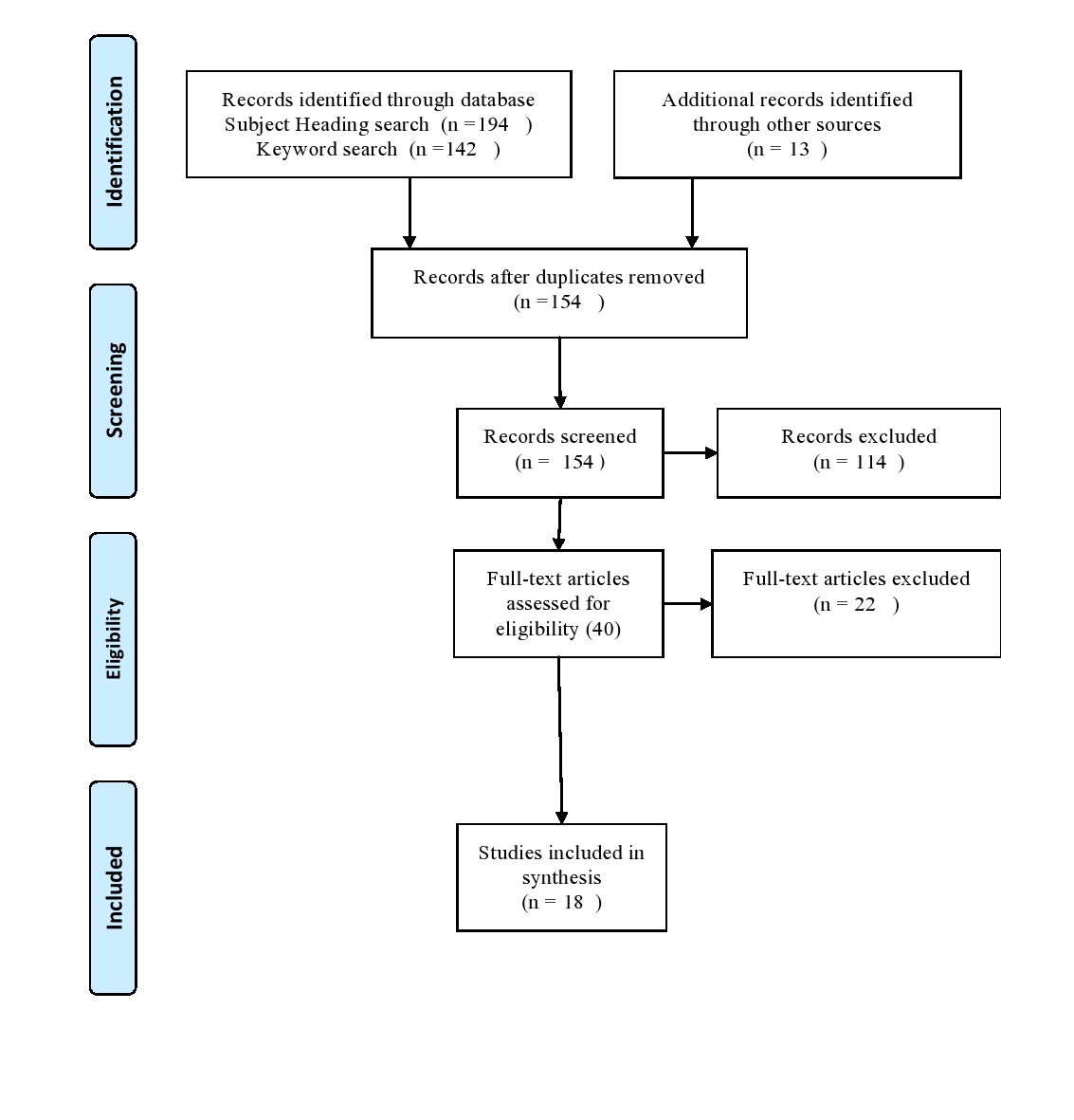
Study selection was performed in three stages (Figure 1):
Stage 1: Database Search
The studies that were identified through the database subject heading search (194 studies), the keyword search (142), and other sources (13 studies) were screened for duplication, yielding 154 studies.
Stage 2: Titles and Abstract Review
Screening of the titles and abstracts of the 154 retrieved studies was conducted by one qualified reviewer (the first author) in order to exclude any obvious non-eligible studies. Of these, 40 studies were deemed eligible for inclusion in a full article review.
Stage 3: Full Article Review
Two qualified reviewers conducted a full article review of the 40 studies. This review had two goals: first, to exclude any studies of non-eligible trials; second, to extract data on specific variables for further analyses. Of the 40 studies, 18 studies were deemed eligible for inclusion in our analysis.
Figure 1: Flowchart of the Review Screening Process
Eighteen peer-reviewed studies published between January 2003 – January 2013 investigating the association between wind turbines and human distress were eligible for inclusion in the analysis after full article review publications.
Data extraction was conducted by a qualified reviewer (the first author) during the full article review of the 18 included studies. The source of data in the individual studies was confirmed by contacting investigators who authored multiple studies included in the review, due to the aggregated weight of these studies potentially affecting our conclusion. The confirmation aimed to verify whether the data examined in the individual studies were collected from a single population and used in more than one study, or from different independent populations.
Data items
Primary Outcomes:
– Quality of Study: The quality of the study was categorized into three groups (Low, Moderate, High) (categorical variable)
– Conclusion of Study Effect: (whether the study concluded association of wind turbines with the effect on human health that was under investigation) (binary variable)
Variables (Outcome Measures of Individual Studies):
– First Author: The name of the first author (nominal variable)
– Year of Publication: The year in which the study was published (ordinal variable)
– Journal Name: The name of the publishing journal (nominal variable)
– Country of Study: The name of the country where the trial was originated (nominal variable)
– Study Design: The design of the study (nominal variable)
– Sample Size: The study sample size (continuous variable)
– Response Rate: The response rate of subjects in the study (continuous variable)
– Level of Evidence: The Level of evidence of the study (nominal variable)
– Level of Potential Bias: The level of risk of bias. Categorized into three groups according to Cochrane’s recommendations [10]. (Low risk of bias: Plausible bias unlikely to seriously alter the results; Unclear risk of bias: Plausible bias that raises some doubt about the results; High risk of bias: Plausible bias that seriously weakens confidence in the results) (categorical variable)
– Outcome Measures of Study: The outcome measure under investigation in the study (nominal variable); these outcome measures are:
– Annoyance (Sensitivity to Noise)
– Sleep disturbance
– Visual impact
– Well-being (Quality of Life/Mental Effect)
– Dose-response (description of the change in distress caused by differing distances from a wind turbine)
– Infrasound effect
– Existing background noise (comparison of stress associated with wind turbines to stress associated with road traffic noise/quiet rural environment)
– Attitude to wind turbines (whether people who complain have negative personal opinions toward wind turbines)
– Economical benefit (whether people who benefit economically from wind turbines have a decreased risk of distress)
Risk of bias in individual studies
Assessing the risk of bias of individual studies was performed at both the study level (study design, sample size, response rate, direction and magnitude of any potential bias and how it was handled, limitations, and reporting quality) and the outcome level (a cautious overall interpretation was drawn of the study’s conclusions, whether effect of human distress exists, considering the specific study’s objectives).
Summary measures and synthesis of results
After data extraction, each study was analyzed to identify the two primary outcomes: First, quality of study, taking into account the study’s principle outcome measures; all outcomes, exposures, predictors, potential confounders, and effect modifiers; how the study size was arrived at; how quantitative variables were handled in the analyses; description of all statistical methods; and how loss to follow-up and missing data were addressed. Second, conclusion of study effect as a cautious overall interpretation of the study’s conclusions, taking into account the specific study’s objectives and how well these conclusions were supported by the study results.
Risk of bias across studies
To reduce potential sampling bias (for example, the quality of study could be confounded by journal name and name of first author), the reviewers blinded themselves to the name of the journal and authors until all data on the other variables of interest were collected. To reduce potential measurement bias, the following three measures were undertaken: The data were directly entered into the database instead of using collection forms, quality assurance on all steps of data collection and management was performed, and in any case of uncertainty in deciding the quality of study, the reviewer consulted one of our senior authors to confirm the decision. Furthermore, the source of data was confirmed by contacting investigators who authored multiple studies included in the review, due to the weight their aggregated studies would have in affecting our conclusions.
Ethics approval
This study used previously published data making it exempt from institutional ethics board approval.
Results
Study selection
Figure 1 presents a flowchart depicting the study screening process. The database searches produced 154 publications. From this group, 40 publications were eligible following screening the titles and abstracts. From this group, 18 publications were eligible for inclusion after full article review. These 18 studies, shown in Table 1, consist of six original studies and 12 non-original studies (secondary analyses and literature reviews based on some of these original studies). Only the six original studies were included in the final analysis shown in Table 2. The 12 non-original studies were excluded from the analysis to minimize potential bias associated with repeated results.
This review used previously published data; therefore, there was no missing data for any of the variables of interest.
Table 1: Study Characteristics of 18 Peer-reviewed Studies Published between January 2003 – January 2013 Investigating the Association between Wind Turbines and Human Distress
N/A = Not applicable; ¥ = Original Study; ^ = Secondary Article (some studies have generated several articles, so the findings in these article were repeats of the findings in the original study) ; * = Data not available; High = Available data indicates high quality; Moderate = Available data indicates moderate quality; Low = Available data indicates low quality; High risk of bias: Plausible bias that seriously weakens confidence in the results; Unclear risk of bias: Plausible bias that raises some doubt about the results; Low risk of bias: Plausible bias unlikely to seriously alter the results.
Table 2: Outcome Measures of Six Peer-reviewed Original Studies Published between January 2003 – January 2013 Investigating the Association between Wind Turbines and Human Distress
Rs = R-squared for the model; U-R: Unadjusted r; p=p-value; LRC = logistic regression coefficients; Exp = Expert Opinion Report
Study characteristics and risk of bias within studies
Table 1 shows data on the 18 peer-reviewed studies captured in our review, including individual study characteristics, level of potential bias, and quality of study.
Results of individual studies
Table 2 shows summary data on the six original studies’ objectives, p-values, and outcome measures.
Risk of bias across studies
One main source of potential bias across these studies was that 10 of them, listed below, were mainly based on three data sets. The first data set (SWE00) was collected in Sweden in the year 2000 in agricultural areas, the second (SWE05) was collected in different environments in Sweden 2005, and the third (NL07) was collected all over the Netherlands in 2007. This potential bias was eliminated by using only the three original studies that collected the data sets [5, 19, 25]. The rest of the 10 studies (non-original studies) were excluded from the analysis to avoid repeated results.
– Bakker [11] 2012 Science of the Total Environment (NL07)
– Pedersen [16] 2011 Noise Control Eng J (SWE00) + (SWE05) + (NL07)
– Janssen [15] 2011 Acoustical Society of America (SWE00) + (SWE05) + (NL07)
– Pedersen [25] 2004 Acoustical Society of America (SWE00)
Another source of bias was that three of the studies were reviews of previous literature [6, 12, 17].
Key results
– All 18 peer-reviewed studies captured in our review found an association between wind turbines and one or more types of human distress. These studies had a level of evidence of four and five.
– None of the studies captured in our review found any association (potential publication bias).
– These studies were published in a variety of journals (representative sample).
– Two of these studies showed a dose-response relationship between distance from wind turbines and distress (Table 2).
– There is still no evidence of whether or not a causal relationship between distance from wind turbines and distress exists.
Discussion
Summary of evidence
The peer-reviewed studies we reviewed provide reasonable evidence (Levels Four and Five) that an association exists between wind turbines and distress in humans.
Two of these studies showed a dose-response relationship between distance from wind turbines and distress, and none of the 18 studies concluded no association (consistency of association). The existence of a dose-response relationship and consistency, two of the Hill’s Criteria of Causality, argues for the credibility of the association.
All the evidence comes from expert opinion, case studies, and cross-sectional studies. No higher level of evidence observational studies, namely case-control and cohort studies, were utilized to investigate the subject. For example, although Shepherd, et al’s study [14] had a sound design and was well conducted and reported, it is considered at a lower level of evidence as a cross-sectional study has an increased potential for bias of its results.
Although three of the studies [6-7, 24] suggested that low-frequency sound energy wind turbines (i.e., infrasound below 20 Hz) may directly and negatively affect health, the level of evidence for these studies is also weak (expert opinions [7, 24] and a review [6] citing these two studies).
Economic benefit found in two of the studies [15, 19] could be intuitively and prematurely viewed as a factor lowering the credibility of the complaint. However, in our opinion, compensation would have lowered the credibility of the complaint only if these people had no distress following compensation. People in the studies who benefited economically from wind turbines had a decreased risk of distress but not a complete elimination of distress. Furthermore, the fact that the level of distress could be altered with financial compensation only speaks to the existence of distress.
It is worth pointing out that no causality has been established. The distress could be due to factors other than actual noise exposure. For example, the distress experienced by the participants in the original studies may have been generated or exaggerated by exposure to negative opinions on wind turbine.
Limitations
This study has a number of limitations and sources of bias. One source of bias is the exclusion of non-English studies. For example, China is the world’s leading country in the number of wind turbines [1]. The exclusion of non-English studies might have affected the overall conclusions of our review.
Another source of bias is the fact that the reviewer could not be completely blinded to the journals’ or authors’ names. There might be a theoretical incline to give studies in high impact journals higher quality because of their reputation (potential sampling bias). Nevertheless, if this bias took place, it would have an effect on the magnitude of evidence and not on the existence of the association due to the dichotomous nature of this variable (the number of studies that speaks for an association will not change).
Publication bias could be the reason for the finding that none of the 18 peer-reviewed studies captured in our review found no association. However, potential publication bias was decreased by conducting a search in two major grey literature databases (SIGLE, and Scirus).
Generalizability
The 18 studies were published in a variety of journals, making the captured studies a representative sample, which in turn increases our results’ generalizability (external validity).
The fact that the data in two of the three mentioned data sets were collected in Sweden may decrease the external validity, but simultaneously may increase the internal validity following the above logic. Furthermore, although these data were collected from one country, it still would be a safe assumption that the people and their experience with wind turbines, on which these data were collected, are not fundamentally different from people and experiences in other countries.
Future research
Further research in the area of exposure assessment and measurement is needed. The mechanism and physiology of harm needs to be confirmed. There is a need to identify the actual risk of harm and the health outcomes in people exposed. Until research can separate out specific sets of significant factors for the exposure with higher-level evidence than is available now, our ability to mitigate the harm is limited. Possible future research could be conducting longitudinal studies, performing measurements before wind turbines and after, and observing what happens to people over time.
Conclusions
We have demonstrated in our review the presence of reasonable evidence (Levels Four and Five) supporting the existence of an association between wind turbines and distress in humans. The existence of a dose-response relationship between distance from wind turbines and distress as well as the consistency of association across studies found in the scientific literature argues for the credibility of this association. Future research in this area is warranted.
Top Acoustic Engineer, Dr Malcolm Swinbanks has been at the forefront of investigating the impacts of infrasound and low-frequency noise for over 40 years; and has been on the wind industry’s stinky trail in Michigan since 2009.
The results and observations as to the character and nature of incessant turbine generated low-frequency noise and infrasound backs up the groundbreaking work done by Steven Cooper at Pac Hydro’s Cape Bridgewater disaster (see our post here).
In that respect, the work sits amongst fine company. However, it’s Malcolm’s own experience with turbine noise and vibration that makes his paper all the more remarkable. Here’s a few extracts that tend to knock the wind industry’s ‘nocebo’ story for six.
Summary
The author first became aware of the adverse health problems associated with infrasound many years ago in 1974, when an aero-engine manufacturer approached him to consider the problems that office personnel were experiencing close to engine test facilities. He had been conducting research into the active control of sound, and the question was posed as to whether active sound control could be used to address this problem. At that time, this research was in its infancy, and the scale of the problem clearly lay outside practical implementation. Five years later, however, the author was asked to address a related problem associated with the low-frequency noise of a 15,000SHP ground-based gas-turbine compressor installation, having a 40 foot high, 10 foot diameter exhaust stack.
This problem was of a more tractable scale, and the author and his colleagues successfully reduced the low-frequency noise of the installation by over 12dB. He subsequently was requested to address a similar installation of significantly greater size and power, again with accurately predicted results.
As a consequence of this and subsequent work, the author has gained considerable experience of the disturbing effects of low-frequency noise and infrasound. So when he first became aware of the nature of adverse health reports from windfarm residents, they were immediately recognisable as effects with which he had been familiar for as many as 35 years.
Since late 2009, the author has lived part-time within a Michigan community where windturbines have been increasingly deployed. Consequently he has had significant interaction with residents whose lives and well-being have been damaged, and moreover has experienced the associated very severe effects directly, at first hand. His resultant perspective is thus based on both detailed theoretical analysis, and extensive personal, practical experience.
Introduction
In the latter part of 2009, the intention was announced to install up to 2,800 wind turbines in Huron County, Michigan, together with adjacent regions of the Thumb of Michigan. The agricultural areas of the county are made up of 1 square mile sections, bounded by a grid of roads running north-south and east-west. The proposed wind-turbine density would amount to approximately 2-3 turbines per square mile, but in each square mile there can be typically 4 to 6 residences, usually located around the perimeter. Consequently, the requirement for adequate turbine separation would very substantially restrict the possible setbacks from residences. At that time, there existed two recently commissioned windfarms in Huron county, at Elkton (32 Vestas 80m diameter V80 turbines) and Ubly (46 GE 1.5MW 77m diameter turbines). The Elkton windfarm is in unobstructed open country, but the Ubly windfarm is in an area with significant clusters of trees, which in certain wind directions could obstruct and disrupt the low-level airflow to the turbines.
Following this announcement, the author attended an Open Meeting of the Michigan Public Services Commission, at which a number of residents spoke of the problems that they were already encountering from the windfarms, in particular the windfarm at Ubly.
This author immediately recognized these problems as relating to the characteristics of low-frequency noise and infrasound, with which he had been familiar for many years. But on subsequently visiting the windfarms, it became clear that the higher frequency audible noise levels were also unacceptable, at Ubly in particular, with up to 50dBA L10 being permitted by the ordinances. The author was astonished that any professional acoustician could possibly regard the levels as acceptable.
Following the county’s early experience the ordinances were reconsidered, so that the existing setbacks of 1000 feet, and levels of 50dBA L10, were changed for non-participating landowners to 1320 feet and 45dBA L10. But problems at Ubly were still apparent even at 1500 feet and 45dBA.
The author obtained data from one such residence, which was immediately downwind of 6 turbines located approximately in a line at distances of 1500 feet to 1.25 miles, and found that there could be significant impulsive infrasound present, even though these turbines were of modern, upwind rotor design. Under some circumstances this infrasound took the form of single pulses per blade passing interval, presumably from the nearest turbine, but sometimes up to 6 separate impulses could be detected from the turbine array.
The commissioning of further wind-turbine developments was initially hampered by the lack of high capacity transmission lines, but more recently a 5GW high voltage transmission line has been routed through the county, permitting more than adequate capacity for any intended number of windfarms and turbines. Several further windfarms, with larger 100m and even 114m diameter turbines up to 500 feet in height have now been constructed, resulting in a total of more than 320 wind-turbines installed to date.
Recently, the county has turned to reconsidering the ordinances, but as of the present date has not finalized any changes. Currently permitted wind turbine sound levels and setbacks appear to be dictated primarily by an over-riding incentive to install the requisite number of turbines per square mile.
The author has attended and commented at many public meetings, but has found that the reluctance to acknowledge adverse effects associated with low frequency and infrasound, has resulted in a situation where little traction can be gained.
Several aspects deriving from his first-hand experience will now be described in the following sections.
During the early 1980’s while working on an industrial gas turbine compressor, the author became very aware that the very low-frequency sound can quickly become imperceptible when outside in any moderate breeze. More recently, while attempting to sleep in a house 3 miles from the nearest wind-turbine of a new wind farm consisting of 35 GE 1.6 100m diameter wind turbines, the author and his wife have sometimes been kept awake by the lowfrequency rumble or infrasonic “silent thump” of the turbines.
This situation can occur when the wind has veered from a cold north wind from Canada, to a warm wind from the south blowing over cold ground. Such conditions give rise to a classic temperature inversion, and the resultant wind turbine infrasound can readily propagate for 3 miles or more.
On such occasions, the author has more than once donned outdoor clothes at 1am and gone out onto the road outside the house, clear of trees and obstructions, but in the airflow of an outside wind has been consistently unable to detect any similar subjective disturbance.
It is often argued that infrasound is more readily detectable within a residence simply because the building structure greatly attenuates the higher frequencies, but has little effect on the lower frequencies. There is an additional effect, however, that tends to be overlooked. Outside, individual ears effectively represent unshrouded pointwise microphones, equally sensitive to the full effects of airflow and true infrasound. In contrast, the conditions within a building are very different.
Pressure due to wind turbulence tends to be only locally correlated over the outside surface of the building, whereas true infrasound acts coherently over the entire structure. This gives rise to an additional spatial filtering effect, whereby the wind induced pressure distribution tends to cancel itself out, but the fully coherent very low frequency wind-turbine infrasound acts to fully reinforce itself over the entire structure.
This characteristic has been exploited for many years in the design of conformal sonar arrays – distributed pressure sensing surfaces which preferentially detect acoustic signals that are fully coherent over the surface, yet “average-out” the uncorrelated pressures due to hydrodynamic flow, yielding a significant improvement in signal-to-noise ratio.
A direct consequence of this difference between inside and outside observation is that observers visiting windfarms in the open air may quite correctly comment that they cannot hear any significant low-frequency sound. Put simply, they are not observing under the appropriate conditions. Perception within a residence, particularly in a quiet bedroom, can be entirely different.
This difference is significantly enhanced by the fact that the threshold of hearing is not a constant threshold, but is automatically raised or lowered according to the background ambient sound conditions. It is for this reason that people in urban areas, with typical ambient sound levels around 55dBA, have a naturally raised threshold and are able to tolerate additional noise of comparable level, yet this same level of noise would be completely intolerable in rural areas where ambient levels can be very much lower, not infrequently in the region of 25-30dBA.
This is one of the most important effects with respect to perception of low-frequency noise and infrasound, yet the widely cited AWEA/CANWEA Expert Health Report of 2009 (3), completely failed to indicate the consequences of this process of automatic threshold adjustment.
First Hand Experience of the Severe Adverse Effects of Infrasound.
Approximately 18 months ago, the author was asked by a family living near the Ubly windturbines to help set up instrumentation and assess acoustic conditions within their basement, which is partially underground, where they hoped to encounter more tolerable sleeping conditions.
In the early evening, the author arrived at the site. It was a beautiful evening, with very little wind at ground level, but the turbines were operating. Within the house, however, it was impossible to hear any noise from the turbines and it became necessary to go outside from time-to-time to confirm that they were indeed running.
The author did not expect to obtain any significant measurements under these conditions, but nevertheless proceeded to help set up instrumentation in the form of a B&K 4193-L-004 infrasonic microphone and several Infiltek microbarometers. Calibration of the microbarometers had previously been confirmed by performing background infrasonic measurements directly side-by-side with the precision B&K microphone. The intention was to define measurement locations, to establish instrumentation gains having appropriate headroom, and to agree and go through practice procedures so that the occupants could conduct further measurements themselves.
After a period of about one hour, which time had been spent setting up instrumentation in the basement and using a laptop computer in the kitchen, the author began to feel a significant sense of lethargy. As further time passed this progressed to difficulty in concentration accompanied by nausea, so that around the 3 hour mark, he was feeling distinctly unwell.
He thought back over the day, to remember what food he had eaten and whether he might have undertaken any other action that might bring about this effect. He had light meals of cereal for breakfast and salad for lunch, so it seemed unlikely that either could have been responsible. Meanwhile, the sun was going down leaving a beautiful orange-pink glow in the sky, while ground windspeed levels remained almost zero and the evening conditions could not have been more tranquil and pleasant.
It was only after about 3.5 hours that it suddenly struck home that these symptoms were being brought about by the wind-turbines. Since there was no audible sound, and the infrasound levels appeared to be sufficiently low that the author considered them to be of little consequence, he had not hitherto given any thought to this possibility.
As further time passed, the effects increasingly worsened, so that by 5 hours he felt extremely ill. It was quite uncanny to be trying to concentrate on a computer in a very solid, completely stationary kitchen, surrounded by solid oak cabinets, with granite counter tops and a cast-iron sink, while feeling almost exactly the same symptoms as being seasick in a rough sea.
Finally, after 5 hours it was considered that enough trial runs had been taken and analysed that it was decided to set up for a long overnight run, leaving the instrumentation under the control of the home owners. The author was immensely relieved finally to be leaving the premises and able to make his way home clear of the wind turbines.
But it was by no means over. Upon getting into the car and driving out of the gateway, the author found that his balance and co-ordination were completely compromised, so that he was consistently oversteering, and the front of the car seemed to sway around like a boat at sea. It became very difficult to judge speed and distance, so that it was necessary to drive extremely slowly and with great caution.
Arriving home 40 minutes later, his wife observed immediately that he was unwell – apparently his face was completely ashen. It was a total of 5 hours after leaving the site before the symptoms finally abated.
It is often argued that such effects associated with wind turbines are due to stress or annoyance brought about by the relentless noise, but on this occasion there was no audible noise at all within the house. Moreover, it was a remarkably tranquil evening with a very impressive sunset, so any thought that problems could arise from the turbines was completely absent.
It was only once the symptoms became increasingly severe that the author finally made the connection, having first considered and ruled out any other possibilities. So explanations of “nocebo effect” would hardly appear to be appropriate, when such awareness occurred only well into the event.
In the following two figures, the typical measured infrasound levels in the basement are shown, as measured with one of the Infiltek microbarometers.
Figure 8 shows the power spectrum, measured with a nominal 0.1Hz FFT bandwidth. As can be seen, the peak of the fundamental blade rate component, at 55dB, might not normally be considered to represent a particularly obtrusive level of infrasound. Several higher harmonics of progressively reducing amplitude are visible, but this characteristic is very much as one would expect for an upwind-rotor turbine operating in comparatively smooth airflow.
The corresponding time-trace is shown in Figure 9. It can be seen that there is a single comparatively sharply defined pulse per blade-passage, so it would appear that only the closest wind-turbine is contributing significantly.
Nevertheless, it should be noted that while the fundamental harmonic of blade-passage is at only 55dB, the cumulative effect of the higher harmonics can raise the peak level of the waveform on occasion to 69-72dB. Most of the author’s prior work has concentrated on time-history analysis of the waveform, consistent with the 2004 observation by Moller & Pedersen (4) that at the very lowest frequencies it is the time-history of infrasound which is most relevant to perception. Simply observing separate spectral levels at discrete frequencies and regarding these as independent components can lead to considerable underestimate of the true levels of repetitive infrasound.
The fact that balance and coordination were found to be adversely compromised during the night drive home would suggest interference with the vestibular organs, as proposed by Pierpont (5) and subsequently by Schomer (6).
An important additional observation, however, is that the effects persisted for 5 hours afterwards, when the immediate excitation was no longer present. In contrast, for sea-sickness, effects tend to dissipate rapidly once sea conditions moderate. It is of interest that a 1984 investigation (7), in which test subjects experienced 30 minutes exposure to 8Hz excitation at very much higher levels of 130dB, reported that some adverse effects could persist for several hours later.
Conclusions
It has been shown that upwind-rotor turbines can indeed sometimes give rise to impulsive low-frequency infrasound – a characteristic commonly attributed only to old-fashioned downwind rotor configurations. But perception of wind turbine low frequency noise and infrasound can be quickly suppressed by the effects of wind-induced airflow over the ears, with the result that incorrect conclusions can easily result from observations made when exposed to outside breezy conditions.
The effects within a residence are much more readily perceptible, and cannot be ignored. An account has been given of an occurrence of severe direct health effects experienced by the author, and considered to be due entirely to wind-turbine infrasound, yet manifest under superficially benign conditions where no such adverse effects were anticipated.
Falmouth wind turbines vs Guantanamo torture techniques
How Much Sleep Deprivation Is Acceptable -None
Falmouth residents have lost sleep and property rights
The United States government used sleep deprivation in the U.S.-operated military Guantanamo Bay detention camp. Sleep deprivation is a very effective torture technique primarily used to break down the will of the detainee. Sleep deprivation causes impaired memory and cognitive functioning, decreased short term memory, speech impairment, hallucinations, psychosis, lowered immunity, headaches, high blood pressure, cardiovascular disease, stress, anxiety and depression.
Sleep deprivation is the major complaint from the wind turbine victims in Falmouth, Massachusetts and other communities with megawatt turbines placed in residential communities. Falmouth residents were made to file written certified noise complaints to the town in an effort to try and make the residents jump through hoops like a circus act in an effort to make them give up and go away.
Recently a letter dated August 3, 2010 from the manufacturer of the turbines Vestas wind company had warned the town prior to the installations of the megawatt turbines about noise. The turbines generate 110 decibels of noise or what is equal to a hard rock band playing outdoors. Falmouth officials had always known about the excessive noise yet acted like the wind turbine victims had wild imaginations and it was NIMBYism . Not In My Back Yard
Today we know how reckless Falmouth planning authorities allowed the town to site industrial-scale wind turbines in residential neighborhoods., The state and local health authorities ignored consistent reports of sleep deprivation from neighboring residents. Falmouth and other Massachusetts towns are violating fundamental human rights. Again according to the August 3, 2010 letter from Vestas town officials had known about the excessive noise long before any wind turbines were installed
Sleep deprivation at Guantanamo was authorized under the 2002 Department of Defense Memo in the form of 20 hour interrogations. The U.S. military authorized sleep deprivation for its prisoners for up to seventy two hours. Falmouth residents were subjected to two distinct types of noise 24 hours a day -7 days a week . The noise is regulatory and human annoyance or what today is called infra sound.
In 2014 no commercial megawatt turbines were built in Massachusetts despite a wind turbine renewable energy goal of 2000 megawatts of commercial wind by the year 2020.
Government agencies have admitted siting mistakes while the news media has been placed in an embarrassing position after reporting press releases from former Governor Patrick as if it was real news.
The question now whether those who ordered the wind turbines into residential neighborhoods will be held accountable.
STT likes to go in hard, call it early and keep on backing it up. Sure we descend to colourful language, and polish it off with a healthy smear of good old-fashioned sarcasm. But the idiom and imagery we use sits atop a pile of festering wind industry generated lies, deception and common garden variety fraud.
Back in January this year, we likened Steven Cooper’s groundbreaking acoustic study into the harm caused by Pac Hydro’s Cape Bridgewater wind farm disaster, to the detonation of a small, but effective, nuclear device:
Earlier this week, a small, but very effective, nuclear device was detonated at Cape Bridewater, which – before Union Super Funds backed Pacific Hydro destroyed it – was a pristine, coastal idyll in South-Western Victoria.
The bomb that went off was a study carried out by one of Australia’s crack acoustic specialists, Steven Cooper – and some typically solid journalism from The Australian’s Graham Lloyd – that put the Pac Hydro initiated pyrotechnics in the International spotlight.
Over the next few posts, STT will analyse just what the detonation, its aftermath and fallout means for an industry which, in Australia, is already on the ropes.
And we’ll look at what it means to the thousands of wind farm victims here – and around the world.
Three months on, and we don’t shy away from any of that. Oh no. If anything likening events at Cape Bridgewater to the wind industry’s very own Hiroshima, was mastery in understatement.
You see, Cooper’s work became the central focus of day one of the Senate Inquiry into the great wind power fraud – which kicked off on 30 March, at Portland, Victoria; right next to Cape Bridgewater.
Not only did Cooper impress the Senators (save Anne Urquhaut – a wind industry apologist and mouthpiece for Friends of the Earth’s propaganda parrot, Leigh Ewbank), the subjects of Cooper’s study gave evidence to the Committee in camera (privately); and a number of the Senators (save Urquhaut, of course) visited them in their homes the night before the hearing. A number of other wind farm victims laid out the suffering they’ve been forced to endure by wind farm operators, like AGL at Glenthompson and Macarthur, as well.
From what STT hears, to say that the Senators were “moved” is to put it mildly.
The gut-wrenching evidence of the symptoms and sensations experienced by these people and caused by incessant turbine generated low-frequency noise, infrasound and vibration, left a group of seasoned political performers and parliamentary knuckle men, including libertarian tough-nut, David Leyonhjelm, with watery eyes and lumpy throats.
And, so it was, that South Australian Senator, Bob Day came to describe their evidence as “harrowing”: thankfully, not a word that gets much of a run these days; but, given the gravity of the harm being caused, and the genuineness and obvious sincerity of the victims, one that’s right on the money.
The real significance of the day was not only what Day had to say, but that he, and the other Senators on the Committee, including David Leyonhjelm from NSW and Matt Canavan from Queensland have had their eyes opened to the scale of the wind power fraud; and the entirely unnecessary suffering it continues to cause.
These boys have uniformly stiffened their opposition to the wind industry; and have joined forces to call for a halt to the greatest rort of all time.
‘Wait for wind inquiry before changing RET’: Bob Day
The Australian
Rosie Lewis
22 April 2015
Family First senator Bob Day has asked Tony Abbott and Industry Minister Ian Macfarlane to delay a vote to change the Renewable Energy Target for six months, until the conclusion of a Senate inquiry into wind turbines.
Any lengthy delay to the scheme is likely to frustrate the renewables sector and energy intensive businesses, which have urged the Prime Minister to end the RET stalemate.
Senator Day said he had heard “harrowing” evidence about the impact of wind turbines on humans and animals during the inquiry’s first hearing last month and wanted to know all the “facts and figures” before a RET deal was reached. “I think it’s not unreasonable to ask that we don’t come to any agreement on the Renewable Energy Target until such time that we get to the bottom of this,” he said.
“I’m not talking about ending the RET, I’m just talking about ‘let’s defer the decision on it’. Nothing’s going to happen in the next six months anyway. It’s more important to do this right than do this quick.”
Labor has backed a compromise from the Clean Energy Council, which would cut the large-scale RET from 41,000-GWh by 2020 to 33,500GWh, but the government’s final offer remains at 32,000GWh.
Without support from Labor or the Greens the government needs six crossbench votes to see legislation pass the Senate.
Liberal Democrat senator David Leyonhjelm, who is also on the wind turbine committee, said he had given the government’s RET offer conditional support.
Senator Leyonhjelm said he was much more likely to support the government’s target if there was less of a “big leg up” to the wind power industry.
“Ian Macfarlane is doing the rounds in an effort to get six votes,” he said. “I think he probably will get six votes. (The government) will have my vote, with conditions. I’m not a fan of wind turbines, they are killing birds and they are also making some people sick.
“My support for 32,000GWh relates to not giving a particularly big leg up to wind and giving more scope for other sources.” The Australian
Bob Day followed up with this letter to The Australian on 27 April 2015.
No rush on RET
Because I have asked Industry Minister Ian Mcfarlane and the Prime Minister to defer a vote on the Renewable Energy Target until a Senate inquiry into wind turbines has handed down its report, Kane Thornton of the Clean Energy Council tells me I have little regard for the many thousands of people whose jobs are at risk every day this review remains unresolved.
This inquiry held its first hearing on March 30 and heard evidence about the adverse effects of wind turbines on humans and animals. The evidence was compelling. There was also evidence on the efficacy of wind turbines to reduce carbon dioxide given the amount of the gas required to manufacture and install them.
Since that hearing, information has been provided regarding reports from the 1980s about the adverse effects of wind turbines. The enquiry is keen to understand what wind turbine owners know, and how long they have known it.
The inquiry hands down its report in August. Given the seriousness of the evidence so far, I do not think it unreasonable to request deferring a vote on the RET until then. Bob Day, Senator for South Australia
The claim by the CEC’s head spruiker, Kane Thornton that “thousands of jobs are at risk” is utter bunkum.
It’s the installation of domestic rooftop solar that’s created the thousands of jobs he’s referring to; and none of them are under threat. No-one is out to scrap the Small-Scale Renewable Scheme (SRES) – which provides the subsidies for rooftop solar – it’s got plenty of backers and – unlike the wind industry – no sworn enemies.
Contrary to the CEC’s wailing, there are no wind industry jobs under threat. Construction activity has ground to a standstill, simply because retailers stopped entering Power Purchase Agreements over 2½ years ago, in November 2012, long before the RET Review kicked off in April 2014 (see our post here).
In the absence of PPAs, wind power outfits have been unable to obtain finance to sling up any new fans. And it’s that fact that means that there are no construction jobs under threat – jobs which are fleeting, in any event. And the handful of wind industry jobs that have any permanence – such as changing oil, replacing generators and blades etc – are under no threat at all from the RET Review. No the CEC’s “case” is all about conflating domestic solar and industrial wind power, when they have absolutely nothing in common – in its efforts to ensure the LRET remains untouched, the wind industry has been using the domestic solar business as a kind of political “human shield”:
As to the claims about the LRET creating thousands of “groovy green” jobs, to debunk that myth you need look no further than Germany, where its insane rush into wind power has seen major energy intensive industries head to the USA to avoid rocketing power prices, while at the same time the millions of so-called “green” jobs, promised by the wind industry there, simply failed to materialise:
So, Bob Day needn’t worry too much about the CEC’s last ditch attempts to save the LRET; and to avoid the unavoidable: the wind industry is on its last legs, and the CEC knows it.
Matt Canavan – who hails from Rockhampton in Queensland, and was another on the Senate Inquiry Committee whose eyes and ears were opened at Portland – has now taken a keen interest in the disaster planned by one of Queensland’s cheesy “white-shoe brigade” for the pristine, tropical wilderness of Mt Emerald, on the Atherton Tablelands:
STT’s covered the politically stinky relationships and wheel greasing that’s gone on behind closed 5 Star Resort doors in the developer’s efforts to side-step the obstacle to his plans to wallow in the REC Subsidy trough, created by a thousand or so dedicated pro-farming and pro-community advocates:
SENATOR REQUESTS DELAY TO DECISION ON MT EMERALD WIND FARM
Media Release
23 April 2015
Senator Matt Canavan has requested the Queensland Government to delay making a final decision on the Mt Emerald wind farm proposal west of Cairns.
This follows a decision by a Senate committee inquiring into wind turbines to hold a public hearing in Cairns on May 18.
Senator Canavan is a member of the Committee and has written to Deputy Premier Jackie Trad requesting a decision on the Mt Emerald proposal be deferred until after the Cairns hearing.
“One of the purposes of the Committee’s hearing in Cairns will be to hear from the local community, and the proponent, about the proposed wind farm at Mt Emerald,” Senator Canavan said. “My understanding is that the Queensland Government is currently considering whether to approve this project.”
“In the interests of wide stakeholder consultation and best-practice policy-making principles, I have requested that the Queensland Government delay making a final decision on the Mt Emerald proposal until it has the opportunity to hear the evidence presented to the Senate Committee.”
“Previous hearings have heard compelling evidence from residents living close to wind turbines about their impact on residents’ health and wellbeing. Unlike other States, Queensland has no specific regulatory guidelines on the minimum distance turbines can be from a place of residence.
“Parliamentary committees provide witnesses with a range of protections. As a result, the evidence provided at this public hearing may add to the statements made at other public consultations that the Queensland Government has already conducted in regards to the Mt Emerald wind turbines proposal.”
Senator Canavan said the Senate Select Committee on Wind Turbines confirmed on Wednesday that it will conduct a public hearing in Cairns on May 18. The Committee is tasked with inquiring into and reporting on the application of regulatory governance and economic impact of wind turbines. Senator Matt Canavan
Despite Matt’s more than reasonable call for a little public health prudence, Labor wind industry shill, Jackie Trad went ahead and gave planning approval, in accordance with the Labor Party/Union Super Fund business model.
Were Trad to have canned the project, it would have cut across Labor’s cash cow, by further threatening the Ponzi scheme in which Labor/Union heavy owned and (badly) run outfits, like Pac Hydro are well ensconced. In a cunning move, Trad’s press release giving the disaster the nod, was slipped out on Anzac Day, so that there would be no way the media would give it any oxygen at all.
STT thinks that it’s no surprise that the Senators on the wind farm Inquiry Committee have turned sharply against the great wind power fraud. And, with Jackie Trad’s sly little move at Mt Emerald, we expect Matt Canavan will come back swinging just that little bit harder.
Human beings, possessed of a modicum of empathy and decency, generally don’t like to sit back and watch the common law rights of hard-working people to live in, use and enjoy their homes get steam-rolled. And much less so, when there’s no justification at all for the harm and suffering being endured by the wind industry’s victims – which it regards as “road-kill” – and which the mock-medicos that spruik for it sneeringly call “wind farm wing-nuts“.
However, as we’ve pointed out before, the endless lies tossed up by the wind industry and its parasites just don’t wash anymore. These days, people are becoming switched on to the fraud; and angry for having been taken for gullible dupes.
Once reasonable people are introduced to the facts about the insane costs of intermittent and unreliable wind power they cease to support it.
When they learn of the senseless slaughter of millions of birds and bats, and the tragic suffering caused to hard working rural people by giant fans, reasonable people start to bristle.
But when they learn that – contrary to the ONLY “justification” for the$billions filched from power consumer and taxpayers and directed as perpetual subsidies to wind power outfits – wind power INCREASES CO2 emissions in the electricity sector – rather than decreasing them, as claimed – their attitude stiffens to the point of hostility to those behind the fraud and those hell-bent on sustaining it.
In our travels we’ve met plenty of people that started out in favour of wind power and turned against it. But we’ve yet to meet anyone who started out opposed to wind power, who later became a supporter. Funny about that.
Present the facts to reasonable people – and they’ll want to know how the scam got started in the first place, and why it hasn’t been stopped in its tracks already?
Watching the Senators on the Inquiry arriving at that point, provides STT with more than just a little encouragement: from here-on, the wind industry hasn’t got a hope in hell of convincing them as to any part of its pitch.
As seminal mod-rockers, The Who, wailed in 1971, STT thinks it’s a case of we Won’t Get Fooled Again:
Open letter on wind turbine noise and action
in response to this letter
Dear decision-makers, politicians, Members of the EU Parliament, EU-Commission and other responsible public officials,
1) 29th April, 2015 is the 20th anniversary of International Noise Awareness Day, so we would like to warn you about the dangers of wind turbine infrasound and low frequency noise (ILFN) which have been largely and intentionally ignored by the global wind industry, politicians and even health authorities. Worldwide the wind industry has been trying to force their wind turbines (WT) as close to people’s homes as possible, for the sake of profit but at the expense of the health of the local residents, by deliberately ignoring the known sleep disturbance and serious health problems caused directly by impulsive wind turbine ILFN. Government authorities have been complicit in ignoring the existing scientific evidence, and the harm.
2) We therefore request you do your own due diligence on this issue, and investigate for yourself. There is an abundance of acoustic, scientific and clinical information independent of wind industry influence at websites such as epaw.org;na-paw.org; waubrafoundation.org.au and scientific evidence found there, and books as Wind Turbine Syndrome by a medical doctor Dr. Nina Pierpont, MD PhD, 2009 (see also: windturbinesyndrome.com) and The Wind Farm Scam by a Reader in Ecology at the University of Wales Dr. John Etherington, 2009).
3) The facts are that wind turbine noise: audible (low frequency noise LFN – under 200 Hz) and inaudible, but sensed very much (infrasound– under 20 Hz) results in serious adverse health effects, and is extremely dangerous to human health. Direct causation of symptoms and sensations from wind turbine generated impulsive infrasound and low frequency noise was established by US scientist Dr Neil Kelley in the 1980’s. More recently Steven Cooper’s work in Australia at Cape Bridgewater for wind developer Pacific Hydro has confirmed many aspects of Kelley’s research thirty years earlier.
4) The lifetime span of wind-turbines is from 20 up to 25 years and there are another 25 years to be expected with new turbines at the same place, therefore there is no escape from them for people in their lifetime. People are mostly exposed to pulsating infrasound. These pulses arise as the wind turbine blades pass the pillar.
5) Therefore we firmly demand that you, as one of the decision-makers:
5.1. Start considering the scientific evidence on the dangers of wind turbine noise, which go back as far as 30 years (NASA study, others and a historical overview on the wind turbine noise). These studies have shown that especially infrasound penetrates through closed windows and walls, and even resonates and amplifies within rooms to cause even stronger effects (cdn.knightlab.com ),
5.2. Stop ignoring so many people all over the world crying for help and even leaving their homes due to the wind turbine noise (for example: epaw.org; na-paw.org),
5.3. Recognize that wind farms are one of the worst night time noise pollutants of today and that prolonged sleep deprivation is also considered to be a method of torture by the ‘’The UN Committee against Torture (CAT),
5.4. Recognize what the wind industry does not want the general public and responsible public officials to learn, that there is much evidence on infra- and LFN wind turbine noise including the facts that:
– More megawatts produced by more powerful wind turbines means a greater proportion of infrasound and low frequency noise is generated,
– Infrasound is known to travel very, very long distances,
– Noise-pollution by wind power developments with many wind turbines is much, much stronger than one with only wind turbine, although serious health damage can occur from just one wind turbine if it is too close to homes and workplaces,
– Infrasound from wind turbines on hills will travel greater distances,
– Stronger winds, higher air moisture, lower background noise in rural areas, temperature inversion, etc., can mean greater adverse impacts from relatively higher levels of infra- and LFN noise pollution,
– No current models exist which accurately predict real wind farm infrasound and low frequency noise pollution,
– Children, older people, pregnant women are especially sensitive and threatened,
– Safe setback distances for different sized wind turbines in different terrain have NOT yet been established and demonstrated to protect the surrounding population.
– Change the current noise measurements to full spectrum measurement inside homes and recognize that A-Weighted Sound Level (dBA) is inappropriate and unsafe because it does not include low-frequency noise and infrasound,
– Stop the use of dBA for wind turbine noise assessments immediately,
– Stop the wind power subsidies immediately.
We look forward to hearing from you soon. Thank you in advance.
Yours faithfully,
Jean -Louis Butré
European Platform Against Wind Farms
EPAW : 877 organisations from 24 European Countries
President 3 rue des eaux Paris 75016 France contact@epaw.org www.epaw.org
+33 6 80 99 38 08
Sherri Lange
North American Platform Against Wind Power
NA-PAW, USA-Canada : 106 organisations
CEO 416-567-5115 kodaisl@rogers.com www.na-paw.org
Sarah Laurie
WAUBRA FOUNDATION
The Waubra Foundation is a national Australian organisation formed to facilitate properly conducted, independent multidisciplinary research into the new health problems identified by residents living near wind turbines
BMBS CEO PO Box 7112 Banyule VIC 3084 AUSTRALIA +61 474 050 463 sarah@waubrafoundation.org.au
www.waubrafoundation.org.au/
Thursday night, Ms Sturgeon on the TV looking relaxed in her home, life is good… Now, in the words o the great Max Bygraves.. “Let me tell you a story”… Most people on here know me, some don’t, some girls need a lot o loving an some girls don’t… Naw, only kidding (could not help it)… Having (this is the real story by the way) been up for several nights due to this horrendous noise and it’s effects, I stupidly pleaded with Ms Sturgeon to do something about WLC and NLC, things were pretty bad and the question had to be asked “are these turbines worth more than my sanity and my life”..? My response from Ms Sturgeon was sending two police officers to my door to check on my well being, when they realised I wanted to discuss why I’m being kept awake they did not want to know so said ” thanks very much and tried to close the door which they kicked open, handcuffed me and held me by my throat saying I was mentally ill and frogmarched me into a van and yes they said they had been contacted by Ms Sturgeons office… Well, I was taken to St Johns hospital where I was mentally assessed, they asked me why I had not slept and was contacting various organisations about wind turbines, I told them what I know as I have discussed with many of you here, they brought a guy in from WLC mental health who asked me (an this’ll crack ye up as it did me) “what do the turbines say to you”… Well you can imagine my response, I explained it’s a humming and that it was now widely known that the LFN does indeed effect certain people and does not effect others, I was then deemed “fixed delusional”, I was immediately seized and given certain drugs against my will, this was done first orally then by syringes thrust into my legs through my clothes, put in a wheelchair carted backwards to a secure mental health ward where I have been for over a week now, if you think that these places have changed since “one flew over the cuckoo’s nest” then be rest assured they ain’t…!!! Earlier today I had a top consultant come to see me and having had her assistant look into this “noise”, I was released with immediate effect, she said I should not have been put there as everything I said was indeed true.. The mental health order revoked, the whole time apart from when they forced me into the ward I had no drugs apart from painkillers due to the injuries inflicted by so called nurses… This is the length these people will go to to silence we sufferers of this god forsaken noise, I will continue this fight regardless of this blatant abuse of my civil liberties, let this story be told and never give in….
Local officials at Michigan’s ground zero for wind energy are telling wind developers “enough is enough.” Huron County has 328 wind turbines, more than all of the other Michigan counties combined. But it has just enacted a moratorium on any additional ones until stricter regulations for industrial wind turbines can be put in place.
“What this means is no turbines for people who don’t want them,” Huron County Commissioner John Nugent said. “The people who want them can still have them as long as it doesn’t adversely affect their neighbors.”
At its final March meeting the Huron County Commission voted 4-3 to adopt the moratorium, which will last 90 days, or until the county zoning ordinance is updated with changes recommended by the county’s wind energy zoning committee. If the changes aren’t enacted within 90 days the moratorium could be extended until they are.
Nugent said there is no secret about what the new regulations will be like. They will include increasing the setback distance for the turbines, creating tighter noise restrictions, eliminating turbine flicker for the homes of nonparticipating residents, and a ban on wind development within three miles of the Lake Huron shoreline. This three-mile no-windmill zone was recommended by the U.S. Fish and Wildlife Service.
The county’s wind energy zoning committee has been working on revisions for more than a year, and a possible moratorium has been under discussion by the board of commissioners for months. On Dec. 30, 2014, the board voted to seek legal assistance for drafting a moratorium. In addition to the moratorium, the board has also taken action to assure it covers wind developers that had already submitted site plan review requests to the planning commission.
Complaints that living near industrial wind turbines causes adverse health impacts have been voiced worldwide. They include symptoms such as headaches and dizziness allegedly caused by exposure to low-frequency noise, infrasound emitted by the turbines and visual problems allegedly caused by the flicker effect of the turbine blades.
“This is a big deal,” said Kevon Martis director of the Interstate Informed Citizens Coalition (IICC), a nonprofit organization that is concerned about the construction of wind turbines in the region. “The moratorium in Huron County is a significant blow to Michigan wind development. Wind developers will no doubt continue to whistle past the tombstones and claim that most people do not mind having entire townships and counties turned into 50-story-tall power plants. But as wind development has increased in Michigan, people’s voices of protest have also increased. And most communities hosting wind turbines are now using every legal and regulatory means at their disposal to stop the bleeding.”
Minnesota-based Geronimo Wind Energy, arguably the wind developer most immediately affected by the moratorium, did not respond to a phone call offering the opportunity to comment.