The Battle to Hold Wind Pushers Accountable!

Steven Cooper’s Cape Bridgewater Wind Farm Study the Beginning of the End for the Wind Industry

atomic-bomb-e1355417893840

Earlier this week, a small, but very effective, nuclear device was detonated at Cape Bridewater, which – before Union Super Funds backed Pacific Hydro destroyed it – was a pristine, coastal idyll in South-Western Victoria.

The bomb that went off was a study carried out by one of Australia’s crack acoustic specialists, Steven Cooper – and some typically solid journalism from The Australian’s Graham Lloyd – that put the Pac Hydro initiated pyrotechnics in the International spotlight.

Over the next few posts, STT will analyse just what the detonation, its aftermath and fallout means for an industry which, in Australia, is already on the ropes.

And we’ll look at what it means to the thousands of wind farm victims here – and around the world.

We’ll kick off with the front page story that has sent the wind industry, its parasites and spruikers into a state of terror filled panic.

Turbines may well blow an ill wind over locals, ‘first’ study shows
The Australian
Graham Lloyd
21 January 2015

PEOPLE living near wind farms face a greater risk of suffering healthcomplaints caused by the low-frequency noise generated by turbines, a groundbreaking study has found.

The study by acoustics expert Steven Cooper is the first in the world in which a wind turbine operator had fully co-operated and turned wind turbines off completely during the testing.

It opens the way for a full-scale medical trial that may resolve the contentious debate about the health impact of wind farms.

Funded by wind farm operator Pacific Hydro, the study was conducted at Cape Bridgewater in southwest Victoria where residents have long complained about headaches, chest pains and sleep loss but have been told it was all in their minds.

As part of the study, residents living between 650m and 1.6km of the wind turbines were asked to diarise what they were experiencing, including headaches, pressure in the head, ears or chest, ringing in the ears, heart racing or a sensation of heaviness.

Their observations were separated into noise, vibration and sensation using a one to five severity scale.

“The resident observations and identification of sensation indicates that the major source of complaint from the operation of the turbines would appear to be related to sensation rather than noise or vibration,” the report says. “For some residents experiencing adverse sensation effects, the impact can be exacerbated by bending over rather than standing, with the effect in some cases being reported as extremely severe and lasting a few hours.”

Mr Cooper said it was the first time that sensation rather than audiblenoise had been used as an indicator of residents’ perception of nearby wind turbines.

The report found offending sound pressure was present at four distinct phases of turbine operation: starting, maximum power and changing load by more than 20 per cent either up or down.

Mr Cooper said the findings were consistent with research into health impacts from early model wind turbines conducted in the US more than 20 years ago.

The relationship between turbine operation and sensation demonstrated a “cause and effect”, something Pacific Hydro was not prepared to concede, he said.

Survey participant Sonja Crisp, 75, said the first time she experience discomfort from the wind turbines, “it was like a thump in the middle of the chest.

“It is an absolute relief, like an epiphany to have him (Mr Cooper) say I was not crazy (that) when I am doing the dishes I feel nausea and have to get out of the house.”

David Brooks, from Gullen Range near Goulburn, NSW, said health concerns from wind farm developments were not confined to Cape Bridgewater.

The findings should be used as the basis for a thorough health study of the impacts from low frequency noise, he said. “Until this is done, there should be a moratorium on further wind farm developments,” he said.

Pacific Hydro and Mr Cooper agree that more widespread testing is needed. Andrew Richards, executive manager external affairs at Pacific Hydro, said: “While we acknowledge the preliminary findings of this report, what they mean at this time is largely unclear.

“In our view, the results presented in the report do not demonstrate a correlation that leads to the conclusion that there is a causal linkbetween the existence of infrasound frequencies and the ‘sensations’ experienced by the residents.”

Mr Cooper said the findings had totally discounted the so-called “nocebo” effect put forward by some public health officials, who said symptoms were the result of concerns about the possibility of experiencing them.

The Cape Bridgewater study included six residents over eight weeks in three houses.

One hearing-impaired participant had been able to identify with 100 per cent accuracy the performance of wind turbines despite not being able to see them.

Another Cape Bridgewater resident Jo Kermond said the findings had been “both disturbing and confirmation of the level of severity we were and are enduring while being ridiculed by our own community and society.”

Mr Cooper said residents’ threshold of sensations were experienced at narrow band sound pressure levels of four to five hertz at above 50 decibels.

The nominal audible threshold for frequencies of four to five hertz is more than 100 decibels. Mr Cooper said an earlier investigation into health impacts of wind farms by the South Australian EPA had been flawed by limiting the study to only one-third octave bands and not looking at narrow band analysis.

“By looking at high sensation and narrow band I have developed a methodology to undertake assessments using narrow band infrasound. We now have a basis on how to start the medical studies” he said.

Mr Cooper was not engaged to establish whether there was a link between wind turbine operation and health impacts, “but the findings of my work show there is something there,” he said.

Mr Cooper said Pacific Hydro should be commended for allowing the work to proceed.

“It is the first time ever in the world that a wind farm has co-operated with a study including shutting down its operations completely,” he said.

Mr Cooper has coined the term Wind Turbine Signature as the basis of the narrow band infrasound components that are evident in other studies. He said the work at Cape Bridgewater had established a methodology that could be repeated very easily all over the world.

Pacific Hydro said it had conducted the study to see whether it could establish any link between certain wind conditions or sound levels at Cape Bridgewater and the concerns of the individuals involved in the study.

“Steven Cooper shows in his report, for the limited data set, that there is a trend line between discrete infrasound components of the blade pass frequency (and harmonics of the blade pass frequency) and the residents’ sensation observations, based on his narrow band analysis of the results,” Pacific Hydro said.

“However, we do not believe the data as it currently stands supports such a strong conclusion.”

The report has been sent to a range of stakeholders, including government departments, members of parliament, environmental organisations and health bodies.
The Australian

Pac Hydro’s Cape Bridgewater wind farm has been an absolute disaster from the get go, which has destroyed the lives of dozens of people since it carpeted the area in giant fans, starting back in 2008.

In a perfectly predictable response to the results of a study fully (but reluctantly) funded by Pac Hydro itself – the wind industry, and its highly paid spruikers, including the Clean Energy Council – have set out to smash the findings of the report in the usual fashion: shoot the messenger and – as is the want of eco-fascist profiteers – to ridicule and lambast their victims.

Here’s Graham Lloyd again.

Wind lobby rejects health link
The Australian
Graham Lloyd
21 January 2015

THE peak wind industry lobby group has rejected a report linking low-frequency noise from wind farms to health complaints from neighbours.

Clean Energy Council policy director Russell Marsh said he would not support further research into the report findings which linked “sensations” felt by residents to low-frequency noise below the threshold of hearing.

The research was funded by Cape Bridgewater wind farm owner Pacific Hydro which said further research was needed.

“Noise measurements had been taken at just three houses and a small number of self-nominated people participated who had previously made complaints about the wind farm’s operation,” Mr Marsh said.

He said the report’s author, acoustics expert Steven Cooper, “believes he has discovered a link between ‘sensations’ felt by the participants and the operation of the wind turbines”.

“However, a number of these ‘sensations’ were reported when the wind turbines were not operating,” Mr Marsh said.

Mr Cooper said wind farm owner Pacific Hydro had limited the study to three houses and the brief was to measure noise and vibration and see if the complaints from residents could be related to specific wind conditions or noise levels.

The houses selected were chosen because residents had stated they were being affected by the wind farm.

One house had been abandoned because the residents said they could no longer live there.

“The study was required to work backwards from the resident’s observations and see what wind or noise levels agreed with the complaint,” Mr Cooper said. “I don’t think you can get any more objective than that.”

Mr Cooper said simple monitoring of each house had cost about $40,000 and complex monitoring with multiple microphones and vibration detectors was $100,000. On-site monitoring of the turbines had cost a further $40,000.

Some sensations and vibration impact had been reported when the turbines were not operating. But Mr Cooper said this was due to vibration of the blades and towers when they were subjected to wind gusts.

The National Health and Medical Research Council has reportedly said it will call for special research into the link between wind turbines and health impacts.

The Clean Energy Council, which is largely funded by the wind and renewable energy industry, said the Cooper report had come to questionable conclusions, and “the vast weight of scientific evidence shows that wind turbines do not directly affect health”.
The Australian

Nice effort there from CEC spin-king, “Rusty” Marsh.  STT followers will remember Rusty’s “Atari” defence – conjured up when the wind industry had to front the work done by NASA in the 1980s, that showed precisely the same kind of problems that are experienced by wind farm neighbours now, existed way back then (see our post here).

Now, why on earth would the Clean Energy Council be out to prevent any further research into the suffering of its clients’ victims?

Could it have anything at all to do with the fact that the Clean Energy Council is now headed up by Miles “Boy” George – the strangely youthful looking head of near-bankrupt wind power outfit, Infigen (aka Babcock & Brown)?

STT’s Spideysenses are tingling.

Could the threat of costly litigation on a massive international scale be sharpening wind industry spin doctors’ minds and their press releases?

It’s a theme to which we will return.

But, first let’s have a look at the guts of the report and just what the study shows.

The report itself is a doorstop – the report runs to 235 pages, with 6 appendices adding another 500 pages or so. The whole shebang is available in the links below:

Cape-Bridgewater-Acoustic-Report

Appendices-Part-1

Appendices-Part-2

Appendices-Part-3

Appendices-Part-4

Appendices-Part-5

Appendices-Part-6

It is detailed; it is technical – so, before you crack into its contents, we suggest that you boil the billy, equip yourself with a brew and plop into your favourite reading chair for a solid day’s work.

Billy_web

While you’re waiting for the billy to get a steam-up – here’s STT’s ‘in-a-nutshell’ version of the study:

The impacts from noise and vibration generated by wind turbines include sleep disturbance – defined by the WHO as, in and of itself, an adverse health effect (see our post here).

In addition, those impacts include a range of other adverse sensations, such as: headaches; pressure in the head, ears or chest; ringing in the ears (tinnitus); heart racing; or a sensation of heaviness.

The impacts are most pronounced when turbines start up, are at full power or changing load by more than 20 per cent up or down.

The trigger for the adverse sensations suffered is turbine noise measured inside homes in the 4Hz to 5Hz frequency range at sound pressure levels as low as 50 decibels – well below the hearing threshold for those frequencies (ie, what is termed “infrasound”).

The audible noise measure (ie dB(A)) – used in the noise guidelines is irrelevant.

The sensation impacts correlated with infrasound generated by the turbines and measured inside homes.

Turbine generated infrasound is readily distinguishable from infrasound generated by natural sources, due to the “signature” produced by wind turbines.

The results accord with the work done during the 1980s by Neil Kelley, et al, which proved that very low frequency noise generated by wind turbines caused the adverse effects suffered by wind farm neighbours.

The wind turbine signature identified by Steve Cooper (for details, see the report and the numerous graphs in it) shows distinct periodic patterns caused by the blades passing the towers; as in this graph from the work done at Waterloo by Professor Colin Hansen and his team (see our post here):

Wind turbine signature

For those unfortunates who have to live with and suffer from any and all the above, so far so obvious.

For a roundup of what Pac Hydro’s victims at Cape Bridgewater have had to suffer for nearly 7 years, see the following posts:

Pac Hydro’s Cape Bridgewater Wind Farm Victims to Be Told What They Already Know: Turbine Noise Has Ruined Their Lives

Pac Hydro’s Wind Farm: How the Mandatory RET Destroyed Cape Bridgewater

Pac Hydro’s Cape Bridgewater Wind Farm Victims Vindicated

Pac Hydro promises but fails to fix its screeching fans at Cape Bridgewater

STT suggests that you take your time to read Steve Cooper’s study from start to finish so you gain a proper appreciation of what his report actually says.

Which is something that the wind industry’s apologists in the media; the AMA; the pseudo-scientists who advocate for the wind industry; and spin-doctors like the CEC, Andrew Bray & Co clearly haven’t bothered to do – and if they have bothered to read it, are incapable of understanding – or, more to point, are, for mercenary reasons, obstinately unwilling to do so.

One of the spurious attacks from the wind industry cheer squad is that the number of homes selected, the length the study and what was measured was a matter determined by Steven Cooper.

On the contrary, Pac Hydro – who engaged Cooper and paid for the study – set the parameters, as is clear from the report itself: the third paragraph of the Acknowledgment defines the brief; the fourth paragraph of the Executive Summary repeats it; as does the first three paragraphs of the Conclusion.

It has to be remembered that Pac Hydro was forced by residents to carry out this study – having previously engaged a top-flight “community outrage” management outfit, called Futureye to put a lid on six years of bitter complaints from neighbours (see our post here).

So, Pac Hydro determined to limit the study to a question of whether certain wind speeds and noise levels would give rise to disturbance – and limited that study to ONLY 3 homes and their 6 residents.

Pac Hydro originally set the study period of 6 weeks, but this was increased to 8 weeks to take account of a two-week shutdown related to high voltage cabling work associated with the wind farm.

Given that Pac Hydro itself set the limitations, it seems a little rich that the wind industry’s spin doctors have drawn their bows on Steven Cooper (attacking him, personally) – and are braying in unison that the study is “flawed”, due to those very same limitations.

The easy answers to the carping coming from the wind industry and its parasites, breaks down like this.

Is the study capable of being reproduced? YES.

Is it possible to scale up the study to include more homes and residents? YES.

Is it possible to find a representative cohort as a control group to further validate this or any further study? YES.

In the light of those answers, is it possible to repeat, validate and extend the findings made in the study? OBVIOUSLY.

So far, so scientific.

But, before we leave the topic, we have to notice one mighty red herring that’s been tossed into the ring by pseudo-scientists and mock-medicosthat says the study is “flawed” because it involved “self-reporting” of the sensations experienced by Pac Hydro’s victims.

Now, it just might be that these nitpickers have superlative powers that allow them to simply look at a patient and determine whether he or she is suffering a headache, for example – and the degree of severity of that headache – or any other such “sensation” of the kind the subject of the study?

But we doubt it.

country gp

Sensations and symptoms, such as headaches – and pain, more generally – are always “self-reported”.

The usual drill goes something like this.

Patient: “I’ve been suffering from a headache since Tuesday”.

Dr: “where precisely?”

Patient: “to the front and the right, up here” (touching his bald spot).

Dr: “how would you rate your headache on a scale of 1 to 10?”

Patient: “it was a 7/10 yesterday, but it’s more like a 9/10 today”.

The exchange might result in some diagnostic tests – MRIs etc that might show a tumour, say, but which are yet to establish the existence (or otherwise) of the sensation of pain. But, more often than not, the patient will be sent packing was some analgesics and advice to take it easy for a while.

In all manner of circumstances, sensations of the kind being reported here will always and everywhere be reported by the person experiencing them to those engaged in recording them.

Unless these boys have uniquely mastered the art of telekinesis – then their carping about the study being “flawed” on that ground falls just a little flat.

What the wind industry has to fear is not so much THIS study, but the DOZENS of studies that will be scaled up, repeated and follow on using the same methods and techniques – both here and around the world.

There are hundreds of unwilling guinea pigs in Australia: Bald Hills, Waubra and Macarthur in Victoria; Waterloo, Mt Bryan and Hallett in South Australia; Cullerin, Lake George and Gullen Range in New South Wales – for starters.

Therefore, finding willing participants for any further, larger and more detailed studies doesn’t present an obstacle.

No, it’ll be the wind industry and its parasites – seeking to protect their entrenched financial interests by avoiding liability to their hundreds of victims – that will be working overtime to prevent any further research. The howling from Rusty Marsh from the CEC is just the beginning of a brewing-blockade by the wind industry on any further scientific endeavour.

And those in on the efforts to stymie and shut down any proper investigation into wind farm health impacts include Infigen’s “great white hope”, Energy Minister, Ian “Macca” Macfarlane (see our posts here andhere) and Australia’s utterly disgraceful National Health and Medical Research Council.

The NHMRC has been infiltrated and co-opted by wind industry plants – like Liz Hanna – from Drs for Wind Turbines – and Norm Broner – who worked as a pet noise expert for wind industry consultants, SKM (see our post here).

And – despite having a massive pile of taxpayers’ cash and years to find it – the NHMRC failed to rustle up (or deliberately ignored) the highly relevant work done by Neil Kelley and Co back in the 1980s (see our postshere and here and here) – which STT found without too much trouble (see our posts here and here).

To keep the Cape Bridgewater ball rolling, it is imperative that “Macca” and his Department and the NHMRC be excluded from having any involvement or role to play in any further repeat of Steve Cooper’s work.

Far better to have the Federal Health Minister, Sussan Ley and her sidekick, Senator Fiona Nash put on the case – and to have them appoint a multi-disciplinary team of suitably qualified experts to crack on and do what the wind industry fears most.

And nor should further studies depend on the whims of wind power outfits choosing to co-operate: ‘co-operation’ should be a mandatory obligation placed on the operator at the planning level – as well as a mandatory requirement attached to their ‘entitlement’ to receive$billions in REC Tax/Subsidies, such that a failure or refusal to assist should automatically result in immediate suspension of their accreditation to receive RECs by the Clean Energy Regulator.

The CER is obliged under the Renewable Energy Act to suspend the entitlement for wind power generators to receive RECs where evidence exists of non-compliance with a range of laws, but flatly refuses to do so – even in blatant cases like Gullen Range (see our post here).

Fortunately, all these matters and more are on the radar and squarely in the sights of the Senate Select Committee, it’s terms of reference including the following:

(1) That a select committee, to be known as the Select Committee on Wind Turbines be established to inquire into and report on the application of regulatory governance and economic impact of wind turbines by 24 June 2015, with particular reference to:

(b) how effective the Clean Energy Regulator is in performing its legislative responsibilities and whether there is a need to broaden those responsibilities;

(c) the role and capacity of the National Health and Medical Research Council in providing guidance to state and territory authorities;

(d) the implementation of planning processes in relation to wind farms, including the level of information available to prospective wind farm hosts;

(e) the adequacy of monitoring and compliance governance of wind farms;

(f) the application and integrity of national wind farm guidelines;

For those suffering from or threatened by turbine generated low-frequency noise and infrasound – the product of ‘standards’ and planning ‘controls’ that are so lax as to be risible – the callous conduct of wind power outfits, like Pac Hydro; and the institutional corruption that not only permits it, but which actively defends that conduct – now is your chance to hammer them; and the so-called ‘standards’ and planning ‘controls’ that set this mess up in the first place – and which, if left in place, will allow it to continue unabated.

Why not drop a submission to the Senate Inquiry along those lines?  Note that the opportunity to make submissions to the Committee ends on 27 February 2015. See the link here.

steve cooper

Wind Turbines are a Scourge on any Community, and People are Becoming Aware!

Greenwich concerned about wind turbines

Greenwich Neighbors United is hosting an event to educate residents about proposed wind park and let them voice their concerns.
AARON KRAUSE
JAN 17, 2015

As members of the Greenwich community learn more about the proposed wind turbine park, they are voicing their concerns about its potential impact on this peaceful and tranquil community. The case is pending before the Ohio Power Siting Board (OPSB), docket #13-990-EL-BGN.

Kay VanScoy, a long-time resident of Greenwich who recently turned 100, said, “I think they will be too close to Greenwich. I’ve heard from big dairy farms that have turbines close to them that they have lost 20 percent of milk production because of them.”

Dean and Carol Sheldon, community members on Greenwich-Milan Townline Road, said, “We were impressed that the OPSB granted OMEGA the application for rehearing after reviewing the hundreds of comments filed by citizens and state and local officials. It would seem appropriate that an entire review of the Ohio Wind Farm siting criteria should be undertaken before a decision is made affecting submitted plans for the proposed Greenwich Wind Farm development.”

Other residents of the community, Heidi Johnson, and Tim Williams, voiced concerns about the impact on Greenwich.

Heidi said, “We have a geothermal heating/cooling system in our home, so we are not against alternative energy. Eight years ago we became interested in erecting a wind mill on our property. We had a company come and give us an estimate. The cost was going to be $25,000 and they told us that it would generate about $35 per month in electric. At that point, we realized that windpower was not a good investment in this area because the system would never pay for itself.

“We believe that putting 900 families within one-mile of a wind turbine is not a wise move. In Europe and Australia, they are moving wind turbines further and further away from private dwellings. Since wind turbines have been in these countries much longer than in the U.S., it seems that they have learned that placing them close to homes can cause problems for families.” Tim added, “If this project is pushed through, we as a community will be negatively impacted in many ways. Personally, there will be a negative visual impact which will ultimately lead to a larger and more destructive issue, the reduction of our property values.”

In addition, Ginnie Robson, life-long resident of Greenwich said, “In my mind I have been comparing the turbines coming to our area to the time before the indoor smoking ban was made law in Ohio in November of 2006. People’s choice to smoke directly infringed on non-smoker’s rights and health. Both sides of the issue were deeply affected but only one side had a choice. Again, the citizens neighboring the huge industrial complexes being created have no choice on a matter that will impact their health as well as their property values.”

The young, the old, life-long residents and those new to the area have great concerns about the proposed wind turbine development.

Greenwich Neighbors United is hosting an event on Feb. 22 to educate more citizens about the proposed wind park and provide an opportunity to voice their concerns. The event will be take place at South-Central (K-8) School, from 5 p.m. to 7 p.m.

Hey! Right here! We are all so worried about where our electricity is going to come from? A nuclear power plant, coal fired or oil fired power plants. A wind farm, a solar farm, a hydro electric dam, geothermal… If you are receiving your electrical power from the grid, a lot of power has been already wasted before it gets to your house. Wasted in heat loss. Come on! I can create a device that can power your house without being connected to the grid. Almost zero power lost in the form of heat. This device can be modified and put in an automobile. With an electric motor, drive non stop. You could drive an Abrams Tank and not have to worry about MPG. Or you could drive a riding lawnmower and not have to worry about MPG. It is not a battery where you are limited to hours or miles driven. But something you could pass on to your children. Oil is dropping in price pulling global currencies down with it. Rely on this, rely on that. Everything is going to work itself out. People it will not work itself out. We have rode power generation into the ground. We need a new way to power our future. I have found a few alternative ways to generate electricity. Combustion free, no external forces needed, green energy. A closet size device, that would fit INSIDE your home or automobile, no POWER GRID. I am not afraid to say I can build this. I have lost multiple jobs, because of greener pastures. I want to create jobs and forge a new future for life past my own. Where is this affirmative action committee?

Battle with an outside company that wants to degrade your standard of living. Or create a device that changes the game of how you receive electricity and power your OWN future. No need to rely on a wind farm, a nuclear power plant, coal, or oil.

Why should anyone be exposed to the dangers of these machines?

Turbine safety concerns

Published: 16 Jan 2015 17:00

FOLLOWING the unexplained collapse of a wind turbine at a Northern Ireland windfarm last week, one local politician has raised concerns over safety at windfarms closer to home.

Turbine risks?

Dumfriesshire, Clydesdale and Tweeddale MP David Mundell is asking the Scottish Government, the Health & Safety Executive and Council Building Control to make them aware of the incident and asking if they are satisfied that all existing local developments are safe, with no likelihood of such a collapse.

Seven remaining wind turbines have been shut down at a wind farm near Fintona, County Tyrone, where a 100-metre high turbine collapsed last Friday night.

Mr Mundell has also expressed that new developments are being proposed with turbines closer to people’s homes and he has asked the Scottish Government and Council to confirm that minimum safe distances between housing and new Windfarms will be strictly enforced.

Mr Mundell said: “I was extremely concerned to learn about this incident at the Screggagh Windfarm in Co Tyronne. It is particularly troubling that there appears to be no obvious explanation such as very high winds at the time. The turbine involved is similar to many locally with a tower height of 60 metres, an 80 metres rotor diameter, and an overall base to blade tip height of 100 metres.

“I understand people in the area said the rotor blades were spinning out of control on the evening the turbine buckled. The sound of the failing mechanical structure was heard more than seven miles away and debris from the stricken turbine was scattered across the mountainside, with a large spike remaining impaled in the earth several hundred yards from the turbine site. I am pleased there were no injuries when the turbine collapsed.”

He added: “It’s now vitally important we get to the bottom of what happened and make sure there are no such incidents possible on local windfarms. That’s why I want to be clear that the Scottish Government, Health and Safety Executive and Building Control are all aware of this incident and the ongoing inquiry. I want to be reassured that all local turbines are completely safe and not in danger of collapse. We might not be so lucky next time to avoid injury or damage to property.

“I have been increasingly concerned about how close some proposed new developments are to people’s homes and this incident reinforces the need for regulation of that and for it to be enforced. So I am also raising those issues with the council and the Scottish Government. Of course, a better solution from my point of view would be to have no new windfarm developments locally at all.”

Local campaigner, Jerry Mulders added: “I share the concern that occasionally small mechanical equipment can fail.

“The concern I would have is with the developer promoting recreational and open areas for land on which windfarms are situated. I would be seeking reassurances from developers that windfarms are not open as recreational areas for things like horse riding as a safety precaution.”

– See more at: http://www.cumnockchronicle.com/news/roundup/articles/2015/01/16/521733-turbine-safety-concerns/#sthash.Zfm2OYG6.dpuf

More Professionals Coming Forward to Protect wind Turbine Victims.

Wind Syndrome: Public Health Crisis

By H. Sterling Burnett, Ph.D  —  The Heartland Institute — December 12, 2014
Wind farms are a “human health hazard,” or so concludes Wisconsin’s Brown County Health Board (BCHB) with regard to the Shirley Wind Project, owned by Duke Energy (DE).
The board’s action has put Duke Energy on the defensive; the power company now has to prove its turbines are not making people sick or face a shutdown order.
This should also serve as a shot across the bow of other wind power operators, a warning to take health complaints seriously, because other towns and counties across the nation could follow BCHB’s example.
BCHB acted with cause. Its decision was based on a year-long study documenting infrasound in homes within a six-mile radius of the Shirley Wind turbines. In addition, BCHB examined peer-reviewed medical research and the complaints of people living around DE’s Shirley Wind Project, which included dozens of sworn affidavits attesting to chronic health problems they have suffered since the turbines began operation in 2010.
In repeated doctor visits, residents near the wind turbines reported experiencing unexplained chronic pain, inability to sleep, ear and head pressure, anxiety, and depression while at their homes, symptoms that disappear after a time away from the turbines. It’s become so bad some families living close to the wind farm have actually left their homes and are renting elsewhere while still paying their mortgages.
After examining all the evidence, BCHB declared “the Industrial Wind Turbines in the Town of Glenmore, Brown County, WI [are] a Human Health Hazard for all who are exposed to Infrasound/Low Frequency Noise and other emissions potentially harmful to human health.”
I have written extensively debunking various phantom health scares hyped by environmental lobbyists. From fears that chemicals in everyday use are causing unusual rates of cancer to unfounded assertions that biotech foods will cause unspecified catastrophic harms to human health or the environment, I’ve refuted them all.
However, there are big differences between the faux scares noted above and the claims wind farms may be making people sick.
First, biotech foods and medicines, as well as most chemicals in everyday use, have gone through extensive testing, and the evidence shows they are safe. With “wind turbine syndrome,” research is just beginning, and, as BCHB pointed out, studies have found evidence linking wind farms and health problems.
Second, genetically modified foods and medicines and modern synthetic chemicals provide myriad benefits other products can’t match, whereas wind power requires huge subsidies, is still inordinately expensive, and is unreliable, and the public has numerous better options for electric power.
Third, the government does not require consumers to purchase or use any GM products or synthetic chemicals about which any particular customer may have concerns. Thus, with a little research and studious shopping, one can avoid any product containing those foods or chemicals.
That is not true for wind power. Many states, including Wisconsin, mandate the use of wind farms and subsidize them; rate payers are captive purchasers. Worse, many states, such as Wisconsin, preempt localities’ authority to set conditions for turbine siting. Residents who don’t want turbines near their homes, who may indeed be made sick by their operations, have to live with the problems or move. If the health complaints prove true, the state government has put those people at risk.
At this point, we don’t know whether wind farms pose substantial health risks to those residing near them, but evidence is mounting they might, and now a public health authority has said they do. Why are major media outlets silent on the possible link between wind power and chronic health problems? I can’t imagine this kind of silence would exist if coal-fired power plants or oil terminals were linked to chronic health concerns.
Certainly, based on the current research and the numerous public complaints from California to New York, and internationally from Australia, Japan, and the United Kingdom, one might think a good investigative journalist would consider wind-turbine syndrome worth investigating, if only to try to disprove it. Consider the challenge laid down.
H. Sterling Burnett (hburnett@heartland.org) is a research fellow with The Heartland Institute, a nonpartisan, nonprofit research institute based in Chicago, Illinois.

Wind Turbines, and The Problems Caused by Their Nasty Habit of Burning Up!

BUSHFIRE RED ALERT: Wind Power Really Is Setting the World on FIRE

vestas_turbine_chabanet_burns

As the Australian countryside turns to the golden hues of summer, the attentions of its farming and rural communities also turn: hundreds of eager eyes become fixed on the horizon for tell-tale signs of the smoke that heralds the bushfires that cast fear amongst those that live and work in the bush.

Rules are set to avoid bushfires on high fire danger days – when a Total Fire Ban is called:

You cannot light, maintain or use a fire in the open, or to carry out any activity in the open that causes, or is likely to cause, a fire. No general purpose hot works such as using tractors, slashers and/or welding, grinding or gas cutting can be done in the open either, and this includes incinerators and barbecues which burn solid fuel, eg. wood or charcoal.

Farmers engaged in crop harvesting operations think twice about operating harvesters when the northerly winds pick up and send temperatures into the 40s – the safety conscious leave their headers parked in the shed or the corner of the paddock and spend the day in front of the A/C enjoying the cricket on TV – ready to respond in a heartbeat to the call if a fire does break out. Better to miss a day’s reaping than set the country ablaze.

grain_harvesting_06

All sensible stuff.

But such is the seriousness with which country people take the ever-present threat of a bushfire, that can turn a swathe of country black; destroy homes, sheds, equipment, livestock, fences, generations of hard work; and, most savage of all – lives.

bushfires

The approach taken to the threat of the savagery of an Australian bushfire is about the common sense management of RISK – and, wherever possible, taking steps to minimise or prevent that risk altogether.

But one massive – and utterly unjustified – RISK is the one created by the roll-out of hundreds of giant fans across WA, SA, NSW, Tasmania and Victoria – all in areas highly prone to bushfires.

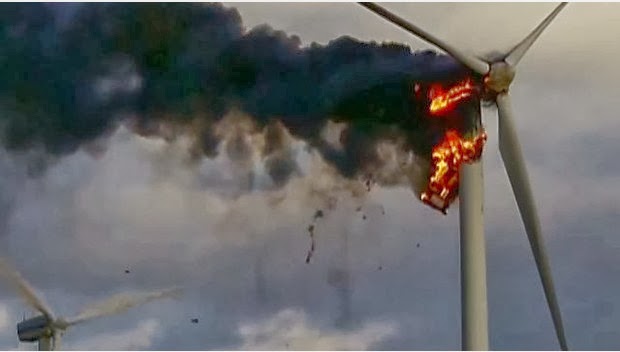
Turbines represent the perfect bushfire incendiary: around the world, hundreds have blown up in balls of flame – in the process – each one raining molten metal and hundreds of litres of flaming hydraulic oil and burning plastic earthwards. Here’s a few pics showing these plucky ‘green’ fire-starters in action:

turbine fire 1

turbine fire Trent-Wind-Farm

turbine fire 6

windturbine-exploding

Vestas turbine on fire

wind_turbine_fire

Feuer in Windkraftanlage

turbine fire 3

turbine fire 4.jpeg

turbine fire 5

turbine fire 7

Wind turbine fires are ten times more common than the wind industry and its parasites claim (see our post here and check out this website:http://turbinesonfire.org).

Here’s a report on, yet more, turbines bursting into fireballs.

One Suzlon turbine destroyed and two badly damaged
Wind Power Monthly
Mike McGovern
8 December 2014

wind turbine suzlon s88 amayo

NICARAGUA: A Suzlon 2.1MW turbine nacelle caught fire and later crashed to the ground on Sunday in an incident involving three damaged turbines at the 63MW Amayo complex in Nicaragua, the country’s first wind project.

“There were no injuries and the site has been secured,” Suzlon told Windpower Monthly in a written statement, confirming the affected turbines to be S88-2.1MW machines.

Suzlon declined to comment on the possible cause, pending further investigation. Nobody at the US-based owner company, AEI Energy, was available for comment.

Local press reports, citing ground staff and fire fighters, said all three machines at the 23MW Amayo II plant — in service since 2010 — suffered failure in their emergency braking systems, leaving them helpless against high gusts of wind. No other turbines were affected, claimed Suzlon.

The turbines caught ablaze at 5.15am, just under an hour after a blackout hit the Rivas municipality, where the wind farm is located.

All three machines reportedly spun uncontrollably. Turbine 28 finally fell and all three blades of turbine 25 were flung off. A blade on turbine 29 was left broken.
Wind Power Monthly

If the story has an upside, it’s the successful bid for “freedom” made by the blades during yet another “component liberation” event (see our posts here and here and here and here and here).

And glad to see our favourite Indian fan maker, Suzlon making the news! But they weren’t overly keen to let much slip – its spin-masters quickly switching to “radio silence” when quizzed about the cause. And – in typical wind weasel fashion – the wind power outfit concerned went into complete media lock-down. No surprises there.

Suzlon – aka Suzlon REPower, aka Senvion – have planted hundreds of its S88s all over the Australian countryside: near-bankrupt wind power outfit, Infigen operate a stack of them in NSW; Trustpower planted 47 at Snowtown, in South Australia’s Mid-North; and AGL speared a hundred or so into SA’s Mid-North, around Jamestown and Hallett.

Senvion are the crowd behind the ridiculous CERES project – which aims to spear 197 of its whirling, pryro-technic devices into SA’s agricultural Heartland, the Yorke Peninsula. Thankfully for farmers and fire-fighters, the chances of that debacle eventuating are slimmer than a German supermodel.

There have been at least 4 bushfires started by wind turbines in Australia, so far:

  • Ten Mile Lagoon in Western Australia in the mid-1990s;
  • Lake Bonney, Millicent (SA) in January 2006 (see the photo below);
  • Cathedral Rocks Wind Farm, Port Lincoln (SA) in February 2009 (see The Advertiser article below); and
  • Starfish Hill (SA) in November 2010 (see this link for more detail).

wind turbine fire Lake_Bonney_windfarm

When it comes to talking about the exceedingly “hot” topic of bushfires started by turbines, Australian wind power outfits exhibit the same well-drilled, reticence shown by American outfit, AEI Energy in the article above, about its flaming little Suzlon beauties.

As a result, the media rarely report on the bushfires that are started by turbines. On the rare occasions that the media do – as in this Advertiser article – wind power outfits never comment, keep their heads well below the PR parapet and hope that the flames die down quickly.

Cathedral Rocks Wind Farm turbine fire
The Advertiser
2 February 2009

A $6 MILLION wind turbine has caught fire near Port Lincoln, starting blazes on the ground as embers fall.

The fire, at the Cathedral Rocks Wind Farm about 30km southwest of the town, was first noticed by a boat about 1am.

The turbine is alight halfway up its 60m structure, making it difficult for the 14 Country Fire Service firefighters trying to deal with it to extinguish the blaze.

They are also busy controlling the spotfires, but consider the situation to be safe.

The cause of the blaze is as yet unknown.
The Advertiser

water bombing

Not only do wind turbines act as the perfect bushfire-starters, their presence precludes the best and safest method of fire-fighting from controlling them: aerial water bombers won’t fly within cooee of these things – experienced pilots have declared that they won’t fly within 3km of a wind turbine, even without the country around them on fire. For a rundown on pilots’ attitudes to flying anywhere near wind farms – see our posts here and here and here.

water bombing elvis

Aircraft and wind turbines – standing 160m tall, with a whirling wing-span of over 100m – don’t mix at the best of times (see our post here). Add billowing smoke, 50m flames and scorching heat and no-one could blame fire-fighting pilots for giving wind farms a very wide berth when the country around them is ablaze.

Fitting it is then, that the Senate Select Committee has the clearly obvious fire risk created by giant fans, and the ability to fight those fires, squarely in its sights – its terms of reference include scrutiny of: “the effect that wind towers have on fauna and aerial operations around turbines, including firefighting and crop management” (see our post here).

For those in the country keen to avoid the very real threat of incineration that comes hand-in-glove with having wind turbines speared all over it – note that the opportunity to make submissions to the Committee ends on 27 February 2015. See the link here.

It’s high time our political betters brought this insanity under control.

bushfire aftermath 2

Faux-Green EPA is Not a Friend of the People….

EPA CO2 rules will make make people poorer — and then kill them

Statistician Stan Young shows how the real costs and imaginary benefits of the EPA CO2 rule are a deadly combination.

Are there mortality co-benefits to the Clean Power Plan? It depends.
S. Stanley Young, genetree@bellsouth.net

Some years ago, I listened to a series of lectures on finance. The professor would ask a rhetorical question, pause to give you some time to think, and then, moreoften than not, answer his question with, “It depends.” Are there mortality co-benefits to the Clean Power Plan? Is mercury coming from power plants leading to deaths? Well, it depends.

So, rhetorically, is an increase in CO2 a bad thing? There is good and bad in everything. Well, for plants an increase in CO2 is a good thing. They grow faster. They convert CO2 into more food and fiber. They give off more oxygen, which is good for humans. Plants appear to be CO2 starved.

It is argued that CO2 is a greenhouse gas and an increase in CO2 will raise temperatures, ice will melt, sea levels will rise, and coastal area will flood, etc. It depends. In theory yes, in reality, maybe. But a lot of other events must be orchestrated simultaneously. Obviously, that senerio depends on other things as, for the last 18 years, CO2 has continued to go up and temperatures have not. So it depends on other factors, solar radiance, water vapor, El Nino, sun spots, cosmic rays, earth presession, etc., just what the professor said.

So suppose ambient temperatures do go up a few degrees. On balance, is that bad for humans? The evidence is overwhelming that warmer is better for humans. One or two examples are instructive. First, Cox et al., (2013) with the title, “Warmer is healthier: Effects on mortality rates of changes in average fine particulate matter (PM2.5) concentrations and temperatures in 100 U.S. cities.” To quote from the aYoung1 Means CIsbstract of that paper, “Increases in average daily temperatures appear to significantly reduce average daily mortality rates, as expected from previous research.” Here is their plot of daily mortality rate versus Max temperature. It is clear that as the maximum temperature in a city goes up, mortality goes down. So if the net effect of increasing CO2 is increasing temperature, there should be a reduction in deaths.

I have a very large California data set. The data covers eight air basins and the years 2000 to 2012. There are over 37,000 exposure days and over two million deaths. The data forYoung2 LA O3 PM DeathLos Angeles for the year 2007 is typical.

The number of Heart or Lung deaths for people 65 and older are given on the left, y-axis. The moving 21-day median number of deaths are given with blue diamonds as time marches to the right. Deaths are high during the winter, when temperatures are lower; the number of deaths are lower during the summer, when the temperatures are higher. These plots are typical. It is known that higher temperatures are associated with lower deaths.

A purported co-benefit of lower CO2 is that there will be lower levels of PM2.5. (PM2.5 is not chemically defined, but is partially made up of combustion products.) It is widely believed that lower levels of PM2.5 will lead to fewer deaths. Here is what Cox et al. (2013) have to say, “Unexpectedly, reductions in PM2.5 do not appear to cause any reductions in mortality rates.” And here is their supporting figure below.

Chay et al. (2003) looked at Young3 Death v PM25a reduction in air pollution due to the Clean Air Act. Counties out of compliance were given stricter air pollution reduction goals. This action by the EPA created a so called natural experiment, Craig et al. (2012). The EPA selected counties did reduce air pollution levels, but there was no reduction in deaths after adjustments for covariates. Chay et al. (2003) say, “We find that regulatory status is associated with large reductions in TSPs pollution but has little association with reductions in either adult or elderly mortality.” So Cox et al. (2013) confirm the finding of Chay et al. (2003) that a reduction in PM2.5 does not lead to a reduction in deaths. Young and Xia (2013) found no assocation of PM2.5 with longevity in western US. Enstrom (2005) and many others have found no association of chronic deaths with PM2.5 in California.

Many claim an assocation of air pollution with deaths, acute and chronic. How can the two sets of claims be understood? Well, it depends. Greven et al. (2011) say in their abstract, “… we derive a Poisson regression model and estimate two regression coefficients: the “global” coefficient that measures the association between national trends in pollution and mortality; and the “local” coefficient, derived from space by time variation, that measures the association between location-specific trends in pollution and mortality adjusted by the national trends. …Results based on the global coefficient indicate a large increase in the national life expectancy for reductions in the yearly national average of PM2.5. However, this coefficient based on national trends in PM2.5 and mortality is likely to be confounded by other variables trending on the national level. Confounding of the local coefficient by unmeasured factors is less likely, although it cannot be ruled out. Based on the local coefficient alone, we are not able to demonstrate any change in life expectancy for a reduction in PM2.5.” (Italics mine) In plain words, associations measured from location to location, which are likely to be affected by differences in covariates, show an association. Examination of trends within locations, which are less likely to be affected by covariates, show no association. In short, the claims made depend on how well covariates are taken into account. When they are taken into account, Chay et al. (2003), Greven et al. (2011), Cox et al. (2013), Young (2014), there is no association of air pollution with deaths. Chay controls for multiple economic factors. Greven controls for location. Cox controls for temperature. Young controls for time and geography.

Note well: The analysis of Young (2014) uses a moving median within a location (air basin). This analysis is much less likely to be affected by covariates. This analysis finds no assocation of air pollution (PM2.5 or ozone) with deaths. Several figures are instructive. The figures are for LA, but are typical for the other California air basins. First ozone:

Young4 Bivariate

The figures were constructed as follows. From the daily death total was subtracted a 21-day moving median. This calculation corrects for the time trend in the data. From the daily air pollution level the 21-day moving median for the air pollution was subtracted. The daily death “deviation” was plotted against the pollution “deviation”. If air pollution was causing deaths, then the density in these three figures should go from lower left to upper right. To examine if previous air pollution, e.g. yesterday or the day before, was associated with current deaths, lags of 0, 1, and 2 days were used, hence the three figures. Plots like these were computed for all eight air basins; the figures for LA are typical. Next we give the same sort of figures, but for PM2.5. Again, LA.

Young5 Bivariate 21

Again, the density is concentrated at zero PM2.5 and zero deaths, and, the important point, there is no tilt of the density from lower left to upper right. And again the plots for LA are typical of the other seven air basins.

Can we say more? Many authors have noted “geographic heterogeneity”, the measured effect of air pollution is not the same in different locations. There is overwhelming evidence for the existence of geographic heterogeneity. See for example, Krewski et al. (2000), Smith et al. (2009), Greven et al. (2011) and Young and Xia (2013). Multiple authors have not found any association of air pollution with acute deaths in California, Krewski et al. (2000), Smith et al. (2009), Young and Xia (2013) and Jarrett et al. (2013). Enstrom (2005) found no association with chronic deaths in California. A careful consideration of of this “geographic heterogeneity” is a key to understanding why it is unlikely that air pollution is causing deaths. Given that geographic heterogeneity exists, how should it be interpreted? First, statistical practice says that if interaction exists, then average effects often are misleading. Any recommendations should be for specific situations. In the words of the finance professor, it depends. In this case it makes no sense to regulate air pollution in California more severely than current regulations.

We can consider the question of interactions of air pollution with geography more deeply. Greven et al. (2011) state in their abstract, “Based on the local coefficient alone, we are not able to demonstrate any change in life expectancy for a reduction in PM2.5.” and they go on to say differences in locations (geographic heterogeneity) is most likely due to differences in covariates, e.g. age distributions, income, smoking. Indeed when Chay et al. (2003) corrected their analysis for an extensive list of covariates, they found no effect of the EPA intervention to reduce air pollution.

There is empirical evidence and a logical case that air pollution is (most likely) not causally related to acute deaths. Heart attacks and stroke were recently removed as a possible etiology, Milojevic et al. (2014).

Economics on the back of an envelope

The EPA claims saving 6,600 deaths per year due to CPP. They value each death at nine million dollars giving a co-benefit of $59.4B. But analysis that takes covariates into consideration finds no excess deaths due to ozone or PM2.5. The $59.4B co-benefit is the result of flawed analysis. And what is the cost of the regulation? The EPA says CPP is the most costly regulation it has considered and puts the cost at up to $90B/yr. The National Manufacturers Association puts the cost at $270B/yr, $900/person/year in 2020.

Consider Figure 4b of Young and Xia (2013). The data used in this figure is that used in Pope, Ezzati, and Dockery (2009) and was kindly provided by Arden Pope III. Change in income and air pollution from ~1980 to ~2000 wasYoung6 LE v incomeused. Income in thousands of dollars increase over that time period, but differed in magnitude from city to city, the x-axis. Life expectancy increased as well, y-axis. The general trend is very clear, increased income is associated with increased life expectancy. The income-life expectancy relationship is well-known. See the dramatic video by Hans Rosling (2010). To the extent that regulations are expensive, they should move people down and left in this figure with life expectancy less than it would have been. For example, $900 less income is expected to reduce life expectancy by two months.

So, do you want the EPA CPP regulations to extend your life not at all, costing you $900/yr or do you want to have use of your own money and save two months of your life? It depends. EPA decides or you decide.

Summary

  1. Increased CO2 is good for plants as plants grow better with increased CO2.
  2. Increases in temperature, however caused, are good for humans as they are less likely to die.
  3. The science literature, when covariates are controlled, is on the side that increased ozone and PM2.5 are not associated with increased deaths.
  4. On balance, the costs of reducing CO2, PM2.5 and ozone are expected to lead to reduced life expectancy.

Torturing Residents With Wind Turbine Noise!

UK Plan to Ban Noisy Wind Farms

when-is-wind-energy-noise-pollutionNoisy wind farms face ban as ministers launch review into ‘annoying’sound levels
The Telegraph
Emily Godsen
30 November 2014

Exclusive: Energy department commissions review into disturbance from turbine noise in order to decide when annoyance becomes unacceptable 

Noisy wind farms that disturb local communities could be banned, after ministers launched an unprecedented review into the annoyance they cause.

In the first official admission that wind turbine noise can adversely affect local residents, the Department of Energy and Climate Change (DECC) has commissioned an independent investigation to assess the levels of sound wind farms produce and the extent of disturbance caused as a result.

Experts from the Institute of Acoustics will conduct the research next year, the Telegraph has learnt, and ministers across Government will then use the data to decide at which point the annoyance officially becomes “unacceptable”.

The review is likely to lead to tighter planning guidance for new wind farms and could force existing wind farm operators to restrict their turbines’ operation to stay within the limits.

It is also likely to open the door to claims for compensation by residents subjected to noise above the official nuisance threshold.

Many residents living near wind farms have complained of noise disturbance, while studies have linked wind turbine noise to poor sleep and mental health.

As well as the routine “swishing” noise of the blades spinning, turbines can sometimes produce “thumping” noises when sudden variations in the wind speed cause the blades to stall.

Current planning guidance limits the swishing noise to 43 decibels at night-time for the nearest property but does not deal with the thumping noises, which are a deeper pitch and can be heard at 40 decibels a kilometre away from the turbine.

Residents near some wind farms have likened the noise to a cement-mixer or a shoe stuck in a tumble-dryer.

A source said the new review would consider all types of turbine noise. “Everything is on the table,” they said.

Developers could be forced to use software to adjust the angle of the blades to prevent the thumping being caused at an unacceptably annoying level.

A spokesman for the DECC said: “This review should empower local people to stop disruptive wind farms and make sure local authorities have all the information they need before giving a planning application the green light.”

The review is expected to be completed by June. While the Institute of Acoustics will independently draw up the index of noise annoyance, the decision over what will be deemed an acceptable threshold will be a political decision for the next Government.

The Conservatives have already pledged an effective ban on new onshore wind farms if they win the election, by ending subsidies for those projects that do not already have planning permission. They have also pledged that all future onshore wind farm planning decisions would be determined by local authorities, instead of large projects being deemed nationally significant.

Matthew Hancock, the Conservative energy minister, said: “It’s important that we maximize the potential of domestic energy resources but we must do this in a responsible way. We cannot jeopardize our green and pleasant land.”

Ed Davey, the Lib Dem energy secretary, has heavily criticized the Conservative plan to ban onshore wind, arguing it would push up consumer bills by forcing the UK to build more expensive types of renewable technologies such as offshore turbines to hit green targets.

Wind industry body Renewable UK said it had already conducted extensive research into the extent of the thumping problem – known as Other Amplitude Modulation – and had devised the ways of tackling it.

Independent research published by the lobby group late last year had helped “to pinpoint when, where and how this sound varies”, Gemma Grimes, the group’s Director of Onshore Renewables said.

“We found that this can be addressed by using computer software to adjust the way turbines operate, changing the angle of the blades to minimize the sound levels.

“We’re hoping that this will now be incorporated within the Institute of Acoustics’ existing Good Practice Guidance document,” she said.

But she said she did not believe the existing guidance on swishing noises would or should be changed. “In this [Institute of Acoustics] guidance, which they published last summer, there was no question of changing the current noise limits, which are rightly very stringent, so we wouldn’t expect any alteration in that when they update the current document,” she said.
The Telegraph

Ever noticed how it’s only the wind industry, its parasites and spin-masters that use the terms “swoosh” and “swishing” to describe the noise produced by their giant fans?

Language abuse like that goes hand-in-glove with the same kind of corporate subterfuge that has given us lines about the noise from turbines being quieter than a refrigerator 500m away and as soothing as waves lapping on a moonlit beach (see our post here).

Funny, though, that those forced to live anywhere near these things never talk about “swishing” and, instead, use a raft of terms pulled from the darker reaches of our lexicon: “roaring”; “thumping”; “grinding”; “whining” – and phrases like “a truck rumbling down the road but never arriving”; “a jet plane overhead that never lands”; and – as appears in the piece above: “a cement-mixer” or “a shoe stuck in a tumble-dryer”.

It’s like the wind industry’s spruikers have never spent a night trying desperately to sleep anywhere near their masters’ monsters. Funny about that, too.

To give them a clue – and to help you decide on whether it’s the impacted neighbours’ choice of language that better describes the racket – here’s a couple of videos of these things in action. Take a listen and see what you think:

blob:https%3A//www.youtube.com/2189e6d8-9736-44e1-9d8f-c2b41473d799

STT particularly loves the second video – where a wind power outfit’s lawyer is telling a planning panel that “noise isn’t going to be an issue of concern” and compares the noise that would be produced by his client’s turbines with “a quiet library” and “an average home”. Hmmm …

STT also loves the claims by wind industry spin kings, Renewable UK that – when it comes to the thumping noise complained of by neighbours – like the Bob the Builder – it can fix most everything. Which begs the question, why is the “thumping” noise a problem at all?

bob the builder

But the argument about “fixing” the “thumping” noise is a typical red-herring response to the real and underlying problem: the incessant (and, therefore, grindingly annoying) nature of the low-frequency noise and infrasound emitted – where the former is audible and the latter isn’t, but operates on the auditory and other sensory systems to disturb sleep; with both combining to cause long-term sleep deprivation and other adverse health effects, as crack Professor Alec Salt explains in simple terms in this video – and as covered in our post here.

blob:https%3A//www.youtube.com/2679c3be-4b60-49cb-9923-fd24e9a26627

turbine collapse 9

GE Scientists, and Mic, Have Been Studying the Effects of Sleep Deprivation!

What Sleep Deprivation Does to Your Brain, in One Stunning Infographic

This partner story is part of BrainMic, a collaboration with GE to share the latest advances in brain research and technology.

If you yawn during the day, conk out as soon as your head hits the pillow or re-read this sentence a few times to absorb its meaning, here’s some bad news: You need more sleep.

Scientists still don’t know exactly why we sleep, but according to a near-constant stream of research, most of us need between six and eight hours of shut-eye each night. Unfortunately, only about 30% of us are getting it. That means 70 million Americans suffer from sleep deprivation, a certified public health epidemic, according to the Centers for Disease Control and Prevention.

Sleep deprivation takes an enormous toll on our bodies, including bloodshot eyes, increased blood pressure and a fuller waistline. But what’s equally alarming is the negative impact of sleep deprivation on the brain.

This infographic explains what happens to your brain, and what it means for you, when you don’t get enough sleep:

Links to infographic resources: The Journal of Neuroscience, International Scholarly Research Notes,Experimental Brain Research, Psychological Bulletin, UC Berkeley Walker Sleep Lab, PNAS, International Journal of Occupational Medicine and Environmental Health, CDC, The Journal of Neuroscience, SLEEP,PLOS one, Psychological Science, Frontiers in Human Neuroscience, Daytime Sleepiness Affects Prefrontal Regulation of Food Intake

All images by: Liran Okanon and Tri Vo

GE Scientists and Mic are partnering to share the latest advances in brain research and technology through BrainMic, a Spotlight Series that explores the universe in our heads, now through December 2014. Click here to read more from this series on BrainMic >>

Ontario’s Liberal Government Ignores, and Denies, Health Effects of Wind Turbines…

Ontario’s Wind Powered Health Calamity

sleepingOntario is the scene of a perfectly avoidable and entirely unnecessarypublic health disaster.

The rights of people to live peaceful, healthy lives in rural Ontario have been trampled under the jackboots of Kathleen Wynne’s Liberals – a solid team of hard-‘green’-left eco-fascist nutjobs, responsible for the most bizarre, pointless and costly energy policy on Earth (see our posts hereand here and here)

The scale and scope of the disaster was laid bare in the brilliant documentary, Down Wind (see our post here) and has been pursued with proper journalistic zeal by Sun News’ investigative reporter, Rebecca Thompson (see our posts here and here).

A couple of weeks back, Wynne’s puppets at her Health Department (laughably called “Health Canada”) threw together yet another half-baked, wind industry approved pile of tosh parading as “research” on the known and obvious impacts of turbine generated low-frequency noise and infrasound.

Ever since, properly qualified people have been slamming it for the sloppiness of the work and the wild assumptions upon which its undercooked “conclusions” rest.

Two of them – Carmen Krogh and Bob McMurtry penned the piece below.

carmen krogh

Carmen Krogh, BScPharm (retired), is a peer reviewed IWT health researcher and former Director of Publications and Editor-in-Chief of the CPS.

bob mcmurtry

RY “Bob” McMurtry is Professor Emeritus (Surgery) of Western University (formerly University of Western Ontario). Dr. McMurtry was also an ADM at Health Canada 2000-02.

Health Canada and Wind Turbines: Too little too late?
CMAJ
28 November 2014

Industrial wind turbines (IWTs) are being erected at rapid pace around the world. Coinciding with the introduction of IWTs, some individuals living in proximity to IWTs report adverse health effects including annoyance, sleep disturbance, stress-related health impacts and reduced quality of life. [i],[ii],[iii],[iv],[v],[vi],[vii],[viii],[ix],[x],[xi],[xii] In some cases Canadian families reporting adverse health effects have abandoned their homes, been billeted away from their homes or hired legal counsel to successfully reach a financial agreement with the wind energy developer.[xiii]

To help address public concern over these health effects Health Canada (HC) announced the Health Canada Wind Turbine Noise and Health Study(HC Study) 2 years ago and brought forth preliminary results November 6, 2014.

Here we briefly comment on the HC Study results and provide some historical context.

Acknowledgement of IWT adverse health effects is not new. The term “annoyance” frequently appears when discussing IWT health effects.

In a 2009 letter the Honourable Rona Ambrose, disclosed:

“Health Canada provides advice on the health effect of noise and low-frequency electric and magnetic fields from proposed wind turbine projects…To date, their examination of the scientific literature on wind turbine noise is that the only health effect conclusively demonstrated from exposure to wind turbine noise is an increase of self-reported general annoyance and complaints (i.e., headaches, nausea, tinnitus, vertigo).” [xiv]

In 2009, the Canadian Wind Energy Association (CanWEA) sponsored a literature review which acknowledges the reported symptoms such as headaches, nausea, tinnitus, vertigo and state they “… are not new and have been published previously in the context of “annoyance”…” and are the “… well-known stress effects of exposure to noise …”[xv]

In 2011, a health survey of people exposed to IWTs in Ontario reported altered quality of life, sleep disturbance, excessive tiredness, headaches, stress and distress. [xvi]

In the same year, CanWEA posted a media release which advised those impacted by wind turbine annoyance stating “The association has always acknowledged that a small percentage of people can be annoyed by wind turbines in their vicinity. … When annoyance has a significant impact on an individual’s quality of life, it is important that they consult their doctor.”[xvii]

It turns out it’s not a small percentage of people annoyed by wind turbines. An Ontario Government report concluded a non-trivial percentage of persons are expected to be highly annoyed.

The December 2011 report prepared by a member of CanWEA for the Ontario Ministry of Environment states in the conclusions:

“The audible sound from wind turbines, at the levels experienced at typical receptor distances in Ontario, is nonetheless expected to result in a non-trivial percentage of persons being highly annoyed. As with sounds from many sources, research has shown that annoyance associated with sound from wind turbines can be expected to contribute to stress related health impacts in some persons.”[xviii]

The World Health Organization (WHO) acknowledges noise induced annoyance to be a health effect [xix] and the results of WHO research “…confirmed, on an epidemiological level, an increased health risk from chronic noise annoyance…”[xx]

HC also acknowledges noise induced annoyance to be an adverse health effect. [xxi],[xxii] The Principal Investigator of the recent HC Study also states “noise-induced annoyance is an adverse health effect”. [xxiii]

Canadian Government sponsored research has found statistically significant relationships from IWT noise exposure.

A 2014 review article in the Canadian Journal of Rural Medicine reports:

“In 2013, research funded by the Ontario Ministry of the Environment indicated a statistically significant relation between residents’ distance from the turbine and the symptoms of disturbed sleep, vertigo and tinnitus, and recommended that future research focus on the effects of wind turbine noise on sleep disturbance and symptoms of inner ear problems.” [xxiv]

Recently on November 6, 2014, HC posted on its website preliminary results of its HC Study[xxv]. Wind turbine noise “…. annoyance was found to be statistically related to several self-reporting health effects including, but not limited to, blood pressure, migraines, tinnitus, dizziness, scores on the PSQI, and perceived stress” as well as related to “measured hair cortisol, systolic and diastolic blood pressure.”

These troubling results come as no surprise. Since at least 2007 HC employees including the Principal Investigator of the HC Study recommended wind turbine noise criteria which they predict will result in adverse health effects. (i.e. result in an increase percentage highly annoyed).[xxvi],[xxvii],[xxviii]

Then turbines were built and HC spent 2.1 million dollars to find out it appears to have under predicted the impact of IWT noise. HC’s IWT noise criteria does not use a dose response based on IWT noise but rather road noise. But of course IWTs are not cars and peer-reviewed studies consistently document that IWTs produce sound that is perceived to be more annoying than transportation or industrial noise at comparable sound pressure levels. [xxix],[xxx]

IWT noise annoyance starts at dBA sound pressure levels in the low 30s and rises sharply at 35 dBA as compared to road noise which starts at 55 dBA. These findings are further supported by the HC Study’s preliminary results. [xxxi]

IWT noise characteristics that are identified as plausible causes for reported health effects include amplitude modulation, audible low- frequency noise (LFN), infrasound, tonal noise, impulse noise and night-time noise. [xxxii]

The logical solution would be to develop IWT noise criteria which will protect human health but that would present a barrier to wind energy development. Noise limits impacts IWT siting, cost of energy produced[xxxiii] and by extension corporate profits. The wind energy industry has actively lobbied governments to be granted IWT noise exposure limits which benefit their industry.

Canadians trying to understand this should be mindful the Government of Canada has invested and distributed significant amounts of public money to attract and support the wind energy industry. [xxxiv],[xxxv],[xxxvi],[xxxvii],[xxxviii],[xxxix],[xl],[xli] In addition to providing funding, the Government of Canada in collaboration with wind industry stakeholders has developed the Wind Technology Road Map (Wind TRM) [xlii] which Natural Resources Canada defined to be an “…industry-led, government supported initiative that has developed a long-term vision for the Canadian wind energy industry …”.[xliii]

Canada’s Wind TRM states “Members of the Steering Committee, government and our industry will be using this roadmap to direct the actions that are necessary for Canada to develop its vast wind resources.”[xliv] HC is a member of the Interdepartmental Wind Technology Road Map Committee [xlv] which was created to assist in the implementation of Canada’s Wind TRM. [xlvi] One of the “key action items” detailed in the Wind TRM calls for Government and Industry collaboration to develop and maintain government documents that address concerns raised about wind energy projects including that of noise, infrasound and other. [xlvii]

Some jurisdictions are trying to take action to protect their residents. For example, several municipalities in Ontario are trying to establish bylaws that protect from IWT noise. In Wisconsin, on October 14, 2014 the Brown County Board of Health unanimously approved a motion to declare the IWTs at a local project a Human Health Hazard. [xlviii]

It would appear HC’s research effort is too little too late. A non-trivial percentage of Canadians continue to experience adverse health effects. HC now has additional scientific evidence of the “conclusively demonstrated” effects from exposure to IWT noise. It is time for HC to take action to help Canadians maintain and improve their health. (for the references, see below)
CMAJ

Bob and Carmen aren’t the only qualified experts dumping on the woeful “methods” and flawed assumptions of the Health Canada “research”.

john harrison

John Harrison, a Queen’s University professor emeritus in physics, slammed the “research”, saying that: “the Health Canada study is more politics than science“.

John Harrison is joined by Denise Wolfe – a highly experienced clinical trial research auditor – who has taken a well-honed axe to the “study” – hammering it for:

  • hiding and fudging the raw data;
  • failing to meet the study design’s own sample size criteria;
  • only taking its noise samples during summer, when there is little or no wind;
  • inherent inconsistencies between the data relied on and the arguments presented in the report;
  • incomplete and inconsistent noise modelling;
  • excluding children – the most vulnerable group – from the study altogether;
  • failing to point out that annoyance of the kind identified by the study (which includes sleep deprivation) is defined by the WHO as an adverse health effect (refer to its Night-time Noise Guidelines for Europe – the Executive Summary at XI to XII covers the point);
  • failing to even bother analysing the infrasound data gathered;
  • and, having failed to even analyse the infrasound data, making wholly unsupported conclusions about its impact on sleep and health;
  • in relation to its flawed noise data modelling, relying on wind speed data up to 50km away from the residences involved;
  • making the bogus claim that the study has been published in a peer-reviewed journal (it hasn’t);
  • misleading verbiage (ie waffle and gobbledygook);
  • prematurely publishing what is a piece of political propaganda, based on incomplete and deliberately misleading and inconsistent information; and
  • failing to disclose links between those that worked on the study and their wind industry backers.

sleeping baby

References (to the CMAJ article)

[i] Pedersen E, Persson KW. Perception and annoyance due to wind turbine noise–a dose response relationship. Journal of the Acoustical Society of America. 2004; 116: 3460-70.

[ii] Harry A. Wind turbines, noise and health. 2007, February. Availablehere

[iii] Pedersen E, Persson Waye K. Wind turbine noise, annoyance and self-reported health and well being in different living environments. Occupational and Environmental Medicine. 2007;64:480-86.

[iv] Phipps R, Amati M, McCoard S, Fisher R. Visual and noise effects reported by residents living close to Manawatu wind farms: Preliminary survey results. 2007. Available here

[v] Pedersen E, Bakker R, Bouma J, van den Berg F. Response to noise from modern wind farms in the Netherlands. Journal of the Acoustical Society of America, 2009; 126: 634-43.

[vi] Pierpont N. Wind turbine syndrome: A report on a natural experiment. Santa Fe, NM: K-Selected Books. 2009. Available here

[vii] Krogh C, Gillis L, Kouwen N, Aramini J. WindVOiCe, a self-reporting survey: Adverse health effects, industrial wind turbines, and the need for vigilance monitoring. Bulletin of Science Technology & Society. 2011; 31: 334-45.

[viii] Shepherd D, McBride D, Welch D, Dirks KN, Hill EM. Evaluating the impact of wind turbine noise on health-related quality of life. Noise Health. 2011;13:333-9.

[ix] Thorne B. The problems with noise numbers for wind farm noise assessment. Bulletin of Science, Technology & Society. 2011;31:262-90.

[x] Rand R., Ambrose S, Krogh C. Wind turbine acoustic investigation: infrasound and low-frequency noise–a case study, Bulletin of Science Technology & Society. 2012;32:128–41

[xi] Falmouth Health Department. Letter to Massachusetts Department of Public Health. June 11, 2012. Available on request.

[xii] Nissenbaum M, Aramini J, Hanning C. Effects of industrial wind turbine noise on sleep and health. Noise Health. 2012;14:60:237-43.

[xiii] Roy D. Jeffery, Carmen Krogh, and Brett Horner Industrial wind turbines and adverse health effects

[xiv] Can J Rural Med 2014;19(1):21-26

[xiv] Krogh – Correspondence from the Honourable Rona Ambrose, June 30, 2009. Available on request.

[xv] Colby, W. D., Dobie, R., Leventhall, G., Lipscomb, D. M., McCunney, R. J., Seilo, M. T., & Søndergaard, B., Wind Turbine Sound and Health Effects: An Expert Panel Review, Washington, DC: American Wind Energy Association and Canadian Wind Energy Association. (2009). Available here

[xvi] Krogh C, Gillis L, Kouwen N, Aramini J. WindVOiCe, a self-reporting survey: Adverse health effects, industrial wind turbines, and the need for vigilance monitoring. Bulletin of Science Technology & Society. 2011; 31: 334-45.

[xvii] The Canadian Wind Energy Association, The Canadian Wind Energy Association Responds To October 14, 2011 Statement By Wind Concerns Ontario, Media Release (2011, October 14) PDF Available on request.

[xviii] Howe Gastmeier Chapnik Limited. (2010, December 10). Low frequency noise and infrasound associated with wind turbine generator systems: A literature review (Rfp No. Oss-078696). Mississauga, Ontario, Canada: Ministry of the Environment.

[xix] World Health Organization, Guidelines for Community Noise,1999 Available here

[xx] Niemann H, Bonnefoy X, Braubach M, Hecht K, Maschke C, Rodrigues C, Robbel N. Noise-induced annoyance and morbidity results from the pan-European LARES study. Noise Health 2006;8:63-79

[xxi] Health Canada, Community Noise Annoyance, It’s Your Health, (2005, September). [cited 2014 Nov 25]. Available here

[xxii] Health Canada, Useful Information for Environmental Assessments, (2010), Published by authority of the Minister of Health. [cited 2014 Nov 25]]. Available here

[xxiii] Michaud, D. S., Keith, S. E., & McMurchy, D., “Noise Annoyance in Canada”, Noise Health, 7, 39-47, (2005)

[xxiv] Roy D. Jeffery, Carmen Krogh, and Brett Horner Industrial wind turbines and adverse health effects

[xiv] Can J Rural Med 2014;19(1) Available here

[xxv] Health Canada, Wind Turbine Noise and Health Study: Summary of Results, November 6 2014. Available here

[xxvi] Keith SE, Michaud DS, Bly SHP. A justification for using a 45 dBA sound level criterion for wind turbine projects. N.D.

[xxvii] Keith SE, Michaud DS, Bly SHP. A proposal for evaluating the potential health effects of wind turbine noise for projects under the Canadian Environmental Assessment Act. Second International Meeting on Wind Turbine Noise, Lyon France September 20 -21 2007

[xxviii] Keith SE, Michaud DS, Bly SHP. A proposal for evaluating the potential health effects of wind turbine noise for projects under the Canadian Environmental Assessment Act. J Low Freq Noise. 2008:27:253-65.

[xxix] Pedersen E, Persson KW. Perception and annoyance due to wind turbine noise–a dose response relationship. Journal of the Acoustical Society of America. 2004; 116: 3460-70.

[xxx] Pedersen E, Bakker R, Bouma J, van den Berg F. Response to noise from modern wind farms in the Netherlands. Journal of the Acoustical Society of America, 2009; 126: 634-43.

[xxxi] Health Canada, Wind Turbine Noise and Health Study: Summary of Results, November 6 2014. Available here

[xxxii] Jeffery RD, Krogh CME, and Horner B, [Review] Industrial wind turbines and adverse health effects Can J Rural Med 2014;19(1), 21-26. Available here

[xxxiii] Canadian Wind Energy Association [website]. Letter to Neil Parish re: sound level limits for wind farms. Ottawa, ON: Canadian Wind Energy Association; 2004. Available on request.

[xxxiv] Government of Canada, Natural Resources Canada, EcoEnergy for Renewable Power, web update June 1 2009 Improving Energy Performance in Canada an ecoACTION initiative. Available here

[xxxv] Government of Canada Natural Resources Canada: Government of Canada Announces $9.2 Million for Alberta Wind Energy Project. July 07, Available here

[xxxvi] Minister of Natural Resources Lisa Raitt (Thursday, 10 Sept 2009) MEDIA RELEASE -Renewable Energy Expands in Ontario. Available here

[xxxvii] Government of Canada, Natural Resources Canada. ecoENERGY for Renewable Power Program Power Program Date Modified: 2011-02-25 Available here

[xxxviii] Government of Canada, Natural Resources Canada. About Renewable Energy

[xxxix] Government of Canada, Natural Resources Canada. ecoENERGY for Renewable Power Program, Available here

[xl] Government of Canada, Natural Resources Canada. ecoENERGY for Renewable Power Program Power Program. Available here

[xli] The Honourable Joe Oliver, Minister of Natural Resources Canada, Letter of correspondence August 10, 2012. Available on request.

[xlii] Access to Information and Privacy Request (ATIP) Briefing Note to the Ministers Office, Update on the Development of Federal-Provincial-Territorial Guidelines on Wind Turbine Noise

[xliii] Government of Canada, Natural Resources Canada (NRCAN) Wind Energy | Canada’s Wind TRM (Technology Road Map). Available here

[xliv] Government of Canada, Natural Resources Canada (NRCAN) Wind Energy | Canada’s Wind TRM (Technology Road Map). Available here

[xlv] Health Canada, (2012) Health Canada Policy and Research Approach for Wind Turbine Noise – A presentation to the Science Advisory Board, February 2, 2012 Available here

[xlvi] Government of Canada, Natural Resources Canada. Wind Technology Road Map. Next Steps. Available here

[xlvii] Government of Canada, Natural Resources Canada (NRCAN) Wind Energy | Canada’s Wind TRM (Technology Road Map). Available here

[xlviii] Proceedings of the Brown County Board of Health, Meeting, Tuesday, October 14, 2014 Available here (see page 13)
CMAJ

Please help the citizens of Brown County! We Are All In This Together!

Shirley Wind Human Health Hazard Declaration — Request for Words of Support

At the October 14, 2014, Brown County (Wisconsin, USA) Board of Health meeting a motion was made to declare the Shirley Wind turbines a Human Health Hazard. The motion was unanimously approved by the Board:

“To declare the Industrial Wind Turbines at Shirley Wind Project in the Town of Glenmore, Brown County, Wisconsin, a Human Health Hazard for all people (residents, workers, visitors, and sensitive passersby) who are exposed to Infrasound/Low-Frequency Noise and other emissions potentially harmful to human health.”

Brown County Citizens for Responsible Wind Energy (BCCRWE) has issued a press release regarding this Human Health Hazard declaration, which can be seen at:http://bccrwe.com/index.php/8-news/16-duke-energy-s-shirley-wind-declared-human-health-hazard. BCCRWE is requesting your words of support for this action.

Research indicates that industrial wind turbines can negatively affect the physical, mental and social well-being of individuals if placed too close to homes. BCCRWE has been working intensively for the past 5 years with professional researchers, physicians, acousticians, and legislators to protect citizens of Brown County, the state of Wisconsin, the United States, and those in other countries from the negative health impacts resulting from industrial wind turbines being built too close to people.

BCCRWE welcomes and encourages individuals, organizations, and governmental agencies from around the world to send their words of support regarding the Board of Health’s action. BCCRWE will pass your emails on to the Brown County Board of Health as support for their courage, integrity, responsibility, intellectual honesty, and care in declaring the industrial wind turbines at Shirley Wind to be human health hazards.

If you or others you know have experienced negative health impacts from living in close proximity to industrial wind turbines and would like to share that experience along with your words of support with the Brown County Board of Health, please do so.

Send your words of support, and if applicable your experiences, to: BOHsupport/bccrwe.      Thank you!