Gov’t Induced “Climaphobia”…..When Will They Learn?

When Will Climate Scientists Say They Were Wrong?

Guest essay by Patrick J. Michaels

Day after day, year after year, the hole that climate scientists have buried themselves in gets deeper and deeper. The longer that they wait to admit their overheated forecasts were wrong, the more they are going to harm all of science.

The story is told in a simple graph, the same one that University of Alabama’s John Christy presented to the House Committee on Natural Resources on May 15.

michaels-102-ipcc-models-vs-realityThe picture shows the remarkable disconnect between predicted global warming and the real world.

The red line is the 5-year running average temperature change forecast, beginning in 1979, predicted by the UN’s latest family of climate models, many of which are the handiwork of our own federal science establishment. The forecasts are for the average temperature change in the lower atmosphere, away from the confounding effects of cities, forestry, and agriculture.

The blue circles are the average lower-atmospheric temperature changes from four different analyses of global weather balloon data, and the green squares are the average of the two widely accepted analyses of satellite-sensed temperature. Both of these are thought to be pretty solid because they come from calibrated instruments.

If you look at data through 1995 the forecast appears to be doing quite well. That’s because the computer models appear to have, at least in essence, captured two periods of slight cooling.

The key word is “appear.” The computer models are tuned to account for big volcanoes that are known to induce temporary cooling in the lower atmosphere. These would be the 1982 eruption of El Chichon in Mexico, and 1992’s spectacular Mt. Pinatubo, the biggest natural explosion on earth since Alaska’s Katmai in 1912.

Since Pinatubo, the earth has been pretty quiescent, so that warming from increasing carbon dioxide should proceed unimpeded. Obviously, the spread between forecast and observed temperatures grows pretty much every year, and is now a yawning chasm.

It’s impossible, as a scientist, to look at this graph and not rage at the destruction of science that is being wreaked by the inability of climatologists to look us in the eye and say perhaps the three most important words in life: we were wrong.


This article appeared in TownHall.com on May 29, 2015.  Patrick J. Michaels is the director of the Center for the Study of Science at the Cato Institute.

The Greed Energy Scam is Crippling Germany!

German Government In Crisis Over Escalating Cost Of Climate Policy

European Power Plants Face Widespread Bankruptcies

An aerial view shows Vattenfall's Jaenschwalde brown coal power station near Cottbus, eastern Germany August 8, 2010. Photo: Reuters/Fabrizio Bensch

Germany’s economics minister Sigmar Gabriel (SPD) wants to levy penalty payments onto coal plants if they produce CO2 emissions above a certain threshold. Against this plan intense resistance is growing in Germany: Within the Christian Democrat, within industry and – for especially dangerous for Gabriel – within the trade unions. The Christian Democrats (CDU) in particular are taking on Gabriel’s climate levy. And Merkel is allowing her party colleagues to assail him. Armin Laschet, the vice chairman of the Federal CDU, is accusing Gabriel of breaking the coalition agreement.  –Jochen Gaugele , Martin Greive , Claudia Kade, Die Welt, 25 May 2015

The transition to renewable power generation is accelerating closures of coal and gas-fired power generation plants at a quicker rate than expected. According to UBS, policymakers may have to take measures to prevent widespread bankruptcies in the European electricity market. That’s the conclusions drawn by investment bank UBS, who have produced a report on the subject. According to their data, some 70 GW of coal and gas-fired power generation shut-downs have occurred in the last five years, and the pace is increasing, according to the analysis. –Diarmaid Williams, Power Engineering International, 11 May 2015

The world’s richest nations are unlikely to reach a deal to phase out subsidies for coal exports at talks in June, reducing the chances of a new global climate change agreement at a U.N. conference in Paris, officials and campaigners say. One European Union official, speaking on condition of anonymity, said the EU hoped to “nudge forwards” the debate, but that within the EU, Germany was an obstacle, while Japan was the main opponent in the OECD as a whole. –Barbara Lewis and Susanna Twidale, Reuters, 27 May 2015

To many western environmentalists, who are determined to see a binding global deal to reduce greenhouse gas emissions at the UN climate change conference in Paris later this year, India’s rising coal use is anathema. However, across a broad range of Delhi politicians and policymakers there is near unanimity. There is, they say, simply no possibility that at this stage in its development India will agree to any form of emissions cap, let alone a cut. — David Rose, The Guardian, 27 May 2015

The idea that India can set targets in Paris is completely ridiculous and unrealistic. It will not happen. This is a difficult concept for eco-fundamentalists, and I say this as a guy who is considered in India to be very green. Copenhagen failed because of climate evangelism. I was sitting for days with Gordon Brown, Ed Miliband, Angela Merkel, Barack Obama and Sarkozy. It was absolutely bizarre. It failed because of an excess of evangelical zeal, of which Brown was the chief proponent. Even with the most aggressive strategy on nuclear, wind, hydro and solar, coal will still provide 55% of electricity consumption by 2030, which means coal consumption will be 2.5 or three times higher than at present. –Jairam Ramesh, India’s former environment minister, The Guardian, 27 May 2015

Wind Turbines – Unaffordable, Unreliable, Novelty Energy!

The Obscene, Hidden Costs of Wind Power

Facts

****

True costs of wind electricity
Planning Engineer and Rud Istvan
12 May 2015
Climate Etc. 

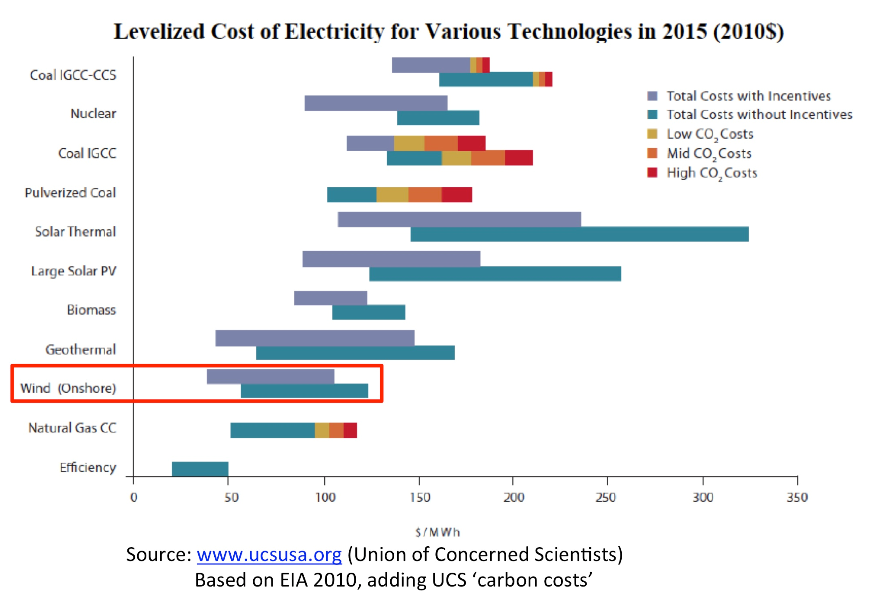
Wind turbines have become a familiar sight in many countries as a favorite CAGW mitigation means. Since at least 2010, the US Energy Information Agency (EIA) has been assuring NGOs and the public that wind would be cost competitive by now, all things considered. Many pro-wind organizations claim wind is cost competitive today. But is it? [if any of the graphs below look fuzzy, click on them and they’ll pop up clear as crystal in a new window]

Curry1-400

Yet incentives originally intended only to help start the wind industry continue to be provided everywhere. This fact suggests wind is not competitive with conventional fossil fuel generation. How big might the wind cost gap be? Will it ever close? We explore these questions in four sections: incentives, lifetime cost of electricity generation (LCOE), system costs, and market distortions. We examine onshore wind, since EIA says offshore is almost 3x more expensive. For simplicity, we examine EIA national averages, rather than regional ranges.

Incentives

The main US federal incentive is the wind Production Tax Credit (PTC), created by the Energy Policy Act of 1992. It is now $21.50/MWh for the first ten years of generation. It was intended to jumpstart the industry, so has expired via sunset provisions several times over the past 23 years. Each time, US wind investment promptly collapsed. Each time, Congress promptly renewed PTC at the same or higher incentive rates. Why? At Berkshire Hathaway’s (BH) 2014 annual meeting (BH’s Iowa based electric utility MidAmerican Energy has $5.6 billion invested in wind generation) Warren Buffet said:

“I will do anything that is basically covered by the law to reduce Berkshire’s tax rate. For example, on wind energy, we get a tax credit if we build a lot of wind farms. That’s the only reason to build them. They don’t make sense without the tax credit.” [1]

Curry2-400

U.S. Congressman Lamar Smith asked the Congressional Budget Office to estimate PTC’s 2013 cost (as part of that year’s reinstitution debate): the 2013 cost was $13 billion.

Iowa has enacted an additional state PTC of $10/MWh. Buffet gets a total PTC of $31.5/MWh from both federal and Iowa taxpayers. YE2014, BH’s MidAmerican Energy, had 2953MW of Iowa wind capacity. Warren Buffet wind farms are receiving $253 million of annual tax credit from Iowa wind generation on an investment of $5.6 billion (2953 MW * 0.31CF * 8766 hr/year *$31.5/MWh). BH’s effective tax rate last year was 31%. Those wind credits are equivalent to earning (253/0.31) $816 million on his $5.6 billion wind investment—a 15% return before any operating profit from selling electricity. That is a good deal for the Nebraska billionaire, but not for the rest of us.

The EIA estimates wind costs five years in the future. Since 2010, each cost estimate has had a separate entry for subsidies. Each estimate since 2012 (for 2017) has zero wind subsidies. EIA assumes the PTC expires (it has yet again YE2014). The Obama administration is proposing it be made permanent, with strong support from the AWEA (American Wind Energy Association). This suggests EIA’s estimated wind costs are too low, and partly political rather than mostly factual. How much is shown by closer examination of their other cost components.

LCOE

The most recent ‘official’ EIA estimates are available in Table 1 of EIA’s Annual Energy Outlook 2015, Electricity Generation Forecasts. The EIA explains:

Levelized cost of electricity (LCOE) is often cited as a convenient summary measure of the overall competiveness of different generating technologies. It represents the per-kilowatthour cost (in real dollars) of building and operating a generating plant over an assumed financial life and duty cycle. Key inputs to calculating LCOE include capital costs, fuel costs, fixed and variable operations and maintenance (O&M) costs, financing costs, and an assumed utilization rate for each plant type. The importance of the factors varies among the technologies. For technologies such as solar andwind generation that have no fuel costs and relatively small variable O&M costs, LCOE changes in rough proportion to the estimated capital cost of generation capacity.

EIA’s LCOE is the annualized net present value (aka annual annuity cost). The estimate is always 5 years into the future. That is why their 2010 estimate above was only verifiable in 2015.

EIA calculates LCOE as the sum of five components: Capital, Fixed O&M, Variable O&M (including fuel), Transmission (incremental), and Subsidies (none). Capital costs are spread over a 30-year life at an interest rate of 6.5%. This appears superficially reasonable, but as we show below, isn’t. Following are the basic LCOE generation comparisons in $/MWh and capacity factor (CF) %, from the EIA AEO 2012 and 2014.

CF% ($2017) ($2019)
CCGT 87 66.1 66.3
Conv. Coal 85 97.7 95.6
Wind 35 96.0 80.3
GT (peaker) 30 127.9 128.4

Three things stand out. Combined cycle gas turbine (CCGT) costs are cheaper than coal. That makes directional sense; in the US CCGT is gaining share at the expense of coal. CCGT cost advantages include: (a) better net thermal efficiency (61% versus 41% for USC coal), (b) abundant inexpensive natural gas thanks to fracked shale, and (c) cheaper capacity. It takes three years to build a CCGT for about $1000-1250/kw. USC coal takes 4 years to build for about $2850/kw.[2] Peak load gas turbine (GT) capacity only costs about $750/kw, but its LCOE is twice CCGT because its capital is under utilized–only operating 30% of the time. Finally, EIA says wind is competitive with coal and will become more so (about 20% more in just three years!).

‘True’ wind LCOE is understated since the PTC is missing. The annuity value of $21.5/MWH for 10 years at 6.5% interest, annuitized over 30 years is $7.2/MWh. A ‘truer’ comparison to coal is (96+7) ~$103/MWh from the general taxpayer perspective, rather than from Warren Buffet’s.

This unsurprising result just shows the PTC was intended to make wind ‘grid competitive’, and seems to do so—at taxpayer expense. That is why investment collapses toward zero in its absence. There are, however, two further ‘obvious’ plus two additional ‘hidden in the fine print’ issues with the EIA LCOE comparisons that are equally consequential, and similarly biased.

Wind capital cost

Wind capital declines 22% from 2017 to 2019; CCGT only declines 8%. This difference is not attributable to turbine production volume. According to GWEC, 51,473 MW was delivered globally in 2014, comprising at least 17000 units (at ~3MW each). Installation costs don’t scale. Past reductions in wind capital per megawatt came from developing larger turbines, not from increased volume.

Curry3-400.png

But actual installed cost/MW stopped declining, and started rising around 2005. There are few onshore turbines larger than 3 MW because of transportation (road/rail) constraints on blade length. The above 2012 NREL composite chart is deliberately misleading; it ended in 2005 although LBNL data was available to 2011.

Curry4-400

EIA’s projected 22% decline in wind capital LCOE is very dubious. We shall use $96/MWh total, the same as EIA’s 2010 LCOE midpoint charted above.

Capacity Factor

The record US annual wind capacity factor was 2014 at 33.9%. EIA itself says the median CF over the past decade is 31%. (Still better than the UK, where CF ranged from a low of 21.5% in 2010 to a record high 27.9% in 2013.) The assumed US 35% CF is unrealistically optimistic. [3]

Curry5-400

Using the historic median CF, a ‘truer’ wind LCOE is roughly (35/31*$96/MWh) $108/MWh.Using the historic median CF, a ‘truer’ wind LCOE is roughly (35/31*$96/MWh) $108/MWh.

Fine Print interest rate

The first fine print fudge is the annuity interest rate. The 2014 EIA text says 6.5% (same as 2012). Ah, but the fine print also says that for coal generation without carbon capture and sequestration (CCS), 9.5% is used. EIA’s fine print inside that fine print says this is the equivalent of a $15/ton CO2 emissions tax on coal (buried inside Capital rather than exposed in Variable O&M explicitly including fuel cost).

EIA says conventional coal produces about 2.15 pounds of CO2 per kWh (depending slightly on coal rank). That is ~2.15 tons of CO2 /MWh, a ‘hidden’ LCOE coal fuel penalty of (2.15*$15) $32.25. There is no US ‘carbon tax’; Congress refused to enact Obama’s proposal. A ‘truer’ comparison is wind at $108/MWh to coal at $65.45/MWh.

This also makes intuitive sense. The newest technology UltraSuperCritical (USC) coal must be similar in cost to CCGT in favorable locations (considering coal transport and quality). One was just completed for $1.8 billion (SWEPCO’s 600MW Turk plant in Arkansas) and 10 additional USC coal facilities are presently planned for the US. None of these will be built until the constitutionality of EPA’s proposed CO2 limit (which effectively prohibit them) is settled.

Fine Print lifetime

EIA comparisons are based on a 30-year lifetime; this introduces a large bias. The EIA itself says the average age of the US coal fleet is 42 years; effective coal lifetime is at least that. GE’s marketing materials say the expected life of its CCGT is at least 40 years. In other words, the capital annuity component of non-wind LCOE should be reduced by ~25% to reflect longer useful lives (40 rather than 30 year annuity, EIA capital only, 0.065 r). That is $8.35/MWh lower LCOE for coal after first subtracting the $32.25 fuel penalty hidden in capital, and $4.30/MWh lower for CCGT.

On the other hand, the design life for wind is 20 years; with maintenance they may last 25 years. EIA’s assumed wind lifetime is longer than the industry’s most cheery estimate, thereby understating LCOE. A ‘truer’ comparison would be wind at (capital component annuity 25 rather than 30 years, 0.065 r) $121/MWh compared to 40 year CCGT $57.5/MWh and Coal $57.1/MWh. ‘True’ wind LCOE is about twice the cost of conventional generation from either coal or natural gas.

Studies of UK and Denmark wind farms suggest their actual economic lives appear to be 12-15 years due to wear and tear.[4] One of the unanticipated problems that arose with larger turbines is premature cracking failure of the main axial bearing(s). These failures arise from two very difficult engineering conditions. First is uneven loading. Wind speeds increase with altitude so the three blades, which span great distances, are never evenly loaded. The bearing(s) wobble under the tremendous forces generated. Second, braking when wind speed exceeds 25mph suddenly loads reverse torque on the axial side where previously unloaded (and wobbling) individual bearings are in natural misalignment to their trace. If things go ‘well’, cracking can be caught before catastrophic failure. It is expensive to repair. The blades must be detached so the turbine can be dismounted and sent back to the factory. The following image shows a 3MW unit.

Curry6-400

Sometimes things do not go well.

Curry7-400

To summarize the second section on LCOE: EIA’s wind future capital, capacity factor, and lifetime all understate the ‘true’ cost of wind. Conventional coal generation is misleadingly overstated. Given other information provably at EIA’s disposal, its wind-biased US findings appear driven by political considerations.

System Costs

We have looked at wind from the perspective of wind farmers and electricity generators. But that is not the whole story, since wind is intermittent. Intermittency has two broad utility system consequences not captured in generation LCOE. First, the grid has to have some level of offsetting backup generation to maintain stability. Those costs are not borne by wind operators unless they also happen to own the regional grid. Most don’t. Second, transmission capacity has to be added. The full extent of those costs is not usually borne by windfarms, but rather (again) by grid owners.

Intermittent backup

Grids always have some spare capacity beyond average peak load. This safety margin handles unexpected peaks, unplanned outages, and other random fluctuations. How much depends on a grid’s many specific details, but 10 – 20% reserve margins are typical. A portion of this amount must be fast start gas turbines, or spinning reserves (older smaller depreciated plants operating at minimum capacity that can be ramped as needed), or flexible hydro, or (newly) flexible CCGT. For very small wind generation proportions, the ‘normal’ reserve suffices. As the percentage of wind in the generation mix grows, it increasingly does not. There are inefficiency costs and (depending on the grid) additional backup capacity costs incurred by the system as a whole.

Additional backup requirements depend on grid details beyond just wind generating penetration. For example, Ontario generation is about 58% nuclear, 24% hydro, and 4% wind (although wind is growing since Ontario subsidizes it with above market feed in tariffs). Nuclear is base loaded. Hydro is flexed for peak loads. The large proportion of hydro in Ontario means wind can grow to double-digit penetration without any significant additional backup capacity costs.

Backup has been studied for the UK National Grid and the Texas ERCOT grid, both of which have a more traditional generation mix than Ontario as well as higher wind penetration.

UK’s zero wind for three days 12/11-13/12 during its winter peak load season illustrates the National Grid’s need for wind backup. UK peak load is handled by flexing fossil fuel generation.

Curry8-400

Newer CCGT is specifically designed to flex as efficiently as possible. In recent years GE, Siemens, Alstom, and Mitsubishi have all introduced units. For example, GE’s FlexEfficiency 50 is a 510MWCCGT that can ramp 50MW/minute. At rated output, it operates 61% efficient. It is 60% efficient down to 87% load, and 58% efficient at 40% load (and not designed to operate below 40%). Cycling at less than rated output increases capital cost/MWh via under utilization, and increases fuel cost via reduced efficiency. Notionally, wind 30% CF means a supporting FlexEfficiency 50 running 70% of the time at rated capacity, and the remainder at 40% minimum load. Using GE’s numbers, that would add about $7.20/MWh LCOE of wind intermittency flex cost on a 30-year annuity basis.[5]

The Texas ERCOT grid is quite different. It has high summer peak load demand because of air conditioning. Texas backup capacity is therefore from high LCOE gas turbine peaker units which are unused except in summer.

Curry9-400

As the proportion of wind generation increases, grids less blessed than Ontario have to add additional standby capacity of some sort. How much of which sort depends on grid details like those illustrated above. The UK National Grid has published estimates. An analysis by the UKERC suggested 15-22% additional for 10% wind production. A different analysis by the IEA ranged from 6% at 2.5% wind generation, to 12% at 5%, to 18% at 15%.[6] UK wind is presently 9.3% of generation. For the UK National Grid using flexed CCGT, these estimates imply about ($66.1+$7.2/MWh *0.15) ~$11/MWh for additional backup, a ‘truer’ wind LCOE of ($121+$11) $132/MWh for UK’s National Grid

On the Texas ERCOT grid, wind in 2014 was 10.6% of generation. For ERCOT’s summer gas peakers, wind’s ‘true’ cost is about ($121+ 0.15*$128) $140/MWh. Little wonder the Austin, Texas utility finds its renewable generation portfolio loses $80 million, while its fossil fuel generation earns $180 million annually at grid wholesale electricity rates! [7]

Transmission constraints

ERCOT also illustrates clearly the wind impact on transmission planning. Much of the wind capacity is in northern Texas, whereas the demand is in Dallas and Houston. ERCOT’s ‘CREZ’ wind driven grid capacity expansion added/upgraded 3600 miles of transmission lines at a cost of $6.9 billion over 3 years. That compares to $26 billion of cumulative (YE2014) investment in Texas wind generation. Annualized over 30 years at 6.5% and spread over ERCOT’s 36.1 million MWh of 2014 wind generation, CREZ adds wind LCOE of $6.44/MWh. That is 6.7% of EIA’s wind LCOE. EIA’s own incremental transmission estimate is 4%–yet again biased substantially low. The ‘true’ system LCOE of ERCOT wind is ($140+$6) ~$146/MWh, not anywhere near the general EIA estimate of $96/MWh — it is off by half.

Curry10-400

In the UK, lack of transmission capacity between Scotland’s wind farms and England/Wales consumers has led to National Grid Balancing Mechanism ‘constraint payments’ netting about £165/MWh for wind NOT produced when it could have been. That comes out of British ratepayer pockets, even though they get no electricity in return.

Market Distortions

In 2011, MIT’s Paul Joskow circulated a Sloan School discussion paperpointing out that non-dispatchable generation (wind) not only has a different cost profile, it has a different value (price) profile.

“Wholesale electricity prices reach extremely high levels for a relatively small number of hours each year (see Figure 1) and generating units that are not able to supply electricity to balance supply and demand at those times are (or should be) at an economic disadvantage. These high-priced hours account for a large fraction of the quasi-rents that allow investors in generating capacity to recover their investment costs (Joskow 2008) and failing properly to account for output and prices during these critical hours will lead to incorrect economic evaluations of different generating technologies.”

Here’s a rough overview of studies that have looked at the impact of intermittent wind upon energy markets. This British study found that wind serves to change the capacity mix more so than the pattern of prices. The market shift to lower fixed cost higher variable cost stations results in relatively small price changes. This study from Ireland finds that increased wind penetration does not impact the pricing of electricity in Ireland (that is argued in the paper as a plus for encouraging more wind). This study found that wind in Denmark reduced costs to consumers. This study of ERCOT in Texas found that the spot market prices were reduced but price variance, volatility and risk increased. Thisstudy of the Pacific Northwest concluded that despite being more economical and easier to integrate in a hydro-rich area, “the direct economic benefits to end-users from greater investment in wind power may be negligible.” There are many factors to consider and the interactions between spot prices and long term cost savings are uncertain. Perhaps the situation is best summed up as this reportconcluded,

“the financial impacts of wind power generation are unclear due to the complex nature of wholesale power markets and the many variables that can impact wholesale electricity prices and generator revenues (i.e., location, natural gas prices, generation mix, and electricity demand).”

It is not clear in any case that subsidizing wind production will lower overall energy prices in any region, and we already showed that subsidized wind raises generation costs.

Wind generation is associated with challenges in scheduling resources and participation in energy markets. Operators serve load with a varied generation mix. Generation plants have limited flexibility including minimum and maximum output levels, ramp up limitations, minimum down times and startup costs. The unpredictability of wind complicates the resource scheduling process. For more background see these Climate Etc postings: Watch out for the Duck Curve and All Megawatts Are Not Equal.

There is a limit to how far conventional plants can be backed down and remain available for service when they may be needed in the upcoming scheduling period. Wind availability coupled with low load periods can present major problems for system operators. It may be the case of simply having mismatched loads and generation of conventional plants may be needed to maintain grid reliability. Under “constraint payments” generators are paid for not injecting power into the grid. Under “negative power pricing” generators are charged for injecting power into the grid. Overwhelmingly conventional resources are not giving favorable treatment relative to intermittent resources.

This study notes the additional harm caused by the US Production Cost Credit, which incents wind generators to make money by injecting power even during times of oversupply. Short term this impacts reliability and raises costs for others. Long term this serves to destabilize the market for conventional generation, which will defer investment and lead to further reliability concerns.

The ERCOT region was plagued by negative pricing concerns until the CREZ transmission improvements reduced such instances.

Curry11-400

Some have argued from this that increased transmission build up cansolve the problem of negative pricing and touted Texas as an example. However, what the transmission build out did was expose the wind resources to a larger market pool, thus reducing the effective penetration level of wind. The problem that wind at significant penetration levels will cause negative pricing remains. If you increase the penetration level in the larger pool, negative problems will remerge. Consistent with that, as Texas has continued to add wind resources, negative pricing problemsre-emerged in March of this year.

Conclusion

It is reasonable to ask why utilities still invest in wind, when even after PTC ‘true’ wind generation is very uncompetitive with Coal or CCGT, as well as distorting the entire wholesale electricity marketplace. EIA LCOE is not the whole story. EIA does not include other incentives such as state level above market feed in tariffs. Ontario wind gets 13.5¢/kwh versus the Province’s 2014 average wholesale generation price of 9.25¢/kwh–a 46% premium. Texas has a variety of state wind incentives (e.g. job credits and property tax breaks) estimated to cost $1 billion in 2014. Oklahoma has a complete income tax moratorium on wind farms. In 2011, California mandated 33% renewables by 2020 no matter the cost (up from 20% in 2006). The UK has the 2008 Climate Change Act. Germany has the Energiewende. Wind operators generally do not pay a price penalty for the market distortions they create. The most severe example of distorted consequences is Germany’s E.ON utility. Late in 2014 E.ON announced it was taking a $5.6 billion impairment charge on its conventional generating assets then spinning them off into a separate (unprofitable) company.[8] Conventional generation simply is no longer profitable in Germany given Energiewende’s renewables pricing distortions and forced flexing.

We can only approximate the ‘true’ cost of wind, and how much the reality differs from ‘official’ EIA (and industry) claims. Wind resources have often been presented in a far more favorable light than they deserve. Looking at the costs presented here they are far higher than can be justified. It has been hoped that subsidies would make wind self-sustaining in short order, but wind appears no closer to economic viability today than years ago.

The impacts of subsidized wind upon electricity markets are highly uncertain, and in many cases demonstrably harmful. Wind serves to raise costs, complicate scheduling, destabilize markets, and adversely impact reliability all in a hopeless effort to receive “free” energy that is actually quite costly.

The potential for wind is limited. Any sub area can have a high penetration of renewables if those resources are diluted into a larger area. Wind can provide adequate performance when correctly integrated with hydro and fossil resources. But the challenges are significant at this time to reach high penetration levels within most standalone resource mixes in most system grids.

[1] US News and World Report 5/12/2014

[2] Essay No Fracking Way in ebook Blowing Smoke.

[3] The aptly named National Renewable Energy Lab (NREL) has an even worse bias. Their 2013 “Transparent Cost Database” (a misnomer) has a selection biased sample of 109 onshore wind farms with a CF of 39% used for LCOE.

[4] Renewable Energy Foundation, Wear and Tear Hits Windfarm Output and Economic Life (2012). Available at www.ref.org.uk. See also Staffel and Green, How does wind farm performance decline with age?, Renewable Energy 66: 775-786 (2014).

[5] We decided not to put this calculation in the text due to its complexity. CCGT LCOE capital $14.3/MWh. 70% operating at rated capacity, and 30% operating at 40% (14.3/.4) costing $21.45. Fuel inefficiency at 40% rated output is (61/58) times LCOE $49.1, a difference of $2.54. Total rated output difference is $23.99/MWh, but only for 0.3 of the time, so Δ$7.20/MWh.

[6] Holttinen et. al., Design and operation of power systems with large amounts of wind power, Final Report IEA Wind Task 25, p.170 (2009)

[7] Texas Comptroller of Public Accounts, Texas Power Challenge (2014)

[8] BloombergBusiness 11/30/14
Climate Etc.

dirtyrottenscoundrelsoriginal

Windweasels Still Trying To Deny the Harm They are Causing!

Wind-farm workers suffer poor sleep, international studies find

Environment Editor
Sydney
Turbines ‘terrible for shut-eye’

Two studies have linked sleep disturbance of wind-farm workers to low-frequency noise and infra­sound from wind turbines. Source: Supplied

Two international studies have linked sleep disturbance and health effects of wind-farm workers to low-frequency noise and infra­sound from wind turbines.

A study of 45 people in three groups by Tehran University ­researchers said: “Despite all the good benefits of wind turbines … this technology has health risks for all those exposed to its sound.”

The study paper said it was the first to examine the effect of wind turbine noise on sleep disorders in workers who are closer to turbines and exposed to higher levels of noise. The Manjil wind farm was examined because it had more staff and turbines than other farms in Iran.

“The results showed that there was a positive and significant relationship between age, workers’ experience, equivalent sound level, and the level of sleep disorder,” the paper said.

The paper, published in next month’s Fluctuation and Noise Letters journal, said more research was needed to confirm the results.

In another study, researchers at Ibaraki University in Japan measured the brainwaves of 15 wind-farm workers listening to recordings of low-frequency and infrasound from wind turbines.

In a paper published in the International Journal of Environmental Science and Technology, the researchers said brain function measured by EEG tests showed the turbine sounds were “considered to be an annoyance to the technicians who work in close proximity to a modern large-scale wind turbine”.

Brain measurements showed test subjects could not stay relaxed after hearing the sound stimulus at the frequency band of 20 hertz. Brainwaves indicating a “strain state” were noted.

Possible health effects from low-frequency noise and infrasound is controversial worldwide.

Clean Energy Council policy director Russell Marsh said Australia’s leading health research body, the National Health and Medical Research Council, had held several reviews of the relationship between wind turbines and health and found “no consistent evidence” wind farms caused adverse health effects in humans.

“Leading national organisations such as the Australian Medical Association and the Australian Association of Acoustical Consultants have said there is not enough infrasound produced by wind farms to have a negative ­effect on humans living near wind farms,” he said.

Australia already had some of the strictest regulations for wind farms, and the council believed further research would reinforce that wind energy was one of the safest and cleanest forms of energy generation.

Windpushers Tell Many Lies, to Achieve Their Nasty Goals…

Hammering Wind Industry Myths: the ‘In-a-Nutshell’ Version

Facts

****

Here’s a sold little wrap-up on the great wind power fraud from Mary Kay Barton – it’s so clear and thumpingly sound for STT to add, would only detract. Hats off, Mary. Over to you.

Wind energy myths spun by lobbyists and salesmen
Principia Scientific
Mary Kay Barton
13 May 2015

Industrial wind energy is a net loser: economically, environmentally, technologically and civilly.

A recent letter in my local paper by American Wind Energy Association (AWEA) representative Tom Vinson is typical of wind industry sales propaganda. It deserves correction.

This is the reality:  Industrial wind energy is a NET LOSER – economically, environmentally, technically and civilly. Let’s examine how.

Economically:

New York State (NYS) has some of the highest electricity rates in the United States – a whopping 53% above the national average. This is due in large part to throwing hundreds of billions of our taxpayer and ratepayer dollars into the wind. High electricity costs drive people and businesses out of the state, and ultimately hurt poor families the most.

A NYS resident using 6,500 kWh of electricity annually will pay about $400 per year more for their electricity than if our electricity prices were at the national average. That’s over $3.2 BILLION dollars annually that will not be spent in the rest of the state economy.

Why destroy entire towns, when just one single 450-MW gas-fired combined-cycle generating unit located near New York City (NYC) – where the power is needed – operating at only 60% of its capacity, would provide more electricity than all of NYS’s wind factories combined.

Furthermore, that one 450 MW gas-fired unit would only require about one-fourth of the capital costs – and would not bring all the negative civil, economic, environmental, human health and property value impacts that are caused by the sprawling industrial wind factories. Nor would it require all the additional transmission lines to NYC.

The Institute for Energy Research tallied the numbers and found that each wind job costs $11.45 million and costs more than four jobs that are lost elsewhere in the economy, because of all the subsidies and the resulting “skyrocketing” cost of electricity. In fact, on a unit of production basis, wind is subsidized over 52 times more than conventional ‘fossil’ fuels.

In the United Kingdom, David Cameron has finally awakened to the folly of wasting billions on the failed technology of wind. He recently declared, “We will scrap funds for wind farms.”

Environmentally:

According to the AWEA, the USA has some 45,100 Industrial Wind Turbines (IWTs). Remotely sited IWTs are located far from urban centers where the power is needed. This requires a spider web of new transmission lines (at ratepayers’ expense), which exponentially adds to the needless bird and bat deaths caused by IWTs themselves.

Additionally, sprawling industrial wind factories cause massive habitat fragmentation, which is cited as one of the main reasons for species decline worldwide.

Studies show MILLIONS of birds and bats are being slaughtered annually by these giant “Cuisinarts of the sky,” as a Sierra official dubbed IWTs in a rare moment of candor.

Governor Cuomo’s environmental hypocrisy is also worth noting. Cuomo is supporting “dimming the lights” in New York City to help stop migrating birds from becoming disoriented and crashing into buildings. Yet simultaneously, Cuomo is pushing for many more giant bird-chopping wind turbines – with 600-foot-high blinking red lights, along the shores of Lake Ontario (a major migratory bird flyway), and across rural New York State.

Technically:

Because wind provides NO capacity value, or firm capacity (specified amounts of power on demand), wind requires constant “shadow capacity” from our reliable, dispatchable baseload generators to cover for wind’s inherent volatile, skittering flux on the grid.  Therefore, wind cannot replace those conventional generation sources.  Instead, wind locks us into dependence on fossil fuels – and represents a redundancy (two duplicate sources of electricity), which Big Wind CEO Patrick Jenevein admitted “turns ratepayers and taxpayers into double-payers for the same product.”

The list of accidentsblade failures (throwing debris over a half mile), fires (ten times more than the wind industry previously admitted) and other problems is updated quarterly at a website in the UK. This lengthy and growing list is evidence of why giant, moving machines do NOT belong anywhere near where people live.

Even the AWEA admits that the life of a typical wind turbine is only 10 to 13 years (January 2006: North American Wind Power). This is substantiated by studies on these short-lived lemons.

Adding insult to injury, the actual output of all of New York State’s wind factories combined has been averaging a pathetic 23 percent.  If IWTs were cars, they would have been correctly dubbed ‘lemons’ and relegated to the junkyard a long time ago.

Civilly:

The only thing that has ever been reliably generated by industrial wind is complete and utter civil discord. Neighbor is pitted against neighbor, and even family member against family member. Sprawling industrial wind factories have totally divided communities, which is already apparent in towns across NYS and the country.  It is the job of good government to foresee and prevent this kind of civil discord – not to promote it.

Regarding human health, NYS officials admitted at a 2009 NYSERDA meeting on wind that they knew “infrasound” from wind turbines was a problem worldwide. The growing list of problems globally highlights that these problems are only getting worse.

At the NYSERDA meeting, a former noise control engineer for the New York State Public Service Commission, Dr. Dan Driscoll, testified that ‘infrasound’ (sounds below 20 Hz) are sounds you can’t hear, but the body can feel.

Dr. Driscoll said that ‘infrasound’ is NOT blocked by walls, and it can very negatively affect the human body – especially after prolonged, continuous exposure.  He said symptoms include headache, nausea, sleeplessness, dizziness, ringing in the ears and other maladies.

NYS Department of Health official Dr. Jan Storm testified that, despite knowing the global nature of the “infrasound” problem, NYS still had not done any health studies (despite having federal money available to do so). Here we are sixyears later, and indefensibly, NYS officials still have not called for any independent studies to assure the protection of New York State citizens.

“The Golden Rule,” as espoused by Rotary International’s excellent ‘Four-Way Test’ of the things we think, say and do, should be the moral and ethical standard our public servants aspire to uphold.  The test asks:

1.      Is it the truth?

2.      Is it fair to all concerned?

3.      Will it build goodwill and better friendships?

4.      Will it be beneficial to all concerned?

When applied to the industrial wind issue, the answers are a resounding, “NO!”
Principia Scientific

turbine fire

Government-induced Climaphobia…..Gov’t Lies, and their “useful Idiots” swear to it!

Scientific integrity versus ideologically-fueled research

by Judith Curry

The main intellectual fault in all these cases is failing to be responsive to genuine empirical concerns, because doing so would make one’s political point weaker or undermine a cherished ideological perspective. – Heather Douglas

I have spoken often and publicly about my concerns about the integrity of climate research.  When I have used the words ‘integrity of research’, I have been referring generally to the adherence of the Mertonian norms of science and a general sense of ‘trustworthiness’.

The role of values in scientific research, and whether research is value laden or should be value free, is a subject of extensive debate.  A perspective on all this that makes sense to me is that provided by philosopher Heather Douglas.

Heather Douglas

Scientific integrity in a politicized world, by Heather Douglas.  See also HD’s talk on youtube. Excerpts:

As of late, the term “scientific integrity” has been used as an overly broad slogan encompassing everything good in research ethics. In this paper, I provide a more precise and narrow account, where scientific integrity consists of proper reasoning processes and handling of evidence essential to doing science. Scientific integrity here consists of a respect for the underlying empirical basis of science, and it is this scientists are often most concerned to protect against transgressions, whether those transgressions arise from external pressures (e.g., politicization) or internal violations (e.g., fabrication of data to further one’s scientific career).

If this value of science is to be protected, evidence must be able to challenge currently held views. This requirement creates certain demands for the structure of how other values (whether ethical, social, political, or cognitive) can play a role in science.

Depending on where one is in the scientific process, values have different legitimate roles they can play, with legitimacy determined by the need to protect the value of science. Consider the following two roles values can play in our reasoning: direct and indirect. In the direct role, values are a reason in themselves for our decisions. They evaluate our options and tell us which we should choose. An indirect role for all kinds of values (political, social, ethical, cognitive) is needed and acceptable throughout the scientific process. Science is thus a value-saturated process.

This view of values in science can now provide us with a clear definition of scientific integrity. First, as described here, scientific integrity is a quality of individual scientists, their reasoning, and particular pieces of scientific work. Thus, a person, a paper, a report can all be said to have scientific integrity. The crucial requirement for scientific integrity is the maintenance of the proper roles for values in science. Most centrally, an indirect role only for values in science is demanded for the internal reasoning of science. When deciding how to characterize evidence, how to analyze data, and how to interpret results, values should never play a direct role, but an indirect role only. This keeps values from being reasons in themselves for choices when interpreting data and results. In addition, values should not direct methodological choices to pre-determined outcomes, nor should they direct dissemination choices to cherry-pick results. This restriction on the role of values, to the indirect role only at these crucial locations in the scientific process, is necessary to protect the value of science itself, given the reason we do science is to gain reliable empirical knowledge. We do science to discover things about the world, not to win arguments. Protecting scientific integrity as so defined thus protects the value of science.

What does this view of scientific integrity mean for our understanding of the politicization of science? Clearly, political forces could cause a scientist, either voluntarily or through coercion, to violate the proper roles for values in science and thus violate scientific integrity. Examples of this include scientists pressured to (or for their own political purposes deciding to) fabricate evidence, cherry-pick evidence, distort results, or stick to a claim even when known criticisms which fatally undermine the claim remain unaddressed. The main intellectual fault in all these cases is failing to be responsive to genuine empirical concerns, because doing so would make one’s political point weaker or undermine a cherished ideological perspective. It is to utilize a direct role for values and have that determine one’s results. It is to use the prima facie reliability and authority of science, which rests on its robust critical practices and evidential bases, and to throw away a concern for the source of science’s reliability in favor of the mere veneer of authority. It is to turn science into a sham. No wonder scientists get so upset when violations of scientific integrity occur.

For example, a failure to respond to criticisms raised repeatedly and pointedly is a clear indication of a problem. If a scientist, or a political leader using science, insists on making a point based on evidence even when clear criticisms undermining their use of that evidence have been raised, and they fail to respond to those criticisms, one is warranted in suspecting that the cherry-picked evidence is but a smokescreen for a deeply held value commitment serving an improper direct role, and that ultimately, the evidence is irrelevant.

Violations can also be detected in overt or covert interference with the activities of scientists. Political actors may not like the results produced by scientists, but their response should not be to declare them by fiat to be otherwise. Instead, politicians can legitimately question whether the evidence is sufficient to support certain policies, whether other policy options might be preferable, or whether value commitments should demand contrary courses of action.

In addition, one needs to assess whether a sufficiently diverse range of scientists (to ensure adequate criticisms of each other’s work are being raised) are working on a range of projects that do not just serve a narrow set of interests. If power and money draw the efforts of scientists into a narrow range of projects, society will not be well served. Even if the science being done is performed with perfect integrity, the results may be distorted and politicized simply because they are the only results available. This is a much harder problem to track and assess, and has not been the main area of concern with the politicization of science. But I suspect it will become a key area of debate in the coming decades.

JC comments: Points that I find to be particularly insightful and relevant to climate science include:

• If this value of science is to be protected, evidence must be able to challenge currently held views.  Premature declarations of ‘consensus’ and attempts to marginalize those that disagree have become institutionalized in climate science, with strong statements of advocacy being made by professional societies (e.g. AGU, APS).

• . . . failing to be responsive to genuine empirical concerns, because doing so would make one’s political point weaker or undermine a cherished ideological perspective. JC: Climate science is rife with such examples, the most notorious example being the ‘hockey stick’. Another example is Lindzen’s iris hypothesis (which is the topic of a forthcoming post).

• If a scientist, or a political leader using science, insists on making a point based on evidence even when clear criticisms undermining their use of that evidence have been raised, and they fail to respond to those criticisms, one is warranted in suspecting that the cherry-picked evidence is but a smokescreen for a deeply held value commitment serving an improper direct role, and that ultimately, the evidence is irrelevant.  JC: Well this pretty much sums up the approach being used by President Obama and his advisors with regard to climate change.

•  One needs to assess whether a sufficiently diverse range of scientists (to ensure adequate criticisms of each other’s work are being raised) are working on a range of projects that do not just serve a narrow set of interests. JC: This is an issue of key importance for climate science, which was raised recently by the post Is federal funding biasing climate research?

Joe Duarte

Of direct relevance to the concerns raised by Hayward, Joe Duarte writes aboutIdeologically-fueled research, pursuant  to a comment on his recently published research Political diversity will improve social science.  Duarte focuses on an example from the social sciences, but these ideas easily generalize to climate research.  Excerpts:

If you believe your ideology is true, but look out upon the world and see that large numbers of people don’t embrace it, it can be frustrating. You have a list of issues you think must be urgently addressed by society, yet society is not addressing them, perhaps doesn’t even see them as problems to begin with. This can create a lot of dissonance – why don’t people see what we see or think as we think? One way to resolve that dissonance is to assume that there must be something wrong those people, that there must be “causes” behind their positions other than simple disagreement, much less any wisdom on their part. So the next step is to inventory the uncharitable reasons why people don’t embrace your ideology, the ideology you just know is true and noble.

Environmentalism is a rather new political ideology, and possibly a religion or a substitute for traditional religion, and it’s alarming that social psychologists are promoting it and trying to convert people to it. Embracing new, abstract, and somewhat ambiguous values like “nature” and “the environment” is just assumed to be equivalent to rationality or something. Environmentalist values are contested by scholars all over the place (though not so vigorously within academia), but the field seems unaware of this, and unaware of their status as values, as ideological tenets, as opposed to descriptive beliefs about the world.

What’s more, we often see researchers declare outright that their motivation is to advance their ideology, to spark political action, and so forth. I think it’s impossible to argue that the field is not biased when researchers declare themselves to be political activists and that their research is an outlet for said activism.

This researcher has already decided that holding a particular position that she disfavors has a certain class of “causes”, including behavioral and neural bases. She has pre-emptively shrunk reality, the reality that she will allow herself to see. Rather, she is extremely likely to find what she is looking for.

Science requires us to be more sober than this. We can’t go in having decided already what kinds of causes must be in force.

It seems to be in the nature of ideology to convert ideological tenets and value judgments into descriptive facts/concepts in the mind of the ideologue. It’s a good protective immune system for an ideology to have, to pre-emptively marginalize and de-legitimize dissent as corrupt or ignorant and thus deter one’s members from closely examining alternative schools. In any case, a valid social science needs to immunize itself from this sort of ideological embedding.

 JC reflections

The ideology that I am concerned about is what I have termed UNFCCC/IPCC ideology.  In the way that I have defined it, there is nothing wrong per se with an ideology; the problem is with ideologues – absence of doubt, intolerance of debate, appeal to authority, desire to convince others of the ideological ‘truth’, and willingness to punish those that don’t concur.

If the community of scientific researchers was sufficiently diverse to accommodate a range of ideological perspectives,  ideology wouldn’t have much impact on the overall scientific oeuvre.  However, when a single ideology is adopted by the professional societies and enforced by the political party in power, then we have a serious problem.

As an individual scientist, navigating all this in a highly politicized environment can be a real land mine.  But the problems – with only a few exceptions – aren’t with individual climate scientists, but with the institutionalization by professional societies of a particular ideology, the general liberal bias at universities, and arguable biases in federal funding of climate research.

It is very good to see philosophers and social scientists tackling these issues; it would be even better to see non-partisans from these fields analyze the situation in climate science.

Open Submission by Carmen Krogh, regarding the ERT for Niagara Region Wind Corp.

By Carmen Krogh, BScPharm
May 25, 2015
To Whom It May Concern
Re: ERT Case No. 14-096 ENVIRONMENTAL REVIEW TRIBUNAL IN THE
MATTER OF an appeal by Mothers Against Wind Turbines Inc and Renewable
Energy Approval No. 4353- 9HMP2R issued by the Director, Ministry of the
Environment, on November 6, 2014 to Niagara Region Wind Corporation.
This Commentary is public and may be shared.
I declare no potential conflicts of interest and have received no financial support with respect
to the research and authorship of this Commentary.
1. ERT Case No. 14-096 states the onus on the Appellant:
[8] Pursuant to s. 145.2.1 of the EPA, the onus is on the Appellant to establish that
engaging in the Project in accordance with the REA will cause serious harm to human
health and/or serious and irreversible harm to plant life, animal life or the natural
environment. (Page 4)
2. The ERT dismissed the Appeal:
[9] For the reasons that follow, the Tribunal finds that the Appellant has failed to meet
either the Health Test or the Environmental Test and has not established the necessary
elements of a s. 7 Charter violation and, therefore, the appeal is dismissed. (Page 4)
3. Ms. Shellie Correia, mother of Joey, testified during this ERT and provided a letter from
her son’s specialist, a Behavioral Pediatrician.
Joey has been under the specialist care for 8 years and is diagnosed with a “Sensory
Processing Disorder”.
Excessive, uncontrollable noise can lead to sensory overload and Joey’s specialist noted
that Joey “is exceptionally more vulnerable”.
With respect to his condition, the specialist states “Wind turbines concern me, given my
strong knowledge of neurobiology.”

4. Other members of the community testified regarding their concerns associated with
children being exposed to IWTs while at home, at school (or both), or while visiting.
5. Ms Correia provided additional citations such as Joey’s Individual Education Plan in
support of his risk factors and that of children in general. See the Appendix below.
6. Ms Correia has advised Premier Wynne, Energy Minister Chiarelli, the Approval Holder
and the project manager, and many others in an effort to protect her son and other
children from harm.
7. Several 3 MWatt IWTs will be in close proximity, with one of the turbines 550 metres
from the family home.
8. Joey and other children will have to travel past transmission lines while attending school
and for other purposes.
9. In its Decision, the ERT states:
[119] In response to Ms. Correia’s concerns about the impact of noise on her son who
has “developmental issues, including ADHD, anxiety and serious processing issues
(mainly, but not exclusively aural)”, Dr. McCunney said that he is unaware of any
scientific literature that suggests that wind turbine noise would adversely affect the
health of a child with these developmental disorders. (Page 28)
10. Dr. Robert McCunney testified on behalf of the Approval Holder. His qualification states:
[95] On agreement of the parties, Dr. McCunney was qualified by the Tribunal as a
medical doctor specializing in occupational and environmental medicine with
particular expertise in the health implications of noise exposure. He provided expert
opinion evidence on behalf of the Approval Holder. (Page 21)
11. Based on this qualification, indications are that Dr. McCunney was not appearing as a
Behavioral Pediatrician, specializing in assessment and care of children with
developmental and mental health problems.
12. Regarding noise in general, the World Health Organization has identified the fetus,
babies, children and youth including those with pre-existing medical conditions and
special needs as a vulnerable population group.
World Health Organization, Children and Noise, Children’s Health and the
Environment, WHO Training Package for the Health Sector, http://www.who.int/ceh

Commentary ERT Case No. 14-096
By Carmen Krogh, BScPharm, May 25, 2015
Any errors or omissions are unintended.
13.
Another WHO reference relating to children states:
Noise is an underestimated threat that can cause a number of short- and long-term
health problems, such as for example sleep disturbance, cardiovascular effects, poorer
work and school performance, hearing impairment, etc.
World Health Organization Noise Facts and Figures
health/noise/facts-and-figures
14.
Stansfeld and Matheson (2003) state:
It is likely that children represent a group which is particularly vulnerable to the non-
auditory health effects of noise. They have less cognitive capacity to understand and
anticipate stressors and lack well-developed coping strategies. Moreover, in view of
the fact that children are still developing both physically and cognitively, there is a
possible risk that exposure to an environmental stressor such as noise may have
irreversible negative consequences for this group…
Stephen A Stansfeld and Mark P Matheson (2003), Noise pollution: non-auditory
effects on health, British Medical Bulletin 2003; 68: 243–257 DOI:
10.1093/bmb/ldg033
Additional citations on children’s risk factors from exposure to noise in general are available.
Conclusion
Research indicates the fetus, babies, children and youth including those with pre-existing
medical conditions and special needs are a vulnerable population group to the effects of noise
exposure in general.
The specialist who has diagnosed and treats Joey states:
I, as a “normal brain” (or typical brain) individual would not want this risk to my
mental health (or my children’s) in my neighbourhood. The placement of these
devices must be thoughtful and, of course, “first, do no harm.”
And that:
In a developed society like Canada, we must advocate and protect the most vulnerable
members. Joey, and all our children deserve our thoughtful and ethical best.
Commentary ERT Case No. 14-096
By Carmen Krogh, BScPharm, May 25, 2015
Any errors or omissions are unintended
4
The World Health Organization comments it is not necessary to wait for full scientific proof
before taking action:
…where there is a reasonable possibility that public health will be damaged, action
should be taken to protect public health without awaiting full scientific proof.
World Health Organization, Guidelines for Community Noise, WHO (1999).
The Policy Interpretation Network on Children’s Health and Environment comments on the
precautionary principle:
Policies that may protect children’s health or may minimise irreversible health effects
should be implemented, and policies or measures should be applied based on the
precautionary principle, in accordance with the Declaration of the WHO Fourth
Ministerial Conference on Environment and Health in Budapest in 2004.
Report WP7 Summary PINCHE policy recommendations Policy Interpretation
Network on Children’s Health and Environment (PINCHE) Policy Interpretation
Network on Children’s Health and Environment QLK4-2002-02395
The Council of Canadian Academies Panel states in its assessment of IWT noise:
…that there is a paucity of research on sensitive populations, such as children and
infants and people affected by clinical conditions that may lead to an increased
sensitivity to sound.
Council of Canadian Academies (2015) Understanding the Evidence: Wind Turbine
Noise, The Expert Panel on Wind Turbine Noise and Human Health, Executive
Summary, Page xvii.
This raises the question whether Appellants and concerned families will be expected to wait
until children-based research demonstrates that “engaging in the Renewable Energy Project
in accordance with the Renewable Energy Approval “will cause serious harm to human
health” (“Health Test”).
If so, are there any potential legal-ethical concerns?
Respectfully,
Carmen Krogh, BScPharm
Ontario, Canada
Commentary ERT Case No. 14-096
By Carmen Krogh, BScPharm, May 25, 2015
Any errors or omissions are unintended
5
Appendix: documents provided to the ERT
1.Open Submission on Risk of Harm to Children May 15/2013
2 Open submission on Risk of Harm to Children Dec 27/2012
3 Letter from Carmen Krogh, requesting help from PM Harper and Peter Mckay Re: UN
Rights of the Child.
4 Arline L. Bronzaft, Noise from Wind Turbines: Potential health Effects on Children.
5 Welfare of Children at Risk, Due to Wind Turbines, Parents Reporting.
6 Joey Correia’s Individual Education Plan
7 Letter from Dr. Calvert, Joey’s Specialist, Regarding Sensory Processing Issues.
8 Information about Auditory Processing Disorder – From Website, KidsHealth from
Nemours
8a Letter from Retired Special Education teacher, Susan Smith, Re: Children & Wind turbines
8b Letter from School Superintendent, William C. Mulvaney
9 Brett Horner’s Open letter to health Canada, (Discontinue Ongoing Experiments)
10 Dr. Sarah Laurie’s Concerns Re: Health Canada Study
11 Ways to Improve Future Health Studies – Multi-Municipal Wind Turbine Working Group.
12 “Critique on Infrasound Study”, by Jerry Punch
13 Dr. Maria Alves-Pereira on Vibro-Acoustic Disease
14 Canadian Journal of Rural Medicine – Industrial Wind Turbines, and Health Effects.
15 Summary of 21 Peer-Reviewed Articles on Adverse Health Effects, on IWT’s.
16 Mothers Against Wind Turbines…Call for a Moratorium.
17 Open Letter/Press Release from N.A.P.A.W.
18 Victim’s Statement’s, from Wind Victims Ontario
19 Letter to PM Harper and Peter McKay, Minister of Justice
20 Letter to Dr. Murray, and Dr. Weiss.
21 Letter to Premier Kathleen Wynne, May 6
22 Letter to Premier Kathleen Wynne, Apr. 18
23 Letter to Steve Klose, M.O.E.
24 Letter to Ombudsman, Andre Marin
25 Attempts to Speak with NRWC.
26 Speeches Read at Local and Regional Councils, to Appeal for Help

When a Community Sticks Together, They Can Win the Wind-War!

STAY STRONG, WIND WARRIORS!

WE ARE RIGHT WITH YOU ALL THE WAY!!!

WE NEVER GIVE UP OR SURRENDER!!!

‘A group which raised £90,000 to successfully fight two appeals against wind farms in the Vale of Belvoir is gearing up for another battle.

Belvoir Locals Oppose Turbines (BLOT) and Melton Borough Council – which also spent £100,000 at appeal – successfully fought against plans for an eight-turbine wind farm at Normanton, near Bottesford, in 2010.

An appeal by another company for a 10-turbine wind farm less than a mile away two years earlier was also rejected.

The inspector at that appeal said: “This part of the vale is unusually rich in the number of historic assets of the highest grades within it.

“Harm to the historic qualities of the landscape would result of such significant and unacceptable magnitude as to outweigh the electricity generation benefits of this particular scheme in its entirety.”

Speakers against the application at the second public inquiry included Rutland and Melton MP Sir Alan Duncan and Frances, Dowager Duchess of Rutland, the widow of the 10th Duke of Rutland.

Planning inspector Christopher Frost said: “I consider that effects on landscape, heritage and residential amenity are of sufficient moment to justify rejecting this scheme, despite its capacity to contribute towards renewable energy production.”

Now, protesters are fighting plans for six 361ft turbines in the same area, near Normanton.

BLOT campaigner Pandora Mawer said: “We are forced into the ludicrous situation of fighting another application for industrial wind turbines here in the Vale of Belvoir.

“The latest wind farm application is on exactly the same site as the wind farm previously dismissed at appeal in 2008 and less a third of a mile from another wind farm, also dismissed at appeal in 2010.”

She added: “BLOT was professionally represented by a QC and barrister, landscape experts, noise experts and a planning expert, all paid for from the generosity of local donations.

“Not to mention the hundreds of hours of unpaid work undertaken by numerous volunteers and the thousands of pounds spent by two local councils defending their original decisions to refuse.”

She added: ” The previous appeal decisions were dismissed mainly due to the severe impact industrial-sized wind turbines would have on the rich heritage assets and the unacceptable harm imposed on the historic landscape of the beautiful Vale of Belvoir.

“BLOT believe the Sewstern Lane application should be refused on the same grounds. Heritage assets will still be severely impacted.”

Jake Surman, Director at Whirlwind Renewables said:

“Wind energy projects are essential if we are to meet international and national targets to reduce emissions of carbon dioxide, the main greenhouse gas contributing to climate change. Onshore wind is the cheapest low carbon generation available and the Sewstern Lane Wind Farm would produce enough electricity to meet the needs of up to 9,658 homes each year, which is equivalent to 6.4% of all households in South Kesteven.’

“We have carried out public consultation on our proposals with the local community and if the scheme is consented, we are committed to establishing a community benefit fund which would provide a guaranteed income of at least £90,000 per annum over 25 years, for local residents to spend on community projects and initiatives.”

Windweasels in Australia, Prove They are Hostile Witnesses!

Thai Turbine-Terrorist, RATCH Scores Monumental “Own Goal” during Senate’s Wind Farm Inquiry

head slap

****

The Australian Senate’s Inquiry into the great wind power fraud resumed on 18 May in Cairns, Far North Queensland.

One of the main topics for the day was the arrogant and high-handed misconduct of RATCH; and its efforts to ride roughshod over the rights of communities on the Atherton Tablelands – surrounding its threatened Mt Emerald wind farm. Although, given that its Thai parent is looking to ditch its Australian “asset” – as if it were a new, more virulent form of herpes – RATCH won’t be around long enough to follow through on the pending debacle:

Wind Power Ponzi Scheme Implodes: IFM Investors Ditches Pac Hydro & Pac Hydro, AGL and RATCH Ditch Wind Farms

Over 90% of locals are bitterly opposed to, yet another, pointless, economic and environmental disaster (see our posts here and here). No surprises there.

Confirming what locals have known all along, RATCH’s goons, true to form, behaved like a band of ham-fisted prats – starting with an attempt to cover up “pre-emptive” land clearing efforts.

Mount Emerald wind farm poisoning claims aired at Senate hearing in Cairns
ABC Online
Kirsty Nancarrow
18 May 2015

A Senate committee hearing on wind turbines has heard claims of poisoning on the site of a proposed wind farm in far north Queensland.

About 50 Atherton Tablelands’ residents opposed to the Mount Emerald wind farm attended yesterday’s hearing in Cairns.

The Queensland Government recently approved a controversial proposal to build 63 wind turbines at Mount Emerald but the project is yet to gain federal approval.

Tablelands regional councillor Marjorie Pagani told the hearing, it appeared clearing began on the site before RATCH Australia received State Government approval for the project.

“There are poisoned tracks either side of the creek,” she said.

“It’s very clearly depicted. Cracking of the trees which is caused by poison, a stench of poison in all the waterways and if one goes outside the turbine proposed circles it’s thick, lush cypress pine vegetation and undergrowth.”

A noise specialist, Robert Thorne, told the hearing, the conditions placed on the wind farm could not be enforced.

Dr Thorne, who previously studied sound levels on Mount Emerald for the Tablelands Regional Council, told the hearing, there were flaws in the current regulation of wind farms.

“They can’t be enforced, they’re impractical, they’re ambiguous, in basis they’re unreasonable both to the wind farm operator, because it doesn’t say how long this has to work for, and the residents, because there’s no complaints process,” he said..

RATCH rejects wind farm site poisoning claims

RATCH’s Anil Nangia said it would investigate the poisoning claims but rejected the allegations.

“There’s certainly not been any poisoning or chemicals put on site that we’re aware of,” he said. “We certainly haven’t done any land clearing that we’re aware of. “The turbine site hasn’t been finalised. We’re still going through the conditions of the DA [development application] which requires us to have a 1.5 kilometre setback from the nearest residence.” He said he was confident the company could comply with any regulations. “We’re happy to work with the committee. If there is some scientific basis for new conditions we will comply with those,” he said.  “We believe that there’s already been eight inquiries in the last five years into the wind farm and all of them have found that wind farms are operated under the required rules and regulations and there’s been no issues with the wind farm’s operation and maintenance.”

The Senate committee is due to report in early August.
ABC Online

Hmmm … it wouldn’t be the first time that RATCH’s operatives have been caught gilding the lily. One of their “best” – Nick Valentine – was caught out using a fictitious handle – Frank Bestic – in order to infiltrate RATCH’s opponents at Collector in NSW (see our posts here and here and here).

Arrogance and hubris aren’t normally seen as beneficial attributes for employees in the main; save in the wind power business, where they’re obviously essential prerequisites, as this story (also from the Cairn’s Senate hearing) proves.

Comic fail by Tableland wind farm developer
The Cairns Post
Daniel Bateman
19 May 2015

THE developer of the Mt Emerald wind farm has caused outrage by tabling a cartoon that ridiculed opponents of wind turbines at a Senate hearing in Cairns – and then asked Senators to colour it in with pencils.

About 60 people – a majority residents from the Tableland – packed the public hearing yesterday morning to hear Ratch Australia questioned by the Select Committee on Wind Turbines about the regulatory governance and economic impact of the $380 million project.

The wind farm, to be built near Walkamin early next year, was granted State approval last month.

The joint venture with local property developer Port Bajool has faced stiff local opposition for about four years from residents concerned about potential adverse health and environmental effects from the turbines.

During the inquiry, Ratch Australia project development manager Joseph Hallenstein presented a First Dog on the Moon cartoon from news website Crikey that portrays the anti-wind turbine lobby as conspiracy theorists that fear wind farms could cause them to fall off horses.

“I printed out black and white copies and I thought that maybe you could get some coloured pencils from reception and colour them in later on,’’ Mr Hallenstein told the hearing.

Committee chairman, Victorian independent Senator John Madigan, said it was disappointing the developer had attacked people’s legitimate concerns about wind farms.

“It reflects quite poorly upon the company when one of their representatives engages in this sort of behaviour,” he told the Cairns Post.

“Any serious business, when there are questions about the product they are providing is causing harm, would seek to establish whether that is the case, and take reasonable precautions against it occurring.

“We have received compelling evidence, as a Committee, that there actually might be an issue with infrasound.”

Ratch Australia business development manager Anil Nangia later told reporters the company did indeed take the Senate inquiry seriously.

“The cartoon was meant to bring a bit of humour to the debate,’’ he said.

“It was not meant to show any disrespect to the Senators and it was just meant to show that this topic can be dealt in a mature way, with a bit of humour as well.

“It doesn’t need to be taken so seriously.”

The company was also questioned by the committee on whether any government subsidies it would receive from the development over its 25-year lifespan – estimated to be more than $500 million – was a good deal for taxpayers.

Mr Nangia told the hearing the funding would be spread throughout Ratch’s other properties across Australia.

Mr Canavan said the money should be spent on further studies to determine whether there were health impacts associated with wind farms.

“A few million would help fill the scientific gap,’’ he said.
Cairns Post

senate review

****

What a fine piece of advocacy from RATCH’s Joseph Hallenstein!

His efforts at ‘persuasion’ went down like the Hindenberg – suddenly and in a fiery mess: “gormless”, doesn’t quite cover it.

One of the general rules of pitching a case is to know as much about your intended audience as possible, before clearing your throat and launching off on your mission to convince them of the merits of your argument.

Had Hallenstein bothered to do even a little rudimentary homework, he would have noted the attitude of the Senators to the wholly unnecessary adverse health impacts being suffered by wind farm neighbours going into the hearing. He would have noticed comments in the mainstream press by the likes of SA Senator, Bob Day describing the moving evidence given at Portland by Pac Hydro’s victims as “harrowing”:

Australian Senators – Day, Leyonhjelm & Canavan – Line Up to Can Big Wind

Not that it matters much, given what the Senators have already heard, and the hundreds of submissions made to like effect, but the efforts of the clowns from RATCH have only served to stiffen the Senators’ resolve to smack into the systematic regulatory failure and insidious institutional corruption at every level of government.

STT’s happy to call it an “own goal” – and to thank RATCH for putting forward people that can only serve to reinforce what STT followers have long ago concluded, about the stench that pervades an “industry” that’s rotten to its subsidy-soaked core.

own goal

Windpushers in California Stoop to New Low! Bulldozed a home…..by accident?

Black American Family Sues Wind Power Outfit for Wantonly Bulldozing their Home

o brother where art thou

****

The goons that people the wind industry are low – to be sure. This is an industry devoid of any moral compass or human empathy, and always quick to ride roughshod over the living:

The Wind Industry’s Latest “Killing Fields”: Africans Just “Dying” to “Save the Planet”

Farmer’s Fiery Suicide Attempt Follows Land Theft by Wind Power Outfit

And the dead:

Wind Power Outfits – Thugs and Bullies the World Over

The Wind Industry Knows No Shame: Turbines to Desecrate the Unknown Graves of Thousands of Australian Soldiers in France

But this little story shows these boys to have outdone themselves, as a bunch of mean-spirited, violent, racist thugs – that would have given the Mississippi Klansmen of old, a solid run for their money.

Instead of burning crosses or blowing up Baptist Churches full of African American worshippers, these wind industry red-necks have destroyed a black family’s desert holiday home, simply because their property stood in the way of their plans to wallow in the PTC subsidy cesspool.

darlene dotson

****

The owner of the home that got bulldozed, Darlene Dotson, is an upstanding member of the California Highway Patrol (see this article).

Here’s the story of how her family’s rights were trampled by EDP Renewables & Others, in only the most recent wind industry outrage.

House Bulldozed for Wind Farm, Family Says
Courthouse News Service
Rebekah Kearn
11 May 2015

LOS ANGELES (CN) – Wind energy companies bulldozed a black family’s house because they were the sole holdouts who refused to sell out to a huge wind farm, the family claims in court.

Darlene Dotson and her sons David and Daniel sued EDP Renewables North America, Horizon Wind Energy Co., Rising Tree Wind Farm, CVE Contracting Group, and Renewable Land LLC, on May 7 in Superior Court.

The family wastes no time in getting down to specifics. “Plaintiffs in this action are the victims of a multinational energy developer who refused to accept ‘No’ for an answer,” the 32-page complaint begins.

“The heart of the issue is that the Dotsons own property in Mojave that is sought after by EDP Renewables for windmills, and they refuse to sell,” the family’s attorney Morgan Stewart told Courthouse News.

Mojave, pop. 4,300, is 50 miles east of Bakersfield, below the Tehachapi Mountains, on the edge of the immense Mojave Desert.

“The home on the property was a family home they used for family vacations and gatherings. EDP pressured them to sell, but they still refused,” Stewart said.

“The house was damaged several times when they were away. And then one time when they went back to the house they found that it had been demolished, scraped to the foundations, along with all of their belongings. The companies did it.

“We see it as intentional because EDP needed the property for the wind farm, but the Dotsons wouldn’t sell,” Stewart said.

EDP Renewables is building the Rising Tree Wind Farm about 3 miles west of Mojave in Kern County.

Project leaders estimate the wind farm will generate 199 megawatts of electricity when it goes online sometime this year – enough to power around 60,000 homes and take 33,000 cars off the road.

The Dotsons say the defendants first approached them about the wind farm in 2009, claiming they needed to buy the surrounding parcels of land, including the Dotsons’ land, for the wind farm.

The Tehachapi Mountains, which top out at 7,992 feet, generate nearly constant winds, as the cool air on top and the Pacific Ocean to the west suck the superheated desert air through the mountain passes.

“Like the infamous Daniel Plainview from Paul Thomas Anderson’s Film, ‘There Will Be Blood,’ defendants held themselves out as friends to the local community and a source of prosperity for its residents. Among other things, defendants promised Mrs. Dotson and her neighbors that the wind farm would stimulate the local economy and generate energy revenue for cooperating landowners. All that Mrs. Dotson and her neighbors had to do was to sign over the rights to their homes,” the complaint states.

But Darlene Dotson says she resisted the sales pitch, telling the companies she was not interested in selling because her family “cherished” their home and its underlying history more than the companies’ offers of money.

“The house had been in their family for 20 years, and was one of the original homesteads built by African Americans in the early 20th century,” attorney Stewart said.

The Dotsons used the home for family gatherings, vacations, barbeques and birthday parties. Daniel and David Dotson grew up playing in the house and then took their own children to play there. It was “hallowed ground” to the family, according to the complaint.

In addition to memories, the house contained the Dotsons’ family mementos, including photographs of deceased family members, family heirlooms and antiques.

Though all of their neighbors agreed to sell or lease their land, the Dotsons held out and “respectfully declined” the companies’ numerous offers, according to the complaint.

When the companies realized the family was adamant about keeping their home, they became aggressive and hostile, the Dotsons say. Mrs. Dotson claims the companies’ agents insulted her and spoke to her disrespectfully, and told her that “the home was worthless and that the Dotsons should take the money because it was the best they would ever get for the land.”

They harassed her sons and tried to bully them into persuading her to sell the house by threatening to “surround the home on all sides with the wind farm, restricting the Dotson’s access to the home and causing the home’s property value to plummet,” the complaint states.

Stewart said the companies wanted the property so badly they approached the Dotsons’ neighbors and asked them how to persuade the Dotsons to sell.

Then the defendants vandalized the house, breaking windows and patio furniture, the Dotsons claim. “In essence, the Dotsons were being terrorized in their home,” the complaint states.

In February this year the defendants started demolishing the surrounding homes to develop the land for the wind farm.

When David Dotson went up to the family home in late March to do some maintenance, he discovered that the home was “literally wiped off the face of the Earth,” that all the furnishings and family belongings “were simply eviscerated,” the complaint states.

Stewart said the family is not sure exactly when the house was demolished, but suspects it was around the time the companies started knocking down the other homes.

The Dotsons say several people from the companies called and left messages admitting that they had demolished the Dotson’s home and insisting that it was a mistake.

But the Dotsons claim it was a deliberate ploy to make them sell their land.

“The pressure to sell from EDP, the strong-arm tactics leading up to the demolition, and coming along afterward and trying to buy again, all indicate that this was not an accident,” Stewart said. “This was an intentional act by a company that thought it could strong-arm these people.”

Though there is no direct evidence of racism, Stewart thinks the Dotsons’ race had something to do with it.

“They are the only African American family in the area, the only ones pressured very hard by the companies, and the only ones who had their house demolished when they refused to sell,” he said.

Stewart said it takes a deliberate effort to destroy a house because the gas and water must be turned off, among other things.

“It’s especially sad because they described how they built parts of the house with their own hands. It’s ugly,” he said.

Representatives with the companies did not reply to requests for comment.

The Dotsons seek punitive damages for trespass to land, violation of the Bane Civil Rights Act, intentional infliction of emotional distress, conversion, nuisance, unfair business practices and negligence.

Attorney Stewart is with Manly, Stewart & Finaldi, of Irvine.
Courthouse News Service

The particulars of the Dotson family’s claim are available here:Complaint_filed_05.07.15

bulldozer-home