Infrasound, from Wind Turbines, makes Life Unbearable, and we Have Proof!

Top Acoustic Engineer – Malcolm Swinbanks – Experiences Wind Farm Infrasound Impacts, First Hand

Swinbanks

****

Top Acoustic Engineer, Dr Malcolm Swinbanks has been at the forefront of investigating the impacts of infrasound and low-frequency noise for over 40 years; and has been on the wind industry’s stinky trail in Michigan since 2009.

Last month, he delivered this technically brilliant paper: “Direct Experience of Low Frequency Noise and Infrasound within a Windfarm Community” at the 6th International Meeting on Wind Turbine Noise – the conference poster is available here: M.A.Swinbanks Poster

The results and observations as to the character and nature of incessant turbine generated low-frequency noise and infrasound backs up the groundbreaking work done by Steven Cooper at Pac Hydro’s Cape Bridgewater disaster (see our post here).

In that respect, the work sits amongst fine company. However, it’s Malcolm’s own experience with turbine noise and vibration that makes his paper all the more remarkable. Here’s a few extracts that tend to knock the wind industry’s ‘nocebo’ story for six.

Summary

The author first became aware of the adverse health problems associated with infrasound many years ago in 1974, when an aero-engine manufacturer approached him to consider the problems that office personnel were experiencing close to engine test facilities. He had been conducting research into the active control of sound, and the question was posed as to whether active sound control could be used to address this problem. At that time, this research was in its infancy, and the scale of the problem clearly lay outside practical implementation. Five years later, however, the author was asked to address a related problem associated with the low-frequency noise of a 15,000SHP ground-based gas-turbine compressor installation, having a 40 foot high, 10 foot diameter exhaust stack.

This problem was of a more tractable scale, and the author and his colleagues successfully reduced the low-frequency noise of the installation by over 12dB. He subsequently was requested to address a similar installation of significantly greater size and power, again with accurately predicted results.

As a consequence of this and subsequent work, the author has gained considerable experience of the disturbing effects of low-frequency noise and infrasound. So when he first became aware of the nature of adverse health reports from windfarm residents, they were immediately recognisable as effects with which he had been familiar for as many as 35 years.

Since late 2009, the author has lived part-time within a Michigan community where windturbines have been increasingly deployed. Consequently he has had significant interaction with residents whose lives and well-being have been damaged, and moreover has experienced the associated very severe effects directly, at first hand. His resultant perspective is thus based on both detailed theoretical analysis, and extensive personal, practical experience.

Introduction

In the latter part of 2009, the intention was announced to install up to 2,800 wind turbines in Huron County, Michigan, together with adjacent regions of the Thumb of Michigan. The agricultural areas of the county are made up of 1 square mile sections, bounded by a grid of roads running north-south and east-west. The proposed wind-turbine density would amount to approximately 2-3 turbines per square mile, but in each square mile there can be typically 4 to 6 residences, usually located around the perimeter. Consequently, the requirement for adequate turbine separation would very substantially restrict the possible setbacks from residences. At that time, there existed two recently commissioned windfarms in Huron county, at Elkton (32 Vestas 80m diameter V80 turbines) and Ubly (46 GE 1.5MW 77m diameter turbines). The Elkton windfarm is in unobstructed open country, but the Ubly windfarm is in an area with significant clusters of trees, which in certain wind directions could obstruct and disrupt the low-level airflow to the turbines.

Following this announcement, the author attended an Open Meeting of the Michigan Public Services Commission, at which a number of residents spoke of the problems that they were already encountering from the windfarms, in particular the windfarm at Ubly.

This author immediately recognized these problems as relating to the characteristics of low-frequency noise and infrasound, with which he had been familiar for many years. But on subsequently visiting the windfarms, it became clear that the higher frequency audible noise levels were also unacceptable, at Ubly in particular, with up to 50dBA L10 being permitted by the ordinances. The author was astonished that any professional acoustician could possibly regard the levels as acceptable.

Following the county’s early experience the ordinances were reconsidered, so that the existing setbacks of 1000 feet, and levels of 50dBA L10, were changed for non-participating landowners to 1320 feet and 45dBA L10. But problems at Ubly were still apparent even at 1500 feet and 45dBA.

The author obtained data from one such residence, which was immediately downwind of 6 turbines located approximately in a line at distances of 1500 feet to 1.25 miles, and found that there could be significant impulsive infrasound present, even though these turbines were of modern, upwind rotor design. Under some circumstances this infrasound took the form of single pulses per blade passing interval, presumably from the nearest turbine, but sometimes up to 6 separate impulses could be detected from the turbine array.

The commissioning of further wind-turbine developments was initially hampered by the lack of high capacity transmission lines, but more recently a 5GW high voltage transmission line has been routed through the county, permitting more than adequate capacity for any intended number of windfarms and turbines. Several further windfarms, with larger 100m and even 114m diameter turbines up to 500 feet in height have now been constructed, resulting in a total of more than 320 wind-turbines installed to date.

Recently, the county has turned to reconsidering the ordinances, but as of the present date has not finalized any changes. Currently permitted wind turbine sound levels and setbacks appear to be dictated primarily by an over-riding incentive to install the requisite number of turbines per square mile.

The author has attended and commented at many public meetings, but has found that the reluctance to acknowledge adverse effects associated with low frequency and infrasound, has resulted in a situation where little traction can be gained.

Several aspects deriving from his first-hand experience will now be described in the following sections.

During the early 1980’s while working on an industrial gas turbine compressor, the author became very aware that the very low-frequency sound can quickly become imperceptible when outside in any moderate breeze. More recently, while attempting to sleep in a house 3 miles from the nearest wind-turbine of a new wind farm consisting of 35 GE 1.6 100m diameter wind turbines, the author and his wife have sometimes been kept awake by the lowfrequency rumble or infrasonic “silent thump” of the turbines.

This situation can occur when the wind has veered from a cold north wind from Canada, to a warm wind from the south blowing over cold ground. Such conditions give rise to a classic temperature inversion, and the resultant wind turbine infrasound can readily propagate for 3 miles or more.

On such occasions, the author has more than once donned outdoor clothes at 1am and gone out onto the road outside the house, clear of trees and obstructions, but in the airflow of an outside wind has been consistently unable to detect any similar subjective disturbance.

It is often argued that infrasound is more readily detectable within a residence simply because the building structure greatly attenuates the higher frequencies, but has little effect on the lower frequencies. There is an additional effect, however, that tends to be overlooked. Outside, individual ears effectively represent unshrouded pointwise microphones, equally sensitive to the full effects of airflow and true infrasound. In contrast, the conditions within a building are very different.

Pressure due to wind turbulence tends to be only locally correlated over the outside surface of the building, whereas true infrasound acts coherently over the entire structure. This gives rise to an additional spatial filtering effect, whereby the wind induced pressure distribution tends to cancel itself out, but the fully coherent very low frequency wind-turbine infrasound acts to fully reinforce itself over the entire structure.

This characteristic has been exploited for many years in the design of conformal sonar arrays – distributed pressure sensing surfaces which preferentially detect acoustic signals that are fully coherent over the surface, yet “average-out” the uncorrelated pressures due to hydrodynamic flow, yielding a significant improvement in signal-to-noise ratio.

A direct consequence of this difference between inside and outside observation is that observers visiting windfarms in the open air may quite correctly comment that they cannot hear any significant low-frequency sound. Put simply, they are not observing under the appropriate conditions. Perception within a residence, particularly in a quiet bedroom, can be entirely different.

This difference is significantly enhanced by the fact that the threshold of hearing is not a constant threshold, but is automatically raised or lowered according to the background ambient sound conditions. It is for this reason that people in urban areas, with typical ambient sound levels around 55dBA, have a naturally raised threshold and are able to tolerate additional noise of comparable level, yet this same level of noise would be completely intolerable in rural areas where ambient levels can be very much lower, not infrequently in the region of 25-30dBA.

This is one of the most important effects with respect to perception of low-frequency noise and infrasound, yet the widely cited AWEA/CANWEA Expert Health Report of 2009 (3), completely failed to indicate the consequences of this process of automatic threshold adjustment.

First Hand Experience of the Severe Adverse Effects of Infrasound.

Approximately 18 months ago, the author was asked by a family living near the Ubly windturbines to help set up instrumentation and assess acoustic conditions within their basement, which is partially underground, where they hoped to encounter more tolerable sleeping conditions.

In the early evening, the author arrived at the site. It was a beautiful evening, with very little wind at ground level, but the turbines were operating. Within the house, however, it was impossible to hear any noise from the turbines and it became necessary to go outside from time-to-time to confirm that they were indeed running.

The author did not expect to obtain any significant measurements under these conditions, but nevertheless proceeded to help set up instrumentation in the form of a B&K 4193-L-004 infrasonic microphone and several Infiltek microbarometers. Calibration of the microbarometers had previously been confirmed by performing background infrasonic measurements directly side-by-side with the precision B&K microphone. The intention was to define measurement locations, to establish instrumentation gains having appropriate headroom, and to agree and go through practice procedures so that the occupants could conduct further measurements themselves.

After a period of about one hour, which time had been spent setting up instrumentation in the basement and using a laptop computer in the kitchen, the author began to feel a significant sense of lethargy. As further time passed this progressed to difficulty in concentration accompanied by nausea, so that around the 3 hour mark, he was feeling distinctly unwell.

He thought back over the day, to remember what food he had eaten and whether he might have undertaken any other action that might bring about this effect. He had light meals of cereal for breakfast and salad for lunch, so it seemed unlikely that either could have been responsible. Meanwhile, the sun was going down leaving a beautiful orange-pink glow in the sky, while ground windspeed levels remained almost zero and the evening conditions could not have been more tranquil and pleasant.

It was only after about 3.5 hours that it suddenly struck home that these symptoms were being brought about by the wind-turbines. Since there was no audible sound, and the infrasound levels appeared to be sufficiently low that the author considered them to be of little consequence, he had not hitherto given any thought to this possibility.

As further time passed, the effects increasingly worsened, so that by 5 hours he felt extremely ill. It was quite uncanny to be trying to concentrate on a computer in a very solid, completely stationary kitchen, surrounded by solid oak cabinets, with granite counter tops and a cast-iron sink, while feeling almost exactly the same symptoms as being seasick in a rough sea.

Finally, after 5 hours it was considered that enough trial runs had been taken and analysed that it was decided to set up for a long overnight run, leaving the instrumentation under the control of the home owners. The author was immensely relieved finally to be leaving the premises and able to make his way home clear of the wind turbines.

But it was by no means over. Upon getting into the car and driving out of the gateway, the author found that his balance and co-ordination were completely compromised, so that he was consistently oversteering, and the front of the car seemed to sway around like a boat at sea. It became very difficult to judge speed and distance, so that it was necessary to drive extremely slowly and with great caution.

Arriving home 40 minutes later, his wife observed immediately that he was unwell – apparently his face was completely ashen. It was a total of 5 hours after leaving the site before the symptoms finally abated.

It is often argued that such effects associated with wind turbines are due to stress or annoyance brought about by the relentless noise, but on this occasion there was no audible noise at all within the house. Moreover, it was a remarkably tranquil evening with a very impressive sunset, so any thought that problems could arise from the turbines was completely absent.

It was only once the symptoms became increasingly severe that the author finally made the connection, having first considered and ruled out any other possibilities. So explanations of “nocebo effect” would hardly appear to be appropriate, when such awareness occurred only well into the event.

In the following two figures, the typical measured infrasound levels in the basement are shown, as measured with one of the Infiltek microbarometers.

Swinbanks Fig 8

Figure 8 shows the power spectrum, measured with a nominal 0.1Hz FFT bandwidth. As can be seen, the peak of the fundamental blade rate component, at 55dB, might not normally be considered to represent a particularly obtrusive level of infrasound. Several higher harmonics of progressively reducing amplitude are visible, but this characteristic is very much as one would expect for an upwind-rotor turbine operating in comparatively smooth airflow.

Swinbanks fig 9

The corresponding time-trace is shown in Figure 9. It can be seen that there is a single comparatively sharply defined pulse per blade-passage, so it would appear that only the closest wind-turbine is contributing significantly.

Nevertheless, it should be noted that while the fundamental harmonic of blade-passage is at only 55dB, the cumulative effect of the higher harmonics can raise the peak level of the waveform on occasion to 69-72dB. Most of the author’s prior work has concentrated on time-history analysis of the waveform, consistent with the 2004 observation by Moller & Pedersen (4) that at the very lowest frequencies it is the time-history of infrasound which is most relevant to perception. Simply observing separate spectral levels at discrete frequencies and regarding these as independent components can lead to considerable underestimate of the true levels of repetitive infrasound.

The fact that balance and coordination were found to be adversely compromised during the night drive home would suggest interference with the vestibular organs, as proposed by Pierpont (5) and subsequently by Schomer (6).

An important additional observation, however, is that the effects persisted for 5 hours afterwards, when the immediate excitation was no longer present. In contrast, for sea-sickness, effects tend to dissipate rapidly once sea conditions moderate. It is of interest that a 1984 investigation (7), in which test subjects experienced 30 minutes exposure to 8Hz excitation at very much higher levels of 130dB, reported that some adverse effects could persist for several hours later.

Conclusions

It has been shown that upwind-rotor turbines can indeed sometimes give rise to impulsive low-frequency infrasound – a characteristic commonly attributed only to old-fashioned downwind rotor configurations. But perception of wind turbine low frequency noise and infrasound can be quickly suppressed by the effects of wind-induced airflow over the ears, with the result that incorrect conclusions can easily result from observations made when exposed to outside breezy conditions.

The effects within a residence are much more readily perceptible, and cannot be ignored. An account has been given of an occurrence of severe direct health effects experienced by the author, and considered to be due entirely to wind-turbine infrasound, yet manifest under superficially benign conditions where no such adverse effects were anticipated.

MA Swinbanks
23 April 2015

Sea-sick-while-fishing

Angry Locals Willing to Fight the Wind Scam!!!

Community Defenders Down MET Mast in Donegal, Ireland

1397574371-dublin-thousands-gather-to-protest-against-pylons-and-wind-turbines_4479876

****

There aren’t many guarantees in life – death and taxes spring to mind: to which can be added open community hostility to giant fans.

Wherever wind farms have appeared – or have been threatened – big numbers of locals take a set against the monsters being speared into their previously peaceful – and often idyllic – rural communities. Their anger extends to the goons that lied their way to development approval – and the bent officials that rubber-stamped their applications and who, thereafter, actively help the operators ride roughshod over locals’ rights to live in and enjoy the peace and comfort of their own homes and properties.

The Irish have already hit the streets to bring an end to the fraud: some 10,000 stormed Dublin back in April last year. The sense of anger in Ireland – as elsewhere – is palpable (see our post here). And they’re tooling up for a raft of litigation in order to prevent the construction of wind farms, wherever they’ve been threatened on the Emerald Isle (seeour post here).

Having seen their political betters co-opted by the wind industry and acquiesce – if not actively condone – the wanton and needless destruction of neighbours’ common law rights to live in and enjoy their own homes and properties, community defenders in Ireland are fighting back. And, as elsewhere, some of the tactics used have led to sanctimonious huffing and puffing from an industry devoid of any moral compass or human empathy, and always quick to ride roughshod over the living and the dead:

Wind Power Outfits – Thugs and Bullies the World Over

The Wind Industry Knows No Shame: Turbines to Desecrate the Unknown Graves of Thousands of Australian Soldiers in France

The MET masts used by hopeful wind power outfits to gauge wind speeds are the vanguard for every wind farm disaster: no MET mast data, no wind farm. As soon as they go up, the locals circle their wagons, marshal their forces and declare war on the proponent. No surprises there.

With the wind industry on the ropes in Australia, developers are quietly pulling down their MET masts at places like Robertstown and Hallett in South Australia – much to the delight of locals (see our post here).

In Ireland, and elsewhere, locals have sought to bring matters to a head by bringing MET masts plummeting back to earth, a little earlier than their wind weasel owners had planned.

Do you know who tore down this mast at Lismulladuff in Co Donegal?
Irish Mirror
Stephen Maguire
4 April 2015

MastJPG

****

This giant 250ft mast was found cut down today on the site of Ireland’s biggest wind farm.

The scene of the crime at Lismulladuff outside Killygordon is currently the subject of local protests.

Plans were lodged with with An Bord Pleanala (ABP) a number of weeks ago by Planree Ltd for the Carrickaduff Wind Farm.

The giant wind farm will stretch from the iconic Barnesmore Gap in Donegal, along the Tyrone border, to near Castlefin.

The plans include an application for 49 giant wind turbines, some of which will be 500ft in height.

A recent meeting organised by protest group Finn Valley Wind Action (FVWA) group, was held in the Parochial Hall in the tiny village of Crossroads and attracted more than 300 locals.

The test mast was erected in recent weeks to take wind readings in the area.

Now gardai believe the mast was attacked in recent days but only discovered yesterday.

The group who are protesting over the planned wind farm have condemned the attack.

A spokesperson for the FVWA protest group condemned the attack on the test mast.

“It’s down so other than that we don’t know what happened. We can’t understand why anyone would want to do that.

“It’s bad form because it wasn’t bothering anybody. We think it was better up – as a size guide being half the height of the proposed wind turbines.

“The FVWA condemns this act of vandalism any anyone with any information should contact Ballybofey Gardai,” said the spokesperson.

Gardai from Ballybofey were on site this morning and have launched a full investigation into the attack.
Irish Mirror

The FVWA “Goldilocks” position is ‘just right’; as an effort to distance themselves from the guerrilla tactics employed – and understandable from that political perspective.

However, the saboteurs’ actions are – given what they’re up against – perfectly understandable too; and not without precedent:

More MET Mast Mayhem: Community Defenders Drop Mast in Fight to Save Homes near Bangor, Maine

MET Mast Mayhem: Scots Use Guerrilla Tactics to Stop These Things

Wave of Destruction: Ontario Wind Farm Neighbours in Open Revolt

While the Gardai set off to investigate a crime scene, it’s clearly arguable – on moral, if not legal, grounds – that what is laid out in the story (and the posts linked above) is conduct aimed at preventing a series of greater – and wholly unnecessary – crimes.

Faced with the threat of sonic torture, smashed property values and the risk of death and injury from self-igniting turbines and “uncontrolled flying blades” – from the developer’s potential victims’ viewpoint – it could equally earn the tag of community “self-defence”. And self-defence is a complete defence, to all bar murder.

As the defenders in Donegal (and elsewhere) were ostensibly acting to protect their homes, families and businesses from an acoustic trespasser (see our post here) the “castle doctrine” clearly comes into play.

That doctrine is one of some force and antiquity – it’s been on the books for nearly 400 years, when lawyer and politician Sir Edward Coke (pronounced Cook), scratched it out in The Institutes of the Laws of England, 1628:

“For a man’s house is his castle, et domus sua cuique est tutissimum refugium [and each man’s home is his safest refuge].”

And so, if a few pro-family and pro-community activists have to drop a MET mast here and there to make their point in the active defence of their homes, and the health and safety of their families, it’s action that’s probably excusable and clearly understandable. And, all the more so, when those that are paid handsomely to protect the health and welfare of their citizens, do little more than spin propaganda on behalf of the wind industry – a form of malign indifference, at best.

Many a good revolution kicked off with a handful of hotheads out to make their point, with a few misdemeanors against the property of the powerful; acts quickly deemed ‘threats to civil order’, if not ‘crimes against the state’, by those under threat – with the actors just as quickly rounded up in chains.

In the main, efforts aimed at suppressing the outrage that led the offenders to act, and punishing them for their actions, only added to their fury, and encouraged other, less passionate souls, to eagerly join the fray; and, thereafter, the rest – as they say – “is history”.

storming_the_bastille1-e1318690559144

Britts Have Come to Their Senses. When will Everyone Else Wake Up?

UK Elections: Britain’s Deliverance from its Wind Power Disaster

SWITZERLAND-WEF-DAVOS-CAMERON

****

Britain’s political betters have set it up for one enormous gamble.  Britain is wagering its entire economic future on its – out of control – wind power debacle.

Back in January last year, The Economist reported on the INSANE cost of delivering offshore wind power – where generators are guaranteed obscene returns – being able to charge “three times the current wholesale price of electricity and about 60% more than is promised to onshore turbines.”

The Economist reported that “offshore wind power is staggeringly expensive” and “among the most expensive ways of marginally reducing carbon emissions known to man”.  But that is merely to compare the insane costs of onshore wind power with the completely insane costs of offshore wind power (see our post here).

Britain’s insane wind power policy has been accompanied with all the usual stuff: an unstable grid, with increased risk of widespread blackouts; subsidy-soaked, institutional corruption; spiralling power costs;splattered birds and bats; and divided and angry rural communities.

With the previous government, Brits were lumbered with the lunatics from the Department of Energy and Climate Change – headed up by Lib-Dem, Ed Davey – who couldn’t tell a reliable Megawatt from his elbow; a ‘team’ wedded to the delusion that Britain could run on millions of giant fans and a whole lot of luck (see our post here).

Now, what a difference a day makes: election day, that is.

Ed Davey lost his seat; the Lib-Dems took a pounding; and Cameron’s Tories have romped over the line with a full-grip on power. And, not only power of the political kind – wind power is about to be squeezed in a manner unthinkable, even a week ago. You see, David Cameron came out on the eve of the election with a very clear set of promises, that spell the beginning of the end for the wind industry in Britain.

‘We’ll scrap funds for windfarms’
County Times
Ben Goddard
7 May 2015

THE PRIME Minister has pledged to stop future government funding to windfarm projects including the delayed inquiry and to give local people the final say – if he is re-elected today.

David Cameron visited Crickhowell on Wednesday when he was quizzed over the delay of any announcement on the results of the Mid Wales Conjoined Wind Farm Inquiry which could see five windfarms built across Powys with each consisting of between 17 and 65 turbines up to 450 feet tall.

The five proposed windfarms, which were the subject of a year long planning inquiry, are proposed to be built at Llandinam, Carnedd Wen, Llaithddu, Llanbrynmair and Llanbadarn Fynydd.

Despite planning inspector Andrew Poulter handing his recommendations to Secretary of State Ed Davey back on December 8, a decision was made to delay any decision until after this week’s General Election.

Mr Cameron pledged to stop the windfarm project and any other on-shore windfarms within Montgomeryshire if he was elected to take a second term in Government.

He said: “You would have to ask the environment secretary who took that decision and that was a decision for him.

“However, I want to make it clear that if there is a Conservative Government in place we will remove all subsidy for on-shore wind and local people should have a greater say.

“Frankly I think we have got enough on-shore wind and we have enough to be going on with, almost 10 per cent of our electricity needs, and I think we should give local people a say if they want to block these sorts of projects.

“The only way to stop more on-shore wind is to vote Conservative there is no other party with this policy. We are saying very clearly we would remove the subsidy and give local people the power to say yes or no.

“This would end the growth of on-shore wind and if that’s what you care about you must vote Conservative.”

Last month a leaked report by the Sunday Telegraph suggested that the inquiry’s planning inspector had advised for three of the five wind turbines to be approved.

Glyn Davies, Conservative MP for Montgomeryshire, welcomed the delay of the inquiry result but said he was shocked if the report had been leaked.

He said: “I would be shocked if the Secretary of State for Energy & Climate Change, or anyone else at DECC, were to have ‘leaked’ to the Sunday Telegraph any decision on the Public Inquiry into windfarms in Mid Wales.

“I’m not in a position to confirm the accuracy or otherwise of the report.

“It would be most improper. This is about the future of Mid Wales, not some grubby political game.

“All I do know is that the inspector’s report was delivered to the Secretary of State on December 8 and that normally a decision could have been expected in early March.

“We also know that DECC has announced that a decision has been delayed for a new Government to decide in early summer.

“I would be disappointed if any of the windfarms are approved but if the Sunday Telegraph report is correct, it would be another big blow to the windfarm developers in Mid Wales in that two of the biggest windfarms would be refused permission.

“Such refusals would further undermine the horribly destructive proposal by National Grid to build a line of massive pylons from North Shropshire to Cefn Coch in Montgomeryshire.

“I have argued that any decision should be delayed, to allow a Secretary of State – other than Liberal Democrat Ed Davey – to consider it.

“If I am re-elected MP for Montgomeryshire, I will seek a further careful consideration of this wind farms/power lines project. It’s financial and environmental madness. It should be abandoned.”

If all five windfarms are approved National Grid has proposed to build a 33-mile pylon route – eight miles of which will be underground from Cefn Coch to near Oswestry – to connect the power generated by the windfarms to the national power grid.
County Times

england somerset

Governments World-wide Have Knowingly Tortured Residents Near Wind Turbines.

 Falmouth wind turbines vs Guantanamo torture techniques

How Much Sleep Deprivation Is Acceptable -None

Falmouth residents have lost sleep and property rights

The United States government used sleep deprivation in the U.S.-operated military Guantanamo Bay detention camp. Sleep deprivation is a very effective torture technique primarily used to break down the will of the detainee.  Sleep deprivation causes impaired memory and cognitive functioning, decreased short term memory, speech impairment, hallucinations, psychosis, lowered immunity, headaches, high blood pressure, cardiovascular disease, stress, anxiety and depression.

Sleep deprivation is the major complaint from the wind turbine victims in Falmouth, Massachusetts and other communities with megawatt turbines placed in residential communities. Falmouth residents were made to file written certified noise complaints to the town in an effort to try and make the residents jump through hoops like a circus act in an effort to make them give up and go away.

Recently a letter dated August 3, 2010 from the manufacturer of the turbines Vestas wind company had warned the town prior to the installations of the megawatt turbines about noise. The turbines generate 110 decibels of noise or what is equal to a hard rock band playing outdoors. Falmouth officials had always known about the excessive noise yet acted like the wind turbine victims had wild imaginations and it was NIMBYism . Not In My Back Yard

Today we know how reckless Falmouth  planning authorities allowed the town to site industrial-scale wind turbines in residential neighborhoods., The state and local health authorities ignored consistent reports of sleep deprivation from neighboring residents.  Falmouth and other Massachusetts towns are violating fundamental human rights. Again according to the August 3, 2010 letter from Vestas town officials had known about the excessive noise long before any wind turbines were installed

Sleep deprivation at  Guantanamo was authorized under the 2002 Department of Defense Memo in the form of 20 hour interrogations. The U.S. military authorized sleep deprivation for its prisoners for up to seventy two hours. Falmouth residents were subjected to two distinct types of noise 24 hours a day -7 days a week  . The noise is regulatory and  human annoyance or what today is called infra sound.

In 2014 no commercial megawatt turbines were built in Massachusetts despite a wind turbine renewable energy goal of 2000 megawatts of commercial wind by the year 2020.

Government agencies have admitted siting mistakes while the news media has been placed in an embarrassing position after reporting press releases from former Governor Patrick as if it was real news.

The question now whether those who ordered the wind turbines into residential neighborhoods will be held accountable.

The Full Impact of the Damage, from the Wynned Fiasco, is being felt in increments. Greed Energy!

GWYN MORGAN

Special to The Globe and Mail

Published Sunday, May. 03 2015, 7:20 PM EDT

Last updated Monday, May. 04 2015, 7:31 AM EDT

Last month’s announcement by Ontario Premier Kathleen Wynne that her province would link up with the existing Quebec and California carbon dioxide cap-and-trade systems prompted an editorial in this newspaper headlined, “Is this Green Energy Act Round Two?”

Ontario’s Green Energy Act offered so-called “feed-in rates” almost four times existing electricity rates for wind and more than 10 times for solar power. Like bees to honey, wind and solar companies rushed in. By the time the government realized that these subsidies were driving Ontario from one of the lowest to one of the highest power cost jurisdictions in North America, the province had signed myriad 20-year-locked-in-rate-guaranteed contracts that will drive power rates up a further 40 per cent to 50 per cent in coming years. Adding salt to this self-inflicted wound is the reality that much of the green power comes on stream when it isn’t needed. This unneeded electricity is dumped into the United States at bargain-basement prices that Ontario’s Auditor-General found has already cost Ontario power consumers billions of dollars, with much bigger losses yet to come before those 20-year contracts expire.

Given these disastrous results, one would think that Ms. Wynne and her cabinet colleagues would have carefully studied experience in other jurisdictions before implementing green policy two. The first and largest carbon cap-and-trade scheme is Europe’s 10-year-old system. As in Ontario, the story begins with huge subsidies for wind and solar power that drove up electricity prices precipitously. Cap-and-trade handed wind and solar power companies a second windfall by creating a “carbon trading market” that allowed them to sell “carbon offsets” from their low-emission projects.

On the other hand, many factories and industrial plants, already struggling with high power costs, found it more profitable to shut down and sell their carbon credit allocation in the carbon trading market. As a result, the bulk of Europe’s emissions reductions have been achieved by the departure of energy-intensive industries to overseas locations. Many of the products consumed by Europeans are now produced in countries without emissions limits, demonstrating the futility of imposing local carbon cap measures without global commitments. And since European industry was already among the world’s most energy efficient, the emissions embedded in most of those imported goods are higher than when the same goods were produced domestically.

Adding irony to this job-exporting fiasco, some European countries, including Germany, have implemented subsidies in an effort to keep the remnants of their industrial sector from shutting down. German electricity consumers paid some €20-billion ($27.2-billion) in green power subsidies last year, while at the same time their government spent billions of euros to help industrial plants survive the combination of high electricity and cap-and-trade costs that made them uncompetitive in the first place.

The Ontario announcement has promulgated a debate as to whether cap-and-trade is a tax. Clearly, for those having to buy carbon credits, it amounts to a tax. But for those who have credits to sell, it amounts to a subsidy.

But what most commenters have missed is that former premier Dalton McGuinty’s Green Energy Act created what is, for practical purposes, an indirect tax on energy consumers. Now comes Ms. Wynne’s equally ill-considered cap-and-trade tax. In mirror image to Europe’s green-power-driven levy on electricity consumers followed by cap-and-trade, Ontario’s ill-considered green scheme No. 2 could strike the final blow that drives industry elsewhere.

This leaves the question as to why Quebec so warmly welcomed Ontario’s decision to join its cap-and-trade system. Quebec’s electricity comes almost entirely from cheap, emissions-free hydropower, mitigating much of the competitive impact of cap-and-trade. Quebec has just announced a massive expansion of its hydropower capacity and is looking for markets. The net effect of signing Ontario onto its cap-and-trade system may well be the export of jobs from Ontario to Quebec businesses and the export of electricity from Quebec to Ontario consumers, along with the added bonus of selling carbon credits to Ontario businesses unable to meet cap-and-trade targets.

Ontario generates just 0.5 per cent of global carbon emissions. Even a giant 20-per-cent reduction would knock just a tenth of 1 per cent off global emissions. A minuscule gain for the globe, at a potentially enormous cost to the people of Ontario, and all Canadians.

Gwyn Morgan is a retired Canadian business leader who has been a director of five global corporations

Climate “Fiction -“They are no longer Climate Scientists…they are Fiction writers….

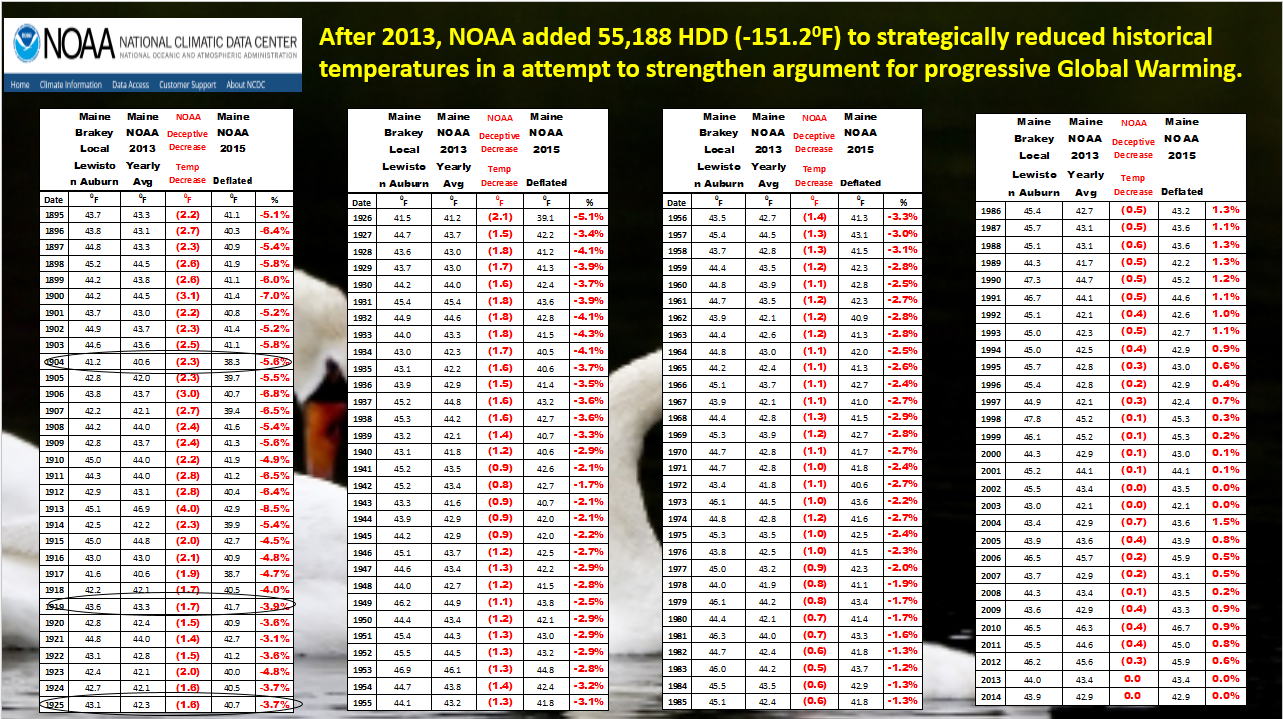
151 Degrees Of Fudging…Energy Physicist Unveils NOAA’s “Massive Rewrite” Of Maine Climate History

Fellow New Englander, engineering physicist and energy expert, Mike Brakey has sent a summary analysis of NOAA past temperature “adjustments” for Lewiston-Auburn, Maine.
=====================================

Black Swan Climate Theory
By Mike Brakey

Here in the U.S. I have documented manipulations similar to those in Switzerland and other locations worldwide that NTZ wrote about yesterday.

Over the last months I have discovered that between 2013 and 2015 some government bureaucrats have rewritten Maine climate history between 2013 and 2015 (and New England’s and of the U.S.). This statement is not based on my opinion, but on facts drawn from NOAA 2013 climate data vs NOAA 2015 climate data after when they re-wrote it.

We need only compare the data. They cooked their own books (see numbers below).

Brakey_1

NOAA cooled the years of Lewiston-Auburn Maine’s past by an accumulated 151°F! (55,188 heating degree day units).

The last four months have been some of the coldest you might ever recall in our lifetime. So far 2015 is the fourth coldest in Maine’s history over the last 120 years. Data from 2013 confirm that so far – from January 1 to April 29 – 2015 has required 4249 heating degree days.

That rivals 1904, 1918 and 1923 over the last 120 years.

But when I recently looked at NOAA’s revised 2015 data, these last four months now would not even put us in the top twenty of coldest months. The federal government went into the historical data and lowered those earlier years – and other years in the earlier decades – so that they can keep spending $27 billion a year on pushing global warming.

They assumed no one would archive temperature data. But I did. My research indicated they used the same algorithm across the United States at the same time. Fortunately I had archived their data from 2013 for Maine and recently compared it to their 2015 data (see above table).

As an engineering physicist and heat transfer specialist, I have worked with heating and cooling degree days for forty years. It is alarming when one discovers multi-million dollar websites have been corrupted with bogus data because the facts do not match up with agendas.

It tremendously harms the industry you and I both work in. Worse, it harms the public. If the public knew the climate data facts indicated it was not getting warmer locally, and that it might actually be getting cooler, it would have all the more reason to insulate and become more energy-efficient in their homes.

I have put together a Maine history of climate temperatures in a narrated PowerPoint Presentation placed on YouTube titled, Black Swan Climate Theory.

Below is a brief sampling of my findings:

Brakey_3

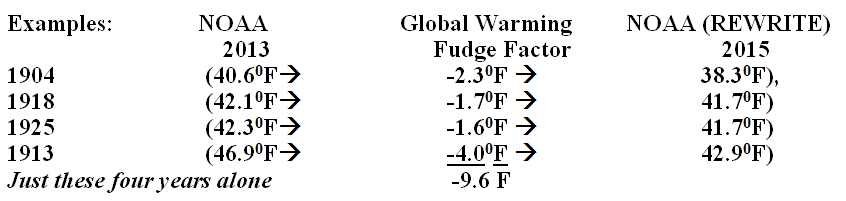
So far 2015 Maine temperatures, as of April, are running neck-and-neck with the coldest years in Maine’s history: 1904 (40.6°F), 1918 (42.1°F) and 1925 (42.3°F). These temperatures cited come right from the federal government’s own NOAA climate data (from 2013). I archived them on my computer for future reference.

2015 so far among coldest on record

A BLACK SWAN event is forming in 2015 (see chart to right). Based on the first four months of 2015, there is an excellent chance 2015 Maine temperature might average, on an annual basis, well under 43.0°F. Not only have Maine temperatures been on a decline since 1998, we are now seeing temperatures reminiscent of the bitter turn of the early 1900s.

Massive rewrite

It appears NOAA panicked and did a massive rewrite of Maine temperature history (they used the same algorithm for U.S. in general). The new official temperatures from Maine between 1895 and present were LOWERED by an accumulated 151.2°F between 1895 and 2012.

“Out-and-out fraud”

In my opinion, this is out-and-out fraud. Why did they corrupt national climate data? Global warming is a $27 billion business on an annual basis in the U.S alone.

Brakey_4

Now NOAA data revised in 2015 indicate that 1904, 1919 and 1925 in Maine were much colder than anything we experience today. (See the scorecard above comparing the NOAA data that are 18 months apart). Note how for 1913 the NOAA lowered the annual temperature a whole 4°F!

For the balance of the years, as they get closer to the present, the NOAA tweaks less and less. They have corrupted Maine climate data between 1895 and present by a whopping accumulated 151.2°F.

Unfortunately NOAA is remaining true to that old saying, “Figures don’t lie but liars figure.”

A multi-million dollar website has been corrupted. I can no longer rely on the tax-payer funded NOAA for clean, unfiltered, climate data for my ongoing research.

Conclusion

I can no longer trust the climate data and energy information ultimately drawn from the U.S. government. Locally, I now have to determine if they got their data from NOAA.

This makes research a lot tougher.

Mike Brakey

– See more at: http://notrickszone.com/2015/05/02/151-degrees-of-fudging-energy-physicist-unveils-noaas-massive-rewrite-of-maine-climate-history/#sthash.BBzJYpeL.gdGB9urs.dpuf

Climate Alarmists: They Hate Facts that Don’t Back Up Their Story, and the People Who Expose Them!

Climate Change | John Roskam
Australian Financial Review 1st May, 2015

In 1987, the American historian and philosopher Allan Bloom wrote a best-selling book, The Closing of the American Mind. It was about the mediocrity and intellectual conformity of American universities. Bloom died in 1992. If he was alive today and writing about Australian universities his book could be titled The Closed Australian Mind.

The reaction of university academics to the Abbott government’s decision to provide $1 million to fund a branch of Bjorn Lomborg’s Copenhagen Consensus Centre at the University of Western Australia demonstrates all that’s wrong with Australia’s universities. Their culture tends to be distrustful, insular and choked in unthinking intellectual uniformity. That’s why the number of Australian researchers who rival Lomborg’s global renown can be numbered on the fingers of one hand. Probably the closest any Australian comes to having anything like Lomborg’s international standing in the field of philosophy and policy is the ethicist Peter Singer now at Princeton University. (Singer who supports infanticide in some circumstances was voted one of Australia’s most outstanding public intellectuals. He’s also been awarded the Companion of the Order of Australia, the country’s second-highest honour.)

Instead of welcoming a world-class public policy thinker coming to Australia and to their university, academics and students at the University of Western Australia are outraged. The vice-president of the university’s staff association talked of having the funding revoked, while the student guild launched a ‘Say No to Bjorn Lomborg’ campaign.

Lomborg’s problem is he’s a climate “contrarian”. As the The Guardian newspaper has helpfully pointed out a climate “contrarian” is someone who is not a climate “denialist” but who nevertheless says things that “infuriate” people who believe climate change is the world’s most serious and urgent problem. And the reason we know Lomborg is not a “denialist” is because the university’s vice-chancellor says so. At a meeting last week of 150 angry academics the vice-chancellor attempted to placate his staff by reassuring them Lomborg most definitely wasn’t a “denialist” and his institution “had a history of defending its climate change research staff against the most extreme views of climate change deniers”. (There’s no record of the vice-chancellor defining what he meant by the term “denialist”. Presumably his university doesn’t employ any.)

LOMBORG’S BELIEFS

Lomborg believes humans are causing the climate to change and he believes it’s a problem. But he also believes that much of the money spent on fighting climate change would be better spent on overcoming malaria and HIV/Aids and assisting the 700 million people on the planet who don’t have clean water. These views apparently make Lomborg unfit to hold a position at the University of Western Australia. As yet it’s not clear what Lomborg would have to believe to satisfy the staff and students of the university.

In The Closing of the American Mind, Bloom examines how the teaching of humanities has been affected by postmodernism and moral relativism. For Bloom, what’s even worse is that so many academics think the same things and they won’t tolerate anyone disagreeing with them. He tells the story of what happened to him as a student.

“We are used to hearing the Founders charged with being racists, murderers of Indians, representatives of class interests. I asked my first history professor in the university, a very famous scholar, whether the picture he gave us of George Washington did not have the effect of making us despise our regime. ‘Not at all,’ he said, ‘it doesn’t depend on individuals but on our having good democratic values.’ To which I rejoined, ‘But you just showed us that Washington was only using those values to further the class interests of the Virginian squirearchy.’ He got angry, and that was the end of it.”

What Bloom said about the humanities in American universities 30 years ago is true of science in Australian universities today. Those who dare to question whether the science of climate change actually is “settled” provoke anger and name calling from many in Australia’s scientific community.

Australia’s Nobel Laureate Peter Doherty is a leader of that community. He’s another one angry Lomborg is coming to this country. Doherty’s attitude is disappointing but also perplexing. Without contrarian thinkers there wouldn’t be many Nobel Prizes to hand out.

Wind Turbines are Novelty Energy, and Do NOT Replace Fossil Fuels!

Why Coal Miners, Oil and Gas Producers Simply Love Wind Power

coalminevn

****

The wind industry parades as an “alternative” energy source. Which begs the question: “alternative” to what?

The lunatics from the hard-green left (like “Greens” head-muppet, Christine Milne) continually whine that “coal is DEATH“; and wax lyrical about the fantasy of going “100% renewable” – all the while pocketing $millions in campaign funding from the party’s wind industry backers (see our post here).

muppets-miss-piggy

****

Economic lunatics, like Milne are wedded to the delusion that there really is a choice between powering nations with hundreds of thousands of giant fans (carpeting every last square mile of other peoples’ back yards) and coal or gas fired plant, that comfortably fit on the back of a figurative “envelope”; and, as they’re usually placed in industrial zones, rarely trouble anyone.

The “green” myth is that fossil fuels can be relegated to history; as every last watt of electricity we need could be generated using ‘wonderful, free wind energy’; and would be, if only “climate deniers”, like Tony Abbott would sod off and die.

The narrative brings with it the claim that we would already be enjoying a wind powered way of life, except that EVIL fossil fuel producers – dead-scared for their futures because of the ‘threat’ posed by “free-wind” – have conspired with blokes like Tony Abbott to protect the ‘dirty’ little businesses they own.

Not bad, as far as ‘green’ yarns go. But, contrary to the Green’s straw-man argument, coal miners, gas producers and diesel suppliers simply love wind power to bits.

hepburn

****

While greentards and ecofascists are wedded to the belief that their beloved giant fans emerge magically from Gaia, like new-born mushrooms after autumn rains, their delusions cause them to miss the several heavy industrial processes needed to create a 100 tonne whirling juggernaut, sitting atop 400-500m3 of concrete, threaded with 45 tonnes of steel reinforcing.

Steel, concrete, aluminium, plastics, rare earths etc – all necessary ingredients for those blade-chucking, pyrotechnic, sonic torture devices – require (wait for it …) OIL, GAS and, heaven forbid, most evil of all, COAL.

Cement is a product that uses mountains of gas or oil to turn limestone etc into the stuff that, with a little water and aggregate mixed in, welds turbines to terra firma (most of the time). Steel is a combination of coal and iron ore; the amalgamation of which uses more coal, gas or electricity to create a molten alloy that, in turn, becomes a product of endless structural wonder. And aluminium is congealed electricity – which, in Australia, is odds-on to be produced by, yep, you guessed it – coal-fired power plants. For a breakdown on the CO2 emissions of all of the above see:

How Much CO2 Gets Emitted to Build a Wind Turbine?

So, with eco-fascist plans to carpet the world with millions of these things, coal miners, oil and gas producers can just sit back and get ready to count their loot. But that’s just to notice the oil, gas and coal that’ll be chewed up in the manufacture of endless seas of eco-crucifixes, which would ignore what the diggers and drillers stand to make from wind-power-perverted power markets.

Power consumers have a couple of basic needs: when they hit the light switch they assume illumination will shortly follow and that when the kettle is kicked into gear it’ll be boiling soon thereafter. And the power consumer assumes that these – and similar actions in a household or business – will be open to them at any time of the night or day, every day of the year.

For conventional generators, delivering power on the basic terms outlined above is a doddle: delivering base-load power around the clock, rain, hail or shine is just good business. It’s what the customer wants and is prepared to pay for, so it makes good sense to deliver on-demand.

But for wind power generators it’s never about how much the customer wants or when they want it, it’s always and everywhere about the vagaries of the wind. When the wind speed increases to 25 m/s, turbines are automatically shut-off to protect the blades and bearings; and below 6-7 m/s turbines are incapable of producing any power at all.

The basic terms of the wind power “deal” break-down like this:

  • we (“the wind power generator”) will supply and you (“the hopeful punter at the end of the line”) will take every single watt we produce, whenever that might be;
  • except that this will occur less than 30% of the time; and, no, we can’t tell you when that might be – although it will probably be in the middle of the night when you don’t need it;
  • around 70% of the time – when the wind stops blowing altogether – we won’t be supplying anything at all;
  • in which event, it’s a case of “tough luck” sucker, you’re on your own, but you can try your luck with dreaded coal or gas-fired generators, they’re burning mountains of coal and gas anyway to cover our little daily output “hiccups” – so they’ll probably help you keep your home and business running; and
  • the price for the pleasure of our chaotic, unpredictable power “supply” will be fixed for 25 years at 4 times the price charged by those “evil” fossil fuel generators.

It’s little wonder that – in the absence of fines and penalties that force retailers to sign up to take wind power (see our post here) and/or massive subsidies (see our post here) – no retailer would ever bother to purchase wind power on the standard “irresistible” terms above.

If you think we’re joking – or you’re struggling with the kind of intellectual difficulties which seem to trouble Christine Milne and her acolytes – here’s a post where we spell it out in pictures:

Wind Power Myths BUSTED

Grid managers and base-load generators are driven mad trying to cope with the hundreds of occasions when wind power output collapses on a routine, but utterly unpredictable basis (see our posts here and here).

coal-seam-gas

****

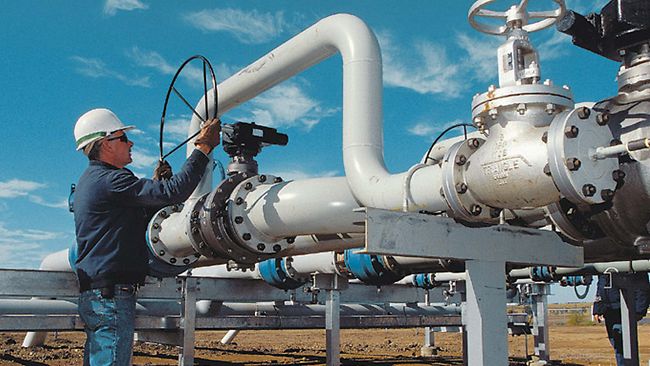
However, those that supply the extra coal that gets burnt to provide additional spinning reserve (see our post here), or the gas that’s used by the pipeline full to run fast-start-up Open Cycle Gas Turbines, or shiploads of diesel for banks of generators – all of which are used to back-up wind power around the clock – have never had it so good.

In fact, the chaos attached to an increased ‘reliance’ on wind power has guaranteed a bright future for coal miners in Germany (see our post here) and for oil and gas producers (as detailed below).

diesel generators UK

****

In Britain, its wind power debacle has seen the roll-out of banks of thousands of diesel generators (see our posts here and here) and Australia’s wind power capital, South Australia has a number of large-scale diesel generation back up plants, including a 65MW diesel plant at Adelaide’s Desal Plant used to back up routine wind power output collapses there (see our post here).

Peaking power at Hallett

****

Far from being threatened by Big Wind, fossil fuel producers are all set to reap a stream of fat profits, thanks to the great wind power fraud, as spelt out in the following reports.

‘Big Oil’ and ‘Big Wind’ Keep Public in the Dark About Wind Dependence on Fossil Fuels – And ‘big media’ is missing the story
Jack Spencer
21 April 2015
Capcon

The news media is at its best when risking the wrath of powerful interests by telling an underdog’s side of a story. When those rare instances arise, the news media stand tall. What seems to increasingly be occurring, however, features the news media misidentifying some entities as underdogs and failing to realize that a charade is being acted out.

Examples of this circumstance are too numerous to list, but one of the most intriguing involves so-called alternative energy (which is almost exclusively wind energy) and the fossil fuel (or petroleum) industry. It seems evident that most of what is commonly termed the “regular” news media sees wind energy as the underdog to what many would call “Big Oil.”

The casting of what we will call “Big Wind,” in an underdog role to “Big Oil,” is the product of simplistic, uninformed thinking. Big Wind is backed by billions of dollars in taxpayer-provided subsidies and rich political exploiters who funnel dollars to politicians so they can keep making even more money off of the subsidies. It enjoys support from thousands of sincere voters who harbor the erroneous belief that once the wind turbines are in place, whatever energy is produced is free and clean.

But this is only part of what the regular news media keep missing. Big Oil also spends tens of millions of dollars in the political money game to protect its interests, which include bolstering both traditional uses of fossil fuels and (here’s where the news media are 180 degrees off) cashing in on wind energy as well.

The secret that neither Big Oil nor Big Wind wants the public to know is that wind energy is roughly two-thirds fossil fuels – mostly natural gas. Both of these entities have a stake in keeping this fact a secret as long as possible. If that were not the case, the public would have been told the truth about the link between Big Wind and Big Oil by now.

Big Oil, in particular, has the ability to make virtually everyone aware of the degree to which wind energy is dependent on fossil fuels. Obviously, it prefers to let the public remain misinformed.

The reason Big Oil prefers that the secret not be revealed is that there’s a lot of money to be made from wind energy subsidies, and many advantages derive from playing two political sides against the middle. The reason Big Wind doesn’t want the fact that it is joined at the hip with fossil fuels to be known, is that its very existence might be jeopardized if the truth were to become common knowledge. The reason the news media have not caught on is because they are comfortable with the preconceptions that allow them to be duped by both Big Oil and Big Wind.

What’s really going on is virtually the opposite of the regular news media’s tragically comical template that Big Wind and Big Oil share an adversarial relationship. As a result, the regular news media assume that Big Oil is behind any effort to point out wind energy’s inefficiency, possible adverse health effects and other flaws. This represents more than ignorance of the facts. Instead, it’s a blind spot that endures due to unjustified trust in superficial assumptions.

But something might be coming soon that could potentially change the dynamics. A group called Ban Fracking in Michigan has submitted language to the Secretary of State for a proposal to prohibit fracking in Michigan. The group wants to put the proposal on the 2016 statewide ballot. Fracking, short for hydraulic fracturing, is the technology that has increased our supplies of natural gas exponentially and revolutionized the world’s energy picture. Some claim, however, that it poses a threat to the environment. This supposition appears unsubstantiated and based on misrepresentation but in the world of politics that might not matter much.

The first thing to remember is that ballot proposals are not always what they appear to be on the surface. A proposal could be put on the ballot for an ulterior motive. For instance, in 2016 the anti-fracking proposal could help boost turnout of liberal-leaning voters. Sometimes a prospective proposal is just a device to blackmail the legislature and governor into doing something they wouldn’t do otherwise – which is how the threat of the minimum wage hike proposal was used in 2014.

However, if the fracking ban were to get on the 2016 ballot and polling showed it had a realistic chance of passing, things could get pretty interesting. In the heat of any election battle there is a tendency to pull out all of the stops. That tendency could conceivably lead to Big Oil letting the cat out of the bag about wind energy’s heavy reliance on natural gas. Such a revelation might possibly alter the perceptions of a lot of voters – and a lot of folks in the regular news media as well.

*Readers note – in some past columns the qualifying word “alleged” was used regarding the degree to which wind energy depends on fossil fuels. Since no one, it seems, disputes the claim, and hardcore believers in man-made climate change have actually lamented the wind energy-fossil fuel link, the word “alleged” no longer appears to be necessary.
Capcon

Here’s a slightly more “starry-eyed” view from a few years ago that – while pulling more than one or two punches, as it tries to pump up the ‘merits’ of wind power – makes it plain enough that the more wind power there is, the better off gas producers will be.

GE’s Gas-Fired Plants Could Enable More Wind and Solar Power
Eric Wesoff
GreenTech Media
25 May 2011

The variability of solar power and wind power can play havoc with the grid.

In a political era where California and other states are mandating 20 percent or 33 percent or even 40 percent Renewable Portfolio Standards,the current system is not designed to deal with that level of variability, according to Jim Detmers, former COO of the California Independent Systems Operator (CAISO). “The system is not designed to accept that proportion of renewables.”

Increasing penetration of renewables like wind and solar actually require an increase in the amount of natural gas-fired backup. And natural gas plants are at their least efficient when they are are ramped up and down. Natural gas, despite its recent good press for being cleaner than coal and of domestic origin, is still a fossil fuel that pollutes the air when combusted and the water when extracted via fracking. Estimates from the Energy Information Administration suggest that shale gas could make up 45 percent of all natural gas production in the U.S. by 2035 — up from the current 14 percent.

Any improvement in the efficiency of natural gas-fired plants is going to help the transition to a more renewable-fueled future — and reduce the amount of natural gas we might use.

General Electric just introduced their new 510-megawatt combined-cycle power plant that offers fuel efficiency greater than 61 percent — the result of an investment of more than $500 million in R&D by GE.

GE drew from the company’s jet engine expertise to engineer a plant that will ramp up at a rate of more than 50 megawatts per minute.

Detmers’ figures differ from that claim. “We can currently ramp generators at 63 megawatts per minute,” but “early studies show that we need over 400 megawatts per minute to cope with a 33 percent RPS,” according to Detmers. “We need new technology,” he concludes.

The GE plant is engineered for flexible operation by integrating a next-generation 9FB Gas Turbine that operates at 50 Hz, a power frequency that is most used in countries around the world; a 109D-14 Steam Turbine, which runs on the waste heat produced by the gas turbine; GE’s W28 Generator; an integrated control system that links all of the technologies; and a heat recovery steam generator.

The International Energy Agency concluded in a report issued yesterday that large shares of variable renewable energy are feasible as long as power systems and markets are properly configured so they can get the best use of their flexible resources. More efficient and flexible natural gas plants are one of the requirements to get more renewables on the grid.

Detmers said that “Germany has some very serious conditions” with its 15,000 megawatts of wind and 17,000 megawatts of distributed solar. “We have a lot to understand about when we transform to a varying supply.
GreenTechMedia

The author’s choice of “variable”, to describe complete daily collapses in wind power output, is a dead give away about his belief in the ‘wonders’ of wind power; and the fact that he’s quoting from the wind industry ‘play-book’.

Flopping to ZERO, every other day, isn’t “variable” – it’s “chaos” – we hammered that kind of language abuse a while back:

The “Great Oz” has spoken: the wind will no longer be “intermittent”

And the Germans – Europe’s wind power “kings” – experience precisely the same type of wind power delivery mayhem on a regular basis:

German Wind Power Goes Completely AWOL 11 Times in the Last 80 Days

No, truth be told, thanks to the great wind power fraud, the fossil fuel boys have never had it so good.

dirtyrottenscoundrelsoriginal

Windweasels Live Up to Their Reputation as….. Gangsters!

Noose Tightens on Spain’s Wind Farm Fraudsters: Tax Inspectors Uncover €110 million Paid as Bribes & Backhanders

clint863

The wind industry seems to attract a particular class of bloke, in much the same way that the Prohibition era drew lots of heavy-set Italians to the Mob.

Maybe that seemingly endless stream of massive subsidies filched from taxpayers and power consumers generates the same allure as festering dung does for swarms of flies?

Whatever it is, the whiff that surrounds the wind industry has attracted (and continues to attract) a class that has no hesitation lying, cheating, stealing and even bonking their way to the easy loot on offer.

The Italian Mob were in on the wind power fraud from the get-go: applying their considerable (and perfectly applicable) skills – leading the European wind power fraud, with what economists call “first-mover-advantage” (see our post here).

We’ve reported on just how rotten the wind industry is – from top to bottom – and whether it’s bribery and fraud; vote rigging scandals; tax fraud; investor fraud or REC fraud – wind weasels set a uniform standard that would make most businessmen blush.

The crooks involved – and the corruption, lies thuggery and deceit that follow them – are uniform across the globe.

Wind power outfits in Taiwan – faced with a pesky community backlash – sent the muscle in and beat the protesters to a bloody pulp (see our posts here and here).

The Thais aren’t much better.

In Australia, Thai outfit RATCH has been lying to, bullying and threatening communities far and wide for years (see our posts here and here andhere).

In previous posts we’ve looked at how the goons that work for RATCH didn’t hesitate to invent a character – Frank Bestic – in a half-cunning attempt to infiltrate their opponents at Collector and elsewhere – see our posts here and here and here.

RATCH also teamed up with one of Queensland’s property developer, “white-shoe-brigade“, John Morris – in a joint plan to destroy the Atherton Tablelands, by spearing 60 odd turbines into a patch of pristine, tropical wilderness on top of Mt Emerald – a move, quite rightly, opposed by 92% of locals (see our post here).

Morris is a five-star resort owner, who generously wined, dined and otherwise accommodated his mate, LNP pollie, David Kempton. Kempton got rolled at the last election, but while in power, held a rabid interest in getting the project approved, despite the fact that his own electorate was miles away, and pulled out all stops to ‘smooth’ the way to development approval (see our post here).

RATCH and Morris have shown all the care and restraint we’ve come to expect from the wind industry and its parasites: an “industry” that has absolutely no interest in producing meaningful power or “saving” the planet. Take away the promise of $50 billion in subsidies from the REC Tax on power consumers (see our post here) and this lot will disappear in a heartbeat (see our post here).

RATCH shares its Thai roots with another Thai wind power outfit that owes its existence to the Thai Military Junta – “Wind Energy Holdings”.

Wind Energy Holdings hit the news a while back when its hitherto-hot-shot head, Nopporn Suppipat was caught with his fingers in the till. Having been caught – he acted with all the honour we’ve come to expect from wind weasels, wherever they ply their trade: he bolted! (see our post here)

Now, it’s the turn of Spanish Wind Conquistadors to feel the heat.

That the wind industry is the product of institutional corruption – fuelled by back-slaps, and $millions in back-handers to planning officers, local councils and others in charge of the rubber stamps needed to start and keep the wind power fraud rolling – is no secret.

However, as these boys have bought the sanction of governments, rooting out the recipients of that crooked cash – when it’s sprinkled all the way to the top – presents investigators with more than the usual forensic challenges. Here’s Spain’s El País on España’s errant wind fraudsters’ trail.

Regional officials and businessmen may have received €110 million, say auditors
El País
F.Garea; R. Méndez
20 April 2015

Private renewable energy firms may have paid more than €110 million in commissions to government officials and local businessmen in Castilla y León to help them obtain licenses and push through paperwork to install wind farms across the region between 2004 and 2007, tax inspectors said.

In a December 30 report obtained by EL PAÍS, seven transactions detail how energy firms paid local businessmen and people connected to the regional Popular Party (PP) government either directly or through stocks in companies created to build and operate wind farms.

The Spanish AEAT tax agency has turned over the 94-page report to anti-corruption prosecutors to investigate if money laundering or other crimes may have been committed.

Those suspected of taking part in the commission deals are public officials in Castilla y León; go-betweens who negotiated on behalf of the energy firms and were able to obtain administrative approvals; and companies belonging to local businessmen who, “without any valid economic motives, received the transfer of funds and stock for an amount superior to €110 million,” inspectors said.

In some cases, the firms transferred stock in the businesses set up in such a way so as to multiply the initial capital invested by hundreds, even thousands, of times.

Among those who may have benefited from this alleged scheme were officials from Castilla y León’s economy department, which authorized the wind farms.

EL PAÍS was unable to reach Rafael Delgado Núñez, who was the deputy chief of the economy department at the time and the official responsible for signing the administrative permits.

In some cases, the firms multiplied the initial capital invested by hundreds, even thousands, of times

Along with other officials, Delgado Núñez was called in to give a statement before tax inspectors. According to his testimony, which was included in the audit, he said the procedure in the region was “very efficient” because there was hardly any legal framework supporting these operations at the time and the government wanted to ensure that “the companies that applied had regional interests.”

One of the main figures in the report is Alberto Esgueva, who until 2006 was CEO of Excal – a public entity formed by the Castilla y León government to promote regional exports. His own firm, according to inspectors, received the most commissions from the operations. Since September Esgueva has been living in Poland, where he runs a real estate business.

He declined to be interviewed for this article despite various attempts to contact him through his secretary.

A spokesman for the region’s economy department said he had no knowledge about the report but added that all the transactions were legally carried out and there was no evidence that commissions were paid.

Tomás Villanueva, who has headed up Castilla y León’s economy department since 2003 and is considered a close aide to PP regional premier Juan Vicente Herrera, on Monday stated that, after carrying out a “first check,” the paperwork authorizing the wind farms under question by the Tax Agency “was correct and in line with the law.”

Villanueva’s name surfaces in one part of the audit where tax inspectors mentioned that Delgado Núñez “played an important role” in both the economic and education departments.

In their report, inspectors alleged that numerous payments helped pave the way for the regional government to make quick decisions about the installation of wind farms. In one case, the money helped overcome the bureaucracy that had been blocking the project for six years.

Utility companies that wanted to install wind farms allegedly set up joint venture vehicles with local businesses and officials who had government ties to the region, the report said.

The association with the local businessman or government official would allegedly help push through the paperwork and, once the electric companies had received authorization to build the wind farm, they would pay back the investors more than what they had initially put into the joint venture.

One of the renewable energy companies that paid out a large amount to install a wind farm was Preneal, owned by Eduardo Merigó, the former president of Visa in Spain and an ex-secretary of state in former Spanish Prime Minister Adolfo Suarez’s Union of the Democratic Centre (UCD) administration (1977-1982). He told tax inspectors that he “felt like a victim of the system.”

Merigó also declined to speak to EL PAÍS for this article.

Preneal paid €6 million to San Cayetano Wind, which belonged to Esgueva, without “any obligation or compensation,” the report states.

Another €7 million was paid to Cronos Global, which was half owned by Esgueva. Last December, a Preneal representative told tax inspectors that Cronos had nothing to do with obtaining permits or building wind farms.

The projects have still not been approved, but Cronos Global received €7 million after putting down a €1.5 million initial investment.

Tax inspectors have also discovered suspicious bank transfers by Cronos Global at the beginning of the recession of up to €100 million to Poland and the United States while around €38 million was transferred to Spain.

The other partners in Cronos Global was Luis María García Clerigó and his family.

Clerigó is the president of the now-defunct Parqueolid, a construction firm in Valladolid. When contacted by EL PAÍS, Clerigó said he had difficulty remembering anything because he suffered a stroke seven years ago.

Parqueolid is under investigation in another case for allegedly receiving €50 million from the Castilla y León regional government to build new offices for the economic department. A judge investigating this case has targeted Delgado Núñez, who served as deputy chief of the regional economy department for eight years, and is also sifting through his bank accounts.
El País

good, bad ugly

Aussies Fight Back, Against Corruption in the Wind Industry!

Australian Senators – Day, Leyonhjelm & Canavan – Line Up to Can Big Wind

senate review

STT likes to go in hard, call it early and keep on backing it up. Sure we descend to colourful language, and polish it off with a healthy smear of good old-fashioned sarcasm. But the idiom and imagery we use sits atop a pile of festering wind industry generated lies, deception and common garden variety fraud.

Back in January this year, we likened Steven Cooper’s groundbreaking acoustic study into the harm caused by Pac Hydro’s Cape Bridgewater wind farm disaster, to the detonation of a small, but effective, nuclear device:

Steven Cooper’s Cape Bridgewater Wind Farm Study the Beginning of the End for the Wind Industry

We wrote that:

Earlier this week, a small, but very effective, nuclear device was detonated at Cape Bridewater, which – before Union Super Funds backed Pacific Hydro destroyed it – was a pristine, coastal idyll in South-Western Victoria.

The bomb that went off was a study carried out by one of Australia’s crack acoustic specialists, Steven Cooper – and some typically solid journalism from The Australian’s Graham Lloyd – that put the Pac Hydro initiated pyrotechnics in the International spotlight.

Over the next few posts, STT will analyse just what the detonation, its aftermath and fallout means for an industry which, in Australia, is already on the ropes.

And we’ll look at what it means to the thousands of wind farm victims here – and around the world.

Three months on, and we don’t shy away from any of that. Oh no. If anything likening events at Cape Bridgewater to the wind industry’s very own Hiroshima, was mastery in understatement.

You see, Cooper’s work became the central focus of day one of the Senate Inquiry into the great wind power fraud – which kicked off on 30 March, at Portland, Victoria; right next to Cape Bridgewater.

Steven Cooper giving evidence to the Senate Committee on wind farms

Not only did Cooper impress the Senators (save Anne Urquhaut – a wind industry apologist and mouthpiece for Friends of the Earth’s propaganda parrot, Leigh Ewbank), the subjects of Cooper’s study gave evidence to the Committee in camera (privately); and a number of the Senators (save Urquhaut, of course) visited them in their homes the night before the hearing. A number of other wind farm victims laid out the suffering they’ve been forced to endure by wind farm operators, like AGL at Glenthompson and Macarthur, as well.

senators visiting

From what STT hears, to say that the Senators were “moved” is to put it mildly.

The gut-wrenching evidence of the symptoms and sensations experienced by these people and caused by incessant turbine generated low-frequency noise, infrasound and vibration, left a group of seasoned political performers and parliamentary knuckle men, including libertarian tough-nut, David Leyonhjelm, with watery eyes and lumpy throats.

Senator David Leyonhelm

And rightly so: Pac Hydro’s continued mistreatment of its wind farm’s neighbours is nothing short of a disgrace – it is unnecessary, unjustifiedand, in STT’s view, criminal.

And, so it was, that South Australian Senator, Bob Day came to describe their evidence as “harrowing”: thankfully, not a word that gets much of a run these days; but, given the gravity of the harm being caused, and the genuineness and obvious sincerity of the victims, one that’s right on the money.

Senator Bob Day

The real significance of the day was not only what Day had to say, but that he, and the other Senators on the Committee, including David Leyonhjelm from NSW and Matt Canavan from Queensland have had their eyes opened to the scale of the wind power fraud; and the entirely unnecessary suffering it continues to cause.

These boys have uniformly stiffened their opposition to the wind industry; and have joined forces to call for a halt to the greatest rort of all time.

‘Wait for wind inquiry before changing RET’: Bob Day
The Australian
Rosie Lewis
22 April 2015

Family First senator Bob Day has asked Tony Abbott and Industry Minister Ian Macfarlane to delay a vote to change the Renewable Energy Target for six months, until the conclusion of a Senate inquiry into wind turbines.

Any lengthy delay to the scheme is likely to frustrate the renewables sector and energy ­intensive businesses, which have urged the Prime Minister to end the RET stalemate.

Senator Day said he had heard “harrowing” evidence about the impact of wind turbines on humans and animals during the inquiry’s first hearing last month and wanted to know all the “facts and figures” before a RET deal was reached. “I think it’s not unreasonable to ask that we don’t come to any agreement on the Renewable Energy Target until such time that we get to the bottom of this,” he said.

“I’m not talking about ending the RET, I’m just talking about ‘let’s defer the decision on it’. Nothing’s going to happen in the next six months anyway. It’s more important to do this right than do this quick.”

Labor has backed a compromise from the Clean Energy Council, which would cut the large-scale RET from 41,000-GWh by 2020 to 33,500GWh, but the government’s final offer remains at 32,000GWh.

Without support from Labor or the Greens the government needs six crossbench votes to see legislation pass the Senate.

Liberal Democrat senator David Leyonhjelm, who is also on the wind turbine committee, said he had given the government’s RET offer conditional support.

Senator Leyonhjelm said he was much more likely to support the government’s target if there was less of a “big leg up” to the wind power industry.

“Ian Macfarlane is doing the rounds in an effort to get six votes,” he said. “I think he probably will get six votes. (The government) will have my vote, with conditions. I’m not a fan of wind turbines, they are killing birds and they are also making some people sick.

“My support for 32,000GWh relates to not giving a particularly big leg up to wind and giving more scope for other sources.”
The Australian

Bob Day followed up with this letter to The Australian on 27 April 2015.

No rush on RET

Because I have asked Industry Minister Ian Mcfarlane and the Prime Minister to defer a vote on the Renewable Energy Target until a Senate inquiry into wind turbines has handed down its report, Kane Thornton of the Clean Energy Council tells me I have little regard for the many thousands of people whose jobs are at risk every day this review remains unresolved.

This inquiry held its first hearing on March 30 and heard evidence about the adverse effects of wind turbines on humans and animals. The evidence was compelling. There was also evidence on the efficacy of wind turbines to reduce carbon dioxide given the amount of the gas required to manufacture and install them.

Since that hearing, information has been provided regarding reports from the 1980s about the adverse effects of wind turbines. The enquiry is keen to understand what wind turbine owners know, and how long they have known it.

The inquiry hands down its report in August. Given the seriousness of the evidence so far, I do not think it unreasonable to request deferring a vote on the RET until then.
Bob Day, Senator for South Australia

The claim by the CEC’s head spruiker, Kane Thornton that “thousands of jobs are at risk” is utter bunkum.

It’s the installation of domestic rooftop solar that’s created the thousands of jobs he’s referring to; and none of them are under threat. No-one is out to scrap the Small-Scale Renewable Scheme (SRES) – which provides the subsidies for rooftop solar – it’s got plenty of backers and – unlike the wind industry – no sworn enemies.

Contrary to the CEC’s wailing, there are no wind industry jobs under threat. Construction activity has ground to a standstill, simply because retailers stopped entering Power Purchase Agreements over 2½ years ago, in November 2012, long before the RET Review kicked off in April 2014 (see our post here).

In the absence of PPAs, wind power outfits have been unable to obtain finance to sling up any new fans. And it’s that fact that means that there are no construction jobs under threat – jobs which are fleeting, in any event. And the handful of wind industry jobs that have any permanence – such as changing oil, replacing generators and blades etc – are under no threat at all from the RET Review. No the CEC’s “case” is all about conflating domestic solar and industrial wind power, when they have absolutely nothing in common – in its efforts to ensure the LRET remains untouched, the wind industry has been using the domestic solar business as a kind of political “human shield”:

Angus Taylor: Coalition set to kill the wind industry, while supporting rooftop solar

As to the claims about the LRET creating thousands of “groovy green” jobs, to debunk that myth you need look no further than Germany, where its insane rush into wind power has seen major energy intensive industries head to the USA to avoid rocketing power prices, while at the same time the millions of so-called “green” jobs, promised by the wind industry there, simply failed to materialise:

German industry set to flee renewable power price punishment

Germany’s Unsustainable “Green” Jobs “Miracle” Collapses

So, Bob Day needn’t worry too much about the CEC’s last ditch attempts to save the LRET; and to avoid the unavoidable: the wind industry is on its last legs, and the CEC knows it.

matt canavan

Matt Canavan – who hails from Rockhampton in Queensland, and was another on the Senate Inquiry Committee whose eyes and ears were opened at Portland – has now taken a keen interest in the disaster planned by one of Queensland’s cheesy “white-shoe brigade” for the pristine, tropical wilderness of Mt Emerald, on the Atherton Tablelands:

The Battle for Mt Emerald FNQ: What’s the Price for the Sound of Your Silence?

STT’s covered the politically stinky relationships and wheel greasing that’s gone on behind closed 5 Star Resort doors in the developer’s efforts to side-step the obstacle to his plans to wallow in the REC Subsidy trough, created by a thousand or so dedicated pro-farming and pro-community advocates:

Mt Emerald: Tablelands Regional Council Puts People & Environment Before Proposed Wind Farm Disaster

It’s an economic nonsense and environmental disaster in the making that has locals seething – over 90% of locals are dead set against it:

1,000 Sign Petition Against Mt Emerald Wind Farm: Survey says 92% Opposed

Now Matt Canavan has entered the fray.

SENATOR REQUESTS DELAY TO DECISION ON MT EMERALD WIND FARM
Media Release
23 April 2015

Senator Matt Canavan has requested the Queensland Government to delay making a final decision on the Mt Emerald wind farm proposal west of Cairns.

This follows a decision by a Senate committee inquiring into wind turbines to hold a public hearing in Cairns on May 18.

Senator Canavan is a member of the Committee and has written to Deputy Premier Jackie Trad requesting a decision on the Mt Emerald proposal be deferred until after the Cairns hearing.

“One of the purposes of the Committee’s hearing in Cairns will be to hear from the local community, and the proponent, about the proposed wind farm at Mt Emerald,” Senator Canavan said. “My understanding is that the Queensland Government is currently considering whether to approve this project.”

“In the interests of wide stakeholder consultation and best-practice policy-making principles, I have requested that the Queensland Government delay making a final decision on the Mt Emerald proposal until it has the opportunity to hear the evidence presented to the Senate Committee.”

“Previous hearings have heard compelling evidence from residents living close to wind turbines about their impact on residents’ health and wellbeing. Unlike other States, Queensland has no specific regulatory guidelines on the minimum distance turbines can be from a place of residence.

“Parliamentary committees provide witnesses with a range of protections. As a result, the evidence provided at this public hearing may add to the statements made at other public consultations that the Queensland Government has already conducted in regards to the Mt Emerald wind turbines proposal.”

Senator Canavan said the Senate Select Committee on Wind Turbines confirmed on Wednesday that it will conduct a public hearing in Cairns on May 18. The Committee is tasked with inquiring into and reporting on the application of regulatory governance and economic impact of wind turbines.
Senator Matt Canavan

Despite Matt’s more than reasonable call for a little public health prudence, Labor wind industry shill, Jackie Trad went ahead and gave planning approval, in accordance with the Labor Party/Union Super Fund business model.

Were Trad to have canned the project, it would have cut across Labor’s cash cow, by further threatening the Ponzi scheme in which Labor/Union heavy owned and (badly) run outfits, like Pac Hydro are well ensconced. In a cunning move, Trad’s press release giving the disaster the nod, was slipped out on Anzac Day, so that there would be no way the media would give it any oxygen at all.

STT thinks that it’s no surprise that the Senators on the wind farm Inquiry Committee have turned sharply against the great wind power fraud. And, with Jackie Trad’s sly little move at Mt Emerald, we expect Matt Canavan will come back swinging just that little bit harder.

Human beings, possessed of a modicum of empathy and decency, generally don’t like to sit back and watch the common law rights of hard-working people to live in, use and enjoy their homes get steam-rolled. And much less so, when there’s no justification at all for the harm and suffering being endured by the wind industry’s victims – which it regards as “road-kill” – and which the mock-medicos that spruik for it sneeringly call “wind farm wing-nuts“.

However, as we’ve pointed out before, the endless lies tossed up by the wind industry and its parasites just don’t wash anymore. These days, people are becoming switched on to the fraud; and angry for having been taken for gullible dupes.

Once reasonable people are introduced to the facts about the insane costs of intermittent and unreliable wind power they cease to support it.

When they learn of the senseless slaughter of millions of birds and bats, and the tragic suffering caused to hard working rural people by giant fans, reasonable people start to bristle.

But when they learn that – contrary to the ONLY “justification” for the$billions filched from power consumer and taxpayers and directed as perpetual subsidies to wind power outfits – wind power INCREASES CO2 emissions in the electricity sector – rather than decreasing them, as claimed – their attitude stiffens to the point of hostility to those behind the fraud and those hell-bent on sustaining it.

In our travels we’ve met plenty of people that started out in favour of wind power and turned against it.  But we’ve yet to meet anyone who started out opposed to wind power, who later became a supporter.  Funny about that.

Present the facts to reasonable people – and they’ll want to know how the scam got started in the first place, and why it hasn’t been stopped in its tracks already?

Watching the Senators on the Inquiry arriving at that point, provides STT with more than just a little encouragement: from here-on, the wind industry hasn’t got a hope in hell of convincing them as to any part of its pitch.

As seminal mod-rockers, The Who, wailed in 1971, STT thinks it’s a case of we Won’t Get Fooled Again:

****