Global Warming Alarmists ….Causing Global Chaos!

Lawrence Solomon: How global warming policies have led to global insecurity

 Lawrence Solomon | September 4, 2014 7:30 PM ET
Lawrence Solomon: Over the last two decades, global warming activists succeeded in slowing the development of the oil sands, blocking major pipelines like Keystone XL, phasing out coal plants and banning shale gas and oil projects.

Nathan VanderKlippe /National Post, fileLawrence Solomon: Over the last two decades, global warming activists succeeded in slowing the development of the oil sands, blocking major pipelines like Keystone XL, phasing out coal plants and banning shale gas and oil projects.
  •  

Limits on energy production in the West enabled conflicts in the Ukraine and the Middle East

Global warming policies abet terrorism and global insecurity. If Western governments weren’t spooked by global warming, ISIS would be less of a threat to the West, the Middle East would be less of a cauldron of hate, Europe wouldn’t be held hostage by Russia and China wouldn’t be threatening its neighbours over islands in the South and East China Seas.

Over the last two decades, global warming activists succeeded in slowing the development of the oil sands, blocking major pipelines like Keystone XL, phasing out coal plants and banning shale gas and oil projects. Without their activism, the Western world would have years ago not only become self-sufficient in fossil fuels, it would have become an exporter. Even with the roadblocks, the U.S. managed a miraculous transformation — once the world’s largest energy importer, it is now becoming a major exporter. Only Europe among the Western continents remains subject to dictates from energy exporters, most of them from unsavoury and hostile areas such as the Middle East, Russia and Venezuela.

Had the West earlier become a major energy exporter, these hostile economies would have lost their chief markets and the bulk of their revenues, particularly since prices would also have collapsed in a world awash in energy. Russia, for example, relies on energy for 30% of its GDP, Venezuela for 33%, some Middle East countries for more than 50%. Their economies would have retrenched, unable to finance social services at home let alone military adventures abroad. Their regimes would have focused on self-preservation rather than spreading ideologies abroad.

Funders of Islamic terrorism would have been strapped for cash

In a world of low-cost, plentiful energy, ISIS could never have emerged as a major threat. This ultimate-Islamic-terror group largely relies on generous grants from energy-exporters like Qatar, a Muslim Brotherhood-friendly emirate, and on sales from its own oil fields, captured in battle. Without global warming dogma, neither of these revenue sources would have taken ISIS far.

Likewise Iran, Qatar’s rival for the title of No. 1 funder of Islamic terrorism, would have been strapped for cash. It would have been unable to bankroll such notables in the region’s terrorist gallery as Hamas and Islamic Jihad in Gaza, Hezbollah in Lebanon and Assad in Syria, not to mention their terror cells in the West.

Russia would also have been sapped of strength and unable to threaten its neighbours, much as occurred in the 1980s, when the USSR’s failed economy led to its breakup and the release from its grasp of Ukraine and the rest of eastern Europe. The potent Putin we created would instead have been Putin the Impotent.

China, too, would have been less belligerent with its neighbours. Its territorial disputes with Japan, Taiwan, the Philippines, Malaysia, and Vietnam often focus on barren islands — sometimes mere outcroppings — in the East and South China Seas. Their value lies mostly in the prospect that oil and gas will be found in their offshore waters. That value would greatly diminish, along with the logic of going to war for them, if energy became cheap and plentiful.

Ironically, the environmentalists who pushed global warming policies on the West thought they would be enhancing global security. Wars — particularly those in the Middle East — stemmed from the West’s desire for oil, they argued. By getting the West off oil and onto CO2-free renewables, the West would lose its lust for the Middle East’s energy resources, ushering in a new era of peace.

They were half right — it did make sense to rid the West of dependence on Middle East energy. And half wrong — the alternative to oil and gas from the Middle East was not renewable energy but oil and gas from Western countries. And they were entirely misguided — contrary to their claims, the planet has not warmed in almost 20 years now.

Today, most Western governments are reining in their global warming policies, slashing their ruinously expensive subsidies to renewables and aggressively developing fossil fuels. All that the global warming scare accomplished was to make people pay with their pocketbooks — tens of millions of Europeans now suffer “fuel poverty,” the household term in Europe for those who now can’t afford to pay their power bills — and to increase wars, terrorism and global insecurity.

Parasitic Wind…..Merely a “Novelty” Source of Energy! (and the novelty has worn off)…

Wind Power: The Parasitic Power Producer

mosquito-7192_lores

Promoting Parasitic Power Producers
carbon-sense.com
Viv Forbes
17 July 2014

Wind and solar are parasitic power producers, unable to survive in a modern electricity grid without the back-up of stand-alone electricity generators such as hydro, coal, gas or nuclear. And like all parasites, they weaken their hosts, causing increased operating and transmission costs and reduced profits for all participants in the grid.

Without subsidies, few large wind/solar plants would be built; and without mandated targets, few would get connected to the grid.

Green zealots posing as energy engineers should be free to play with their green energy toys at their own expense, on their own properties, but the rest of us should not be saddled with their costs and unreliability.
We should stop promoting parasitic power producers. As a first step, all green energy subsidies and targets should be abolished.

For those who wish to read more:

Wind Power Chaos in Germany:

http://www.telegraph.co.uk/comment/9559656/Germanys-wind-power-chaos-should-be-a-warning-to-the-UK.html

The reality of green energy:

http://wattsupwiththat.com/2014/07/18/the-stark-reality-of-green-techs-solar-and-wind-contribution-to-world-energy/

Blowing Our Dollars in the Wind

Wind energy produces costly, intermittent, unpredictable electricity. But Government subsidies and mandates have encouraged a massive gamble on wind investments in Australia – over $7 billion has already been spent and another $30 billion is proposed.

This expenditure is justified by the claim that by using wind energy there will be less carbon dioxide emitted to the atmosphere which will help to prevent dangerous global warming.

Incredibly, this claim is not supported by any credible cost-benefit analysis – a searching enquiry is well overdue. Here is a summary of things that should be included in the enquiry.

Firstly, no one knows how much global warming is related to carbon dioxide and how much is due to natural variability. However, the historical record shows that carbon dioxide is not the most important factor, and no one knows whether net climate feedbacks are positive or negative. In many ways, the biosphere and humanity would benefit from more warmth, more carbon dioxide and more moisture in the atmosphere.

However, let’s assume that reducing man’s production of carbon dioxide is a sensible goal and consider whether wind power is likely to achieve it. To do this we need to look at the whole life cycle of a wind tower.

Wind turbines are not just big simple windmills – they are massive complex machines whose manufacture and construction consume much energy and many expensive materials. These include steel for the tower, concrete for the footings, fibre glass for the nacelle, rare metals for the electro-magnets, steel and copper for the machinery, high quality lubricating oils for the gears, fibre-glass or aluminium for the blades, titanium and other materials for weather-proof paints, copper, aluminium and steel for the transmission lines and support towers, and gravel for the access roads.

There is a long production chain for each of these materials. Mining and mineral extraction rely on diesel power for mobile equipment and electrical power for haulage, hoisting, crushing, grinding, milling, smelting, refining. These processes need 24/7 reliable electric power which, in Australia, is most likely to come from coal.

These raw materials then have to be transported to many specialised manufacturing plants, again using large quantities of energy, generating more carbon dioxide.

Then comes the construction phase, starting with building a network of access roads, clearance of transmission routes, and excavation of the massive footings for the towers. Have a look here at the massive amount of steel, concrete and energy consumed in constructing the foundations for just one tower: https://www.youtube.com/watch?v=KX0RhjeLlCs

Not one tonne of steel or concrete can be produced without releasing carbon dioxide in the process.

Almost all of the energy used during construction will come from diesel fuel, with increased production of carbon dioxide.

Moreover, every bit of land cleared results in the production of carbon dioxide as the plant material dozed out of the way rots or is burnt, and the exposed soil loses its humus to oxidation.

Once the turbine starts operating the many towers, transmission lines and access roads need more maintenance and repair than a traditional power plant that produces concentrated energy from one small plot of land using a small number of huge, well-tested, well protected machines. Turbines usually operate in windy, exposed, isolated locations. Blades need to be cleaned using large specialised cranes; towers and machinery need regular inspection and maintenance; and mobile equipment and manpower needs to be on standby for lightning strikes, fires or accidents. All of these activities require diesel powered equipment which produces more carbon dioxide.

Even when they do produce energy, wind towers often produce it at times when demand is low – at night for example. There is no benefit in this unwanted production, but it is usually counted as saving carbon fuels.

Every wind farm also needs backup power to cover the 65%-plus of wind generating capacity that is lost because the wind is not blowing, or blowing such a gale that the turbines have to shut down.

In Australia, most backup is provided by coal or gas plants which are forced to operate intermittently to offset the erratic winds. Coal plants and many gas plants cannot switch on and off quickly but must maintain steam pressure and “spinning reserve” in order to swing in quickly when the fickle wind drops. This causes grid instability and increases the carbon dioxide produced per unit of electricity. This waste should be debited to the wind farm that caused it.

Wind turbines also consume energy from the grid when they are idle – for lubrication, heating, cooling, lights, metering, hydraulic brakes, energising the electro-magnets, even to keep the blades turning lazily (to prevent warping) and to maintain line voltage when there is no wind.

A one-month study of the Wonthaggi wind farm in Australia found that the facility consumed more electricity than it produced for 16% of the period studied. A detailed study in USA showed that 8.3% of total wind energy produced was consumed by the towers themselves. This is not usually counted in the carbon equation.

The service life of wind towers is far shorter than traditional power plants. Already many European wind farms have reached the end of their life and contractors are now gearing up for a new boom in the wind farm demolition and scrap removal business. This phase is likely to pose dangers for the environment and require much diesel powered equipment producing yet more carbon dioxide.

Most estimates of carbon dioxide “saved” by using wind power look solely at the carbon dioxide that would be produced by a coal-fired station producing the rated capacity of the wind turbine. They generally ignore all the other ways in which wind power increases carbon energy usage, and they ignore the fact that wind farms seldom produce name-plate capacity.

When all the above factors are taken into account over the life of the wind turbine, only a very few turbines in good wind locations are likely to save any carbon dioxide. Most will be either break-even or be carbon-negative – the massive investment in wind may achieve zero climate “benefits” at great cost.

Entrepreneurs or consumers who choose wind power should be free to do so but taxpayers and electricity consumers should not be forced to subsidise their choices for questionable reasons.

People who claim climate sainthood for wind energy should be required to prove this by detailed life-of-project analysis before getting legislative support and subsidies.

Otherwise we are just blowing our dollars in the wind.

For those who wish to read more:
 
UK Wind farms will create more carbon dioxide than they save:
 
 
Wind energy does little to reduce carbon dioxide emissions:
 
 
The High Cost of reducing carbon dioxide using wind energy:
 
 
Wind power does not avoid significant amounts of greenhouse gas emissions:
 
 
and


Why Wind Won’t Work:
 
 
Energy Consumption in Wind Facilities:
 
 
Growing Problem of Grid Instability:
 
 
Contractors prepare for US81M boom in decommissioning North Sea wind farms:
 
 
Time to End Wind Power Corporate Welfare:
 

Viv Forbes
17 July 2014
carbon-sense.com

Money Wasted

Big Wind’s Energy Has Trickled to a Light Breeze!

Big Wind’s Last Gasp?

Wind energy development in the United States has slumped.

Despite record installations in 2012, and eking out a 1-year, $12 billion extension of the wind production tax credit (PTC), new wind capacity last year fell to just 1,087 megawatts, a level not seen in more than a decade. Development in 2014 is showing signs of improvement but the year may not fare much better.

The industry blames Congress and the uncertainty surrounding the PTC for the slowdown, but such thinking is overly simplistic and ignores the fundamental challenges facing big wind. This slump, like others that plagued wind development in prior years, can be traced directly to generous government assistance, current energy prices, and the inherent limitations of wind power.


Reasons for the slowdown

The Section 1603 cash grants enacted under ARRA fueled a wind bubble as developers raced to build and qualify their sites. By the end of 2012, the industry’s project pipeline was exhausted with just 43 MW of wind under development in two states. The surge in new capacity created a glut in RPS-qualified generation and eroded demand for wind as states met and/or exceeded their renewable mandates. The shale gas boom further hampered growth by driving down energy prices and harming wind’s economic competitiveness against cheaper, more reliable fuels.

Proponents insist wind energy is a few short years away from thriving without government assistance, but the trends do not support the claim.

For wind to go it alone, average wind capacity factors need to increase dramatically and/or project construction costs must drop dramatically. But that’s not happening according to the U.S. Department of Energy’s (DOE) Wind Technologies Market Report 2013, just released.

The authors, Ryan Wiser and Mark Bolinger from the Lawrence Berkeley National Laboratory (LBNL), report that average capacity factors for projects built after 2005 have been stagnant despite advances in turbine technology. The interior region of the country covering Texas and the plains states continues to show the best capacity factors (36-38%) and lowest project costs ($/kw) but it’s also the most remote. A smaller population means miles of expensive new transmission is needed to transport the energy to higher demand centers east and west.

Turbine prices and project costs may have declined somewhat from 2012, but with only 11 projects in LBNL’s 2013 sample, drawing a firm conclusion about construction costs is premature. The same applies for average wind pricing. According to the report, the national average price for wind dropped to a surprising $25/MWh in 2013, but again, the small sample of power purchase agreements examined was skewed by projects sited in the lowest-priced interior region of the country.

We agree that wind PPAs from 2012-13 have seen some decline in prices but nowhere near $25/MWh in most areas of the country and not for the reasons cited. Wind power is not more competitive. Rather, its pricing in the U.S. is under severe pressure because of the shale gas boom and the accumulation of new wind capacityconcentrated in just twelve states, which has lowered demand.

Also, by constructing tens of thousands of megawatts of generation that produces largely off peak, wind developers actually hurt their own energy sales by driving down wholesale prices, which makes the PTC even more critical.


Subsidizing Big Wind

The PTC offsets the high price of wind energy, giving the false impression that wind is competitive with other resources, but at 2.3¢/kWh, the subsidy’s pre-tax value (3.5¢/kWh) equals, or exceeds the wholesale price of power in much of the country! The tax credit provides a significant out-of-market revenue source for developers by shifting costs to taxpayers at large. At current energy prices, we’re not convinced wind power can demonstrate sustained growth without the PTC, and this is confirmed in EIA’s latest Annual Energy Outlook 2014.

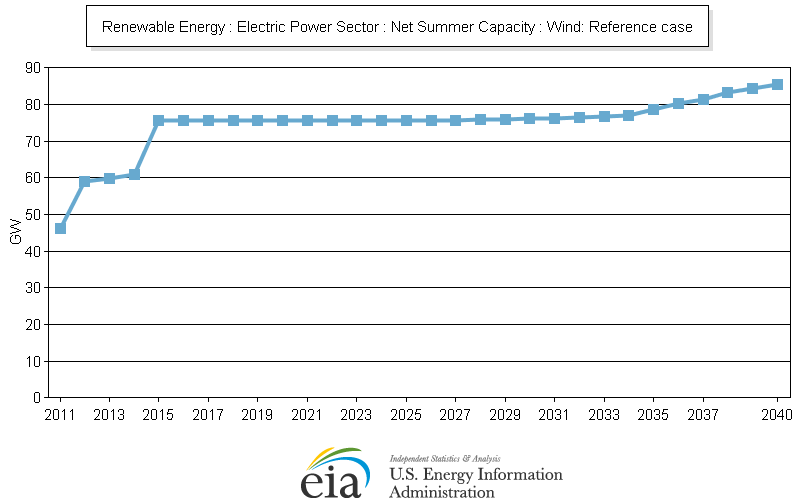
According to EIA, if the expired PTC is allowed to stay expired, their models show an expected stair-step increase in wind capacity by 2015 that flattens out for the next decade until gas prices rise and technology improvements make wind more competitive (see chart). If the PTC and the 30% ITC were made permanent EIA shows it would drive more renewables, particularly wind and solar, but at a significant cost: $4.5 billion/year from 2014 to 2040.


So what’s next

Big wind grew up on the tax credit, developed market plans and forecasts that relied on it, and now the wind PTC appears to be a required component of the industry’s economics. That was never the intent of Congress when this temporary tax credit was enacted 24 years ago. The PTC and ITC are now expired and we can expect roughly 15,000 MW of new wind to be built in response to the 1-year extension passed in 2013. After that, it’s over. It’s now time for taxpayers to consider better ways to spend their money.


This is the Result of Politicians, Thinking They are Scientists!…..Disaster!

The physics of a boiling kettle – my question to the commission!

2fa36b2
MY WRITTEN QUESTION TO THE COMMISSION:

“I understand that the Commission proposes to introduce measures to limit the power of electric kettles. Is this the case?

Does the Commission have any grasp of the basic physics of boiling a kettle?

Is the Commission aware that so far as the water itself is concerned, it takes just the same energy to boil a litre of water slowly as to boil it quickly?

Is the Commission aware that in boiling it slowly, over a longer time, more waste heat will be lost to the environment through conduction, convection and radiation?

Does the Commission therefore recognise that this proposal will increase electricity consumption, generate more waste heat, and tend to increase emissions, both of CO2 and water vapour?”


Leading Scientists Warn of Vibro-Acoustic Disease, from Wind Turbines!

Are wind turbines a headache?

turbine1LEADING SCIENTISTS are concerned that a new threat may be posed by wind turbines, a threat that could damage our ears known as ‘Vibro-Acoustic Disease’. 

This new warning may come as too little too late for a local Pembrokeshire resident, Gwen Burkhardt, who it is alleged had to sell her Newcastle Emlyn farm several years ago because the of the three wind turbines that were a mile away from her home and were adversely affecting her health. Her doctor, apparently, put it down to ‘infra-sound’, that sound which is inaudible to human ears. She was suffering from headaches at home, which was on a B road near to Emlyn’s three 250 foot wind turbines. According to Gwen Burkhardt, once she sold up and moved from the area, the headaches disappeared.

The main proponent of this theory, ‘Vibro-Acoustic Disease’, is Dr Nina Pierpont, who published a book entitled ‘Wind Turbine Syndrome’ in 2001. In this book a link is alleged between low frequency noise and vibration and a range of symptoms such as tinnitus, dizziness, nausea, palpitations, sleep disturbance and migraines. Another disturbing case was reported in the Danish press who reported the story of a garden centre going out of business because of nearby wind turbines. Headaches were frequent among employees, and female workers complained of unusual bleeding and problems with their menstrual cycles.

The employers were worried that more serious illnesses may have followed after five employees resigned. The owner, Boye Jensen, closed the business for fear of being held liable should a child be born with deformities. The World Council for Nature (WCFN) is calling attention to the fact that, as occurred for tobacco, asbestos, thalidomide etc, governments are siding with private financial interests in ignoring or denying the existence of what they see as obvious health problems linked to wind turbines.

They went on to say: “In Denmark as elsewhere in the world, many rural families are suffering, particularly since the manufacture of the mega turbines, which emit more infrasound as they grow bigger. This may explain why the complaints are growing. How much longer can this suffering be ignored, or even denied by health authorities? Some countries, including Canada and Australia, have commissioned studies into the matter of noise emitted by windfarms. But the studies’ scope and methodology doom them to failure, perhaps intentionally”. Such is the concern of the potential damage caused by these turbines that the WCFN have called for an epidemiological study, and the measurement of low frequency sound (including infrasound down to 0.1 Hz), inside the homes of windfarm victims.

They suggest that as a precaution, no mega turbines should be erected less than 10 km from habitations until these studies are completed, published and analyzed. They finished by saying: “There is indeed compelling evidence that infrasound travels much farther than other noise, and tortures sensitive people in their homes at distances of 10 km and more. Shorter distances could be temporarily set for smaller turbines, in proportion with their generating capacity”. Pembrokeshire residents, many of whom may be living near to these turbines, will be hoping that this concern proves to be a false alarm.


Wind weasels try to Deny the Negative Health Effects from Wind Turbines….No Surprise!

Wind turbines make people ill: fact not fiction  

Author:  Kenny, Pamela

Would I say this?:

Hundreds of thousands of people around the world live near and work at operating wind turbines without health effects. Wind energy enjoys considerable public support, but wind energy detractors have publicized their concerns that the sounds emitted from wind turbines cause adverse health effects. These allegations of health-related impacts are not supported by science. Studies show no evidence for direct human health effects from wind turbines.

It is certainly not me talking.

It is the claim of the American Wind Energy Association (AWEA), the national trade association for the U.S. wind industry. Wind power developers and their lobby groups around the world are shouting the same message – that the noise and vibration (infrasound, sound pressure, and low frequency noise) produced by large-scale wind turbines produce no direct health effects.

In reality, their claim is a lie. There is an ocean of documented evidence to support the assertions of anti-wind campaigners that the noise and vibration from wind turbines causes a range of health problems in significant numbers of people. If you search for just a couple of hours online, you can find personal stories by the thousand, and also numerous highly technical research papers by eminent medics and scientists detailing, amongst others, these symptoms:

  • Chronic sleep deprivation
  • Sleep disturbance
  • Increased blood pressure
  • Increased blood sugar (dangerous for diabetics)
  • Poor concentration and memory
  • Depression
  • Headaches and migraines
  • Dizziness, unsteadiness, ear pain and vertigo
  • Vibration in the body, particularly the chest
  • Nausea/“seasickness”
  • Tinnitus
  • Sensations of pressure or fullness in the ear
  • Stress
  • Panic
  • Annoyance, anger and aggression
  • Increase in agitation by those with Autistic Spectrum Disorder, and ADD/ADHD

Some of these symptoms can be attributed to sleep deprivation. It is increasingly clear from peer- reviewed medical papers that night noise interrupting sleep has an adverse effect on both cardiovascular health and stress levels. Interrupted sleep can also have serious effects on daytime concentration leading, potentially, to increased risk of industrial accidents and road traffic collisions. As these problems are likely to occur at locations remote from the cause of the interrupted sleep they are difficult to attribute to their actual cause. Dr. Christopher Hanning, a now-retired Consultant in Sleep Disorders Medicine to the University Hospitals of Leicester NHS Trust, writes:

In the short term … deprivation of sleep results in daytime fatigue and sleepiness, poor concentration and memory function. Accident risks increase. In the longer term, sleep deprivation is linked to depression, weight gain, diabetes, high blood pressure and heart disease.[1]

I do not pretend to be an expert in the effects of noise, but I do know that in over 30 years as a GP I have seen countless patients presenting with the effects of insomnia, and shift workers in particular suffer far more than the general population with the effects of disturbed sleep. What I find astonishing is that the noise regulations for the wind industry permit MORE noise to be generated by the turbines at night than during the day. This is completely contrary to noise pollution legislation, World Health Organisation (WHO) guidelines – and common sense.

Other symptoms listed above are likely to be a response to exposure to infrasound (sound with a frequency of less than 20 Hz) and low frequency noise (sound with a frequency of less than 200 Hz) produced by the turbines. Both low frequency noise and infrasound occur naturally in the environment (for instance, from household appliances and machinery in the case of low frequency noise, and ocean waves in the case of infrasound). In periods when the wind is blustery, large wind turbines generate both very low frequency sounds and infrasound which can travel much greater distances than audible sound. These sounds are not audible to the human ear, but our brains certainly detect them and some susceptible people suffer some of the unpleasant symptoms I have listed, such as tinnitus, ear pain and vertigo. If you feel up to reading some technical, but very interesting, research on this subject, take a look at “Wind-Turbine Noise. What Audiologists Should Know” by Punch, James and Pabst, published in the American publication Audiology Today in 2010.[2]

Other reasons why people experience health impacts from wind turbines include the swishing or thumping of the blades, which is highly annoying as the frequency and loudness varies with changes in wind speed and local atmospheric conditions. This is not at all like the sound of a passing train, aeroplane or tractor which moves on rapidly to be replaced by less intrusive background sounds. The noise of wind turbines has been likened to a “passing train that never passes” which may explain why it is prone to cause sleep disruption.

Some of those with heightened sensitivity to specific repetitive stimuli, such as those with Autistic Spectrum Disorder, Attention Deficit Disorder or Attention Deficit Hyperactivity Disorder (ADD/ADHD), can be seriously affected by the noise. Consultant clinical psychologist Dr. Susan Stebbings, from the Lincolnshire Partnership NHS Trust, said more research was needed into wind turbine noise and these disorders:

Because it is clear from our clinical knowledge of the condition of autism that the sensory difficulties individuals can have are possibly going to be impacted on by the presence of such large sensory objects in their environment.[3]

Indeed, there is at least one case on record of a wind farm application being turned down because of the proven impact on children with autism.[4]

Then there is shadow flicker or strobing which occurs when the rotating blades periodically cast shadows through the windows of properties. This can be truly unpleasant to live with and can trigger migraine and – much more rarely – epileptic fits in those suffering from photosensitive epilepsy.[5] At night, the red warning lights on the tops of some turbines can cause blade glint and strobing effects, so it is not just a daytime phenomenon.

Then there is the effect of stress. If you live in a tranquil rural area like ours, where the daytime and night time noise levels are almost always very low, you may well suffer varying levels of stress from the imposition of industrial-scale wind turbines into the landscape. The stress can occur long before the turbines are erected: during the planning process; during the noise and disruption of the construction; when you see the turbines for the first time and cannot believe the scale of them; and, then, during their operation when your sleep is disrupted and other physical and mental symptoms present themselves.

The effects of wind turbine noise have been known for several years now. In February 2007, a Plymouth GP, Dr. Amanda Harry, published a report “Wind Turbines, Noise and Health”.[6] The report documents her contacts with 39 people living between 300 metres and 2 kilometres from the nearest turbine of a wind farm. She discovered symptoms such as those I have outlined experienced by people living up to 1.6 kilometres from the wind farms.

The wind industry has repeatedly tried to discredit Dr. Harry’s report, and another – published in 2009 – by a leading American Pediatrician Dr. Nina Pierpont, who coined the phrase “Wind Turbine Syndrome” to cover the range of health problems she investigated over five years in the US, the UK, Italy, Ireland and Canada.[7] The global wind industry also spends vast sums attempting to discredit scientifically sound research studies, and the papers of experts in the physiology of the ear that prove infrasound can have adverse effects despite it not being audible.

It is true that both Dr. Harry’s and Dr. Pierpont’s research is largely anecdotal and does not reach the high standards needed for statistical validity. However, that also applied to reports on the association between lung cancer and smoking, and asbestos and asbestosis, in the early days.

We have now reached the stage in the debate when there can be no reasonable doubt that industrial wind turbines – whether singly or in wind farms – generate sufficient noise to disturb the sleep and impair the health of those living nearby.[8] In fact, our own Government has long been fully aware of the problems, as demonstrated in a 2008 Economic Affairs Committee Memorandum by Mr Peter Hadden, which concludes that:

onshore wind turbines built within 2km of homes offer no benefits and should not be part of a plan to provide the UK with a viable, secure, predictable supply of electricity. Indeed, onshore wind turbines ensure an unpredictable energy supply, by the very nature of the wind, with a long list of adverse impacts that diminish their supposed usefulness. Other renewables, such as solar and hydropower, offer more options and more predictability, especially combined with the still necessary (and technologically advancing) conventional sources of energy.[9]

I find it unbelievable that the wind industry is permitted to inflict health nuisance such as sleep disturbance, stress, and headaches on our communities – let alone more serious health issues such as depression, and heart and diabetes problems. To suggest, as the wind industry does, that there is “no problem” when faced with the huge body of evidence from around the world is perverse.

What sums up this entire problem for me is the quote below. It is by Dr. Noel Kerin of the Occupational and Environmental Medical Association of Canada. He was attending the First International Symposium on Adverse Health Effects and Industrial Wind Turbines, held in Canada in October 2010. He was shocked by the overwhelming evidence on the harmful effects of wind turbines:

First we had tobacco, then asbestos, and urea formaldehyde, and now wind turbines. Don’t we ever learn? Our public health system should be screaming the precautionary principle. The very people who are sworn to protect us have abandoned the public.[10]

My extensive reading into the harmful effects of wind turbines leaves me in no doubt that, to protect our community, we need to oppose the erection of three 125 metre turbines on Berry Fen.* Quite aside from the damage to our beautiful landscape, our tranquillity, our tourism industry, and wildlife, this wind farm would have serious implications for the health of many who live and work here for the entire 25-year life of the wind farm, and well beyond.

Pamela Kenny, MB BS, MRCS LRCP, FIMC RCSEd

Dr. Pamela Kenny was a founder of the current Haddenham and Stretham GP surgeries in 1986. She retired from practice there in 2006, but continued to work in Cottenham and St Ives and is a Trustee of the emergency medical service MAGPAS. Dr. Kenny has always had an interest in how lifestyle factors affect patient’s health, and continues to do so in the interests of the community. She has immense sympathy with anyone who might be affected by any form of flicker as she has always suffered from flicker-induced migraine. She also has the kind of hearing that is super-sensitive to both high and very low sound.

[1] http://docs.wind-watch.org/Hanning-sleep-disturbance-wind-turbine-noise.pdf

[2] http://docs.wind-watch.org/AudiologyToday-WindTurbineNoise.pdf

[3] www.bbc.co.uk/news/uk-england-lincolnshire-19374360

[4] http://news.bbc.co.uk/1/hi/england/humber/8646326.stm

[5] doi: 10.1111/j.1528-1167.2008.01563.x

[6] http://docs.wind-watch.org/wtnoise_health_2007_a_harry.pdf

[7] www.windturbinesyndrome.com/wind-turbine-syndrome/

[8] www.noiseandhealth.org/article.asp?issn=1463-1741;year=2012;volume=14;issue=60;spage=237;epage=243;aulast=Nissenbaum

[9] www.publications.parliament.uk/pa/ld200708/ldselect/ldeconaf/195/195we34.htm

[10] www.windvigilance.com/international-symposium/wind-turbines-linked-to-sick-building-syndrome

*There is still time to object to the planning application [the deadline has been extended to 3rd September 2014]. You do not have to write a long letter – just a couple of points outlining why you object – and every single person in your household should write individually as the number of objections will make a difference. Whichever method you choose, please include your name and full postal address, and the Planning Application Number 14/00728/ESF:

  • Send your objection by email to plservices@eastcambs.gov.uk
  • Or write to: Mrs Penny Mills, Planning Officer, East Cambs District Council, The Grange, Nutholt Lane, Ely, CB7 4EE
  • Or drop off to the following addresses: Simon Monk, Dunelm House, 4d The Borough, Aldreth; and Ian Munford, 4 Orchard Way, Haddenham.

Download original document: “Wind Turbines Make People Ill: Fact Not Fiction”

Investing in the Wind Turbine Scam, is a Risky Business!

Australia’s wind turbines may stop spinning as banks foreclose


Australian analysts have warned that some of the country’s wind farms could be forced to close down under proposals made by the Abbott government’s RET Review panel.

Insiders are aghast at the assumptions made by the panel about the possibility of closing the scheme to new entrants and providing “grandfathering” arrangements for existing assets.

They say the proposals – and the assumption that LGCs, the certificates that are the currency of the scheme – will hold value are flawed, and the panel has not considered the basic refinancing risks of all projects under any scenario.

“I’m amazed at how flawed this document is,” said one close observer. “It is internally inconsistent, it is intellectually flawed … and it doesn’t even try to cover up its bias. It is 160 pages of self-serving logic.”

Another noted that almost every wind farm in the country will be up for refinancing for next 3 years. “They will be in major financial distress, and they are all at risk of falling over.”

While wind farms in Australia can have long term power purchase agreements out to 2030, the financing arrangements are much shorter, usually around 5 years.

This means that most, if not all, wind farms, will be up for refinancing in the next few years. When that happens, the major banks will review the state of the market, and are either likely to raise the price of debt, or do an “equity sweep” – calling on project owners to invest more cash.

None are likely to do so.

And in some cases – because the value of the LGCs will be effectively zero – as Bloomberg New Energy Finance has pointed out – and the price of wholesale electricity has fallen due to the removal of the carbon price and over-capacity brought about by the construction of thousands of megawatts of gas-fired generation – many wind farms will struggle to make debt obligations under current terms.

In its report, BNEF warned that a “whole host of Australian and foreign companies and lenders could be exposed to asset impairments, and almost all will suffer significant write-downs in the mark-to-market value of their investments.”

This dire situation was confirmed last week by Infigen Energy, which warned of potential bankruptcieslast week (an extraordinary enough statement for a listed company). Infigen Energy head Miles George – who doubles as the chair of the Clean Energy Council – warned that many other companies are in a similar situation.

Those wind farms on merchant contracts are most at risk, but even those with PPAs have clauses which allow bankers to review the financing arrangements.

Analysts suggest that Australian banks will be mortified when they understand the full implications of the review panel’s recommendations.

“Every time there is a refinancing, banks redo the base case model for the project. As the situation gets worse – with a lower LGC price – they will have to squeeze all of their parameters to make sure they get repaid,” one said.

“When they pull all those levers – a shorter amortisation period, a higher debt-equity ratio, then the equity holders are going to have to tip in additional capital to keep the projects going. The project owners are not in position to do that.

“And if the equity holders start falling over, banks might be left with wind farms to run and operate. But there will be no real market left, and no real market value in those projects. It may be that they have to turn them (the wind turbines) off.”

Even the other scenario recommended by the RET Review panel – that of downgrading the target from its current level of 41,000GWh to a “real” 20 per cent target of around 25,000GWh with targets set annually, would not be practical.

Analysts warn that there would unlikely be any new entrants because of the price uncertainty with rolling targets and – as a result – the higher cost of capital.  It is highly unlikely that any Australian bank would provide debt finance in these circumstances.

All of Australia’s big four banks are at risk, but particularly NAB and ANZ, who have project financed most wind farms in Australia.

bnef debt

The Wind Turbine Scam is Destroying Our Economies, as Well as Our Communities!

Professor Ross McKitrick: Wind turbines don’t run on wind, they run on subsidies.

economics101

As STT followers are acutely aware, wind power is an economic and environmental fraud. Because wind power can only ever be delivered at crazy, random intervals – and, therefore, never “on-demand” – it will never be a substitute for those generation sources which are – ie hydro, nuclear, gas and coal (see our posts here and here and here and hereand here and here and here and here).

Were it not for government mandates – backed by a constant and colossal stream of subsidies (see our post here) – wind power generators would never dispatch a single spark to the grid, as they would never find a customer that would accept power delivered 30% of the time (at best) on terms where the vendor can never tell customers just when that power might be delivered – if at all (see our post here).

Ultimately, it’ll be the inherently flawed economics of wind power that will bring the greatest rort of all time to an end. The policies that created the wind industry are simply unsustainable and, inevitably, will either fail or be scrapped.

The Canadians are reeling under the ludicrous wind power policies of a hard-green-left Liberal government, clearly intent on committing economic suicide. Power prices – driven by exorbitant guaranteed rates to wind power outfits – have rocketed – tripling in less than a decade, driving energy intensive businesses – like manufacturing – out of business or offshore – stifling business investment – killing off or threatening thousands of sustainable (unsubsidised) jobs across Canada and otherwise creating economic chaos (see our post here).

The scale and scope of Canada’s wind power disaster hasn’t been lost on top energy market economists, like Ontario’s Professor Ross McKitrickfrom the University of Guelph.

Downwind - Ross McKitrick - Uni of Guelph (Time 0_06_00;22)

Ross was interviewed for the brilliant Sun News documentary ‘Down Wind’ by presenter, Rebecca Thompson, which has been extracted in the video below. The transcript appears below.

****

Downwind – Ross McKitrick – Uni of Guelph

Downwind – Ross McKitrick – Uni of Guelph


Rebecca Thompson: First we turn to Professor Ross McKitrick, an economist. He recently published a very scathing review of how economically unsound the Ontario Liberal government’s Green Energy Act is.

Professor Ross McKitrick: Well the important thing to understand about wind turbines is that they don’t run on wind, they run on subsidies.

Rebecca Thompson:  We went to see McKitrick at the University of Guelph.

Professor Ross McKitrick:  All the arguments that they’ve put forward for the Green Energy Act they really turned out to be phoney once we looked at them closely. They said that it would improve the economy, reduce air pollution emissions and it would replace coal fired power. And the problem is with the first one, it is not going to improve the economy because of what you are doing is replacing power that costs 3 to 5 cents per kilowatt hour to generate, and you’re replacing it with power that costs at least 13 1/2 cents per kilowatt hour to generate. So you’re raising the cost of doing business, it will drive down the rate of return in manufacturing and mining and that has to translate into job losses and reduced investment and shrinking the economy.

Rebecca Thompson: So you’ve pointed out that wind energy in fact, isn’t in the public interest in the short term but will it be in the long term?

Professor Ross McKitrick:  Nobody was building wind turbines in Ontario until the government started throwing money at it. It is not a profitable source of electricity, it’s not cost-effective. Wind turbines can’t compete on the wholesale market without a lot of government support.

Rebecca Thompson: The system used to fund wind energy in many places around the world is called a Feed-In-Tariff (FIT).

Professor Ross McKitrick:  And that means if you build a bank of wind turbines somewhere, and you get the contract that everyone is looking for you get a guarantee of 20 years being paid 13 1/2 cents per kilowatt-hour for the electricity that’s generated while the wholesale rate in Ontario is typically between 2 – 4 cents per kilowatt hour.

Rebecca Thompson: The Ontario government piggybacked off what is a European idea of a feed in tariff policy where the prices are locked in for 20 year contracts. And here’s another head scratcher …

Professor Ross McKitrick: The other provision of the contracts is that the system has to buy the power from you whenever you produce it. So the standard power plants, nuclear plants and hydro plants and so forth – there is no guarantee for them to buy their power, they have to compete on a wholesale market they have to price their product, in this case electricity, so that the system operator will buy it. With wind turbines, if the blades are running, the system operator has to buy it. Now they have adjusted that slightly in the last year because of this problem of the system operator being forced to buy tons and tons of power when it doesn’t need it, at 13 1/2 cents per kilowatt hour and sell it on the export market at one or two cents per kilowatt-hour – it was costing hundreds of millions of dollars a year for the system operator to do that. So the province now allows the system operator to reject some of the power that the wind turbines produce and instead the province will pay the wind turbine owners a benefit for what they call ‘deemed production’. So it’s really just transferred that same costs on to the taxpayer now.

Rebecca Thompson: The bottom line is pretty good for the wind energy sector.

Professor Ross McKitrick:  They get a 20 year contract to sell wind power at far above market rates and it doesn’t matter that they are generating power at times when the province absolutely doesn’t need it, and we can’t use it, and we just have to try to find some neighbouring jurisdiction to buy it from us. We used to have a few large power plants in Ontario and we had our grid that was optimised to source electricity from a few large central locations. We’re now shutting down the large central locations and replacing them with this proliferation of tiny little unreliable wind farms and you have to build a whole new grid to accommodate that. So that’s again an extra cost to get something that we already had.

Rebecca Thompson: What’s more is that the Green Energy Act hasn’t even come close to creating the number of jobs the Liberals claimed it would.

Professor Ross McKitrick: It turned out that the province had claimed that there were going to be 50,000 new jobs created from the Green Energy Act. When the Auditor General asks them to back that up because it doesn’t really make sense that this would create any jobs – what they admitted was they were really talking about were temporary construction jobs – as you put up wind turbines you need some workers in to do that. But then once the wind turbines are built, then those jobs disappear and there are no ongoing jobs. In economics, it’s an old fallacy, what’s called the broken window fallacy. If you go around breaking shopkeeper’s windows, since they have to hire repair people to fix the windows then you’ve somehow improved the economy. But, you haven’t. All you have done is increase the cost of having what you had before – which was windows in stores.

Rebecca Thompson: If the new shift to green power is so inefficient why hasn’t anyone working in the system spoken out?

Professor Ross McKitrick:  There are a couple of reasons. The power workers union has spent money on advertisements. They did try to fight against the closing of Lambton and Nanticoke – they understood that this was a bad deal for the workers in the province. But they did want they could. But it’s hard to be up against a government that is pushing so much propaganda on coal. There were people certainly in the power generating sector that understood that the government’s numbers weren’t correct and didn’t add up. But, they were effectively muzzled.

Rebecca Thompson: McKitrick speaks to people all the time about the changes in the system.

Professor Ross McKitrick:  I do find people working in the power sector, they know that this is a crazy system. These wind farms are displacing hydro electricity which is just a waste on every level because we have the hydroelectric facilities, they don’t generate any air pollution emissions. They give us reliable, predictable baseload power. And now we run wind turbines and let those hydro-facilities sit idle. So people who work in the sector, they can see what’s going on and they know that this is a waste. But, for understandable reasons they’re not about to make a big noise about it because they could lose their jobs if they do.

Rebecca Thompson: Whether any government would actually be able to get out of existing contracts is debatable. Ross McKitrick says it’s possible.

Professor Ross McKitrick: One option might be to buy out some of the wind turbine companies and take those wind turbines off the grid, or only use their power when they’re competitive. In Europe, what governments have started to do though is put on special new taxes on renewable sources, solar and wind, to try and recover some of these costs. Alternatively, the government may look to try and tear up the contracts and accept the legal liability that goes with it, but it’s not going to be easy.
Sun News: Down Wind

Down Wind, which runs for 96 minutes, can be purchased as a file and downloaded or as a DVD for those in the US and Canada (here’s the link). For those outside the US and Canada the file can be purchased and downloaded (using this link). If you’re in there fighting the great wind power fraud, Down Wind is essential viewing.

For a detailed synopsis of Down Wind – see our post here.

down wind

Industrial Wind Turbines….Not the First Time, that Sound Has Been Used As a Weapon!

A History of Using Sound as a Weapon

Written by
JOE ZADEH
July 30, 2014 

Last week, a collaborative research project known as AUDiNT (short for Audio Intelligence) released Martial Hauntology,a box set of vinyl and literature that explores the darker history of sound. It’s a journey into the lesser known realms of sonic weaponry.

The project is the latest in-depth study from Glaswegian electronic artist Steve Goodman (perhaps best know as Hyperdub label owner Kode9) and Manchester University research fellow Toby Heys. Heys describes AUDiNT as a “research cell investigating how ultrasonic, sonic and infrasonic frequencies are used to demarcate territory in the soundscape and the ways in which their martial and civil deployments modulate psychological, physiological and architectural states.”

The incorporation of sound into warfare may sound like a modern tactic, but the first reports have their roots in history. Back in 1944, as World War II slipped through Germany’s fingertips, it was rumoured that Hitler’s chief architect Albert Speer had set up research to explore his own theories of sonic warfare, with the intention of creating tools of death. An episode of the History Channel’s Weird Weapons claimed that his device, dubbed an acoustic cannon, was intended to work by igniting a mixture of methane and oxygen in a resonant chamber, and could create a series of over 1,000 explosions per second.

This sent out a deafening and focused beam of sound which was magnified by huge parabolic reflector dishes. The idea, apparently, was that by repeatedly compressing and releasing particular organs in the human body, the cannon could potentially kill someone standing within a 100-yard radius in around thirty seconds. Fortunately, the weapon was never actually used in battle.

The actual volume of sound frequency isn’t the only way sound has been used in war. In his 2009 book Sonic Warfare, a key body of research in the understanding of contemporary sonic thought, Goodman included a chapter titled “Project Jericho,” which explored the US PSYOPS campaigns during the Vietnam War.

Goodman described a particular campaign known as Operation Wandering Soul. The Curdler, a helicopter-mounted sonic device, produced the “voodoo effects of Wandering Soul, in which haunting sounds said to represent the souls of the dead were played in order to perturb the superstitious snipers, who, while recognizing the artificial source of the wailing noises, could not help but dread what they were hearing was a premonition of their own postdeath dislocated soul.”

It was these operations, Goodman wrote, that directly inspired the famous scene of Francis Ford Coppola’s Apocalypse Now, in which a fleet of helicopters fly towards their target whilst blasting Wagner’s “Ride of the Valkyries.”

And while Wagner might not exactly be a torturous sound, the use of popular music for non-lethal weaponry goes further than Apocalypse Now. In 2003, the BBC reported that US interrogators were using songs by Metallica, Skinny Puppy and, erm, Barney the Dinosaur, in a bid to break the will of Iraqi prisoners of war. As Sergeant Mark Hadsell told Newsweek at the time, “These people haven’t heard heavy metal. They can’t take it. If you play it for 24 hours, your brain and body functions start to slide, your train of thought slows down and your will is broken. That’s when we come in and talk to them.”

All this kicked off a bizarre discussion about whether music used during torture meant royalties were owed to the artists. Skinny Puppy jumped on this and filed a sizeable $666,000 royalties bill claim against the American defence department.

Jump forward to June 13, 2005, when the late Israeli president Ariel Sharon had just agreed to the disengagement from Gaza. That involved the displacement of settlers from the West Bank area, and stories soon started filtering in that the Israeli Defence Force (IDF) was trying out a new weapon on the streets. “The knees buckle, the brain aches, the stomach turns, and suddenly nobody feels like protesting anymore” reported the Toronto Star’s Middle East Bureau.

“An Associated Press photographer at the scene said that even after he covered his ears, he continued to hear the sound ringing in the back of his head,” wrote Amy Teibel for the Associated Press. This special vehicle-mounted weapon was an LRAD (long range acoustic device). They’re mostly used at sea as a defence against pirates, and can fire beams of up to 150-decibel alarm sounds at crowds.

Its victims on the streets knew it by another name: “The Scream.”

An LRAD on a ship. Image: Wikimedia Commons/Tucker M. Yates
Other sonic tactics against Palestinians were also reported, like jets breaking the sound barrier at low altitudes over settlements to cause what The Guardian described as “sound bombs.”

And sonic weapons weren’t limited to that part of the world, either. In 2004, the American Technology Corporation landed a nearly $5 million deal to supply LRADs to US troops in Iraq.

By 2011 and 2012, the use of LRADs began domestically in the US, when the government issued devices to various police forces, with their most publicised use coming during the Occupy Wall Street and G20 protests. Only seven months ago, the American-based LRAD Corporation also struck a $4 million deal with “a Middle Eastern country” for their most powerful hailing device yet: the LRAD 2000X, which gazumps previous models by beaming sound over 3,500 metres.

Despite domestic use elsewhere, the UK is yet to use an LRAD on its own civilians for crowd dispersal. How it feels about the accelerating industry, however, is confusing. When London mayor and water cannon enthusiast Boris Johnson was asked about LRADs in March, he denied knowing of their existence, responding, “Is this some sort of April fool?” Another politician pointed out that the devices were installed on the Thames during the 2012 Olympics.

In fact, London is home to one of the only non-military or police owners of LRADs in the world: Anschutz Entertainment Group, or as you probably know it, The O2. It was once left outside the venue and unattended, where it was photographed by a worried Twitter user (the O2 insisted it couldn’t have been misused).

The increased use of sonic weapons by armies and police forces around the world, and the growing stock market value of LRAD Corporation, reveal a continuing fascination with utilizing sound as a weapon, and the release of ever more in-depth studies like Martial Hauntology offers an insight into how sonic warfare is entering an age of global amplification.


Faux-green Energy…..No more than an Over-priced Novelty!

Obama’s Green Unicorn


The true cost of renewable energy is being masked by government subsidies and bailouts.

Wind turbines are silhouetted by the setting sun Friday, Aug. 23, 2013, near Beaumont, Kan. The turbines are part of the 100-unit Elk River Wind Farm in south central Kansas.

Propped up by the government.

By    Aug. 25, 2014 
America is about as likely to become reliant on green energy to meet its baseload power requirements as a unicorn is to stroll down the middle of Washington’s Pennsylvania Avenue during rush hour followed by a pink elephant.

It’s just not happening – but that’s hasn’t deterred the modern day snake oil salesmen and their allies inside the Obama administration from continuing to make a push for wind and solar power as an eventual replacement for energy generated from traditional sources like coal, oil and natural gas. Renewable technology has improved, no doubt, but it’s a long way away from being ready to make a substantial contribution to the heating of our homes and the powering of our businesses unless the generous tax subsidies that create the illusion of cost competitiveness continue.

There’s nothing wrong per se with the pursuit of renewable energy; it’s just that what it actually costs is being masked by taxpayer subsidies, federal loan guarantees and renewable fuels mandates at the state level that force power companies to put wind and solar into the energy mix, sometimes at two to three times what traditional power costs. Ultimately, one way or another, the taxpayers and energy consumers are footing the bill even if they don’t know it

Congress has taken a few positive steps in the right direction. The federal Wind Production Tax Credit was allowed to expire at the end of the year, meaning new wind projects are going to have to be competitive at market rates to attract funding. Remember it was none other than billionaire Warren Buffett, the “Oracle of Omaha,” who explained recently to a group of investors that the tax credit was the only reason that any sensible person invested in wind projects in the first place.

Unfortunately, some federal agencies are trying to keep the program alive through the backdoor.

The worst offender in this regard may be the IRS, which recently issued new “guidelines” that make it even easier for wind projects currently in development to qualify for the tax credit on the basis of work already contemplated or completed. According to Politico, “The IRS says completed or in-progress facilities can be sold and the costs incurred by the seller will still count toward qualifying for the [credit], except in cases where tangible property (think equipment like wind turbines) bought for one project is sold and used at another site.”

To translate this into English, it’s a move to help keep the whole shell game alive until such time as wind power supporters can get the tax credit reauthorized. “There is a large pipeline of projects that were under development at some stage that by virtue of this guidance will be able to go forward. In that regard it is going to permit a lot of projects to be developed,” said one wind energy expert cited by Politico.

Outside groups are also weighing in, including the Sierra Club, which has targeted nine members of Congress in a pressure campaign over the August recess to push for reauthorization of the Wind Production Tax Credit. That is in addition to the online ad buys in 16 other districts that started in June.

[MORE: Cartoons on Gas Prices]

The Democrats who run the Senate want to keep the now-expired credit alive and have, in the Senate Finance Committee, already approved a package of so-called “extenders” that would breathe new life into it. The House has thus far refused to go along – and kudos to Texas Republican Rep. Randy Weber, who deserves credit for successfully introducing an amendment to shut the whole business down permanently. But he’s not just fighting the lobbyists and green groups in favor of the credit, but the entire federal bureaucracy which, once a program has been established, is loath to let it die.

Major government investment in speculative green projects may have at one time made sense. But even if that were once the case, it is so no longer. The Obama green energy push has enriched more than a few politically well-connected liberals who used tax credits and government bailouts to enlarge their portfolios, but it has done little to make energy more abundant or lower costs to consumers, which is the justification in the first place to get the taxpayers involved. If people want to build wind farms – on land or offshore – and they want to reap the benefits of their investments, then they should be willing to take the same risks as everyone else. The way the bureaucrats have it structured now, the taxpayers are making payments on both ends through subsidies for construction and higher rates on consumption. It’s a system only a bureaucrat could love.

Frauds, Crooks and Criminals

Demonstrating daily that diversity is not strength!

Family Hype

All Things Related To The Family

DeFrock

defrock.org's principal concern is the environmental and human damage of industrial wind turbines on rural communities

Gerold's Blog

The truth shall set you free but first it will make you miserable

Politisite

Breaking Political News, Election Results, Commentary and Analysis

Canadian Common Sense

Canadian Common Sense - A Unique Perspective from Grassroots Canadians

Falmouth's Firetower Wind

a wind energy debacle

The Law is my Oyster

The Law and its Place in Society

Illinois Leaks

Edgar County Watchdogs

stubbornlyme.

My thoughts...my life...my own way.

Oppose! Swanton Wind

Proposed Wind Project on Rocky Ridge

Climate Audit

by Steve McIntyre

4TimesAYear's Blog

Trying to stop climate change is like trying to stop the seasons from changing. We don't control the climate; IT controls US.

Wolsten

Wandering Words

Patti Kellar

WIND WARRIOR

John Coleman's Blog

Global Warming/Climate Change is not a problem