Donna Quixote’s “Liberal Monopoly” makes the NEWS!!!

Merriam: Grits’ fixation on wind power is a losing game

By Jim Merriam

How dreadful . . . to be caught up in a game and have no idea of the rules.

— Caroline Stevermer

Two games have taken on new meanings, thanks to opponents of the Ontario government’s fixation with wind power.

First is the game of politics and second is the board game Monopoly.

A new game circulating via electronic media is called Ontario Liberal Monopoly. The game highlights the relationship between this power-hungry party and its various power flubs.

Instead of jail, there’s an unemployment line for all those thrown out of work by the government’s destruction of the manufacturing sector.

There’s also a wind victims’ safe house, presumably a place where all the folks can move after they’ve been driven from their farms by wind turbines that have caused serious health problems.

Permit me an aside. I recently exchanged correspondence with a dear friend who couldn’t understand how I could abandon the “Liberal family,” to which my clan has belonged since Ontario was nothing but unsettled bush.

The answer: I could never support a party that condones big business delivering health problems to people and driving them off the land, for no good reason. I doubt most of my ancestors would have supported such reckless disregard for people either.

But I digress.

Back on the special monopoly board, we see the price of various wind factory developments. These include Wolfe Island at $75 billion, Melancthon wind farm at $80 billion, Port Alma at $30 billion and Underwood at $50 billion.

As you roll the dice and make your move you might land on a square that gives you a gift basket. Of course, it’s for Toronto residents only.

Another square says you can take a ride on an Ornge ambulance. Perhaps it should have said, be taken for a ride by Ornge.

Just like real Monopoly, another square moves you directly to the unemployment line because your company has moved to New York for cheaper electricity rates.

When CEOs pass “Go” they receive $2 million in salary, but unlucky players might end up paying $20 in gas tax and 10% or $200 in debt retirement charges.

On the square for electricity charges, you get to choose one only from heat, light, food or shelter.

Instead of the likes of Marvin Gardens, you can buy various parts of the province. Widely ranging prices seem related to how much the province cares about the area in question.

For example you can buy Don Valley West for $2,000, but Guelph will cost you only $25. Shelburne is $12, while Port Burwell and Kincardine are $10 each.

Huntsville will cost you $50 or you can buy Vaughan for $110 and the Muskokas for $150. (I know it’s not “Muskokas” but that’s what it says on the board.)

If you get an unlucky roll, you land on the cancelled gas plants square and get to pay $1.1 billion. Other unlucky players take a chance and get to deal with the fact their neighbours leased land to a wind developer.

You can learn more about this special game and about the Liberal party’s destruction of Ontario at http://www.QuixotesLastStand.com. Here is the history of the Liberal monopoly game:

“With more and more families in Ontario entering energy poverty, thanks to the insane policies of the Liberal party, families are now finding themselves sitting in the dark at night. This has spawned a resurgence in board games, and the newest rage in board games is the Ontario Liberal party version of Monopoly.”

It’s all kind of funny, except it’s a sad commentary on the last decade of Liberal rule in Ontario.

jmerriam@bmts.com


UK is Wising Up to the Windscam….JUST SAY NO!!!

New! Manage Your Group
See pending posts, member requests and reported posts for the group in which you are an admin.
Okay

Close popup and return

Finally….the plug is pulled on the Liberal Fiasco!!! Oh HAPPY DAY!!!

TORONTO – Ontario is heading to the polls.

NDP Leader Andrea Horwath said she will vote against Premier Kathleen Wynne’s spring budget which means that the Liberal minority government would fall on a confidence vote as early as May 7.

“It’s time for change,” Horwath said Friday. “You deserve a better government.”

Horwath said the growing list of scandals attached to the Liberal government and her lack of confidence in Wynne to deliver on her budget promises are behind her party’s decision to pull the plug on its support.

Wynne had given Horwath until May 8 to decide but she rendered her decision one day after Finance Minister Charles Sousa delivered his supposedly NDP-friendly budget.

“Kathleen Wynne cannot even build a raft. How do we expect her to actually build a ship?” Horwath said. “We will not be voting in favour of any confidence motion including the budget.”

A confidence vote could be held any time between May 7 and June 2, but Wynne could also trigger an earlier election herself.

Premier Kathleen Wynne, speaking on the Lorne Brooker Show on CJBQ radio in Belleville, said Friday that she was disappointed that Horwath would not meet with her as requested to discuss the budget.

“I think there’s a lot in this budget that needs to be implemented in the province,” Wynne said. “But I’ve said all along if we didn’t have a partner in the Legislature then we would taken this budget to the people of the province. And we will do that.”


Wake-up People. Climate Alarmism is a Government Tool!!!

A Big Threat To The Global Warming Consensus

The global warming “consensus” has been maintained by silencing scientists through funding. Those who don’t tow the line, don’t get paid. 97% of scientists understand that.

But as more scientists retire, their interest turns towards setting the record straight. Once they are out of the clutch of the government propaganda ponzi scheme, they unleash.

ScreenHunter_105 May. 02 04.44

www.nzcpr.com/wp-content/uploads/2014/04/Global-Warming-Dr-David-Kear.pdf

Lies that the Wind Developers tell…..Will that be their downfall?

Elected officials suppressed key report, failed to halt project or recover taxpayer dollars

“It was heartbreaking to see this project desecrate such a historically and culturally significant landscape, and it’s even worse when you find out that it was built on false claims by the developer, and with the assistance of the BLM. “– Anthony Pico, Chairman, Viejas Band of Kumeyaay Indians

By Miriam Raftery

April 30, 2014 (Ocotillo) – An international wind energy expert has concluded that Pattern Energy appears to have defrauded the federal government in order to obtain lucrative tax subsidies for a wind energy development in southern California that has failed to live up to the developer’s claims.

“I believe we have a clear case for the False Claims Act,” Nicolas Boccard told East County Magazine, after reviewing full first-year wind production data for the Ocotillo Wind Energy Facility on U..S. Bureau of Land Management (BLM) public land.  The project produced only about half of the energy that Pattern claimed it would produce—far below levels deemed viable for a wind project, a second expert confirms.

These dismal results are no surprise to Boccard, who predicted in a report written before construction of the project was  completed that Ocotillo lacks sufficient wind speeds to sustain a viable wind energy project.

So were Pattern’s lofty wind speed claims nothing more than spin?

Boccard, an international energy expert and assistant professor of economics at the University of Girona, Spain, has written and published in Energy Policy prior reports exposing exaggerated wind  production claims made by energy companies in Europe. The Ocotillo report authored by Boccard was commissioned by the  Desert Protective Council but its findings have since been independently validated by multiple experts.

Concerned tribal leaders, environmentalists and residents initially kept the Boccard  report  on Ocotillo confidential, but did share copies only with their public officials– members of Congress and the Legislature, who failed to take action to prevent the project from being built—with one exception; one Congressman sent a letter to the U.S. Treasury Department asking that funds for the project be halted pending an investigation of wind speeds, but the agency failed to act.  The other political leaders appear to have done nothing to investigate the fraud allegations before the project was built.  Confronted with the year-end wind speed data, however, a second Congressional member has now taken action, asking the U.S. Department of Energy to investigate fraud claims.

The citizens’ coalition also provided evidence strongly suggesting fraud to the North American Development Bank, which financed the project, but the evidence was ignored. Documents obtained by East County Magazine, which were provided to NADB,  suggest that Pattern falsified maps to make it appear that wind turbines would be built atop windy ridges 3,000 feet higher in elevation than the flat desert sands on which the project was actually built. 

Boccard’s report has not been published—until now.  East County Magazine received the Boccard report on Ocotillo Wind before the  Federal Energy Regulatory Commission (FERC) released its data  on the project’s actual wind production,  under condition that we withhold publication until the first full year of wind speed data was available and analyzed.  That analysis is now complete, confirmed by multiple experts.

The project was offline for several weeks due to dropping a multi-ton blade on a Jeep trail on public land.  But even after accounting for the missing months using several different calculations, all with very generous estimates for how much power the project might have produced if not for the accident, the full-year results are still very poor.  Moreover, experts agree, there is no reason to believe this project will ever produce significantly more power.  After all, Boccard noted, “California winds for 2013 were not unduly weak.”

Decommission Ocotillo Wind  Now (DOWN), a coalition of environmentalists,  Native American tribal representatives and Ocotillo residents has formed and is calling on the federal government to take action and order the decommissioning of the project on public lands, which has a long track record of  serious  and in some cases, dangerous problems. (Photo, left: protesters beneath turbine section on passing truck)

Pattern Energy has not responded to our requests for comment on this story.

The finds raise doubts not only about the Ocotillo project’s viability, but about the fast-tracking process and the potential viability of other projects proposed in our region. Pattern Energy has indicated it aims to expand to add a future phase at Ocotillo. Federal agencies and San Diego County have approved Tule Wind, a massive project slated to be built in McCain Valley. Plus San Diego’s Supervisors recently enacted a controversial county wind ordinance that would open wide much of East County to industrial-scale wind energy development.

Scroll down for details with links to full documentation regarding the dubious claims in Ocotillo and citizens’ efforts to expose what they contend is fraud.

Why the Boccard report was commissioned

We thought this was a terribly inappropriate and destructive project to begin with,” Terry Weiner with the Desert Protective Council told East County Magazine.  The DPC, along with Native American tribes, residents and others, had grown frustrated that new federal fast-tracking procedures had failed to heed serious concerns raised by the project—including doubts about the developer’s wind speed projections raised by Jim Pelley, an aerospace engineer and Ocotillo resident, and others.

So the DPC with help from consultant John Kennedy of San Diego sought out Boccard, a University of Girona, Spain faculty member and wind energy expert who had authored a prior report which found that the wind industry in Europe had published wind production estimates that were overly optimistic, given the experiences of Denmark and Germany.

That earlier report found that though the wind industry had claimed a capacity factor of 35% overall in Europe, the actual wind capacity for 2003-2007 was only about 21%, thus making “costs 66% higher than previously thought.”

Kennedy had learned about Boccard after reading peer-reviewed materials in the book Green Illusions: the Dirty Secrets of Clean Energy and the Future of Environmentalism, by Ozzie Zehner.

Weiner recalls, “We told Boccard, ‘We don’t want you to alter the report in any way, shape or form. We want the truth.”

Boccard report predicted failure of Ocotillo project

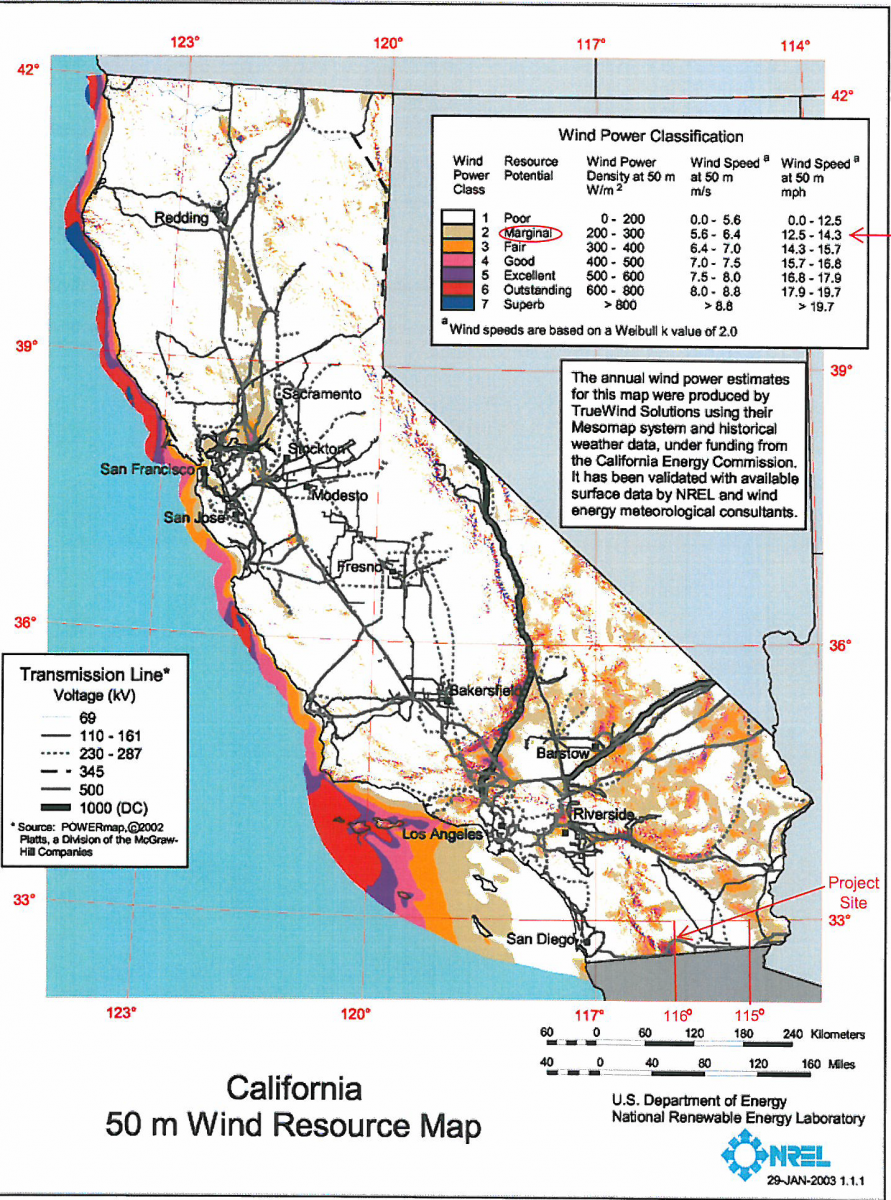
Boccard’s Ocotillo Wind Resource Study examined numerous documents including wind density maps from the federal government.  He concluded that the Ocotillo project design was “suboptimal” due to its location in what he found to be a class 2 wind resource area—class 1 being the worst on a scale of 1 to 7.   “If one is to follow the standard rule, this site should be listed as `unsuitable for the development of wind-powered electricity,’” Boccard concluded while the project was being built. He concluded the report with: “The 34% capacity factor claimed by the  Ocotillo developer is far off the mark and shall never be achieved.”

How inflated were Pattern Energy’s claims, in Boccard’s estimation?  To produce as much power as Pattern projected would require wind speeds higher than some of the windiest places on earth, such as Ireland’s Atlantic coast wind projects.  Overall, Ireland had a 30% wind capacity factor for the past decade, Boccard found.  He then predicted that the actual power produced at Ocotillo would likely range between 20% and 23%.

Actual wind production at Ocotillo during first year

In fact, wind production at Ocotillo during its first year was even lower than Boccard forecasted.  After obtaining federal data from FERC following a long day delay due to a website upgrade at the agency, we had four different sources crunch the numbers based on a standard mathematical calculation for wind capacity factor.  Below are the results.

Over the year 2013, the Ocotillo Wind capacity factor was somewhere between 15.7% and 17.7%. Expert calculations varied slightly, due to minor variables and whether turbine sizes were 2.3 or 2.37 MW, how long each turbine was actually offline, and so forth. All turbines were off line for the last half of May, and some remained offline for June and a portion of July due to the fallen blade.

But even if we look at only the 9 months with full data, the capacity factor is still only 18.9%.

If we make a generous estimate of strong winds for those months (purely a guess) and estimate how much the project might have produced if it hadn’t dropped a multi-ton blade and been forced offline, the number would still be only about 21.5% in a best case scenario for Pattern.

Overall for the year, Pattern’s project generated only 334 gigawatts (Gwh of power.  That’s astonishingly short—less than 52%–of the 646 Gwh that Pattern claimed in its application to the NADB.  It falls even more short—just 37.5% of an even higher claim, 891 Gwh, that SDG&E claimed  the project would produce in a resolution  sent to the California Public Utilities Commission.  Even allowing for a fallen blade, it’s clear that this project could not have come close to the wind production claims made to secure financing, a 30% cash grant under Section 1603, and an approved Power Purchase Agreement funded by SDG&E ratepayers.

The following calculations were made by Parke Ewing and Jim Pelley, a former construction superintendent and an aerospace engineer in Ocotillo.   Since both are on record opposed to the project, East County Magazine’s staff ran the calculations and confirmed their estimates.

We then sent the data to Reza Alam, a wind energy expert and assistant professor of mechanical engineering at the University of California, Berkeley College of Engineering. At the time, we had the first 11 months of data.  “Yes, capacity factors are calculated correctly,” Alam confirmed.

He added, “Anything below 30% capacity factor for wind is considered relatively low.” He added that other factors may impact output such as storms, long-term weather patterns, turbine models and efficiency.

OCOTILLO ACTUAL WIND PRODUCTION CHART:

Shown the first year of wind data at Ocotillo, Boccard’s initial reaction was, “Told ya. There’s no rocket science here.”

Boccard calculated that if the blade had not fallen, Ocotillo might have reached at best a 17.7% capacity factor and 379 Mwh for the full year—far below Pattern’s projections.

Boccard subsequently crunched some more numbers, comparing data from the Kumeyaay Wind facility in nearby Campo atop a ridgeline. He found that the Kumeyaay facility lived up to its projected capacity factor, actually hitting 33.9% for the year overall—nearly spot on the 34% that Pattern predicted for Ocotillo.

Pattern Energy’s predecessor built the Kumeyaay wind facility (photo, right), so the company had good reason to know  that wind speeds at the higher elevations were strong.  But why would Pattern claim an identical capacity factor for Ocotillo, knowing the site is on flat desert, at several thousand feet lower in elevation in an area ranked only a class 2 wind resource area?

Boccard observed, “The builder may be excellent but if you do that at the bottom of a valley you’re doomed.” He predicted, “There is no reason to believe it will improve, since performance is driven by Mother Nature alone, unless the local shaman put a spell on local winds.”

Boccard stated that he would support decommissioning (tearing down) the Ocotillo project and moving the turbines to a good location since many Californians favor this type of electricity. Further,  he stated, he believes the U.S. government should seek financial redress from Pattern.  “After all, “ he said, “they lied to their funding bank and the authorities, for they must have seen the wind maps.” He added that he hoped such action would “set a precedent against stupid, rushed locations.”

The False Claims Act, also known as the Lincoln Law, imposes liability on companies or people who defraud the U.S. government, typically federal contractors. Over 70% of such cases are initiated by whistleblowers, who can share in a portion of any financial recoveries.  Over $35 billion has been recovered under the False Claims Act from 1987 to 2012.

Alam stated that he, too, might support decommissioning if turbines could be reassembled elsewhere.

A Pattern of misrepresentation

Pattern’s spokesperson, Matt Dallas, failed to respond to multiple requests for comment including requests sent to his email list listed as a current contact on an April 25, 2014 press release on Pattern Energy’s website.  We also asked Pattern to disclose proprietary wind data now that the project is built, but the company ignored our requests over several weeks.

John Calloway from Pattern Energy, at a public Bureau of Land Management scoping meeting on Ocotillo wind, made this statement, “Why here in Ocotillo?”  He then showed a map from the National Renewable Energy Laboratory of wind resources at 50 meters above ground.  “As you can see, almost all of Imperial County is absolutely no wind,” he stated, then later added that their measurements confirm that “as the wind comes off of the mountains, as it hits the flat area it starts to dissipate out and it just goes away,” confirming that Pattern knew the flat desert area lacks wind, unlike the ridgelines above.  View video with embedded clip from the meeting.

Pattern put up meteorological (MET) wind testing towers for two to three years, the Imperial Valley Press reported and residents confirm. But Patternsubmitted less than a year of data (7,700 hours from 2010, according to the Final Enviornmental Impact Report section on meteorological resources) to the federal government. Why?  Pattern also claims to have conducted additional wind speed testing with equipment such as “Sodar” and “Lidar” system (or as residents derisively call it, “Lie-dar”) .  An Imperial Valley Pres article quoted Pattern’s Matt Dallas stating these “showed the Ocotillo area to have a strong wind resource.”

Numerous interested parties have sought to obtain the full data on all testing, but neither the federal government nor Pattern would release that information, claiming it is proprietary data.  In other words, your government wants to keep secret whether or not your tax dollars are being paid out for projects that may have been funded based on incomplete, inaccurate, or outright falsified reports.

“I have argued to all decision makers that they should include public access to the MET tower data in any permits that get issued,” Donna Tisdale with the Protect Our Communities Foundation said.  “At a minimum, the agency with jurisdiction should require access to that data in order to make an informed decision before handing over public land and funds for private profit.”

It gets worse.

In its application for financing and certification sent to the Border Environmental Cooperation Commission (BECC) Pattern again claimed the project has “excellent wind resources” and that the “area boasts strong winds…”

But William C. Pate, an attorney representing Ocotillo residents,  has concluded in a letter he sent seeking to block funding of the project that Pattern falsified data to make it appear that the project would be situated atop ridgelines –where winds actually are strong.

The North American Development Bank (NADB) and its sister institution, BECC, were created by the governments of the U.S. and Mexico in a joint effort to “preserve and enhance environmental conditions and the quality of life of people living along the U.S. –Mexico border.”

Numerous opponents of the Ocotillo project sent letters to the NADB or BECC urging that funds be withheld on a wide range of grounds. But Pate’s letter stood out for bold-faced allegation that Pattern provided misleading data on not only wind speeds, but the location of the project itself.

In a letter to the BECC, Pate overlaid maps from Pattern and from the National Renewable Energy Lab (a California wind resources map).  His shocking conclusion: the NREL map that Pattern submitted with its application “has been altered to remove longitude lines and Interstate 8 as a point of reference…GPS coordinates do not lie.” But Pattern did lie, Pate contends.  “GPS confirms that contrary to Pattern’s statement in this federal financing proposal, none of the project boundary is where wind speeds achieve “excellent” and above classifications.”

According to the maps Pate provided, Pattern’s application for certification and financing falsely indicated that the project would be located 3,000 feet higher in elevation and substantially further west than where it was actually built.  Pattern’s mapping (click to see enlarged copy of map, right) would have placed the project atop the Mountain Springs grade at Boulder Park, where the Desert View Tower in Jacumba is located –a place known for his strong winds—and a place off-limit to development due to bighorn sheep habitat and other factors.

Moreover, Pate  noted, the Record of Decision approving the project lists blade diameters that were never included when the project was built. “Complete bait and switch,” he said.

He called for the loan proposal to be rejected   “because Pattern has materially misrepresented the wind resources for the project.”

Pate wasn’t the only one to alert the NADB.

Edie Harmon, a biologist, wrote in her comments to the NADB, that a review of San Diego-Imperial Counties at the NREL website revealed that, “Indeed, the project area for Ocotillo wind is not even mentioned as one of the places with records of high wind potential at  . Similarly, a review of the Wind Atlas map for southern California suggests that the site for the Ocotillo Wind Energy Project is not a good wind resource. ,” she wrote.

Harmon added, “Because I could not locate the source of any map for Southern California which looks anything like the overlay on BECC Figure 6, I conclude that the NREL maps are more likely to be an accurate assessment of wind resource potential. Failure of the OWEF EIS/EIR to provide the results of any wind speed data at the site should raise considerable concerns with the BECC staff about a potential recipient of a NADB loan.”

Many similar complaints were made to elected officials in Congress and to the Bureau of Land Management (BLM), but the project was built anyhow atop 12,000 acres of publicly owned BLM land.

Before construction, residents were so confident that the area lacked winds that they staged a public kite-flying contest and invited the media, offering cash prizes for any child who could fly a kite for at least one minute. None could.

Since construction, Pelley has taken videos nearly every day documenting in almost all cases, turbines not moving, or barely moving due to no or low winds far below what a viable project would need. View sample videos.   Also read about serious questions about wind production vs. claims around the world and at Ocotillo raised in our January 2013 special report, Where is the Wind?

Another possible red flag suggesting Pattern has something to hide occurred when Pelley and Ewing videotaped Ocotillo’s wind project manager giving a tour at the project on public land.  Asked how many homes the project would power, he gave a figure that was one-tenth the number Pattern had promised the federal government the project would power.  The manager, Russell Graham, later threatened both photographers with violence and physically attacked Ewing, attempting to take his camera as he demanded the video be taken offline. Ewing recorded the exchange on his camera as Graham threatened to “kick a hole in your f***ing throat.”

A judge later issued restraining orders against Graham to protect both photographers. Graham claimed in court that he made a mistake on the wind production remark. So why didn’t he simply ask to have his statement /explanation added to the photographer’s story, which was published on ECM?

Edi Harmon, a biologist and Ocotillo resident, wants to know if Pattern misled the government and is upset that records on wind tests are kept secret.

If this was not fraud, she asks, “What is the alternative explanation of why turbines are motionless ghosts so much of the time?  I wonder if ratepayers and investors in SDG&E might be having similar questions and awaiting answers.”

Warnings ignored by elected officials

Consultant John Kennedy says the FERC findings on poor energy output in Ocotillo demonstrate that Boccard’s predictions were accurate and Pattern’s were wrong.  “The Boccard report serves as a big `We told you so’ and all the while, local Congressmen had the Boccard report and sat on their hands,” he concluded.

Robert Scheid, vice president of community and public relations at Viejas, observed, “It was frustrating to all of us that it [the Boccard report] didn’t blow things wide open. It’s been a tough battle.”

“We were hoping that our legislators, both Democratic and Republican, would pick up on this and realize that this is a great example of what not to do with people’s tax funds and our stimulus dollars,” Weiner told ECM. “We have a wind project that’s not producing wind.”

The DPC wanted to release the Boccard report immediately, but after consulting with other stakeholders, decided to wait in hopes that their Congressional members would agree to hold a joint press conference to expose what increasingly looked like a taxpayer-funded boondoggle, Weiner told ECM.

Despite the Boccard report bearing out this forecast, however, officials largely ignored such concerns and one official, Congressman Darrell Issa, led residents and tribal representative to believe his House Oversight Committee would take action, but dropped the ball entirely.

Members of the coalition opposed to the Ocotillo project met with Congressman Issa’s staffer, John Franklin in August 2012, Kennedy confirmed. “He said he needed more than our interpretation of the data to set up a meeting with the Congressman. It was at that point we contracted with Dr. Boccard to do the study. The study was completed in October 2012 and forwarded to John Franklin immediately.”

At all of the meetings, Kennedy emphasized “We asked the same question. How can Pattern Energy achieve an above average capacity factor with the sub-standard winds in Ocotillo?” He elaborated, “If the average of all the projects in the U.S. for the last 40 years is only 24%, how can Ocotillo generate significantly higher capacity factor with a below average wind resource?”

But three months passed, and nothing was done. A string of emails from Issa’s office to concerned citizens revealed repeated promises of a full investigation, but we could find no evidence that any such investigation was ever done. Our pointed request to Issa, including asking if defrauding taxpayers should be a matter his committee should investigate, never received a response.

The project opened in December 2012. Congressman Issa declined to meet with his concerned constituents until January 2013, at which time he said his staff needed to vet Dr. Boccard’s finding. “We have been waiting for 12 months for any word from his office,” Kennedy said.  ECM contacted several  Issa staffers with a detailed list of questions, but did not receive any response.

The group also asked  then-Congressman Bob Filner and later, Congressman Juan Vargas to ask the U.S. Treasury Department to withhold all stimulus funds pending an investigation into the wind speed claims. “To date, there has been a deafening silence,” Kennedy said.

Rep. Filner, before stepping down from Congress to become Mayor of San Diego, did send a letter to Treasury Secretary Timothy Geitner asking that the funds be withheld. Written shortly after the Solyndra scandal over a failed solar company in which the government had invested taxpayer funds, Filner’s letter included this hand-written note in the margin: “Mr. Secretary–this could be another embarrassment for the Administration.”  A Treasury official, Richard Gregg, wrote back to Filner indicated the agency would look into the matter. The letter said payment is required to any applicant meeting statutory criteria, but that a review of the application would be conducted as in all applications to determine if eligibility criteria had been met.  Geitner subsequently has been replaced as Treasury Secretary.

ECM sent a public records request to the Treasury Department asking to see results of its “review.”  We received hundreds of pages in response, with more than a thousand pages more withheld on various grounds including proprietary data.  However all the key portions that might have proved informative had been redacted, or blacked out. The agency also refused  to turn over any correspondence with Pattern, members of Congress, or the White House.

Viejas Chairman Anthony Pico, along with Kennedy, met with Aaron Allen, a staffer for Congressman Juan Vargas, who replaced Filner.  A Vargas staffer read a statement on behalf of the Congressman into the record at a California Native American Heritage Commission (NAHC) hearing in San Diego. Vargas supported Viejas’ request, granted by the NAHC, to declare Ocotillo a scared cemetery and chastised the BLM for building atop a site that tribes had testified repeatedly to federal and local agencies had been a burial site for over 10,000 years.  The NAHC Chairman indicated he believed the Ocotillo project should be torn down for desecrating Native American cultural resource sites that should have been protected under federal and state law.

Chairman Pico said, “It was heartbreaking to see this project desecrate such a historically and culturally significant landscape, and it’s even worse when you find out that it was built on false claims by the developer, and with the assistance of the BLM. We absolutely support renewable energy but the costs of this project clearly outweighed the benefits. It’s a travesty, not only to Native Americans but to all area residents and taxpayers.”

Vargas office did not initially respond to constituents’ requests for help to stop taxpayer funding of what increasingly appeared to be a boondoggle project in Ocotillo.   Last June, in a meeting with Vargas staffer Jason Moore in Chula Vista, Kennedy recalled, “He already had seen the Boccard report or was aware of it because it had been given to the Congressman at the Chairman Pico meeting.  We discussed fully all of the issues.” He  was referred  to Vargas’ El Centro office and further, advised that  since the project was now operational, this was a state issue (despite being a federally funded project on federal land) and referred them to State Senator Ben Hueso.

“We met with Ben Hueso on October 18, 2013,” said Ocotillo resident Parke Ewing. But Hueso’s office took no actions.

Our initial request for records of correspondence to Vargas office was rejected because Congress has exempted itself from the Freedom of Information Act.  However, at a meeting with constituents of the Congressmen at his Imperial Valley office, a Vargas staffer ,  Rebecca Terrazas Baxter, did obtain FERC data on wind records that had been unavailable previously despite repeated requests from FERC.

After ECM forwarded analysis of the wind data for Ocotillo’s first year, along with other documentation such as the claims of map falsification and more, we received a response from Dianna Zamora in Rep. Vargas’ office in Washington D.C. on March 1, 2014.

“I would like to thank you and our constituents, as it is clear that you did your due diligence,” she stated. The Congressman takes any accusations of impropriety or fraud very seriously. He has reached out to the Department of Energy to share with them the information you have provided.”  She added that Vargas has asked the best method for evaluating the information to “determine if any wrongdoing has occurred,” she added, promising to get back to us “as soon as we hear details of the Department’s evaluation.”  Two months later, we have not received a response.

Congresswoman Susan Davis’ office also made efforts to obtain the FERC records on our behalf, questioning whether FERC’s delays in providing data may have violated federal law.

We also reached out to Senator Barbara Boxer’s office with a detailed list of concerns and requests, since Senator Boxer chairs the Senate Environmental committee. Her staff referred our request to the committee, which in turn passed the buck back to her office.  Neither ever responded to our requests, other than to refer us to Matt Weiner, legislative director for Rep. Henry Waxman, to assist us in getting wind speed data. He didn’t.

In each of our inquiries to officials – Issa, Vargas, Davis, and Boxer, we attached the Boccard report, Filner’s letter, additional documentation and asked how many other “green” projects might be similarly questionable or even fraudulent.

Nor is this the only indication of misleading claims made by Pattern.  ECM has previously documented dubious claims made about earthquake seismic safety, distances from homes and earthquake faults, avian radar,  health, safety and jobs, and wildlife issues at a project that has also been linked to Dust Bowl-scale dust storms and pollution of Ocotillo waterways and residential areas with a flammable dust suppression chemical.

The company also drew criticism from multiple Native American tribes for desecrating sacred sites and burial grounds.  In addition, the project also destroyed groves of century-old Ocotillo plants for which the town was named, as this video and the photo (right) shows.

Follow the Money

Why didn’t public officials do more to prevent taxpayer dollars from being squandered on a wind project that appears to lack adequate wind resources?

We don’t know.  What we can tell you, however, is that officials in both parties have taken substantial sums of money in campaign contributions from vested special interests including energy companies, utilities, and labor unions that all backed construction of the Ocotillo wind project.

According to Open Secrets, Rep. Issa’s top 20 contributors in 2009/2010 included Leidos Engineering (formerly SAIC). Leidos, which has wind projects, contributed $20,000 to Issa and its executives or employees donated another $9,600 for a total of $29,600.  In 2011/2012, Leidos and its representatives gave even more–$41,150 –to Issa.  Issa had other energy industry donations including oil companies; Carlyle Group, Pattern’s parent corporation, also has oil interests. Carlyle was also a major donor to the Republican National Committee, giving $35,000.

Rep. Vargas received $52,000 in his 2012 campaign for the state legislature from the building trades union, which supports wind project construction to create jobs. His second highest contribution in his  2014 Congressional race was the International Brotherhood of Electrical Workers, which backs construction of  industrial wind projects and power lines.

State Senator Hueso received $8,000 from Sempra Energy and $28,200 from electric utilities, as well as $175,300 from general trade unions.

Responses and reactions

We asked SDG&E to review the Boccard report and respond.  Jennifer Ramp replied that SDG&E is not in a position to comment or critique validity of the Boccard report.  As for whether SDG&E is disappointed in the first year energy production levels, or might consider cancelling its power purchase agreement for the project, she said, “It would be imprudent to review the first year of operation to make assumptions as to the longer term viability of any project.”

Could ratepayers be stuck with a higher bill? Not according to Ramp. “SDG&E only pays a developer for the amount of energy actually produced. In the event that the amount of energy falls short of initial expectations in any year, then SDG&E’s customers are protected.”

Perhaps.  But if a project repeatedly fails to produce the power promised, where will replacement power come from?  Building additional power plants, power lines and substations are costs that in part have historically flowed back to ratepayers to absorb.

Ramp added that SDG&E had to comply with state law requiring it to meet renewable portfolio obligations.  She said Pattern placed successful bids and received all required state and federal approvals to construct the project. In addition, SDG&E’s contracts were reviewed and approved by the California Public Utilities Commission (CPUC) as being “in the best interest of SDG&E’s customers,” Ramp stated.

Terrie Prosper, director of news and information at the CPUC, told ECM, “The contract terms are based on the electricity actually produced, so if the facility is underperforming, ratepayers pay less.  The risk of underperformance is on the developer and not SGD&E ratepayers.”

But federal tax subsidies are coming directly out of taxpayers’ pockets—and not just for construction.  Wind projects reap subsidies for years or even decades on each wind turbine—and Ocotillo has 112. This amounts to many millions of dollars per project. Moreover, KCET reported that the IRS recently revealed that many energy companies have been illegally double-dipping, taking both stimulus funds and wind production tax credits—but that the agency has no mechanism to check and find out how many companies may have engaged in this form of theft from taxpayers.  ECM has asked the IRS whether Pattern Energy was among companies found double-dipping in an initial check, but has not yet received a response.

Greener options

The Washington Post recently ran an editorial calling for an end to wind production tax credits, noting that the credits have been renewed repeatedly “with a cockroach-like resilience” despite evidence of what the Post calls a “boondoggle” as “industries develop to chase federal handouts.”   The Post calls for a simple, transparent tax on carbon credits instead.

Others, including the DPC, favor shifting tax credits to homeowners and business owners to install  solar on rooftops (distributed generation with power produced near where it is used instead of remote industrialization of public lands). Rooftop solar increasingly is being shown to be available at lower cost than wind projects and with far fewer negative impacts on the environment, wildlife, public health and safety.

Ironically, utilities are required to produce 33% of their power from renewable sources by 2030 in California—but due to utility lobbying, state law does not allow utilities to even consider rooftop solar as alternatives to utility-scale projects such as Ocotillo wind. Utilities make money charging back costs to ratepayers for every mile of transmission lines, so remote projects are far more profitable for utilities such as Sempra Energy, owner of SDG&E.

Utilities also support construction of backup gas-fired “peaker” power plants such as Quail Brush proposed near Mission Trails Regional Park for when the wind doesn’t blow, which in Ocotillo is the vast majority of the time.  Cogentrix, applicant for the Quail Brush project, is owned by the Carlyle Group—the same company that owns Pattern Energy, developer of Ocotillo wind. Carlyle’s 2009 Annual Report confirms that Carlyle founded Pattern Energy.   Riverstone Holdings, parent of Pattern Energy, formed  a joint venture partner of the Carlyle Report, Bloomberg News reported.

Thus if the Quail Brush gas plant  is approved by the CPUC, Carylye would be poised to make money regardless of whether Ocotillo produces significant power or not.

For area residents, tribes, and environmentalists, destruction of the Ocotillo desert now seems not only heartbreaking, but senseless.

Tom Budlong, an outdoor enthusiast recently met with a Bureau of Land Management representative at a community meeting and asked why data on a project built on public land was kept secret from the public.  If it had been made public, he concluded, “It might have revealed that the wind resources here were indeed insufficient.”

After discovering that the project is generating electricity at only half the capacity factor of a well-sited wind energy facility, he lamented that while Pattern pocketed profits off tax subsidies,  “A lot of very good land got chewed up. Added together, it is all a farce.”

Miriam Raftery is a national award-winning journalism who has won more than 200 major journalism prizes, including top honors from the Society of Professional Journalists in San Diego and the San Diego Press Club, for her investigative reporting on issues involving the Ocotillo Wind Energy Facility. She is the editor and founder of East County Magazine, a nonprofit, nonpartisan media outlet which has won over 58 awards.  You can help support independent reporting in the public interest by donating online atwww.EastCountyMagazine.org

Ontario Chamber of Commerce discusses the Liberals 2014 budget….

Ontario Budget 2014: What Businesses Needs to Know

Today, the Government of Ontario tabled its 2014 Budget. What follows is a summary of the key highlights from a business perspective.

On the whole, this is a ‘two-steps back’ budget for Ontario businesses. The budget does little to address Ontario’s most significant problem: its runaway debt and deficit.


Spending, deficit, and debt are going up.

This budget increases government spending by $3 billion, from $127 billion in 2013-14 to $130 billion in 2014-15.

The deficit will grow from $11.3 billion to $12.5 billion over the same period. Meanwhile, Ontario’s overall debt will grow to $289.3 billion by end of 2014-15 and $317.2 billion by the end 2016-17. The province’s debt-to-GDP ratio will grow to an alarming 40.3 percent in 2014-15.

Servicing the debt will cost $11 billion in 2014-15, approximately $3 billion more than government spends on colleges and universities.

The budget includes an annual program review savings target of $250 million for 2014-15 and $500 million for each of the subsequent two years.

OCC Analysis

Ontario requires a robust plan to reduce spending and tackle the debt. Controlling spending in an effort to reduce the deficit and debt is a top priority for the OCC and the number one means by which Ontario can guarantee its long-term prosperity.

This budget falls short on the pace of deficit and debt reduction. The annual program review targets are too modest. For the OCC’s vision for a smarter, more efficient government, see Unlocking the Public Service Economy in Ontario.


Ontario is introducing a new pension plan, but at what price?

The government plans to establish the Ontario Retirement Pension Plan (ORPP) in 2017. The new pension plan will coincide with expected reductions in Employment Insurance premiums. Employers and employees will each contribute 1.9 percent of wages to a maximum of $90,000. These premiums would be in addition to existing Canada Pension Plan (CPP) contributions.

The government will also introduce legislation on Pooled Registered Pension Plans (PRPPs) in 2014. PRPPs are a new form of tax-assisted individual retirement savings plan for workers without employer-sponsored pension plans.

OCC Analysis

According to an OCC survey, 72 percent of members feel that pension reform should be a provincial priority. Eighty-six percent of members support PRPPs.

The OCC does not support a stand-alone Ontario pension plan, as the plan will create administrative duplication with the CPP, further fragment Canada’s pension landscape, and potentially deter job creation.

Only 23 percent of those surveyed said they could afford additional employer premiums. Seerecent OCC economic analysis projects that the Ring of Fire will contribute up to $9.4 billion to Ontario’s Gross Domestic Product and sustain over 5,000 jobs annually over the first 10 years of its development. In the analysis, it is estimated that government will receive between $1.8 and $1.95 billion in revenue in the first 10 years of Ring of Fire development, and up to $6.7 billion over the first 32 years.

The federal government has a history of investing in large transformational economic development projects (e.g. Alberta’s oil sands and Churchill Falls in Newfoundland and Labrador). The federal government should match the province’s commitment.


The government is dedicating revenue for transit and transportation infrastructure.

The Government of Ontario is dedicating $29 billion in funding over the next 10 years to public transit and transportation infrastructure projects. The money will come from new sources (including a 148 percent increase in the provincial aviation fuel tax over the next 4 years) and repurposed revenues from the HST on gasoline and road diesel.

OCC Analysis

Improving transit and transportation in the Greater Toronto and Hamilton Area is a priority for the OCC. The OCC is disappointed that the government has not looked to reducing costs to help fund any new government spending.


Some taxes are going up.

The government is raising some taxes, including tobacco taxes (up 1.5 cents per cigarette), personal income taxes (a 1-point increase for those who earn between $150,000 and $220,000 annually, and a 2-point increase on those who earn between $220,000 and $514,000 annually), and aviation fuel taxes (148 percent increase in the provincial aviation fuel tax over the next 4 years).

Further, government will no longer allow larger businesses to use the Small Business Deduction (SBD). The SBD reduces the general corporate income tax rate from 11.5 percent to 4.5 percent on the first $500,000 of income.

OCC Analysis

Any measures that diminish the province’s tax competitiveness will hurt job creation and detract from investment. For example, the government’s plan to more than double the provincial aviation fuel tax will increase the cost of flying domestically and internationally. Fuel is already airlines’ biggest cost, and Canada already loses nearly 5 million passengers to American airports every year.


The government is creating a $2.5 billion fund to attract investment to Ontario.

The government is creating a 10-year, $2.5 billion Jobs and Prosperity Fund aimed at attracting business investment to Ontario. The fund will be used to secure investments that will create jobs in Ontario and/or improve the province’s productivity and export performance.

OCC Analysis

Ontario must focus its efforts on the overall business climate, including lowering energy prices and holding the line on payroll taxes.


The province will impose registration and licensing requirements on road-building machines that use public roads and highways.

Road-building machines, including mobile cranes, hydrovacs, and concrete pumpers, are currently allowed to use tax-exempt diesel fuel in unlicensed commercial vehicles. The government will end this exemption and dedicate the revenues to public transit and transportation infrastructure.

OCC Analysis

The OCC will consult with its members to further understand the impact of these changes.


Ontario is moving forward with sector-based strategies in an effort to capitalize on the province’s competitive advantages.

The province is partnering with industry and, in some cases, providing new funding to boost growth in key industries, including Information and Communications Technology, Manufacturing, and Agri-Food.

OCC Analysis

The OCC is pleased to see the government taking a sector-based approach to economic development. The OCC’s economic agenda for Ontario, Emerging Stronger, calls on government to support the province’s competitive advantages.


Inefficient, Unreliable, Unaffordable Wind turbines! What a waste of money!!!

Wind power may be responsible for £200m of constraint payments

Credit:  The Herald | Thursday 1 May 2014 | www.heraldscotland.com ~~


Having digested Jenny Hogan’s defence of wind power (“Time truth was told about the vital role of renewables in our wellbeing,” Agenda, The Herald, April 22), I feel I must respond.

As the policy director of Scottish Renewables she is clearly concerned that wind energy is getting an increasingly bad press because of rising constraint payments with wind farms being shut down by the National Grid controller, and being paid for not producing electricity. By her own estimate £39m was paid to UK wind farms for this reason over the last 12-month period.

Her defence seems to be that fossil fuel generators are also paid for not putting power on the grid – about £270m over the same period. What she does not point out, or perhaps does not understand, is that the majority of these payments are also due to the deployment of wind power, forcing the fossil fuel power stations to operate less efficiently.

Wind may well be responsible for nearer to £200m of constraint payments for our bills, rather than the £39m declared.

It used to be the case that a small “spinning reserve” was all that was needed at some gas-fired power stations to cover for the occasional unexpected blips in supply or demand on the grid caused by unit failure, weather damage or unexpectedly high or low customer demand. However these were rare events, probably amounting on average to no more than one incident per month.

The advent of wind power with significant amounts of variable and unpredictable power spikes and slumps being offered to the grid coming from many wind turbines powering up or down more or less together, forces more conventional power stations, especially gas-fired power stations, to run or be constrained much more frequently.

For example, over the 30 days of a recent November, six very large power spikes and eight almost complete power slumps were experienced from the combined output of all wind farms in the UK. Constraint payments would have been made on all of these occasions, both to the wind farm operators and to those companies providing the balancing reserve power.

Renewables are of course a very mixed bag – hydro, biomass, and solar are very much more controllable and predictable technologies, and at the level they are deployed, cause no real problems for the grid.

Wind power is vastly different, expensive and inefficient in ways that we have yet to get our minds fully around.

Bruce McIntosh,

Corriedoo,

Dalry,

Castle Douglas.

Source:  The Herald | Thursday 1 May 2014 | www.heraldscotland.com

Nigel Lawson Lecture – Talks about The Religion of Climate Alarmism

Nigel Lawson: Cool It


Standpoint, May 2014

This essay is based on the text of a speech given to the Institute for Sustainable Energy and the Environment at the University of Bath.

There is something odd about the global warming debate — or the climate change debate, as we are now expected to call it, since global warming has for the time being come to a halt.

I have never shied away from controversy, nor — for example, as Chancellor — worried about being unpopular if I believed that what I was saying and doing was in the public interest.

But I have never in my life experienced the extremes of personal hostility, vituperation and vilification which I — along with other dissenters, of course — have received for my views on global warming and global warming policies.

For example, according to the Climate Change Secretary, Ed Davey, the global warming dissenters are, without exception, “wilfully ignorant” and in the view of the Prince of Wales we are “headless chickens”. Not that “dissenter” is a term they use. We are regularly referred to as “climate change deniers”, a phrase deliberately designed to echo “Holocaust denier” — as if questioning present policies and forecasts of the future is equivalent to casting malign doubt about a historical fact.

The heir to the throne and the minister are senior public figures, who watch their language. The abuse I received after appearing on the BBC’s Today programme last February was far less restrained. Both the BBC and I received an orchestrated barrage of complaints to the effect that it was an outrage that I was allowed to discuss the issue on the programme at all. And even the Science and Technology Committee of the House of Commons shamefully joined the chorus of those who seek to suppress debate.

In fact, despite having written a thoroughly documented book about global warming more than five years ago, which happily became something of a bestseller, and having founded a think tank on the subject — the Global Warming Policy Foundation — the following year, and despite frequently being invited on Today to discuss economic issues, this was the first time I had ever been asked to discuss climate change. I strongly suspect it will also be the last time.

The BBC received a well-organised deluge of complaints — some of them, inevitably, from those with a vested interest in renewable energy — accusing me, among other things, of being a geriatric retired politician and not a climate scientist, and so wholly unqualified to discuss the issue.

Perhaps, in passing, I should address the frequent accusation from those who violently object to any challenge to any aspect of the prevailing climate change doctrine, that the Global Warming Policy Foundation’s non-disclosure of the names of our donors is proof that we are a thoroughly sinister organisation and a front for the fossil fuel industry.

As I have pointed out on a number of occasions, the Foundation’s Board of Trustees decided, from the outset, that it would neither solicit nor accept any money from the energy industry or from anyone with a significant interest in the energy industry. And to those who are not-regrettably-prepared to accept my word, I would point out that among our trustees are a bishop of the Church of England, a former private secretary to the Queen, and a former head of the Civil Service. Anyone who imagines that we are all engaged in a conspiracy to lie is clearly in an advanced stage of paranoia.

The reason why we do not reveal the names of our donors, who are private citizens of a philanthropic disposition, is in fact pretty obvious. Were we to do so, they, too, would be likely to be subject to the vilification and abuse I mentioned earlier. And that is something which, understandably, they can do without.

That said, I must admit I am strongly tempted to agree that, since I am not a climate scientist, I should from now on remain silent on the subject — on the clear understanding, of course, that everyone else plays by the same rules. No more statements by Ed Davey, or indeed any other politician, including Ed Milliband, Lord Deben and Al Gore. Nothing more from the Prince of Wales, or from Lord Stern. What bliss!

But of course this is not going to happen. Nor should it; for at bottom this is not a scientific issue. That is to say, the issue is not climate change but climate change alarmism, and the hugely damaging policies that are advocated, and in some cases put in place, in its name. And alarmism is a feature not of the physical world, which is what climate scientists study, but of human behaviour; the province, in other words, of economists, historians, sociologists, psychologists and — dare I say it — politicians.

And en passant, the problem for dissenting politicians, and indeed for dissenting climate scientists for that matter, who certainly exist, is that dissent can be career-threatening. The advantage of being geriatric is that my career is behind me: there is nothing left to threaten.

But to return: the climate changes all the time, in different and unpredictable (certainly unpredicted) ways, and indeed often in different ways in different parts of the world. It always has done and no doubt it always will. The issue is whether that is a cause for alarm — and not just moderate alarm. According to the alarmists it is the greatest threat facing humankind today: far worse than any of the manifold evils we see around the globe which stem from what Pope called “man’s inhumanity to man”.

Climate change alarmism is a belief system, and needs to be evaluated as such.
There is, indeed, an accepted scientific theory which I do not dispute and which, the alarmists claim, justifies their belief and their alarm.

This is the so-called greenhouse effect: the fact that the earth’s atmosphere contains so-called greenhouse gases (of which water vapour is overwhelmingly the most important, but carbon dioxide is another) which, in effect, trap some of the heat we receive from the sun and prevent it from bouncing back into space.

Without the greenhouse effect, the planet would be so cold as to be uninhabitable. But, by burning fossil fuels — coal, oil and gas — we are increasing the amount of carbon dioxide in the atmosphere and thus, other things being equal, increasing the earth’s temperature.

But four questions immediately arise, all of which need to be addressed, coolly and rationally.

First, other things being equal, how much can increased atmospheric CO2 be expected to warm the earth? (This is known to scientists as climate sensitivity, or sometimes the climate sensitivity of carbon.) This is highly uncertain, not least because clouds have an important role to play, and the science of clouds is little understood. Until recently, the majority opinion among climate scientists had been that clouds greatly amplify the basic greenhouse effect. But there is a significant minority, including some of the most eminent climate scientists, who strongly dispute this.

Second, are other things equal, anyway? We know that, over millennia, the temperature of the earth has varied a great deal, long before the arrival of fossil fuels. To take only the past thousand years, a thousand years ago we were benefiting from the so-called medieval warm period, when temperatures are thought to have been at least as warm, if not warmer, than they are today. And during the Baroque era we were grimly suffering the cold of the so-called Little Ice Age, when the Thames frequently froze in winter and substantial ice fairs were held on it, which have been immortalised in contemporary prints.

Third, even if the earth were to warm, so far from this necessarily being a cause for alarm, does it matter? It would, after all, be surprising if the planet were on a happy but precarious temperature knife-edge, from which any change in either direction would be a major disaster. In fact, we know that, if there were to be any future warming (and for the reasons already given, “if” is correct) there would be both benefits and what the economists call disbenefits. I shall discuss later where the balance might lie.

And fourth, to the extent that there is a problem, what should we, calmly and rationally, do about it?

It is probably best to take the first two questions together.

According to the temperature records kept by the UK Met Office (and other series are much the same), over the past 150 years (that is, from the very beginnings of the Industrial Revolution), mean global temperature has increased by a little under a degree centigrade — according to the Met Office, 0.8ºC. This has happened in fits and starts, which are not fully understood. To begin with, to the extent that anyone noticed it, it was seen as a welcome and natural recovery from the rigours of the Little Ice Age. But the great bulk of it — 0.5ºC out of the 0.8ºC — occurred during the last quarter of the 20th century. It was then that global warming alarmism was born.

But since then, and wholly contrary to the expectations of the overwhelming majority of climate scientists, who confidently predicted that global warming would not merely continue but would accelerate, given the unprecedented growth of global carbon emissions, as China’s coal-based economy has grown by leaps and bounds, there has been no further warming at all. To be precise, the latest report of the Intergovernmental Panel on Climate Change (IPCC), a deeply flawed body whose non-scientist chairman is a committed climate alarmist, reckons that global warming has latterly been occurring at the rate of — wait for it — 0.05ºC per decade, plus or minus 0.1ºC. Their figures, not mine. In other words, the observed rate of warming is less than the margin of error.

And that margin of error, it must be said, is implausibly small. After all, calculating mean global temperature from the records of weather stations and maritime observations around the world, of varying quality, is a pretty heroic task in the first place. Not to mention the fact that there is a considerable difference between daytime and night-time temperatures. In any event, to produce a figure accurate to hundredths of a degree is palpably absurd.

The lessons of the unpredicted 15-year global temperature standstill (or hiatus as the IPCC calls it) are clear. In the first place, the so-called Integrated Assessment Models which the climate science community uses to predict the global temperature increase which is likely to occur over the next 100 years are almost certainly mistaken, in that climate sensitivity is almost certainly significantly less than they once thought, and thus the models exaggerate the likely temperature rise over the next hundred years.

But the need for a rethink does not stop there. As the noted climate scientist Professor Judith Curry, chair of the School of Earth and Atmospheric Sciences at the Georgia Institute of Technology, recently observed in written testimony to the US Senate:
Anthropogenic global warming is a proposed theory whose basic mechnism is well understood, but whose magnitude is highly uncertain. The growing evidence that climate models are too sensitive to CO2 has implications for the attribution of late-20th-century warming and projections of 21st-century climate. If the recent warming hiatus is caused by natural variability, then this raises the question as to what extent the warming between 1975 and 2000 can also be explained by natural climate variability.

It is true that most members of the climate science establishment are reluctant to accept this, and argue that the missing heat has for the time being gone into the (very cold) ocean depths, only to be released later. This is, however, highly conjectural. Assessing the mean global temperature of the ocean depths is — unsurprisingly — even less reliable, by a long way, than the surface temperature record. And in any event most scientists reckon that it will take thousands of years for this “missing heat” to be released to the surface.

In short, the CO2 effect on the earth’s temperature is probably less than was previously thought, and other things — that is, natural variability and possibly solar influences — are relatively more significant than has hitherto been assumed.
But let us assume that the global temperature hiatus does, at some point, come to an end, and a modest degree of global warming resumes. How much does this matter?

The answer must be that it matters very little. There are plainly both advantages and disadvantages from a warmer temperature, and these will vary from region to region depending to some extent on the existing temperature in the region concerned. And it is helpful in this context that the climate scientists believe that the global warming they expect from increased atmospheric CO2 will be greatest in the cold polar regions and least in the warm tropical regions, and will be greater at night than in the day, and greater in winter than in summer. Be that as it may, studies have clearly shown that, overall, the warming that the climate models are now predicting for most of this century (I referred to these models earlier, and will come back to them later) is likely to do more good than harm.

This is particularly true in the case of human health, a rather important dimension of wellbeing. It is no accident that, if you look at migration for climate reasons in the world today, it is far easier to find those who choose to move to a warmer climate than those who choose to move to a colder climate. And it is well documented that excessive cold causes far more illnesses and deaths around the world than excessive warmth does.

The latest (2013-14) IPCC Assessment Report does its best to ramp up the alarmism in a desperate, and almost certainly vain, attempt to scare the governments of the world into concluding a binding global decarbonisation agreement at the crunch UN climate conference due to be held in Paris next year. Yet a careful reading of the report shows that the evidence to justify the alarm simply isn’t there.

On health, for example, it lamely concludes that “the world-wide burden of human ill-health from climate change is relatively small compared with effects of other stressors and is not well quantified” — adding that so far as tropical diseases (which preoccupied earlier IPCC reports) are concerned, “Concerns over large increases in vector-borne diseases such as dengue as a result of rising temperatures are unfounded and unsupported by the scientific literature.”

Moreover, the IPCC conspicuously fails to take proper account of what is almost certainly far and away the most important dimension of the health issue. And that is, quite simply, that the biggest health risk in the world today, particularly of course in the developing world, is poverty.

We use fossil fuels not because we love them, or because we are in thrall to the multinational oil companies, but simply because they provide far and away the cheapest source of large-scale energy, and will continue to do so, no doubt not forever, but for the foreseeable future. And using the cheapest source of energy means achieving the fastest practicable rate of economic development, and thus the fastest elimination of poverty in the developing world. In a nutshell, and on balance, global warming is good for you.

The IPCC does its best to contest this by claiming that warming is bad for food production: in its own words, “negative impacts of climate change on crop yields have been more common than positive impacts”. But not only does it fail to acknowledge that the main negative impact on crop yields has been not climate change but climate change policy, as farmland has been turned over to the production of biofuels rather than food crops. It also understates the net benefit for food production from the warming it expects to occur, in two distinct ways.

In the first place, it explicitly takes no account of any future developments in bio-engineering and genetic modification, which are likely to enable farmers to plant drought-resistant crops designed to thrive at warmer temperatures, should these occur. Second, and equally important, it takes no account whatever of another effect of increased atmospheric carbon dioxide, and one which is more certain and better documented than the warming effect. Namely, the stimulus to plant growth: what the scientists call the “fertilisation effect”. Over the past 30 years or so, the earth has become observably greener, and this has even affected most parts of the Sahel. It is generally agreed that a major contributor to this has been the growth in atmospheric CO2 from the burning of fossil fuels.

This should not come as a surprise. Biologists have always known that carbon dioxide is essential for plant growth, and of course without plants there would be very little animal life, and no human life, on the planet. The climate alarmists have done their best to obscure this basic scientific truth by insisting on describing carbon emissions as “pollution” — which, whether or not they warm the planet they most certainly are not — and deliberately mislabelling forms of energy which produce these emissions as “dirty”.

In the same way, they like to label renewable energy as “clean”, seemingly oblivious to the fact that by far the largest source of renewable energy in the world today is biomass, and in particular the burning of dung, which is the major source of indoor pollution in the developing world and is reckoned to cause at least a million deaths a year.

Compared with the likely benefits to both human health and food production from CO2-induced global warming, the possible disadvantages from, say, a slight increase in either the frequency or the intensity of extreme weather events is very small beer. It is, in fact, still uncertain whether there is any impact on extreme weather events as a result of warming (increased carbon emissions, which have certainly occurred, cannot on their own affect the weather: it is only warming which might). The unusual persistence of heavy rainfall over the UK during February, which led to considerable flooding, is believed by the scientists to have been caused by the wayward behaviour of the jetstream; and there is no credible scientific theory that links this behaviour to the fact that the earth’s surface is some 0.8ºC warmer than it was 150 years ago.

That has not stopped some climate scientists, such as the publicity-hungry chief scientist at the UK Met Office, Dame Julia Slingo, from telling the media that it is likely that “climate change” (by which they mean warming) is partly to blame. Usually, however, the climate scientists take refuge in the weasel words that any topical extreme weather event, whatever the extreme weather may be, whether the recent UK rainfall or last year’s typhoon in the Philippines, “is consistent with what we would expect from climate change”.

So what? It is also consistent with the theory that it is a punishment from the Almighty for our sins (the prevailing explanation of extreme weather events throughout most of human history). But that does not mean that there is the slightest truth in it. Indeed, it would be helpful if the climate scientists would tell us what weather pattern would not be consistent with the current climate orthodoxy. If they cannot do so, then we would do well to recall the important insight of Karl Popper — that any theory that is incapable of falsification cannot be considered scientific.

Moreover, as the latest IPCC report makes clear, careful studies have shown that, while extreme weather events such as floods, droughts and tropical storms, have always occurred, overall there has been no increase in either their frequency or their severity. That may, of course, be because there has so far been very little global warming indeed: the fear is the possible consequences of what is projected to lie ahead of us. And even in climate science, cause has to precede effect: it is impossible for future warming to affect events in the present.

Of course, it doesn’t seem like that. Partly because of sensitivity to the climate change doctrine, and partly simply as a result of the explosion of global communications, we are far more aware of extreme weather events around the world than we used to be. And it is perfectly true that many more people are affected by extreme weather events than ever before. But that is simply because of the great growth in world population: there are many more people around. It is also true, as the insurance companies like to point out, that there has been a great increase in the damage caused by extreme weather events. But that is simply because, just as there are more people around, so there is more property around to be damaged.

The fact remains that the most careful empirical studies show that, so far at least, there has been no perceptible increase, globally, in either the number or the severity of extreme weather events. And, as a happy coda, these studies also show that, thanks to scientific and material progress, there has been a massive reduction, worldwide, in deaths from extreme weather events.

It is relevant to note at this point that there is an important distinction between science and scientists. I have the greatest respect for science, whose development has transformed the world for the better. But scientists are no better and no worse than anyone else. There are good scientists and there are bad scientists. Many scientists are outstanding people working long hours to produce important results. They must be frustrated that political activists then turn those results into propaganda. Yet they dare not speak out for fear of losing their funding.

Indeed, a case can be made for the proposition that today’s climate science establishment is betraying science itself. During the period justly known as the Enlightenment, science achieved the breakthroughs which have so benefited us all by rejecting the claims of authority — which at that time largely meant the authority of the church — and adopting an overarching scepticism, insisting that our understanding of the external world must be based exclusively on observation and empirical investigation. Yet today all too many climate scientists, in particular in the UK, come close to claiming that they need to be respected as the voice of authority on the subject — the very claim that was once the province of the church.

If I have been critical of the latest IPCC report, let me add that it is many respects a significant improvement on its predecessors. It explicitly concedes, for example, that “climate change may be beneficial for moderate climate change” — and moderate climate change is all that it expects to see for the rest of this century — and that “Estimates for the aggregate economic impact of climate change are relatively small . . . For most economic sectors, the impact of climate change will be small relative to the impacts of other drivers.” So much for the unique existential planetary threat.

What it conspicuously fails to do, however, is to make any assessment of the unequivocally adverse economic impact of the decarbonisation policy it continues to advocate, which (if implemented) would be far worse than any adverse impact from global warming.

Even here, however, the new report concedes for the first time that the most important response to the threat of climate change must be how mankind has always responded, throughout the ages: namely, intelligent adaptation. Indeed, the “impacts” section of the latest report is explicitly entitled “Impacts, Adaptation and Vulnerability”. In previous IPCC reports adaptation was scarcely referred to at all, and then only dismissively.

This leads directly to the last of my four questions. To the extent that there is a problem, what should we, calmly and rationally, do about it?

The answer is — or should be — a no-brainer: adapt. I mentioned earlier that a resumption of global warming, should it occur (and of course it might) would bring both benefits and costs. The sensible course is clearly to pocket the benefits while seeking to minimise the costs. And that is all the more so since the costs, should they arise, will not be anything new: they will merely be the slight exacerbation of problems that have always afflicted mankind.

Like the weather, for example — whether we are talking about rainfall and flooding (or droughts for that matter) in the UK, or hurricanes and typhoons in the tropics. The weather has always varied, and it always will. There have always been extremes, and there always will be. That being so, it clearly makes sense to make ourselves more resilient and robust in the face of extreme weather events, whether or not there is a slight increase in the frequency or severity of such events.

This means measures such as flood defences and sea defences, together with water storage to minimise the adverse effects of drought, in the UK; and better storm warnings, the building of levees, and more robust construction in the tropics.

The same is equally true in the field of health. Tropical diseases — and malaria is frequently (if inaccurately) mentioned in this context — are a mortal menace in much of the developing world. It clearly makes sense to seek to eradicate these diseases — and in the case of malaria (which used to be endemic in Europe) we know perfectly well how to do it — whether or not warming might lead to an increase in the incidence of such diseases.

And the same applies to all the other possible adverse consequences of global warming. Moreover, this makes sense whatever the cause of any future warming, whether it is man-made or natural. Happily, too, as economies grow and technology develops, our ability to adapt successfully to any problems which warming may bring steadily increases.

Yet, astonishingly, this is not the course on which our leaders in the Western world generally, and the UK in particular, have embarked. They have decided that what we must do, at inordinate cost, is prevent the possibility (as they see it) of any further warming by abandoning the use of fossil fuels.

Even if this were attainable — a big “if”, which I will discuss later — there is no way in which this could be remotely cost-effective. The cost to the world economy of moving from relatively cheap and reliable energy to much more expensive and much less reliable forms of energy-the so-called renewables, on which we had to rely before we were liberated by the fossil-fuel-driven Industrial Revolution — far exceeds any conceivable benefit.

It is true that the notorious Stern Review, widely promoted by a British prime minister with something of a messiah complex and an undoubted talent for PR, sought to demonstrate the reverse, and has become a bible for the economically illiterate.

But Stern’s dodgy economics have been comprehensively demolished by the most distinguished economists on both sides of the Atlantic. So much so, in fact, that Lord Stern himself has been driven to complain that it is all the fault of the integrated assessment models, which — and I quote him — “come close to assuming directly that the impacts and costs will be modest, and close to excluding the possibility of catastrophic outcomes”.

I suggested earlier that these elaborate models are scarcely worth the computer code they are written in, and certainly the divergence between their predictions and empirical observations has become ever wider. Nevertheless, it is a bit rich for Stern now to complain about them, when they remain the gospel of the climate science establishment in general and of the IPCC in particular.

But Stern is right in this sense: unless you assume that we may be heading for a CO2-induced planetary catastrophe, for which there is no scientific basis, a policy of decarbonisation cannot possibly make sense.

A similar, if slightly more sophisticated, case for current policies has been put forward by a distinctly better economist than Stern, Harvard’s Professor Martin Weitzman, in what he likes to call his “dismal theorem”. After demolishing Stern’s cost-benefit analysis, he concludes that Stern is in fact right but for the wrong reasons. According to Weitzman, this is an area where cost-benefit analysis does not apply. Climate science is highly uncertain, and a catastrophic outcome which might even threaten the continuation of human life on this planet, cannot be entirely ruled out however unlikely it may be. It is therefore incumbent on us to do whatever we can, regardless of cost, to prevent this.

This is an extreme case of what is usually termed “the precautionary principle”. I have often thought that the most important use of the precautionary principle is against the precautionary principle itself, since it can all too readily lead to absurd policy prescriptions. In this case, a moment’s reflection would remind us that there are a number of possible catastrophes, many of them less unlikely than that caused by runaway warming, and all of them capable of occurring considerably sooner than the catastrophe feared by Weitzman; and there is no way we can afford the cost of unlimited spending to reduce the likelihood of all of them.

In particular, there is the risk that the earth may enter a new ice age. This was the fear expressed by the well-known astronomer Sir Fred Hoyle in his book Ice: The Ultimate Human Catastrophe, and there are several climate scientists today, particularly in Russia, concerned about this. It would be difficult, to say the least, to devote unlimited sums to both cooling and warming the planet at the same time.

At the end of the day, this comes down to judgment. Weitzman is clearly entitled to his; but I doubt if it is widely shared; and if the public were aware that it was on this slender basis that the entire case for current policies rested I would be surprised if they would have much support. Rightly so.

But there is another problem. Unlike intelligent adaptation to any warming that might occur, which in any case will mean different things in different regions of the world, and which requires no global agreement, decarbonisation can make no sense whatever in the absence of a global agreement. And there is no chance of any meaningful agreement being concluded. The very limited Kyoto accord of 1997 has come to an end; and although there is the declared intention of concluding a much more ambitious successor, with a UN-sponsored conference in Paris next year at which it is planned that this should happen, nothing of any significance is remotely likely.

And the reason is clear. For the developing world, the overriding priority is economic growth: improving the living standards of the people, which means among other things making full use of the cheapest available source of energy, fossil fuels.

The position of China, the largest of all the developing countries and the world’s biggest (and fastest growing) emitter of carbon dioxide, is crucial. For very good reasons, there is no way that China is going to accept a binding limitation on its emissions. China has an overwhelmingly coal-based energy sector — indeed it has been building new coal-fired power stations at the rate of one a week — and although it is now rapidly developing its substantial indigenous shale gas resources (another fossil fuel), its renewable energy industry, both wind and solar, is essentially for export to the developed world.

It is true that China is planning to reduce its so-called “carbon intensity” quite substantially by 2020. But there is a world of difference between the sensible objective of using fossil fuels more efficiently, which is what this means, and the foolish policy of abandoning fossil fuels, which it has no intention of doing. China’s total carbon emissions are projected to carry on rising — and rising substantially — as its economy grows.

This puts into perspective the UK’s commitment, under the Climate Change Act, to near-total decarbonisation. The UK accounts for less than 2 per cent of global emissions: indeed, its total emissions are less than the annual increase in China’s. Never mind, says Lord Deben, chairman of the government-appointed Climate Change Committee, we are in the business of setting an example to the world.

No doubt this sort of thing goes down well at meetings of the faithful, and enables him and them to feel good. But there is little point in setting an example, at great cost, if no one is going to follow it; and around the world governments are now gradually watering down or even abandoning their decarbonisation ambitions.  Indeed, it is even worse than that. Since the UK has abandoned the idea of having an energy policy in favour of having a decarbonisation policy, there is a growing risk that, before very long, our generating capacity will be inadequate to meet our energy needs. If so, we shall be setting an example all right: an example of what not to do.

So how is it that much of the Western world, and this country in particular, has succumbed to the self-harming collective madness that is climate change orthodoxy? It is difficult to escape the conclusion that climate change orthodoxy has in effect become a substitute religion, attended by all the intolerant zealotry that has so often marred religion in the past, and in some places still does so today.

Throughout the Western world, the two creeds that used to vie for popular support, Christianity and the atheistic belief system of Communism, are each clearly in decline. Yet people still feel the need both for the comfort and for the transcendent values that religion can provide. It is the quasi-religion of green alarmism and global salvationism, of which the climate change dogma is the prime example, which has filled the vacuum, with reasoned questioning of its mantras regarded as little short of sacrilege.

The parallel goes deeper. As I mentioned earlier, throughout the ages the weather has been an important part of the religious narrative. In primitive societies it was customary for extreme weather events to be explained as punishment from the gods for the sins of the people; and there is no shortage of this theme in the Bible, either — particularly, but not exclusively, in the Old Testament. The contemporary version of this is that, as a result of heedless industrialisation within a framework of materialistic capitalism, we have directly (albeit not deliberately) perverted the weather, and will duly receive our comeuppance.

There is another aspect, too, which may account for the appeal of this so-called explanation. Throughout the ages, something deep in man’s psyche has made him receptive to apocalyptic warnings that the end of the world is nigh. And almost all of us, whether we like it or not, are imbued with feelings of guilt and a sense of sin. How much less uncomfortable it is, how much more convenient, to divert attention away from our individual sins and reasons to feel guilty, and to sublimate them in collective guilt and collective sin.

Why does this matter? It matters, and matters a great deal, on two quite separate grounds. The first is that it has gone a long way towards ushering in a new age of unreason. It is a cruel irony that, while it was science which, more than anything else, was able by its great achievements, to establish the age of reason, it is all too many climate scientists and their hangers-on who have become the high priests of a new age of unreason.

But what moves me most is that the policies invoked in its name are grossly immoral. We have, in the UK, devised the most blatant transfer of wealth from the poor to the rich — and I am slightly surprised that it is so strongly supported by those who consider themselves to be the tribunes of the people and politically on the Left. I refer to our system of heavily subsidising wealthy landlords to have wind farms on their land, so that the poor can be supplied with one of the most expensive forms of electricity known to man.

This is also, of course, inflicting increasing damage on the British economy, to no useful purpose whatever. More serious morally, because it is on a much larger scale, is the perverse intergenerational transfer of wealth implied by orthodox climate change policies. It is not much in dispute that future generations — those yet unborn — will be far wealthier than those — ourselves, our children, and for many of us our grandchildren — alive today. This is the inevitable consequence of the projected economic growth which, on a “business as usual” basis, drives the increased carbon emissions which in turn determine the projected future warming. It is surely perverse that those alive today should be told that they must impoverish themselves, by abandoning what is far and away the cheapest source of energy, in order to ensure that those yet to be born, who will in any case be signally better off than they are, will be better off still, by escaping the disadvantages of any warming that might occur.

However, the greatest immorality of all concerns the masses in the developing world. It is excellent that, in so many parts of the developing world — the so-called emerging economies — economic growth is now firmly on the march, as they belatedly put in place the sort of economic policy framework that brought prosperity to the Western world. Inevitably, they already account for, and will increasingly account for, the lion’s share of global carbon emissions.

But, despite their success, there are still hundreds of millions of people in these countries in dire poverty, suffering all the ills that this brings, in terms of malnutrition, preventable disease, and premature death. Asking these countries to abandon the cheapest available sources of energy is, at the very least, asking them to delay the conquest of malnutrition, to perpetuate the incidence of preventable disease, and to increase the numbers of premature deaths.

Global warming orthodoxy is not merely irrational. It is wicked.


The Windscam – Hurting Families and Others who Cannot Afford it!

Bjørn Lomborg: Cost of Renewables Hit Poorest the Hardest

Bjorn-Lomborg-wsj

Bjørn Lomborg has become one of the most high profile critics of insanely expensive and utterly pointless renewable energy policies across the globe (see our posts here and here).

Bjørn’s back – and this time adds the impact our ludicrous Renewable Energy Target has had – and will have – on power prices and the ensuing punishment that spiralling power costs cause to the poorest and most vulnerable in Australian society.

Renewables pave path to poverty
The Australian
Bjørn Lomborg
29 April 2014

THE Australian government recently released an issues paper for the review of the renewable energy target. What everyone engaged in this debate should recognise is that policies such as the carbon tax and the RET have contributed to household electricity costs rising 110 per cent in the past five years, hitting the poor the hardest.

A Salvation Army report from last year found 58 per cent of low-income households were unable to pay their electricity bills on time. Lynne Chester of the University of Sydney estimated last year that 20 per cent of households are now energy poor: “Parents are going without food, families are sitting around the kitchen table using one light, putting extra clothes on and sleeping in one room to keep warm, and this is Australia 2013.”

What is true in Australia is true globally. According to the UN Secretary-General Ban Ki-moon, “Climate change harms the poor first and worst.” But we often forget that current policies to address global warming harm the world’s poor much more.

Solar and wind power was subsidised by $65 billion in 2012. And because the total climate benefit was a paltry $1.5bn, the subsidies essentially wasted $63.5bn. Biofuels were subsidised by another $20bn, with ­essentially no climate benefit. All of that money could have been spent on healthcare, education, better roads or lower taxes.

Forcing everyone to buy more expensive, less-reliable energy pushes up costs throughout the economy, leaving less for other public goods. The average of macroeconomic models indicates the total cost of the EU’s climate policy will be $US310bn a year from 2020 until the end of the century.

The burden of these policies falls overwhelmingly on the world’s poor, because the rich can easily pay more for their ​energy. In the US, well-meaning and well-off environmentalists often cavalierly suggest petrol prices should be doubled or electricity exclusively sourced from high-cost green sources.

That may be OK in affluent suburbs, where residents reportedly spend just 2 per cent of their income on petrol. But the poorest 30 per cent of the US population spends almost 17 per cent of its after-tax income on petrol.

Similarly, environmentalists boast that households in Britain have reduced their electricity consumption almost 10 per cent since 2005. But they neglect to mention that this reflects a 50 per cent increase in electricity prices, mostly to pay for an increase in the share of renewables from 1.8 per cent to 4.6 per cent.

The poor, no surprise, have reduced their consumption by much more than 10 per cent, whereas the rich have not reduced theirs at all.

Over the past five years, heating a home has become 63 per cent more ​expensive in Britain while real wages have declined. About 17 per cent of households are now energy-poor — they have to spend more than 10 per cent of their income on energy; and, because the elderly are typically poorer, about a quarter of their households are energy poor. Pensioners burn old books to keep warm because it is cheaper than coal; they ride on heated buses all day, and a third leave part of their homes cold.

In Germany, where green subsidies will cost $US35bn ($37.6bn) this year, household electricity prices have increased 80 per cent since 2000, causing 6.9 million households to live in energy poverty. Wealthy homeowners in Bavaria can feel good about their inefficient solar panels, receiving lavish subsidies essentially paid by poor tenants in the Ruhr who cannot afford solar panels, but still have to
pay more for power.

In Greece, where tax hikes on oil have driven up heating costs 48 per cent, more and more Athenians are cutting down park trees, causing air pollution from wood burning to triple. It is even worse in the developing world, where three billion lack access to cheap energy. They cook
and keep warm by burning twigs and dung, producing indoor air pollution that causes 3.5 million deaths a year — by far the world’s biggest environmental problem.

Access to electricity could solve that while allowing families to read at night, own a refrigerator or use a computer. It would also allow businesses to operate more competitively, creating jobs and economic growth.

Consider Pakistan and South Africa, where a dearth of generating capacity means recurrent blackouts wreak havoc on businesses and cost jobs. Yet funding new coal-fired power plants in both countries has been widely opposed by well-meaning Westerners and governments.

Instead, they suggest renewables. This is hypocritical. The rich world gets just 1.2 per cent of its energy from hugely expensive solar and wind technologies, and we would never accept having power only when the wind was blowing. In the next two years, Germany will build 10 coal-fired power plants.

In 1971, 40 per cent of China’s energy came from renewables. Since then it has lifted 680 million people out of poverty using coal. Today, China gets a trifling 0.23 per cent of its energy from wind and solar. Africa gets 50 per cent of its energy today from ​renewables — and remains poor.
New analysis from the Centre for Global Development shows that, investing in renewables, we can pull one person out of poverty for about $US500.

But, using gas electrification, we could quadruple that. By ​focusing on our climate concerns, we deliberately choose to leave more than three out of four people in darkness and poverty.

Addressing global warming requires long-term innovation that makes green energy affordable. Until then, wasting enormous sums of money at the expense of the world’s poor is no solution at all.
The Australian

For a household to be “energy poor” is defined as needing to spend more than 10% of household income on energy, which, in practice, often leaves families with the choice of lighting or heating their homes and putting bread on the table.

The finding that 20 per cent of Australian households are now energy poor is a National Disgrace. That it has occurred as a consequence of renewable policies that amount to the largest wealth transfer from the poor to the rich in human history is nothing short of obscene.

The mandatory Renewable Energy Target is utterly devoid of merit and is simply punishing those who cannot fight back: it must go now.

bread and water for dinner