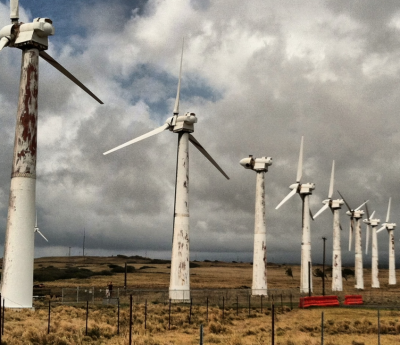
Even in Iran, People are harmed by Wind Turbine Emissions….results of pilot study.

Impact of wind turbine sound on general health, sleep disturbance and annoyance of workers: a pilot-study in Manjil wind farm, Iran

Author:  <rel=author value=”Abbasi, Milad”>Abbasi, Milad; <rel=author value=”Monazzam, Mohammad Reza”>Monazzam, Mohammad Reza; <rel=author value=”Akbarzadeh, Arash”>Akbarzadeh, Arash; <rel=author value=”Zakerian, Seyyed Abbolfazl”>Zakerian, Seyyed Abbolfazl; and <rel=author value=”Ebrahimi, Mohammad Hossein”>Ebrahimi, Mohammad Hossein

Background: The wind turbine’s sound seems to have a proportional effect on health of people living near to wind farms. This study aimed to investigate the effect of noise emitted from wind turbines on general health, sleep and annoyance among workers of manjil wind farm, Iran.

Materials and methods: A total number of 53 workers took part in this study. Based on the type of job, they were categorized into three groups of maintenance, security and office staff. The persons’ exposure at each job-related group was measured by eight-hour equivalent sound level (LAeq, 8 h). A Noise annoyance scale, Epworth sleepiness scale and 28-item general health questionnaire was used for gathering data from workers. The data were analyzed through Multivariate Analysis of variance (MANOVA) test, Pillai’s Trace test, Paired comparisons analysis and Multivariate regression test were used in the R software.

Results and discussion: The results showed that, response variables (annoyance, sleep disturbance and health) were significantly different between job groups. The results also indicated that sleep disturbance as well as noise exposure had a significant effect on general health. Noise annoyance and distance from wind turbines could significantly explain about 44.5 and 34.2 % of the variance in sleep disturbance and worker’s general health, respectively. General health was significantly different in different age groups while age had no significant impact on sleep disturbance. The results were reverse for distance because it had no significant impact on health, but sleep disturbance was significantly affected.

Conclusions: We came to this conclusion that wind turbines noise can directly impact on annoyance, sleep and health. This type of energy generation can have potential health risks for wind farm workers. However, further research is needed to confirm the results of this study.

Milad Abbasi
Mohammad Reza Monnazzam
Seyyed Abolfazl Zakerian
Department of Occupational Health Engineering, School of Public Health, Tehran University of Medical Sciences, Tehran, Iran
Arash Akbarzadeh
Department of Epidemiology and Biostatistics, School of Public Health, Tehran University of
Medical Sciences, Tehran, Iran
Mohammad Hossein Ebrahimi
Department of Occupational Health Engineering, School of Public Health, Shahroud University of Medical
Sciences, Shahroud, Iran

Journal of Environmental Health Science & Engineering (2015) 13:71
DOI: 10.1186/s40201-015-0225-8

Download original document: “Impact of wind turbine sound on general health, sleep disturbance and annoyance of workers: a pilot-study in Manjil wind farm, Iran”

Insightful Letter From a Victim of the “Wind Travesty” in Ontario

 To the Loyalist Township

As a resident and farmer in Essex County living with 24 Industrial wind turbines surrounding my home and farm, I can attest to the incessant presence and ruination of my environment as a result of so called “environmentally friendly wind energy”.

Simply put, it’s not pretty!! Nor is it nice to live with!!

View from my backdoor (first turbine is 600 from back door,  furthest turbine is 1.5 km from back door)  All  three turbines are 200 metres from my property line)

And for the last 5 years, a day doesn’t go by without the feeling of loss and depression all because my  gov’t officials were too short sighted to assess fairly and critically the value of wind energy.

If you believe that health issues are not the concern that many residents are being vilified and denigrated over, despite the many reports being conveyed  www.illwind.org worldwide,  then you should at least understand the mounting evidence that shows the true cost of wind is continually being under estimated.

Note this independent study from the University of  Utah. Despite being an American study, similarities to the Ontario FIT program and GEA policies can easily be made.

“The true cost of wind power, however, is what consumers and society as a whole pay both to purchase wind-generated electricity and also to subsidize the wind energy industry through taxes and government debt. The true cost includes both traditional cost accounting and the seen and unseen costs of policies that seek to artificially bolster renewable energy development and production. When examined more closely, many claims about wind energy are found to be indefensible.”

http://www.strata.org/wp-content/uploads/2015/07/Full-Report-True-Cost-of-Wind1.pdf

I always find it very alarming that claims by the wind industry seem to always go unchallenged such as those surrounding the idea that wind energy will address  the issues we face in dealing with Global warming or Climate Change;   yet  ignore the FACT that wind development exists entirely due to the very lucrative artificial subsidies wind energy is receiving.  Forget the fact that the cost benefit of wind has never been investigated or shown to:

1)         Reduce our use of fossil fuels

2)         Reduce GHG emissions

3)         Provide reliable generation for a modern grid

4)         reduce costs because back-up (fossil fuel) generation is always needed to counter when the wind does not blow or sun does not shine

5)         provide new “green” jobs without atrophying jobs in other sectors because electricity prices must increase to support wind energy’s business case

6)         provide a safe, and  healthy environment for people or wildlife

You can read a good synopsis of wind energy problems here:

http://wind-power-problems.org/

In closing I can only hope and pray that Loyalist Council will not be swayed by the so-called “Community Benefit Funds” wind developers so  effortlessly like to vaunt to small communities, since this amounts to nothing more than a “bribe” that  can never replace the loss of property rights, property values, health, well-being, and wildlife that makes our communities precious & vibrant.

Colette McLean

Essex County area resident

519 738-3356

Note  that Essex Council agreed to a paltry $1500 per turbine/yr for ten years as their Community Fund and were given the choice of either accepting this money with a favourable vote or not receive this fund if they decided to vote against the project. Either way, the developer assured them that the GEA allowed them to go ahead with their project since they had already received their Ministry approval.  Needless to say council voted to receive the funds.

Aussie Senator, Chris Back, Demands Moratorium on New Wind Farms….

Liberal Senator – Chris Back – Demands Moratorium on New Wind Farms

no wind turbines

****

Over bitter opposition from Labor and the Greens, and following almost 6 months of solid graft, 8 hearings in 4 States and the ACT, dozens of witnesses and almost 500 submissions, the Senate Inquiry into the great wind power fraud delivered its ‘doorstop’ final report, which runs to some 350 pages – available here: Senate Report

The first 200 pages are filled with facts, clarity, common sense and compassion; the balance, labelled “Labor’s dissenting report”, was written by the wind industry’s parasites and spruikers – including the Clean Energy Council (these days a front for Infigen aka Babcock & Brown); theAustralian Wind Alliance; and Leigh Ewbank from the Enemies of the Earth.

One of the hard-working Senators on the Inquiry was Chris Back – a Liberal from WA – the ‘Liberals’ are meant to be Australia’s free-market Conservatives. True to his colours, Chris is still in there fighting for a ‘fair go’ for rural communities and Australian power consumers, everywhere.

But it’s not just the lunatic left that Chris is up against. He faces dogged efforts to kill off the Senate’s recommendations by Patrick Gibbons – the wind industry’s ‘Mr Fix It’; who ‘controls’ traffic in order to protect his wind industry mates, from within the (notionally) ‘Liberal’ Environment Minister, young Gregory Hunt’s office.

Notwithstanding rats in his own ranks, Chris Back is determined to see the benefits of 6 months of hard work get delivered. Here’s a taste of what Chris is all about.

Senate Select Committee on Wind Turbines

In November 2014, I sponsored the motion in the Senate to establish the Senate Select Committee on Wind Turbines. The Committee concluded its Inquiry and reported to the Senate on 3 August 2015, making a number of important recommendations. The government has committed to responding actively and in good faith to the findings.

The Committee has recommended that:

The government sets up an Independent Expert Scientific Committee on Industrial Sound (IESC). This is in response to the large number of reports of ill-health from witnesses living near turbines.

A pilot acoustic study of the low frequency sound and infrasound produced by large industrial turbines has indicated that there is a link between sound and sensations damaging to human health. This recommendation has been accepted by the Minister for the Environment, Greg Hunt. I have made recommendations to the Minister regarding membership of the Committee.

The IESC develop a single national acoustic standard for the operation of wind turbines and reports to the relevant Health, Environment and Planning Ministers.

The IESC forms National Wind Farm Guidelines.

The government establish a National Wind Farm Ombudsman in response to community complaints. Minister Hunt has recently begun the process of establishing a Wind Farm Commissioner. I have recommended Terms of Reference to the Minister.

Eligibility to receive Renewable Energy Certificates (RECs) will be made subject to compliance with the national acoustic standard and the wind farm guidelines.

The Australian National Audit Office (ANAO) conduct a performance audit of the Clean Energy Regulator’s (CER) compliance with its role under the legislation.

The Government directs the Productivity Commission to conduct research into the impact of electricity generated by wind turbines on retail electricity prices.

All State Governments consider shifting responsibility for monitoring wind farms away from local councils to the State Environmental Protection Authority and failing that, a national regulatory body be established.

That all new wind farms will be eligible to receive RECs for a period of no more than five years (under current legislation they would be receiving subsidy until 2030).

These recommendations are required because:

In the absence of a known safe distance between wind turbines and occupied residences, the government must adopt a precautionary approach to protect people. The best precautionary approach is a moratorium on new wind farms.

In an industry that has operated with little regulation to date, strict regulation of noise compliance is necessary to protect people living in proximity to wind turbines.

Wind turbines are not reducing emissions in the electricity sector by the same amount that the industry is claiming and being subsidised.

The federally issued subsidy to wind farms (RECs) are paid for in the retail price of electricity which is paid by families, schools and hospitals. The retail price is set by power purchase agreements (PPAs) and amounts to billions every year. The subsidy issued to wind farms amounts to half a million dollars per turbine per year.

The new Renewable Energy Target (RET) of 33,000 GWh will require upwards of 2,500 new wind turbines to be built in rural areas across Australia.

Rural communities are caught unaware when they are canvassed to sign ‘Landholder Agreements’ and ‘Neighbour Benefit Schemes’ which sign away their personal and property rights.

Labor is vehemently in denial of the current issues, taking a completely unaffordable 50% RET to the next election. Furthermore, in their dissenting report, Labor refused to accept the evidence pointing to adverse health effects of industrial wind turbines.

The Greens refused to participate in the Inquiry at all.

I appreciate the support and interest by many State Councillors, especially Robyn Nolan, on this long term challenge.

Kind regards
Dr Chris Back
Liberal Senator for Western Australia

Chris Back

Wind Turbines Rely More On Subsidies, Than They Do On Wind…

Who Needs Wind When Massive Subsidies Will Do the Trick?

dirtyrottenscoundrelsoriginal

****

WHO NEEDS WIND WHEN YOU’VE GOT SUBSIDIES
Pickering Post
Larry Pickering
25 September 2015

A unique set of circumstances gave Turnbull the keys to Kirribilli House, but he didn’t want them, he decided to stay in his far nicer house at Point Piper while he does his filthy global warming deals with the Greens in exchange for economic reform.

The first of his deals will be what he takes to the Paris Conference on Climate Change with the support of the diminutive Green global warmist, Greg Hunt and the UN besotted, NWO convert, Julie Bishop.

Tony Abbott may not have been able to change his spots after a near death experience in February of this year and you can rest assured Malcolm Turnbull has no intention to change his.

It is now clear that Turnbull’s grab for leadership was always planned prior to the IPCC Paris Conference but a Canning by-election suddenly emerged and looked certain to favour the Libs so it became imperative that he move early.

Turnbull was left in the luxurious position of having more than 30 terrified Lib backbenchers in marginal electorates who were prepared to do anything to save their seats and they looked to Malcolm Turnbull as their saviour.

Despite this unique political windfall Turnbull won the leadership by a mere ten votes (only five were needed to switch back to Abbott and Turnbull was gone to Gowings). But the urgent gamble paid off and he is now able to bury Abbott’s objection to inefficient windmills and the global warming myth and present Australia as a willing participant in the IPCC’s warming hoax.

Mr Turnbull has no problem finding the money for his electricity bills and the Greens care only for their ideology and they all must have sore hands from either high-fiving each other or masturbating over Turnbull’s exciting intentions.

Abbott said warming was crap and windmills were an eyesore, he was right, but now it’s too late, there were enough Judas backbenchers with nothing to lose to save the day.

Greg Hunt’s thousands of magic windmills, that can add nothing to the essential base load, are costing between one and two million bucks each with between $200,000 and $400,000 paid for by the taxpayer and a mere $10,000 going to the landholder, many of whom now wish they had never seen the bloody things.

We can now see why our electricity bills have gone through the roof and the Turnbull Government intends to ensure they keep climbing?

The UK Tory Government under Cameron has signalled it will end subsidies to onshore wind farms from April 1 next year.

The onshore wind industry executives have attacked the move as “political intervention”, while the trade body “RenewableUK” called for an urgent meeting with the new energy secretary, Amber Rudd (gord there’s another one) to discuss the implications of the announcement.

Scottish energy minister Fergus Ewing claimed that British consumers could end up paying between £2bn and £3bn more in bills because Scotland would now be home to 70 per cent of all future wind farms. (I can only presume he really meant to say bn.)

Conservative governments and windmills make poor bedfellows except when an erstwhile conservative government is led by Turnbull and a few UN sycophants.

These outrageous subsidies must soon stop but windmills will not survive without them. These inefficient, million dollar monstrosities only have an average life of 11 years before they need replacing. (No, industry advice is not reconditioning but replacing… they say replacement would be cheaper.)

The urgency with which Greg Hunt threw taxpayer funds at windmill construction companies meant that they will need replacing in a very short time… and all at the same time!

But who in their right mind would replace them without up to a half million dollar subsidy on each one? And if the subsidies continue under the Turnbull Government that half million subsidy becomes one million when it’s for the same replaced windmill.

The fact is no-one will ever construct a windmill without being heavily subsidised! What we are doing is replacing power that costs 3 to 5 cents per kilowatt hour to generate with windmill power that costs at least 13 1/2 cents per kilowatt hour.

“And these bastards know exactly what the sums are!”

So, even a Lefty Government led by Turnbull and a windmill addicted Greg Hunt cannot continue forever with subsidies that support inefficient power! So what must be the end result?

Thousands and thousands of these noisy, visually polluting bird killers will become land fill. And who will be forking out the brass to dismantle these eyesores? Yep, again it will be we the poor taxpayers.

Only the limited brain of a Green gopher could conceive that a windmill could be an efficient producer of power. And only a Green will argue that it actually is.

So if the Green gopher is right, why the bloody subsidies?
Pickering Post

Nice work, Larry!

But the subsidy figure he notes of a mere $400,000 per turbine, per year  – paid in renewable energy certificates (RECs) – is a tad light on.

Pickering’s target, young Gregory Hunt has locked-in a $45 billion electricity tax, that’s designed to funnel every last cent of that sum to wind power outfits:

Greg Hunt Delivers Coalition’s Political Suicide Manifesto: Liberals Lock-In $46 Billion Power Tax in Futile Effort to Save the Wind Industry

At $3 billion per year until 2031, Greg’s efforts to look after his mates, Vesta’s, Ken McAlpine and Infigen’s Miles George, amounts to the single, greatest industry subsidy scheme in the history of the Commonwealth.

As to what a single turbine can reap from the rort, under the ludicrously generous the REC Subsidy, consider a single 3 MW turbine.

If it operated 24 hours a day, 365 days a year – its owner would receive 26,280 RECs (24 x 365 x 3). Assuming, generously, a capacity factor of 35% (the cowboys from wind power outfits often wildly claim more than that) that single turbine will receive 9,198 RECs annually. At $93 per REC (the value at which they are designed to trade), that single turbine will, in 12 months, rake in $855,414 in REC Subsidy.

But wait, there’s more: that subsidy doesn’t last for a single year. Oh no. A turbine operating now will continue to receive the REC subsidy for 16 years, until 2031 – such that a single 3 MW turbine spinning today can pocket a total of $13,686,624 over the remaining life of the LRET. Not a bad little rort – considering the machine and its installation costs less than $3 million; and that being able to spear it into some dimwit’s back paddock under a landholder agreement costs a piddling $10-15,000 per year. State-sponsored theft never looked easier or more lucrative!

The REC Tax/Subsidy, including that associated with domestic solar under the original RET scheme, has already added more than $9 billion to Australian power bills, so far.

But, apart from that minor quibble, Larry is otherwise on the money.

It’s a subsidy rort, pure and simple.

Money Wasted

Rural Dweller Want to Run the Windpushers out of Town!!

Democracy in Action: Vermonters Vent Fury at Planned Wind Power Project

hay-wagon-team

****

Remember all those glowing stories about wind power outfits being welcomed into rural communities with open arms? You know, tales about how farmers are dying to have turbines lined up all over their properties? How locals can’t wait to pick up some of the thousands of permanent,high paying jobs on offer? How developers are viewed with the kind of reverence reserved for Royalty?

No?

We’ve forgotten them too.

It’s ‘outrage’ that’s become the order of the day. With the wind industry facing growing and increasingly hostile hordes, their teams of community ‘liaison’ officers have taken to literally thumping their message home, setting the muscle on to old-age pensioners and disabled farmers:

Wind Industry Belting its ‘Message’ Home: Trustpower’s Thugs Assault 79-Year-Old Pensioner & Disabled Farmer

It’s a sure sign that the wind industry’s ‘game’ is lost.

Pro-(real)farming, pro-family, pro-community and pro-(real)power groups have an air of ascendancy now; they’re angry, they’re organised, and they aren’t about to be taken for fools any longer. Here’s another example of people fighting back against the greatest economic and environmental fraud of all time.

Vermont town set for protest vote against wind turbines
Vermont Watchdog
Bruce Parker
1 October 2015

IRASBURG, Vt. — The ongoing clash between Vermonters and Big Wind is set for a slugfest Thursday night as Irasburg residents will attempt a protest vote against two 500-foot wind turbines to be sited atop the ridgeline of nearby Kidder Hill.

In a special Selectboard meeting at 6:30 p.m. at Irasburg’s Town Hall, voters will cast ballots to answer the following question: “Shall Kidder Hill, or any other ridgelines of the town of Irasburg, Vermont, be used for development by industrial wind turbine projects?”

A no vote would be a setback for David Blittersdorf, whose Kidder Hill Community Wind company plans to construct the 5-megawatt electricity-generating towers to provide power for approximately 2,100 homes in the area.

“We have 421 signatures opposing this project,” said Ron Holland, a local resident, and member of the Irasburg Ridgeline Alliance, which led a petition drive against the turbines.

Holland, who helped expose broad opposition to the project, said a no vote would launch a sustained revolt by residents who are determined to protect local ridgelines.

“It will send a very clear message to the administration of the state of Vermont, and to Mr. Blittersdorf, that he can expect total noncooperation from the citizens of Irasburg.”

While Blittersdorf has yet to present his plan to regulators at the Public Service Board, the green energy mogul told a meeting of Addison County Democrats in June that Vermonters can expect wind turbines on one-third of Vermont’s ridgelines as part of the state’s goal to become 90 percent renewable-powered by 2050. A YouTube video of the meeting went viral across Vermont.

Residents who oppose the project say unsightly turbines would negatively affect property values and generate unhealthy amounts of noise in the community. Holland said he’s equally concerned by the sale of Vermont’s ridgelines to developers whose biggest supporters are well-funded politicians.

“This is an alliance between state interests and business interests that excludes towns in the decision-making process. This is being foisted on us and we have no say,” Holland said, referring to the town’s lack of authority to block energy projects.

“The policies that have been developed are a textbook example of crony capitalism. There are far less expensive, far less polluting, far less destructive options available that don’t make money for the people that control Vermont utilities. But they haven’t been considered.”

Asked for evidence of a state-business alliance, Holland said Blittersdorf is a major donor to Gov. Peter Shumlin, House Speaker Shap Smith and Joint Energy Committee Chair Rep. Tony Klein.

Blittersdorf did not return Watchdog’s request for comment. However, the green energy CEO is scheduled to give a speech defending Kidder Hill Community Wind prior to the vote.

Wind turbine opponents also have politicians in the fight.

State Sen. John Rodgers, D-Essex/Orleans, who represents Irasburg and other towns in the Northeast Kingdom, is a vocal critic of unregulated siting of renewable energy projects.

“The Northeast Kingdom has become the dumping ground for every ill-conceived, poorly sited renewable energy project the developers can dream up,” Rodgers said in a news release. “Environmental and energy issues are real, but we know that there are far more effective ways to address them without ruining the quality of life that defines us as Vermonters.”

Rodgers is a rare Democrat. Given that the state’s Democratic legislative majority overwhelmingly supports industrial scale renewables, blocking controversial wind turbines rests with local citizens.

For Irasburg residents like Rebecca Boulanger, it’s the feeling of powerlessness that has stoked the flames of anger in the small town.

“Here in Vermont, where we’re known worldwide for our town-meeting democracy, it is inconceivable that a decision with so many irreversible consequences for our citizens would be made without regard for the democratic process,” she said.

But for Holland, who said he expects a win Thursday night, protecting Vermont’s pristine ridgelines is simply about being a good neighbor.

“If your neighbor’s house is on fire, you go and help put it out. These people’s homes are going to be destroyed in terms of what happens in the environment around there, and so the neighbors are coming to the rescue.”
Vermont Watchdog

turbine fire 6

What was forecast by the community defenders themselves was realised at the meeting that took place a few nights later; where 96% of voters made plain their outright hostility to the great wind power fraud. No surprises there!

What was surprising is how the Editor of the local rag reported on the community’s clear expression of outrage.

Over the last few years, the media’s attitude and approach to the wind industry has ranged from fawning acquiescence to foaming eco-fascism.

In the former guise, journos would simply parrot the propaganda handed to them by wind power outfits, their parasites and spruikers: recounting complete fictions such as this project “will power 200,000 homes, save gazillions of tonnes of CO2 and all for free”. The resultant gushing drivel, arising from the combination of the scribes’ inherent laziness and infantile gullibility.

At the extreme end of the spectrum were journalists that attacked anyone with the temerity to challenge the Wind Gods; and the infallibility of the high priests that faithfully serve them.

Now, however, journalists too, have worked out the fickle nature of the Wind Gods; and that the wind industry’s high priests have all the credibility and moral fibre you’d expect from deranged cult leaders – of the same class as Jim Jones and David Koresh:

Vesta’s Ken McAlpine Forced to Apoligise to Dr Sarah Laurie for …. well, just being ‘Ken’

Wind Industry’s Propaganda King – Simon Chapman Forced to Apologise to Dr Sarah Laurie for False & Malicious Taunts

In the early days, newspaper editors took the deluded and warm and fuzzy view that everyone simply loves wind power to bits.

Now that community defenders – in places like Vermont and Rye Park in New South Wales – have joined forces and shown that the great majority would, rather than hugging them, simply love to blow these things to bits, newspapers have, for obvious commercial reasons, sided with the great majority. It’s pretty hard to sell newspapers thumping wind industry propaganda to a population, where 90% have worked out that the wind power pitch is utter bunkum.

Instead, newspapers are calling the wind industry for what it is: the greatest economic and environmental fraud of all time.

Here’s an example from The Caledonian Record, as it recounts the backlash against wind power and Vermont and slaughters the developer’s high-handed arrogance, lies, treachery and deceit.

Editorial: Blowing Blittersdorff Away
The Caledonian Record
3 October 2015

On Thursday night hundreds of people packed into the Irasburg Town Hall to tell renewable energy developer David Blittersdorf they don’t want his industrial wind towers in their town. Out of 285 voters, 274 said “NO” to wind development in town.

Dr. Ron Holland, the town’s moderator, also presented a folder of petitions to the select board, signed by 481 voters, asking the select board to take a formal stand against wind development. Dr. Holland also spoke about a formal organization formed to challenge Blittersdorf’s plan — the Irasburg Ridgeline Alliance — and reasons for their opposition. Among them: the health effects of living near towers, the effect on property values, aesthetics, and their utter failure to reduce carbon emissions.

Blittersdorf didn’t attend the meeting but sent a strongly worded email that we translated to say — “I believe in renewable energy, I know what my property rights are, and I don’t care what Irasburg thinks.”

Blittersdorf has gotten filthy rich on renewable energy subsidies and mandates. In fact, he’s had a hand in writing many of the rules and laws that benefit his companies directly. Nobody in Vermont, that we know of, has gotten richer from gaming the rigged system than Blittersdorf. He knows how to cash in both as a developer and as a manufacturer of renewable energy systems.

He says he’s on a crusade to save the world. But anyone as involved in green energy as Blittersdorf is knows that the small benefit of wind energy can’t ever justify their overall inefficiency or heavily subsidized expense.

He knows wind projects are a bad fit for Vermont’s climate, make no sense economically, and yield zero impact on net carbon footprint.

He knows, because of well-known and understood transmission and infrastructure limitations, the New England grid operator has to limit the amount of power it can absorb from Vermont’s boutique projects.

He knows that taxpayers and ratepayers are getting fleeced at every turn of the turbine.

He knows that there aren’t “green jobs” associated with power generation.

He knows that after a quarter decade, and billions of tax subsidies through the wind Production Tax Credit, that wind farms aren’t competitive anywhere in the United States.

He knows that his developments are irreconcilable with the spirit, and the letter, of Act 250 land protections.

He knows wind tax credits (as one critic explained) “are nothing more than a cost imposed on all taxpayers in order to accommodate development of a politically well-connected, high-priced, low-value resource that cannot meet our electric capacity needs.”

He knows most of the state’s carbon footprint derives from vehicles and heating our homes in winter. As such, expensive and inefficient wind projects yield no meaningful effect on aggregate carbon emissions.

He knows wind energy is notoriously intermittent and unreliable, requiring fossil-fuel powered backup plants when the wind doesn’t blow.

He knows Shumlin’s grand plan that calls for Vermont’s energy use to come from 90 percent renewable sources by 2050 is not only unachievable, but the tax subsidies that it will require in the intervening failed effort to reach it will cost Vermont taxpayers an unforgivable and unsustainable fortune.

He knows wind is only a winner for developers – earning tax credits, naked subsidies, and guaranteed (fixed) consumption by ratepayers.

He knows wind projects distort energy markets and require such intensive energy to develop that nobody believes them to actually be “green.”

He knows, despite his invocation of property rights, that wind development is the ultimate zoning issue and has enormous impact on surrounding communities.

He knows that those communities are being torn apart by bad public policy, big government subsidies and a misguided pursuit of “green energy.”

Of course Blittersdorf knows all of this. What he might not know is that Northeast Kingdom residents won’t suffer fools. And they’ve gotten better over the years, and from hard experience, at protecting themselves from predatory developers.

Everyone now understands that this isn’t about the environment or global warming. It’s a naked money grab.

And we all stand with Irasburg in saying bureaucrats, investors and hotshot energy lobbyists shouldn’t have more say about what happens in our communities than the people actually living here.
The Caledonian Record

winston-churchill-quotes

Winning this war involves winning skirmishes and battles: house by house, village by village and town by town.

Education is the key; facts the key weapon.

The endless lies tossed up by the wind industry and its parasites just don’t wash anymore: these days, people are switched on to the fraud; and angry for having been taken for gullible country bumpkins.

Once reasonable people are introduced to the facts about the insane costs of intermittent and unreliable wind power they cease to support it.

When they learn of the senseless slaughter of millions of birds and bats, and the tragic suffering caused to hard working rural people by giant fans, reasonable people start to bristle.

But when they learn that – contrary to the ONLY “justification” for the $billions filched from power consumer and taxpayers and directed as perpetual subsidies to wind power outfits – wind power INCREASES CO2 emissions in the electricity sector – rather than decreasing them, as claimed – their attitude stiffens to the point of hostility to those behind the fraud and those hell-bent on sustaining it.

In our travels we’ve met plenty of people that started out in favour of wind power and turned against it. But we’ve yet to meet anyone who started out opposed to wind power, who later became a supporter. Funny about that.

turbines giant

Present the facts to reasonable people – and they’ll want to know how the scam got started in the first place and why it hasn’t been stopped in its tracks already?

Once communities and their newspapers turn against the great wind power fraud, they’ll never turn back.

Get angry, get organised and make some noise. These are your homes, your families and your communities. Fight them; and they will flee.

storming_the_bastille1-e1318690559144

Harm From Wind Turbines Will Dwarf that of Asbestos…..

June 2015                                                                                     New ZealandNew Zealand

Wind turbines worse than asbestos?

“In the future, I believe that the adverse health effects of wind turbines will eclipse the asbestos problem in the annals of history.”

The views of Dr Bruce Rapley given to the Australian senate select committee on wind turbines in June 2015.Video also available on our YouTube channel

Dr. Bruce Rapley is a consulting scientist with Atkinson & Rapley Consulting Ltd., New Zealand, specialising in acoustics and human health.

He has three degrees from Massey University in New Zealand. A BSc in biological systems, an MPhil in technology (System Design and Testing of a Medical Biostimulator) and a PhD in acoustics and human health (Sound in the Military Environment: Detection, Measurement and Perception – undertaken in collaboration with the New Zealand Defence Force).

Dr. Bruce Rapley’s submissions to the Australian senate select committee on wind turbines:

Submission 1 – 27 February 2015

Appendices

Submission 2 – 1 June 2015

Dr. Bruce Rapley – June 2015

Brits Beginning to Hold Wind Pushers Accountable!

Brits to Force £2 Wind Power Outfits to Hold £Millions in Reserve to Pay Damages to Victims & for Decommissioning

David_Davis_2181020a

***

In a stunningly brilliant legislative move, David Davis MP recently introduced a Bill in UK’s Parliament which will allow Britons to enforce judgments against wind power outfits; and which will ensure the removal of these things when they grind to an inevitable halt within the next decade or so – whether because the massive subsidies they run on are chopped; or because they have flamed out; rusted out; thrown their blades to the four winds; or have simply collapsed in heaps.

The standard corporate structures used by wind power outfits involve a parent company – like Infigen, say – usually as a holding company, with a subsidiary, which usually takes on the name of the wind farm (threatened or realised), such as Cherry Tree Wind Farm Pty Ltd (a wholly owned subsidiary of Infigen – going nowhere, thanks to its inability to obtain a Power Purchase Agreement).

The subsidiary is lumbered with all the current debts and other liabilities, which are loaded up in such a way as to exceed its assets (as long as the wind farm is operating, the parent sees that sufficient cash flushes through the subsidiary for it to remain technically solvent, at least in the short term).

In the event that a creditor pursues the subsidiary for any substantial claim, the parent (or related holding company) simply sits back and watches its subsidiary wind up in insolvency; leaving the creditor(s) without so much as a penny to pinch. Infigen has done it all before, back when it was called “Babcock and Brown”.

Among the class of creditors seeking to recover, are wind farm neighbours who successfully sue the windfarm operator (ie the subsidiary company) and who obtain a substantial award of damages for nuisance.

In David Davis’s speech below, he refers to the case of Julian and Jane Davis who successfully obtained a £2 million out of court settlement from a wind farm operator, for noise nuisance; and the resultant loss of property value (the home became uninhabitable due to low-frequency noise, infrasound and vibration).

The Particulars of Julian and Jane Davis’ Claim are available here: Davis Complaint Particulars of Claim

And Jane Davis’ Statement (detailing their unsettling experiences and entirely unnecessary suffering) is available here: davis-noise-statement

So, the next time you’ve got some wind industry parasite mouthing off that there has never been a successful claim against a wind power outfit, simply flick them a link to this post.

The other reason for setting up £2 subsidiary companies (in Australia referred to as $2 companies) of little or no real value, is to avoid (by winding up in insolvency) liability to clean up the mess after the rort is all over and done with.

Hawaii rusting turbines

***

While planning authorities often talk about obtaining what are called “decommissioning bonds”, whatever promises are made, are given by the subsidiary (not the parent), which is designed to have no assets available to cover the cost of decommissioning; whenever that inevitable event takes place. Hence, the thousands of wind turbines scattered all over California and Hawaii, left rusting as monuments to our political betters’ collective stupidity (see our post here).

To avoid that event, David Davis introduced the “Public Nuisance from Wind Farms (Mandatory Liability Cover) Bill”, which is to be voted on sometime next month. Here’s David’s speech as he introduces the Bill  – video and then audio (Hansard – Transcript follows).

***

****

Audio Player

00:00
00:00

Public Nuisance from Wind Farms (Mandatory Liability Cover) Bill
David Davis
21 July 2015
House of Commons Hansard

Mr David Davis (Haltemprice and Howden) (Con): I beg to move,

That leave be given to bring a Bill to require the Secretary of State to make provision about obligations on wind farm operators in respect of financial cover for potential liabilities arising from cause of public nuisance; and for connected purposes.

Wind farms are contentious. Some argue passionately that they are a great public good and the solution to global warming while others equally passionately believe they are a waste of money. This Bill takes no side in that debate. It is narrowly defined to one aspect of public interest; it requires the operators of wind farms, who are in receipt of £797 million of public subsidy a year, to organise their affairs so that they are able to meet the costs of any nuisance imposed on people living near them.

In 1995 the World Health Organisation recommended that to prevent sleep interruption low frequency noise should not exceed 30 decibels. However, in 1996 the Government’s Energy Technology Support Unit—ETSU—set the noise limit for wind turbines at 43 decibels. That is an enormous difference; on the logarithmic decibel scale it is approximately double the WHO limit. We still use those standards today.

In the last five years no planning application was refused on noise-related grounds, but there have been 600 noise-related incidents arising from wind farm operations. The majority of complaints arise as a result of amplitude modulation, which is the loud, continuous thumping or swishing noise regularly described by those living near wind farms.

Numerous studies have identified that sleep is disturbed on a regular basis even at distances over 1 km away from turbines, yet under the ETSU standards turbines can be installed just 600 metres away from residential property. The wind farm companies are acutely aware of this, and all the more so since a member of the public, Jane Davis, sued a wind farm near her home for noise nuisance. The matter was settled out of court, and there is a gagging order preventing us from knowing the details, but the settlement is rumoured to have been in the region of £2 million.

Since this case, some dubious measures have been taken by the industry to obstruct perfectly legitimate claims for nuisance. The use of shell companies in the wind industry seems to be the commonest trick. The parent company provides a loan to a specially created subsidiary to set up the wind farm, then leaves it in control of operations. The subsidiary’s balance sheet typically comprises the wind farm physical assets, but they are more than offset by a very large loan from the parent company, with a resulting net liability. Profits from energy generation and large amounts of public subsidy are siphoned off to the parent company. The subsidiary is left as a financial shell, with very few liquid assets and total liabilities greater than total assets. That makes it impossible to bring litigation against a wind farm, simply because there is nothing to win from them. As such companies have negative net assets, even liquidating them would generate no cash to pay either damages or a legal bill.

One of my constituents bought his house in my constituency to enjoy a quiet retirement with his wife. After living there for more than a decade a 10-turbine wind farm was built near the house. The closest windmill is just over 600 metres from his home. He was assured at the planning stage that the wind farm would not trouble him, yet he has suffered the misery of regular noise and turbine blade flicker which has rendered his home almost unliveable. The low frequency noise from the turbines easily penetrates the double glazing. The couple have had to change bedrooms in order to sleep, but even so the persistent noise from the wind farm has taken its toll on his wife’s health; she now suffers heart palpitations and is prescribed anti-depressants on a permanent basis by her doctor.

My constituent, fearing his retirement has been ruined and his home thoroughly devalued, attempted to use his legal insurance to claim for nuisance from the wind farm operators. While there was a good chance of success in court, the company’s finances were organised so that there was no realistic prospect of recovering either damages or the legal costs of bringing the case. That being so, his insurers would, quite understandably, not cover his legal costs. That is despite the fact that the eventual owner of the wind farm is AES, a multibillion dollar international company involved partly in renewables but largely in coal and gas, that paid its chief executive $8.4 million last year. It laughably claims in its annual report to be a “World’s Most Ethical Company”.

It is not alone in its hypocrisy. In March I raised this disreputable practice with Falck Renewables, prospective operators of a wind farm near my own village in my constituency. I asked it whether it was going to do the same. It did not reply.

My constituents have no way to recover the tranquillity of the lives that they thought they were going to enjoy when they first moved to rural Yorkshire. They can neither sell their house nor get any financial recompense to enable them to afford to move, so they are trapped in this misery.

My point is a simple one. My constituents are just individual representatives of a situation that is repeated up and down the country. Wind farm companies must be adequately capitalised so that there can be a reasonable prospect of financial success for prospective litigants whose way of life they have damaged.

It is not only the noise that is a nuisance, of course. When the sun is low in the sky behind a turbine it creates a “strobe effect” which can be harmful to health and wellbeing, and there are also now concerns that some wind farms could be abandoned at the end of their operational lifespan, creating another sort of visual blight, this time in perpetuity.

The simple solution that I propose in this Bill is to require wind farm-operating companies to hold enough cash in hand to manage a legal case at any time, and in addition a financial bond—a guarantee, or insurance policy—as a security against potential liabilities, including all public nuisance and final decommissioning costs.

Any wind farm that fails to do that should lose its right to subsidy—which, as I said, amounted to £797 million in one year for the industry.

This would ensure that citizens could reasonably sue when they suffer damage, but, just as importantly, it would be a strong incentive for the companies to operate wind farms in such a way as to avoid public nuisance, which is causing great distress in some cases, and would mean that when the turbines are decommissioned there is money or insurance to cover the cost of clearing the wind farm, avoiding a situation whereby the local council has to pick up the bill.

Whatever our stance on onshore wind, companies in receipt of public subsidy should be required to meet their public responsibilities. This measure seeks to ensure that the big wind farm companies can truly be held liable when they are at fault and gives families the protection they deserve. I beg to move.

Question put and agreed to.

Ordered,

That Mr David Davis, supported by Chris Heaton-Harris, Tom Pursglove, John Mann and Jim Shannon, present the Bill

Mr David Davis accordingly presented the Bill

Bill read the First time; to be read a Second time on Friday 11 September, and to be presented (Bill 62).

Public Nuisance from Wind Farms (Mandatory Liability Cover) Bill

tehachapi-wind-turbines-p1

Wind Industry Fraud & Corruption Exposed: Pacific Hydro & Acciona Defrauding the Commonwealth

263977-alan-jones

****

Following up on Senator John Madigan’s brilliant exposé of criminal fraud and corruption in Australia’s wind industry, which we covered in this post:

Pacific Hydro & Acciona’s Acoustic ‘Consultant’ Fakes ‘Compliance’ Reports for Non-Compliant Wind Farms

Alan Jones went to town on his 2GB Breakfast Show that – some 2 million listeners tune in to – via 77 stations across the Country.

Alan has been belting the great wind power fraud since June 2013, calling all and sundry to account. And this interview with John Madigan is no exception. You can read the transcript that follows….

Alan Jones OM: The date today is September 24. On Tuesday the 15th of September Senator John Madigan rose in the Parliament of Australia to make a speech. Now remember, this is all about carbon dioxide, and I’ve explained what that’s about – 0.038% of all the air, say 0.04%, is carbon dioxide. Human beings produce only 3% of that. 3% of 0.04 of a percent and Australia produces 1% of the 3%. So about one 10 millionth of CO2 in the air is produced by Australians.

As a consequence of that this mad obsession with renewable energy,  wind, solar which we can’t afford, which are many times dearer than coal-fired power. Which are killing manufacturing because they’ve increased massively the price of energy. And your electricity bills. As Terry McCrann said to me years ago, this represents a national suicide note.

Well on September 15th, Senator John Madigan rose in the Parliament, his opening sentence was this “Tonight I speak about corruption and fraud in the power generation industry”. Who cares? Corruption and fraud.

Now before I go to Senator Madigan, let me remind you of a simple example of that. There’s a wind farm down near Goulburn, the Gullen Range wind farm. Believe me it’s completely illegal. Owned by Chinese Company, Goldwind. 69 of its 73 turbines have been built in areas that weren’t approved. Some were more than 180 metres from their original positions. Many were within the 2 km limit of residential homes. But the government of New South Wales is recommending that the Planning Assessment Commission approve the turbines on the basis that, well the company had reached financial settlement with 2 aggrieved property owners. How gutless is government? Are we so committed to this renewable energy nonsense and so frightened of the Chinese, that they’ve erected turbines in breach of their licence and it’s just business as usual.

The Labour government, prior to O’Farrell, had signed off on this Chinese outfit Goldwind’s appointment of an independent environmental monitor to oversee the turbine placement. Swallowed that hook line and sinker. Without knowing that the so-called expert was a Director of a consultancy firm that actually worked on the wind farm’s development. So technically this mob say well, we had approval. Goldwind should be told to rip up the turbines. They’ve put them in place in breach of their licence simple as that. If you are driving a car in breach of your licence they’ll take you, your keys and your car away from you. The same should apply to this mob.

Well may Senator Madigan say “Tonight I speak about corruption and fraud in the power generation industry.” This is what he’s talking about. Only a week ago Graham Lloyd, the Environment editor of The Australian, Graham Lloyd is a fearless reporter and he wrote, all levels of government have been duped by sham compliance reports which have allowed major wind farms to breach noise limits and collect millions of dollars in subsidies, that’s your money. He was quoting John Madigan.

John Madigan has just blown the whistle on what he said was a corrupt system of wind farm noise assessments and he singled out International noise consultants, Marshall Day and its consultant Christophe Delaire, who have been involved in more than 50 wind farm projects. Senator Madigan told the Senate this outfit MDA , the consultants commercial arrangements with wind farm operators Acciona and Pacific Hydro, had “adversely impacted the independence of its reports and the legitimacy of its conclusions.” In other words, the so called independent consultant is tied up with the proponent. With the proponent. So it’s signs off for the proponent and as a result they qualify for your money.

Senator Madigan was speaking in support of a Labour recommendation in its dissenting report to the Senate inquiry into wind farms and health. That wind companies should use independent consultants to assess post-construction. Now that’s a keyword, post-, well hyphenated word, post-construction noise compliance. Now this is a scandal but don’t expect anyone down there, they’re all furry and fluffy and warm and fuzzy about renewable energy. Now we’ve got the global warming advocates in the saddle in Canberra, so it will be renewable energy at any price. And that means break the law.

You’ve heard me talk about the awful predicament of people living in the vicinity of these wind farms. Especially in Victoria. You’ve heard me say that if they weren’t injurious to health, well put them in Macquarie Street. Put them on Bondi Beach. Put them in Collins Street Melbourne. Queens Street Brisbane. I’ve had a million and one letters from people about the Cape Bridgwater wind farm in Victoria.

John Madigan said in the Parliament “In 2006 Marshall Day Acoustics, with the consultant Christophe Delaire, prepared a – and this is the other key phrase – pre-construction noise impact assessment for the Cape Bridgewater wind farm. Pre-construction. The report predicted that compliance could not be achieved at Cape Bridgewater wind farm without of a rating 13 of the 29 turbines in reduced operational noise modes.

Now just think for a moment, ‘oh god now what’s this got to do with me?’ just imagine if you were living here beside this stuff. People become refugees in their own homes. But this so called independent report said – compliance could not be achieved at Cape Bridgewater. That’s before they were built.

As Madigan said, Senator Madigan, “before it was even built, developers knew that this wind farm would operate in breach of its permit unless adjustments were made”. But Delaire told the Committee of Inquiry, “following measurements on-site it was found the noise optimisation was not required.”

Asks Senator Madigan, “How did Delaire’s expert pre-construction and post-construction reports come to draw such contrasting conclusions?” He answers his own question. He said “The answer is simple, Pacific Hydro did not noise optimise its turbines at Cape Bridgewater, because they knew they didn’t have to. They only had to commission a post-construction noise report to say the wind farm was compliant. On both occasions Pacific Hydro got exactly the report they wanted from Marshall Day Acoustics, but the compliance assessments were not compliant with the standard and neither were the reports.”

Is that corruption? John Madigan, Senator, is on the line. John Madigan good morning.

Senator John Madigan: Good morning Alan.

Alan Jones OM: You’re talking into an empty tank. Eh? Unbelievable.

Senator John Madigan: Yes Alan, its very disconcerting and with any project Alan, as you well know, there is little point in giving permission for a wind farm to operate under certain conditions, or any industrial plant unless compliance with those conditions can be demonstrated and that what we’re being told is correct, so that people can have faith.

Alan Jones OM: That’s it. To put it in lingo that the people who are listening to you, who don’t listen to wind farms understand, you are talking about corruption. If this was in the trade union movement, we’d have Royal Commission. In the trade union movement. Taking money from others to which they weren’t entitled. That is what this is about. Corruption in the union movement. Oh yes we’ll have a Royal commission. Here we have, in relation to wind farms, the developers knew the wind farm would be operating in breach of its permit unless adjustments were made but they were able to get a post-construction report which miraculously came to the opposite conclusion.

Senator John Madigan: It’s just gob-smacking Alan, and it is there for all to see. I suggest to your listeners that, you know that the speech that I gave in the Senate is there on Hansard, I suggest people go and read it. As you and I both know, Alan how litigious these people are.

Alan Jones OM: Oh yeah they’ve got plenty of money. Don’t this mob, don’t this mob, Marshall Day Acoustics, on their website boast, not Madigan’s words, not Jones’ words, but they boast “they’ve got a proven record of successful wind farm approvals”. In other words, get us to investigate it and we’ll get you the green light. We write it, we’re regarded as independent, we’re regarded as authoritative and governments swallow it hook, line and sinker ‘cos they are on the renewable energy gravy train. That’s the guts of it isn’t it?

Senator John Madigan: That’s pretty much what I’ve said Alan.

Alan Jones OM: And people are lying, people are lying, basically. There was a pre-construction report which said you’re going to have to change here you’re not going to compliant. The original report identified non-compliance at multiple homes and at every wind speed. That’s the original report pre-construction. That didn’t satisfy the client. So suddenly on the 22nd of July 2009  – and John Madigan told the Parliament this – the same mob, Marshall Day Acoustics, issued revised monthly reports for every house and every month – but those reports were to Pacific Hydro’s satisfaction. The exact opposite of what they’d originally found. It’s beyond belief. This is trade, this is Dyson Heydon revisited.

Senator John Madigan: It’s beyond belief. As you’ve said Alan, we hear a lot about corruption in the union movement. You and I know there there are disreputable unionists as has been proven. This needs to be, that needs to be stamped out. But so does corruption anywhere, wherever it be, politicians, wherever it be, local government, Councillors, wherever it be, a company, any sort of company, that is acting disreputably, or outside of the law, or taking people down, ripping people off, should be held to account.

Alan Jones OM: Absolutely.

Senator John Madigan: And you can’t say the corruption only exists in the union, because Alan, its everywhere.

Alan Jones OM: Correct. Correct. Now in 2006, I’ll just repeat, and analysis by this mob, Marshall Day Acoustics, this is about Cape Bridgewater, these poor people write to me every day, compliance with the standard (I won’t go into detail about the standard, it happens to be a New Zealand standard forget all that, that’s irrelevant). There is a standard which applies to the granting of the permit to have these wind turbines. Compliance could not be achieved at Cape Bridgewater without operating 13 of the 29 wind turbines in reduced noise modes. Reduce, you can’t, its non-compliant. But a post-construction report cleared the wind farm. And then the government accepts the post-construction must report, and your money, millions of dollars of your money, subsidy payments are made to the operators. And Marshall Day Acoustics Chief Executive Peter Fearnside, said in relation to Senator John Madigan, “we’ve decided not to respond to Madigan’s comments in the Senate”. I mean where on earth? And anyway John the other thing here is Tony Abbott rightly said he wasn’t going to chase Holden down the road with an open cheque book, why are we chasing these people down the road with an open cheque-book anyway?

Senator John Madigan: Well you know Alan, as you’ve pointed out this is a industry that receives millions of dollars from consumers, through higher power prices. Now why?

Alan Jones OM: On the basis of fraudulent reports.

Senator John Madigan: And with the car industry leaving Australia, Alan, as you know I’m a great supporter of Australian manufacturing and if you were to have a look at how much the car industry was receiving and then analysed the social and economic benefits that flowed from that back to government through tax receipts, skills for people, for apprentices.

Alan Jones OM: You could justify giving the car industry the money, but not this mob.

Senator John Madigan: Well you know as I say Alan very dubious social, economic and environmental outcomes.

Alan Jones OM: That’s it.

Senator John Madigan: And that’s me being polite.

Alan Jones OM: That’s being polite. It’s what you said at the start, it’s what you said at the start, of your speech, and you made a very emphatic statement at the start of the speech when you simply said, and I’m finding that those words again, what were they, you said the whole thing is corrupt. “Tonight I speak about corruption and fraud in the power generation industry.” Well Dyson Heyden is talking about it in the union movement.

John, we’ll keep at it. Don’t worry I have written and I am saying to you Josh Frydenberg, you’re the Minister for wind farms, you’re on notice, you’re on notice. And the first thing it you have to do is read Senator Madigan’s speech.

John Madigan thank you for the work you’re doing, it’s much appreciated.

2GB

John Madigan

Falmouth Families Fight for Freedom from Wind Turbine Torture!

Wind Farm Nuisance Case: Falmouth Zoning Board Orders Turbine Shutdown

suffer

****

Back in November 2013, we reported on the orders made by a Court in Falmouth, Massachusetts that pulled to a halt the operation of a couple of Vestas V82s that have been driving townspeople nuts, since they kicked into gear over 5 years ago (see our post here).

We’ve also reported on Barry Funfar, a former Marine whose own country has forsaken him and his family, by aiding and abetting the local wind power outfit to ride roughshod over the rules; and decent Americans, like Barry (see our post here).

We gave an update on the Falmouth case in March 2015:

US Wind Farm Litigation: Update on the Falmouth Case

And again in April:

Wind Turbine Infrasound: an “Acoustic Trespasser”

And now, here’s the latest in a 6 year battle by locals to restore their ability to sleep in, and otherwise enjoy, their very own homes.

Falmouth zoning board orders turbine shutdown
Sean F. Driscoll
Cape Cod Times
17 September 2015

FALMOUTH — In a stunning move, the Falmouth Zoning Board of Appeals voted Thursday night to temporarily shut down one of the town’s twin wind turbines after six years of legal battles by neighbors.

The board voted 4-1 to overturn the zoning enforcement officer’s denial of a cease-and-desist order on Wind 1, which the Massachusetts Court of Appeals ruled in June had been erected without proper zoning approval. The court stopped short of ordering the turbine shut down, however, leaving that matter a question for local authorities to tackle.

Neil Andersen, one of the turbine neighbors who filed the cease-and-desist request, said late Thursday that he was “feeling pretty good” about the decision.

“It’s about time we got some relief,” he said. “The correct, legal thing to do was to shut them off.”

Andersen’s enthusiasm for the win was tempered, however. It was unclear Thursday when, or if, the town would shut off the turbine. The ZBA’s decision can be appealed in court; the Board of Selectmen has already done so twice over prior ZBA rulings that the turbines were a nuisance to neighbors and that the town needed to take whatever actions were necessary to remedy the situation.

The turbines are already operating on a reduced schedule under a November 2013 order from Barnstable Superior Court Judge Christopher Muse.

“Talk to me when they’re turned off. That’s the next step,” Andersen said.

Andersen and his wife, Elizabeth, were one of three sets of neighbors whose cease-and-desist requests were scheduled for a hearing Thursday. Technically, the requests were appeals of Zoning Enforcement Officer Eladio Gore’s lack of zoning enforcement against the turbines. ZBA Chairwoman Kimberly Bielan was the sole vote to uphold Gore’s decision, said Malcolm Donald, a resident who attended the meeting. Members Kenneth Foreman, Terrence Hurrie, Edward Van Keuren and Paul Murphy voted to overrule Gore, who is also the town’s building commissioner.

The board only discussed Wind 1 on Thursday; it decided to hear requests regarding Wind 2, the second turbine, on Oct. 29.

Also scheduled for that day is the hearing to begin the special permit application process by the town in the wake of the Appeals Court order, which the Supreme Judicial Court declined to review. The ZBA’s ruling Thursday shuts down Wind 1 until that process is complete.

Attorneys Christopher Senie and J. Alexander Watt, who represents Andersen, both spoke atThursday’s hearing, Andersen said. Neighbors also shared their stories of ill health effects and the diminished quality of life they say they’ve suffered since the 397-foot-tall turbines were installed at the town’s wastewater treatment facility on Blacksmith Shop Road in 2009.

The suits brought by a cluster of neighbors were based on the town’s zoning bylaws, which exempt town buildings from the zoning permit process but don’t specifically exempt wind turbines. Although turbines don’t have to be named to be covered by that bylaw, the Court of Appeals wrote that, since the town has a bylaw specifically for wind turbines, it is reasonable to conclude that the devices were not intended to be exempt from the zoning process.

Senie said it had been a long road for the neighbors but that he believes the zoning board came to realize the cease-and-desist order was the proper decision.

“I think it’s a close call for a board like this but I think they saw the neighbors have been dealing with this for five years now,” he said. “We’re now aware that the turbines are not permitted and I think the board looked at some of their past decisions and realized the cease-and-desist order for a period of time until the special permitting process concludes is the right thing to do.”

Town officials were not immediately available for comment Thursday evening following the ZBA meeting.
Cape Cod News

Fridge_less_noisy_than_wind_turbine

Negative Health Effects From Wind Turbines…Chickens Coming Home to Roost!

US Wind Industry in Flat Panic: Report Confirms Turbines a ‘Human Health Hazard’

panic-disorder-971

Back in October last year, we reported on the Brown County’s Board of Health’s declaration that Duke Energy’s Shirley Wisconsin Wind Development is a “Hazard to Human Health”:

Board of Health Declares Wisconsin Wind Farm a “Human Health Hazard”

Since then, for the wind industry, things have gone from bad to worse.

Wisconsin ‘health hazard’ ruling could shock wind industry
E&E Publishing, LLC
Jeremy P. Jacobs
17 September 2015

A Wisconsin town of fewer than 1,200 stands on the verge of sending shock waves through the wind energy industry.

Late last year, Glenmore, a rural community just south of Green Bay, persuaded its county’s board of health to declare that the sounds of an eight-turbine wind farm pose a “human health hazard.”

It was the first time a health board has made such a determination. Wind energy opponents from across the country seized on the decision as proof of “wind turbine syndrome,” a supposed illness caused by low-frequency noise and “infrasound” that is typically undetectable to the human ear.

Local activists have continued to press the issue in hopes of shutting down the turbines, pointing to families who complain of sleep deprivation, headaches, nausea and dizziness — symptoms similar to sea sickness. Lawns display signs saying, “Turbines kill: Birds, Bats, Communities” and “Consider How Your Turbine May Harm Your Neighbor.” More than one family has moved out of their home.

Duke Energy Corp., which purchased the Shirley wind farm in 2011, has strongly pushed back against the hazard determination, pointing to a series of studies that have found no connection between infrasound and the symptoms described by the local residents. The case has caught the attention of the national wind industry, which is concerned about the precedent it could set and whether it could embolden local activists around the country. They claim it is part of a politically motivated campaign by anti-wind advocates.

Attention has now turned to the county’s lead health official, who has said she will rule on the issue by the end of the year. It’s unclear whether the official can force the wind farm to shut down, but if she does, Duke will be quick to challenge the decision in court.

By the end of the month, the local campaign, Duke Energy and other parties will submit binders of public comments making their cases. The local advocates appear bullish about their chances.

“Abandoned homes, sick families, continued Duke Energy ordinance violations,” said Steve Deslauriers of the Brown County Citizens for Responsible Wind Energy, the principal group opposing the farm. “If this were any other industry, they would already be shut down. It is high time that wind developers are held accountable for the hell they levy upon families.”

The Shirley wind farm looms large over Glenmore, with its sweeping turbines situated close to farms and family homes. It went online in December 2010 amid local opposition. Local newspapers featured opinion pieces and letters to the editor that expressed various concerns about the project, including health effects.

It produces 20 megawatts of electricity that it supplies to the utility Wisconsin Public Service Corp., enough to power 6,000 homes.

The controversy over the farm ramped up after Duke purchased it at the end of 2011. As the state was preparing to permit a larger wind farm elsewhere, it requested a study on the sound and health issues reported at the Shirley turbines.

In December 2012, the Public Service Commission of Wisconsin, which is an independent regulatory agency, and the environmental group Clean Wisconsin released a study that included the findings of four acousticians. The consultants spanned the ideological spectrum; some worked primarily for opponents of wind farms, while others had worked on both sides of the issue.

The report’s top-line conclusion appeared incriminating.

“The four investigating firms are of the opinion that enough evidence and hypotheses have been given herein to classify [low frequency noise] and infrasound as a serious issue, possibly affecting the future of the industry,” it said.

It acknowledged that there is “sparse or non-existent” evidence of sickness in “peer-reviewed literature” but concluded that the four specialists “strongly recommend additional testing” at the Shirley farm.

Local advocates seized on the findings as validation that their symptoms were caused by the turbines. They pressed the seven-member Brown County Board of Health to declare the farm a health hazard. In particular, they highlighted the conclusions of Robert Rand, a Maine-based “acoustics investigator” who has primarily worked for groups opposing wind projects.

Rand said turbine sounds and infrasound cause effects similar to sea sickness and health boards shouldn’t need peer-reviewed scientific papers to accept the health impacts.

“Most people accept — because it’s been occurring for thousands of years — that people get motion sickness,” Rand said in an interview. “And yet, in this particular case, there seems to be a lot of pushback.”

The findings grabbed the attention of the health board. Audrey Murphy, its president, said in an interview that the “symptoms are pretty universal throughout the world.”

Murphy insisted the board doesn’t oppose wind energy, saying the turbines should be located farther from homes. In Wisconsin, they must be at least 1,250 feet away.

There is some precedent for the board’s decision. The issue has long plagued local health boards in Massachusetts. Fairhaven, for example, in June 2013 shut down the town’s two turbines at night in response to complaints about sleep deprivation.

Falmouth, Massachusetts, found in 2012 that one turbine was violating local ordinances because it was too close to a home and emitting too much audible noise — not infrasound. But the controversy spurred studies by acousticians, including Rand, that concluded the turbines produce sounds capable of disturbing nearby residents and may lead to annoyance, sleep disturbance and other impacts. That led multiple residents to file lawsuits seeking damages for their health problems, claiming the turbines were to blame.

But wind supporters cite other studies showing no such linkages.

Murphy said the Wisconsin board has sought to take all the relevant findings into account.

“This has been done very slowly and very methodically,” she said. “The board has been concerned about the health of these people.”

‘No factual basis’
Wind proponents are quick to try to poke holes in the board’s findings, as well as the local activists’ evidence.

They start in Massachusetts. After the action in Falmouth, the state agency convened a panel of independent scientists and doctors. They found no evidence that wind turbines pose a tangible health risk to those living near them.

Plus, there have been several peer-reviewed scientific studies since then that have reached similar conclusions, including one by the Massachusetts Institute of Technology and another by Canada’s health ministry. The Centers for Disease Control and Prevention doesn’t recognize “wind turbine syndrome” as an illness. The term was created by a pediatrician, Nina Pierpont, around 2006. Pierpont’s husband is an anti-wind activist.

Health Canada’s 2014 study, for example, found no evidence to suggest a link between exposure to turbine noise and any self-reported illnesses, including dizziness, migraines and chronic conditions.

North Carolina-based Duke Energy claims the complaints are unique to Brown County.

“Duke Energy Renewables operates about 1,200 wind turbines around the United States, and we’ve only had health complaints about the eight turbines we operate in Brown County,” said Tammie McGee, a company spokeswoman. “We don’t see these kinds of complaints, for the most part, anywhere else.”

She added: “We feel confident that we’ve met all the state and the town of Glenmore’s conditions for operations and compliance with all noise ordinances and laws and regulations.”

The American Wind Energy Association has also responded to the local group’s claims and pointed to some research on a “nocebo” effect. The concept is the opposite of the placebo effect, meaning that people who are told to expect certain symptoms may experience them whether or not the supposed cause of the symptom — in this case, turbines — is actually present.

But perhaps most importantly, some who were involved in the 2012 Public Service Commission study dispute the advocates’ interpretation.

Katie Nekola, the general counsel of Clean Wisconsin, which helped fund the study, said it was only an inventory of noise levels and shouldn’t be used to draw conclusions on health effects.

The local groups, she said, “took the equivocal nature of the preamble to mean that things are falling apart and everyone is going to die.”

There is “no factual basis in what they found for the health determination that the county made,” she added. “Nothing in our study provided any kind of basis to say that noise was making them sick.”

Rand, the acoustician who worked on the earlier study, contended that the results show what he’s argued for years: Some people experience the health effects, and they are real and scary. Others simply don’t and refuse to acknowledge they exist.

“Some people are saying this isn’t happening — or people are making it up in their heads,” Rand said. “People who don’t get seasick will never understand what you’re talking about. … It doesn’t require peer-reviewed scientific studies to accept that some people get motion sickness and sea sickness.”

What comes next
Deslauriers, the representative of the local group opposing the farm, declined to comment further, citing the ongoing public comment period on the health board’s finding.

That window closes at the end of September. Then the county’s top health officer, Chua Xiong, will rule on the issue by the end of the year after meeting with stakeholders and doctors.

It is unclear, however, whether she has the authority to shut down the turbines. Murphy, the head of the county’s health board, thinks Xiong does. Duke isn’t sure but will challenge such a determination in court.

The county lawyer, Juliana Ruenzel, refused to answer a question on Xiong’s enforcement authority before abruptly ending an interview with Greenwire. Xiong did not return several messages seeking comment.

Nekola of Clean Wisconsin said a county determination would apply only to local projects and shouldn’t affect other wind farms that have obtained permits from the state.

She said the Brown County effort was indicative only of a localized desire to block wind farms motivated by a not-in-my-backyard sentiment.

“There is just a contingent of people who oppose wind,” she said. “And they will use any mechanism they can think of to stop a project.”

But Rand sought to emphasize that the symptoms are real and he has felt them.

“This isn’t an intellectual exercise,” he said. “People get sick.”
E&E Publishing and Mid-West Energy News

Good to see the AWEA still sticking the long-debunked ‘nocebo’ story. Proving that desperation is a stinky cologne – when you’ve got nothing else, cling to what’s left.

The AWEA’s – indeed the entire wind industry’s – last redoubt is the same theory that was cooked up by a former tobacco advertising guru – lambasted by the Australian Senate after his hand-trembling appearance before them, to defend the desktop ‘studies’ he has plopped together for his wind industry employers. Our Senate stating that:

The committee highlights the fact that Professor Chapman is not a qualified, registered nor experienced medical practitioner, psychiatrist, psychologist, acoustician, audiologist, physicist or engineer. Accordingly:

  • he has not medically assessed a single person suffering adverse health impacts from wind turbines;
  • his research work has been mainly—and perhaps solely—from an academic perspective without field studies;
  • his views have been heavily criticised by several independent medical and acoustic experts in the international community; and
  • many of his assertions do not withstand fact check analyses.

For more on the guru’s ‘nocebo’ theory and what the Australian Senate concluded about it:

Wind Industry’s Propaganda King – Simon Chapman Forced to Apologise to Dr Sarah Laurie for False & Malicious Taunts

As for what turbine noise does to the class of people the guru says never, ever complain about adverse health effects from turbine noise:

SA Farmers Paid $1 Million to Host 19 Turbines Tell Senate they “Would Never Do it Again” due to “Unbearable” Sleep-Destroying Noise

Wisconsin sign sick and tired

Frauds, Crooks and Criminals

Demonstrating daily that diversity is not strength!

Family Hype

All Things Related To The Family

DeFrock

defrock.org's principal concern is the environmental and human damage of industrial wind turbines on rural communities

Gerold's Blog

The truth shall set you free but first it will make you miserable

Politisite

Breaking Political News, Election Results, Commentary and Analysis

Canadian Common Sense

Canadian Common Sense - A Unique Perspective from Grassroots Canadians

Falmouth's Firetower Wind

a wind energy debacle

The Law is my Oyster

The Law and its Place in Society

Illinois Leaks

Edgar County Watchdogs

stubbornlyme.

My thoughts...my life...my own way.

Oppose! Swanton Wind

Proposed Wind Project on Rocky Ridge

Climate Audit

by Steve McIntyre

4TimesAYear's Blog

Trying to stop climate change is like trying to stop the seasons from changing. We don't control the climate; IT controls US.

Wolsten

Wandering Words

Patti Kellar

WIND WARRIOR

John Coleman's Blog

Global Warming/Climate Change is not a problem