Advice that Inspired me, To Fight The Windpushers, With Everything I Have In me!

How to Fight the Big Wind Onslaught

Calvin Luther Martin, January 2009

Yesterday I turned 61. I’ve been fighting the wind bastards well over 4 years. Four years devoted to almost nothing else. Put a big book on hold with Yale Univ. Press for this. In those years I’ve answered thousands of emails from people around the world. Japan. Cyprus. Norway. Sweden. Czechoslovakia. Australia. New Zealand. Ireland. England. Wales. France. Canada. Many states of the Union. On and on.

In those years (which included years of fighting the wind thugs in three or four different iterations) in my backyard and beating the sons of bitches (at least for now), I’ve learned some valuable lessons. I oughta write a book. Consider this the first installment of that book.

I am no longer an academic. I’m a writer. Writers write to convey something in the most appropriate language for the matter at hand. For wind energy the most appropriate language is profanity, vulgarity, and obscenity. The louder the better. These are not honorable people. Wind energy is not an honorable enterprise.

Big Wind is obscene, profane, and vulgar.

Okay, rough draft of book:

Chapter 1. Courtesy doesn’t work.

Chapter 2. Questions don’t work. Stop going to meetings and asking questions. Problem is, you’re asking questions of the wind sharks. This is akin to the hens asking questions of the foxes who are about to pounce on the henhouse. Wake up!

Second, stop expressing your concerns at meetings. Weenie word. Your biggest rhetorical enemy in this fight is this word, concerns. Drop it! The media (see below) loves to describe you as concerned. (“The hens expressed some concerns to the foxes.”) Screw concerned and start getting angry and defiant. And stop asking the windies questions and start informing them of the fact they and their goddam monster turbines and substations are not welcome in town. This is the your conversation with them: Get the hell out of Dodge!

Chapter 3. Real evidence doesn’t work. The wind sharks fabricate their own, using whorish little companies to perform noise measurements and do environmental impact studies, including bird and bat studies. Companies often consisting of four guys with sweaty balls and BS degrees from nondescript bullshit state colleges, from which they graduated three years ago. But they’ve got a website and stationery and PO Box — and they’re rarin’ to get those permits for Big Wind. Give me a break!

Chapter 4. Meetings with state senators, governors, premiers, department heads, county commissioners, the media, other various and assorted lawmakers — don’t work.

Chapter 5. Following the rules at public meetings does not work. The meetings are (a) a charade, (b) a farce, (c) a hoax, and (d) altogether a mockery of public participation. The fix has already been made, the deal bought and paid for. Refuse to be silenced by Robert’s Rules of Order. Screw Roberts! Major Henry Martyn Robert never had to abandon his home to a wind turbine!

Chapter 6. Lawsuits don’t work. They might appear to initially, but ultimately, at some level of court, they fail. With very few exceptions, lawyers and lawsuits are a waste of time, money, and mostly strategic advantage. You’re barking up the wrong tree with a lawyer. Your town board and county commissioners are poised and prepared for you to take them on legally; they’ve got attorneys on retainer and they can swallow you whole in the byzantine legal process.

Don’t bother going down that road. Dr. Martin Luther King (see below) didn’t use lawyers. Neither did Gandhi, who was a trained lawyer. Wrong strategy. If you think the Big Wind Onslaught is not on the scale of a Gandhi and King, but just a minor issue — think again. I suggest you do some reading on the English Enclosure Movement. Look for parallels. The Big Wind Onslaught is a big deal. Stop imagining otherwise. This from a (retired) professional historian (see attached c.v.).

Chapter 7. Wind energy is bullshit. Nitwits who begin their case by telling the local newspaper, “Well, Gee, we fully support renewable energy, including wind energy, and we feel wind turbines are marvelous so long as they’re placed in the right spot” — nitwits who start off their campaign with this are doomed. Wind energy, folks, is horseshit. From beginning to end. Fairy Godmother economics. Right up there with the Easter Bunny. This is 4.5 years of reading thousands of documents, yes, much of it on the physics and economics of wind energy. (By the way, my BA is in science and I did several years of graduate training in hard core science. Science doesn’t scare me.) Wind energy, when subjected to Physics 101, falls apart. It’s laughable. Buy a textbook in introductory physics. Start reading.

Chapter 8. Wind energy works because of (a) carbon credits (an unspeakable scam), (b) federal and state subsidies of various sorts, (c) a slow bleed from your monthly energy bill (check it out), (d) PILOT (Payment in Lieu of Taxes) arrangements with communities, and (e) huge tax write-offs for wind investors, including big Wall Street banks. It does not work because it is economically feasible — it’s not — or because it produces meaningful electricity — it does not. And if I hear that it “gets us off foreign oil” I’m gonna scream. For that statement, you need not a beginning physics text, you need your head examined.

Chapter 9. Wind energy companies are bullshit. I guarantee you, you know virtually nothing about that wind company that’s been schmoozing your town board. You know nothing about their financial records, background, credit, or trustworthiness. Nothing. In fact, you know nothing about 98% of their personnel, including what they like to call the Principals. (You will love the pretentious names they bestow on themselves.) These people just drop out of the sky — like snake oil salesmen in the Old West. No different. They’re carnies, carpet baggers, grifters, and cons. All of ’em. Including more than a few Enron re-treads. Amazing, in fact, how many are from Ireland. (I’m Irish.) To treat these people with respect is hilarious. Like treating the Three Stooges-who-turn-out-to-be-your executioner with respect. One more thing: most of these companies are 200% leveraged (no money of their own).

Chapter 10. Most of the jerks who sign wind leases either (a) don’t live there, or (b) if they do, their property’s big enough they make sure those turbines are next to your house, not theirs, or (c) they’re so stupid and such losers and so desperate for money they’d sell their first-born for several grand a year. Successful, smart farmers don’t sign wind leases. Except for a slight modification. It’s called the Domino Principle. It’s insidious. Consider Farmer Brown. He’s smart, he’s successful. But he’s surrounded by Farmers Jones, Smith, and Martin — all of whom are losers and pikers. Jones, Smith, and Martin have signed on with the windies. Brown realizes he’s gonna be looking at these damn things and listening to them whether he “hosts” them or not. So he turns to Hortense, the wife, “Jeez honey, we might as well have a couple and make some money, too, since we’re gonna have to be dealing with these friggin things anyhow.” Nasty, yes. Remember, it’s called the Domino Principle. Windies play this game every day. It’s their favorite strategy for winning the hearts and minds of the community.

Chapter 11. We need to take a look at Economics 101. This is a long one. I apologize. America (insert any nation here, as you wish) is in a profound recession. Profound in the sense it has exposed a systemic, structural flaw within the nation’s economy. A strong argument can be made that America’s economy has for decades (probably since WWII) run on “bubbles.” Perhaps it would be more accurate to say the “bubble” ratio in the overall economy has grown since WWII.

The most recent bubble, the housing bubble, accounted for a surprisingly large part of the nation’s economy. To wit, people used their homes as piggy banks, and Wall Street rode this bubble (mixing metaphors, but we’ll let it pass).

My point is for you to notice that at the bottom of a bubble is something which appears to have real value. Your house. Or that house you’re thinking of buying over there and which you know will increase dramatically in value, real quick. (Remember, the USA no longer has a gold standard, so gold ain’t it.) There was a whole financial sand castle built on the back of your house. But, alas, the sea inexorably came in and washed away the sand castle (Wall Street, mortgage lenders like Countrywide Financial), and your house has gone back to being worth far less than you dreamed it was. (Or your house is on its way to readjusting to its more realistic value. May not have reached that level yet.)

Now listen. We need another thing that gives the appearance of value. That seems tangible, solid, ubiquitous, and can somehow enter the nation’s financial account, funny numbers, Enron-esque imagination, and bizarre Wall Street lingo. And, on the back of this New Basis of Bubble we will build the Next Big Bubble.

I’m here to strongly suggest that your property value has become, and is becoming, the basis of the Next Big Bubble.

Consider Barbara Ashbee, in rural Ontario. You can read about her plight on the windturbinesyndrome.com website. Barbara’s a realtor, which makes this story even more poignant. Barbara and husband Dennis are just like you and me: our major investment is in our home and property. Notice this: she just had her property value stolen from her. Bam, just like that. Her property, to her, is now nearly worthless. Same with Daniel d’Entremont (Nova Scotia), Gerry Meyer (Wisconsin), Jane and Julian Davis (England), Charlie Porter (Missouri), Cheryl LeClair (New York State), and so on. Hundreds of people? Nope, thousands. Or more.

Now, think: Who just gained from Barbara Ashbee’s loss? The wind developer. Worthless wind power and worthless turbines have now acquired something worthwhile and real, something tangible, something that gives the appearance of value — the value of your property (even though you are not “hosting” turbines) and, even more so, the value of “host” properties.

More than this, wind companies now control the value of whole communities. Churubusco, NY (next door to me), Chateaugay, NY (next door to me), Bellmont, NY (next door to me), Ellenburg, NY (next door to me), Altona, NY (next door to me). All these communities have become (or are becoming) industrial wastelands — in my eyes and yours. But not so for wind developers and their stockholders and the banks that own them: this is now financially controlled and financially-manipulable land. Read those lease contracts.

Even without a contract your property value plunges when turbines go up in your community. Land use has now changed from “lovely rural bucolic I want to live here and raise my kids it’s so quiet and nights are dark and magical we’ve farmed this land for eight generations and I want to pass it on to my kids” to “I can’t stand living here I hate these turbines the noise drives me nuts and the spinning blades are horrible and the whole landscape looks surreal and nobody in his right mind would move here and my kids won’t live here when they grow up and dear God I pray the developer buys me out.”

In Enron and Wall Street economics, the value of your community — a value that has now shifted to Enron-spawned wind companies and Wall Street banker control — is something that can be traded, bought and sold, reassigned, financially speculated in, financially gambled with, sold as hedge funds, investments, preferred stock.

I’ll stop with this, since it gives you the gist of what I believe is happening. I admit I don’t have the details worked out fully, and one can certainly make corrections and additions and refinements to my argument, but I suspect you, dear reader, are creating the basis for the next bubble. The Renewable Energy Bubble (read, Wind Bubble), built on the stolen value of your land and your town’s value.

Anyhow, ponder this and consider that this forms yet another reason to stop being polite and cordial and reasonable with the wind/Wall Street sharks. Wall Street: You don’t believe me that big banks are heavily invested in that cutely-named wind company that’s moved into town? Better look harder, buddy.

Chapter 12. Given the last chapter, why on earth do you think any lawmaker or other government official or agency is going to listen to your pleas about not building wind turbines in your backyard? Are you nuts? Wind energy is the perfect storm, as I keep saying: it’s our solution to Global Warming, The Energy Crisis, Jobs, The Economy, The Recession, Environmentalism, Foreign Oil, General Electric’s Bottom Line, and Fill-in-the-Blank. (Note to Barbara Ashbee: Wind energy is the answer to Ontario Premier McGuinty’s most fervent wish and fantasy. Even Obama, clearly an intelligent man, has embraced Big Wind with the devotion of a Born Againer.)

One of the problems with nukes, by the way, is that they don’t provide a basis for a New Bubble: nuclear plants don’t rob millions of people of the value of their land, which land the wind developers in a weird sense now control (for trading and investment purposes).

I have been paying attention to the feverish activity of little wind companies going around and snapping up “wind leases” even as the bum economy prevents them from building “wind farms,” as yet, on those properties. One company in particular, whom I won’t name, has been working New England and the Midwest (now Minnesota) even as this company, to our eyes, appears to be bankrupt. Hmmm. Interesting.

(Here’s a tip to anyone unscrupulous reading this: Wanna get in on the ground floor of The Next Bubble? Form a bullshit wind energy company and start buying up wind leases which, I believe, also control underground rights. There you get into natural gas and fracking. Fracking? Look it up and be prepared to be horrified. Fracking is now about to move to the Marcellus Shale, NY State and indeed much of the Appalachian region, from the West and Southwest.)

Okay. What works, and the only thing that’s going to work, is . . .

Chapter 13. Civil disobedience. Use it imaginatively, floridly, boisterously, loudly, and as obnoxiously, extravagantly, creatively, and brilliantly as you possibly can. Start this weekend.

Here is exactly what I mean by civil disobedience. Signs, placards, banners, handbills, marches, demonstrations, picketing, shutting down public meetings both large and small and both high falutin’ and low falutin’, shouting matches, getting arrested for refusing to shut up and sit down. As Rosa Parks did, when she sparked the Civil Rights movement: you need to refuse to give up your seat to the wind bastard on the bus. Do this with the wind sharks and your town officers, all the way up to state and federal government.

Here is exactly what I don’t mean by civil disobedience: Breaking the law. Nor am I advocating violence. I detest violence. For me, violence is not only illegal; it’s abhorrent, it’s inelegant, and nothing can be stupider. It accomplishes nothing good. Ever. I say this as a former professor of history. I stand with Gandhi and M.L. King on this matter. My sympathies lie with Quakers, not jihadists.

I believe in working within the system, and the system includes the Bill of Rights in the US Constitution. “Congress shall make no law … abridging the freedom of speech, or of the press; or the right of the people peaceably to assemble, and to petition the government for a redress of grievances.”

This is all you need. Add in the right to vote, by the way. Working within these parameters, apply what Martin Luther King in his letter from the Birmingham jail called direct action.

“The purpose of our direct action program is to create a situation so crisis-packed that it will inevitably open the door to negotiation …. Indeed, this is the very purpose of direct action …. It seeks so to dramatize the issue that it can no longer be ignored …. My citing the creation of tension as part of the work of the nonviolent resister may sound rather shocking. But I must confess that I am not afraid of the word “tension.” I have earnestly opposed violent tension, but there is a type of constructive, nonviolent tension which is necessary for growth.”

None of the public agencies and bureaucracies will take seriously any of your marvelous evidence about the follies and dangers of wind energy (including Nina Pierpont’s, or Rick James’s, or Glenn Schleede’s, or God’s for that matter) until — à la Martin Luther King — you demonstrate to them that they are going to have to take your evidence seriously.

The operative word is demonstrate. This is not done by reason or argument or a sense of fairness or justice. Sorry to disillusion you, and sorry to shoot down one of the cornerstones of academia: that “the truth will set you free” and “reason prevails over ignorance.” Gandhi, Nelson Mandela, Martin Luther King all knew the vital word in their struggle was demonstrate.

Dr. King had plenty of sociological and economic and constitutional and statutory and even theological evidence in his briefcase — but it was going nowhere until he showed Alabama and the nation and the US Attorney General and Congress: “Ladies and gentlemen, we are all going to take my evidence of racism and Jim Crow and lynching and economic and political harassment and general disfranchisement very seriously, okay? And to drive home my point that you whities are gonna take the evidence seriously, we colored folks are gonna get in your face about it until you take us seriously.”

It’s precisely for this that he wound up in the Birmingham jail.

Let me rephrase. You can have all the Nina Pierponts and Rick James and Glenn Schleedes you want, yet they amount to nothing if you have failed to convince your audience (lawmakers) that they are going to have to take this seriously. This is the role of civil disobedience. Reason, meetings, arguments, fairness, justice: reliance on these will not and does not work. Civil disobedience. King’s “direct action.” Nonviolent tension that’s “so crisis-packed that it will inevitably open the door” to being listened to. This is the route to follow.

The wind developers and their shills? You will never convince them. They are not your audience. Don’t make the blunder of imagining them to be your audience, and don’t argue with them. Cut them out of the discourse! Don’t rise to them! The people whom you need to impress with your nonviolent tension are not the developers; it’s the lawmakers.

By the way, stop reading wind developer websites. These carpetbaggers are not your audience: I can’t emphasize this enough. It’s like reading the handbills distributed by snake oil salesmen at 19th-century carnivals. Why bother? For entertainment, yes. But for truth, use your brain. As in, “If it smells like a turd and looks like a turd and tastes like a turd, chances are it is.” Likewise, “if it sounds almost too good to be true: it is.”

The media? Simpering assholes who have all gone with the wind. (Don’t you love it when they interview the smilin’ smirkin’ salesman sayin’ “Them turbines, folks — why them turbines is gonna electrify 35,000 American homes” — except nobody mentions it’s only if the wind’s blowing 25-35 mph 24/7, 365 days a year. That’s my all-time favorite line, right after “Don’t you worry ’bout them turbines and noise. No louder than a hummin’ ‘frigerator, and God’s my witness!” Newspaper reporters always fall for this crap. Always. Everywhere.)

Anyhow, media. This is where you need to place large, costly, frequent ads in the local newspaper. And start your own website.

You’ve got your facts, your figures, your data. What you don’t have is civil disobedience. Till you do, your facts, including your Wind Turbine Syndrome facts, are valueless. Remember M.L. King. He knew his facts (Jesus, he even had the law on this side!) were worthless until he began marching and picketing and getting in their face.

Whether you call it civil disobedience or direct action, I suggest that before you begin, check with your local police department and find out the local regulations on peaceful demonstration. (Matters like not blocking public access, not blocking automobile traffic, etc.) If you need a permit, get one. Police and the courts are not your enemy. Police, the law, and the courts are not the issue; the issue is demonstrating to lawmakers that your evidence and your plight must be taken seriously.

Second, when elections come round in November, it is essential you run anti-Wind candidates for town board, county legislature, state senator, etc. But mostly town board. Work within the electoral process: it works! To elect these people means you’re going to have to do a lot of leg work and advertising. Lots of door to door. Pamphlets. Leaflets. Public meetings to meet the candidates. It works.

Many people seem to think the Big Wind Onslaught doesn’t call for such measures. People are being driven from their homes, and made ill besides — and they don’t seem to think these measures are appropriate. They write letters to bureaucrats. They speak politely at town meetings where the Wind Mafia are “presenting.” These thugs need to be shouted down. These meetings need to be legally obstructed to the point where they can’t function.

Best of all — ready for this? — get arrested. Before TV cameras: arrested. Hundreds of you. Old ladies, ministers, college professors and deans, doctors. Arrested. Little kids too. Then, watch to see how the county commissioners and the conniving lawyers — watch how they come around. It’s miraculous how they change.

Big Wind is being given a free pass to destroy communities and lives and homes and health. Pretend these assholes are Martians, with little antennae and a Mother Ship parked somewhere, and they’re taking over your community. (When you survey an operating windplant, the analogy is not far fetched.) What would you do then? Still discuss the matter politely with your county commissioners and health commissioner and department of environmental conservation and town board? Still “follow the usual channels”?

Hell no! You’d take to the barricades and the streets and shout to these commissioners, “Hey, wake up! We’ve been invaded!”

My apologies for being cranky. I’ve been playing games with wind bullshit for too many years. I’ve seen too many sheep led to the slaughter. Sheep now have to take up the instruments of civil disobedience. Otherwise sheep is toast. (Mixing metaphors again.)

One last time: What doesn’t work in this mass movement (which I’ve outlined above in caricature) is polite discourse. Nor do letters to politicians berating them for not doing “their job.” Their job! Their job? Their job, dear reader, is to promote big business and big ideas and panaceas. That’s their job. To think otherwise is naïve.

Politicians hate (make that HATE) public demonstrations. Nothing worse. They hate marches and banners and slogans and placards and picketing. The television crew arrives with cameras rolling, the klieg lights suddenly switch on, and the town board, minister of the environment, county commissioner, state senator — writhe.

Consider Barbara Ashbee’s home. It’s worthless. Toxic. She’s a realtor; she knows better than I that she could not give away her home. Nor can she bear to live in it. She’s now in the horrible world of the d’Entremonts: Abandonment.

Abandon your home: that’s really the only option for many people, isn’t it? Or get bought out by the so-called developer. (Isn’t there a more appropriate name for people who do this to you?)

Big Wind picks you off, one township at a time. Like shooting fish in a barrel.

So, what have you got left? You’ve got your pen, you’ve got your voice, your wits, and your anger. Use them effectively.

Calvin Luther Martin

Ph.D. (History) 1974 University of California, Santa Barbara

Author, Keepers of the Game: Indian-Animal Relationships and the Fur Trade (California 1978). Winner of the American Historical Association’s Albert J. Beveridge Award 1979 for the “best book of the year in American History.” Subject of Shepard Krech, ed., Indians, Animals, and the Fur Trade: A Critique of Keepers of the Game (Georgia 1981).

Editor, The American Indian and the Problem of History (Oxford 1987)

Author, In the Spirit of the Earth: Rethinking History and Time (Johns Hopkins 1992)

Author, The Way of the Human Being (Yale 1999). Winner of the Westchester County Library System’s Anne Izard Storyteller’s Choice Award 2000. See Calvin Luther Martin, Insanin Yolu, Turkish trans. by Ayse Sirin Okyayuz Yener (Phoenix 2002).

Author, The Language of Wildness (Yale, probably. Slowly forthcoming)

Hartwick College, assistant professor 1974

Rutgers University, assistant professor 1975, associate professor (with tenure) 1978

Queen’s University (Kingston, Canada), visiting professor 1978

Dartmouth College, visiting professor summer 1983

Alaska (Native) Moravian Seminary (Bethel, Alaska), visiting professor 1995-1996

Hartwick College, Distinguished Visiting Scholar in the Humanities, 2000-2003

Newberry Library Center for the History of the American Indian 9/73-6/74

Henry E. Huntington Library, summer 1976

Henry E. Huntington Library, June 1980

National Endowment for the Humanities, July and August 1980

National Endowment for the Humanities Senior Fellowship 7/81-6/82

John Simon Guggenheim Memorial Fellowship 7/82-6/83

American Council of Learned Societies Fellowship 7/86-6/87

http://www.aweo.org/Martin.html

Fair Use Notice: This website may reproduce or have links to copyrighted material the use of which has not been expressly authorized by the copyright owner. We make such material available, without profit, as part of our efforts to advance understanding of environmental, economic, scientific, and related issues. It is our understanding that this constitutes a “fair use” of any such copyrighted material as provided by law. If you wish to use copyrighted material from this site for purposes that go beyond “fair use,” you must obtain permission from the copyright owner.

Open Letter from Carmen Krogh, Re: Health Canada Presentation at Wind Turbine Noise Conferences

The Right Honourable Stephen Harper

Prime Minister of Canada

pm@pm.gc.ca

The Honourable Rona Ambrose

Minister of Health, Health Canada

minister_ministre@hc-sc.gc.ca

M.P. Ben Lobb

Chair

House of Commons Standing Committee on Health

ben.lobb.a2@parl.gc.ca

May 14, 2015

Dear Prime Minister Harper, Hon. Minister of Health, and MP Ben Lobb,

Re: Open Letter: Health Canada Presentation at Wind Turbine Noise Conferences

The purpose of this letter is that in the interests of openness and transparency, any additional results of the Health Canada Wind Turbine Noise and Health Study: Summary of Results be publicly disclosed.

Attached is a copy of the schedule relating to David Michaud, Principal Investigator of the Health Canada Study’s presentation entitled Wind Turbine Noise and Health Study: Summary of Results.[1]

The presentation took place Tuesday, April 21, 2015 during a Wind Turbine Noise Conference held in Scotland.[2] 

I am aware that David Michaud will be presenting this paper during the Acoustical Society of America meeting scheduled Thursday, May 21, 2015.[3]

The paper being presented informs new information.

In addition, I am aware a copy of the paper was available during a recent Ontario Environmental Review Tribunal.[4]

To ensure openness and transparency I respectfully urged on two occasions that the Health Canada plenary session, the Wind Turbine Noise and Health Study: Summary of Results be publicly disclosed prior to its presentation.[5],[6]

Typically, Conference registrants receive a copy; however with respect to public disclosure, I have searched Health Canada’s and other websites and am unable to locate a link to the paper presented. It is possible the link is not easily located. If the paper and media release are available publicly, please direct me to the links and advise me of the date of the postings.

Based on previous participation in several Wind Turbine Noise Conferences[7],[8] the final papers disclose the contents of a presentation. Since the paper presented by David Michaud should have conformed to requirements for submitting the paper by January 31, 2015,[9] it is expected that members of the planning committee would have had the opportunity to be informed of its contents. I note that David Michaud is a member of the Scotland Conference planning committee.

The Health Canada Study is a 2.1 million dollar publicly funded study. An issue in Ontario and other venues is that those reporting adverse health effects have not been given the opportunity to participate on various initiatives such as the Health Canada Study team and the Council of Canadian Academies (CCA) assessment. Affected neighbours, despite their appeals to the various government authorities feel they have been set aside and ignored. Industry and government is represented but not those affected.

To ensure openness and transparency I respectfully urge that the paper presented by Health Canada during the Conference be publicly disclosed.

Thank you for your consideration of this matter.

Respectfully submitted,

Carmen Krogh, BScPharm

Cell 613 312 9663

Attachments

Open Letter_Health Canada transparency and disclosure May 14 2015.pdf

Tuesday.pdf

References

[1] Wind Turbine Noise (2015), Monday 20th April to Thursday 23rd, April 2015, Glasgow, Scotland http://windturbinenoise.eu/

[2] Michaud D, PLENARY, Health Effects and Annoyance ,Wind Turbine Noise and Health Study: Summary of Results, Tuesday, April 21, 2015, http://windturbinenoise.eu/?page_id=973

[3] Acoustical Society of America, May 18 to 21, 2015, Pittsburgh Pennsylvania, Spring 2015 Meeting

Wyndham Grand Pittsburgh Downtown Hotel, Pittsburgh Pennsylvania

[4] Dingeldein v. Director, Ministry of the Environment and Climate Change, Ontario Environmental Review Tribunal, Case No. 15-011

[5] Correspondence to Prime Minister, Minister of Justice and Minister of Health March 18, 2015

[6] Correspondence to Prime Minister, Minister of Justice and Minister of Health April 4, 2015

[7] Trading off human health: Wind turbine noise and government policy Carmen ME Krogh, Joan Morris, Murray May, George Papadopoulos, Brett Horner, Paper presented at the Wind Turbine Noise conference 2013, August 28 to 30, Denver, Colorado, USA

[8] Carmen ME Krogh, Roy D Jeffery, Jeff Aramini, Brett Horner, Wind turbines can harm humans: a case study, Paper presented at Inter-noise 2012, New York City, NY

[9] Wind Turbine Noise 2015, Deadlines, Final Papers, January 31, 2015  http://windturbinenoise.eu/?page_id=363

Wendy-Heiger-Bernays PhD talks About Sleep Disruption, from Wind Turbine Noise.

Wendy Heiger-Bernays PhD- Falmouth Wind Turbine Sleep Disruption

Massachusetts

Wendy Heiger-Bernays PhD of Boston University School of Public Health explained that “it is possible that living too close to wind turbines can cause annoyance and sleep disruption, but we don’t have measurements that can show levels that disrupt sleep.”

She agreed that sleep disruption can bring on a whole host of adverse health impacts.”

http://www.safesetbacks.com/page4/styled-23/page82.html

MA DEP/DPH Expert-Falmouth Wind Turbines “are too close”

Falmouth, MA – Last Wednesday eight Falmouth wind turbine neighbors traveled to Waltham to hear three Department of Environmental Protection [DEP] / Department of Public Health [DPH] expert health panel members present their Wind Turbine Health Impact Study report.  That document, released only two weeks ago, caused great controversy not only in Falmouth but also across the Commonwealth. … [panel member] Wendy Heiger-Bernays PhD of Boston University School of Public Health explained that “it is possible that living too close to wind turbines can cause annoyance and sleep disruption, but we don’t have measurements that can show levels that disrupt sleep.” She agreed that sleep disruption can bring on a whole host of adverse health impacts.”

Dr. Heiger-Bernays is to be commended for her statements.  It is a step in the right direction and acknowledges what the neighbors in Falmouth know.  Sleep is being disturbed.  Yet there is much more to be acknowledged which has nothing to do with sleep deprivation.

It is unfortunate that the Expert Panel was unable to acknowledge in their report a most compelling fact presented in the case-study Bruce McPherson Study reports [1,2].  From [2],

“The investigators were surprised to experience the same adverse health symptoms described by neighbors living at this house and near other large industrial wind turbine sites.  The onset of adverse health effects was swift, within twenty minutes, and persisted for some time after leaving the study area.  …  This research revealed that persons without a pre-existing sleep deprivation condition, not tied to the location nor invested in the property, can experience within a few minutes the same debilitating health effects described and testified to by neighbors living near the wind turbines.  The debilitating health effects were judged to be visceral (proceeding from instinct, not intellect) and related to as yet unidentified discordant physical inputs or stimulation to the vestibular system.”

I understand that what the investigators experienced in their case-study may inadvertently fall into a branch of analysis called “time-series”.  Before they arrived at the study site, they felt fine.  Soon after they arrived at the study site they soon felt debilitated.  Later when they left the study site, they started to feel better.  When they returned to continue work their health worsened.  When the turbine stopped and they left, they started to feel better.  It took some time for them to regain full health (days to weeks).  The reports’ figures and tables illustrate the health changes experienced by the investigators with an unexpectedly clear correlation to wind turbine operations.

While the Bruce McPherson study was limited in time, the experiences of the two investigators will remain compelling.

The study confirms that large industrial wind turbines can produce real and adverse health impacts and suggests that this is due to acoustic pressure pulsations, not related to the audible frequency spectrum, by affecting the vestibular system especially at low ambient sound levels.  The study results emphasize the need for epidemiological and laboratory research by medical health professionals and acousticians concerned with public health and well-being.  This study underscores the need for more effective and precautionary setback distances for industrial wind turbines.  It is especially important to include a margin of safety sufficient to prevent inaudible low-frequency wind turbine noise from being detected by the human vestibular system.

Sincerely,
Rob Rand, Member INCE

1.  Peer-reviewed journal: Robert W. Rand, Stephen E. Ambrose, and Carmen M. E. Krogh, Occupational Health and Industrial Wind Turbines: A Case Study. Published online before print August 22, 2011, doi: 10.1177/0270467611417849, The Bulletin of Science Technology & Society, August 22, 2011.

2.  Stephen Ambrose and Robert Rand, The Bruce McPherson Infrasound and Low Frequency Noise Study: Adverse Health Effects Produced By Large Industrial Wind Turbines Confirmed. December 14, 2011.

http://randacoustics.com/wp-content/uploads/2011/12/The-Bruce-McPherson-ILFN-Study.pdf

Australia’s “Melissa Ware”, Attacks the Ignorance, Surrounding the Effects of Infrasound!

Pac Hydro Cape Bridgewater Wind Farm Victim – Melissa Ware – Attacks Infrasound Ignorance

200355536-002

****

Melissa Ware is one of the long-suffering victims of Pac Hydro’s Cape Bridgewater disaster.

No sooner had Melissa given Labor-in-Liberal clothing Federal MP, Disappointing Dan Tehan a solid whack – for his wind industry backed plea to salvage the completely unsustainable Large-Scale Renewable Energy Target – (see our post here), than she was back lining up another, ignoramus with this cracking letter to the Ballarat Courier.

Ill-informed opinions build on wind farm ignorance
The Courier
By Melissa Ware
5 May 2015

SENATORS and public servants, please listen to the doctors and [not] Ms Hawkins’ ill informed knowledge on wind farm health issues, and publicly remedy the ignorance without delay.

For those failing to understand simple physics and dynamics of wind turbines and resulting impacts of noise, vibration and sensation to human and animal health then you can surely understand IWEF ‘noise’ is not always ‘heard’ by the ear but by the brain. Vibrations from turbines that ripple through the ground and air, through our homes and bodies, [are] not always consciously ‘felt’, [but] are detected.

These turbine emitted noise and vibrations and sensations are torturous to many, not only in south west Victoria but around the world.

Educate yourself with some facts and figures about impacts, read Mr Cooper’s recent findings and summary of the Cape Bridgewater Wind Farm, read the submissions into the senate inquiry into wind farms: or if you can’t manage to recognise what you allow to occur in your backyard, try some empathy. Adapt.

Recognise wind farm health issues being cruelly scorned or dismissed has only one purpose, and it is not to promote good public health or well-being.

Science is purely based on a theory which is founded on fact. When new information or facts are provided then the theory is supposed to adapt accordingly.

Harmed rural people like myself tell scientists, acousticians and the medicos we are getting sick and sicker near turbines and many adversely impacted residents are prepared to assist in learning why and how we are getting sick. We are willing to open our homes and share our experiences, what we don’t need from Ms Hawkins is an accusation there is a dubious sounding, completely unbelievable ‘health scare’ campaign being undertaken by Senator Madigan.

Wind energy [is] an illusion, is illustrated and promoted as clean and safe as expected from a huge business raking in huge sums of taxpayer funding through the RECs. It is gullible believing the surface story investigate, read up on some facts or live 900m from a wind farm for six years and experience first hand the oil leaks, the chemicals, the cement, the cost, the never ending maintenance, the bombardment and the cruelty, and the utter uselessness of wind energy.

Rural people [are] forced through the inaction of the AMA and the NHMRC, and inadequate planning laws, to endure impacting emissions of wind turbines and are being prescribed the only recommendation available by GPs, and that is to ‘move away’.

Imagine, if you are able, what your response would be to the imposition of a wind farm built next door, which damages your health, which the company and the government refuse to acknowledge and you are told for your health to move away.

You can’t sell because no-one will live by choice in close proximity to these monstrosities. Senator Madigan is not the only one doing a great job in having our voices heard in parliament and seeing that this marginalisation of rural people, including my family, being adversely impacted is recognised.
Melissa Ware
Cape Bridgewater

Melissa is on very solid scientific ground, when she talks about the known, and well-established, relationship between incessant, turbine generated low-frequency and infrasound and adverse health consequences, for those constantly exposed to it.

The wind industry have known about it for over 30 years; and, in all of that time, have done precisely what you’d expect from people without a shred of empathy or human decency – they lied through their back teeth and covered it up:

Three Decades of Wind Industry Deception: A Chronology of a Global Conspiracy of Silence and Subterfuge

Melissa-Ware

Whenever they Do a “Study” on Wind Turbine Emissions, It is Never Done Properly! Science Ignored!

Massachusetts Wind Turbine Health Impact Study- Fraud, Hoax Sham,

http://patch.com/massachusetts/falmouth/bogus-mass-wind-turbine-noise-study-2012-update-0

Jeffrey M. Ellenbogen, MD; MMSc
Assistant Professor of Neurology, Harvard Medical School Division Chief, Sleep Medicine, Massachusetts General Hospital

Sheryl Grace, PhD; MS Aerospace & Mechanical Engineering Associate Professor of Mechanical Engineering, Boston University

Wendy J Heiger-Bernays, PhD
Associate Professor of Environmental Health, Department of Environmental Health, Boston University School of Public Health
Chair, Lexington Board of Health

James F. Manwell, PhD Mechanical Engineering;
MS Electrical & Computer Engineering; BA Biophysics
Professor and Director of the Wind Energy Center, Department of Mechanical & Industrial Engineering University of Massachusetts, Amherst

Dora Anne Mills, MD, MPH, FAAP
State Health Officer, Maine 1996–2011
Vice President for Clinical Affairs, University of New England

Kimberly A. Sullivan, PhD
Research Assistant Professor of Environmental Health, Department of Environmental Health, Boston University School of Public Health

Marc G. Weisskopf, ScD Epidemiology; PhD Neuroscience
Associate Professor of Environmental Health and Epidemiology Department of Environmental Health & Epidemiology, Harvard School of Public Health

Facilitative Support provided by Susan L. Santos, PhD, FOCUS GROUP Risk Communication and Environmental Management Consultants

Bogus Mass Wind Turbine Noise Study 2012 Update
Counter Points To The 2012 Massachusetts Wind Turbine Noise Study -110 Decibels Equal To A Loud Out Door Rock Band

Share  CommentsBogus Mass Wind Turbine Noise Study 2012 Update

Bogus Mass Wind Turbine Noise Study 2012 Updated –May 2015

Counter Points To The Massachusetts Wind Turbine Noise Study. This study was done in 2012

Not One Victim Was Ever Interviewed or Examined

– Massachusetts has not installed a megawatt wind turbine since 2013.

First it has been found the Town of Falmouth had known three years prior to the Massachusetts DEP 2012 noise report in 2009 that the turbines being installed would produce noise levels over 110 Decibels of noise equivalent to a loud outdoor rock band .

The August 3, 2010 noise letter from Vestas wind company is at the link :
http://www.windaction.org/posts/41357-vestas-raises-concerns-about-turbine-noise-letter#.VVJlVflVikp
Since the installation of the Falmouth wind turbines the Massachusetts Clean Energy Center has admitted the turbines were placed “Ad Hoc” and now looks at setbacks over 2000 feet and has changed their noise testing procedures.

Counter Points To The Massachusetts Wind Turbine Noise Study In Which Not One Victim Was Ever Interviewed or Examined

What the Study Says: On page 1: “…It should be noted that the scope of the Panel’s effort was focused on wind turbines and is not meant to be a comparative analysis of the relative merits of wind energy vs. non-renewable fossil fuel sources such as coal, oil, and natural gas.”

However: The second paragraph of Chapter 1 of the study discusses a significant decrease in the consumption of conventional fuels and a corresponding decrease in the production of carbon dioxide and nitrogen and sulfur oxides.

The second paragraph states that reductions in the production of these pollutants will have demonstrable and positive benefits on human and environmental health

Appendix A has a 28 page summary on the origin of wind energy, the mechanics and operation of wind turbines, and the reduction of emissions if more turbines were providing energy (Section 12 is titled“Wind Turbines and Avoided Pollutants”)

On page 1: “The overall context for this study is that the use of wind turbines results in positive effects on public health and environmental health…local impacts of wind turbines, whether anticipated or demonstrated, have resulted in fewer turbines being installed than might otherwise have been expected. To the extent that these impacts can be ameliorated, it should be possible to take advantage of the indigenous wind energy resource more effectively.”

This passage indicates the true purpose of the Massachusetts study—to create an expansion of the wind industry through a slanted interpretation of wind health study documents.

The Panel merely reviewed literature and public media sources and met only three times.

Stated that sleep disruption is the most commonly reported complaint by people and discusses this primarily as a result of “unwanted sound” and audible, amplitudemodulated noise (“whooshing”)

Writes off most self-reported “annoyance” as a combination of sound, sight of the turbine, and attitude towards the wind project (ES-5)

Therefore, according to the Panel, because they “found” no negative health effects to humans as a result of their literature research, it must necessarily follow that there are positive health effects.

Yet, these positive health effects are not the result of wind turbines being safe, but that the turbines’ “green” impact on the environment will result in a decrease of conventional sources of fuel.

This endorsement of safety is an admission that the Panel failed to strictly adhere to the scope of their charge.

Expert “Independent” Panel Members:Dr. James F. Manwell and Dora Anne Mills are extreme pro-wind advocates:

Manwell oversaw the first utility scale wind turbine and the largest wind turbine constructed in Massachusetts

Manwell has won several awards from American Wind Association and U.S. Department of Energy Mills has provided public testimony and “op-ed” newspaper pieces supporting wind turbines while a member of the Commission and before the findings were released Posted information on Maine’s CDC website as Maine’s public health director that wind turbines do not have negative health effects in 2009

Page 2 of the study states that 5 of the panel members “did not have any direct experience with wind turbines.”

While the other members had backgrounds in epidemiology, toxicology , neurology, and sleep medicine, they had no past direct experience with wind turbines

Massachusetts Study Cites Sources that Contain Information that Wind Turbines Cause Negative Health Effects:

The Panel used several articles by the same authors of other studies that Senator Lasee provided to the PSC

The Panel used several articles that Senator Lasee provided to the PSC that found that infrasound from wind turbines can have negative health effects, yet the Massachusetts panel comes to different conclusions than the study authors: Ambrose, S.E. & Rand R. W., (2011, December).

The Bruce McPherson Infrasound and Low Frequency Noise Study: Adverse Health Effects Produced By Large Industrial Wind Turbines Confirmed.

http://randacoustics.com/wp-content/uploads/2011/12/The-Bruce-McPherson-ILFN- Study.pdf
http://docs.wind-watch.org/Infrasound-Measurements-Falmouth-Wind-Turbines-NCE.pdf

http://legis.wisconsin.gov/eupdates/sen01/Massachusetts%20Wind%20Turbine%20Health%20Impact%20Study%20Talking%20Points.pdf

Infrasound Measurements of Falmouth Wind Turbines Wind #1 and Wind #2NoiseControl Engineering, LLC (NCE) – February 27, 2015 Impact on People  Noise Massachusetts
This important study conducted at a home situated within 1300 feet of the Falmouth MA wind turbines identified infrasonic sound pressure levels inside the residence. These results are similar to results from other international researchers with references given in the report.
http://www.windaction.org/posts/42443-infrasound-measurements-of-falmouth-wind-turbines-wind-1-and-wind-2#.VVJmU_lViko

Counter Points To The 2012 Massachusetts Wind Turbine Noise Study -110 Decibels Equal To A Loud Out Door Rock Band

Educated Consumers are the Wind Industry’s Worst Enemy! Knowledge is power!

America’s Worst Wind-Energy Project
Wind-energy proponents admit they need lots of spin to overwhelm the truly informed.

The more people know about the wind-energy business, the less they like it. And when it comes to lousy wind deals, General Electric’s Shepherds Flat project in northernOregon is a real stinker.

I’ll come back to the GE project momentarily. Before getting to that, please ponder that first sentence. It sounds like a claim made by an anti-renewable-energy campaigner. It’s not. Instead, that rather astounding admission was made by a communications strategist during a March 23 webinar sponsored by the American Council on Renewable Energy called “Speaking Out on Renewable Energy: Communications Strategies for the Renewable Energy Industry.”

During the webinar, Justin Rolfe-Redding, a doctoral student from the Center for Climate Change Communication at George Mason University, discussed ways for wind-energy proponents to get their message out to the public.Rolfe-Redding said that polling data showed that “after reading arguments for and against wind, wind lost support.” He went on to say that concerns about wind energy’s cost and its effect on property values “crowded out climate change” among those surveyed.

The most astounding thing to come out of Rolfe-Redding’s mouth — and yes, I heard him say it myself — was this: “The things people are educated about are a real deficit for us.” After the briefings on the pros and cons of wind, said Rolfe-Redding, “enthusiasm decreased for wind. That’s a troubling finding.” The solution to these problems, said Rolfe-Redding, was to “weaken counterarguments” against wind as much as possible. He suggested using “inoculation theory” by telling people that “wind is a clean source, it provides jobs” and adding that “it’s an investment in the future.” He also said that proponents should weaken objections by “saying prices are coming down every day.”

It’s remarkable to see how similar the arguments being put forward by wind-energy proponents are to those that the Obama administration is using to justify its support of Solyndra, the now-bankrupt solar company that got a $529 million loan guarantee from the federal government. But in some ways, the government support for the Shepherds Flat deal is worse than what happened with Solyndra.

The majority of the funding for the $1.9 billion, 845-megawatt Shepherds Flat wind project in Oregon is coming courtesy of federal taxpayers. And that largesse will provide a windfall for General Electric and its partners on the deal who include GoogleSumitomo, and Caithness Energy. Not only is the Energy Department giving GE and its partners a $1.06 billion loan guarantee, but as soon as GE’s 338 turbines start turning at Shepherds Flat, the Treasury Department will send the project developers a cash grant of $490 million.

The deal was so lucrative for the project developers that last October, some of Obama’s top advisers, including energy-policy czar Carol Browner and economic adviser Larry Summers, wrote a memo saying that the project’s backers had “little skin in the game” while the government would be providing “a significant subsidy (65+ percent).” The memo goes on to say that, while the project backers would only provide equity equal to about 11 percent of the total cost of the wind project, they would receive an “estimated return on equity of 30 percent.”

The memo continues, explaining that the carbon dioxide reductions associated with the project “would have to be valued at nearly $130 per ton for CO2 for the climate benefits to equal the subsidies.” The memo continues, saying that that per-ton cost is “more than 6 times the primary estimate used by the government in evaluating rules.”

The Obama administration’s loan guarantee for the now-bankrupt Solyndra has garnered lots of attention, but the Shepherds Flat deal is an even better example of corporate welfare. Several questions are immediately obvious:


First: Why, as Browner and Summers asked, is the federal government providing loan guarantees and subsidies for an energy project that could easily be financed by GE, which has a market capitalization of about $170 billion?

Second: Why is the Obama administration providing subsidies to GE, which paid little or no federal income taxes last year even though it generatedsome $5.1 billion in profits from its U.S. operations?

Third: How is it that GE’s CEO, Jeffrey Immelt, can be the head of the President’s Council on Jobs and Competitiveness while his company is paying little or no federal income taxes? That question is particularly germane as the president never seems to tire of bashing the oil and gas industry for what he claims are the industry’s excessive tax breaks.

Over the past year, according to Yahoo! Finance, the average electric utility’s return on equity has been 7.1 percent. Thus, taxpayer money is helping GE and its partners earn more than four times the average return on equity in the electricity business.

A few months ago, I ran into Jim Rogers, the CEO of Duke Energy. I asked him why Duke — which has about 14,000 megawatts of coal-fired generation capacity — was investing in wind energy projects. The answer, said Rogers forthrightly, was simple: The subsidies available for wind projects allow Duke to earn returns on equity of 17 to 22 percent.

In other words, for all of the bragging by the wind-industry proponents about the rapid growth in wind-generation capacity, the main reason that capacity is growing is that companies such as GE and Duke are able to goose their profits by putting up turbines so they can collect subsidies from taxpayers.

There are other reasons to dislike the Shepherds Flat project: It’s being built in Oregon to supply electricity to customers in Southern California. That’s nothing new. According to the Energy Information Administration, “California imports more electricity from other states than any other state.” Heaven forbid that consumers in the Golden State would have to actually live near a power plant, refinery, or any other industrial facility. And by building the wind project in Oregon, electricity consumers inCalifornia are only adding to the electricity congestion problems that have been plaguing the region served by the Bonneville Power Authority. Earlier this year, the BPA was forced to curtail electricity generated by wind projects in the area because a near-record spring runoff had dramatically increased the amount of power generated by the BPA’s dams. In other words, Shepherds Flat is adding yet more wind turbines to a region that has been overwhelmed this year by excess electrical generation capacity from renewables. And that region will now have to spending huge sums of money building new transmission capacity to export its excess electricity.

Finally, there’s the question of the jobs being created by the new wind project. In 2009, when GE and Caithness announced the Shepherds Flat deal, CNN Money reported that the project would create 35 permanent jobs. And in an April 2011 press release issued by GE on the Shepherds Flat project, one of GE’s partners in the deal said they were pleased to be bringing “green energy jobs to our economy.”

How much will those “green energy” jobs cost? Well, if we ignore the value of the federal loan guarantee and only focus on the $490 million cash grant that will be given to GE and its partners when Shepherds Flat gets finished, the cost of those “green energy” jobs will be about $16.3 million each.

As Rolfe-Redding said, the more people know about the wind business, the less they like it.

— Robert Bryce is a senior fellow at the Manhattan Institute. His latest book, Power Hungry: The Myths of “Green” Energy and the Real Fuels of the Future, was recently issued in paperback.

More Proof of Harm, that Windpushers & Government Choose to Ignore!

Systematic Review 2013: Association Between Wind Turbines and Human Distress


Abstract

Background and Objectives: The proximity of wind turbines to residential areas has been associated with a higher level of complaints compared to the general population. The study objective was to search the literature investigating whether an association between wind turbines and human distress exists.

Methods: A systematic search of the following databases (EMBASE, PubMed, OvidMedline, PsycINFO, The Cochrane Library, SIGLE, and Scirus) and screening for duplication led to the identification of 154 studies. Abstract and full article reviews of these studies led to the identification of 18 studies that were eligible for inclusion as they examined the association of wind turbines and human distress published in peer-review journals in English between 2003-2013. Outcome measures, including First Author, Year of Publication, Journal Name, Country of Study, Study Design, Sample Size, Response Rate, Level of Evidence, Level of Potential Bias, and Outcome Measures of Study, were captured for all studies. After data extraction, each study was analyzed to identify the two primary outcomes: Quality of Study and Conclusion of Study Effect.

Results: All peer-reviewed studies captured in our review found an association between wind turbines and human distress. These studies had levels of evidence of four and five. Two studies showed a dose-response relationship between distance from wind turbines and distress, and none of them concluded no association.

Conclusions: In this review, we have demonstrated the presence of reasonable evidence (Level Four and Five) that an association exists between wind turbines and distress in humans. The existence of a dose-response relationship (between distance from wind turbines and distress) and the consistency of association across studies found in the scientific literature argues for the credibility of this association. Future research in this area is warranted as to whether or not a causal relationship exists.

Introduction

Unlike most industries, the global wind industry grows annually by 21% despite the recent economic challenges. Canada is the ninth largest producer of wind energy in the world with a 45-fold growth in the industry in the year 2012 relative to 2000 [1-2].

The invention of the wind turbine as an electricity generating machine dates back to 1887 by James Blyth, a Scottish academic, and it used to light his holiday home in Marykirk, Scotland[3]. Wind turbines were at first welcomed by the public as being a source of energy that is both renewable and carbon emission-free. The need to generate electrical power on a large scale was the main driver in establishing the industrial wind turbines (IWTs) [4].

Wind turbines can be located as solo wind or in groups called “Wind Farms”. In either form and for various reasons (e.g., minimizing transmission costs), wind turbines are usually positioned in close proximity to residential areas (farms, villages, towns, and cities). This proximity to residential areas has been associated with a higher level of complaints compared to the general population [5]. These complaints are coined in research conducted and articles written on the subject under different terms, such as “Extreme Annoyance”, “Wind Turbine Syndrome (WTS)”, and “Distress”, among others. In this article, the term “distress” will be used unless we are quoting other articles.

Complaints resulting from the proximity to wind turbines vary in their nature, and distress is often attributed to different mechanisms, such as noise, visual impact, sleep disturbance, infrasound, and others [5-7]. Noise is the complaint that has been studied most often, especially given that environmental noise has become one of the major public health concerns of the 21st century [8].

These complaints triggered the debate about possible mechanisms of effect. Several hypothetical mechanisms have been suggested to explain the possible link(s) between wind turbines and the reported distress; some of these hypotheses attribute distress to one or more of the following: chronic noise exposure, infrasound effect, visual impact, perceived lack of control over noise, attitudes, personality, and age [5-6].

To assess the possible effects of wind turbines on human health, different outcome measures have been suggested, including annoyance, sleep disturbance, and cortisol levels. An alternative approach to health assessment involves the subjective appraisal of health-related quality of life, a concept that measures general well-being in all domains, including physical, psychological, and social domains [8].

Although the focus on researching mechanisms of effect may very well be a good first step to identifying the cause, finding an association is a cornerstone of establishing any causality, according to Hill’s Criteria of Causality [9]. A key missing piece of the scientific literature is that of an up-to-date and thorough review that examines the possible existence of an association between wind turbine and human distress. Therefore, the objective of our study was to search the literature investigating whether or not an association between wind turbines and human distress exists.

Materials & Methods

Study design

A systematic review of the existing literature of published peer-reviewed studies investigating the association between wind turbines and human distress between January 2003 – January 2013 was undertaken. This study was conducted as a collaboration between the Northern Ontario School of Medicine (NOSM), Sudbury, and Grey Bruce Health Unit, Owen Sound, Ontario, Canada.

Eligibility criteria

Inclusion Criteria:

– Peer-reviewed studies

– Studies examining association between wind turbines and distress

– Studies published in peer-review journals

– English language

– Studies involving humans

– Studies published between January 2003 – January 2013

Exclusion Criteria:

– Non-English language reports

– Investigations reporting interim analysis that did not result in stopping the study

– Secondary and long-term update reports

– Duplicate reports

– Cost effectiveness and economic studies

– Engineering studies

– Studies involving animals

Information sources

The following bibliographic databases were searched: EMBASE, PubMed, Ovid Medline, PsycINFO and The Cochrane Library, SIGLE, and Scirus, the last two of which deal with grey literature (materials that cannot be found easily through conventional channels, such as publishers; for example, thesis, dissertations, and unpublished peer-reviewed studies). Authors who published multiple studies included in our review were also contacted to identify any additional studies.

Search

Two search approaches were taken: subject heading and keyword searching. Electronic keyword searches were conducted in EMBASE, PubMed, PsycINFO, The Cochrane Library, SIGLE, and Scirus for published peer-reviewed studies according to the study inclusion criteria. All search strategies included the same search terms and combinations ([Wind power OR wind farm OR air turbine OR wind turbine] AND [Distress OR annoyance, sleep disturbance, noise OR sound OR infrasound OR sonic OR low-frequency OR acoustic OR hear OR ear OR wind turbine syndrome]).

Appropriate subject headings and limiters were identified in consultation with the corresponding author and were used to conduct electronic searches in the following bibliographic databases: EMBASE, PsycINFO, Ovid Medline, and PubMed. In order to retrieve all relevant published studies, subject headings were exploded; select subject headings were also chosen as the major focus of the search. Searches were refined by setting a publication restriction of 2003 to current and limiting results to humans.

Study selection

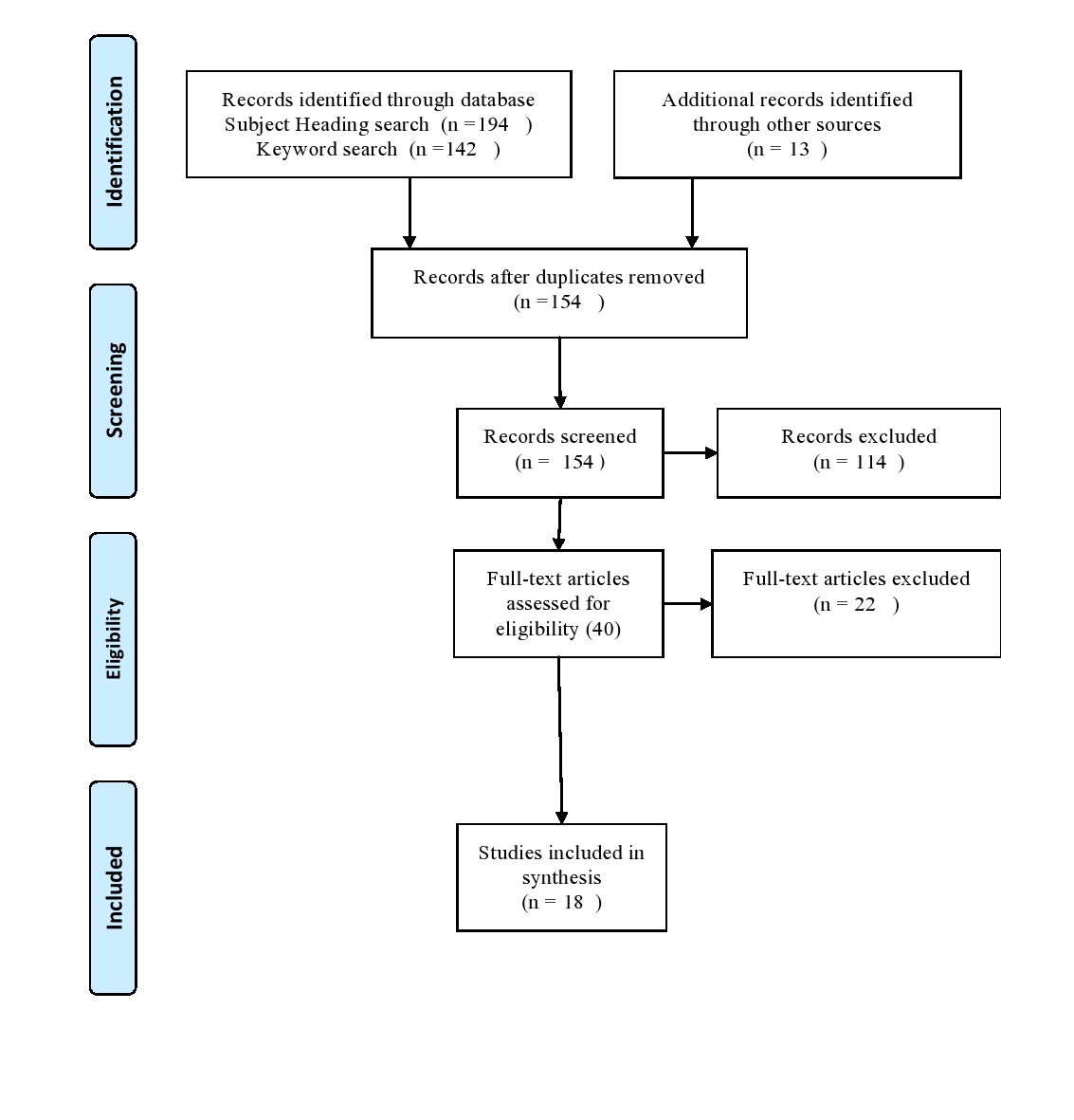
Study selection was performed in three stages (Figure 1):

Stage 1: Database Search

The studies that were identified through the database subject heading search (194 studies), the keyword search (142), and other sources (13 studies) were screened for duplication, yielding 154 studies.

Stage 2: Titles and Abstract Review

Screening of the titles and abstracts of the 154 retrieved studies was conducted by one qualified reviewer (the first author) in order to exclude any obvious non-eligible studies. Of these, 40 studies were deemed eligible for inclusion in a full article review.

Stage 3: Full Article Review

Two qualified reviewers conducted a full article review of the 40 studies. This review had two goals: first, to exclude any studies of non-eligible trials; second, to extract data on specific variables for further analyses. Of the 40 studies, 18 studies were deemed eligible for inclusion in our analysis.

Flowchart of the Review Screening Process

Data collection process

Data extraction was conducted by a qualified reviewer (the first author) during the full article review of the 18 included studies. The source of data in the individual studies was confirmed by contacting investigators who authored multiple studies included in the review, due to the aggregated weight of these studies potentially affecting our conclusion. The confirmation aimed to verify whether the data examined in the individual studies were collected from a single population and used in more than one study, or from different independent populations.

Data items

Primary Outcomes:

– Quality of Study: The quality of the study was categorized into three groups (Low, Moderate, High) (categorical variable)

– Conclusion of Study Effect: (whether the study concluded association of wind turbines with the effect on human health that was under investigation) (binary variable)

Variables (Outcome Measures of Individual Studies):

– First Author: The name of the first author (nominal variable)

– Year of Publication: The year in which the study was published (ordinal variable)

– Journal Name: The name of the publishing journal (nominal variable)

– Country of Study: The name of the country where the trial was originated (nominal variable)

– Study Design: The design of the study (nominal variable)

– Sample Size: The study sample size (continuous variable)

– Response Rate: The response rate of subjects in the study (continuous variable)

– Level of Evidence: The Level of evidence of the study (nominal variable)

– Level of Potential Bias: The level of risk of bias. Categorized into three groups according to Cochrane’s recommendations [10]. (Low risk of bias: Plausible bias unlikely to seriously alter the results; Unclear risk of bias: Plausible bias that raises some doubt about the results; High risk of bias: Plausible bias that seriously weakens confidence in the results) (categorical variable)

– Outcome Measures of Study: The outcome measure under investigation in the study (nominal variable); these outcome measures are:

– Annoyance (Sensitivity to Noise)

– Sleep disturbance

– Visual impact

– Well-being (Quality of Life/Mental Effect)

– Dose-response (description of the change in distress caused by differing distances from a wind turbine)

– Infrasound effect

– Existing background noise (comparison of stress associated with wind turbines to stress associated with road traffic noise/quiet rural environment)

– Attitude to wind turbines (whether people who complain have negative personal opinions toward wind turbines)

– Economical benefit (whether people who benefit economically from wind turbines have a decreased risk of distress)

Risk of bias in individual studies

Assessing the risk of bias of individual studies was performed at both the study level (study design, sample size, response rate, direction and magnitude of any potential bias and how it was handled, limitations, and reporting quality) and the outcome level (a cautious overall interpretation was drawn of the study’s conclusions, whether effect of human distress exists, considering the specific study’s objectives).

Summary measures and synthesis of results

After data extraction, each study was analyzed to identify the two primary outcomes: First, quality of study, taking into account the study’s principle outcome measures; all outcomes, exposures, predictors, potential confounders, and effect modifiers; how the study size was arrived at; how quantitative variables were handled in the analyses; description of all statistical methods; and how loss to follow-up and missing data were addressed. Second, conclusion of study effect as a cautious overall interpretation of the study’s conclusions, taking into account the specific study’s objectives and how well these conclusions were supported by the study results.

Risk of bias across studies

To reduce potential sampling bias (for example, the quality of study could be confounded by journal name and name of first author), the reviewers blinded themselves to the name of the journal and authors until all data on the other variables of interest were collected. To reduce potential measurement bias, the following three measures were undertaken: The data were directly entered into the database instead of using collection forms, quality assurance on all steps of data collection and management was performed, and in any case of uncertainty in deciding the quality of study, the reviewer consulted one of our senior authors to confirm the decision. Furthermore, the source of data was confirmed by contacting investigators who authored multiple studies included in the review, due to the weight their aggregated studies would have in affecting our conclusions.

Ethics approval

This study used previously published data making it exempt from institutional ethics board approval.

Results

Study selection

Figure 1 presents a flowchart depicting the study screening process. The database searches produced 154 publications. From this group, 40 publications were eligible following screening the titles and abstracts. From this group, 18 publications were eligible for inclusion after full article review. These 18 studies, shown in Table 1, consist of six original studies and 12 non-original studies (secondary analyses and literature reviews based on some of these original studies). Only the six original studies were included in the final analysis shown in Table 2. The 12 non-original studies were excluded from the analysis to minimize potential bias associated with repeated results.

This review used previously published data; therefore, there was no missing data for any of the variables of interest.

                                                                                  Study Characteristics
1st Author, Year Country Design Sample Size Response Rate % Level of Evidence Risk Of Bias Within Studies Quality of Study
Bakker [11]2012 ^ Netherlands Cross-sectional 725 37 4 Unclear risk of bias Moderate
Hanning [12]2012 ^ UK Expert Opinion/Review N/A N/A 5 Unclear risk of bias Moderate
Nissenbaum[13] 2012 ¥ USA Cross-sectional 106 75 4 Low risk of bias Moderate
Knopper [6]2011 ^ Canada Review 15 N/A 4 Unclear risk of bias High
Shepherd[14] 2011 ¥ New Zealand Cross-sectional 39, 158 34, 32 3,4 Low risk of bias High
Janssen [15]2011 ^ Netherlands Secondary analysis 1820 68, 58,  <30 4 Low risk of bias High
Pedersen[16] 2011 ^ Sweden Secondary analysis 1755 * 4 Low risk of bias High
Bolin [17]2011 ^ Sweden Review N/A N/A 4 Unclear risk of bias Low
Pedersen[18] 2010 ^ Sweden Secondary analysis 725 37 4 Low risk of bias High
Salt [7] 2010 ¥ USA Expert Opinion Report N/A N/A 5 Unclear risk of bias High
Pedersen[19] 2009 ¥ Netherlands Cross-sectional 1948 37 4 Low risk of bias High
Keith [20]2008 ^ Canada Expert Review N/A N/A 5 Unclear risk of bias High
Pedersen[21] 2008 ^ Sweden Secondary analysis 1095 N/A 4 Low risk of bias High
Pedersen[22] 2008 ^ Sweden Secondary analysis 1822 60 4 Low risk of bias High
Pedersen[23] 2007 ^ Sweden Qualitative Study 15 N/A 5 Low risk of bias High
Pedersen [5]2007 ¥ Sweden Cross-sectional 754 58 4 Low risk of bias High
Leventhall[24] 2006 ^ UK Report N/A N/A 5 Unclear risk of bias High
Pedersen[25] 2004 ¥ Sweden Cross-sectional 351 68 4 Low risk of bias High
1st Author, Year Does-response Road Traffic Noise / quiet rural environment Sleep Disturbance Annoyance/ sensitivity to noise Visual impact Attitude to wind turbines Infrasound effect Well-being (Quality of Life / mental effect) Economical Benefit
Nissenbaum[13] 2012 p < 0.05 p = 0.03 p = 0.002
Shepherd[14] 2011 U-R = 0.43 p < 0.001 U-R = 0.44 p < 0.001 U-R = 0.20 p < 0.01
Salt [7] 2010 Exp Exp
Pedersen[19] 2009 LRC = 0.50 p < 0.001 LRC = 1.07- p < 0.01 LRC = 0.35 p < 0.001 LRC = 1.04 p <0.001 LRC = 0.54 p < 0.001 LRC = -2.77 p < 0.001
Pedersen [5]2007 OR = 1.1 (95% CI 0.91 to 1.21) OR = 1.1 (95% CI 1.01 to 1.25) OR = 1.1 (95%  CI 0.97 to 1.21) OR = 1.1 (95%  CI 1.00 to 1.25)
Pedersen[25] 2004 Rs = 0.35  p < 0.001 Rs = 0.42  p < 0.001 Rs = 0.52  p < 0.001 Rs = 0.33  p < 0.001

Study characteristics and risk of bias within studies

Table 1 shows data on the 18 peer-reviewed studies captured in our review, including individual study characteristics, level of potential bias, and quality of study.

Results of individual studies

Table 2 shows summary data on the six original studies’ objectives, p-values, and outcome measures.

Risk of bias across studies

One main source of potential bias across these studies was that 10 of them, listed below, were mainly based on three data sets. The first data set (SWE00) was collected in Sweden in the year 2000 in agricultural areas, the second (SWE05) was collected in different environments in Sweden 2005, and the third (NL07) was collected all over the Netherlands in 2007. This potential bias was eliminated by using only the three original studies that collected the data sets [5, 19, 25].  The rest of the 10 studies (non-original studies) were excluded from the analysis to avoid repeated results.

– Bakker [11] 2012 Science of the Total Environment (NL07)

– Pedersen [16] 2011 Noise Control Eng J (SWE00) + (SWE05) + (NL07)

– Janssen [15] 2011 Acoustical Society of America (SWE00) + (SWE05) + (NL07)

– Pedersen [18] 2010 Energy Policy (NL07)

– Pedersen [19] 2009 Acoustical Society of America (NL07)

– Pedersen [21] 2008 Journal of Environmental Psychology (SWE00) + (SWE05)

– Pedersen [22] 2008 Environ Res Lett (SWE00) + (SWE05)

– Pedersen [23] 2007 Qualitative Research in Psychology (SWE00)

– Pedersen [5] 2007 Occup Environ Med (SWE05)

– Pedersen [25] 2004 Acoustical Society of America (SWE00)

Another source of bias was that three of the studies were reviews of previous literature [6, 12, 17].

Key results

– All 18 peer-reviewed studies captured in our review found an association between wind turbines and one or more types of human distress. These studies had a level of evidence of four and five.

– None of the studies captured in our review found any association (potential publication bias).

– These studies were published in a variety of journals (representative sample).

– Two of these studies showed a dose-response relationship between distance from wind turbines and distress (Table 2).

– There is still no evidence of whether or not a causal relationship between distance from wind turbines and distress exists.

Discussion

Summary of evidence

The peer-reviewed studies we reviewed provide reasonable evidence (Levels Four and Five) that an association exists between wind turbines and distress in humans.

Two of these studies showed a dose-response relationship between distance from wind turbines and distress, and none of the 18 studies concluded no association (consistency of association). The existence of a dose-response relationship and consistency, two of the Hill’s Criteria of Causality, argues for the credibility of the association.

All the evidence comes from expert opinion, case studies, and cross-sectional studies. No higher level of evidence observational studies, namely case-control and cohort studies, were utilized to investigate the subject. For example, although Shepherd, et al’s study [14] had a sound design and was well conducted and reported, it is considered at a lower level of evidence as a cross-sectional study has an increased potential for bias of its results.

Although three of the studies [6-7, 24] suggested that low-frequency sound energy wind turbines (i.e., infrasound below 20 Hz) may directly and negatively affect health, the level of evidence for these studies is also weak (expert opinions [7, 24] and a review [6] citing these two studies).

Economic benefit found in two of the studies [15, 19] could be intuitively and prematurely viewed as a factor lowering the credibility of the complaint. However, in our opinion, compensation would have lowered the credibility of the complaint only if these people had no distress following compensation. People in the studies who benefited economically from wind turbines had a decreased risk of distress but not a complete elimination of distress. Furthermore, the fact that the level of distress could be altered with financial compensation only speaks to the existence of distress.

It is worth pointing out that no causality has been established. The distress could be due to factors other than actual noise exposure. For example, the distress experienced by the participants in the original studies may have been generated or exaggerated by exposure to negative opinions on wind turbine.

Limitations

This study has a number of limitations and sources of bias. One source of bias is the exclusion of non-English studies. For example, China is the world’s leading country in the number of wind turbines [1]. The exclusion of non-English studies might have affected the overall conclusions of our review.

Another source of bias is the fact that the reviewer could not be completely blinded to the journals’ or authors’ names. There might be a theoretical incline to give studies in high impact journals higher quality because of their reputation (potential sampling bias). Nevertheless, if this bias took place, it would have an effect on the magnitude of evidence and not on the existence of the association due to the dichotomous nature of this variable (the number of studies that speaks for an association will not change).

Publication bias could be the reason for the finding that none of the 18 peer-reviewed studies captured in our review found no association. However, potential publication bias was decreased by conducting a search in two major grey literature databases (SIGLE, and Scirus).

Generalizability

The 18 studies were published in a variety of journals, making the captured studies a representative sample, which in turn increases our results’ generalizability (external validity).

The fact that the data in two of the three mentioned data sets were collected in Sweden may decrease the external validity, but simultaneously may increase the internal validity following the above logic. Furthermore, although these data were collected from one country, it still would be a safe assumption that the people and their experience with wind turbines, on which these data were collected, are not fundamentally different from people and experiences in other countries.

Future research

Further research in the area of exposure assessment and measurement is needed. The mechanism and physiology of harm needs to be confirmed. There is a need to identify the actual risk of harm and the health outcomes in people exposed. Until research can separate out specific sets of significant factors for the exposure with higher-level evidence than is available now, our ability to mitigate the harm is limited. Possible future research could be conducting longitudinal studies, performing measurements before wind turbines and after, and observing what happens to people over time.

Conclusions

We have demonstrated in our review the presence of reasonable evidence (Levels Four and Five) supporting the existence of an association between wind turbines and distress in humans. The existence of a dose-response relationship between distance from wind turbines and distress as well as the consistency of association across studies found in the scientific literature argues for the credibility of this association. Future research in this area is warranted.


References

  1. The Global Wind Energy Council. Accessed: October 30, 2013: http://www.gwec.net/?s=canada.
  2. The Global Wind Energy Council.. (2012). Accessed: October 30, 2013:http://www.gwec.net/wp-content/uploads/2012/06/Top-10-Cumulative-Capacity-December-2012.jpg.
  3. University of Strathclyde Archives. Accessed: January 20, 2014:http://stratharchives.tumblr.com/post/85511105886/week-18-windmill-designed-and-built-by-james.
  4. Krogh C, Gillis L, Kouwen N, Aramini J: WindVOiCe, a self-reporting survey: adverse health effects, industrial wind turbines, and the need for vigilance monitoring. Bull Sci Technol Soc. 2011, 31:334-45.
  5. Pedersen E, Hallberg L, Waye KP: Living in the vicinity of wind turbines–a grounded theory study. Qualitative Research in Psychology. 2007, 4:49–63.
  6. Knopper LD, Ollson CA: Health effects and wind turbines: A review of the literature. Environ Health. 2011, 10:78. 10.1186/1476-069X-10-78
  7. Salt AN, Hullar TE: Responses of the ear to low frequency sounds, infrasound and wind turbines. Hear Res. 2010, 268:12-21. 10.1016/j.heares.2010.06.007
  8. World Health Organisation: Night noise guidelines for Europe. (2009). Accessed: October 30, 2013:http://www.euro.who.int/__data/assets/pdf_file/0017/43316/E92845.pdf.
  9. Hill AB: The Environment and Disease: Association or Causation?. Proc R Soc Med. 1965, 58:295-300.
  10. Higgins JPT, Altman DG, Sterne JAC on behalf of the Cochrane Statistical Methods Group and the Cochrane Bias Methods Group: Chapter 8: Assessing risk of bias in included studies. Cochrane Handbook for Systematic Reviews of Interventions. 2011, Version 5.1.0:Accessed: October 30, 2013:http://handbook.cochrane.org/chapter_8/8_assessing_risk_of_bias_in_included_studies.htm.
  11. Bakker RH, Pedersen E, van den Berg GP, Stewart RE, Lok W, Bouma J: Impact of wind turbine sound on annoyance, self-reported sleep disturbance and psychological distress. Sci Total Environ. 2012, 425:42-51. 10.1016/j.scitotenv.2012.03.005
  12. Hanning CD, Evans A: Wind turbine noise. BMJ. 2012, 344:e1527. 10.1136/bmj.e1527
  13. Nissenbaum MA, Aramini JJ, Hanning CD: Effects of industrial wind turbine noise on sleep and health. Noise Health. 2012, 14:237-43. 10.4103/1463-1741.102961
  14. Shepherd D, McBride D, Welch D, Dirks KN, Hill EM: Evaluating the impact of wind turbine noise on health-related quality of life. Noise Health. 2011, 13:333-9.10.4103/1463-1741.85502
  15. Janssen SA, Vos H, Eisses AR, Pedersen E: A comparison between exposure-response relationships for wind turbine annoyance and annoyance due to other noise sources. J Acoust Soc Am. 2011, 130:3746-53. 10.1121/1.3653984
  16. Pedersen E: Health aspects associated with wind turbine noise—Results from three field studies. Noise Control Eng J. 2011, 59:47-53.
  17. Bolin K, Bluhm G, Eriksson G, Nilsson ME: Infrasound and low frequency noise from wind turbines: Exposure and health effects. Environ Res Lett. 2011, 6:1-6. 10.1088/1748-9326/6/3/035103
  18. Pedersen E, van den Berg F, Bakker R, Bouma J: Can road traffic mask the sound from wind turbines? Response to wind turbine sound at different levels of road traffic. Energy Policy. 2010, 38:2520–2527. 10.1016/j.enpol.2010.01.001
  19. Pedersen E, van den Berg F, Bakker R, Bouma J: Response to noise from modern wind farms in The Netherlands. J Acoust Soc Am. 2009, 126:634-43. 10.1121/1.3160293
  20. Keith SE, Michaud DS, Bly SHP: A proposal for evaluating the potential health effects of wind turbine noise for projects under the Canadian Environmental Assessment Act. Low Freq Noise Vib Active Control. 2008, 27:253-65.
  21. Pedersen E, Larsman P: The impact of visual factors on noise annoyance among people living in the vicinity of wind turbines. J Environ Psychol. 2008, 28:379–89.10.1016/j.jenvp.2008.02.009
  22. Pedersen E, Waye KP: Wind turbines – low level noise sources interfering with restoration?. Environ Res Lett. 2008, 3:1–5.
  23. Pedersen E, Waye KP: Wind turbine noise, annoyance and self-reported health and well-being in different living environments. Occup Environ Med. 2007, 64:480-6.
  24. Leventhall HG: Low frequency noise and annoyance. Noise Health. 2004, 6:59-72.
  25. Pedersen E, Waye KP: Perception and annoyance due to wind turbine noise–a dose-response relationship. J Acoust Soc Am. 2004, 116:3460-70.

Infrasound, from Wind Turbines, makes Life Unbearable, and we Have Proof!

Top Acoustic Engineer – Malcolm Swinbanks – Experiences Wind Farm Infrasound Impacts, First Hand

Swinbanks

****

Top Acoustic Engineer, Dr Malcolm Swinbanks has been at the forefront of investigating the impacts of infrasound and low-frequency noise for over 40 years; and has been on the wind industry’s stinky trail in Michigan since 2009.

Last month, he delivered this technically brilliant paper: “Direct Experience of Low Frequency Noise and Infrasound within a Windfarm Community” at the 6th International Meeting on Wind Turbine Noise – the conference poster is available here: M.A.Swinbanks Poster

The results and observations as to the character and nature of incessant turbine generated low-frequency noise and infrasound backs up the groundbreaking work done by Steven Cooper at Pac Hydro’s Cape Bridgewater disaster (see our post here).

In that respect, the work sits amongst fine company. However, it’s Malcolm’s own experience with turbine noise and vibration that makes his paper all the more remarkable. Here’s a few extracts that tend to knock the wind industry’s ‘nocebo’ story for six.

Summary

The author first became aware of the adverse health problems associated with infrasound many years ago in 1974, when an aero-engine manufacturer approached him to consider the problems that office personnel were experiencing close to engine test facilities. He had been conducting research into the active control of sound, and the question was posed as to whether active sound control could be used to address this problem. At that time, this research was in its infancy, and the scale of the problem clearly lay outside practical implementation. Five years later, however, the author was asked to address a related problem associated with the low-frequency noise of a 15,000SHP ground-based gas-turbine compressor installation, having a 40 foot high, 10 foot diameter exhaust stack.

This problem was of a more tractable scale, and the author and his colleagues successfully reduced the low-frequency noise of the installation by over 12dB. He subsequently was requested to address a similar installation of significantly greater size and power, again with accurately predicted results.

As a consequence of this and subsequent work, the author has gained considerable experience of the disturbing effects of low-frequency noise and infrasound. So when he first became aware of the nature of adverse health reports from windfarm residents, they were immediately recognisable as effects with which he had been familiar for as many as 35 years.

Since late 2009, the author has lived part-time within a Michigan community where windturbines have been increasingly deployed. Consequently he has had significant interaction with residents whose lives and well-being have been damaged, and moreover has experienced the associated very severe effects directly, at first hand. His resultant perspective is thus based on both detailed theoretical analysis, and extensive personal, practical experience.

Introduction

In the latter part of 2009, the intention was announced to install up to 2,800 wind turbines in Huron County, Michigan, together with adjacent regions of the Thumb of Michigan. The agricultural areas of the county are made up of 1 square mile sections, bounded by a grid of roads running north-south and east-west. The proposed wind-turbine density would amount to approximately 2-3 turbines per square mile, but in each square mile there can be typically 4 to 6 residences, usually located around the perimeter. Consequently, the requirement for adequate turbine separation would very substantially restrict the possible setbacks from residences. At that time, there existed two recently commissioned windfarms in Huron county, at Elkton (32 Vestas 80m diameter V80 turbines) and Ubly (46 GE 1.5MW 77m diameter turbines). The Elkton windfarm is in unobstructed open country, but the Ubly windfarm is in an area with significant clusters of trees, which in certain wind directions could obstruct and disrupt the low-level airflow to the turbines.

Following this announcement, the author attended an Open Meeting of the Michigan Public Services Commission, at which a number of residents spoke of the problems that they were already encountering from the windfarms, in particular the windfarm at Ubly.

This author immediately recognized these problems as relating to the characteristics of low-frequency noise and infrasound, with which he had been familiar for many years. But on subsequently visiting the windfarms, it became clear that the higher frequency audible noise levels were also unacceptable, at Ubly in particular, with up to 50dBA L10 being permitted by the ordinances. The author was astonished that any professional acoustician could possibly regard the levels as acceptable.

Following the county’s early experience the ordinances were reconsidered, so that the existing setbacks of 1000 feet, and levels of 50dBA L10, were changed for non-participating landowners to 1320 feet and 45dBA L10. But problems at Ubly were still apparent even at 1500 feet and 45dBA.

The author obtained data from one such residence, which was immediately downwind of 6 turbines located approximately in a line at distances of 1500 feet to 1.25 miles, and found that there could be significant impulsive infrasound present, even though these turbines were of modern, upwind rotor design. Under some circumstances this infrasound took the form of single pulses per blade passing interval, presumably from the nearest turbine, but sometimes up to 6 separate impulses could be detected from the turbine array.

The commissioning of further wind-turbine developments was initially hampered by the lack of high capacity transmission lines, but more recently a 5GW high voltage transmission line has been routed through the county, permitting more than adequate capacity for any intended number of windfarms and turbines. Several further windfarms, with larger 100m and even 114m diameter turbines up to 500 feet in height have now been constructed, resulting in a total of more than 320 wind-turbines installed to date.

Recently, the county has turned to reconsidering the ordinances, but as of the present date has not finalized any changes. Currently permitted wind turbine sound levels and setbacks appear to be dictated primarily by an over-riding incentive to install the requisite number of turbines per square mile.

The author has attended and commented at many public meetings, but has found that the reluctance to acknowledge adverse effects associated with low frequency and infrasound, has resulted in a situation where little traction can be gained.

Several aspects deriving from his first-hand experience will now be described in the following sections.

During the early 1980’s while working on an industrial gas turbine compressor, the author became very aware that the very low-frequency sound can quickly become imperceptible when outside in any moderate breeze. More recently, while attempting to sleep in a house 3 miles from the nearest wind-turbine of a new wind farm consisting of 35 GE 1.6 100m diameter wind turbines, the author and his wife have sometimes been kept awake by the lowfrequency rumble or infrasonic “silent thump” of the turbines.

This situation can occur when the wind has veered from a cold north wind from Canada, to a warm wind from the south blowing over cold ground. Such conditions give rise to a classic temperature inversion, and the resultant wind turbine infrasound can readily propagate for 3 miles or more.

On such occasions, the author has more than once donned outdoor clothes at 1am and gone out onto the road outside the house, clear of trees and obstructions, but in the airflow of an outside wind has been consistently unable to detect any similar subjective disturbance.

It is often argued that infrasound is more readily detectable within a residence simply because the building structure greatly attenuates the higher frequencies, but has little effect on the lower frequencies. There is an additional effect, however, that tends to be overlooked. Outside, individual ears effectively represent unshrouded pointwise microphones, equally sensitive to the full effects of airflow and true infrasound. In contrast, the conditions within a building are very different.

Pressure due to wind turbulence tends to be only locally correlated over the outside surface of the building, whereas true infrasound acts coherently over the entire structure. This gives rise to an additional spatial filtering effect, whereby the wind induced pressure distribution tends to cancel itself out, but the fully coherent very low frequency wind-turbine infrasound acts to fully reinforce itself over the entire structure.

This characteristic has been exploited for many years in the design of conformal sonar arrays – distributed pressure sensing surfaces which preferentially detect acoustic signals that are fully coherent over the surface, yet “average-out” the uncorrelated pressures due to hydrodynamic flow, yielding a significant improvement in signal-to-noise ratio.

A direct consequence of this difference between inside and outside observation is that observers visiting windfarms in the open air may quite correctly comment that they cannot hear any significant low-frequency sound. Put simply, they are not observing under the appropriate conditions. Perception within a residence, particularly in a quiet bedroom, can be entirely different.

This difference is significantly enhanced by the fact that the threshold of hearing is not a constant threshold, but is automatically raised or lowered according to the background ambient sound conditions. It is for this reason that people in urban areas, with typical ambient sound levels around 55dBA, have a naturally raised threshold and are able to tolerate additional noise of comparable level, yet this same level of noise would be completely intolerable in rural areas where ambient levels can be very much lower, not infrequently in the region of 25-30dBA.

This is one of the most important effects with respect to perception of low-frequency noise and infrasound, yet the widely cited AWEA/CANWEA Expert Health Report of 2009 (3), completely failed to indicate the consequences of this process of automatic threshold adjustment.

First Hand Experience of the Severe Adverse Effects of Infrasound.

Approximately 18 months ago, the author was asked by a family living near the Ubly windturbines to help set up instrumentation and assess acoustic conditions within their basement, which is partially underground, where they hoped to encounter more tolerable sleeping conditions.

In the early evening, the author arrived at the site. It was a beautiful evening, with very little wind at ground level, but the turbines were operating. Within the house, however, it was impossible to hear any noise from the turbines and it became necessary to go outside from time-to-time to confirm that they were indeed running.

The author did not expect to obtain any significant measurements under these conditions, but nevertheless proceeded to help set up instrumentation in the form of a B&K 4193-L-004 infrasonic microphone and several Infiltek microbarometers. Calibration of the microbarometers had previously been confirmed by performing background infrasonic measurements directly side-by-side with the precision B&K microphone. The intention was to define measurement locations, to establish instrumentation gains having appropriate headroom, and to agree and go through practice procedures so that the occupants could conduct further measurements themselves.

After a period of about one hour, which time had been spent setting up instrumentation in the basement and using a laptop computer in the kitchen, the author began to feel a significant sense of lethargy. As further time passed this progressed to difficulty in concentration accompanied by nausea, so that around the 3 hour mark, he was feeling distinctly unwell.

He thought back over the day, to remember what food he had eaten and whether he might have undertaken any other action that might bring about this effect. He had light meals of cereal for breakfast and salad for lunch, so it seemed unlikely that either could have been responsible. Meanwhile, the sun was going down leaving a beautiful orange-pink glow in the sky, while ground windspeed levels remained almost zero and the evening conditions could not have been more tranquil and pleasant.

It was only after about 3.5 hours that it suddenly struck home that these symptoms were being brought about by the wind-turbines. Since there was no audible sound, and the infrasound levels appeared to be sufficiently low that the author considered them to be of little consequence, he had not hitherto given any thought to this possibility.

As further time passed, the effects increasingly worsened, so that by 5 hours he felt extremely ill. It was quite uncanny to be trying to concentrate on a computer in a very solid, completely stationary kitchen, surrounded by solid oak cabinets, with granite counter tops and a cast-iron sink, while feeling almost exactly the same symptoms as being seasick in a rough sea.

Finally, after 5 hours it was considered that enough trial runs had been taken and analysed that it was decided to set up for a long overnight run, leaving the instrumentation under the control of the home owners. The author was immensely relieved finally to be leaving the premises and able to make his way home clear of the wind turbines.

But it was by no means over. Upon getting into the car and driving out of the gateway, the author found that his balance and co-ordination were completely compromised, so that he was consistently oversteering, and the front of the car seemed to sway around like a boat at sea. It became very difficult to judge speed and distance, so that it was necessary to drive extremely slowly and with great caution.

Arriving home 40 minutes later, his wife observed immediately that he was unwell – apparently his face was completely ashen. It was a total of 5 hours after leaving the site before the symptoms finally abated.

It is often argued that such effects associated with wind turbines are due to stress or annoyance brought about by the relentless noise, but on this occasion there was no audible noise at all within the house. Moreover, it was a remarkably tranquil evening with a very impressive sunset, so any thought that problems could arise from the turbines was completely absent.

It was only once the symptoms became increasingly severe that the author finally made the connection, having first considered and ruled out any other possibilities. So explanations of “nocebo effect” would hardly appear to be appropriate, when such awareness occurred only well into the event.

In the following two figures, the typical measured infrasound levels in the basement are shown, as measured with one of the Infiltek microbarometers.

Swinbanks Fig 8

Figure 8 shows the power spectrum, measured with a nominal 0.1Hz FFT bandwidth. As can be seen, the peak of the fundamental blade rate component, at 55dB, might not normally be considered to represent a particularly obtrusive level of infrasound. Several higher harmonics of progressively reducing amplitude are visible, but this characteristic is very much as one would expect for an upwind-rotor turbine operating in comparatively smooth airflow.

Swinbanks fig 9

The corresponding time-trace is shown in Figure 9. It can be seen that there is a single comparatively sharply defined pulse per blade-passage, so it would appear that only the closest wind-turbine is contributing significantly.

Nevertheless, it should be noted that while the fundamental harmonic of blade-passage is at only 55dB, the cumulative effect of the higher harmonics can raise the peak level of the waveform on occasion to 69-72dB. Most of the author’s prior work has concentrated on time-history analysis of the waveform, consistent with the 2004 observation by Moller & Pedersen (4) that at the very lowest frequencies it is the time-history of infrasound which is most relevant to perception. Simply observing separate spectral levels at discrete frequencies and regarding these as independent components can lead to considerable underestimate of the true levels of repetitive infrasound.

The fact that balance and coordination were found to be adversely compromised during the night drive home would suggest interference with the vestibular organs, as proposed by Pierpont (5) and subsequently by Schomer (6).

An important additional observation, however, is that the effects persisted for 5 hours afterwards, when the immediate excitation was no longer present. In contrast, for sea-sickness, effects tend to dissipate rapidly once sea conditions moderate. It is of interest that a 1984 investigation (7), in which test subjects experienced 30 minutes exposure to 8Hz excitation at very much higher levels of 130dB, reported that some adverse effects could persist for several hours later.

Conclusions

It has been shown that upwind-rotor turbines can indeed sometimes give rise to impulsive low-frequency infrasound – a characteristic commonly attributed only to old-fashioned downwind rotor configurations. But perception of wind turbine low frequency noise and infrasound can be quickly suppressed by the effects of wind-induced airflow over the ears, with the result that incorrect conclusions can easily result from observations made when exposed to outside breezy conditions.

The effects within a residence are much more readily perceptible, and cannot be ignored. An account has been given of an occurrence of severe direct health effects experienced by the author, and considered to be due entirely to wind-turbine infrasound, yet manifest under superficially benign conditions where no such adverse effects were anticipated.

MA Swinbanks
23 April 2015

Sea-sick-while-fishing

Angry Locals Willing to Fight the Wind Scam!!!

Community Defenders Down MET Mast in Donegal, Ireland

1397574371-dublin-thousands-gather-to-protest-against-pylons-and-wind-turbines_4479876

****

There aren’t many guarantees in life – death and taxes spring to mind: to which can be added open community hostility to giant fans.

Wherever wind farms have appeared – or have been threatened – big numbers of locals take a set against the monsters being speared into their previously peaceful – and often idyllic – rural communities. Their anger extends to the goons that lied their way to development approval – and the bent officials that rubber-stamped their applications and who, thereafter, actively help the operators ride roughshod over locals’ rights to live in and enjoy the peace and comfort of their own homes and properties.

The Irish have already hit the streets to bring an end to the fraud: some 10,000 stormed Dublin back in April last year. The sense of anger in Ireland – as elsewhere – is palpable (see our post here). And they’re tooling up for a raft of litigation in order to prevent the construction of wind farms, wherever they’ve been threatened on the Emerald Isle (seeour post here).

Having seen their political betters co-opted by the wind industry and acquiesce – if not actively condone – the wanton and needless destruction of neighbours’ common law rights to live in and enjoy their own homes and properties, community defenders in Ireland are fighting back. And, as elsewhere, some of the tactics used have led to sanctimonious huffing and puffing from an industry devoid of any moral compass or human empathy, and always quick to ride roughshod over the living and the dead:

Wind Power Outfits – Thugs and Bullies the World Over

The Wind Industry Knows No Shame: Turbines to Desecrate the Unknown Graves of Thousands of Australian Soldiers in France

The MET masts used by hopeful wind power outfits to gauge wind speeds are the vanguard for every wind farm disaster: no MET mast data, no wind farm. As soon as they go up, the locals circle their wagons, marshal their forces and declare war on the proponent. No surprises there.

With the wind industry on the ropes in Australia, developers are quietly pulling down their MET masts at places like Robertstown and Hallett in South Australia – much to the delight of locals (see our post here).

In Ireland, and elsewhere, locals have sought to bring matters to a head by bringing MET masts plummeting back to earth, a little earlier than their wind weasel owners had planned.

Do you know who tore down this mast at Lismulladuff in Co Donegal?
Irish Mirror
Stephen Maguire
4 April 2015

MastJPG

****

This giant 250ft mast was found cut down today on the site of Ireland’s biggest wind farm.

The scene of the crime at Lismulladuff outside Killygordon is currently the subject of local protests.

Plans were lodged with with An Bord Pleanala (ABP) a number of weeks ago by Planree Ltd for the Carrickaduff Wind Farm.

The giant wind farm will stretch from the iconic Barnesmore Gap in Donegal, along the Tyrone border, to near Castlefin.

The plans include an application for 49 giant wind turbines, some of which will be 500ft in height.

A recent meeting organised by protest group Finn Valley Wind Action (FVWA) group, was held in the Parochial Hall in the tiny village of Crossroads and attracted more than 300 locals.

The test mast was erected in recent weeks to take wind readings in the area.

Now gardai believe the mast was attacked in recent days but only discovered yesterday.

The group who are protesting over the planned wind farm have condemned the attack.

A spokesperson for the FVWA protest group condemned the attack on the test mast.

“It’s down so other than that we don’t know what happened. We can’t understand why anyone would want to do that.

“It’s bad form because it wasn’t bothering anybody. We think it was better up – as a size guide being half the height of the proposed wind turbines.

“The FVWA condemns this act of vandalism any anyone with any information should contact Ballybofey Gardai,” said the spokesperson.

Gardai from Ballybofey were on site this morning and have launched a full investigation into the attack.
Irish Mirror

The FVWA “Goldilocks” position is ‘just right’; as an effort to distance themselves from the guerrilla tactics employed – and understandable from that political perspective.

However, the saboteurs’ actions are – given what they’re up against – perfectly understandable too; and not without precedent:

More MET Mast Mayhem: Community Defenders Drop Mast in Fight to Save Homes near Bangor, Maine

MET Mast Mayhem: Scots Use Guerrilla Tactics to Stop These Things

Wave of Destruction: Ontario Wind Farm Neighbours in Open Revolt

While the Gardai set off to investigate a crime scene, it’s clearly arguable – on moral, if not legal, grounds – that what is laid out in the story (and the posts linked above) is conduct aimed at preventing a series of greater – and wholly unnecessary – crimes.

Faced with the threat of sonic torture, smashed property values and the risk of death and injury from self-igniting turbines and “uncontrolled flying blades” – from the developer’s potential victims’ viewpoint – it could equally earn the tag of community “self-defence”. And self-defence is a complete defence, to all bar murder.

As the defenders in Donegal (and elsewhere) were ostensibly acting to protect their homes, families and businesses from an acoustic trespasser (see our post here) the “castle doctrine” clearly comes into play.

That doctrine is one of some force and antiquity – it’s been on the books for nearly 400 years, when lawyer and politician Sir Edward Coke (pronounced Cook), scratched it out in The Institutes of the Laws of England, 1628:

“For a man’s house is his castle, et domus sua cuique est tutissimum refugium [and each man’s home is his safest refuge].”

And so, if a few pro-family and pro-community activists have to drop a MET mast here and there to make their point in the active defence of their homes, and the health and safety of their families, it’s action that’s probably excusable and clearly understandable. And, all the more so, when those that are paid handsomely to protect the health and welfare of their citizens, do little more than spin propaganda on behalf of the wind industry – a form of malign indifference, at best.

Many a good revolution kicked off with a handful of hotheads out to make their point, with a few misdemeanors against the property of the powerful; acts quickly deemed ‘threats to civil order’, if not ‘crimes against the state’, by those under threat – with the actors just as quickly rounded up in chains.

In the main, efforts aimed at suppressing the outrage that led the offenders to act, and punishing them for their actions, only added to their fury, and encouraged other, less passionate souls, to eagerly join the fray; and, thereafter, the rest – as they say – “is history”.

storming_the_bastille1-e1318690559144

Britts Have Come to Their Senses. When will Everyone Else Wake Up?

UK Elections: Britain’s Deliverance from its Wind Power Disaster

SWITZERLAND-WEF-DAVOS-CAMERON

****

Britain’s political betters have set it up for one enormous gamble.  Britain is wagering its entire economic future on its – out of control – wind power debacle.

Back in January last year, The Economist reported on the INSANE cost of delivering offshore wind power – where generators are guaranteed obscene returns – being able to charge “three times the current wholesale price of electricity and about 60% more than is promised to onshore turbines.”

The Economist reported that “offshore wind power is staggeringly expensive” and “among the most expensive ways of marginally reducing carbon emissions known to man”.  But that is merely to compare the insane costs of onshore wind power with the completely insane costs of offshore wind power (see our post here).

Britain’s insane wind power policy has been accompanied with all the usual stuff: an unstable grid, with increased risk of widespread blackouts; subsidy-soaked, institutional corruption; spiralling power costs;splattered birds and bats; and divided and angry rural communities.

With the previous government, Brits were lumbered with the lunatics from the Department of Energy and Climate Change – headed up by Lib-Dem, Ed Davey – who couldn’t tell a reliable Megawatt from his elbow; a ‘team’ wedded to the delusion that Britain could run on millions of giant fans and a whole lot of luck (see our post here).

Now, what a difference a day makes: election day, that is.

Ed Davey lost his seat; the Lib-Dems took a pounding; and Cameron’s Tories have romped over the line with a full-grip on power. And, not only power of the political kind – wind power is about to be squeezed in a manner unthinkable, even a week ago. You see, David Cameron came out on the eve of the election with a very clear set of promises, that spell the beginning of the end for the wind industry in Britain.

‘We’ll scrap funds for windfarms’
County Times
Ben Goddard
7 May 2015

THE PRIME Minister has pledged to stop future government funding to windfarm projects including the delayed inquiry and to give local people the final say – if he is re-elected today.

David Cameron visited Crickhowell on Wednesday when he was quizzed over the delay of any announcement on the results of the Mid Wales Conjoined Wind Farm Inquiry which could see five windfarms built across Powys with each consisting of between 17 and 65 turbines up to 450 feet tall.

The five proposed windfarms, which were the subject of a year long planning inquiry, are proposed to be built at Llandinam, Carnedd Wen, Llaithddu, Llanbrynmair and Llanbadarn Fynydd.

Despite planning inspector Andrew Poulter handing his recommendations to Secretary of State Ed Davey back on December 8, a decision was made to delay any decision until after this week’s General Election.

Mr Cameron pledged to stop the windfarm project and any other on-shore windfarms within Montgomeryshire if he was elected to take a second term in Government.

He said: “You would have to ask the environment secretary who took that decision and that was a decision for him.

“However, I want to make it clear that if there is a Conservative Government in place we will remove all subsidy for on-shore wind and local people should have a greater say.

“Frankly I think we have got enough on-shore wind and we have enough to be going on with, almost 10 per cent of our electricity needs, and I think we should give local people a say if they want to block these sorts of projects.

“The only way to stop more on-shore wind is to vote Conservative there is no other party with this policy. We are saying very clearly we would remove the subsidy and give local people the power to say yes or no.

“This would end the growth of on-shore wind and if that’s what you care about you must vote Conservative.”

Last month a leaked report by the Sunday Telegraph suggested that the inquiry’s planning inspector had advised for three of the five wind turbines to be approved.

Glyn Davies, Conservative MP for Montgomeryshire, welcomed the delay of the inquiry result but said he was shocked if the report had been leaked.

He said: “I would be shocked if the Secretary of State for Energy & Climate Change, or anyone else at DECC, were to have ‘leaked’ to the Sunday Telegraph any decision on the Public Inquiry into windfarms in Mid Wales.

“I’m not in a position to confirm the accuracy or otherwise of the report.

“It would be most improper. This is about the future of Mid Wales, not some grubby political game.

“All I do know is that the inspector’s report was delivered to the Secretary of State on December 8 and that normally a decision could have been expected in early March.

“We also know that DECC has announced that a decision has been delayed for a new Government to decide in early summer.

“I would be disappointed if any of the windfarms are approved but if the Sunday Telegraph report is correct, it would be another big blow to the windfarm developers in Mid Wales in that two of the biggest windfarms would be refused permission.

“Such refusals would further undermine the horribly destructive proposal by National Grid to build a line of massive pylons from North Shropshire to Cefn Coch in Montgomeryshire.

“I have argued that any decision should be delayed, to allow a Secretary of State – other than Liberal Democrat Ed Davey – to consider it.

“If I am re-elected MP for Montgomeryshire, I will seek a further careful consideration of this wind farms/power lines project. It’s financial and environmental madness. It should be abandoned.”

If all five windfarms are approved National Grid has proposed to build a 33-mile pylon route – eight miles of which will be underground from Cefn Coch to near Oswestry – to connect the power generated by the windfarms to the national power grid.
County Times

england somerset