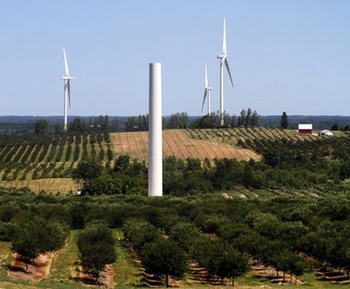
French Doctor Talks about Health Effects From Wind Turbines…..No More Denial!

Chevallier: wind turbines, eco sham and new drama Public Health

The Point – Published 10/24/2014 at 15:34

We swear by these symbols of environmental cleanliness. Yet the myth to reality, there is an abyss, and maybe even a scandal!

Avignonet Lauragais Midi-Pyrenees.  Studies show a link between these giant industrial facilities and health problems.
Avignonet Lauragais Midi-Pyrenees. Studies show a link between these giant industrial facilities and health problems.Gabalda © Remy / AFP 
By DR.

Ecology is still good. European companies seeking by all means to implement giant wind (we approach the 200 m high) in the French countryside, close to the houses. It is clear that wind turbines do not have anything green with the thousands of tons of concrete needed to support these steel monsters; about the energy, it is far from the account feedback from those already established.

My concern, as a physician and member of the European Association Physicians for a healthier environment being created, focus on health. A report by the National Academy of Medicine, published in 2006, concluded that the need to suspend (or prohibit) the construction of wind turbines with a capacity greater than 2.5 megawatts located within 1500 meters of housing. These are actually real industrial plants inducing nuisance, including noise.

Industrial wind turbines are in fact classified as ICPE: installations and plants that generate risks or dangers. Several scientific studies are being published, the results recommend that wind turbines are not located within 2.5 kilometers of homes. Thus, clinical observations of Dr. Michael Nissenbaum two wind farms in the state of Maine to the United States indicate that there is a correlation between the distance residential wind turbines and health problems for residents.

The responsibility of prefects engaged

A number of doctors have already identified multiple health problems related to ownership with these industrial machines. A medically defined the “wind syndrome” which includes increasing headache (noise and turbulence as triggers of migraines), ringing in the ears like tinnitus, sleep disorders, an increase of anxiety and depressive disorders, sometimes the appearance as Dr. Jean-François FERRIEU of “nausea, dizziness, palpitations, all of these chronic conditions can promote authentic depressions” said.

This dimension is not taken into account, or insufficiently, by the government, probably through lack of information. During this time, various local businesses, which more often then sell the exploitation rights to legally well structured international companies continue to put pressure on municipalities to accelerate Starts at times 500 meters of housing, wind farms, as they are never isolated wind turbines are located but the groups multiplied effects. The responsibility of prefects is committed to this day, since it is they who issue building permits.

Gel ongoing projects

On the evidence currently available, it would seem sensible in principle of responsibility to recommend minimum distances of 5 km between industrial wind turbines and homes. Ideally, it would be desirable to freeze all ongoing projects now and deepen health dimension not induce new diseases on a large scale.

It may also come to the conclusion that, for the health of humans and animals such as birds, farm animals or bats, precious “insecticides” natural which have been the subject of a report of the American Academy of Sciences (PNAS, September 29, 2014), it is sufficient to ban industrial wind turbines on land.

As noted by Nicolas Hulot , “initially, wind energy is a great idea, but upon arrival, it is a tragic realization. If we were told that at least it would close plants, but this is not the case. ”

Corruption and Collusion….Pillars of the Faux-Green Blob!

EXPOSED: How a shadowy network funded by foreign millions is making our household energy bills soar – for a low-carbon Britain

  • Shadowy pro-green lobbyists working at every level of the Establishment
  • Organisations are channelling tens of millions of pounds into green policies
  • Elite lobby group linked to Friends of the Earth, Greenpeace and the WWF
  • Current energy policies shaped by the Green Blob will cost up to £400billion
  • If continued, there will be further eye-watering energy bill rises for Britons
The 'Green Blob', a phrase first coined by former Environment Secretary Owen Paterson, is a group of pro-green lobbyists working at every level of the British Establishment

The ‘Green Blob’, a phrase first coined by former Environment Secretary Owen Paterson, is a group of pro-green lobbyists working at every level of the British Establishment

The Mail on Sunday today exposes how a ‘Green Blob’ financed by a shadowy group of hugely wealthy foreign donors is driving Britain towards economically ruinous eco targets.

The phrase the ‘Green Blob’ was coined by former Environment Secretary Owen Paterson after he was sacked from the Cabinet in July.

He was referring to a network of pro-green lobbyists working at every level of the British Establishment, who have helped shape the eco policies sending household energy bills soaring.

But investigations by this newspaper reveal the Blob is not just an abstract concept.

We have found that innocuous-sounding bodies such as the Dutch National Postcode Lottery, the American William and Flora Hewlett Foundation and the Swiss Oak Foundation are channelling tens of millions of pounds each year to climate change lobbyists in Britain, including Greenpeace and Friends of the Earth.

They have publicly congratulated themselves on their ability to create green Government policy in the UK – most notably after Ed Miliband steered through aggressive CO2 reduction targets in his 2008 Climate Change Act, and announced there would be no more coal power stations.

Yet the consequences of their continuing success are certain: further eye-watering rises in energy costs for millions of Britons and an increasing risk of blackouts.

According to leading energy analyst Peter Atherton of Liberum Capital, current UK energy policies shaped by the Blob will cost between £360 billion and £400 billion to implement by 2030. He said this will see bills rise by at least a third in real terms – on top of the increases already seen over the past ten years.

This bill dwarfs the EU’s £1.7 billion demand from Britain last week.

Scroll down for video 

Lobbying by the Blob helped lead to a new European Union emissions deal announced on Friday, when EU leaders including the Prime Minister agreed to triple the current pace of emissions cuts.

Following earlier deals, EU-wide emissions of CO2 are supposed to fall 20 per cent over the 30-year period 1990 to 2020.

Under the new agreement, this reduction must be doubled in just a decade, reaching ‘at least’ 40 per cent by 2030 – a goal that could only be accomplished through further massive investment in wind and nuclear energy.

At the heart of the Blob is a single institution – the European Climate Foundation (ECF) – which has offices in London, Brussels, The Hague, Berlin and Warsaw.

Every year it receives about £20 million from ‘philanthropic’ foundations in America, Holland and Switzerland, and channels most of it to green campaign and lobby groups.

Overview of the EU’s climate and energy policy architecture

An investigation has found the 'Green Blob' is working at every level of the British Establishment and Westminster (pictured)

An investigation has found the ‘Green Blob’ is working at every level of the British Establishment and Westminster (pictured)

It refuses to disclose how much it gives to each recipient, and does not publish its accounts. But it admits that the purpose of these grants is to influence British and EU climate and energy policy across a broad front.

Many more millions are fed directly to British and European lobby groups from the same overseas foundations which also fund ECF.

In its last annual report, ECF said working towards a 2030 deal was ‘a big focus area for ECF as a whole’.

ECF managing director Tom Brookes told The Mail on Sunday he provides ‘a fact-base’ to help policy-makers make the ‘many complex decisions that are necessary to move towards a high-innovation, prosperous and low-carbon future’. He added: ‘The UK is a leader in many of these fields.’

The Blob and Red Ed

Friday’s EU deal contains a get-out clause: if the rest of the world fails to agree a binding global emissions treaty at a UN conference in Paris next year, then Europe’s targets can be ‘reviewed’ – or in other words, abandoned.

Giants such as China, India and Australia have insisted they will not sign such a treaty. It is also unlikely to be approved by the US Congress, which is Republican-controlled.

However, thanks to Ed Miliband and his 2008 Climate Change Act, the get-out will make no difference for Britain. The UK is the only country which already has a binding target for 2050. By then, the law says, UK emissions must be 80 per cent down on 1990.

Mr Miliband’s Act also created a mechanism for ensuring the country sticks to a path that achieves this target – the so-called ‘carbon budget’. The scale of the challenge that its latest version poses is not widely realised.

Over the next 15 years, the electricity industry has to cut the CO2 it emits for every kilowatt it generates by 90 per cent – an unprecedented transformation.

An EU deal contains a climate change get-out clause - but thanks to Miliband's 2008 Climate Change Act - this makes no difference to Britain

An EU deal contains a climate change get-out clause – but thanks to Miliband’s 2008 Climate Change Act – this makes no difference to Britain

But the carbon budget also means the total amount of power generating capacity has to more than double. In order to meet the 2050 target, there has to be a massive shift towards electric vehicles and heating. While fossil fuel power plants will close, both their replacements and this vast additional capacity will have to be wind or nuclear – by far the most expensive types of power.

Remarkably, green lobby group Friends of the Earth not only conceived the Climate Change Act, but Bryony Worthington, the FoE official who came up with the idea and lobbied MPs to support it, later actually drafted it.

‘When you’re on the outside lobbying, you kind of hope that you are going to have an impact, [but] you’re never really very sure,’ she told a green seminar three years ago.

But she hit the jackpot. Her proposal was taken up first by the new Tory leader, David Cameron, and followed by the then-Labour Government. Worthington, who was seconded into the civil service, was asked to rewrite her lobbyist’s memo, this time as a law.

Once it was safely on the statute book, she left the civil service to form a new green campaign group, Sandbag, which presses the Government to adopt more stringent forms of carbon taxes. Like her previous employer FoE, it is now funded by ECF. Ed Miliband made her a Labour peer in 2011.

While the Act was going through Parliament, the ECF, which was launched in 2007-8, was giving money to Greenpeace UK, FoE, Christian Aid and the WWF to mount a campaign against coal-fired power plants. Also funded was Client Earth, a group of lawyers who secured court acquittals for ‘direct action’ protesters who broke into the Kingsnorth plant in Kent, climbed its chimneys and occupied it.

The campaign persuaded Mr Miliband to announce the cancellation of a planned new generating unit at Kingsnorth – and that there would be no new coal plants built in Britain.

Afterwards, the ECF president, Jules Kortenhorst, boasted that Miliband had acted in response to ‘a complex, multifaceted effort over a year and a half, with grass-roots mobilisation campaigns [and] behind the scenes lobbying’.

He added: ‘All of this work, backed by substantial philanthropic investment, resulted in UK Climate Change Secretary Ed Miliband announcing that no new coal-fired power plants would be built… This is an example of a policy that can be replicated, increasing its impact.’

Follow the money

The most significant source for the ECF’s millions is a body called Climate Works – a private foundation which channels colossal sums to climate campaigners worldwide.

The Climate Works manifesto was set out in 2007 in a document entitled ‘Design to Win: Philanthropy’s Role in the Fight Against Global Warming’. It said that to be effective, a campaign to change government policies on energy and emissions would need at least $600 million from donors.

Generous grants have been given to campaigners in countries such as Britain who have detailed knowledge of their local political systems. Their brief is to 'promote renewables and low emission alternatives'. Pictured is Drax  Power Station near Selby

Generous grants have been given to campaigners in countries such as Britain who have detailed knowledge of their local political systems. Their brief is to ‘promote renewables and low emission alternatives’. Pictured is Drax Power Station near Selby

It was driven by the belief that without radical action, ‘we could lose the fight against global warming over the next ten years’.

It advocated the giving of generous grants to local campaigners in countries such as Britain who had detailed knowledge of the way their political systems operated.

As well as better energy efficiency, carbon taxes and emissions caps, they must ‘promote renewables and low emission alternatives’. Utility companies must be given ‘financial incentives’ – in other words, enormous subsidies from tax and bill payers – to make this happen.

Climate Works soon achieved its ambitious fundraising target, with a grant in 2008 of $500 million from the William and Flora Hewlett Foundation, which spends the fortune amassed by the co-founder of the Hewlett-Packard computer firm. This was followed by further grants of up to $100 million, and donations of $60 million from the sister Packard foundation. In July, a report by a US Senate committee named the Hewlett foundation as a key element in a ‘billionaires’ club’ which effectively controlled the environmental movement, pumping more than half a billion dollars a year into green groups around the world.

It claimed these ‘wealthy liberals fully exploit the benefits of a generous tax code meant to promote genuine philanthropy and charitable acts’, but instead were transferring money to ‘activists’ to ‘promote shared political goals’.

One of the US-based Climate Works’s first acts was to set up and fund ECF as its European regional office. All ECF’s main funders are represented on ECF’s board, including Charlotte Pera, who is also Climate Works’s CEO. Susan Bell, ECF’s vice-chairman, was formerly the Hewlett foundation’s vice-president.

Another director is Kate Hampton, an executive director at the Children’s Investment Fund, a UK charity with assets worth £324 million.Others come from finance and business. ECF’s chairman is Caio Koch-Weser, vice-chairman of Deutsche Bank, whose contacts in Brussels could not be better: from 2003–5, he chaired the EU’s Economic and Financial committee. Yet another director is Mary Robinson, the former president of Ireland.

No transparency 

It is hard to assess the ECF’s full impact for a simple reason – although it publishes the names of some of the organisations it funds, it does not state how much it gives, nor exactly how this money is used.

The ECF’s Tom Brookes said: ‘The projects we fund all fall within the overall mission of the Foundation to support the development of a prosperous low-carbon economy in Europe.’

He would not explain why no amounts were stated, saying only that ECF’s annual report ‘describes the objectives of each ECF programme area and its significant grantees.

‘We are confident that this is a sufficient level of detail to provide insight into the work of the Foundation… Our policy on the information we publish reflects our responsibilities to our grantees and donors.’

Nevertheless, it is clear from the information that is available that the list of ECF funding recipients is a Who’s Who of the green movement, including Friends of the Earth, Greenpeace, the WWF, Client Earth, Carbon Brief, the Green Alliance, and E3G, the elite lobby group that persuaded the Government to set up the £3 billion Green Investment Bank.

The 2013 ECF report sets out its priorities for Britain, praising its ‘leadership on the climate front’ – thanks to the Climate Change Act.

It also boasts that its grants had an impact on this year’s Energy Act: ‘ECF grantees such as Green Alliance, E3G, and Greenpeace helped secure important milestones such as an emissions performance standard for new power stations.’

The 2013 ECF report boasts of gains made in emissions performance standards for new power stations. File image used

The 2013 ECF report boasts of gains made in emissions performance standards for new power stations. File image used

To ECF’s dismay, however, the supposed UK ‘consensus’ on climate and energy is now in jeopardy: ‘Household energy bills have shot to the top of the political agenda, and progress on decarbonisation is tangled in competing visions of the country’s energy future… A growing number of media and political voices are casting doubt on the climate science and the economic case for action.’

Against this opposition, ECF’s 2013 report says it intends to work with British greens to ‘rebuild confidence in the low-carbon transition’, by ‘fact-checking the UK media’s coverage of climate and energy issues’.

It says it will ‘establish a new unit that will promote evidence-based discussions in the media and mobilise authoritative voices on the low-carbon economy’.

Since the report was published, this unit has come into being, run by former BBC environment correspondent Richard Black. How effective it will be remains to be seen.

Meanwhile, it is clear that the sheer scale of this lavishly funded lobbying effort dwarfs that of its opponents.

The Global Warming Policy Forum in London, Europe’s only think-tank which is sceptical about climate science and energy policy, has an annual budget of £300,000 and employs just three people.

Its director, Dr Benny Peiser, said yesterday: ‘At the end of the day, someone will have to be held accountable for us committing economic suicide. We are the only organisation that does what we do – against hundreds on the other side, all saying the same thing.’

Windweasels Attack Another Community….Residents in Fighting Mode….

Jupiter Wind Farm Proponents from Another Planet

rocket atlas-5-launches-tdrs-l-liftoff-1

Yet another wind farm disaster proposed for the Southern Tablelands, yet another community backlash. This time it’s the threatened Jupiter wind farm at Tarago that has sent locals into orbit: the community is nothing short of ropeable (see our posts here and here).

Here’s one of their number smashing the Spanish developer, the disgraceful NSW Planning Department and the hypocritical ACT government.

LETTER: They are on another planet
Greg Faulkner
Goulburn Post
15 October 2014

I AM writing regarding Jupiter wind farm, proposed for the area surrounding Tarago. The proposed development would consist of up to 110 wind turbines each 170 meters or 50 stories tall.

The developer is EPYC a company which I understand is over 80 per cent Spanish owned.

My partner and I are long term residents from within the project area.

Like most locals we live here for the peace and quiet. We now face the sickening possibility of our home being sandwiched between banks of these colossal turbines, situated on our neighbours land, and possibly as close as 600 meters from our house door.

After having contacted NSW Dept of Planning about the situation, and having received no helpful response, we find ourselves with no alternative but to speak out publicly against the frightening unfairness surrounding the current approach to wind farm development in The Southern Highlands.

The turbines proposed are mind boggling huge, this cannot be overstated.

They are taller than the Sydney Harbour Bridge and very nearly as tall as Canberra’s Black Mountain Tower.

247586460-14114959

They are bigger than the ones around Bungendore and, for close residents, will never be obscured by tree plantings or anything else. Giant turbines may be a novelty to marvel at for a few moments, as we drive past, but I don’t think many Australians would want to live in their midst 24/7. I have observed the use of the term NIMBY in the media, in relation to rural residents who express any doubt about wind farm development near their homes.

The most enthusiastic users of this brutal and provocative term seem to be “green” city residents, who may be comfortable in the knowledge that their communities will never be the target of wind farm development. It seems common sense that any person who learns that their beloved home may soon be surrounded by giant turbines will be understandably devastated, and should not be subjected to cheap name calling.

A little understanding would be more productive.

Like most working, middle aged Australians, our home represents virtually all of our capital and its sale was to be central to any type of retirement or health care in our old age (not so far away).

If Jupiter wind farm proceeds our house will be sandwiched between arrays of monstrous, spinning, noise emitting turbines.

I do not think I am being pessimistic when I predict that any sale will difficult, unless the price is very, very low indeed.

In this sense alone the development is an absolute disaster for us, and most of our neighbours are in the same boat.

Australia may want renewable power options but we cannot continue forward like this.

In its haste to establish the renewable power sector it seems the NSW Government is prepared to sacrifice the wellbeing of many rural residents in the Southern Highlands, so as to provide a financially appealing environment to tempt foreign investors. It has offered up the unregulated development of the Southern Highlands to foreign developers without bothering to provide any protection for existing residents.

Claims by developers that large turbine arrays don’t affect the value or amenity of a location are ludicrous and dishonest. It seems the ACT Government is also prepared to overlook the frightening unfairness of the various wind farm developments just outside its borders, in order to buy the power produced and achieve its renewable power ambitions.

The residents of Canberra may not be aware that these arrangements will come at a very high price for many families in neighbouring rural communities.

The ACT’s position is staggeringly hypocritical, given its long standing commitment to stringent height limits in its own planning law, which protect its own skyline from unsightly high rise development.

It is clear that the ACT government understands the importance of controlling development to ensure a healthy and unoffensive environment for its own residents.

It is also clear that this concern does not extend to nearby NSW neighbours who are being targeted for wind farm development that Canberra would never tolerate itself.
GREG FAULKNER, Boro Rd via Braidwood.
Goulburn Post

At a mere 600m from the nearest turbine, the Faulkner’s currently peaceful home will be turned into a sonic torture trap and will be totally uninhabitable.

That’s around the same distance that Pac Hydro lobbed its giant fans from long-suffering Sonia Trist’s Cape Bridgewater home. After years of suffering from incessant turbine generated low-frequency noise and infrasound, Sonia has decided enough is enough and is abandoning her beautiful and – once tranquil – home (see our post here).

But not to worry, the Spanish outfit aiming to destroy the Faulkner’s property and ability to enjoy it will employ a little of the $millions it’ll receive in REC subsidy to buy the house, stitch up the owners with a bullet-proof gag clause (see our posts here and here) and then quietly bulldoze it (see our post here).

bulldozer-home

Wind Turbine Contracts…Lefty’s Use Them To Reward Their Cronies! Corruption!

Ex-Rep. Istook: Wind Energy a Crony Capitalist Gift

Thursday, 23 Oct 2014 10:13 PM

By Sean Piccoli

Wealthy investors in wind power are reaping profits from an expensive — and subsidized — form of green energy that is driving up the electricity bills of ordinary Americans, a former Oklahoma congressman told Newsmax TV on Thursday.

Under the guise of saving the planet from global warming, wind power has become a taxpayer ripoff and a boon to investors claiming massive federal subsidies for an industry that cannot compete on price with traditional energy sources, former Republican Rep. Ernest Istook told “MidPoint” host Ed Berliner.

Of the $40 billion annually doled out to various green energy incentives, grants and loans, one of the biggest magnets for public funds is a wind energy tax credit first enacted in 1992, said Istook.

“For every megawatt hour that [producers] generate through wind energy, they get $23 from the U.S. Treasury,” he said, “and of course you multiply that by the many thousands of megawatt hours that are generated — which is still a small fraction of what the country uses — and they’re talking about an $18 billion renewal of this.

“Now, this was supposed to be a temporary tax credit back in 1992 to help the industry get on its feet,” said Istook. “Well, the problem is wind power is such an expensive way to generate electricity, that even with these major subsidies — plus all sorts of subsidies from different states — it still is one of the costliest forms of power. And it makes people’s electric bills skyrocket.”

Istook said a new study from the Energy Information Administration — the U.S. Department of Energy’s statistical service — finds electric rates rising four times faster in the states that use the most wind power.

He said the arrangement continues year in and year out thanks to a classic “vicious cycle,” in which subsidy recipients use their profits to secure more subsidies.

“I want to give you a quote, though, from one individual who was a major wind energy investor and getting a lot of these tax benefits: Warren Buffett,” said Istook, citing the Nebraska-based billionaire investment guru.

“These are his words, not mine: ‘We get a tax credit if we build a lot of wind farms. That’s the only reason to build them. They don’t make sense without the tax credit.’ Those are Warren Buffett’s words,” said Istook.

“The people that are making this investment recognize that unless they can get these crony capitalism dollars, it’s a bad investment,” he said. “But government is paying them to do that. It’s paying some people to get rich at our expense while our utility bills go up”.

Istook said the public has a chance to put a stop to the tax credit, which expired last December, but is being pushed for retroactive renewal by the administration during the lame-duck congresional session that begins after the Nov. 4 midterm elections.

“They’ve got the skids greased in the U.S. Senate to do it,” said Istook.

And they will, too, he said, “unless people call their member of Congress and say, ‘Don’t vote for anything that renews this $18 billion giveaway, no matter what it’s packaged with. Don’t vote for it.’ That’s the only way we’re going to put a stop to this crony capitalism.”

Wind Turbines are a Waste of Time, Money, Agricultural lands, and Won’t Help the Environment!

Greens’ silence on folly of wind and solar power

by Ian Plimer

News Weekly, October 25, 2014

A simple evaluation of ideological electricity shows that it is unsustainable. The answer is certainly not blowing in the wind.

The amount of energy embedded in steel pylons, concrete footings, blades, wiring, magnets, land clearing and roads is more than a wind pylon would ever generate in its working life. Wind farms cannot generate electricity in a gentle zephyr or a gale, cannot operate continuously and optimistically operate at 20 per cent of nameplate capacity.

Professor Ian Plimer

Wind farms have the life of a parasite because they freeload themselves onto existing grids paid by conventional efficient energy, need subsidies and drain electricity from the grid when it is too cold. Wind turbines don’t run on wind; they run on subsidies.

A single 1,000-megawatt wind farm produces at least 7 million tonnes of carbon dioxide in component construction and concrete. Almost 100,000 truckloads of concrete are required just for the footings. Maintenance by diesel-powered vehicles only adds to emissions. Wind farms need 24/7 back-up from carbon dioxide emitting coal-fired power stations.

Wind farms do not reduce human emissions of carbon dioxide; they increase emissions.

A wind farm using 660-kilowatt generators requires 7,600 generators at 20 per cent efficiency to produce 1,000 megawatts. At $2,000 per kilowatt installation, this would cost $10 billion. This is more than twice the cost of a reliable, clean, coal-fired 1,000-megawatt generator.

The environmental effects of wind farms are devastating. Construction of wind farms in rural areas results in a decline in residents’ mental and physical health, decreased property values and community disharmony. A recent study showed hearing loss for people experiencing low frequency noise.

In the United Kingdom, renewable energy costs, principally from wind, create fuel poverty for 2.4 million folk. In the 2012-2013 UK winter, there were an additional 35,000 deaths. This translates as six sick, elderly or vulnerable people killed every year for each installed wind turbine.

At 20 per cent efficiency, 1,000 megawatts of delivered electricity requires about 800 square kilometres of cleared land. A nuclear or coal-fired power station requires up to 60 hectares of cleared land.

Habitats are destroyed by land-clearing to reduce turbulence. Generator fires are common, and the resultant grass and bushfires cannot be water-bombed from the air as wind pylons are a flight hazard. Is this the modern face of environmentalism?

In Spain, at least 18 million birds are slaughtered annually by wind-turbine blades. Bird deaths in Germany are more than 300 per turbine, and in Sweden almost 900 per turbine. German turbines kill more than 200,000 bats per year, and in the U.S. turbines kill some 2.8 million bats.

Not to worry. Greens feel morally superior because they think that wind farms emit less carbon dioxide into the atmosphere and hence are saving the planet. We are certainly saving the planet from birds and bats. If a nuclear or coal-fired electricity generator damaged the environment as much as wind farms, there would be an outcry.

Wind farms are meant to be a contribution to prevent global warming. However, patient people have been waiting for three decades for the evidence showing human emissions of carbon dioxide drive climate change. The evidence is missing in action.

The same calculations can be made for solar power. The amount of embedded energy in the metal, concrete, glass and roads is far greater than can ever be produced in a solar farm’s life. Construction of solar panels leaves toxic chemicals in someone else’s back yard. The amount of carbon dioxide released in manufacture and maintenance is greater than the saving, and coal-fired generators need to be on standby all the time because solar power is not continuous. Solar power has an efficiency of about 10 per cent and, until the laws of physics are changed, this cannot be improved.

Greens must be very pleased that the 4,000-megawatt Drax power station in Yorkshire is changing from coal to wood-burning. Some 70,000 tonnes of wood will be burned each day. Clear felling of forests in North Carolina, rail transport, pelletising, ship loading, 5,000 km of ship transport, unloading and train transport do not sound very environmentally friendly and result in huge carbon dioxide emissions from diesel and bunker fuels.

The EU has deemed that carbon dioxide emitted from wood burning is recycled by plants yet carbon dioxide emitted from fossil fuel burning is dangerous. Go figure!

Why are the Greens silent about the environmental damage of wind and solar electricity generation?

Wind power is unreliable, uneconomic and environmentally damaging. No wind farm could provide mains power without generous subsidies, increased electricity charges and horrendous damage to the environment.

Few jurisdictions have plans for disassembling a wind farm after its useful life. Defunct wind farms should remain on the skyline as a reminder to future generations of our environmental ecocide and a memorial to our stupidity resulting from caving in to green pressure.

Fund managers have invested in wind energy to make money, not to save the environment. Their due diligence would have shown that wind farms are a costly, subsidised, high-risk method of ruining the environment and that a Renewable Energy Target was unsustainable ideology.

Rather than plead to the government for even more money, fund managers should be sacked. It is not the role of government to bail out high-risk investors who follow fads and spend more money on advertisements in The Australian than on due diligence.

Ian Plimer is an Australian geologist, professor emeritus of earth sciences at the University of Melbourne, professor of mining geology at the University of Adelaide, and the director of multiple mineral exploration and mining companies. He has published many scientific papers, six books and is one of the co-editors of Encyclopedia of Geology. His most recent book, Not For Greens, is available from News Weekly Books. 

Unaffordable, Unreliable, Impractical, Unwanted Wind Turbines

October 23, 2014

Of the 10 states most reliant on wind power, nine of them have seen their electricity prices rise at least five times faster than the national average, writes James Taylor, senior fellow at the Heartland Institute. While wind advocates claim that wind power reduces costs, on-the-ground evidence suggests the opposite is true.

Taylor cites a recent report from the Texas Comptroller, which found that Texas were paying higher prices due to wind power, despite an overall drop in electricity prices. According to the report:

  • Not only is wind power more costly than traditional power, but it is unpredictable, as it only generates power when the wind blows. As a result, conventional power plants must stand ready to fill in when wind power fails, requiring additional output on short notice and making wind power far less efficient.
  • Electricity demand in Texas in Texas is at its highest on hot summer days; wind power is at its lowest production point on hot summer days.
  • Delivering wind power to residents requires the construction of new transmission lines, costing Texas households an average of $70 to $100 annually. Expanding the power grid further for more wind power will cost $2 billion in additional funds.

While Texas electricity prices have fallen, Taylor says the drop is due to deregulation and a fall in price of other energy sources. It is not, however, due to wind power, which has only slowed a drop in electricity prices.

Source: James M. Taylor, “Texas Comptroller Report Destroys Wind Industry Claims,” Heartland Institute, October 21, 2014.

MI Wind Turbine Lawsuit Settled….Operating out of Compliance!

aeinews.org


MI turbine suit settled; another lesson in operating too close to already-generous noise limits

Posted: 22 Oct 2014 03:22 PM PDT

MI Lake Winds under constructionFor the past couple of years the Lake Winds Energy Park in Mason County, Michigan has been embroiled in a contentious dispute about its noise levels (image to left is the “Park” under construction).  In April 2013, five months after the 56 turbines began operating, 17 neighbors filed suit, claiming that wind farm noise, vibrations and flickering lights were adversely affecting their health. After commissioning an independent sound study, the Mason County Planning Commission formally declared the wind farm out of compliance and demanded a mitigation plan; the developer, Consumers Energy, disputed the findings yet lost two appeals, one at the Zoning Board of Appeals and one in Circuit Court. During that series of challenges, Consumers developed a plan to modify turbine operations for 7 turbines closest to the four sites where they were found to be marginally too loud.

Marginal is indeed the word: the sound study found 4 locations where the sound level peaked at 0.3 to 1.2 decibels over the 45dBA noise limit (it takes 3dB for a difference between two sounds to be audible); when using 10-minute averages, there were no violations.  The various explanations by the consultant, Brian Howe, illustrated the fine line that the turbine operations were walking.  His report stressed “general compliance with sound level criteria,” and noted that the brief violations “do not represent a statistically significant portion of time and do not indicate a systemic exceedance.” In his initial testimony at an August Planning Commission meeting, he said that there are no recommendations to correct for these times because “there is not a situation where they are predictably going over 45.”  Later, in a November letter to the Commission, after learning that the county had previously decided NOT to allow for occasional exceedances, he stressed that “I can assure the County that competent, material and substantive evidence supports the conclusion that the turbines are not in compliance at certain residences on occasion” and elaborated:

Excursions over 45 dBA should have been anticipated since, as outlined in the acoustic study by Tech Environmental prepared in June 2011, the wind energy park was designed with sound levels identically equal to the 45 dBA criteria at some key receptors with no factor of safety to address the fact that the prediction methodology has a stated accuracy worse than +/- 3 dBA. If Tech Environmental was aware that achieving the criteria even 95% of the time was unacceptable to the County, it would have been prudent to incorporate a suitable safety margin to account for the statistical variation in sound levels.

And this the first half of the central lesson here: it’s essential that enough of a safety factor is built in to the sound models to account for known variability in sound production (how loud the blades are in various unsteady wind conditions) and sound propagation (how far sound travels as it gradually loses power).  Regular readers will know that variability is indeed, as Howe mentioned, often more than the simplified 3dB margin of error that was neglected here (see AEI’s 2012 report). The second half the lesson is related: when noise limits—for the sound of the turbines when it reaches nearby homes—are set as high as 45dBA, they will be regularly audible at these homes, and likely well above night-time ambient sound levels.  As many acousticians have stressed for years, these situations are very apt to trigger a significant number of complaints, especially if there are dozens of homes in that nearby range.  Here, we had the worst of both worlds: turbine siting plans that pushed sound right at the limit into nearby homes, and a limit that was on the high end of tolerability for many neighbors.  Indeed, after one such cautionary report was presented to the Mason County Planning Board, it decided to lower the limit to 40dB, but that change was revoked after push-back from Consumers Energy.

With this backdrop, this week the 17 original plaintiffs in the noise nuisance lawsuit agreed to a settlement offer from Consumers;
the financial and possible operational details are confidential (2 later additional litigants are yet to settle, but negotiations are ongoing).  While many such lawsuits languish, as it can be very hard to prove causality of health effects or to prove nuisance, it is always notable when a company decides it’s more advantageous to settle than to push through a court hearing (which was set to begin, with the jury already seated).  This is the latest of several such suits that were settled behind closed doors—other high profile compensation cases include Mars Hill, Maine and the Davis family in the UK, while property buy-outs of people who’ve either moved from their homes or become vocal about their issues are widespread, if not common, including a recent buy-out settlement with a family in Vermont, and purchases of multiple homes in Ontario’s Bruce and DufferinCounties.  It’s unfortunate that confidentiality clauses leave the rest of us in the dark, for one of the ways forward is for the wind industry to more willingly compensate those most impacted by their operations, and these cases could offer some guidance as to what level of compensation may be mutually agreeable.

Meanwhile, to the best of my knowledge, Consumers Energy’s challenge to the Mason County demand for mitigation is ongoing; the latest report I’ve found is that the company filed an appeal in July after its loss in Circuit Court.  The implications of how that plays out could be far-reaching.  The challenge consists of two related technical points: whether instantaneous exceedances should be considered violations, and  whether unattended sound monitoring can reliably identify violations. The latter question gets down into the technical weeds, including accounting for the presence of other ambient noise as well as turbine sounds, and the choice of measurement metric (L90 or Leq, as well as strict adherence to other sound measurement standards identified in the ordinance, which, like many local ordinances, is not necessarily savvy about all the implications and options for measurement).  As reported by Michigan Capital Confidential, a good source for coverage of this issue:

Arguing that the County’s decision was an “erroneous ruling,” the utility filed a 38-page appeal with the Michigan Court of Appeals on July 18. In addition, Consumers Energy is saying that if the ruling by 51st Circuit Court Judge Richard Cooper were allowed to stand, it could have an impact on many other wind turbine plants across the state.

“This has implications beyond just Mason County,” Dennis Marvin, spokesman for Consumers Energy told Capitol Confidential. “We believe the study the county based its decision on was flawed. We took this decision (to appeal) very seriously, but ultimately our legal staff determined this was in the best interest of our customers and the landowners at the wind park.”

Rick James, of East Lansing-based E-Coustic Solutions, is an acoustician specializing in the production, control, transmission, reception and effects of sound. According to James, Consumers Energy is not exaggerating when it talks about the potential impact of the Lake Winds case.

“Consumers’ appeal has less to do with the supposed 1 decibel error, the topic of the appeal, and more to do with the wind industry’s broader concerns,” James said. “A decision by the Appeals Court in favor of Mason County would make it easier for other counties and townships with wind energy utility noise regulations to prove non-compliance.”

“Consumers would have been better advised if they had not accepted the conclusions of their acoustical consultant that the proposed project could be fit into the host community without causing problems,” James continued.

The Undeniable Facts About Useless Wind Energy!

With wind turbines, ‘rotten’ cuts both ways

Bill Lueder’s Oct. 13 Money & Politics column in The Reporter — Wisconsin Lags on Renewable Energy — focuses on the progress of renewable energy projects in our state. He discusses solar and wind project development.

The author quotes Matt Neumann, president of the Wisconsin Solar Energy Industries Association, who says that Wisconsin’s recent record on renewable energy is “rotten.”

As a resident for six years in the Blue Skies Green Fields industrial wind project in Fond du Lac County, “rotten” is how I would describe what life has been like for my family and a number of my neighbors.

Yes, most citizens likely want energy policies that include a conservation plan, as well as different forms of renewable energy. I am not against renewable options. But what wind developers and the author of this article won’t tell you is that increasing numbers of wind turbine project residents report being sick in their homes with headaches, ear pressure, ear pain, nausea, dizziness and sleep deprivation from the infrasound and inaudible Low Frequency Noise emitted by the giant wind turbine blades.

Lueder’s article used numbers and percentages to make his case supporting renewable energy. In regard to industrial wind turbines (IWTs), what the article fails to tell readers is that industrial-scale wind turbines after 20 years of federal tax dollar subsidies in the form of Production Tax Credits have a capacity factor rated from only 17 percent to 25 percent. IWTs are not reliable and cost-effective.

When there is no measurable wind, the IWTs are not adding electricity to the grid. In fact, they require winds up to eight miles per hour before they add electricity to the grid. The money could be better spent on biomass, solar and conservation programs because wind-generated electricity is not only unsafe when sited too close to people, but is 45 percent more expensive than conventional energy systems in the state of Wisconsin.

Michael Vickerman, a spokesman for Renew Wisconsin and lobbyist for wind turbine projects, stated in the column that wind projects have “flatlined.” He added that no new wind turbine projects have been built in 2013 and 2014.

In my opinion, that is because rural Wisconsinites are educating themselves on the hazards of living 1,250 feet from these massive wind generators as set by Public Service Commission guidelines. They won’t tell you about the over 100 wind project residents in five counties who have completed notarized affidavits submitted to their county Boards of Health and reporting the above adverse health symptoms.

When these residents leave their homes for a few days, the adverse symptoms disappear. They can sleep at night. They do not experience the ear pressure and pain and tinnitus. After years of the state ignoring these complaints and their calls for a state-ordered scientific health study, last week the Brown County Board of Health weighed the scientific data collected, including the December 2012 noise testing from Shirley Wind in southern Brown County, and voted unanimously on the following resolution:

“To declare the Industrial Wind Turbines at Shirley Wind Project in the Town of Glenmore, Brown County, WI a Human Health Hazard for all people (residents, workers, visitors, and sensitive passersby) who are exposed to Infrasound/Low Frequency Noise and other emissions potentially harmful to human health.” (Brown County Board of Health, 10/14/2014)

These victims in five Wisconsin counties can no longer be dismissed and discredited by some journalists and the wind lobbyists.

Joan M. Lagerman of the town of Marshfield is a member of Concerned Citizens of Fond du Lac County.

NAPAW Discusses Low Frequency Noise Testing, & it’s Implications for Wind Industry!

NAPAW: WILL ILFN BE THE “SILENT” INDUSTRY DESTROYER? PLYMPTON WYOMING BYLAW UPDATE

Dear friends,

Please find attached a media release that we would appreciate having wide circulation.

pdf file : media release v 4 plympton wyoming

Word Document file:  media release v 4 plympton wyoming

MEDIA RELEASE

October 16, 2014

BOOKEND HEALTH ISSUES TURBINES: Existing project in Glenmore WI (Brown County) formally declares its Duke’s “Shirley Wind” project a “health hazard”, and Mayor Lonny Napper and council in Plympton Wyoming, Ontario, anticipating several projects, create a revolutionary bylaw that includes ILFN (Infra and Low Frequency Noise) penalties

By Sherri Lange

Plympton Wyoming, Ontario, Mayor Lonny Napper is astonished. “With all the available evidence from around the world about the effects of Low Frequency and Infrasound from industrial wind turbines, it amazes me that the alarms are not sounding earlier and stronger.”

With about 1,000 acres of prime land under lease for turbine development, signed up between willing hosts and developers, this council is fighting to protect its citizens’ health. A new bylaw signed and completed third reading, October 8th, 2014, sets a new and interesting precedent by mentioning and effecting fines for health impairing ILFN. ILFN is well known to be an industrial plague, now exacerbated by industrial wind turbines that plague every corner of the globe, without, as is now acknowledged widely, producing viable, reliable or “green,” energy.

In Glenmore WI, the Health Department in Brown County, almost simultaneously with the efforts of the Mayor of Plympton Wyoming and CAO, Kyle Pratt, and council, declares that the Shirley Wind Project, containing some of the largest turbines in the US, is already the site of an industrial human health hazard.

“On Monday night, the Brown County Board of Health in Wisconsin voted to declare the Shirley Wind Project to be a human health hazard.  The approved motion states:

“To declare the Industrial Wind Turbines at Shirley Wind Project in the Town of Glenmore, Brown County, WI. A Human Health Hazard for all people (residents, workers, visitors, and sensitive passersby) who are exposed to Infrasound/Low Frequency Noise and other emissions potentially harmful to human health.””

While the State of Wisconsin controls siting of industrial wind, it cannot override or subjugate the “public health hazard” declaration and initiatives. A health hazard, in most jurisdictions, is a condition of high alert, where acute or chronic illness, or death, may occur due to prolonged exposure. The hazard must be reported, and in some areas,mandated abatement must take place.

Mayor Lonny Napper seems to be of the same mind, noting that the Green Energy and Green Economy Act has taken away much democratic decision-making: his council’s bylaw aims to ensure people in his jurisdiction will be protected from turbine related ILFN and the effects that are recorded, sadly, worldwide.

Common effects are from chronic unrelenting noise, sleep disorders, hormone level disruption, increased risk of disease, diabetes, hypertension, depression, heart arrhythmias, and possibly even cancer. (Carmen Krogh and Dr Robert McMurtry recently published a case definition that accepts inner ear disruption, sleep disorders, hypertension, mood disorders, nausea, tinnitus, as part of the presenting complaints combined with proximity to wind turbines.)

“When I took an oath to protect my community, I took it very seriously,” continues Mayor Napper. “The information about what other communities are suffering, disruption, noise, degradation of precious landscapes, seriously divided communities, and to see that this possible devastation is in my full view, for my residents, something has to give.”

Mayor Napper does not understand the delay for protective measures. “People are suffering in other projects. My community is slated for multiple developers and several proposed wind projects. The time for action, and protective measures, has been with us for some time now….we can’t continue to bounce around the same arguments and with no noticeable gain in community health rights. The protection of health is first.”

Lange, of the North American Platform Against Wind Power (NA-PAW) agrees. “We have for some time now sounded the alarm for what amounts to a turbine factory health pandemic: similar effects are reported in communities worldwide. These “factories” operate without the sanction of communities. They operate without fire controls, without any regard for environmental practices, and they certainly override what is now common knowledge about noise: audible, shadow flicker, vibration and Low Frequency and Infrasound, and related air pressure fluctuations, which in combination or separately, are known to extract “torture” on unwilling people/communities.”

Both Mayor Napper and Mr. Pratt, CAO, agree that individual communities need to understand that they can use bylaw powers to protect health as required. “If Ontario communities are having so little jurisdiction to control development of massive electrical producing facilities within their boundaries, the least the council can do is to mediate the devastating health effects already reported and well known to exist, that many feel are sure to happen here.” Mr. Pratt says that he hopes the bylaw will be an example to other councils. Pratt adds, “The Town of Plympton-Wyoming Council has worked hard to protect our residents, and make sure that developers are required to deal with issues and appropriately respond to complaints and requirements from council.”

Adds Lange, “The known effects of infrasound and low frequency noise may well turn out to be the death sentence for a non-performing, entirely subsidy driven, outrage.”

Even the MOE (Ministry of Environment Ontario) admits in 2009 the complex nature of sounds and pressures:

“I went out last night for about 5 hours (got home midnight) and got some real firsthand experience with different types of noise that the turbines can create. The same turbine or groups of turbines could create 3-4 different types of noise and at different magnitudes at different times in the evening all depending on meteorological conditions, time of day, their orientation, and how they readjusted themselves (auto or by manual control – we don’t know) to wind speed and direction. Also I was able to experience firsthand wind shear conditions (no wind at ground but turbines still generating creating noise) and how that plays an important role in noise impacts.”  —Oct. 29, 2009, Bill Bardswick, Director West Central Region, Ontario Ministry of Environment

ORDER TO STAND DOWN

“Ok, message received and understood. Cam [Cameron Hall] and I will  stand down until directed otherwise.”  —Mar. 8, 2010, Gary Tomlinson, Provincial Officer, Senior Environmental Officer, Guelph District Office, West Central Region, Ontario Ministry of the Environment

For more information please contact:

Mayor Lonny Napper

Town of Plympton-Wyoming

546 Niagara Street, P.O. Box 250

Wyoming, Ontario N0N 1T0

Phone: 1 226 307 0523

Napper1@cogeco.on.ca

Kyle Pratt MPA, CMM III, CHRP, CMO

Chief Administrative Officer

Town of Plympton-Wyoming

546 Niagara Street, P.O. Box 250

Wyoming, Ontario N0N 1T0

Phone: 519-845-3939

Toll Free (Ontario): 1-877-313-3939

kpratt@plympton-wyoming.ca

Sherri Lange

CEO NA-PAW (North American Platform Against Wind Power)

kodaisl@rogers.com

416 567 5115

REFERENCES

http://stopthesethings.com/2014/10/13/world-first-ontario-council-includes-infrasound-in-wind-farm-noise-law/

http://www.obwf.ca/industrial-wind-turbines-declared-a-human-health-hazard/

http://waubrafoundation.org.au/resources/video-shirley-wind-project-wisconsin-usa/

http://waubrafoundation.org.au/resources/brown-county-ordinance-chapter-38-public-health-nuisance/

http://www.na-paw.org/pr-121207.php

http://waubrafoundation.org.au/resources/definitive-document-wind-turbine-noise-simple-statement-facts-august-2014/

http://waubrafoundation.org.au/resources/definitive-document-wind-turbine-noise-simple-statement-facts-august-2014/

http://www.thecrimson.com/article/2010/9/10/wind-energy-power-farms/

http://stopthesethings.com/2014/10/16/board-of-health-declares-wisconsin-wind-farm-a-human-health-hazard/

http://stopthesethings.com/2014/02/14/dr-mariana-alves-pereira-how-to-test-for-the-effects-of-low-frequency-turbine-noise/

file:///C:/Users/Home/Downloads/JRSM_Open-2014-McMurtry-.pdf

Wind Turbine Host, Tells the Truth About the Harm the Do!

Video – Brown Country Wisconsin Wind Turbine Host Speaks Out

Dick Koltz speaks about regretting signing on with a wind developer, and explains the color “green” when it comes to wind developers.

Video from public forum at VanAbles, Town of Holland, Brown County Wisconsin, February 18, 2010, by courtesy of Better Plan, Wisconsin.