The Greed Energy Scam is Crippling Germany!

German Government In Crisis Over Escalating Cost Of Climate Policy

European Power Plants Face Widespread Bankruptcies

An aerial view shows Vattenfall's Jaenschwalde brown coal power station near Cottbus, eastern Germany August 8, 2010. Photo: Reuters/Fabrizio Bensch

Germany’s economics minister Sigmar Gabriel (SPD) wants to levy penalty payments onto coal plants if they produce CO2 emissions above a certain threshold. Against this plan intense resistance is growing in Germany: Within the Christian Democrat, within industry and – for especially dangerous for Gabriel – within the trade unions. The Christian Democrats (CDU) in particular are taking on Gabriel’s climate levy. And Merkel is allowing her party colleagues to assail him. Armin Laschet, the vice chairman of the Federal CDU, is accusing Gabriel of breaking the coalition agreement.  –Jochen Gaugele , Martin Greive , Claudia Kade, Die Welt, 25 May 2015

The transition to renewable power generation is accelerating closures of coal and gas-fired power generation plants at a quicker rate than expected. According to UBS, policymakers may have to take measures to prevent widespread bankruptcies in the European electricity market. That’s the conclusions drawn by investment bank UBS, who have produced a report on the subject. According to their data, some 70 GW of coal and gas-fired power generation shut-downs have occurred in the last five years, and the pace is increasing, according to the analysis. –Diarmaid Williams, Power Engineering International, 11 May 2015

The world’s richest nations are unlikely to reach a deal to phase out subsidies for coal exports at talks in June, reducing the chances of a new global climate change agreement at a U.N. conference in Paris, officials and campaigners say. One European Union official, speaking on condition of anonymity, said the EU hoped to “nudge forwards” the debate, but that within the EU, Germany was an obstacle, while Japan was the main opponent in the OECD as a whole. –Barbara Lewis and Susanna Twidale, Reuters, 27 May 2015

To many western environmentalists, who are determined to see a binding global deal to reduce greenhouse gas emissions at the UN climate change conference in Paris later this year, India’s rising coal use is anathema. However, across a broad range of Delhi politicians and policymakers there is near unanimity. There is, they say, simply no possibility that at this stage in its development India will agree to any form of emissions cap, let alone a cut. — David Rose, The Guardian, 27 May 2015

The idea that India can set targets in Paris is completely ridiculous and unrealistic. It will not happen. This is a difficult concept for eco-fundamentalists, and I say this as a guy who is considered in India to be very green. Copenhagen failed because of climate evangelism. I was sitting for days with Gordon Brown, Ed Miliband, Angela Merkel, Barack Obama and Sarkozy. It was absolutely bizarre. It failed because of an excess of evangelical zeal, of which Brown was the chief proponent. Even with the most aggressive strategy on nuclear, wind, hydro and solar, coal will still provide 55% of electricity consumption by 2030, which means coal consumption will be 2.5 or three times higher than at present. –Jairam Ramesh, India’s former environment minister, The Guardian, 27 May 2015

Wind Turbines – Unaffordable, Unreliable, Novelty Energy!

The Obscene, Hidden Costs of Wind Power

Facts

****

True costs of wind electricity
Planning Engineer and Rud Istvan
12 May 2015
Climate Etc. 

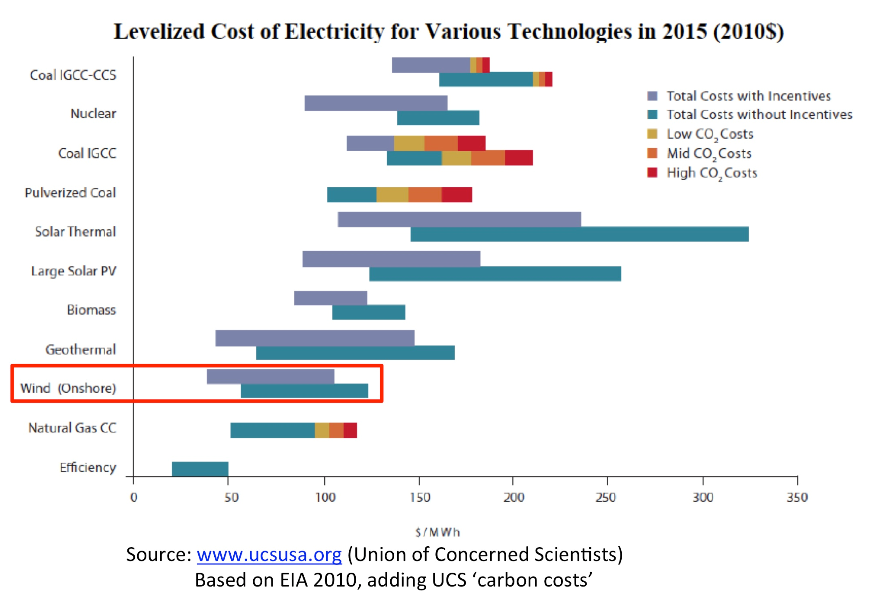
Wind turbines have become a familiar sight in many countries as a favorite CAGW mitigation means. Since at least 2010, the US Energy Information Agency (EIA) has been assuring NGOs and the public that wind would be cost competitive by now, all things considered. Many pro-wind organizations claim wind is cost competitive today. But is it? [if any of the graphs below look fuzzy, click on them and they’ll pop up clear as crystal in a new window]

Curry1-400

Yet incentives originally intended only to help start the wind industry continue to be provided everywhere. This fact suggests wind is not competitive with conventional fossil fuel generation. How big might the wind cost gap be? Will it ever close? We explore these questions in four sections: incentives, lifetime cost of electricity generation (LCOE), system costs, and market distortions. We examine onshore wind, since EIA says offshore is almost 3x more expensive. For simplicity, we examine EIA national averages, rather than regional ranges.

Incentives

The main US federal incentive is the wind Production Tax Credit (PTC), created by the Energy Policy Act of 1992. It is now $21.50/MWh for the first ten years of generation. It was intended to jumpstart the industry, so has expired via sunset provisions several times over the past 23 years. Each time, US wind investment promptly collapsed. Each time, Congress promptly renewed PTC at the same or higher incentive rates. Why? At Berkshire Hathaway’s (BH) 2014 annual meeting (BH’s Iowa based electric utility MidAmerican Energy has $5.6 billion invested in wind generation) Warren Buffet said:

“I will do anything that is basically covered by the law to reduce Berkshire’s tax rate. For example, on wind energy, we get a tax credit if we build a lot of wind farms. That’s the only reason to build them. They don’t make sense without the tax credit.” [1]

Curry2-400

U.S. Congressman Lamar Smith asked the Congressional Budget Office to estimate PTC’s 2013 cost (as part of that year’s reinstitution debate): the 2013 cost was $13 billion.

Iowa has enacted an additional state PTC of $10/MWh. Buffet gets a total PTC of $31.5/MWh from both federal and Iowa taxpayers. YE2014, BH’s MidAmerican Energy, had 2953MW of Iowa wind capacity. Warren Buffet wind farms are receiving $253 million of annual tax credit from Iowa wind generation on an investment of $5.6 billion (2953 MW * 0.31CF * 8766 hr/year *$31.5/MWh). BH’s effective tax rate last year was 31%. Those wind credits are equivalent to earning (253/0.31) $816 million on his $5.6 billion wind investment—a 15% return before any operating profit from selling electricity. That is a good deal for the Nebraska billionaire, but not for the rest of us.

The EIA estimates wind costs five years in the future. Since 2010, each cost estimate has had a separate entry for subsidies. Each estimate since 2012 (for 2017) has zero wind subsidies. EIA assumes the PTC expires (it has yet again YE2014). The Obama administration is proposing it be made permanent, with strong support from the AWEA (American Wind Energy Association). This suggests EIA’s estimated wind costs are too low, and partly political rather than mostly factual. How much is shown by closer examination of their other cost components.

LCOE

The most recent ‘official’ EIA estimates are available in Table 1 of EIA’s Annual Energy Outlook 2015, Electricity Generation Forecasts. The EIA explains:

Levelized cost of electricity (LCOE) is often cited as a convenient summary measure of the overall competiveness of different generating technologies. It represents the per-kilowatthour cost (in real dollars) of building and operating a generating plant over an assumed financial life and duty cycle. Key inputs to calculating LCOE include capital costs, fuel costs, fixed and variable operations and maintenance (O&M) costs, financing costs, and an assumed utilization rate for each plant type. The importance of the factors varies among the technologies. For technologies such as solar andwind generation that have no fuel costs and relatively small variable O&M costs, LCOE changes in rough proportion to the estimated capital cost of generation capacity.

EIA’s LCOE is the annualized net present value (aka annual annuity cost). The estimate is always 5 years into the future. That is why their 2010 estimate above was only verifiable in 2015.

EIA calculates LCOE as the sum of five components: Capital, Fixed O&M, Variable O&M (including fuel), Transmission (incremental), and Subsidies (none). Capital costs are spread over a 30-year life at an interest rate of 6.5%. This appears superficially reasonable, but as we show below, isn’t. Following are the basic LCOE generation comparisons in $/MWh and capacity factor (CF) %, from the EIA AEO 2012 and 2014.

CF% ($2017) ($2019)
CCGT 87 66.1 66.3
Conv. Coal 85 97.7 95.6
Wind 35 96.0 80.3
GT (peaker) 30 127.9 128.4

Three things stand out. Combined cycle gas turbine (CCGT) costs are cheaper than coal. That makes directional sense; in the US CCGT is gaining share at the expense of coal. CCGT cost advantages include: (a) better net thermal efficiency (61% versus 41% for USC coal), (b) abundant inexpensive natural gas thanks to fracked shale, and (c) cheaper capacity. It takes three years to build a CCGT for about $1000-1250/kw. USC coal takes 4 years to build for about $2850/kw.[2] Peak load gas turbine (GT) capacity only costs about $750/kw, but its LCOE is twice CCGT because its capital is under utilized–only operating 30% of the time. Finally, EIA says wind is competitive with coal and will become more so (about 20% more in just three years!).

‘True’ wind LCOE is understated since the PTC is missing. The annuity value of $21.5/MWH for 10 years at 6.5% interest, annuitized over 30 years is $7.2/MWh. A ‘truer’ comparison to coal is (96+7) ~$103/MWh from the general taxpayer perspective, rather than from Warren Buffet’s.

This unsurprising result just shows the PTC was intended to make wind ‘grid competitive’, and seems to do so—at taxpayer expense. That is why investment collapses toward zero in its absence. There are, however, two further ‘obvious’ plus two additional ‘hidden in the fine print’ issues with the EIA LCOE comparisons that are equally consequential, and similarly biased.

Wind capital cost

Wind capital declines 22% from 2017 to 2019; CCGT only declines 8%. This difference is not attributable to turbine production volume. According to GWEC, 51,473 MW was delivered globally in 2014, comprising at least 17000 units (at ~3MW each). Installation costs don’t scale. Past reductions in wind capital per megawatt came from developing larger turbines, not from increased volume.

Curry3-400.png

But actual installed cost/MW stopped declining, and started rising around 2005. There are few onshore turbines larger than 3 MW because of transportation (road/rail) constraints on blade length. The above 2012 NREL composite chart is deliberately misleading; it ended in 2005 although LBNL data was available to 2011.

Curry4-400

EIA’s projected 22% decline in wind capital LCOE is very dubious. We shall use $96/MWh total, the same as EIA’s 2010 LCOE midpoint charted above.

Capacity Factor

The record US annual wind capacity factor was 2014 at 33.9%. EIA itself says the median CF over the past decade is 31%. (Still better than the UK, where CF ranged from a low of 21.5% in 2010 to a record high 27.9% in 2013.) The assumed US 35% CF is unrealistically optimistic. [3]

Curry5-400

Using the historic median CF, a ‘truer’ wind LCOE is roughly (35/31*$96/MWh) $108/MWh.Using the historic median CF, a ‘truer’ wind LCOE is roughly (35/31*$96/MWh) $108/MWh.

Fine Print interest rate

The first fine print fudge is the annuity interest rate. The 2014 EIA text says 6.5% (same as 2012). Ah, but the fine print also says that for coal generation without carbon capture and sequestration (CCS), 9.5% is used. EIA’s fine print inside that fine print says this is the equivalent of a $15/ton CO2 emissions tax on coal (buried inside Capital rather than exposed in Variable O&M explicitly including fuel cost).

EIA says conventional coal produces about 2.15 pounds of CO2 per kWh (depending slightly on coal rank). That is ~2.15 tons of CO2 /MWh, a ‘hidden’ LCOE coal fuel penalty of (2.15*$15) $32.25. There is no US ‘carbon tax’; Congress refused to enact Obama’s proposal. A ‘truer’ comparison is wind at $108/MWh to coal at $65.45/MWh.

This also makes intuitive sense. The newest technology UltraSuperCritical (USC) coal must be similar in cost to CCGT in favorable locations (considering coal transport and quality). One was just completed for $1.8 billion (SWEPCO’s 600MW Turk plant in Arkansas) and 10 additional USC coal facilities are presently planned for the US. None of these will be built until the constitutionality of EPA’s proposed CO2 limit (which effectively prohibit them) is settled.

Fine Print lifetime

EIA comparisons are based on a 30-year lifetime; this introduces a large bias. The EIA itself says the average age of the US coal fleet is 42 years; effective coal lifetime is at least that. GE’s marketing materials say the expected life of its CCGT is at least 40 years. In other words, the capital annuity component of non-wind LCOE should be reduced by ~25% to reflect longer useful lives (40 rather than 30 year annuity, EIA capital only, 0.065 r). That is $8.35/MWh lower LCOE for coal after first subtracting the $32.25 fuel penalty hidden in capital, and $4.30/MWh lower for CCGT.

On the other hand, the design life for wind is 20 years; with maintenance they may last 25 years. EIA’s assumed wind lifetime is longer than the industry’s most cheery estimate, thereby understating LCOE. A ‘truer’ comparison would be wind at (capital component annuity 25 rather than 30 years, 0.065 r) $121/MWh compared to 40 year CCGT $57.5/MWh and Coal $57.1/MWh. ‘True’ wind LCOE is about twice the cost of conventional generation from either coal or natural gas.

Studies of UK and Denmark wind farms suggest their actual economic lives appear to be 12-15 years due to wear and tear.[4] One of the unanticipated problems that arose with larger turbines is premature cracking failure of the main axial bearing(s). These failures arise from two very difficult engineering conditions. First is uneven loading. Wind speeds increase with altitude so the three blades, which span great distances, are never evenly loaded. The bearing(s) wobble under the tremendous forces generated. Second, braking when wind speed exceeds 25mph suddenly loads reverse torque on the axial side where previously unloaded (and wobbling) individual bearings are in natural misalignment to their trace. If things go ‘well’, cracking can be caught before catastrophic failure. It is expensive to repair. The blades must be detached so the turbine can be dismounted and sent back to the factory. The following image shows a 3MW unit.

Curry6-400

Sometimes things do not go well.

Curry7-400

To summarize the second section on LCOE: EIA’s wind future capital, capacity factor, and lifetime all understate the ‘true’ cost of wind. Conventional coal generation is misleadingly overstated. Given other information provably at EIA’s disposal, its wind-biased US findings appear driven by political considerations.

System Costs

We have looked at wind from the perspective of wind farmers and electricity generators. But that is not the whole story, since wind is intermittent. Intermittency has two broad utility system consequences not captured in generation LCOE. First, the grid has to have some level of offsetting backup generation to maintain stability. Those costs are not borne by wind operators unless they also happen to own the regional grid. Most don’t. Second, transmission capacity has to be added. The full extent of those costs is not usually borne by windfarms, but rather (again) by grid owners.

Intermittent backup

Grids always have some spare capacity beyond average peak load. This safety margin handles unexpected peaks, unplanned outages, and other random fluctuations. How much depends on a grid’s many specific details, but 10 – 20% reserve margins are typical. A portion of this amount must be fast start gas turbines, or spinning reserves (older smaller depreciated plants operating at minimum capacity that can be ramped as needed), or flexible hydro, or (newly) flexible CCGT. For very small wind generation proportions, the ‘normal’ reserve suffices. As the percentage of wind in the generation mix grows, it increasingly does not. There are inefficiency costs and (depending on the grid) additional backup capacity costs incurred by the system as a whole.

Additional backup requirements depend on grid details beyond just wind generating penetration. For example, Ontario generation is about 58% nuclear, 24% hydro, and 4% wind (although wind is growing since Ontario subsidizes it with above market feed in tariffs). Nuclear is base loaded. Hydro is flexed for peak loads. The large proportion of hydro in Ontario means wind can grow to double-digit penetration without any significant additional backup capacity costs.

Backup has been studied for the UK National Grid and the Texas ERCOT grid, both of which have a more traditional generation mix than Ontario as well as higher wind penetration.

UK’s zero wind for three days 12/11-13/12 during its winter peak load season illustrates the National Grid’s need for wind backup. UK peak load is handled by flexing fossil fuel generation.

Curry8-400

Newer CCGT is specifically designed to flex as efficiently as possible. In recent years GE, Siemens, Alstom, and Mitsubishi have all introduced units. For example, GE’s FlexEfficiency 50 is a 510MWCCGT that can ramp 50MW/minute. At rated output, it operates 61% efficient. It is 60% efficient down to 87% load, and 58% efficient at 40% load (and not designed to operate below 40%). Cycling at less than rated output increases capital cost/MWh via under utilization, and increases fuel cost via reduced efficiency. Notionally, wind 30% CF means a supporting FlexEfficiency 50 running 70% of the time at rated capacity, and the remainder at 40% minimum load. Using GE’s numbers, that would add about $7.20/MWh LCOE of wind intermittency flex cost on a 30-year annuity basis.[5]

The Texas ERCOT grid is quite different. It has high summer peak load demand because of air conditioning. Texas backup capacity is therefore from high LCOE gas turbine peaker units which are unused except in summer.

Curry9-400

As the proportion of wind generation increases, grids less blessed than Ontario have to add additional standby capacity of some sort. How much of which sort depends on grid details like those illustrated above. The UK National Grid has published estimates. An analysis by the UKERC suggested 15-22% additional for 10% wind production. A different analysis by the IEA ranged from 6% at 2.5% wind generation, to 12% at 5%, to 18% at 15%.[6] UK wind is presently 9.3% of generation. For the UK National Grid using flexed CCGT, these estimates imply about ($66.1+$7.2/MWh *0.15) ~$11/MWh for additional backup, a ‘truer’ wind LCOE of ($121+$11) $132/MWh for UK’s National Grid

On the Texas ERCOT grid, wind in 2014 was 10.6% of generation. For ERCOT’s summer gas peakers, wind’s ‘true’ cost is about ($121+ 0.15*$128) $140/MWh. Little wonder the Austin, Texas utility finds its renewable generation portfolio loses $80 million, while its fossil fuel generation earns $180 million annually at grid wholesale electricity rates! [7]

Transmission constraints

ERCOT also illustrates clearly the wind impact on transmission planning. Much of the wind capacity is in northern Texas, whereas the demand is in Dallas and Houston. ERCOT’s ‘CREZ’ wind driven grid capacity expansion added/upgraded 3600 miles of transmission lines at a cost of $6.9 billion over 3 years. That compares to $26 billion of cumulative (YE2014) investment in Texas wind generation. Annualized over 30 years at 6.5% and spread over ERCOT’s 36.1 million MWh of 2014 wind generation, CREZ adds wind LCOE of $6.44/MWh. That is 6.7% of EIA’s wind LCOE. EIA’s own incremental transmission estimate is 4%–yet again biased substantially low. The ‘true’ system LCOE of ERCOT wind is ($140+$6) ~$146/MWh, not anywhere near the general EIA estimate of $96/MWh — it is off by half.

Curry10-400

In the UK, lack of transmission capacity between Scotland’s wind farms and England/Wales consumers has led to National Grid Balancing Mechanism ‘constraint payments’ netting about £165/MWh for wind NOT produced when it could have been. That comes out of British ratepayer pockets, even though they get no electricity in return.

Market Distortions

In 2011, MIT’s Paul Joskow circulated a Sloan School discussion paperpointing out that non-dispatchable generation (wind) not only has a different cost profile, it has a different value (price) profile.

“Wholesale electricity prices reach extremely high levels for a relatively small number of hours each year (see Figure 1) and generating units that are not able to supply electricity to balance supply and demand at those times are (or should be) at an economic disadvantage. These high-priced hours account for a large fraction of the quasi-rents that allow investors in generating capacity to recover their investment costs (Joskow 2008) and failing properly to account for output and prices during these critical hours will lead to incorrect economic evaluations of different generating technologies.”

Here’s a rough overview of studies that have looked at the impact of intermittent wind upon energy markets. This British study found that wind serves to change the capacity mix more so than the pattern of prices. The market shift to lower fixed cost higher variable cost stations results in relatively small price changes. This study from Ireland finds that increased wind penetration does not impact the pricing of electricity in Ireland (that is argued in the paper as a plus for encouraging more wind). This study found that wind in Denmark reduced costs to consumers. This study of ERCOT in Texas found that the spot market prices were reduced but price variance, volatility and risk increased. Thisstudy of the Pacific Northwest concluded that despite being more economical and easier to integrate in a hydro-rich area, “the direct economic benefits to end-users from greater investment in wind power may be negligible.” There are many factors to consider and the interactions between spot prices and long term cost savings are uncertain. Perhaps the situation is best summed up as this reportconcluded,

“the financial impacts of wind power generation are unclear due to the complex nature of wholesale power markets and the many variables that can impact wholesale electricity prices and generator revenues (i.e., location, natural gas prices, generation mix, and electricity demand).”

It is not clear in any case that subsidizing wind production will lower overall energy prices in any region, and we already showed that subsidized wind raises generation costs.

Wind generation is associated with challenges in scheduling resources and participation in energy markets. Operators serve load with a varied generation mix. Generation plants have limited flexibility including minimum and maximum output levels, ramp up limitations, minimum down times and startup costs. The unpredictability of wind complicates the resource scheduling process. For more background see these Climate Etc postings: Watch out for the Duck Curve and All Megawatts Are Not Equal.

There is a limit to how far conventional plants can be backed down and remain available for service when they may be needed in the upcoming scheduling period. Wind availability coupled with low load periods can present major problems for system operators. It may be the case of simply having mismatched loads and generation of conventional plants may be needed to maintain grid reliability. Under “constraint payments” generators are paid for not injecting power into the grid. Under “negative power pricing” generators are charged for injecting power into the grid. Overwhelmingly conventional resources are not giving favorable treatment relative to intermittent resources.

This study notes the additional harm caused by the US Production Cost Credit, which incents wind generators to make money by injecting power even during times of oversupply. Short term this impacts reliability and raises costs for others. Long term this serves to destabilize the market for conventional generation, which will defer investment and lead to further reliability concerns.

The ERCOT region was plagued by negative pricing concerns until the CREZ transmission improvements reduced such instances.

Curry11-400

Some have argued from this that increased transmission build up cansolve the problem of negative pricing and touted Texas as an example. However, what the transmission build out did was expose the wind resources to a larger market pool, thus reducing the effective penetration level of wind. The problem that wind at significant penetration levels will cause negative pricing remains. If you increase the penetration level in the larger pool, negative problems will remerge. Consistent with that, as Texas has continued to add wind resources, negative pricing problemsre-emerged in March of this year.

Conclusion

It is reasonable to ask why utilities still invest in wind, when even after PTC ‘true’ wind generation is very uncompetitive with Coal or CCGT, as well as distorting the entire wholesale electricity marketplace. EIA LCOE is not the whole story. EIA does not include other incentives such as state level above market feed in tariffs. Ontario wind gets 13.5¢/kwh versus the Province’s 2014 average wholesale generation price of 9.25¢/kwh–a 46% premium. Texas has a variety of state wind incentives (e.g. job credits and property tax breaks) estimated to cost $1 billion in 2014. Oklahoma has a complete income tax moratorium on wind farms. In 2011, California mandated 33% renewables by 2020 no matter the cost (up from 20% in 2006). The UK has the 2008 Climate Change Act. Germany has the Energiewende. Wind operators generally do not pay a price penalty for the market distortions they create. The most severe example of distorted consequences is Germany’s E.ON utility. Late in 2014 E.ON announced it was taking a $5.6 billion impairment charge on its conventional generating assets then spinning them off into a separate (unprofitable) company.[8] Conventional generation simply is no longer profitable in Germany given Energiewende’s renewables pricing distortions and forced flexing.

We can only approximate the ‘true’ cost of wind, and how much the reality differs from ‘official’ EIA (and industry) claims. Wind resources have often been presented in a far more favorable light than they deserve. Looking at the costs presented here they are far higher than can be justified. It has been hoped that subsidies would make wind self-sustaining in short order, but wind appears no closer to economic viability today than years ago.

The impacts of subsidized wind upon electricity markets are highly uncertain, and in many cases demonstrably harmful. Wind serves to raise costs, complicate scheduling, destabilize markets, and adversely impact reliability all in a hopeless effort to receive “free” energy that is actually quite costly.

The potential for wind is limited. Any sub area can have a high penetration of renewables if those resources are diluted into a larger area. Wind can provide adequate performance when correctly integrated with hydro and fossil resources. But the challenges are significant at this time to reach high penetration levels within most standalone resource mixes in most system grids.

[1] US News and World Report 5/12/2014

[2] Essay No Fracking Way in ebook Blowing Smoke.

[3] The aptly named National Renewable Energy Lab (NREL) has an even worse bias. Their 2013 “Transparent Cost Database” (a misnomer) has a selection biased sample of 109 onshore wind farms with a CF of 39% used for LCOE.

[4] Renewable Energy Foundation, Wear and Tear Hits Windfarm Output and Economic Life (2012). Available at www.ref.org.uk. See also Staffel and Green, How does wind farm performance decline with age?, Renewable Energy 66: 775-786 (2014).

[5] We decided not to put this calculation in the text due to its complexity. CCGT LCOE capital $14.3/MWh. 70% operating at rated capacity, and 30% operating at 40% (14.3/.4) costing $21.45. Fuel inefficiency at 40% rated output is (61/58) times LCOE $49.1, a difference of $2.54. Total rated output difference is $23.99/MWh, but only for 0.3 of the time, so Δ$7.20/MWh.

[6] Holttinen et. al., Design and operation of power systems with large amounts of wind power, Final Report IEA Wind Task 25, p.170 (2009)

[7] Texas Comptroller of Public Accounts, Texas Power Challenge (2014)

[8] BloombergBusiness 11/30/14
Climate Etc.

dirtyrottenscoundrelsoriginal

Windpushers Tell Many Lies, to Achieve Their Nasty Goals…

Hammering Wind Industry Myths: the ‘In-a-Nutshell’ Version

Facts

****

Here’s a sold little wrap-up on the great wind power fraud from Mary Kay Barton – it’s so clear and thumpingly sound for STT to add, would only detract. Hats off, Mary. Over to you.

Wind energy myths spun by lobbyists and salesmen
Principia Scientific
Mary Kay Barton
13 May 2015

Industrial wind energy is a net loser: economically, environmentally, technologically and civilly.

A recent letter in my local paper by American Wind Energy Association (AWEA) representative Tom Vinson is typical of wind industry sales propaganda. It deserves correction.

This is the reality:  Industrial wind energy is a NET LOSER – economically, environmentally, technically and civilly. Let’s examine how.

Economically:

New York State (NYS) has some of the highest electricity rates in the United States – a whopping 53% above the national average. This is due in large part to throwing hundreds of billions of our taxpayer and ratepayer dollars into the wind. High electricity costs drive people and businesses out of the state, and ultimately hurt poor families the most.

A NYS resident using 6,500 kWh of electricity annually will pay about $400 per year more for their electricity than if our electricity prices were at the national average. That’s over $3.2 BILLION dollars annually that will not be spent in the rest of the state economy.

Why destroy entire towns, when just one single 450-MW gas-fired combined-cycle generating unit located near New York City (NYC) – where the power is needed – operating at only 60% of its capacity, would provide more electricity than all of NYS’s wind factories combined.

Furthermore, that one 450 MW gas-fired unit would only require about one-fourth of the capital costs – and would not bring all the negative civil, economic, environmental, human health and property value impacts that are caused by the sprawling industrial wind factories. Nor would it require all the additional transmission lines to NYC.

The Institute for Energy Research tallied the numbers and found that each wind job costs $11.45 million and costs more than four jobs that are lost elsewhere in the economy, because of all the subsidies and the resulting “skyrocketing” cost of electricity. In fact, on a unit of production basis, wind is subsidized over 52 times more than conventional ‘fossil’ fuels.

In the United Kingdom, David Cameron has finally awakened to the folly of wasting billions on the failed technology of wind. He recently declared, “We will scrap funds for wind farms.”

Environmentally:

According to the AWEA, the USA has some 45,100 Industrial Wind Turbines (IWTs). Remotely sited IWTs are located far from urban centers where the power is needed. This requires a spider web of new transmission lines (at ratepayers’ expense), which exponentially adds to the needless bird and bat deaths caused by IWTs themselves.

Additionally, sprawling industrial wind factories cause massive habitat fragmentation, which is cited as one of the main reasons for species decline worldwide.

Studies show MILLIONS of birds and bats are being slaughtered annually by these giant “Cuisinarts of the sky,” as a Sierra official dubbed IWTs in a rare moment of candor.

Governor Cuomo’s environmental hypocrisy is also worth noting. Cuomo is supporting “dimming the lights” in New York City to help stop migrating birds from becoming disoriented and crashing into buildings. Yet simultaneously, Cuomo is pushing for many more giant bird-chopping wind turbines – with 600-foot-high blinking red lights, along the shores of Lake Ontario (a major migratory bird flyway), and across rural New York State.

Technically:

Because wind provides NO capacity value, or firm capacity (specified amounts of power on demand), wind requires constant “shadow capacity” from our reliable, dispatchable baseload generators to cover for wind’s inherent volatile, skittering flux on the grid.  Therefore, wind cannot replace those conventional generation sources.  Instead, wind locks us into dependence on fossil fuels – and represents a redundancy (two duplicate sources of electricity), which Big Wind CEO Patrick Jenevein admitted “turns ratepayers and taxpayers into double-payers for the same product.”

The list of accidentsblade failures (throwing debris over a half mile), fires (ten times more than the wind industry previously admitted) and other problems is updated quarterly at a website in the UK. This lengthy and growing list is evidence of why giant, moving machines do NOT belong anywhere near where people live.

Even the AWEA admits that the life of a typical wind turbine is only 10 to 13 years (January 2006: North American Wind Power). This is substantiated by studies on these short-lived lemons.

Adding insult to injury, the actual output of all of New York State’s wind factories combined has been averaging a pathetic 23 percent.  If IWTs were cars, they would have been correctly dubbed ‘lemons’ and relegated to the junkyard a long time ago.

Civilly:

The only thing that has ever been reliably generated by industrial wind is complete and utter civil discord. Neighbor is pitted against neighbor, and even family member against family member. Sprawling industrial wind factories have totally divided communities, which is already apparent in towns across NYS and the country.  It is the job of good government to foresee and prevent this kind of civil discord – not to promote it.

Regarding human health, NYS officials admitted at a 2009 NYSERDA meeting on wind that they knew “infrasound” from wind turbines was a problem worldwide. The growing list of problems globally highlights that these problems are only getting worse.

At the NYSERDA meeting, a former noise control engineer for the New York State Public Service Commission, Dr. Dan Driscoll, testified that ‘infrasound’ (sounds below 20 Hz) are sounds you can’t hear, but the body can feel.

Dr. Driscoll said that ‘infrasound’ is NOT blocked by walls, and it can very negatively affect the human body – especially after prolonged, continuous exposure.  He said symptoms include headache, nausea, sleeplessness, dizziness, ringing in the ears and other maladies.

NYS Department of Health official Dr. Jan Storm testified that, despite knowing the global nature of the “infrasound” problem, NYS still had not done any health studies (despite having federal money available to do so). Here we are sixyears later, and indefensibly, NYS officials still have not called for any independent studies to assure the protection of New York State citizens.

“The Golden Rule,” as espoused by Rotary International’s excellent ‘Four-Way Test’ of the things we think, say and do, should be the moral and ethical standard our public servants aspire to uphold.  The test asks:

1.      Is it the truth?

2.      Is it fair to all concerned?

3.      Will it build goodwill and better friendships?

4.      Will it be beneficial to all concerned?

When applied to the industrial wind issue, the answers are a resounding, “NO!”
Principia Scientific

turbine fire

Turkish Court has the Decency to Protect Residents from Wind Turbine Noise!

Turkish Court Shuts Down 50 Turbines: Yaylaköy Residents Delighted at 1st Chance to Sleep in Years

turk1

****

One of the myths pedalled by Australia’s self-appointed wind farm noise, sleep and health ‘expert’ (a former tobacco advertising guru) is that the known and obvious adverse health impacts from incessant turbine generated low-frequency noise and infrasound are a cooked-up “phenomenon”, exclusive to the English speaking world. Trouble with that little tale is that’s been scotched by the Danes:

Vestas’ Danish Victims Lay Out the FACTS

Denmark Calls Halt to More Wind Farm Harm

And the Germans:

German Medicos Demand Moratorium on New Wind Farms

And the Tawainese:

Winning Taiwanese Hearts and Minds?

And, now the Turks. As this article lays out – in terms so simple, that even tobacco advertising gurus should be capable of understanding them.

50 operating wind turbines stopped by the court!
BurGün
18 May 2015

turk2

****

The Administrative Court in Ankara has ruled that fifty operating wind turbines in Karaburun be stopped. The locals of Yaylaköy, Karaburun are delighted with the court decision. It is 20 days since the wind turbines stopped working.

From the beginning of the struggle to protect their village from the adverse affects from the Wind Power Plants that are spreading all over the peninsula, the local people have finally received good news.

The Administrative Court, ruled in April that even if fifty wind turbines are already operating, the activities have to be halted since the environmental damage is irreversible. First an EIA report will have to be issued. The wind turbine company’s request to continue to run their turbines meanwhile, was also denied by the court.

‘THE FIRST DECISION’

The lawyer Cem Altiparmak said the decision would be a first in the country. Mr. Altiparmak states that there are very few court cases related to renewable energy.

In this area the law is insufficient, there are no precedents, so we have to live it to get experience. “A number of license revocation proceedings have started in our country. Our court ruling is one of the first and will have an impact on up-coming cases.

What has happened?

İzmir Governorship Provincial Directorate of Environment and Urban Development, had issued a “EIA Not Required” to install 166 MW in the Karaburun Peninsula.

8 years later when EMRA issued a new license for another 50 turbines to the same company leaning on the same “EIA Not Required” document, the residents of Yaylaköy and the environmental movement Karaburun City Council sued EMRA – The Energy Market Regulatory Authority.

The court ruled that this is against the law and if allowed to operate the damages will irreversible therefore all operations have to be stopped until an EIA investigation has been performed.

The court decision has given hope to the local people as well as other people in Cesme, Bodrum, Datca and Urla where wind turbines projects are being planned without any public consultation. All these projects have been issued with an EIA Not Required”.

Hopefully this Wind turbine project will not be able to operate again and for the first time in years the people in Yaylaköy are able to sleep comfortably and we will continue to work for that, says one man from the village.
BurGün

turk3

Government-induced Climaphobia Strikes Again!

Tom Harris explains why the climate promises are a joke

Harris is an engineer with a special interest in Climate studies and GHG agreements. Here he explains the hypocrisy of the Lima “promises” on reductions in emissions.

It’s like any agreement with a leftist agenda, the words hide the intentions. In any international “promise” on GHG no verification, no enforcement–window dressing.

http://www.torontosun.com/2015/05/23/harpers-climate-pledge-is-hot-air

Harper’s climate pledge is hot air

Canada has no way to ensure developing nations keep their commitments

Tom Harris, Guest Columnist

First posted: Saturday, May 23, 2015 07:00 PM EDT | Updated: Saturday, May 23, 2015 11:51 AM EDT

In announcing the Stephen Harper government’s new greenhouse gas (GHG) reduction targets earlier this month, Environment Minister Leona Aglukkaq said Canada will “work with our international partners to establish an international agreement in Paris that includes meaningful and transparent commitments from all major emitters.”

But Canadians are being tricked.

Any GHG emission reduction pledges made by developing countries in Paris later this year will almost certainly not be enforced.

Written in bureaucratese, the convoluted first sentence in last December’s “Lima Call for Climate Action”, the United Nations’ last major climate change agreement, indicated exactly that.

It reads: “The Conference of the Parties, Reiterating that the work of the Ad Hoc Working Group on the Durban Platform for Enhanced Action (ADP) shall be under the Convention and guided by its principles…”

The ADP are the back room negotiators who are drafting the text for the big climate deal to be signed in Paris in December.

The “Convention” refers to the UN Framework Convention on Climate Change (UNFCCC), signed by former Canadian prime minister Brian Mulroney and hundreds of other world leaders at the Earth Summit in Rio in 1992.

And the ADP’s work will adhere to the UNFCCC, including its critical Article 4: “The extent to which developing country Parties will effectively implement their commitments under the Convention will depend on the effective implementation by developed country Parties of their commitments under the Convention related to financial resources and transfer of technology and will take fully into account that economic and social development and poverty eradication are the first and overriding priorities of the developing country Parties.”

So, under any treaty based on the UNFCCC (which all UN climate agreements are), developing countries will keep their emission reduction commitments only if we in the developed world pay them enough and give them enough of our technology.

Also implied in the article is that, even if we give them everything we promise, developing countries may simply forget about their GHG targets if they interfere with their “first and overriding priorities” of “economic and social development and poverty eradication.”

Developed nations like Canada, on the other hand, do not have this option. We must keep our emission reduction commitments no matter how it impacts our economies.

It is not as if the UN has been hiding this “firewall” between developing and developed nations.

It has told us repeatedly in UN climate change agreements in Copenhagen, Cancun, Durban and Lima that, “development and poverty eradication”, not emission reduction, takes top billing for developing countries.

Actions to significantly reduce GHG emissions would entail dramatically cutting back on the use of coal, the source of 81% of China’s electricity and 71% of India’s.

As coal is by far the least expensive source of electric power in most of the world, reducing GHG emissions by restricting coal use would unquestionably interfere with development priorities.

So, developing countries simply won’t do it, citing the UNFCCC in support of their actions.

Some commentators have speculated that tougher requirements will be imposed by the UN on poor nations over time as they develop.

The only way this can happen is if there are substantial revisions to the UNFCCC treaty.

China, India, and other developing countries have clearly indicated they will not allow this to happen any time soon.

Chinese negotiator Su Wei summed up the stance of developing nations when he explained that the purpose of the Paris agreement is to “reinforce and enhance” the 1992 convention, not rewrite it.

Canada withdrew from the Kyoto Protocol in part because it lacked legally binding GHG targets for developing countries.

So why is the Harper government supporting a process that will result in our country being stuck in another Kyoto?

— Harris is Executive Director of the Ottawa-based International Climate Science Coalition, which opposes the hypothesis carbon dioxide emissions from human activities are known to cause climate problems

Tom Harris, B. Eng., M. Eng. (Mech.)
Executive Director,
International Climate Science Coalition (ICSC)
P.O. Box 23013
Ottawa, Ontario
K2A 4E2
Canada

Good to See Sanity Returning to Britain….

UK’s Wind Industry in Meltdown: Cameron to Flush-Out DECC’s Detritus

SWITZERLAND-WEF-DAVOS-CAMERON

****

The wind industry’s current form reminds STT of Simon Pegg’s character in ‘How to Lose Friends and Alienate People‘, Sidney Young – blunt, gormless, and ready to pull out all stops to ensure every one who counts hates him.

Now that they’ve lost the grip on the game in countries where they thought they had things sewn up, they’ve been reduced to abusing those who have the ability to make or break them. STT thinks they’re just working through the 5 stages of grief: denial, anger, bargaining, depression and acceptance (see our post here).

David Cameron has just won an election promising to end all subsidies to on-shore wind power:

UK Elections: Brit’s Deliverance from its Wind Power Disaster

In the US, ‘wind power’ states have cut their state based subsidies to wind power outfits (or are well on the path of doing so); and Republicans are out to prevent the extension of the Federal government’s PTC wind power subsidy:

2015: the Wind Industry’s ‘Annus Horribilis’; or Time to Sink the Boots In

US Republicans Line Up to Can Subsidies for Wind Power

In Germany, consumers and industry are fed up with escalating power prices:

German’s Top Daily – Bild – says Time to Chop Massive Subsidies for Wind Power

And, on Vesta’s home turf, Denmark, the government’s brewing and massive legal liability to wind farm neighbours has resulted in a full-blown moratorium on planning permits for new wind farms:

Denmark Calls Halt to More Wind Farm Harm

brat

****

The response from the wind industry has been just what you’d expect from a bunch of immature brats, that couldn’t survive for a second without a massive and endless stream of subsidies filched from taxpayers and power consumers. Here’s yet another childish wind industry outburst – this time from Britain.

Cameron Puts Wind-Farm Opponent at Junior U.K. Energy Post
Bloomberg Business
Alex Morales
12 May 2015

Prime Minister David Cameron named a vocal opponent of onshore wind farms to a junior post in the U.K. energy department, reinforcing his Conservative government’s effort to halt the spread of turbines in rural areas.

Andrea Leadsom, who has campaigned against “intrusive wind farms” in South Northamptonshire constituency in central England, will report to Amber Rudd, who was named as the Cabinet minister in charge of energy on Monday.

The two will work to balance Britain’s growing energy needs and stricter pollution rules against the demands of rural voters who voted overwhelmingly for the Conservatives. Some of those voters have raised concerns about the spread of wind farms that they say blight the landscape under the previous two governments, which encouraged the technology as the cheapest way to generate low-carbon electricity at scale.

“Whilst renewable energy has an important part to play in providing energy for our 21st century needs, we have got to stop building incredible insensitive and intrusive wind farms on top of local communities,” Leadsom says on her website. “In the future, I want to see a proper consultation process and the opportunity for communities to say no.”

Rudd, who was promoted from a junior ministerial role to lead the Department of Energy & Climate Change, worked with the Liberal Democrats in the previous coalition government and stuck closely to the government script encouraging all forms of energy, especially renewables and nuclear power.

If Rudd’s appointment reassured the renewable energy industry about the continuity of government policy to cut carbon emissions, Leadsom’s elevation is a reminder of the manifesto promise Cameron’s party made to halt subsidies to wind developments on land.

Before the election, those promises prompted Ecotricity Group Ltd. Chief Executive Officer Dale Vince, a donor to the opposition Labour Party, to call the Conservatives “an existential threat to the renewable energy industry.”

Leadsom’s appointment was announced on the Twitter feed of Cameron’s office. Her role hasn’t yet been defined, and so far she’s the only junior minister to be named at DECC. Previously, two ministers Rudd and Matthew Hancock, served as junior ministers at the department.

Hancock was moved to a role at the Cabinet Office in charge of civil service reform.
Bloomberg Business

Just a tiny whiff of panic from the wind industry’s parasites there. And just what you’d expect from Ecotricity’s Dale Vince, when he wails about the Conservatives being “an existential threat to the renewable energy industry.” We’ve covered Dale Vince’s faux claims to be the environment’s best friend:

The Guardian Caught Out Pumping Dale Vince’s Bogus Wind Power Propaganda

Although, this time around, we can’t fault Vince’s analysis: Vince and his cronies are doomed.

Cameron’s Tory-Only line up gives him the chance to follow through on the clear-as-crystal promise to “halt subsidies to wind developments on land”.

It’s that humungous policy shift that spells the beginning of the end for the wind industry in Britain.

The promise to allow communities to reject wind farms adds nothing, in practical effect – a bit like stabbing a corpse, really. Without an endless stream of guaranteed subsidies, rent-seekers like Dale Vince will disappear in a heartbeat; the wind industry will die a natural death.

With Britain turning on the wind industry, pretty soon it’ll have no “friends” left to alienate anywhere at all.

Andrea Leadsom

More Countries Caught Manipulating Their Climate Data. FRAUD!

DAILY CALLER NEWS FOUNDATION
Al Gore: green house gases and sweat.
More Countries Caught Manipulating Their Climate Data
Photo of Michael Bastasch
MICHAEL BASTASCH

05/19/2015
Weather agencies in Australia, Paraguay and Switzerland may be manipulating temperature data to create a sharper warming trend than is present in the raw data — a practice that has come under scrutiny in recent months.

Most recently, Dr. H. Sterling Burnett with the Heartland Institute detailed how the Swiss Meteorological Service adjusted its climate data “to show greater warming than actually measured by its temperature instruments.”

In his latest article, Sterling wrote that Switzerland’s weather bureau adjusted its raw temperature data so that “the temperatures reported were consistently higher than those actually recorded.” For example, the cities of Sion and Zurich saw “a doubling of the temperature trend” after such adjustments were made.

But even with the data tampering, Sterling noted that “there has been an 18-year-pause in rising temperatures, even with data- tampering.”

Unrecognizable! Cute Child Star to Ugly Adult
SportFluff
Bollywood Celebrity Love Marriages that Ended in Divorce
TenetNews.com
Creepy Secrets In Disney Movies You Won’t Believe — Just Wow
HyperTomb
by TaboolaSponsored Links
“Even with fudged data, governments have been unable to hide the fact winters in Switzerland and in Central Europe have become colder over the past 20 years, defying predictions of the Intergovernmental Panel on Climate Change (IPCC) and other climate alarmists,” according to Sterling.

The Swiss affair, however, is not the first instance of data “homogenization” catalogued by scientists and researchers who are skeptical of man-made global warming. In January, skeptic blogger Paul Homewood documented how NASA has “homogenized” temperature data across Paraguay to create a warming trend that doesn’t exist in the raw data.

Homewood found that all three operational rural thermometers in Paraguay had been adjusted by NASA to show a warming trend where one did not exist before. Homewood also found that urban thermometers in Paraguay had similarly been adjusted by NASA.

“[NASA is] supposed to make a ‘homogenisation adjustment,’ to allow for [urban heat island (UHI)] bias,” Homewood wrote. “The sort of thing you would expect to see at Asuncion Airport, Paraguay’s main gateway, handling over 800,000 passengers a year.”
“However, far from increasing historic temperatures to allow for UHI, [NASA] has done the opposite and decreased temperatures prior to 1972 by 0.4C,” Homewood added.

Before that, the Australian Bureau of Meteorology (ABM) was forced to admit it adjusts temperatures recorded at all weather stations across the country. Aussie journalists had been critical of ABM for being secretive about its data adjustments.

“Almost all the alterations resulted in higher temperatures being reported for the present and lower numbers for the past–with the higher numbers being used to demonstrate a historical warming trend–than the numbers that were actually recorded,” wrote Sterling.

“Downward homogenizations in recent years were rare. In some areas, downward temperature trends measured over time showed a significantly increased temperature trend after homogenization,” he added. “The difference between actually measured temperatures and homogenized temperatures topped 4 degrees Celsius over certain periods at some measuring stations.”

Global warming skeptics have increasingly become critical of adjustments to raw temperature data made by government climate agencies. Such adjustments seem to overwhelmingly show a massive warming trend not present in the raw data.

Such adjusted data has been used by climate scientists and environmental activists to claim that 2014 was the warmest year on record. Adjusted data also shows that 13 of the warmest years on record have occurred since 2000.

NOAA and other climate agencies have defended such adjustments to the temperature record, arguing they are necessary to correct for “biases” that distort the reality of the Earth’s climate.

NOAA scientists increase or decrease temperatures to correct for things like changes in the locations of thermometers (some that were once in rural areas are now in the suburbs or even in cities). Scientists have also had to correct for a drastic change in the time of day temperatures were recorded (for whatever reason, past temperatures were recorded in the afternoon, but are now often collected in the morning).

Other adjustments have been made to the data to correct for such “biases,” but global warming skeptics question if the scope of the data adjustments are justifiable.

The U.K.’s Global Warming Policy Foundation has created a panel of skeptical scientists from around the world who will evaluate temperature adjustments to find out if they are scientifically justified.

“Many people have found the extent of adjustments to the data surprising,” Terence Kealey, former vice-chancellor of the University of Buckingham, said in a statement.

“While we believe that the 20th century warming is real, we are concerned by claims that the actual trend is different from — or less certain than — has been suggested,” said Kealey, who has been appointed chairman of the foundation’s investigative task force. “We hope to perform a valuable public service by getting everything out into the open.”

Follow Michael on Twitter
Content created by The Daily Caller News Foundation is available without charge to any eligible news publisher that can provide a large audience. For licensing opportunities of our original content, please contact licensing@dailycallernewsfoundation.org.

Windpushers in California Stoop to New Low! Bulldozed a home…..by accident?

Black American Family Sues Wind Power Outfit for Wantonly Bulldozing their Home

o brother where art thou

****

The goons that people the wind industry are low – to be sure. This is an industry devoid of any moral compass or human empathy, and always quick to ride roughshod over the living:

The Wind Industry’s Latest “Killing Fields”: Africans Just “Dying” to “Save the Planet”

Farmer’s Fiery Suicide Attempt Follows Land Theft by Wind Power Outfit

And the dead:

Wind Power Outfits – Thugs and Bullies the World Over

The Wind Industry Knows No Shame: Turbines to Desecrate the Unknown Graves of Thousands of Australian Soldiers in France

But this little story shows these boys to have outdone themselves, as a bunch of mean-spirited, violent, racist thugs – that would have given the Mississippi Klansmen of old, a solid run for their money.

Instead of burning crosses or blowing up Baptist Churches full of African American worshippers, these wind industry red-necks have destroyed a black family’s desert holiday home, simply because their property stood in the way of their plans to wallow in the PTC subsidy cesspool.

darlene dotson

****

The owner of the home that got bulldozed, Darlene Dotson, is an upstanding member of the California Highway Patrol (see this article).

Here’s the story of how her family’s rights were trampled by EDP Renewables & Others, in only the most recent wind industry outrage.

House Bulldozed for Wind Farm, Family Says
Courthouse News Service
Rebekah Kearn
11 May 2015

LOS ANGELES (CN) – Wind energy companies bulldozed a black family’s house because they were the sole holdouts who refused to sell out to a huge wind farm, the family claims in court.

Darlene Dotson and her sons David and Daniel sued EDP Renewables North America, Horizon Wind Energy Co., Rising Tree Wind Farm, CVE Contracting Group, and Renewable Land LLC, on May 7 in Superior Court.

The family wastes no time in getting down to specifics. “Plaintiffs in this action are the victims of a multinational energy developer who refused to accept ‘No’ for an answer,” the 32-page complaint begins.

“The heart of the issue is that the Dotsons own property in Mojave that is sought after by EDP Renewables for windmills, and they refuse to sell,” the family’s attorney Morgan Stewart told Courthouse News.

Mojave, pop. 4,300, is 50 miles east of Bakersfield, below the Tehachapi Mountains, on the edge of the immense Mojave Desert.

“The home on the property was a family home they used for family vacations and gatherings. EDP pressured them to sell, but they still refused,” Stewart said.

“The house was damaged several times when they were away. And then one time when they went back to the house they found that it had been demolished, scraped to the foundations, along with all of their belongings. The companies did it.

“We see it as intentional because EDP needed the property for the wind farm, but the Dotsons wouldn’t sell,” Stewart said.

EDP Renewables is building the Rising Tree Wind Farm about 3 miles west of Mojave in Kern County.

Project leaders estimate the wind farm will generate 199 megawatts of electricity when it goes online sometime this year – enough to power around 60,000 homes and take 33,000 cars off the road.

The Dotsons say the defendants first approached them about the wind farm in 2009, claiming they needed to buy the surrounding parcels of land, including the Dotsons’ land, for the wind farm.

The Tehachapi Mountains, which top out at 7,992 feet, generate nearly constant winds, as the cool air on top and the Pacific Ocean to the west suck the superheated desert air through the mountain passes.

“Like the infamous Daniel Plainview from Paul Thomas Anderson’s Film, ‘There Will Be Blood,’ defendants held themselves out as friends to the local community and a source of prosperity for its residents. Among other things, defendants promised Mrs. Dotson and her neighbors that the wind farm would stimulate the local economy and generate energy revenue for cooperating landowners. All that Mrs. Dotson and her neighbors had to do was to sign over the rights to their homes,” the complaint states.

But Darlene Dotson says she resisted the sales pitch, telling the companies she was not interested in selling because her family “cherished” their home and its underlying history more than the companies’ offers of money.

“The house had been in their family for 20 years, and was one of the original homesteads built by African Americans in the early 20th century,” attorney Stewart said.

The Dotsons used the home for family gatherings, vacations, barbeques and birthday parties. Daniel and David Dotson grew up playing in the house and then took their own children to play there. It was “hallowed ground” to the family, according to the complaint.

In addition to memories, the house contained the Dotsons’ family mementos, including photographs of deceased family members, family heirlooms and antiques.

Though all of their neighbors agreed to sell or lease their land, the Dotsons held out and “respectfully declined” the companies’ numerous offers, according to the complaint.

When the companies realized the family was adamant about keeping their home, they became aggressive and hostile, the Dotsons say. Mrs. Dotson claims the companies’ agents insulted her and spoke to her disrespectfully, and told her that “the home was worthless and that the Dotsons should take the money because it was the best they would ever get for the land.”

They harassed her sons and tried to bully them into persuading her to sell the house by threatening to “surround the home on all sides with the wind farm, restricting the Dotson’s access to the home and causing the home’s property value to plummet,” the complaint states.

Stewart said the companies wanted the property so badly they approached the Dotsons’ neighbors and asked them how to persuade the Dotsons to sell.

Then the defendants vandalized the house, breaking windows and patio furniture, the Dotsons claim. “In essence, the Dotsons were being terrorized in their home,” the complaint states.

In February this year the defendants started demolishing the surrounding homes to develop the land for the wind farm.

When David Dotson went up to the family home in late March to do some maintenance, he discovered that the home was “literally wiped off the face of the Earth,” that all the furnishings and family belongings “were simply eviscerated,” the complaint states.

Stewart said the family is not sure exactly when the house was demolished, but suspects it was around the time the companies started knocking down the other homes.

The Dotsons say several people from the companies called and left messages admitting that they had demolished the Dotson’s home and insisting that it was a mistake.

But the Dotsons claim it was a deliberate ploy to make them sell their land.

“The pressure to sell from EDP, the strong-arm tactics leading up to the demolition, and coming along afterward and trying to buy again, all indicate that this was not an accident,” Stewart said. “This was an intentional act by a company that thought it could strong-arm these people.”

Though there is no direct evidence of racism, Stewart thinks the Dotsons’ race had something to do with it.

“They are the only African American family in the area, the only ones pressured very hard by the companies, and the only ones who had their house demolished when they refused to sell,” he said.

Stewart said it takes a deliberate effort to destroy a house because the gas and water must be turned off, among other things.

“It’s especially sad because they described how they built parts of the house with their own hands. It’s ugly,” he said.

Representatives with the companies did not reply to requests for comment.

The Dotsons seek punitive damages for trespass to land, violation of the Bane Civil Rights Act, intentional infliction of emotional distress, conversion, nuisance, unfair business practices and negligence.

Attorney Stewart is with Manly, Stewart & Finaldi, of Irvine.
Courthouse News Service

The particulars of the Dotson family’s claim are available here:Complaint_filed_05.07.15

bulldozer-home

Windpushers Lie about CO2 Abatement from Wind Turbines. Top Physics Professor Disputes Their Claims.

Wind Industry’s CO2 Abatement Claims Smashed by Top Physics Professor – Dr Joseph Wheatley

lies

****

The mandatory RET has seen the cost of around $9 billion worth of Renewable Energy Certificates added to retail power prices and recovered from all Australian power consumers.

Under the Large-Scale Renewable Energy Target, a further $45 to $55 billion will be transferred from power consumers to wind power outfits via the REC Tax/Subsidy over the next 17 years; depending on whether Ian “Macca” Macfarlane and his youthful ward, Gregory Hunt strike a deal with Labor to cut the ultimate annual target from 41,000 GWh to 33,000 GWh (see our post here). The ‘deal’ is aimed at saving their mates at Infigen, Vestas & Co – and is doomed to fail, in any event (see our postshere and here).

With that phenomenal cost being added to already spiralling power bills – there will be many more households who will be unable to afford power; adding to the tens of thousands of homes already deprived of what was once a basic necessity of (a decent) life. And thousands more destined to suffer “energy poverty” as they find themselves forced to choose between heating (or cooling) and eating:

Victoria’s Wind Rush sees 34,000 Households Chopped from the Power Grid

Casualties of South Australia’s Wind Power Debacle Mount: Thousands Can’t Afford Power

If our political betters in Canberra don’t get a grip and line up to kill the LRET very soon – in less than a decade – Australia will have created an entrenched energy underclass, dividing Australian society into energy “haves” and “have-nots”.

For a taste of an escalating social welfare disaster, here are articles from Queensland (click here); Victoria (click here); South Australia (click here); and New South Wales (click here).

There’s something deeply troubling about thousands of Australian households descending into gloom after dark – unable to afford the power needed for electric lighting; or troubling, at least, for those with a social conscience.

The ONLY justification for the massive stream of subsidies filched from power consumers and directed to wind power outfits is the claim that wind power reduces CO2 emissions in the electricity sector and, therefore, provides a solution to climate change (or what used to be called “global warming”). The former proposition is a proven fallacy (seeour post here). And, because the planet hasn’t reached boiling point (in bitter defiance of the IPCC’s models), the once concrete relationship between CO2 emissions and increasing global temperature now seems murky, at best.

Claiming the “global warming” moral high ground, wind power proponents continue to blindly chant the mantra that wind power reduces CO2 emissions – although they rarely, if ever, talk about the actual cost of the claimed reductions.  Probably because there are, in fact, no reductions.

STT has focused on the fact that industrial scale wind power does not – and will never – reduce CO2 emissions simply because it is intermittent; being delivered at crazy, random intervals, such that 100% of its capacity must be backed up 100% of the time by fossil fuel generation sources (see our post here).  Accordingly, we call it an environmental fraud.

Because wind power fails to deliver on its primary claim (and the wind industry’s only reason for existence) the $billions in subsidies purloined from taxpayers and power consumers have been received on an utterly false premise. Accordingly, we call it an economic fraud. Wind power, whichever way you slice it, is not, and will never be, a meaningful power generation source.

With that in mind, power consumers and taxpayers are clearly entitled to ask whether the subsidies received by wind power generators represent a cost-effective means of reducing CO2 emissions; if, indeed, there is any such reduction at all.

One such group is the Association for Research of Renewable Energy in Australia (ARREA): a band of hard-hitting, pro-farming and pro-community advocates, with a mission to ensure Australia gets the sensible energy policy it needs. Rather than the present policy fiasco, foisted on power consumers and rural communities by eco-fascist nutjobs – that wouldn’t know the first thing about markets and/or power generation – and the rent-seekers from the wind industry and its parasites that profit from the useful idiots they pay handsomely to run cover on their behalf: like yes2-ruining-us, GetUp!, the Climate Speculator and ruin-economy.

On that score, ARREA’s latest effort is to put some facts before the Senate Inquiry into the great wind power fraud – that kicked off in Portland on 30 March, and which continues at a clip this week in Cairns and Canberra.  ARREA’s submission is available here: sub372_ARREA

ARREA has a very solid crack at the most colossal industry subsidy scheme in the history of the Commonwealth; and the fact that, despite the ridiculous cost of the LRET (set up as a $3.8 billion a year subsidy for wind power), there has never been any cost/benefit analysis of the policy in its 15 years of operation.

ARREA also takes a well-aimed swipe at the ludicrous claims by the wind industry that each and every MWh of wind power dispatched to the grid results in the abatement (or reduction) of 1 tonne of CO2 gas in the electricity generation sector.

It’s that relationship that is said to justify – what Greg Hunt calls – the “massive $93 per tonne carbon tax” imposed on all Australian power consumers under the LRET (see our post here).

Under the LRET, a REC is issued for each MWh of wind power dispatched to the grid, on the assumption that it in fact reduces or abates 1 tonne of CO2, that would otherwise be emitted by a conventional generator. The figure of $93 talked about by Hunt as a 1 “tonne carbon tax” is the full cost of a REC, that will be reached when the shortfall penalty starts to apply: the full cost of the REC is added to retail power bills.

STT hears that young Greg has taken to arguing that there is no such assumption: his argument appears to be that a REC is issued for a MWh of wind power, irrespective of whether any CO2 is abated elsewhere in the electricity sector; which simply begs the question as to what Australians are getting for their $93 per MWh electricity tax? Hmmm …

ARREA’s submission also picks up on the work done by Dr Joseph Wheatley, a graduate of Trinity College Dublin with a PhD in condensed matter physics from Princeton University. Here’s a little primer on Dr Wheatley’s submission from Graham Lloyd.

Emission cuts due to wind power ‘not so big as claimed’
The Australian
Graham Lloyd
16 May 2015

Carbon dioxide emissions savings from wind turbines were 20 per cent less than claimed, leading to the overpayment of renewable energy certificates worth about $70 million last year, according to an inter­national analysis of Australia’s national electricity market.

The study found wind farm inefficiencies were likely to grow as more turbines were added to the grid under the renewable energy target.

Joseph Wheatley analysed the output of 256 generators connected to the national electricity market last year. His research, funded by private individuals through the Association for Research of Renewable Energy in Australia, found that while wind provided 4.5 per cent of national electricity generation, it reduced emissions by only 3.5 per cent.

“This represents a significant loss of effectiveness,” Dr Wheatley said. His research found the possibility that wind power was 100 per cent effective in reducing carbon dioxide emissions, as is the current basis for issuing renewable energy certificates, was not supported by evidence.

“The evidence in this study suggests that effectiveness in the national electricity market would fall to less than 70 per cent if the proportion of energy provided by wind is doubled from 2014 levels,” the report says.

Dr Wheatley said more data was needed on actual fuel consumption at coal-fired power stations but there were several reasons for the inefficiencies of wind in abating emissions.

“Lower emissions gas and black-coal plant were displaced more than brown-coal plant,” he said. “Displaced thermal generators operating under part load were less efficient on average and wind power also tended to be subject to larger system losses.”

Dr Wheatley is a graduate of Trinity College Dublin with a PhD in condensed matter physics from Princeton University. He has worked as a researcher at Cambridge University. A report of his findings has been submitted to the Senate inquiry into wind turbines and health issues.

The Clean Energy Council said it would not respond to the detailed findings in Dr Wheatley’s paper. But Clean Energy Council policy director Russell Marsh said “the vast majority of Australians support renewable energy and would be better served by objective scientific analysis rather than a group of grumblers brainstorming imaginary problems”.

ARREA is a not-for-profit organisation founded in 2013 by a group of senior businessmen including former liquidator, Tony Hodgson. ARREA spokesman Rodd Pahl said the group believed “the behaviour of wind farm companies and the level of subsidies they are given is the result of bad policy settings and sloppy administration”.
The Australian

Nice ‘work’ there from wind industry spruiker, “Rusty” Marsh!

STT followers will remember Rusty as the creator of the “Atari defence“, which he conjured up in answer to the highly relevant work done by NASA in the 1980s, that proved the direct causal relationship between turbine generated low-frequency noise and infrasound and adverse health effects, and which Rusty and his ilk have spent 30 years covering up, ever since (see our post here).

Now, Rusty appears to be more than just a little flummoxed by the hard-hitting qualifications of Jo Wheatley and what he has to say. So, as is the wind industry fashion, he sets out to attack the boys at ARREA, instead. Clever!

Jo Wheatley’s submission to the Senate Inquiry is available here:sub348_Wheatley

STT thinks that Dr Wheatley is on the right track – he’s travelled the path before (see his paper on the Irish situation here).

However, his findings are estimates, based on assumptions, rather than a complete set of actual fuel use data. As is noted in the piece above, where Dr Wheatley says: “more data was needed on actual fuel consumption at coal-fired power stations”. For that reason, his finding that the chaotic delivery of wind power connected to a coal/gas fired grid might reduce CO2 emissions in the electricity sector as a whole is a form of polite flattery.

The coal and gas generators have never been that keen to hand over their fuel use data; the ‘carbon’ tax set up under the Green/Labor alliance would have seen them liable for a much greater whack if they did. And, with the threat of such a tax always on the horizon, they have no incentive in opening their fuel use books to public scrutiny, any time soon.

hamish-cumming

****

And it was for that reason that, STT Champion, Hamish Cumming ran into a brick wall, as he set about thumping the wind industry’s wild claims about CO2 abatement. Hamish – a farmer and grazier and engineer with 20 years of international experience – has already given evidence to the Inquiry about the wind industry’s bogus CO2 abatement claims:

Senator LEYONHJELM: Thank you. I have a couple more questions, and then I will give someone else a go. Mr Cumming, in your submission you say that the Loy Yang A power station annual report shows a rising carbon intensity, which is increasing proportionally to the increase in wind turbine output. Why is this so?

Mr Cumming: If you look through the annual reports from 2005 report through to about 2013 you will see that carbon intensity has continued to rise. Off the top of my head, it was something like 1.14 tonnes of carbon per megawatt and it is currently running at about 1.35. If you look at all the power stations, you will see where you can get the information – it is very hard to get some of it – and you will see that it is happening across the board, even in Queensland.

The Queensland power stations are the same. It is all to do with backing up wind farms and making the grid safe so that it will not blackout. The more wind farms that come on, the higher the backup has to be. In 2005, it was something like 600 megawatts and now it is over 1,000. Nothing has changed in the grid. In fact, demand is less. The reasons for having it should be less. Industry is less. And it is all in line with wind farms coming on line.

Senator LEYONHJELM: So you think Loy Yang, Yallourn and Hazelwood burn more coal now than prior to the penetration of wind energy capacity into the grid?

Mr Cumming: Very much so. The data for Loy Yang is very clear and very public – much to their horror when I point it out to them. Now they have even changed the way they do their carbon intensity calculation. They have removed a third of the input data to try and make it look smaller, but it is very public for Loy Yang.

If you look at the savings that they have made in thermal efficiency and other in-house savings of performance of the plant and then you look at the coal-led burning, there is a gap for Loy Yang of six million tonnes of coal a year today versus 2005.

Senator LEYONHJELM: Did you hear the evidence of Pacific Hydro this morning?

Mr Cumming: No. I was not here for that, sorry.

Senator LEYONHJELM: They basically put a completely alternative point of view to us on that.

Mr Cumming: Did he use Loy Yang’s annual reports and public data?

Senator LEYONHJELM: He did not provide any data. The view was simply that there was no increase in spinning capacity.

Mr Cumming: That is incorrect. You have to look at the documents that the industry runs on. There is a guy called Hugh Saddler, who works for Pitt & Sherry. He does what are called CEDEX reports, ACIL Tasman reports. That is what the industry is always based on. All the emissions, all the RECs – everything – is based on that.

It is all reverse calculated. It is all calculated from what power is sold through theoretical thermal efficiency and data. It has a number of errors in it, including a seven per cent error for the Yallourn power station. When I highlighted this to them, they said, yes, they know. It is the closest thing they have got, whereas carbon intensity is actual fuel burnt. You cannot get away from it.

Senator LEYONHJELM: Do you think the Clean Energy Regulator’s reports of emissions reductions are accurate?

Mr Cumming: No, not at all.

Senator LEYONHJELM: Why is that?

Mr Cumming: Because they are relying on the CEDEX reports and the ACIL Tasman reports and those are all based on reverse calculation. None of it is based on fact. The fact has to come from the actual carbon, the actual fuel burnt –

Senator LEYONHJELM: The actual fuel burnt?

Mr Cumming: The actual fuel burnt. If you have actual fuel burnt for a half-hour period and then you use the AEMO data for the same half-hour period, you can see exactly what is happening.

And this was highlighted in my submission on 4 July 2013, when Macarthur, Lake Bonney and another one went off line at the same time. The power was instantly picked up, without a flicker of a light bulb, without down time of any industry. It was picked up by New South Wales and Queensland coal-fired power stations – 450 megawatts. That is a massive amount of power. It is bigger than the largest Victorian single generating plant, and it was picked up instantly. The only way they can do that is if they are burning the coal already and venting for steam as backup. None of that is covered in the reports that are used officially by government.

Senator LEYONHJELM: Do you have a view on how effectively the Clean Energy Regulator is performing its legislated responsibilities?

Mr Cumming: My personal belief is that they cannot perform their responsibilities if they are not using facts. If they are using reverse calculated data estimates, they cannot perform their responsibilities. They have got to get the facts.

Senator LEYONHJELM: What would you do? Would you broaden their responsibilities or change the way they calculate what they are supposed to calculate already?

Mr Cumming: I would change the rules so that they have to use base data from the entire power industry. That will force the generators to provide the hourly coal feed, gas feed, fuel feed data.

At the moment there is no regulation to enforce those companies to provide the data – and it is not in their interests to because it affects how they get paid. If they tell the truth about what they are doing then the investors are not going to allow AGL to buy more wind farms or build more wind farms when AGL owns Loy Yang A. It is the same with the other power stations. They all own wind farms, power stations and coal seam gas. It is in none of their interests to tell the truth.

Hansard, 30 March 2015

Hamish hits the bulls-eye! The actual fuel use data needed to make any definitive statement on the purported ability of wind power to reduce CO2 emissions just simply isn’t made available, in order to protect the commercial interests of all parties involved. However, getting at that data is very much on the Senate Inquiry’s radar.

No wonder the wind industry and its spruikers, like the CEC’s Rusty Marsh are working in a pool of cold sweat, as they try to deflect, diminish, deny and otherwise attempt to throw cold water on the work of ARREA; and the likes of Jo Wheatley and Hamish Cumming.

STT predicts that this week will see the wind industry, its parasites, spruikers and their institutional aiders and abetters enter a new world of pain, as the Senators on the Inquiry start smacking into the lies, treachery and deceit, that defines the greatest fraud of all time, with an unparalleled zeal for the task.

STT will bring you blow-by-blow descriptions of the carnage; it won’t be pretty, but, in a “let’s get it over with”, kind of way, it will be fun.

“Bring it on”, as the REAL contenders say.

Ali Vs Patterson

Human-hating Eco-fascists Want to Send Us Back to the Dark Ages!

The Fossil Fuel-Free Fantasy: Robert Bryce Hammers Harvard’s Human-Hating Ecofascist Hit Squad

robert bryce 2

****

Robert Bryce picked the wind power fraud for what it is from the very beginning.

In his 2010 book “Power Hungry: The Myths of “Green” Energy and the Real Fuels of the Future” (Public Affairs), Bryce skewered every one of the myths relied upon by the wind industry to peddle its wares; and went on to predict the massive benefits of the US shale gas revolution – in terms of both cheap energy – operating as a boost to a flagging economy – and as a method of reducing CO2 emissions in the electricity sector.

We’ve covered some of his recent writings on US energy policy and the wind power fraud (see our posts here and here and here).

Bryce recently published another cracking book “Smaller Faster Lighter Denser Cheaper: How Innovation Keeps Proving the Catastrophists Wrong” (Public Affairs) that loads up on the nonsense that is US energy policy today: we covered a review of Bryce’s latest by the New York Timesin this post.

Robert also gave a brilliant lecture here last year, which is worth revisiting, as the lunatics from Getup! & Co work themselves into an astroturfing eco-frenzy selling (at a handsome mark-up – worth over $1 million, so far) the myth that the world can happily run on millions of giant fans and a lot of ‘luck’ (such as the wind Gods agreeing to blow at a constant 11m/s 24 x 365, say):

Robert Bryce: Want to live in Stone-Age Poverty? Then tie your future to Wind Power

In the post above, Robert lays out the key arguments as to why cheap, reliable sparks are critical to the growth, wealth and development of Nations.

While access to power is something we – in the developed world – smugly take for granted, for the billion or so at the bottom of the development heap it is the ONLY path out of poverty. And for those struggling to escape deprivation and darkness, the answer is most certainly not insanely expensive and unreliable wind power. To the contrary, reliable and affordable power is a guarantee of both wealth and freedom.

Energy policy has been over-run by “green” ideologues who are determined to ensure that the poorest remain that way by wedding the world to the fiction that wind power provides a meaningful answer to growing energy demand, while “solving” the climate change “problem”.

Robert picks up the theme in this piece from the National Review in response to the fantasy that the world could operate, as it does, on the strength of a friendly (occasional) breeze – and goes on to hammer the misanthropy of an intellectually dishonest elite, who would – on the strength of little more than an ideological whim – deprive the poorest on the planet that, which they happily take for granted.

The Environmentalists’ Civil War
National Review
Robert Bryce
17 April 2015

It’s a manifesto smackdown, a fight among the members of the green Left for the intellectual and moral high ground. It’s also a fight that reflects the growing schism within American environmentalism. On one side are the pro-energy, pro-density humanists. They call themselves ecomodernists and are led by the Breakthrough Institute, a centrist, Oakland-based environmental group. On Wednesday, it released what it describes as an “ecomodernist manifesto,” a document that, at root, states the obvious: Economic development is essential for environmental protection.

On the opposite side are the anti-energy, pro-sprawl absolutists. Their views are evident in the ongoing protests this week in Harvard Yard. A group called Divest Harvard is pushing the Harvard Corporation, the school’s governing body, to divest the school’s $36 billion endowment of any investments in companies that provide coal, oil, and natural gas to consumers. This group’s manifesto, issued in February, demonizes energy use.

The absolutists like to use the squishy term “climate justice.” They believe that the threat of climate change trumps all other concerns, including the welfare of people living in energy poverty. For the absolutists, the only path to salvation is through the exclusive use of renewable energy. And in that regard, Divest Harvard falls smack in the middle of mainstream liberal-left environmentalism in America.

The anti-energy, pro-sprawl absolutists — a designation that, in my view, fits the Sierra Club, 350.org, Greenpeace, and Natural Resources Defense Council — are anti-nuclear, anti-hydrocarbon, and anti-hydraulic fracturing. They routinely peddle slogans such as “fossil-free” and continually claim that we can rely solely on increased efficiency and renewable energy.

They push these claims despite overwhelming evidence from Germany and Japan that shuttering nuclear power plants and relying too much on renewables results in higher electricity prices and decreased reliability. (For more on that, see this April 13 Reuters piece about the potential shuttering of dozens of conventional power plants in Germany.)

The absolutists are anti-energy. In a Divest Harvard video posted on YouTube, the group stated that its goal is to “stigmatize the fossil fuel industry.” The absolutists try to do that all the time. Just last week, the Sierra Club announced the expansion of its “beyond coal” campaign.

The group’s backers — who include former New York mayor Michael Bloomberg — have pledged some $60 million in funding for the effort, which aims to shutter half of U.S. coal plants by 2017.

Celebrating the fundraising effort, the group’s executive director, Michael Brune, declared, “Dirty, outdated, deadly coal is a thing of the past.” Never mind that coal remains the world’s fastest-growing source of energy and that it has been the fastest-growing source of energy since 1973. Never mind that countries from Germany to Bangladesh are building hundreds of gigawatts of coal-fired power plants. Never mind that the United States has more coal reserves than any other country does. Coal must be stigmatized.

Based on the logic that the Sierra Club and Divest Harvard put forward, companies such as Coal India Limited must be stigmatized. Coal India is deemed untouchable because it provides coal to generation stations in a poverty-stricken country that gets about 70 percent of its power from coal. Coal India provides fuel to 82 of India’s 86 coal-fired generators. Therefore, it must be stigmatized. Never mind that more than 300 million Indians — a group approximately equal to the entire population of the United States — lack access to electricity.

To be clear, the absolutists at Divest Harvard don’t mention Coal India in their manifesto. But the open letter published in mid-February and signed by about three dozen Harvard graduates — including 350.org founder Bill McKibben, Robert F. Kennedy Jr., author Susan Faludi, former U.S. senator Tim Wirth, and actress Natalie Portman — condemns investment in what it calls the “dirtiest energy companies on the planet.”

The manifesto lays bare Divest Harvard’s anti-human outlook. They write: “Global warming is the greatest threat the planet faces . . . . This issue demands we all make changes to business as usual — especially those of us who have prospered from the systems driving climate change.”

Who might be included in “those of us who have prospered” from the use of coal, oil, and natural gas — fuels that, when burned, emit carbon dioxide and therefore contribute to climate change? My back-of-the-envelope calculation shows that it would include nearly every person in America, (approximately 319 million), as well as anyone who has ever made money by taking a car, bus, plane, or ship to work, baked a loaf of bread, or delivered a piano. In all, the number of who’ve prospered thanks to the availability of hydrocarbons probably totals 3 billion to 4 billion people.

Despite energy poverty that afflicts hundreds of millions of people in countries such as India, Pakistan, Bangladesh, and Indonesia (all of which, by the way, are in the process of adding huge amounts of new coal-fired generation capacity), the absolutists equate energy use with evil.

In their February manifesto, the absolutists claim that selling the Harvard’s investments in hydrocarbon producers will make the school “accountable for the future” and that the school should divest because “Harvard eventually divested from apartheid, from tobacco, and from the genocide in Darfur.”

By comparing energy producers (and therefore, energy consumers) with the people involved in racist repression and mass murder, the absolutists are, in effect, saying that consumers who use gasoline, diesel fuel, natural gas, or coal-fired electricity are as morally bankrupt as those who aided racial repression and mass murder.

This is nonsense on stilts. Even if the divestment push at Harvard were to succeed — and dozens of other institutions were to follow suit — it wouldn’t halt the consumption of any hydrocarbons. It won’t give us a “safe climate.” The investments that Harvard sells will simply be purchased by another entity.

To argue that divestment of companies that produce coal, oil, and natural gas will make a difference on climate change is akin to arguing that if investors sell their equity in a McDonalds or Burger King franchise, hungry people will quit buying cheeseburgers.

The divestment movement is predicated on the fantastical assumption that we humans can, as the organizers of 350.org have repeatedly claimed, live “fossil free.” And they continue to claim, wrongly, that the world can be run on nothing more than solar panels and wind turbines.

The absolutists claim that we only need to “do the math” to understand their position. Okay. Let’s do some math. And by doing so, we will show how the absolutists favor sprawl and therefore the destruction of the very environment they say they want to protect.

To make it easy on the Harvard grads, let’s focus solely on Massachusetts, which consumes about 56 terawatt-hours (1 terawatt-hour is equal to 1 trillion watt-hours) of electricity per year. To create that much electricity solely with wind energy would require, in rough terms, about 31 gigawatts of wind-energy capacity. (The annual productivity of wind energy, based on the BP Statistical Review 2014, is 1.8 terawatt-hours per gigawatt of capacity. That’s the average over nine years, from 2005 to 2013.)

The power density of wind energy — as I have repeatedly proven — is 1 watt per square meter. Therefore, the land area needed to produce that much renewable electricity would total about 31 billion square meters or 31,000 square kilometers, which is about 12,000 square miles. Put another way, just to meet electricity demand in Massachusetts with wind energy would require an area larger than the state itself, which, including water area, covers about 27,000 square kilometers, or 10,500 square miles.

And remember, these calculations ignore the essentiality of oil for transportation and home heating. The latter is important because about 30 percent of all Bay State residents rely on heating oil to stay warm in the winter. Staying warm can be a challenge in the Boston area, which got about 100 inches of snow this past winter.

The absolutist, pro-sprawl outlook touted by McKibben and his allies provides a stark contrast to the pro-human outlook the ecomodernists support. Perhaps the key line of their manifesto is in the concluding sentence, which says they want to “achieve universal human dignity on a biodiverse and thriving planet.”

Toward that end, the 18 signers of the manifesto — a group that includes Breakthrough Institute founders Ted Nordhaus and Michael Shellenberger, as well as Whole Earth Catalog founder Stewart Brand, and the University of Tasmania’s Barry Brook — support increased energy use. They note, rightly: “Climate change and other global ecological challenges are not the most important immediate concerns for the majority of the world’s people. Nor should they be. A new coal-fired power station in Bangladesh may bring air pollution and rising carbon dioxide emissions but will also save lives.” That’s it exactly.

While the absolutists want one of America’s most prestigious universities to sell some of its investments — with the only goal being to stigmatize the world’s biggest and single most important business — the ecomodernists are arguing not only that greater global energy consumption is inevitable, but that it’s good, that more energy use will allow more people in the developing world to live fuller, freer lives.

As part of that, they are adding, rightly, that nuclear energy must be a central element of climate policy if we are going to reduce the rate of growth in global carbon dioxide emissions. The ecomodernists oppose sprawl. Their manifesto talks of the need to intensify “many human activities — particularly farming, energy extraction, forestry, and settlement — so that they use less land and interfere less with the natural world.”

Increasing density, they continue, “is the key to decoupling human development from environmental impacts.” The absolutists don’t have any credible plans for producing the vast quantities of energy the world demands. They not only ignore energy poverty in the developing world, they also have worked to block the American government from providing any financing for coal-fired power plants in developing counties. (See my 2013 piece on that issue here.)

At the same time, they promote landscape and wildlife-destroying schemes such as wind energy that will result in unprecedented sprawl. That’s the very same energy sprawl that property owners all over the world are objecting to. (Among the property owners who don’t want wind turbines near their property, of course, is Robert F. Kennedy Jr. The Divest Harvard proponent vociferously objected to the Cape Wind project, the now-dead proposal to install more than a hundred 440-foot-high turbines in Nantucket Sound, near the Kennedy family’s vacation compound at Hyannisport.)

The manifesto smackdown exposes our need to rethink what it means to be an environmentalist. The ecomodernists have laid out a thoughtful position paper that dares the absolutists to go beyond sloganeering and stigmatizing. I will be pleasantly surprised if Divest Harvard, 350.org, Sierra Club, and their allies respond to that dare. But I’m not holding my breath.

Robert Bryce is a senior fellow at the Manhattan Institute. His most recent book is Smaller Faster Lighter Denser Cheaper: How Innovation Keeps Proving the Catastrophists Wrong.
National Review

A solid analysis from go to whoa, as we’ve come to expect from Robert. What he does better than most is to throw the spotlight on the malign aspects of an ideology that has all the hallmarks of an insidious, quasi-religious cult.

hipsterbike1

****

The concept that one can – by ticking a box, or signing up to an outfit like GetUp! etc – become “fossil-fuel-free”, is up there with belief in the tooth fairy or Father Christmas; which requires an intellect so soggy that it hasn’t got the ability to connect the creation and production of things – like the steel and aluminium in their hipster, urban commuting devices –  with the fuel and resources incorporated in them, or needed to make them.

It’s a point well made by Ian Plimer in his book, Not For Greens, available from News Weekly Books (see our post here).

The worship of wind power also runs into the same paradox, for the “faithful”.

Far from being an antidote to the fossil fuels they dread, and are at pains to publicly eschew, fossil fuel producers are delighted with the opportunity to make wild profits, on the back of a meaningless power source, that requires 100% of its capacity to be backed up 100% of the time with conventional generation sources, which, in practical effect, means coal, gas and diesel:

Why Coal Miners, Oil and Gas Producers Simply Love Wind Power

What people like Plimer and Bryce do so well is throw a little reality back at the fantasists, who are happy to live with every modern convenience, product and device made possible by oil, gas and coal. But, in the same breath, are quick to deny the lifestyle, they take for granted, to anyone, anywhere in the world with the simple human ambition to live just a little better than their parents did. “Green” hypocrisy is hardly a crime (more a symptom of intellectual infancy, really); but when its energy impoverished victims run into the millions, it gets mighty close; and becomes even harder to defend, on any level.

poverty india