Paul Driessen on political developments and the highjacking of the American government
Well lets just be a little old fashioned and assume that the American Experiment in Government was designed by wise men who had studied the human reality and decided to form a union based on the best of principles of self government.
Then imagine that intrusive ideologies arose that would corrupt and then destroy those best of principles.
Paul Driessen speaks to some of those concerns.
President Obama and many Democrats have excoriated companies for utilizing “tax inversions” to repatriate stockpiles of cash from overseas bank accounts, thereby avoiding the 35% US corporate tax rate and providing new funds for plants and equipment, innovation, hiring and keeping workers, and tapping new markets. Calling this “unpatriotic” and “immoral” is just another false, distracting, divisive community agitator tactic.
What America really needs right now is regulatory patriotism – and Executive Branch morality, citizenship, and fealty to our Constitution and laws. What we’re stuck with is a destructive, unpatriotic regulatory onslaught. The bare tip of the iceberg is that confiscatory 35% corporate tax rate, which is embedded in a Tax Code that is 74,000 pages and 33 million words long – 42 times more words than in the King James Bible.
As President Obama said recently, “Make no mistake, [my] policies are on the ballot, every single one of them.” He’s absolutely right. Will American voters remember that when they head to the polls in November?
Thank you for posting my article, quoting from it, and forwarding it to your friends and colleagues.
Best regards,
Paul
We need some regulatory patriotism!
President Obama condemns tax inversions, but pillages America with his regulatory agenda
“My policies are on the ballot, every single one of them,” he reminded voters on October 2.
Paul Driessen
It’s no mystery why American companies have stockpiled over $2 trillion of overseas earnings in foreign bank accounts. If they bring it to the United States, the IRS would grab 35% of it. That’s the US corporate tax rate – the highest in the developed world, double the average in EU nations.
Medtronic found a creative way to repatriate its cash, allowing it to bring money to the USA subject to just a 12.5% tax. The company acquired Covidien, another, smaller medical device firm in Ireland and will establish its formal headquarters in Dublin, thereby slashing its tax rate by two-thirds, and leaving it with far more cash for plants and equipment, innovation, hiring and keeping workers, and tapping new markets.
Pharmaceutical, biotechnology, healthcare and other companies have concluded or are pursuing similar “tax inversion” strategies. The actions have outraged the White House, “progressive” activists and many Democrats in Congress – except when President Obama’s BFF Warren Buffett engineered Burger King’s acquisition of Canada’s Tim Horton café and bakery chain.
The President says the practice is “unpatriotic” and “immoral,” calls the companies “corporate deserters,” and says businesses must start acting like “good corporate citizens.” Congressional Democrats have issued similar denunciations and want inversions prohibited or punished. They’re barking up the wrong tree.
The proper solution is comprehensive tax reform. However, Republicans want to address both corporate and individual tax issues, Democrats insist that only corporate taxes on the table, and Mr. Obama is typically not inclined to do the hard work of forging bipartisan compromises. Instead, he wants his IRS and Treasury Department to review “a broad range of authorities for possible administrative actions” and ways to “meaningfully reduce the tax benefits after inversions take place,” as one Treasury official put it.
Companies, workers and investors are bracing for the coming executive fiats. The diktats epitomize a huge problem that neither Congress nor the courts have been willing to address, but which continues to drag our nation’s economy and employment into the abyss: an out-of-control federal bureaucracy that is determined to control virtually every aspect of our business and personal lives – at great cost, for few benefits, and with little or no accountability for mistakes or even deliberate harm.
Of course we need taxes, laws and regulations, to set norms and guidelines, safeguard society, punish miscreants and pay for essential government programs. No one contests that. The question is, How much?
What we need right now is regulatory patriotism – and Executive Branch morality, citizenship, and fealty to our Constitution and laws. The federal behemoth today is destructive, and unpatriotic.
* The confiscatory 35% corporate tax rate is embedded in a Tax Code that’s 74,000 pages long, counting important cases and interpretations. It totals some 33 million words (compared to 788,280 in the King James Bible) and is loaded with crony corporatist provisions and complex, indecipherable language.
* A 906-page, 418,779-word (un)Affordable Care Act that has already metastasized into more than 10,000 pages of complex, often contradictory regulations, with more interpretations and clarifications to come.
* The 2,300-page Dodd-Frank law has already spawned over 14,000 pages of banking and financial rules.
* Over 175,000 pages in the Code of Federal Regulations are coupled with more than 1.4 million pages of tiny-type Federal Register proposed and final rules published just since 1993, at the rate of over 71,000 pages per year. Doctors, patients, insurers, businesses large and small – much less average citizens – cannot possibly read, comprehend or follow this onslaught.
* At least 4,450 federal crimes are embedded in those laws and regulations (with some 500 new crimes added per decade) – often for minor infractions like failing to complete or file precisely correct paperwork for selling orchids or importing wood for guitars. Neither inability to understand complex edicts, lack of knowledge that they could possibly exist, nor absence of intent to violate them is a defense, and the “crime” can bring military swat teams through doors, and land “violators” in prison for months or years.
* Production Tax Credits and other sweetheart “green” energy subsidies and grants total some $40 billion a year – for ethanol producers and folks like Tesla CEO Elon Musk and Mr. Tom Kiernan, who is both CEO of the American Wind Energy Association and treasurer of the League of Conservation Voters, which gives millions to mostly Democratic candidates to perpetuate the arrangements.
* American businesses and families must pay $1.9 trillion per year to comply with these mountains of regulations. That’s one-eighth of the nation’s Gross Domestic Product; it’s almost all the corporate money now held overseas: $5,937 a year for every American citizen – and far more than the $1.6 trillion in direct economic losses that re-insurer Munich Re blames on weather-related disasters between 1980 and 2011.
* $353 billion of these regulatory costs are inflicted by the Environmental Protection Agency alone, say Competitive Enterprise Institute experts who prepared the $1.9 trillion regulatory costs analysis for 2013.
Even worse, these criminal complexities and costs are being imposed by increasingly ideological, left-of-center, anti-business “public servants” who target conservatives and are intent on advancing President Obama’s agenda of “fundamentally transforming” the United States. They are determined to redistribute wealth, pit economic and ethnic groups against each other, close down coal-fired power plants, ensure that electricity prices “necessarily skyrocketing,” and stop drilling, mining, ranching, fracking and pipelines.
Poll after poll finds Americans focused on jobs and the economy, and on ISIL, terrorism and Ebola. Not so our federal government. Secretary of State John Kerry says climate change is “the world’s most fearsome weapon of mass destruction,” posing “greater long-term consequences” than terrorism or Ebola. For EPA the biggest issues are global warming, “environmental justice” and “sustainable development.”
How is the US economy responding to these policies? Median household income is down $2,000 since Obama took office, while costs of living continue to rise. Despite the subsidies, electricity prices have soared 14-33% in states with the most wind power. Some 45 million Americans now live below the poverty line – a 50% increase over the 30 million in poverty on inauguration day 2009.
While the official unemployment rate is now under 6% for the first time in six years, University of Maryland economist Peter Morici puts the real jobless rate at closer to 20% – which includes the millions who have given up looking for work, those who want to work full-time but must settle for part-time, and students enrolled in graduate school because their employment prospects are so bleak.
The labor force participation rate now stands at 62.7 percent, the lowest level in 36 years, with over 92 million adults not working. Over the past six years, one million more Americans have dropped out of the labor force than have found a job.
Indeed, a hallmark of the Obama recovery is its unique ability to convert three full-time jobs with benefits into four part-time positions with no benefits – and then say unemployment is declining.
It’s hardly surprising that dozens of senators and congressmen who voted with Mr. Obama 90-99% of the time now want to be seen as “moderate independents” – and do not want to be seen with the President.
But as President Obama told Northwestern University students October 2, “Make no mistake, [my] policies are on the ballot, every single one of them.”
He’s absolutely right. So are his economic and employment records. Time will tell how many people remember that when they vote November 4.
_________
Paul Driessen is senior policy analyst for the Committee For A Constructive Tomorrow (CFACT) and Congress of Racial Equality (CORE), and author of Eco-Imperialism: Green power – Black death.


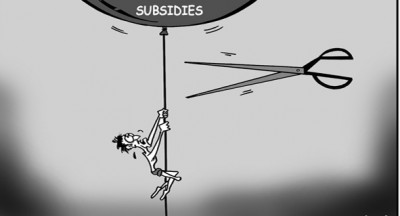


One of the world’s largest wind turbine manufacturers let loose a bit of truth and self-admission to the Financial Times: We still need help, and that help must come from taxpayers.
The wind production tax credit, a generous $23 per-megawatt-hour tax credit the producer receives for 10 years, expired last year. At that rate, taxpayers are effectively covering half the wholesale price of electricity and, in some areas of the country, the entire wholesale price. The PTC expired at the end of 2013, but several policymakers are pushing for an extension.
Lisa Davis, who leads the global energy business at Siemens, told the Financial Times the wind industry was close to grid parity with conventional sources of electricity such as coal and natural gas, but “we’re not there yet.”
“We’ve not yet got to the point where it’s truly self-sustaining,” she said. “We’ve got to focus on cost competitiveness.”
So the way to become self-sustaining and cost-competitive is to plead for extended reliance on the taxpayer? That is exactly why Congress needs to cut the cord on wind energy subsidies from the federal government. The wind industry cannot focus on lowering costs while it is so heavily subsidized because subsidies enable them to ignore costs. So, rather than trying to achieve the true price point necessary for cost-competitiveness, the wind industry concentrates on securing more subsidies. Eliminating the PTC for good will allow wind producers to become self-sustaining if the technology truly can compete with other sources of energy.
If wind cannot compete, then it doesn’t belong in our energy mix. America has a robust and diverse supply of electricity generation where our energy demands are met through coal, natural gas, nuclear, hydropower and other renewable sources. We don’t need the federal government to create artificial diversity that wastes taxpayer dollars and promotes stagnation. This holds true for all energy sources.
The reality is startups and new ideas and technologies succeed and fail all of the time. Failure should not be a signal for the federal government to come to the rescue; it’s a signal those resources can be put to more productive use in the economy. But the wind industry is no start-up. It’s been more than 22 years since Matthew Wald of the New York Times wrote, “Because of striking improvements in technology, the commercial use of these windmills, or wind turbines as the builders call them, has shown that in addition to being pollution free, they can now compete with fossil fuels in the cost of producing electricity.”
There is no justification for propping up established companies, either. If Chi Chi’s pleaded for handouts to stay competitive with the likes of Applebees, or Microsoft told America it needed support from the taxpayer to sell more Zunes, policymakers rightfully would scoff. Those companies didn’t fail because they weren’t cost competitive; they simply offered a product consumers didn’t want to buy.
Rather than creating a sustainable industry, the PTC artificially propped up an industry, advanced special interests and allocated labor and capital away from more competitive uses in the marketplace. Extending the credit would only exacerbate those problems and complicate opportunities for real tax reform. Congress should hold its ground and keep the sun set on the wind PTC.