Seneca Mountain Wind, Will Not Be Destroying Vermont Environment! Project Cancelled!!!

SENECA MOUNTAIN WIND PULLS THE PLUG

Editor’s note: This article is by James Jardine, of the Caledonian-Record, in which it was first published Sept. 27, 2014.

Seneca Mountain Wind has removed its MET wind measurement device from its Ferdinand location.

The company also confirmed it has not started construction or site preparation at any of the other three MET sites authorized under a certificate of public good (CPG) issued to Seneca Mountain Wind by the Vermont Public Service Board.

In a letter dated Thursday, Karen Tyler, an attorney with the Burlington law firm of Dunkiel Saunders Elliott Raubvogel and Hand PLLC states, “SMW (Seneca Mountain Wind) no longer plans to either pursue its MET Tower project at a later date, or seek permission from the Board to transfer the CPG to another person or entity.”

The letter continues, “In light of these developments, [SMW] now agrees with the Appellants that their appeal of the Board’s order in Docket No. 7867 is moot.”

The MET tower in Ferdinand cited by Seneca Mountain Wind was previously constructed by Matthew Rubin when Rubin was planning a wind farm in East Haven several years ago. When Rubin canceled his plans for a wind farm, he left the MET tower in place.

Previously, Seneca Mountain Wind has argued before the Vermont Supreme Court that the certificates of public good issued by the Vermont Public Service Board have value even if Seneca Mountain Wind has canceled leases it holds on the land on which the towers are to be located. Seneca Mountain canceled a lease on land in Newark owned by Scott and Sarah Williams, Guilford, Vt., according to Newark Town Clerk Joan Bicknell. Seneca Mountain Wind also canceled a lease on land in Ferdinand and Brighton owned by Daniel Ouimette, Colebrook, N.H.

The Vermont Supreme Court, on Aug. 12, remanded Seneca Mountain’s lawsuit back to the Public Service Board, telling the PSB, “to consider, given  the current circumstances whether appellant’s CPG should be revoked or declared void with respect to the towers located in the Town of Newark and the Town of Brighton.” The remand continues, “If the Board either revokes or declares void Seneca’s CPG for those towers, then the appeal will be dismissed.”

Now that Seneca Mountain Wind has confirmed it will no longer pursue its MET tower project at a later date and will not seek permission to transfer its authorizing certificate to another person or entity, anyone hoping to build a commercial wind farm in Newark, Brighton or Ferdinand will have to start from scratch.

Climate Scientist Calls For Common Sense, Not Alarmism, in the Handling of the Environment.

Richard Lindzen–MIT hot shot on climate–declaims on the issues and warns us

Who am I to even comment on the eloquence of Richard Lindzen, who has tried–lord how he’s tried, to educate people on climate science done by real scientists.

Here he provides some wisdom on the mess that is the debate on Anthropogenic Warming.

I would add, as a humble physician–warm is better, what’s the damn panic about a few degrees of warming?

Dr. Lindzen:

Reflections on Rapid Response to Unjustified Climate Alarm
The Cato Institute’s Center for the Study of Science today kicks off its rapid response center that
will identify and correct inappropriate and generally bizarre claims on behalf of climate alarm. I
wish them luck in this worthy enterprise, but more will surely be needed to deal with this issue.
To be sure, there is an important role for such a center. It is not to convince the ‘believers.’ Nor
do I think that there is any longer a significant body of sincere and intelligent individuals who
are simply trying to assess the evidence. As far as I can tell, the issue has largely polarized that
relatively small portion of the population that has chosen to care about the issue. The remainder
quite reasonably have chosen to remain outside the polarization. Thus the purpose of a rapid
response Center will be to reassure those who realize that this is a fishy issue, that there remain
scientists who are still concerned with the integrity of science. There is also a crucial role in
informing those who wish to avoid the conflict as to what is at stake. While these are important
functions, there are other issues that I feel a think tank ought to consider. Moreover, there is a
danger that rapid response to trivial claims lends unwarranted seriousness to these claims.
Climate alarm belongs to a class of issues characterized by a claim for which there is no
evidence, that nonetheless appeals strongly to one or more interests or prejudices. Once the
issue is adopted, evidence becomes irrelevant. Instead, the believer sees what he believes.
Anything can serve as a supporting omen. Three very different previous examples come to mind
(though there are many more examples that could be cited): Malthus’ theory of overpopulation,
social Darwinism and the Dreyfus Affair. Although each of these issues engendered opposition,
only the Dreyfus Affair led to widespread societal polarization. More commonly, only the
‘believers’ are sufficiently driven to form a movement. We will briefly review these examples
(though each has been subject to book length analyses), but the issue of climate alarm is
somewhat special in that it appeals to a sizeable number of interests, and has strong claims on the
scientific community. It also has the potential to cause exceptional harm to an unprecedented
number of people. This has led to persistent opposition amidst widespread lack of interest.
However, all these issues are characterized by profound immorality pretending to virtue.
Malthus’ peculiar theory wherein the claimed linear growth of food loses out to the exponential
growth of population has maintained continuous popularity in the faculty lounge for about two
centuries. It is, therefore, worth noting that Malthus had no evidence that food supply would
increase only linearly. Nor did he have evidence for exponential population growth. Malthus
initially went so far as to estimate an e-folding time for population of 25 years, based on the
population of North America, and ignoring the role of immigration. Although Malthus, himself,
eventually acknowledged these problems, the enthusiasm for his anti-human conclusions remains
strong. Neither the green revolution nor the diminution of famine amidst increasing population
dissuades them. The fact that Chad is poor and the Netherlands is rich never strikes the believer
as odd. Apparently, the growth of cities, the movement of workers from the farm to the city,
and, for much of the developed world, immigration, all served to convince people of means that
there were too many other people around, and Malthusian theory formed a framework for
something they were (and are) eager to believe.
Social Darwinism and its corollary, eugenics, represents another case of a theory without support
that was widely accepted with, at times, horrid consequences. Darwin’s “The Origin of the
Species” had immense influence. It presented a theory whereby natural selection and what were
essentially mutations could account for biological evolution. While it offered valuable insights
into the development of finch beaks, it was hardly meant to describe societal evolution.
Nevertheless, the notion of ‘survival of the fittest’ applied to society had obvious appeal to those
who perceived themselves to be the fittest and who naturally regarded the application as
scientifically justified. It was a small step to eugenics which was the counterpart of modern day
environmentalism during the first third of the twentieth century, and was supported by all the
‘best’ people (including George Bernard Shaw, Margaret Sanger, Alexander Graham Bell, and
Theodore Roosevelt) despite the fact that there actually was a mathematical theorem (the Hardy-
Weinberg Theorem) that showed that the impact of eugenics on the gene pool would be
negligible. Needless to add, mathematics is of no importance to the ‘best’ people. Malthusian
population fears continue to the present, but eugenics was rendered unfashionable by the obvious
implications presented by the Nazis.
While science is a common vehicle for such misuse, the Dreyfus Affair shows that other vehicles
exist. In 1894, Captain Alfred Dreyfus was accused of passing secret French military
information to the Germans. There was, in fact, no evidence to support this accusation.
Nevertheless, there was again a strong desire on the part of many people in France to believe the
accusation. To be sure, there was the endemic anti-Semitism in France. However, there was
also the humiliation of France’s loss in the Franco-Prussian War, and the desire to blame such
loss not on the army, but on the perfidy of a group that some considered to be ‘outside’. (The
Nazis’ ‘stab in the back’ theory for the German loss in WW1 represents a similar instinct).
Dreyfus was tried (several times) and sentenced to Devil’s Island. Prominent Frenchmen (Emile
Zola in particular) , incensed by the obvious injustice campaigned for Dreyfus, and the issue
literally split France in half (partly because the conflict between Catholics and Secularists also
entered the Affair). Dreyfus was eventually exonerated after the identification of the actual spy
became undeniable.
The current issue of global warming/climate change is extreme in terms of the number of special
interests that opportunistically have strong interests in believing in the claims of catastrophe
despite the lack of evidence. In no particular order, there are the leftist economists for whom
global warming represents a market failure, there are the UN apparatchiks for whom global
warming is the route to global governance, there are third world dictators who see guilt over
global warming as providing a convenient claim on aid (ie, the transfer of wealth from the poor
in rich countries to the wealthy in poor countries), there are the environmental activists who love
any issue that has the capacity to frighten the gullible into making hefty contributions to their
numerous NGOs, there are the crony capitalists who see the opportunity to cash in on the
immense sums being made available for ‘sustainable’ energy, there are the government
regulators for whom the control of a natural product of breathing is a dream come true, there are
newly minted billionaires who find the issue of ‘saving the planet’ appropriately suitable to their
grandiose pretensions, etc., etc. Strange as it may seem, even the fossil fuel industry is generally
willing to go along. After all, they realize better than most, that there is no current replacement
for fossil fuels. The closest possibilities, nuclear and hydro, are despised by the
environmentalists. As long as fossil fuel companies have a level playing field, and can pass
expenses to the consumers, they are satisfied. Given the nature of corporate overhead, the latter
can even form a profit center. The situation within science itself is equally grim. Huge sums of
government and private funding have become available to what was initially a small backwater
field. Science becomes easy when emphasis is on malleable models supported by hugely
uncertain data that can be readily found ‘consistent’ with the models supplemented by fervidly
imagined catastrophic ‘implications.’ Indeed, uncertainty is often exaggerated for just this
purpose. Opposition within the scientific community is immediately met with ad hominem
attacks, loss of funding, and difficulty in publishing.
Of course, science is not the only victim of this situation. Affordable energy has been the
primary vehicle for the greatest advance in human welfare in human history. This issue
promises to deny this to the over 1 billion humans who still lack electricity. For billions more
energy will be much less affordable leading to increased poverty. Poverty, itself, is a major
factor in reduced life expectancy. It requires a peculiarly ugly obtuseness to ignore the
fundamental immorality of this issue.
Although all these issues have strong political consequences, it is by no means clear that their
origin is, itself, political. I would suggest that a more likely situation is that politics is always
opportunistically seeking some cause that fits its needs. However, once an illusional issue
becomes a passionate belief, it becomes impervious to argument. Given how dangerous some
illusional positions are, it is an important problem to know how to avoid them. This is a problem
that is truly worthy of Cato’s attention. Rapid response can only do so much; belief seems to
inevitably trump objective reality when one is free to choose ones narrative.
Richard S. Lindzen
Sloan Professor of Atmospheric Sciences, Emeritus, MIT
Distinguished Senior Fellow, Cato Institute
September 14, 2014

Politicians Should Be Jailed for Pushing the “Unreliable Renewables” scam!

Lunacy of Wind & Solar Power Policy: Political Incompetence or Conspiracy?

john kutsch

John Kutsch heads up the Thorium Energy Alliance an outfit that aims to see power generated using thorium enjoy a place at our reliable energy table.

Thorium is an abundant silver-gray element named for the Norse god of thunder. It’s less radioactive than the uranium used to power conventional nuclear plants; it produces less waste; and is more difficult to turn into nuclear weapons.

Advocates like Kutsch want to adapt traditional nuclear plants to use thorium as a fuel or replace them with a completely new kind of reactor called a liquid-fluoride thorium reactor, or LFTR (pronounced “lifter”). The LFTR would use a mixture of molten chemical salts to cool the reactor and to transfer energy from the fission reaction to a turbine.

Kutsch argues that such a system is more efficient and safer than existing plants, which use pressurized water to cool uranium fuel rods and boiling water or steam to transfer the energy they create. Kutsch says: “A molten-salt reactor is not a pressurized reactor. It doesn’t use water for cooling, so you don’t have the possibility of a hydrogen explosion, as you did in Fukushima.”

Kutsch and other advocates say that a thorium-fueled reactor burns hotter than uranium reactors, consuming more of the fuel. Kutsch says that “Ninety-nine percent of the thorium is burned up. Instead of 10,000 pounds of waste, you would have 300 pounds of waste.”

STT isn’t about to weigh into the debate about thorium, but we’re on the same page as Kutsch when he slams into the lunacy of wind power.

Here’s a video of John belting into the infantile logic of trying to rely upon power sources delivered at crazy, random intervals. Oh and it comes with a “PG” warning: John’s frustration at our political betters leads to one or two “F” bombs.

blob:https%3A//www.youtube.com/b6668f91-9d89-49a1-9a99-190b7f2f361a

Windweasels are Known Worldwide, for their Coercion, and Corruption!

The Wind Industry: Rotten to the Core

dirtyrottenscoundrelsoriginal

We’ve reported on just how rotten the wind industry is – from top to bottom – and whether it’s bribery and fraud; vote rigging scandals; tax fraud; investor fraud or REC fraud – wind weasels set a uniform standard that would make most businessman blush.

In previous posts we’ve looked at how the goons that work for RATCH didn’t hesitate to invent a character – Frank Bestic – in a half-cunning attempt to infiltrate their opponents at Collector and elsewhere – see our posts here and here and here.

These boys have no shame and, apparently, moral business conduct is an “opt in” model, rather than a day-to-day proposition – like it is for most everybody else.  It’s all about “ways and means”, really.

Here’s a tale from Mexico about just how low they can go – pulled together by STT Champion, James Delingpole.

Environmental Researcher: Wind Industry Riddled with ‘Absolute Corruption’
Breitbart.com
James Delingpole
20 September 2014

A Mexican ecologist has blown the whistle on the corruption, lies and incompetence of the wind industry – and on the massive environmental damage it causes in the name of saving the planet.

Patricia Mora, a research professor in coastal ecology and fisheries science at the National Institute of Technology in Mexico, has been studying the impact of wind turbines in the Tehuantepec Isthmus in southern Mexico, an environmentally sensitive region which has the highest concentration of wind farms in Latin America.

The turbines, she says in an interview with Truthout, have had a disastrous effect on local flora and fauna.

When a project is installed, the first step is to “dismantle” the area, a process through which all surrounding vegetation is eliminated. This means the destruction of plants and sessilities – organisms that do not have stems or supporting mechanisms – and the slow displacement over time of reptiles, mammals, birds, amphibians, insects, arachnids, fungi, etc. Generally we perceive the macro scale only, that is to say, the large animals, without considering the small and even microscopic organisms…

After the construction is finalized, the indirect impact continues in the sense that ecosystems are altered and fragmented. As a result, there is a larger probability of their disappearance, due to changes in the climate and the use of soil.

Then there is the damage caused by wind turbine noise:

There is abundant information about the harm caused by the sound waves produced by wind turbines. These sound waves are not perceptible to the human ear, which makes them all the more dangerous. They are also low frequency sound waves and act upon the pineal and nervous systems, causing anxiety, depression (there is a study from the United States that found an elevated suicide rate in regions with wind farms), migraines, dizziness and vomiting, among other symptoms.

But the wind turbine operators are able to get away with it because the system is so corrupt.

What happens is absolute corruption. I have to admit that generally there are “agreements” behind closed doors between the consultants or research centers and the government offices before the studies are conducted. They fill out forms with copied information (and sometimes badly copied), lies or half truths in order to divert attention from the real project while at the same time complying with requirements on paper. Unfortunately, consultants sometimes take advantage of high unemployment and hire inexperienced people or unemployed career professionals without proper titles. Sometimes the consultants even coerce them into modifying the data.

Research centers, pressured by a lack of funding, accept these studies. It is well known that scientists recognized by CONACYT (National Counsel on Science and Technology) accept gifts from these companies, given that they need money to buy equipment for their laboratories and to fill their pocketbooks to maintain their lifestyles. This is the extent of the corruption. Upon reviewing these studies, it is clear that the findings are trash, sometimes even directly copied from other sources online. These studies tend to focus on the “benefits of the project” and do not include rigorous analysis.

The Secretary of Environment and Natural Resources (SEMARNAT) does follow-up to the studies, but everything can be negotiated. The bureaucrats have the last word.

Though Professor Mora is talking specifically about Mexico, what she says applies equally well to supposedly more transparent democracies such as Britain, Australia, the US, Canada and Denmark. The wind industry is necessarily one of the most corrupt enterprises on earth because it depends for its entire existence on government favours, backhanders, dishonest environmental impact assessments and on regulators turning a blind eye to the known health problems caused by wind turbine noise. Without crony capitalism, the wind industry simply would not exist.

Here are some links to a few of Breitbart’s hits on the subject. As I can personally testify from a decade spent covering this scandal, there are few forms of life on the planet lower than those parasites who make their fortune out of bird-chomping, bat-slicing eco-crucifixes.
Breitbart.com

james-delingpole_3334

Communists Masquerading as Environmentalists…..Watermelons!

Climate Movement Drops Mask, Admits Communist Agenda

September 23rd, 2014 – 4:31 pm

Communists along with a few environmental groups staged a “People’s Climate Rally” in Oakland, California on Sunday, September 21, in conjunction with the larger “People’s Climate March” in New York City on the same day.

Wait — did I say communists? Isn’t that a bit of an exaggeration?
Well…no.

At the New York event, many people noticed that gee, there sure are a lot of communists at this march. But in Oakland — always on the cutting edge — the entire “climate change” movement at last fully, irrevocably and overtly embraced communism as its stated goal. Any concerns about “optics” or operating in “stealth mode” were abandoned.

The “climate change” “crisis” is now nothing but the latest justification for “total revolution” and getting rid of capitalism forever.
Yes, capitalism itself is the problem. The primary message of the People’s Climate Rally was this: Climate change is caused by capitalism, and merely attempting to reform capitalism will not stop global warming; it is impossible to work within the existing system if we want to save the planet. We must replace it with a new social and economic system entirely.

Until recently, those attacking the capitalist system as the cause of global warming were intentionally a little vague as to what will replace it if we are to solve the problem. But on Sunday in Oakland, that curtain was drawn back and the new system was finally revealed: Communism. Or at least hardcore socialism as Marx defined it — the necessary transitional phase before true complete communism (i.e. no private property, no families, no individualism). Most countries we tend to think of as “communist” actually self-defined as “socialist”: The USSR, the Union of Soviet Socialist Republics, for example, was (as its name reveals) socialist. I point out this detail in case anybody reading this article thinks that the “socialism” advocated at the rally was merely some kind of squishy soft-hearted semi-capitalism; no, it is the same type of socialism one finds in places generally thought of as communist.

Below you will find irrefutable proof that communist ideologies, organizations and phraseologies have completely moved to the forefront of the “climate change” movement. (I was originally tempted to say that the communists, as they are wont to do, have merely “co-opted” environmentalism. But that would imply that the goal of global warming scaremongering was something other than “destroying capitalism” in the first place. At this point I now know that destroying capitalism has always been the goal; the only thing that changed on Sunday is that the mask was dropped.)

This proof will necessarily entail posting a lot of photographs; in situations like this, the only way to conclusively demonstrate a point is through repetition of evidence. One could summarize the evidence with a few shorthand images, but that would leave open the possibility that the case was being overstated. To quash that counter-argument before it arises, I will post lots and lots and lots and lots of images from all over the rally, from the sponsors, to the attendees, to the booths, to the speakers, to show beyond any doubt that the entire rally was thoroughly saturated with communism and socialism to the point where these ideologies were the overarching theme of the event.

Ready? All the photos below were taken at the People’s Climate Rally in Oakland on September 21, 2014.
As you enter the rally you encounter booths hosted by Socialist Action, a Trotskyist/Marxist group…
…and the Communist Party USA, a Marxist-Leninist political party who like to think of themselves as the communists, since they’ve been around for almost a century…
…and the Revolutionary Communist Party USA, a Maoist political cult devoted to overthrowing the United States in a total revolution.

Along the way, you encounter the rally’s attendees, carrying signs advocating concepts like…
…”eco-socialism,” which I nominate as “word of the day,” since the theme of the rally was the fusion of ecology with socialism.
“Another Big, Fat, straight, Midwestern, White Man for WORLD REVOLUTION.”
“Capitali$m is Destroying the Environment.”

Do I even need to point out that socialist and communist countries like China, the Soviet Union, North Korea and elsewhere have absolutely appalling environmental histories, past present and future, which far exceed in ecological destruction anything encountered in capitalist societies? No, I don’t need to point that out, because you already know it. You do — but apparently the people at this rally live in a fantasy world where “socialism” is the opposite of “pollution.”
“Capitalism is Killing the Planet. FIGHT FOR A SOCIALIST FUTURE!” This same message from the International Socialist Organization, a self-professed Marxist/Leninist/Trotskyist revolutionary group, was also prominent at the New York climate march.

If you enter the rally from the other side, you encounter
The Socialist Alternative, one of the few socialist parties to actually have a member elected to public office in mainstream society…
…The Democratic Socialists of America, a comparatively mild-mannered group who want to make America communist via peaceful democratic transition instead of the violent revolution advocated by most other extreme left revolutionary parties….
…and Freedom Socialist, a lesser-known group who nonetheless managed to gain control of the coveted “socialism.com” URL which they use to promote their radical feminist version of communism in “the living tradition of Marx, Engels, Lenin, and Trotsky.”

Many of these Marxist, communist and socialist groups, by the way, were official sponsors of the event. They weren’t hangers-on — they helped to organize the rally.
Children were encouraged to hang out in the protest’s kid-friendly zone, where they could draw their own signs promoting “revolution.”

Had enough? Sorry. I apologize. Because we’re just getting started with the proof that communists dominate the narrative of the climate change movement.

Everywhere I turned, I encountered people with the message, “System Change, Not Climate Change.” If anything, this was the motto of the entire rally.

What d’ya Mean….It’s the wind’s Fault? You depend Upon the Weather? That’s Dumb!

Germans Blame “Missing Wind” for their Wind Power Debacle

yacht

Germany’s Debacle: 2/3 Of Wind Projects “Running Badly To Very Badly”… Case Of The “Missing Wind”
NoTricksZone
P Gosselin
20 September 2014

Germany-based European Institute for Climate and Energy (EIKE) here brings up a television report on the disappointing returns from wind parks, recently appearing on SWR South German public television.

The days of the media not questioning green energy are over.

Wind parks experienced a gold rush atmosphere, with thousands of turbines being erected over the last 15 years. Now the data are coming in on their real performance, and it looks bad. The German SWR TV report (can be viewed at Youtube) first presents the background on wind energy development in Germany and tells the story of “disappointed investors”, especially in the western German state of Rhineland Palantinate.

Initially investors’ expectations of getting rich on wind were high, the report says. Big returns were promised (between 400 and 800% in 2006). But for a wide majority that dream has shattered violently as losses mount.

“2/3 of all projects are running badly to very badly”

The SWR report at the 1:20 mark says the promises of huge returns were based on overly optimistic wind model forecasts. Werner Haldorf of the pro-wind-energy German Association of Wind Energy analyzed wind park performance and sums up the “surprising” results at the 1:38 mark:

We can say that one third of all projects have pleased the investors, or at least have been satisfactory – depending on how high or low the subjective expectations were, satisfied also with respect to the planning results. And two thirds of all projects are running somewhat badly to very badly.”

In his summary report he concludes:

SWF wind report

The origin of the plight for commercial windparks in Germany is the excessive “planning optimism” (Garrad Hassan) that was created among investors.”

Unexpectedly high repair, maintenance and insurance costs

At the 2:06 mark Daldorf tells SWF that the cause is “the missing wind, too much wind was planned, shoddy planning, improper planning, and unexpected (or falsely expected) high repair, maintenance, and insurance costs“.

These are the results of Daldorf’s nationwide windpark analysis. More and more it is becoming obvious that many of the investors were conned to some extent by Big Wind.

The missing wind

The report then focusses on the wind parks in the German state of Rhineland Palatinate. There the picture is even worse. The problem is that the necessary amount of wind needed to make the projects profitable there often just does not materialize. At the 2:51 mark economist Uwe Pilgram tells viewers that a turbine must run a minimum of 1700 hrs at full capacity each year in order to make a profit. But Pilgram says the average in 2013 was barely over 1400 hours.

Mainz Public Utility Director Detlev Höhner sullenly says that his community’s 20 wind plants put into operation between 2005 and 2010 so far have not made any profit and has made a “light loss”.

In the city of Trier (3:55) the result for its public utility is also disappointing. Public utility manager Rudolf Schöller:

We planned for average wind conditions, but in the first years we had relatively weak winds, and that’s why the wind yields were not so high.”

The reporter tells viewers that some years saw as little as 80% of the expected wind. The reporter adds: “That’s a disaster, experts tells us. A privately run company would certainly have gone bankrupt.”

The problem, the SWR reporter says (5:15), lies in false wind projections. Often times the planning goes out of control and is thus too costly. For the city of Mainz the new wisdom has become: “Don’t trust any planning office“.

Wind index adjusted downward three times!

At the 6:30 mark SWF brings in a wind energy expert Prof. Uwe Leprich, who warns that wind turbines “are not money printing machines” and says that the last years have seen weak wind conditions, yet hopes that will change in the years ahead. Interestingly he says that future wind conditions are based on data from the past and from these data a wind-index is computed for future planning. Here he admits (7:00 mark) that the wind index has been “adjusted three times” downward. Leprich blames the unpredictable weather conditions specifically in Rhineland Palatinate for the wind park profit problems.

The moderator then asks why that had not been foreseen (7:27 mark). Leprich replies that data from the previous decades were used, and blames “changes in wind conditions over the last few years”, adding that the wind index had to be adjusted nationwide. He repeats that especially in Rhineland Palatinate the wind conditions are especially difficult.

Skeptics’ warnings were ignored

Later Leprich says that “new framework conditions” have since been drawn up for planning future projects and that planners will need to be extra careful when siting wind projects. Readers here need to know that wind-park opponents and skeptics provided plenty of warnings on the poor profitability of wind parks, but in the mad and blind gold rush, no one heeded the warnings. Skeptics were branded crackpots, naysayers and complainers.

And what about the communities that have already falsely speculated (8:40) and lost money? Who pays for the losses, asks the moderator? Leprich doesn’t answer the question, making a huge circle around it. It was a rhetorical question anyway.

German green energy companies collapsing

The SWR report also looks at how Germany’s recent cut in subsidies for green energies and on how renewable energy companies are really feeling the pain. At the 9:30 mark the report features German renewable energy company Juwi., which years earlier had boomed mightily in the wind and solar businesses. In 2012 the company even broke the €1 billion mark in sales. But the report continues: “However 2 years later, everything is different“. Today the mood at Juwi is especially bleak as the company lays off its workers: Every third worker is getting a pink slip – 400 in all.

Government to blame…CEO drives expensive sports car

Without the subsidy nipple, the orders disappear and green energy companies die off. At the 12:20 mark the reporter says that the Juwi managing director Matthias Willenbacher blames the government for the misery, just before he is shown cruising in his ultra-high-priced sports car.

Back in the studio at the 14:00 mark, Leprich says the industry grew too fast and was led by inexperienced managers. He says the move into green energies was too rash and uncontrolled. He calls the massive investment in solar energy a mistake and concedes that the industry was too dependent on politics. At the end Leprich still thinks that solar and wind energy are the energies of the future – a seemingly obstinate position in view of the monumental debacle they are turning out to be. Leprich keeps clinging.

Historic industrial debacle

In reality, however, what we are actually seeing is the unfolding of one of history’s greatest industrial debacles, all driven by a fraudulent climate science and a deceptive industry. Slowly realizing they’ve been bamboozled, the German media, government and the numerous green energy promoters are scrambling to save face.

USA poised to follow same ruinous path

With the debacle now clear to the rest of the world, one would think other countries would sober up and be more cautious about following a similar path. They aren’t. Indeed it is truly astonishing that other countries, like the USA for example, are ignoring it all and are now attempting to put themselves on the very same ruinous path to repeat the German debacle, and to do so on an even grander scale.

If there ever was a definition for madness, this is it.
NoTricksZone

After pouring billions of euros into wind power, the Germans are left with spiralling power prices, energy market chaos (see our post here) and, now, collapsing wind power outfits. In concert with wind industry whining everywhere, German wind power outfits moan that their failing fortunes are all the government’s fault. Never mind that the wind industry circus would have never hit the road without a fat pile of government subsidies and mandated targets.

Irony is a subtle art; and one that the wind industry and its parasites struggle to identify, let alone master. After years of telling us how competitive wind power is with conventional generators, when the subsidies are pulled they yelp and do what any (inherently) unprofitable venture does: sack their workers.

And if the irony of biting the hand that feeds them isn’t enough, why not blame the vagaries of the wind?

STT loves the breezy optimism of Prof. Uwe Leprich, who says that “the last years have seen weak wind conditions“, but hangs on the hope that this “will change in the years ahead“. Although, unless the weather turns on consistently solid blows, the German wind industry could be in more trouble than Ned Kelly.

As Prof Leprich points out “wind park profit problems” are all about “unpredictable weather conditions” and goes on to blame: “changes in wind conditions over the last few years”.

Well fancy that! Who would have thought that wind power output – and, therefore, wind power outfits’ profits – might have a teensy weensy relationship with – ahem, ur – the wind?

That the fortunes of wind power outfits might wane a little when the wind doesn’t blow seems fairly obvious to an adult of moderate intelligence.

STT thinks seeing wind power outfits being done in by the vagaries of the wind is simply the inevitable result of an intellectual mismatch – of the kind that occurs when parents let toddlers play with sharp objects.

kites

Nothing Clean, or Green, about Industrial Wind Turbines!

Clean Energy’s Dirty Secrets

Renewable energy has become a potent rallying cry uniting Hollywood and the Beltway. “We can move our economy town by town, state by state to renewable energy and a sustainable future,” Leonardo DiCaprio says in his eight-minute climate movie Carbon, released in August. In his fiscal-showdown speech during his first term, in April 2011, President Obama put Paul Ryan’s proposals for a 70 percent cut in clean energy at the top of his list of reprehensible and unnecessary reductions. “These aren’t the kind of cuts you make when you’re trying to get rid of some waste or find extra savings in the budget,” he said. “These are the kinds of cuts that tell us we can’t afford the America that I believe in and I think you believe in.”

In May of this year, President Obama declared the shift to clean energy a “fight” that was about shaping the sector “that is probably going to have more to do with how well our economy succeeds than just about any other.” At least on that, the president was right. If we get energy wrong, America will throw away the world-leading energy advantages bestowed on it by geology, technology, and capitalism.

Presenting the administration’s Clean Power Plan, EPA administrator Gina McCarthy admitted it was not about pollution control. “It’s about investments inrenewables and clean energy,” she told the Senate Committee on Environment and Public Works in July. “This is an investment strategy.” The president’s favorite corporate-tax inverter has a different take on the nature of the investment opportunity. “We get a tax credit if we build a lot of wind farms,” Warren Buffett told Berkshire Hathaway’s investors. “That’s the only reason to build them. They don’t make sense without the tax credit.” While wind investors hoover up the $23 production tax credit per megawatt hour (MWh) of electricity produced, the real costs of intermittent renewables such as wind and solar are many times greater. And they’re not even good at what they’re meant to do — reduce carbon dioxide emissions.

Deriving a large proportion of energy from renewables is proving extremely costly for Germany. Last year, Peter Altmaier, then the energy and environment Minister and now one of Chancellor Angela Merkel’s closest advisers, said that Germany’s effort to decarbonize electricity generation could cost one trillion euros by the end of the 2030s. Not that you would necessarily see that from Germany’s carbon dioxide emissions. Despite lower economic growth in Germany than in the U.S., German emissions have been rising seven times faster — up 9.3 percent between 2009 and 2013 compared with 1.3 percent for the United States.

Indeed, renewable energy provides a textbook case of what the French 19th-century economist Frédéric Bastiat meant when he described the difference between a bad economist and a good one: The bad economist confines himself to the visible effect; the good economist takes into account both the effect that can be seen and those effects that must be foreseen. The visible effect of renewables is their use of “free” wind, sun, and running water. All that’s needed to transition from a world of dark, satanic power stations to a clean, low-carbon world are temporary subsidies until renewable power becomes competitive. Hailing the closure of nuclear-power plants in the Midwest due to a glut of wind power, Howard Learner of Chicago’s Environmental Law and Policy Center last year declared: “It’s a matter of economic competitiveness.” This is the story told by Bastiat’s bad economists.

The closure of a nuclear-power station shows that something is amiss. Nuclear-power stations emit no carbon dioxide. Their running costs are low and much of the costs are unavoidable whether the stations are kept open or closed — construction and commissioning at the front-end, de-commissioning at the back. Since 2008, the output of America’s nuclear-power stations has fallen by 0.480 billion MWh, a decline of 6 percent. In a properly functioning market, this shouldn’t be happening.

Advocates of renewables are getting excited about falling costs of solar photovoltaic (PV) panels. According to the Department of Energy (DoE), PV costs have fallen by two thirds since 2010 and the cost of solar-generated electricity has fallen from $21.4 per MWh in 2010 to $11.2 per MWh in 2013, leading the DoE toclaim that solar will be “fully cost-competitive” by the end of the decade.” A growing number of Bastiat’s “good” economists have been looking behind the visible costs of renewables. They reveal a very different picture. A 2010 paper by MIT professor Paul Joskow, a leading economist in the field, shows why the DoE’s cost-competitiveness claim is thoroughly misleading. Using levelized costs (life-cycle costs per MWh) to assess the economics of intermittent energy gives the wrong answer because they ignore the changes in the value of electricity throughout the day and the costs of coping with unpredictable renewable energy.

To the life-cycle cost of renewables must be added short-term balancing and longer-term-capacity adequacy to match supply to demand. Because renewables output depends on the weather, an electricity system with a high proportion of renewables needs much more generating capacity. Without renewables, Britain would need 22GW of new capacity to replace aging coal and nuclear-power stations. With renewables, Britain will need 50GW, i.e., 28 GW extra to deal with the intermittency problem. And the more renewables in the system, the worse the problem is. A 2012 analysis by the OECD illustrates the problems caused by the increase in cost due to the increasing scale of wind and solar power. For onshore wind with 10 percent penetration (meaning that wind supplies 10 percent of the energy in that market), the Organisation for Economic Cooperation and Development (OECD) estimates extra balancing and adequacy costs of $7.61 per MWh rising to $11.14 per MWh at 30 percent penetration.

Levelized costs also ignore extra spending on grid infrastructure. Texas is the leading wind state, accounting for nearly 22 percent of the nation’s wind-generated electricity.  Transmitting electricity from wind farms in the rural north and west of the state to cities such as Dallas and Houston caused grid congestion. The state decided to have consumers back the inaptly named Competitive Renewable Energy Zones (CREZ) grid program to give wind investors a windfall subsidy in the form of access to nearly 3,600 miles of transmission lines. Subsidies via grid infrastructure spending can be more costly than overt plant-level subsidies. Bill Peacock and Josiah Neeley of the Texas Public Policy Foundation reckon that CREZ costs attributable to wind amount to $6.8 billion. This compares to plant-level subsidies of $4.14 billion in the ten years between 2005 and 2015.

Perhaps the dirtiest secret of renewables is how ineffective they are at displacing carbon dioxide emissions. Brookings senior fellow Charles Frank has calculated that replacing coal with modern combined-cycle gas turbines cuts 2.6 times more emissions than using wind does, and cuts four times as many emissions as solar.  If anything, these figures are likely to be too generous to renewables. Frank uses conservative assumptions about the energy consumed for balancing and cycling (starting up or shutting down gas-fired plants). Based on recent research, Edinburgh University’s Professor Gordon Hughes found that balancing costs are nearly ten times higher than Frank’s assumptions and that cycling reduces the amount of CO2 up to 50 percent more than wind turbines do (relative to the classic grid-average method of calculation used by most official bodies such as the International Energy Agency).

The most insidious and destructive effect of renewables, however, is on the wholesale electricity markets. Intermittent renewables, particularly wind, can flood the market at random times of day with zero marginal-cost electricity. The production tax credit means that renewable investors make money from negative prices down to minus $23 per MWh. Episodes of negative prices are evidence of an electricity market that isn’t working. They imply that what is being produced is garbage — someone has to be paid to take the electricity away.

Negative prices crush incentives to invest in the conventional capacity needed to keep the power on when the wind doesn’t blow and the sun doesn’t shine. The OECD report warns that gas, coal, and nuclear-power stations would experience lower electricity prices, reduced load factors, and higher costs because of intermittent renewables. To avoid the risk of “green outs” caused by inadequate investment in conventional and nuclear capacity, governments and regulators have to intervene and construct capacity markets to redress the distortion created by renewables. These don’t come cheap. In the case of Texas, the Brattle Group estimates that a capacity market would cost Texans an extra $3.2 billion a year.

Unseen system costs highlight a critical flaw in the EPA’s Clean Power Plan. With the exception of Texas, electricity systems cross state boundaries. Yet the EPA’s approach, in the words of Gina McCarthy, is to provide states with a flexible path toward compliance. One state’s mandates affect all the other states served by the same system, so the impacts of renewables are on systems, rather than states. Thus the EPA approach risks sparking energy wars between states, illustrating the cluelessness of the EPA and the dangers of allowing an environment agency to craft energy policy. Already North Dakota has refused to co-fund the costs of Minnesota’s renewable energy mandate, which is costing North Dakotans an extra $5.7 million a year. Yet for the EPA to recognize the systems costs of renewables would be to destroy any objective justification for them.

The bad economist, Bastiat wrote, pursues a small present good that will be followed by a great evil to come, while the good economist pursues a great good to come, at the risk of a small present evil. Across the Atlantic, the calamity of renewable energy is becoming more visible each day. It will not be only good economists who see that imitating Europe would be a colossal blunder.

— Rupert Darwall is the author of The Age of Global Warming: A History.

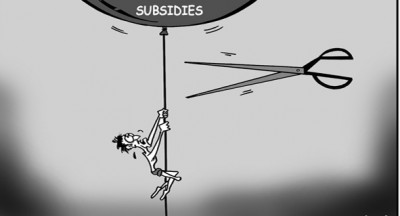
Stop the Outrageous Subsidies, and the Wind Scam Dies!

US Wind Industry Under Siege: Congress Set to Cut Subsidies as Communities Boil Over

turbine collapse 9

Wind power opponents seek repeal of tax credit
The Seattle Times
Hal Bernton and Erin Heffernan
21 September 2014

FOREST, Wisconsin — When wind-power developers prospected the rolling hills around this small dairy town, they found plenty of gusty sites for turbines. In 2011, they proposed a $250 million project with up to 44 turbines that could produce enough energy to power thousands of homes.

Since then, nothing has come easy for the developer in a state that has emerged as a stronghold of resistance to the spread of wind power.

In Forest, opponents gained enough votes to take over the town government, sued in state court to try to block the project, and added their support to a national movement that seeks to end the federal tax credit for the wind-power industry.

“We are here to protect our property values, our eagles, our health and our town,” said Brenda Salseg, spokeswoman for the Forest Voice, the local opposition group, which posted online a form letter urging the Wisconsin congressional delegation to oppose the tax credit.

The tax credit was passed by Congress in 1992 and has been periodically extended. It is currently set at 2.4 cents per kilowatt hour, and, during times of glutted electricity markets, can be worth more than the wholesale price of power.

This tax credit has helped catapult wind power to the front of the U.S. efforts to launch a renewable-energy industry.

By the end of 2012, wind power represented 43 percent of all new U.S. electric generation installed that year and was hailed by the Obama administration as a key in the global effort to combat climate change.

Wind power also has been bolstered by state mandates that require utilities to acquire a certain percentage of the power from renewable-energy sources.

The turbines operate in more than three dozen states, from Washington’s Columbia River Plateau to the Allegheny Mountains of Maryland, and in 2013 provided more than 4 percent of the nation’s power, according to a Lawrence Berkeley National Laboratory report.

In many areas, wind turbines have been welcomed as an economic boon to landowners who are paid for leasing acreage.

But as wind power has grown, so, too, has the opposition.

In some communities, such as Forest, developers have faced a backlash from residents concerned about the noise and health effects of living near wind-power projects.

The toll on birds and bats killed by turbine blades has drawn scrutiny.

Critics have attacked wind power as a fickle source of electricity that ebbs whenever the wind dies down. They fault the tax credit for encouraging new projects when many utilities have plenty of power.

Over time, the politics of wind power have become more partisan.

Most of the wind-power capacity is within Republican congressional districts, but many politicians in the party have made ending the tax credit part of their agenda. This year, efforts to extend the tax credit have made little headway in the Republican-controlled House.

Some House Republicans such as Rep. Dave Reichert, R-Wash., still back the tax credit, according to Reichert’s spokeswoman. But some former supporters have turned against it.

Rep. Kevin McCarthy, the House majority leader, once advocated the tax credit that helped spur investment in wind farms in his California district. But before his June election to his leadership position, he told the Wall Street Journal he thinks wind companies no longer need the tax credit.

“My feeling is the current situation is as bad as it has ever been,” said Robert Kahn, a Seattle consultant who represents wind-power developers. “Congress is so polarized about so many things that if some people are for it, other people are going to have to be against it.”

The fight against the tax credit also has been championed by Americans for Prosperity. One of the nation’s most prominent conservative advocacy groups, it was co-founded by billionaire David Koch, who has extensive interests in the fossil-fuels industry.

The organization last fall sent an open letter to Congress signed by more than 100 groups, including many smaller groups formed to fight wind power.

Wind-power advocates note that fossil-fuel industries have received federal subsidies for decades, such as a tax provision that allows favorable write-offs of oil-drilling costs. They say the government should put a price on carbon, or continue offering incentives for technologies that produce energy without carbon emissions. “We don’t want to lower or eliminate our tax credit when everyone else gets to keep theirs,” said Jim Reilly, a senior vice president of the American Wind Energy Association.

The wind-power tax credit extends over the first 10 years of a project’s operation. Congress has typically extended the credit a few years at a time, creating financial uncertainties for the wind-power industry.

In 2013, installations of wind farms declined by more than 90 percent from the previous year, reflecting concerns that the credit would not be extended.

Congress did extend the credit that year, eventually prompting many companies to break ground on projects.

Many are going in this year, putting the industry on a record pace for construction, according to the American Wind Energy Association.

The cost of new power has plummeted to record lows. The average price of about $25 per megawatt hour for power-purchase agreements in 2013 was nearly a third less than in 2009, according to a study by the Lawrence Berkeley lab.

What would happen if the tax credit dies?

Ryan Wiser, a co-author of the Berkeley report, said that would push the price of wind power past $40 a megawatt hour, and cool investor interest.

“The number of projects would be much less, but there is no doubt there would be some,” Wiser said.

Even without a tax credit, wind power also would receive a boost from President Barack Obama’s proposed rule to limit emissions from existing power plants. It could prompt the closing of some coal plants and open up more demand for turbine power.

But the proposed rule is opposed by many Republicans, and already is facing court challenges.

Conflict still rages Wisconsin once was swept up in the wind-power boom. But it’s now an example of how a state, even with federal incentives in place, can put the brakes on turbines. Many wind-power projects in Wisconsin are on relatively small properties, increasing the potential for conflicts with neighbors who don’t receive any lease payments but find themselves living next to turbines.

“The first day the turbines came on, I thought it was a jet plane taking off,” said Gerry Meyer, a retired mail carrier who complains of health effects from living near turbines in rural southeast Wisconsin.

Meyer has testified at state legislative hearings and also networked with Forest activists seeking to block the wind-power project proposed there by Emerging Energies.

These opponents have found some powerful allies among state Republican politicians.

“Wind turbines have proved to be an expensive, inefficient source of electricity, and thus any future construction of turbines simply is not a policy goal or object that should be pursued further,” Gov. Scott Walker wrote in a 2010 campaign memo obtained by the Milwaukee Journal Sentinel.

Walker, once in office, backed a legislative effort to increase setbacks for turbines by increasing the distance they must be located from a neighbor, and measuring that setback from the neighbor’s house rather than property line. That 2011 effort failed.

But a legislative committee voted to suspend the state’s wind-siting rule to study the health effects of wind turbines.

By the time the rule was reinstated a year later, five Wisconsin wind projects had been suspended or canceled, according to Clean Wisconsin, a wind-power advocacy group. New installations of turbines plummeted in the state.

In the months ahead, developers’ attorneys will argue in court for the right to finally move ahead on the Forest project.

Meanwhile, an emotional battle over the project continues to rage within the community. “It’s been devastating for the town,” said Carol Johnson, a Forest resident who supports the project. “Many family members will never speak again … It’s just torn the town apart.”
The Seattle Times

As it goes in Wisconsin, it goes all around the globe: spear giant fans into closely settled rural communities and the only thing guaranteed to be generated isn’t meaningful power, but a constant source of anger, hostility and community division. What makes these people so wild is that all their suffering has done nothing for the economy or the environment, leaving them feeling like dupes in the greatest fraud of all time (see our post here).

We love the line about how closing coal plants would “open up more demand for turbine power”. We think that’s a form of flattery best reserved for first dates. There is no “demand for turbine power”. In the absence of mandated targets (shortfall charges, penalties and the like) or massive subsidies there is NO demand for an unreliable and intermittent power source that can only ever be delivered at crazy, random intervals (see our post here). Wind power is not an alternative energy source (unless you’re prepared to sit in the dark for hours and days on end?) and will never be a substitute for conventional generation sources available on demand (see our post here).

We note a lot of “brave” talk about the wind industry being able to survive if the US Congress does away with the Production Tax Credit (PTC).

If the tax credit dies, the US wind industry dies – it will not be a case – as Ryan Wiser asserts – that: “The number of projects would be much less, but there is no doubt there would be some”.

What utter piffle. Cut the subsidies and there will never be another wind turbine erected anywhere, ever again.

The massive stream of subsidies – like the REC and PTC – provide the ONLY explanation for the wind industry – as recognised by the “Sage of Omaha”, billionaire Warren Buffett – whose company Berkshire Hathaway has invested $billions in wind power in order to get at federal subsidies – namely the PTC – which is worth US$23 per MW/h for the first 10 years of operation.

A subsidiary of the Buffett-owned MidAmerican Energy Holdings owns 1,267 turbines in the US with a capacity of 2,285 MW – eventually when the company’s Wind VIII expansion is finished, MidAmerican will own 1,715 turbines with a capacity of 3,335 MW. Buffett has piled into giant fans for one reason only: to lower the tax rate paid by Berkshire Hathaway.

As Buffett put it earlier this year at his annual investor jamboree in Omaha, Nebraska:

“I will do anything that is basically covered by the law to reduce Berkshire’s tax rate. For example, on wind energy, we get a tax credit if we build a lot of wind farms. That’s the only reason to build them. They don’t make sense without the tax credit.”

There, Warren Buffett said it, not us.

At least he had the honesty and integrity to explain the only conceivable basis for the greatest rort of all time. And isn’t it so much better when those that profit from it choose not to speak with “forked tongue”. Maybe Ryan Wiser, the CEC and AWEA can take a leaf out of Warren’s book?

subsidies

We Are Systematically Slaughtering Our Birds, With Useless Wind Turbines!

Bird Carcass Count proves AGL’s Macarthur Wind Farm is an Avian Slaughterhouse

dead_eagle_at_base_of_turbine

Wind farm turbines take toll on birds of prey
The Australian
Graham Lloyd
22 September 2014

EAGLES, falcons and other raptors make up to a third of the estimated 1500 birds killed each year at Australia’s biggest wind farm.

The finding of an independent report for Macarthur Wind Farm operator AGL follows 12 monthly searches of 48 turbines at the 140-turbine operation in Victoria that found 576 bird carcasses.

After adjusting for birds eaten by scavengers between searches and the total 140 turbines, Australian Ecological Research Services estimated each turbine killed about 10 birds a year.

The analysis said this would include 500 raptors a year.

AGL has confirmed that 64 bird fatalities were found during the official searches and an additional 10 carcasses were found near turbines by maintenance personnel, landowners or ecologists when not undertaking scheduled carcass searches.

The total included eight brown falcons, seven nankeen kestrels, six wedge-tailed eagles, one black falcon, two black-shouldered kites and one spotted harrier.

But an AGL spokesman said the report had “shown no significant impact on threatened species”. The company said overall estimates of bird and bat mortality “are subject to several sources of bias which may result in inaccurate estimates”.

The report recommended more frequent searches of a smaller number of turbines to get a more accurate assessment.

Australian Ecological Research Services said there were several reasons for the high percentage of raptors killed. They were at higher risk of collision with turbine blades possibly due to a combination of factors such as the altitude they mostly fly at, the proportion of time spent flying and flying behaviour.

“Raptors tend to glide slowly and are constantly looking downward for potential prey, rather than flying in a single ­direction and looking where they are heading,” the report said. “This may increase their risk of flying through the rotor-swept area of turbines.

“Other studies have also suggested that raptors are more ­likely to collide with turbine blades than many other avian species due to their morphology and foraging behaviour.”

Anti-windfarm campaigner Hamish Cumming said: “If someone shot this many birds they’d be fined and jailed and there would be public outrage.

“But, somehow, we’re expected to just accept it if they are killed by a wind farm.

“And before anyone rolls out the tired old mantra of ‘statistics show more birds get killed flying into suburban windows’, just tell me when was the last time a wedge-tailed eagle flew into your lounge room window?”
The Australian

The report referred to above is available here: Macarthur bat and avifauna mortality monitoring report full. For a detailed rundown on what it says see Hamish Cumming’s email below.

The wind industry and its parasites have – from the outset – pitched their fans as a “planet saving, clean, green and environmentally friendly technology”; which doesn’t quite gel with the wholesale slaughter of birds and bats. Let’s call it an “inconvenient truth” (see our post here).

Were anyone caught shooting eagles or other protected raptors they would face prosecution.

wedge_tail_eagle

Kill a relatively common Wedge-Tailed Eagle in Australia and you’ll face 6 months imprisonment or a $10,000 fine. As the stories in these links show – when lads with a .22 do it – there is media “shock” and “outrage” at a crime worthy of condign punishment.

But the operators of wind farms face no such criminal penalties – and get to slice and dice birds and bats of all shapes and sizes with impunity (see our posts here and here).

The one thing that giant fans can’t be accused of is “prejudice”: they’ll slaughter anything that flies by; from bats to lowly seagulls, pelicans, majestic raptors and everything in between. Here’s just a few of their range of victims:

Seagull_head_11

pelican

eagle 1

bat

STT Champion, Hamish Cumming has always been on the front foot when it comes to protecting our feathered friends (see our posts here and hereand here).

hamish-cumming

Armed with the report detailing the carnage at Macarthur, Hamish sent this pointed email to a couple of monstrous “green” hypocrites: Victorian Green, Greg Barber and Cam Walker who heads up economy wrecking ecofascist outfit, Enemies of the Earth:

Well Greg and Cam,

I know you both hug wind turbines more than you do trees these days, but what are you going to do about the slaughter of raptors at Macarthur.

AGL’s own report, which they state is likely to be conservative due to monitoring methods being poor, estimates a kill of 10.19 birds per turbine, (1426 per years) 30% of which are raptors.

This is 5 times the original estimation of bird kills and nearly 100 times the original raptor kill estimate.

AGL are also not following Planning Panel recommendations and are not shutting down problem turbines which are in some cases killing 80 birds per turbine just in two seasons.

So-called Greens and so-called Friends of the Earth are just standing by and watching it happen just because it is a wind farm.

If this was a forest being cleared, a developer destroying habitat or coal fired power station causing such carnage and devastating species numbers in a region, you would be beating your chests and in every media possible. Yet you both just sit there and do nothing, because it is a wind farm.

Bob Brown stood up to the wind farm companies at Woolnorth in Tasmania when 11 eagles were killed, because they found that as one is killed another comes in to take over the territory. Raptors are attracted to wind farms to feed on the smaller birds killed by turbines. Wind farms become a species sink for raptors and can deplete a whole area out to many kilometres. This is now happening at Macarthur, with hundreds being killed in just one year.

Today I received the Bat and Avifauna Mortality Monitoring report published June 2014.

Page 22 of the report (attached) shows AGL turbines are reportedly killing 10.19 birds per turbine per year or 1426 birds a year. That is killing birds at approximately 5 times the rate estimated at the time the permit was issued. Page 22 also shows that 30% of these deaths are raptors, even though they are less than 1% of the birds observed at the site during utilisation studies.

On Page 23 the report concludes that the once a month monitoring of 28% of turbines is insufficient, and should be changed to weekly surveys, as data from pages 14 to 17 shows many carcasses are removed within 2 weeks of death by predators

In the Macarthur Panel Hearing, consultant Bret Lane stated that there were very few birds of prey utilising the site and even fewer water birds. The panel commented at the time that this record was unexpectedly low considering the waterways, wetlands and terrain.

It was stated that the risk of collision of raptors was low.

The claim by wind farm consultants at that time was mortality at Australian wind farms was between 2 and 4 birds per turbine a year, but as Macarthur would not be shore based, the mortality would be lower. The consultant compared overseas (European and American) wind farm declared mortalities of .04 to 3.4 deaths per turbine per year, but concluded Macarthur would be half of that.

So the permit was granted with the expectation that mortality would be in the order of a maximum of 2 deaths per turbine per year.

In reality, the first year AGL have declared an average of 10 dead birds per turbine per year, with some individual turbines killing more than 80 each per year.

The panel concluded that:

The BAM Plan must include:

a) A strategy for managing and mitigating any significant bird and bat strike arising from the wind energy facility operations. The strategy must include procedures for the regular removal of carcasses likely to attract raptors to areas near generators and reporting on the species and numbers of carcasses found near generators. Such a strategy must ensure that any bird or bat strikes are detected within a short time frame.

(This has not happened and is likely to be increasing the problem)

The proponent also had to ascertain, the mortality rate for specified species which triggers the requirement for responsive mitigation measures to be undertaken by the proponent either on or off the wind farm site, to the satisfaction of the DSE.

Monitoring timing and frequency must be stated within the plan with intensity of monitoring increasing to coincide with the behaviours and movements of specific species.

A strategy to offset impacts if impacts are detected during monitoring.

(None of this has happened)

6. The panel recommends that the DSE recommended Management Actions required to address potential impacts on Brolga (and other species) be included in the EMP. They are:

  • Upon approval (including pre-construction), commitment to ongoing observations of Brolgas within a defined radius (eg. 20 km or 30 km) and at specified times of the year – to better understand Brolga behaviour and record species numbers and breeding sites; this could involve local land owners. This information should be provided to DSE for sharing with the wider research community;

(This has not happened)

  • Commitment to extended monitoring of bird and bat strike (on a specified schedule) with all species recorded. This information should be provided to DSE for sharing with the wider research community;
  • Link the survey and monitoring to collection of relevant information such as rainfall and climate data and wind farm operations so that patterns over time can be tracked and analysed;

(This has partially been addressed in the report June 2014)

  • Define the acceptable local population impact threshold. If this threshold is met at interval milestones, then continue the monitoring program but defer other mitigation measures. If the threshold is not met, then mitigation measures should be implemented. These might include measures to enhance habitat in the immediate vicinity of the wind farm or else in more protected locations, wind generator shutdown at critical times, and any other measure identified as the survey and monitoring programs are implemented; and

(None of this has happened)

  • The management of the wind farm should be flexible enough to account for unanticipated impacts on Brolga (and other species), and include turbine shutdown protocols. The panel recommends that in addition to dead bird searches, bird monitoring include protocols for indirect disturbance impact assessments and avoidance studies as part of the EMP.

(I do not believe this has happened either)

How about both of you do something to stop the raptor deaths? The turbines should be switched off until there is a realistic and workable plan.

Take action now if you really care for the environment at all.

Hamish Cumming

Nice work Hamish! STT doesn’t expect to see any meaningful response from Greg or Cam.

The wind industry kills millions of birds and bats across the world every year. In Spain alone, wind farms are killing between 6,000,000 and 18,000,000 birds every year. The figures come from 136 monitoring studies collected by the Spanish Ornithological Society. Here’s one take on the numbers killed by the Spectator.

A recent study in the US shows that the numbers of bird deaths accredited to turbines underestimates the true figure by more than 30%. (for the full story refer Smallwood, K Shawn. 2013. Comparing bird and bat fatality-rate estimates among North American wind-energy projects.Wildlife Society Bulletin 37: 19-33.)

When challenged about the slaughter, the standard wind industry response is to lie by denying it even happens.

When that fails to wash (mounting piles of carcasses at the bases of turbines don’t help), its spin doctors admit the “problem” but downplay the kill-rate, by asserting that the numbers are “made up” by “mysterious forces” backed by “big coal”.

If an unsatisfied challenger persists, the response is a resort to the ol’ chestnut about “saving the planet from cataclysmic climate change”. And, for dramatic effect, calling the challenger an anti-wind, climate change DENIER.

Of course, giant fans have absolutely NOTHING to do with global warming or climate change (whichever is your poison) – as they require 100% of their capacity to be backed up 100% of the time with fossil fuel generation sources (see our post here). That simple and unassailable fact means wind power cannot and will never reduce CO2 emissions in the electricity sector: the sole justification for the wind industry’s heavily subsidised existence.

After more than 20 years in operation the wind industry has yet to produce a shred of credible evidence to support its claims about wind power abating CO2 – and all the evidence is to the contrary effect (seeour post here and this European paper here; this Irish paper here; this English paper here; and this Dutch study here).

In the result, there is no environmental gain for an awful lot of avian pain.

Once the wind industry’s fallacious (self) justification is stripped away, the deaths of millions of birds and bats can be seen for what it is: nothing more than senseless slaughter.

eagle at waterloo

“Watermelons”, as James Delingpole so aptly describes them, Green on the Outside, & Red on the Inside!

Communists coming out of the Green Closet.

Image source: Oliver Darcy/TheBlaze

Christopher Monckton is presently in Australia. Previously he has said: (link – WUWT)

So at last the communists who piled out of the Berlin Wall and into the environmental movement and took over Greenpeace so that my friends who founded it left within a year because they’d captured it. Now the apotheosis is at hand. They are about to impose a communist world government on the world.

Patrick Moore who will soon visit Australia,  co-founder of Greenpeace, left the Green Movement when it was infiltrated by communists: (link)

The collapse of world communism and the fall of the Berlin Wall during the 1980s added to the trend toward extremism. The Cold War was over and the peace movement was largely disbanded. The peace movement had been mainly Western-based and anti-American in its leanings. Many of its members moved into the environmental movement, bringing with them their neo-Marxist, far-left agendas.

Further:

Progressives are very resilient, so when Soviet communism finally collapsed after 70 years of world wide tyranny, progressives and liberal Democrats pushed the existential green movement to the forefront, which was in reality the same old exhausted red communism in a new disguise.

The “Green” Movement tried to disguise their “Red” Socialist/Communist ideas, however, now they are coming out of the closet.

The New York “Climate” March, as reported by the Blaze had socialists elements spread through it. (link)

Dozens of signs denouncing capitalism were spotted at the demonstration, often held by self-proclaimed socialists.
“Capitalism is destroying the planet,” a sticker on one woman’s shirt read, “We need revolution, nothing less.”

Image source: Oliver Darcy/TheBlaze

Members of the Socialists Workers Party also manned a table, passing out flyers attempting to make “the case for ecosocialism.”