Wind Turbines Kill More than Birds and Bats……They Kill Jobs, and Economies!

Subsidising Wind Power: A Sure-Fire Job Killer

spain unemployment

As the wind industry gravy train shudders to a halt in Australia, the wind industry and its parasites are working overtime to garner support for retention of the completely unsustainable 41,000 GWh mandatory Renewable Energy Target.

One of the “pitches” being made is that winding back the RET will costs tens of thousands of jobs. Never mind that the wind industry has generated only a handful of permanent jobs in Australia; that the bulk of the jobs created were in fleeting construction work; and that new wind farm construction has more or less ground to a halt: “investment” in the construction of wind farms went from $2.69 billion in 2013 to a piddling $40 million this year (see this article).

When the “wind industry creates jobs” mantra is being chanted, what the Clean Energy Council doesn’t say is that every single job it’s “created” depends entirely on the mandatory RET and the Renewable Energy Certificates issued to wind power outfits under it.

The REC operates as a Federal Tax on all Australian power consumers – that is paid as a direct subsidy to wind power generators. The REC Tax/Subsidy has already cost power consumers over $8 billion and – if the current RET remains – will add a further $50 billion to power bills over the next 17 years (see our post here).

A subsidy paid to “create” a job in one part of an economy, means that a job (or jobs) will be lost elsewhere. A study by UK Versa Economics found that for every job created in the wind industry 3.7 jobs are lost elsewhere in the UK economy (see our post here).

One Australian study has forecast that the current mandatory RET will kill over 6,000 jobs (see our post here).

The idea of wind industry job “creation” is like robbing Peter to pay Paul, except that the thief has to filch $4 from Peter to end up handing $1 to Paul.

The Germans have worked out that their dream of “creating” thousands of sustainable “green” jobs was just that: a dream. The hundreds of €billions spent subsidising wind and solar have killed the German’s international competiveness, with major companies heading to the USA – where power costs are a third of Germany’s (see our post here). And, as renewables subsidies are inevitably wound back, the jobs they “created” are disappearing fast (see our post here).

The renewables subsidy story in Spain is no different. The Spaniards have thrown 100s of billions of euros in subsidies at solar and wind power, and have achieved nothing but economic punishment in return. The much touted promise of thousands of so-called “green” jobs never materialized. No surprises there. Instead, the insane cost of subsidising wind and solar power has killed productive industries, with the general unemployment rate rocketing from 8% to 26% – youth unemployment is nearer to 50% in many regions (see our post here). For an update on the Spanish renewables disaster see the study produced by the Institute for Energy Research available here.

A study undertaken by Gabriel Calzada Álvarez (PhD) of the University of Rey Juan Carlos back in 2009 – “Study of the effects on employment of public aid to renewable energy sources” (available here) summed up the adverse employment impacts of the Spanish renewables disaster as follows:

EXECUTIVE SUMMARY: LESSONS FROM THE SPANISH RENEWABLES BUBBLE

Europe’s current policy and strategy for supporting the so-called “green jobs” or renewable energy dates back to 1997, and has become one of the principal justifications for U.S. “green jobs” proposals. Yet an examination of Europe’s experience reveals these policies to be terribly economically counterproductive. This study is important for several reasons. First is that the Spanish experience is considered a leading example to be followed by many policy advocates and politicians.

This study marks the very first time a critical analysis of the actual performance and impact has been made. Most important, it demonstrates that the Spanish/EU-style “green jobs” agenda now being promoted in the U.S. in fact destroys jobs, detailing this in terms of jobs destroyed per job created and the net destruction per installed MW. The study’s results demonstrate how such “green jobs” policy clearly hinders Spain’s way out of the current economic crisis, even while U.S. politicians insist that rushing into such a scheme will ease their own emergence from the turmoil.

The following are key points from the study:

1. As President Obama correctly remarked, Spain provides a reference for the establishment of government aid to renewable energy. No other country has given such broad support to the construction and production of electricity through renewable sources. The arguments for Spain’s and Europe’s “green jobs” schemes are the same arguments now made in the U.S., principally that massive public support would produce large numbers of green jobs. The question that this paper answers is “at what price?”

2. Optimistically treating European Commission partially funded data, we find that for every renewable energy job that the State manages to finance, Spain’s experience cited by President Obama as a model reveals with high confidence, by two different methods, that the U.S. should expect a loss of at least 2.2 jobs on average, or about 9 jobs lost for every 4 created, to which we have to add those jobs that non-subsidized investments with the same resources would have created.

3. Therefore, while it is not possible to directly translate Spain’s experience with exactitude to claim that the U.S. would lose at least 6.6 million to 11 million jobs, as a direct consequence were it to actually create 3 to 5 million “green jobs” as promised (in addition to the jobs lost due to the opportunity cost of private capital employed in renewable energy), the study clearly reveals the tendency that the U.S. should expect such an outcome.

4. At minimum, therefore, the study’s evaluation of the Spanish model cited as one for the U.S. to replicate in quick pursuit of “green jobs” serves a note of caution, that the reality is far from what has typically been presented, and that such schemes also offer considerable employment consequences and implications for emerging from the economic crisis.

5. Despite its hyper-aggressive (expensive and extensive) “green jobs” policies it appears that Spain likely has created a surprisingly low number of jobs, two-thirds of which came in construction, fabrication and installation, one quarter in administrative positions, marketing and projects engineering, and just one out of ten jobs has been created at the more permanent level of actual operation and maintenance of the renewable sources of electricity.

6. This came at great financial cost as well as cost in terms of jobs destroyed elsewhere in the economy.

7. The study calculates that since 2000 Spain spent €571,138 to create each “green job”, including subsidies of more than €1 million per wind industry job.

8. The study calculates that the programs creating those jobs also resulted in the destruction of nearly 110,500 jobs elsewhere in the economy, or 2.2 jobs destroyed for every “green job” created.

9. Principally, the high cost of electricity affects costs of production and employment levels in metallurgy, non-metallic mining and food processing, beverage and tobacco industries.

10. Each “green” megawatt installed destroys 5.28 jobs on average elsewhere in the economy: 8.99 by photovoltaics, 4.27 by wind energy, 5.05 by mini-hydro.

11. These costs do not appear to be unique to Spain’s approach but instead are largely inherent in schemes to promote renewable energy sources.

…
Gabriel Calzada Álvarez (PhD)
University of Rey Juan Carlos

Well, that couldn’t be much clearer.

In Spain, just as here, the great bulk of employment in the wind industry involves fleeting construction work (once the turbines are up, there’s nought to do) – as noted in point 5 – of the jobs created:

“two-thirds of which came in construction, fabrication and installation, one quarter in administrative positions, marketing and projects engineering, and just one out of ten jobs has been created at the more permanent level of actual operation and maintenance”.

That the Spaniards had to stump up “subsidies of more than €1 million” to create each wind industry job; that each wind industry job thus created, killed off 2.2 jobs elsewhere in the economy; and that each MW of wind power capacity installed destroyed 4.27 jobs – is nothing short of an economic disaster.

Faced with an unemployment calamity, the Spanish government has moved to dramatically slash the subsidies to renewables: tearing up wind farm contracts; retrospectively stopping subsidies for wind farms built before 2005; reducing the insanely high rates paid for wind power (previously guaranteed for 20 years) – capping the (subsidised) profits wind power outfits can make at 7.4%, above which the outfit must sell at the (unsubsidised) market rate (see our post here).

Given the results of Spain’s disastrous wind power experiment, the Australian wind industry’s “fan-tastic” claims about an employment Eldorado at the end of the RET rainbow are little more than fool’s gold.

pyrite

The Wind Turbine Scam is Destroying Our Economies, as Well as Our Communities!

Professor Ross McKitrick: Wind turbines don’t run on wind, they run on subsidies.

economics101

As STT followers are acutely aware, wind power is an economic and environmental fraud. Because wind power can only ever be delivered at crazy, random intervals – and, therefore, never “on-demand” – it will never be a substitute for those generation sources which are – ie hydro, nuclear, gas and coal (see our posts here and here and here and hereand here and here and here and here).

Were it not for government mandates – backed by a constant and colossal stream of subsidies (see our post here) – wind power generators would never dispatch a single spark to the grid, as they would never find a customer that would accept power delivered 30% of the time (at best) on terms where the vendor can never tell customers just when that power might be delivered – if at all (see our post here).

Ultimately, it’ll be the inherently flawed economics of wind power that will bring the greatest rort of all time to an end. The policies that created the wind industry are simply unsustainable and, inevitably, will either fail or be scrapped.

The Canadians are reeling under the ludicrous wind power policies of a hard-green-left Liberal government, clearly intent on committing economic suicide. Power prices – driven by exorbitant guaranteed rates to wind power outfits – have rocketed – tripling in less than a decade, driving energy intensive businesses – like manufacturing – out of business or offshore – stifling business investment – killing off or threatening thousands of sustainable (unsubsidised) jobs across Canada and otherwise creating economic chaos (see our post here).

The scale and scope of Canada’s wind power disaster hasn’t been lost on top energy market economists, like Ontario’s Professor Ross McKitrickfrom the University of Guelph.

Downwind - Ross McKitrick - Uni of Guelph (Time 0_06_00;22)

Ross was interviewed for the brilliant Sun News documentary ‘Down Wind’ by presenter, Rebecca Thompson, which has been extracted in the video below. The transcript appears below.

****

Downwind – Ross McKitrick – Uni of Guelph

Downwind – Ross McKitrick – Uni of Guelph


Rebecca Thompson: First we turn to Professor Ross McKitrick, an economist. He recently published a very scathing review of how economically unsound the Ontario Liberal government’s Green Energy Act is.

Professor Ross McKitrick: Well the important thing to understand about wind turbines is that they don’t run on wind, they run on subsidies.

Rebecca Thompson:  We went to see McKitrick at the University of Guelph.

Professor Ross McKitrick:  All the arguments that they’ve put forward for the Green Energy Act they really turned out to be phoney once we looked at them closely. They said that it would improve the economy, reduce air pollution emissions and it would replace coal fired power. And the problem is with the first one, it is not going to improve the economy because of what you are doing is replacing power that costs 3 to 5 cents per kilowatt hour to generate, and you’re replacing it with power that costs at least 13 1/2 cents per kilowatt hour to generate. So you’re raising the cost of doing business, it will drive down the rate of return in manufacturing and mining and that has to translate into job losses and reduced investment and shrinking the economy.

Rebecca Thompson: So you’ve pointed out that wind energy in fact, isn’t in the public interest in the short term but will it be in the long term?

Professor Ross McKitrick:  Nobody was building wind turbines in Ontario until the government started throwing money at it. It is not a profitable source of electricity, it’s not cost-effective. Wind turbines can’t compete on the wholesale market without a lot of government support.

Rebecca Thompson: The system used to fund wind energy in many places around the world is called a Feed-In-Tariff (FIT).

Professor Ross McKitrick:  And that means if you build a bank of wind turbines somewhere, and you get the contract that everyone is looking for you get a guarantee of 20 years being paid 13 1/2 cents per kilowatt-hour for the electricity that’s generated while the wholesale rate in Ontario is typically between 2 – 4 cents per kilowatt hour.

Rebecca Thompson: The Ontario government piggybacked off what is a European idea of a feed in tariff policy where the prices are locked in for 20 year contracts. And here’s another head scratcher …

Professor Ross McKitrick: The other provision of the contracts is that the system has to buy the power from you whenever you produce it. So the standard power plants, nuclear plants and hydro plants and so forth – there is no guarantee for them to buy their power, they have to compete on a wholesale market they have to price their product, in this case electricity, so that the system operator will buy it. With wind turbines, if the blades are running, the system operator has to buy it. Now they have adjusted that slightly in the last year because of this problem of the system operator being forced to buy tons and tons of power when it doesn’t need it, at 13 1/2 cents per kilowatt hour and sell it on the export market at one or two cents per kilowatt-hour – it was costing hundreds of millions of dollars a year for the system operator to do that. So the province now allows the system operator to reject some of the power that the wind turbines produce and instead the province will pay the wind turbine owners a benefit for what they call ‘deemed production’. So it’s really just transferred that same costs on to the taxpayer now.

Rebecca Thompson: The bottom line is pretty good for the wind energy sector.

Professor Ross McKitrick:  They get a 20 year contract to sell wind power at far above market rates and it doesn’t matter that they are generating power at times when the province absolutely doesn’t need it, and we can’t use it, and we just have to try to find some neighbouring jurisdiction to buy it from us. We used to have a few large power plants in Ontario and we had our grid that was optimised to source electricity from a few large central locations. We’re now shutting down the large central locations and replacing them with this proliferation of tiny little unreliable wind farms and you have to build a whole new grid to accommodate that. So that’s again an extra cost to get something that we already had.

Rebecca Thompson: What’s more is that the Green Energy Act hasn’t even come close to creating the number of jobs the Liberals claimed it would.

Professor Ross McKitrick: It turned out that the province had claimed that there were going to be 50,000 new jobs created from the Green Energy Act. When the Auditor General asks them to back that up because it doesn’t really make sense that this would create any jobs – what they admitted was they were really talking about were temporary construction jobs – as you put up wind turbines you need some workers in to do that. But then once the wind turbines are built, then those jobs disappear and there are no ongoing jobs. In economics, it’s an old fallacy, what’s called the broken window fallacy. If you go around breaking shopkeeper’s windows, since they have to hire repair people to fix the windows then you’ve somehow improved the economy. But, you haven’t. All you have done is increase the cost of having what you had before – which was windows in stores.

Rebecca Thompson: If the new shift to green power is so inefficient why hasn’t anyone working in the system spoken out?

Professor Ross McKitrick:  There are a couple of reasons. The power workers union has spent money on advertisements. They did try to fight against the closing of Lambton and Nanticoke – they understood that this was a bad deal for the workers in the province. But they did want they could. But it’s hard to be up against a government that is pushing so much propaganda on coal. There were people certainly in the power generating sector that understood that the government’s numbers weren’t correct and didn’t add up. But, they were effectively muzzled.

Rebecca Thompson: McKitrick speaks to people all the time about the changes in the system.

Professor Ross McKitrick:  I do find people working in the power sector, they know that this is a crazy system. These wind farms are displacing hydro electricity which is just a waste on every level because we have the hydroelectric facilities, they don’t generate any air pollution emissions. They give us reliable, predictable baseload power. And now we run wind turbines and let those hydro-facilities sit idle. So people who work in the sector, they can see what’s going on and they know that this is a waste. But, for understandable reasons they’re not about to make a big noise about it because they could lose their jobs if they do.

Rebecca Thompson: Whether any government would actually be able to get out of existing contracts is debatable. Ross McKitrick says it’s possible.

Professor Ross McKitrick: One option might be to buy out some of the wind turbine companies and take those wind turbines off the grid, or only use their power when they’re competitive. In Europe, what governments have started to do though is put on special new taxes on renewable sources, solar and wind, to try and recover some of these costs. Alternatively, the government may look to try and tear up the contracts and accept the legal liability that goes with it, but it’s not going to be easy.
Sun News: Down Wind

Down Wind, which runs for 96 minutes, can be purchased as a file and downloaded or as a DVD for those in the US and Canada (here’s the link). For those outside the US and Canada the file can be purchased and downloaded (using this link). If you’re in there fighting the great wind power fraud, Down Wind is essential viewing.

For a detailed synopsis of Down Wind – see our post here.

down wind

Wind Industry Denies Health Problems Cause by Wind Turbines, to Avoid Being Held Accountable!

Sunday Express 24th August, 2014

I’m abandoning my home over wind turbine illness

Credit: Paula Murray

A Pensioner is abandoning her Scottish dream home after more than a quarter of a century because wind turbines are making her life a “living hell”.

Kay Siddell, 69, and her husband John, 64, moved to their rural retreat at Old Dailly, near Girvan, Ayrshire, in 1988 to enjoy the peace and quiet of the countryside.

They saved for years to renovate their home, but after a 53 turbine wind farm, Hadyard Hill, was built, the pair put everything on hold.

For the past eight years they have tried to come to terms with the noise and visual impact, but now, with Mrs Siddell’s health failing and further turbines planned, they have finally decided to move away.

Remarkably, Mrs Siddell and her retired Army sergeant spouse plan to abandon the steading and a sizeable parcel of land in a bid to prevent any more wind farms being built.

The pensioner said: “The turbines are forcing us out. We don’t want to sell our property – which comes with 10 acres of land – because we object to wind farms and want to make sure the operators cannot buy this land for more turbines.

“So rather than trying to sell our home we are just abandoning it in a bid to make sure at least that small area remains turbine free.”

The mother – of – one said there was an application to extend Hadyard Hill by another 55 turbines and planning permission to construct another 20 within the vicinity of their property.

She said: “That would bring the number to well over 100.

“We already have the TV and radio on at all times to try and block out the noise. There’s the obvious noise you hear and the flicker which comes in, especially in the winter because of the low sun, and that’s terribly disturbing.

“Then there’s the noise you can’t hear which is infrasound.

“Within two weeks of the turbines being switched on in 2006 our cats refused to go out and eat or drink – eventually we had to put them down. I think it was because of the sensation or noise they got from the wind farm which we couldn’t feel or hear.”

Mrs Siddell, who used to work for the Ministry of Defence, is adamant the turbines are damaging her health – adding to the growing number of cases since the issue was first exposed by the Scottish Sunday Express.

She is even willing to have a biopsy to prove her internal organs have been damaged by low-frequency noise.

She said” “Air stewards and people working on ships develop a hardening in their internal organs related to the vibration brought on by infrasound.

“I would like to have a biopsy to test if I have any signs of this vibroacoustic disease. If the evidence is there the only reason it would be there is the wind farm, as I’ve never worked on board planes and I am no cruise goer.

What’s magical with this marker is that it could not be anything but infrasound damage.

“It could explain my stress levels which are causing other physiological problems.”

Using the money they saved for the planned renovation, the Siddells are now packing up their belongings and moving to England to be near their son.

The first removal load was due to leave their home last week, and the rest will follow soon.

Mrs Siddell said: “We were here long before any turbines went up. We always knew that because of our remote location, the day would come we would have to move out. However the day came much sooner than we expected because of the wind farm.”

Wind farm operators and trade groups insist there are no proven links between turbines and ill health.

Credit: Paula Murray, Sunday Express, Scotland

Oh My…Enercon Floundering? What a Shame! Subsidies end….Turbines NOT Sustainable!

Brazil Tax Exemption Removal Curbs Wobben’s Wind Turbine Orders

Enercon GmbH’s Wobben Windpower is losing contracts in Brazil after tax authorities canceled some exemptions for wind turbine manufacturers in the country, an official said.

The Brazil unit of Germany’s Enercon had a single customer so far this year, Mathias Moser, a vice president of Wobben, said in an interview yesterday in Rio de Janeiro. The company had considered leaving South America’s fastest-growing market after Brazilian tax authorities in April removed a tax incentive and required turbine makers such as Wobben, Spain’s Gamesa Corp., Tecnologica SA and Denmark’s Vestas Wind Systems A/S to pay back taxes for the exemption.

“This is definitely a restructuring year for us in Brazil,” said Mathias, who came to the country in April amid a management change.

Enercon, based in Aurich, Germany, decided to stay in Brazil last month after filing an appeal on the tax incentive ruling, according to Mathias. He didn’t disclose how much the company owes in back taxes. Brazil is seeking the previous five fiscal years of back taxes for the exemption.

“We have always produced in Brazil, so we have had the benefit for many years,” Mathias said. “It is a lot of money.”

Wobben started manufacturing turbines in Brazil in 1995, the first turbine maker to install a facility in the country. It has four facilities in the country, and has the capacity to produce as many as 200 turbines at its Sorocaba plant in Sao Paulo state. In its sole contract this year, the company delivered 23 turbines for Elecnor SA of Spain’s wind park in southern Brazil.

“It is a drop from last year’s,” Mathias said, without specifying 2013 deliveries.

Turbine Talks

Brazil’s Ministry of Finance is considering reinstating the tax exemption for turbine makers, according to Elbia Melo, president of the country’s wind power association known as Abeeolica.

“The wind industry is facing problems with the government’s special incentive plan for the equipment manufacturers and it is relevant to solve it,” Melo said in a phone interview from Sao Paulo. “We are in talks with the government.”

The Ministry of Finance’s press office said it does not comment on potential rule changes.

Wind energy in Brazil is among the cheapest sources of power. The country has the biggest capacity in Latin America, according to a Global Wind Energy Council report of 2013.

Wobben is optimistic about winning its appeal in court, according to Mathias.

“We are staying, given the good prospects for the Brazilian market,” said Mathias. “The size of the company’s business in the country can be affected if we don’t sign contracts in the future.”

To contact the reporter on this story: Vanessa Dezem in Sao Paulo at vdezem@bloomberg.net

To contact the editors responsible for this story: Reed Landberg at landberg@bloomberg.netRobin Saponar, Carlos Caminada

  • Even Democrats Find Obama’s Climate Nonsense, Hard to Swallow!

    LOL! Obama’s Climate Plan Spooks U.S. Democrats

    Yesterday we mentioned Obama’s nuclear option event, and now the fallout begins. |

    From Timothy Cama and Scott Wong, The Hill
    keep-calm-and-run-for-your-life-66[1]President Obama’s election-year plan to win a new international climate change accord is making vulnerable Democrats nervous.

    The administration is in talks at the United Nations about a deal that would seek to reduce global greenhouse gas emissions by “naming and shaming” governments that fail to take significant action.

    The State Department on Wednesday denied a report in The New York Times that the plan is to come up with a treaty that would not require Senate confirmation, but that appeared to provide cold comfort to Democrats worried the issue will revive GOP cries about an imperial Obama presidency.

    One Democratic strategist said the proposal would put swing-state candidates who are critical to the party keeping its Senate majority “in front of the firing squad.”

    “You’re … making it more difficult for them to win and certainty putting them in a position to lose,” the strategist said.

    Several vulnerable Senate Democrats kept mum on the issue.
     
    Sens. Mark Begich (Alaska) and Mark Udall (Colo.), along with a handful of House Democrats, either declined to comment or didn’t respond to interview requests.
     
    Senate Energy Committee Chairwoman Mary Landrieu (La.) cautiously signaled support for the oil and gas industry that is important to her state, without commenting on the plan to sidestep the Senate.
     
    “It is important that all nations do what they can to reduce carbon in the atmosphere,” she said. “But the president should not take any action that undermines the American energy revolution currently underway that is creating thousands of high-paying jobs for middle class families in Louisiana and across the country.”
     
    spokesman for Rep. Scott Peters (D-Calif.), who heads a House climate task force, said it was premature to comment on a plan with so few details.

    Drew Hammill, a spokesman for House Minority Leader Nancy Pelosi (D-Calif.), who pushed a climate change bill through the House in 2009, said the Times story was inaccurate but had no further comment.

    Other Democrats immediately distanced themselves from the proposal.

    “This administration’s go it alone strategy is surely less about dysfunction in Congress than about the president’s own unwillingness to listen to our coal miners, steelworkers, farmers and working families,” Rep. Nick Rahall (W.Va.) said in a statement. Rahall is in a difficult reelection race.

    Republicans in tight Senate contests, for their part, quickly seized on the issue.

    Rep. Cory Gardner (R-Colo.), who’s trying to unseat Udall, called on the incumbent to denounce Obama’s “latest executive power grab.”

    “Coloradans don’t elect Senators to watch them toss their power to the president, whether Republican or Democrat,” Gardner said.

    Republicans have been seeking to make the 2014 elections all about Obama, whose approval numbers remain low. They’ve sought to tie candidates such as Udall and Landrieu to Obama, and the Democratic strategist said the climate change proposal gave them ammunition.

    Republicans have also sought to portray Obama as a figure abusing his power with executive actions. House Republicans approved legislation in August that would allow Speaker John Boehner (R-Ohio) to file a lawsuit challenging Obama’s actions.

    “Once again, the president is circumventing the wishes of the American people and their elected representatives, and doing so in a fashion that will destroy more jobs,” Boehner said Wednesday of the climate report.

    Both the White House and State Department said the climate agreement is still being discussed, and they denied that it was a sure thing that the administration would seek to go around Congress.

    Infrasound Can Cause Physical Distress, But Authorities Refuse to Monitor It!

    Wind Turbine ‘Infrasound’ May Be Making Thousands Sick In UK, US

    The windswept Scottish highlands are increasingly becoming home to thousands of wind turbines due to government policies seeking to boost green energy production and fight global warming.

    But such well-intentioned policies may be having an unintended side effect: They could be making people sick.

    The Scottish Express reported Sunday that the Scottish government has commissioned a study into the “potential ill effects of turbines at 10 sites across the country.” There are more than 33,500 families living within two miles of these turbines, meaning thousands could be getting sick.

    Activists warn that “infrasound” emanating from nearby wind turbines are causing people to feel sick. Infrasound is noise that is at such a low frequency, it can’t be heard but can be felt by those nearby.

    Former U.K. army Capt. Andrew Vivers has been looking into the issue and was surprised that local authorities were unwilling to accept that infrasound could make people sick, even though it’s a “known military interrogation aid and weapon.”

    “When white noise was disallowed they went on to infrasound,” Vivers told the Express. “If it is directed at you, you can feel your brain or your body vibrating.”

    “It is bonkers that infrasound low frequency noise monitoring is not included in any environmental assessments. It should be mandatory before and after turbine erection,” Vivers added.

    Vivers also noted that there has been an “acknowledged and unexplained increase of insomnia, dizziness and headaches” in the town of Dundee, which is where two wind turbines been in service since 2006.

    The Scottish government study has been welcomed by communities that have complained about infrasound sickness, but anti-wind farm campaigners say it doesn’t go far enough.

    “On the face of it, it does look like a step in the right direction, but can we really trust it? My issue is that it is not independent enough,” Susan Croswaithe, U.K. spokeswoman for the European Platform Against Windfarms, told the Express.

    “Our website is full of examples of people not being listened to,” Croswaithe said. “We have two very large wind farms near us in Ayrshire, Arecleoch and Mark Hill – 60 turbines and 28 turbines.”

    “If people in my area have noticed they are feeling better at the moment but do not understand why, it may be because the turbines have been switched off while they do maintenance on the grid,”she added.

    But complaints about nearby wind turbines causing sickness have not been isolated to Scotland. U.S. residents have also complained of “wind turbine syndrome” causing headaches and nausea.

    A Falmouth, Massachusetts woman was diagnosed with “wind turbine syndrome” by a Harvard Medical School doctor in 2011, after complaining about “headaches, ringing in her ears, insomnia and dizziness,” ABC News reported last year.

    Sue Hobart didn’t immediately blame the three wind turbines that were installed 1,600 feet from her home in 2010, but after finding her symptoms went away when she left for vacation, it all started to fall into place.

    But Hobar wasn’t the only Falmouth resident to supposedly become sick from wind turbines. Dozens of residents have filed lawsuits, arguing that three 400-foot tall wind turbines have been causing them to get sick.

    Before Hobart was diagnosed with wind turbine syndrome, New Jersey state lawmakers proposed legislation outlawing the construction of wind turbines within 2,000 feet of residential-zoned land. The bill was championed by some coastal communities, but derided by environmentalists who want to see more green energy generation.

    State Sen. Sean Kean introduced the bill after hundreds in his district turned out to protest a “proposed 325-foot windmill by Department of Military and Veterans Affairs at the National Guard training center in Sea Girt,” which residents said could “threaten birds, cause noise, pose health risks and decrease property values,” reports NJ.com.

    So can wind turbines really make people sick? Wind turbine syndrome is not recognized by the Centers for Disease Control and Prevention. An expert Medical panel in Massachusetts was reported to have found “insufficient evidence that noise from wind turbines is directly… causing health problems or disease.” However, research shows that “human response to wind turbines relates to self-reported ‘annoyance,’ and this response appears to be a function of some combination of the sound itself, the sight of the turbine, and attitude towards the wind turbine project.”

    Other state health departments and medical review panels have also concluded that there are no direct health impacts from wind turbines.

    But complaints of sickness from wind turbines keep cropping up across the world as government policies cause wind farms to sprout up in places where they previously were not.

    SSE and Centrica have Cancelled Economically Unfeasible Big Wind Projects! Check this out!

    Funding boost will help fuel SSE joint venture


    A JOINT venture between energy giant SSE and Intelligent Energy which is developing technology to change the way domestic energy is generated and consumed has received £800,000 in fresh funding.


    Bellshill-based IE-CHP will use the latest funds from its backers, which also include the Scottish Investment Bank, to develop its mini power station or smart power unit prototype.

    It says the fuel cell technology, which works alongside existing heating systems, has the potential to reduce the fuel bills of millions of home owners.

    The technology takes mains gas and converts it into hydrogen, which is then fed into a hydrogen fuel cell stack. The cell then acts like a mini power station by converting the hydrogen into low-cost electrical power and heat, which can be used in the home.

    IE-CHP technical director Mark Bugler, who hopes to start rolling out the technology in 18 months, said the latest funds will allow it “to finish some of the development work we are doing”.

    He noted: “We’ve got some political lobbying to do to get a fuller understanding really of the potential for fuel cells. Certainly on the technology side, it [the funding] helps.

    “This is really the start of the journey to get the whole of the UK excited about the potential for what ultimately is the best form of using a gas in a chemical process, rather than burning it.”

    The funding boost, which takes the total raised by IE-CHP to £5 million, coincides with research suggesting the installation of millions of mini power stations could transform the UK power market.

    A report by Ecuity, the energy analyst, claimed the roll out of five million fuel cell smart power units across the UK by 2030 would generate annual energy bill savings of £1000 for five million consumers.

    It is understood smart units are significantly more efficient than power stations, where energy is lost through production and transmission. More than 80,000 smart power units have been installed in Japan, which plans to roll out 5.3 million by 2030 as it replaces nuclear power with fuel cells.

    Mr Bugler said: “We see this as part of the UK energy mix for the future. At the moment you have got centralised power stations, which generate electricity at less than 50 per cent efficiency.

    “By decentralising power and putting power stations at the homes, rather than centrally in the country, you avoid all the emissions plus all the losses and extra cost of upgrading and maintaining the network.”

    He added: “SSE and Centrica have announced cancellation of their big wind farms because the economics don’t stack up. There will have to be some other low carbon technology which replaces that. We think fuel cells is probably that technology.”

    Industrial Wind Projects are Falling Out of Favour, and for Good Reasons!

    As the tide turns on wind farms in Northumberland, we look at what is causing the wind of change

    A growing number of wind farm proposals in Northumberland are being refused amid an apparent turning of the tide…

     
    Wingates in Northumberland where a wind farm community fund has not been set up as agreed with wind farm developers.

    You don’t have to go back too far to a time when you couldn’t open The Journal without reading about residents Northumberland begging for mercy from an onslaught of wind turbines.

    People in the county adopted a siege mentality as figures time and again proved that they were being made to live with more wind farms than elsewhere in the country. Planning application after planning application seemed to be nodded through despite their desperate pleas.

    Indeed new figures from Northumberland County Council show that the authority has approved 80 out of 98 wind related proposals in the last three years.

    In 2012, Dr James Lunn, who was involved in a fight to halt plans for generators near his Fenrother home, not far from Morpeth, said: “We need both a national and Northumberland policy to protect settlements, because we can’t rely on the county council planning department to protect us.

    “They seem to believe there is no upper limit for the number of wind farms that can be considered.”

    Back to the present and the wind of change seems to have blown through the whole vexed issue on onshore wind.

    Only recently proposals for wind turbines at Dr Lunn’s village, at a site close to the Duddo Stone Circle and Flodden battlefield have been rejected or approvals quashed.

    And the brakes are being applied by the Government, namely the Department of Communities and Local Government.

    Another scheme at Rayburn Lake has also been recommended for refusal by council officers although a decision has been deferred.

    But what is behind the turning tide? Is it a recognition that Northumberland has had enough as residents would argue?

    Or is it as a growing number of commentators in the industry believe, politics at play?

    Many believe that the DCLG and its boss Eric Pickles is acting out of a desire to appease rank and file Conservative voters, who rightly or wrongly are associated with an anti-wind stance.

    The minister created the new planning guidance, so sought by Dr Lunn, which decreed that the importance of renewable energy should not automatically override the views of communities.

    Mr Pickles himself issued the final say on appeal decisions – including Fenrother and the Flodden scheme – in order to ensure that guidance was being followed.

    Those behind the wind farms are becoming used to disappointment.

    Jennifer Webber, spokesman for RenewableUK, the self proclaimed voice of wind energy, said: “The vast majority of people in the North East support more onshore wind with polling last year finding that three quarters of people in the North East would support more wind farms in the area they live.

    “Polling consistently shows that people are in favour of onshore wind, so it’s unfortunate that the secretary of state for communities and local government is trying to block schemes, based on a misguided belief that such an approach will be popular with voters.

    “Each megawatt of installed onshore wind brings in £100,000 of income to the local community over its lifetime, and it’s a shame communities are missing out on this.”

    The organisation’s claims about the popularity of wind will no doubt surprise its opponents in the wide open spaces of the North East.

    The claim that Mr Pickles is seeking to appease his voters is disputed by one Conservative in Northumberland.

    Longhorsley Councillor Glen Sanderson at Wingates in Northumberland where a wind farm community fund has not been set up as agreed
    Longhorsley Councillor Glen Sanderson at Wingates in Northumberland


    County councillor for Longhorsley Glen Sanderson, who was a vocal opponent of the Fenrother scheme, said: “I think that would be far from the truth, it is not just Conservative voters who feel strongly about the impact that wind farms have on our very sensitive parts of the country.

    “It is not just Conservatives, it is visitors to our county and people who enjoy the beauty around them.

    “It is not a political point at all.”

    The councillor believes, not unsurprisingly, that his minister, has accepted the argument often made in Northumberland that the perceived desecration of the countryside must stop.

    “It is a question of getting to grips with reality and understanding we only have one beautiful countryside and that government has a duty of ensuring that natural beauty is preserved.

    “The government have listened to the people, not just Conservative voters.”

    Dr Lunn feels the government is partially motivated by the desire to “win votes.” Yet he also believes the wind of change is inspired by acknowledgement that turbines are not benefiting the environment or the economy.

    “I think there is a current nail in the coffin for large scale onshore wind farms both at local level and at national level.

    “Both for political reasons in winning votes but also for the sheer fact is it not helping the country’s economy.

    “Wind power was sold on the fact it was sustainable for the environment but it does not provide sustainable communities if not everyone likes it.

    “It does not provide a sustainable economy if not everyone can afford it.

    “It is no longer a sustainable green form of energy. Regardless of which political party is in power they can not argue it is a sustainable way to take the country forward.”

    Dr Lunn does not fear a revival in the wind industry under a different government.

    “I am not particularly concerned, it is seen as a vote winning policy. These things take five years from start to finish, regardless of who wins the next election you have got to look five years into the future.”

    The Labour party has indicated it would allow decisions on planning applications to be made at local level if elected, hitting out at the Conservatives for allowing so many decisions to be made by the government.

    The party believes this “reverse localism” could come back to bite Northumberland in the fracking debate.

    Councillor Scott Dickinson, the new County Council Business Chair for Northumberland, at County Hall, Morpeth


    Scott Dickinson, a party county councillor in Northumberland and parliamentary candidate for Berwick, said: “I’m uncomfortable that a Conservative secretary of state is making decisions about what’s best for North Northumberland rather than local people.

    “Northumberland Conservatives seem to be happy to allow ‘reverse localism’ but I’m worried that this is a precursor to the ‘fracking debate.’

    “If a secretary of state is intervening to halt planning applications for wind farms then what happens when communities want to stop ‘fracking’ in their backyard when its government policy to support ‘fracking’?

    “Will he intervene to overrule local concerns.”

    Coun Sanderson however argued the government has shown it will listen to local people on wind and would similarly do so with fracking.

    Villagers from Fenrother, near Morpeth, celebrate plans for a Wind Farm at the village being refused
    Villagers from Fenrother, near Morpeth, celebrate plans for a Wind Farm at the village being refused


    “You just need to go back to a recent one in Fenrother where thousands of people were prepared to put their names against that proposal.

    “If the same thing happened in Northumberland about fracking, I think the government would be forced to consider their position on that as well.

    “I am absolutely convinced that localism has a part to play in all planning matters and I think the government has shown they have listened in their change of line on onshore wind farms.

    “Otherwise they can not be a directly responsible government.”

    In addition to the potential for fracking, Dr Lunn believes the loss of momentum could see an increase in applications for solar power, with a preliminary application for 160 acres at Bellingham already lodged.

    Yet he believes wind will remain in the mix through small projects of one or two generators and domestic farm turbines, which he feels will became even more prevalent as doubts grow among landowners over large schemes.

    Aussies Determined to Scrap the Renewable Energy Targets to Save the Poor!

    Senator David Leyonhjelm: “Wake Up Clive!” – It’s Time to Kill the RET & Save the Poor

    clive palmer sleeping

    STT hears that Tony Abbott is hard at work on his mission to kill off the mandatory RET – with the aim of bringing an end to the most expensive and pointless policy of all time. One of the cross-bench Senators the PM needs to help demolish it during this parliament is David Leyonhjelm – the Liberal Democrats Senator for NSW – and he gets it.

    David has come out with a cracking piece published by The Australian – which is pitched squarely at Clive Palmer and his PUPs. The Palmer United Party’s 3 Senators – Glenn Lazarus (QLD), Dio Wang (WA) and Jacqui Lambie (Tasmania) – are the only obstacle that stands in the way of scrapping the mandatory RET during the life of this parliament. Big Clive and his Senators should consider David’s article a timely “wake up” call.

    Ditch RET to set economy free
    The Australian
    David Leyonhjelm
    27 August 2014

    If Labor and Clive Palmer care about the poor they will stop subsidies for windmills.

    ELECTRICITY bills are a huge worry for many Australians. In coming months a lot of people will receive the biggest household utility bills they have seen.

    The latest figures from the Australian Bureau of Statistics show that in the five years to June 2012, Australia’s retail electricity prices rose by 72 per cent with even higher increases in Melbourne and Sydney.

    The Queensland Competition Authority’s annual report revealed recently that 344 households were disconnected every week in the Sunshine State because of non-payment of electricity bills.

    Senators and MPs, however, don’t need to worry about whether staying warm in chilly Canberra may send them broke. Perhaps if they had to pay for their own heating and airconditioning in Parliament House, it would concentrate their minds on the important discussion we need to have on the future of the renewable energy target.

    The repeal of the carbon tax will help, but studies show that the RET has an even greater impact on the bottom line, reducing our living standards and the competitiveness of our entire economy.

    The dramatic surge in power bills has been a major factor in the decline of our manufacturing sector and the loss of thousands of jobs. In a little more than 10 years the RET has rocketed Australia from almost the cheapest to almost the most expensive electricity in the world: Australian states occupy four of the top six spots beaten only by Denmark and Germany. These countries also are sapped pointlessly with punishing renewable energy policies producing small amounts of extremely expensive, intermittent power that has to be backed up by fossil fuel power anyway.

    Contrary to claims by industry lobby groups and consultants representing Big Wind producers and merchant bankers, it is no coincidence that power prices went up so steeply when mandatory renewable energy targets were introduced. A report from the accounting firm Deloitte shows the RET will stifle the economy, cost jobs and drive up prices, and is a very inefficient means of reducing greenhouse gas emissions. It concludes that abolishing the RET would increase real GDP by $29 billion in net present terms relative to the RET continuation.

    The chief beneficiary of the RET is the wind industry, which receives Renewable Energy Certificates worth about $30 for every megawatt of electricity it produces, on top of the price paid to it for electricity generated by wind turbines. The certificates are funded by electricity customers as a hidden charge on their bills. The net effect of this subsidy is to hand an additional $17bn of our money to these companies over 15 years for no measurable environmental benefit.

    It is undisputed that despite being a mature technology the wind generation industry is not viable anywhere in the world without government or customer subsidies. It is just government mandated corporate welfare.

    Grant King, chief executive of Origin Energy, one of Australia’s largest electricity retailers with extensive interests in gas and wind energy generation, has said that the RET would be the main driver of electricity price rises by 2020 and that renewable energy costs now accounted for 14 per cent of electricity bills, up from 2 per cent five years ago; for larger users it is 30 per cent of their bills.

    If Labor, the Greens and Clive Palmer really care for social justice they will not allow working families, pensioners and the disadvantaged to be ripped off by wealthy wind generators and will back the abolition of the RET.

    David Leyonhjelm is the Liberal Democrats senator for NSW.
    The Australian

    david leyonhjelm

    When David talks about handing wind power outfits “$17bn of our money … over 15 years for no measurable environmental benefit”, he bases that figure on a REC price of $30.

    While RECs are currently trading at $30, from 2017 – when the annual figure for the RET starts to increase dramatically – RECs will be worth at least as much as the mandated shortfall charge of $65 per MWh.

    The total renewable energy target between 2014 and 2031 is 603,100 GWh, which converts to 603.1 million MWh (1 GW = 1,000 MW). In order for the target to be met, 603.1 million RECs have be purchased and surrendered over the next 17 years: 1 REC is issued for every MWh of renewable energy dispatched to the grid. The REC is a Federal Tax on all Australian electricity consumers.

    The cost of subsiding the wind industry through the REC Tax is born entirely by Australian power consumers. As Origin Energy chief executive Grant King correctly put it earlier this week:

    “[T]he subsidy is the REC, and the REC certificate is acquitted at the retail level and is included in the retail price of electricity”.

    It’s power consumers that get lumped with the “retail price of electricity” and, therefore, the cost of the REC subsidy to wind power outfits.

    Even at the current REC price of $30, the amount to be added to power consumers’ bills will hit $18 billion (David gets pretty close with his figure of $17 billion). However, beyond 2017 (when the target ratchets up from 27.2 million MWh to 41 million MWh and the $65 per MWh shortfall charge starts to bite) the REC price will almost certainly reach $65 and, due to the tax benefit attached to RECs, is likely to exceed $90.

    Between 2014 and 2031, with a REC price of $65, the cost of the REC Tax to power consumers (and the value of the subsidy to wind power outfits) will approach $40 billion – with RECs at $90, the cost of the REC Tax/Subsidy balloons to over $54 billion (see our post here).

    This massive stream of subsidies for wind power stands as the greatest wealth transfer in the history of the Commonwealth.

    That transfer comes at the expense of the poorest and most vulnerable; struggling businesses; and cash-strapped families.

    If Clive Palmer is serious when he says he is out to represent the poorest in society, he has a golden opportunity to put his money where his mouth is.

    With thousands of Australian households living without power – having been chopped from the grid simply because they can no longer afford what used to be a basic necessity of life – and thousands more suffering “energy poverty” as they find themselves forced to choose between heating (or cooling) and eating – Australia risks the creation of an entrenched energy underclass, dividing Australian society into energy “haves” and “have-nots”.

    For a taste of the scale (so far) of a – perfectly avoidable – social welfare disaster, here are articles from Queensland (click here); Victoria (click here); South Australia (click here); and New South Wales (click here).

    Slapping a further $50 billion on top of already spiralling Australian power bills over the next 17 years can only add to household misery. So Clive, if you really do care about the poor? – then it’s time to muscle up and help kill the mandatory RET now.

    Beyond the RET’s perverse impact on the poorest and most vulnerable is its wealth and job destroying impact on the economy as a whole.

    The Australian Chamber of Commerce and Industry (ACCI) – the top body representing Australian business – came out with this press release in full support of the position taken by David Leyonhjelm – calling for the mandatory RET to be scrapped outright.

    Australian Chamber of Commerce and Industry
    MEDIA RELEASE
    WEDNESDAY, August 27, 2014

    BUSINESS WELCOMES LEADERSHIP ON RENEWABLE ENERGY TARGET

    The Australian Chamber of Commerce and Industry (ACCI), Australia’s largest and most representative business organisation, welcomes the leadership of Independent Senator David Leyonhjelm in calling for the abolition of the Renewable Energy Target (RET).

    The RET is a major policy failure that drives up electricity prices and is a highly inefficient means of emissions abatement. Economic modelling by Deloitte Access Economics commissioned by ACCI makes a powerful policy case for the abolition of the RET. The modelling shows that persisting with the policy in its current form will cost the economy $29bn in lost economic output and more than 5,000 jobs.

    “It is a matter of deep regret that a policy with such appalling economic foundations has remained uncontested for so long”, remarked Chief Economist Burchell Wilson.

    “This insidious tax needs to be taken off energy users and is important step toward restoring the competitiveness of Australian industry.”

    “The business community remains hopeful that the Palmer United Party after examining the findings of the Deloitte Access Economics modelling will reconsider their support for a policy that is driving up electricity prices, sending businesses to the wall and destroying jobs”.

    While options for appropriate compensation for sunk investment under the scheme will need to be considered, it is clear that abolition of the RET is the best outcome for energy users and the economy.

    At the very least the target should be wound back to a level consistent with 20 per cent of demand in the wake of the collapse in actual and projected electricity consumption over the past five years.

    A robust Parliamentary debate in which all the facts are on the table is the first step in achieving that objective.
    Australian Chamber of Commerce and Industry
    27 August 2014

    kate carnell

    Climate Alarmists Never Let the Truth Stand in Their Way!

    Nothing To See Here – Move Along

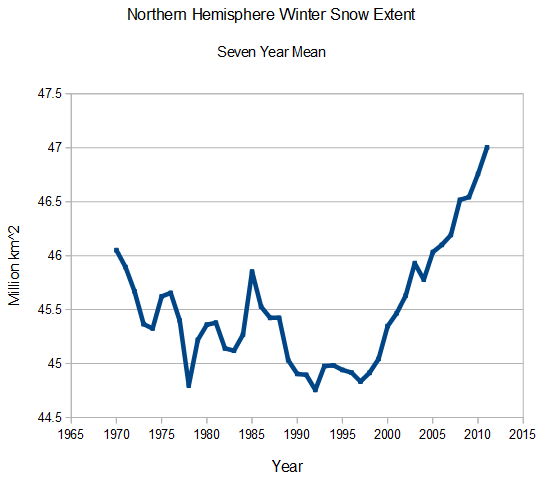
    Northern Hemisphere winter snow extent is going through the roof, due to Arctic air pushing further south.

    BvElMTCCAAAfGr6Rutgers University Climate Lab :: Global Snow Lab

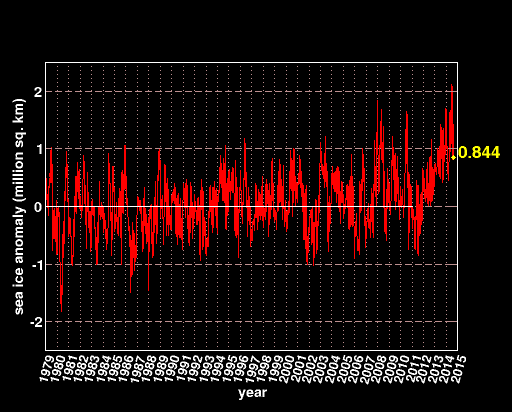
    Antarctic sea ice extent is going through the roof

    iphone.anomaly.antarctic (1)

    iphone.anomaly.antarctic.png (512×412)

    US summer temperatures are plummeting

    ScreenHunter_2311 Aug. 26 05.44

    Pay no attention to all this. Just keep believing the mindless propaganda being spewed by the White House and their minions.