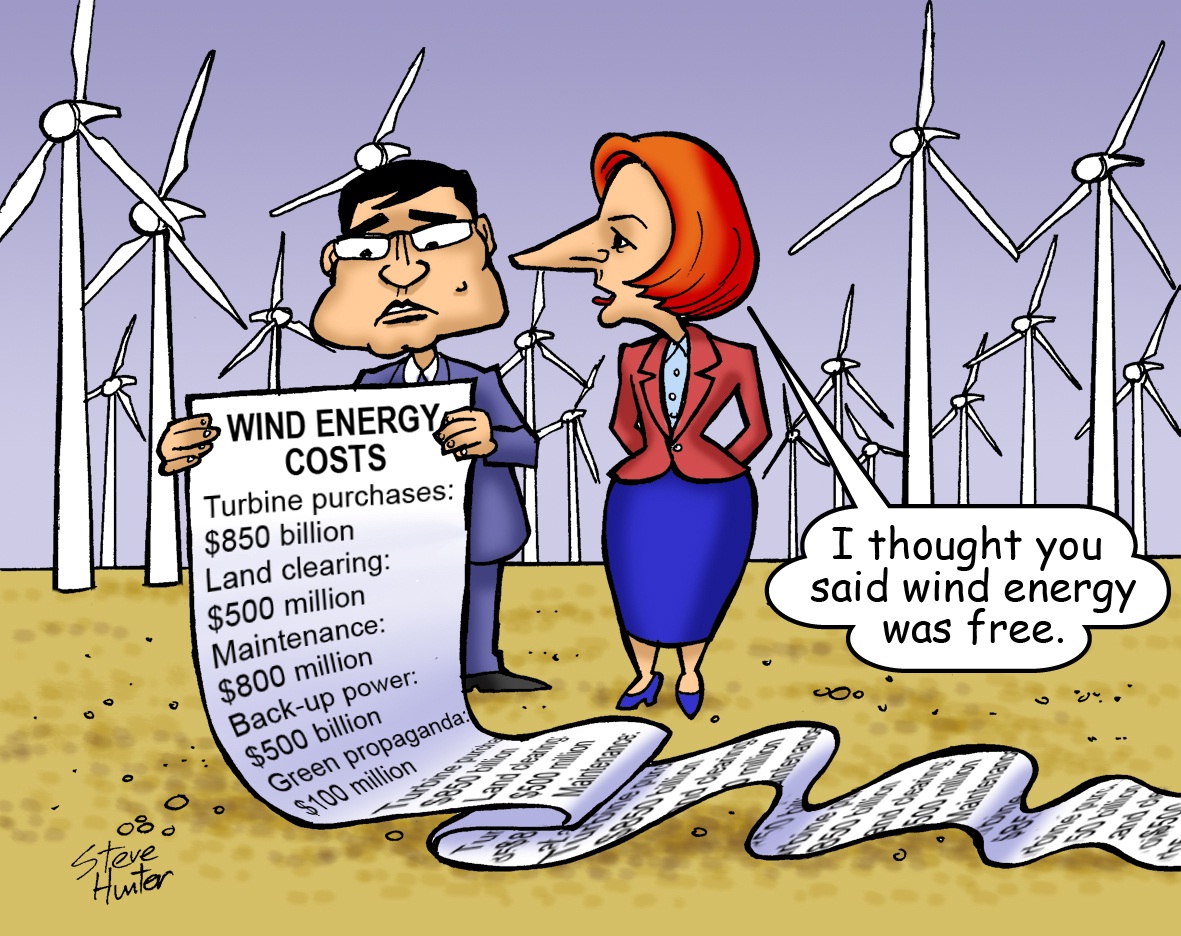
As an Industrial Source of Energy…..Wind Doesn’t Just Blow….It SUCKS!!

The Wind: Only Designed for Recreational Pursuits

kites

Why Not Wind?
wind-watch.org
Eric Rosenbloom

To whom it may concern:

This is a brief representation of the reasons industrial-scale wind is a destructive boondoggle that only fools – or worse – would approve.

Unlike “conventional” power sources, wind does not follow demand. As the Bonneville Power Authority in the Pacific Northwest of the USA has shown, the relationship between load and wind generation is essentially random (www.wind-watch.org/pix/493). That means that wind can never replace dispatchable sources that are needed to meet actual demand.

The contribution of wind generation is therefore an illusion, because the grid has to supply steady power in response to demand, and as the wind rises and falls, the grid maintains supply by relying on its already built-in excess capacity.

That is also why meaningful reductions in carbon emissions are not seen: because fuel continues to be burned in “spinning reserve” plants which are kept active to kick in when needed for meeting surges in demand or, now, drops in the wind. Denmark’s famously high wind penetration is possible only because it is connected to the large Nordic and the German grids – so that Denmark’s wind power actually constitutes a very small fraction of that total system capacity. To make further wind capacity possible (despite a public backlash that has essentially stopped onshore wind development since 2003), Denmark is now building a connection to the Dutch grid.

Another reason that meaningful reductions in carbon emissions are not seen is that the first source to be modulated to balance wind is usually hydro. This is seen quite clearly in Spain, another country with high wind penetration: The changes in electricity from hydro are an almost exact inverse of those from wind (https://demanda.ree.es/generacion_acumulada.html). This is also seen in the USA’s Pacific Northwest (http://transmission.bpa.gov/business/operations/Wind/baltwg.aspx).

Finally, on systems with sufficient natural gas–powered generators, which can ramp on and off quickly enough to balance wind’s highly variable infeed, wind forces those generators to operate far less efficiently than they would otherwise. It is like city versus highway driving. According to several analyses (e.g., www.wind-watch.org/doc/?p=1568), the carbon emissions from gas + wind are not significantly different from gas alone and in some cases may be more.

And again, whatever the effect, wind is always an add-on. The grid must be able to operate reliably without it, because very often, and often for very long stretches of time, wind is indeed in the doldrums: It is not there.

And beware the illusion of “average” output. The fact is that any wind turbine or group of turbines generates at or above its average rate (which is typically 20%–30% of the nameplate capacity, depending on the site) only about 40% of the time. Because of the physics of extracting energy from wind, the rest of the time production approaches zero. About one-third of the time, wind production is absolutely zero.

As an add-on, therefore, its costs are completely unnecessary and wasteful. And even if, by some miracle, it were a reliable, dispatchable, reasonably continuous source, its costs would still be enormous – not only economically, but also environmentally. Wind is a very diffuse resource and therefore requires a massive mechanical system to catch any useful amount. That means ever larger blades on ever taller towers in ever larger arrays. And the only places where that is feasible are the very places we need to preserve as useful agricultural land, scenic landscapes that are so important to our soul (and to tourism), and wild land where the natural world can thrive.

Besides the obvious damage to the land of heavy-duty roads for construction and continued maintenance, huge concrete platforms, new powerlines, and substations (while making no meaningful contribution to the actual operation of the grid) and the visual intrusion of 150-metre (500-ft) structures with strobe lights and rotating blades, there are serious adverse impacts from the giant airplane-like blades cutting through 6,000–8,000 square metres (1.5–2 acres) of vertical airspace both day and night: pulsating noise (including infrasound which is felt more than heard) that carries great distances and disturbs neighbors (especially at night, when there is a greater expectation of – and need for – quiet), even threatening their physical health, pressure vortices that kill bats by destroying their lungs, blade tip speeds of 300 km/h that also kill bats as well as birds, particularly raptors, many of which are already endangered, and vibration that carries through the tower into the ground with effects on soil integrity and flora and fauna that have yet to be studied.

In short, the benefits of industrial-scale wind are minuscule, while its adverse impacts and costs are great. Its only effect is to provide greenwashing (and tax avoidance) for business-as-usual energy producers and lip-service politicians, while opening up to vast industrial development land that has been otherwise fiercely protected – most disturbingly by many of the same groups now clamoring for wind.

Industrial-scale wind is all the more outrageous for the massive flow of public money into the private bank accounts of developers. It is not surprising to learn that Enron established the package of subsidies and regulatory “innovations” that made the modern wind industry possible. Or that in Italy, the Mafia was an early backer of developers. It is indeed a criminal enterprise: crony capitalism, anti-environment rapaciousness, and hucksterism at its most duplicitous.

After decades of recorded experience, there is no longer any excuse to fall for it.
Eric Rosenbloom
President, National Wind Watch, Inc. (www.wind-watch.org)

Eric Rosenbloom lives in Vermont, USA, where he works as a science editor, writer, and typographer. He has studied and written about wind energy since 2003. He was invited to join the board, and then elected President (a wholly volunteer position), of National Wind Watch in 2006, a year after it was founded by citizens from 10 states who met to share their concerns about the risks and impacts of wind energy development. National Wind Watch is a 501(c)(3) educational charity registered in Massachusetts.

yacht

Turn Off the Money Tap, the Windweasels will Scurry!

Fears for renewables after energy target ‘described as government largesse’


Report: wind farms
The renewable energy review is expected to deliver a draft report next week. Photograph: Picasa

Windfarm owners say the head of Tony Abbott’s renewable energy review recently told them they were foolish to “build a whole business model on government largesse”, raising fears he will recommend a severe winding back of the renewable energy target.

Simon Holmes a Court, the founding chair of Hepburn Wind, a community windfarm, told Guardian Australia he had been astonished by the comments from businessman Dick Warburton at a meeting last week.

Meanwhile, the now-independent Climate Council has released a report arguing Australia’s coal-fired power stations are among the oldest and dirtiest in the world and difficult to retrofit with carbon capture and storage technology – leaving renewables such as wind as the least-cost “zero emissions” option.

Holmes a Court said Warburton asked “didn’t we feel foolish basing a whole business model on government largesse”. The “government largesse” being referred to was the renewable energy target (RET) that was first introduced by the Howard government, has enjoyed bipartisan support ever since and has attracted about $18bn in investment.

“If the RET was to be abolished our project will fold. Two thousand people invested in this community windfarm on the basis that this was settled bipartisan policy. We are not feeling foolish, we are feeling betrayed,” Holmes a Court said.

Warburton’s review is expected to deliver a draft report to government next week.

The Coalition went into the election promising to keep the RET, which underpins investment in energy sources such as wind and solar, but saying it would review the fact that the policy was exceeding its original goal of delivering 20% renewable energy by 2020 because of falling electricity demand.

But, after the election, the Coalition began debating whether the RET should be scrapped altogether or – a more likely outcome – “grandfathered” so only existing projects will benefit.

The terms of reference for the RET review said it would look at “the extent of the RET’s impact on electricity prices, and the range of options available to reduce any impact while managing sovereign risk”.

And even government backbenchers who question the science of climate change and oppose the RET concede its total abolition would constitute “sovereign risk” – a situation where governments change the rules after investment decisions have already been made.

George Christensen, who the climate-sceptic Heartland Institute is sponsoring to address its conference in Las Vegas next month and who chairs the Coalition backbench industry committee, said there were “conflicting views within the Coalition because we are acutely aware of its impact on power prices but on the other hand there is a strong argument we should not disadvantage people who have invested on the basis of what was bipartisan policy”.

But the Institute of Public Affairs (IPA) thinktank – which has long lobbied against the RET – has used a submission to the Warburton review to argue for its abolition, dismissing concerns that abolishing the RET would constitute “sovereign risk”. Like Warburton, the IPA suggests businesses should not have based investments on government “favours”.

“Sovereign risk involves a ‘taking’ of property and should be avoided because, ethical issues aside, it creates great uncertainties for investment, especially investment with long payback times. But sovereign risk from the government withdrawing a favour is different from when it takes a property. No investor can reasonably expect a subsidy to prevail for 15 years as is notionally the case with windfarms and other exotic renewable facilities. And there would be few precedents for a government committing its successors to what would become 24 years of worthless expenditure,” the IPA says in its submission.

“If removal of such favourable and lengthy regulatory provisions was considered to constitute reimbursable sovereign risk, the motor vehicle manufacturers now abandoning production in Australia would have a case for compensation … The termination of the renewable energy requirements should be done immediately.”

According to the IPA, there are three options for modifying the RET scheme:

• Reduce it to a “real” 20% of the current electricity market. It says this would reduce the amount of renewables from 41,000 gigawatt hours (20% of what was the estimated size of the market in 2020) to a maximum of 33,000 GWh.

• Allow only the existing and committed projects to proceed as subsidised. This would mean about 15,000 GWh.

• Totally abandon the RET and force “renewables to immediately compete without subsidy, as their adherents always claimed they would eventually be able to do”.

The climate commission, which became a crowd-funded independent body after it was abolished by the Abbott government, will release a report on Tuesday arguing that “the least-expensive zero-emission option available at scale for deployment today in Australia is wind, closely followed by field-scale solar PV”.

“These costs are falling fast as take-up globally accelerates. Wind should be 20% to 30% cheaper by 2020, solar PV is expected to halve in cost,” the report says.

Assuming Australia does need to reduce emissions from its power sector, the report says moving to renewables would be cheaper than trying to “clean up” coal-fired plants.

It says that by 2030, 65% of australia’s power stations will be over 40 years old. The nation’s older power stations cannot be made more efficient without vast expense, and their age limits the potential for retrofit CCS investment, it says.

After the election, Abbott took control of the RET review of his own department and appointed Warburton – a self-professed climate sceptic – to head it.

Warburton, a veteran industrialist and the chairman of the Westfield Retail Trust, described his views on climate science in a 2011 interview on ABC in this way: “Well I am a sceptic. I’ve never moved away from that. I’ve always believed sceptical,’’ he said. “But a sceptic is a different person than a denier. I say the science is not settled. I’m not saying it’s wrong. I’ve never said it’s wrong, but I don’t believe it’s settled.”

Others, including Abbott’s top business adviser, Maurice Newman, want the RET scrapped altogether.

Newman, the former chairman of the ABC and the ASX, has said persisting with government subsidies for renewable energy represented a “crime against the people” because higher energy costs hit poorer households the hardest and there was no longer any logical reason to have them.

Under legislation, the next review of the RET is supposed to be undertaken by the independent Climate Change Authority (CCA) but the government is seeking to abolish the CCA.

Lenore Taylor

Lenore Taylor is the political editor of Guardian Australia. She is a Walkley award winner and a winner of the Paul Lyneham award for excellence in press gallery journalism. She co-authored a book, Shitstorm, on the Rudd government’s response to the global economic crisis.

Ontarians Shoot Themselves in the Foot! Again….and again!

Lakehead University Professor Livio Di Matteo Reports on Economy

But don’t cry for the province; it has mainly itself to blame

THUNDER BAY – EDITORIAL – Ontarians have re-elected a government whose decade long reign dovetails with the lowest growth rate of provincial real per capita GDP in the Canadian federation. In the face of economic decline, Ontarians have come to fear change and opted for the status quo in the hope that things may get better if enough time goes by. Sadly, Ontario has embarked on the road to Argentina.

Despite Ontario’s mounting public debt, laggard economic performance, new status as a have not province, general lack of competitiveness, as well as a government marked by scandals and charges of corruption, the opposition parties were unable to convince the electorate of the need for change. In the face of such abundant fodder, this also represents a notable failure on the part of the opposition parties. Like Argentina, Ontario’s economic decline has spilled over to pervade its institutions with an inability to articulate and effect change.

In the early 20th century, Argentina was a successful export-led economy rooted in agricultural production – particularly beef. During the 20th century, Ontario became a successful export-led economy based particularly on its manufacturing sector. During its heyday, Argentina had one of the highest standards of living in the world and believed it was on the verge of becoming the next United States. Meanwhile, Ontario has grown accustomed to one of the highest standards of living in the world and taken its role as an economic cornerstone of the Canadian federation for granted.

The First World War and Great Depression shocked the Argentine export economy and the beef export industry never fully recovered. The result was poor economic policies over the next half-century that aimed to recapture a fading standard of living. Argentina was marked by large public sector debts and deficits, corruption, high inflation, and protectionism for uncompetitive sectors of the economy. Most importantly, there were entrenched economic interests that benefitted from poor government economic policies and a general inability to implement changes that would reverse the long-term decline of the Argentine economy. With a set of poor political institutions that included military coups, Argentina settled into a long-term decline punctuated by bouts of economic crisis and an inability to resolve its problems.

For Ontario, its problems began with an incomplete transition to the economic changes brought about by a more competitive world economy after 1990. Ontario’s economic development reached a crucial watershed in the wake of the economic boom of the 1980s that saw free trade with the United States, a shift away from the traditional east-west economic alignment, and the recession of the early 1990s. While the mid-1990s saw the onset of public sector restructuring and economic reforms, these petered out in the early 21st century with the return of more interventionist government economic policy that saw tax increases, increased public sector spending and a flawed industrial strategy based on green energy initiatives that became a factor in higher electricity prices. Economic productivity faltered and the 2009 tilt into recession was compounded by an appreciating Canadian dollar.

Ontarians have become used to ever-larger amounts of public spending fueled by growing public debt to compensate for faltering private sector productivity. This has created clients with a vested interest in more interventionist government. The recent election campaign saw promises of new public infrastructure spending, a new pension plan as well as overt political meddling by some traditionally circumspect public sector unions. While Ontario police unions do not have the heft of the Argentine military, their election activity is nevertheless yet another sign that Ontario may be changing for the worse.

In towns and cities across the province ravaged by manufacturing decline, the public sector has picked up the slack with public works construction projects, expanded government initiatives and their associated employment. Ontarians have convinced themselves that what is needed to reverse their malaise is more government spending fueled by debt and deficits, despite the evidence that the past decade of such policies have yet to turn the economy around. It is still early on in Ontario’s economic and fiscal troubles but another decade of economic policy ineptness could well make Ontario’s decline terminal.

Don’t cry for Ontario, it has mainly itself to blame.

Livio Di Matteo

– See more at: http://www.netnewsledger.com/2014/06/13/ontario-the-new-argentina-di-matteo/#sthash.RvVq5SNA.dpuf

Governments and Wind Industries Know They are Harming Us!!

Wind turbines are a human health hazard: the smoking gun

Credit:  By James Delingpole | The Telegraph | July 25th, 2013 | telegraph.co.uk ~~


How much more dirt needs to come out before  the wind industry gets the thorough investigation it has long deserved?

The reason I ask is that it has now become clear that the industry has known for at least 25 years about the potentially damaging impact on human health of the impulsive infrasound (inaudible intermittent noise) produced by wind turbines. Yet instead of dealing with the problem it has, on the most generous interpretation, swept the issue under the carpet – or worse, been involved in a concerted cover-up operation.

A research paper prepared in November 1987 for the US Department of Energy demonstrated that the “annoyance” caused by wind turbine noise to nearby residents is “real not imaginary.” It further showed that, far from becoming inured to the disturbance people become increasingly sensitive to it over time.

This contradicts claims frequently made by wind industry spokesmen that there is no evidence for so-called Wind Turbine Syndrome (the various health issues ranging from insomnia and anxiety to palpitations and nausea reported by residents living within a mile or more of wind turbines). Until recently, RenewableUK – the British wind industry’s trade body – claimed on its website: “In over 25 years and with more than 68,000 machines installed around the world, no member of the public has ever been harmed by the normal operation of wind farms.”

In a section called Top Myths About Wind Energy’ section it claimed that accusations that wind farms emit ‘infrasound and cause associated health problems’ are ‘unscientific’.

Other pro-wind campaigners, such as Australian public health professor Simon Chapman, have gone still further by insisting that the symptoms reported by Wind Turbine Syndrome victims around the world are imaginary and often politically motivated.

But the 1987 report, based on earlier research by NASA and several universities, tells a different story. A team led by physicist ND Kelley from the Solar Energy Research Institute in Golden, Colorado tested under controlled conditions the impact of low-frequency noise generated by turbine blades.

It found that the disturbance is often worse when indoors than when outside (a sensation which will be familiar to anyone who has heard a helicopter hovering above their house).

In subsequent lab tests involving seven volunteers, it found that “people do indeed react to a low-frequency noise environment”. As a result of its findings, the report recommended that in future wind turbines should be subject to a maximum noise threshold to prevent nearby residents experiencing “low-frequency annoyance situations.”

However these recommendations – widely publicised at the Windpower 87 Conference & Exposition in San Francisco – fell on (wilfully, it seems more than plausible) deaf ears.

It found that the disturbance is often worse when indoors than when outside (a sensation which will be familiar to anyone who has heard a helicopter hovering above their house).

In subsequent lab tests involving seven volunteers, it found that “people do indeed react to a low-frequency noise environment”. As a result of its findings, the report recommended that in future wind turbines should be subject to a maximum noise threshold to prevent nearby residents experiencing “low-frequency annoyance situations.”

Rather than respond to the issues raised, the industry devised a code of practice apparently contrived to ignore those very acoustic levels of most concern. ETSU-R-97 – the UK industry standard, which became the model for wind developers around the world – places modest limits on sound within the normal human hearing range, but specifically excludes the lower frequency “infrasonic” noise known to cause problems.

Last month the Department of Energy and Climate Change  (DECC) published a report by the Institute of Acoustics examining whether ETSU-R-97 was still adequate to the task. Remarkably, instead of stiffening regulations, it made them more lax, not only continuing to ignore the Low Frequency Noise and infrasound issue, but actually giving wind farms leeway to make more noise at night and to be built even closer to dwellings.

John Constable, director of the Renewable Energy Foundation, commented: “The report may represent current wind industry practice but it is very poor guidance and fails in its duty of care.”

The industry’s response is that turbine design has grown so much more sophisticated since the late Eighties that the problems identified in the 1987 report – which built on work from another report two years before – no longer apply.

“We’re often hearing these weird and wacky reports on the effects of wind. It seems anyone can stand up and say anything, which we find somewhat worrying because it gives a false impression. We don’t accept the suggestion that there are any health impacts caused by wind turbine noise, though we welcome any new research into the issue,” a spokesman for Renewable UK told me.

However this is contradicted by the author of the original reports Neil Kelley. Kelley has told Graham Lloyd – the environment editor from The Australian who (uncharacteristically for an environment editor puts truth before green ideology) broke the story – that research has shown that it is still possible for modern wind turbines to create “community annoyance.”

Kelley, who served as the principal scientist (atmospheric physics) at the National Renewable Energy Laboratory’s National Wind Technology Centre from 1980 to 2011, told Lloyd:

“Many of the complaints I have heard described are very similar to those from residents who were exposed to the prototype wind turbine we studied.”

He said the original research was performed to understand the “totally unexpected community complaints from a 2MW downwind prototype wind turbine.”

He said: “While follow-on turbine designs moved the rotors upwind of the tower, the US Department of Energy funded an extensive multi-year research effort in order to develop a full understanding of what created this situation.”

“Their goal was to make such knowledge available to the turbine engineers so they could minimise the possibility of future designs repeating the experience. We found the majority of the physics responsible for creating the annoyance associated with this downwind prototype are applicable to large upwind machines.”

The wind industry has resisted demands from campaigners to investigate this problem further. For example, in Australia, Lloyd reports, the wind turbine manufacturer Vestas has argued in a submission to the NSW government that low frequency noise not be measured.

But as Kelley said to Lloyd, if low frequency noise from turbines does not influence annoyance within homes, “then why should [the industry] be concerned?”

Those readers with an appetite for even more technical detail may be interested in the views of acoustics expert Dr Malcolm Swinbanks:

The important aspect to understand is that the old-fashioned downwind rotor-turbines did indeed generate a wider spectrum of infranoise and low-frequency noise, extending from 1Hz to 50Hz or 60Hz. Modern upwind rotor turbines are definitely very much quieter in the 32 and 64 Hz octave bands, but under some circumstances they can be similarly noisy over the frequency range 1Hz – 10Hz.

The wind industry denies this aspect, namely that they do not generate impulsive infrasound – I was present at a public meeting, with 400 farmers enthusiastically wanting wind-turbines on their land, when a wind-industry representative argued that I was incorrect to quote NASA research because the NASA research related only to downwind turbines. In fact NASA led the world in developing upwind rotor turbines, with the first, MOD-2 in 1981. They were fully aware of the differences between downwind and upwind configurations as long ago as 1981. Although upwind turbines are indeed quieter in respect of audible sound, NASA was well aware that inflow turbulence or wind-shear could give rise to enhanced infrasound from upwind turbines.

In the context of that particular public meeting, the chairman refused to let me respond at that time to correct the wind-industry presentation, and argued that I could only send a letter to the Planning Committee, which I duly did under strong protest. So I have encountered the wind-industry position directly at first hand.

The problem is that while the acoustics community fully acknowledge that the audible component of low-frequency sound (>20Hz) can cause adverse human reaction, they consistently deny that infrasound (

The response of the Australian Senate Inquiry to this information was that wind-turbines don’t generate 110dB. But just as sound pressure levels are always weighted in the audible frequency range, using the dBA scale – one does not quote absolute sound pressure levels, but dBA levels, so the infrasound range is correctly measured using the weighted dBG scale. This is an ISO internationally approved scale, and 110dB at 2.14Hz represents 82 dBG on the dBG scale. Modern wind turbine peak infrasonic impulsive levels have been measured as high as 76-80dBG, which is only marginally below the 82dBG level that was found to cause adverse effects in the Chen laboratory tests.

It is notable that when some acousticians wish to argue that wind turbine infrasound is not a problem, they quote known problematic infrasonic sound levels using the unweighted decibel dB scale, which makes these levels seem well “out-of-reach” of wind turbine infrasound levels. Yet these same acousticians would not dream of using absolute sound pressure levels to evaluate conventional audible sound, but will always quote correctly weighted dBA levels.

Thus, for example, the Chen infrasonic tests were at 110dB at 2.14Hz. This is 82dBG. In contrast, a “child-on-a swing” is also quoted by some acousticians as “not-a-problem”, when it is experiencing 110dB. This 110dB is at around 0.5Hz, so the corresponding dBG level is only 50dBG. Although the absolute sound pressure levels are identical, the perceived infrasound levels in these two cases are very different and cannot be equated to each other.

So I am unimpressed by the casual practice of quoting absolute sound pressure levels for describing infrasound, in order to exaggerate differences, when it is well recognized that the response of the ear is not uniform, and weighted sound pressure levels should be used for describing the likely hearing response.

This feature is responsible for much of the confusion that arises – interchange of unweighted and weighted levels can lead to very different conclusions – a situation which does not help to clarify the overall impact of infrasound.

It is noteworthy that some recent research indicates that at the very lowest frequencies (around ~1Hz) infrasound may be perceived by a different, separate mechanism than the ear’s conventional auditory mechanisms, so that at these frequencies, the G-weighting may no longer be accurate. But this is only a very recent deduction. Wind turbines undoubtedly generate their strongest signals at around 1Hz, so this is a new area of investigation which may also reveal additional adverse effects.

And here is the expert opinion of another US acoustics expert, Rick James – who thinks it somewhat unlikely that the wind industry is unaware of the problem:

 The “Kelley paper” is just one of many studies and reports published in the period from 1980 to 1990 by acousticians and other researchers working under grants from the US Dept. of Energy (DOE), NASA, and other agencies and foundations. All of these papers are still available on web sites open to the public. I have attached one of the later papers (“Wind Turbine Acoustics, Hubbard and Shepherd”) that summarize many of those studies. The acoustical conferences, at least those here in the US, all had presentations on wind turbine noise and it was one of the “hot” topics in the field. Earlier papers such as the 1982 Hubbard paper on Noise Induced House Vibrations was reporting some of the early research showing wind turbines were heard at lower auditory thresholds and that the infrasound was affecting people inside homes in much the same was jet noise at airports was affecting communities along flight paths. As a general rule, all of this research noted the need for caution if large upwind wind turbines of the type being installed today were to be located near homes and communities. As you can see in the Kelly paper there was concern over health impacts by the research community. Concurrent with this type of work the US DOD and NASA were investigating human response to infrasonic sound and vibration to help select candidates for jet pilots and space missions. This led to studies of nauseogenicity like the “1987 report on Motion Sickness Symptoms and Postural Changes……” Suffice it to say that between the issues of dynamically modulated infra and low frequency sound causing adverse health effects called “Sick Building Syndrome,” similar effects observed from wind turbines leading to the Kelley paper, military interest in motion sickness and other similar issues for large ships with slowly rotating engines to jet aircraft noise few acousticians in that period would have discounted the premise that for some people these types of sounds posed serious issues.

Can anyone imagine a potential scandal of this magnitude in the fossil fuel industry going uninvestigated by the green lobby – and hitting the front pages of all the newspapers?

I can’t.

Special Needs Children are Being Abused by Their Own Governments.

‘I need to protect my autistic child from wind farms’

Credit:  Originally published as: ‘I need to protect my child from wind farms’ | By Celine Naughton | Irish Independent | Published 9 June 2014 | www.independent.ie ~~


Whenever Jenny Spittle’s children visit their grandad in England, 12-year-old Billie comes home tired, complaining of headaches, earache, dizziness and hearing buzzing noises. Billie has autism and her mother is convinced her symptoms are brought on by the towering pylons and wind turbines located near her grandfather’s house. Now Jenny lies awake at night worrying about plans to build a wind farm close to her home in Co Westmeath.

“I see what she’s like after a week with her grandfather and wonder how she’ll cope if we have these things on our doorstep,” she says.

Like many autistic children, Billie is hyper-sensitive to sound and light. She hears sounds at frequencies that are inaudible to most people, and Jenny is afraid she will find the sound of wind turbines close to home intolerable.

“It’s not easy raising an autistic child, yet while I’m busy trying to organise psychotherapy, speech and language, occupational therapy and all the other kinds of supports she needs to help her cope with everyday life, I also have to make time to protest against pylons and wind turbines,” she says. “I can’t afford to wait until they’ve been built to voice my objections. I have to protect my child.”

Thirteen years ago, university lecturer Neil van Dokkum and his wife Fiona moved from South Africa to an idyllic part of Waterford with their two sons. Their youngest, Ian, had been diagnosed with autism and part of the reason for choosing to make their home in such a remote location was to give Ian the peaceful environment they felt he needed in which to thrive. Then, six months ago, Neil heard about the proposed construction of pylons in the area from a neighbour. The news set off alarm bells for him and his family.

“Ian is incredibly sensitive to electric noise and certain types of light,” he says. “He will start crying and become very agitated. It is a source of emotional trauma for him. My wife and I discovered the extent of this sensitivity when we installed energy-saving light bulbs in our kitchen. When Ian walked in, he put his fingers into his ears, screwed his face up tight and said: ‘Blue light off, please Daddy. Blue light off!’ I was sitting directly under the light and had not noticed anything. Ian was standing at the door, about four metres away, and he couldn’t bear it. Can you imagine how he will be affected by pylons carrying 400kV power lines? Like many other parents of autistic kids and indeed children with other intellectual disabilities, we deliberately moved to the country so as to be away from the city with its high levels of ambient noise, including electrical noise, and disturbance. At night, it can be so quiet here that I can hear the cows crunching grass in the field opposite. Can you imagine how that silence will be shattered by clanking pylons? More specifically, how my son’s silence will be shattered by the electrical noise coming from those cables? How will he be able to sleep with that noise? And how will the rest of my family sleep as Ian becomes highly agitated when awakened by this distressing noise?

“The other concern I have is flight risk. Ian, like many autistic children, has no sense of danger and will run away and on to the road at any opportunity. He is not running away from anything, but sometimes seems to feel the need to rush into an open space. Again, the countryside, with its minimal traffic and quieter roads, is far safer than a city with all those vehicles. Even so, my property is fenced and gated, not to keep people out, but rather to keep my son in and safe.

My deepest fear now is that the electrical noise coming off cables and pylons will disturb him so much that he will attempt to run from it. And if he can’t get out, he will bang his head against the wall out of sheer frustration. The potential consequences are too painful to even contemplate, and if the proposed construction of pylons across the countryside goes ahead, selling our house would be impossible, so we are effectively trapped.

“If the Government were to abandon its slavish adulation of the wind industry and pursue the biomass option, converting Moneypoint power station to biomass boilers, it could save over three billion euro. Imagine how many state-of-the-art facilities for people with intellectual disabilities could be built with that sort of money.”

A Department of Health spokesperson says: “According to international literature, no direct health effects have been demonstrated in persons living in close proximity to wind turbines. However, it is agreed that there is a need for additional, well-designed studies in this area. The Department of Health advises that anyone who believes they are experiencing any health problems should consult their GP promptly.”

In its draft development plan, Westmeath County Council required any new wind farm development to implement a setback distance of 10 times the height of the turbine from residential dwellings, but the Department of the Environment intervened. Under Objective PWin6 of the plan, a turbine measuring 180m, for instance, would be sited at least 1.8km away from any house, while according to the Department’s wind energy guidelines, a distance of 500m is deemed sufficient. Minister of State for Planning Jan O’Sullivan wrote to the council instructing it to re-examine the setback distance.

“We received over 5,600 submissions from constituents who supported PWin6, which would have kept the setback distance in place,” says Westmeath County Council chairman Peter Burke. “We informed the Minister of State that we felt the Department’s guidelines were not adequate and she appointed an inspector to carry out an independent review.”

Last month, that inspector’s report recommended against the inclusion of the PWin6 objective on the grounds that it “would be contrary to section 28 of the Planning and Development Act 2000.”

At the time of writing, the Department’s final decision on the matter is pending.

Safety first: Are turbines and pylons dangerous?

Now that Ireland’s plan to export wind energy to Britain has been scrapped, the public has been left a little breathing space to focus on a simple question: Are wind farms and their related pylons and overhead power lines safe or not?

The Department of Health’s Deputy Chief Medical Officer, Dr Colette Bonner, has said that older people, people who suffer from migraine, and others with a sensitivity to low-frequency vibration, are some of those who can be at risk of ‘wind turbine syndrome’.

“These people must be treated appropriately and sensitively as these symptoms can be very debilitating,” she commented in a report to the Department of the Environment last year. We asked Dr Bonner for clarification.

“Presently the World Health Organisation does not classify Wind Turbine Syndrome as a disease under the WHO international classification of diseases,” she said. “Current research in the area suggests that there are no direct health effects of wind turbines. However, there are methodological limitations of many of the studies in this area and more high quality research is recommended.”

Side by side with the controversy over wind farms comes concern over the high voltage pylons which distribute the electricity generated by the wind turbines to the national grid. Chief Medical Officer in the Deptartment of Health, Dr Tony Holohan, has stated that he does not think there is a health risk associated with people living in vicinity of pylons.

But not everybody agrees; according to British physicist Denis Henshaw, people have every reason to be concerned. Emeritus professor of human radiation effects at Bristol University and scientific director of the charity Children with Cancer UK, he recently told a public health meeting in Trim, Co Meath, that high voltage power cables are linked “beyond reasonable doubt” to childhood leukaemia and other diseases.

“It has been shown again and again that there is a definite risk of childhood leukaemia and other diseases near these lines,” he says. “The link is so strong that when a childhood leukaemia occurs near these lines there is a greater than 50pc chance that the leukaemia is due to the line. This raises the prospect of legal action for corporate manslaughter against those involved in putting the line there. The Irish government and EirGrid need to take care of their citizens and acknowledge the known health risks in people near these lines.”

A spokesman for EirGrid says: “We’re not doctors, but having taken advice from experts at the World Health Organisation, along with the chief science adviser and the chief medical officer, it is clear to us that there is no evidence to link overhead lines with adverse health effects.”

The Government report ‘Health Effects of Electromagnetic Fields’ 2007 says: “Given that there is still uncertainty about whether long-term exposure to extremely low frequency magnetic fields could cause childhood leukaemia, use of precautionary measures to lower people’s exposure would therefore appear to be warranted.

“As a precautionary measure, future power lines and power installations should be sited away from heavily populated areas to keep exposures to people low.”

Source:  Originally published as: ‘I need to protect my child from wind farms’ | By Celine Naughton | Irish Independent | Published 9 June 2014 | www.independent.ie
As the mother of a child with ADHD and Severe Sensory Processing Issues, I can empathize entirely with this family.  My son’s Specialist has written a letter on his behalf, telling of the trauma my son will be subjected to, if huge wind turbines are surrounding our property, one of them, only 550m from the center of our home.  The wind turbines proposed for our community, are 185m high, and 3MW.  If they don’t stop this project, many people will suffer terribly, in many different ways.  It is a disgrace.
                                                                                                                                                                                                                                                                                                             Shellie Correia

Ontario…..Canada’s Financial Anchor! What a Shame!

Canadians pay for Ontario verdict

tim hudak, waving
Ontario PC leader Tim Hudak announced he is stepping down as leader Thursday night after defeat in the provincial election on June 12 2014. (Bob Tymczyszyn/QMI Agency)

Onlookers in more fiscally stable regions might have sat back on the couch with a bowl of popcorn to chuckle as the results poured in.

“Will it be ‘Welcome to Hell: The Sequel’? or will they dodge the bullet?” they might have asked their spouses.

But when one province makes up more than a third of the country’s population, we’re all in this together.

For starters, if energy prices in Ontario continue to rise and jobs leave the province, that’ll impact the general economy.

People in Ontario will pay less federal tax, buy fewer domestic goods and cut back on vacations among other household spending.

Then there’s the more direct money drain of equalization payments. In 2009, Ontario became a “have-not” province. It takes out of the pot more than it puts in. For 2014-15, Ontario will get $2 billion.

Provinces like Saskatchewan and Alberta, which have a greater median family income and lower debt per capita than Ontario, are paying for this.

We’re in trouble when Canada’s most populous province is on the “takers” list. Yet Ontario voters just gave the Liberals — who presided over Ontario’s negative turnaround — a four-year majority. Yikes.

To paraphrase the Iron Lady, sooner or later we’re going to run out of Alberta’s money.

Besides, the very people who think reducing our spending is wrong tend to be the same who think our resources sector should be shut down.

Even if the Toronto latte crowd is morally okay with turning Albertans upside down and shaking them for cash, they should at least understand that without resource extraction there won’t be any wealth to share.

Restraining spending and growing the economy is the only way to move forward together in these sluggish times. Ontario Premier Kathleen Wynne must bring Ontario back to black.

When Canada’s premiers met in 2013 it was in Ontario and Wynne chaired the meeting.

This August when they meet in PEI, someone like Saskatchewan Premier Brad Wall needs to take the reins and teach these spendaholics how it’s done.

Ontario and the have-nots are simply endangering Canada’s future prosperity.


“Renewables” …. The only purpose they serve….robbing us blind!

Despite the hype, ‘carbon-free’ energy sources aren’t gaining traction globally

Dr. Roger Pielke Jr. tips us to this interesting yet inconvenient graph.

The graph below shows data from the BP Statistical Review of World Energy 2014, which was released yesterday. It shows the proportion of global energy consumption that comes from carbon-free sources. Guess what? It isn’t growing.


Pielke writes:

The proportion of carbon-free energy consumption is a far more important metric of progress with respect to the challenge of stabilizing carbon dioxide levels in the atmosphere than looking at carbon dioxide emissions.

…

What you should take from this however is that there remains no evidence of an increase in the proportion of carbon-free energy consumption even remotely consistent with the challenge of atmospheric stabilization of atmospheric carbon dioxide. Those who claim that the world has turned a corner, soon will, or that they know what steps will get us around that corner are dreamers or fools. We don’t know. The sooner we accept that, the sooner we can design policies more compatible with policy learning and muddling through.


Another Climate Scientist, Disgusted With the Politicization of Science~

(My LAST Piece on “Climate Change,” I Promise)

The Debate is finally over on “Global Warming” – Because Nobody will Debate

I am deserting from the Climate War.  I will never write another climate article or give another climate talk, and I’ll bite my tongue and say oooooooooooom when I hear or see the sort of exaggerations and certainties about the dangers of heat-trapping gasses that tend to make my blood boil at their absurdity.  For a decade I’ve been a busy soldier for the scientific method, and hence a “skeptic” to climate alarmism.  I’ve said all I think and know about this repetitive, unresolveable topic.  I’ll save hundreds of hours a year for other pursuits!

This is not like my pledge to my wife after a marathon that “I’ll never do another one.”  This is real.  There is simply too little room for true debate, because the policy space is dominated by people who approach this issue not like scholars weighing evidence, but like lawyers inflaming a jury with suspect data and illogical and emotional arguments.

The believers in human–induced catastrophic climate change, strongly represented among the liberal and radical left of American and international politics, have won the mainstream media and government battle for the conventional wisdom, but lost the war for policy change.  None of the governmental and few of the institutional and individual actors who claim to fear climate change will take real steps to reduce their use of energy, choosing instead to put on phony shows of “green-ness” and carbon-trading shell games.  So it’s over, on both fronts.

I guess I should be happy, since in the other two areas, and blogs, in which I expend professional and personal blood, sweat, and tears (the American empire, and school “reform”) I am usually in agreement with the radical left, and never win.  I nod my head happily when reading the Nation magazine and listening to Amy Goodman’s Democracy Now, yet am sadly on the losing end of the policy fights in my areas that they describe.  Politicians and well-paid reformers continue to double down on the disaster of nearly 30 years of the blame-the-teacher, mistest-the-student regime, and U.S. arms and training for dictators have reached new heights under every president from Carter to Obama.

Finally, I’m a winner, but for all the wrong reasons.  The leaders of the big governments who control global policy aren’t avoiding change because they disagree with the conventional wisdom.  They’re avoiding change because it would be politically uncomfortable for them.  Thank goodness, because the change they’re mouthing would be more than uncomfortable for developing countries.  It would be a disaster, de-industrializing them and taking decades off their citizens’ life expectancy.

* * *

Climate Claims and Fears Can Drive You Crazy

I never expected to be in the Climate War.  I have enough wars to fight as an anti-imperialist and an activist supporting development and democracy in Africa against a U.S. policy of backing dictators and American corporations.  Only by chance did I get drafted for climate duty.  About 10 years ago, when a graduate student in my class on international research statistics wrote a required analysis of any peer-reviewed study in the field, she chose a journal article on some aspect of climate science.  Her paper reported data and conclusions about human-induced global warming that were so weak and illogical in their own terms that I gave her a poor grade, noting: “You can’t have read this study carefully.”  She protested, and brought me the article, and indeed I saw that one of the most respected names in climate science and climate policy was writing flights of fancy and getting them published in refereed journals.  I raised her grade, of course, but not all the way to an A, because she had been so smitten with the credibility of the author and the journal that she forgot to check his logic.

Since then I have assigned hundreds of climate articles as I taught and learned about the physics of climate, the construction of climate models, and the statistical evidence of extreme weather.  My justification to my department has been that there may be no issue in global politics more important to more people worldwide than the claim of catastrophic, human-induced warming.   If it’s true, billions will suffer from its effects if we do not act; if it’s false, billions will suffer from needless restrictions on energy, growth, and life expectancy if we do act.  Africans will be foremost among those suffering in both cases.

As an academic, in both employment and inclination, I wanted to learn, to promote inquiry and debate, and that it why I now need to stop.  My blood simply boils too hot when I read the blather, daily, about climate catastrophe.  It is so well-meaning, and so misguided.  I feel like I am watching the modern version of Phrenology, the racist “science” of skull shape that permeated academia and public opinion about Africans and Africa-Americans throughout the 19th century in Europe and white America.  That conventional wisdom conveniently justified colonialism and segregation as systems in which intelligent and benevolent whites ruled colored people.  And it pains me to see climate hysteria spread, because Africans again could pay the price.  It will inevitably put pressure on Western lenders like the World Bank to reduce funding for power generation in Africa, leading to less economic growth, less personal income, and lower life expectancy.

When the Nobel Peace Prize-winning Intergovernmental Panel on Climate Change (IPCC) butchers basic statistical concepts in its findings and its charts; when students call on their universities to divest from energy companies and their presidents argue financial impact but proffer the assumption that greenhouse gasses are a threat to survival; when advocates of African development call for the World Bank to block energy projects; or when the Nation magazine publishes a call to lower the parts per million of carbon dioxide in the atmosphere from 400 parts per million to 300, which would require an end to all world industry for 100 years, and has a picture of the globe on its cover with the caption, “It’s not warming, it’s dying,” I become a man on the verge of doing something I’ll certainly regret.

I don’t want to be driven to crime like climate alarmist Peter Gleick, who stole, leaked, and attributed forged materials from the pro-growth Heartland Institute in 2012, or the climate skeptics who stole and leaked the “Climategate” memos from the University of East Anglia’s Central Research Unit (CRU) in Britain in 2009, facing certain moral sanction and possible criminal investigation.  I don’t want, to cite Gleick’s partial confession, to wake up and find that “my judgment was blinded by my frustration with the ongoing efforts” that disrupt “the rational public debate that is desperately needed.”

I don’t want go raving around, making absurd statements like President Obama, UN Secretary General Ban, or World Bank President Kim.  Obama has long been delusional on this issue, speaking of a coming catastrophe and seeing himself as King Canute, stopping the rise in sea-level.  But he really went off the chain in his state of the union address this year.  “For the sake of our children and our future” he issued an appeal to authority with no authority behind it:

We can choose to believe that Superstorm Sandy, and the most severe drought in decades, and the worst wildfires some states have ever seen were all just a freak coincidence. Or we can choose to believe in the overwhelming judgment of science and act before it’s too late.

There is no judgment of science, overwhelming or other, that human-induced warming has led to any of the events cited.  In fact, there is little conclusive science on the causes of these extreme events at all, except to say that like their predecessors at earlier times in recorded history, they require rare coincidences in many weather building blocks and are unpredictable.

Then Obama pulled out the IPCC’s illogical last refuge, the hoary claim that “the 12 hottest years on record have all come in the last 15.”  That record started in 1860, when a 150-year warming began that even the IPCC concedes had nothing to do with industrial emissions in its first 75 years.  At the high point of a warming period you will of course have a concentration of high years!  And of course this trivial claim says nothing about the cause of the warming, or the temperature in previous warm periods, of which we would probably find quite a few since the end of the Ice Age 15,000 years ago, if we had always had today’s measuring devices.  (A 100,000 year oscillation in our orbit of the Sun from perfect circle to five percent elliptical drives temperatures up and down on the order of 20 degrees, and we happen to be at the high end right now.)

Ban, in a speech on the “Threat of Climate Catastrophe,” recently warned that “if we continue along the current path, we are close to a 6 degree increase.  You all know the potential consequences:  a downward global spiral of extreme weather and disaster; reversals in development gains; increases in displacement; aggravated tensions over water and land; fragile States tipping into chaos.”  Actually, the IPCC’s models, which are fundamentally mathematical data-fitting exercises with little real-life scientific basis, predict a 4 degree rise at most over 100 years, but actual temperatures have been running at about one-third of that rate in the 30 years since the models first made that prediction.

Kim tells us: “If we do not act to curb climate change immediately we will leave our children and grandchildren an unrecognizable planet.”  That’s sort of like the CRU’s David Viner saying in 2000, a decade before two winters of dramatic snowfall on England’s green and pleasant land: “Children just aren’t going to know what snow is.”  Acting for children is definitely a big theme here: an analyst at a left-leaning think-tank wrote about yelling out the names of Obama’s children when subjecting herself to arrest as part of a campaign to block the Keystone oil pipeline.  Fortunately the World Bank has not followed another hip American campaign and tried to reduce today’s 400 parts of carbon dioxide per million in the atmosphere to 350, which would require an end to all industry on earth for 100 years.  The Bank still funds power plants based on coal and gas.  Coal is an inexpensive African resource that can be scrubbed with modern technology to eliminate the real pollution, which is not carbon dioxide but sulfur dioxide, and gas has nearly no dangerous residue when burned.

* * *

“The Debate is Over” Indeed

“The debate is over on Global Warming.”  That statement has been popular for 25 years with a group I call the catastrophists.  During this period they have held true to their claim, consistently refusing to engage in debate, as opposed to polemics.  As a result, the catastrophists have perversely made it true for all of us, as not just public discourse but scientific inquiry, not just interpretive models and statistical studies but the basic data itself, about human influence on global climate have all been hopelessly politicized in a scurry for money, loyalty, and reputation.  Finally, the catastrophists are right: the debate is over, because the fundamental elements of a useful debate are lacking.

I define a catastrophist as someone who insists that any debate is dilatory and therefore immoral because the evidence is so clear and overwhelming that:

  • the roughly one degree rise in average global temperature since 1860 has been triggered by industrial emissions (I say triggered because the climate models that attribute the one degree rise to emissions do so by tripling their purported impact through theoretical cloud feedbacks to the initial increase in heat);

  • this slight warming has increased storms, droughts, and sea levels; and

  • these effects will turn into a catastrophe that threatens life on earth if we don’t replace fossil fuels with other forms of energy.

Catastrophists are generally environmental activists, politicians, and journalists.  They come from the rich tradition of Malthusians, Luddites, and Greens, by which I generally mean the apocalyptic, anti-growth, environmental left.  They still celebrate tarnished figures and institutions, such as:

  • Rachel Carson, author of the 1962 book The Silent Spring, who called the pesticide DDT cancerous to humans without any evidence (and the CDC has found that there still is none), resulting in an effective ban on DDT that led to millions of deaths in Africa from malaria before it was reversed;

  • Paul Ehrlich, author of the 1968 book The Population Bomb, who predicted billions of deaths from starvation and the end of nations from India to the United Kingdom within decades, only to see the greatest increase in well-being in human history over the next thirty years.  Population did double, but energy production and real average income tripled, and life expectancy rose 15 years in poor countries and 12 years worldwide.  (Poor Professor Ehrlich – his belief in scarcity due to high demand caused him to lose his famed 1980 bet on commodity prices with economist Julian Simon, who held that scarcity is redefined constantly by technology and human ingenuity.)

  • Mother Jones magazine, which claimed in 1982 that men’s sperm counts were falling to infertile levels because of industrial chemicals and radioactivity, a claim that had little basis then and has been thoroughly debunked by now.  However, as in the case of Erin Brockovitch, portrayed in an Oscar-winning movie for suing over a harmful chemical in a town’s water when that chemical is not harmful in water, the facts have never caught up with the sensational allegation.

  • The late Stephen Schneider, a leading warming alarmist who in the 1970’s was a cooling alarmist, as was the first director of the data and modeling pinnacle of warming alarmism today, the CRU.

Catastrophists have taken over the workings of the Intergovernmental Panel on Climate Change (IPCC), a United Nations body comprised not of scientists, but of governments.  The IPCC was formed in 1988 not to test the assumption that emissions were driving heat and heat was driving dangerous “climate change,” but to broadcast it.  The IPCC was supposed to be the gold standard for climate claims, but as it become a politicized forum, pushing out scientists who were frustrated by the way careful discussions of findings and theories in its working papers were distilled into political alarms in the summary materials used by politicians and the press.

The IPCC uses tricks that scientists and statisticians rage about, almost like a mimicking of the classic text, How to Lie with Statistics.  For example, the IPCC claims “90 percent certainty” in its attribution of most of the warming of the past 50 years to human causes.  All scientists know that using this phrase implies that a statistical test has been performed on random data, leaving only a ten percent chance that the conclusion is incorrect.  But there is no testing, and there are no statistics, involved in the IPCC’s statement — just a number pulled from thin air.

The IPCC also featured a misleading trend line chart in its latest report, in which convenient starting points and different time periods were used to show a constantly “accelerating” change in temperature when there was no true acceleration.  The chart was eventually pulled, but the IPCC’s favorite physicist, catastrophist guru James Hansen, continues to use similar tricks in showing temperature and shifts in number of hot days, comparing different time periods of different lengths.

The IPCC’s tricks show that it is too politicized to trust.  In addition to its repeated claims about the recent number of “hottest years on record” it has reversed its earlier judgment that proxy data like tree rings showed that global average temperature was much higher just a few hundred years ago, during the Medieval Warming period.  In either case, the proxy data is so rough that nothing conclusive or meaningful can be said about past temperatures at anywhere near the scale of accuracy we use today, but the reversal was politically significant.

The reversal resulted from a concerted campaign by catastrophists who saw that the Medieval warming might imply that the cooling afterwards was an oscillation, caused by nothing but the natural regression to a long-term mean.  That, in turn, might imply that the recent warming is just another natural counter to that, without the need for SUV’s to explain it.  The reversal was fraudulent in two ways: technical, by using data manipulation and ignoring error margins to create a “hockey stick” that shows a recent spike up in temperature (the stick’s blade) after a thousand year flat-line (its handle), and theoretical, by arguing that logically the recent increase from a flat-line, even if true, is somehow evidence of human cause.

Finally, the IPCC is flat out wrong about the computer models of the atmosphere that sit at the core of its claim that the recent correlation of carbon dioxide levels and temperatures is a causal relationship.  (Note that the models say nothing useful about the effects of temperature on weather events, which is the holy grail of catastrophists.  Those claims are made from statistical studies of the frequency of rare events, are handicapped by poor data for the past, and are generally inconclusive even in their own terms.)

  • The IPCC argues that the models are based on physical science, unlike social science models.  This is not true.  While the models use physical equations about the theoretical rate of heat transfer, like social science models they rely on estimates and parameters for those equations, and more importantly are just as helpless before the many interactions of key variables.

  • The IPCC argues that the models take the numerical relationships that best explain the temperature record of the past 150 years and simply apply them to the next 100.  This is not true.  Models as big as these run away, up or down, very quickly, and arrive at nonsensical answers.  They must be “tuned” carefully, not just for the past but for the future.

  • The IPCC argues that the models reveal a strong “sensitivity” of temperature to increases in carbon dioxide.  This is not true.  The models build in a theoretical sensitivity and then triple it through proposed feedbacks in cloud formation.

  • The IPCC argues, and this is its supposed clinching argument, that the fit between physics and temperature in the model is best captured by its claims on carbon sensitivity, and that no other variable works as well.  This is preposterously incorrect.  Physicist Richard Lindzen caustically calls this “proof by lassitude,” since it implies that if the modelers can’t think of any other reasons for warming, there must be none.  (The proof is a little strange, when you think that the mechanism through which the 100,000 year, 20 degree cycle based on the earth’s ellipse is also physically unknown.)  But the problem is far greater than that.  With just a bit of the level of scrubbing the IPCC models undergo, one could indeed fit the temperature series beautifully to baseball scores, or snail lengths, or any series of data.  That is the nature of modeling, and why Wall Street geniuses go broke with close-fit models of the past: they may have no predictive value for the future, because the associations are correlational, not causal.

There are a few scientists, statisticians, and mathematical modelers among the catastrophists, but most of their peers don’t qualify, because of our caution about data and models.  Let me summarize the more cautious position:

  • We know that, all things being equal, industrial emissions lead to warming because their frequencies of oscillation match some of the frequencies of infra-red heat leaving the earth — although the warming response generally lessens over time as the absorption bands in those frequencies become full.

  • But we also know that all things are never equal.  It is the interactions and feedbacks that determine the true impact of a physical change, and there is little physical evidence to support the assumption in the IPCC’s models that the feedback from initial emissions-based warming is on the order of a tripling.

  • Finally, we know that the lack of decent long-term data on all sorts of contributing variables keeps us from concluding much of anything about the effects of the roughly one degree rise in temperature since 1860 on hurricanes, drought, floods, storms, wild-fires, sea-level, and other present-day “climate catastrophes.”

As a statistician who teaches about the fundamental uncertainties of global climate models and the difficulty of finding data series that are good enough and long enough to find a recent trend in extreme weather and sea levels, I have for years scoffed at claims that “the debate is over.”  The climate system is so complex and chaotic, and its many interactions so poorly understood on so many time scales, that I more think that there is little useful information with which to begin, let alone end, a debate.

“Anti-intellectual, and anti-science,” I would complain, as the catastrophists dominated mainstream debate, turning the noble scientific title of “skeptic” into the horrific libel of being a “denier” of a coming Holocaust.  At least I could be thankful that the domination of mainstream and leftist debate did not translate into domination of policy.  Both rich and poor countries continue to talk down fossil fuels while using them every chance they get, because these low-cost forms of energy have been the source of the economic growth and longer life expectancy the world has experienced in two dramatic waves: the industrialization of Europe, the United States and Japan in the 19th century and the industrialization of Korea, China, India, and others in Asia and to a lesser extent in Latin America and Africa in the 20th century.

But after a decade of trying to engage in public discourse on the various issues relating to carbon power, now I have concluded that the catastrophists are finally right – the debate IS over on global warming:

  • Both sides have their scientists (Lindzen versus Hansen, Happer versus the pack)), both sides have their media (Washington Post versus Wall Street Journal, Time versus Forbes, Fox versus ABC).

  • Both sides even have their own data streams (CRU’s ground instrument set and the University of Alabama at Huntsville’s satellite wave-length set) that require significant and judgment-laden adjustments.  (Unlike the case of the U.S. Consumer Price Index, the measurements and corrections are not handled by an unbiased, protected team, but by the protagonists themselves!)

  • Both sides have their central websites that constantly compile articles and arguments for the media and public: the catastrophists’ realclimate.org and Union of Concerned Scientists versus the skeptics’ staid Science and Environmental Policy “The Week that Was” at sepp.org and the wild and wooly climatedepot.org.  (Wonderful exceptions to all this gloom about partisanship are environmental scientist Roger Pielke Jr.’s blog and climate physicist Fred Taylor’s books, which show a clarity and restraint I admire but can no longer replicate.  Their scientific expertise, of course, I never could.)

  • Both sides shamelessly, immediately, and viciously attack the findings and background of those they oppose.

  • Both sides resort to silly arguments that would be laughed out of an introductory statistics or logic course.  The catastrophists seize on a decade of rising temperatures in the 1980’s, some hot days and rain storms, and recent extreme weather and damages, and they issue ingenious interpretation of ancient proxies to show a current high, along with misleading charts.  The skeptics similarly seize on a decade of flat temperatures in the 2000’s, some cool days and snow storms, and extreme weather and damages in decades past, and they issue their own interpretations of ancient proxies to show higher temperatures a thousand years ago, and their own misleading charts.  None of these tricks, none, are relevant to determining the cause and effect of the one degree rise in global temperature since 1860.

  • But only one side, the catastrophists, won’t debate, fearing to give credibility to their opponents and preferring to cast them as kooks.  I have given up on inviting my colleagues from environmental and left-leaning think tanks to debate me and more distinguished skeptics on my campus.  They just won’t do it.

Useful inquiry cannot be conducted in this politicized environment, and without useful inquiry, relevant public discourse is impossible.  So much money, and so many jobs and reputations, are wrapped up in the core creation of data and models and the analysis of proposed policies that the debate is effectively over.

Even the language of the issue is politicized.  At first, catastrophists used the term “global warming.”  While not quite accurate (the warming has been concentrated on the higher latitudes, suspiciously near the entirely natural North Atlantic Oscillation), it is something that can at least be measured with a consistent methodology, at least since 1980 and the advent of satellite sensing with global coverage.  One can say today if the average global temperature is rising, and if it is rising in some regions but not others, with much more certainty than before 1980.  In that earlier era, and in the series the IPCC still uses today, global temperature was estimated from averaging data from weather collection stations that stood in as proxies for thousands of square miles of land and ship collection stations that stood in for hundreds of thousands of square miles of sea.  Hilariously, the pre-1980 estimates are accorded respect down to the tenth of a degree, and included in comparisons with the satellite data, when their uncertainty is many orders more massive.

Then, coincident with the satellite data showing a flat line in global temperature for five-year averages from the mid-1990’s to today, the term “climate change” completely replaced “global warming.”  Now, climate is always changing, so this doesn’t mean anything more than when my students tell me that studying abroad “changed their life.”  I always ask: how did their life change, and was it for the worse or the better?

“Climate change” has inappropriately become short-hand for “extreme heat and droughts, extreme rainfall and snowfall (which seem contradictory…), extreme winds, and floods that emerge from them.”  It includes by incorporation a rise in sea-level from warmer water (which expands in size) and melting ice on land (melting sea ice, as in the Arctic, already displaces its weight in sea-level).  Every time the phrase is used, it is loaded, a claim already assumed.  TheNew York Times reported a rise in carbon dioxide levels with this headline: “CO2 at Level Not Seen in Millions of Years, Portending Major Climate Changes.”  The article provided no evidence, of course, about which changes were portended – and that word itself implies calamitous changes.

What finally brought me to my retirement from the Climate War was my attempt to think through the claims in a recent film about the Maldives Islands that my think-tank had sponsored.  The former president had been a darling of the catastrophists, holding a cabinet meeting under water to show how his country would look if the wicked West didn’t stop warming the planet.  A trip through journal articles, particularly one by a noted sea-level expert, Nils Axel-Morner, that disputed the rise in detail, showed me that the president’s claim is very hard to evaluate.  Nowhere could I find evidence for dramatic changes over the past 40 years in the Maldives — which of course does not rule out dramatic changes being on the way — and I discovered that land sinks, and rises, to the clock of its underlying tectonic plates and geological formations as well as to the sea’s clock.  Sea level is difficult to measure because it sloshes around, over tens of thousands of miles, and the measuring devices must be relative to some standard – the land, a dock, the bottom, all of which are always changing.

So here we are again on the Maldives, facing a question that relies on good historical data, systematic corrections and interpretations, and careful modeling.  I could tell even before I read competing studies how the dispute would go.  Just as with temperature, hurricanes, droughts, and global sea level, interested parties on both sides, skeptics and catastrophists, control the data and its manipulation, as well as the modeling.  Even disinterested scientists are forced into line by the high political stakes, finding themselves either hailed and rewarded or castigated and exiled based on their results.  I realized that no matter how much I studied the issue, I could never trust the data, the manipulation, and the models, because of the partisanship.  And that is why the debate is over.

I’m gonna miss a lot of it – the excitement of learning about modeling, paleoclimate, satellite sounding, the 100,000 year cycles, how ice cores can provide temperature estimates, and the fun of watching students grapple with the possibility that everything they have been taught about climate change in college might be wrong.  But I’m not gonna miss the stress of being the odd man out in my lefty think-tank, or of being in agreement with my usual foes.  All I can say is, to people in both developed and developing countries, I hope I’ve helped just a little bit by being part of the resistance to the plan to de-industrialize your economies.  So far, so good — not because we skeptics convinced anybody about the dangers of emissions, but because people remain convinced of their benefits.

* * *

Wind and Solar are Crippling Economies, Foolish Enough to Have Them….

« How did CO2 necessary for life on Earth & only 4 parts in 10,000 of our atmosphere get rebranded as some sort of deadly gas? | Main

16 June 2014