not financially feasible
Tim Hudak will NOT raise Taxes….The Other Parties…..the Sky’s the Limit!
MAY 28

The Liberals have lied about the Conservative’s Platform!!
MATT YOUNG DENOUNCES FEAR MONGERING ABOUT PUBLIC SECTOR JOBS
 Photo: Ottawa Citizen
During an all-candidates’ debate hosted by Rogers on May 27, PC candidate for Ottawa South Matt Young refuted misinformation being spread about public service job losses. “We’re not going to touch public safety. Our platform makes it clear. We’re going to hire more nurses and more doctors” he said, adding that a PC government will focus on hiring more front-line workers to improve the services that we all rely on.
“There has been a lot of misinformation out there,” he said, adding that out of Ontario’s 1.1 million public sector employees, 50,000 retire or quit each year, so it’s easier to reduce 100,000 jobs over four years by hiring one person for every two who retire.
“You don’t have to destroy our economy to provide good services,” he told his opponents. The PC plan calls for lower taxes, affordable energy, job creation, better services like healthcare, and a balanced budget. This will ease the burden on households and get Ontario businesses back to the province.
Rogers is re-broadcasting the debate on Monday June 2 at 10:00 a.m., Tuesday June 3 at 8 p.m., and Sunday June 8 at 6 p.m.
Two other debates are scheduled:
– Canterbury All-Candidates Debate: all candidates’ debate at Hillcrest High School this Thursday, May 29th, from 7:00 to 9:00 p.m
– Ottawa Muslim Coordinating Council: all-candidates’ debate at the Jim Durrell Recreation Centre on Walkley Road on Monday, June 2nd from 7:00 to 9:00 p.m.
Please share this page with your friends and family on Facebook and Twitter. Let’s all work with Matt for a better Ontario.
U.K. Villagers Willing to Have Solar Panels, Rather than Wind Turbines!
Haslington villagers welcome plans for 46,500
solar panels – if it stops wind farm being built
| Posted: May 28, 2014
VILLAGERS have welcomed plans to install 46,500 solar panels in two fields to power about 3,700 homes – if it stops a wind farm being built at the site.
TGC Renewables plans to install 31,460 panels on 17.5 hectares of farmland off Maw Lane, Haslington, and 15,080 panels on 9.7 hectares off Clay Lane.
The equipment will stand just under three metres high and could take between two to three months to set up.
If approval is granted TGC hopes to have the panels in place by 2015. They have a 40-year life span but the firm is asking to use the field for only 25 years.
If both sites – which could generate 14.2 megawatts – go ahead, the council could receive up to £14,000 per year.
Yesterday, families visited Yoxall Village Hall to view the proposals.
Barrie Hacking, of Newtons Crescent, Winterley, said: “After looking at the plans I am happy in principle and would prefer it to a wind farm.”
Karen Harding, aged 38, of Winterley, said: “It is important that renewable energy is put into place.”
TGC leases lower grade land from farmers and landowners and pays them ‘higher than the average pasture rental rates’.
The company says animals will be able to graze on the fields when the panels are installed.
James Jamieson, senior town planner for TGC, which runs more than a dozen sites across the country, attended Tuesday’s consultation to discuss the plans with residents.
He said: “There’s a big demand for power in the Crewe area and the power created at these two sites will be sent to local houses.
“The great thing about these sites is that there are not many houses nearby and we will not have to move any hedges or trees.
“The technology has improved in the last few years so the panels will even work during a winter’s day. Also, the projects provide additional revenue for farmers.”
Haslington Parish Council chairman Richard Hovey said the solar farm would benefit the village.
He said: “The panels should be no higher than 10 feet so they will be screened by hedges.
“If both of the two sites were built they would power all of Haslington which has just over 2,500 houses.
“Personally I think it looks like a good idea. We have not come across any flaws yet and it will make the village more sustainable.”
A final decision will be made by Cheshire East Council when plans have been submitted.
Read more: http://www.stokesentinel.co.uk/Haslington-villagers-welcome-plans-46-000-solar/story-21153177-detail/story.html#ixzz33442pQpF
Read more at http://www.stokesentinel.co.uk/Haslington-villagers-welcome-plans-46-000-solar/story-21153177-detail/story.html#eROOS3AM2umSUVyQ.99
Ohio Puts Brakes On Green Energy “Targets”! Finally!
Posted: 4:04 p.m. Wednesday, May 28, 2014
Ohio House passes green energy freeze
Bill puts a hold on standards adopted five years ago.
Columbus bureau
Columbus —
Under current energy law, utilties must:
- Buy 12.5 percent of their energy from renewable sources by 2025
- Meet benchmarks along the way
- Help customers reduce energy usage by 22 percent by 2025
- Get half of their green energy from in-state sources by 2025
Senate Bill 310 would:
- Freeze the renewable standards requirements at current levels for two years
- Set up a legislative study committee
- Eliminate the requirement that half of green energy must come from Ohio sources
- Allow large industrial customers to opt out of the conservation requirements and self-report efforts made to cut energy use.
Ontario Pension Plan….another cash cow for Liberals?
Philip Cross: Ontario’s proposed pension
plan is riddled with faulty assumptions!


FotoliaSimply asking people if they’d like to save more does not, by itself, demonstrate insufficient saving
Traditionally Ontarians have one of the highest personal saving rates in the country
The Ontario government’s proposal to supplement the CPP with its own compulsory pension plan is based on a series of faulty assumptions.
A fundamental but unproven assumption is that people are not saving enough for their retirement. Another faulty assumption is that workers can’t make the link between insufficient saving and retirement, and unwittingly retire without enough to secure their retirement – people behave as if they’re richer than they really are, a self-delusion that only exists in economic models. A third assumption is that governments can mandate higher household saving, when the evidence is that other savings fall when government raises mandatory public pension taxes.
The government assumes that large pension plans always generate higher returns and minimize risk, although Quebec’s public pension plan demonstrates just the opposite. It is also assumed that investment is currently constrained by a lack of saving, and any increase in saving will boost investment. Finally, there is an assumption that higher investment automatically boosts productivity. All of these assumptions are questionable if not downright incorrect.
It is ironic that Ontario stresses that people are not saving enough when traditionally Ontarians have one of the highest personal saving rates in the country. From 1990 to 2008, Ontario’s personal saving rate was always higher than the rest of Canada. After the 2008 recession, Ontario more than doubled its saving rate to 6.8%, much higher than the 4.4% rate elsewhere in Canada.
The household saving rate in Ontario uncharacteristically has returned to the national average, reflecting the pressure on households to stretch every dollar to sustain their living standard. This squeeze on household finances exists despite lower interest rates, which saved about 2% of income from servicing debt. However, income growth has been so weak in Ontario that people had to lower saving to maintain consumption.
It isn’t that Ontarians lack sufficient income to save after making their everyday expenses, the government believes. Rather, Ontarians don’t save more due to the same lack of discipline in managing finances that the government displays. To support its case, the budget cites polls of people wishing they could save more. Of course, the vast majority of people, if asked, would also say they would like better homes and cars, more travel and entertainement and so on. Simply asking people if they’d like to save more does not, by itself, demonstrate insufficient savings.
The underlying problem in Ontario is that real per capita incomes fell over the last two years, their first such declines since the early 1990s. The squeeze on household incomes means saving more would require cutting back on spending, a logic that households in Ontario seem to understand better than their government. In such an environment, raising mandatory saving will not boost household saving, as people will reduce other forms of saving (like RRSPs) to maintain their standard of living. This is what happened in the late 1990s, the last time mandatory pension taxes were increased.
The ideal scenario is stronger income and job growth, which would allow both spending and saving to increase. Instead, the higher taxes required for the Ontario pension plan will depress household income and spending. The Ontario Budget glosses over the implication of employees paying 3.8 percentage points more on nearly twice as much income as the current CPP. It will cost individuals up to $3,420 a year, or nearly $7,000 for a working couple. About three million Ontario workers will be affected.
The government believes that more saving would benefit the economy by increasing investment, despite no evidence that investment is currently limited by a lack of saving. In fact, firms have increased their saving substantially over the past two decades. Given the high internal saving of firms, how would more household saving increase business investment? A lack of profitable opportunities has discouraged business investment, not a lack of funds. It is noteworthy that investment has floundered the most in Ontario and Quebec, where a hostile environment to business has prevailed. Large government deficits also inhibit investment, since they promise unknown but inevitable tax hikes and spending cuts in the future.
There are also several flaws in the design of the management of the Ontario pension plan’s assets. Because the fund will be very large, its investments necessarily will be concentrated in fewer areas than individual investors would make on their own. This exposes the fund to the risk of a spectacularly poor investment decision, as happened to the Quebec Pension Plan in 2007, potentially offsetting whatever efficiences are gained from lower management costs.
The fundamental problem behind the Ontario government’s thinking about all economic problems – whether a perceived lack of saving, low business investment or changing the distribution of income – is that it has forgotten how rapid economic growth addresses all these problems without pitting one group against another over the table scraps left from meagre economic growth. Higher growth also would reduce the government deficit, the largest contribution to higher saving the Ontario government can make. It is time for Ontario to adopt policies that encourage growth.
Philip Cross is the former Chief Economic Analyst at Statistics Canada and the author of the Fraser Institute’s evaluation of the proposed Ontario Pension Plan.
- Find a
The Promise of an abundance, of “Green Jobs”, was just another “Green Lie!”
1) Germany’s Green Jobs Miracle Collapses
Die Welt, 26 May 2014
Daniel Wetzel
Renewable energy was supposed to create tens of thousands of green jobs. Yet despite three-digit Euro billions of subsidies, the number of jobs is falling rapidly. Seven out of ten jobs will only remain as long as the subsidies keep flowing.

The subsidisation of renewable energy has not led to a significant, sustainable increase in jobs. According to recent figures from the German Government, the gross employment in renewable energy decreased by around seven per cent to 363,100 in 2013.
Counting the employees in government agencies and academic institution too, renewable energy creates work for about 370,000 people.
This means, however, that only to about 0.86 percent of the nearly 42 million workers, which are employed in Germany, work in the highly subsidized sector of renewable energy. Much of this employment is limited to the maintenance and operation of existing facilities.
Further job cuts expected
In the core of the industry, the production of renewable energy systems, only 230,800 people were employed last year: a drop of 13 percent within one year, which is primarily due to the collapse of the German solar industry.
There is no improvement in sight, according to the recent report by the Federal Government. It says: “Overall, a further decline of employees will probably be observed in the renewable energies sector this and next year.”
15 years after the start of green energy subsidies through the Renewable Energy Sources Act (EEG), the vast majority of jobs from in this sector are still dependent on subsidies.
Hardly any self-supporting jobs in Green energy
According to official figures from the Federal Government, 70% of gross employment was due to the EEG last year. Although this is a slight decrease compared to 2012, seven out of ten jobs in the eco-energy sector are still subsidized by the Renewable Energy Sources Act (EEG).
Around 137,800 employees work in the wind sector which was the only eco-energy sector, besides geothermal, that increased employment. About 56,000 employees in photovoltaic sector depend on EEG payments.
Investments drop by 20 percent
Subsidies for the generation of green electricity have been paid for almost 15 years and have piled up into a three-digit billion sum, which has to be paid over 20 years by electricity consumers through their electricity bills. This year alone, consumers must subsidize the production of green electricity to the tune of around 20 billion Euros. A lasting effect on the labour market is not obvious.
The report, “Gross employment in renewable energy sources in Germany in 2013″, commissioned by the Federal Ministry of Economy and Energy, was jointly written by the institutes DLR, DIW , STW , GWS and Prognos. According to the researchers, the cause of the decrease in employment is the declining investments in green energy systems.
The investments in renewable energy sources in Germany fell by a fifth, to 16.09 billion Euros in the past year. Only about half as many solar panels were installed in Germany as the year before. Investment in biomass plants and solar thermal dropped as well.
“Nothing left from the job miracle“
The researchers do not expect that the production of high quality green energy systems will still lead to a job boom in Germany. For this year and the next they expect a further decline in employment instead. Thereafter, low-tech sectors such as “operation and maintenance” as well as the supply of biomass fuels are expected to „stabilise the employment effect”.
„A few years ago the renewable sector was the job miracle in Germany, now nothing is left of all of that,” said the deputy leader of the Greens in the Bundestag, Oliver Krischer.
The Green politician is sceptical about the attempts by the Federal Government to reduce the subsidy dependence of the green energy sector: „The brakes on the expansion of renewables by the previous conservative-liberal government is now fully hitting the job market,” said Krischer: “Thanks to the current EEG reform by the Union and SPD, the innovative and young renewables industry will lose more jobs.”
The bottom line, no jobs remain
The report by the Federal Government explicitly estimates only the „gross employment“ created primarily by green subsidies. The same subsidies, however, have led to rising costs and job losses in many other areas, such as heavy industry and commerce as well as conventional power plant operators. For a net analysis, the number of jobs that have been prevented or destroyed as a result would have to be deducted from the gross number of green jobs.
Official figures for the net effect of renewables on employment in Germany were originally supposed to be presented in July, according to the Federal Economics Ministry. However, the presentation has now been delayed until the autumn.
Researchers such as the president of the Munich-based IFO institute, Hans-Werner Sinn, believe that the net effect of subsidies for renewable energy on the labour market is equal to zero:
“Whoever claims that net jobs have been created must prove that the capital intensity of production in the new sectors is smaller than in the old ones. There are no indications for that. ”
“There is no positive net effect on employment by the EEG,” said Sinn: “Through subsidies for inefficient technologies not a single new job has been created, but wealth has been destroyed. “
Translation Philip Mueller

2) Reminder: Gordon Hughes: The Myth of Green Jobs
Global Warming Policy Foundation, September 2011
“Claims by politicians and lobbyists that green energy policies will create a few thousand jobs are not supported by the evidence. In terms of the labour market, the gains for a small number of actual or potential employees in businesses specialising in renewable energy has to be weighed against the dismal prospects for a much larger group of workers producing tradable goods in the rest of the manufacturing sector,” said Professor Gordon Hughes.
Full GWPF report: The Myth of Green Jobs

Wind Turbines Have a Very Short Shelf Life!! Useless!!
Wind Turbines: lucky to last 10 Years
May 28, 2014 by

Dr Gordon Hughes is a Professor of Economics at the University of Edinburgh and a while back produced this cracking study which destroyed yet another wind industry myth about the longevity of their giant fans: windfarm peformance UK hughes.19.12.12.
Instead of the much touted 25 years, the output from modern turbines starts to drop significantly after about 8 – and they’re well and truly ready for the scrapheap by the time they hit their teens. Here’s a story on Dr Hughe’s findings by The Courier.
Wind turbines’ lifespan far shorter than believed, study suggests
The Courier
29 December 2012
SCOTLAND’S LANDSCAPE could be blighted by the rotting remains of a failed regeneration of windfarms, according to a scathing new report.
A study commissioned by the Renewable Energy Foundation has found that the economic life of onshore wind turbines could be far less than that predicted by the industry.
The “groundbreaking” research was carried out by academics at Edinburgh University and saw them look at years of windfarm performance data from the UK and Denmark.
The results appear to show that the output from windfarms — allowing for variations in wind speed and site characteristics — declines substantially as they get older.
By 10 years of age, the report found that the contribution of an average UK windfarm towards meeting electricity demand had declined by a third.
That reduction in performance leads the study team to believe that it will be uneconomic to operate windfarms for more than 12 to 15 years — at odds with industry predictions of a 20- to 25-year lifespan.
They may then have to be replaced with new machinery — a finding that the foundation believes has profound consequences for investors and government alike.
Members of the renewables industry have attacked the findings, questioning the Edinburgh University research and describing them as “misleading”.
Scottish Renewables for one said that its oldest commercial windfarms in Scotland were around 16 years old and that none of them have been decommissioned or repowered.
Nonetheless, anti-windfarm campaigners believe that the evidence should be enough to halt the pace of development and force the Scottish Government to rethink its backing of the energy source.
Conservative MSP Murdo Fraser said that parts of the USA, where the industry is further advanced, were already home to what amounted to windfarm graveyards.
And he said the difficulties associated with the decommissioning of such machinery could blight the Scottish landscape for years.
“We already know that the average wind turbine must be in operation for a minimum of two years to pay back the carbon cost of construction,” he said.
“If the average lifespan of a wind turbine is only 10 years then the Scottish Government must seriously question wind energy’s role in displacing carbon emissions.
“However, the rapid wear and tear of wind turbines comes as no surprise. We need only cast our eye across the Atlantic to see 12,000 turbines rotting in the Californian desert.
“I have particular concerns surrounding the environmental costs of decommissioning and exactly who bears these burdens.
“With question marks raised over intermittency, noise, cost, efficiency, placement and now lifespan, when will the Scottish Government see sense and pull at the reins of wind energy?”
The Renewable Energy Foundation is a registered charity promoting sustainable development for the benefit of the public by means of energy conservation and the use of renewable energy. It claims to have “no political affiliation or corporate membership” and believes its findings have worrying implications for the investment being made in the UK in wind power.
The study also reports that the decline in the performance of Danish offshore windfarms had been greater than that of UK onshore windfarms.
Director Dr John Constable said: “This study confirms suspicions that decades of generous subsidies to the wind industry have failed to encourage the innovation needed to make the sector competitive.
“Put bluntly, wind turbines onshore and offshore still cost too much and wear out far too quickly to offer the developing world a realistic alternative to coal.”
The Courier
California has something like 14,000 giant fans that have been abandoned – erected in the late 1980s they lasted less than 20 years – most were clapped-out by 1998 – before the enormous cost of maintaining them saw them left to rust:

In Hawaii a stack went up at Kamaoa in 1985 – by 2004 they too were left to the elements:
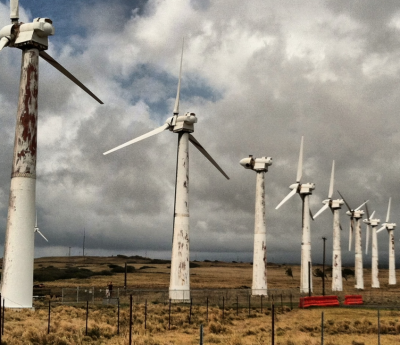
So, you’re thinking, only in America could wind power outfits get away with leaving thousands of giant fans to rust in the paddock. Well, think again.
The company that wind power outfits use to hold the land holder agreements with farmers is usually a $2 company with no real assets and, therefore, the “promise” contained in those agreements to decommission turbines isn’t worth the paper it’s written on: the parent company will simply let the company with the land holder agreement be wound up in insolvency; and host farmers were too gullible to obtain decommissioning bonds to ensure the clean-up costs are covered. And planning authorities were just as stupid – they could have easily forced developers to provide decommissioning bonds as a condition of granting planning consent, but generally failed to do so.
So, once these things are past their economic use by dates, their owners will cut and run in a heartbeat. Expect to see fleets of dilapidated fans rusting on Australian ridge-lines in the not too distant future.
The Lying Liberals….They have Got to Go!
Exposing Liberal half-truths
Hospital closure myths

Exposing Liberal half-truthBurlington Post
The Ontario Liberals have quietly pushed their tall tales, saying the PC government under Mike Harris gutted Ontario’s health-care system.
Their tales go beyond spin and enter the realm of self-serving lie. It is most telling that the Liberals never bring this lie into public debate, they merely use it as part of a whisper campaign, repeating it until it begins to take hold among the general populace.
For example, references to hospital closures that I’ve found suggest that in total the Liberals claim that the PC government closed 39 hospitals in Ontario. They arrive at this number in two ways. Several places in Ontario, including Thunder Bay, Cobourg, Peterborough and Sault Ste. Marie, had two aging hospital facilities. The PCs closed these old, outdated hospitals and built new ones.
The Liberals have lied by omission, in failing to account for the new hospitals that were built in Ontario, some to replace aging buildings and several entirely new hospitals to serve growing populations. By my count we closed 12 hospitals in this manner and opened 17 new ones.
In addition, several hospitals located in close proximity were amalgamated to save on administrative costs. For example, Oakville Trafalgar, Milton District and Georgetown hospitals were amalgamated into Halton Healthcare Services. Liberal Party math says we closed three hospitals. The truth is we simply streamlined the costs — the facilities never closed. We repeated this in major urban centres across Ontario.
The truth is we streamlined costs, opened new facilities to replace aging buildings, significantly grew health-care facilities and increased services in Ontario.
The Liberals conveniently forget the PC government opened new facilities across the province to house 20,000 long-term care patients, people who were taking spaces in acute-care hospitals. In addition, we upgraded existing long-term care facilities for 16,000 Ontarians.
This isn’t only about hospitals. If the PCs gutted health care, how do they explain the expansion of nursing positions? How do they explain our creation of home-care services? How do they explain our substantially-increased funding for cardiac and cancer care and expanded cancer care centres across Ontario? How do they explain 52 new MRIs the PCs brought to Ontario where only 12 existed and the addition of 55 CT scanners? At what point does partisan political spin damage our society? At what point do lies like this get punished by voters?
Ted Chudleigh is the Conservative MPP for Halton.
Climate Change Alarmists have Cried wolf…. Once too often!
Politics: Sorry, global warmists: The ’97 percent consensus’ is complete fiction

Image Credit: Spinster Cardigan via Flickr
Published by: Dan Calabrese on Tuesday May 27th, 2014

How dare you question them?
You hear it all the time. Why, 97 percent of all climate scientists agree that global warming is dangerous and man is causing it.The debate is over and it’s time to act! (With the very kinds of tax and regulatory policies liberals would advocate anyway.)
Did you ever think to question, though, what the basis of this 97 percent figure might be? Joseph Bast and Roy W. Spencer did. Mr. Bast is president of the Heartland Institute, while Dr. Spencer is a principal research scientist for the University of Alabama in Huntsville and the U.S. Science Team Leader for the Advanced Microwave Scanning Radiometer on NASA’s Aqua satellite. Writing today in the Wall Street Journal, the two men examine the most frequently cited sources for this claim and find them wanting. No matter how many times you hear politicians repeat the claim, there is no 97 percent consensus:
Where did Mr. Kerry get the 97% figure? Perhaps from his boss, President Obama, who tweeted on May 16 that “Ninety-seven percent of scientists agree: #climate change is real, man-made and dangerous.” Or maybe from NASA, which posted (in more measured language) on its website, “Ninety-seven percent of climate scientists agree that climate-warming trends over the past century are very likely due to human activities.”
Yet the assertion that 97% of scientists believe that climate change is a man-made, urgent problem is a fiction. The so-called consensus comes from a handful of surveys and abstract-counting exercises that have been contradicted by more reliable research.
One frequently cited source for the consensus is a 2004 opinion essay published in Science magazine by Naomi Oreskes, a science historian now at Harvard. She claimed to have examined abstracts of 928 articles published in scientific journals between 1993 and 2003, and found that 75% supported the view that human activities are responsible for most of the observed warming over the previous 50 years while none directly dissented.
Ms. Oreskes’s definition of consensus covered “man-made” but left out “dangerous”—and scores of articles by prominent scientists such as Richard Lindzen, John Christy, Sherwood Idso and Patrick Michaels, who question the consensus, were excluded. The methodology is also flawed. A study published earlier this year in Nature noted that abstracts of academic papers often contain claims that aren’t substantiated in the papers.
That’s just the beginning. Bast and Spencer examine source after supposed source of this claim and methodically destroy the credibility of every single one. You’re left with the realization that this statistic, constantly cited by left-wing politicians, is completely bogus. And the very people who beat skeptics over the head with these bogus numbers are the ones who say we are “anti-science” for refusing to agree with them.
This explains a lot. It certainly explains the East Anglia e-mails, which sound like they were written by people who are trying to sustain a scam and are nervous about being exposed. It explains the insistence of the so-called “climate science community” to try to silence the work of skeptics and prevent their papers from being published. Science is not the practice of enforcing orthodoxies and siliencing apostates who question things, and yet that’s what these folks do with regularity and their backers in the political realm cheer them on.
And it exposes yet again the pliability of the mainstream media, which continually cites this “97 percent” number without ever questioning where it came from or whether there is any basis for it. It reminds me of activists used to claim back in the 1980s that there were 4 million homeless, and the media would repeat the number as a matter of course without ever questioning its validity or its origin. They just figured that since they heard it all the time from people who ought to know, that was authoritative enough for them. (Besides, it seemed to be an indictment of Reagan policies, so hey, why not?)
There’s all kinds of statistical nonsense floating around out there, and a lot of it that should be questioned never is because the people who ought to be doing the questioning want to believe. It’s like the X-Files.
Once you recognize this, it really shows how insidious is the effort of the political class to marginalize so-called “deniers.” These people are citing completely bogus data themselves – certainly to make the “consensus” claim and almost as certainly to make the claim of man-made global warming as well, not to mention their claims about what it will cause to happen in the future if we don’t “act” (i.e. raise taxes, put government in charge of industry, etc.). Their entire proposition is a lie, and they’re going to shut you up if you say anything about it, because the debate over, damn it!
And why should anyone be surprised about this? The same people who told you “if you like your plan you can keep your plan” now tell us there is no room for questioning them on man-made global warming or its future effects.
Usually people who are dealing in facts and truth don’t have a conniption fit when someone questions them. They are confident about their assertions and they figure they can withstand a healthy challenge. If it’s ever occurred to you that global warmists seem awfully insecure in the way they denounce their critics, now you know a little more about why.

