Harm From Wind Turbines Will Dwarf that of Asbestos…..

June 2015                                                                                     New ZealandNew Zealand

Wind turbines worse than asbestos?

“In the future, I believe that the adverse health effects of wind turbines will eclipse the asbestos problem in the annals of history.”

The views of Dr Bruce Rapley given to the Australian senate select committee on wind turbines in June 2015.Video also available on our YouTube channel

Dr. Bruce Rapley is a consulting scientist with Atkinson & Rapley Consulting Ltd., New Zealand, specialising in acoustics and human health.

He has three degrees from Massey University in New Zealand. A BSc in biological systems, an MPhil in technology (System Design and Testing of a Medical Biostimulator) and a PhD in acoustics and human health (Sound in the Military Environment: Detection, Measurement and Perception – undertaken in collaboration with the New Zealand Defence Force).

Dr. Bruce Rapley’s submissions to the Australian senate select committee on wind turbines:

Submission 1 – 27 February 2015

Appendices

Submission 2 – 1 June 2015

Dr. Bruce Rapley – June 2015

Brits Beginning to Hold Wind Pushers Accountable!

Brits to Force £2 Wind Power Outfits to Hold £Millions in Reserve to Pay Damages to Victims & for Decommissioning

David_Davis_2181020a

***

In a stunningly brilliant legislative move, David Davis MP recently introduced a Bill in UK’s Parliament which will allow Britons to enforce judgments against wind power outfits; and which will ensure the removal of these things when they grind to an inevitable halt within the next decade or so – whether because the massive subsidies they run on are chopped; or because they have flamed out; rusted out; thrown their blades to the four winds; or have simply collapsed in heaps.

The standard corporate structures used by wind power outfits involve a parent company – like Infigen, say – usually as a holding company, with a subsidiary, which usually takes on the name of the wind farm (threatened or realised), such as Cherry Tree Wind Farm Pty Ltd (a wholly owned subsidiary of Infigen – going nowhere, thanks to its inability to obtain a Power Purchase Agreement).

The subsidiary is lumbered with all the current debts and other liabilities, which are loaded up in such a way as to exceed its assets (as long as the wind farm is operating, the parent sees that sufficient cash flushes through the subsidiary for it to remain technically solvent, at least in the short term).

In the event that a creditor pursues the subsidiary for any substantial claim, the parent (or related holding company) simply sits back and watches its subsidiary wind up in insolvency; leaving the creditor(s) without so much as a penny to pinch. Infigen has done it all before, back when it was called “Babcock and Brown”.

Among the class of creditors seeking to recover, are wind farm neighbours who successfully sue the windfarm operator (ie the subsidiary company) and who obtain a substantial award of damages for nuisance.

In David Davis’s speech below, he refers to the case of Julian and Jane Davis who successfully obtained a £2 million out of court settlement from a wind farm operator, for noise nuisance; and the resultant loss of property value (the home became uninhabitable due to low-frequency noise, infrasound and vibration).

The Particulars of Julian and Jane Davis’ Claim are available here: Davis Complaint Particulars of Claim

And Jane Davis’ Statement (detailing their unsettling experiences and entirely unnecessary suffering) is available here: davis-noise-statement

So, the next time you’ve got some wind industry parasite mouthing off that there has never been a successful claim against a wind power outfit, simply flick them a link to this post.

The other reason for setting up £2 subsidiary companies (in Australia referred to as $2 companies) of little or no real value, is to avoid (by winding up in insolvency) liability to clean up the mess after the rort is all over and done with.

Hawaii rusting turbines

***

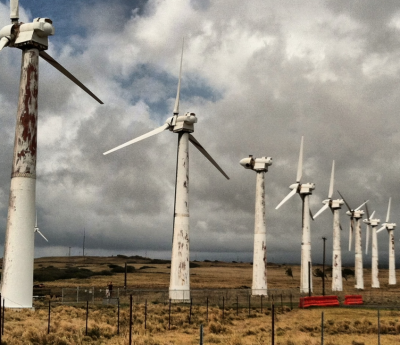
While planning authorities often talk about obtaining what are called “decommissioning bonds”, whatever promises are made, are given by the subsidiary (not the parent), which is designed to have no assets available to cover the cost of decommissioning; whenever that inevitable event takes place. Hence, the thousands of wind turbines scattered all over California and Hawaii, left rusting as monuments to our political betters’ collective stupidity (see our post here).

To avoid that event, David Davis introduced the “Public Nuisance from Wind Farms (Mandatory Liability Cover) Bill”, which is to be voted on sometime next month. Here’s David’s speech as he introduces the Bill  – video and then audio (Hansard – Transcript follows).

***

****

Audio Player

00:00
00:00

Public Nuisance from Wind Farms (Mandatory Liability Cover) Bill
David Davis
21 July 2015
House of Commons Hansard

Mr David Davis (Haltemprice and Howden) (Con): I beg to move,

That leave be given to bring a Bill to require the Secretary of State to make provision about obligations on wind farm operators in respect of financial cover for potential liabilities arising from cause of public nuisance; and for connected purposes.

Wind farms are contentious. Some argue passionately that they are a great public good and the solution to global warming while others equally passionately believe they are a waste of money. This Bill takes no side in that debate. It is narrowly defined to one aspect of public interest; it requires the operators of wind farms, who are in receipt of £797 million of public subsidy a year, to organise their affairs so that they are able to meet the costs of any nuisance imposed on people living near them.

In 1995 the World Health Organisation recommended that to prevent sleep interruption low frequency noise should not exceed 30 decibels. However, in 1996 the Government’s Energy Technology Support Unit—ETSU—set the noise limit for wind turbines at 43 decibels. That is an enormous difference; on the logarithmic decibel scale it is approximately double the WHO limit. We still use those standards today.

In the last five years no planning application was refused on noise-related grounds, but there have been 600 noise-related incidents arising from wind farm operations. The majority of complaints arise as a result of amplitude modulation, which is the loud, continuous thumping or swishing noise regularly described by those living near wind farms.

Numerous studies have identified that sleep is disturbed on a regular basis even at distances over 1 km away from turbines, yet under the ETSU standards turbines can be installed just 600 metres away from residential property. The wind farm companies are acutely aware of this, and all the more so since a member of the public, Jane Davis, sued a wind farm near her home for noise nuisance. The matter was settled out of court, and there is a gagging order preventing us from knowing the details, but the settlement is rumoured to have been in the region of £2 million.

Since this case, some dubious measures have been taken by the industry to obstruct perfectly legitimate claims for nuisance. The use of shell companies in the wind industry seems to be the commonest trick. The parent company provides a loan to a specially created subsidiary to set up the wind farm, then leaves it in control of operations. The subsidiary’s balance sheet typically comprises the wind farm physical assets, but they are more than offset by a very large loan from the parent company, with a resulting net liability. Profits from energy generation and large amounts of public subsidy are siphoned off to the parent company. The subsidiary is left as a financial shell, with very few liquid assets and total liabilities greater than total assets. That makes it impossible to bring litigation against a wind farm, simply because there is nothing to win from them. As such companies have negative net assets, even liquidating them would generate no cash to pay either damages or a legal bill.

One of my constituents bought his house in my constituency to enjoy a quiet retirement with his wife. After living there for more than a decade a 10-turbine wind farm was built near the house. The closest windmill is just over 600 metres from his home. He was assured at the planning stage that the wind farm would not trouble him, yet he has suffered the misery of regular noise and turbine blade flicker which has rendered his home almost unliveable. The low frequency noise from the turbines easily penetrates the double glazing. The couple have had to change bedrooms in order to sleep, but even so the persistent noise from the wind farm has taken its toll on his wife’s health; she now suffers heart palpitations and is prescribed anti-depressants on a permanent basis by her doctor.

My constituent, fearing his retirement has been ruined and his home thoroughly devalued, attempted to use his legal insurance to claim for nuisance from the wind farm operators. While there was a good chance of success in court, the company’s finances were organised so that there was no realistic prospect of recovering either damages or the legal costs of bringing the case. That being so, his insurers would, quite understandably, not cover his legal costs. That is despite the fact that the eventual owner of the wind farm is AES, a multibillion dollar international company involved partly in renewables but largely in coal and gas, that paid its chief executive $8.4 million last year. It laughably claims in its annual report to be a “World’s Most Ethical Company”.

It is not alone in its hypocrisy. In March I raised this disreputable practice with Falck Renewables, prospective operators of a wind farm near my own village in my constituency. I asked it whether it was going to do the same. It did not reply.

My constituents have no way to recover the tranquillity of the lives that they thought they were going to enjoy when they first moved to rural Yorkshire. They can neither sell their house nor get any financial recompense to enable them to afford to move, so they are trapped in this misery.

My point is a simple one. My constituents are just individual representatives of a situation that is repeated up and down the country. Wind farm companies must be adequately capitalised so that there can be a reasonable prospect of financial success for prospective litigants whose way of life they have damaged.

It is not only the noise that is a nuisance, of course. When the sun is low in the sky behind a turbine it creates a “strobe effect” which can be harmful to health and wellbeing, and there are also now concerns that some wind farms could be abandoned at the end of their operational lifespan, creating another sort of visual blight, this time in perpetuity.

The simple solution that I propose in this Bill is to require wind farm-operating companies to hold enough cash in hand to manage a legal case at any time, and in addition a financial bond—a guarantee, or insurance policy—as a security against potential liabilities, including all public nuisance and final decommissioning costs.

Any wind farm that fails to do that should lose its right to subsidy—which, as I said, amounted to £797 million in one year for the industry.

This would ensure that citizens could reasonably sue when they suffer damage, but, just as importantly, it would be a strong incentive for the companies to operate wind farms in such a way as to avoid public nuisance, which is causing great distress in some cases, and would mean that when the turbines are decommissioned there is money or insurance to cover the cost of clearing the wind farm, avoiding a situation whereby the local council has to pick up the bill.

Whatever our stance on onshore wind, companies in receipt of public subsidy should be required to meet their public responsibilities. This measure seeks to ensure that the big wind farm companies can truly be held liable when they are at fault and gives families the protection they deserve. I beg to move.

Question put and agreed to.

Ordered,

That Mr David Davis, supported by Chris Heaton-Harris, Tom Pursglove, John Mann and Jim Shannon, present the Bill

Mr David Davis accordingly presented the Bill

Bill read the First time; to be read a Second time on Friday 11 September, and to be presented (Bill 62).

Public Nuisance from Wind Farms (Mandatory Liability Cover) Bill

tehachapi-wind-turbines-p1

Corruption in the Wind Industry, is NO secret!

US Justice Dept Takes on Wind Power Outfits’ Bribery & Corruption

judges-gavel

****

Lies, treachery and deceit are the hallmarks of the wind industry – fraud of all manner of descriptions is de rigueur for wind power outfits; and whether it’s bribery and fraud; vote rigging scandals; tax fraud; investor fraud or REC fraudcrooks and corruption rule.

These boys are the grand masters of fleecing customers andshareholders; and hood-winking rural communities alike – see our postshere and here and here.

Bribery is standard practice; deployed to get unwilling locals and venal council members on-side:

UK Wind Industry Turns to Bribery as it Fails to “Win Brit’s Hearts & Minds”

However, as anger turns to fury, not only are rural communities refusing to be bought off with trinkets and blankets, they’ve called the wind industry’s efforts to ‘grease’ the wheels of ‘democracy’ for precisely what it is: corruption. Much to the wind industry’s horror.

Wind energy projects opponents try new tactic
The Whig: Kingston Whig-Standard
Elliot Ferguson
20 September 2015

DENBIGH — A group fighting proposed wind energy projects in Lennox and Addington County filed a complaint with the United States Justice Department against the project’s American parent companies.

The complaint was filed earlier this month by John Laforet of the public relations firm Broadview Strategy Group Inc. and supported by the group Bon Echo Area Residents Against Wind Turbines (BEARAT).

The complaint alleged that Florida-based NextEra Energy and Colorado-based Renewable Energy Systems Americas violated the United States’ Foreign Corrupt Practices Act when their Canadian subsidiaries offered financial compensation in exchange for resolutions of municipal support.

“I was taken fairly aback by the money-for-votes approach that both NextEra and RES Canada took when dealing with councils,” said Laforet, who was president of Wind Concerns Ontario from 2000 to 2011.

“Unlike community benefit or vibrancy agreements that exist elsewhere in Ontario, these are being negotiated as a condition of a support resolution which will then benefit the proponent in receiving a contract from the provincial government.

“It’s no longer a goodwill measure, its a transaction. Money for support.”

The U.S. Department of Justice declined to comment about Laforet’s complaint.

Steve Stengel, a spokesperson for NextEra Energy Canada, said in an email to the Whig-Standard that the Justice Department complaint will not stand up to scrutiny.

“The claims of Mr. Carruthers and Mr. Laforet are completely without merit,” Stengel said. “NextEra Energy, Inc. and its affiliates work tirelessly to ensure that all contracts with local municipalities, entities, and individuals fully adhere to all Canadian and U.S. laws.”

Peter Clibbon, senior vice-president with RES Canada, said in an email that the company has not received a copy of the complaint.

“As a matter of policy, the company does not comment on pending litigation,” he said.

Provisions of the Foreign Corrupt Practices Act prohibit officials with American companies from making “payments to foreign government officials to assist in obtaining or retaining business.”

Laforet said that law should apply to American companies’ Canadian subsidiaries.

Protests and petitions by community groups across Ontario have failed to prevent wind energy projects from being built, said Ashby Lake resident Dan Carruthers, co-chair of the Bon Echo Area Residents Against Wind Turbines.

The Justice Department complaint is an effort to try something that hadn’t been tried before, he said.

“What we wanted to do was stay on step ahead of the proponents,” he said.

“We need to have a very novel approach to this problem, something that hasn’t been tried, something that will put these proponents off guard but is going to be effective.”

Carruthers said the complaint is meant to make the projects too unattractive for the Independent Electricity System Operator to approve.

“We want to make the North Frontenac-Addington Highlands proposals stink so much, just so toxic from a political and public relations point of view, that they are just going to say ‘We don’t want to touch this, we’re just going to stick it to the bottom of the pile. There are easier ones to pick,’” Carruthers said.

A community benefits package are fairly common with large renewable energy projects like these, said Queen’s University geography professor Warren Mabee, and are a good way to compensate the community and give residents a sense of ownership.

But Mabee said the justice department complaint is a tactic that he has never seen from an anti-turbine group.

“It could get very sticky,” said Mabee, director of Queen’s University’s Institute for Energy and Environmental Policy. “In all likelihood this is totally innocent and it is just a strategy by the companies to drive these projects forward with as few bumps as possible but it may backfire on them.”

Ontario’s Independent Electricity System Operator in the coming months is to award about 565 megawatts of new renewable energy contracts, including 300 megawatts of wind energy.

IESO spokesperson Alexandra Campbell said there are certain mandatory requirements that companies must meet in order for an application to be considered, including holding a public meeting and making sure local residents are informed about the project.

Community benefit agreements are not considered part of the mandatory process, she said.

“In terms of the project proponents’ discussions or engagements with either individuals or the municipality, we don’t have rules or are involved in those,” Campbell said.

“If a proponent and a municipality have met, talked about needs or there have been agreements, that is not something we are a part of. We sort of say ‘Do you have community support? Show us the documentation.’ And that is kind of the end of our role.”

NextEra and RES-Canada are among more than 40 companies approved to bid for the renewable energy contracts from the Ontario government.

RES-Canada is proposing to build 170-megawatt Denbigh Wind LP and NextEra Energy Canada is proposing its 200-megawatt Northpoint II project in Addington Highlands Township.

According to the minutes of the June 15 township council meeting, Stephen Cookson of RES-Canada told councillors the company would provide $25,000 in bursaries, $30,000 a year during development and an ongoing community benefit fund of $2,000 per megawatt in the project.

In a June 5 presentation to council, a delegation from NextEra Energy Canada told councillors the company would offer annually $1,750 per megawatt produced.

Both companies asked for a resolution of support from council, which would strengthen their applications to the Independent Electricity System Operator.

Addington Highlands Township council voted 3-2 in favour of supporting both projects on July 20.
The Whig

dirtyrottenscoundrelsoriginal

Renewables are “Novelty Energy”. Nuclear Power is Clean, and Can Do the Job!

Aussie Nuclear Industry: “renewables won’t get us across the line”

Susquehanna steam electric nuclear power station

Guest essay by Eric Worrall

The nuclear industry has announced plans to lobby the Australian government, to advocate nuclear power as an affordable, practical alternative to renewables.

According to The Guardian;

The Australian Nuclear Association (ANA) will accompany Danny Roderick, chief executive of the leading US nuclear technology firm Westinghouse, to talk to government ministers and business leaders in Canberra and Sydney next week.

Roderick said nuclear power could help produce “clean, reliable, affordable electricity for more people”.

“We’d like to help Australia explore ways to create jobs and economic opportunity that are also good for the environment,” he said.

“My concern is that renewables won’t get us across the line in terms of emissions reduction,” said Rob Parker, the president of the ANA. “Nuclear is more reliable and it has a smaller resources footprint than renewables.

“Until we approach the issue of carbon abatement honestly, we won’t replace coal because it is the cheapest fuel we have. Nuclear is dead until we acknowledge carbon abatement is the main issue. We already pay a premium for renewables but we need to go further or we’ll just keep burning coal.”

Read more: http://www.theguardian.com/environment/2015/sep/29/nuclear-industry-to-push-for-australia-to-adopt-clean-affordable-power

In my opinion, the last thing Australia needs is any form of new energy infrastructure investment, except where driven by economic demand. In one decade, Australia went from paying one of the cheapest electricity rates in the world, to paying some of the most expensive rates in the world, thanks largely to government green energy initiatives.

If Australia’s newly greened government is determined to waste taxpayer’s money on CO2 emissions reduction, nuclear power at least has the advantage that it works. You can convert a modern economy to nuclear power without ruining it. France for example,generates around 75% of their electricity from nuclear power.

By contrast, spending money on renewables is unlikely to deliver any value whatsoever. According to a report produced by top Google engineers, major scientific advances would be required to make renewable energy useful.

Wind Power Generation….as Fickle as the Weather!

US Wind Power Outfits Curse ‘El Niño’ for Massive & Mounting Losses

kites

****

STT has likened it to the great corporate Ponzi schemes, pointing out, just once or twice, that the wind industry is little more than the most recent and elaborate effort to fleece gullible investors, in a list that dates back to “corporate investment classics”, like the South-Sea Bubble and Dutch tulip mania.

In the wind industry, the scam is all about pitching bogus projected returns (based on overblown wind “forecasts”) (see our posts here andhere and here and here); claiming that wind turbines will run for 25 years, without the need for so much as an oil change (see our posts hereand here and here); and telling investors that massive government mandated subsidy schemes will outlast religion (see our posts here andhere and here).

In Britain, Wind Prospect Group has stopped paying dividends to its bond holders and has prevented them from cashing them in to recover their capital outlay:

Got Money in the Great Wind Power Ponzi Scheme? Then, Grab it & Get Out Now!

In Australia, one of the wind industry’s BIG players – Pacific Hydro – managed to rack up an annual loss of $700 million, last year; in circumstances where the subsidy scheme – on which its profits depend – hadn’t changed at all (see our post here).

Also in Australia, so-called ‘community wind farm’ operators have taken thousands for dupes, with wild claims about whopping profits to be had – all while ‘saving the planet’, of course:

Wind Power ‘Investors’ Cut & Run from Australia as Ponzi Scheme Implodes

At the heart of every great Ponzi scheme sits the “excuse”. Ploys, such as asking shareholders and creditors for “patience” – as the overblown, promised returns (surprise, surprise) fail to materialize.

And the scammers will happily toss up any other pitch capable of stalling those about to be fleeced, while the scheme’s organisers get ready to flee with their loot. The more scurrilous adding some gleeful touch to their pleas for ‘patience’, such as “don’t call us, we’ll call you”; or “the weather’s especially nice this time of year in [insert name of tropical paradise, with no Australian/American extradition treaty]”, say?

Over the last few months, the wind industry – facing calamitous financial results – has taken to blaming – of all things – the weather. Yep, that’s right it’s all the wind’s fault:

Australia’s Most Notorious Wind Power Outfit – Infigen – Blames $304 Million Loss on the WIND

Wind Power Ponzi Scheme Running Out of Puff

In America, US wind power outfits have taken to cursing El Niño – a naturally occurring phenomenon – that has seen winds slacken and losses mount among wind power outfits in the US. The delicious irony appears to be lost on the Neanderthals that people the wind industry, as this little article demonstrates.

El Niño Buffers US Wind Power ‘Dreams’
Wall Street Daily
Tim Maverick
21 September 2015

The National Oceanic and Atmospheric Administration (NOAA) made it official last week. The current El Niño is classified as a strong event.

An El Niño falls into the “strong” category if weekly sea surface temperatures depart from the average by more than two degrees Celsius.

In fact, this El Niño has nudged ahead of the 1997 El Niño as the strongest in the modern era!

Meteorologists believe this occurrence is actually the most potent since 1948. And it’s expected to persist through winter and into spring.

Every El Niño’s effects are different. At the moment, this one is having a surprisingly negative effect on the wind power industry in the United States.

A Little Too Quiet

You see, this occurrence of El Niño has produced the weakest winds across the United States in 40 years. Forecasters say this situation will continue and may even worsen through the spring of 2016.

This might not seem like such a big deal, at first. Wind isn’t a huge part of our country’s power generation, right? Not so fast.

Wind is no longer just a mere marginal source of power for the electric industry. According to Bloomberg New Energy Finance, wind power installations in the United States surged 800% last year. Our country is now the second largest user of wind power technology, behind only China.

Wind accounted for 4.4% of U.S. power generation in 2014. That’s up from just 1.9% five years ago. In some states, wind makes up an even larger chunk of power generation. Wind provides nearly 10% of electricity production in Texas and 7% in California.

The overall effect of these calm conditions is that electric output from U.S. wind farms fell by 6% in the first half of this year. That happened despite wind power capacity rising by 9%.

Overall, U.S. wind farms operated at only about a third of their total generating capacity in the first half of 2015.

An Ill Wind for Some Utilities

The lack of wind has had very real effects on some utilities, and also on some yieldcos.

These include the likes of NextEra Energy (NEE), NextEra Energy Partners (NEP), NRG Energy (NRG), NRG Yield (NYLD), Pattern Energy (PEGI), and even Duke Energy (DUK).

It’s a serious matter for these firms. The CEO of NRG Energy, David Crane, told analysts last month, “We never anticipated a drop-off in the wind resource as we have witnessed over the past six months.”

Even the rating agency Standard & Poor’s is weighing in. After downgrading some wind farm bonds, S&P stated, “Although our current expectation is that the wind resource will revert back to historical averages, at this time it is unclear when this will happen.”

It’s already been a tough 2015. Year to date, NEE is 10 % lower, PEGI fell 16.5%, DUK is down 18%, NEP fell 23%, NRG is down 31.5%, and NYLD is down a whopping 69%.

Of course, utilities have been hit by the rising interest rate expectations. But the lack of strong breezes in the United States has given a little tailwind to the downside for the wind power-related stocks.

Obviously, El Niño will eventually subside and wind patterns across the country will return to normal.

But until then, the wind power generation industry in the United States will continue to suffer. Shareholders in the wind-related yieldcos and utilities will continue to take a battering for an unknown amount of time.

Maybe they can somehow tap into the hot air generated by opponents of President Obama’s Clean Power Plan. They’re having a field day right now with the Plan’s heavy reliance on fickle breezes.

Good investing, Tim Maverick
Wall Street Daily

June 2015 National

It’s a ‘fickle’ thing; to be sure. The picture above tells the woeful – weather driven – story of the performance during June 2015 of all wind farms connected to Australia’s Eastern Grid: with a combined capacity of 3,669MW – spanning 4 States and a geographical expanse of 632,755 km² – an area which is 2.75 times the combined area of England (130,395 km²) Scotland (78,387 km²) and Wales (20,761 km²) of 229,543 km². ‘Impressive’, don’t you think?

However, for the wind industry to air its dirty laundry in public demonstrates just how gormless these boys are.

You see, the whole subsidy-fuelled rort runs on “belief”.

“Belief” that a wholly weather dependent power generation source can provide meaningful electricity around the clock.

Until recently, the wind industry, its parasites and spruikers have maintained the line that the “wind is always blowing somewhere” and is, therefore, able to provide baseload power; “powering” millions of homes for “free”. The more deluded among them claiming that it can do so at prices even cheaper than the cheapest of all, coal-fired power (for a trip to fantasy-land tap into the nitwits over at ruin-economy).

But, now that bankers, investors and creditors have worked out that their debts and investments are in the hands of the Wind Gods – the scammers have been forced to come clean and admit that they have just about as much control over their financial situation, as they have over the weather. Funny about that.

yacht

Government-Induced Climaphobia Based on Faulty, Inaccurate Computer Climate Models.

SEP
28

TIME TO STOP THE INSANITY OF WASTING TIME AND MONEY ON MORE CLIMATE MODELS?

Written by Dr Tim Ball, Climatologist on 28 Sep 2015

Nearly every single climate model prediction, projection or whatever else they want to call them has been wrong. Weather forecasts beyond 72 hours typically deteriorate into their error bands. The UK Met Office summer forecast was wrong again. broken computer

I have lost track of the number of times they were wrong. Apparently, the British Broadcasting Corporation had enough as they stopped using their services. They are not just marginally wrong. Invariably, the weather is the inverse of their forecast.Short, medium, and long-term climate forecasts are wrong more than 50 percent of the time so that a correct one is a no better than a random event.

Global and or regional forecasts are often equally incorrect. If there were a climate model that made even 60 percent accurate forecasts, everybody would use it. Since there is no single accurate climate model forecast, the IPCC resorts to averaging out their model forecasts as if, somehow, the errors would cancel each other out and the average of forecasts would be representative.

Short term climate forecasts no better than the Old Farmers Almanac

Climate models and their forecasts have been unmitigated failures that would cause an automatic cessation in any other enterprise. Unless, of course, it was another government funded, fiasco. Daily weather forecasts are improved from when modern forecasting began in World War I. However, even short term climate forecasts appear no better than the Old Farmers Almanac, which appeared in 1792, using moon, sun, and other astronomical and terrestrial indicators.

I have written and often spoken about the key role of the models in creating and perpetuating the catastrophic AGW mythology. People were shocked by the leaked emails from the Climatic Research Unit (CRU), but most don’t know that the actual instructions to “hide the decline” in the tree ring portion of the hockey stick graph were in the computer code. It is one reason that people translate the Garbage In, Garbage Out (GIGO) acronym as Gospel in, Gospel Out when speaking of climate models.

I am tired of the continued pretense that climate models can produce accurate forecasts in a chaotic system. Sadly, the pretense occurs on both sides of the scientific debate. The reality is the models don’t work and can’t work for many reasons, including the most fundamental; lack of data, lack of knowledge of major mechanisms, lack of knowledge of basic physical processes, lack of ability to represent physical mechanisms like turbulence in mathematical form, and lack of computer capacity.

Bob Tisdale summarized the problems in his 2013 book Climate Models Fail. It is time to stop wasting time and money and put people and computers to more important uses.The only thing that keeps people working on the models is government funding, either at weather offices or in academia. Without this funding computer modelers would not dominate the study of climate.

Without the funding, the Intergovernmental Panel on Climate Change could not exist. Many of the people involved in climate modeling were not familiar with or had no training in climatology or climate science. They were graduates of computer modeling programs looking for a challenging opportunity with large amounts of funding available and access to large computers.

The atmosphere and later the oceans fit the bill. Now they put the two together to continue the fiasco. Unfortunately, it is all at massive expense to society. Those expenses include the computers and the modeling time but worse the cost of applying the failed results to global energy and environmental issues.

Let’s stop pretending and wasting money and time. Remove that funding and nobody would spend private money to work on climate forecast models.

I used to argue that there was some small value in playing with climate models in a laboratory, with only a scientific responsibility for the accuracy, feasibility, and applicability. It is clear they do not fulfill those responsibilities. Now I realize that position was wrong. When model results are used as the sole basis for government policy, there is no value.

It is a massive cost and detriment to society, which is what the Intergovernmental Panel on Climate Change (IPCC) was specifically designed to do.The IPCC has one small value. It illustrates all the problems identified in the previous comments. Laboratory-generated climate models are manipulated outside of even basic scientific rigor in government weather offices or academia, and then become the basis of public policy through the Summary for Policymakers (SPM).

Another value of the IPCC Physical Science Basis Reports is they provide a detailed listing of why models can’t and don’t work. Too bad few read or understand them. If they did, they would realize the limitations are such that they preclude any chance of success. Just a partial examination illustrates the point.

Data

The IPCC people knew of the data limitations from the start, but it didn’t stop them building models.In 1993, Stephen Schneider, a primary player in the anthropogenic global warming hypothesis and the use of models went beyond doubt to certainty when he said,“Uncertainty about important feedback mechanisms is one reason why the ultimate goal of climate modeling – forecasting reliably the future of key variables such as temperature and rainfall patterns – is not realizable.”A February 3, 1999, US National Research Council Report said,“Deficiencies in the accuracy, quality and continuity of the records place serious limitations on the confidence that can be placed in the research results.”

To which Kevin Trenberth responded,

“It’s very clear we do not have a climate observing system….This may come as a shock to many people who assume that we do know adequately what’s going on with the climate, but we don’t.”

Two Directors of the CRU, Tom Wigley, and Phil Jones said,“Many of the uncertainties surrounding the causes of climate change will never be resolved because the necessary data are lacking.”

70% of the world is oceans and there are virtually no stations

The Poles are critical in the dynamics of driving the atmosphere and creating climate yet there are virtually no stations in 15 million km2 of the Arctic Ocean or for the 14 million km2 of Antarctica. Approximately 85% of the surface has no weather data.

The IPCC acknowledge the limitations by claiming a single station data are representative of conditions within a 1200km radius. Is that a valid assumption? I don’t think it is.

But it isn’t just lack of data at the surface. Actually, it is not data for the surface, but for a range of altitudes above the surface between 1.25 to 2 m and as researchers from Geiger (Climate Near the Ground) on show this is markedly different from actual surface temperatures as measured at the few microclimate stations that exist.

Arguably US surface stations are best, but Anthony Watts diligent study shows that only 7.9 percent of them accurate to less than 1°C. (Figure 1) To put that in perspective, in the 2001 IPCC Report Jones claimed a 0.6°C increase over 120 years was beyond a natural increase. That also underscores the fact that most of the instrumental record temperatures were measured to 0.5°C.

tball fig 1

Other basic data, including precipitation, barometric pressure, wind speed, and direction are worse than the temperature data. For example, in Africa there are only 1152 weather watch stations, which are one-eighth the World Meteorological Organization (WMO) recommended minimum density.

As I noted in an earlier paper, lack of data for all phases of water alone guarantees the failure of IPCC projections.The models attempt to simulate a three-dimensional atmosphere, but there is virtually no data above the surface.

The modelers think we are foolish enough to believe the argument that more layers in the model will solve the problem, but it doesn’t matter if you have no data.

Major Mechanisms

During my career as a climatologist, several mechanisms of weather and climate were either discovered or measured, supposedly with sufficient accuracy for application in a model. These include, El Nino/La Nina (ENSO), the Pacific Decadal Oscillation (PDO), the Atlantic Multidecadal Oscillation (AMO), the Antarctic Oscillation (AAO), the North Atlantic Oscillation (NAO), Dansgaard-Oeschger Oscillation (D-O), Madden-Julian Oscillation (MJO), Indian Ocean Dipole (IOD), among others.

Milankovitch Effect not included in IPCC models

Despite this, we are still unclear about the mechanisms associated with the Hadley Cell and the Inter-tropical Convergence Zone (ITCZ), which are essentially the entire tropical climate mechanisms. The Milankovitch Effect remains controversial and is not included in IPCC models.

The Cosmic Theory appears to provide an answer to the relationship between sunspots, global temperature, and precipitation but is similarly ignored by the IPCC.

They do not deal with the Monsoon mechanism well as they note,“In short, most AOGCMs do not simulate the spatial or intra-seasonal variation of monsoon precipitation accurately.”There is very limited knowledge of the major oceanic circulations at the surface and in the depths. There are virtually no measures of the volumes of heat transferred or how they change over time, including measures of geothermal heat.

Physical Mechanisms

The IPCC acknowledge that,“In climate research and modeling, we should recognize that we are dealing with a coupled non-linear chaotic system, and therefore that the long-term prediction of future climate states is not possible.”

That comment is sufficient to argue for cessation of the waste of time and money. Add the second and related problem identified by Essex and McKitrick in Taken By Storm and it is confirmed.

Climate research is anything but a routine application of classical theories like fluid mechanics, even though some may be tempted to think it is. It has to be regarded in the “exotic’ category of scientific problems in part because we are trying to look for scientifically meaningful structure that no one can see or has ever seen, and may not even exist.“In this regard it is crucial to bear in mind that there is no experimental set up for global climate, so all we really have are those first principles.

You can take all the measurements you want today, fill terabytes of disk space if you want, but that does not serve as an experimental apparatus. Engineering apparatus can be controlled, and those running them can make measurements of known variables over a range of controlled physically relevant conditions.

In contrast, we have only today’s climate to sample directly, provided we are clever enough to even know how to average middle realm data in a physically meaningful way to represent climate. In short, global climate is not treatable by any conventional means.”

Computer capacity

Modelers claim computers are getting better, and all they need are bigger, faster computers. It can’t make any difference, but they continue to waste money. In 2012, Cray introduced the promotionally named Gaea supercomputer (Figure 2).

It has a 1.1 petaflops capacity. FLOPS means Floating-Point Operations per Second, and peta is 1016 (or a thousand) million floating-point operations per second. Jagadish Shukla says the challenge is“We must be able to run climate models at the same resolution as weather prediction models, which may have horizontal resolutions of 3-5 km within the next 5 years. This will require computers with peak capability of about 100 petaflops.”Regardless of the computer capacity it is meaningless without data for the model.

tball fig 2

Failed Forecasts, (Predictions, Projections)

Figure 3 shows the IPCC failed forecast. They call them projections, but the public believes they are forecasts. Either way, they are consistently wrong. Notice the labels added to Hayden’s graph taken from the Summary for Policymakers. As the error range increase in the actual data the Summary claims it is improving. One of the computer models used for the IPCC forecast belongs to Environment Canada. Their forecasts are the worst of all of those averaged results used by the IPCC (Figure 4).

tball fig 3

tball fig 4

The Canadian disaster is not surprising as their one-year forecast assessment indicates. They make a one –year forecast and provide a map indicating the percentage of accuracy against the average for the period 1981-2010 (Figure 5).

tball fig 5

The Canadian average accuracy percentage is shown in the bottom left as 41.5 percent. That is the best they can achieve after some thirty years of developing the models. Other countries results are no better.

In a New Scientist report Tim Palmer, a leading climate modeller at the European Centre for Medium-Range Weather Forecasts in Reading England said:“I don’t want to undermine the IPCC, but the forecasts, especially for regional climate change, are immensely uncertain.”

The Cost – “The sum expended must be well over $100 billion”

Joanne Nova has done most research on the cost of climate research to the US government.“In total, over the last 20 years, by the end of fiscal year 2009, the US government will have poured in $32 billion for climate research—and another $36 billion for development of climate-related technologies.

These are actual dollars, obtained from government reports, and not adjusted for inflation. It does not include funding from other governments. The real total can only grow.”There is no doubt that number grew, and the world total is likely double the US amount as this commentator claims.“

However, at least I can add a reliable half-billion pounds to Joanne Nova’s $79 billion – plus we know already that the EU Framework 7 programme includes €1.9 billion on direct climate change research. Framework 6 runs to €769 million. If we take all the Annex 1 countries, the sum expended must be well over $100 billion.”These are just the computer modeling costs.

The economic and social costs are much higher and virtually impossible to calculate.

As Paul Driessen explains“As with its polar counterparts, 90% of the titanic climate funding iceberg is invisible to most citizens, businessmen and politicians.”It’s no wonder Larry Bell can say,“The U.S. Government Accounting Office (GAO) can’t figure out what benefits taxpayers are getting from the many billions of dollars spent each year on policies that are purportedly aimed at addressing climate change.”

If it is impossible for a supposedly sophisticated agency like US GAO to determine the costs, then there is no hope for a global assessment. There is little doubt the direct cost is measured in trillions of dollars. That does not include the lost opportunities for development and lives continuing in poverty.

All this because of the falsified results from completely failed computer model prediction, projections or whatever they want to call them.It is time to stop the insanity, which in climate science is the repetition of creating computer models that don’t and can’t work? I think so.“Those who have knowledge don’t predict. Those who do predict don’t have knowledge.” Tzu, Lao (6th Century BC)

See Dr Ball’s website here:drtimball.com

Dr Tim F Ball:

B.A., (Honours), Gold Medal Winner, University of Winnipeg, 1970

M.A., University of Manitoba, 1971

Ph.D. (Doctor of Science), Queen Mary College, University of London (England), 1982Career

1996 to Now – Environmentalist, Public Speaker, Consultant, Author, columnist.

1988-96 Professor, University of Winnipeg

1984-88 Associate Professor, University of Winnipeg

1982-84 Assistant Professor, University of Winnipeg

1977-78 Acting Dean of Students

1972-82 Lecturer, Department of Geography, University of Winnipeg

1971-72 Instructor, Geography Department, University of Winnipeg

Dr Ball has authored more than 80 significant publications.

See list here:

http://drtimball.com/_files/dr-tim-ball-CV.pdf

Wind Industry Fraud & Corruption Exposed: Pacific Hydro & Acciona Defrauding the Commonwealth

263977-alan-jones

****

Following up on Senator John Madigan’s brilliant exposé of criminal fraud and corruption in Australia’s wind industry, which we covered in this post:

Pacific Hydro & Acciona’s Acoustic ‘Consultant’ Fakes ‘Compliance’ Reports for Non-Compliant Wind Farms

Alan Jones went to town on his 2GB Breakfast Show that – some 2 million listeners tune in to – via 77 stations across the Country.

Alan has been belting the great wind power fraud since June 2013, calling all and sundry to account. And this interview with John Madigan is no exception. You can read the transcript that follows….

Alan Jones OM: The date today is September 24. On Tuesday the 15th of September Senator John Madigan rose in the Parliament of Australia to make a speech. Now remember, this is all about carbon dioxide, and I’ve explained what that’s about – 0.038% of all the air, say 0.04%, is carbon dioxide. Human beings produce only 3% of that. 3% of 0.04 of a percent and Australia produces 1% of the 3%. So about one 10 millionth of CO2 in the air is produced by Australians.

As a consequence of that this mad obsession with renewable energy,  wind, solar which we can’t afford, which are many times dearer than coal-fired power. Which are killing manufacturing because they’ve increased massively the price of energy. And your electricity bills. As Terry McCrann said to me years ago, this represents a national suicide note.

Well on September 15th, Senator John Madigan rose in the Parliament, his opening sentence was this “Tonight I speak about corruption and fraud in the power generation industry”. Who cares? Corruption and fraud.

Now before I go to Senator Madigan, let me remind you of a simple example of that. There’s a wind farm down near Goulburn, the Gullen Range wind farm. Believe me it’s completely illegal. Owned by Chinese Company, Goldwind. 69 of its 73 turbines have been built in areas that weren’t approved. Some were more than 180 metres from their original positions. Many were within the 2 km limit of residential homes. But the government of New South Wales is recommending that the Planning Assessment Commission approve the turbines on the basis that, well the company had reached financial settlement with 2 aggrieved property owners. How gutless is government? Are we so committed to this renewable energy nonsense and so frightened of the Chinese, that they’ve erected turbines in breach of their licence and it’s just business as usual.

The Labour government, prior to O’Farrell, had signed off on this Chinese outfit Goldwind’s appointment of an independent environmental monitor to oversee the turbine placement. Swallowed that hook line and sinker. Without knowing that the so-called expert was a Director of a consultancy firm that actually worked on the wind farm’s development. So technically this mob say well, we had approval. Goldwind should be told to rip up the turbines. They’ve put them in place in breach of their licence simple as that. If you are driving a car in breach of your licence they’ll take you, your keys and your car away from you. The same should apply to this mob.

Well may Senator Madigan say “Tonight I speak about corruption and fraud in the power generation industry.” This is what he’s talking about. Only a week ago Graham Lloyd, the Environment editor of The Australian, Graham Lloyd is a fearless reporter and he wrote, all levels of government have been duped by sham compliance reports which have allowed major wind farms to breach noise limits and collect millions of dollars in subsidies, that’s your money. He was quoting John Madigan.

John Madigan has just blown the whistle on what he said was a corrupt system of wind farm noise assessments and he singled out International noise consultants, Marshall Day and its consultant Christophe Delaire, who have been involved in more than 50 wind farm projects. Senator Madigan told the Senate this outfit MDA , the consultants commercial arrangements with wind farm operators Acciona and Pacific Hydro, had “adversely impacted the independence of its reports and the legitimacy of its conclusions.” In other words, the so called independent consultant is tied up with the proponent. With the proponent. So it’s signs off for the proponent and as a result they qualify for your money.

Senator Madigan was speaking in support of a Labour recommendation in its dissenting report to the Senate inquiry into wind farms and health. That wind companies should use independent consultants to assess post-construction. Now that’s a keyword, post-, well hyphenated word, post-construction noise compliance. Now this is a scandal but don’t expect anyone down there, they’re all furry and fluffy and warm and fuzzy about renewable energy. Now we’ve got the global warming advocates in the saddle in Canberra, so it will be renewable energy at any price. And that means break the law.

You’ve heard me talk about the awful predicament of people living in the vicinity of these wind farms. Especially in Victoria. You’ve heard me say that if they weren’t injurious to health, well put them in Macquarie Street. Put them on Bondi Beach. Put them in Collins Street Melbourne. Queens Street Brisbane. I’ve had a million and one letters from people about the Cape Bridgwater wind farm in Victoria.

John Madigan said in the Parliament “In 2006 Marshall Day Acoustics, with the consultant Christophe Delaire, prepared a – and this is the other key phrase – pre-construction noise impact assessment for the Cape Bridgewater wind farm. Pre-construction. The report predicted that compliance could not be achieved at Cape Bridgewater wind farm without of a rating 13 of the 29 turbines in reduced operational noise modes.

Now just think for a moment, ‘oh god now what’s this got to do with me?’ just imagine if you were living here beside this stuff. People become refugees in their own homes. But this so called independent report said – compliance could not be achieved at Cape Bridgewater. That’s before they were built.

As Madigan said, Senator Madigan, “before it was even built, developers knew that this wind farm would operate in breach of its permit unless adjustments were made”. But Delaire told the Committee of Inquiry, “following measurements on-site it was found the noise optimisation was not required.”

Asks Senator Madigan, “How did Delaire’s expert pre-construction and post-construction reports come to draw such contrasting conclusions?” He answers his own question. He said “The answer is simple, Pacific Hydro did not noise optimise its turbines at Cape Bridgewater, because they knew they didn’t have to. They only had to commission a post-construction noise report to say the wind farm was compliant. On both occasions Pacific Hydro got exactly the report they wanted from Marshall Day Acoustics, but the compliance assessments were not compliant with the standard and neither were the reports.”

Is that corruption? John Madigan, Senator, is on the line. John Madigan good morning.

Senator John Madigan: Good morning Alan.

Alan Jones OM: You’re talking into an empty tank. Eh? Unbelievable.

Senator John Madigan: Yes Alan, its very disconcerting and with any project Alan, as you well know, there is little point in giving permission for a wind farm to operate under certain conditions, or any industrial plant unless compliance with those conditions can be demonstrated and that what we’re being told is correct, so that people can have faith.

Alan Jones OM: That’s it. To put it in lingo that the people who are listening to you, who don’t listen to wind farms understand, you are talking about corruption. If this was in the trade union movement, we’d have Royal Commission. In the trade union movement. Taking money from others to which they weren’t entitled. That is what this is about. Corruption in the union movement. Oh yes we’ll have a Royal commission. Here we have, in relation to wind farms, the developers knew the wind farm would be operating in breach of its permit unless adjustments were made but they were able to get a post-construction report which miraculously came to the opposite conclusion.

Senator John Madigan: It’s just gob-smacking Alan, and it is there for all to see. I suggest to your listeners that, you know that the speech that I gave in the Senate is there on Hansard, I suggest people go and read it. As you and I both know, Alan how litigious these people are.

Alan Jones OM: Oh yeah they’ve got plenty of money. Don’t this mob, don’t this mob, Marshall Day Acoustics, on their website boast, not Madigan’s words, not Jones’ words, but they boast “they’ve got a proven record of successful wind farm approvals”. In other words, get us to investigate it and we’ll get you the green light. We write it, we’re regarded as independent, we’re regarded as authoritative and governments swallow it hook, line and sinker ‘cos they are on the renewable energy gravy train. That’s the guts of it isn’t it?

Senator John Madigan: That’s pretty much what I’ve said Alan.

Alan Jones OM: And people are lying, people are lying, basically. There was a pre-construction report which said you’re going to have to change here you’re not going to compliant. The original report identified non-compliance at multiple homes and at every wind speed. That’s the original report pre-construction. That didn’t satisfy the client. So suddenly on the 22nd of July 2009  – and John Madigan told the Parliament this – the same mob, Marshall Day Acoustics, issued revised monthly reports for every house and every month – but those reports were to Pacific Hydro’s satisfaction. The exact opposite of what they’d originally found. It’s beyond belief. This is trade, this is Dyson Heydon revisited.

Senator John Madigan: It’s beyond belief. As you’ve said Alan, we hear a lot about corruption in the union movement. You and I know there there are disreputable unionists as has been proven. This needs to be, that needs to be stamped out. But so does corruption anywhere, wherever it be, politicians, wherever it be, local government, Councillors, wherever it be, a company, any sort of company, that is acting disreputably, or outside of the law, or taking people down, ripping people off, should be held to account.

Alan Jones OM: Absolutely.

Senator John Madigan: And you can’t say the corruption only exists in the union, because Alan, its everywhere.

Alan Jones OM: Correct. Correct. Now in 2006, I’ll just repeat, and analysis by this mob, Marshall Day Acoustics, this is about Cape Bridgewater, these poor people write to me every day, compliance with the standard (I won’t go into detail about the standard, it happens to be a New Zealand standard forget all that, that’s irrelevant). There is a standard which applies to the granting of the permit to have these wind turbines. Compliance could not be achieved at Cape Bridgewater without operating 13 of the 29 wind turbines in reduced noise modes. Reduce, you can’t, its non-compliant. But a post-construction report cleared the wind farm. And then the government accepts the post-construction must report, and your money, millions of dollars of your money, subsidy payments are made to the operators. And Marshall Day Acoustics Chief Executive Peter Fearnside, said in relation to Senator John Madigan, “we’ve decided not to respond to Madigan’s comments in the Senate”. I mean where on earth? And anyway John the other thing here is Tony Abbott rightly said he wasn’t going to chase Holden down the road with an open cheque book, why are we chasing these people down the road with an open cheque-book anyway?

Senator John Madigan: Well you know Alan, as you’ve pointed out this is a industry that receives millions of dollars from consumers, through higher power prices. Now why?

Alan Jones OM: On the basis of fraudulent reports.

Senator John Madigan: And with the car industry leaving Australia, Alan, as you know I’m a great supporter of Australian manufacturing and if you were to have a look at how much the car industry was receiving and then analysed the social and economic benefits that flowed from that back to government through tax receipts, skills for people, for apprentices.

Alan Jones OM: You could justify giving the car industry the money, but not this mob.

Senator John Madigan: Well you know as I say Alan very dubious social, economic and environmental outcomes.

Alan Jones OM: That’s it.

Senator John Madigan: And that’s me being polite.

Alan Jones OM: That’s being polite. It’s what you said at the start, it’s what you said at the start, of your speech, and you made a very emphatic statement at the start of the speech when you simply said, and I’m finding that those words again, what were they, you said the whole thing is corrupt. “Tonight I speak about corruption and fraud in the power generation industry.” Well Dyson Heyden is talking about it in the union movement.

John, we’ll keep at it. Don’t worry I have written and I am saying to you Josh Frydenberg, you’re the Minister for wind farms, you’re on notice, you’re on notice. And the first thing it you have to do is read Senator Madigan’s speech.

John Madigan thank you for the work you’re doing, it’s much appreciated.

2GB

John Madigan

Falmouth Families Fight for Freedom from Wind Turbine Torture!

Wind Farm Nuisance Case: Falmouth Zoning Board Orders Turbine Shutdown

suffer

****

Back in November 2013, we reported on the orders made by a Court in Falmouth, Massachusetts that pulled to a halt the operation of a couple of Vestas V82s that have been driving townspeople nuts, since they kicked into gear over 5 years ago (see our post here).

We’ve also reported on Barry Funfar, a former Marine whose own country has forsaken him and his family, by aiding and abetting the local wind power outfit to ride roughshod over the rules; and decent Americans, like Barry (see our post here).

We gave an update on the Falmouth case in March 2015:

US Wind Farm Litigation: Update on the Falmouth Case

And again in April:

Wind Turbine Infrasound: an “Acoustic Trespasser”

And now, here’s the latest in a 6 year battle by locals to restore their ability to sleep in, and otherwise enjoy, their very own homes.

Falmouth zoning board orders turbine shutdown
Sean F. Driscoll
Cape Cod Times
17 September 2015

FALMOUTH — In a stunning move, the Falmouth Zoning Board of Appeals voted Thursday night to temporarily shut down one of the town’s twin wind turbines after six years of legal battles by neighbors.

The board voted 4-1 to overturn the zoning enforcement officer’s denial of a cease-and-desist order on Wind 1, which the Massachusetts Court of Appeals ruled in June had been erected without proper zoning approval. The court stopped short of ordering the turbine shut down, however, leaving that matter a question for local authorities to tackle.

Neil Andersen, one of the turbine neighbors who filed the cease-and-desist request, said late Thursday that he was “feeling pretty good” about the decision.

“It’s about time we got some relief,” he said. “The correct, legal thing to do was to shut them off.”

Andersen’s enthusiasm for the win was tempered, however. It was unclear Thursday when, or if, the town would shut off the turbine. The ZBA’s decision can be appealed in court; the Board of Selectmen has already done so twice over prior ZBA rulings that the turbines were a nuisance to neighbors and that the town needed to take whatever actions were necessary to remedy the situation.

The turbines are already operating on a reduced schedule under a November 2013 order from Barnstable Superior Court Judge Christopher Muse.

“Talk to me when they’re turned off. That’s the next step,” Andersen said.

Andersen and his wife, Elizabeth, were one of three sets of neighbors whose cease-and-desist requests were scheduled for a hearing Thursday. Technically, the requests were appeals of Zoning Enforcement Officer Eladio Gore’s lack of zoning enforcement against the turbines. ZBA Chairwoman Kimberly Bielan was the sole vote to uphold Gore’s decision, said Malcolm Donald, a resident who attended the meeting. Members Kenneth Foreman, Terrence Hurrie, Edward Van Keuren and Paul Murphy voted to overrule Gore, who is also the town’s building commissioner.

The board only discussed Wind 1 on Thursday; it decided to hear requests regarding Wind 2, the second turbine, on Oct. 29.

Also scheduled for that day is the hearing to begin the special permit application process by the town in the wake of the Appeals Court order, which the Supreme Judicial Court declined to review. The ZBA’s ruling Thursday shuts down Wind 1 until that process is complete.

Attorneys Christopher Senie and J. Alexander Watt, who represents Andersen, both spoke atThursday’s hearing, Andersen said. Neighbors also shared their stories of ill health effects and the diminished quality of life they say they’ve suffered since the 397-foot-tall turbines were installed at the town’s wastewater treatment facility on Blacksmith Shop Road in 2009.

The suits brought by a cluster of neighbors were based on the town’s zoning bylaws, which exempt town buildings from the zoning permit process but don’t specifically exempt wind turbines. Although turbines don’t have to be named to be covered by that bylaw, the Court of Appeals wrote that, since the town has a bylaw specifically for wind turbines, it is reasonable to conclude that the devices were not intended to be exempt from the zoning process.

Senie said it had been a long road for the neighbors but that he believes the zoning board came to realize the cease-and-desist order was the proper decision.

“I think it’s a close call for a board like this but I think they saw the neighbors have been dealing with this for five years now,” he said. “We’re now aware that the turbines are not permitted and I think the board looked at some of their past decisions and realized the cease-and-desist order for a period of time until the special permitting process concludes is the right thing to do.”

Town officials were not immediately available for comment Thursday evening following the ZBA meeting.
Cape Cod News

Fridge_less_noisy_than_wind_turbine

Pope Has Overstepped His Authority….He’s Pushing the Global Warming Agenda!

SPECIAL REPORT The VATICAN ADVISORS: An Unholy Alliance with the UN Global Warming Agenda September 2015 In the preparation and promotion of its widely touted encyclical, Laudato Si: On Care for Our Common Home, the Vatican relied on advisors who can only be described as the most extreme elements in the global warming debate. These climate advisors are so far out of the mainstream they even make some of their fellow climate activists cringe. Many of these advisors oppose individual freedom and market economics and stand against traditional family values. The Vatican and Pope Francis did not allow dissent or alternative perspectives to be heard during the creation and promotion of the encyclical. The Vatican only listened to activist voices within the climate movement. Even more startling, many of the Vatican’s key climate advisors have promoted policies directly at odds with Catholic doctrine and beliefs. The proceedings of the Vatican climate workshop included activists like Naomi Oreskes, Peter Wadhams, Hans Joachim Schellnhuber, and UN advisor Jeffrey Sachs. Pope Francis’ advisors, and the UN climate agenda he is aligning himself with, are strong supporters of development restrictions, contraceptives, population control, and abortion. Despite these strange bedfellows, the encyclical is clear in condemning abortion, contraception, and population control. There has been nothing short of an “Unholy Alliance” between the Vatican and promoters of man-made climate fear. The Vatican advisors can only be described as a brew of anti-capitalist, pro-population control advocates who allow no dissent and are way out of the mainstream of even the global warming establishment. Here are profiles of some of the key radical voices with whom the Vatican has associated itself. http://www.climatedepot.com/2015/02/02/pope-francis-apparently-doesnt-know-un-ipcc-climate-objective-contradicts-catholic-doctrine/ http://www.casinapioiv.va/content/accademia/en/publications/extraseries/sustainable.html http://www.climatedepot.com/2012/02/07/read-all-about-it-climate-depots-round-up-of-uns-sustainable-development-efforts/ http://www.climatedepot.com/2014/01/27/gore-fertility-management-is-needed-in-africa-to-help-control-the-proliferation-of-unusual-weather/ http://www.casinapioiv.va/content/accademia/en/publications/extraseries/sustainable.html UN Advisor Jeffrey Sachs Jeffrey Sachs, a special advisor to UN Secretary General Ban Ki-moon, participated in a 2014 Vatican workshop on sustainability as well as in the Vatican summit on climate that took place in April 2015. Sachs was reportedly the author of the Pontifical statement, Climate Change and the Common Good: A Statement of the Problem and the Demand for Transformative Solutions, issued on April 29, 2015. Sachs, who is also the director of The Earth Institute, believes climate skeptics are responsible for the deaths of people due to alleged man-made, global warming driven, extreme storms. Sachs tweeted on November 10, 2014, that “Climate liars like Rupert Murdoch & the Koch Brothers have more & more blood on their hands as climate disasters claim lives across the world.” Sachs is such a devoted salesman for UN “solutions” to global warming that he declared: “We’ve got six months to save the world or we’re all doomed.” Many of Sachs’ views are at odds with Catholic teachings. Catholic activist Liz Yore detailed Sachs’ view on overpopulation. “At a 2007 international lecture, Sachs claimed that ‘we are bursting at the seams.’ The focus of Sachs’ overpopulation mantra is primarily the continent of Africa. He argues that if only poor African countries would just lower their fertility rate, the world and Africa would thrive economically. This fear mongering is nothing new. Sachs is standing on the shoulders of Paul Ehrlich, architect of the ‘sky is falling’ deception perpetrated in his 1968 book, The Population Bomb.” Yore concluded: It is “incomprehensible that the Vatican would be duped into thinking that the United Nations and its Millennium and Sustainable Development goals share common solutions for the world’s problems. The Catholic Church welcomes children as a gift from God. The UN Secretary General and Jeffrey Sachs want to limit children.” 2 http://www.climatedepot.com/2015/02/02/pope-francis-apparently-doesnt-know-un-ipcc-climate-objective-contradicts-catholic-doctrine/ http://www.climatedepot.com/2015/06/20/update-vatican-banned-skeptical-french-scientist-from-climate-summit-they-did-not-want-to-hear-an-off-note/ http://www.climatedepot.com/2015/06/20/update-vatican-banned-skeptical-french-scientist-from-climate-summit-they-did-not-want-to-hear-an-off-note/ 3 In 2009, Sachs addressed the annual conference of the Party of European Socialists. He described the “profound honor” of addressing the far-Left Party of European Socialists and said they were heirs and leaders of the most successful economic and political system in the world — Social Democracy. Social equity, environmental sustainability, and fiscal redistribution are the successful elements in managing a just society, Sachs maintained. This is, he argues, in marked contrast to the U.S., whose taxes are too low and where the poor are ignored. In 2009, in advance of the Copenhagen UN climate meeting, Sachs called for a carbon levy, claiming that millions were suffering because of drought caused by Western-induced climate change. Sachs has advocated for a carbon tax and a financial transactions tax, a global health fund, a global education fund, and a global climate fund. Sachs’ Earth Institute at Columbia has included members of an external advisory board such as George Soros and Rajendra Pachauri (former UN IPCC chairman). Soros has funded Sachs via his Open Society Institute. German climate adviser Hans Joachim Schellnhuber Hans Joachim Schellnhuber, who has called for the “creation of a CO2 budget for every person on the planet,” was appointed a member of the Pontifical Academy of Sciences in June 2015 and was one of the four presenters of Pope Francis’ new encyclical on the environment. Schellnhuber was also a key player at the Vatican climate presentation in 2014. Schellnhuber is an atheist who believes in “Gaia, but not in God.” In 2015, Schellnhuber boasted about having climate skeptics excluded from participating in drafting the Pope’s climate encyclical. The April 2015 Vatican climate summit in Rome banned a skeptical French scientist from attending because the organizers reportedly “did not want to hear an off note” during the summit. Schellnhuber is a scientific activist who is mocked even by his fellow warmist colleagues. See: Warmist Ray Bradley trashes prominent warmist Hans Joachim Schellnhuber for “spouting bullsh*t”; Phil Jones says “We all agree on that.” At a meeting in Japan in 2004, Scientist Tom Wigley found prominent EU warmist Schellnhuber to be “a bit of a laughing stock among these people.” Schellnhuber has also declared human society needs to be managed by an elite group of “wise men.” He referred to this idea as his “master plan” for the “great transformation” of global society. Schellnhuber’s views on population also are at odds with Catholic teachings. Echoing the claims of overpopulation guru Paul Ehrlich, he has claimed that when the Earth reaches nine billion people, which is projected to occur soon, “the Earth will explode” due to resource depletion. Schellnhuber also berates those who disagree with him, calling his critics “vicious liars” and mocking Americans as “climate illiterate” for being skeptics. 4 Naomi Oreskes Climate historian Naomi Oreskes has been actively involved in helping produce the Papal encyclical. Oreskes wrote the introduction to Pope Francis’ book version of the encyclical. See: Papal Encyclical book w/ introduction by Naomi Oreskes. Oreskes is perhaps best known for her calls for placing restrictions on the freedom of speech of global warming skeptics. Oreskes believes climate skeptics who dissent from the UN/Gore climate alarmist point of view should be prosecuted as mobsters for their tobacco lobbyist style tactics. See: Merchants of Smear: Prosecute Skeptics Like Gangsters?! Warmist Naomi Oreskes likes the idea of having climate ‘deniers’ prosecuted under the RICO act (Racketeer Influenced and Corrupt Organizations Act). Critics of Oreskes fired back that it is Oreskes herself – not the skeptics — who uses the tactics of the tobacco lobby. As a researcher, Oreskes’ body of work has not fared well among her peers. She has been criticized by warmist and skeptical scientists alike. See: Statistician from the U. of Mass Amherst performs very polite savaging of claims of Naomi Oreskes. Warmist scientist Tom Wigley wrote that Oreskes’ work is “useless”. Wigley wrote: “Analyses like these by people who don’t know the field are useless. A good example is Naomi Oreskes’ work.” 5 Warmist scientist William M. Connolley slammed Oreskes for “silly” and “shoddy” work. Connolley, a former UN IPCC scientist, wrote that he “eventually concluded that Oreskes was hopelessly wrong.” He explained that a highprofile Oreskes “paper seems to have been written around pre-arranged conclusions…it is unlikely that anyone outside the incestuous field of climate history scholarship will notice or care.” Others have been equally as uncharitable in describing Oreskes’ research. See: Warmist Naomi Oreskes taken down — “consistently misrepresents the meaning of statistical significance and confidence intervals” – “Oreskes, the historian, gets the history wrong” Oreskes has been undeterred, continually ratcheting up climate alarmism to the point of silliness. See: Forget Polar Bears, cats & dogs to die! Warmist Naomi Oreskes prophesizes the climate deaths of puppies and kittens – Oreskes: “The loss of pet cats and dogs garnered particular attention among wealthy Westerners, but what was anomalous in 2023 soon became the new normal.” Sadly, Pope Francis is allowing Oreskes, who equates climate change to a “Nazi atomic bomb,” to write the introduction to the book form of his encyclical. Prof. Peter Wadhams Another key advisor to Pope Francis is Cambridge University Professor Peter Wadhams. Wadhams is a scientist and activist whose views are so extreme that even many of his fellow global warming advocates distance themselves from him. In 2014, NASA’s lead global warming scientist Dr. Gavin Schmidt ridiculed Wadhams for “using graphs with ridiculous projections with no basis in physics.” Wadhams’s fellow warmist colleagues have also piled on and ridiculed him, claiming Wadhams “uses anecdotal…very, very poor data; not credible plots…no physics behind his extrapolations.” One of his colleagues even chided: “Hasn’t Wadhams already predicted four of the last zero ice-free summers?” 6 Wadhams was at the center of international controversy in 2015, when he suggested three global warming scientists were assassinated by the oil industry. These claims were wholly unsubstantiated. See: Cambridge professor Peter Wadhams insists three scientists have been assassinated. Wadhams later tried to claim his comments about the deaths were “completely off the record.” Other colleagues have also criticized Wadhams. See: German Scientists: Former IPCC Author Peter Wadhams Showing Pattern Of Irrationality …”Extremely Far-Fringe Corner” Pope Francis has also reached out to climate activist and anti-capitalist crusader Naomi Klein. See: Pope Francis recruits ‘ferocious critic’ of capitalism — Naomi Klein — in climate battle Klein was brought into the Vatican climate process by one of the Pope’s key aides, Cardinal Peter Turkson, to lead a high-level conference. Klein, described by the Washington Post as a “secular” feminist, is a “ferocious critic” of 21st century capitalism. Klein believes: “To fight climate change we must fight capitalism.” Klein explained: “There is still time to avoid catastrophic warming but not within the rules of capitalism as they are currently constructed.” Klein is author of the book, This Changes Everything: Capitalism vs. The Climate. She has declared that “Capitalism is irreconcilable with a livable climate.” She also noted: “Dealing with the climate crisis will require a completely different economic system.” Klein’s anti-capitalist advocacy clearly places her science as subservient to her politics. During the panel discussion at an event at the People’s Climate March, Klein was asked: “Even if climate change issue did not exist, you would be calling for same structural changes?” Klein responded: “Yeah.” Naomi Klein 7 8 1875 Eye Street NW 5th Floor Washington, DC 20006 http://www.cfact.org http://www.climatedepot.com Greenpeace co-founder Dr. Patrick Moore criticized Pope Francis for sounding like Naomi Klein. Klein has also claimed that “It’s Clear” Climate Change Is Making Racism Worse.

Negative Health Effects From Wind Turbines…Chickens Coming Home to Roost!

US Wind Industry in Flat Panic: Report Confirms Turbines a ‘Human Health Hazard’

panic-disorder-971

Back in October last year, we reported on the Brown County’s Board of Health’s declaration that Duke Energy’s Shirley Wisconsin Wind Development is a “Hazard to Human Health”:

Board of Health Declares Wisconsin Wind Farm a “Human Health Hazard”

Since then, for the wind industry, things have gone from bad to worse.

Wisconsin ‘health hazard’ ruling could shock wind industry
E&E Publishing, LLC
Jeremy P. Jacobs
17 September 2015

A Wisconsin town of fewer than 1,200 stands on the verge of sending shock waves through the wind energy industry.

Late last year, Glenmore, a rural community just south of Green Bay, persuaded its county’s board of health to declare that the sounds of an eight-turbine wind farm pose a “human health hazard.”

It was the first time a health board has made such a determination. Wind energy opponents from across the country seized on the decision as proof of “wind turbine syndrome,” a supposed illness caused by low-frequency noise and “infrasound” that is typically undetectable to the human ear.

Local activists have continued to press the issue in hopes of shutting down the turbines, pointing to families who complain of sleep deprivation, headaches, nausea and dizziness — symptoms similar to sea sickness. Lawns display signs saying, “Turbines kill: Birds, Bats, Communities” and “Consider How Your Turbine May Harm Your Neighbor.” More than one family has moved out of their home.

Duke Energy Corp., which purchased the Shirley wind farm in 2011, has strongly pushed back against the hazard determination, pointing to a series of studies that have found no connection between infrasound and the symptoms described by the local residents. The case has caught the attention of the national wind industry, which is concerned about the precedent it could set and whether it could embolden local activists around the country. They claim it is part of a politically motivated campaign by anti-wind advocates.

Attention has now turned to the county’s lead health official, who has said she will rule on the issue by the end of the year. It’s unclear whether the official can force the wind farm to shut down, but if she does, Duke will be quick to challenge the decision in court.

By the end of the month, the local campaign, Duke Energy and other parties will submit binders of public comments making their cases. The local advocates appear bullish about their chances.

“Abandoned homes, sick families, continued Duke Energy ordinance violations,” said Steve Deslauriers of the Brown County Citizens for Responsible Wind Energy, the principal group opposing the farm. “If this were any other industry, they would already be shut down. It is high time that wind developers are held accountable for the hell they levy upon families.”

The Shirley wind farm looms large over Glenmore, with its sweeping turbines situated close to farms and family homes. It went online in December 2010 amid local opposition. Local newspapers featured opinion pieces and letters to the editor that expressed various concerns about the project, including health effects.

It produces 20 megawatts of electricity that it supplies to the utility Wisconsin Public Service Corp., enough to power 6,000 homes.

The controversy over the farm ramped up after Duke purchased it at the end of 2011. As the state was preparing to permit a larger wind farm elsewhere, it requested a study on the sound and health issues reported at the Shirley turbines.

In December 2012, the Public Service Commission of Wisconsin, which is an independent regulatory agency, and the environmental group Clean Wisconsin released a study that included the findings of four acousticians. The consultants spanned the ideological spectrum; some worked primarily for opponents of wind farms, while others had worked on both sides of the issue.

The report’s top-line conclusion appeared incriminating.

“The four investigating firms are of the opinion that enough evidence and hypotheses have been given herein to classify [low frequency noise] and infrasound as a serious issue, possibly affecting the future of the industry,” it said.

It acknowledged that there is “sparse or non-existent” evidence of sickness in “peer-reviewed literature” but concluded that the four specialists “strongly recommend additional testing” at the Shirley farm.

Local advocates seized on the findings as validation that their symptoms were caused by the turbines. They pressed the seven-member Brown County Board of Health to declare the farm a health hazard. In particular, they highlighted the conclusions of Robert Rand, a Maine-based “acoustics investigator” who has primarily worked for groups opposing wind projects.

Rand said turbine sounds and infrasound cause effects similar to sea sickness and health boards shouldn’t need peer-reviewed scientific papers to accept the health impacts.

“Most people accept — because it’s been occurring for thousands of years — that people get motion sickness,” Rand said in an interview. “And yet, in this particular case, there seems to be a lot of pushback.”

The findings grabbed the attention of the health board. Audrey Murphy, its president, said in an interview that the “symptoms are pretty universal throughout the world.”

Murphy insisted the board doesn’t oppose wind energy, saying the turbines should be located farther from homes. In Wisconsin, they must be at least 1,250 feet away.

There is some precedent for the board’s decision. The issue has long plagued local health boards in Massachusetts. Fairhaven, for example, in June 2013 shut down the town’s two turbines at night in response to complaints about sleep deprivation.

Falmouth, Massachusetts, found in 2012 that one turbine was violating local ordinances because it was too close to a home and emitting too much audible noise — not infrasound. But the controversy spurred studies by acousticians, including Rand, that concluded the turbines produce sounds capable of disturbing nearby residents and may lead to annoyance, sleep disturbance and other impacts. That led multiple residents to file lawsuits seeking damages for their health problems, claiming the turbines were to blame.

But wind supporters cite other studies showing no such linkages.

Murphy said the Wisconsin board has sought to take all the relevant findings into account.

“This has been done very slowly and very methodically,” she said. “The board has been concerned about the health of these people.”

‘No factual basis’
Wind proponents are quick to try to poke holes in the board’s findings, as well as the local activists’ evidence.

They start in Massachusetts. After the action in Falmouth, the state agency convened a panel of independent scientists and doctors. They found no evidence that wind turbines pose a tangible health risk to those living near them.

Plus, there have been several peer-reviewed scientific studies since then that have reached similar conclusions, including one by the Massachusetts Institute of Technology and another by Canada’s health ministry. The Centers for Disease Control and Prevention doesn’t recognize “wind turbine syndrome” as an illness. The term was created by a pediatrician, Nina Pierpont, around 2006. Pierpont’s husband is an anti-wind activist.

Health Canada’s 2014 study, for example, found no evidence to suggest a link between exposure to turbine noise and any self-reported illnesses, including dizziness, migraines and chronic conditions.

North Carolina-based Duke Energy claims the complaints are unique to Brown County.

“Duke Energy Renewables operates about 1,200 wind turbines around the United States, and we’ve only had health complaints about the eight turbines we operate in Brown County,” said Tammie McGee, a company spokeswoman. “We don’t see these kinds of complaints, for the most part, anywhere else.”

She added: “We feel confident that we’ve met all the state and the town of Glenmore’s conditions for operations and compliance with all noise ordinances and laws and regulations.”

The American Wind Energy Association has also responded to the local group’s claims and pointed to some research on a “nocebo” effect. The concept is the opposite of the placebo effect, meaning that people who are told to expect certain symptoms may experience them whether or not the supposed cause of the symptom — in this case, turbines — is actually present.

But perhaps most importantly, some who were involved in the 2012 Public Service Commission study dispute the advocates’ interpretation.

Katie Nekola, the general counsel of Clean Wisconsin, which helped fund the study, said it was only an inventory of noise levels and shouldn’t be used to draw conclusions on health effects.

The local groups, she said, “took the equivocal nature of the preamble to mean that things are falling apart and everyone is going to die.”

There is “no factual basis in what they found for the health determination that the county made,” she added. “Nothing in our study provided any kind of basis to say that noise was making them sick.”

Rand, the acoustician who worked on the earlier study, contended that the results show what he’s argued for years: Some people experience the health effects, and they are real and scary. Others simply don’t and refuse to acknowledge they exist.

“Some people are saying this isn’t happening — or people are making it up in their heads,” Rand said. “People who don’t get seasick will never understand what you’re talking about. … It doesn’t require peer-reviewed scientific studies to accept that some people get motion sickness and sea sickness.”

What comes next
Deslauriers, the representative of the local group opposing the farm, declined to comment further, citing the ongoing public comment period on the health board’s finding.

That window closes at the end of September. Then the county’s top health officer, Chua Xiong, will rule on the issue by the end of the year after meeting with stakeholders and doctors.

It is unclear, however, whether she has the authority to shut down the turbines. Murphy, the head of the county’s health board, thinks Xiong does. Duke isn’t sure but will challenge such a determination in court.

The county lawyer, Juliana Ruenzel, refused to answer a question on Xiong’s enforcement authority before abruptly ending an interview with Greenwire. Xiong did not return several messages seeking comment.

Nekola of Clean Wisconsin said a county determination would apply only to local projects and shouldn’t affect other wind farms that have obtained permits from the state.

She said the Brown County effort was indicative only of a localized desire to block wind farms motivated by a not-in-my-backyard sentiment.

“There is just a contingent of people who oppose wind,” she said. “And they will use any mechanism they can think of to stop a project.”

But Rand sought to emphasize that the symptoms are real and he has felt them.

“This isn’t an intellectual exercise,” he said. “People get sick.”
E&E Publishing and Mid-West Energy News

Good to see the AWEA still sticking the long-debunked ‘nocebo’ story. Proving that desperation is a stinky cologne – when you’ve got nothing else, cling to what’s left.

The AWEA’s – indeed the entire wind industry’s – last redoubt is the same theory that was cooked up by a former tobacco advertising guru – lambasted by the Australian Senate after his hand-trembling appearance before them, to defend the desktop ‘studies’ he has plopped together for his wind industry employers. Our Senate stating that:

The committee highlights the fact that Professor Chapman is not a qualified, registered nor experienced medical practitioner, psychiatrist, psychologist, acoustician, audiologist, physicist or engineer. Accordingly:

  • he has not medically assessed a single person suffering adverse health impacts from wind turbines;
  • his research work has been mainly—and perhaps solely—from an academic perspective without field studies;
  • his views have been heavily criticised by several independent medical and acoustic experts in the international community; and
  • many of his assertions do not withstand fact check analyses.

For more on the guru’s ‘nocebo’ theory and what the Australian Senate concluded about it:

Wind Industry’s Propaganda King – Simon Chapman Forced to Apologise to Dr Sarah Laurie for False & Malicious Taunts

As for what turbine noise does to the class of people the guru says never, ever complain about adverse health effects from turbine noise:

SA Farmers Paid $1 Million to Host 19 Turbines Tell Senate they “Would Never Do it Again” due to “Unbearable” Sleep-Destroying Noise

Wisconsin sign sick and tired

Frauds, Crooks and Criminals

Demonstrating daily that diversity is not strength!

Family Hype

All Things Related To The Family

DeFrock

defrock.org's principal concern is the environmental and human damage of industrial wind turbines on rural communities

Gerold's Blog

The truth shall set you free but first it will make you miserable

Politisite

Breaking Political News, Election Results, Commentary and Analysis

Canadian Common Sense

Canadian Common Sense - A Unique Perspective from Grassroots Canadians

Falmouth's Firetower Wind

a wind energy debacle

The Law is my Oyster

The Law and its Place in Society

Illinois Leaks

Edgar County Watchdogs

stubbornlyme.

My thoughts...my life...my own way.

Oppose! Swanton Wind

Proposed Wind Project on Rocky Ridge

Climate Audit

by Steve McIntyre

4TimesAYear's Blog

Trying to stop climate change is like trying to stop the seasons from changing. We don't control the climate; IT controls US.

Wolsten

Wandering Words

Patti Kellar

WIND WARRIOR

John Coleman's Blog

Global Warming/Climate Change is not a problem