Anti-poverty and wildlife protection groups must distance themselves from climate activistsMarching with the enemy By Tom Harris — Bio and Archives July 6, 2015 Imagine pro-tobacco groups wanted to participate in fund raising marches for cancer research. ‘We want to help defeat cancer too,’ the tobacco advocates announce. Anti-cancer campaigners would never march in solidarity with tobacco promoters. They know that if smoking increased, cancer rates would almost certainly rise as well. Marching arm in arm with those working against one’s interests is irrational. This logic does not seem to have occurred to the groups concerned with social justice and wildlife protection who participated in the July 5 “March for Jobs, Justice, and the Climate” in Toronto. They were, in effect, marching with their enemies, groups such as 350.org and Citizens’ Climate Lobby which unwittingly encourage outcomes that are harming the poor and disadvantaged, biodiversity, and endangered species. For example, by promoting the idea that carbon dioxide (CO2) emissions must be reduced to prevent dangerous climate change, climate mitigation activists support the expanded use of biofuels. This is resulting in 6.5% of the world’s grain being diverted to fuel instead of food, causing food price spikes that are a disaster for the world’s most vulnerable people. The growing demand for biofuels is also creating serious problems for indigenous land owners in developing countries, especially in Indonesia and Malaysia where 90% of the world’s palm oil is grown. In a February 2015 open letter to the European Parliament endorsed by 197 civil society organisations from Asia, Africa, and Latin America, it was asserted: “The destruction of forests and fertile agricultural land to make way for oil palm plantations is jeopardising the food sovereignty and cultural integrity of entire communities who depend on the land as their source of food and livelihoods.” Replacing virgin forests with monoculture plantations to provide palm oil for biodiesel greatly reduces biodiversity over vast regions. In another attempt to reduce CO2 emissions, hundreds of thousands of industrial wind turbines (IWT) are being constructed worldwide. For example, the Ontario government is erecting 6,736 IWTs across the province, the most recent as tall as a 61 story building. Only 4% of the province’s power came from wind energy in 2013 and 1% from solar, yet together they accounted for 20% of the commodity cost paid by Ontarians. Despite massive government subsidies for wind power, electricity rates in Ontario have soared, mostly affecting the poor and seniors on fixed incomes. IWTs kill millions of birds and bats across the world. Ontario’s situation has drawn the attention of the Spain-based group, Save the Eagles International, which, on May 23, issued the news release “Migrating golden eagles to be slaughtered in Ontario.” They showed that some of the turbines planned for Ontario are being placed directly in the path of migrating golden eagles, which are already an endangered species. The consequences for people living near IWTs can be severe as well. Besides a significant loss in property value, health concerns abound. A particularly tragic example is occurring in the West Lincoln and surrounding regions of Southern Ontario. There, despite the objections of local residents, wind developers have received approval to install at least seventy-seven 3 Megawatt IWTs, each up to 609 ft. tall, the largest such machines in North America. One resident, Shellie Correia of Wellandport has a particular reason to be concerned. Her 12 year old son Joey has been diagnosed with Sensory Processing Disorder and it is crucial that he live in an environment free from excessive noise. But as a result of Ontario’s Green Energy Act, the primary focus of which is climate change mitigation, an IWT will be sited only 550 metres from their home. Correia explained in her January 2015 presentation before the government’s Environmental Review Tribunal, “On top of the incessant, cyclical noise, there is light flicker, and infrasound. This is not something that my son will be able to tolerate.” But the approvals go ahead anyways. As Correia told the Tribunal, “No one was able to help, because of the Green Energy Act.” The drive to reduce CO2 emissions makes it difficult for developing countries to finance the construction of vitally-needed hydrocarbon-fueled power plants. For example, in 2010 South Africa secured a $3.9 billion loan to build the Medupi coal-fired power station only because developing country representatives on the World Bank board voted for approval. The U.S. and four European nation members abstained from approval because of their concerns about climate change. They apparently wanted South Africans to use wind and solar power instead, sources too expensive for widespread use even in wealthy nations. Finally, because of the belief that humans control climate, only 6% of the one billion dollars spent every day across the world on climate finance goes to helping vulnerable people cope with natural climate change today. The rest is spent trying to stop dangerous anthropogenic global warming that will probably never happen. This is immoral, effectively valuing the lives of people yet to be born more than those in need today. In all of these cases, climate mitigation takes precedence over the needs of the present. Groups such as Ontario Coalition Against Poverty, Oxfam Canada, and Great Lakes Commons, all of which participated in Sunday’s event, must distance themselves from climate activists, not march with them. They are not their friends. Tom Harris — Bio and Archives | Click to view 0 Comments |
Return to sanity!
The Windfighters in Scotland, are not Easily Duped. Windweasel lies do not pass the muster!
Scots Fight-back as Wind Power Outfit Aims to Thump its ‘Community Message’ Home
July 6, 2015 by

****
Remember all those glowing stories about wind power outfits being welcomed into rural communities with open arms? You know, tales about how farmers are dying to have turbines lined up all over their properties? How locals can’t wait to pick up some of the thousands of permanent,high paying jobs on offer? How developers are viewed with the kind of reverence reserved for Royalty?
No?
We’ve forgotten them too.
If such a place ever existed? – it was probably just a case of one too many Single Malts, causing the usual senses to take an unscheduled break.
After years of being lied to, bullied, berated and treated like fools (at best) and “road-kill” (at worst), for most, the ‘gloss’ comprising wind industry PR efforts to ‘win hearts and minds’ has well and truly worn off.
These days, the communities aren’t so gullible; they aren’t so welcoming; and they aren’t willing to take it lying down. Despite having the skills of the best spin doctors in the business at its disposal, it’s “outrage” that’s become the word synonymous with the wind industry, wherever it goes. In short, rural communities have had enough – and they’re fighting back, by fair means and foul:
Angry Wind Farm Victims Pull the Trigger: Turbines Shot-Up in Montana and Victoria
Having lost the battle to ‘shape the debate’ – with soothing words about listening to ‘community concerns’ – wind power outfits are sending in the muscle, instead. Here’s a story from the Highlands on how one wind power outfit’s “Fight Club” inspired PR effort ended.
Drama at Highland windfarm event as man is allegedly assaulted by security staff
The Press and Journal
Jamie McKenzie
24 June 2015

Police were called to a north windfarm exhibition yesterday after a member of the public claimed he was assaulted by security staff brought in to prevent trouble.
The drama unfolded outside Kiltarlity Village Hall, where plans for a 10-turbine scheme went on display for the first time.
Druim Ba Sustainable Energy Ltd (DBSE Ltd) wants to build the devices on the nearby Blairmore Estate.
It is the company’s second attempt to build a windfarm in the area after previous plans were rejected by the Scottish Government in 2013.
People attending the exhibition were shocked to find four employees from a local firm, Castle Security, had been drafted in for one-day event.
And just a few minutes after the display opened, one visitor complained that he had been involved in an altercation with a member of the team.
Cosmo MacKenzie, of Fanblair, Kiltarlity, said the man was “not pleased” and tried to stop him going into the hall.
He claimed he was then shoved as he tried to enter a second and third time.
“I called the police,” he said.
“It’s a distressing way to start the event. I am going in the door and the first thing I come to are security guards preventing people from coming into public property.”
Mr MacKenzie was allowed inside to view the plans after speaking to a security supervisor.
Two police officers arrived a short time later and spent 45 minutes taking statements from him and the staff at the centre of the allegations.
The security workers said they were there to provide “a bit of reassurance and to make people feel more comfortable” after problems at a consultation event for the previous application.
DSBE representatives at the event refused to comment on the windfarm plans or the security presence.
The company’s previous proposals – for 23 turbines – sparked outrage locally and prompted a huge campaign against the development.
Some of those protesters attended the exhibition yesterday.
The new plans involve reducing the size of the windfarm and cutting the height of turbines from 490ft to 415ft.
After viewing the designs, opponents sat at a table and chairs outside the hall and asked others to sign a petition against the development.
Denise Davis, who is leading the local campaign against the scheme, said: “We have been to dozens of exhibitions and have never seen security before.
“The proposal was refused locally by Highland Council and the Scottish Government. How much more of a message do they (DSBE) need? This new proposal is not really an improvement and they are continuing to use old noise monitoring data.”
Fellow campaigner Lyndsey Ward said: “There are more security guards here than there are members of staff inside.
“This is a ridiculous proposal and the community is fully against it.”
The Press and Journal

Shellie Correia, Discussing the Wind Scam, on “Game On”, Radio Show, With Host, Ron Stephens!
Please listen to this interview, with Ron Stevens, of Canada Live Radio. We discuss the wind scam, and how it all relates to our problems with the UN and Agenda 21. Not to be missed!
Wind Will Never Be More Than “Novelty Energy”. Investors are Waking Up to Reality!
Global Investment Collapses: Investors Wake Up to the Wind Power Delusion
July 5, 2015 by

***
The wind industry is in meltdown around the globe, simply because investors have woken up to the monumental RISKS.
Risks like: – turbines falling apart in less than 2 years; under pressure from voters, governments pulling the plug on the massive subsidies essential to keep the scam rolling; neighbours suing the operators toobtain compensation and/or to have turbines shut down or removed.
In response to these pretty obvious risks, the amount being stumped up by investors to build more of these things has plummeted.
The scam is little more than the latest Ponzi scheme – with Australia’s best and brightest at Union Super Fund backed Pacific Hydro losing $700 million of mum and dad retirement savings; with its parent – IFM Investors – deciding to ditch Pac Hydro and Pac Hydro deciding to ditch its Cape Bridgewater wind farm disaster.
While the wind industry’s parasites and spruikers try hard to pin their woes in Australia on dreaded policy “uncertainty”, the situation in Europe – held up by eco-fascists as the wind power Super Model – is just as dire.
The amount being thrown by investors at wind power has dropped off a cliff; in the UK, with David Cameron’s election win, subsidies have been pulled to a halt and, as an inevitable result, hundreds of threatened projects have been blown to the four winds.
Behind it all is the simple fact that wind power is not, and will never be, a meaningful power generation source. Here’s a solid analysis, that exposes the delusion and details the imminent collapse of the greatest economic and environmental fraud of all time.
The Difficulties Of Powering The Modern World With Renewables
Roger Andrews
10 June 2015
Energy Matters
In the May 12, 2015 “G7 Hamburg Initiative for Sustainable Energy Security”, the energy ministers of Canada, France, Germany, Italy, Japan, the United Kingdom and the United States, plus the European Commissioner for Climate Action and Energy, said this:
An increasing number of countries are following the path of a rapid expansion of renewable energy. There (are) a number of challenges as energy systems change and related greenhouse gas emissions are reduced, one of which is how to integrate growing shares of variable renewable energy into electricity systems.
The G7 energy ministers are correct in their assessment. Integrating growing shares of variable renewable energy into electricity systems is indeed a challenge – and so far one without a good solution.
A few quick facts before proceeding. In 2013 renewables supplied the world with 21.7% of its electricity, according to BP. Take out hydro and they supplied the world with only 5.3% of its electricity. Then take out “other” renewables such as biomass and geothermal and the percentage falls to 3.3%.
Why take out hydro and “others”? Because their growth potential is limited by resource availability – too few good hydro sites, too few high-temperature geothermal fields, not enough wood to make biomass pellets etc. – and for these reasons they may never make a significant contribution to future global energy needs. Their growth performance since 1997, the year the Kyoto Protocol set the renewables bandwagon rolling, has certainly been less than impressive, as illustrated in Figure 1. “Others” have gained market share, but at a painfully slow rate, and hydro has actually lost ground:

****
Not so, however, for wind and solar, which aren’t resource-limited (the amount of solar energy hitting the earth in a year, for example, vastly exceeds annual global energy consumption). They show rapid growth since 1997, although from small beginnings. Clearly they are the energy sources the world must concentrate on developing if it is ever to “go green”.
And why shouldn’t continued rapid growth in wind and solar allow the world to go green? I’ve discussed the reasons piecemeal before. Here I summarize them all in the same post:
Intermittency
Intermittency, or non-dispatchability, is the Achilles heel of wind and solar. So far it hasn’t caused widespread problems because wind and solar still contribute only a small fraction of total power generation in most countries. Integrating wind power into the UK grid in February 2013, for example, was not difficult because wind only supplied 5% of the UK’s electricity in that month:

***
But if in February 2013 the UK had had enough installed wind capacity to generate 50% of its electricity from wind Figure 2 would have looked like this:

***
Now it’s a different ball game. How do we match a generation curve like that to demand, or at least smooth it out to the point where it becomes manageable? There is in fact a way of doing it, but we’ll get to it later. First we will discuss the options that won’t work.
Energy Storage
This is the obvious solution; store intermittent renewable energy during periods of surplus generation and release it during deficit periods. But the only existing technology that can do this at the scale necessary is pumped hydro, and as discussed at length in previous posts here,here and here the amount of pumped hydro storage needed is enormous. At only moderate levels of solar & wind penetration the UK would need several terawatt-hours of storage, maybe as much as a hundred times the capacity of its existing pumped hydro plants, while Europe and the US would need tens of TWh each and the world proportionately more. There is no realistic prospect of bringing this much new pumped hydro – or even conventional hydro, which can also function in an energy-storage mode – into service in the foreseeable future even if enough suitable hydro sites could be found.
The alternative is battery (or flywheel, or compressed air, or thermal) storage. These technologies are so far from deployment on the multi-terawatt-hour scale that they can be discounted. (According toWikipedia total world battery + CAES + flywheel + thermal storage capacity still amounts to only about 12GWh, enough to fill global electricity demand for all of fifteen seconds.)
Another option that’s been mooted as a potential solution to the storage problem is electric vehicle batteries, which can be charged from the grid during periods of generation surplus and discharged back into the grid during periods of deficit. But this option also founders on the rock of scale. Assuming a 100% charge/discharge capability and no energy losses during the charge/discharge process we would still need 12 million 85kWh Teslas (or 42 million 24kWh Nissan Leafs) to get a single terawatt-hour of storage.
Grid Interconnections
It’s frequently assumed that a smart grid covering a large enough area, like the proposed European supergrid, will be able to smooth out local spikes and troughs in renewables generation and provide “reliable electricity” to all. Unfortunately it won’t. Figure 4, reproduced from Wind Blowing Nowhere compares 2013 wind generation in Spain, the largest producer, with combined wind generation in Belgium, the Czech Republic, Denmark, Finland, France, Ireland, Germany, Spain and the UK. Combining wind generation from all nine countries doesn’t flatten out the Spanish spikes or fill in the Spanish troughs. It just moves them around:

***
What about solar? Seasonal and diurnal variations in solar generation can be smoothed out by combining output from different areas, but the European supergrid would have to link up with New Zealand to do it.
Combining Generation from Different Renewable Sources
It’s also been claimed that because the wind and the sun blow and shine at different times we will get smoother power output when we combine them. That doesn’t work either. Figure 5 re-plots the Figure 2 case with the UK getting 40% of its electricity from wind and 10% from solar instead of 50% from wind. Adding the midday solar spikes, which lead evening peak demand by about five hours in the winter, if anything makes things worse:

***
Demand-side management
A lot of faith is pinned on the potential of DSM, which instead of matching generation to demand seeks to match demand to generation, or at least to match it as closely as possible. But there’s no way demand could be matched to the generation curves shown in Figures 3 or 5. The best that could be hoped for is an incremental improvement, maybe a flattening of the daily demand curve and/or a reduction in total demand, but the larger problem of how to smooth out bursts of intermittent power into a manageable form would remain unresolved.
And then there’s the great unexploited renewable resource:
Tide Power
It’s predictable, infinitely renewable and has near-unlimited potential. What’s not to like about it? As discussed in the Swansea Bay post (link above), quite a lot. Arguably the best indicator of tide power’s lack of potential, however, is that almost fifty years after the world’s first tide power plant went in at La Rance in France it still supplies less than 0.005% of the world’s electricity.
So if energy storage, supergrids, combining output from different sources, demand-side management and tide power won’t work, what will? Only one thing:
Fossil Fuel Backup
The concept is simple: use load-following fossil fuel capacity – I’m going to assume gas turbines – to generate the electricity needed to meet demand whenever renewable energy can’t generate enough. The approach requires no storage and imposes no theoretical limits on the level of wind & solar penetration, as discussed in How much windpower can the UK grid handle and Wind power and the island of Denmark. Figure 6 illustrates how it would apply to the 50% wind penetration case shown in Figure 2:

***
Inevitably, however, there are problems. One is that there are times when wind generation exceeds demand and has to be curtailed, and as a result the UK gets only about 47% of its electricity from wind instead of 50% in the above case. Another is the generation curve the gas turbines would have to follow to fill demand when wind generation can’t, which looks like this:

***
Tracking this erratic generation curve would severely stress the gas turbines (and probably the grid operators too). Wear, tear, downtime and generation costs would all increase, as would fuel consumption because of the constant start-up and shutdown, thereby offsetting some of the CO2 emissions reductions generated by the wind energy.
And that’s with 47% wind penetration. At higher levels the system becomes progressively more inefficient until at 80-90% penetration it’s running at load factors as low as 10% and well over half of the wind generation has to be curtailed (more details in the tables in the How much windpower post linked to above). We can therefore anticipate that this approach will also eventually run up against the hard wall of reality, if only because sooner or later it will occur to someone that it would be a lot easier to keep the dispatchable gas generation and do away with the non-dispatchable wind generation altogether.
But the way things are going there’s a good chance that this point will never be reached. Why? Because of a problem that’s rarely taken into consideration:
Lack of Investment
Every year UNEP publishes a chart of annual global investment in renewable energy, the lion’s share of which (92% in 2014) goes to wind and solar. Here’s the latest version:

***
Total investment in renewables since 2004 now exceeds $2 trillion – a lot of money, but it’s still far short of what’s needed to stimulate growth to the point where renewable energy, assuming it can be made to work, eventually powers the world. The $232 billion invested in renewables in 2013 was dwarfed by the $1.6 trillion total global energy investment in that year reported by IEA, and of the 235GW of new generation capacity installed globally in 2012 only 76GW was wind or solar, according to EIAand BP. If investments in conventional generation continue to dominate to this extent then wind and solar are doomed to remain also-rans. A very substantial transfer of investment from conventional generation to wind and solar will be needed if they are ever to become the dominant players, but the investment climate needed to achieve this just isn’t there.
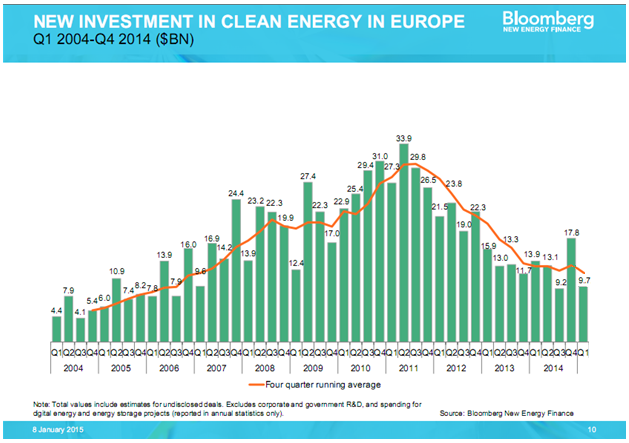
Another question is whether global renewables investment might not already have peaked (as shown in Figure 8, it’s certainly flattened out). Renewables investment is still increasing in the developing countries – notably China – but it’s been essentially flat in the US since 2008 and in Europe it’s been declining since 2011. Europe in particular bears watching because if the decline continues at the rate shown in the Bloomberg New Energy Finance chart below it won’t be long before Europe will have had all the clean energy it’s going to get:
***
And finally the big problem. Even if the world succeeds in developing wind and solar to the point where they supply 100% of its electricity the job is still less than half-done because electricity supplies the world with only about 40% of its energy. The remaining ~60% comes from the oil, gas and coal consumed in transportation, heating etc. How to decarbonize that? Again no solution is presently in sight.
Energy Matters

How the Wind Scam Is Destroying Europe’s Economy….Do We want to be Next?
Europe’s Wind Powered Recipe for Economic Disaster
July 4, 2015 by

****
Lessons from Europe: Recipe for a high-cost energy system
Communities Digital News
Steve Goreham
26 May 2015
CHICAGO, May 26, 2015 — While President Obama promotes renewable energy and members of Congress argue about energy policy, a renewable energy disaster is unfolding in Europe. Driven by a desire to halt climate change, Europe has created a high-cost energy system where everyone loses. U.S. policy leaders should learn from the debacle occurring overseas.
European energy policy today is dominated by the European Climate Change Program (ECCP), which was established by the European Community in 2000. The program called for the nations of Europe to adopt measures to cut greenhouse gas emissions. The goal was for Europe to collectively meet the targets of the Kyoto Protocol climate treaty signed in 1997.
The ECCP was based on two assumptions. The first was that changes to national energy systems were needed to fight global warming. Second, that coal, gas and oil fuels would become more expensive, allowing renewable energy to compete. But policies to promote renewables resulted in substantially higher electricity prices for Europe.
Europe used subsidies and mandates to promote renewables. Feed-in tariffs were enacted in most nations, providing a payment to homeowners and businesses for electricity fed into the grid from solar or wind facilities. Governments paid a fixed subsidy of four to 10 times the wholesale electricity price, guaranteed for up to 20 years, for generated electricity.
Electricity from renewables is also granted grid priority. Utilities are required to accept wind and solar-generated electricity as a first priority, regardless of market demand. Output from traditional coal, natural gas and nuclear plants is scaled back or shut down when renewable output is high. Wholesale electricity prices, once driven by market demand, are today dominated by the weather. When the wind blows and the sun shines, large amounts of electricity are dumped onto the grid from wind and solar installations, forcing wholesale electricity prices negative.
Other factors added to the growing debacle. In 2011, Germanyannounced a complete phase-out of nuclear power in the wake of the Fukushima disaster in Japan, closing nuclear power plants and straining the electrical system of Europe’s largest economy. In addition, Germany and France banned hydraulic fracturing, ensuring that European natural gas prices will remain high for the next decade.
The results of Europe’s green energy measures have been bizarre. Feed-in tariffs in Germany stimulated more than one million rooftop solar installations. But Germany is not exactly the sun belt. The latitude of central Germany is the same as that of Calgary, Canada. As a result, German solar installations generate electricity at less than 10 percent of rated output. Over a million solar installations provide only 6 percent of Germany’s electricity and 1 percent of the nation’s energy. For this solar miracle, German citizens are obligated to pay over $400 billion in current and future payments to solar providers through higher electricity rates.
Denmark erected over 5,000 wind turbine towers, one for every thousand Danish citizens. Turbines blanket the nation, providing a beautiful view of a 300- to 500-foot tall tower from almost every house, farm, field, forest and beach. But the turbines produce only 1.3 gigawatts each of electricity on average. All could be replaced by a single large conventional power plant. Today, Denmark has the highest electricity prices of the developed nations.
Europe has created an energy system where everyone loses. Consumers, industry, traditional power plants and even renewable energy companies are now losing. Even though wholesale electricity prices are falling, consumer electricity prices have doubled over the last 10 years due to large subsidy payments to renewable companies. Nations with the largest percentage of renewable energy also have the highest electricity prices.
Citizens of Spain pay 23 eurocents per kilowatt-hour, three times the U.S. price, and citizens of Germany and Denmark pay more than 25 eurocents per kilowatt-hour, four times the U.S. price.
European industrial companies are also big losers. French firms pay more than twice the U.S. electricity rate and German firms pay three times the rate. European industrial electricity rates have risen more than 50 percent since 2007, while U.S. industrial rates have been flat. European firms also pay double the U.S. price for natural gas. European chemical firms are now building plants in America to utilize low-cost ethane from shale fracking, a technology not available in Europe.
Traditional European electrical power companies are losing as well. The wholesale price of electricity is down 50 percent in the last five years and conventional plants can no longer break even. An example is the Irsching high-efficiency natural gas plant in Germany. Built in 2010, it can operate at 60 percent efficiency. But the plant is not profitable as a backup to renewables. In March, the owners announced a shutdown of the plant.
Last year, E.ON, the largest German utility, suffered its first loss in more than 50 years. Both E.ON and Swedish utility Vattenfall have announced plans to exit their conventional power plant business in Germany in favor of renewables. Magnus Hall, president of Vattenfall, stated last year, “It makes it difficult to see how you could invest in conventional generation under these circumstances.”
Finally, even renewable energy companies are now losing. European governments have realized that they can no longer afford the green energy revolution. Subsidies have recently been cut in Belgium, Germany, Greece, Italy, Spain and the United Kingdom. In Germany, solar employment dropped 50 percent and many renewable companies declared bankruptcy. Spain ended its feed-in tariff subsidy and placed a cap on renewable industry profits, resulting in 75,000 lost renewable jobs and a 90 percent reduction in solar installations.
U.S. energy policy makers should learn from Europe’s energy experience and pursue sensible energy economics.
Steve Goreham is executive director of the Climate Science Coalition of America and author of the book The Mad, Mad, Mad World of Climatism: Mankind and Climate Change Mania.
Communities Digital News

“Ellesworth American” Editorial – Speaks the Truth About the Wind Scam!
Another reason to just say “No”
Several good reasons exist to oppose the ongoing proliferation of giant windmills on Maine’s ridges and mountains. Recently, the Maine Department of Inland Fisheries and Wildlife (DIF&W) added yet another one in its recommendation that the Weaver Wind farm proposed by SunEdison in the towns of Eastbrook and Osborn be rejected. The department cited what it considers unacceptable risks to birds and bats migrating through the Hancock County region where one wind farm already is operating and another has been permitted but not yet constructed.
The Bull Hill Wind farm includes 19 turbines, each 476 feet tall, in Township 16. SunEdison’s Hancock Wind farm in Townships 16 and 22, already permitted, will add 18 more of the three-bladed monsters. Those two projects were enough to cause staff at the Department of Environmental Protection (DEP) to voice concerns, in a June 15 analysis, about their cumulative effect on the bird and vulnerable bat populations in the area. The Weaver Wind farm would introduce 23 more turbines, each nearly 600 feet tall, into the mix. The DEP analysis made reference to DIF&W concerns “with the risks to migrating birds and bats” posed by the proposed Weaver Wind project. “Avian passage rate, which is an index to mortality risk, was the highest record for any project in northern New England and fatality estimates of birds at the nearby Bull Hill Wind Project also were the highest recorded in the region,” said the fish and wildlife department.
Some may regard the mortality risk to birds and bats posed by the windmill blades as inconsequential. Taken by itself, that risk may seem a small price to pay for wind farm development. But there are other compelling arguments against wind energy projects and the state policy that encourages them.
Much of the scenic beauty for which Maine is so widely known will be despoiled. The stated 2,700-Megawatt goal of Maine’s Wind Energy Act would require as many as 1,500 wind turbines, each hundreds of feet tall, with accompanying access roads and new transmission lines, on up to 300 miles of Maine’s hills and mountains. Those transmission lines, to carry the electricity that could be provided by a single, high-quality conventional generator, will add billions of dollars to New England electric bills.
Maine already is one of the cleanest states in the nation for CO2 emissions and the massive buildup of wind farms will not improve that, since almost 90 percent of our CO2 emissions are from sources other than electricity generation. The myth that wind will “get us off oil” is just that. Oil accounts for just two percent of Maine’s electricity generation.
But there is a major wind generation flaw — one that goes unaddressed by wind power advocates: it is both intermittent and unpredictable. It will not — indeed, it cannot — replace constant capacity generators that meet peak load and base load demands. A 2010 New England Wind Integration Study stated, “Wind’s intermittent nature would require increased reserves, ensuring that there are other generation options when the wind isn’t blowing.”
It’s unfortunate that such concerns fall largely on deaf ears in the small communities where wind farms are proposed. Former Governor John Baldacci and the Legislature did much to assure a warm welcome for such projects by requiring that developers provide thousands of dollars in ongoing community benefit funds for public purposes in such communities. Added sweeteners are the resulting temporary construction jobs, payments to property owners where the turbines are based and the very few permanent jobs that are created — all of which benefit a handful of local residents while undermining Maine’s quality of place and imposing unnecessary extra statewide costs on taxpayers and ratepayers.
Notwithstanding the rosy and patently false picture painted by wind farm developers and their supporters, the costs and impacts of hundreds of land-based industrial wind turbines vastly exceed the minimal benefits. And despite all the hype, it remains likely that wind never will be more than a marginal supplier of electricity.
If the Dutch Hate Windmills, They Must Be Useless. Who would know better?
Dutch Quixote: Why the Dutch oppose windmills
Credit: Wind energy once powered the Netherlands. Not anymore | The Economist | Jul 4th 2015 | www.economist.com ~~
During its 17th-century golden age, the Netherlands was the world’s most enthusiastic exploiter of wind technology. Over 10,000 windmills dotted the landscape; the city walls of Amsterdam were crowned with a row of them. Today many Dutch find the stereotype of their country as the land of windmills irritating—and inaccurate. Wind turbines supplied just 5.2% of the Netherlands’ electricity in 2014, far behind Germany, Spain or Denmark. Renewable sources as a whole make up 4.2% of the country’s energy mix, putting the Netherlands 26th in the European Union, ahead only of Malta and Luxembourg.
That leaves the government in a fix. It has five years to meet an EU-wide mandate to generate 14% of energy from renewable sources. Among other things, it plans to build a lot of new wind turbines. This, however, runs up against the reason why the Netherlands has so few of them: a severe case of not-in-my-backyard syndrome. Almost everywhere new turbines are mooted, locals howl that they will be ugly and noisy. One proposed wind park prompted a group calling itself the Don Quixote Foundation to block a drawbridge on the 32km dike connecting North Holland and Friesland. The far-right Party for Freedom rails against “the sinister green-windmill subsidy complex”.
To minimise local anger, the government has turned to the sea. A national energy accord reached in 2013 calls for new wind parks in the North Sea that could generate 3,450 megawatts, more than triple the country’s current offshore capacity. But these parks are meeting resistance as well. Two of them will be as little as 18km from shore, within sight of beach towns north of The Hague. The town governments say the 200-metre masts will ruin the view and drive away German tourists. They want to push the parks back to an area midway between the Netherlands and Britain. The Dutch government says the more distant site would cost an extra €45m ($50m) per year, in part due to longer cables.
Those costs may be the least of the government’s worries. On June 24th a climate-action group won a suit in a Dutch court arguing that the government’s target for reducing greenhouse gases is not ambitious enough. Current policy would reduce emissions in 2020 to 17% below 1990 levels. But the court ruled that if the world’s governments cut 2020 emissions by anything less than 25%, it will ultimately put Dutch citizens in danger from rising sea levels. Since all governments should meet that 25% reduction, the court reasoned, the Dutch government must do so as well. If the decision is upheld, the government will have to slash emissions even further within five years.
Doing so is not impossible, says Pieter Boot, an economist at the Dutch government’s environmental assessment agency. The agency estimates that if the government fulfills its promises under the 2013 energy accord—which it is not currently on track to do—that could generate half of the necessary reductions. But more renewable energy would also be needed. New wind parks will not be part of the solution, as it would take five years to build them.
Despite the opposition to individual wind parks, polls show that over 70% of Dutch approve of wind energy in principle, a figure similar to Germany. The problem may simply be that the Netherlands is very densely populated; nearly every mast is in someone’s backyard. But other polls show that once turbines are built, local opposition tends to fade. As readers of Don Quixote know, not everyone liked 17th-century windmills either, at first.
Wind-Pushers in Denial, to Avoid Being Held Accountable…Gov’t covers up for them.
Wind farm impact ‘under-assessed’
Developers are sometimes under-assessing the impact of wind farm noise and appearance on residents living nearby, according to new research.
The two-year study looked at how the visual, shadow flicker and noise impacts predicted by developers at the planning stage of ten wind farms across Scotland compared to the reality once operational.
The test sites included wind farms at Dalswinton in Dumfries and Galloway, Achany in the Highlands, Drone Hill in the Borders, Hadyard Hill in South Ayrshire, Little Raith in Fife and West Knock Farm in Aberdeenshire.
In some cases what was set out in planning applications did not match the actual impact, the research by climate change body ClimateXChange concluded.
It also found that efforts to engage with the public had not always adequately prepared residents for the visual, shadow flicker and noise impacts of a development.
The information was gathered through a combination of residents’ surveys and assessments by professional consultants.
The report said: “T here was a reasonable correspondence between the predicted impacts at application stage and the study team’s assessment of the as-built impacts.
“However, there were some instances in respect of each of the topics where impacts were under-assessed.
“This divergence between objective measurement and experience of impacts was evident from the residents’ survey which captured a range of responses.
“In respect of all three types of impacts considered by the study there were instances where no or limited impacts were predicted by the expert team, but residents reported experiencing adverse impacts.
“This finding points to the difficulties of predicting or assessing experiential responses.
“It is therefore important that the assessment process and subsequent consideration of applications by relevant authorities takes account of this.”
Researchers said this could be achieved through good project siting and design, rigorous impact assessments and improved public engagement.
Project manager Ragne Low said: “As the study has focused on issues relating to the planning process, we are confident that the findings will feed into improved practice in measuring the predicted impacts of proposed wind farms and in communicating this to decision-makers and those likely to be affected.
“The findings point to several possible improvements in planning guidance and good practice.
“Some have been implemented in the time between the case study wind farms being planned and built, and the present. The study will contribute to building on these improvements.”
Linda Holt, spokeswoman for the campaign group S cotland Against Spin, welcomed the findings.
She said: “For too long, people who have complained about wind farms have been dismissed as nimbies and we applaud the energy minister Fergus Ewing for commissioning this work.
“The recommendations show that the planning system is ill-equipped to address potentially adverse impacts on wind farm neighbours and we urge the Scottish Government to lose no time in implementing them.
“For too long, decision-makers on wind farms have been asked to determine applications while blind-folded about the true impacts of placing enormous industrial machines near people’s homes.”
A spokesman for Scottish Renewables said: “This study highlights the high standards of guidance available for those planning an onshore wind farm in Scotland, and we were pleased to see the sector has been putting these into practice.
“The industry has long worked with government and its agencies to put these high standards in place and this report demonstrates how much we have continuously improved, while identifying areas for further improvements for future schemes.”
A Scottish Government spokeswoman said: ” We welcome the publication of the wind farm impacts study report which is the first of its kind in the world and presents the findings of a two-year study involving a wide-range of interest groups.
“The report shows improvements have already been made in our planning system, which is rigorous and ensures appropriate siting of wind farms, and studies like this will make sure this improvement continues, and we look forward to considering the recommendations carefully.
“Our policy on wind farm applications strikes a careful balance between maximizing Scotland’s huge green energy potential and protecting environmental interests and residential amenity.”
Absolutely Wonderful News, for the Brits!
Deliverance for Brits: David Cameron Empties Subsidy Trough & 250 Wind Farms Get Scrapped
July 2, 2015 by 7 Comments

****
The wind industry isn’t powered by wind; it’s fuelled by massive and endless subsidies. If ever that proposition needed support, then events in the UK since David Cameron’s election win provide plenty.
250 onshore windfarms will be scrapped as taxpayer subsidies are axed
Daily Express
John Ingham
22 June 2015
LARGE swathes of the British countryside are to be spared the blight of windfarms by the axing of taxpayer subsidies, Energy Secretary Amber Rudd has revealed.
She said about 2,500 proposed turbines in 250 projects are now “unlikely to be built”.
The Renewables Obligation subsidy for new onshore wind farms is being scrapped a year early from April next year.
Ms Rudd said this would save consumers cash by avoiding a surplus of state-funded windfarms and by helping newer green technologies compete.
Ms Rudd, who has also announced plans to give local communities the final say over windfarms, said: “We are reaching the limits of what is affordable, and what the public is prepared to accept.”
But critics said taxpayers still face a soaring bill for subsidies to costly offshore windfarms.
Benny Peiser of the Global Warming Policy Forum, which argues that many anti-climate change measures are too costly, said: “This announcement is a move in the right direction but it is a bit schizophrenic.
Tory Chris Heaton-Harris said many of his Daventry constituents had been so alienated by backers of windfarms who had “destroyed people’s faith in renewable energies as a whole”.
But Shadow Energy Secretary Caroline Flint accused Ms Rudd of causing “confusion and concern”.
She said: “Despite the Prime Minister’s warm words on tackling climate change in this most important year of global negotiations, this Parliament has hardly begun but already the cheapest form of renewable energy is under attack and other renewable investors are worried that they are next.”
Earlier Ms Rudd had explained that Britain is on course to exceed its 2020 target of 30 per cent of the UK’s electricity from renewables.
She said Britain is also on course to meet its targets for electricity from windpower which means the impact of subsidies on domestic bills will grow.
She said that Britain currently has about 8.3GigaWatts of electricity from onshore wind – enough to power the equivalent of over 4.5 million homes.
But the ending of subsidies means another 7.1GW will not now go ahead.
She said: “Consumer bills will not rise because of this change. Indeed, those onshore wind projects unlikely now to go ahead would have cost hundreds of millions of pounds.”
RenewableUK’s Deputy Chief Executive Maf Smith disputed Ms Rudd’s figures.
He said: “She is wrong to say that we have enough onshore wind in the pipeline to meet our legally-binding 2020 renewable energy target.
“Government has today put us on a trajectory to undershoot this target because renewable heat and renewable transport fuel are behind on their own targets, which means renewable electricity is expected to make up the shortfall.”
He added: “It’s unfortunate that the Energy Secretary has again failed to grasp the importance of onshore wind. It’s our best option for keeping the lights on and keeping our bills down. It already costs less than nuclear and other renewables, and by 2020 will be competitive with new gas. It’s a mystery why she’s chosen to disregard the high level of public support for this technology, which remains consistently at two-thirds of the population; much higher than for alternatives being championed by Government.”
“The Government is phasing out subsidies for onshore wind but they are still subsiding offshore turbines which are twice as expensive.
“This will not reduce the overall cost for renewables because that was agreed by the coalition Government a year ago.
“Under the Levy Control Framework subsidies for renewables will double from £4billion now to about £8billion in 2020.
“So while many rural communities will celebrate the scrapping of onshore wind subsidies, offshore farms will continue because there are no voters to object.”
The axing for onshore support was welcomed by some Tory MPs including John Redwood who said his party was the only one that cared about the consumer and sought to get energy bills down.
Daily Express

****
The guff about wind power “powering” 4.5 million homes and providing an “answer” to “climate change” (the apparently apocalyptic threat, formerly known as “global warming”) is, of course, patent nonsense:
Wind Industry’s Bogus Claims about “Powering” Millions of Homes Scorched
There’s Only One Problem with Claims that Wind Power ‘Kills Coal’: and that’s the Wind
Why Coal Miners, Oil and Gas Producers Simply Love Wind Power
But it’s the fact that wind industry shill, Caroline Flint is accusing Amber Rudd of causing “confusion and concern” that has STT grinning.
You see, the propaganda parrots that spruik the “wonders” of wind power have been telling us for years now that it’s a “product” with all the admirable characteristics of the REAL stuff, that’s so cheap it should be jumping off the shelves. Those from the wind industry’s more deluded fringes even run the ludicrous claim that wind power is (now) actually cheaper than coal-fired power – see this piece of twaddle from ruin-economy, for example.
RenewableUK’s head spruiker, Maf Smith – like his equivalents elsewhere – ties himself in knots, trying to turn fantasy into reality. He’s not alone – the same pitch has been run all over the globe.
Here, the wind industry, its parasites and spruikers – like The Climate Speculator’s, Tristan Edis (see our post here) – keep telling us, over and over again, how cheap wind power is by comparison with conventional power sources – a story pitched up in order to counter the recent challenge to the Large-Scale Renewable Energy Target and its insane cost to power consumers.
Having boasted about the wonders of their product – and its ability to “compete” with the big boys – in the very next breath, these subsidy leeches start wailing – like crazed little brats – at the prospect of there being so much as the slightest interference with a stream of subsidies, so massive that their scale makes Croesus look like a penny-pinching pauper.
Either wind power is economically viable, or it isn’t? If the former, then there’s no need for mandated subsidies and/or massive penalties, at all.
Trouble is, the conduct of the actors – as is usually the case – reveals the teensy, weensy flaw in their ‘case’.
If, as Maf Smith claims, onshore wind “already costs less than nuclear and other renewables, and by 2020 will be competitive with new gas” then wind power outfits have no need for subsidies, mandated targets, or guaranteed, fixed-price government contracts at all.
In which event, instead of developers pulling the plug on 250 threatened wind farms, they’d be spearing those 2,500 turbines all over Ol’ Blighty as fast as they could – wouldn’t they? So what’s all the fuss about?
STT thinks it all boils down to the quality of the “product” on offer. Break down the terms on which wind power is “supplied”, and the “deal” reduces to this:
- we (“the wind power generator”) will supply and you (“the hopeful punter at the end of the line”) will take every single watt we produce, whenever that might be;
- except that this will occur less than 30% of the time; and, no, we can’t tell you when that might be – although it will probably be in the middle of the night when you don’t need it;
- around 70% of the time – when the wind stops blowing altogether – we won’t be supplying anything at all;
- in which event, it’s a case of “tough luck” sucker, you’re on your own, but you can try your luck with dreaded coal or gas-fired generators, they’re burning mountains of coal and gas anyway to cover our little daily output “hiccups” – so they’ll probably help you keep your home and business running; and
- the price for the pleasure of our chaotic, unpredictable power “supply” will be fixed for 25 years at 4 times the price charged by those “evil” fossil fuel generators.
It’s little wonder that – in the absence of fines and penalties that force retailers to sign up to take wind power (see our post here) and/or massive subsidies (see our post here) – no retailer would ever bother to purchase wind power on the standard “irresistible” terms above.
There is NO market for electricity that cannot be delivered on demand – wind power has NO commercial value for that very obvious reason. The “demand” that exists is nothing more than legislated policy artifice – in the absence of mandated fines, penalties and/or endless subsidies the wind industry would have never got going at all.
Any policy that is unsustainable will either fail under its own steam; or its creators will eventually be forced to scrap it. Endless streams of massive subsidies for a meaningless power source fits the “unsustainable” tag to a T.
The wind industry has been telling the world it’s almost ready to stand on its own two feet for over 30 years (see our post here).
To the horror of the wind industry, its parasites and spruikers, David Cameron, Amber Rudd & Co have offered it the chance to stand shoulder-to-shoulder with the big boys. We wish it the best of luck.

Those Wonderful Aussies are at it again!~ Love them! Fighting the Wind Scam!
Senator Bob Day Aims the Blowtorch at the Great Wind Power Fraud
July 1, 2015 by 4 Comments

****
Bob Day is the Family First Senator for South Australia. He’s one of the good Senators sitting on the Senate’s Inquiry into the great wind power fraud; and he gets it.
Here’s a recent press release from Bob which requires no further introduction or comment from us.
WIND TURBINES NOW FACE OVERDUE SCRUTINY
Wednesday 24 June 2015
Family First Senator for South Australia Bob Day marked the end of the contentious Renewable Energy Target (RET) debate by welcoming new government commitments on wind turbines: “For a long time Family First has been receiving complaints about wind turbines.
When I was elected to the Senate in 2013 it became apparent that something needed to be done about this, so together with a number of Senate crossbenchers, I moved to establish a Senate inquiry. I have been deputy chair of this inquiry which has held hearings all over Australia,” he said.
“In at least fifteen (15) countries around the world, people from all walks of life have come forward complaining about the health impacts of wind turbines – nausea, blurred vision, vertigo, tachycardia, high blood pressure, ear pressure, tinnitus, headache, exacerbated migraine disorders, sleep deprivation, motion sensitivity and inner ear damage.
Many of these people initially welcomed turbines into their area. It has been found that the principal cause of these symptoms is ‘infrasound’ or low frequency noise which is emitted by wind turbines.
People living up to 10 kilometres from turbines have been affected. Acoustics experts, biologists, engineers, farmers, doctors, nurses, sleep experts, pharmacists and others have all come forward from throughout Australia and the world testifying about the impact that wind turbines have had on people’s lives.
Only now are non-English speaking countries finding voice about the impact of turbines in their backyards. Yet the wind turbine industry and its environmental supporters all claim this is either a conspiracy driven by anti-wind activists or it’s all psychological and have at times treated these victims in an offensive, dismissive and uncompassionate fashion.
To add insult to injury, wind turbines have had negative impacts on property values, have driven up power prices, compromised local shire councils and divided what were once friendly & harmonious communities.”
“After receiving evidence from well over 500 people all over the nation so far, the inquiry tabled an interim report which made several recommendations. Key among these were to:
- Improve scientific knowledge about the health impacts of wind turbines;
- Appoint a wind farm commissioner to provide independent assistance with complaints about wind turbines; and
- Ensure the government finance corporation responsible for funding renewable energy will stick to its charter of supporting new technologies rather than established technology like wind.
These measures put the brakes on the out-of-control wind turbine juggernaut so, at last, some oversight, scrutiny and accountability can be imposed on this damaging mass-scale energy experiment.”
“South Australians have been asking for these reforms on wind turbines. I have endeavoured to secure them.”
Senator Bob Day
24 June 2015

****
Now, while STT feels no need to add to Bob’s solid presentation of plain, old common sense, we’re moved to allow STT Champion, Annie Gardner to respond in terms that can only turn up the heat. As soon as it hit the network, Annie forwarded Bob’s Press Statement to all and sundry among our political betters and journos, along with this pointed missive.
Dear All,
I am forwarding to you all, Senator Bob Day’s recent Press Release, which outlines what the Senators have learnt since the Senate Inquiry into wind farms began hearings on 30th March 2015, in Portland.
To date, I am aware at least seven hearings have been held, with another in Sydney next week, with no doubt more disturbing revelations which have till now been denied, and swept under the carpet.
We thank Senator Day and his Senate Inquiry colleagues very much, for listening to so many rural Australians impacted by acoustic emissions from wind turbines, and for issuing, to begin with, the Interim Report from the Senate Inquiry, and for this Press Release, which really tells the TRUTH about what’s happening to thousands of innocent, hard-working rural Australians, the backbone of this country.
No matter what the outcome of the Senate Inquiry, whether it is acted upon, or deliberately ignored due to close association or direct pressure from the wind industry, the evidence is “out there” that there definitely are health impacts caused by the acoustic emissions from wind turbines.
We seize on Senator Day’s description of wind power as an energy “experiment”. We have heard wind power described in this manner on several occasions previously, and the impacted families here at Macarthur align this description as an “experiment,” side by side with the Nuremberg code.
We are of the opinion we have been the “guinea pigs” with the “experiment” of AGL’s Macarthur wind energy facility, as have so many other rural Australians been used, in similar situations. Seehttp://waubrafoundation.org.au/resources/video-health-windfarms-experimentation-people/
Googling the Nuremberg Code Section 1, I read as follows –
“The voluntary consent of the human subject is absolutely essential. This means that the person involved should have legal capacity to give consent, should be so situated as to be able to exercise free power of choice, without the intervention of any element of force, fraud, deceit …..”
Section 4 reads –
“The experiment should be so conducted as to avoid all unnecessary physical and mental suffering and injury.”
However, we DID NOT GIVE OUR INFORMED CONSENT to this energy “experiment” at the Macarthur Wind Factory. We had NO CHOICE in the matter.
We request that this experiment ceases IMMEDIATELY and that in particular, as we have requested of AGL hundreds of times to no avail, the wind turbines are TURNED OFF AT NIGHT, so we can sleep, just as Justice Muse ordered in the Falmouth Court case in the USA:
The Amended Renewable Energy Target passed in the Senate last week will ensure possibly double the amount of wind turbines constructed during the next four years, in order to reach this new target. As a result of this, thousands more rural Australians will be sentenced to a life of pain and suffering (without their consent) particularly as these new turbines will be considerably higher than the monsters here at Macarthur, and have far greater generating capacity, emitting far greater infrasound.
Those persons impacted as a result of this “energy experiment” will suffer ongoing sleep deprivation, as our families suffer constantly. Our sleep deprivation is most likely to increase with the most probable construction (thanks to the new RET deal) of yet another enormous wind farm to the north and east of our properties (Penshurst), literally surrounding our homes and farming properties with 365 monster turbines of at least 3, and possibly 4 megawatts (4 mw turbines never having been used in Australia before).
Sleep deprivation is recognised as TORTURE, by the UN Committee against Torture.
“The Committee against Torture (CAT) has noted that sleep deprivation used for prolonged periods constitutes a breach of the CAT, and is primarily used to break down the will of the detainee. Sleep deprivation can cause impaired memory and cognitive functioning, decreased short term memory, speech impairment, hallucinations, psychosis, lowered immunity, headaches, high blood pressure, cardiovascular disease, stress, anxiety and depression.”
The truth is emerging ….. countries such as the United Kingdom and Germany realise this and are taking action, whilst Australia is foolishly forging ahead with the very damaging Amended Renewable Energy Target, despite being warned ….. the consequences will be disastrous, both physically and financially, opening the door for what would appear to be, inevitable litigation.
Ann Gardner

 "Mothers Against Wind Turbines™" Phoenix Rising...