Turkish Court has the Decency to Protect Residents from Wind Turbine Noise!

Turkish Court Shuts Down 50 Turbines: Yaylaköy Residents Delighted at 1st Chance to Sleep in Years

turk1

****

One of the myths pedalled by Australia’s self-appointed wind farm noise, sleep and health ‘expert’ (a former tobacco advertising guru) is that the known and obvious adverse health impacts from incessant turbine generated low-frequency noise and infrasound are a cooked-up “phenomenon”, exclusive to the English speaking world. Trouble with that little tale is that’s been scotched by the Danes:

Vestas’ Danish Victims Lay Out the FACTS

Denmark Calls Halt to More Wind Farm Harm

And the Germans:

German Medicos Demand Moratorium on New Wind Farms

And the Tawainese:

Winning Taiwanese Hearts and Minds?

And, now the Turks. As this article lays out – in terms so simple, that even tobacco advertising gurus should be capable of understanding them.

50 operating wind turbines stopped by the court!
BurGün
18 May 2015

turk2

****

The Administrative Court in Ankara has ruled that fifty operating wind turbines in Karaburun be stopped. The locals of Yaylaköy, Karaburun are delighted with the court decision. It is 20 days since the wind turbines stopped working.

From the beginning of the struggle to protect their village from the adverse affects from the Wind Power Plants that are spreading all over the peninsula, the local people have finally received good news.

The Administrative Court, ruled in April that even if fifty wind turbines are already operating, the activities have to be halted since the environmental damage is irreversible. First an EIA report will have to be issued. The wind turbine company’s request to continue to run their turbines meanwhile, was also denied by the court.

‘THE FIRST DECISION’

The lawyer Cem Altiparmak said the decision would be a first in the country. Mr. Altiparmak states that there are very few court cases related to renewable energy.

In this area the law is insufficient, there are no precedents, so we have to live it to get experience. “A number of license revocation proceedings have started in our country. Our court ruling is one of the first and will have an impact on up-coming cases.

What has happened?

İzmir Governorship Provincial Directorate of Environment and Urban Development, had issued a “EIA Not Required” to install 166 MW in the Karaburun Peninsula.

8 years later when EMRA issued a new license for another 50 turbines to the same company leaning on the same “EIA Not Required” document, the residents of Yaylaköy and the environmental movement Karaburun City Council sued EMRA – The Energy Market Regulatory Authority.

The court ruled that this is against the law and if allowed to operate the damages will irreversible therefore all operations have to be stopped until an EIA investigation has been performed.

The court decision has given hope to the local people as well as other people in Cesme, Bodrum, Datca and Urla where wind turbines projects are being planned without any public consultation. All these projects have been issued with an EIA Not Required”.

Hopefully this Wind turbine project will not be able to operate again and for the first time in years the people in Yaylaköy are able to sleep comfortably and we will continue to work for that, says one man from the village.
BurGün

turk3

Open Submission by Carmen Krogh, regarding the ERT for Niagara Region Wind Corp.

By Carmen Krogh, BScPharm
May 25, 2015
To Whom It May Concern
Re: ERT Case No. 14-096 ENVIRONMENTAL REVIEW TRIBUNAL IN THE
MATTER OF an appeal by Mothers Against Wind Turbines Inc and Renewable
Energy Approval No. 4353- 9HMP2R issued by the Director, Ministry of the
Environment, on November 6, 2014 to Niagara Region Wind Corporation.
This Commentary is public and may be shared.
I declare no potential conflicts of interest and have received no financial support with respect
to the research and authorship of this Commentary.
1. ERT Case No. 14-096 states the onus on the Appellant:
[8] Pursuant to s. 145.2.1 of the EPA, the onus is on the Appellant to establish that
engaging in the Project in accordance with the REA will cause serious harm to human
health and/or serious and irreversible harm to plant life, animal life or the natural
environment. (Page 4)
2. The ERT dismissed the Appeal:
[9] For the reasons that follow, the Tribunal finds that the Appellant has failed to meet
either the Health Test or the Environmental Test and has not established the necessary
elements of a s. 7 Charter violation and, therefore, the appeal is dismissed. (Page 4)
3. Ms. Shellie Correia, mother of Joey, testified during this ERT and provided a letter from
her son’s specialist, a Behavioral Pediatrician.
Joey has been under the specialist care for 8 years and is diagnosed with a “Sensory
Processing Disorder”.
Excessive, uncontrollable noise can lead to sensory overload and Joey’s specialist noted
that Joey “is exceptionally more vulnerable”.
With respect to his condition, the specialist states “Wind turbines concern me, given my
strong knowledge of neurobiology.”

4. Other members of the community testified regarding their concerns associated with
children being exposed to IWTs while at home, at school (or both), or while visiting.
5. Ms Correia provided additional citations such as Joey’s Individual Education Plan in
support of his risk factors and that of children in general. See the Appendix below.
6. Ms Correia has advised Premier Wynne, Energy Minister Chiarelli, the Approval Holder
and the project manager, and many others in an effort to protect her son and other
children from harm.
7. Several 3 MWatt IWTs will be in close proximity, with one of the turbines 550 metres
from the family home.
8. Joey and other children will have to travel past transmission lines while attending school
and for other purposes.
9. In its Decision, the ERT states:
[119] In response to Ms. Correia’s concerns about the impact of noise on her son who
has “developmental issues, including ADHD, anxiety and serious processing issues
(mainly, but not exclusively aural)”, Dr. McCunney said that he is unaware of any
scientific literature that suggests that wind turbine noise would adversely affect the
health of a child with these developmental disorders. (Page 28)
10. Dr. Robert McCunney testified on behalf of the Approval Holder. His qualification states:
[95] On agreement of the parties, Dr. McCunney was qualified by the Tribunal as a
medical doctor specializing in occupational and environmental medicine with
particular expertise in the health implications of noise exposure. He provided expert
opinion evidence on behalf of the Approval Holder. (Page 21)
11. Based on this qualification, indications are that Dr. McCunney was not appearing as a
Behavioral Pediatrician, specializing in assessment and care of children with
developmental and mental health problems.
12. Regarding noise in general, the World Health Organization has identified the fetus,
babies, children and youth including those with pre-existing medical conditions and
special needs as a vulnerable population group.
World Health Organization, Children and Noise, Children’s Health and the
Environment, WHO Training Package for the Health Sector, http://www.who.int/ceh

Commentary ERT Case No. 14-096
By Carmen Krogh, BScPharm, May 25, 2015
Any errors or omissions are unintended.
13.
Another WHO reference relating to children states:
Noise is an underestimated threat that can cause a number of short- and long-term
health problems, such as for example sleep disturbance, cardiovascular effects, poorer
work and school performance, hearing impairment, etc.
World Health Organization Noise Facts and Figures
health/noise/facts-and-figures
14.
Stansfeld and Matheson (2003) state:
It is likely that children represent a group which is particularly vulnerable to the non-
auditory health effects of noise. They have less cognitive capacity to understand and
anticipate stressors and lack well-developed coping strategies. Moreover, in view of
the fact that children are still developing both physically and cognitively, there is a
possible risk that exposure to an environmental stressor such as noise may have
irreversible negative consequences for this group…
Stephen A Stansfeld and Mark P Matheson (2003), Noise pollution: non-auditory
effects on health, British Medical Bulletin 2003; 68: 243–257 DOI:
10.1093/bmb/ldg033
Additional citations on children’s risk factors from exposure to noise in general are available.
Conclusion
Research indicates the fetus, babies, children and youth including those with pre-existing
medical conditions and special needs are a vulnerable population group to the effects of noise
exposure in general.
The specialist who has diagnosed and treats Joey states:
I, as a “normal brain” (or typical brain) individual would not want this risk to my
mental health (or my children’s) in my neighbourhood. The placement of these
devices must be thoughtful and, of course, “first, do no harm.”
And that:
In a developed society like Canada, we must advocate and protect the most vulnerable
members. Joey, and all our children deserve our thoughtful and ethical best.
Commentary ERT Case No. 14-096
By Carmen Krogh, BScPharm, May 25, 2015
Any errors or omissions are unintended
4
The World Health Organization comments it is not necessary to wait for full scientific proof
before taking action:
…where there is a reasonable possibility that public health will be damaged, action
should be taken to protect public health without awaiting full scientific proof.
World Health Organization, Guidelines for Community Noise, WHO (1999).
The Policy Interpretation Network on Children’s Health and Environment comments on the
precautionary principle:
Policies that may protect children’s health or may minimise irreversible health effects
should be implemented, and policies or measures should be applied based on the
precautionary principle, in accordance with the Declaration of the WHO Fourth
Ministerial Conference on Environment and Health in Budapest in 2004.
Report WP7 Summary PINCHE policy recommendations Policy Interpretation
Network on Children’s Health and Environment (PINCHE) Policy Interpretation
Network on Children’s Health and Environment QLK4-2002-02395
The Council of Canadian Academies Panel states in its assessment of IWT noise:
…that there is a paucity of research on sensitive populations, such as children and
infants and people affected by clinical conditions that may lead to an increased
sensitivity to sound.
Council of Canadian Academies (2015) Understanding the Evidence: Wind Turbine
Noise, The Expert Panel on Wind Turbine Noise and Human Health, Executive
Summary, Page xvii.
This raises the question whether Appellants and concerned families will be expected to wait
until children-based research demonstrates that “engaging in the Renewable Energy Project
in accordance with the Renewable Energy Approval “will cause serious harm to human
health” (“Health Test”).
If so, are there any potential legal-ethical concerns?
Respectfully,
Carmen Krogh, BScPharm
Ontario, Canada
Commentary ERT Case No. 14-096
By Carmen Krogh, BScPharm, May 25, 2015
Any errors or omissions are unintended
5
Appendix: documents provided to the ERT
1.Open Submission on Risk of Harm to Children May 15/2013
2 Open submission on Risk of Harm to Children Dec 27/2012
3 Letter from Carmen Krogh, requesting help from PM Harper and Peter Mckay Re: UN
Rights of the Child.
4 Arline L. Bronzaft, Noise from Wind Turbines: Potential health Effects on Children.
5 Welfare of Children at Risk, Due to Wind Turbines, Parents Reporting.
6 Joey Correia’s Individual Education Plan
7 Letter from Dr. Calvert, Joey’s Specialist, Regarding Sensory Processing Issues.
8 Information about Auditory Processing Disorder – From Website, KidsHealth from
Nemours
8a Letter from Retired Special Education teacher, Susan Smith, Re: Children & Wind turbines
8b Letter from School Superintendent, William C. Mulvaney
9 Brett Horner’s Open letter to health Canada, (Discontinue Ongoing Experiments)
10 Dr. Sarah Laurie’s Concerns Re: Health Canada Study
11 Ways to Improve Future Health Studies – Multi-Municipal Wind Turbine Working Group.
12 “Critique on Infrasound Study”, by Jerry Punch
13 Dr. Maria Alves-Pereira on Vibro-Acoustic Disease
14 Canadian Journal of Rural Medicine – Industrial Wind Turbines, and Health Effects.
15 Summary of 21 Peer-Reviewed Articles on Adverse Health Effects, on IWT’s.
16 Mothers Against Wind Turbines…Call for a Moratorium.
17 Open Letter/Press Release from N.A.P.A.W.
18 Victim’s Statement’s, from Wind Victims Ontario
19 Letter to PM Harper and Peter McKay, Minister of Justice
20 Letter to Dr. Murray, and Dr. Weiss.
21 Letter to Premier Kathleen Wynne, May 6
22 Letter to Premier Kathleen Wynne, Apr. 18
23 Letter to Steve Klose, M.O.E.
24 Letter to Ombudsman, Andre Marin
25 Attempts to Speak with NRWC.
26 Speeches Read at Local and Regional Councils, to Appeal for Help

Government-induced Climaphobia Strikes Again!

Tom Harris explains why the climate promises are a joke

Harris is an engineer with a special interest in Climate studies and GHG agreements. Here he explains the hypocrisy of the Lima “promises” on reductions in emissions.

It’s like any agreement with a leftist agenda, the words hide the intentions. In any international “promise” on GHG no verification, no enforcement–window dressing.

http://www.torontosun.com/2015/05/23/harpers-climate-pledge-is-hot-air

Harper’s climate pledge is hot air

Canada has no way to ensure developing nations keep their commitments

Tom Harris, Guest Columnist

First posted: Saturday, May 23, 2015 07:00 PM EDT | Updated: Saturday, May 23, 2015 11:51 AM EDT

In announcing the Stephen Harper government’s new greenhouse gas (GHG) reduction targets earlier this month, Environment Minister Leona Aglukkaq said Canada will “work with our international partners to establish an international agreement in Paris that includes meaningful and transparent commitments from all major emitters.”

But Canadians are being tricked.

Any GHG emission reduction pledges made by developing countries in Paris later this year will almost certainly not be enforced.

Written in bureaucratese, the convoluted first sentence in last December’s “Lima Call for Climate Action”, the United Nations’ last major climate change agreement, indicated exactly that.

It reads: “The Conference of the Parties, Reiterating that the work of the Ad Hoc Working Group on the Durban Platform for Enhanced Action (ADP) shall be under the Convention and guided by its principles…”

The ADP are the back room negotiators who are drafting the text for the big climate deal to be signed in Paris in December.

The “Convention” refers to the UN Framework Convention on Climate Change (UNFCCC), signed by former Canadian prime minister Brian Mulroney and hundreds of other world leaders at the Earth Summit in Rio in 1992.

And the ADP’s work will adhere to the UNFCCC, including its critical Article 4: “The extent to which developing country Parties will effectively implement their commitments under the Convention will depend on the effective implementation by developed country Parties of their commitments under the Convention related to financial resources and transfer of technology and will take fully into account that economic and social development and poverty eradication are the first and overriding priorities of the developing country Parties.”

So, under any treaty based on the UNFCCC (which all UN climate agreements are), developing countries will keep their emission reduction commitments only if we in the developed world pay them enough and give them enough of our technology.

Also implied in the article is that, even if we give them everything we promise, developing countries may simply forget about their GHG targets if they interfere with their “first and overriding priorities” of “economic and social development and poverty eradication.”

Developed nations like Canada, on the other hand, do not have this option. We must keep our emission reduction commitments no matter how it impacts our economies.

It is not as if the UN has been hiding this “firewall” between developing and developed nations.

It has told us repeatedly in UN climate change agreements in Copenhagen, Cancun, Durban and Lima that, “development and poverty eradication”, not emission reduction, takes top billing for developing countries.

Actions to significantly reduce GHG emissions would entail dramatically cutting back on the use of coal, the source of 81% of China’s electricity and 71% of India’s.

As coal is by far the least expensive source of electric power in most of the world, reducing GHG emissions by restricting coal use would unquestionably interfere with development priorities.

So, developing countries simply won’t do it, citing the UNFCCC in support of their actions.

Some commentators have speculated that tougher requirements will be imposed by the UN on poor nations over time as they develop.

The only way this can happen is if there are substantial revisions to the UNFCCC treaty.

China, India, and other developing countries have clearly indicated they will not allow this to happen any time soon.

Chinese negotiator Su Wei summed up the stance of developing nations when he explained that the purpose of the Paris agreement is to “reinforce and enhance” the 1992 convention, not rewrite it.

Canada withdrew from the Kyoto Protocol in part because it lacked legally binding GHG targets for developing countries.

So why is the Harper government supporting a process that will result in our country being stuck in another Kyoto?

— Harris is Executive Director of the Ottawa-based International Climate Science Coalition, which opposes the hypothesis carbon dioxide emissions from human activities are known to cause climate problems

Tom Harris, B. Eng., M. Eng. (Mech.)
Executive Director,
International Climate Science Coalition (ICSC)
P.O. Box 23013
Ottawa, Ontario
K2A 4E2
Canada

Governments that Refuse to Protect Citizens, Should be Charged With Negligence!

German doctors push to halt building of wind turbines

The “parliament” of Germany’s medical profession has called on its leaders to support a halt to further wind farm developments near housing until more research has been undertaken into the possible health impacts of low-frequency noise from wind turbines.

German doctors want more research into the health effects of wind turbines. Source: AP

By Graham Lloyd, Environment Editor, Sydney

The issue was debated at the German Medical Assembly in Frankfurt on Friday and transferred to the executive board of the German Medical Association.

Association policy adviser Adrian Alexander Jakel confirmed a motion calling for ­research had been forwarded to the board “for further action”.

Germany is considered a world leader in adopting renewable ener­gy and the minutes of the Medical Assembly meeting said that, with the phase-out of nuclear power, more wind energy would be used in future. But it said the entir­e life cycle of renewable technologies, from the initial raw mater­ial supply to disposal and the planning and risk considerations, should be considered in advance.

The Medical Assembly motion said this required “scientifically sound findings of potential health effects, and a deliberate balance between benefit and validity to be able to make conscious weightings between the benefits and of the disadvantages and risks”.

“In particular regarding emissions in the low frequency and infra­sound range there are no reliab­le independent studies that investigate field measurement methodology suitable for this sound field below the threshold of hearing,” they said.

The assembly called for the federal government to close the gaps in knowledge about the health effec­ts of infrasound and low-frequenc­y sound from wind turbines through scientific research.

It said research should clarify open questions concerning meas­urement methods and, where approp­riate, adjust regulations to “allow the expansion and the operation of wind turbines wisely, carefully, with integrated expertise, sustainability and overall societal responsibility”.

It said the health effects of infra­sound (below 20 Hz) and low-frequency sound (below 100 Hz) in relation to emissions from wind turbines were “still open questions’’, as were “the effects of noise below the hearing threshold or lower frequencies with increasing exposure duration”. The assembly said the erection of more turbines close to settlements should be stopped until there was reliable data to exclude a safety hazard.

Good to See Sanity Returning to Britain….

UK’s Wind Industry in Meltdown: Cameron to Flush-Out DECC’s Detritus

SWITZERLAND-WEF-DAVOS-CAMERON

****

The wind industry’s current form reminds STT of Simon Pegg’s character in ‘How to Lose Friends and Alienate People‘, Sidney Young – blunt, gormless, and ready to pull out all stops to ensure every one who counts hates him.

Now that they’ve lost the grip on the game in countries where they thought they had things sewn up, they’ve been reduced to abusing those who have the ability to make or break them. STT thinks they’re just working through the 5 stages of grief: denial, anger, bargaining, depression and acceptance (see our post here).

David Cameron has just won an election promising to end all subsidies to on-shore wind power:

UK Elections: Brit’s Deliverance from its Wind Power Disaster

In the US, ‘wind power’ states have cut their state based subsidies to wind power outfits (or are well on the path of doing so); and Republicans are out to prevent the extension of the Federal government’s PTC wind power subsidy:

2015: the Wind Industry’s ‘Annus Horribilis’; or Time to Sink the Boots In

US Republicans Line Up to Can Subsidies for Wind Power

In Germany, consumers and industry are fed up with escalating power prices:

German’s Top Daily – Bild – says Time to Chop Massive Subsidies for Wind Power

And, on Vesta’s home turf, Denmark, the government’s brewing and massive legal liability to wind farm neighbours has resulted in a full-blown moratorium on planning permits for new wind farms:

Denmark Calls Halt to More Wind Farm Harm

brat

****

The response from the wind industry has been just what you’d expect from a bunch of immature brats, that couldn’t survive for a second without a massive and endless stream of subsidies filched from taxpayers and power consumers. Here’s yet another childish wind industry outburst – this time from Britain.

Cameron Puts Wind-Farm Opponent at Junior U.K. Energy Post
Bloomberg Business
Alex Morales
12 May 2015

Prime Minister David Cameron named a vocal opponent of onshore wind farms to a junior post in the U.K. energy department, reinforcing his Conservative government’s effort to halt the spread of turbines in rural areas.

Andrea Leadsom, who has campaigned against “intrusive wind farms” in South Northamptonshire constituency in central England, will report to Amber Rudd, who was named as the Cabinet minister in charge of energy on Monday.

The two will work to balance Britain’s growing energy needs and stricter pollution rules against the demands of rural voters who voted overwhelmingly for the Conservatives. Some of those voters have raised concerns about the spread of wind farms that they say blight the landscape under the previous two governments, which encouraged the technology as the cheapest way to generate low-carbon electricity at scale.

“Whilst renewable energy has an important part to play in providing energy for our 21st century needs, we have got to stop building incredible insensitive and intrusive wind farms on top of local communities,” Leadsom says on her website. “In the future, I want to see a proper consultation process and the opportunity for communities to say no.”

Rudd, who was promoted from a junior ministerial role to lead the Department of Energy & Climate Change, worked with the Liberal Democrats in the previous coalition government and stuck closely to the government script encouraging all forms of energy, especially renewables and nuclear power.

If Rudd’s appointment reassured the renewable energy industry about the continuity of government policy to cut carbon emissions, Leadsom’s elevation is a reminder of the manifesto promise Cameron’s party made to halt subsidies to wind developments on land.

Before the election, those promises prompted Ecotricity Group Ltd. Chief Executive Officer Dale Vince, a donor to the opposition Labour Party, to call the Conservatives “an existential threat to the renewable energy industry.”

Leadsom’s appointment was announced on the Twitter feed of Cameron’s office. Her role hasn’t yet been defined, and so far she’s the only junior minister to be named at DECC. Previously, two ministers Rudd and Matthew Hancock, served as junior ministers at the department.

Hancock was moved to a role at the Cabinet Office in charge of civil service reform.
Bloomberg Business

Just a tiny whiff of panic from the wind industry’s parasites there. And just what you’d expect from Ecotricity’s Dale Vince, when he wails about the Conservatives being “an existential threat to the renewable energy industry.” We’ve covered Dale Vince’s faux claims to be the environment’s best friend:

The Guardian Caught Out Pumping Dale Vince’s Bogus Wind Power Propaganda

Although, this time around, we can’t fault Vince’s analysis: Vince and his cronies are doomed.

Cameron’s Tory-Only line up gives him the chance to follow through on the clear-as-crystal promise to “halt subsidies to wind developments on land”.

It’s that humungous policy shift that spells the beginning of the end for the wind industry in Britain.

The promise to allow communities to reject wind farms adds nothing, in practical effect – a bit like stabbing a corpse, really. Without an endless stream of guaranteed subsidies, rent-seekers like Dale Vince will disappear in a heartbeat; the wind industry will die a natural death.

With Britain turning on the wind industry, pretty soon it’ll have no “friends” left to alienate anywhere at all.

Andrea Leadsom

When a Community Sticks Together, They Can Win the Wind-War!

STAY STRONG, WIND WARRIORS!

WE ARE RIGHT WITH YOU ALL THE WAY!!!

WE NEVER GIVE UP OR SURRENDER!!!

‘A group which raised £90,000 to successfully fight two appeals against wind farms in the Vale of Belvoir is gearing up for another battle.

Belvoir Locals Oppose Turbines (BLOT) and Melton Borough Council – which also spent £100,000 at appeal – successfully fought against plans for an eight-turbine wind farm at Normanton, near Bottesford, in 2010.

An appeal by another company for a 10-turbine wind farm less than a mile away two years earlier was also rejected.

The inspector at that appeal said: “This part of the vale is unusually rich in the number of historic assets of the highest grades within it.

“Harm to the historic qualities of the landscape would result of such significant and unacceptable magnitude as to outweigh the electricity generation benefits of this particular scheme in its entirety.”

Speakers against the application at the second public inquiry included Rutland and Melton MP Sir Alan Duncan and Frances, Dowager Duchess of Rutland, the widow of the 10th Duke of Rutland.

Planning inspector Christopher Frost said: “I consider that effects on landscape, heritage and residential amenity are of sufficient moment to justify rejecting this scheme, despite its capacity to contribute towards renewable energy production.”

Now, protesters are fighting plans for six 361ft turbines in the same area, near Normanton.

BLOT campaigner Pandora Mawer said: “We are forced into the ludicrous situation of fighting another application for industrial wind turbines here in the Vale of Belvoir.

“The latest wind farm application is on exactly the same site as the wind farm previously dismissed at appeal in 2008 and less a third of a mile from another wind farm, also dismissed at appeal in 2010.”

She added: “BLOT was professionally represented by a QC and barrister, landscape experts, noise experts and a planning expert, all paid for from the generosity of local donations.

“Not to mention the hundreds of hours of unpaid work undertaken by numerous volunteers and the thousands of pounds spent by two local councils defending their original decisions to refuse.”

She added: ” The previous appeal decisions were dismissed mainly due to the severe impact industrial-sized wind turbines would have on the rich heritage assets and the unacceptable harm imposed on the historic landscape of the beautiful Vale of Belvoir.

“BLOT believe the Sewstern Lane application should be refused on the same grounds. Heritage assets will still be severely impacted.”

Jake Surman, Director at Whirlwind Renewables said:

“Wind energy projects are essential if we are to meet international and national targets to reduce emissions of carbon dioxide, the main greenhouse gas contributing to climate change. Onshore wind is the cheapest low carbon generation available and the Sewstern Lane Wind Farm would produce enough electricity to meet the needs of up to 9,658 homes each year, which is equivalent to 6.4% of all households in South Kesteven.’

“We have carried out public consultation on our proposals with the local community and if the scheme is consented, we are committed to establishing a community benefit fund which would provide a guaranteed income of at least £90,000 per annum over 25 years, for local residents to spend on community projects and initiatives.”

More Countries Caught Manipulating Their Climate Data. FRAUD!

DAILY CALLER NEWS FOUNDATION
Al Gore: green house gases and sweat.
More Countries Caught Manipulating Their Climate Data
Photo of Michael Bastasch
MICHAEL BASTASCH

05/19/2015
Weather agencies in Australia, Paraguay and Switzerland may be manipulating temperature data to create a sharper warming trend than is present in the raw data — a practice that has come under scrutiny in recent months.

Most recently, Dr. H. Sterling Burnett with the Heartland Institute detailed how the Swiss Meteorological Service adjusted its climate data “to show greater warming than actually measured by its temperature instruments.”

In his latest article, Sterling wrote that Switzerland’s weather bureau adjusted its raw temperature data so that “the temperatures reported were consistently higher than those actually recorded.” For example, the cities of Sion and Zurich saw “a doubling of the temperature trend” after such adjustments were made.

But even with the data tampering, Sterling noted that “there has been an 18-year-pause in rising temperatures, even with data- tampering.”

Unrecognizable! Cute Child Star to Ugly Adult
SportFluff
Bollywood Celebrity Love Marriages that Ended in Divorce
TenetNews.com
Creepy Secrets In Disney Movies You Won’t Believe — Just Wow
HyperTomb
by TaboolaSponsored Links
“Even with fudged data, governments have been unable to hide the fact winters in Switzerland and in Central Europe have become colder over the past 20 years, defying predictions of the Intergovernmental Panel on Climate Change (IPCC) and other climate alarmists,” according to Sterling.

The Swiss affair, however, is not the first instance of data “homogenization” catalogued by scientists and researchers who are skeptical of man-made global warming. In January, skeptic blogger Paul Homewood documented how NASA has “homogenized” temperature data across Paraguay to create a warming trend that doesn’t exist in the raw data.

Homewood found that all three operational rural thermometers in Paraguay had been adjusted by NASA to show a warming trend where one did not exist before. Homewood also found that urban thermometers in Paraguay had similarly been adjusted by NASA.

“[NASA is] supposed to make a ‘homogenisation adjustment,’ to allow for [urban heat island (UHI)] bias,” Homewood wrote. “The sort of thing you would expect to see at Asuncion Airport, Paraguay’s main gateway, handling over 800,000 passengers a year.”
“However, far from increasing historic temperatures to allow for UHI, [NASA] has done the opposite and decreased temperatures prior to 1972 by 0.4C,” Homewood added.

Before that, the Australian Bureau of Meteorology (ABM) was forced to admit it adjusts temperatures recorded at all weather stations across the country. Aussie journalists had been critical of ABM for being secretive about its data adjustments.

“Almost all the alterations resulted in higher temperatures being reported for the present and lower numbers for the past–with the higher numbers being used to demonstrate a historical warming trend–than the numbers that were actually recorded,” wrote Sterling.

“Downward homogenizations in recent years were rare. In some areas, downward temperature trends measured over time showed a significantly increased temperature trend after homogenization,” he added. “The difference between actually measured temperatures and homogenized temperatures topped 4 degrees Celsius over certain periods at some measuring stations.”

Global warming skeptics have increasingly become critical of adjustments to raw temperature data made by government climate agencies. Such adjustments seem to overwhelmingly show a massive warming trend not present in the raw data.

Such adjusted data has been used by climate scientists and environmental activists to claim that 2014 was the warmest year on record. Adjusted data also shows that 13 of the warmest years on record have occurred since 2000.

NOAA and other climate agencies have defended such adjustments to the temperature record, arguing they are necessary to correct for “biases” that distort the reality of the Earth’s climate.

NOAA scientists increase or decrease temperatures to correct for things like changes in the locations of thermometers (some that were once in rural areas are now in the suburbs or even in cities). Scientists have also had to correct for a drastic change in the time of day temperatures were recorded (for whatever reason, past temperatures were recorded in the afternoon, but are now often collected in the morning).

Other adjustments have been made to the data to correct for such “biases,” but global warming skeptics question if the scope of the data adjustments are justifiable.

The U.K.’s Global Warming Policy Foundation has created a panel of skeptical scientists from around the world who will evaluate temperature adjustments to find out if they are scientifically justified.

“Many people have found the extent of adjustments to the data surprising,” Terence Kealey, former vice-chancellor of the University of Buckingham, said in a statement.

“While we believe that the 20th century warming is real, we are concerned by claims that the actual trend is different from — or less certain than — has been suggested,” said Kealey, who has been appointed chairman of the foundation’s investigative task force. “We hope to perform a valuable public service by getting everything out into the open.”

Follow Michael on Twitter
Content created by The Daily Caller News Foundation is available without charge to any eligible news publisher that can provide a large audience. For licensing opportunities of our original content, please contact licensing@dailycallernewsfoundation.org.

Windpushers in California Stoop to New Low! Bulldozed a home…..by accident?

Black American Family Sues Wind Power Outfit for Wantonly Bulldozing their Home

o brother where art thou

****

The goons that people the wind industry are low – to be sure. This is an industry devoid of any moral compass or human empathy, and always quick to ride roughshod over the living:

The Wind Industry’s Latest “Killing Fields”: Africans Just “Dying” to “Save the Planet”

Farmer’s Fiery Suicide Attempt Follows Land Theft by Wind Power Outfit

And the dead:

Wind Power Outfits – Thugs and Bullies the World Over

The Wind Industry Knows No Shame: Turbines to Desecrate the Unknown Graves of Thousands of Australian Soldiers in France

But this little story shows these boys to have outdone themselves, as a bunch of mean-spirited, violent, racist thugs – that would have given the Mississippi Klansmen of old, a solid run for their money.

Instead of burning crosses or blowing up Baptist Churches full of African American worshippers, these wind industry red-necks have destroyed a black family’s desert holiday home, simply because their property stood in the way of their plans to wallow in the PTC subsidy cesspool.

darlene dotson

****

The owner of the home that got bulldozed, Darlene Dotson, is an upstanding member of the California Highway Patrol (see this article).

Here’s the story of how her family’s rights were trampled by EDP Renewables & Others, in only the most recent wind industry outrage.

House Bulldozed for Wind Farm, Family Says
Courthouse News Service
Rebekah Kearn
11 May 2015

LOS ANGELES (CN) – Wind energy companies bulldozed a black family’s house because they were the sole holdouts who refused to sell out to a huge wind farm, the family claims in court.

Darlene Dotson and her sons David and Daniel sued EDP Renewables North America, Horizon Wind Energy Co., Rising Tree Wind Farm, CVE Contracting Group, and Renewable Land LLC, on May 7 in Superior Court.

The family wastes no time in getting down to specifics. “Plaintiffs in this action are the victims of a multinational energy developer who refused to accept ‘No’ for an answer,” the 32-page complaint begins.

“The heart of the issue is that the Dotsons own property in Mojave that is sought after by EDP Renewables for windmills, and they refuse to sell,” the family’s attorney Morgan Stewart told Courthouse News.

Mojave, pop. 4,300, is 50 miles east of Bakersfield, below the Tehachapi Mountains, on the edge of the immense Mojave Desert.

“The home on the property was a family home they used for family vacations and gatherings. EDP pressured them to sell, but they still refused,” Stewart said.

“The house was damaged several times when they were away. And then one time when they went back to the house they found that it had been demolished, scraped to the foundations, along with all of their belongings. The companies did it.

“We see it as intentional because EDP needed the property for the wind farm, but the Dotsons wouldn’t sell,” Stewart said.

EDP Renewables is building the Rising Tree Wind Farm about 3 miles west of Mojave in Kern County.

Project leaders estimate the wind farm will generate 199 megawatts of electricity when it goes online sometime this year – enough to power around 60,000 homes and take 33,000 cars off the road.

The Dotsons say the defendants first approached them about the wind farm in 2009, claiming they needed to buy the surrounding parcels of land, including the Dotsons’ land, for the wind farm.

The Tehachapi Mountains, which top out at 7,992 feet, generate nearly constant winds, as the cool air on top and the Pacific Ocean to the west suck the superheated desert air through the mountain passes.

“Like the infamous Daniel Plainview from Paul Thomas Anderson’s Film, ‘There Will Be Blood,’ defendants held themselves out as friends to the local community and a source of prosperity for its residents. Among other things, defendants promised Mrs. Dotson and her neighbors that the wind farm would stimulate the local economy and generate energy revenue for cooperating landowners. All that Mrs. Dotson and her neighbors had to do was to sign over the rights to their homes,” the complaint states.

But Darlene Dotson says she resisted the sales pitch, telling the companies she was not interested in selling because her family “cherished” their home and its underlying history more than the companies’ offers of money.

“The house had been in their family for 20 years, and was one of the original homesteads built by African Americans in the early 20th century,” attorney Stewart said.

The Dotsons used the home for family gatherings, vacations, barbeques and birthday parties. Daniel and David Dotson grew up playing in the house and then took their own children to play there. It was “hallowed ground” to the family, according to the complaint.

In addition to memories, the house contained the Dotsons’ family mementos, including photographs of deceased family members, family heirlooms and antiques.

Though all of their neighbors agreed to sell or lease their land, the Dotsons held out and “respectfully declined” the companies’ numerous offers, according to the complaint.

When the companies realized the family was adamant about keeping their home, they became aggressive and hostile, the Dotsons say. Mrs. Dotson claims the companies’ agents insulted her and spoke to her disrespectfully, and told her that “the home was worthless and that the Dotsons should take the money because it was the best they would ever get for the land.”

They harassed her sons and tried to bully them into persuading her to sell the house by threatening to “surround the home on all sides with the wind farm, restricting the Dotson’s access to the home and causing the home’s property value to plummet,” the complaint states.

Stewart said the companies wanted the property so badly they approached the Dotsons’ neighbors and asked them how to persuade the Dotsons to sell.

Then the defendants vandalized the house, breaking windows and patio furniture, the Dotsons claim. “In essence, the Dotsons were being terrorized in their home,” the complaint states.

In February this year the defendants started demolishing the surrounding homes to develop the land for the wind farm.

When David Dotson went up to the family home in late March to do some maintenance, he discovered that the home was “literally wiped off the face of the Earth,” that all the furnishings and family belongings “were simply eviscerated,” the complaint states.

Stewart said the family is not sure exactly when the house was demolished, but suspects it was around the time the companies started knocking down the other homes.

The Dotsons say several people from the companies called and left messages admitting that they had demolished the Dotson’s home and insisting that it was a mistake.

But the Dotsons claim it was a deliberate ploy to make them sell their land.

“The pressure to sell from EDP, the strong-arm tactics leading up to the demolition, and coming along afterward and trying to buy again, all indicate that this was not an accident,” Stewart said. “This was an intentional act by a company that thought it could strong-arm these people.”

Though there is no direct evidence of racism, Stewart thinks the Dotsons’ race had something to do with it.

“They are the only African American family in the area, the only ones pressured very hard by the companies, and the only ones who had their house demolished when they refused to sell,” he said.

Stewart said it takes a deliberate effort to destroy a house because the gas and water must be turned off, among other things.

“It’s especially sad because they described how they built parts of the house with their own hands. It’s ugly,” he said.

Representatives with the companies did not reply to requests for comment.

The Dotsons seek punitive damages for trespass to land, violation of the Bane Civil Rights Act, intentional infliction of emotional distress, conversion, nuisance, unfair business practices and negligence.

Attorney Stewart is with Manly, Stewart & Finaldi, of Irvine.
Courthouse News Service

The particulars of the Dotson family’s claim are available here:Complaint_filed_05.07.15

bulldozer-home

Climate Change Scare, is nothing but a tool, for Wealth Redistribution….

UN Negotiating Text For Climate Agreement Opens Up Gravy Train

How the UN is 'breaking bad' with taxpayer money.How the UN is ‘breaking bad’ with U.S. taxpayer money.In December the United Nations will convene in Paris, for the purpose of hammering out an international agreement on climate change. Reaching an agreement has become a“legacy issue” for President Obama, and his administration is devoting enormous resources towards the successful completion of this task.

In March the UN Framework Convention on Climate Change distributed draft language to serve as options for the agreement that may be decided in December. In a previous IER post I showed how the two climate change goals adopted in the UN text could not be justified, using the UN’s own scientific reports, and how the draft language opened the doors to massive international bureaucracies.

In this post I’ll focus specifically on the enormous wealth transfers from rich to poor countries that are being proposed in the draft—as high as annual transfers in excess of $100 billion from the United States alone, according to some of the language.

To be sure, at this stage these ludicrous suggestions are merely a “wish list,” but average Americans should realize just how much of their money will be on the buffet line when the UN delegates meet in December. In November President Obama already pledged $3 billion for such efforts, and the new UN proposal shows how much more the most zealous advocates have in mind.

The UN’s $100 Billion+ Bonanza

Anyone with the stamina to click on the link and skim through the UN’s draft language will see that the 90-page document is very redundant. However, the following excerpt gives a good sampling of a theme reiterated throughout:

  1. [Scale of resources provided by developed country Parties shall be based on a percentage of their GNP of at least (X per cent) taking into consideration the following:
  2. The provision of finance to be based on a floor of USD 100 billion per year, and shall take into account the different assessment of climate-related finance needs prepared by the secretariat and reports by other international organizations;
  3. Based on an ex ante process to commit quantified support relative to the required effort and in line with developing countries’ needs… [UNFCCC Negotiating Text, p. 43]

Later on, in section 96, the document states, “a. Developed country Parties to provide 1 per cent of gross domestic product per year from 2020 and additional funds during the pre-2020 period to the GCF [Green Climate Fund]…” (bold added).

Thus we see that this negotiating text contains more than a simple pledge for various countries to cap their emissions—it also includes enormous transfers of money from rich to developing countries. If the particular suggestion quoted above from section 96 were to be implemented, it would entail some $175 billion annually in transfers from Americans (because U.S. GDP is currently above $17.5 trillion). Note that this is in addition to conventional foreign aid programs—the UN document makes that clear, elsewhere. The sole (ostensible) purpose of these dedicated funds is to help poorer countries deal with climate change. The recipient countries will no doubt be quite creative in justifying all sorts of infrastructure and other spending projects necessary to combat climate change.

Now, a reasonable reader might think, “Well, supposing the ‘pause’ in global warming continues, they’d probably scale back the funds needed for adaptation, right?” But such common sense would be mistaken. On page 22 of the document we learn that “since adaptation efforts will need to be undertaken far in advance of the temperature rise,” therefore “planning for adaptation and undertaking adaptation should be based on an evaluation of temperature scenarios that are expected to result from particular levels of mitigation action…

In other words, the authors of this proposed treaty language want the transfer spigot turned on with no accountability. So long as they can point to future damages that occur inside a computer simulation, the United States and other wealthy countries will be expected to cough up billions of dollars to fight the computer-projected threat of future climate change damage.

Already, the Green Climate Fund is beefing up staff, with openings ranging from “gender social specialist” to“marketing consultant” whose duties include “helping to shape the brand of the fund.” It is quite clear from the bureaucratic progress of the Green Climate Fund that they mean business (of some kind) and are counting on the money to fund their multiple activities.

Conclusion

The UN has released the Negotiating Text of the possible treaty that may come out of talks in Paris in December. Americans should familiarize themselves with the main items contained in this document. In a previous IER post I showed that the UN document adopts climate change goals that the UN’s own reports can’t justify, and furthermore would create a huge new international bureaucracy.

In the present post, I quoted from the document to show the desire to fund these unaccountable extra-national organizations with an enormous flow of money taken from rich countries. Although the demands are so ludicrous that they should be viewed as a “wish list,” it is nonetheless instructive—and alarming—to see just how expensive they could be. According to one idea contained in the text that the UN has released, the U.S. would be expected to contribute more than $175 billion annually into the giant pot of money. President Obama in November already pledged $3 billion to such an effort. How far do Americans want to go along?

Source

The Horrific Slaughter of Birds, Even Endangered Species, is Hidden by the Wind Industry.

Covering up the massacre

GRULLA MONTES CIERZO
European crane.
Unlike cats, cars and buildings, wind turbines kill cranes, eagles, storks etc.


Wind farms: a slaughter kept hidden from the public
15 May 2015


Submission to the Australian Senate – updated version
WIND TURBINES SELECT COMMITTEE
Parliament House
Canberra ACT 2600


Subject:
Impact of wind turbines on bird and bat populations


Distinguished Senators of the Commonwealth of Australia,


Australian members of our organisation have complained to us that mortality predictions being used in Australia to assess the impacts of wind turbines on birds and bats are minimised to a level that thoroughly misleads decision makers. To wit, in a widely used report prepared for the Australian Government by consultant Biosis Research Pty Ltd, we read: “the additional mortality predicted for the cumulative effects of turbine collisions for wind farms within the range of the Tasmanian Wedge-tailed Eagle (TWTE) is likely to result in the additional death of approximately one bird per annum” (1). Yet, actual eagle mortality at just one of the 7 wind farms considered by the study turned out to be 3.2 eagles per year, according to the operator of the Woolnorth wind farm (2). Dr. Stephen Debus puts the number at 5 TWTE per year (3). As the 6 other wind farms have not been monitored, “there might be tens of eagle deaths per year in Tasmania” (from blade strikes), adds Dr. Debus. Of these, the vast majority concerns the TWTE: at the Woolnorth wind farm, from 20 eagles killed in 4 years, 17 were TWTEs and 3 were white-bellied sea eagles (2).


The Tasmanian Wedge-tailed Eagle, a (bigger) sub-species of the Wedge-tailed Eagle, numbered only 130 successful breeding pairs in 2010 according to the state’s National Parks and Wildlife Service (2) – and obviously less now, as the killings are allowed to continue. It is classified as “endangered”. The result of the misleading assessment of Biosis will be to condemn to extinction the largest of Australia’s eagles.


I analysed the Biosis TWTE study in 2010, and found disturbing “errors” in it, huge ones at that, totalling two orders of magnitude. So I wrote an open letter to the authors (4). They failed to reply. Australian ornithologists, which had been copied on it, also kept silent. The letter generated record levels of traffic on the Iberica 2000 website that had published it, but nobody responded, no one. Apparently, nobody wanted to hear the bad news, let alone acknowledge them, especially ornithologists, bird societies, and even the media, enthralled as they all are by the “goodness” of wind turbines. In fact, I realised that everyone had an interest in continuing business as usual. And business as usual it has been, in the five years that followed to this date. As we speak, mendacious mortality predictions from eager-to-please consultants continue to be used to promote wind farms across your great country.


The Tasmanian situation was resolved by making sure that no more news of eagles killed by wind farms on the island would be published by the media. This cover-up is now 5 years old, and has been quite effective: no news of eagle mortality has transpired from Woolnorth or any other Tasmanian wind farm.


I shall come back to the matter of unethical consultants and bird societies later, but I would like to cite another example briefly, to make my point. It’s about the Macarthur wind farm, in Victoria. Before the project was built, consultants had estimated that the level of bird activity was low in the area, and that the impact on birds would be insignificant. But after construction, a monitoring surveycounted the carcasses and estimated the death toll at about 1500 birds in one year, including nearly 500 raptors – among which 6 wedge-tailed eagles) (5). So much for the negligible bird mortality…


This scenario is repeating itself at wind farms all over the world, wherever post-construction monitoring surveys are performed. My experience has been that predicted rates of mortality are often two orders of magnitude (100 times) lower than reality. The monitoring surveys themselves play their part, by never reflecting the full extent of the death toll (for technical reasons – e.g. the insufficient size of the area searched under each turbine * – as well as conflicts of interest).
* search area: a 50-meter-radius circle around each mast, whereas a 150-meter-tall wind turbine can project the body of a small bird 200 meters away and beyond).


MANIPULATED MORTALITY STATISTICS


It is my duty, as President of the World Council for Nature, to bring to your attention the true extent of the carnage which is taking place at wind farms around the world, including Australia. The deception being staged by consultants in order to fool people and their governments will have unfathomed consequences for wildlife, biodiversity, natural habitats, and the health of forests and agriculture. We are facing widespread corrupt behavior, which is putting private interests ahead of the common good.


In Australia, but also elsewhere, consultants mislead decision-makers by predicting insignificant mortality. We have seen the case of the Macarthur wind farm. In Europe it is much the same, e.g. in France the official mortality estimate is about one bird/turbine/year (6). Here again,consultants willing to please the wind industry, their main employer, are the source of the deception.


In the US, the latest nationwide windfarm mortality estimates are Dr. Smallwood’s 573,000 birds and 888,000 bats per year, i.e. almost 15 birds and 23 bats per turbine (7). But there are also European estimates of interest: for instance, extrapolating to Germany the findings of reknowned Dutch biologist J.E. Winkelman, ornithologistBernd Koop had calculated that annual mortality would be 60,000 – 100,000 birds per Gigawatt of installed wind capacity (8). For today’s Germany, which has 39 Gigawatts, this would add up to 2,340,000 – 3,900,000 dead birds a year.


The Koop estimate is much closer to reality, which was revealed in 2012 by a comprehensive evaluation of wind farm mortality by the Spanish ornithological society SEO-BirdLife (Sociedad Española de Ornitología). In response to a request based on the right to information in environmental matters (Aarhus Convention), SEO has obtained copies of 136 monitoring studies of wind farms, studies that the Spanish government had filed without publishing. Having analysed them, SEO researchers estimated the mortality as follows: Spain’s 18,000 wind turbines kill on average 6 – 18 million birds and bats a year. Considering that wind turbines kill roughly twice as many bats as birds, this comes to a death toll of 100 – 300 birds and 200 – 600 bats per turbine per year (9). Averaging these numbers, we can say that, on average, each wind turbine kills 200 birds and 400 bats a year. For the Macarthur wind farm: 200 birds x 140 turbines = 28,000 birds a year, as opposed to 1,500 estimated by monitoring consultants.


These figures are actually shy of the first estimates of two decades ago. In a study published by an agency of the California government, the California Energy Commission, we can read as follows: “In a summary of avian impacts at wind turbines by Benner et al. (1993) bird deaths per turbine per year were as high as 309 in Germany and 895 in Sweden(10). We are very far indeed from the 1 bird per turbine/year being routinely predicted by some remarkably mendacious consultants or government agencies.


THE COVER-UP


Something obviously happened between the high mortality found in the early days of wind farms by biologists such as Winkelman, Benner, Lekuona, Everaert etc. and present estimates as low as 1 bird per turbine/year being “predicted” in Australia, France, the UK etc. Could it be that actual mortality has come down to such a low level?
– Not in the least: if you need convincing, see the mortality at Altamont Pass, Macarthur, Wolfe Island etc.


What actually happened was that powerful political and financial interests have worked together towards deceiving our perception of mortality from wind turbines – i.e. putting in place a cover-up. To succeed in this mystification, it was essential to obtain the cooperation of ornithological NGOs. This was generally done by way of donations, and a plethora of attractive contracts: impact studies for wind projects, monitoring avian mortality once the projects are built, modelling ornithological mortality etc… In countries with high penetration of “green” energy, the wind industry quickly became the main employer of ornithologists.


In Spain, Iberdrola and Banco Triodos (the renewable energies’ bank) used to make donations to SEO-Birdlife amounting to nearly 25% of its budget. After a number of years, this finally caused some dissension among members, eventually resulting in the departure of the General Manager, Alejandro Sánchez, in 2010 (11). Less than two years later, the ornithological society published its estimate of windfarm mortality in Spain, revealing the enormity of the massacre (9). But their report was neither published nor mentioned by ornithological societies in other countries –what better proof of the collusion between wind interests and ornithology?


An average of 200 dead birds per turbine per year is not at all surprising: it is less than one bird per 24 hours. It could easily be more, considering that song birds migrate at night, to avoid overheating. On moonless nights, all they can see from the turbines are the position lights on the nacelles, while the blades are slashing through the air at up to 300 km/h, invisible, up to 30, 40 or 50 meters away…


Accidents also happen during the day, particularly in the case of those species that are attracted to wind turbines(12). This attraction puts their lives in danger, because the blades can reach speeds of 300 km/h at the tip (see further below). It is the case for swallows, swifts and other birds that catch insects on the wing; Professor Ahlén found that they look for insects that are themselves attracted to wind turbines (12).

THE CASE OF RAPTORS


It is also the case of raptors, which are attracted by dead or wounded birds or bats that lie under the turbines, or by the mice and rabbits that live there. Indeed, rodents find plenty of food in these open spaces covered in gramineae; also, it is easy to dig burrows where the soil has been softened up by foundation work – see picture below.
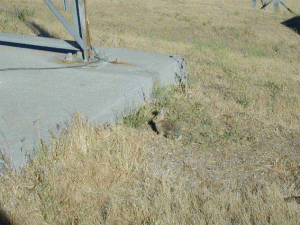
cottontail Altamont
Rabbit in front of its burrow, Altamont Pass wind farm, California – (first generation turbines).


Perched on the still blades (picture further below), or on the nacelles, birds of prey have a commanding view of this exceptional hunting territory. Many will hunt successfully without getting struck by a blade. But their very success will cause their brains to establish a connection between wind turbines and great hunting opportunities. Thus, when they spot some wind turbines, which may be seen from many miles away, they will be attracted to them. Young, unattached raptors will therefore visit many windfarms, and so will adults on migration. Breeding adults, on the other hand, will only visit the wind turbines within their territories, but will do it over and over again. In either case, the more time they spend near the turbines, the greater the chances they will be struck by a blade, the speed of which it is very easy to misjudge .


For birds as for humans, the blades appear to be moving at a leisurly pace. Yet, they travel at up to 300km/h at their tip. Here is the calculation for a 2.3 MW ENERCON Model E-70: 71m (diameter) x 3.14 = circumference of 223m x 21.5 revolutions per minute (in winds above 45 km/h) = 4.794m travelled by the tip of each blade in a minute x 60 minutes = 287,640m travelled in an hour, i.e. at a speed of 287km/h. In low winds, the speed is of 100 – 200 km/h. The difference between apparent slowness and actual high speed, plus the attraction they exert, are what turn wind turbines into deadly traps for birds and bats.


Raptors, experience has shown, are prone to be decimated by wind turbines (13). Yet these birds are very useful to us, as they control certain animal populations (rats, mice, rabbits, and nest plunderers such as magpies, crows etc.). They also eliminate sick or dead animals, thus preventing epidemics and contributing to the health of many species. Their role is important for the maintenance of natural balances, biodiversity and ecosystems. Yet, a new peer-reviewed study is alerting us that wind turbines are partly responsible for the coming extinction of some species of raptors (in southern Europe). One of them, the Egyptian Vulture, is seeing its population of breeding adults decline by 3-4% per year (14). This spectacular glider is already very rare in Europe, and millions of euros have been spent for its protection (and its reintroduction in France).

2_blade_perching_tubular
Photo: Red-tailed hawk perched on a blade, Altamont Pass, California.


Perching opportunities make wind turbines attractive to raptors, so does the prey or carcasses to be found under them (as we commented above). Here are more pictures (15), and videos (25 and 26) proving the point. But consultants promote the fiction that raptors “avoid” wind turbines, and the ornithology profession turns a blind eye to that baseless assertion, all of which is helping their common employers: wind farm promoters. But if raptors avoided wind turbines, why would so many be killed by their blades? (13).


Consultants use a wide array of deceptive tricks, which they developped over the years. I listed some of them years ago in an article, “the Shame of Scotland” (16). One of these tricks has been pushed to unprecedented levels in Australia: the “core-range manipulation” (16). There, consultants have decided, based upon unscientific, biased and unpublishedobservations, that wind turbines can be safely erected as close as 300 meters from the nests of eagles or other raptors. For instance, in the Bulgana Windfarm Flora and Fauna Assessment Report No. 13051 (7.6), page 97, we read: “Previous studies on wind farms have shown that resident Wedge-tailed Eagles are able to successfully nest and raise young on wind farms, if turbines are located at least 300 metres away (BL&A unpublished data )”.

Years ago, I debunked an identical assertion which was based on 24 searches spread over two years at theChallicum Hills wind farm – hardly constituting solid scientific evidence, to say the least. Biosis even admitted:“the work does not discount the possibility of WT eagle collisions” (17). Yet the fiction perdures, and wind turbines continue to be erected in Australia as close as 300 meters from eagle and other raptors’ nests. Nowhere else in the world are protected birds being treated so carelessly. We have seen the tragic results of this attitude at Woolnorth, Macarthur, Starfish Hill, etc. Australia’s eagles are being slaughtered, but the cover-up keeps Australians uninformed.


By contrast, Scottish raptor expert Michael J. McGrady recommends a 5 km buffer zone for the Golden Eagle, in the peer-reviewed study “A model of golden eagle (Aquila chrysaetos) ranging behavior”, J. Raptor Res. 36 (1 Supplement): 62-69 – by McGrady, M.J., Grant, J. R., Baingridge, I. P. & David R.A. McLeod D.R.A. (2002) (18). This study and its recommendation are mentioned in SEO-Birdlife’s guide for the assessment of windfarms as regards bird life, in which one can find the buffer zones recommended by scientists for various protected bird species (18). The shortest is 1 km, for the smallest of the kestrel species. For eagles, they vary from 5 to 10 km (18). Ospreys (“Águila pescadora” in Spanish): 2 km. Peregrine falcons: 2 – 4 km. Cranes: 10 km.


PLUNDERING NATURE WITH PUBLIC FUNDS


Out of control windfarm development is hurting many protected species, riding as it does on the optimistic estimates put out by hired consultants, government agencies, bird societies, the wind industry and its agents, pro-wind activists etc. It is also facilitated by considerable flows of public money, in the form of subsidies, tax credits, special loans, carbon certificates, etc. These millions of dollars (billions in those countries that have thousands of wind turbines) enable private interests to remove all obstacles to their greed, and this includes overriding nature protection legislation. Migration routes and stopover areas, shrinking habitat of threatened species (e.g. brolgas), high bird-traffic areas bordering natural reserves (e.g. Bald Hills, Victoria), nothing is sacred: the plunder has no limits.


Planning authorities which give the green light to wind projects rarely have other bird data at hand than what’s reported in impact studies prepared by unethical consultants. I read about a hundred of these reports over the past 12 years, and none concluded that the impact on the environment would be unacceptable, even when the project was to be located inside a protected nature reserve, or was threatening an endangered species with extinction. None of them was honest, without errors or omissions, and free of manipulations.


MITIGATION


To obtain approval for wind projects that will highly impact protected species, consultants usually suggest applying some techniques for avoiding, minimising, or attenuating the risks of collision. They call these “mitigation”. But we must be aware that none of these schemes, none of these formulas have proved effective. Wherever they have been implemented, they have failed (Altamont Pass, Woolnorth, Smola, Tarifa). The President of the French bird society LPO-Birdlife acknowledged the fact that mitigation does not work (19).


In situations where opponents to a wind project have raised the issue of bat mortality, consultants often propose a mitigation which consists in increasing the cut-in wind speed to, say, 6 meters per second. This means not letting the blades rotate unless the speed of the wind exceeds 22 km/h. The idea is that, as few bats fly when the wind exceeds that speed, mortality will be reduced by about 90%. We would comment on this particular mitigation as follows:

First observation: the promised reduction in mortality to 90% has not been verified. To our knowledge, no wind farm has put this measure into practice and published the results.

Second observation: a 10% residual mortality is considered by consultants to be negligible, as if it were acceptable to kill 1.2 million bats per year instead of 12 million (supposing a country that has, or will have, 18,000 wind turbines as in Spain). Most bat species are endangered, all are extremely useful. Killing them in such numbers is irresponsible. Also consider that the figure of 1,2 million will be much higher, as a) the reduction to 10% is unproven, b) only few wind projects contemplate “bat mitigation”.

Third observation: the practical application of such a measure is not verifiable . Indeed, who would make sure that, during 25 years, the computer program controlling the feathering of the blades a) reflects that mitigation, b) is in good order and c) is being applied? The interest of the windfarm owner is to not apply it, as it reduces his income. Thus, inspectors would be needed, but who would pay them during 25 years? It would have to be the State. And who would ensure that the operators of the wind farms will not “convince” these civil servants to turn a blind eye? Indeed, wind farms are often associated with corruption (20).


BATS


Thus, mitigation of bat mortality is doubtful at best. Yet bats are killed in bigger numbers than birds – about twice as many, i.e. circa 400 per turbine/year, or one bat per turbine/night. According to a study published in France, bats“are the most valuable fauna group” (in French:«constituent le groupe faunistique ayant la plus forte valeur patrimoniale» )(21). Indeed, bat species are very useful to humans, but they all are in decline. To make things worse, their populations cannot recover easily, most females only raising one pup a year.

Many of the chiropter species are classified as threatened with extinction. This is especially worrying because, without bats, farmers, the forest industry, and national forestry administrations would have to use more pesticides to control insects that attack trees and crops. This would lead to undesirable effects on prices and on the health of citizens. Services rendered by bats to US agriculture have been valued at $3.7 billion – $53 billion annually (22). That we know of, no evaluation has been made for services rendered by chiropters to forestry, but their usefulness in controlling some forest pests is recognised (23). Yet they are being killed in their millions by wind turbines. This is causing considerable harm to the environment.


In this video (24), we see bats getting hit by turbine blades, and others falling to the ground due to “barotrauma” (fatal injuries in the lungs caused by large pressure differences created around the blades).


COMPENSATION


The ineffectiveness of mitigation resulted in wily consultants proposing yet another deceptive scheme: “compensation”. This stratagem is useful to businesses that are causing serious harm to nature as a result of their activities. So much so that “offset programs” (27) are being set up, fooling people into believing that destroying more nature can be compensated. “No net biodiverity loss” is the publicised goal, but it is yet another scam to facilitate more plundering of nature. It boggles the mind to see most ecologists and bird societies support this. Here again, ethics vanish where there is money to be made…


Natural wetlands cannot be replaced by man-made reservoirs, any more than destroying primary tropical forests can be compensated by planting eucalyptus, nor killing birds of a protected species can be offset by giving money to a bird society. This scheme of redeeming one’s ecological sins with money is not without parallel with the indulgences that were sold by the Church in the Middle Ages.


Compensation is increasingly being used in the windfarm business. For instance, it is being alleged that, if new hunting areas for raptors are created nearby, it is acceptable to install wind turbines in their breeding territories. But this only works on paper. It hasn’t been successful anywhere in the world. The example of Beinn an Tuirc, Scotland, is sometimes quoted by some consultant as a reference. But this example is anything but conclusive. I exposed its false claim to success years ago (28).


The since-discovered fact that raptors are attracted to wind turbines further proves the ineffectiveness of this compensation. A wind farm is a giant bird trap which acts as a population sink, attracting its victims from many miles around. Nothing can compensate this ongoing massacre. Creating new hunting grounds next to it is as absurd as “killing the children but building orphanages”. .


No government in the world has considered objectively the cumulative effects of so many wind turbines, each of them an ecological trap attracting and killing many protected species. Some residents report that, since wind turbines were built, there are no more bats where they live; others noted that they see fewer and fewer raptors. Swallows and swifts are becoming rarer too, according to others.


The situation is serious, if only because these species are of great benefit to humanity. Natural equilibriums are also at risk, and so is quality of life. Are we willing to replace our countryside with industrial landscapes, our birds and bats with crop dusters? Where are we headed, with this “green” ideology which destroys nature by calling for a new, unnecessary industrial revolution, and misleads people into thinking it’s for the greater good of the planet?


What an awful mess are these ideologues making of our world, under the pretext of saving it… The wind industry has never been able to prove it can achieve its goal of significantly reducing harmful emissions. The wind’s intermittency stands in its way. The German experience is far from being conclusive in this regard, to say the least (29). A few years from now, when all the expensive tinkering will have failed (more power lines, international connections, smart meters, giant batteries, reservoirs and pumping stations, etc.), the Germans will have to face the harsh reality: wind intermittency has no economically viable solution.


Independent engineers keep repeating it (30), but stubborn governments are not listening. Through the famous “revolving door” of politics, wind power subsidies help finance political parties. Thus, cutting subsidies would be suicide for the party that would decide to do so (30). The wind industry clearly calls the shots, be it in Canberra, Copenhagen, London, Berlin, Paris or Washington.


The renewable energy bubble has burst in Spain and other southern European countries. It occurred when the cost of subsidies became unaffordable, i.e. when these countries became technically bankrupt and HAD to cut down on government expenses. When this happened, the so-called “green jobs” vanished. The countries were left with households impoverished by the high cost of “renewable” electricity. Some companies relocated abroad due to this cost, or are contemplating doing so. Tourists looking for nature, landscapes and relaxation choose other destinations. In the countryside, residents are poorer as their homes are worth a fraction of their normal value. Many live unhappy lives because of the Wind Turbine Syndrome, shorter too as they suffer chronically from high levels of cortisol. As for the birds, they keep being chopped up year after year…


Mark Duchamp
Chairman, World Council for Nature
Tél: +34 693 643 736 wcfn@live.com


References:


1) –http://www.environment.gov.au/system/files/resources/2d42fcbd-31ea-4739-b109-b420571338a3/files/wind-farm-bird-risk.pdf page 32 of TWTE modelling study


2) – http://www.smh.com.au/environment/animals/deaths-of-rare-eagles-rise-20101116-17vy7.html


3) –http://www.iberica2000.org/documents/eolica/BIRD_MORTALITY/Yaloak_South_Debus_comments.pdf


4) – http://www.iberica2000.org/Es/Articulo.asp?Id=4382


5) –http://www.weeklytimesnow.com.au/news/national/wind-farm-turbines-take-toll-on-birds-of-prey/story-fnkfnspy-1227066199577


(6) – http://www.lefigaro.fr/sciences/2007/03/19/01008-20070319ARTFIG90140-l_effet_des_eoliennes_sur_les_oiseaux.php


(7) –http://onlinelibrary.wiley.com/doi/10.1002/wsb.260/abstract


(8) – (Koop B., 1997. Vogelzug und Windenergieplanung. Beispiele für Auswirkungen aus dem Kreis Plön (Schleswig-Holstein). Naturschutz und Landschaftsplanung 29 (7): 202-207).


(9) –http://savetheeaglesinternational.org/releases/spanish-wind-farms-kill-6-to-18-million-birds-bats-a-year.html


(10) –http://www.iberica2000.org/documents/EOLICA/REPORTS/Dave_Sterner_2002.pdfPage 12, 1er paragraphe.


(11) –http://es.wikipedia.org/wiki/Alejandro_S%C3%A1nchez_P%C3%A9rez


(12) – http://wcfn.org/2013/07/24/biodiversity-alert/


(13) – Some of the eagles killed by wind turbines (tip of the iceberg)
http://www.iberica2000.org/es/Articulo.asp?Id=3071 – Last updated in 2006

– Some of the ospreys killed by wind turbines (tip of the iceberg)
http://savetheeaglesinternational.org/new/843-2.html

– Effects on red kites
http://rapaces.lpo.fr/sites/default/files/milan-royal/63/actesmilan150.pdf (pages 96, 97).


(14) – Study “Action on multiple fronts, illegal poisoning and wind farm planning, is required to reverse the decline of the Egyptian vulture in southern Spain”
Ana Sanz-Aguilar, José Antonio Sánchez-Zapata, Martina Carrete, José Ramón Benítez, Enrique Ávila, Rafael Arenas f, José Antonio Donázar (a).
Study published on April 21 2015 by ELSEVIER, Biological Conservation, Volume 187, July 2015, pages 10–18
http://www.sciencedirect.com/science/article/pii/S0006320715001408


(15) – –https://savetheeagles.wordpress.com/2013/05/28/raptors-attracted-to-windfarms-2/


(16) – The Shame of Scotland:http://www.iberica2000.org/es/Articulo.asp?Id=3426
See –> ” 3 . THE CORE RANGE MANIPULATION ”


(17) – http://www.iberica2000.org/es/Articulo.asp?Id=4313
See –> ” 4 – The precedent of Challicum Hills ”


(18) – https://www.seo.org/wp-content/uploads/2012/05/MANUAL-MOLINOS-VERSION-31_WEB.pdf
See –> Annex II, pages 106 and 107
Literature review of recommended buffer zones and sizes of home range for eagles and other raptors.


(19) –https://conseilmondialpourlanature.wordpress.com/2014/12/01/lpo-et-systemes-de-dissuasion-avienne/


(20) – http://wcfn.org/2015/04/22/huge-wind-farm-corruption-scandal-in-spain/


(21) –http://www.aude.gouv.fr/IMG/pdf/Etude_d_impacts_CVO_21-06-2013_Partie2_cle55bcf8.pdf
See –> page 89


(22) –
http://www.usgs.gov/newsroom/article.asp?ID=2743#.VU4hv_ntmkp


(23) –http://www.ncbi.nlm.nih.gov/pmc/articles/PMC4186828/


(24) – VIDEO http://savetheeaglesinternational.org/bats-struck-by-wind-turbines.html


(25) – VIDEO http://savetheeaglesinternational.org/vulture-struck-by-wind-turbine.html


(26) – VIDEO http://savetheeaglesinternational.org/vultures-killed-videos.html


(27) – http://bbop.forest-trends.org/


(28) –http://www.iberica2000.org/Documents/eolica/BIRD_MORTALITY/Critique_Beinn_an_Tuirc_report.rtf


(29) –
http://online.wsj.com/articles/germanys-expensive-gamble-on-renewable-energy-1409106602 Available upon request to wcfn@live.com


(30) – http://www.epaw.org/documents.php?lang=en&matter=backup


(31) – http://en.friends-against-wind.org/realities/windfarms-are-only-good-for-financing-political-parties


X X X