|
||||||
Return to sanity!


Wind Energy….NOT clean, NOT green, NOT affordable!
Wind Power’s Toxic Embrace
April 25, 2015

Our Toxic Relationship with Wind Power
The Valley Patriot
Christine Morabito
February, 2015
If clean, safe and efficient energy is to be our standard, then why use wind power at all?
When we examine the entire process, the construction and operation of wind turbines is a dangerous and toxic affair. It begins with the mining of rare earth minerals, a collection of chemical elements manufactured mostly in China. The ill-protected workers are exposed to hazardous materials like hydrofluoric acid and radioactive particles. These substances are then exported worldwide, for use in wind turbines as well as computers, cell phones, hybrid cars and energy saving light bulbs.
The process of refining of these elements leaves death and destruction in its wake, polluting farmland, killing livestock, seeping into waterways and poisoning drinking water. Besides the devastation to the environment, nearby villagers report significant health problems, like bone, respiratory and heart diseases. Some residents suffer helplessly while their teeth fall out. But, since all this is occurring in the Far East, Western environmentalists don’t seem particularly concerned.
Meanwhile, in the United States, the massive windmills gobble up valuable habitat, as do the roads needed to access them. These eyesores ruin otherwise picturesque landscapes, and are built with little regard for the migratory paths of protected wildlife. The deadly blades can reach speeds up to 170 mph, often chopping birds into pieces. Most recent data estimates that 600,000 birds and hundreds of thousands of bats fall prey to this “green” technology every year.
Just east of San Francisco lies a 58 square mile wind farm called theAltamont Pass. The turbines have reportedly killed some 3,000 golden eagles, putting their population in serious jeopardy.
In the 30-odd years that wind energy has existed, only 2 companies have been prosecuted for illegally killing protected birds. The first was in 2013, when the U.S. Department of Justice and Duke Energy, of Wyoming, announced a $1 million settlement related to the deaths of 14 golden eagles and 149 hawks, blackbirds, larks, wrens and sparrows.
In January, 2015, Pacific Corp, also in Wyoming, was ordered to pay $2.5 million for killing 38 golden eagles and 336 other protected birds.
Under the auspices of fighting climate change, the Obama Administration is awarding wind-power companies a 30-year amnesty in the form of “take permits,” which allow the killing of endangered species. It’s ironic that our tax dollars are being used to study and protect endangered species, while simultaneously subsidizing an industry that is killing the aforementioned animals.
By working with the U.S. Fish and Wildlife Service, wind producers can avoid creating killing fields. The key is to bypass well-known migration routes.
I spoke to Bob Johns, Public Relations Director at the American Bird Conservancy. When holding energy companies accountable, Johns says, “green energy is held to a different standard.” The problem is one of selective enforcement. Fish and Wildlife Service guidelines are voluntaryand not enforced via regulation like those governing oil and electric companies. Johns stressed that “wind producers are not ‘mom and pop’ businesses, but large corporations,” with little incentive to follow mere guidelines. He believes regulations are needed to stop the egregious killing of birds and level the playing field. Deadly turbines are a worldwide problem, with wind farms in Spain, Belgium, Sweden, Germany and the Netherlands, among others.
What exactly is the up-side? Wind energy is expensive, costing about twice as much as conventional power sources. And, since wind is heavily subsidized, taxpayers fund it before and after it is produced, as evidenced by the infamous Cape Wind project in Massachusetts, which is already $10 million over budget. Wind energy is not particularly efficient, producing only between 3 to 4 percent of our country’s electricity. Like other alternative energy sources, turbines must be backed-up by fossil fuels when the wind isn’t blowing.
Like all fledgling energy sources, new technologies, combined with regulations, will make wind energy safer, cleaner and more efficient. Through innovative filtration systems, we have made great strides inremoving pollutants from fossil fuel emissions. The plastics we have come to rely on were once discarded waste products from oil refining, proving that the human race will continue to innovate – because that’s what we do.
While there is risk in producing every type of energy, the risks of using fossil fuels are greatly exaggerated; the benefits rarely mentioned. The well-funded, well-connected environmental lobby has an ideological, knee-jerk reaction to energy. In their world, fossil fuels = bad, alternative energy = good.
Massachusetts State Senator, Kathleen O’Connor Ives plans to introduce legislation to ban the practice of hydraulic fracturing (fracking) in Massachusetts. While carrying some hypothetical risk, fracking has the phenomenal ability to make America energy independent. Lower energy costs make us all richer, and we are sending billions less to our oil producing enemies – who, as we speak, are plotting our demise.
I know Senator Ives to be a reasonable legislator, and I’m hoping she and others will consider the pros and cons of every energy source at our disposal. In our quest for energy alternatives, facts should trump ideology. The earth and all its inhabitants deserve nothing less.
The Valley Patriot

John Middleton, from Scotland, Reports on the Windpushers Latest Tactics!
Thursday night, Ms Sturgeon on the TV looking relaxed in her home, life is good… Now, in the words o the great Max Bygraves.. “Let me tell you a story”… Most people on here know me, some don’t, some girls need a lot o loving an some girls don’t… Naw, only kidding (could not help it)… Having (this is the real story by the way) been up for several nights due to this horrendous noise and it’s effects, I stupidly pleaded with Ms Sturgeon to do something about WLC and NLC, things were pretty bad and the question had to be asked “are these turbines worth more than my sanity and my life”..? My response from Ms Sturgeon was sending two police officers to my door to check on my well being, when they realised I wanted to discuss why I’m being kept awake they did not want to know so said ” thanks very much and tried to close the door which they kicked open, handcuffed me and held me by my throat saying I was mentally ill and frogmarched me into a van and yes they said they had been contacted by Ms Sturgeons office… Well, I was taken to St Johns hospital where I was mentally assessed, they asked me why I had not slept and was contacting various organisations about wind turbines, I told them what I know as I have discussed with many of you here, they brought a guy in from WLC mental health who asked me (an this’ll crack ye up as it did me) “what do the turbines say to you”… Well you can imagine my response, I explained it’s a humming and that it was now widely known that the LFN does indeed effect certain people and does not effect others, I was then deemed “fixed delusional”, I was immediately seized and given certain drugs against my will, this was done first orally then by syringes thrust into my legs through my clothes, put in a wheelchair carted backwards to a secure mental health ward where I have been for over a week now, if you think that these places have changed since “one flew over the cuckoo’s nest” then be rest assured they ain’t…!!! Earlier today I had a top consultant come to see me and having had her assistant look into this “noise”, I was released with immediate effect, she said I should not have been put there as everything I said was indeed true.. The mental health order revoked, the whole time apart from when they forced me into the ward I had no drugs apart from painkillers due to the injuries inflicted by so called nurses… This is the length these people will go to to silence we sufferers of this god forsaken noise, I will continue this fight regardless of this blatant abuse of my civil liberties, let this story be told and never give in….
Wind is Novelty Energy. Too much Pain, For Far Too Little Gain!
Brits Waking Up to the Insane Cost of its Wind Power Disaster
April 24, 2015 by

****
Green targets ‘cost £214 a year’: Report says rush for renewable energy has been ‘most expensive policy disaster in modern British history’
Jack Doyle
Daily Mail
18 March 2015
- Shifting to wind and solar power has increased costs to consumers
- Ditching green energy targets would save households £214 a year
- Report into renewable energy carried out by The Centre for Policy Studies
- Found the rush to go green has been the ‘most expensive policy disaster’
- Say no British Government has carried out analysis of costs vs benefits
- Annual cost of renewable target is said to be a staggering £9 billion
Ditching green energy targets would save every household in Britain around £214 a year, a report reveals today.
The Centre for Policy Studies paper concludes that the rush for renewable energy has been the ‘most expensive policy disaster in modern British history’.
Shifting to wind and solar power have hugely increased costs to consumers, while creating an energy supply that is ‘intermittent’.
As a result, huge additional investment has been required in backup capacity to cover for when the wind isn’t blowing and the sun isn’t shining.
And billions more have been spent to connect remote wind farms to the national grid.
Author Rupert Darwall concludes that, astonishingly, no British government has conducted a rigorous analysis of the costs and benefits of the renewables target which was first negotiated by Tony Blair at the European Council in 2007.
The Government is committed to providing 15 per cent of its energy from renewable power by 2020.
Mr Darwall, the author of The Age of Global Warming, concludes that the annual costs of the renewables target is a staggering £9billion.
Switching back to a free market in power would save households around £214 a year, assuming that gas replaces renewables, he says.
The report says: ‘Energy policy represents the biggest expansion of state power since the nationalisations of the 1940s and 1950s. It is on course to be the most expensive domestic policy disaster in modern British history.
‘By committing the nation to high, cost, unreliable renewable energy, its consequences will be felt for decades.’
‘In addition to their higher plant-level costs, renewables require massive amounts of extra generating capacity to provide cover for intermittent generation when the wind doesn’t blow and the sun doesn’t shine.’
The report concludes that the costs of ‘intermittent renewables’ have been ‘massively understated’.
As a result, ‘massively subsidiesed wind and solar capacity floods the market with near random amounts of zero marginal cost electricity.’
‘To keep the lights on, everything ends up requiring subsidies, turning what was once a profitable sector into the energy equivalent of the Common Agricultural Policy.’
The cost of the national grid has nearly trebled as a result of connecting to remote wind farms, he says. More solar and wind means Britain is having to more than double its overall capacity, because additional sources are needed when wind isn’t working.
Without renewable energy, the UK would need 22GW of new capacity to replace old coal and nuclear stations, but as a result of renewable energy, an additional 50GW is required, the report says.
Abandoning renewables and going back to a market system would save around £6billion a year, or around £214 for every household, he says.
But Professor Catherine Mitchell, Professor of Energy Policy at the University of Exeter said the report ‘downplays climate change as a problem’.
She said: ‘What is needed is an electricity market that is constructed to best integrate renewable energy and energy efficiency for the benefit of customers, the environment and security.’
Last month, Energy Secretary Ed Davey announced £4billion in new energy deals for wind and solar schemes. It means a guarantee for some 27 new renewable energy projects that they can sell their power at a fixed price until 2040. The subsidised schemes include 15 onshore wind farms, five solar arrays, two offshore wind programmes and five waste conversion plants.
It will be paid for by householders through their electricity bills with a subsidy added to the basic cost of electricity.
A spokesman for the Department of Energy and Climate Change said: ‘We are dealing with a legacy of underinvestment to safeguard people’s electricity supplies now and in the years ahead.
‘The Government’s Electricity Market Reforms are designed to attract up to £100 billion of capital investment that we will need in the sector over the next decade. By creating the world’s first low carbon electricity market, we are going green at the lowest cost, and attracting tens of billions of pounds of infrastructure investment, creating huge numbers of green jobs.’
Daily Mail
Rupert Darwall’s brilliant, but sobering, analysis is covered in full here:
How Wind Power Subsidies Destroy Both Electricity Markets & Economies

Even Germany is Seeing Reality, and Coming to it’s Senses About “Novelty Energy”…
German’s Top Daily – Bild – says Time to Chop Massive Subsidies for Wind Power
April 23, 2015 by

****
The Germans went into wind power harder and faster than anyone else – and the cost of doing so is catching up with a vengeance. The subsidies have been colossal, the impacts on the electricity market chaotic and – contrary to the environmental purpose of the policy – CO2 emissions are rising fast: if “saving” the planet is – as we are repeatedly told – all about reducing man-made emissions of an odourless, colourless, naturally occurring trace gas, essential for all life on earth – then German energy/environmental policy has manifestly failed (see our post here).
Some 800,000 German homes have been disconnected from the grid – victims of what is euphemistically called “fuel poverty”. In response, Germans have picked up their axes and have headed to their forests in order to improve their sense of energy security – although foresters apparently take the view that this self-help measure is nothing more than blatant timber theft (see our post here).
German manufacturers – and other energy intensive industries – faced with escalating power bills are packing up and heading to the USA – where power prices are 1/3 of Germany’s (see our posts here and hereand here). And the “green” dream of creating thousands of jobs in the wind industry has to turned out to be just that: a dream (see our post here).
By piling into wind power without ever having thought through the costs, let alone the “benefits”, of trying to rely on a wholly weather dependent power generation source, the Germans are left with a generation system on the brink of total collapse, as picked up by The Daily Caller.
Germany’s On The Brink Of An Energy Crisis
The Daily Caller
Michael Bastasch
13 April 2015
After years of subsidizing green energy production, Germany may be on the brink of an imminent “energy crisis,” reports German Mittelstand News.
Some 39 power plants across the country “could be decommissioned later this year” which could “jeopardize the security of supply,” precipitating a huge energy crisis in the coming years as more plants are shuttered, according to the German Association of Energy and Water Industries — the country’s main utilities lobby.
“Every second power plant planned in Germany is about to fold,” Mittelstand News reports. “The willingness to invest is decreasing rapidly as even the most efficient gas-fired power plants can no longer be operated profitably.”
Problems will get even worse when Germany’s last nuclear power plant is retired in 2022, reports Mittelstand News. For years, the government has subsidized solar and wind energy through energy taxes that have dramatically jacked up electricity rates.
But at the same time, the flood of solar and wind energy on the grid has caused wholesale electricity prices to collapse — all while retail rates have skyrocketed. But the collapse in wholesale prices are cutting into the profitability of coal and gas plant operators that don’t get the generous subsidies that green energy does.
This problem was highlighted by a 2014 report by the Switzerland-based FAA Financial Advisory AG. The group found Germany’s green energy revolution is having “profound effects on wholesale electricity markets that could ultimately result in a deterioration of the country’s reliability.”
What’s happening is that green energy sources are given priority on the grid when meeting power demand, therefore setting the marginal price of electricity being produced — which is very low because they have no fuel costs. The prioritization of green energy has depressed wholesale prices and means that coal and gas power can’t recover their full costs.
This normally wouldn’t be a problem in a free, competitive market, but subsidies for green energy means more coal and gas plants are needed for back-up. These, plants, however, are having trouble finding investors willing to lose money because they can’t make money selling electricity.
“There are fewer hours in which the conventional power plants earn more than the marginal cost since they run fewer hours than originally planned and, in many cases, provide back-up power only,” FAA Financial noted. “Generators’ financial difficulties have already translated into lower stock prices and credit ratings.”
The problem has gotten so bad that utilities are asking the government to bail them out. Reduced profitability means less investment in the power sector, which the utilities lobby says could create problems down the road if nothing is done to prop up coal and gas plants.
“If politicians carry on as they do now then there will be no new, modern power stations,” utilities lobby chief Hildegard Mueller told Reuters. “There are no incentives whatsoever for investments, despite politicians emphasizing all the time that they aim to change this.”
German utilities already get payments for not producing power when green energy output is peaking — generally in the middle of the day because of solar energy.
Over the last decade, Germany’s embarked on a costly $412 billion crusade to subsidize green energy production and reduce carbon dioxide emissions 80 percent by 2050. In that time green energy production has boomed from 4.3 percent of total energy consumption in 1990 to 23.5 percent in 2012.
But Germany’s green energy revolution is costing German residents dearly. Retail electricity rates have more than doubled in the last decade due to ever-growing taxes to support green energy use. German politicians have been pressured to reform the system, but it’s still expected to cost consumers more and more every year.
Consumer energy bills have gotten to the point where electricity in the country has been called a “luxury good” by major media outlets.
In recent years, Germany has expanded coal power, but has rejected calls to open up the country to hydraulic fracturing, or fracking, to boost natural gas production. Even so, new coal plants in Germany could be closed down if trends continue.
The Daily Caller
The Germans are fast waking up the unassailable fact that wind power is not only insanely expensive, it’s utterly meaningless as a power source:
German Wind Power Goes Completely AWOL 11 Times in the Last 80 Days
With hostility from power punters escalating, Germany’s top daily, Bild has called for an end to the subsidies that have fuelled its great wind power fraud: the original in German is available here; and the English translation – courtesy of NoTricksZone – appears below.
Germany’s Leading Daily Calls For An End To Green Energy Subsidies! Calls Green Promises “A Fairy Tale”
NoTricksZone
Pierre Gosselin
3 April 2015
Germany’s leading daily in terms of circulation Bild recently featured an op-ed piece that harshly criticizes Germany’s Energiewende (transition to renewable energies).
Clearly the Energiewende is not even coming close to living up to what is was originally billed to deliver.
Despite adding more than 70 gigawatts of wind and solar capacity that will cost consumers some $200 billion, German CO2 emissions have not decreased to speak of. Coal-fired power has actually risen.
In summary German electricity prices have skyrocketed and poor consumers are being hit hard. Energy-intensive industries are off-shoring operations – and jobs!
A number of experts are calling the Energiewende the greatest wealth redistribution from poor to rich scheme in Germany’s history as wealthy property owners cash in with subsidized zero-risk wind and solar installations. The poor consumers are forced to cough up the money.
“Enough with green power!”
So it’s little wonder that major German media outlets are beginning to express doubts. Bild features an opinion piece titled: “Enough with green power!”
The popular German daily calls the promises of cheap power from wind and sun “a fairy tale”. It writes:
Indeed the truth is: The price of power continues to climb. Just in the past five years the power price exploded 29 percent.
The reason is simple: In the energy market, central planning rules and not the free market.”
Disfigured market
Today there is so much installed capacity, Bild writes, that “on days with lots of sunshine and wind, the green power has to be sold to foreign countries” – even if they don’t need it. When that happens the highly subsidized power gets sold at negative prices. The result? Huge losses for power companies. This is how disfigured the electric power market has become.
In summary Bild concludes that the price of power is much more expensive than it needs to be and that it is a product that needs to remain affordable. Germany’s energy policy is on the wrong path.
Unfortunately there are no signs things will change anytime soon in Germany, which now has the world’s second highest electricity prices in the world after Denmark.
No Tricks Zone
In Australia, the wind industry, its parasites and spruikers hold the Germans up as wind power “super-models”, touting its wind-rush as the perfect path to prosperity, millions of groovy “green” jobs and a CO2 free future (best warn every living thing on Earth if that ever looks likely).
But, as with every “model” or “example”, there are good ones, and bad ones.
When Germany’s top newspaper is clamoring for an end to its wind powered energy debacle, it’s pretty clear we’re talking about a mighty poor “model”; and an “example” to be avoided at all costs.

If the Windpushers Need a Story…..They Just Make One Up!
Victorian Country Fire Authority’s Claim that Wind Turbines Not Combustible Scorched
April 22, 2015 by

****
During the Senate Inquiry’s first hearing into the great wind power fraud, the Committee had to listen to a number of wind industry backed patsies and stooges.
Among them were a pair from Victoria’s Country Fire Authority (CFA): Craig Brownlie (Operations Officer, Specialist Response) andAndrew Andreou (Executive Manager, Community Infrastructure).
When the pair were quizzed by Senator David Leyonhjelm on the “cause of the East Kilmore fire on Black Saturday [2009] and how many people died in it” (one of the worst bushfires in Victoria’s history and the subject of very public findings given after a lengthy Royal Commission) they both drew blanks, asked if they could “phone a friend”, and take the question on notice.
So comforting to hear that the Victorian CFA’s Top Brass have such a solid grip on their brief! For a frightening (for those who place faith in their fire authorities and their ability to protect them and their properties) trip into the bizarre, see the Hansard here.
Things went from the sublime to the ridiculous, as the CFA boys tried to downplay the risk of turbines spontaneously combusting – a tough ask, given the hundreds of pyrotechnic meltdowns recorded both here and around the world:
BUSHFIRE RED ALERT: Wind Power Really Is Setting the World on FIRE
But it was this exchange in which Andrew Andreou’s limited grip on reality came to the fore, as he was caught out parroting the wind industry line on turbine fires, that really caught the Committee’s attention:
Senator BACK: Do you have any idea of what the volume of oil would be up in the top of the wind turbines? It is probably the oil more than plastics that are likely to burn.
Mr Andreou: I am aware that non-combustible oils are generally used these days for lubricant, hydraulics and the like. That is the type. I could not give you exact figures on the quantities. I know that they are significant quantities, but, no, I could not provide you with the detail of the exact quantities.
CHAIR: You said that the oil is non-combustible. Would you be able to take on notice what that statement is based on, gentlemen? What information do you have to rely on that it is not combustible oil used in the gearboxes of the turbines?
Mr Andreou: We have been reliant on the information provided by the facility managers or owners.
CHAIR: Would you take that on notice and come back to the committee with where that information has been obtained from?
Mr Andreou: That is fine; we will do that.
Hansard, 30 March 2015

****
The “information” that Andrew Andreou was relying on came from none other than struggling Danish fan maker, Vestas, you know the boys who ran around a couple of years back telling us all to “Act on Facts” (see our post here).
Well, here’s a few that the CFA boys missed. A Vestas V112 3MW turbine – the kind used at Macarthur – holds the following “chemicals”, according to their specifications:

The hydraulic system has about 100 litres of hydraulic fluid in reserve; and to keep the gearbox lubricated requires 1,170 litres of gear oil; which sits in the gearbox sump and a reservoir (“external gravity tank), all housed in the nacelle:

The CFA’s claims that 1,000 (or more) litres of gear oil won’t explode in a thrilling pyrotechnic display are pure bunkum.
As STT followers know, we just love FACTS – the more graphic, the more bloody, the better.
So here’s a little video, and some snaps, from Estonia of a recent turbine “flame-out”, that tends to undermine the CFA’s upbeat fire safety predictions about wind turbines, in general; and its ludicrous – wind industry backed – claim that a tonne of gear oil and hydraulic fluid has the same combustibility as H2O:
Bus trip to turbine fire


People Worldwide are Waking Up to the Reality of the Wind Scam!
Top US Energy Economist Takes the Scalpel to the Great Wind Power Fraud
April 21, 2015 by

****
One of the great mysteries behind the lunacy that is the great wind power fraud is how and why so many governments launched into mandating massive and endless subsidies (filched from unwitting power consumers and/or taxpayers) for an utterly meaningless power generation source – WITHOUT ever having carried out a cost/benefit analysis?
You know, the kind of analysis that economists put together on a daily basis; and which are used to give the thumbs up (or down) to government policies BEFORE they’re set rolling like unstoppable locomotives; especially where, as here, they involve massive streams of corporate welfare.

****
In a better late than never move, economists the world over are now taking the scalpel to the wind industry and, especially, its wilder claims about being “competitive” with conventional generation sources. Of course, if there was a shred of truth in that ripping yarn, the wind industry and its parasites wouldn’t need to spend every waking hour on the rent-seeker trail; bleating about the need for Renewable Energy Targets (written in stone), and the need to keep the subsidy gravy train rolling, interminably.
As the myth, fantasy and fallacy gets sliced away to reveal the true costs of wind power, the number crunchers are finding that wind power simply doesn’t measure up, on any score. Here’s Newsweek with one such dissection.
What’s the True Cost of Wind Power?
Newsweek
As consumers, we pay for electricity twice: once through our monthly electricity bill and a second time through taxes that finance massive subsidies for inefficient wind and other energy producers.
Most cost estimates for wind power disregard the heavy burden of these subsidies on US taxpayers. But if Americans realized the full cost of generating energy from wind power, they would be less willing to foot the bill – because it’s more than most people think.
Over the past 35 years, wind energy – which supplied just 4.4% of US electricity in 2014 – has received US$30 billion in federal subsidies and grants. These subsidies shield people from the uncomfortable truth of just how much wind power actually costs and transfer money from average taxpayers to wealthy wind farm owners, many of which are units of foreign companies.
Financial advisory firm Lazard puts the cost of generating a megawatt-hour of electricity from wind at a range of $37 to $81. In reality, the true price tag is significantly higher.
This represents a waste of resources that could be better spent by taxpayers themselves. Even the supposed environmental gains of relying more on wind power are dubious because of its unreliability – it doesn’t always blow – meaning a stable backup power source must always be online to take over during periods of calm.
But at the same time, the subsidies make the US energy infrastructure more tenuous because the artificially cheap electricity prices push more reliable producers – including those needed as backup – out of the market. As we rely more on wind for our power and its inherent unreliability, the risk of blackouts grows. If that happens, the costs will really soar.

Many government agencies are in the wind business these days. GAO
Where the subsidies go
Many people may be familiar with Warren Buffet’s claim that federal policies are the only reason to build wind farms in the US, but few realize how many of the companies that benefit most are foreign. The Investigative Reporting Workshop at American University found that, as of 2010, 84% of total clean-energy grants awarded by the federal government went to foreign-owned wind companies.
More generally, the beneficiaries of federal renewable energy policies tend to be large companies, not individual taxpayers or small businesses. The top five recipients of federal grants and tax credits since 2000 are: Iberdrola, NextEra Energy, NRG Energy, Southern Company and Summit Power, all of which have received more than $1 billion in federal benefits.
Iberdrola Renewables alone, a unit of a Spanish utility, has collected $2.2 billion in federal grants and allocated tax credits over the past 15 years. That’s equivalent to about 6.7% of the parent company’s 2014 revenue of $33 billion (in current US dollars).
President Obama’s proposed 2016 budget would permanently extend the biggest federal subsidy for wind power, the Production Tax Credit (PTC), ensuring that large foreign companies continue to reap most of the taxpayer-funded benefits for wind. The PTC is a federal subsidy that pays wind farm owners $23 per megawatt-hour through the first ten years of a turbine’s operation. The credit expired at the end of 2013, but Congress extended it so that all projects under construction by the end of 2014 are eligible.
In all, Congress has enacted 82 policies, overseen by nine different agencies, to support wind power.
I explained in December why Congress shouldn’t revive the PTC, which expired at the end of 2014. In this article, I’m adding up the true cost of wind power in the US, including the impact of the PTC and other subsidies and mandates. It’s part of a study I’m doing of other energy sources including solar, natural gas, and coal to determine how much each one actually cost us when all factors are considered.

As Warren Buffett has said, there wouldn’t be a wind industry without the PTC. UCS, DOE, AWEA
Tallying the true costs of wind
Depending on which factors are included, estimates for the cost of wind power vary wildly. Lazard claims the cost of wind power ranges from $37 to $81 per megawatt-hour, while Michael Giberson at the Center for Energy Commerce at Texas Tech University suggests it’s closer to $149. Our analysis in an upcoming report explores this wide gap in cost estimates, finding that most studies underestimate the genuine cost of wind because they overlook key factors.
All estimates for wind power include the cost of purchasing capital and paying for operations and maintenance (O&M) of wind turbines. For the studies we examined, capital costs ranged from $48 to $88 per megawatt-hour, while O&M costs ranged from $9.8 to $21 per megawatt-hour.
Many estimates, however, don’t include costs related to the inherent unreliability of wind power and government subsidies and mandates. Since we can’t ensure the wind always blows, or how strongly, coal and natural gas plants must be kept on as backup to compensate when it’s calm. This is known as baseload cycling, and its cost ranges from $2 to $23 per megawatt-hour.
This also reduces the environmental friendliness of wind power. Because a coal-fired or natural gas power plant must be kept online in case there’s no wind, two plants are running to do the job of one. These plants create carbon emissions, reducing the environmental benefits of wind. The amount by which emissions reductions are offset by baseload cycling ranges from 20% to 50%, according to a modeling study by two professors at Carnegie Mellon University.
While the backup plants are necessary to ensure the grid’s reliability, their ability to operate is threatened by wind subsidies. The federal dollars encourage wind farm owners to produce power even when prices are low, flooding the market with cheap electricity. That pushes prices down even further and makes it harder for more reliable producers, such as nuclear plants, that don’t get hefty subsidies to stay in business.
For example, the Kewaunee Nuclear Plant in Wisconsin and the Yankee Nuclear Plant in Vermont both switched off their reactors in 2013. Dominion Energy, which owned both plants, blamed the artificially low prices caused by the PTC as one of the reasons for the shutdown.
As more reliable sources drop off and wind power takes their place, consumers are left with an electrical infrastructure that is less reliable and less capable of meeting demand.
Lost in transmission
Another factor often overlooked is the extra cost of transmission. Many of America’s wind-rich areas are remote and the turbines are often planted in open fields, far from major cities. That means new transmission lines must be built to carry electricity to consumers. The cost of building new transmission lines ranges from $15 to $27 per megawatt-hour.
In 2013, Texas completed its Competitive Renewable Energy Zone project, adding over 3,600 miles of transmission lines to remote wind farms, costing state taxpayers $7 billion.
Although transmission infrastructure may be considered a fixed cost that will reduce future transmission costs for wind power, these costs will likely remain important. Today’s wind farms are built in areas with prime wind resources. If we continue to subsidize wind power, producers will eventually expand to sub-prime locations that may be even further from population centers. This would feed demand for additional transmission projects to transport electricity from remote wind farms to cities.
The final bill comes to…
Finally, federal subsidies and state mandates also add significantly to the cost, even as many estimates claim these incentives actually reduce the cost of wind energy. In fact, they add to it as American taxpayers are forced to foot the bill. According to Giberson, federal and state policiesadd an average of $23 per megawatt-hour to the cost of wind power.
That includes the impact of state mandates, which end up increasing the cost of electricity on consumer power bills. California is one of the most aggressive in pushing so-called Renewable Portfolio Standards (RPS), requiring the state to consume 33% of its electricity from renewables by 2020. Overall electricity prices in states with RPS are 38% higher than those without, according to the Institute for Energy Research, a non-profit research group that promotes free markets.
The best estimate available for the total cost of wind power is $149 per megawatt-hour, taken from Giberson’s 2013 report.
It is difficult to quantify some factors of the cost of wind power, such as the cost of state policies. Giberson’s estimate, however, includes the most relevant factors in attempting to measure the true cost of producing electricity from wind power. In future reports, Strata will explore the true cost of producing electricity from solar, coal, and natural gas. Until those reports are completed, it is difficult to accurately compare the true cost of wind to other technologies, as true cost studies have not yet been completed.
Blowing in the wind
The high costs of federal subsidies and state mandates for wind power have not paid off for the American public. According to the Mercatus Center at George Mason University, wind energy receives a higher percentage of federal subsidies than any other type of energy while generating a very small percentage of the nation’s electricity.
In 2010 the wind energy sector received 42% of total federal subsidies while producing only 2% of the nation’s total electricity. By comparison, coal receives 10% of all subsidies and generates 45% and nuclear is about even at about 20%.

Wind gobbles up the largest share of subsidies yet produces little power. EIA
But policymakers at the federal and state level, unfortunately, have decided that the American people will have renewable energy, no matter how high the costs. As a result, taxpayers will be stuck paying the cost of subsidies to wealthy wind producers.
Meanwhile, electricity consumers will be forced to purchase the more expensive power that results from state-level mandates for renewable energy production. Although such policies may be well intended, the real results will be limited freedom, reduced prosperity and an increasingly unreliable power supply.
Randy Simmons is professor of political economy at Utah State University. Megan Hansen, a Strata policy analyst, co-authored this article, which first appeared on The Conversation. Full disclosure: Randy Simmons receives funding from the U.S. Department of Energy (grant has been completed and there is no current funding) and Strata, a 501 (c)3 non-profit organization. Megan Hansen, a Strata policy analyst, co-authored this article.
Newsweek

Wonderful News! The Blanding’s Turtle Will Be Protected After All!
Turtle beats turbine
Mon, Apr 20th, ’15

An endangered species has won the power struggle over Ostrander Point as Ontario’s top court has ruled in favour of the Blanding’s turtle over turbines.
In a historic ruling the Ontario Court of Appeal overturned a provincial court decision in relation to the Renewable Energy Approval of Gilead Power’s nine turbine project.
Prince Edward County Field Naturalist President Myrna Wood.
Lawyer Eric Gillespie says this case represents the first time ever that the Environmental Review Tribunal said that their would be serious and irreversible harm to the Blanding’s Turtle and the Ontario Court of Appeal chose appropriately to uphold that decision.
Gillespie says Gilead now has a couple of options going forward one of them being to ask the Supreme Court of Canada in Ottawa to hear the case. He says there’s no automatic right to do that you need leave or permission from the Supreme Court.
Gillespie says the other way that this is definitely going to play out is the Environmental Review Tribunal has been asked by the Ontario Court of Appeal to hear some further submissions on what the solution to this situation should be.
Gillespie chuckled anyone who has ever been to Ostrander Point knows there’s all kinds of ways to get into the point and a a simple gate across a road isn’t going to stop people visiting that site. He says unless there is something completely new that nobody has heard of yet it would be somewhat certainly surprising to our clients if the ERT does anything different than what they originally decided.
PECFN member Cheryl Anderson says the naturalists are more than willing to show the Tribunal how putting gates on the very access roads, which will cause the irreversible harm, is no remedy at all.
The Ministry of Environment says it hasn’t decided how to proceed as of yet.
Gilead Power hasn’t responded to our requests for comment on whether or not they plan to ask for permission to escalate this to the Supreme Court of Canada.
To read the full judgement click here.
Climate Models Never Reflect Reality…..Reality Must be Wrong???
95% of Climate Models Agree: The Observations Must be Wrong
Roy W. Spencer, Ph. D.
I’m seeing a lot of wrangling over the recent (15+ year) pause in global average warming…when did it start, is it a full pause, shouldn’t we be taking the longer view, etc.
These are all interesting exercises, but they miss the most important point:the climate models that governments base policy decisions on have failed miserably.
I’ve updated our comparison of 90 climate models versus observations for global average surface temperatures through 2013, and we still see that >95% of the models have over-forecast the warming trend since 1979, whether we use their own surface temperature dataset (HadCRUT4), or our satellite dataset of lower tropospheric temperatures (UAH):
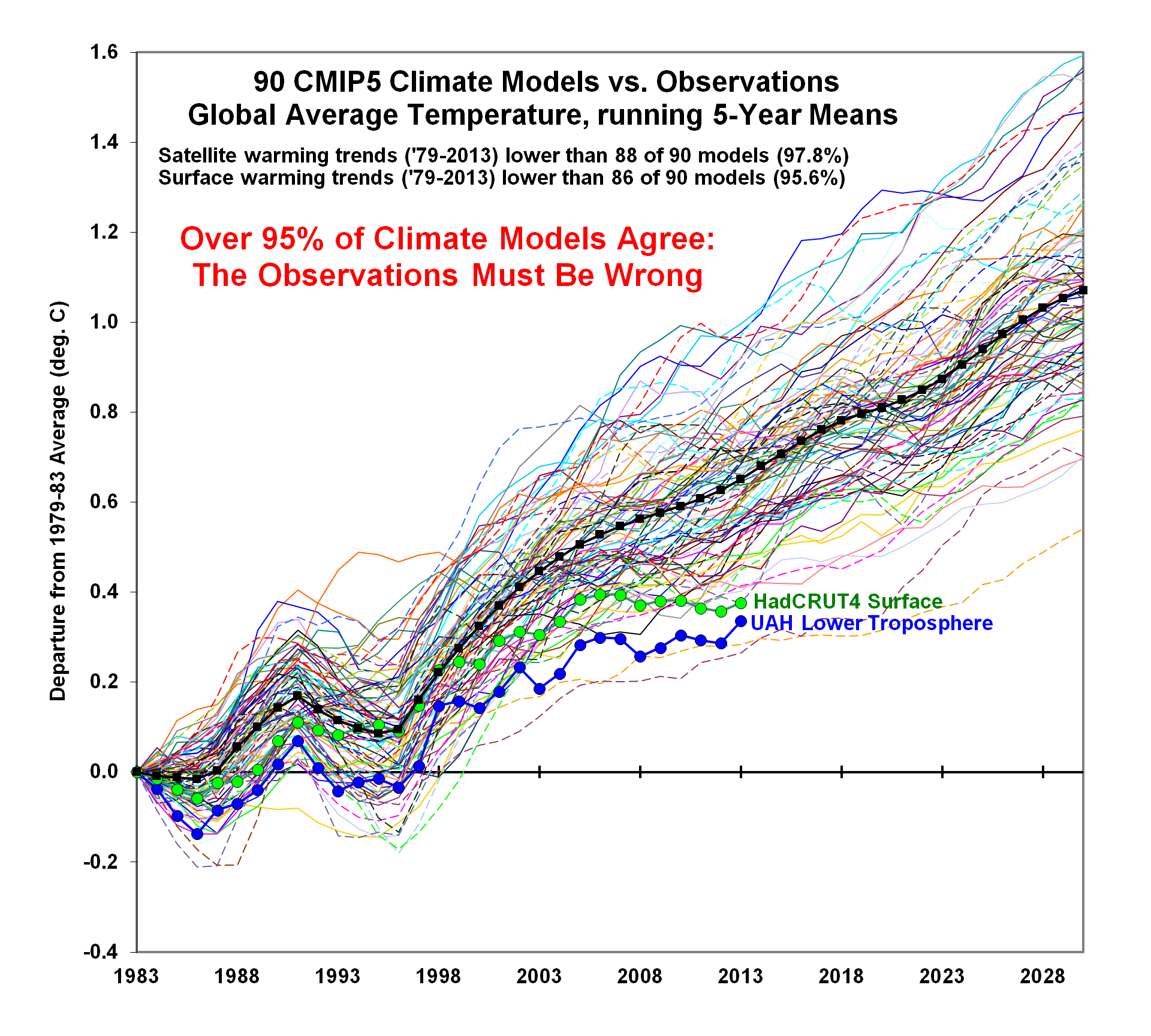
Whether humans are the cause of 100% of the observed warming or not, the conclusion is that global warming isn’t as bad as was predicted. That should have major policy implications…assuming policy is still informed by facts more than emotions and political aspirations.
And if humans are the cause of only, say, 50% of the warming (e.g. our published paper), then there is even less reason to force expensive and prosperity-destroying energy policies down our throats.
I am growing weary of the variety of emotional, misleading, and policy-useless statements like “most warming since the 1950s is human caused” or “97% of climate scientists agree humans are contributing to warming”, neither of which leads to the conclusion we need to substantially increase energy prices and freeze and starve more poor people to death for the greater good.
Yet, that is the direction we are heading.
And even if the extra energy is being stored in the deep ocean (if you have faith in long-term measured warming trends of thousandths or hundredths of a degree), I say “great!”. Because that extra heat is in the form of a tiny temperature change spread throughout an unimaginably large heat sink, which can never have an appreciable effect on future surface climate.
If the deep ocean ends up averaging 4.1 deg. C, rather than 4.0 deg. C, it won’t really matter.
Sign a Wind Lease in Haste, Repent at Your Leisure!
Wind Leaseholders May Be On The Hook For Billions
 A recent visit by members of the Ontario Landowners Association to the Land Registry Office in Goderich (Service Ontario) has revealed the registration of a one billion dollar encumbrance by K2 Wind Ontario Inc. on 100 wind leaseholder properties in Ashfield-Colborne-Wawanosh (ACW), home of the 140 turbine K2 Wind Project. They were looking for the original deed for a property and stumbled on K2 Wind’s charge. Certified publicrecords indicate that some properties may be encumbered at twenty times their farm land value, or more.
“We don’t know the full ramifications of what we have discovered this week”, stated Dave Hemingway, President of the Huron Perth Landowners Association. “We know that K2 Wind is not the only wind company following this practice but we don’t know at this point just how many others are involved.” Mr. Hemingway went on to say, “This raises some serious questions. Have the wind developers been smooth talkers and have rural leaseholders been too naïve and trusting? This might very well impact leaseholders’ ability to borrow money for their farming operations.”
Mr. Hemingway states that this discovery could have a profound effect on a leaseholders’ ability to borrow money, sell the farm or otherwise do what he/she sees fit with their own land.
The Ontario Landowners Association has been promoting the concept of property rights for landowners and has been encouraging them to make application for their Crown Land Patent. As part of this program the association encourages property owners to get a copy of the original deed for when the property was transferred from the Crown to private ownership. In the Huron Perth area, this happened from around 1830. The Crown sold the land to the Canada Company which then sold parcels to the local landowners of the time. The Huron Perth Landowners Association has published a Crown Letters Patent booklet to explain what a Crown Letters Patent is and how to get one for your own property. The association also recommends getting the original deed for one’s property which sets out the terms under which the first individual landowner received the property rights which have subsequently becomes the current owner’s property rights.
For further information, contact Dave Hemingway at 519-482-7005 or davehemingway@gmail.com.
 "Mothers Against Wind Turbines™" Phoenix Rising...