Supreme Court Tells Obama, He Cannot Rewrite Laws to Push His Agenda!

July 14, 2014 by Marita Noon,

Now that the dust has settled on the Supreme Court’s 2014 session, we can look at the decisions and conclude that the Administration received a serious smack down. Two big cases got most of the news coverage: Hobby Lobby and the National Labor Relations Board’s (NLRB) recess appointments. In both cases, the Administration lost. At the core of both is the issue of the Administration’s overreach.

Within the cases the Supreme Court heard, one had to do with energy—and it, too, offered a rebuke.

You likely haven’t heard about Utility Air Regulatory Group (UARG) v. Environmental Protection Agency (EPA)—and may think you don’t care. But with the session over, UARG v. EPA makes clear the Court’s trend to trim overreach.

ginamc3The UARG v. EPA decision came down on June 23. None of the major news networks covered it. Reviews of the 2014 cases, since the end of the session, haven’t mentioned it either. The decision was mixed—with both sides claiming victory. Looking closely, there is cause for optimism from all who question the president’s authority to rewrite laws.

A portion of the UARG v. EPA case was about the EPA’s “Tailoring Rule” in which it “tailored” a statutory provision in the Clean Air Act—designed to regulate traditional pollutants such as particulate matter—to make it work for CO2. In effect, the EPA wanted to rewrite the law to achieve its goals. The decision, written by Justice Antonin Scalia for the majority, stated:

“Were we to recognize the authority claimed by EPA in the Tailoring Rule, we would deal a severe blow to the Constitution’s separation of powers… The power of executing laws…does not include a power to revise clear statutory terms that turn out not to work in practice.”

Had the EPA gotten everything it wanted, it could have regulated hundreds of thousands of new sources of CO2—in addition to the already regulated major industrial sources of pollutants. These new sources would include office buildings and stores that do not emit other pollutants—but that do, for example, through the use of natural gas for heating, emit 250 tons or more of CO2 a year.

The Supreme Court did allow the EPA to regulate CO2 emissions from sources that already require permits due to other pollutants—and therefore allowed the EPA and environmentalists pushing for increased CO2 reductions to claim victory because the decision reaffirmed the EPA does have the authority to regulate CO2 emissions. However, at the same time, the decision restricted the EPA’s expansion of authority. Reflecting the mixed decision, the Washington Post said the decision was: “simultaneously very significant and somewhat inconsequential.”

It is the “very significant” portion of the decision that is noteworthy in light of the new rules the EPA announced on June 2.

Currently, the Clean Air Act is the only vehicle available to the Administration to regulate CO2 from power plant and factory emissions. However, the proposed rules that will severely restrict allowable CO2 emissions from existing power plants, resulting in the closure of hundreds of coal-fueled power plants, bear some similarities to what the Supreme Court just invalidated: both involve an expansive interpretation of the Clean Air Act.

It is widely believed that the proposed CO2 regulations for existing power plants will face legal challenges.

Tom Wood, a partner at Stoel Rives LLP who specializes in air quality and hazardous waste permitting and compliance, explains: “Although the EPA’s coalplant3Section 111 (d) proposals cannot be legally challenged until they are finalized and enacted, such challenges are a certainty.” With that in mind, the UARG v. EPA decision sets an important precedent. “Ultimately,” Wood says, “the Supreme Court decision seems to give more ammunition to those who want to challenge an expansive view of 111 (d).” Wood sees it as a rebuke to the EPA—a warning that in the coming legal battles, the agency should not presume that its efforts will have the Supreme Court’s backing.

In his review of the UARG v. EPA decision, Nathan Richardson, a Resident Scholar at Resources For the Future, says: “In strict legal terms, this decision has no effect on EPA’s plans to regulate new or existing power plants with performance standards. … However, if EPA is looking for something to worry about, it can find it in this line from Scalia:”

When an agency claims to discover in a long-extant statute an unheralded power to regulate “a significant portion of the American economy” . . . we typically greet its announcement with a measure of skepticism. We expect Congress to speak clearly if it wishes to assign an agency decisions of vast “economic and political significance.”

Cato’s Andrew Grossman adds: “The Court’s decision may be a prelude of more to come. Since the Obama Administration issued its first round of greenhouse gas regulations, it has become even more aggressive in wielding executive power so as to circumvent the need to work with Congress on legislation. That includes … new regulations for greenhouse gas emissions by power plants …that go beyond traditional plant-level controls to include regulation of electricity usage and demand—that is, to convert EPA into a nationwide electricity regulator.” Grossman suggests: “this won’t be the last court decision throwing out Obama Administration actions as incompatible with the law.”

Philip A. Wallach, a Brookings fellow in Governance Studies, agrees. He called the UARG v. EPA case “something of a sideshow,” and sees “the main event” as EPA’s power plant emissions controls, which have “much higher practical stakes.”

The UARG v. EPA decision is especially important when added to the more widely known Hobby Lobby and NLRB cases, which are aptly summed up in the statement by the American Fuel & Petrochemical Manufacturers’ General Counsel Rich Moskowitz: “We are pleased that the Court has placed appropriate limits on EPA’s authority to regulate greenhouse gases under the Clean Air Act. By doing so, the Court makes clear that an agency cannot rewrite the law to advance its political goals.”

Justice Scalia’s opinion invites Congress to “speak clearly” on agency authority. It is now up to our elected representatives to rise to the occasion and pass legislation that leaves “decisions of vast ‘economic and political significance’” in its hands alone. Such action could rein in many agency abuses including the heavy-handed application of the Endangered Species Act and public lands management.

It would seem that the UARG v. EPA decision—while “somewhat inconsequential”—is, in fact, “very significant.” With this decision the Supreme Court has outlined the first legislation of the new, reformatted, post-2014 election, Congress.

Hard to Believe Governments Could Be So Stupid!!

Littlejohn, Bacofoil & Exploding Manhole Covers – You Could Not Make It Up!

JULY 9, 2014
 

By Paul Homewood


bccomics-globalwarming


Littlejohn on top form!


So far, so typical. Last week spectators at Wimbledon were being treated for sunstroke as temperatures soared into the 80s.

On Saturday the heavens opened, as they usually do after a heatwave, soaking the motor racing at Silverstone and Henley Regatta.

By the end of this week, the Met Office is predicting it will be Phew, What A Scorcher! time again. It’s called the British summer.

Not according to the Government, it isn’t. Officially, we don’t have weather any more.

We have ‘climate change’, a catch-all excuse for everything from raising taxes and refusing to empty the bins to exploding manhole covers.

That’s right, exploding manhole covers. The Health and Safety Executive has warned pedestrians to be on the alert after a series of manhole cover explosions in London’s West End.

There have been 64 such incidents already this year, compared with just nine in 2011. ‘Experts’ blame the ‘wettest winter on record’ for rainwater damaging underground electric cables.

The heavy rainfall, which brought flooding to many parts of the country, is naturally attributed to ‘climate change’, which is also allegedly responsible for last week’s hot weather and the subsequent deluge at the weekend.

Self-appointed ‘experts’ refuse to acknowledge that we had extreme weather before ‘man-made global warming’ was invented.

You don’t have to go as far back as the 17th century, when ice fairs were held on the frozen River Thames and vineyards flourished across the South of England.

Within living memory, we had the famous floods of 1953, the big freeze ten years later, and the unusually dry summers of 1976 and 1977.

Even then, the Government thought it had to do something. Denis Howell, a former football referee turned MP, was appointed Minister of Drought.

Within three days of him taking the job, it started to rain heavily and he was made Minister of Floods. During the harsh winter of 1978/9, his job description changed again and he became Minister for Snow.

You couldn’t make it up.

I seem to remember Denis importing an American Indian medicine man to perform a rain dance, which at least kept us all entertained.

Today’s political class thinks the answer to unpredictable weather is to close perfectly serviceable coal-fired power stations, litter the landscape with useless windmills and jack up the cost of fuel to meet ‘green’ energy targets.

They also assume the right to lecture us about our behaviour. An outfit called ‘Public Health England’ has taken it upon itself to draw up a ‘Heatwave Plan 2014’ to be distributed to all homes.

I only became aware of this patronising drivel when Mail reader Tony Singleton sent me a copy of a leaflet which had been pushed through his letter box by Devon County Council’s ‘Emergency Management’ team.

It begins: ‘Although many of us enjoy the sunshine, as a result of climate change we are increasingly likely to experience summer temperatures that may be harmful to health.’

We are instructed to obey a shopping list of precautions to keep us safe. For instance: ‘Keep out of the sun between 11am and 3pm. If you have to go out in the heat, walk in the shade, apply sunscreen and wear a hat and light scarf.

‘Eat cold foods, particularly salads. Take a cool shower, bath or body wash. Sprinkle water over the skin or clothing or keep a damp cloth on the back of your neck.’ (I never leave home without one.)

As if this isn’t sufficiently insulting to our intelligence, we are also told how to act in our own homes.

‘Close curtains that receive morning and afternoon sun. However, care should be taken with metal blinds and dark curtains, as these can absorb heat. Consider replacing or putting reflective material in between them and the window space.’

What? Covering your windows with Bacofoil is normally associated with lunatics who are convinced they are being targeted by invisible death rays from alien space ships. It’s the kind of thing which gets people sectioned.

Now, though, it appears to be official Government policy. After reading this rubbish, I presumed it couldn’t be confined only to Devon.

I was right. The Heatwave Plan 2014 has been adopted by councils and NHS Trusts all over Britain as part of a national action plan.

I’ve stumbled across websites called ‘Norfolk Prepared’ and ‘Staffordshire Prepared’ giving identical advice.

The author of this extraordinary 45-page document is Professor  Sally C. Davies, Chief Medical Officer and Chief Scientific Officer at the Department of Health.

She has drawn on the expertise of a wide range of healthcare ‘professionals’ from across the public sector. It even contains advice to Muslims on how to avoid becoming dehydrated in the event of a heat wave coinciding with fasting during Ramadan.

They think of everything, don’t they? It was only a matter of time before the ‘climate change’ and ‘diversity’ agendas collided. Goodness knows how much all this madness is costing us.

Meanwhile, in other news, the BBC has decided to stop giving airtime to ‘unqualified climate change deniers’ and the EU is issuing new recycling rules and demanding higher petrol taxes to ‘combat climate change’.

American ‘climate change experts’ have been exposed for fiddling temperature records to make it appear the past was colder than it actually was. Oh, and, far from melting, as the warmist computer models predicted, Antarctic sea ice has hit record levels.

Still, that won’t stop us being lectured like naughty children on the need to wear a hat and cover our windows with Bacofoil.

Curiously, the Heatwave Plan 2014 has nothing to offer about coping with exploding manhole covers.


 http://www.dailymail.co.uk/debate/article-2684001/RICHARD-LITTLEJOHN-The-sun-got-hat-break-Bacofoil.html

Lord Christopher Monckton Defends Himself Against False Allegations!

There comes a point …

By Christopher Monckton of Brenchley

Those of us who have raised questions about the magnitude of Man’s influence on climate have become used to the expensively funded, often carefully co-ordinated campaigns of personal vilification organized by adherents of the Climatist Party Line. Occasionally we growl a little. More often we refuse to be distracted. We carry on.

The purpose of these relentless attacks on us is not only to do us down but also to frighten off third parties who might otherwise find the courage to speak out and express their own doubts about the Party Line.

But there comes a point when it is necessary to take action. I hope no one will disagree that that point is reached when allegations of lying or fabrication are made; when the allegations are unquestionably false; when they are persisted in despite requests to cease and desist; and when they are widely disseminated in a manner calculated baselessly to cause maximum reputational damage.

Recently a commenter at Jo Nova’s blog posted several comments to the effect that I had “faked” a graph. I quickly asked Jo to replace them with a note to say legal proceedings were in train. Enough, I had decided, was enough.

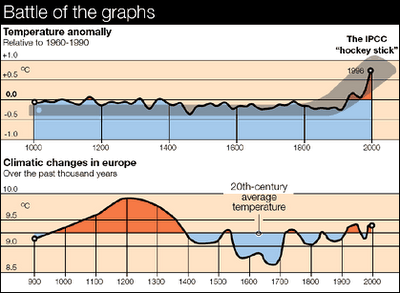
Here is the diagram I was supposed to have “faked”:

clip_image001

This surely blameless diagram appeared alongside an article I had written for the Sunday Telegraph on 5 November 2006, the first time I ever went public on the climate question. The article went live on the internet at midnight on a Saturday night. Two hours later theTelegraph’s website crashed, for 127,000 people had tried to access the article.

Now, it is not the custom of UK newspapers to ask their contributors to illustrate their articles. As usual, I was not consulted and offered no advice on the matter, and had no hand in their production and no foreknowledge that they were to be used. The graphs are not labeled as having been sourced from the IPCC (indeed, one of the graphs has the shadow of a hockey stick overlaid on it and marked as the “IPCC ‘hockey stick’”, making it blindingly obvious that it is not an official IPCC’s graph).

The Telegraph’s graphs are simple and, it seems to me, harmless schematics illustrating the difference between the representations of 1000 years’ global temperatures as they appeared in the IPCC’s 2001 (top) and 1990 (bottom) reports.

The graph from p. 202 of the IPCC’s 1990 report now looks like this:

clip_image003

With the article I supplied some background material for Telegraph readers on its website. In that material, the IPCC’s 1990 graph also appeared, mistakenly captioned as 1996 rather than 1990. The graph as I reproduced it looked like this:

clip_image005

What I had not realized until very recently was that for several years allegations had been circulated all over the place to the effect that I had fabricated the graphs that had appeared in the Sunday Telegraph article. Yet not one of those who had made these allegations had ever contacted me to verify the facts. And not one of them had said what was wrong with the Telegraph’s graphs anyway.

Perhaps the worst of the many allegations of dishonesty against me appeared on a “science education” website, where an entire section under the bold heading “Misuse of scientific images” was devoted to the Telegraph’s graphs.

The offending section contained the following untruths:

  • Ø that in that article I had “disputed the concept of climate change” (Not that old chestnut again! I had accepted the concept but queried its likely magnitude);
  • Ø that the Telegraph’s graphs were instances of “poor use of graphical displays” that “can confuse and obscure data” (No, they neatly showed the main point: in 1990 the medieval warm period and little ice age were shown clearly, but by 2001 both had gone, and a sharp uptick in the 20th century had been added);
  • Ø that I had “created the [1990] graph on the bottom using different calculations that did not take into account all of the variables that climate scientists used to create the top graph” (No, I had not created either graph or done any calculations for such a graph);
  • Ø that I had deployed “common techniques used to distort visual forms of data – manipulating axes, changing one of the variables in a comparison, changing calculations without full explanation – that can obscure a true comparison” (No, none of the above); and
  • Ø that the article had been published in the Daily Telegraph (No, the Sunday Telegraph, and that suggests the website had never seen the original article but had picked up the libel from somewhere else).

I only discovered that this spectacularly inaccurate and profoundly damaging infestation of allegations when the commenter at Jo Nova’s site who had accused me of “faking” the graph mentioned on his own blog that I had not objected to the libel as it appeared on the science-education website. I had not objected because I had not known about it. No one at that website had thought to check any of the facts with me, or, as far as one can tell, with anyone else.

In short order a letter before action was sent to the website, which promptly did the right thing and took out the entire section, though there are indications that attempts are being made in some quarters – unsuccessfully so far – to get them to put it back up again.

I gave the commenter at Jo Nova’s website who had accused me of “faking” the graphs several chances to retract and apologize. Instead, he and several others sneeringly doubled down by accusing me of “lying” when I had said the graphs at the Telegraph website had not purported to be, and had not been labeled as, IPCC graphs.

They also alleged that the graph in my background materials accompanying the Telegrapharticle was “not the same graph” as that from the IPCC’s 1990 report: in effect, that I had “faked” that one as well. Judge that for yourselves from the two monochrome versions of the graph above. There seem to me to be no material differences, and I think it would be hard for the defendants to convince a court that there were any.

So I am going to court. My lawyers say the libels are plain and indefensible. They comment additionally that no judge would regard the schematics in the Telegraph (whoever had drawn them) as significantly misrepresenting the difference between the 1990 and 2001 reports’ images of the past millennium’s global temperature anomalies. As far as they can see, there is not a lot wrong with the graphs in any event.

I have told this story not only because some commenters here have been unwise enough to repeat in threads here the allegations they have made elsewhere but also because I thought it might be time to reveal the steps we have to take on an almost weekly basis to try to stem the tide of false allegations directed at us.

Nor am I by any means the only victim. For years, this shadowy Propagandaamt has been tampering with Fred Singer’s Wikipedia page to allege that he believes in Martians.

Niklas Mörner, the sea-level expert, has had his page got at on the ground that he sometimes dowses for water or other underground treasure. My late father once did that for the Maltese Government, and found three lost Punic tombs and a fine marble head of Seneca from the first century AD. My drawing of it (in the day before digital cameras) is probably still to be found somewhere in the Museum of Classical Archaeology at Cambridge. But I never had the knack for dowsing myself.

A pressure-group founded and funded by Prince Charles is prone to intervene to try (unsuccessfully, the last time they tried it on me) to prevent the publication of skeptical scientific papers in British learned journals.

A team of paid hacks telephones the Chancellor and the Dean of the Faculty at every university at which skeptics are invited to speak. About half the time, they succeed in getting us disinvited.

Journal editors are sacked for printing papers by skeptics.

However much one might hope that scientific discourse can be conducted in an open atmosphere of sensible dialog, the truth is that on the climate it can’t, because the extremists won’t play fair. The Politburo are determined to keep the scare going for just a little longer, till they can get the Treaty of Paris safely signed by all nations in December 2015.

So I am going to court to defend myself and, in so doing against the constant barrage of falsehoods told in support of the Party Line. We went to court against Al Gore because his movie was poisonous political propaganda dressed up as science.

We won. Nothing else but a court case would have worked. It was only when the department of education in London were confronted with 80 pages of scientific testimony, and knew that that testimony would stand up in court against all their falsehoods and evasions, that they caved in and settled, paying $400,000 to the plaintiffs and undertaking to circulate 77 pages of corrective guidance to every school in England.

In the present case, the other side has blinked thrice. On the website of my defamer, there is a nervous little note that he will not give me his name and address unless I answer various impertinent questions of his. The court will have no patience with any nonsense of that sort.

And there are now various postings at the same blog, again rather nervous, saying that perhaps they could plead that I don’t have a reputation and they can accuse me of whatever they like.

They will be unwise to take that line. For if they say I have no reputation they have to be able to come up with evidence that any material detrimental to my reputation on which they may try to rely is true. And most of it is no more accurate than their accusations that I “faked” a graph that I had plainly not faked. If they waste the court’s time with point after point that has nothing to do with the case at hand, they will merely aggravate the damages they will have to pay.

Finally, the perp has been unwise enough to admit that at the time when he made his allegation of “fakery” he did not know whether I had “faked” the graph or not. In the courts, to make a damaging and untrue allegation not knowing whether or not it is true is as culpable as making it when one knows it is not true. And there is no defense once that admission has been made. It has been made.

There is a curious and touching notion among some skeptics that, since the truth will of course prevail in the end, we should persevere with the scientific argument but not take the defamers and the scamsters to court. The feeling is that using the courts somehow isn’t cricket.

Sometimes, though, it’s necessary to play hardball. Being Valiant for Truth is not for wimps.

Just a message for my “true friends”….You know who you are!


Thank you sincerely, to those in my community, and elsewhere,  that are fighting this travesty against rural citizens alongside me now , and especially, to those that always have been there!

My son’s situation has given me an opportunity to help children everywhere, who are in similar situations, and those of you who are close to me, are well aware of that.  In spite of some negativity from certain parties, we continue to make strides.  Those who have chosen to interfere in this fight, and take what they know is rightfully ours, have their own crosses to bear!  We shall never surrender!   Shellie Correia

Climate Lies Used by the Fear Mongers, Fall Apart Under Closer Scrutiny!

Blinded by Beliefs: The Straight Poop on Emperor Penguins

Guest essay by Jim Steele,

Director emeritus Sierra Nevada Field Campus, San Francisco State University and author of Landscapes & Cycles: An Environmentalist’s Journey to Climate Skepticism

clip_image002Two recent press releases concerning the Emperor Penguin’s fate illustrate contrasting forces that will either advance or suppress trustworthy conservation science. The first study reminds me of Mark Twain’s quip, “Education consists mainly in what we have unlearned.” Embodying that truism is a paper by lead author Dr. Michelle LaRue who reports new advances in reading the Emperor Penguin’s fecal stains on Antarctic sea ice that are visible in satellite pictures. Two years ago the fecal stain method identified several large, hitherto unknown colonies and nearly doubled our estimate of the world’s Emperor Penguins.1,2 That didn’t mean climate change had necessarily increased penguin numbers, but a larger more robust population meant Emperor Penguins were far more resilient to any form of change. 

LaRue’s new study advances the science by analyzing the shifting patterns of penguin poop, and her results are prompting some scientists to “unlearn” a key belief that has supported speculation of the Emperors imminent extinction. Believing Emperors are loyal to their breeding locations (philopatry), whenever researchers counted declining penguins at their study site, they assumed the missing penguins had died. However other studies had shown populations could suddenly double, and such observations challenged the notion of philopatry.10 The only reasonable explanation for unusual rapid population growth was that other penguins had immigrated from elsewhere, and loyalty to a breeding location was a misleading belief. LaRue’s study confirmed those suspicions by identifying the appearance of freshly stained ice in several new locations. LaRue rightfully said, “If we want to accurately conserve the species, we really need to know the basics. We’ve just learned something unexpected, and we should rethink how we interpret colony fluctuations.”….”That means we need to revisit how we interpret population changes and the causes of those changes.”

Of course several alarmist websites have spun this evidence of an ancient behavior into a new behavior forced by climate change disruptions.

Although mistaking unanticipated emigration for a local extinction has been the hallmark of several bad global warming studies, some researchers refuse to unlearn mistaken beliefs. In 2009 scientists argued that a missing herd of caribou that once numbered 276,000, had been extirpated by climate change. But the herd was later found in an unexpected location in 2011 just as native peoples had suggested. Likewise the co-author of the penguin extinction papers 3,8, Hal Caswell from the Woods Hole Oceanic Institute, mistakenly interpreted polar bear emigration as evidence of death due to climate change to advocate the bears’ imminent extinction as discussed here and here). He was similarly instrumental in modeling the extinction of the “March of the Penguins” Pt. Geologie colony. (Pt. Geologie Emperor Penguins are also known as the Terre Adelie colony or the Dumont d’Urvillecolony, named after the adjacent French research station known by the locals as DuDu.). Caswell and his co-authors are now doubling-down on their first prophesy of extinction for DuDu’s penguins to promote a more calamitous continent‑wide extinction scenario.

In a recent interview posted at ScienceDaily, the lead author Jenouvrier summarized their new extinction study saying, “If sea ice declines at the rates projected by the IPCC climate models, and continues to influence Emperor penguins as it did in the second half of the 20th century in Terre Adélie, at least two-thirds of the colonies are projected to have declined by greater than 50 percent from their current size by 2100.” “None of the colonies, even the southern-most locations in the Ross Sea, will provide a viable refuge by the end of 21st century.”

But Jenouvrier’s reference to sea ice’s influence on Emperor penguins during “second half of the 20th century in Terre Adélie” is a belief that should have been wisely abandoned. It was originally based on bizarre speculation in a 2001 paper Emperor Penguins And Climate Change,9 speculations that defied well-established biology and contradicted observations. The most obvious being Antarctic sea ice has not declined as al climate models predicted, but sea ice has now reached record extent. By attaching flipper bands and monitoring how many banded birds returned to DuDu researchers argued the penguins were less able to survive due to climate change. The paper’s authors, Barbraud et al, reported a 50% population drop from 1970 to 1981, and they blamed a prolongedabnormally warm period with reduced northward sea-ice extent. But any correlation with northward sea ice extent was absolutely meaningless.

Indeed the northward extent of sea ice had varied from 400 to 150 kilometers away from the colony, but the Emperor’s breeding success and survival depends solely on access to the open waters within the ice such as “polynya” and “leads.” That open water must be much, much closer. When open water was within 20 to 30 kilometers from the colony, penguins had easier access to food and experienced exceptionally high breeding success. When shifting winds caused open water to form 50 to 70 kilometers away, accessing food became more demanding, and their breeding success plummeted.7 Yet Barbraud et al absurdly argued that a reduction in sea ice extent, for unknown reasons, had lowered the penguin’s survival.9 It was catastrophic climate change speculation based on nothing more than a meaningless statistical coincidence.

Barbraud also argued that the warming of winter air temperatures from -17° to -11°C in 1981 contributed to the penguins demise, even though penguins would welcome any respite from deadly cold. When the penguins spend most of their lives swimming in +2°C water, there is no reason to believe the rise to -11°C had any deadly consequences. Again it was nothing more than a statistical coincidence. Yet the journal Nature gladly published their nebulous analyses and climate far, and then Jenouvrier, Caswell and several climate scientists were using that apocryphal study to predict more catastrophic extinctions.

Below is the graph featured by penguin expert Dr. David Ainley on his PenguinScience website showing a purported connection between the penguins’ decline and rising temperatures. His website argues, “The Emperor Penguin colony where the movie “March of the Penguins” was filmed has been shrinking. The colony ( Pt Géologie) is located in northern Antarctica where temperatures have been steadily rising. In recent years, the ice has become too thin, and so it blows away before the chicks are grown. Therefore, fewer and fewer young penguins have been returning to live in this colony. Most Emperor Penguin colonies occur much farther south where temperatures are still very cold. This could change, however, if global warming trends continue.”

clip_image004

The blue arrow in Figure A. suggesting a “steadily rising” temperatures, is a figment of Ainely’s imagination. The actual temperatures for the DuDu research station are seen in Figure B. Ainley and I had been involved in several pleasant and thoughtful email discussions about the decline of DuDu’s Emperors, when I became aware of his Fig. A. I emailed him and asked how he justified such a false representation. He apologized and promised to remove it saying, “My intent with the graph was to refer to the temperature trend, a period when temperature was increasing. Sorry about that.” I have always had great respect for Ainley’s work and from our discussion felt a kindred spirit and dedication to being good environmental stewards. But 2 years have passed and his bogus graph remains as of this writing. Perhaps it will be removed if enough people object to its the gross misrepresentation.

Despite satellite estimates that more than doubled the population of known Emperor Penguins, the International Union for the Conservation of Nature (IUCN) changed their ranking of Emperors from a species of Least Concern to a Near-Threatened species based on modeling studies blaming the decline of DuDu’s penguins on climate change as presented in Jenouvrier and Caswell’s study. Likewise Ainley’s paper Antarctic Penguin Response To Habitat Change As Earth’s Troposphere Reaches 2°C Above Preindustrial Levels10 had great influence. Ainley believed the DuDu colony had been unable to recover since 1980 because global warming had caused a thinning of the sea ice resulting in a premature loss of sea ice that was drowning chicks. Based on his faith in the models, he warned thinning se ice would get worse. However there was no evidence for such catastrophic events. So I first contacted Ainley to determine if his “drowning chicks” were based on observation or theoretical beliefs. Ainley confessed his claims were based on a sentence in Barbraud’s paper that stated, “Complete or extensive breeding failures in some years resulted from early break-out of the sea-ice holding up the colony, or from prolonged blizzards during the early chick-rearing period.” The early break-out of the sea-ice holding up the colony was merely a belief consistent with global warming hypotheses.

Mark Twain again provides insight to why bad science so easily goes viral having written, “In religion and politics people’s beliefs and convictions are in almost every case gotten at second-hand, and without examination, from authorities who have not themselves examined the questions at issue but have taken them at second-hand from others.” And apparently scientists suffer the same second‑hand folly. Not wanting to succumb to a similar mistake, I emailed Barbraud and asked for the dates during which he had observed an “early break-out of sea-ice holding up the colony”. As it turns out, I was not the only one having difficulty finding that evidence. Dr Barbraud replied, “We are currently doing analyses to investigate the relationships between meteorological factors and breeding success in this species, including dates of sea ice break out, which are relatively difficult to find for the moment!” So why did he ever make the claim of “premature breakouts” in the first place?

There is a much more parsimonious explanation for the DuDu penguins’ decline. Between 1967 and 1980 researchers from DuDu attached flipper bands to breeding penguins, and that is exactly when the penguins began to desert the colony as seen in Figure A. By the time the much-ballyhooed “warm spike” occurred in the winter of 1981, the colony had already declined by 50%.

Several studies have shown that tight flipper bands can increase penguin mortality because flippers can atrophy or swimming efficiency is reduced. Those observations have prompted researchers to argue for another “unlearning” writing, “our understanding of the effects of climate change on marine ecosystems based on flipper-band data should be reconsidered.”15 However it is unlikely that atrophied flippers from tight bands can fully explain the 50% drop in the Emperor’s abundance. However, interrupting the Emperor’s pair-bonding and vital huddling behavior to attach flipper bands and count birds is a significant disruption that would encourage penguins to seek a more secluded breeding colony.

Placing a band on an Emperor Penguin is no easy task. Male Emperors must conserve energy in order to survive their 4 month winter fast, and tussles with researchers consumed their precious energy. Emperors must also huddle in order to conserve vital warmth (as seen below in the picture from Robertson 2014). But huddling was disrupted whenever researchers “drove” the penguins into files of 2 or 3 individuals in order to systematically read bands or more accurately count the population. “Droving” could also cause the males to drop their eggs that are so precariously balanced on their feet.

When DuDu’s flipper banding finally ended in 1980, coincidentally the Emperors’ “survival rate” immediately rebounded. Survival rates remained high for the next four years despite extreme shifts in weather and sea-ice extent. However, survival rates suddenly plummeted once again in 1985, despite an above-normal pack-ice extent.Coincidentally, that is when the French began building an airstrip at DuDu, and to that end they dynamited and joined three small islands.


clip_image006

I had argued with Ainley that the only parsimonious explanation for the decline in DuDu’s penguins was that researchers had created such disturbances to their breeding ground, that the Emperors chose to abandon the colony to join others far from such disruptions. Satellite studies such as LaRue’s now support that interpretation as 2 new colonies have been discovered and are the likely home for DuDu refugees.

Yet despite those obvious disruptions, and despite the growing and thickening sea ice, and despite the lack of any warming trend what so ever, the scientific literature is spammed and the public bombarded with more propaganda claiming climate change has put penguins in peril. A peril derived from how they imagined climate change had killed the DuDu penguins in the 1970s. Robert Bolton wrote, ““A belief is not merely an idea the mind possesses; it is an idea that possesses the mind” and catastrophic climate changes is tragically possessing too many minds. To repeat LaRue’s advice, if we want to accurately conserve the species, we really need to know the basics. And basically, changing concentrations of CO2 have done absolutely nothing to hurt the Emperor Penguins.

clip_image008


Literature Cited

1.Woehler, E.J. (1993) The distribution and abundance of Antarctic and Subantarctic penguins. Scientific Committee on Antarctic Research, Cambridge.

2. Fretwell, P., et al.,, ( 2012) An Emperor Penguin Population Estimate: The First Global, Synoptic Survey of a Species from Space. PLoS ONE.

3. Jenouvrier, S., et al., (2009) Demographic models and IPCC climate projections predict the decline of an emperor penguin population. Proceedings of the National Academy of Sciences, DOI: 10.1073/pnas.0806638106

4. Brahic, C., (2009) Melting ice could push penguins to extinction. NewScientist,http://www.newscientist.com/article/dn16487-melting-ice-could-push-penguins-to-extinction.html.

5. BBC New, (2009) Emperor penguins face extinction.http://news.bbc.co.uk/2/hi/science/nature/7851276.stm

6. Fraser, A., et al. (2012) East Antarctic Landfast Sea Ice Distribution and Variability, 2000‑08. Journal of Climate, vol. 25, p. 1137-1156.

7. Massom, R., et al. (2009) Fast ice distribution in Adelie land, east Antarctica: interannual variability and implications for Emperor penguins Aptenodytes forsteri. Marine Ecology Progress Series, vol. 374, p. 243-257.

8. Jenouvrier, S., M. Holland, J. Stroeve, M. Serreze, C. Barbraud, H. Wimerskirch and H. Caswell (2014), Climate change and continent-wide declines of the emperor penguin. Nature Climate Change, , doi: NCLIM-13101143-T

9. Barbraud, C., and Weimerskirch, H. (2001) Emperor penguins and climate change. Nature, vol. 411, p.183‑186.

10. Kato, A. (2004) Population changes of Adelie and emperor penguins along the Prince Olav Coast and on the Riiser-Larsen Peninsula. Polar Biosci., vol. 17, 117-122.

11. Ainley, D., et al., (2010) Antarctic penguin response to habitat change as Earth’s troposphere reaches 2°C above preindustrial levels. Ecological Monographs, vol. 80, p. 49–66

12. Dugger, K., et al., (2006) Effects of Flipper Bands on Foraging Behavior and Survival of Adélie Penguins (Pygoscelisadeliae). The Auk, vol. 123, p. 858-869

13. Robertson , G. et al (2014) Long-term trends in the population size and breeding success of emperor penguins at the Taylor Glacier colony, Antarctica. Polar Biol (2014) 37:251–259

14. Saraux, C., et al., (2011) Reliability of flipper-banded penguins as indicators of climate change. Nature, 469, 203‑206.

Adapted from the chapter “The Emperor Penguin Has No Clothes” in Landscapes & Cycles: An Environmentalist’s Journey to Climate Skepticism

Wind Weasels Deny the Problems, Instead of trying to Correct Them…

Got Wind Turbine Syndrome? This Harvard Medical School Professor believes you!

Jun 27, 2014

doctor

Editor’s note:  You’ve heard of the Harvard Medical School, correct? And I’ll bet you’re aware it’s one of the finest medical schools in the world, right?   Harvard Medical School has a number of world-class institutes and centers.  One being the Massachusetts Eye and Ear Infirmary (MEEI).

Put it this way. Let’s say you are a Saudi Arabian prince, or a head of state (president, prime minister) of a foreign country. Or Bill Gates or Warren Buffet. You’re someone in this stratum of society, in other words, and your doctor says you have an inner ear disorder, something affecting your utricle or saccule or semicircular canals, or your cochlea.  Because you don’t want to mess around with medical mediocrity, you have your physician make an appointment for you at Massachusetts Eye & Ear.

You fly to Boston and meet with a specialist at MEEI.  The specialist is likely to be a physician doing a fellowship in neuro-otology.  (He’s called a “Fellow in Neuro-otology.”)  Or perhaps it’s one of the senior, attending physicians — that is, one of the full-time faculty.

The doc does a bunch of tests, but he’s still mystified about what’s going on. He needs to consult with some colleagues.  If he’s really stumped (or “she,” if the doc’s a woman), he asks the director of the Clinical Balance & Vestibular Center for a consult. (Think of going to the Vatican and being seen by one of the archbishops or cardinals about a spiritual problem. If the cardinal can’t help you — and if you’re really lucky — the cardinal may ask the pope for a consultation.)

When the Medical Director of Mass. Eye & Ear’s Clinical Balance & Vestibular Center comes on board, you can safely assume you are seeing the ultimate authority on balance and vestibular disorders — in the world. The pope.  Or at least, you’re seeing one of the half-dozen best qualified and knowledgeable and trained and recognized specialists in the world.

Follow me so far?

When Dr. Stephen Rauch says the following, it’s worth paying attention to.   (Incidentally, Dr. Rauch has read Dr. Pierpont’s  book, “Wind Turbine Syndrome.” Dr. Rauch met with Dr. Pierpont in Cambridge, Mass., several years ago.)

Dr. Steven Rauch, an otologist at the Massachusetts Eye and Ear Infirmary and a professor at Harvard Medical School, believes WTS is real. Patients who have come to him to discuss WTS suffer from a “very consistent” collection of symptoms, he says. Rauch compares WTS to migraines, adding that people who suffer from migraines are among the most susceptible to turbines. There’s no existing test for either condition but “Nobody questions whether or not migraine is real.”

“The patients deserve the benefit of the doubt,” Rauch says. “It’s clear from the documents that come out of the industry that they’re trying very hard to suppress the notion of WTS and they’ve done it in a way that [involves] a lot of blaming the victim.”

When the Medical Director of Harvard’s Clinical Balance & Vestibular Center says the above, and says this, the question becomes: “Why are we still discussing the veracity of Wind Turbine Syndrome in these pages, and in the media, and with wind developers, and with wind turbine manufacturers, and with politicians — with anyone, for that matter?”

Why are we even considering ludicrous theories like the “nocebo effect” advanced by Australian sociologist Simon Chapman, whose scholarly speciality is “tobacco industry advertising”?  (I’m serious.)  Why are we listening to British physicist Geoff Leventhall(whose physics Dr. Pierpont has had to correct on at least one occasion), who for years has been a paid consultant to wind energy companies and has absolutely no clinical credentials, who for years maintained that wind turbines produce negligible infrasound, and for years argued that “if you can’t hear something audibly, it can’t affect you negatively” — why are we still paying attention to this irrelevant man?

Who gives a goddam whether Geoff Leventhall or Simon Chapman think Wind Turbine Syndrome is real or not?  (Am I missing something in this discussion?)

In addition to Dr. Rauch, there is Dr. Alec Salt, worldclass neuro-physiologist at theWashington University School of Medicine in St. Louis, Missouri, where he is head of theCochlear Fluids Research Laboratory.  Dr. Salt specializes in inner ear disorders. He’s been doing this for decades, publishing in major clinical journals.  Dr. Salt is the one who demolished Leventhall’s silly thesis that “if you can’t hear it, it can’t hurt you.” (Leventhall was not the originator of that stupid idea; he’s just parroted it for decades and, like a wind-up toy, refuses to stop.)

Geoff 600

Between Harvard’s Dr. Rauch and  Washington University’s Dr. Salt, and Dr. Pierpont’s meticulous, peer-reviewed research (M.D. from the Johns Hopkins Univ. School of Medicine, Ph.D. from Princeton in Population Biology), there really need be no further discussion about the legitimacy of WTS.  Yes, the neuropathology of WTS needs further elucidation, but there is absolutely no question whether the illness is real. Anyone who denies it is simply playing games — and the moon (don’t you know?) is made of Swiss cheese and the Easter Bunny, folks, is honest-to-god real.

Read on. The author of the following article, Alex Halperin, requested an interview with Dr. Pierpont before writing the article. She declined. (At this point, she prefers that specialists like Dr. Rauch speak to the issue.)

Rauch

.
“Big Wind Is Better Than Big Oil, But Just as Bad at P.R.”

— Alex Halperin, The New Republic (6/15/14)

Nancy Shea didn’t learn about the wind farm until after she moved to northwest Massachusetts to enjoy a quiet country life. The news didn’t bother her. Shea, who describes herself as “green” and “crunchy,” favors clean and renewable energy. But just days after the 19-turbine project went online Shea sensed something wrong. She “felt kind of queasy,” one day in the kitchen. Later she woke up feeling like she had bed spins.

Shea’s husband did some research and learned about wind turbine syndrome (WTS), a condition said to be caused by “infrasound,” an inaudible low-frequency sound produced by the turbines. Sufferers complain about symptoms like insomnia, vertigo, headaches and disorientation. “It’s a hard to describe sensation, you just want to crawl out of your skin,” Shea says.

A few nights later, the couple could hear the turbines spinningthe closest is 2,200 feet away. It sounded, Shea says, like a jet repeatedly flying over their cabin. Neither of them could sleep and they drove through a snowstorm to another property they have several miles away. Shea felt better immediately. Similar symptoms have been reported worldwide by people who live near wind turbines. But America’s wind industry says their condition is psychological.

There’s a great deal to like about wind power. It’s a domestic, renewable power source that doesn’t produce greenhouse gasses. It doesn’t require digging anything out of the ground and, unlike nuclear energy, doesn’t create any risk of catastrophic accidents. According to the American Wind Energy Association (AWEA), more than 70 percent of the public view wind energy favorably. Following President Obama’s recent push to reduce greenhouse gas emissions, there’s every reason to believe that these giant pinwheels will become more familiar sights on the American landscape. (The towers alone are hundreds of feet high.)

Clean energy, however, is not the same thing as flawless energy. Producing power on a large scale involves processes and infrastructure which disrupt ecosystems and have other unintended consequences. Dams, for example, remain the most important source of renewable power in this country and environmentalists hate them.

Wind farms have raised objections for ruining views and being noisy. But the fight over WTS presents a more difficult challenge for the industry. And while wind power advocates like to think of it as a forward looking and pragmatic fix for America’s energy needs, when it comes to managing this mysterious phenomenon, they’re foolishly borrowing from the bad old energy playbook.

Earlier this year, two physiologists at Washington University in St. Louis published a paper in the journal Acoustics Today detailing several mechanisms by which infrasound from wind turbines could have detrimental effects. One, for example, is “excitation” of nerve fibers in the inner ear that are related to tinnitus and “aural fullness.” The article concludes that more study of infrasound is needed and pointedly states:

If, in time, the symptoms of those living near the turbines 
are demonstrated to have a physiological basis, it will become apparent that the years of assertions from the wind industry’s acousticians that “what you can’t hear can’t affect you”… was a great injustice.

Last year the same journal published an article by an England-based acoustician named Geoff Leventhall who argues that wind turbines don’t produce infrasound at sufficient levels to cause health problems. When I called Leventhall, whose clients have included wind power developers, he said he doesn’t believe WTS exists. Leventhall doesn’t dispute that infrasound can distress people. His disagreement with the Washington University scientists, grossly simplified, is in how the infrasound produced by wind turbines should be measured.

In written responses to questions, AWEA says that waves on the seashore, a child’s swing, a car and even a human heartbeat expose people to higher levels of infrasound than wind turbines do. AWEA relied heavily on Leventhall’s work and calls him “the most cited and referenced acoustician regarding wind energy in the world.” The organization cited two studies, one from Australia, one from New Zealand, which suggest that WTS results from a “nocebo” effect, essentially that if people are told wind turbines make them sick, they will feel sick around wind turbines. Leventhall endorses this view.

In an email, one AWEA manager wrote that “Independent, credible studies from around the world have consistently found that sound from wind farms has no direct impact on human physical health.” AWEA also cites a 2012 report prepared for two Massachusetts state agencies by an independent panel which found no evidence of the existence of WTS. (Activists who oppose situating turbines near homes have numerous objections to the report.)

Anyone who has ever played the NIMBY game knows the power of a scientific imprimatur. But the two sides are wielding their science to achieve asymmetrical goals. In the Washington University paper, Alec Salt and Jeffrey Lichtenhan write:

Whether it is a chemical industry blamed for contaminating groundwater with cancer-causing dioxin, the tobacco industry accused of contributing to lung cancer, or athletes of the National Football League (NFL) putatively being susceptible to brain damage, it can be extremely difficult to establish the truth when some have an agenda to protect the status quo.

In these cases, industry’s primary goal isn’t to be right on the merits, though that would be nice, but to continue operating. As long as it’s planting turbines, the wind industry is winning. But as long as it’s simply dismissing WTS, the industry is putting itself at risk of losing its sympathetic, clean image.

Dr. Steven Rauch, an otologist at the Massachusetts Eye and Ear Infirmary and a professor at Harvard Medical School, believes WTS is real. Patients who have come to him to discuss WTS suffer from a “very consistent” collection of symptoms, he says. Rauch compares WTS to migraines, adding that people who suffer from migraines are among the most susceptible to turbines. There’s no existing test for either condition but “Nobody questions whether or not migraine is real.”

“The patients deserve the benefit of the doubt,” Rauch says. “It’s clear from the documents that come out of the industry that they’re trying very hard to suppress the notion of WTS and they’ve done it in a way that [involves] a lot of blaming the victim.”

In fact, the inconstant nature of symptoms can compound WTS. Even when someone doesn’t feel the effects, they’re always conscious of wind speed and direction as they try to sense when their symptoms might return. (Turbines produce infrasound independently of audible noise.)

Massachusetts governor Deval Patrick aims to increase the state’s wind energy capacity to 2000 megawatts by 2020, a total equal to roughly 15 percent of the state’s current electricity production. In a densely populated state that means more people are inevitably going to feel affected by WTS, even if it doesn’t exist.

As wind power has become more prominent, so have complaints. Scores of residents of Herkimer County, N.Y. are suing the Spanish wind power company Iberdrola over a wind farm. A judge has ordered that two wind turbines in Falmouth, Mass. can only be operated 12 hours a day and not on Sundays.

The wind industry might take a lesson from Nancy Shea: People are generally reasonable, maybe more reasonable than they should be. Shea refuses to spend any more nights in the house she and her husband bought. She calls it a “dead asset.” Nonetheless, she still considers herself pro-wind.

In the annals of corporate public relations debacles, WTS is a relatively minor one, at least for now. It would be self-defeating if the industry squanders this promising moment by failing to candidly address WTS concerns. Not doing so invites further attacks from Fox News and National Review and other conservative groups looking for an excuse to bash clean energy.

The best advice might come from the Salt and Lichtenhan article. Big Wind, it argues, should “acknowledge the problem and work to eliminate it.”

Rauch-c-516x226


We’ve all Had to Deal With These Kind of People, from Time to Time!

Fifteen Things You Probably Do Not Know about Psychopaths

Have you ever worked for someone who you seriously thought might be crazy?  About half of all workers have such an experience within a lifetime.  The other half misses out on one of life’s most perplexing and educational opportunities.

The subject is psychopathy.  Knowledge and understanding of psychopathy is now advancing, and at an accelerating rate, after a decades-long period of no growth and slow growth.  Good thing!  Psychopathy is the very worst mental disorder; psychopathy and related conditions have cost millions of lives lost and trillions of dollars wasted, though it is still very poorly understood by most people.  I am now speaking not as a medical or psychological professional, but as a professional project engineering manager who has been faced with numerous severe personnel and management problems not addressed in engineering or business school.

Psychopathy is without a doubt the most destructive, the most deadly, and the least comprehensible of mental disorders.  So, to promote understanding of psychopathy, the following points are offered:

  1. Briefly – A psychopath is a person with a very nasty personality who builds a more attractive and very fake personality to cover his frauds, transgressions, and, sometimes, murders.  A representative sample of people psychologically assessed as psychopaths includes Casey Anthony, who allegedly killed her daughter; John Wayne Gacy, who murdered and sodomized thirty-three young men and who was executed; and Jeff Skilling, who was CEO of Enron when it was destroyed in the largest corporate fraud case in history, and who is now in prison.  Andrew Lobaczewski was a psychologist in Poland during the Cold War who identified Stalin as a psychopath.
  1. Rational – Psychopaths are quite rational.  Psychopaths’ minds work no better and no worse than yours, except that psychopaths have a big void where most people have a conscience and moral values.  In a family setting, a psychopath typically abuses the spouse and children and is respected and is even well thought of by outsiders.  In a working environment, psychopaths choose their victims from lower-ranking individuals and take care to act properly around higher-ranking individuals.  In national and international relations, psychopaths create and exploit divisions based on ethnic, religious, national, or class differences.\

    On first being exposed to a psychopath, a person may be quite favorably impressed.Odd things then begin to happen.Subordinates soon observe incomprehensible behaviors, including pathological dishonesty, and begin to think that the psychopath is “crazy” – or, more technically, he is psychotic.But a psychopath is not psychotic.Psychopathy is a personality disorder, and psychopaths at their worst may start wars or create worldwide financial disasters.Psychopaths are substantially or totally devoid of human feelings: no sympathy, no empathy, no guilt, no remorse, no conscience, and no sense of humor.

    Psychopaths are quite predatory.Not only are psychopaths without human feelings, but they are, deep down, contemptuous of all with whom they deal: superiors, subordinates, supporters, opponents, associates, and family alike.Psychopaths genuinely think that they are better and smarter than everyone else, an impression that psychopath enablers fully endorse (think Chris Matthews or the German General Staff during WWII).

  1. Mental Disorders – The primary indicators for psychopathy are anti-social personality disorder and malignant narcissism personality disorder, plus tendencies toward criminal behaviors and an inability to establish mature sexual relationships.  These mental disorders are recognized in theDiagnostic and Statistical Manual of Mental Disorders (DSM), though the DSM and the criteria for these mental disorders have been through many revisions as knowledge develops and fashions change.
  1. Measurement – Formal measurement of psychopathy is performed by a trained professional using Dr. Robert Hare’s Psychopathy Check List – Revised (PCL-R), consisting of twenty-one items such as pathological dishonesty, parasitic lifestyle, and irresponsibility.  Not all of the items are required to assess a psychopathic condition.  Neurological exams may be used to confirm damage or defect in the brain.  Electroencephalograms (EEGs), functional Magnetic Resonant Imaging (fMRI), and Computerized Axial Tomography scans (CAT scans) are highly effective in confirming neurological abnormalities; Dr. Hare has done much original research in this area to confirm diagnoses of psychopathy.  On a macro scale, psychopaths are inefficient, incompetent, and corrupt, much like the Soviet Union.  Psychopathy is thought to be incurable at this time.
  1. Control – Psychopaths want to control you – physically, emotionally, sexually, financially, and politically.  Psychopaths want to control your soft drinks, your ability to defend yourself, your health care, and your life.
  1. Occurrence – Psychopaths are thought to be about one percent of the population.  Dr. Hare has noted that the occurrence of corporate psychopaths ranges up to four percent of corporate executives; psychopaths with the proper schooling and qualifications are attracted to positions of wealth and power, and they manipulate themselves into positions of responsibility and authority.
  1. Masks – There are few overt characteristics to distinguish a psychopath from the general population, within which the psychopath can easily blend.  Dr. Cleckley’s 1941 book, which first described clinical psychopathy, was entitled The Mask of Sanity.  The “mask” to which Dr. Cleckley referred takes different forms.  Ted Bundy wore fake bandages and fake arm and leg casts to attract sympathetic young women, whom he subsequently murdered.  Corporate psychopaths typically collect and ostentatiously display degrees, certifications, and awards as proof of their abilities while committing their often subtle frauds.  Jeff Skilling at Enron in particular had a rock-solid resume, including an MBA from Harvard and a partnership in McKinsey and Company, a premier business consultancy company.  Skilling is now in prison for the greatest case of corporate fraud in history, with thousands of careers disrupted and billions of dollars of corporate value lost.
  1. Causes – Neurological defect or injury is often associated with psychopathy, though some cases have no known causative factors.  Cases have been reported of identical twins, one psychopathic, the other not.  Stalin, Hitler, and Saddam Hussein exhibited traits common to psychopaths, and each had been subject to abusive or neglectful parenting, possibly resulting in psychological damage.  There is another possible factor relating to an outsider status.  Napoleon was not French, but Corsican.  Lenin was not Russian, but Kalmyk and Turkic.  Stalin was not Russian, but Georgian.  And Hitler was not German, but Austrian.
  1. Flavors – By far, most psychopaths operate on a family and community level, destroying family relationships, committing crimes and misdemeanors, and rotating in and out of mental hospitals, jails, and prisons, and then back into the community.  But many psychopaths tend to come in other distinct flavors depending on their personalities.  Serial-murder psychopaths and corporate psychopaths were previously mentioned.  Other flavors include military, religious, financial, and political psychopaths.  Dr. Clive Boddy made a convincing argument that the 2008 financial meltdown was the product of financial and political psychopaths.

    The rarest of psychopathic types is the intellectual psychopath.Karl Marx, Saul Alinsky, and Cloward-Piven come to mind.   Both Marx and Alinsky displayed psychopathic traits and inspired other psychopaths to infiltrate and sometimes forcibly seize governments, followed by characteristic psychopathic inefficiency, incompetence, and corruption in the administration of the state.

  1. Psychopath Enablers and Supporters – Family and local psychopath enablers are well-identified and can be researched on the internet.  Political psychopath enablers were institutionalized by Antonio Gramsci in his concept of “Corporate Communism,” wherein Marxists were to infiltrate and take over cultural institutions: academia, media, legal, courts, and political parties.
  1. Creativity – Creative psychopaths are often audacious and leave people surprised and off balance, as when Hitler invaded the Sudetenland or when Putin invaded Crimea.  Corporate psychopaths are often credited with being creative even as their organizations suffer massive personnel turnover and financial loss.
  1. Tough Reputation – Beyond the items on Dr. Hare’s PCL-R, psychopaths cultivate a reputation for toughness, but that does not mean that they get good results.  In reality, they are just very nasty personalities who abuse subordinates and may commit crimes.  Rahm Emanuel (now failing as mayor of Chicago) and Rod Blagojevich (now in prison) fall in this category.
  1. Recognizing Psychopathy – Many psychologists have different interpretations of conditions similar to psychopathy.  The Federal Bureau of Investigation (FBI) and the Royal Canadian Mounted Police (RCMP) are virtually the only institutions that unequivocally accept and utilize Dr. Hare’s findings on psychopathy in solving crimes and profiling criminals and criminal psychopaths.  The Society for Human Resources Management (SHRM) specifically recognizes the “bully boss” but ignores the “psychopathic boss.”  By whatever label, the two designations are indistinguishable for personnel turnover, financial losses, and criminal behaviors.
  1. Failure – In practical terms, psychopaths always fail, and psychopathic failure creates misery for families, communities, and nations.  Political psychopaths and their systems fail in the manner that the Soviet Union failed, leaving massive social and economic costs for their supporters and for their opponents.  This is exactly what one might expect from the world’s most severe mental disorder.  Long-running psychopathic systems such as militant Islam and Marxism typically endure periods of success alternating with failure, during which massive social and economic losses are endured by everyone, supporters and opponents alike.
  1. Ending Psychopathic Expression – Dr. Hare and associates are increasingly capable of identifying a psychopath at an early age.  Many conditions are medically or legally sanctioned (eyeglasses may be required for a driver’s license), and psychopathy should be in this category, with psychopaths limited in their opportunities to control others.  The Tyee had a novel but quite workable approach to corporate psychopathy: require all corporate executives to have performance insurance, with denial of insurance to those who cannot pass a psychopathy screening exam.  Internationally, the best strategy appears to be to contain psychopathic states and let them die of their own corruption, as the Soviet Union did.

Psychopathy is a common and extremely destructive mental disorder that afflicts not only the psychopath, but whole communities, nations, and the world.  We now have the tools to identify and mitigate psychopathy, if we can develop the will to do so.

James G. Long has been an army captain, a professional engineer, an author, and a blogger, with a lifelong interest in organizational management problems.  

Aussie, Clive Palmer, Supports Demolition of Carbon Tax Scam….while Al Gore, Looks On!

The truth inconveniently dawns on the Clive show THE AUSTRALIAN

CLIVE Palmer must have been tempted to throw out some chicken pellets as he left. The former media adviser to Joh Bjelke-Petersen had just sold the chooks of the Canberra press gallery a chopping block and rotisserie, and they gobbled it up.

Journalists and commentators who had long campaigned against Tony Abbott and in favour of a carbon price had just been advised of a package that would kill the carbon tax, defer an emissions trading scheme into the never-never and put an end to carbon abatement through “direct action” — and they applauded. “Palmer in carbon tax blow to PM,” bellowed the front page of The Age, suggesting the Prime Minister’s plans to abolish the tax were in “chaos”, while The Sydney Morning Herald, which favours a price on carbon, editorialised that Mr Palmer’s intervention was a “positive” move for the environment.

That the Queensland coalmine developer and nickel-refining billionaire was audacious enough to think he could snow the media just by having Al Gore share his podium was bizarre enough. That so many in the media fell for it is droll and depressing in equal measure. As for Mr Gore, given his claims about the origins of the internet, he might have found 10 minutes to Google his new political ally before administering self-harm to his diminishing reputation as a climate evangelist. Did Mr Gore even know he was sharing the stage with a man who had often denied global warming was a problem and was planning to make billions of dollars from coal exports? Did the man who shared a Nobel prize for climate activism not even take the time to ascertain that what he was endorsing was the abolition of any and all substantial carbon emissions reduction schemes in this country?

SMH columnist Mike Carlton took to Twitter saying the announcement would “screw the Tories” but succeeded only in demonstrating his venom and lack of political acuity. “Cute of Palmer to front with Al Gore, though, it will drive the climate change deniers at News Corpse to an apoplectic frenzy, just watch,” was his take. If that weren’t embarrassing enough, no lesser figure than the managing director of the ABC shared an identical sentiment. “Sensing hyperventilation in The Australian’s editorial room,” tweeted Mark Scott. We should welcome Mr Scott’s honesty in publicly aligning himself with the embittered left fringe of politics but we should also despair that the ABC’s editor-in-chief should misunderstand policy and politics so comprehensively.

The policy implications of Mr Palmer’s stand are neither disappointing nor surprising. As expected — indeed, as promised — he will support the abolition of the carbon tax. Further, he has vowed to oppose Mr Abbott’s direct action plan. The Australian has always been sceptical of this policy because it will not lead to the lowest cost abatement. However, Mr Palmer’s stand means that the nation could be left with no scheme at all to enable the delivery of its emissions reduction target of 5 per cent below 2000 levels by 2020. The trump card, strangely lauded by much of the media, is his proposition to legislate an ETS that would be set at $0 until our major trading partners adopted similar schemes. This is a fundamentally sensible position at one level but includes some obvious paradoxes. Australia, effectively, already has an ETS because the carbon tax is due to switch to a market price next year. So what Mr Palmer really suggests is that a fixed price should be kept in place indefinitely but cut to the rate of zero. It would be a carbon price signal without a price signal. This is bizarre, of course, and really no more than spin. Few people could or would argue against an ETS to be imposed if and when our major trading partners adopted one. In fact that has been the consistent policy thread of most sensible advocates in this country since the Shergold report first informed the Howard government on these matters in 2007. And this newspaper has always supported that policy direction: an Australian ETS acting in concert with our trading partners. This is the only way to ensure we do not place ourselves at an economic disadvantage or simply export emissions, and jobs, offshore. The elephant in the room, which we suspect Mr Palmer sees but his media throng doesn’t, is that this won’t be happening any time soon. If ever. To demonstrate what a setback this is for carbon price supporters we simply need to consider the most optimistic scenario. Let us pretend for a moment that global agreement for a trading scheme occurred a decade from now. If that were the case we could see now that the ABC and Fairfax press have been cheering a policy that switches the nation from a $25.40 a tonne carbon price escalating every year for 10 years and raising a minimum of $70 billion, to one set at $0 raising nothing across a decade. Some progress.

And to shatter their climate dreams further, Mr Palmer, with Labor and the Greens, promises to axe the Coalition’s $2.5bn direct action plan that would have been spent entirely on domestic schemes to reduce carbon emissions. This is a great win for carbon pricing in the same way that the Titanic’s maiden voyage was a great win for trans-Atlantic travel.

Mr Palmer is demanding the renewable energy target remains in place. This initiative has long held bipartisan support but is under government review. Dismantling or reducing it would be difficult economically and politically, but keeping it will continue to put upward pressure on electricity prices. The heaviest burden will fall on the poor; not businessmen like Mr Palmer. By also insisting the Clean Energy Finance Corporation remains, Mr Gore’s newest friend ensures only some ongoing government subsidies and investments for industry; although without a carbon tax to fund it, the CEFC soon may wither and die.

So let’s consider the winners and losers from this week’s theatrics. Mr Palmer certainly wins because he has ensured that none of his companies will pay carbon tax and he has again been lauded by the ABC and other media, blowing more CO2 into his political balloon. Mr Abbott wins because he gets rid of the carbon tax and pockets the unexpected bonus of a $2.5bn budget benefit because he can’t get his direct action plan through the Senate. The Labor Party and the Greens lose because they will have conspired to eradicate any emissions reduction scheme — unless either of them backflips and supports direct action. The Greens eventually should wear the odium of having pulled off the extraordinarily counterintuitive feat of killing off climate action under Kevin Rudd, Julia Gillard and Mr Abbott. The hypocrisy eventually may catch up with them. Or not.

The Palmer United Party may stay united or may fracture in the Senate; we would not presume to guess where this coagulation of characters and interests might end. But in the best traditions of the Queensland white shoe brigade, Mr Palmer has spun the media and the southern politicians to his personal advantage. Wednesday night on the ABC’s 7.30 Sarah Ferguson said the PUP leader was “putting himself at the vanguard” of climate policy. A couple of hours later on Lateline Tony Jones asked Mr Palmer what had caused his “road to Damascus conversion” on climate. At least Jones also asked Mr Palmer if he was “feeding the chooks”. Still, praise from a Nobel laureate, the ABC and the Fairfax press is not bad for a bloke who killed off climate action.

Eventually, reality began to set in. Even the Ten Network’s Paul Bongiorno, who tends to make Radio National hosts sound mainstream, could see through the smoke and mirrors. “The Australian seems to call it as it is,” he summarised, referring to our front page headline of “Palmer kills carbon action”. Independent senator Nick Xenophon declared the Palmer-Gore doctrine was “more ham than plan” and Mr Palmer emerged from talks with the Prime Minister confirming the carbon tax would, indeed, be axed. Almost 24 hours on from the excitement of seeing Mr Gore take the stage with a man who has an equally large carbon footprint, the overexcited media pundits started to grasp what was happening. It dawned on the Greens that they had been sold a pup (pun intended) and they began hoping Mr Palmer was befuddled. And over at Fairfax, Tony Wright had worked out that an ETS dependent on action from our trading partners might be some time off. “Say, just after world peace is achieved,” he mused. “Or when Clive becomes Jenny Craig’s poster boy.” Or, perhaps, when Mr Gore next endorses a death blow to climate action.

This is a Bit of Good News…. Anything to Lower Energy Prices!

US to end 40-year ban on oil exports in a move which

could lower world petrol prices and reduce Britain’s

dependency on Russia and the Middle East

  • Two companies given permission to sell ultralight oil to foreign buyers
  • US could start supplying Britain with oil under new scheme
  • Americans typically pay less for petrol as they do not have to import oil
  • US has not sold unrefined oil abroad since the 1970s when Arab countries placed embargo on shipments to the West over support for Israel

By DANIEL BATES IN NEW YORK


America is to begin exporting unrefined oil for the first time in nearly four decades in a move which could lower petrol prices around the world.

Two companies have been given permission by the White House to sell an ultralight oil to foreign buyers after intense lobbying by the energy industry.

If it goes well then larger firms could join them and up to 700,000 barrels could be exported next year.

America is to begin exporting unrefined oil for the first time in nearly four decades in a move which could lower petrol prices around the world

America is to begin exporting unrefined oil for the first time in nearly four decades in a move which could lower petrol prices around the world

Potentially the US could start supplying Britain with oil, reducing our dependency on countries like Russia or unstable regimes in the Middle East.

Americans have long enjoyed cheap energy bills and cheap petrol as they do not have to import oil – drivers typically pay around £2.20 a gallon at the pump compared to £5.84 in the UK.

Now due to the explosion in shale oil production which has reached three million barrels of oil a day the US is looking to sell it on the foreign market, where producers can get a higher price.

Britain gets 43 per cent of its fossil fuels from abroad as domestic reserves from the North Sea (pictured) are dwindling, the statistics show

Britain gets 43 per cent of its fossil fuels from abroad as domestic reserves from the North Sea (pictured) are dwindling, the statistics show

The oil that is being sold abroad is known as condensate and can be turned into petrol, jet fuel and diesel, the Wall St Journal reported.

It is being exported by two companies, Pioneer Natural Resources Co. and Enterprise Products Partners LP and comes from Texas’ Eagle Ford Shale formation.

America has not sold unrefined oil abroad since the 1970s when Arab countries announced an embargo on shipments to the West because of its support for Israel in the Yom Kippur War.

The resulting instability sent Britain into a recession and led to the oil price shock of 1979.

Figures from the Department of Energy and Climate Change show that Britain could benefit from US oil as we are heavily dependent on foreign countries for our fuel.

Britain gets 43 per cent of its fossil fuels from abroad as domestic reserves from the North Sea are dwindling, the statistics show.

In a statement the US Department of Commerce said there was ‘no change in policy on crude oil exports.’

The “Dumbing down”, of our Children….It must be stopped!

Reform Math Must Be Destroyed Root and Branch

The Education Establishment went way too far, and this has presented the country with a unique opportunity for real improvement of the public schools.

As never before, parents across the United States will tell you emphatically that they hate Common Core, and they especially hate Common Core Math.

The Education Establishment will try to maneuver around this revulsion.  Compromises will be offered.  The same dumb ideas will be repackaged as something new and wonderful.  The challenge is to refuse to compromise.  Sometimes a good thing, compromise is now the biggest threat to genuine reform.

Our Education Establishment has been selling inferior goods for more than half a century.  They know how to bait and switch, and how to lie.  Ordinary citizens stand little chance against these cunning maneuvers.  So let’s keep it strategically simple.  Go for total victory.  Reform Math should be discarded, inane root and goofy branch.

By way of background, Reform Math comprises a dozen separate but similar math curricula created in the 1980s.  The most hated of these is Everyday Math  (Mathland used to be the most hated, but it has been buried, which is what we need in every case.)  Here are some of the other titles: College Preparatory Math, Connected Math, Core-Plus Mathematics, Discovering Math, Number Power,  Interactive Mathematics, Investigations Math, Trailblazers, Chicago Math.

But why did the experts create so many basically interchangeable programs?  The answer is that when a community learned to hate one of them, the experts could say, Okay, you win; let’s try this one.  And they bounced the people sideways from one bad program to the next.  If you like cynical, you have to love this.

During the 1960s, the Education Establishment watched New Math, in development for a long time, crash and burn in a few years.  Parents laughed it out of town; schools went back to real arithmetic.  Apparently, the Education Establishment did not want that same scenario repeated.  So they cloned a dozen math programs.  In that way, parents never really had a chance during the last 30 years.  If they didn’t like Tweedledum, they got Tweedledee.

Now the Education Establishment is cycling all of these crummy Reform programs forward under the banner of Common Core, thus the phrase Common Core Math.

The common denominator of all these inferior programs is an artificial complexity, and an emphasis on learning concepts and “meaning” without actually being able to do problems.  These programs teach algorithms that parents don’t know.  A tremendous separation is created between the generations.  Parents are rendered irrelevant.  The children are frustrated to tears.  In a few years, in all of these Reform curricula, the kids end up dependent on calculators.

The short-term effect is that fewer kids become skilled at math.  The long-range effect is that millions of students are discouraged from studying algebra, calculus, physics, chemistry, etc.

So there is a sick joke here.  The Education Establishment promises to help children understand the meaning.  At the end, the children don’t know meaning, method, or anything else.  Even if there is such a thing as the meaning of math, you would surely want to teach children how to count, add, and subtract first.  Later, when the children feel comfortable with basic arithmetic, you could explain deeper aspects.  The essential perversity of all Reform Math programs is to introduce the complex ahead of the simple.  It’s a bulletproof way to confuse little children, and our Education Establishment keeps exploiting it.

Clearly, the all-pervasive problem is that we can’t trust our so-called experts.  They are ideologues first, educators second, and therein lies the tragedy.  These pretenders design curricula to achieve ideological goals.  What we need from now on are curricula that achieve educational goals.

Almost no homeschoolers or private schools use Reform Math curricula.  These programs are used when ideologues can gang up and bully the public.  (Full disclosure: I’ve spoken to an elite  private school that uses Investigations.  Keep in mind that these are highly motivated students, very involved parents, and very dedicated teachers.  They can make anything work.)

The favorite programs outside of Reform Math are Singapore Math and Saxon Math.  Both teach children how to do arithmetic in a systematic, logical way, with mastery throughout.  So that’s the answer.  Reject all varieties of Reform Math.  Instead, use Singapore Math, Saxon Math, or the equivalent.

John Saxon was particularly proud that students using his textbooks moved on, in far greater percentages, to algebra, calculus, etc.

Looking back at the sweep of American secondary education, the big event was the introduction in 1931 of an unworkable reading method known as Whole Word.  The Education Establishment got away with it.  Whole Word was in control in most communities until the end of the 20th century, and schools were turning out functional illiterates by the million.  We have to suspect that our elite educators saw this as the paradigm: a school pretends to teach something but makes sure that the children don’t learn it.  Whole Word does that.  New Math and Reform Math do that.

If you want to be really depressed about all this, keep in mind that the National Science Foundation pumped $100 million (your tax money) into subsidizing hundreds and hundreds of professors as they drew up equally disastrous Reform curricula that would fundamentally undercut the study of science!  Meanwhile, the National Council of Teachers of Math gushed approval of every little anti-math gimmick.  All these front groups, pretending to be independent and impartial, keep pushing bad ideas on the public.  The same pattern repeated itself with Common Core, which was supposedly given to us by the National Governors Association and the Council of Chief State School Officers (CCSSO).

So many credentialed experts; so many billions of dollars; so many secret intentions.  The Education Establishment has everything but curricula that let children become good students.  We may not be able to fire these faux-educators.  But we can systematically eliminate the kind of poisons they like to inject.  We can systematically take the attitude that the Education Establishment has proven itself incompetent, if not malicious, and from now on, whatever they’re selling, we don’t want it.  In particular, Reform Math.

CODA: parents must fight back.  Laurie Rogers has just posted  “The Myth of the Helpless Parent,” a wonderful short guide to fighting a corrupt system.

Bruce Deitrick Price explains education theories and methods on his site  Improve-Education.org.