Even the “Slower” Aussies, are catching on, to the fact that Wind Turbines are Useless!

How the Public Are Deceived About the True Cost of the Mandatory RET

sprinter_2248190b

The Australian Financial Review – as one of the lefty Fairfax stable – “drank the Kool Aid” early and happily ran with the wind industry’s narrative that having Australia bristle with giant fans is a sure-fire way of cooling mother Earth; that wind power is free; and that the mandatory RET is public policy at its best.

In short, the AFR has been a faithful outlet for wind industry spin and propaganda. Regurgitating an endless stream of Clean Energy Council (CEC) press releases; and giving the likes of Infigen (aka Babcock & Brown) free rein to spruik about the “wonders” of wind – never questioning, let alone challenging, the wild and fantastic claims made about lowering retail power prices (all while “saving” the planet, of course) – it’s been a serious media outlet of choice for the wind industry and its parasites.

Until now.

In the last few weeks there’s been a seismic shift in the AFR’s approach to the imminent demise of the mandatory RET. Faced with an increasing barrage of hysterical claims about the world ending if the RET gets the axe (by the likes of the CEC and Infigen’s Miles George) the AFR’s journos and editor have finally opened their eyes to the greatest rort of all time. And, to the horror of the CEC and its taskmasters, they’ve stopped buying the myths and mis-information pitched up by Infigen & Co.

Phil Coorey’s piece on how Tony Abbott, Joe Hockey and Mathias Cormann have joined forces to bring an end to most ludicrous policy ever devised sent the wind industry into a state of panic (see our post here).

Since then, the AFR has followed up with a terrific piece from Alan Moran and an editorial calling the mandatory RET flawed and unsustainable (seeour post here) – and a detailed analysis of the inherent flaws and failings of the RET by crack energy market economist Danny Price (see our post here).

With the AFR turning on it, the wind industry must know its days are numbered.

The AFR continues its recent trend with this fine piece of work by Ben Potter and another terrific editorial that strip away the myth that the mandatory RET is a benign piece of “climate change” policy which won’t cost power consumers a thing.

Renewable energy lobby’s shell game
Australian Financial Review
Ben Potter
25 August 2014

shell-game2009Mar06

The renewable energy lobby employs a neat trick to show that billions in subsidies for the costliest forms of electricity can lower power prices.

Wind and solar power costs between 1½ and 10 times as much to produce as power from coal and gas. But the vagaries of the National Electricity Market allow the renewables sector to claim that it lowers prices – even if it imposes costs on consumers elsewhere.

In a shell game, a conman quickly moves around three shells on a table or mat and his buddies pressure passers-by to bet which one contains a pea.

The pea under the shell is $37 billion of renewable energy certificates (RECs) that electricity retailers will buy from renewable energy generators or generate themselves between now and 2030 if the renewable energy target scheme isn’t changed.

“It’s misleading, because the subsidy is the REC, and the REC certificate is acquitted at the retail level and is included in the retail price of electricity,” Origin Energy chief executive Grant King says.

The renewable energy target has helped drive installations of 52 wind farms and 1.3 million solar roof-top systems – about one-eighth of total capacity – since 2001, Bloomberg New Energy Finance says.

The NSW Independent Pricing and Regulatory Tribunal estimated the cost of the renewable energy target to the average household in 2013-14 at $107 – about 5.3 per cent of a typical $2012 bill.

It is now under review by a panel headed by businessman Richard Warburton, who is sceptical that human activity is causing global warming.

Because the price of RECs is about the same as the electricity price per megawatt/hour, renewables generators are deriving as much revenue from selling RECs as they are from selling power to the National Electricity Market.

“All it is is a tax on existing producers which is passed onto existing consumers,” says Tony Wood, head of the energy program at the Grattan Institute.

“No one denies, when they are asked the right question, that renewable energy costs more than fossil energy.

“The only question is who pays for it? And right now it’s a combination of consumers and fossil generators who are paying for it, and you’ve got to question is that the right policy?”

The RET’s costs are buried in ACIL Allens’ modelling for the RET review and a report issued by the Climate Institute last week.

Most of the costs are REC costs. Deloitte Access Economics in a report for business groups estimates the net present value of REC transfers to the renewables industry over 2015-30 at $17 billion, compared with $8 billion to $9 billion if the RET is closed or the target is wound back to a true 20 per cent of energy supplied.

When REC costs are included, retail bills are higher until at least 2020, after which opinions diverge.

ACIL Allen and the Climate Institute find that continuing the RET on its current path lowers household power bills by as much as $80 a year from now to 2030, despite swelling bills between now and 2020. Deloitte, using different assumptions about capital costs, falling demand and market responses, finds retail bills higher after 2020 as well.

The Climate Institute report shows the high long-run marginal production costs of solar and wind power – which include capital costs – relative to coal and gas. Coal and gas power come in at about $60 to $80 a megawatt hour in the eastern states, wind at $88 to $544 a megawatt hour and solar at $128 to $1533 megawatt hour.

But when it comes to bidding in the National Electricity Market, wind and solar clean up because they have zero short-term marginal costs (in the short term, capital costs are less important). Wood argues they even have negative short-term marginal costs because they need to produce energy to sell RECs.

The rising RET target forces renewables into the NEM, even though electricity demand is shrinking and no more capacity is required. Those factors combine to suppress wholesale prices, which have dipped below $40 a megawatt hour.

That in turn squeezes profits and market share for coal and gas generators, which have to cover their fuel costs, at peak times when they used to make their profits. Retailers then have to buy or generate renewable energy certificates to cover the renewable energy target – currently about 10 per cent, rising to about 28 per cent by 2020. The REC cost goes into the retail price.

If that cost is less than the wholesale price suppression, the consumer wins. But it’s a fine call, says Wood.

The RECs subsidy costs about $29 billion in net present value economic activity, 5000 jobs and $1260 in average annual earnings. This comes from more costly investments in renewables, which Deloitte says raise power prices and suppress resources, jobs and demand in other sectors.

Erwin Jackson, deputy chief executive of the Climate Institute, says such losses are more than offset by the benefits of emissions reductions under the RET.

A Climate Institute report released last week puts a much lower $2.7 billion economic cost on the RET. It finds it lowers household power bills after 2020. It values the social benefits of emissions cuts at $19 billion, based on a $24 to $50 a tonne social cost of carbon. Mr Jackson said this was almost certainly an under-estimate but “you have to factor it in, otherwise it’s a one-sided model and you are assuming climate change doesn’t exist.”

He admitted it was only an estimate of the RET’s contribution to global climate change efforts – offset by emissions increases in large emerging economies such as China and India – rather than any quantifiable benefit to Australia.

But it was the “best tool we have” to “open up the conversation” to considering the benefits of reducing emissions.

“What they’ll talk about very carefully is the cost to consumers, and they’ll show the cost to consumers is either slightly favourable or not much different – therefore ‘isn’t this a reasonable price to pay for renewable energy?’” Wood says.

“What they are very careful not to say [is] ‘what’s the cost to the Australian economy?’ because the cost to the economy includes the negative cost to the existing generators.

“To say that the renewable energy target is a small impost to consumers is the right answer but it’s the wrong question. The right question is ‘what’s the economic impact of the RET?’ and the economic impact of the RET is negative.”

The RET is a costly way to cut greenhouse gas emissions. Its price of abatement is $54 to $186 a tonne, up to eight times the recently abolished carbon price, ACIL Allen modelling for the RET review finds.

A cheaper – but politically tricky – way to reduce emissions to would be to return to a technology neutral carbon price signal.

The difference between Deloitte’s estimate of the REC cost savings from winding back the RET to a true 20 per cent and closing it – $9 billion – is similar to the $10 billion “additional profit” for coal and gas generators – such as Origin and EnergyAustralia – claimed by the Climate Institute report.

“It’s not that they’re better off because the RET was removed. It’s that they’re worse off because the RET was introduced,” Wood says.

Tim Sonnreich, strategic policy manager at the Clean Energy Council, an industry body, accepts that there’s a substantial wealth transfer from incumbent generators to renewables generators.

“We are not denying that,” Sonnreich says. “But it’s a wealth transfer that’s in favour of consumers so we would have thought in a political sense that’s a pretty popular one.”
Australian Financial Review

A valiant effort there from the CEC, as its spin master plays the shell game and otherwise attempts to turn night into day.

The mandatory RET sets up the greatest wealth transfer in the history of the Commonwealth. However, it’s not – as the CEC asserts – one that power consumers are going to thank their political betters for. That transfer – which comes at the expense of the poorest and most vulnerable; struggling businesses; and cash-strapped families – is effected by the issue, sale and surrender of RECs. As Origin Energy chief executive Grant King correctly puts it:

“[T]he subsidy is the REC, and the REC certificate is acquitted at the retail level and is included in the retail price of electricity”.

It’s power consumers that get lumped with the “retail price of electricity” and, therefore, the cost of the REC subsidy to wind power outfits. Between 2014 and 2031, the mandatory RET requires power consumers to pay the cost of issuing 603.1 million RECs to wind power generators. With the REC price likely be at least $65 (by 2017) – and tipped to exceed $90 – the wealth transfer from power consumers to the wind industry will be somewhere between $40 billion and $60 billion, over the next 17 years (see our posts here and here).

Here’s the AFR’s editor in response to the wind industry’s latest efforts to spin its way out of trouble.

Models can’t hide true RET cost
Australian Financial Review
Editorial
25 August 2014

Studies relied on by the renewable energy lobby to justify the continuation of the Renewable Energy Target make a lot about noise about the RET’s effect on the wholesale price of energy. But as shown in this newspaper today, force feeding up to 30 per cent renewables such as wind and sun-generated electricity into the power grid may put downward pressure on wholesale prices amid weak demand by artificially boosting supply. But the effect of forcing more power into the system will then show up in other ways: by increasing retail prices through the cost of renewable energy certificates. Those increased prices will reduce gross domestic product, by depressing productivity and by pushing up prices and costs elsewhere in the economy. That is, it is a highly expensive way to reduce emissions.

As previously discussed in this newspaper, an ongoing review of the RET led by Dick Warburton to make recommendations about winding back or even ending the scheme has resulted in considerable argument over the scheme’s effect on the electricity markets. These arguments include contradictory findings by computer modelling groups, with the RET lobby relying on studies pointing to the effect of dumping a lot of additional capacity into the wholesale market at a time of stagnating demand. However, as the coverage in today’s Financial Review notes, retailers still have to buy the Renewable Energy Certificates required to meet their obligations under the RET from the renewable generators, and that is expected to cost $37 billion between now and 2030, or as much as the electricity itself. That is $37 billion that must be reflected in higher prices elsewhere.

The arguments over the Renewable Energy Target show just how deftly skilled lobbyists can distort the debate, but we should not lose sight of the fact that the RET in any form will cost many billions of dollars in return for an hypothetical social benefit of the carbon emissions being offset.
Australian Financial Review

dirtyrottenscoundrelsoriginal

Anti-Wind Protesters Take Their Issues, Right to the Pollies!

Pollies hit spot of turbulence

THE Premier and Planning Minister walked into an Indian restaurant.

One was told he “wouldn’t know if his arse was on fire”; the other urged to wear a caricature mask mockingly depicting her own face.

Anti wind farm protesters made sure Mike Baird and Pru Goward received their message loud and clear at lunchtime on Friday.

The crowd – made up predominately of members from the Residents Against Jupiter Wind Farm group – used placards, T-shirts, masks, verbal jibes and even a replica turbine to reinforce their point outside the Southern Star Inn.

Premier Mr Baird and Planning Minister Ms Goward were among those who converged on the Reynolds Street restaurant for a Liberal Party fundraiser.

Some of the very people protesting out front laid down their signs and strolled into the luncheon – at a cost of $50-a-head.

They urged Mr Baird and Ms Goward to better consider landowners’ views and ensure consumers were exempt from paying a wind farm excess that benefits operators.

One protestor pleaded with the government to consider compensation for landholders whose property values have plummeted courtesy of wind farm developments.

Both the Premier and Planning Minister handled flak diplomatically.

“Good on you,” Mr Baird said in response to banter that claimed he wouldn’t know if his own backside was alight.

Ms Goward politely refused to wear one of the many masks indicating the Member for Goulburn was being figuratively gagged by Cabinet.

“I’m not going to wear myself,” she said.

Others present at the protest and Liberal Party fundraiser included mayor Geoff Kettle, his neighbouring compatriots John Shaw from Upper Lachlan and Wingecarribee’s Juliet Arkwright, Goulburn Mulwaree councillor Sam Rowland, outspoken anti wind farm campaigner Humphrey Price-Jones, and Christian Democrat candidate from the 2013 federal election, Adrian Van Der Byl.

The protesters’ motives transcended party politics, Residents Against Jupiter Wind Farm member Michael Crawford said.

“We’re aiming to get a message across to the government in terms of the resistance here,” he said on Friday.

“Clearly the Premier is ill-advised in terms of the policy he’s following. It’s harmful to local residents, it’s awful to ordinary citizens who are the consumers of the state and it benefits no-one except the developers.”

Boro Road property owner Greg Faulkner played recordings of wind turbine noises through loudspeakers on the back of his ute.

A lack of respect for property owners most affected by the proposed Jupiter Wind Farm, east of Lake George, drove him to act.

“It takes no account of local residents who live near the developments,” he said.

“A lot of the people here are committed to renewable power, but we make the distinction between all types of renewable energy and giant wind farms.

“There’s a world of difference between having some solar panels on your roof and living with 550 wind turbines placed as close as 350 metres from your front door.”

Tamsin Hanbrook estimates she and her family will lose a potential $440,000 due to the Jupiter Wind Farm project.

“We owe more than what our place will ever be worth, we can’t sell it,” she said of their Braidwood Road property.

“The people we were going to exchange contracts with pulled out because of the wind farms.

“The other block [on the Kings Highway], we’ve been trying to sell it for six months. We can’t sell it for love or money. As soon as people find out about the wind farms, they don’t want a bar of it.”

Aussies Know Renewable Energy Targets are a SCAM! Get rid of them!

Senator Matt Canavan: mandatory RET is an Enormous Wind Industry Protection Racket

abbott, hockey, cormann

With news that Tony Abbott, Joe Hockey and Mathias Cormann have teamed up to axe the mandatory RET (see our post here), the wind industry and its parasites have been reduced to a pitiful spectacle: drifting between pleading and begging for mercy, on the one hand, and foaming rage, on the other.

These desperados are like a band of teenage brats facing a little “parenting” for the first time in their lives: how dare anyone pull the plug on $50 billion worth of REC Tax/Subsidy that would have given me a delightful Point Piper view of Sydney Harbour, and kept me and my mates in Mercs and Beamers for life?!?!

And like spoilt infants facing a little discipline, these boys are looking for any hint that they might avoid punishment. Overblown reports put out by the ABC and Fairfax press that the Coalition isn’t really intent on scrapping the mandatory RET outright have been seized on by the wind industry and its parasites like shipwreck survivors clinging to floating wreckage.

But this is one occasion where the stricken will be denied any salvation.

STT hears that what was reported in the Australian Financial Review (and covered in this post) is just the beginning of the wind industry’s woes.

STT hears that Tony Abbott harbours a deep antipathy to the wind industry, which is only matched by his distaste for corporate welfare; we’ve covered a little of it in our posts here and here and here.  The PM is determined to bring the wind industry to an end; the only question is precisely how that objective is to be achieved. While the shortest route home is to simply scrap the Renewable Energy (Electricity) Act 2000, there are plenty of other ways of skinning the subsidy cat.

STT hears that the (current) preferred option is to leave the legislation in tact, but to gut it in such a way that the wind industry will be starved of subsidies by choking off the current and, more importantly, expected value of RECs.

The plan goes a little like this.

The Coalition has a policy aimed at achieving least-cost CO2 abatement, called “Direct Action” (a run down on the policy is available here). The policy has its critics on other scores, but it may well end up being the wind industry’s Armageddon.

Under the Direct Action policy, CO2 abatement is to be achieved at the lowest possible cost using “Australian Carbon Credit Units” (CCUs).

CCUs would be issued on audited proof of the abatement of 1 tonne of CO2. That could be by way of “carbon farming”: planting trees or restoring vegetation cover to over-grazed pastoral range-lands, say.

RECs, on the other hand, are issued on proof of renewable power dispatched to the grid: 1 REC for each and every MWh delivered. The deal has proceeded on the (wild) assumption that 1 MWh of wind power dispatched to the grid results in 1 tonne of CO2 emissions reduction in the electricity sector.

Under the PM’s brewing plan to kill the wind industry, RECs would be made redundant and, instead, wind power generators would be entitled to apply for CCUs. RECs and CCUs would be consolidated, with the former being phased out, and eventually replaced by the latter.

Now, here’s the clever part.

A CCU will only be issued on audited proof that the applicant has, in fact, reduced or abated 1 tonne of CO2 emissions. That will see wind power outfits struggle to jump the first hurdle: despite some “smoke and mirrors” modelling, the wind industry has never produced a shred of evidence to back its CO2 abatement claims.

The auditing of CCU applications will be done by way of certification and verification by a registered valuer. In the event that wind power outfits can satisfy the auditor and pocket a CCU, they then face the prospect of a far less generous subsidy stream.

(As an aside, one earlier variation of the plan was that the recipient of the CCU would not be able to cash it in, but would, rather, surrender the CCU to the Australian Tax Office and enjoy a reduction in their taxable income to the (pre-determined) value of the CCU: after auditing, the applicant would present their CCUs to a Certified Practicing Accountant to be submitted to the ATO with the applicant’s tax returns.)

The point of Direct Action and the CCU is to bring about the cheapest possible CO2 abatement, by whatever means. This means that the market for CCUs will be open to all comers and competitive in a way which the market for RECs isn’t.

The REC price is underpinned by the mandated shortfall charge of $65 per MWh: the effect of which comes into play from 2017, as the annual RET figure begins to climb from 27,200 GWh to the 41,000 GWh target, effective from 2020 to 2031. It’s that relationship that has wind power outfits salivating at the prospect of RECs being worth at least $65 and, by 2017, exceeding $100.

The CCU, however, is meant to be tradeable and interchangeable with carbon credits on international markets; such as those traded in Europe. Under Direct Action, certain CO2 emitters will be able to meet their obligations to surrender CCUs by purchasing European carbon credits at the going rate: the trading price of which has ranged between A$7-10.

The price for CCUs is, therefore, expected to top out at around $10.

And it’s on the issue of being able to trade CCU’s on the international market that the Coalition have been talking seriously to big Clive Palmer and, in this respect, may end up adopting parts of the PUP’s much reported plan for an ETS – starting with internationally tradeable CCUs. Of course, Palmer’s stated position is that the price for ETS credits must be set at ZERO, until such time as all of Australia’s major trading partners (like Europe, China, Japan, Canada and the US etc) sign up to an international ETS (see our post here).

For wind power outfits to survive, let alone build any new capacity, they need RECs to be trading at around $40, at a minimum. Anything less than $30, and wind power generators will never cover their operating costs, which run between $25-30 per MWh (see our post here).

Under Direct Action (assuming audited proof that 1 tonne of CO2 emissions has been abated) wind power generators would be issued with 1 CCU (instead of 1 REC).

By replacing RECs (currently trading around $30) with CCUs likely to trade around $8, the wind industry would disappear in a heartbeat. Although, we note that wind industry barrackers, the Climate Institute predicts that wind power outfits will soon be able to survive on subsidies of around $10 per MWh (see further below) – in which case, the wind industry will lap up CCUs at $8-10 and rub along just fine: but we doubt it … What’s that they say about being careful about what you wish for?

STT hears that over the last few months crack energy market economist, Danny Price has been working on the plan to rework the RET to bring it into line with the Direct Action policy; starting with the plan to replace the REC system with CCUs (see our post here).

So, if you hear the members of the Coalition talking about retaining the mandatory RET, don’t be too concerned. STT hears that Tony Abbott is absolutely committed to killing the wind industry; and how it’s done is a matter of substance, not form.

In the meantime, a growing number of Coalition members are going on the offensive; calling for the mandatory RET to be scrapped outright.

matt canavan

Another to join the queue is Queensland Nationals Senator, Matt Canavan (a former Director of the Productivity Commission) who penned this brilliant piece for The Australian.

Dodgy sums on renewables don’t add up
The Australian
Matt Canavan
19 August 2014

THE advocates of renewable energy would have you believe that they have discovered the economic equivalent of the fountain of youth. According to them, we can adopt more expensive ways of doing things, yet that will lead to cheaper prices.

That renewable energy is more expensive than fossil fuels should not be in dispute. If renewables were cheaper, they would not need the billions of dollars in subsidies they receive every year courtesy of taxpayers.

The most recent example of magic pudding economic modelling was released by the Climate Institute yesterday and purports to show that subsidising renewable energy will in fact reduce energy prices. The report concedes, at least in its graphs, that abolishing the renewable energy target will reduce power prices.

The Climate Institute claims that after a few years of falling prices, they will increase. This primarily occurs because the modelling assumes that renewable energy will get cheaper through learning by doing. Thanks to this miraculously rapid learning, it is assumed that subsidies to renewables will drop from more than $70 per megawatt hour in 2020 to just over $10 by 2030. The modelling refers to “international studies” to support this assumption without referencing any. So much for peer review.

Windmills have been around for centuries and despite massive investment from countries such as Denmark, they are still not economically viable without subsidies. But if the RET is about to solve the problem of affordable energy, why stop there?

For instance, Australia has long had a problem producing cheap and competitive cars but we have the solution. All we need is a domestic automobile target. The DAT will mandate that, say, 20 per cent of our cars should be produced domestically. Domestic manufacturers will receive domestic automobile certificates for every car they produce. Importers of cars will have to buy these DACs. We know this will work because it is a market-based solution. Just like the RET, it should magically reduce the price of cars for Australian consumers.

In reality, such a scheme would be nothing but a fancy form of tariff. Those who argued for tariffs argued that Australian industry needed protection when it was young, but one day it would grow up and would become cheaper and more competitive. Advocates of renewables use a version of this discredited infant industry argument today.

The models used to support this just confirm the old joke: ask an economist what two plus two equals and he will respond: “How much would you like it to equal?”

Some who can’t bear to defend wealthy companies asking for taxpayer handouts say the RET is cheap. It is true that credible economic modelling shows the RET probably costs consumers about $50 a year. Is that cheap?

Last week, the nation was gripped by the spectacle of a “regressive” fuel tax that would cost the average consumer $20 a year. The same people who pillory the Treasurer for indexing fuel excise argue for a RET more than twice as costly. At least fuel excise will help build roads, whereas the RET doesn’t make electricity more reliable or powerful, it just makes pensioners and the poor go without heating or airconditioning to subsidise the lucky few with the resources to invest in the latest fad: renewables.

The RET is an extremely expensive form of emission reductions, between double and six times the cost of the carbon tax.

And it doesn’t stop there. The big losers from the RET are those industries that use lots of energy, such as aluminium and fertiliser producers. Some economic modelling finds that the RET will lead to 5000 fewer jobs.

There are few supporters left of high car or other tariffs. The biggest protection racket left is renewable energy.

The final argument used to stop protection from being removed is that it introduces sovereign risk and would be unfair to those who have invested in an industry based on government policy. Even some who want to remove renewable subsidies argue that we should grandfather existing investments.

There is merit in this but it cuts both ways. When the 20 per cent RET was introduced five years ago it effectively devalued billions of dollars worth of coal and gas assets. Some estimates say the RET will transfer more than $5 billion from fossil fuel to renewable assets in the next 15 years. Such an expropriation also represents sovereign risk. It is fine to talk about grand­fathering renewables but we should also great-grandfather those who invested in coal, gas or aluminium before there was a prospect of a RET.

As an economically damaging protectionist policy, the RET should be removed. The adjustment should be done over time and the costs should be shared between fossil fuel, energy-intensive and renewable sectors alike.

Matt Canavan is a Nationals senator for Queensland. He was formerly a director of the Productivity Commission.
The Australian

The only quibble we have with Matt’s fine piece of analysis is the implicit concession that reducing or scrapping the mandatory RET amounts to “sovereign risk”.

In this post, WA Senator, Chris Back slammed that one straight over the long-boundary, based on Parliamentary advice which, funnily enough, reflects what STT has already said on the issue (see our posts here andhere). What the wind industry faces is “regulatory risk” – just like the risk realised by aluminium processors and conventional power generators when Labor increased the mandatory RET to 41,000 GWh in 2010: examples relied on by Matt when dealing with the claimed need for “grandfathering” wind industry investments.

Matt has a pretty fair crack at the “Magic Pudding” economics put up by wind industry cheer squad, the Climate Institute and its nonsensical claims that subsidies to wind power outfits will drop from $70 per MWh in 2020 to around $10 per MWh by 2030. That fiction dissolves with a cursory peek at the legislation that makes up the mandatory RET; and the application of plain old arithmetic to its terms.

By 2020, the RECs issued to wind power outfits (1 REC per MWh dispatched) will be worth at least $65 (equal to the cost of the mandated shortfall charge) – and are expected to trade at around $100 by then – which means the subsidy extracted from power consumers and directed to wind power outfits will be worth at least $65 per MWh and, more likely, $100 per MWh, right up until 2031. Between 2014 and 2031, the REC Tax/Subsidy will add between $36 billion and $50 billion to Australian power consumers’ bills (see our post here).

Not only is the Climate Institute’s claim about the cost of subsidies to wind power outfits utter bunkum, its “modelling”, of course, deliberately ignores the impact of the Power Purchase Agreements struck between wind power generators and retailers, which guarantee returns of between $90-120 per MWh (versus the wholesale price for conventional power of $30-40 per MWh). Sticking with its “Magic Pudding” approach to the cost of the mandatory RET, the Climate Institute tosses up the wind industry’s argument that wind power lowers wholesale prices: precisely how it does so on days when the entire wind power output of all wind farms connected to the Eastern Grid struggles to top 20 MW is anybody’s guess (see our post here). But, in any event, power consumers don’t pay the wholesale price (and couldn’t care less about it): it’s the price fixed by PPAs (which run from 15 to 25 years) that determines the price retailers charge their customers and the final cost of wind power; and, therefore, retail prices (see our posts here and here).

The Magic Pudding’s ability to return to his original form – no matter how many times he was eaten – is the stuff of delicious fantasy. However, slice $50 billion from Australian power consumers and our economy is unlikely to mimic the Magic Pudding’s most desirable quality and bounce back without a scratch. The mandatory RET is not only “the biggest protection racket left”, it is the single biggest (and perfectly avoidable) threat to sustainable Australian employment and prosperity there is. The mandatory RET must go now.

MagicPudding

Corruption In The Wind Industry, Drags Weak People In!

Texas is not what you think it is–because of politics on energy

I have a person clown senator–Troy Fraser, who was, before he became a well dressed Texas Senator who walks around the State House like Khan, a guy who made pallets–wooden flats for heavy items.

I first met Fraser when he was handing out cards in front of the Walmart, kind of a dumpy guy on the rise. Now he looks like a million bucks, striding around the capitol like a nobleman.

He is a political oligarch and he paid the price–he wrote bill more than 10 years ago that guaranteed we would be dealing with wind turbines in Texas forever, Texas of the Oil industry–but Fraser is owned by the wind turbine hustlers. Beats hustling pallets for sure.

One of Fraser’s projects in the past was creating the nonsense of a set asides. Fraser wrote up–to cater to his wind campaign supporters–a bill requiring that Texas Electricity/Energy Companies set aside 15% of their portfolios of energy production for alternative sources.

Troy Fraser is a well dressed male whore. Simple as that.

And Texas has an immense investment in a stupid idea–wind.

http://environmentblog.ncpa.org/texas-wind-energys-expensive-wait-and-see-experiment/

Faux-Green Renewable Energy is NOT Good In Any Way! It’s a nightmare!

Green Energy Threatens All Flying Creatures

On July 4, President Obama gave permission for wind farms to kill the national bird.

ScreenHunter_2082 Aug. 19 00.07

Solar is just as bad, or worse

ScreenHunter_2084 Aug. 19 00.09Emerging solar plants scorch birds in mid-air – The Washington Post

Environmental organizations have permitted their mindless fear about CO2, to completely corrupt their core principles.

Wind and Solar….No More Than an Overpriced, Inefficient, Novelty

FRIDAY, AUGUST 15, 2014

Parasitic Power Producers


Another Issue of “Carbon Sense” prepared by The Carbon Sense Coalition
Please pass on. We rely on our supporters to spread the word.


www.carbon-sense.com

15 August 2014


Promoting Parasitic Power Producers

Wind and solar are parasitic power producers, unable to survive in a modern electricity grid without the back-up of stand-alone electricity generators such as hydro, coal, gas or nuclear. And like all parasites, they weaken their hosts, causing increased operating and transmission costs and reduced profits for all participants in the grid.

Without subsidies, few large wind/solar plants would be built; and without mandated targets, few would get connected to the grid.

Green zealots posing as energy engineers should be free to play with their green energy toys at their own expense, on their own properties, but the rest of us should not be saddled with their costs and unreliability.

We should stop promoting parasitic power producers. As a first step, all green energy subsidies and targets should be abolished.

 
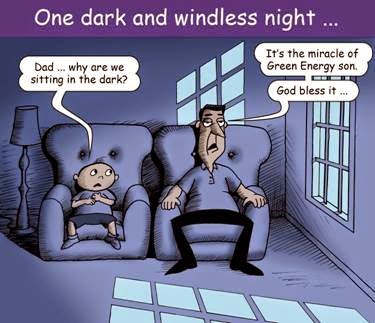
The Miracle of Green Energy – by Steve Hunter  www.stevehunterillustrations.com.au
Viv Forbes,17th July 2014

Community Opposition to Wind Farms Grows Because Wind Power is a Fraud

lies

As community and political opposition to the great wind power fraud rolls and builds across the world, the charge that opponents are red-necked climate change deniers, infected with a dose of Not In My Backyard syndrome, starts to ring hollow.

Surely that charge can’t stick to each and every one of the 1,000 who signed the petition against the Mt Emerald wind farm proposal in Far North QLD – and the 92% of locals there who are bitterly opposed to it (see our post here)?

The same level of opposition arises at the local level – wherever wind power outfits are seeking to spear turbines into closely settled agricultural communities (see our post here).

Communities across the Southern Tablelands of NSW, locals are up in arms at efforts by wind farm outfits and the NSW Planning Department to sack and stack “community consultation committees” to ensure their development applications don’t face any real scrutiny. At Rye Park, 91% of locals are opposed to the wind farm being pitched by Epuron (see our post here). And communities like Tarago have erupted in anger at plans to destroy their lives and livelihoods (see our post here).

A little while back, the usual response from those opposed to wind farms was along the lines of: “we’re all in favour of renewable energy, so long as wind farms are built in the right place”.

But that was before people understood the phenomenal cost of the subsidies directed at wind power through the mandatory RET (see our post here) – and the impact on retail power prices (see our post here).

Fair minded country people are usually ready to give others the benefit of the doubt; and, not used to being lied to, accepted arguments pitched by wind power outfits about the “merits” of wind power: guff like “this wind farm will power 100,000 homes and save 10 million tonnes of CO2 emissions” (see our post here).

Not anymore.

Apart from the very few farmers that stand to profit by hosting turbines, rural communities have woken up to the fact that wind power – which can only ever be delivered at crazy, random intervals – is meaningless as a power source because it cannot and will never replace on-demand sources, such as hydro, gas and coal. And, as a consequence, that wind power cannot and will never reduce CO2 emissions in the electricity sector. The wind industry has never produced a shred of actual evidence to show it has; and the evidence that has been gathered shows intermittent wind power causing CO2 emissions to increase, not decrease (see this European paper here; this Irish paper here; this English paper here; and this Dutch study here).

The realisation that the wind industry is built on series of unsustainable fictions has local communities angrier than ever and helps explain the remarkable numbers opposed: 90% is what’s fairly called a solid “majority” in anybody’s book.

This extract from the Mt Emerald survey captures some of the changing mood and the reasons for it.

Mt emerald survey2

These days, locals fighting wind power outfits are quick to challenge the wild and unsubstantiated environmental benefits touted by the developers; and will launch into them about the massive subsidies (ie the mandatory RET and the REC Tax) upon which the whole rort depends.

And it’s not because these people are “anti-environment” – it’s simply because they’ve woken up to the fact that wind power is pointless: both as a power source; and as a solution to CO2 emissions reduction. Here’s the Business Report with a take on the same tale from Britain and Europe.

Opposing wind generators is not anti-green
Business Report
Keith Bryer
8 August 2014

The intolerance of dissenting views by the Green Lobby is an unpleasant aspect of some of its members. They are perhaps unaware that tolerance of difference is a pillar of democracy and essential to individual freedom. But, whatever the reasons for vitriolic attacks on those against wind generators, environmentalists should take a closer look at Scottish opposition.

The most prominent in Scotland is the Windfarm Action Group. This group firmly states that everyone should take environmental responsibilities seriously. Whatever the causes of global warming and the varying views on what causes it, we must protect our earth and steward it wisely. It accepts a need to reduce carbon dioxide (CO2) emissions. It wants cleaner, reliable energy. It supports sound scientific solutions with the goal of a cleaner, greener world.

No sane, sensible person can disagree with this. Even the most rabid environmentalist should agree too.

But this green group and 300 others like in Britain, plus another 400 in four EU countries, are against windfarms. They have gone into the subject thoroughly and engineers and scientists back up their conclusions.

To those who accuse them of merely being concerned with their own backyards and not the common good, they say add up our membership and you will find an awful lot of backyards. They are simply against what does not make good sense. They are convinced that wind power:

– Is not a technically legitimate solution.

– Does not meaningfully reduce CO2 emissions.

– Is not a commercially viable source of energy

– Is not environmentally responsible.

They believe there are better solutions to Britain’s energy concerns; solutions that meet scientific, economic, and environmental tests – and they have good reasons.

They point to the massive subsidies that windfarms received initially from the British taxpayer, money that attracts multinational corporations like flies to treacle. These subsidies added to the higher price ordinary British householders pay for their electricity.

This “stealth” tax was considerable. Most consumers were unaware that it was used to make wind-generated economically feasible on the one hand, and to fill the pockets of the manufacturers on the other.

This largess allowed wind-generation companies to make generous payments to landowners for permission to use their land. Such was the temptation that some Welsh farmers trying to raise sheep in arduous and scarcely profitable areas leapt at it.

One told his local newspaper that if it were not for the payments he got, he would have given up farming long ago.

The Wind farm Action Group quotes British government documents that say each wind turbine in Britain still receives an annual subsidy of more than £235,000 (R4.3 million). Britain has about 1,120 turbines in 90 parts of the country.

Among the usual objections to windfarms – they do not work all the time, they are noisy, kill birds and bats, and so on, the group adds a few more. For example, wind generators interfere with radar; dirt and flying insects affect their performance; ice build-up on the propellers affects performance even more; and wind turbulence further reduces their power production.

Finally, there is rust. Britain is a wet place but offshore wind turbines have salt to contend with as well. One Danish offshore wind farm had to be entirely dismantled for repair when it was only 18 months old.

Yes, groups such as these exist almost everywhere there are windfarms. They are often, like this Scottish one, as caring of the environment as anyone, perhaps more so. They are not only concerned with their own backyard; they are concerned about everyone’s backyard.

Yet they say this: “We believe that in time this [windfarms] may well be the greatest environmental disaster that mankind in panic, haste, folly and greed, has ever conceived.”

Britain is an old country and its language is full of folk wisdom like this: “No one ever built a windmill, if he could build a watermill.”

A more modern version of common sense would be: “Using wind power to reduce carbon dioxide emissions is akin to trying to empty the Atlantic Ocean with a teaspoon.”
BusinessReport

The mythical claims of the wind industry and its parasites have all be hinged on a perverse notion of “green” is good. But just what being “green” means these days is a matter of politics, not reason, fact or beneficial environmental outcomes: it’s become little more than a political fashion statement.

Ben Acheson writes for the Huffington Post. He’s also the Energy and Environment Policy Adviser and Parliamentary Assistant to Struan Stevenson MEP at the European Parliament in Brussels. For a taste of Ben’s views on wind power – see our post here.

Here’s Ben taking a swipe at faux “green” politics:


Ineffective, Unreliable, Unaffordable, Wind Turbines!

LETTER: Wind turbines are a waste of time and money

The coalition has sanctioned the construction of Rampion, despite the overwhelming evidence that wind turbines are unreliable, grossly inefficient, inflict huge damage on the environment and wildlife, do not reduce greenhouse emissions one iota, and are, by a large margin, the most expensive means of generating electricity.

Thus, one could be forgiven for thinking the two headlines are linked.

Consider, as revealed by the company awarded the contract for the construction of the off-shore wind farm that, although the designed output is 700 megawatts (MW) because of the unreliability of wind turbines, the actual output will be no more than 240MW. Compare this with the output of a gas-fired generator, costing less than half the over £2bn for Rampion, which produces ten times as much electricity 100 per cent of the time.

Some years ago, Centricia, and other electricity-producing companies, made it absolutely clear to the government that, because of the unreliability of the wind, full back-up of conventional power stations is essential.

Therefore, greenhouse gas-emitting generating plants will have to remain permanently in service – thus, there is no point in building wind turbines.

Denmark, which has the greatest number of wind turbines per capita, has the most expensive power in Europe. I have yet to meet

a qualified electrical engineer who thinks the construction of wind turbines to power the national grid is a good idea.

Rampion will cover 60 square miles from Beachy Head to the Isle of Wight. The unreliability, comparatively short life, and huge cost of maintaining the turbines, means that it is only a question of time before Rampion is seen as one of the biggest scrap metal sites in the world.

France, where 80 per cent of electricity is produced by nuclear power, has the cheapest electricity in Europe. To satisfy the Green lobby, nuclear power stations in the UK should employ thorium as the fuel which is much safer than uranium. Nuclear bombs cannot be produced using thorium.

I do hope everyone reading this will write to their MP, county and district councillors, demanding the construction of all wind turbines, both on and off-shore, be halted immediately.

Ideally, those wind turbines already constructed should be dismantled.

Derek Hunnikin

St Leodegar’s Way

Hunston

Wind Pusher’s Conduct, Called Into Question!….Not acceptable!

MSP calls for wind farm developer code of conduct

The move comes after constituents raised concerns about the activities of one particular developer in trying to garner public support for its proposed wind farm.

Speaking from his constituency office, Mr Fergusson said: “As competition grows for wind farm sites, developers will be keener than ever to attract support from communities and individuals for their proposed developments.

“In doing so, it would seem that one company in particular has angered a large number of my constituents by negotiating secret agreements with individuals to ensure that they don’t object to the development in return for an undisclosed sum of money.

“This activity causes suspicion between neighbours, division within communities and is the polar opposite of the levels of openness and accountability that ought to characterize the local negotiations that precede any wind farm development.

“In my opinion, a code of practice for developers would ensure that all affected communities and individuals would be treated with respect as negotiations move forward and remove the atmosphere of distrust and suspicion that clearly exists in at least one particular local situation.

“I have written to the minister to suggest a code of practice, and will pursue the possibility through normal parliamentary processes.”

Earlier this year, 50 community councils from across the region called for a moratorium on consent for wind farms in the region, claiming a map produced by Scottish Natural Heritage shows southern Scotland has more onshore wind farm developments proposed than any other part of the country.