Ontario Government Climate Change Presentation Riddled With Mistakes (Town Hall Meeting in Guelph today)

More Lies & Propaganda, from the “Warmist Crowd”!

Donna Quixote's avatarQuixotes Last Stand

The Climate Change Discussion Paper public town hall in Guelph will be held from 6 — 8 p.m. March 18 at the University of Guelph Arboretum on College Avenue East.

Tom Harris — Guelph Mercury — March 17, 2015

On Wednesday, the Ontario Ministry of the Environment is leading a town-hall meeting in Guelph to gather public input on their Climate Change Discussion Paper 2015.

After attending a similar event in Ottawa, I write to alert Guelph residents to the many basic science mistakes to which you will soon be subjected.

Ministry of the Environment spokesperson Karen Clark set the tone by starting her talk in Ottawa by stating, “Scientists around the world agree that climate change is happening,” a statement as meaningful as “water is wet.”

Carleton University earth sciences professor Tim Patterson explains, “It’s obvious that climate is and always has been variable. In fact, the only constant…

View original post 261 more words

What is The Purpose Of This Scam?

The biggest scam ever perpetrated? It’s WORLDWIDE!

Tony Heller's avatarReal Climate Science

Huge amounts of money, energy, effort and coordination are being spent on the global warming scam in the US. There is no scientific or policy end game to it, because the US doesn’t have much, if any, control over atmospheric CO2 levels. That is in Asia’s hands.

The only explanation is a power grab. They are creating an army of brownshirts (like Hope) who will back anything the regime does to retain power, and thus “save the planet.”

“Those who can make you believe absurdities, can make you commit atrocities.”

― Voltaire

View original post

Australians Falling Prey, to United Nations, Agenda 21?

Posted: 17 Mar 2015

Graham Williamson

Control of Australia’s environmental policies, including climate change, AG21 and sustainability is increasingly being exported to foreign countries, especially through the UN. Since this is all part of globalisation however, control of other policies, even including our human rights, is also being exported to the UN.

This exporting of control typically occurs gradually and involves various stages. Firstly, our government, on our behalf, signs various international treaties or agreements, which the instigators always rush to say are ‘soft law’ and ‘non-binding’. In reality however, although having no basis in law (and no justification democratically), our politicians, in their eagerness to invite the UN to interfere in Australian domestic affairs, effectively get around the law and democratic impediments by using the following means of ‘enforcement’.
  • International moral obligations and economic, or market mechanisms
  • Building reporting requirements and need for compliance reports into the agreement – Australia has agreed to send regular compliance reports to the UN to prove compliance with UN directives, not only in regard to AG21, but also human rights.
In reality there are many non-legal mechanisms to ensure compliance. These international agreements are however only the first step in a gradual process.
The next step in the process is to incorporate the UN’s directives into domestic laws. This process is ongoing, but already it is well advanced with hundreds of UN directives incorporated into local laws.
The end game in this process, is to incorporate UN requirements into enforceable international laws.  This process is intended to be accelerated in Paris this year.
The point must be made abundantly clear, that those who have been actively involved in this process, or those whose philosophy or ideology supports an abandonment of national sovereignty and democracy in support of globalisation, can be expected to strongly defend these changes.
For instance, In a personal communication Greg Hunt advised me that AG21 is a ‘non-binding’ international agreement which is therefore irrelevant. Similarly, Tim Wilson recently advised me, in regard to the exporting of control of human rights to the UN:

“UN treaties have no binding power. They are only binding to the extent that they are incorporated into Australian law. If it is not in law, it has no legal standing.”

The statements of both Greg and Tim are notable not for what they actually said, but rather for what they chose to exclude.
Greg of course, being both a politician and a lawyer, as well as having a background in the UN, is well aware of the international mechanisms which are used to ensure compliance with UN agreements. He is also aware that increasingly, Australian domestic legislation is based upon the dictates of the UN. He must also be aware that for two decades his political colleagues have been compiling expensive compliance reports to convince the UN we are complying with their requirements. And although he claimed the Commonwealth has nothing to do with local Councils, he must also be aware the Commonwealth has been funding AG21 implementation by Councils and has even produced a Local AG21 instruction manual.
Although he is aware of these facts he chose to exclude all this information when questioned. (bold added)
As noted above, Tim also tried to dismiss concerns about the UN controlling human rights on the basis that UN human rights agreements are non-binding. Like Greg though, Tim chose to exclude many pertinent facts from his answer.
But even as Tim was answering, the HRC has  submitted a report to the UN alleging a violation of the UN Convention against Torture by the Australian government. Although this referral to the UN, and the response of the UN, are claimed by Tim to be irrelevant and inconsequential, Australia has been criticised by the UN for an alleged breach of the convention. Even worse though, the HRC also recommended, in their submission:

That the government ensure domestic implementation of Australia’s international human rights obligations in law, policy and practice

So as Tim, a human rights Commissioner with the HRC, says there is no need to worry, UN human rights agreements are non-binding, at exactly the same time the HRC is lobbying the government to ensure UN human rights provisions are made even more enforceable by being enshrined into Australian law. Interestingly, according to Article 29(3) of the UN Declaration of Human Rights:

These rights and freedoms may in no case be exercised contrary to the purposes and principles of the United Nations.”

This is just one of the UN controlled human rights that the HRC is seeking to further enforce upon Australians, but when I questioned Tim to see if this is one of the ‘rights’ he supports for all Australians, he declined to answer.
One of the main human rights Australians need to protect our democracy is the right to make an informed vote for genuine alternatives. But the right to make a democratic vote, which includes the right to be correctly informed and the right to choose from genuine alternatives, is NOT protected in the Constitution. Clearly, a vote for bipartisan collusion, or a vote made in ignorance of the true covert agenda, is not a democratic vote. This right to make a democratic vote should surely receive top priority for Constitutional reform, but it seems it is not even part of the HRC’s agenda.
Interestingly, Tim Wilson would also be aware that, rather than consolidate our human rights as birthright or god given constitutionalised rights, the Australian government announced in 2010 that they will continue to export the control of the human rights of all Australians to the UN, requiring all legislation to be consistent with UN requirements. According to the Australian Human Rights Framework:

“Since its election, the Australian Government has acted to reinvigorate Australia’s engagement with the United Nations. We have issued a standing invitation to the UN to visit Australia to examine the protection of human rights here, sending a clear message that we are committed to our international  obligations and relationship with the United Nations. The Government is committed to restoring Australia’s reputation as a good international citizen……… 

The Government will introduce legislation requiring that each new Bill introduced into Parliament, and delegated legislation subject to disallowance, be accompanied by a statement which outlines its compatibility with the seven core UN human rights treaties to which Australia is a party.”

While this change was announced by the previous government, such changes are continuing, and are not reversed by successive governments. The general direction remains the same.
Interestingly, while the right to make an informed democratic vote is not part of the HRC’s agenda, recommended constitutional changes to support one particular race (aborigines) are part of the HRC report to government.
Now, as the OIC assumes the largest voting bloc in the UN, and attempts to control freedom of speech by outlawing criticism of Islam, we need to extremely vigilant  about who we are placing in charge of our human rights.
When fellow Australians, who we assume are on our side, glibly dismiss concerns by stating international agreements are non-binding, it is pertinent to request a more proactive response in support of Australia, and Australian values.
The direction in which Australia is going is perfectly clear. Australians deserve the truth, a genuine democratic choice. It is simply not the Aussie way to sell your friends and neighbours out behind their backs.
Any system built upon deception, disloyalty, and abandonment of democracy, will have dire consequences. (bold added)

Wind Energy Will NEVER Be Anything More than a Novelty Energy Source…

Wind Industry’s Bogus Claims about “Powering” Millions of Homes Scorched

lies

****

The hackneyed myth that wind power “powers” millions of homes with wonderful “free” wind energy is taking a beating around the globe (seeour post here).

The idea that a wholly weather dependent power generation source can ever be – as is touted endlessly by the wind industry and it parasites – an “alternative” to conventional generation is, of course, patent nonsense.

If there wasn’t already a complete power generation system built around on-demand sources, such as gas, coal, nuclear or hydro – then a country trying to run on wind power would – unless it was keen to revisit (or remain in) the stone age – inevitably need to build one (see our post here). So far, so insanely costly, and utterly pointless.

At STT the term “powering” means exactly what it says: that when someone – at any time of the day or night – in any and all of the thousands of homes claimed to be “powered” by wind power – flicks theswitch the lights go on or the kettle starts boiling.

The wind industry never qualifies its we’re “powering thousands of homes” mantra by saying what it really means: that wind power might be throwing a little illumination or sparking up the kettle in those homes every now and again – and that the rest of time their owners will be tapping into a system of generation that operates quite happily 24 x 7, rain, hail or shine – without which they’d be eating tins of cold baked beans, while sitting freezing (or boiling) in the dark.

Glenn R. Schleede spent more than 35 years dealing with energy related matters in the government and private sector in the US. He’s put pen to paper numerous times on energy policy, and hammered the patent nonsense that is the great wind power fraud, just once or twice.

In this piece from 2009, Glenn belts the wind farms are “powering millions of homes” myth clean over the long boundary for an easy 6 – although in the US, wind power outfits apparently use the term “homes served” instead of “powered”. But, whatever the moniker, the bogus claim just hasn’t got the legs to withstand even the mildest scrutiny.

False Claims about “homes served” by electricity from wind
Glenn Schleede
4 February 2009

Anyone using the phrase “homes served” to describe the potential output from one or more wind turbines is demonstrating that he or she (a) doesn’t understand the facts about wind turbines, (b) believes false claims from the wind industry, or (c) is trying to mislead their reader or listener.

False statements about “homes served” by wind turbines are not the only – and certainly not the most important – false claims regularly made by wind industry developers and lobbyists. But they are annoying when politicians, naïve reporters, and others adopt and regurgitate them.

The concept of “homes served”

The concept of “homes served” has long been used in the electric industry as a way to give some idea of the amount of electricity that would be produced by a proposed generating plant without using such terms as megawatt or kilowatt-hours that mean little to most people. The concept is always misleading since residential users of electricity (i.e., “homes served”) account for only 37% of all US electricity use. [i]

Claims about “homes served” by a proposed “wind farm” or other generating unit are usually based on a three step calculation. Specifically:

  • Start with an assumption (i.e., a guess) about the amount of electricity that would be produced annually by a “wind farm” or other generating unit, in kilowatt-hours (kWh) or megawatt-hours (MWh). [ii]
  • Use an estimate of the amount of electricity used annually (in kWh) by an average residential customer in the area or state where their “wind farm” is located. [iii]
  • Divide the assumed annual production of electricity by the estimated annual average residential electricity use.

Concept can be useful when talking about reliable generating units

While misleading, the concept, “homes served” has some validity when used to describe the output from a reliable, “dispatchable” electric generating unit; i.e., one that can be called upon to produce electricity whenever it is needed. Such generating units are the ones that are counted on by the electric industry to provide a reliable supply of electricity for customers every day, at all hours of the day, year around.

“Homes served” is NOT a valid concept when referring to wind turbines and “wind farms”

Using “homes served” when talking about wind turbines and “wind farms” is both false and misleading for several reasons; specifically:

  1. No homes are really served by wind . In fact, NO homes are served by wind energy because wind turbines produce electricity only when wind speeds are in the right speed range (see below). Homes using electricity from wind must always have some reliable energy source immediately available to provide electricity when there is insufficient wind unless the residents are content to have electricity only when the wind is blowing in the right speed range – a condition that few in America are willing to tolerate.
  2. Electricity from wind turbines is inherently intermittent, volatile, and unreliable. Wind turbines produce electricity only when the wind is blowing within the right speed range. Wind turbines typically start producing electricity at around 6 mph, reach rated capacity about 32 mph, and cut out about 56 mph. Unless a home owner has an expensive battery storage system, such volatile and unreliable output wouldn’t be suitable for lights, heating,computers, appliances, or many other purposes.
  3. Electricity from “wind farms” is seldom available when most needed by home users. Again, the output of wind turbines is dependent on wind conditions. Depending on the specific area, winds tend to be strongest at night in cold months. However, electricity demand in most areas of the US is heavily concentrated during daytime and early evening hours. Even worse, wind turbines cannot be counted on to produce at the time of peak electricity demand which often occurs on hot weekday late afternoons in July and August. At the time of peak electricity demand, wind turbine output may be in the range of 0% to 5% of rated capacity.
  4. The electricity produced by wind turbines is low in value compared to electricity from reliable generating units. That’s because it is inherently intermittent, volatile, unreliable, and not available when most needed – as described in paragraphs 2 and 3, above.
  5. Not all the electricity produced by a wind turbine actually reaches customers or serves a useful purpose. Some electricity is lost as it is moved over transmission and distribution lines that carry the electricity from generating units to homes, offices, stores, factories and other users. The amount of electricity that is lost depends on distance and condition of lines and transformers.“Line losses” are a significant issue for wind energy because huge, obtrusive wind turbines (often 40+ stories tall) and “wind farms” are not welcome near metropolitan areas that account for most electricity demand. Instead, they often are located distant from the areas where electricity is needed and require expensive transmission line capacity which they use inefficiently. (Ironically, the lucrative federal tax credits provided to “wind farm” owners are based on electricity produced, not the lesser amount that actually reaches customers and serves a useful purpose.)
  6. Claims of “homes served” by wind energy are additionally misleading because of the high true cost of electricity from wind turbines. Claims that the cost of electricity from wind turbines is “competitive” with the cost of electricity from traditional sources are false. Such claims typically do not include the cost of (a) the huge federal and state tax breaks available to “wind farm” owners, [iv] or (b) the cost of providing the generating capacity and generation that must always be immediately available to “back up” intermittent, unreliable wind turbine output and keep electric grids reliable and in balance.

Claims of “homes served” should always be challenged

Any use of the “homes served” assertion in connection with a “wind farm” should be challenged, whether the assertion is from a wind industry lobbyist, other wind energy advocate, political leader, other government official, or reporter. They should be required to explain each of their assumptions and calculations, and admit that industrial scale wind turbines are useless unless reliable generating units are immediately available to supply electricity when wind is not strong enough to produce significant electricity. Almost certainly, their assertions will be false.

What valid claim could wind industry officials make?

As explained above, wind industry developers, promoters, and lobbyists – and politicians and reporters – should never use the false and misleading “homes served” metric. In theory, they could justify an assertion that the estimated amount of electricity produced by a “wind farm” – once discounted for line losses which are likely to be in the range of 5% to 10% – may be roughly equal to the amount of electricity used annually by x homes – after doing a calculation such as that outlined earlier. However, as indicated above, even this assertion would be misleading because it ignores the fact that the output from wind turbines is intermittent, volatile, unreliable and unlikely to be available when electricity is most needed.

Other false and misleading claims about wind energy

As shown above, “homes served” are not the only or the most important false claim made about wind energy. Other false claims about wind energy include the following:

  • It is low or competitive in cost when, in fact, its cost is high when all true costs are counted.
  • It is environmentally benign when, in fact, it has significant adverse environmental, ecological, scenic, and property value impacts.
  • It avoids significant emissions that would otherwise be produced when, in fact, it avoids few.
  • It provides big job and economic benefits when, in fact, there are few such benefits.
  • Reduces US dependence on imported oil when, in fact, it does not.
  • Reduces the need for building reliable generating units in areas experiencing growth in peak electricity demand or needing to replace old generating units, when the opposite is true.

Such claims as these have been made often during the past decade or more by the wind industry and other wind advocates. Only during the past 3-4 years have these claims begun to be demonstrated as false and misleading. The facts about wind energy are beginning to show up in the media but, unfortunately, have yet to be understood by most political leaders and regulators.

Endnotes

[i] According to EIA data, the percentage of total electricity use accounted for by residential customers in 2007 varied from lows of 16.3% in DC and 16.7% in WY to 44.6% in AZ and 51.0% in FL – with a nation-wide average of 37%. http://www.eia.doe.gov/cneaf/electricity/esr/esr_sum.html

[ii] Assumptions about output from proposed “wind farms” start with the rated capacity of the wind turbine(s) in kWh, multiplied by the number of hours in a year (usually 8760) and multiplied by the wind turbine(s)’ assumed “capacity factor.” In fact, actual capacity factors can be known only on an after the fact basis. “Capacity factor” is calculated by dividing actual annual production in kWh by 8760 (hrs per year) times the rated capacity of the turbine(s) in kW.

[iii] Annual residential use of electricity varies widely. According to US EIA, average annual residential electricity use nationwide during 2007 averaged 11,232 kWh – varying from lows of 6,360 kWh in Maine and 6,960 in California to highs of 15,660 kWh in Alabama and 16,128 kWh in Tennessee. http://www.eia.doe.gov/cneaf/electricity/esr/esr_sum.html

[iv] Wind industry officials have indicated that just two federal tax breaks account for about 2/3rds of the economic value of a “wind farm.”

hitting a 6

Doctors in Ireland Expose Inadequate Noise Regulations!

Wind farm noise makes people sick,

say Irish doctors:

“change noise regulations

by ottawawindconcerns


Here is a story from the Irish Examiner, fitting on St Patrick’s Day.

By Conall Ó Fátharta
Irish Examiner Reporter

Leading doctors have called on the Government to reduce the noise levels of wind turbines — which they claim are four times that recommended by World Health Organisation (WHO) guidelines.

The Irish Doctors’ Environmental Association also said the set-back distance of 500m is not enough, that it should be increased to at least 1,500m.

Visiting Research Professor at Queen’s University, Alun Evans and lead clinical consultant at Waterford Regional Hospital Prof Graham Roberts have both expressed concerns over the current noise levels and distance of turbines from homes.

Environment Minister Alan Kelly is currently reviewing the wind energy planning guidelines and the group is calling for both issues to be examined closely in the interest of public health.

The association has called for the introduction of a maximum noise level of 30 decibels as recommended by the WHO and for the set-back distance from inhabited houses to at least 1,500m from the current 500m.

Prof Evans said the construction of wind turbines in Ireland “is being sanctioned too close to human habitation”.

Because of its impulsive, intrusive, and sometimes incessant nature, the noise generated by wind turbines is particularly likely to disturb sleep,” he said.

“The young and the elderly are particularly at risk. Children who are sleep-deprived are more likely to become obese, predisposing them to diabetes and heart disease in adulthood. As memory is reinforced during sleep, they also exhibit impaired learning.”

Prof Evans said adults who are sleep-deprived are at risk of a ranges of diseases, particularly “heart attacks, heart failure, and stroke, and to cognitive dysfunction and mental problems”.

Prof Evans, attached to the Centre for Public Health at Queen’s, said the Government should exercise a duty of care towards its citizens and exercise the ‘precautionary principle’ which is enshrined in the Lisbon Treaty.

“It can achieve this by raising turbine set-back to at least 1500m, in accordance with a growing international consensus,” said Prof Evans.

In a statement, the Department of the Environment said that in December 2013 it published draft revisions to the noise, set-back distance, and shadow-flicker aspects of the 2006 Wind Energy Development Guidelines.

These draft revisions proposed: 1. The setting of a more stringent day and night noise limit of 40 decibels for future wind energy developments; 2. A mandatory minimum setback of 500m* between a wind turbine and the nearest dwelling for amenity considerations; 3. The complete elimination of shadow flicker between wind turbines and neighbouring dwellings.

A public consultation process was initiated on these proposed revisions to the guidelines, which ran until February 21, 2014.

“The department received submissions from 7,500 organisations and members of the public during this period. In this regard, account has to be taken of the extensive response to the public consultation in framing the final guidelines,” the department said in the statement.

“However, it is the department’s intention that the revisions to the 2006 Wind Energy Development Guidelines will be finalised in the near future and will address many of the issues raised in that bill.”

*Editor’s note: Ontario’s wind turbine noise regulations, which are based on geography and wind power lobby group instruction, not science, work out to 550 meter setbacks. Health Canada’s Wind Turbine Noise and Health study revealed that problems exist at 55 meters, with 25% of people exposed to the turbine noise and low frequency noise being distressed; 16.5% were distressed at 1 km. The Health Canada research results suggest that a setback should be a minimum of 1300 meters, which means Ontario’s existing noise regulations are completely inadequate to protect health.

One Scam They Want Us To Forget

No Such Thing, as “Settled Science”….

Tony Heller's avatarReal Climate Science

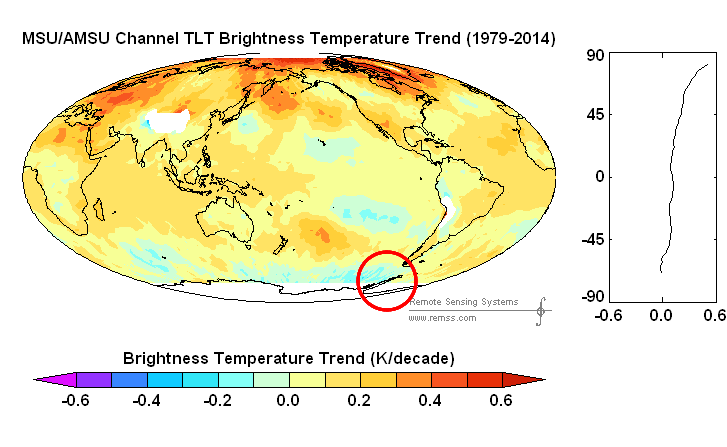
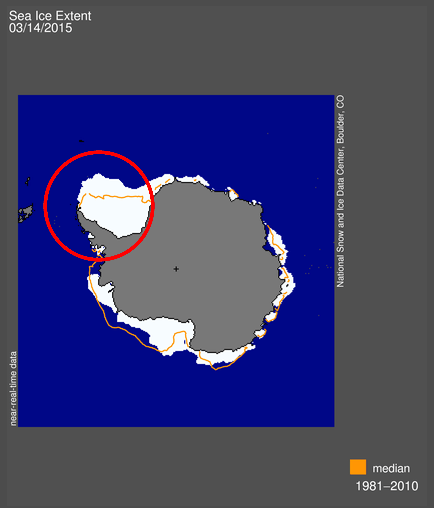
The climate scum spent years pimping the Antarctic Peninsula as the “fastest warming place on Earth” and telling us that a crack in the Larsen Ice Shelf meant doom for the planet.

Well, that region is actually the fastest cooling place on the planet and has seen peak sea ice gain. $29 billion in climate scam money buys an awful lot of lies from people pretending to be scientists.

ScreenHunter_7960 Mar. 16 07.06ScreenHunter_7959 Mar. 16 07.06

View original post