Useless, Unreliable, and DANGEROUS! Wind Turbines Self Destruct!

Berserk Warriors: it’s the Dane’s Turn to Take Cover as (Yet) Another Turbine Self-Destructs

turbine-collapse-germany1

Remember all those stories about wind turbines lasting for 25 years – without so much as the need for an oil-change – and being “safe as houses”?

Well, as STT followers well-know those ‘stories’ are unraveling at a rocketing rate – with giant fans collapsing in crumpled heaps;spontaneously combusting; and throwing blades to the four-winds – all over the world.

We’ve just about covered the Globe now, with “events” from Ireland (see our posts here and here); Scotland (see our posts here and here); Devon (see our post here); Nicaragua (see our post here)  – BrazilKansasPennsylvaniaGermany and Scotland – where turbines have been going berserk like Viking Warriors.

berserkers

Now – if you’re nowhere near these things, you’re probably finding these events a bit boring and our posts a little repetitive?

But – if you’re within a bulls’ roar of these pyrotechnic-50m-blade-chuckers – your anxiety and blood-pressure levels could be excused for being a little on the high side.

However, we figure that we’re bound to keep them coming – forewarned is forearmed.

So here’s another about a turbine going “berserk” – this time, in Denmark.

Blades fly off runaway wind turbine
The Local Denmark
16 January 2015

turbine collapse denmark2

The blades and gearbox have been spun off a wind turbine in western Jutland after a malfunction allowed it to reach to dangerous speeds in high winds.

turbine collapse denmark 3

“There was a loud bang and then one of the blades span off, and shortly afterwards the the gearbox’s housing fell to the ground,” Henrik Nielsen, one of the officials at the scene, told Denmark’s TV Midvest. “The wings splintered, and fragments and smoke reached as far as 35 meters away from the turbine.”

No one was hurt due to a 100m safety zone which local police had enforced around the turbine ever since it first ran out of control on Thursday afternoon. Several turbine maintenance specialists had tried to bring the turbine under control, but in the end judged it too dangerous to approach.

turbine collapse denmark 4

“We cannot get close to it until the wind dies down,” Oluf Jakobsen, from the local Morsø municipality explained on Friday morning. “There’s nothing we can do but sit and wait for the outcome.”
The Local Denmark

Wind energy in Denmark : wind turbines in Holstebro , Westjutland

Little wonder then that the wind industry in Denmark has decided to bring in the bulldozers to flatten homes and whole villages (see our post here).

Creating vast-vacuums, devoid of all human life will, no doubt, help with their escalating public liability insurance premiums.

bulldozer-home

Wind Turbines Blow an Ill Wind Over Locals, First Study Shows!

by: GRAHAM LLOYD
From: The Australian
January 21, 2015

‘PEOPLE living near wind farms face a greater risk of suffering health complaints caused by the low-frequency noise generated by turbines, a groundbreaking study has found.

The study by acoustics expert Steven Cooper is the first in the world in which a wind turbine ­operator had fully co-operated and turned wind turbines off completely during the testing.

It opens the way for a full-scale medical trail that may resolve the contentious debate about the health impact of wind farms.

Funded by wind farm operator Pacific Hydro, the study was conducted at Cape Bridgewater in southwest Victoria where residents have long complained about headaches, chest pains and sleep loss but have been told it was all in their minds.

As part of the study, residents living between 650m and 1.6km of the wind turbines were asked to ­diarise what they were experiencing, including headaches, pressure in the head, ears or chest, ringing in the ears, heart racing or a sensation of heaviness.

Their observations were separated into noise, vibration and sensation using a one to five severity scale.

“The resident observations and identification of sensation indicates that the major source of complaint from the operation of the turbines would appear to be related to sensation rather than noise or vibration,” the report says.

“For some residents experiencing adverse sensation effects, the impact can be exacerbated by bending over rather than standing, with the effect in some cases being reported as extremely severe and lasting a few hours.”
Mr Cooper said it was the first time that sensation rather than audible noise had been used as an indicator of residents’ perception of nearby wind turbines.

The report found offending sound pressure was present at four distinct phases of turbine operation: starting, maximum power and changing load by more than 20 per cent either up or down.

Mr Cooper said the findings were consistent with research into health impacts from early model wind turbines conducted in the US more than 20 years ago.

The relationship between turbine operation and sensation demonstrated a “cause and effect”, something Pacific Hydro was not prepared to concede, he said.

Survey participant Sonja Crisp, 75, said the first time she experience discomfort from the wind turbines, “it was like a thump in the middle of the chest.

“It is an absolute relief, like an epiphany to have him (Mr Cooper) say I was not crazy (that) when I am doing the dishes I feel nausea and have to get out of the house.”

David Brooks, from Gullen Range near Goulburn, NSW, said health concerns from wind farm developments were not confined to Cape Bridgewater.

The findings should be used as the basis for a thorough health study of the impacts from low frequency noise, he said. “Until this is done, there should be a moratorium on further wind farm developments,” he said.

Pacific Hydro and Mr Cooper agree that more widespread testing is needed. Andrew Richards, executive manager external affairs at Pacific Hydro, said: “While we acknowledge the preliminary findings of this report, what they mean at this time is largely unclear.

“In our view, the results presented in the report do not demonstrate a correlation that leads to the conclusion that there is a causal link between the existence of ­infrasound frequencies and the ‘sensations’ experienced by the residents.” Mr Cooper said the findings had totally discounted the so-called “necebo” effect put forward by some public health ­officials, who said symptoms were the result of concerns about the possibility of experiencing them.

The Cape Bridgewater study included six residents over eight weeks in three houses.

One hearing-impaired participant had been able to identify with 100 per cent accuracy the performance of wind turbines despite not being able to see them.

Another Cape Bridgewater resident Jo Kermond said the findings had been “both disturbing and confirmation of the level of severity we were and are enduring while being ridiculed by our own community and society.”

Mr Cooper said residents’ threshold of sensations were experienced at narrow band sound pressure levels of four to five hertz at above 50 decibels.

The nominal audible threshold for frequencies of four to five hertz is more than 100 decibels. Mr ­Cooper said an earlier investi­gation into health impacts of wind farms by the South Australian EPA had been flawed by limiting the study to only one-third octave bands and not looking at narrow band analysis.
“By looking at high sensation and narrow band I have developed a methodology to undertake assessments using narrow band infrasound,” he said.
“We now have a basis on how to start the medical studies,”
Mr Cooper was not engaged to establish whether there was a link between wind turbine operation and health impacts, “but the findings of my work show there is something there,” he said.

Mr Cooper said Pacific Hydro should be commended for allowing the work to proceed.

“It is the first time ever in the world that a wind farm has co-­operated with a study including shutting down its operations completely,” he said.

Mr Cooper has coined the term Wind Turbine Signature as the basis of the narrow band infrasound components that are evident in other studies. He said the work at Cape Bridgewater had established a methodology that could be repeated very easily all over the world.

Pacific Hydro said it had conducted the study to see whether it could establish any link between certain wind conditions or sound levels at Cape Bridgewater and the concerns of the individuals involved in the study.

“Steven Cooper shows in his report, for the limited data set, that there is a trend line between discrete infrasound components of the blade pass frequency (and harmonics of the blade pass frequency) and the residents’ sensation observations, based on his narrow band analysis of the results,” Pacific Hydro said.

“However, we do not believe the data as it currently stands supports such a strong conclusion.”

The report has been sent to a range of stakeholders, including government departments, members of parliament, environmental organisations and health bodies.’

Danish Villages Bulldozed Because of Wind Turbines….Agenda 21

This Town is ‘coming like a Ghost Town: Wind Industry Buys Up & Bulldozes Whole Danish Villages

The Specials there, outlining Vesta’s ultimate plans for a town like yours.

If any further evidence was needed to show that the wind industry is the extension of the human-haters – who regard people, in the words of Greenpeace founder, Patrick Moore “as the enemies of the Earth, a cancer on the planet” – that, these days, try to pass themselves off as “greens” out to ‘save’ the planet, then look no further than Denmark.

Denmark is the home of the original eco-fascist profiteers – Vestas – thestruggling fan makerrun by by a band of crooks – that exhorted the world to “Act on (its parallel universe version of the) Facts” a while back: paying $millions to the Australian Greens and Trotskyite fronts like Getup! & Co – and pitching lies like the one about the noise from V112s being just like the noise from a fridge 500m away (see our post here).Tune your ears into your electric icebox for a few minutes and compare it with this:

Well, it seems, that on their home turf at least, the Vesta’s ‘fridge-noise-analogy’ isn’t cutting the mustard.

Having already been whacked with costly lawsuits from wind farm neighbours – in one case a court awarding Dkr 500,000 (A$93,439) in compensation for the substantial reduction in the value of the plaintiffs’ home, caused by incessant turbine noise (see our post here) – the Danish wind industry has resorted to the wholesale destruction of homes in order to carpet the country in even more of the things. So instead of this:

Wind energy in Denmark : wind turbines in Holstebro , Westjutland

It’s down to this:

bulldozer-home

Company’s extreme wind strategy: Towns today, turbines tomorrow
The Copenhagen Post
Philip Tees
16 January 2015

Swedish energy company Vattenfall is going to extreme lengths for the sake of its Danish windfarms – buying up whole villages in rural Denmark, razing them to the ground and replacing the buildings with wind turbines, Børsen reports.

Mette Korsager, who is responsible for Vattenfall’s onshore wind projects in Denmark, told the business newspaper that the strategy was to make it easier for the company to achieve the goal of installing 250 MW of wind turbines in Denmark by 2018-2019. “We typically buy up farms in bad condition and demolish the farmhouse,” she said.

“Recently we bought most of a village to make a windpark.”

Helps the region, according to Vattenfall

That village is Kølby in northern Jutland, and Vattenfall plans to acquire a total of 20 properties.

Korsager told Børsen the strategy served a number of purposes. “We solve the problem of unsellable properties in peripheral regions,” she said.

“We solve the problem of neighbours being critical of wind farms, and we make it easier to reach agreements about the installation of wind turbines at the municipalities because we go in and help them by developing problem areas.”
The Copenhagen Post

STT bets that you just can’t wait for the wind industry to get in there and “help your region” by flattening every home as far as the eye can see?

And what an admission from the perpetrators of this grand-scale human expulsion project?

Aren’t we forever being told how much everyone loves wind turbines and just can’t get enough of them?

Now, why on earth would there be any kind of “problem of neighbours being critical of wind farms”?

One theory pedalled by a former tobacco advertising guru is that opposition to the ‘joys’ of living with giant fans is only a problem among English speaking countries: the guru reckons that complaints like those heard from dozens of wind farms around Australia are a cooked-up phenomenon exclusive to the English speaking world – as pitched-up inthis piece of propaganda on ABC radio and parroted in this piece of eco-fascist drivel from ruin-economy (for a taste of what the Taiwanese – not the world’s strongest English speakers – think about giant fans, see our post here).

Curious that Danes should complain about precisely the same effects from the incessant low-frequency noise and infra-sound generated by giant fans that Vestas’ victims at Macarthur in Victoria do?  (see our post here)

Curious too, that Vestas and Siemens refused to be interviewed for the video?  Surely, here was a golden opportunity to toss up some more “wonderful facts” about their products?  But, we guess, it’s probably safer to keep your head below the parapet when you’re not in complete control of the final product.

The only contribution from Vestas was a pious eco-fascist guilt trip – laid on thicker than a whale omelette – that appears towards the end of the video.

When presented with FACTS about the very real human suffering caused by their fans (ie the daily acoustic misery lived by thousands of people globally, just like those in this video) these monsters fallback on the “threat” of man-made catastrophic global warming in an effort to justify it. And follow on with the utter fallacy that wind power will rid the world of CO2 gas – an odourless, colourless, beneficial trace gas, essential for life on earth (aka “plant food”).

For the purpose of simplifying the argument, STT is happy to concede that man-made CO2 emissions may cause an increase in atmospheric temperatures – whether or not modest increases in atmospheric temperature from present levels represents a threat to humans or the planet is another question again (see our post here).

The one, teensy, weensy problem with the wind industry’s “save the planet” pitch is that 100% of the capacity from intermittent and unreliable wind power has to be backed-up 100% of the time by fossil fuel generators running in the background and burning fuel ALL the time – and, therefore, increases CO2 emissions in the electricity sector.

But – the Danish wind industry with its mission to bulldoze homes and replace them, and the families that occupy them, with exploding pyrotechnic, sonic torture devices – in an astonishing admission of guilt – at least now recognises that humans and giant wind turbines are entirely INCOMPATIBLE.

The wind industry is alive to that FACT – and – wherever they’ve had to concede it – they quietly buy out their victims’ properties, bulldoze them (see our post here) and make damn sure they stitch up the unfortunate (homeless) family with bullet proof gag clauses (see our posts here andhere) – that their lawyers enforce with the zeal and vigour of the Old GDR’s Stasi (see our post here).

So, wind farm neighbours, next time you’re being hectored by the wind industry, its parasites and spruikers about the ‘wonders’ of wind power and told it’s “all in your head”; or being called “dick brains” by the ABC’ssmarmy little cutie-pie wind industry apologist, Annabel Crabb (as she did in a recent ABC radio wind industry propaganda broadcast) – flick them the link to this story.

The audio and transcript of Annabel’s “dick brain” outburst can be found on the ABC’s website here. However, to avoid the need to listen to (or trawl through reams of transcript of) almost an hour of tedious and nauseating ‘green’ group-think, we’ve extracted the relevant parts of the transcript, which is available here.

During the ABC’s little wind industry love-in, having called wind farm neighbours “dick brains”, that fabricate their complaints, Annabel – giggles on cue – and proudly tells us that: “I’m going to buy a property next to a wind farm, just to express the sincerity of my resolve”.

Now you can let her know that there are plenty up for grabs in Denmark; and quite a few up for grabs in Australia, but she’ll need to be quick before the Caterpillar D9s are fired-up and brought in to flatten them.

annabel crabb

Wind Turbines are a Scourge on any Community, and People are Becoming Aware!

Greenwich concerned about wind turbines

Greenwich Neighbors United is hosting an event to educate residents about proposed wind park and let them voice their concerns.
AARON KRAUSE
JAN 17, 2015

As members of the Greenwich community learn more about the proposed wind turbine park, they are voicing their concerns about its potential impact on this peaceful and tranquil community. The case is pending before the Ohio Power Siting Board (OPSB), docket #13-990-EL-BGN.

Kay VanScoy, a long-time resident of Greenwich who recently turned 100, said, “I think they will be too close to Greenwich. I’ve heard from big dairy farms that have turbines close to them that they have lost 20 percent of milk production because of them.”

Dean and Carol Sheldon, community members on Greenwich-Milan Townline Road, said, “We were impressed that the OPSB granted OMEGA the application for rehearing after reviewing the hundreds of comments filed by citizens and state and local officials. It would seem appropriate that an entire review of the Ohio Wind Farm siting criteria should be undertaken before a decision is made affecting submitted plans for the proposed Greenwich Wind Farm development.”

Other residents of the community, Heidi Johnson, and Tim Williams, voiced concerns about the impact on Greenwich.

Heidi said, “We have a geothermal heating/cooling system in our home, so we are not against alternative energy. Eight years ago we became interested in erecting a wind mill on our property. We had a company come and give us an estimate. The cost was going to be $25,000 and they told us that it would generate about $35 per month in electric. At that point, we realized that windpower was not a good investment in this area because the system would never pay for itself.

“We believe that putting 900 families within one-mile of a wind turbine is not a wise move. In Europe and Australia, they are moving wind turbines further and further away from private dwellings. Since wind turbines have been in these countries much longer than in the U.S., it seems that they have learned that placing them close to homes can cause problems for families.” Tim added, “If this project is pushed through, we as a community will be negatively impacted in many ways. Personally, there will be a negative visual impact which will ultimately lead to a larger and more destructive issue, the reduction of our property values.”

In addition, Ginnie Robson, life-long resident of Greenwich said, “In my mind I have been comparing the turbines coming to our area to the time before the indoor smoking ban was made law in Ohio in November of 2006. People’s choice to smoke directly infringed on non-smoker’s rights and health. Both sides of the issue were deeply affected but only one side had a choice. Again, the citizens neighboring the huge industrial complexes being created have no choice on a matter that will impact their health as well as their property values.”

The young, the old, life-long residents and those new to the area have great concerns about the proposed wind turbine development.

Greenwich Neighbors United is hosting an event on Feb. 22 to educate more citizens about the proposed wind park and provide an opportunity to voice their concerns. The event will be take place at South-Central (K-8) School, from 5 p.m. to 7 p.m.

Hey! Right here! We are all so worried about where our electricity is going to come from? A nuclear power plant, coal fired or oil fired power plants. A wind farm, a solar farm, a hydro electric dam, geothermal… If you are receiving your electrical power from the grid, a lot of power has been already wasted before it gets to your house. Wasted in heat loss. Come on! I can create a device that can power your house without being connected to the grid. Almost zero power lost in the form of heat. This device can be modified and put in an automobile. With an electric motor, drive non stop. You could drive an Abrams Tank and not have to worry about MPG. Or you could drive a riding lawnmower and not have to worry about MPG. It is not a battery where you are limited to hours or miles driven. But something you could pass on to your children. Oil is dropping in price pulling global currencies down with it. Rely on this, rely on that. Everything is going to work itself out. People it will not work itself out. We have rode power generation into the ground. We need a new way to power our future. I have found a few alternative ways to generate electricity. Combustion free, no external forces needed, green energy. A closet size device, that would fit INSIDE your home or automobile, no POWER GRID. I am not afraid to say I can build this. I have lost multiple jobs, because of greener pastures. I want to create jobs and forge a new future for life past my own. Where is this affirmative action committee?

Battle with an outside company that wants to degrade your standard of living. Or create a device that changes the game of how you receive electricity and power your OWN future. No need to rely on a wind farm, a nuclear power plant, coal, or oil.

Most People Are Becoming Aware of Wind Turbine’s Futility, and Inaffordability!

Wind Industry Keeps Losing ‘Hearts and Minds’: Community Opposition Rolls & Builds

1397574371-dublin-thousands-gather-to-protest-against-pylons-and-wind-turbines_4479876

Remember all the guff about everyone just “loving” wind farms: you know, the spin trotted out by wind industry spruikers – like the Clean Energy Council – in Mickey Mouse “surveys” that claim 150% of your compatriots just can’t wait to spear thousands of giant fans into YOUR slice of heaven (not theirs, of course).

As we’ve pointed out before, though, the answer you get depends very much on the question you ask (see our post here).

survey

And – funnily enough – it also depends on WHO you ask.

Sure enough, a gullible-green-voting-skinny-soy-latte-sipper from inner city Melbourne or Sydney is going to Tweet his support for wonderful ‘free’ wind power to Getup! – with exactly the same level of conscious ‘thought’ directed to the energy-end-game as when he’s madly re-Tweeting yet another 100 cat videos to his bearded-band of BFFs.

life organic

But ask anyone with a basic grip on reality – and the facts – and you tend to get a very different response.

Around the world, rural communities are fighting back hard against the great wind power fraud.

Wherever wind farms have appeared – or have been threatened – big numbers of locals take a set against the monsters being speared into their previously peaceful – and often idyllic – rural communities.

Their anger extends to the goons that lied their way to development approval – and the bent officials that rubber-stamped their applications and who, thereafter, help the operators ride roughshod over locals’ rights to live in and enjoy the peace and comfort of their own homes and properties (see our post here).

Australians are in there fighting hard – with the numbers solidly against wind power outfits that cause nothing more than community division and open hostility wherever they go (see our posts here and here and hereand here). In Australia, the wind industry, it’s parasites and spruikers have completely lost their grip on the ‘game’ (see our post here).

The Irish have already hit the streets to bring an end to the fraud: some 10,000 stormed Dublin back in April last year. The sense of anger inIreland – as elsewhere – is palpable (see our post here).

Rural Ontario is seething, with locals taking the law into their own hands – sabotaging turbines and construction equipment in order to defend their (once) peaceful and prosperous communities (see our post here).

And the Scots have joined in – tearing down MET masts in order to prevent wind power outfits from gaining a foothold and, thereafter, violating their right to live free from turbine terror (see our post here).

The back-lash against wind power outfits has been mirrored in the US – with communities rallying to shut down projects before they begin; and a raft of litigation launched by neighbours (see our post here) – as well as 23 Texan turbine hosts suing the wind farm outfit they contracted with for turbine noise impacts and loss of property value, etc (see our post here).

As community and political opposition to the great wind power fraud rolls and builds across the world, the charge that opponents are red-necked climate change deniers, infected with a dose of Not In My Backyard syndrome, starts to ring hollow.

Surely that charge can’t stick to each and every one of the 1,000 who signed the petition against the Mt Emerald wind farm proposal in Far North QLD – and the 92% of locals there who are bitterly opposed to it (see our post here)?

Mt Emerald Summary

The same level of opposition arises at the local level – wherever wind power outfits are seeking to spear turbines into closely settled agricultural communities (see our post here) – and extends to efforts that result in the destruction of pristine and fragile desert environments (seeour post here).

That includes dozens of communities across the Southern Tablelands of NSW, where locals are up in arms at efforts by wind farm outfits and the NSW Planning Department to sack and stack “community consultation committees” to ensure their development applications don’t face any real scrutiny (see our post here).

At Rye Park, 91% of locals are opposed to the wind farm Epuron plans to spear into their peaceful and prosperous farming community (see our post here).  And here’s the results of a survey carried out at a community meeting held there last year – taken by organisers to determine the level of support for wind power development in Boorowa, Yass, Rugby and Rye Park. After the speakers finished, the crowd delivered their responses to the survey to organisers: of the 104 in attendance, 88 people participated. The results were:

  • “I do not support wind power development in Boorowa, Yass, Rugby and Rye Park”: 80 votes (91%)
  • “I do support wind power development in Boorowa, Yass, Rugby and Rye Park”: 6 votes (7%)
  • “I am undecided about wind power development in Boorowa, Yass, Rugby and Rye Park”: 2 votes (2%).

No surprises there.

And communities like Tarago have erupted in anger at plans to destroy their lives and livelihoods (see our post here).

Australian farmers – who had signed up to host turbines based on the promise of a few thousand dollars a year per turbine – and, initially, sucked in by the lies pedalled by the hopeful wind power outfit concerned – have told the companies concerned to stick their fans where the sun don’t shine (see our post here).

A little while back, the usual response from those opposed to wind farms was along the lines of: “we’re all in favour of renewable energy, so long as wind farms are built in the right place”.

But that was before people understood the phenomenal cost of the subsidies directed at wind power through the mandatory LRET (see our post here) – and the impact on retail power prices (see our post here).

Fair minded country people are usually ready to give others the benefit of the doubt; and, not used to being lied to, accepted arguments pitched by wind power outfits about the “merits” of wind power: guff like “this wind farm will power 100,000 homes and save 10 million tonnes of CO2 emissions” (see our post here).

Not anymore.

Apart from the very few farmers that stand to profit by hosting turbines, rural communities have woken up to the fact that wind power – which can only ever be delivered at crazy, random intervals – is meaningless as a power source because it cannot and will never replace on-demand sources, such as hydro, gas and coal.

And, as a consequence, that wind power cannot and will never reduce CO2 emissions in the electricity sector. The wind industry has never produced a shred of actual evidence to show it has; and the evidence that has been gathered shows intermittent wind power causing CO2 emissions to increase, not decrease (see our post here; this European paper here; this Irish paper here; this English paper here; and this Dutch study here).

The realisation that the wind industry is built on series of unsustainable fictions has local communities angrier than ever and helps explain the remarkable numbers opposed: 90% is what’s fairly called a solid “majority” in anybody’s book.

The hostility that’s erupted among pro-community groups to the great wind power fraud is a world-wide phenomenon – with more than 2,000 groups doing their level best to bring an end to the greatestenvironmental and economic fraud of all time (see our post here).

And, for the wind industry and its parasites, the situation will only get worse from here. In our travels we’ve met plenty of people that started out in favour of wind power and turned against it.  But we’ve yet to meet anyone who started out opposed to wind power, who later became a supporter.  Funny about that.

turbine-2_3153749b

So, with that in mind, let’s have a look a little survey conducted where the right questions were asked of the right people, which gives a fair taste of the scale of the community backlash brewing in New Hampshire: of 353 residents (to whom surveys were sent) 41% are opposed to wind power plants; of the 226 that responded to the survey, 64% are dead-against.

Poll shows Groton voters oppose new wind plants
New Hampshire Union Leader
Dan Suefert
18 December 2014

GROTON — A master plan poll of town residents by the planning board shows most people in town are against adding more wind-energy plants.

According to planning board Chairman Steve Spafford, the board sent 353 mailings to all of the residents on the voting list, and received 226 of them back.

Of those, 89 people said they would approve more wind-energy plants, and 145 were opposed to the idea, Spafford said.

The town, which accepted the plans of Spanish wind-energy developer Iberdrola Renewables and allowed the Groton Wind Power Project, a 25-turbine, $120 million, 48-megawatt plant which went online in 2012, to be built.

In return, the town is given payments from the plant each year which were set at an amount that is roughly the town’s budget amount.

After some debate and legal questioning, the town accepted a proposal from EDP Renewables of Portugal this fall for a test tower on a local hill. Since then, EDP officials have announced that they will be filing an application for a $140 million, 15- to 25-turbine wind project called Spruce Ridge, which, if permitted by the state’s Site Evaluation Committee, would be built on land in five towns, including Groton.

The town is hoping to update its master plan in 2015, Spafford said, and needed to “get a sense of how people are feeling about new power projects, in this case wind projects.”

Earlier this month, the board mailed a survey to residents, asking, “Do you support more wind projects or oppose them?”

“We got a pretty strong response,” Spafford said. “We will likely add some wording on this for the master plan, and now we have something to tell the SEC when (EDP) files for this new project. according to our vote, the town is against more wind projects.”

EDP officials did not return requests for comment.

A local group opposing more wind power plants in the area, New Hampshire Wind Watch, said EDP should not ignore the vote.

“Industrial wind developers take notice, you are not wanted here,” said Wind Watch President Lori Lerner. “We have one huge turbine complex here already. One is one too many.”

“People live in this area because we don’t want to be urbanized. Now that the region has been ‘turbanized’ by (Groton Wind), residents in all towns in the region are coming together to fight this latest industrial scourge from EDP as the residents of Groton did so overwhelmingly (in the poll).”
New Hampshire Union Leader

turbine fire 3

If Supplying Clean, Dependable, Electricity, is the Problem, Wind is NOT the solution!

Greens clueless on energy
The Australian
Brendan Pearson
16 January 2015

DURING his formative years, the legendary 20th-century American journalist Walter Lippman spent a lot of time with revolutionaries, radical intellectuals and others with a weak grip on reality.

But Lippman soon grew tired of “dilettante rebels, he who would rather dream 10 dreams than realise one; he who so often mistakes a discussion in a cafe for an artistic movement, or a committee meeting for a social revolution”. It was, he complained, “a form of lazy thoughtlessness to suppose that something can be made of nothing; that the act of creation consists of breathing upon the void”.

It is a description that is apt for activists, the Greens and related vested interests who argue blithely that fossil fuels can and should be phased out in the next few decades. No thought of the practicality of the goal or consideration of the consequences. No evidence is presented on whether such a transition is possible, or at what cost, including to the world’s poorest people. Nothing is allowed to interrupt the addiction to the pleasures of intellectual condescension.

Certainly no reference is made to the lessons of recent history. Between 1990 and 2010, 1.7 billion people secured access to electricity for the first time. More than 1.27 billion people secured access to electricity powered by fossil fuels. By comparison, 65 million people secured access to electricity for the first time from renewable energy sources. Put another way, 19 gained access to energy from fossil fuels for every one person who secured access via renewable energy sources.

Now let’s consider the plausibility of the challenge. Within a generation, can non-fossil fuel sources provide reliable, affordable electricity to 1.3 billion people who have no access to energy and another two billion people who have only limited access, while also replacing the 82 per cent of global primary energy that is currently supplied by fossil fuels?

According to the International Energy Agency, non-fossil-fuel energy sources (nuclear, hydro and other renewables) accounted for 18 per cent of energy in 2013. Let’s test this proposition using the IEA’s most aggressive emissions reduction scenario, consistent with the goal of limiting the global increase in temperature to 2C. Even under this scenario, fossil fuels will still provide 59 per cent of primary energy in 2040.

In short, if campaigners get their wish and fossil fuels are phased out by 2040, the world will face an energy gap of at least 9.2 billion tonnes of oil equivalent. That is the equivalent of 147 countries with no energy.

To illustrate, an energy gap like that would mean that the 56 nations of Africa, the 44 nations of Latin America, the 12 nations of the Middle East and 35 nations in Asia, including China, would have to exist without energy.

It would be a neo-medieval existence for most of the world’s population — much lower life expectancy and much higher levels of infant mortality, poverty and abject misery.

If nuclear and hydropower are off limits — the Greens are hostile to both — the situation is even worse. You can add the US and Japan to the list of 147 countries with no access to energy.

It is a point that demonstrates the farcical nature of the anti-fossil-fuel movement’s central proposition.

But why can’t renewables fill the gap? Independent analysis has shown that replacing existing fossil fuel-powered electricity with solar power by 2030 would take 470 years at the current rate of deployment. To do so with wind energy would take 270 years and require 3,460,000 wind turbines. (Incidentally that would be good news for the coal sector — every offshore wind turbine uses 250 tonnes of coking coal in its manufacture.)

What’s more, back-up power storage would be necessary for when the sun didn’t shine and the wind didn’t blow. That would mean 4600 new hydro projects — 13 times the number of large dams operating globally today.

The simple reality is that fossil fuels will continue to be indispensable if the world is to meet rapidly growing energy demand.

The good news is that continued fossil fuel use and lower emissions are not mutually exclusive. In addition to good progress on carbon capture and storage, conventional technologies are slashing carbon dioxide emissions from coal-fired generation by as much as 50 per cent.

The bottom line is that all energy sources will be needed. To pretend otherwise is to substitute an ideological prejudice for empirical evidence. In Lippman’s words, it is simply “breathing upon the void”.

Brendan Pearson is chief executive of the Minerals Council of Australia.
The Australian

Not a bad little wrap-up there by Brendan, but his line “that all energy sources will be needed” – if taken to include wind power – represents the kind of wooly-headed thinking that got the great wind power fraud going in the first place.

The wind industry parades as an “alternative” energy source. Which begs the question: “alternative” to what?

When it comes to their demand for electricity, the power consumer has a couple of basic needs: when they hit the light switch they assume illumination will shortly follow and that when the kettle is kicked into gear it’ll be boiling soon thereafter. And the power consumer assumes that these – and similar actions in a household or business – will be open to them at any time of the night or day, every day of the year.

For conventional generators, delivering power on the basic terms outlined above is a doddle: delivering base-load power around the clock, rain, hail or shine is just good business. It’s what the customer wants and is prepared to pay for, so it makes good sense to deliver on-demand.

But for wind power generators it’s never about how much the customer wants or when they want it, it’s always and everywhere about the vagaries of the wind. When the wind speed increases to 25 m/s, turbines are automatically shut-off to protect the blades and bearings; and below 6-7 m/s turbines are incapable of producing any power at all.

The basic terms of the wind power “deal” break-down like this:

  • we (“the wind power generator”) will supply and you (“the hopeful punter at the end of the line”) will take every single watt we produce, whenever that might be;
  • except that this will occur less than 30% of the time; and, no, we can’t tell you when that might be – although it will probably be in the middle of the night when you don’t need it;
  • around 70% of the time – when the wind stops blowing altogether – we won’t be supplying anything at all;
  • in which event, it’s a case of “tough luck” sucker, you’re on your own, but you can try your luck with dreaded coal or gas-fired generators, they’re burning mountains of coal and gas anyway to cover our little daily output “hiccups” – so they’ll probably help you keep your homeand business running; and
  • the price for the pleasure of our chaotic, unpredictable power “supply” will be fixed for 25 years at 4 times the price charged by those “evil” fossil fuel generators.

It’s little wonder that – in the absence of fines and penalties that force retailers to sign up to take wind power (see our post here) and/or massive subsidies (see our post here) – no retailer would ever bother to purchase wind power on the standard “irresistible” terms above.

If you think we’re joking – or you’re suffering the kind of mental incapacity for which greentards are renowned – we’ll spell it out in pictures.

Here’s a little hard data from July and August last year for the entire Eastern Grid  – which covers every wind farm in Victoria, Tasmania and New South Wales, as well as including the 1,329 MW of installed capacity that comes from Australia’s “wind power capital” – South Australia. All of these wind farms are connected to the Eastern Grid and, back then, had a total installed capacity of 2,952 MW. Oh, and if our data looks a little fuzzy, click on the image, it will pop up in a new window, use your magnifier and it will look crystal clear.

JULY20

Entire Eastern Grid – 20 July 2014 – from 12 noon to 6.30pm (6.5hrs):

Total wind farm output: never more than 140 MW; generally less than 70 MW; collapsing to less than 20 MW for 2hrs.  (Note the collapse of over 600 MW between 4.30am and 3pm).

Output as a percentage of total installed wind farm capacity: 12 noon to 6.30pm – 4.7%, generally less than 2.3%, falling to 0.67%.

Total demand (average): 22,000 MW.

Contribution to total demand as a percentage: 12 noon to 6.30pm – never more than 0.64%, generally less than 0.32%, falling to 0.09%.

JULY21

Entire Eastern Grid – 21 July 2014 – from 11am to 8.30pm (9.5hrs):

Total wind farm output: never more than 120 MW; generally less than 60 MW; collapsing to less than 20 MW for 2hrs.  (Note the collapse of 580 MW between 3am and 3pm).

Output as a percentage of total installed wind farm capacity: 11am to 8.30pm – 4.1%, generally less than 2%, falling to 0.67%.

Total demand (average): 24,000 MW.

Contribution to total demand as a percentage: 11am to 8.30pm – never more than 0.5%, generally less than 0.25%, falling to 0.08%.

JULY22

Entire Eastern Grid – 22 July 2014 – from 3.30am to 6.30pm (15hrs):

Total wind farm output: never more than 140 MW; generally less than 70 MW; collapsing to less than 20 MW for 5hrs.

Output as a percentage of total installed wind farm capacity: 3.30am to 6.30pm – 4.7%, generally less than 2.3%, falling to 0.67%.

Total demand (average): 24,000 MW.

Contribution to total demand as a percentage: 3.30am to 6.30pm – never more than 0.58%, generally less than 0.29%, falling to 0.08%.

AUGUST2

Entire Eastern Grid – 2 August 2014 – from 4.30am to 9pm (16.5hrs):

Total wind farm output: never more than 165 MW; generally less than 140 MW; dropping to 80 MW.

Output as a percentage of total installed wind farm capacity: 4.30am to 9pm – 5.6%, generally less than 4.7%, falling to 2.7%.

Total demand (average): 22,000 MW.

Contribution to total demand as a percentage: 4.30am to 9pm – never more than 0.75%, generally less than 0.63%, falling to 0.36%.

Bear in mind that the 30 wind farms covered by the data above are spread over 4 States.

Eastern grid3

On the Eastern Grid Australia’s wind farms are spread from: Jamestown in the Mid-North, west to Cathedral Rocks on lower Eyre Peninsula and south to Millicent in South Australia; down to Cape Portland (Musselroe) and Woolnorth (Cape Grim) in Tasmania; all over Victoria; and right up to Cullerin on the New South Wales Tablelands.

Those wind farms have hundreds of fans spread out over a geographical expanse of 632,755 km². That’s an area which is 2.75 times the combined area of England (130,395 km²) Scotland (78,387 km²) and Wales (20,761 km²) of 229,543 km².

One of the wilder claims made by the wind industry is that if you erect thousands of giant fans over a large enough area wind power will produce base-load power and replace on-demand sources such as hydro, gas and coal: the “distributed network” myth.

Nowhere else in the world are so many interconnected wind farms spread over such a large geographical expanse. If there was a shred of substance to the distributed network myth, then it would be just jumping out of the pictures above, but – surprise, surprise – it just ain’t there.

When you have 2,952 MW of installed capacity – connected and spread over an area more than twice the size of Great Britain – producing less than 140 MW for hours on end – and, on plenty of occasions, less than half that figure – the idea that wind power is providing (or could ever provide) “base-load” power – or even power “on demand” – by having wind farms spread far and wide is pure, infantile nonsense.

For a solid debunking of that and other wind industry myths see our post here.

Oh, and if you think the data we’ve picked represents a few “unlucky” days for wind power generators see our posts here and here and hereand here and here and here.

On the FACTS laid out in the pictures above, STT is happy to go all out and say that in Australia wind power requires 100% of its capacity to be backed up 100% of the time by conventional generation sources.

Where the TOTAL output from all of the wind farms connected to the Eastern Grid was a derisory 20 MW (or 0.67% of installed capacity) for hours on end (see our post here), the 99.33% of wind power output that went AWOL for hours (at various times, 3 days straight) HAD to come from somewhere.

And that somewhere was from conventional generators; the vast bulk of which came from coal and gas plants, with the balance coming from hydro.

Now and again we get comments which query the comparative costs of wind power and conventional power. But there is simply NO comparison: the question is patent nonsense.

Conventional generation – is available 24 x 7 – ON DEMAND – and doesn’t depend on the weather – therefore, comfortably earning the tag “generation system”.

Wind power will NEVER be available on demand (can’t be stored) – is entirely dependent upon the weather – and is, therefore, not a generation “system” at all: “chaos” and “system” are words that come from completely different paddocks; and which mean completely different things.

If an economy started out with a power generation “system” that was entirely based upon the inherent chaos of wind power generation – in order for its people to enjoy a meaningful power supply (ie, one available around the clock and every day of the year) so as to live, thrive and survive – that economy would inevitably need to build an entire conventional power generation system based on coal, gas, hydro, geo-thermal or nuclear power – with enough capacity to supply 100% of the predictable needs of all power consumers in that economy.

In other words, if an economy with no power generation system at all built a “system” based on wind power alone, it would inevitably need to build a conventional generation system – capable of supplying every last MW of power used by homes, business and industry – of the kind enjoyed by first world economies, like Australia, in any event.

The pictures tell the story.

Rod-Stewart-Every-Picture

Why should anyone be exposed to the dangers of these machines?

Turbine safety concerns

Published: 16 Jan 2015 17:00

FOLLOWING the unexplained collapse of a wind turbine at a Northern Ireland windfarm last week, one local politician has raised concerns over safety at windfarms closer to home.

Turbine risks?

Dumfriesshire, Clydesdale and Tweeddale MP David Mundell is asking the Scottish Government, the Health & Safety Executive and Council Building Control to make them aware of the incident and asking if they are satisfied that all existing local developments are safe, with no likelihood of such a collapse.

Seven remaining wind turbines have been shut down at a wind farm near Fintona, County Tyrone, where a 100-metre high turbine collapsed last Friday night.

Mr Mundell has also expressed that new developments are being proposed with turbines closer to people’s homes and he has asked the Scottish Government and Council to confirm that minimum safe distances between housing and new Windfarms will be strictly enforced.

Mr Mundell said: “I was extremely concerned to learn about this incident at the Screggagh Windfarm in Co Tyronne. It is particularly troubling that there appears to be no obvious explanation such as very high winds at the time. The turbine involved is similar to many locally with a tower height of 60 metres, an 80 metres rotor diameter, and an overall base to blade tip height of 100 metres.

“I understand people in the area said the rotor blades were spinning out of control on the evening the turbine buckled. The sound of the failing mechanical structure was heard more than seven miles away and debris from the stricken turbine was scattered across the mountainside, with a large spike remaining impaled in the earth several hundred yards from the turbine site. I am pleased there were no injuries when the turbine collapsed.”

He added: “It’s now vitally important we get to the bottom of what happened and make sure there are no such incidents possible on local windfarms. That’s why I want to be clear that the Scottish Government, Health and Safety Executive and Building Control are all aware of this incident and the ongoing inquiry. I want to be reassured that all local turbines are completely safe and not in danger of collapse. We might not be so lucky next time to avoid injury or damage to property.

“I have been increasingly concerned about how close some proposed new developments are to people’s homes and this incident reinforces the need for regulation of that and for it to be enforced. So I am also raising those issues with the council and the Scottish Government. Of course, a better solution from my point of view would be to have no new windfarm developments locally at all.”

Local campaigner, Jerry Mulders added: “I share the concern that occasionally small mechanical equipment can fail.

“The concern I would have is with the developer promoting recreational and open areas for land on which windfarms are situated. I would be seeking reassurances from developers that windfarms are not open as recreational areas for things like horse riding as a safety precaution.”

– See more at: http://www.cumnockchronicle.com/news/roundup/articles/2015/01/16/521733-turbine-safety-concerns/#sthash.Zfm2OYG6.dpuf

We are being Misled by Many of the World’s Climate Scientists….Here’s Why!

Global Temperatures

January 18th, 2015 by Roy W. Spencer, Ph. D.

OR: Why I Should Have Been an Engineer Rather than a Climate Scientist

I’ve been inundated with requests this past week to comment on the NOAA and NASA reports that 2014 was the “hottest” year on record. Since I was busy with a Japan space agency meeting in Tokyo, it has been difficult for me to formulate a quick response.

Of course, I’ve addressed the “hottest year” claim before it ever came out, both here on October 21, and here on Dec. 4.

In the three decades I’ve been in the climate research business, it’s been clear that politics have been driving the global warming movement. I knew this from the politically-savvy scientists who helped organize the U.N.’s process for determining what to do about human-caused climate change. (The IPCC wasn’t formed to determine whether it exists or whether is was even a threat, that was a given.)

I will admit the science has always supported the view that slowly increasing carbon dioxide levels in the atmosphere from burning of fossil fuels should cause some warming, but the view that this would is any way be a bad thing for humans or for Nature has been a politically (and even religiously) driven urban legend.

I am embarrassed by the scientific community’s behavior on the subject. I went into science with the misguided belief that science provides answers. Too often, it doesn’t. Some physical problems are simply too difficult. Two scientists can examine the same data and come to exactly opposite conclusions about causation.

We still don’t understand what causes natural climate change to occur, so we simply assume it doesn’t exist. This despite abundant evidence that it was just as warm 1,000 and 2,000 years ago as it is today. Forty years ago, “climate change” necessarily implied natural causation; now it only implies human causation.

What changed? Not the science…our estimates of climate sensitivity are about the same as they were 40 years ago.

What changed is the politics. And not just among the politicians. At AMS or AGU scientific conferences, political correctness and advocacy are now just as pervasive as as they have become in journalism school. Many (mostly older) scientists no longer participate and many have even resigned in protest.

Science as a methodology for getting closer to the truth has been all but abandoned. It is now just one more tool to achieve political ends.

Reports that 2014 was the “hottest” year on record feed the insatiable appetite the public has for definitive, alarming headlines. It doesn’t matter that even in the thermometer record, 2014 wasn’t the warmest within the margin of error. Who wants to bother with “margin of error”? Journalists went into journalism so they wouldn’t have to deal with such technical mumbo-jumbo. I said this six weeks ago, as did others, but no one cares unless a mainstream news source stumbles upon it and is objective enough to report it.

In what universe does a temperature change that is too small for anyone to feel over a 50 year period become globally significant? Where we don’t know if the global average temperature is 58 or 59 or 60 deg. F, but we are sure that if it increases by 1 or 2 deg. F, that would be a catastrophe?

Where our only truly global temperature measurements, the satellites, are ignored because they don’t show a record warm year in 2014?

In what universe do the climate models built to guide energy policy are not even adjusted to reflect reality, when they over-forecast past warming by a factor of 2 or 3?

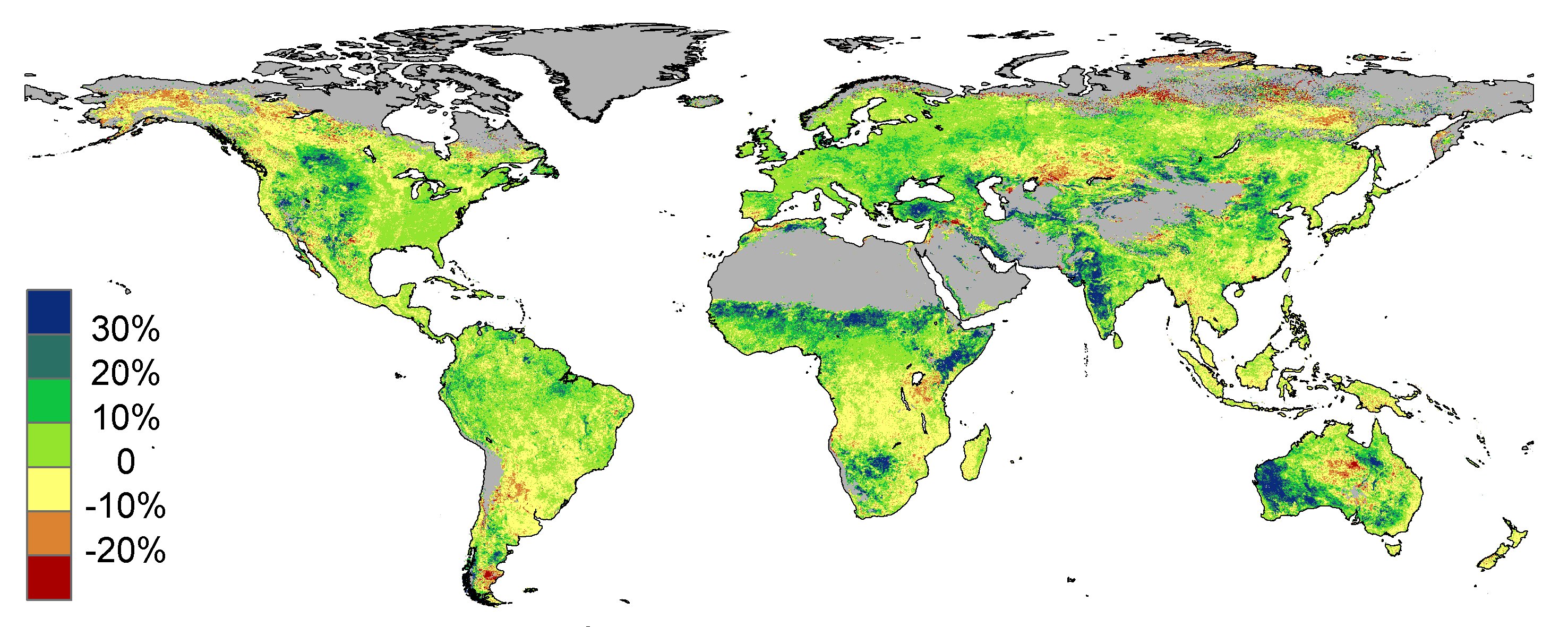
And where people have to lie about severe weather getting worse (it hasn’t)? Or where we have totally forgotten that more CO2 is actually good for life on Earth, leading to increased agricultural productivity, and global greening?:

Estimated changes in vegetative cover due to CO2 fertilization between 1982 and 2010 (Donohue et al., 2013 GRL).

It’s the universe where political power and the desire to redistribute wealth have taken control of the public discourse. It’s a global society where people believe we can replace fossil fuels with unicorn farts and antigravity-based energy.

Feelings now trump facts.

At least engineers have to prove their ideas work. The widgets and cell phonesand cars and jets and bridges they build either work or they don’t.

In climate science, whichever side is favored by politicians and journalism graduates is the side that wins.

And what about those 97% of scientists who agree? Well, what they all agree on is that if their government climate funding goes away, their careers will end.